
Galatians 2:4

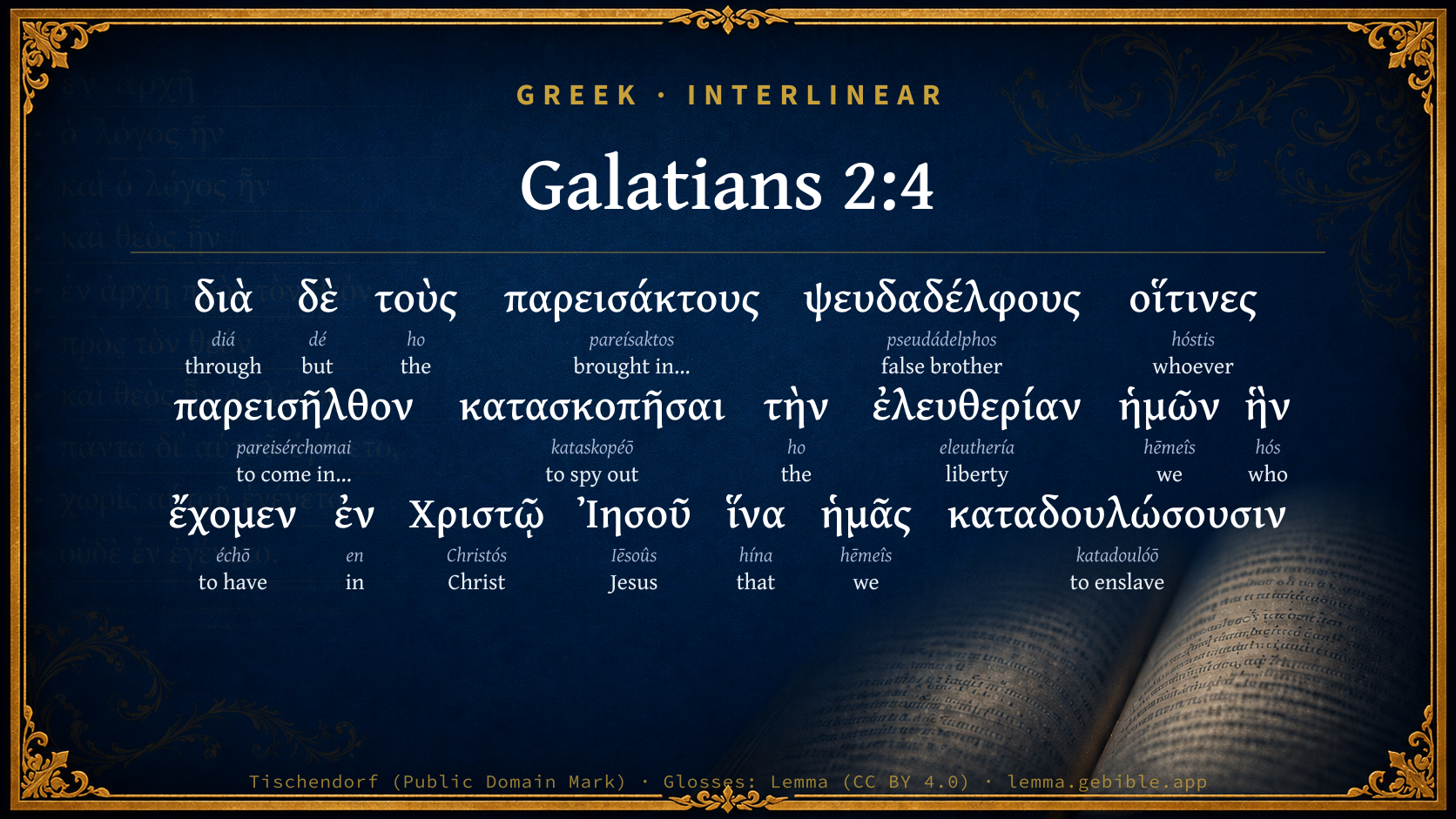
Greek (Tischendorf 8th ed.) Galatians 2:4 appears in the Greek New Testament. The text above is from the Tischendorf 8th edition. Each word links to its Strong’s number and a concise gloss. Click any word for its full Thayer’s Greek Lexicon entry.
Download image
Cite this verse

Galatians 2:4 (World English Bible). Public Domain. Lemma interlinear Bible study tool, https://lemma.gebible.app/v/galatians/2/4.

Show BibTeX & RIS
BibTeX
RIS
English Translation
This was because of the false brothers secretly brought in, who stole in to spy out our liberty which we have in Christ Jesus, that they might bring us into bondage;
World English Bible · Public Domain
Highlights
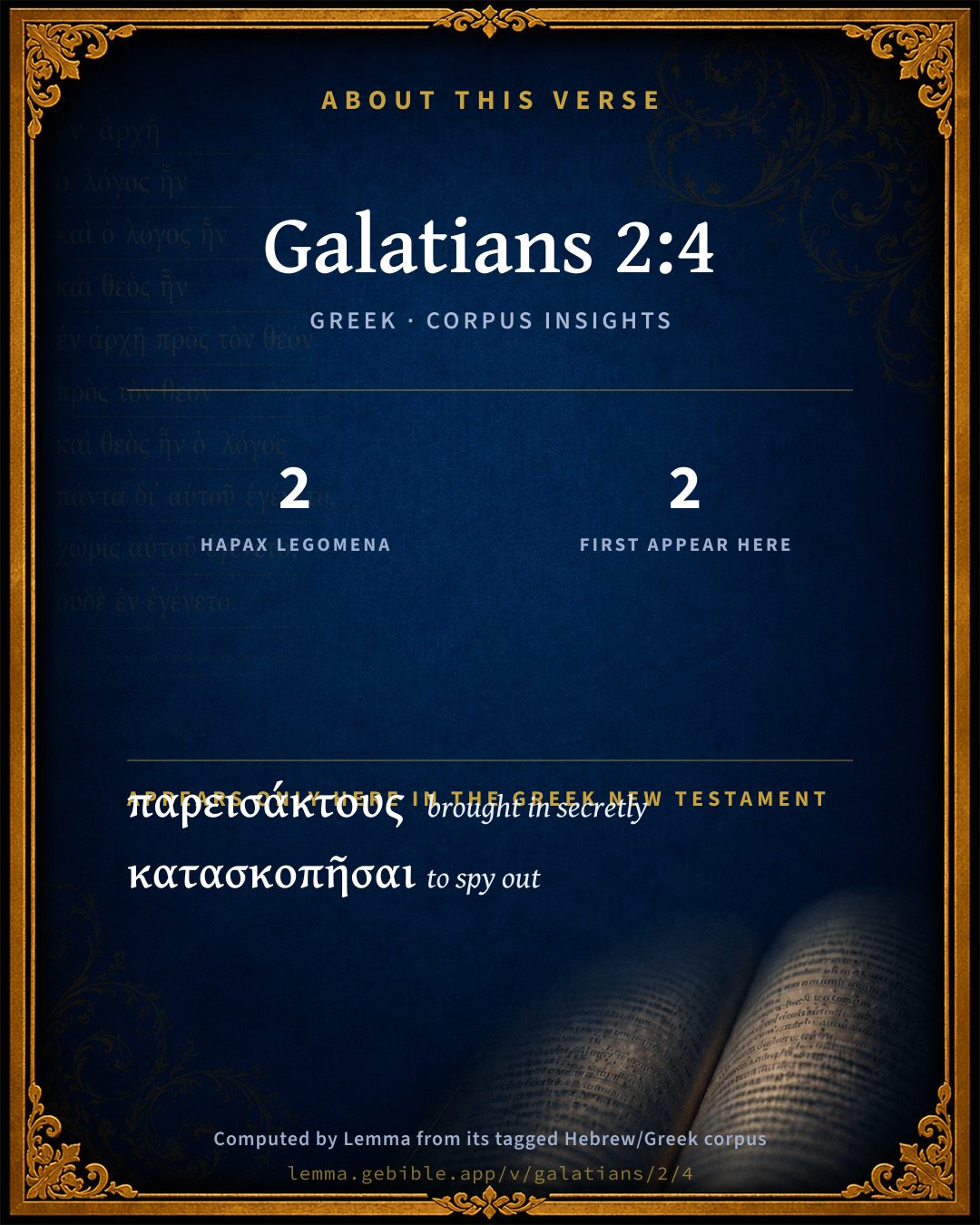
  • 2 hapax legomena — only here in the Greek New Testament
  • 2 first appearances in the Greek New Testament
Full analysis ↓
Download a study sheet

One document with this verse’s original text, its word-by-word gloss line, the meaning frame, cross-references with their text, attributed commentary, and full source and license credits — printable, and it pastes into notes with its structure intact.

This verse Autodidact and up

Study sheet (.html) Plain text (.txt)

A passage Seminary Student

Up to 50 verses in one chapter. A passage sheet keeps up to 6 commentary sources and 12 cross-references per verse, in the order this page ranks them, and says so on the sheet whenever that leaves anything out. Ask for a single verse and you get the Autodidact verse sheet above.

Everything on this page stays free to read, with no account — the sheet is a download of what is already on screen, not access to it.

Want to remove ads? Support Godless Engineer
Compare translations 3

The same verse in 3 English versions, stacked beneath the original-language interlinear above. Click any original word for its lexicon entry.

Each is an independent rendering of the whole verse — the interlinear is not word-aligned to these translations.

Highlighted words mark where these versions differ — a whole-verse word diff, not a word-by-word alignment.

  • World English Bible Public Domain
    This was because of the false brothers secretly brought in, who stole in to spy out our liberty which we have in Christ Jesus, that they might bring us into bondage;
  • King James Version Public Domain
    And that because of false brethren unawares brought in, who came in privily to spy out our liberty which we have in Christ Jesus, that they might bring us into bondage:
  • unfoldingWord Literal Text CC BY-SA 4.0
    But it was because of the secretly brought in false brothers, who came in secretly to spy on our freedom that we have in Christ Jesus so that they will enslave us,

unfoldingWord Literal Text — © unfoldingWord, licensed CC BY-SA 4.0. Word-aligned USFM3 via Door43 (git.door43.org/unfoldingWord/en_ult).

Versions to compare (up to 4)

3 of 4 selected

Show all 19 translations

Every available English version of this verse, each an independent rendering of the whole verse.

  • World English Bible Public Domain
    This was because of the false brothers secretly brought in, who stole in to spy out our liberty which we have in Christ Jesus, that they might bring us into bondage;
  • Berean Standard Bible Public Domain
    This issue arose because some false brothers had come in under false pretenses to spy on our freedom in Christ Jesus, in order to enslave us.
  • Majority Standard Bible Public Domain
    This issue arose because some false brothers had come in under false pretenses to spy on our freedom in Christ Jesus, in order to enslave us.
  • King James Version Public Domain
    And that because of false brethren unawares brought in, who came in privily to spy out our liberty which we have in Christ Jesus, that they might bring us into bondage:
  • American Standard Version (1901) Public Domain
    and that because of the false brethren privily brought in, who came in privily to spy out our liberty which we have in Christ Jesus, that they might bring us into bondage:
  • Revised Version (1885) Public Domain
    and that because of the false brethren privily brought in, who came in privily to spy out our liberty which we have in Christ Jesus, that they might bring us into bondage:
  • Geneva Bible (1599) Public Domain
    To wit, for the false brethren which were craftily sent in, and crept in priuily to spie out our libertie, which we haue in Christ Iesus, that they might bring vs into bondage.
  • Douay-Rheims (1899) Public Domain
    But because of false brethren unawares brought in, who came in privately to spy our liberty, which we have in Christ Jesus, that they might bring us into servitude.
  • Young's Literal Translation Public Domain
    and `that' because of the false brethren brought in unawares, who did come in privily to spy out our liberty that we have in Christ Jesus, that us they might bring under bondage,
  • Literal Standard Version CC BY-SA 4.0
    and [that] because of the false brothers brought in unaware, who came in secretly to spy out our liberty that we have in Christ Jesus, that they might bring us under bondage,
  • Unlocked Literal Bible CC BY-SA 4.0
    The false brothers came in secretly to spy on the liberty we have in Christ Jesus. They desired to make us slaves,
  • unfoldingWord Literal Text CC BY-SA 4.0
    But it was because of the secretly brought in false brothers, who came in secretly to spy on our freedom that we have in Christ Jesus so that they will enslave us,
  • Darby Bible Public Domain
    and [it was] on account of the false brethren brought in surreptitiously, who came in surreptitiously to spy out our liberty which we have in Christ Jesus, that they might bring us into bondage;
  • World Messianic Bible Public Domain
    This was because of the false brothers secretly brought in, who stole in to spy out our liberty which we have in Messiah Yeshua, that they might bring us into bondage,
  • Webster's Bible Public Domain
    And that because of false brethren unawares brought in, who came in privately to spy out our liberty which we have in Christ Jesus, that they might bring us into bondage:
  • Free Bible Version CC BY-SA 4.0
    (That issue only arose because some false Christians slipped in to spy on the freedom we have in Christ Jesus, trying to make us slaves.
  • Bible in Basic English Public Domain
    And that because of the false brothers let in secretly, who came searching out our free condition which we have in Christ Jesus, so that they might make servants of us;
  • Text-Critical English NT CC BY 4.0
    Now this matter arose because of the false brothers who were secretly brought in, who slipped in to spy on the freedom we have in Christ Jesus, so that they might enslave us.
  • Tyndale New Testament (1534) Public Domain
    and that because of incommers beynge falce brethren which came in amonge other to spye out oure libertie which we have in Christ Iesus that they might bringe vs into bondage.

Literal Standard Version (2020), Covenant Press — licensed CC BY-SA 4.0. Text via the HelloAO Bible API (eBible.org). Unlocked Literal Bible (unfoldingWord) — licensed CC BY-SA 4.0. Text via the HelloAO Bible API (eBible.org). unfoldingWord Literal Text — © unfoldingWord, licensed CC BY-SA 4.0. Word-aligned USFM3 via Door43 (git.door43.org/unfoldingWord/en_ult). Free Bible Version, Dr. Jonathan Gallagher — licensed CC BY-SA 4.0. Text via the HelloAO Bible API (eBible.org).

Word by word

More ways to search: Search by grammar → Find every occurrence → Compare this word →

Practice this passage: Drill this verse → Learn its vocabulary →

παρεισάκτους
pareísaktos
G3920
“brought in secretly”
Adjective, Accusative, Plural, Masculine
Part of Speech
Adjective
Case
Accusative
Number
Plural
Gender
Masculine
Full Thayer's Definition

Origin: from G3919

TDNT: 18:44,8

1. secretly or surreptitiously brought in 2. one who has stolen in
  1. διὰ diá G1223 “through” Preposition
  2. δὲ dé G1161 “but” Conjunction
  3. τοὺς ho G3588 “the” Article, Accusative, Plural, Masculine
  4. ψευδαδέλφους pseudádelphos G5569 “false brother” Noun, Accusative, Plural, Masculine
  5. οἵτινες hóstis G3748 “whoever” Relative pronoun, Nominative, Plural, Masculine
  6. παρεισῆλθον pareisérchomai G3922 “to come in secretly” Verb, Aorist, Active, Indicative, 3rd person, Plural
  7. κατασκοπῆσαι kataskopéō G2684 “to spy out” Verb, Aorist, Active, Infinitive
  8. τὴν ho G3588 “the” Article, Accusative, Singular, Feminine
  9. ἐλευθερίαν eleuthería G1657 “liberty” Noun, Accusative, Singular, Feminine
  10. ἡμῶν hēmeîs G2249 “we” Personal pronoun, 1st person, Genitive, Plural
  11. ἣν hós G3739 “who” Relative pronoun, Accusative, Singular, Feminine
  12. ἔχομεν échō G2192 “to have” Verb, Present, Active, Indicative, 1st person, Plural
  13. ἐν en G1722 “in” Preposition
  14. Χριστῷ Christós G5547 “Christ” Noun, Dative, Singular, Masculine
  15. Ἰησοῦ Iēsoûs G2424 “Jesus” Noun, Dative, Singular, Masculine
  16. ἵνα hína G2443 “that” Conjunction
  17. ἡμᾶς hēmeîs G2249 “we” Personal pronoun, 1st person, Accusative, Plural
  18. καταδουλώσουσιν katadoulóō G2615 “to enslave” Verb, Future, Active, Indicative, 3rd person, Plural

About this verse

These counts appear in no published source. They are computed here, from the morphology-tagged text and Lemma’s own curated glosses. What Lemma adds →

19
words
17
distinct lemmas
Pauline Epistles
section

Notable vocabulary

2 hapax legomena — words that appear only here in the entire Greek New Testament:

  • παρεισάκτους brought in secretly G3920
  • κατασκοπῆσαι to spy out G2684

First appearance in Scripture

These words make their first canonical appearance in the Greek New Testament here:

  • παρεισάκτους brought in secretly G3920
  • κατασκοπῆσαι to spy out G2684

Shared distinctive vocabulary

ψευδαδέλφους false brother G5569 occurs in 2 verses of the Greek New Testament. Also found in:
Repetition

Words recur within this verse:

Cross-references

26

Topical passages linked to Galatians 2:4 in the Treasury of Scripture Knowledge — connected by theme and wording, ordered by reader-vote popularity; previews shown in the World English Bible.

  • Galatians 5:1 Stand firm therefore in the liberty by which Christ has made us free, and don't be entangled again with a yoke of bondage.
  • Jude 1:4 For there are certain men who crept in secretly, even those who were long ago written about for this condemnation: ungodly men, turning the grace of our God into lasciviousness, and denying our only Master, God, and Lord, Jesus Christ.
  • 2 Corinthians 11:26 I have been in travels often, perils of rivers, perils of robbers, perils from my countrymen, perils from the Gentiles, perils in the city, perils in the wilderness, perils in the sea, perils among false brothers;
  • Galatians 5:12–13 I wish that those who disturb you would cut themselves off.
  • 2 Peter 2:1–2 But there also arose false prophets among the people, as among you also there will be false teachers, who will secretly bring in destructive heresies, denying even the Master who bought them, bringing on themselves swift destruction.
  • 1 John 4:1 Beloved, don't believe every spirit, but test the spirits, whether they are of God, because many false prophets have gone out into the world.
  • Galatians 4:3 So we also, when we were children, were held in bondage under the elements of the world.
  • Galatians 4:9–10 But now that you have come to know God, or rather to be known by God, why do you turn back again to the weak and miserable elements, to which you desire to be in bondage all over again?
  • 2 Peter 2:19 promising them liberty, while they themselves are bondservants of corruption; for by whom a man is overcome, by the same is he also brought into bondage.
  • Psalms 51:12 Restore to me the joy of your salvation. Uphold me with a willing spirit.
  • Psalms 119:45 I will walk in liberty, For I have sought your precepts.
  • Isaiah 51:23 and I will put it into the hand of those who afflict you, who have said to your soul, Bow down, that we may go over; and you have laid your back as the ground, and as the street, to those who go over.
  • John 8:31–36 Jesus therefore said to those Jews who had believed him, "If you remain in my word, then you are truly my disciples.
  • Acts 15:1 Some men came down from Judea and taught the brothers, "Unless you are circumcised after the custom of Moses, you can't be saved."
  • Acts 15:24 Because we have heard that some who went out from us have troubled you with words, unsettling your souls, saying, 'You must be circumcised and keep the law,' to whom we gave no commandment;
  • Acts 20:30 Men will arise from among your own selves, speaking perverse things, to draw away the disciples after them.
  • Romans 8:15 For you didn't receive the spirit of bondage again to fear, but you received the Spirit of adoption, by whom we cry, "Abba! Father!"
  • 2 Corinthians 3:17 Now the Lord is the Spirit and where the Spirit of the Lord is, there is liberty.
  • 2 Corinthians 11:17 That which I speak, I don't speak according to the Lord, but as in foolishness, in this confidence of boasting.
  • 2 Corinthians 11:20 For you bear with a man, if he brings you into bondage, if he devours you, if he takes you captive, if he exalts himself, if he strikes you on the face.
  • Galatians 3:23–26 But before faith came, we were kept in custody under the law, shut up to the faith which should afterwards be revealed.
  • Galatians 4:25 For this Hagar is Mount Sinai in Arabia, and answers to the Jerusalem that exists now, for she is in bondage with her children.
  • Galatians 5:10 I have confidence toward you in the Lord that you will think no other way. But he who troubles you will bear his judgment, whoever he is.
  • 2 Timothy 3:6 For of these are those who creep into houses, and take captive gullible women loaded down with sins, led away by various lusts,
  • 1 Peter 2:16 as free, and not using your freedom for a cloak of wickedness, but as bondservants of God.
  • 2 Corinthians 11:13 For such men are false apostles, deceitful workers, masquerading as Christ's apostles.

Cross-references courtesy of OpenBible.info (CC BY 4.0).

Commentary

Notes on Galatians 2:4 from classic Christian and Jewish commentators (each source and its license shown beneath its notes). The classic Christian expositions comment on the surrounding passage and are grouped to its opening verse, so a note may address several verses; the Jewish commentaries on the Tanakh (Rashi and others) are per-verse, so they appear only where the commentator wrote on this verse.

Lemma curates 59 commentaries, every one of them public domain or Creative Commons licensed, each selected and text-cleaned for this edition rather than reprinted as found. About our sources →

The Biblical Illustrator

Joseph S. Exell

Gal_2:4

And that because of false brethren.

False brethren

I. The Church of God when at its best has wicked men and hypocrites in it. In Adams family there was Cain; in Christs family, Judas; in the earliest Church, false brethren. The sheep may be sometimes without the fold; the wolves therein. A perfect Church is an impossible dream.

II. False brethren creep into the Church. Christ is the door of the Church, and His true sheep enter by Him-false brethren climb in another way. They creep in.

1. Hence they maintain a certain resemblance to the true.

2. Hence the precise origin of error cannot be detected. The time when the ship sinks we often observe, but the time when it first drew water we do not. (W. Perkins.)

Paul and the false brethren

I. A fierce opposition made by some erroneous Christians against a great apostle and a prime authority in the Church.

II. The cause of this opposition; the violent and unreasonable demands made to him to confirm the practice of a thing as necessary which in itself was not so.

III. The methods taken in this opposition: slandering Pauls doctrine, and detracting from his authority for withstanding their demands.

IV. The wholesome method of the apostle: not to give place in the least.

V. The end and design of the apostle: the preservation of the gospel in truth and purity. (R. South, D. D.)

The conference interrupted by false brethren:--

The interview took place, but not as Paul had desired and expected

He could not come to an understanding with the principal personages without the interference of others, whose presence could have been well dispensed with, and who came to spy out. They were suspicious; some plot was In process; they must be on their guard against novelties, and prevent any resolution being earned by which the Church might be compromised. The debate waxed warm, for these intruders made peremptory demands; the contest was protracted, tOT Paul hints that he had to withstand long and steadily; he boasts that he did not yield for an instant, which proves that the struggle was not over in a moment, and was not confined to an objection modestly made and easily removed. (E. Reuss, D. D.)

Spying

I. Hypocrites spy into the persons and lives of men that they may find some fault to disgrace them (Mat_7:4).

II. Sceptics pry into the Scriptures that they may discover discrepancies.

III. Hearers often spy out sermon and worship that they may find something to cavil at.

IV. Enemies spy out religion to find the easiest means of overthrowing it. Application: Devote the eye of your mind to a better use.

1. To your sins (Lam_3:40).

2. To your spiritual enemies. (W. Perkins.)

Moral Jesuits

I. Their character. False brethren.

II. Their methods.

1. Surreptitious invasion of privacy.

2. Indefatigable espionage.

III. Their objects.

1. To circumscribe Christian liberty.

2. To gain spiritual ascendency over the conscience.

3. To reduce to ritualistic bondage.

False brethren

I. Their character--they have the name and the form--but not the spirit of Christ--the spirit of liberty.

II. Their craft--they creep into the Church--by the wrong door--unawares, because disguised.

III. Their object--to spy out what they can--to do mischief. (J. Lyth.)

Liberty in Christ Jesus

Christianity is no provincialism; it is the worlds highway. (Jeremy Taylor.)

Christian liberty

Spiritual liberty consists in freedom from the curse of the moral law; from me servitude of the ritual; from the love, power, and guilt of sin; from the dominion of Satan; from the corruption of the world; from the fear of death and the wrath to come. (C. Buck.)

Liberty in Christ Jesus

In those ill times when there were slaves across the Atlantic, a lady went down to one of the ships, accompanied by her negro servant. The lady remarked to the captain that if she were to go to England and take this black woman with her, she would be free as soon as she landed. The captain replied, Madam, she is free already. The moment she came on board a British vessel she was free. When the negro woman knew this, do you think she went on shore with her mistress? By no means. She chose to keep her liberty. She was free on board and a slave on land. How slight the change of place; but how great the difference involved; marvel not that faith involves such great things. (C. H. Spurgeon.)

Christian liberty

I. Our liberty, which is in Christ Jesus, includes our freedom from the exactions and impositions of men in religion. Now observe, we say, in religion; because we do not here refer to civil things. No, my brethren, where religion is concerned, Jesus is the King in Zion. He is our Lawgiver.

II. We observe, Our liberty which we have in Christ Jesus, includes a freedom from the bondage of corruption. I was thinking, in my retirement this morning, what a number of tyrants does every sinner serve! What a tyrant is Satan! What a tyrant is the world!--they who have faith indeed overcome the world; but all others are overcome by it. What a tyrant is sin! He that committeth sin, says the apostle, is the servant of sin. Is he free who is under the dominion of pride and revenge and envy and malice? We are upholden by His free Spirit, and we can say with David, We will walk at liberty, for we seek Thy precepts.

III. We said, Our liberty which we have in Christ Jesus, includes a freedom from the condemnation of the law. The soul that sinneth it shall die.

IV. We said, Our liberty, which is in Christ Jesus, includes a freedom of access to God. He is the greatest and the best of Beings. In His presence is fulness of joy; at His right hand are pleasures for evermore.

V. We said, Our liberty which we have in Christ Jesus, is a freedom to partake Of and enjoy the good things of nature and Providence. We have thus endeavoured to exemplify our liberty which we have in Christ Jesus. How shall we improve it? The improvement will include four admonitions.

1. Stand fast in the liberty wherewith Christ hath made you free, and be not again entangled with the yoke of bondage.

2. Do not abuse your liberty. There is nothing too good to he abused. Beware of the Antinomian scheme--Oh, he is freed from the law; therefore he has nothing to do with it. But Paul had to do with it. Paul said, I delight in the law of the Lord after the inward man. Though he turned away from it as a covenant of works, he viewed it as a rule of life. Remember, your liberty is not a liberty to sin. There is another abuse of this liberty, that is, of placing all who profess Christianity upon the same level in society, as if, because we are all one in Christ Jesus (for so we are), that the rich and the poor, the master and the servant, the ruler and the ruled, were all the same, in a civil condition. God Himself maintains the gradations and distinctions of life, and the duties and obligations resulting from them; and I never knew any violation of these distinctions but it was attended with injury, not only with regard to those above, but even to those below their level.

3. Improve this liberty. In one sense you cannot; its provisions surpass all expression and conception. Eye hath not seen, nor ear heard, neither hath entered into the heart of man, the things which God hath prepared for them that love Him. But we mean we should make use of it and improve it.

4. Recommend this liberty to others; only see that you exemplify yourselves what you recommend, otherwise you may be more injurious than beneficial, as some are by their talking on religious subjects--otherwise you may draw forth the proverb, Physician, heal thyself; or the retort, Thou that teachest another, teachest thou not thyself? (W. Jay.)

Courage in defiance of Christian liberty

I. The liberty assailed. It was a liberty in Christ. This liberty meant being exempt from the requirements of the ceremonial law.

II. This liberty was threatened by false brethren. They were traitors.

III. This attempt upon the liberty of the Church was firmly and courageously resisted.

1. Paul firmly adhered to the truth of the gospel. Truth precise, unaccommodating, abandons nothing that belongs to itself, admits nothing that is inconsistent with it.--Bengel.

2. The refusal to submit was absolute. He would not give way by subjection, no, not for an hour. In things indifferent we may well, out of love, yield something of our liberty to the good of the weak. But where men would press these upon us as necessary to salvation, and our yielding would have the appearance of bringing the truth of the gospel into jeopardy, we should never yield.--Starke.

We may renounce our liberty for loves sake, but we must not let ourselves be robbed of it for the truth of the gospels sake. We must cling to that which is abiding. The law is something transient, the gospel is permanent. Lessons:

1. In the best state of the Christian Church, false brethren may creep in.

2. False brethren are the most dangerous enemies to liberty. Weak brethren disturb it; false brethren undermine and destroy it.

3. To preserve the truth should be the first duty of Christians. (R. Nicholls.)

False brethren

A Scotch Churchman was once reproached by a member of a small sect with the blots in the lives of many of his brethren of past days. He answered, When your chimney has smoked as long as ours there will be some soot in it. (Anthony Bathe.)

The Biblical Illustrator, edited by Joseph S. Exell (c. 1880s–1900s) — public domain. Text from a community e-Sword module.

Tyndale Open Study Notes

Tyndale Open Resources

2:4-5 The false Christians entered the church there (either Jerusalem or Antioch) to subvert Paul’s message that Gentiles are free from Jewish requirements such as circumcision.

2:4 By labeling some so-called believers as false, Paul denied that they were Christians at all. They did not understand or truly receive the Good News, in contrast with the apostles in Jerusalem (2:3). • were secretly brought in: Paul implies that a larger group of Jewish “Christians” opposed his preaching (cp. Acts 15:5) and stood behind the false teachers who entered the church. • Requiring Gentile Christians to observe Jewish law would enslave them to regulations (see Gal 3:23–4:11) and deny the Good News of Christ.

Tyndale Open Study Notes — © Tyndale Open Resources, licensed CC BY-SA 4.0. Text via the HelloAO Bible API.

Bengel's Gnomon

Johann Albrecht Bengel

Gal 2:4. Διὰ δὲ) But this matter concerning Titus happened on account of, etc.—δὲ, but [Engl. Vers. And that] is here a particle explanatory and intensive.—παρεισάκτους) παρὰ here and in παρεισῆλθον, denotes by the way, stealthily, underhand.—ψευδαδέλφους, false brethren) He had shown greater respect to those, who were professed Jews, as in the case of Timothy, Act 16:3.—οἵτινες, who) Comp. Act 15:1; Act 15:24.—κατασκοπῆσαι) to spy out, and destroy.

Bengel's Gnomon of the New Testament — English translation (T&T Clark, Edinburgh, 1860) — public domain. Text from a community e-Sword module.

Meyer's Critical & Exegetical Commentary

Heinrich August Wilhelm Meyer

f

Gal_2:4 f. The motive, why the demand of circumcision made as to Titus was not complied with by Paul, Barnabas, and Titus (comp. εἴξαμεν, Gal_2:5). It was refused on account of the false brethren, to whom concession would otherwise have been made in a way conducive to their designs against Christian freedom.

διὰ δὲ τοὺς παρεισάκτους ψευδαδέλφους] sc. οὐκ ἠναγκάσθη περιτμηθῆναι.[65] These words, however, are not, properly speaking, to be supplied; in διὰ δὲ τ. π. ψ. they receive their more precise definition, made specially prominent by ΔΈ, autem: on account, however, of the false brethren. Though Paul might have subjoined this immediately without δέ, he inserts the ΔΈ not superfluously (Jerome, Theodoret, Theophylact), but on account of the important bearing of the matter on his argument. The case is similar when a more precise definition is made prominent by ΔΈ, the same word being repeated, as in Gal_2:2. So, in substance, Theodore of Mopsuestia, Augustine, Camerarius, Erasmus, Castalio, Piscator, Bos, Calovius, Estius, Bengel, and others; more recently, Schott, Fritzsche, Baumgarten-Crusius, de Wette, Ellicott, Reithmayr; also Matthies, who, however, so explains the passage that we should rather expect it to run, ΔΙᾺ ΔῈ ΤῶΝ ΠΑΡΕΙΣΆΚΤΩΝ ΨΕΥΔΑΔΈΛΦΩΝ. On ΔΈ Bengel justly remarks, declarat et intendit, as in fact ΔΈ is often used by classical authors for giving prominence to an explanatory addition in which the previous verb is of course again understood (Klotz, ad Devar. p. 359). As to the matter itself, observe how Paul under other circumstances, where there was no dogmatic requirement of opponents brought into play, could bring himself to allow circumcision; see Act_16:3. Consequently after Gal_2:3 a comma only is to be placed, not a full stop, or even a colon (Lachmann, Tischendorf). Others, as Zachariae, Storr, Borger, Flatt, Hermann, Matthias, supply ἀνέβην, which, however, after Gal_2:3, could not possibly occur to the mind of a reader.[66] Rinck, Lucubr. crit. p. 170 f. (so previously Grotius, and recently Wieseler), assumes an anacoluthon,that οὐκ εἴξαμεν was intended to follow on ΔΙᾺ ΔῈ ΤΟῪς ΠΑΡΕΙΣΆΚΤ. ΨΕΥΔΑΔΈΛΦ., but that Paul had been led off by the long parenthesis and had then added ΟἿς. Buttmann, neut. Gr. p. 329 f., leaves the choice to be made between this view and ours. But if Paul had intended to write, on account of the false brethren we have not yielded, he would not in doing so have represented the false brethren as those to whom he had not yielded; by using οἷς he would thus have altered[67] the sense of what he had begun to say, and would simply have occasioned perplexity by the mixture of on account of and to whom. But there is no need to resort at all to an anacoluthon when, as here, what immediately precedes presents itself to complete the sense. This remark holds good also against Winer, p. 529 [E. T. 711], who (comp. Hilgenfeld) assumes that Paul mixed up the two thoughts: We did not have Titus circumcised on account of the false brethren; and, I might nowise yield to the false brethren. Hofmann (comp. his Schriftbew. II. 2, p. 46) also produces an unnecessary anacoluthic derangement of the sentence, by supposing that a new sentence begins with διὰ δὲ παρεισάκτ. ψευδ., but that the relative definition ΟἽΤΙΝΕς Κ.Τ.Λ. does not allow it to be completed; that, in fact, this completion does not take place at all, but with Gal_2:6 a new period is begun, attached to what immediately precedes. Following the example of Tertullian, c. Marc. v. 8, Ambrose, Pelagius, and Primasius (opposed by Jerome), Rückert, who is followed by Elwert, supplements the passage as follows: But on account of the false brethren I withal allowed Titus to be circumcised (consequently περιετμήθη). According to his view, this is the course of thought in the passage: Even Titus was at that time not forced to be circumcised; there was not, and could not be, any question of compulsion; but because I saw that there were false brethren, whose sole endeavour was to discover a vulnerable point in us, I considered it advisable to give them no occasion (?), and had Titus circumcised. Nevertheless, to yield out of obedience to them, and to acknowledge a necessity in respect to all Gentiles, never occurred to me for a moment, etc. Against this view it may be decisively urged, first, that in Gal_2:3 the emphasis is laid on Τίτος and not on ἨΝΑΓΚΆΣΘΗ, and in Gal_2:5 on ΠΡῸς ὭΡΑΝ and not on Τῇ ὙΠΟΤΑΓῇ; secondly, that the idea of acknowledging a necessity in respect to all Gentile Christians is not even hinted at by any word of Paul; and thirdly, the general consideration that a point so important and so debateable as the (alleged) permission of the circumcision of Titus would have been, would have needed, especially before the Galatians (comp. Gal_5:2), a very different elucidation and vindication from one so enigmatically involved, in which the chief ideas could only be read between the lines. But such a compliance itself shown towards false brethren,not for the sake, possibly, of some weak brethren, who are imported into the case by Elwert, nor on account of the Jews, as in the circumcision of Timothy (Act_16:3),would have been quite unprincipled and wrong. Very near to the interpretation of Rückert comes that of Reiche, who places the (supposed) circumcision of Titus not at the time then being and at Jerusalem, but at an earlier period, at which it took place either in Antioch or elsewhere: At vero … ut rem aliam hic interponam, Gal_2:3-6 (nam Gal_2:6 oratio ad apostolos redit), Titi nimirum circumcisionem, quam quis forte modo dictis Gal_2:2 opponat, quasi apostolorum aliorumve auctoritate vel jussu fecerim, aut ipse circumcisionem legisque observationem necessariam duxerim 6 f. parum mihi constans, sufficiat monuisse:nec Titus ille comes meus et adjutor, Graecus natus, minime est coactus circumcidi a me vel a quocunque; propter falsos autem fratres, qui tum nos speculabantur, quomodo immunitate a lege Mos. a Christo nobis parta uteremur, eo consilio, ut denuo nos sub legis servitium redigerent … propter hos dico Titus ritum hunc externum … suscepit volens, ut istis calumniandi nocendique ansa et materies praeripiatur, etc. But against this view may be urged partly the arguments already used against Rückert, and in addition the arbitrary procedure involved in shifting Gal_2:3-6 to an earlier time; although Τίτος ὁ σὺν ἑμοί, evidently referring back to ΣΥΜΠΑΡΑΛΑΒῺΝ ΚΑῚ ΤΊΤΟΝ in Gal_2:1, precludes our taking this event out of the course of the narrative begun in Gal_2:1. Moreover, ΠΕΡΙΕΤΜΉΘΗ as supplied by Reiche cannot be invested with the sense liber et volens circumcisionem suscepit,a sense which, for the very sake of the contrast, since the emphasis lies on liber et volens, would need to be expressed (by ἐθελοντὴν περιετμήθη or the like). Lastly, an un-Pauline compliance[68] would be the result of the sense which would follow from the omission of οἷς οὐδέ in Gal_2:5 (see the critical notes): But on account of the false brethren … I gave way momentarily and caused Titus to be circumcised, to which also the sentence of purpose which follows, ἽΝΑ Ἡ ἈΛΉΘΕΙΑ Κ.Τ.Λ., would be utterly unsuitable; for, according to the point of view of our epistle, the truth of the gospel could only continue with the Galatians if such a compliance did not take place.

παρεισάκτους] subintroductos (Vulgate), brought in by the side, that is, privily and illegitimately,namely, into the association of Christian brotherhood, of which they are not at all true members. See the note after Gal_2:5. The word does not occur elsewhere in ancient authors (Prol. Sir. in Biel, III. p. 43, and Schleusner, IV. p. 228, πρόλογος παρείσακτος ἀδήλου); but it must have been employed on several occasions, as ΠΑΡΕΊΣΑΚΤΟΝ is quoted by Hesychius, Photius, Suidas, and ΠΑΡΕΙΣΆΚΤΟΥς by Zonaras, being explained by ἈΛΛΌΤΡΙΟΝ and ἈΛΛΟΤΡΊΟΥς. The word has also been preserved as a name (by-name) in Strabo, xvii. 1, p. 794, Παρείσακτος ἐπικληθεὶς Πτολεμαῖος. The verb ΠΑΡΕΙΣΆΓΩ is very current in later authors (Plut. Mor. p. 328 D; Polyb. ii. 7. 8, vi. 56. 12; Diod. xii. 41; 2Pe_2:1). Comp. παρεισέδυσαν, Jud_1:4.

ΨΕΥΔΑΔΈΛΦΟΥς] as in 2Co_11:26, persons who were Christians indeed, but were not so according to the true nature of Christianityfrom the apostles standpoint, anti-Pauline, Judaizing reactionaries against Christian freedom. The article points out that these people were historically known to the readers, Act_15:1; Act_15:5.

οἵτινες κ.τ.λ.] quippe qui, contains the explanation as to the dangerous character of these persons, by which the διὰ δὲ τ. π. ψ. is justified.

ΠΑΡΕΙΣῆΛΘΟΝ] Comp. Lucian, Asin. 15, εἰ λύκος παρεισέλθοι; Polyb. ii. 55. 3. The idea of being smuggled in (which is denied by Hofmann) is here accordant with the context, and indicated purposely by the twice-repeated παρεις. Comp. generally on Rom_5:20, and see Chrysostom on our passage.

ΚΑΤΑΣΚΟΠῆΣΑΙ] in order to spy out, hostilely to reconnoitre, to watch. Comp. Jos_2:2-3; 2Sa_10:3; 1Ch_19:3; Eur. Hel. 1623; Polyb. 10:2; also κατάσκοπος, a spy.

ἥν ἔχομεν ἐν Χριστῷ Ἰησ.] a more precise definition of the preceding ἩΜῶΝ. Comp. Eph_2:4 et al. This freedom is, as may be gathered from the entire context, nothing else than the freedom from Mosaism (Rom_10:4) through justification by faith. Comp. Gal_3:13, Gal_5:1. Matthies introduces also the Christian life, but without warrant; the spying of the pseudo-Christians was directed to the point, whether and to what extent the Christians did not conform to the enactments of the Mosaic law. Ἐν Χριστῷ implies as its basis the solemn idea of the ἘΝ ΧΡΙΣΤῷ ΕἾΝΑΙ (Gal_5:6; 2Co_5:21; Eph_3:6, et al. Comp. Eph_1:7; Eph_3:12). Hence: in Christ, as our element of life by means of faith (comp. 2Co_3:17), as Christians.

ἵνα ἡμᾶς καταδουλώσουσιν[69]] is the dangerous design which they had in view in their κατασκοπῆσαι. Ἡμᾶς applies, as before, to the Christians as such, not merely to Paul and Titus (Winer, de Wette), or to Paul and the Gentile Christians (Baur); for it must be the wider category of those to whom, as the genus, the ὑμεῖς in Gal_2:5 belong as the species. We must also notice ΔΙΑΜΕΊΝῌ in Gal_2:5, which is correlative to the ἜΧΟΜΕΝ in Gal_2:4. The future after ἵνα indicates, that the false brethren expected their success to be certain and enduring. See Matthiae, p. 1186; Klotz, ad Devar. p. 683; Rost, ad Duncan. Lex. p. 870. In classical authors we find only ὅπως, ὄφρα, and μή thus construed, and not ἵνα, as Brunck, ad Eur. Bacch. 1380, supposed (Klotz, ad Devar. p. 629), but in the Hellenists and Fathers ἵνα also. Comp. Winer, p. 271 [E. T. 361]; Buttmann, neut. Gr. p. 202. ΚΑΤΆ strengthens the idea of the simple verb: to make us wholly slaves (of Mosaism), to enslave us. Comp. 2Co_11:20; Plat. Pol. i. p. 315 B, δουλοῦσθαι ἀδίκως καὶ καταδεδουλῶσθαι: Thuc. iii. 70. 2, and Duker in loc. The mode in which the apostle looks at these people does not confound the result with the intention (de Wette); it represents the latter correctly according to the fact (they desire to bind the Christians to the law), but in the form which it assumed from the Pauline point of view. Comp. Gal_6:12 f.

[65] To supply merely ἠναγκάσθη περιτμ. without οὐκ (Koppe), so that ἠναγκάσθη is to be understood in the altered sense, But on account of the false brethren, it was insisted on in his case, is entirely inadmissible, both on account of this very diversity of sense, and also because in ver. 3 the negation is essential and indeed the chief point.

[66] Olshausen takes a similar but still more harsh and arbitrary view, that the idea in Pauls mind was, I went indeed up to Jerusalem, in order to lay my gospel before the apostles (?) for examination; on account of these, however, it was really not at all necessary … but, on account of the false brethren, I found myself induced to take steps. In the ardour of his language, Paul had allowed himself to be diverted from the construction he had begun; and described instead the nature of the false teachers.

[67] Wieseler seeks to avoid this by taking διὰ δὲ τοὺς παρεισ. ψευδαδ. as equivalent to τῶν δὲ ψευδαδέλφων κελευόντων τοῦτο: with their demand Paul had not exhibited compliance. But διά means nothing else than on account of, that is, according to the context, with reference to them (comp. Act_16:3), namely, because they lurked in the background in the matter, and it was inexpedient to take account of their designs or to give them any free scope. Also in Heb_2:10; Heb_6:7, Joh_6:57, διά with the accus. is simply on account of, and has to receive its more precise meaning from the context. In the passages quoted by Wieseler (Xen. Cyr. v. 2. 35, and Plut. Cam. 35), διά, according to the well-known Greek usage, is for the sake of, that is, through merit or through fault of any one.

[68] Reiche seeks to evade this by thus explaining ver. 5 : quibus, quanquam prudentiae fuerit, propter eos Titum circumcidere, attamen ceterum, in rebus ad fidem libertatemque Christianam fere facientibus, ne paulisper quidem cessimus iis obtemperantes. We should thus have in ver. 5 a saving clause, the most essential point of which (ceterum, in rebus, etc.) would have to be mentally supplied.

[69] The Recepta, defended by Reiche, is καταδουλώσωνται. But B** F G, 17, Dam., have καταδουλώσωσιν; and A B* C D E א, min., καταδουλώσουσιν (so Lachmann, Scholz, Tischendorf). The middle (to which, moreover, Lucian, Soloec. 12, assigns an unfounded difference from the active) is accordingly abandoned unanimously by the best MSS., and is the more readily to be given up, because in this case the versions cannot come into consideration, and consequently the importance of the MSS. is all the greater. The middle being most familiar from the LXX. (Gen_47:21; Exo_1:14; Exo_6:5; Lev_25:46; Eze_29:18; the active, only in Jer_15:14; Jer_17:4; the Apocrypha has the middle only), intruded itself unsought. This much in opposition to Reiche, who derives the active from 2Co_11:20. Further, as καταδουλώσουσιν has the great preponderance of testimony, and was very easily liable to the alteration into the subjunctive usual after ἵνα, it is to be adopted (with Usteri, Schott, Wieseler, Hofmann), but is not to be considered (with Fritzsche) as a corruption of the subjunctive. The Recepta καταδουλώσωνται, which K and most of the later MSS. have, shows that the change into the subjunctive must have been very prevalent at an early date. Nevertheless L and one min. have καταδουλώσονται, which must have sprung from the original καταδουλώσουσιν.

Meyer — Critical and Exegetical Commentary on the New Testament — English translation by Peter Christie, edited by Frederick Crombie (T&T Clark, 1880) — public domain. Text from a community e-Sword module.

Expositor's Greek Testament

ed. W. Robertson Nicoll

Gal 2:4 . The narrative returns here, after the parenthetical reference to Titus, to the subject of Gal 2:1-2 , and the verb ἀνέβην , already repeated in Gal 2:2 , must here also be supplied to complete the sense: But it was because of the false brethren privily brought in that I went up, men who came in .… The addition of the article, rightly inserted by the Revised Version before false brethren , shows that they were a particular body of convicted offenders against Christ, of whose guilt the Galatians had been already informed. The force of παρεισάκτους is well illustrated by Strabo. xvii., p. 794, where it denotes the treacherous introduction of foreign enemies into a city by a faction within the walls. In the next clause παρεισῆλθον describes the stealthy entrance of these secret foes; κατασκοπῆσαι marks their hostile intent, and likens them to spies who are bent on discovering to an enemy the weak points in a military position: the freedom of the Greek Churches in Christ is further declared to be the object of their hostility. This description brings the Epistle into close touch with the Acts: for it is there stated that Paul and Barnabas were driven to go up to Jerusalem by the factious opposition of certain foreign emissaries from Judæa who attacked the freedom of the Greek converts from circumcision and disturbed the peace of the Church; also that these men were altogether repudiated and condemned at Jerusalem by the Apostles and brethren, and finally that the document embracing this sentence of condemnation had been placed by Paul himself in the hands of the Galatians. There can be no doubt, in view of this close correspondence, that the false brethren whom the Epistle denounces are identical with the Pharisaic emissaries who stirred up strife at Antioch. καταδουλώσουσιν . All the best MSS. agree in reading this future indicative instead of the subjunctive after ἵνα ; possibly the author meant to express thereby the assured hope of success, and not merely the intention of the conspirators.

The Expositor's Greek Testament, edited by W. Robertson Nicoll (1897–1910) — public domain. Text from a community e-Sword module.

Geneva Bible (1599)

Geneva Bible translators

Which by deceit, and counterfeit holiness crept in amongst the faithful.

Geneva Bible (1599) marginal notes — public domain. Text via Bolls.life.

Jamieson, Fausset & Brown

Robert Jamieson, A. R. Fausset & David Brown

And that--that is, What I did concerning Titus (namely, by not permitting him to be circumcised) was not from contempt of circumcision, but "on account of the false brethren" (Act 15:1, Act 15:24) who, had I yielded to the demand for his being circumcised, would have perverted the case into a proof that I deemed circumcision necessary.

unawares--"in an underhand manner brought in."

privily--stealthily.

to spy out--as foes in the guise of friends, wishing to destroy and rob us of

our liberty--from the yoke of the ceremonial law. If they had found that we circumcised Titus through fear of the apostles, they would have made that a ground for insisting on imposing the legal yoke on the Gentiles.

bring us into bondage--The Greek future implies the certainty and continuance of the bondage as the result.

Jamieson, Fausset & Brown — Commentary Critical and Explanatory on the Whole Bible (1871) — public domain (CC PDM 1.0). Text via the HelloAO Bible API.

John Calvin's Commentaries

4. And that because of false brethren. This may mean either that false brethren made it the subject of wicked accusation, and endeavored to compel him; or that Paul purposely did not circumcise him, because he saw that they would immediately make it an occasion of slander. They had insinuated themselves into Paul’s company with the hope of gaining one of two objects. Either he would treat with open scorn the ceremonial law, and then they would rouse the indignation of the Jews against him; or he would refrain entirely from the exercise of his liberty, and in that case they would exult over him among the Gentiles as one who, overwhelmed with shame, had retracted his doctrine.

I prefer the second interpretation, that Paul, having discovered the snares laid for him, determined not to circumcise Titus. When he says that he was not “compelled,” the reader is led to understand that circumcision is not condemned as a bad thing in itself, but that the obligation to observe it was the subject of dispute. As if he had said, “I would have been prepared to circumcise Titus if higher matters had not been involved.” Their intention was to lay down a law; and to such compulsion he would not yield.

John Calvin's Commentaries (1540-1563) — public domain. Text from the Calvin Translation Society English edition (1840s-50s) via the Christian Classics Ethereal Library (ccel.org). Calvin's coverage is partial (roughly two-thirds of the Bible); uncommented books and verses are honest gaps, never fabricated. The 19th-century editor's footnotes and remarks are omitted so the notes are faithfully Calvin's own voice.

Ellicott's Commentary for English Readers

(4) And that because of . . .—The sense is here, in any case, broken and imperfect. It seems, on the whole, best to supply the missing clause thus: “But (or, though) on account of false brethren . . . [I was urged to have him circumcised].” The leaders of the Church at Jerusalem took the ground, not of insisting upon circumcision as a necessity, but rather advising it as a matter of policy, to allay the ill feeling excited against St. Paul by designing men, traitors in the camp, who, though Christians in name, were Jews at heart. Many commentators, however, adopt the rendering of the Authorised version: “And that because of false (or rather, the false) brethren,” understanding that he was not compelled to be circumcised. The reason why Titus was not circumcised was the evidently interested and treacherous motives of the Judaising partisans who clamoured for it.

Unawares brought in, who came in privily.—These two words correspond to each other in the Greek, and bring out in a graphic and forcible way the insidious and designing character of the party most violently opposed to St. Paul. Professing to be Christians, they were really Jews of the narrowest sort, who only entered into the Church to spy into and restrict its liberties.

Which we have in Christ Jesus.—The Christian Church is the Messianic kingdom, which derives all its attributes directly from its Head. If it is free, Christ has won for it its freedom, by relieving it from the burden of the Law, by abolishing race distinctions, and offering all the Messianic privileges to those who through faith are united to Him.

Bring us into bondage.—The “bondage” is, in the first instance, that of the Mosaic law, and through it the personal domination of the Jewish partisans.

A Bible Commentary for English Readers, edited by Charles John Ellicott (1878–1897) — public domain. Text from a community e-Sword module.

The Cambridge Bible for Schools and Colleges

gen. ed. J. J. S. Perowne

4. and that, because] Better, but only, because. The pressure would not have been put upon us, had it not been for false brethren, &c.

false brethren] Rather, ‘pretended’. Venn.

unawares brought in] Rather, ‘insidiously brought in’.

our freedom] Liberty (not license) is the watchword of the Gospel. The truth alone—the truth as it is in Jesus makes man free—free alike from the bondage of the law and the slavery of sin.

bring us into bondage] A strong expression = ‘utterly enslave us’. For the thought, ever uppermost in St Paul’s mind when writing this Epistle, comp. ch. Gal_4:21 to Gal_5:1.

The Cambridge Bible for Schools and Colleges (gen. ed. J. J. S. Perowne; Cambridge University Press, 1878–1918) — public domain. Text from a community e-Sword module.

John Gill's Exposition

And that because of false brethren,.... This is the reason why the elders did not insist upon the circumcision of Titus, why he did not submit to it, and why the apostle would not admit of it: had it been left as a thing indifferent, or had it been moved for in order to satisfy some weak minds, it might have been complied with, as in the case of Timothy; but these men insisted upon it as necessary to salvation; they were sly, artful, designing men; could they have gained their point in such an instance; could they have got such a precedent at such a time, when this matter was canvassing, they would have made great use of it in the Gentile churches, for which reason it was by no means judged proper and expedient. These men are described as "false brethren": they had the name, but not the grace, which entitles to the character of "brethren"; they called themselves Christians, but were in reality Jews: at the head of these, Cerinthus, that arch-heretic, is said (b) to be. They are further described as such,

who were unawares brought in, who came in privily; into the churches, and into the ministry, into private houses, where the apostles were; or rather into the public synod, where they were convened together about this article of the necessity of circumcision to salvation. Their views, aims, and ends were,

to spy out our liberty which we have in Christ Jesus; by which is meant, not a liberty to sin, which is no Christian liberty, is contrary to Christ, to the Spirit of Christ, to the principle of grace in believers, and to the doctrines of the Gospel; but a liberty from sin; not the being of it, but the dominion and damning power of it: that branch of Christian liberty the apostle here chiefly designs is a freedom from the law, both the moral law, as in the hands of Moses, and as a covenant of works, though not from obedience to it as in the hands of Christ, and as a rule of walk and conversation; but from obeying it, in order to obtain life, righteousness, and salvation by it, and from the curse and condemnation of it; and chiefly the ceremonial law, circumcision, and all the other rituals of it, and the free use of all things indifferent, provided the glory of God, and the peace of weak believers, are secured. This liberty is said to be had "in Christ", because Christ is the author of it; it is that with which Christ makes his people free; and such as are made free by him, are free indeed; and is what they come to enjoy by being in him; for by having union to him, they come to partake of all the blessings of grace which come by him, and this among the rest. Now the design of these false teachers getting in privily among the apostles, elders, and brethren, was to make their remarks upon this liberty, to object to it, and, if possible, to break in upon it, and destroy it, and so gain another point, which follows:

that they might bring us into bondage; to the moral law, by directing souls to seek for justification and salvation by the works of it, which necessarily induces a spirit of bondage, genders to a state of bondage and involves in it; and to the ceremonial law, by engaging to an observance of circumcision, that yoke of bondage, and of day, months, times, and years, and other beggarly elements, which naturally lead on to such a state.

(b) Epiphan. contr. Haeres. l. 1. Tom. 2. Haeres. 28.

John Gill's Exposition of the Whole Bible (1746–1763) — public domain (CC PDM 1.0). Text via the HelloAO Bible API.

Trapp's Complete Commentary

John Trapp

4 And that because of false brethren unawares brought in, who came in privily to spy out our liberty which we have in Christ Jesus, that they might bring us into bondage:

Ver. 4. Unawares brought in] παρεισακτοι, or privily slipped in, pretending piety to their worldly or wicked respects. With such ill instruments the Church hath ever been pestered, 2Pe 2:1. These hell-scouts are skulking in every corner.

To spy out our liberty] viz. Of circumcising or not circumcising Titus, that they might pick a quarrel with us.

That they might bring us into bondage] sc. To the ceremonial law. Carolostadius attempted some such thing in Luther’s days, and by him was opposed. (Bucholcer.)

John Trapp, A Commentary or Exposition upon All the Books of the Old and New Testament (1647–1656) — public domain. Text from a community e-Sword module.

Albert Barnes' Notes on the Bible

And that because of false brethren - Who these false brethren were is not certainly known, nor is it known whether he refers to those who were at Jerusalem or to those who were at Antioch. It is probable that he refers to Judaizing Christians, or persons who claimed to be Christians and to have been converted from Judaism. Whether they were dissemblers and hypocrites, or whether they were so imperfectly acquainted with Christianity, and so obstinate, opinionated, and perverse, though really in some respects good men, that they were conscientious in this, it is not easy to determine. It is clear, however, that they opposed the apostle Paul; that they regarded him as teaching dangerous doctrines; that they perverted and misstated his views; and that they claimed to have clearer views of the nature of the true religion than he had. Paul met such adversaries everywhere 2Co 11:26; and it required all his tact and skill to meet their plausible representations.

It is evident here that Paul is assigning a reason for something which he had done, and that reason was to counteract the influence of the “false brethren” in the case. But what is the thing concerning which he assigns a reason? It is commonly supposed to have been on account of the fact that he did not submit to the circumcision of Titus, and that he means to say that he resisted that in order to counteract their influence and to defeat their designs. But I would submit whether Gal 2:3 is not to be regarded as a parenthesis, and whether the fact for which he assigns a reason is not that he sought a private interview with the leading men among the apostles? Gal 2:2. The reason of his doing that would be obvious. In this way he could more easily counteract the influence of the false brethren. He could make a full statement of his doctrines. He could meet their inquiries, and anticipate the objections of his enemies. He could thus secure the influence of the leading apostles in his favor, and effectually prevent all the efforts of the false brethren to impose the Jewish rites on Gentile converts.

Unawares brought in - The word rendered “unawares” (παρεισάκτους pareisaktous) is derived from a verb meaning to lead in by the side of others, to introduce along with others; and then to lead or bring in by stealth, to smuggle in - Robinson, Lexicon. The verb occurs nowhere in the New Testament but in 2Pe 2:1, where it is applied to heresies, and is rendered “Who privily shall bring in.” Here it refers probably to men who had been artfully introduced into the ministry, who made pretensions to piety, but who were either strangers to it, or who were greatly ignorant of the true nature of the Christian system; and who were disposed to take every advantage, and to impose on others the observance of the special rites of the Mosaic economy. Into what they were brought, the apostle does not say. It may have been that they had been introduced into the ministry in this manner (Doddridge); or it may be that they were introduced into the “assembly” where the apostles were collected to deliberate on the subject - Chandler. I think it probable that Paul refers to the occurrences in Jerusalem, and that these false brethren had been introduced from Antioch or some other place where Paul had been preaching, or that they were persons whom his adversaries had introduced to demand that Titus should be circumcised, under the plausible pretence that the laws of Moses required it, but really in order that there might be such proof as they desired that this rite was to be imposed upon the Gentile converts. If Paul were compelled to submit to this; if they could carry this point, it would be just such an instance as they needed, and would settle the whole inquiry, and prove that the Mosaic laws were to be imposed upon the Gentile converts. This was the reason why Paul so strenuously opposed it.

To spy out our liberty which we have in Christ Jesus - In the practice of the Christian religion. The liberty referred to was, doubtless, the liberty from the painful, expensive, and onerous rites of the Jewish religion; see Gal 5:1. Their object in spying out the liberty which Paul and others had, was, undoubtedly, to be witnesses of the fact that they did not observe the special rites of the Mosaic system; to make report of it; to insist upon their complying with those customs, and thus to secure the imposition of those rites on the Gentile converts. Their first object was to satisfy themselves of the fact that Paul did not insist on the observance of their customs; and then to secure, by the authority of the apostles, an injunction or order that Titus should be circumcised, and that Paul and the converts made under his ministry should be required to comply with those laws.

That they might bring us into bondage - Into bondage to the laws of Moses; see the note at Act 15:10.

Albert Barnes' Notes on the Bible (1834–1885) — public domain. Text from a community e-Sword/MySword module.

Matthew Poole's English Annotations

He gives the reason why circumcision was not urged upon Titus, viz. because there were some got into that meeting, where Paul debated these things with the apostles that were at Jerusalem, who, though they had embraced the Christian religion, (and upon that account were brethren), yet were soured with the Jewish leaven, and were very zealous for all Christians to observe the Jewish rites of circumcision, &c.; upon which account it is that he calleth them

false brethren. These (he saith)

came in privily, to spy out that

liberty which all Christians had, and Paul had preached and used, as to these Jewish ceremonies; who, could they have obtained to have had Titus circumcised, they had had a great advantage to have defamed Paul, as teaching one thing to the Gentile churches, and practising the contrary when he came to Jerusalem to the apostles, and amongst the Jews. And this being a liberty which he and all Christians had, in and from Jesus Christ, he would not part with it, for they aimed at nothing but the bringing of Christians again under the bondage of the ceremonial law. Some may say: It being a thing wherein Christians had a liberty, why did not St. Paul yield to avoid their offence; becoming all things to all men to gain some?

Answer. In the use of our liberty, all circumstances are to be considered, as well as that of scandal and offence. The valuable opposite circumstance in this case, seems to be the validity and success of the apostle’s ministry, the efficacy of which would have been much weakened, if his enemies had from hence gained an advantage to represent him, as doing one thing in one place and the quite contrary in another. Besides, though at this time the use or not use of the ceremonial rites, by the Jews, was a matter of liberty, by reason of God’s indulgence to them for the prejudices of their education, yet whether they were at all so to the Gentile churches, may be doubted: see Gal 5:2,3. Further yet, these brethren urged the observation of these rites, as necessary to salvation, (as appears from Act 15:1), for they were of the sect of the Pharisees, Gal 2:5. And to use them under that notion, was no matter of liberty.

Matthew Poole's English Annotations on the Holy Bible (1683–1685) — public domain. Text from a community e-Sword/MySword module.

Whedon's Commentary on the Bible

Daniel D. Whedon

4. And that—The refusal to circumcise him.

False brethren—The different sections of the Council we have classified into four, (Act_15:6,) and the false brethren are the fourth. We are able to put our finger upon them. They tried to make the trouble at Antioch, (Act_15:1,) and they are succeeding in making this trouble at Galatia. Renan, in his Life of Paul, (following Baur,) identifies class four with three, and insists that this faction are the true primitive Christians. Paul, then, was really an innovator—the fabricator of a new Christianity—which was, in fact, a better than the original. All which is elaborate nonsense. Not only have we Luke’s gospel and Acts, but we have the epistles of these very pillars— Peter, James, and John—to show us that the Christianity of all three is identical with that of Paul.

Unawares brought in—Luke says, that they, so far from being the real primitive disciples, were certain of the sect of the Pharisees. They belonged to the zealot class of Hebrews described in our note on Act_6:1, who became the Ebionites of later Church history. The quarrel, in fact, began at the murmuring of the Hellenistic widows. We have noted at Act_15:7 that these Pharisees properly formed no part of the assembly, but were unawares brought in. They were wholly overridden by the decision of the Council.

Daniel D. Whedon (gen. ed.), Commentary on the Old and New Testaments (1874–1909) — public domain. Text from a community e-Sword module.

The Pulpit Commentary

And that because of false brethren unawares brought in (dia de touktouv yeudadelfouv); and that because of the false brethren without warrant brought in. The conjunction de often is not adversative, but only introduces a fresh thought of a qualifying or explanatory character (comp. ajnebhn de and kat ijdiam de of ver. 2). The rendering of our English Version represents the connection with the preceding sentence quite correctly. The designation, "false brethren," after the analogy of "false apostles," "false prophets" (yeudapostoloi, yeudoprofhtai, (2Co_11:13; 2Pe_2:1) were those who were not really brethren in Christ, but had superinduced the profession of such over a state of mind radically incompatible with it; not children of God through faith in Christ Jesus," but only simulating faith in Christ; outwardly "baptized into Christ," but not inwardly, and therefore not really. The loud demand which those false brethren were making, that all Gentile converts should be circumcised, was distinctly rested by them upon the principle that otherwise those converts were not qualified for sonship in God"s family or for admission to Church fellowship with, at any rate, the believing circumcision. This demand of theirs, made upon this pernicious principle, it was that had raised the present controversy, and had brought Paul and his fellow-deputies to Jerusalem. If, under such circumstances, Titus, with St. Paul"s concurrence, had consented to be circumcised, then, whatever the motive of his consenting, it would have seemed to those false brethren, and not to them only, but indeed to the Church at large, that all had agreed in recognizing the soundness of that principle of theirs that circumcision was indispensable for perfect Divine acceptance. This consideration, we may believe, Titus and St. Paul now urged upon those who, not themselves alleging that principle, nor even allowing it to be true, yet, on other grounds, were recommending and pressing for Titus"s circumcision. And the argument prevailed with them. They withdrew that pressure of theirs, and consented to leave Titus to stand there before the Church and the world, a claimant of full admission to all Christian fellowship while still in uncircumcision. It was those false brethren themselves, then, that made it impossible at the present juncture that those who held fast to the truth of the gospel should accept counsels of compromise or conciliation. In matters of indifference (ajdiafora) there is a time for conciliation this no one could ever be more ready to see and act upon than St. Paul; but there is also a time for the unbending assertion of truth, and the clamours of the false brethren made the present to be one of the latter kind. In that particular juncture of Church development, the doctrine itself of the absolute justification of men through faith in Christ was at stake. If Titus was not qualified for Christian fellowship by simply his faith in Christ, then neither was he qualified for acceptance with God by simply his faith. Without warrant brought in. In the compound verbal pareisaktouv, the preposition para, appears to point, not so much to the manner in which they had been brought in, as e.g. stealthily, craftily, as to the circumstance that they had no business to be brought in at all; they were an alien brood. The Greek glosselogists, Hesychius, Photius, and Suidas, render it ajllotriov, i.e. alien. Inxousin 2Pe_1:1, pareisa aiJreseiv ajpwleiav, reference is made to the alien character of the teaching spoken of. The apostle"s feeling is that men who do not accept the truth that through faith in Christ we are justified, and through faith only, have no proper place in the Church of Christ. (comp. Gal_5:4, Gal_5:5) If the question be asked Who brought them in? the parable of the tares suggests the answer The devil. (comp. 2Co_11:15 2Co_2:11) Who came in privily (oitinev pareishlqon); a set of men who without warrant came in. The preposition para in the verb has the same force as it has in pareisaktouv. So also in pariesedusan. (Jud_1:4) To spy out our liberty which we have in Christ Jesus (kataskophsai than hJmwn hn ecomen ejn Cristw jIhsou); to spy out that liberty of ours which, etc. These men had come into the Church prepared to detect and to regard with the keenest dislike anything, either in doctrine or in Church action, which would infringe upon their own legalism, and to wage war upon it. For this notion of hostile intent is strongly suggested by the verb "to spy out" (cf. 2Ki_10:3; 1Ch_19:3; and kataskopeusai in. (Jos_2:2) The infinitive (of purpose), viewed in reference to the men themselves, can be understood only of their disposed-ness to make this use of their membership; for they can hardly be supposed to have entered into the Church for that definite object; but the apostle views them as emissaries of the great enemy; Satan"s design thus to wage war with our gospel liberty (2Co_11:13, 2Co_11:15) is by a bold figure ascribed in this infinitive to his instruments. This liberty means the whole spirit of freedom which faith in Christ imparts to the Christian, including, for one thing, his emancipation from the yoke of ceremonialism, but containing also more. That they might bring us into bondage (ina hJmav katadoulwsousin) Receptus, katadoulwswntai, The reading of six of the uncial manuscripts is katadoulwsousin; of three, swsin; of one, -swntai. The variation in the mood of the verb is immaterial; for the construction of ina (of purpose) with an indicative, though strange to the eye of the student of classical Greek, is not foreign to the writers of the New Testament; but the variation in the voice affects the sense. Katadoulwswntai would mean "bring into bondage to themselves," which most probably is not the writer"s meaning; he apparently means:rather, "deprive us of our liberty by enslaving us to the Law" (cf. Gal_4:25 Gal_5:1) The simple verb doulow, occurs repeatedly; the compound katadoulow here and in 2Co_11:20, intensifies the sense: degrade us into slavery.

The Pulpit Commentary (1880–1919), ed. H.D.M. Spence-Jones & Joseph S. Exell — public domain. Text from a community e-Sword module.

John Wesley's Explanatory Notes

Because of false brethren -- who seem to have urged it. Introduced unawares - Into some of those private conferences at Jerusalem. Who had slipped in to spy out our liberty - From the ceremonial law. That they might, if possible, bring us into that bondage again.

John Wesley, Explanatory Notes Upon the Whole Bible (1754–1765) — public domain. Text via the GEBible commentary corpus.

Luther on Galatians

Martin Luther

VERSES 4,5. And that because of false brethren unawares brought in, who came in privily to spy out our liberty which we have in Christ Jesus, that they might bring us into bondage: To whom we gave place by subjection, no, not for an hour; that the truth of the gospel might continue with you.

Paul here explains his motive for going up to Jerusalem. He did not go to Jerusalem to be instructed or confirmed in his Gospel by the other apostles. He went to Jerusalem in order to preserve the true Gospel for the Galatian churches and for all the churches of the Gentiles.

When Paul speaks of the truth of the Gospel he implies by contrast a false gospel. The false apostles also had a gospel, but it was an untrue gospel. "In holding out against them," says Paul, "I conserved the truth of the pure Gospel."

Now the true Gospel has it that we are justified by faith alone, without the deeds of the Law. The false gospel has it that we are justified by faith, but not without the deeds of the Law. The false apostles preached a conditional gospel.

So do the papists. They admit that faith is the foundation of salvation. But they add the conditional clause that faith can save only when it is furnished with good works. This is wrong. The true Gospel declares that good works are the embellishment of faith, but that faith itself is the gift and work of God in our hearts. Faith is able to justify, because it apprehends Christ, the Redeemer.

Human reason can think only in terms of the Law. It mumbles: "This I have done, this I have not done." But faith looks to Jesus Christ, the Son of God, given into death for the sins of the whole world. To turn one’s eyes away from Jesus means to turn them to the Law.

True faith lays hold of Christ and leans on Him alone. Our opponents cannot understand this. In their blindness they cast away the precious pearl, Christ, and hang onto their stubborn works. They have no idea what faith is. How can they teach faith to others?

Not satisfied with teaching an untrue gospel, the false apostles tried to entangle Paul. "They went about," says Paul, "to spy out our liberty which we have in Christ Jesus, that they might bring us into bondage."

When Paul saw through their scheme, he attacked the false apostles. He says, "We did not let go of the liberty which we have in Christ Jesus. We routed them by the judgment of the apostles, and we would not give in to them, no, not an inch."

We too were willing to make all kinds of concessions to the papists. Yes, we are willing to offer them more than we should. But we will not give up the liberty of conscience which we have in Christ Jesus. We refuse to have our conscience bound by any work or law, so that by doing this or that we should be righteous, or leaving this or that undone we should be damned.

Since our opponents will not let it stand that only faith in Christ justifies, we will not yield to them. On the question of justification we must remain adamant, or else we shall lose the truth of the Gospel. It is a matter of life and death. It involves the death of the Son of God, who died for the sins of the world. If we surrender faith in Christ, as the only thing that can justify us, the death and resurrection of Jesus are without meaning; that Christ is the Savior of the world would be a myth. God would be a liar, because He would not have fulfilled His promises. Our stubbornness is right, because we want to preserve the liberty which we have in Christ. Only by preserving our liberty shall we be able to retain the truth of the Gospel inviolate.

Some will object that the Law is divine and holy. Let it be divine and holy. The Law has no right to tell me that I must be justified by it. The Law has the right to tell me that I should love God and my neighbor, that I should live in chastity, temperance, patience, etc. The Law has no right to tell me how I may be delivered from sin, death, and hell. It is the Gospel’s business to tell me that. I must listen to the Gospel. It tells me, not what I must do, but what Jesus Christ, the Son of God, has done for me.

To conclude, Paul refused to circumcise Titus for the reason that the false apostles wanted to compel him to circumcise Titus. Paul refused to accede to their demands. If they had asked it on the plea of brotherly love, Paul would not have denied them. But because they demanded it on the ground that it was necessary for salvation, Paul defied them, and prevailed. Titus was not circumcised.

Martin Luther — Commentary on the Epistle to the Galatians (1535), English translation by Theodore Graebner (Zondervan, 1939) — public domain (U.S. copyright not renewed). Text from a community e-Sword module.

McGarvey & Pendleton's Commentaries

J. W. McGarvey

and that because of the false brethren privily brought in, who came in privily to spy out our liberty which we have in Christ Jesus, that they might bring us into bondage

J. W. McGarvey (with Philip Y. Pendleton), Commentaries on the New Testament (The Fourfold Gospel, 1914; Acts; and the epistles) — public domain. Text from a community e-Sword/MySword module.

The People's New Testament

B. W. Johnson

4. And that because of false brethren. In the case of Timothy (Acts 16:3) Paul had circumcised him, not as a matter of obligation, or out of deference to the views of Jewish Christians, but so that he could reach unconverted Jews better, who would not listen to a Gentile. The apostles might have recommended the circumcision of Titus, Paul here intimates, not as a matter of duty, but of prudence, had it not been made an issue by the false brethren. He could not yield to such a demand without a sacrifice of principle. Unawares brought in. These false brethren were really Jews who had slipped into the church. To spy out our liberty. Really enemies in the guise of friends whose object was to take away the freedom of the gospel, and subject Christians to the bondage of the Jewish law.

B. W. Johnson's The People's New Testament with Notes (1889–1891) — public domain. Electronic text from the Christian Classics Ethereal Library (CCEL) ThML edition.

Cambridge Greek Testament for Schools and Colleges

4. διὰ δὲ κ.τ.λ. “But it was because of” R.V. marg. (a) This verse and the next most naturally are to be connected closely with Gal 2:3, as explanatory of the reason why Titus was not circumcised. St Paul was going to say, But because of the nature of the arguments advanced I did not yield to them, but he alters the form of his sentence in describing the character of those who desired the circumcision of Titus. Jowett writes: “Altogether, three ideas seem to be struggling for expression in these ambiguous clauses: (1) Titus was not circumcised; (2) though an attempt was made by the false brethren to compel him; (3) which as a matter of principle we thought it so much the more our duty to resist. The ambiguity has arisen from the double connexion in which the clause διὰ τοὺς παρεισάκτους ψευδαδέλφους stands, (1) to ἠναγκάσθη which precedes, and (2) to οἷς οὐδὲ πρὸς ὥραν εἴξαμεν which follow.”

(b) It is possible however that St Paul here begins to say “on the contrary, the attempt to get Titus circumcised led to my official recognition by the recognized leaders of the Church at Jerusalem.” But if so St Paul is a long time in arriving at the point of saying so (Gal 2:7).

τοὺς παρεισάκτους ψευδαδέλφους (2Co 11:26[66]), “the false brethreu who had been brought in secretly”: παρεισάκτους[67], cf. παρεισῆλθον infra and παρεισάγω 2Pe 2:1. They had doubtless been brought into the Christian Church by over-zealous lovers of the Law. In Strabo XVII. p. 794 “it denotes the treacherous introduction of foreign enemies into a city by a faction within the walls” (Rendall). Cf. Polyb. I. 18. 3. It should be noted that Zahn thinks their introduction was not into the Christian Church generally, but into the sphere that belonged in a special sense to St Paul and Barnabas, the Gentile Church of Antioch and its dependent congregations of Syria and Cilicia. Cf. Gal 1:21, Act 15:1; Act 15:23.

[66] Is affixed it means that all the passages are mentioned where the word occurs in the Greek Bible.

[67] Is affixed it means that all the passages are mentioned where the word occurs in the Greek Bible.

οἵτινες, “who in fact,” justifying the term ψευδαδέλφους. Rom 2:15; Col 2:23 note.

παρεισῆλθον. Rom 5:20[68]. Cf. παρεισεδύησαν Jud 1:4, and 2Ma 8:1 Judas Maccabaeus and his friends παρεισπορευόμενοι λεληθότες εἰς τὰς κώμας.

[68] Is affixed it means that all the passages are mentioned where the word occurs in the Greek Bible.

κατασκοπῆσαι[69]. Cf. Heb 11:31. To spy out, with the object as it seems of finding out any weak points and thus to injure.

[69] Is affixed to a word it means that all the passages are mentioned where that word occurs in the New Testament.

τὴν ἐλευθερίαν ἡμῶν ἣν ἔχομεν ἐν Χ. Ἰ. The first occurrence of the word which best sums up the fundamental thought of the epistle; cf. Gal 5:1; Gal 5:13; Gal 4:22-31. The metaphor would be readily suggested by the universal presence of slaves, cf. Gal 3:28, and there is no need to see in it a trace of the influence exerted on St Paul by the important school of Stoics at Tarsus (see Clemen, Religionsgeschichtliche Erklärung des N.T. 1909, p. 45). It is perhaps not wholly accidental that we have here also the first occurrence in this epistle of the compound Name in this order: “in Christ, yes even Jesus.”

ἡμῶν … ἵνα ἡμᾶς. St Paul felt his own liberty, both of action and spiritual life, bound up with that of his converts. Contrast ὑμᾶς Gal 2:5.

καταδουλώσουσιν. Acts of manumission frequently forbade, under severe penalties, making freedmen slaves again (see Deissmann, Licht vom Osten, p. 235). Fut. indic, after ἵνα, certainly in 1Jn 5:20. But as ου is often confused with ω in the popular Egyptian dialect there is some doubt which is here intended (Winer-Schmiedel, § 5. 21 f.). Cf. Gal 4:17 note on ζηλοῦτε. καταδ., 2Co 11:20[70]. The middle voice of the Received Text is the common classical form, but both here and in Cor. the thought is that they enslave others, not to themselves, but to the Law.

[70] Is affixed to a word it means that all the passages are mentioned where that word occurs in the New Testament.

Cambridge Greek Testament for Schools and Colleges (Cambridge University Press, 1896; 21 vols, various authors incl. Carr, Maclear, Plummer, Farrar, Lumby, Moule, M. R. James, Simcox) — public domain. Text from a community e-Sword module.

Alford’s Greek Testament

Henry Alford

4.] but (i.e. ‘and this:’—the construction of the sentence is (against Ellic.) precisely as ver. 2: this δέ restricts and qualifies the broader assertion which went before. ‘Titus was not compelled …: and that,’ &c. To connect this with ver. 2, supposing ver. 3 to be parenthetical, as Mr. Bagge, seems harsh, and unnecessary. A second δέ would hardly be found in the same sentence in this restrictive sense) on account of the false brethren who had been foisted in among us (the Judaizers in the church at Jerusalem, see Act 15:1. The word παρείσακτος is not found elsewhere. It occurs in the title of the “prologus incerti auctoris” to Sirach: πρόλογος παρείσακτος ἀδήλου. It is found however in the lexicons of Hesych., Photius, and Suidas, and interpreted ἀλλότριος. The verb παρεισάγειν is common in Polybius, without any idea of surreptitious introduction: see Schweigh.’s Index: but such an idea certainly seems here to be attached to it, by the repetition of παρεις-, in παρεισῆλθον immediately after), men who (οἵτινες classifies) crept in to spy out (in a hostile sense: so Chrys.,—ὁρᾷς πῶς καὶ τῇ τῶν κατασκόπων προσηγορίᾳ ἐδήλωσε τὸν πόλεμον ἐκείνων,—reff., and Eur. Helen. 1607, ὅποι νοσοῖεν ξυμμάχων κατασκοπῶν) our freedom (from the ceremonial law: to see whether, or how far, we kept it) which we have in Christ Jesus, with intent to enslave us utterly (the future after ἵνα is found Joh 17:2; Rev 3:9; Rev 8:3; Rev 22:14. Hermann, on Œd. Col. 156, says—“futuro non jungitur ἵνα, ut.” The construction of the future with ὅπως and ὅπως μή is common enough in the classics. Winer remarks, Gr. edn. 6, § 41. b. 1. b, that it denotes continuance, whereas the aorist subjunctive is used of something transitory: but qu.? I should rather say that it signifies the certain sequence, in the view of the agent, of that which follows, not merely that it is his intent,—and that it arises from the mingling of two constructions, beginning as if ἵνα with the subjunctive were about to be used, and then passing off to the direct indicative); to whom not even for one hour (reff.) did we (Barnabas, Titus, and myself) yield with the subjection required of us (dative of the manner: the article giving the sense, ‘with the subjection claimed.’ Fritzsche takes it, ‘yield by complying with the wish of the Apostles:’ but this is manifestly against the context: Hermann, and similarly Bretschneider, ‘quibus ne horæ quidem spatium Jesu obsequio segnior fui,’—absurdly enough, against the whole drift of the passage, and the Apostle’s usage of ὑποταγή abstractedly), that the truth of the Gospel (as contrasted with the perverted view which they would have introduced: but not to be confounded with τὸ ἀληθὲς εὐαγγέλιον. Had they been overborne in this point, the verity of the Gospel would have been endangered among them,—i.e. that doctrine of justification, on which the Gospel turns as the truth of God) might abide (reff.: and note on ch. 1:18) with you (‘you Galatians:’ not, ‘you Gentiles in general:’ the fact was so,—the Galatians, specially, not being in his mind at the time: it is only one of those cases where, especially if a rhetorical purpose is to be served, we apply home to the particular what, as matter of fact, it only shares as included in the general).

The omission of οἷς οὐδέ in this sentence (see var. readd.) has been an attempt to simplify the construction, and at the same time to reconcile Paul’s conduct with that in Act 16:3, where he circumcised Timothy on account of the Jews. But the circumstances were then widely different: and the whole narrative in Act_15. makes it extremely improbable that the Apostle should have pursued such a course on this occasion.

Henry Alford, The Greek Testament (1849–1861) — public domain. Text from a community e-Sword module.

International Critical Commentary

4. διὰ δὲ τὸυς παρεισάκτους ψευδαδέλφους, “now it was because of the false brethren surreptitiously brought in.” The question what this phrase limits, i. e., what it was that was done because of the false brethren, is one of the most difficult of all those raised by the passage. The most probable view is that it is to be associated with the idea of pressure, urgency, implied in οὐδὲ ἠναγκάσθη. The meaning may then be expressed thus: “And not even Titus… was compelled to be circumcised, and (what shows more fully the significance of the fact) it was urged because of the false brethren.” If this is correct it follows that there were three parties to the situation under discussion in Jerusalem. There were, first, Paul and Barnabas, who stood for the policy of receiving Gentiles as Christians without circumcision; on the other hand, there were those whom Paul characterises as false brethren, and who contended that the Gentile Christians must be circumcised; and finally there were those who for the sake of the second party urged that Paul should waive his scruples and consent to the circumcision of Titus. This third party evidently consisted of the pillar apostles, with whom Paul held private conference (v. 3) and who because of Paul’s representations finally themselves yielded and gave assent to Paul’s view (vv. 7-9). With the second party it does not appear that Paul came into direct contact; they are at least mentioned only as persons for whose sake, not by whom, certain things were done. It is thus clearly implied that they who in person urged the circumcision of Titus (οἱ δοκοῦντες) did not themselves regard it as necessary except as a matter of expediency, as a concession to the feelings or convictions of those whom Paul designates as false brethren, but who were evidently regarded by the other apostles rather as persons whose prejudices or convictions, however mistaken, it was desirable to consider. On the question whether the apostles carried their conciliatory policy to the extent of urging the circumcision of all Gentile converts, see fn. p. 91.

Παρείσακτος, a word not found in extant classical writings, is nevertheless given by the ancient lexicographers, Hesych. Phot. and Suid. Cf. Frit. Opuscula, pp. 181 ff. (Th.); Sief. ad loc., p. 101, fn. In view of the frequent use of the passive of verbs in later Greek in a middle sense, and of the definition of this word by Hesych. Phot. and Suid. by the neutral term ἀλλότριος, it is doubtful whether the passive sense can be insisted upon, as if these false brethren had been brought in by others. The relative clause, οἵτινες etc., distinctly makes the men themselves active in their entrance into the church, which though by no means excluding the thought that some within were interested in bringing them in, throws the emphasis upon their own activity in the matter. Nor is the idea of surreptitiousness, secrecy, at all clearly emphasised. That they are alien to the body into which they have come is what the term both etymologically and by usage suggests. ψευδάδελφος, used elsewhere in N. T. only 2Co 11:26, evidently means those who profess to be brethren, i. e., to be true members of the Christian body, but are not so in fact. Cf. Paul’s use of the term ψευδαπόστολος, 2Co 11:13. These words παρεισάκτους ψευδαδέλφους express, of course, Paul’s judgment concerning these men when he wrote. That they were so looked upon by the other apostles at the time of the events here referred to does not necessarily follow.

The community into which “the false brethren” had made their way is unnamed. That they had made their influence felt in Antioch, if not also generally among the churches having Gentile members, and that they came from Jerusalem and were in some sense representatives of that church, is implied in the very fact that Paul and Barnabas came up to Jerusalem about the matter. If, therefore, παρεισάκτους and παρεισῆλθον refer to a visit to a church, we should mentally supply with them “into the church at Antioch,” or “into the churches among the Gentiles.” But if, as is more probable, these words refer to incorporation into the membership of the body, then the reference is either to the church at Jerusalem, which is favoured by the facts above cited as indicating that they were actually from Jerusalem, or the Christian community in general, which is favoured by the indefiniteness of the language here employed and the fact that the apostle’s indignation is most naturally explained if he is thinking of these men not as additions to the Jerusalem church in particular, with which he was not directly concerned, but as an element of discord in the Christian community. In either case it is clear that they emanated from Jerusalem and were exerting their influence as a foreign element at Antioch or in general in the churches having Gentile members. See further, par. 12, p. 117.

Of the numerous constructions which have been adopted for the phrase διὰ … ψευδαδέλφους the following may be named:

4. The defenders of the freedom of the Gentiles were Paul and Barnabas, Titus being present also as a representative of the Gentile element in the church from which Paul and Barnabas came, presumably Antioch.

4. “To live after death,” “to possess eternal life”: 1Th 5:10, 2Co 13:4, Rom 6:10, Rom 14:9.

All the instances in this chap. fall under 2 above; those in chap. 3 under 3.

International Critical Commentary — older volumes (1896–1929), various authors — public domain. Text from a community e-Sword module.

Vincent's Word Studies in the New Testament

Marvin R. Vincent

The false brethren [τους ψευδαδελφους] . Only here and 2Co 11:26. Christians in name only; Judaisers; anti - Paulinists. The article marks them as a well known class.

Unawares brought in [παρεισακτους] . N. T. o. Lit. brought in by the side, and so insidiously, illegally. Vulg. subintroductos. o 70 Strabo (xvii. 1) uses it as an epithet of Ptolemy, "the sneak." Comp. pareisaxousin shall privily bring in, 2Pe 2:1; and pareiseduhsan crept in privily, Jude 1:4. Brought in, not from Jerusalem into the church at Antioch, nor into the Pauline churches generally, but into the Christian brotherhood to which they did not rightfully belong.

Who [οιτινες] . The double relative introduces the explanation of the two preceding epithets : false brethren, privily brought in, since they came in privily to spy out our liberty.

Came in privily [παρεισηλθον] . Lit. came in beside. Only here and Rom 5:20, where it implies nothing evil or secret, but merely something subsidiary. The aorist has a pluperfect sense, indication the earlier intrusion of these persons into the Christian community.

To spy out [κατασκοπησαι] . N. T. o. In LXX, of spying out a territory, 2Sa 10:3; 1Ch 19:3.

Liberty [ελευθεριαν] . Freedom from Mosaism through justification by faith.

Bring us into bondage [καταδουλωσουσιν] . Only here and 2Co 11:20. Bring us into subjection to Jewish ordinances. The compound verb indicates abject subjection.

Marvin R. Vincent, Word Studies in the New Testament (1887–1900) — public domain. Text from a community e-Sword/MySword module.

Lesson kit

Teaching starters — assembled from the data on this page, not authored interpretation. Every prompt links to the verse data it draws on. Edit before teaching.

Galatians, in the Pauline Epistles, opens this verse with 19 words (17 distinct Greek lemmas). Its most distinctive word is pareísaktos (“brought in secretly”). A historical commentator’s framing appears above. Read the whole chapter for the surrounding context.

Discussion questions

  1. How does “brought in secretly” (pareísaktos) shape what this verse is saying?
  2. This verse holds 2 words here found nowhere else in the Greek New Testament. What might the rare words draw attention to?
  3. 2 words here appear for the first time in Scripture. What is being introduced at this debut?
  4. 2 Corinthians 11:26 shares the word «false brother» with this verse. How do the two illuminate each other?
  5. “the” occurs 2× in this one verse. What is the effect of the repetition?
  6. These translations render this verse differently. What is at stake in choosing one wording over another?
  7. Reading how The Biblical Illustrator and Tyndale Open Study Notes read this verse, where do the two commentators agree and where do they part?

Things to notice

  • 2 words in this verse appear nowhere else in the Greek New Testament.
  • 2 words make their first canonical appearance in Scripture here.
  • These translations choose different wording for 17 words in this verse.
  • “the” occurs 2× in this single verse.
  • 17 distinct Greek lemmas span 19 words in this verse.

Reading settings

Reading text

Shown beneath each verse's original-language words.

Old Testament
Old Testament edition

Read the OT as the Masoretic Hebrew (MT) or the Greek Septuagint (LXX).

English shown for the Greek Septuagint (in the Hebrew ↔ Greek comparison).

Comparing translations? Open the Compare panel on any verse page to stack up to four side by side.