Revelation 11:8

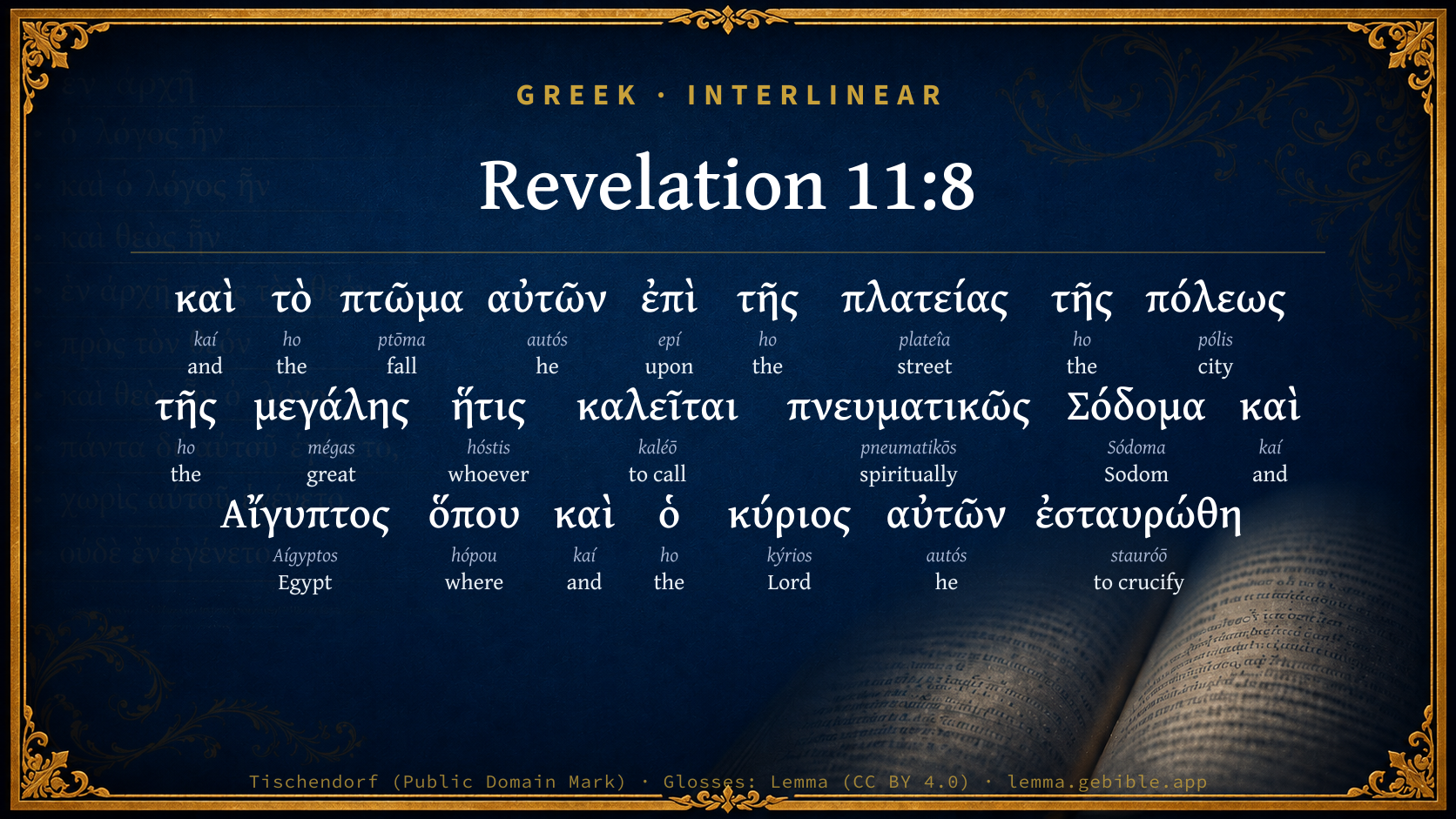
Greek (Tischendorf 8th ed.) Revelation 11:8 appears in the Greek New Testament. The text above is from the Tischendorf 8th edition. Each word links to its Strong’s number and a concise gloss. Click any word for its full Thayer’s Greek Lexicon entry.
Download image
Cite this verse

Revelation 11:8 (World English Bible). Public Domain. Lemma interlinear Bible study tool, https://lemma.gebible.app/v/revelation/11/8.

Show BibTeX & RIS
BibTeX
RIS
English Translation
Their dead bodies will be in the street of the great city, which spiritually is called Sodom and Egypt, where also their Lord was crucified.
World English Bible · Public Domain
Download a study sheet

One document with this verse’s original text, its word-by-word gloss line, the meaning frame, cross-references with their text, attributed commentary, and full source and license credits — printable, and it pastes into notes with its structure intact.

This verse Autodidact and up

Study sheet (.html) Plain text (.txt)

A passage Seminary Student

Up to 50 verses in one chapter. A passage sheet keeps up to 6 commentary sources and 12 cross-references per verse, in the order this page ranks them, and says so on the sheet whenever that leaves anything out. Ask for a single verse and you get the Autodidact verse sheet above.

Everything on this page stays free to read, with no account — the sheet is a download of what is already on screen, not access to it.

Want to remove ads? Support Godless Engineer
Compare translations 3

The same verse in 3 English versions, stacked beneath the original-language interlinear above. Click any original word for its lexicon entry.

Each is an independent rendering of the whole verse — the interlinear is not word-aligned to these translations.

Highlighted words mark where these versions differ — a whole-verse word diff, not a word-by-word alignment.

  • World English Bible Public Domain
    Their dead bodies will be in the street of the great city, which spiritually is called Sodom and Egypt, where also their Lord was crucified.
  • King James Version Public Domain
    And their dead bodies shall lie in the street of the great city, which spiritually is called Sodom and Egypt, where also our Lord was crucified.
  • unfoldingWord Literal Text CC BY-SA 4.0
    And their corpses in the public square of the great city, which is spiritually called Sodom and Egypt, where also their Lord was crucified.

unfoldingWord Literal Text — © unfoldingWord, licensed CC BY-SA 4.0. Word-aligned USFM3 via Door43 (git.door43.org/unfoldingWord/en_ult).

Versions to compare (up to 4)

3 of 4 selected

Show all 19 translations

Every available English version of this verse, each an independent rendering of the whole verse.

  • World English Bible Public Domain
    Their dead bodies will be in the street of the great city, which spiritually is called Sodom and Egypt, where also their Lord was crucified.
  • Berean Standard Bible Public Domain
    Their bodies will lie in the street of the great city—figuratively called Sodom and Egypt—where their Lord was also crucified.
  • Majority Standard Bible Public Domain
    Their bodies will lie in the street of the great city—figuratively called Sodom and Egypt—where their Lord was also crucified.
  • King James Version Public Domain
    And their dead bodies shall lie in the street of the great city, which spiritually is called Sodom and Egypt, where also our Lord was crucified.
  • American Standard Version (1901) Public Domain
    And their dead bodies `lie' in the street of the great city, which spiritually is called Sodom and Egypt, where also their Lord was crucified.
  • Revised Version (1885) Public Domain
    And their dead bodies lie in the street of the great city, which spiritually is called Sodom and Egypt, where also their Lord was crucified.
  • Geneva Bible (1599) Public Domain
    And their corpses shall lie in the streetes of the great citie, which spiritually is called Sodom and Egypt, where our Lord also was crucified.
  • Douay-Rheims (1899) Public Domain
    And their bodies shall lie in the streets of the great city, which is called spiritually, Sodom and Egypt, where their Lord also was crucified.
  • Young's Literal Translation Public Domain
    and their dead bodies `are' upon the broad-place of the great city (that is called spiritually Sodom, and Egypt, where also our Lord was crucified,)
  • Literal Standard Version CC BY-SA 4.0
    and their body [is] on the street of the great city that is called spiritually Sodom and Egypt, where also their Lord was crucified,
  • Unlocked Literal Bible CC BY-SA 4.0
    Their bodies will lie in the street of the great city (which is symbolically called Sodom and Egypt) where their Lord was crucified.
  • unfoldingWord Literal Text CC BY-SA 4.0
    And their corpses in the public square of the great city, which is spiritually called Sodom and Egypt, where also their Lord was crucified.
  • Darby Bible Public Domain
    and their body [shall be] on the street of the great city, which is called spiritually Sodom and Egypt, where also their Lord was crucified.
  • World Messianic Bible Public Domain
    Their dead bodies will be in the street of the great city, which spiritually is called Sodom and Egypt, where also their Lord was crucified.
  • Webster's Bible Public Domain
    And their dead bodies shall lie in the street of the great city, which spiritually is called Sodom and Egypt, where also our Lord was crucified.
  • Free Bible Version CC BY-SA 4.0
    Their dead bodies will lie on the open street of the great city, called Sodom and Egypt in spiritual symbolism—also the place where their Lord was crucified.
  • Bible in Basic English Public Domain
    And their dead bodies will be in the open street of the great town, which in the spirit is named Sodom and Egypt, where their Lord was put to death on the cross.
  • Text-Critical English NT CC BY 4.0
    Their dead bodies will lie in the street of the great city, which in a spiritual sense is called Sodom and Egypt, where their Lord was crucified.
  • Tyndale New Testament (1534) Public Domain
    And their boddyes shall lye in the stretes of the greate cite which spritually is called zodom and Egypte where oure lorde was crucified.

Literal Standard Version (2020), Covenant Press — licensed CC BY-SA 4.0. Text via the HelloAO Bible API (eBible.org). Unlocked Literal Bible (unfoldingWord) — licensed CC BY-SA 4.0. Text via the HelloAO Bible API (eBible.org). unfoldingWord Literal Text — © unfoldingWord, licensed CC BY-SA 4.0. Word-aligned USFM3 via Door43 (git.door43.org/unfoldingWord/en_ult). Free Bible Version, Dr. Jonathan Gallagher — licensed CC BY-SA 4.0. Text via the HelloAO Bible API (eBible.org).

Word by word

More ways to search: Search by grammar → Find every occurrence → Compare this word →

Practice this passage: Drill this verse → Learn its vocabulary →

πνευματικῶς
pneumatikōs
G4153
“spiritually”
Adverb
Part of Speech
Adverb
Full Thayer's Definition

Origin: from G4152

TDNT: None

1. spiritually: i.e. by the aid of the Holy Spirit
  1. καὶ kaí G2532 “and” Conjunction
  2. τὸ ho G3588 “the” Article, Nominative, Singular, Neuter
  3. πτῶμα ptōma G4430 “fall” Noun, Nominative, Singular, Neuter
  4. αὐτῶν autós G846 “he” Personal pronoun, Genitive, Plural, Masculine
  5. ἐπὶ epí G1909 “upon” Preposition
  6. τῆς ho G3588 “the” Article, Genitive, Singular, Feminine
  7. πλατείας plateîa G4113 “street” Noun, Genitive, Singular, Feminine
  8. τῆς ho G3588 “the” Article, Genitive, Singular, Feminine
  9. πόλεως pólis G4172 “city” Noun, Genitive, Singular, Feminine
  10. τῆς ho G3588 “the” Article, Genitive, Singular, Feminine
  11. μεγάλης mégas G3173 “great” Adjective, Genitive, Singular, Feminine
  12. ἥτις hóstis G3748 “whoever” Relative pronoun, Nominative, Singular, Feminine
  13. καλεῖται kaléō G2564 “to call” Verb, Present, Passive, Indicative, 3rd person, Singular
  14. Σόδομα Sódoma G4670 “Sodom” Noun, Nominative, Plural, Neuter
  15. καὶ kaí G2532 “and” Conjunction
  16. Αἴγυπτος Aígyptos G125 “Egypt” Noun, Nominative, Singular, Feminine
  17. ὅπου hópou G3699 “where” Adverb
  18. καὶ kaí G2532 “and” Conjunction
  19. ὁ ho G3588 “the” Article, Nominative, Singular, Masculine
  20. κύριος kýrios G2962 “Lord” Noun, Nominative, Singular, Masculine
  21. αὐτῶν autós G846 “he” Personal pronoun, Genitive, Plural, Masculine
  22. ἐσταυρώθη stauróō G4717 “to crucify” Verb, Aorist, Passive, Indicative, 3rd person, Singular

About this verse

These counts appear in no published source. They are computed here, from the morphology-tagged text and Lemma’s own curated glosses. What Lemma adds →

23
words
16
distinct lemmas
Revelation
section

Notable vocabulary

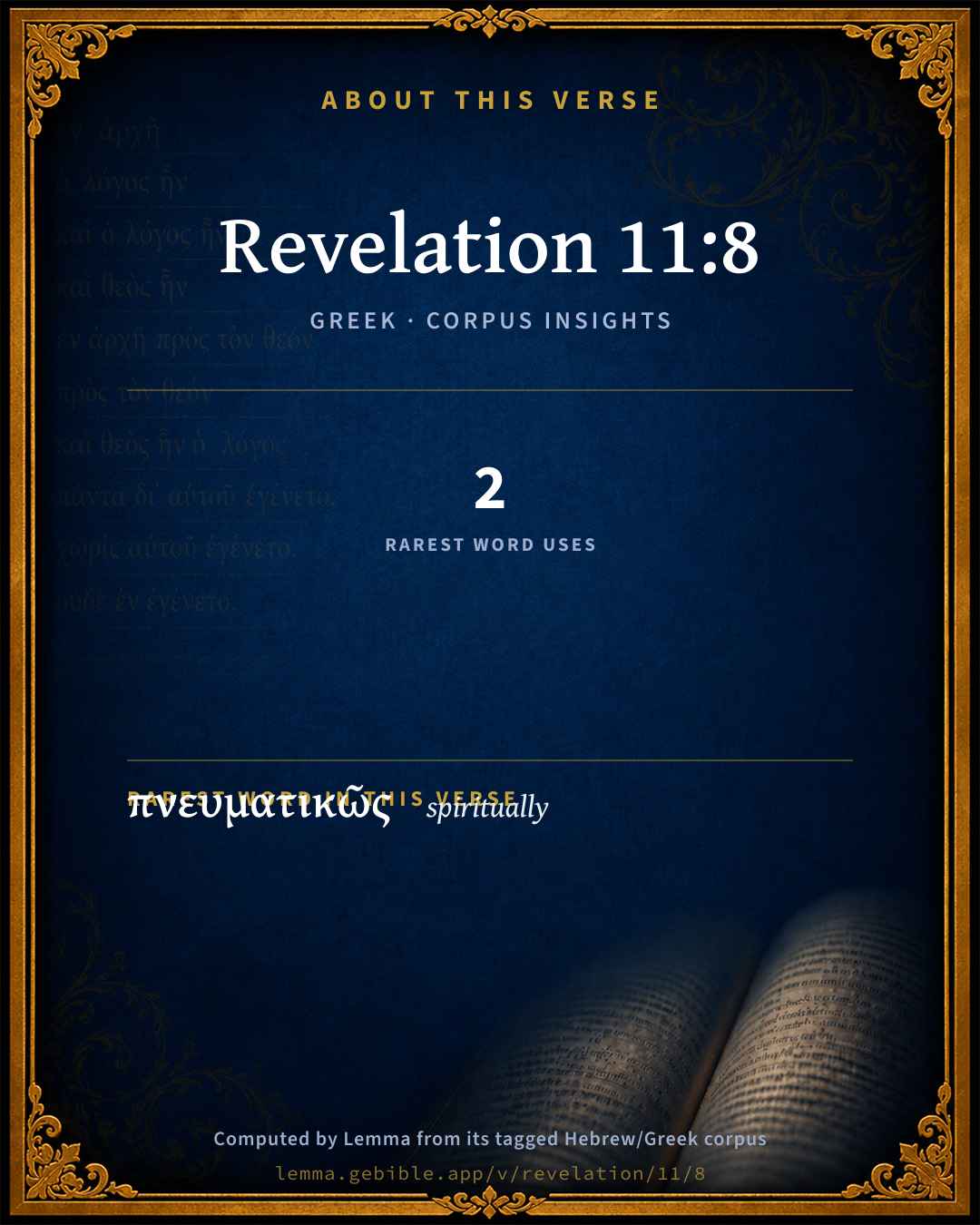
The rarest word here is πνευματικῶς spiritually G4153 — appearing just 2 times in the whole Greek New Testament.

Shared distinctive vocabulary

πνευματικῶς spiritually G4153 occurs in 2 verses of the Greek New Testament. Also found in:

Repetition

Words recur within this verse:

Cross-references

36

Topical passages linked to Revelation 11:8 in the Treasury of Scripture Knowledge — connected by theme and wording, ordered by reader-vote popularity; previews shown in the World English Bible.

  • Jeremiah 23:14 In the prophets of Jerusalem also I have seen a horrible thing: they commit adultery, and walk in lies; and they strengthen the hands of evil-doers, so that none does return from his wickedness: they are all of them become to me as Sodom, and the inhabitants of it as Gomorrah.
  • Revelation 18:10 standing far away for the fear of her torment, saying, 'Woe, woe, the great city, Babylon, the strong city! For your judgment has come in one hour.'
  • Ezekiel 16:53–55 I will turn again their captivity, the captivity of Sodom and her daughters, and the captivity of Samaria and her daughters, and the captivity of your captives in the midst of them;
  • Hebrews 13:12 Therefore Jesus also, that he might sanctify the people through his own blood, suffered outside of the gate.
  • Revelation 18:21 A mighty angel took up a stone like a great millstone and cast it into the sea, saying, "Thus with violence will Babylon, the great city, be thrown down, and will be found no more at all.
  • Amos 4:11 "I have overthrown some of you, As when God overthrew Sodom and Gomorrah, And you were like a burning stick plucked out of the fire; Yet you haven't returned to me," says Yahweh.
  • Matthew 10:15 Most assuredly I tell you, it will be more tolerable for the land of Sodom and Gomorrah in the day of judgment than for that city.
  • 2 Peter 2:6 and turning the cities of Sodom and Gomorrah into ashes, condemned them to destruction, having made them an example to those who would live ungodly;
  • Jude 1:7 Even as Sodom and Gomorrah, and the cities around them, having, in the same way as these, given themselves over to sexual immorality and gone after strange flesh, are set forth as an example, suffering the punishment of eternal fire.
  • Revelation 11:9 From among the peoples, tribes, languages, and nations people will look at their dead bodies for three and a half days, and will not allow their dead bodies to be laid in a tomb.
  • Revelation 18:18 and cried out as they looked at the smoke of her burning, saying, 'What is like the great city?'
  • Genesis 13:13 Now the men of Sodom were exceedingly wicked and sinners against Yahweh.
  • Genesis 19:24 Then Yahweh rained on Sodom and on Gomorrah sulfur and fire from Yahweh out of the sky.
  • Exodus 3:7 Yahweh said, "I have surely seen the affliction of my people who are in Egypt, and have heard their cry because of their taskmasters, for I know their sorrows.
  • Exodus 20:2 "I am Yahweh your God, who brought you out of the land of Egypt, out of the house of bondage.
  • Isaiah 1:9–10 Unless Yahweh of hosts had left to us a very small remnant, We would have been as Sodom; We would have been like Gomorrah.
  • Isaiah 3:9 The look of their faces testify against them. They parade their sin like Sodom. They don't hide it. Woe to their soul! For they have brought disaster upon themselves.
  • Ezekiel 23:3 and they played the prostitute in Egypt; they played the prostitute in their youth; there were their breasts pressed, and there was handled the bosom of their virginity.
  • Ezekiel 23:8 Neither has she left her prostitution since [the days of] Egypt; for in her youth they lay with her, and they handled the bosom of her virginity; and they poured out their prostitution on her.
  • Ezekiel 23:19 Yet she multiplied her prostitution, remembering the days of her youth, in which she had played the prostitute in the land of Egypt.
  • Ezekiel 23:27 Thus will I make your lewdness to cease from you, and your prostitution [brought] from the land of Egypt; so that you shall not lift up your eyes to them, nor remember Egypt any more.
  • Luke 13:33–34 Nevertheless I must go on my way today and tomorrow and the next day, for it can't be that a prophet perish outside of Jerusalem.'
  • Exodus 1:13–14 The Egyptians ruthlessly made the children of Israel serve,
  • Psalms 78:43–51 How he set his signs in Egypt, His wonders in the field of Zoan,
  • Psalms 79:2–3 They have given the dead bodies of your servants to be food for the birds of the sky, The flesh of your saints to the animals of the earth.
  • Jeremiah 26:23 and they fetched forth Uriah out of Egypt, and brought him to Jehoiakim the king, who killed him with the sword, and cast his dead body into the graves of the common people.
  • Acts 9:4 He fell on the earth, and heard a voice saying to him, "Saul, Saul, why do you persecute me?"
  • Hebrews 6:6 and then fell away, it is impossible to renew them again to repentance; seeing they crucify the Son of God for themselves again, and put him to open shame.
  • Revelation 11:13 In that day there was a great earthquake, and a tenth of the city fell. Seven thousand people were killed in the earthquake, and the rest were terrified, and gave glory to the God of heaven.
  • Revelation 14:8 Another, a second angel, followed, saying, "Babylon the great has fallen, which has made all the nations to drink of the wine of the wrath of her sexual immorality."
  • Revelation 16:19 The great city was divided into three parts, and the cities of the nations fell. Babylon the great was remembered in the sight of God, to give to her the cup of the wine of the fierceness of his wrath.
  • Revelation 18:2 He cried with a mighty voice, saying, "Fallen, fallen is Babylon the great, and she has become a habitation of demons, a prison of every unclean spirit, and a prison of every unclean and hateful bird!
  • Ezekiel 37:11 Then he said to me, Son of man, these bones are the whole house of Israel: behold, they say, Our bones are dried up, and our hope is lost; we are clean cut off.
  • Revelation 17:1 One of the seven angels who had the seven bowls came and spoke with me, saying, "Come here. I will show you the judgment of the great prostitute who sits on many waters,
  • Revelation 17:5 And on her forehead a name was written, "MYSTERY, BABYLON THE GREAT, THE MOTHER OF THE PROSTITUTES AND OF THE ABOMINATIONS OF THE EARTH."
  • Revelation 18:24 In her was found the blood of prophets and of saints, and of all who have been slain on the earth."

Cross-references courtesy of OpenBible.info (CC BY 4.0).

Commentary

Notes on Revelation 11:8 from classic Christian and Jewish commentators (each source and its license shown beneath its notes). The classic Christian expositions comment on the surrounding passage and are grouped to its opening verse, so a note may address several verses; the Jewish commentaries on the Tanakh (Rashi and others) are per-verse, so they appear only where the commentator wrote on this verse.

Lemma curates 59 commentaries, every one of them public domain or Creative Commons licensed, each selected and text-cleaned for this edition rather than reprinted as found. About our sources →

The Biblical Illustrator

Joseph S. Exell

Rev_11:8

Where also our Lord was crucified.

The Cross of the Lord Jesus

This passage strikingly identifies the Master and the servants--our Lord and His witnesses. They were to suffer as He suffered and where He suffered: one with Him in life and death, in shame and glory; one with Him on the Cross, in the grave, in resurrection, in ascension, and on the throne. Where also our Lord was crucified. It is the last reference to the Cross of Christ in the Bible, and corresponds well with that frequent expression in the Revelation, the Lamb slain; carrying us back to the seed of the woman and the bruised heel.

1. It was the place of guilt and condemnation (Mat_27:22; Mat_27:26; Mat_27:28).

2. It was the place of shame (Heb_12:2).

3. It was the place of weakness (2Co_13:4).

4. It was the place of pain (Heb_13:12).

5. The place of the curse (Gal_3:13).

6. The place of rejection (Joh_19:6).

7. The place of hatred (Mat_27:25).

8. The place of death (Mat_20:18-19). (H. Bonar, D. D.)

Good things found in the Cross

This Cross, where so many evil things meet, is the place where all good things are to be found. God gathered all the evil to that spot, that He might utterly make away with it, through Him who took all the evil on Himself, that He might bring out of it only good.

1. It is the place of propitiation (Lev_16:15; Rom_3:25). The altar was there for the burnt-offering. The place without the gate for the sin-offering was there.

2. It is the meeting-place (Exo_29:42). It is the place where we meet with God, and God meets with us in friendship, and love, and joy. It is the place where the Father meets the prodigal and embraces him.

3. It is the place of love. Gods love is there, shining in its full brightness, unhindered and undimmed.

4. It is the place of acceptance. Here we become accepted in the Beloved. Here the exchange takes place between the perfect and the imperfect. Believing in the perfect One, we become complete in Him. (H. Bonar, D. D.)

What the Cross accomplished

The Cross accomplished such things as the following:--

1. It removed the wall of partition (Col_2:14).

2. It made peace (Col_1:20).

3. It has secured oneness (Eph_2:15-16).

4. It has brought life (2Co_13:4).

5. It contains power (1Co_1:18; 1Co_1:23).

6. It is the focus or centre of all wisdom (1Co_1:24).

7. It crucifies the world (Gal_6:14).

8. It furnishes a theme for glorying (Gal_6:14).

9. It is the model and test of service (Mar_8:34; Luk_9:23).

10. It is the badge of discipleship (Luk_14:27).

11. It is Gods way of salvation (Act_10:39-43).

12. It is the measure of Christs endurance and obedience (Php_2:8).

13. It is the pledge and standard of Divine love (Rom_5:8).

14. It is the revelation of Gods character (1Jn_4:10).

15. It is Gods lamp of light.

16. It is the universal magnet (Joh_12:32).

17. It is the universal balm and medicine.

18. It is mans estimate of sin.

19. It is Gods verdict against sin, and His estimate of it (Rom_8:3).

20. It is mans estimate of the Son of God.

21. It is Gods interpretation of law and its penalties.

(H. Bonar, D. D.)

The Biblical Illustrator, edited by Joseph S. Exell (c. 1880s–1900s) — public domain. Text from a community e-Sword module.

Tyndale Open Study Notes

Tyndale Open Resources

11:8 their bodies will lie in the main street: Evil is so vindictive that it even desecrates the dead. • Jerusalem (literally the great city): The designation “the great city” would have immediately suggested Rome to early readers (16:19; 17:18; 18:10, 16, 18-19, 21). But John also describes it as the city where their Lord was crucified as well as Sodom and Egypt—all places that were hostile to God and his people (see also 17:5, 9). • where their Lord was crucified: There is a direct connection between how the Lord was treated by evil forces and the experience of persecuted Christians (see Acts 9:5).

Tyndale Open Study Notes — © Tyndale Open Resources, licensed CC BY-SA 4.0. Text via the HelloAO Bible API.

Bengel's Gnomon

Johann Albrecht Bengel

Rev 11:8-9. Τὸ πτῶμα) נבלה in the singular number is used collectively, Psa 79:2; Isa 26:19; Jer 34:20: and so in this place, τὸ πτῶμα respecting two. Also the head of Oreb and Zeeb is spoken of for the heads, Jdg 7:25. Presently afterwards, in the third place, τὰ πτώματα[111] is used: although in that place also there is a trace of the singular number in the Codex Leicestrensis, τὸ σῶμα. Although we see no reason for the difference, yet it would be rash to say that there is none. [In the text they are not said to lie. What, if you should suppose that they will be suspended, as their Lord also was suspended from the cross?—V. g.]—τῆς πλατείας—ἐσταυρώθη, in the street—was crucified) The place of crucifixion was outside the city under Tiberius; I almost think that it was so under Adrian also. Eusebius teaches, that the scene of the Lord’s martyrdom, or the place of the cross, passed over into the city built by Constantine; lib. iii. on the Life of Const. ch. xxxii. and ch. xxxviii., where he mentions the neighbouring street. The shape of the city has been changed in various ways, and will be changed hereafter. Whether the city has the place of the cross within the walls at the present day, or has not (for travellers are at variance with one another, and those who deny it, do so with far greater appearance of truth), at the time of the witnesses, at least, it will undoubtedly have the place of the cross in the street, either within the walls or without; for thus also רהב is called the street, 2Sa 21:12; Pro 26:13; Neh 8:1, with Adnot. Halens, p. 178; Luk 10:10 (comp. Mat 10:14); Est 4:6. Comp. Lightfoot, Hor. in Matt. p. 54. The beast has been this long time struggling eagerly concerning Palestine; after his ascent from the bottomless pit he struggles much more.

[111] τὰ πτώματα in ver. 8, and in the first and second places ver. 9, is the reading of Rec. Text, with h Vulg. Syr. But ABC Memph., in the former two instances, read τὸ πτῶμα.—E.

Bengel's Gnomon of the New Testament — English translation (T&T Clark, Edinburgh, 1860) — public domain. Text from a community e-Sword module.

Meyer's Critical & Exegetical Commentary

Heinrich August Wilhelm Meyer

Rev_11:8-10. As the slaying of the two witnesses could not occur[2868] until they had fulfilled their mission, so the Almighty Lord[2869] here allows dishonor to be shown their dead bodies, only in order afterwards to glorify them the more, Rev_11:11.

τὸ πτῶμα αὐτῶν. The sing.[2870] is regarded collectively;[2871] that which has fallen of them, i.e., their corpses.

ἐπὶ τῆς πλατείας τῆς πόλεως τῆς μεγάλης. On the street, in the place where in the public exercise of their μαρτυρία they are slain, they remain lying unburied,[2872] the most ignominious outrage even according to the feeling of the Gentiles,[2873] who here are represented as instruments of the beast of the abyss from the fact that they inflict such an outrage upon Christs witnesses, Rev_11:9, and rejoice at this, Rev_11:10.

That the great city is identical with the holy city where the ναὸς τοῦ θεοῦ stands, Rev_11:1 sqq., and, therefore, is none other than Jerusalem, is evident already from the connection; just as unambiguously is this declared in Rev_11:8, first in the spiritual designation of the same as Sodom and Egypt, then especially in the words ὅπου καὶ ὁ κύριος αὐτων ἐσταυρώθη. The spiritual designation (καλ. πνευματικῶς) expresses, in distinction from the proper historical name, the spiritual nature of the city; but the juxtaposition of the two names, Sodom and Egypt, shows that reference is not made here to individual relations,[2874] but to that wherein Sodom and Egypt are essentially alike, viz., entire enmity to the true God, his servants, and his people. As already the ancient prophets called Jerusalem, in express terms, Sodom,[2875] or a sister of Sodom,[2876] they wished not so much to characterize individual sins, as rather to designate them radically from the perverted position of the people to their God. So here the city wherein the witnesses of Christ are slain, and lie unburied on the street, and wherein also the Lord was crucified, is spiritually designated by both anti-theocratic names, because its antichristian hostility to the Lord is to be represented as against his witnesses.[2877] But the pneumatic designation of the city gives also the answer in harmony with the context to the question in hand as to why the city is called here, not, as Rev_11:2, the holy, but the great. Aret., Calov., and many of the older Protestants, have concluded from a comparison with Rev_16:19, Rev_18:15, etc., that also in this passage the great city is nothing but Babel, i.e., Papal Rome. Ebrard and other allegorists wish from this designation to prove at least that not the actual Jerusalem, but that which is allegorically meant, i.e., the secularized church, is to be understood. The reply of De Wette, that John could no longer call the city holy after its profanation, and yet wanted to designate it as a chief city containing a large population, Rev_11:13, and at the same time many Gentiles, warriors, and others, especially in its second part, is not properly satisfactory. The reason is more probable that it is impossible in one breath to call the city holy, and Sodom and Egypt, while the τ. μεγἀλῆς points in like manner as with respect to the city, which in ch. 16 sqq. bears the spiritual name of Babel, to the citys greatness and power as the vain foundation of its godless security and arrogant enmity against the Lord and his witnesses calling to repentance.

That the concluding words of Rev_11:8, ὅπου, κ.τ.λ., dare not be conceived of as a mere notice of locality, Ebrard properly mentions; but from this the impossibility does not result that the significance of the πνευματικῶς with καλεῖται extends also to the clause ὄπου

ἐσταυρώθη, as Hengstenb. and Ebrard still assert, as, like the old Protestant allegorists, they refer it to the spiritual crucifixion of the Lord in the secularized church,[2878] a conception against which already the aor. ἐσταυρώθη, pointing to the definite fact of the crucifixion, is arrayed,but only the necessity follows for seeking the correct reference of that clause in the pragmatism of the context. Again, the text itself shows this, partly by the καὶ before ὁ κύρ. αὐτ., partly by the expression ὁ κύρ. αὐτων. Both belong inwardly together; as the two witnesses, so also their Lord was there slain, crucified; the servants have suffered the same thing as their[2879] Lord.[2880] This is accordingly made prominent, because from this it becomes clear that the antichristian enmity of the great city remains always the same; with the same hatred as that wherewith they formerly once brought the Lord there to the cross, they now slay the two witnesses just because they are his witnesses. But still in another respect is the allusion to the crucifixion of the Lord significant, viz., with respect to the judgment announced. For even in their days,[2881] the city shows the same impenitent hostility, on account of which the Lord himself already had proclaimed its judgment.[2882]

Rev_11:9. The subj. to βλέπουσιν lies directly in the partitively formed expression ἐκ τῶν λαῶν, in connection with which a τινὲς is not to be supplied.[2883] In like manner, the subject is partitively formed, Joh_16:17, the object, Mat_23:34; in the simple gen., without ἐκ, the partitive obj. is found; e.g., Rev_3:9.

From peoples, kindreds, etc. (Rev_5:9), Jews and Gentiles (cf. Rev_11:2), many then have assembled in Jerusalem;[2884] these see the indignity (Rev_11:8) ἡμέρας τρεῖς καὶ ἡμίσυ, three days and a half.[2885] The schematic significance of this date can only be mistaken, and a definite chronological prophecy be found here, if the specifications of time of Rev_11:2-3, also be taken literally,[2886] which then of course is ill adapted to the further view of the allegorical character, and the reference of the whole to the antichristian period at the end of the world. All those have felt the schematic nature of the three and a half days, who have thought in connection therewith of only a short time;[2887] but that just three and a half days are named cannot be explained by an allusion to the three days during which the Lord lay in the grave;[2888] also not with Ewald: Longer than it is proper for a dead person to be left unburied, especially if we consider that from the nature of the land the dead should be buried sooner, so as not to become offensive; but only from the analogy of the three and a half years, Rev_11:2 sq.[2889]

ἀφίουσι. The form, like the ἥφιεν, Mar_1:34; Mar_11:16, from the stem ἄφίω.[2890]

τεθῆναι εἰς μνῆμα. Cf. Luk_23:53; Luk_23:55; Mat_27:60.

From the fact that in Rev_11:10 it is said, they that dwell upon the earth rejoice over them,[2891] it has been inferred[2892] that not the actual Jerusalem is to be regarded as the scene, but the allegorically so-called great city, Papal Rome, or rather the Romish Papacy, which actually extends over the whole earth. Improperly; for the strange attempt in this way to present the entire mass of all individuals dwelling on earth as spectators would thereby miscarry. In the expression ΟἹ ΚΑΤΟΙΚ. ἘΠῚ Τ. Γ., the question is not with respect to the numerical mass, but the generic idea;[2893] the self-evident limitation to the ΚΑΤΟΙΚΟῦΝΤΕς ἘΠῖ Τῆς Γῆς[2894] found in the city, as representatives of the entire class, the text itself gives by accounting for their joy, to which they testify by mutual presents as on festivals,[2895] as follows: ὅτι οὺτοι οἱ δύο προφῆται ἐβασάνισαν τοὺς κατοικοῦντας ἐπὶ τῆς γῆς. The βασανισμός[2896] on the part of the two prophetic witnesses, which in no way can be referred to the inner pain[2897] excited by their preaching of repentance,[2898] was perceptible only to the enemies in the city, who just as such represent the entire class of dwellers upon earth.

[2868] Cf., on this idea, the ἐδόθη αὐτῷ (Rev_13:7).

[2869] Cf. Rev_11:4.

[2870] Cf. Rev_11:9, the plural.

[2871] De Wette.

[2872] Cf. Rev_11:9.

[2873] Cf. Winer, Rwb., i. 172 sq.

[2874] Against Hengstenb.: Ἁιγυπτος refers to religious corruption, Σόδομα to immoral practices. Otherwise in Vitr., etc.

[2875] Isa_1:9 sqq.

[2876] Eze_16:48.

[2877] Cf. Ewald, Bleek, De Wette.

[2878] In the Papacy. Calov., etc.

[2879] The reference of the αὐτῶν to the inhabitants of Jerusalem (Ew. ii.) is ingenious, but violates the pragmatism of the statement, which also testifies to the passive form ἐσταυρώθη.

[2880] Cf. Mat_10:24 sqq.: Joh_15:20.

[2881] Cf. Rev_11:2 sqq.

[2882] Cf. Luk_19:41 sqq.

[2883] Against Ebrard.

[2884] Beng., De Wette, etc.

[2885] Accus. of duration, as Rev_11:3.

[2886] Beng.

[2887] Zeg., Hengstenb., etc.

[2888] C. a Lap., Hengstenb.

[2889] De Wette. Cf. also Hengstenb. and Ebrard, of whom, however, the latter concurs therein with Beng., etc., in that he also understands the time of antichrist at the end of the world, by conceiving of the one thousand two hundred and sixty days (Rev_11:3), at whose close the three and one-half days (Rev_11:9) fall, as the period of the Church from the destruction of Jerusalem until the conversion of Israel before the end of the world.

[2890] Cf. Winer, p. 77.

[2891] ἐπʼ αὑτοῖς; viz., so far as the witnesses are slain, and lie ignominiously upon the street.

[2892] Calov., Vitr., etc.

[2893] Cf. Rev_6:10, Rev_3:10.

[2894] Cf. Rev_11:9 : ἐκ τῶν λαῶν, κ.τ.λ.

[2895] Cf. Neh_8:10; Neh_8:12; Est_9:22. Cf. Winer, Rwb., i. 482.

[2896] Rev_9:5.

[2897] Hengstenb.

[2898] Beng., Ew., De Wette.

Meyer — Critical and Exegetical Commentary on the New Testament — English translation by Peter Christie, edited by Frederick Crombie (T&T Clark, 1880) — public domain. Text from a community e-Sword module.

Expositor's Greek Testament

ed. W. Robertson Nicoll

Rev 11:8 . God’s servants rejected and cast aside, as so much refuse! See Sam. Agonistes , 667 704. The “great city” is Jerusalem, an identification favoured by ( a ) incidental O.T. comparisons of the Jews to Sodom (Isa 11:9 ; Jer 23:14 ; so Asc. Isa 3:10 ), ( b ) the Christian editor’s note ὅπου καὶ ὁ κύριος αὐτῶν ἐσταυρώθη , ( c ) a passage like Luk 13:33 , ( d ) the reference in Rev 16:19 , and ( e ) passages in Appian ( Syr. 50 μεγίστη πόλις Ἱ .), Pliny ( H. N. xiv. 70), Josephus ( Apion , i. 22), and Sib. Or. (ver 154, 226, 413, written before 80 A.D.), all of which confirm this title ( cf. the variant addition μεγάλην in Rev 21:10 ): it is indeed put beyond doubt by the peculiar antichristtradition upon which the Jewish original was based ( A. C. 19 f., 134 f., E. Bi. i. 179, 180). The obscurity and isolated character of this eschatology, “an exotic growth upon the soil of Judaism” and much more in early Christianity, may be accounted for perhaps by the historical changes in the later situation, which concentrated the antichrist in anti-Roman rather than in anti-Jewish hostility. As yet, however, the seduction of the Jews by a false messiah ( cf. Joh 5:43 and its patristic interpretation) was quite a reasonable expectation: see the evidence gathered in A. C. 166 f. Victorinus, following the Apocalypse literally (Rev 11:7 = Rev 17:11 ), makes Nero redivivus beguile the Jews. The alternative to this theory has won considerable support (especially from Spitta and Wellhausen) upon various grounds; it regards the great city as Rome, where the two prophets are supposed to preach repentance to the heathen world and eventually to be killed. But although this suits some portions of the language well ( e.g. , Rev 11:13 , conversion to God of heaven ), it is not exegetically necessary; it introduces Rome abruptly (8 c being of course taken as a gloss) and irregularly: nor does it explain the general contour of the oracle as happily as that advocated above. Bruston’s ingenious attempt to take τ . μεγάλης with πλατείας (= Jewish justice) is quite untenable, and the great city is not likely to be a translator’s error (Weyland), גרולה for קדושׁה . πνευματικῶς ( cf. Gal 4:24 f.) as opposed to σαρκικῶς (“literally,” Just. Mart. Dial. xiv. 231 d ) is “allegorically, or mystically.” καὶ Αἴγυπτος , not as the home of magic ( cf. Blzu’s Altjüd. Zauber-wesen , 39 f.) but as a classical foe of God’s people (and Moses of old?). The connexion with the water-dragon of Rev 12:15 ( cf. Eze 29:3 ; Eze 32:2 ) is obvious. Philo allegorises E [914] usually as a type of the corporeal and material. ὅπου κ . τ . λ ., no wonder if Christians suffer, after what their Lord had to suffer ( cf. Mat 10:22-25 ; Mat 10:28 f.) at the hands of impious men. There is none of the modern’s surprise or indignation at the thought of “Christian blood shed where Christ bled for men”.

[914]. Codex Sangermanensis (sæc. ix.), a Græco-Latin MS., now at St. Petersburg, formerly belonging to the Abbey of Saint-Germain-des-Prés. Its text is largely dependent upon that of D. The Latin version, e (a corrected copy of d), has been printed, but with incomplete accuracy, by Belsheim (18 5).

The Expositor's Greek Testament, edited by W. Robertson Nicoll (1897–1910) — public domain. Text from a community e-Sword module.

Geneva Bible (1599)

Geneva Bible translators

Namely in his members, as also he said unto Saul, Acts 9:5.

After a most secret kind of meaning and understanding.

That is, openly at Rome: where at that time was a most great concourse of people, the year of Jubilee being then first ordained by Boniface unto the same end, in the year of Christ a thousand three hundred, example whereof is read, Rev. 1. Extra, de penitentys & remissionibus. So by one act he committed double injury against Christ, both abolishing his truth by the restoring of the type of the Jubilee, and triumphing over his members by most wicked superstitions. O religious heart! Now that we should understand the things of Rome, Saint John himself is the author, both after in the seventeenth Chapter almost throughout, and also in the circumscription now next following, when he saith, it is that great City (as Rev. 17; 18 he calleth it) and is spiritually termed Sodom and Egypt: that spiritually (for that must here again be repeated from before) Christ was there crucified. For the two first appellations signify spiritual wickednesses: the latter signifieth the show and pretence of good, that is, of Christian and sound religion. Sodom signifieth most licentious impiety and injustice: Egypt most cruel persecution of the people of God: and Jerusalem signifieth the most confident glorying of that city, as it were in true religion, being yet full of falsehood and ungodliness. Now who is ignorant that these things do rather, and more agree unto Rome than unto any other city? The commendations of the City of Rome for many years past are publicly notorious, which are not for me to gather. This only I will say that he long since did very well see what Rome is, who taking his leave thereof, used these verses:Roma vale, vidi, Satis est vidisse: revertar,Quumleno, meretrix, scurra, cinadus ero.Now farewell Rome, I have thee seen: It was enough to see:I will return when as I mean, bawd, harlot knave to be.

Geneva Bible (1599) marginal notes — public domain. Text via Bolls.life.

Jamieson, Fausset & Brown

Robert Jamieson, A. R. Fausset & David Brown

dead bodies--So Vulgate, Syriac, and ANDREAS. But A, B, C, the oldest manuscripts, and Coptic read the singular, "dead body." The two fallen in one cause are considered as one.

the great city--eight times in the Revelation elsewhere used of BABYLON (Rev 14:8; Rev 16:19; Rev 17:18; Rev 18:10, Rev 18:16, Rev 18:18-19, Rev 18:21). In Rev 21:10 (English Version as to the new Jerusalem), the oldest manuscripts omit "the great" before city, so that it forms no exception. It must, therefore, have an anticipatory reference to the mystical Babylon.

which--Greek, "the which," namely, "the city which."

spiritually--in a spiritual sense.

Sodom--The very term applied by Isa 1:10 to apostate Jerusalem (compare Eze 16:48).

Egypt--the nation which the Jews' besetting sin was to lean upon.

where . . . Lord was crucified--This identifies the city as Jerusalem, though the Lord was crucified outside of the city. EUSEBIUS mentions that the scene of Christ's crucifixion was enclosed within the city by Constantine; so it will be probably at the time of the slaying of the witnesses. "The beast [for example, Napoleon and France's efforts] has been long struggling for a footing in Palestine; after his ascent from the bottomless pit he struggles much more" [BENGEL]. Some one of the Napoleonic dynasty may obtain that footing, and even be regarded as Messiah by the Jews, in virtue of his restoring them to their own land; and so may prove to be the last Antichrist. The difficulty is, how can Jerusalem be called "the great city," that is, Babylon? By her becoming the world's capital of idolatrous apostasy, such as Babylon originally was, and then Rome has been; just as she is here called also "Sodom and Egypt."

also our--A, B, C, ORIGEN, ANDREAS, and others read, "also their." Where their Lord, also, as well as they, was slain. Compare Rev 18:24, where the blood of ALL slain on earth is said to be found IN BABYLON, just as in Mat 23:35, Jesus saith that, "upon the Jews and JERUSALEM" (Compare Mat 23:37-38) shall "come ALL the righteous blood shed upon earth"; whence it follows Jerusalem shall be the last capital of the world apostasy, and so receive the last and worst visitation of all the judgments ever inflicted on the apostate world, the earnest of which was given in the Roman destruction of Jerusalem. In the wider sense, in the Church-historical period, the Church being the sanctuary, all outside of it is the world, the great city, wherein all the martyrdoms of saints have taken place. Babylon marks its idolatry, Egypt its tyranny, Sodom its desperate corruption, Jerusalem its pretensions to sanctity on the ground of spiritual privileges, while all the while it is the murderer of Christ in the person of His members. All which is true of Rome. So VITRINGA. But in the more definite sense, Jerusalem is regarded, even in Hebrews (Heb 13:12-14), as the world city which believers were then to go forth from, in order to "seek one to come."

Jamieson, Fausset & Brown — Commentary Critical and Explanatory on the Whole Bible (1871) — public domain (CC PDM 1.0). Text via the HelloAO Bible API.

Adam Clarke's Commentary

Verse 8. The great city] Some say Rome, which may be spiritually called Sodom for its abominations, Egypt for its tyrannous cruelty, and the place where our Lord was crucified, because of its persecution of the members of Christ; but Jerusalem itself may be intended. All these things I must leave to others.

Adam Clarke's Commentary on the Bible (1810–1826) — public domain. Text from a community e-Sword/MySword module.

Ellicott's Commentary for English Readers

(8-10) And their dead bodies . . .—Better, And their corpse (is) upon the street of the great city, which is called spiritually Sodom and Egypt, where their Lord also was crucified. And some from among the peoples and tribes and tongues and nations look upon their corpse three days and a half, and do not suffer their corpses to be put into a tomb. And they that dwell upon the earth rejoice over them, and make merry, and shall send gifts one to another; because these two prophets tormented them that dwelt upon the earth. Their corpses remain unburied, while congratulations and rejoicings go on; harmony and concord prevail, as when Pilate and Herod were made friends; it is the millennium of evil, the paradise of fools who make a mock at sin; but the forms of the witnesses, though silenced, still in silence witness against evil. At no time are they hid away out of sight. Even in an age of religious and social anarchy the silent tokens of a better order remain, as when in mockery and profanation the harlot was enthroned within Notre Dame, the very sanctuary walls, which no longer echoed to the psalm of Christian life, yet bore silent testimony to the higher genius of the past. They are said to lie in “the street of the great city.” The city is described as the great city (comp. Rev_16:19), and also as Sodom, Egypt, and Jerusalem. Do not passages like this show conclusively that to deny the mystical or allegorical sense of the Apocalypse is to keep the husk and cast away the seed? The city is great, for it is all-important in the eyes of the inhabitants, as public opinion is all-important to the weak or the worldly; it is Sodom, for it is the place where, through pleasure and luxuriousness (fulness of bread), the worst forms of immorality take root; it is Egypt, for it is the house of bondage, where the wages of sin become tyrannous; it is Jerusalem, for it is the apostate place where the presence of Christ is hated. The same spirit which slew their Lord is alive to persecute His servants. “It cannot be that a prophet perish out of Jerusalem. If they have called the master of the house Beelzebub, how much more them of his household;” and the reason of this hatred is told—the words of the witnesses “tormented them.” “The reproof of their gospel and the reproof of their example . . . had been a torture to them; there was a voice in them which echoed its voice—the voice of a convicting conscience, and the voice of an anticipated judgment.”

A Bible Commentary for English Readers, edited by Charles John Ellicott (1878–1897) — public domain. Text from a community e-Sword module.

The Cambridge Bible for Schools and Colleges

gen. ed. J. J. S. Perowne

8. the street] For the sing. cf. Rev_21:21, Rev_22:2. The word in fact means a broad street, such as the principal street of a city would be. The modern Italian piazza is the same word; but Rev_22:2 seems to shew that it is a street rather than a square—perhaps most accurately a “boulevard” in the modern sense, only running through the city, not round it.

the great city] Many commentators suppose this to be the Babylon of Rev_14:8 and chaps. 17 sqq.—i.e. Rome, whether literally or in an extended sense. But this seems hardly natural. If it were, why is it not called Babylon here, just as in the last verse the beast was called the beast? Besides, here the great majority of the inhabitants repent at God’s judgement: contrast Rev_16:9. The only other possible view is, that this great city is Jerusalem: and with this everything that is said about it seems to agree.

Sodom] Jerusalem is so called in Isa_1:10, and is likened to Sodom in Eze_16:46. For the licentiousness of the generation before the fall of Jerusalem, see comm. on Hos_4:14 : Jos. B. J. IV. ix. 10 suggests a closer likeness.

Egypt] Jerusalem, it must be admitted, is never so called in the O. T. But New Testament facts made the name appropriate: comparing Act_2:47; Act_5:12, &c. with the Epistle to the Galatians, we see how Jerusalem was at first the refuge of the people of God, from which nevertheless they had at last to escape as from a house of bondage.

our Lord] Read, their Lord—i.e. of the two Witnesses. This clause seems almost certainly to identify “the great city” as Jerusalem: perhaps St John uses the title, as implying that its old one, “the Holy City,” is forfeited. At the same time, if we do suppose the City meant to be Rome, these words can be explained, either by the responsibility of Pilate for the Lord’s death, or on the principle of the beautiful legend, Domine, quo vadis?—that the Lord suffered in His Servants.

The Cambridge Bible for Schools and Colleges (gen. ed. J. J. S. Perowne; Cambridge University Press, 1878–1918) — public domain. Text from a community e-Sword module.

John Gill's Exposition

And their dead bodies shall lie in the street of the great city,.... Not Jerusalem, which was destroyed when John had this vision, and which will; not be rebuilt at the time it refers to; nor is it ever called the great city, though the city of the great King; however, not in this book, though the new Jerusalem is so called, Rev 21:10; but that can never be designed here; but the city of Rome, or the Roman jurisdiction, the whole empire of the Romish antichrist, which is often called the great city in this book; see Rev 16:19. The city of Rome itself was very large, and the Roman empire still larger, so as to be called the whole world and the antichristian see of Rome has been of great extent. Now as the street of a city denotes a public open place in it, a place of concourse and resort, Pro 1:20, the dead bodies of those witnesses being said to lie here, may design the publicness of their silence, disgrace, and contempt; and that the silencing and degrading them, and depriving them of all privileges, will be known all over the antichristian empire; and that they will be exposed to public ignominy and shame, their persons, their characters, their testimony, their doctrines, their writings, their churches, and families, and all that belong to them: or else this "street" may design some part of the Romish jurisdiction, and it may be Great Britain may be particularly designed; for where should the dead bodies of the witnesses lie, but where they are slain? and where can they be slain, but where they are? and where are they, at least where are there so many as in these islands? It may be objected, that Great Britain is not a part of the see of Rome, does not belong to the jurisdiction of it; to this it may be replied, that in this last war of the beast, the outer court will be given to the Gentiles, the bulk of the reformed churches will fall off to Popery, and their countries again fall into the hands of the pope, and, among the rest, Great Britain. The fears of Dr. Goodwin seem to be too just, and well grounded, that the prophecy in Dan 11:45 respects our island, which speaks of antichrist planting "the tabernacles of his palace between the seas, in the glorious holy mountain", or "the mountain of delight, of holiness". Now where has God such a mountain of delight, or a people that are the darling of his soul, as here? where in all the globe is there such a spot where God has so many saints, so many Holy Ones, as in this island? it may have been truly called a glorious holy mountain, or a mountain of delight; and what place between the seas is there to which these characters can agree, but Great Britain? Here then antichrist will plant the tabernacles of his palace; but it will be but a tabernacle, or tent; it will be but for a short time, as it follows, "yet he shall come to his end, and none shall help him", Dan 11:45. Now this great city, in the street of which the bodies of the witnesses will lie exposed, is that

which spiritually is called Sodom and Egypt; that is, it is called so in a mystic and allegoric sense, in distinction from the literal sense; see Co1 10:3; it is called Sodom because of the fulness of bread, plenty and abundance of all outward good things in it; as well as for the pride and idleness of the priests, monks, and friars which swarm in it; and also for the open profaneness and contempt of true and serious religion in it; and particularly for the sin of sodomy, so frequently committed here, with impunity, yea with allowance, and even with commendation. This sin was extolled with praises, as Brightman observes, by John a Casa, archbishop of Beneventum; and was defended in a book, published for that purpose, by one Mutius; and which was allowed by the bulls and letters patent of Pope Julius the Third; and it is called Egypt, because of its tyranny and oppression; as the Egyptians kept the Israelites in bondage, and made them to serve with rigour, and embittered their lives, so the pope, and his Gentiles, or Egyptians, have in a most oppressive and rigorous manner tyrannised over the souls, bodies, and estates of men; and also because of its great idolatry, Egypt being very remarkable for the number of its deities, and the meanness of them; by which the idols and idolatries of the church of Rome may be fitly expressed:

where also our Lord was crucified; that is, in the great city, which is fitly compared to Sodom and Egypt; for Christ was crucified actually in Judea, which was then become a Roman province, and under Pontius Pilate, a Roman governor, and by his order, and suffered a Roman kind of death, crucifixion, and for a crime he was charged with, though a false one, against Caesar the Roman emperor; and Christ has been crucified at Rome itself in his members, who have suffered persecution and death, and even the death of the cross there; and he has been crucified afresh, both by the sins and immoralities of those who have bore the Christian name there, and by the frequent sacrifices of him in the Mass. Moreover, by this periphrasis may be meant Jerusalem; and the sense be, that as the great city, or jurisdiction of Rome, may be spiritually or mystically called Sodom and Egypt, so likewise the place where our Lord was crucified, that is, Jerusalem; and that for this reason, because that as Jerusalem stoned and killed the prophets of the Lord, and upon the inhabitants of it were found all the righteous blood shed upon the earth, so in Rome, in mystical Babylon, will be found the blood of prophets, and of saints, and of all that were slain upon earth, Mat 23:35. The Alexandrian copy, the Complutensian edition, the Vulgate Latin, Syriac, and Ethiopic versions, read, "where also their Lord was crucified"; and the Arabic version more expressly, "the Lord of these two", i.e. the two witnesses.

John Gill's Exposition of the Whole Bible (1746–1763) — public domain (CC PDM 1.0). Text via the HelloAO Bible API.

Trapp's Complete Commentary

John Trapp

8 And their dead bodies shall lie in the street of the great city, which spiritually is called Sodom and Egypt, where also our Lord was crucified.

Ver. 8. And their dead bodies] This shows it cannot be meant as a natural death; for how should their bodies lie dead (in that sense) for three years and a half, or (say as it were) for a shorter time?

Of the great city] Rome, of whose greatness Lipsius and Stapleton have written. See Rev 17:18; Rev 18:2-6. Hence she is called the great whore, and great Babylon, not without reference unto the old Babylon; which was so great a city, that when it was taken by Cyrus, some part of it knew not what condition they were in till three days after. (Herodot. Arist. Pol.)

Where also our Lord was crucified] For he was put to death by a Roman judge, by a Roman authority, by a kind of death proper to the Romans, &c. He is also crucified in Rome in his members, word, spirit, and worship.

John Trapp, A Commentary or Exposition upon All the Books of the Old and New Testament (1647–1656) — public domain. Text from a community e-Sword module.

Albert Barnes' Notes on the Bible

And their dead bodies shall lie in the street - Prof. Stuart, “Shall be in the street.” The words “shall lie” are supplied by the translators, but not improperly. The literal rendering would be, “and their corpses upon the street of the great city”; and the meaning is, that there would be a state of things in regard to them which would be well represented by supposing them to lie unburied. To leave a body unburied is to treat it with contempt, and among the ancients nothing was regarded as more dishonorable than such treatment. See the Ajax of Sophocles. Among the Jews also it was regarded as a special indignity to leave the dead unburied, and hence they are always represented as deeply solicitous to secure the interment of their dead. See Gen 23:4. Compare 2Sa 21:9-13; Ecc 6:3; Isa 14:18-20; Isa 22:16; Isa 53:9. The meaning here is, that, for the time specified, those who are here referred to would be treated with indignity and contempt. In the fulfillment of this, we are not, of course, to look for any literal accomplishment of what is here said, but for some treatment of the “witnesses” which would be well represented by this; that is, which would show that they were treated, after they were silenced, like unburied corpses putrefying in the sun.

Of the great city - Where these transactions would occur. As a great city would be the agent in putting them to death, so the result would be as if they were publicly exposed in its streets. The word “great” here supposes that the city referred to would be distinguished for its size - a circumstance of some importance in determining the place referred to.

Which spiritually is called - πνευματικῶς pneumatikōs. This word occurs only in one other place in the New Testament, 1Co 2:14, “because they are spiritually discerned” - where it means, “in accordance with the Holy Spirit,” or” through the aid of the Holy Spirit.” Here it seems to be used in the sense of metaphorically, or allegorically, in contradistinction from the literal and real name. There may possibly be an intimation here that the city is so called by the Holy Spirit to designate its real character, but still the essential meaning is, that that was not its literal name. For some reason the real name is not given to it; but such descriptions are applied as are designed to leave no doubt as to what is intended.

Sodom - Sodom was distinguished for its wickedness, and especially for that vice to which its abominations have given name. For the character of Sodom, see Gen 18:19. Compare 2Pe 2:6. In inquiring what “city” is here referred to, it would be necessary to find in it such abominations as characterized Sodom, or so much wickedness that it would be proper to call it Sodom. If it shall be found that this was designed to refer to papal Rome, no one can doubt that the abominations which prevailed there would justify such an appellation. Compare the notes on Rev 9:20-21.

And Egypt - That is, it would have such a character that the name Egypt might be properly given to it. Egypt is known in the Scriptures as the land of oppression - the land where the Israelites, the people of God, were held in cruel bondage. Compare Exo. 1–15. See also Eze 23:8. The particular idea, then, which seems to be conveyed here is, that the “city” referred to would be characterized by acts of oppression and wrong toward the people of God. So far as the language is concerned, it might apply either to Jerusalem or to Rome - for both were eminently characterized by such acts of oppression toward the true children of God as to make it proper to I compare their cruelties with those which were inflicted on the Israelites by the Egyptians. Of whichever of these places the course of the exposition may require us to understand this, it will be seen at once that the language is such as is strictly applicable to either; though, as the reference is rather to Christians than to the ancient people of God, it must be admitted that it would be most natural to refer it to Rome. More acts authorizing persecution, and designed to crush the true people of God, have gone forth from Rome than from any other city on the face of the earth; and taking the history of the church together, there is no place that would be so properly designated by the term here employed.

Where also our Lord was crucified - If this refers to Jerusalem, it is to be taken literally; if to another city, it is to be understood as meaning that he was practically crucified there: that is, that the treatment of his friends - his church - was such that it might be said that he was “crucified afresh” there; for what is done to his church may be said to be done to him. Either of these interpretations would be justified by the use of the language. Thus in Heb 6:6, it is said of apostates from the true faith (compare the notes on the passage), that “they crucify to themselves the Son of God afresh.” If the passage before us is to be taken figuratively, the meaning is, that acts would be performed which might properly be represented as crucifying’ the Son of God; that, as he lives in his church, the acts of perverting his doctrines, and persecuting his people, would be, in fact, an act of crucifying the Lord again. Thus understood, the language is strictly applicable to Rome; that is, if it is admitted that John meant to characterize that city, he has employed such language as a Jewish Christian would naturally use. While, therefore, it must be admitted that the language is such as could be literally applied only to Jerusalem, it is still true that it is such language as might be figuratively applied to any other city strongly resembling that, and that in this sense it would characterize Rome above all other cities of the world. The common reading of the text here is “our Lord” - ἡμῶν hēmōn; the text now regarded as correct, however (Griesbach, Tittmann, Hahn), is “their Lord” - αὐτῶν autōn. This makes no essential difference in the sense, except that it directs the attention more particularly to the fact that they were treated like their own Master.

Albert Barnes' Notes on the Bible (1834–1885) — public domain. Text from a community e-Sword/MySword module.

Haydock's Catholic Bible Commentary

Their bodies shall lie in the streets. It is what has often happened to the bodies of the martyrs, and may happen to Henoch [Enoch] and Elias [Elijah], for three days and a half, for a short time. --- The great city. Some understand any city where Christians are persecuted. Others by the following words, where also their Lord was crucified, will needs have to be understood Jerusalem, which they hold shall be rebuilt in the time of antichrist, and where by him shall be put to death Henoch and Elias. But others think it may be expounded of heathen Rome, which in a mystical sense might be called Sodom for its infamous crimes, and Egypt for its idolatries and superstitions, where Christ might be said to be crucified, not as to himself, but in his members, according to what he himself said, Matthew xxv. 40. "inasmuch as you did it to one of these, my least brethren, you did it to me." (Witham) -- City; Jerusalem, which is supposed will be the residence of antichrist, and filled with a great concourse of people. (Menochius)

George Leo Haydock (1774–1849), Haydock's Catholic Family Bible and Commentary, 1859 edition — public domain. Excludes Psalms (Douay-Rheims chapter numbering differs from Protestant) and Deuterocanonical books (Catholic canon only).

Matthew Poole's English Annotations

Their bodies dead, in the sense before mentioned, shall continue so for three days and a half, of which we shall speak, Rev 11:11. But what is here meant:

1. By the great city?

2. By the street of the great city?

Some, by the great city, would have Jerusalem understood; but that was now far from a great city, nor do the addition of those words in the latter end of the verse prove it; for Christ was not crucified in that city, but without the gates. Most judicious interpreters, by the great city here, understand Rome, which is seven or eight times (under the name of Babylon) so called in this hook, Rev 14:8; Rev 16:19; 18:10,16,18,19,21; nor is any other city but that so called. This great city is here said, in a spiritual sense, to be Sodom and Egypt; Sodom, for whoredom and filthiness; Egypt, for oppression of the Lord’s Israel. As to the second question, what is here meant by the street of the great city? Mr. Mede hath irrefragably proved, that it cannot be meant of any parish, or such place in this city, as we call a street:

1. Because our Lord was crucified neither in any street, or parish, or any other place within the walls of Jerusalem.

2. Both Jerusalem and Rome had many more than one street.

3. Because the bodies being dead, doubtless lay in the place where they were slain; but men do not use to fight in the streets of cities.

4. Nor was that a place for all people, kindred, tongues, and nations, to see them in.

He therefore rightly judgeth, that the Greek word which we translate street, signifies the territories and jurisdiction of this city. See what he says to justify this in his Clavis Apocal. 40. p. 138. And this makes the last clause plain; for though our Lord was not crucified within any city, or in the street of any city, yet he was crucified in a place belonging to the jurisdiction of the Roman emperor; and it is very likely that it is in Europe that the witnesses shall be slain, which, in this sense, was all of it a street belonging to the city of Rome.

Matthew Poole's English Annotations on the Holy Bible (1683–1685) — public domain. Text from a community e-Sword/MySword module.

Whedon's Commentary on the Bible

Daniel D. Whedon

8. The great city—In opposition to the holy city of Rev_11:2; and so identical with the Babylon of Rev_14:9, the antichristic capital.

Lie in the street—Picture of most dishonouring exposure. The defeat of the reformation is in its hour of defeat the object of derision through all the ranks of the apostasy.

Spiritually called—The word figurative is the opposite to literal, and the word spiritual, as an epithet for language, is opposed to secular. Secularly the great city is called Babylon, but in the dialect of the spirit it is a Sodom, an Egypt. Babylon is called Sodom as the seat of licentiousness, whose end was to be burned. Rev_19:3, compared with Gen_19:28. And is called Egypt, as the cruel oppressor of God’s people, from which they were called to come out, Rev_18:4.

Where… crucified—Stuart, Gebhardt, and others, consider this clause as demonstrating that Jerusalem is the great city. But, 1. All the references to Jerusalem in the Apocalypse make her a symbol of the holy. She is “the city of God,” Rev_3:12; “the holy city,”

Rev_11:2; the “beloved city,” Rev_20:9; the “holy city,”

Rev_22:19. And so, also, the Jews and Israel are throughout a type of the true Church. 2. On the other hand, in every case the “great city” is Babylon, Rev_14:8; Rev_17:18; Rev_18:16; see also, Rev_16:19; Rev_18:10; Rev_18:19. So uniform a use, in both cases, cannot but be decisive. 3. Our Lord was truly crucified, not indeed in the literal and local, but in the mystical or spiritual, “Babylon.” Literal and fallen Jerusalem was within the limits, and part of, that Babylon, as being part of the Roman Empire as belonging to antichrist, and as where Roman hands crucified the Saviour. The also implies that our Lord’s being crucified is viewed as a martyrdom in addition to that of the saints slain in the great city.

Daniel D. Whedon (gen. ed.), Commentary on the Old and New Testaments (1874–1909) — public domain. Text from a community e-Sword module.

The Pulpit Commentary

And their dead bodies shall lie in the street of the great city, which spiritually is called Sodom and Egypt, where also our Lord was crucified; their dead body (in the singular), according to A, B, C, Arethas, and others. The plural is read in N, P, Andreas, Primasius, and others. Omit "lie upon the highway... their Lord." "The great city" is referred to in Rev_16:19 Rev_17:18 Rev_18:10-19. Its signification is always the same, viz. the type of what is ungodly and of the world, and it is always consigned to punishment. Jerusalem, the type of what is holy, is never thus designated. Here we are plainly told the spiritual, that is, the symbolical nature of the designation. Sodom and Egypt are chosen as the type of what is evil. (cf. Deu_32:32 Isa_1:10 Eze_16:46 Eze_20:7, etc.) It was in this city, that is, by the influence of this world power, that the Lord was crucified. In describing the fate of the Church, St. John seems to have in mind the life of Christ. His witness, the opposition he encountered, his death for a brief time at the completion of his work, his resurrection and ascension, and triumph over the devil, are all here reproduced. "The bodies lie in the street" symbolizes, according to Jewish custom, the most intense scorn and hatred.

The Pulpit Commentary (1880–1919), ed. H.D.M. Spence-Jones & Joseph S. Exell — public domain. Text from a community e-Sword module.

John Wesley's Explanatory Notes

And their bodies shall be - Perhaps hanging on a cross. In the street of the great city - Of Jerusalem, a far greater city, than any other in those parts. This is described both spiritually and historically: spiritually, as it is called Sodom Isaiah i, and Egypt; on account of the same abominations abounding there, at the time of the witnesses, as did once in Egypt and Sodom. Historically: Where also their Lord was crucified - This possibly refers to the very ground where his cross stood. Constantine the Great inclosed this within the walls of the city. Perhaps on that very spot will their bodies be exposed.

John Wesley, Explanatory Notes Upon the Whole Bible (1754–1765) — public domain. Text via the GEBible commentary corpus.

Scofield Reference Notes

C. I. Scofield

great city

i.e. Jerusalem.

The Scofield Reference Bible (1917 edition), notes by C. I. Scofield — public domain. Text from a community e-Sword module.

The People's New Testament

B. W. Johnson

8. And their dead bodies shall lie in the street. They shall not be buried, but remain in plain sight. I believe that this is what is signified. Though the witnesses were slain, their enemies could not get them out of sight. They could not bury them. Of the great city. This term is used eight times in Revelation. It is never used of Jerusalem. It is in contrast with the Holy City. As the Holy City is a symbol of the church, a wicked City would symbolize a false religion, or apostate church. Spiritually is called Sodom, and Egypt. Symbolically so called. Sodom, with its sins, was a type of this city; Egypt, the house of bondage, is also a type. It is a sinful organization which has enslaved the true Israel. Where also our Lord was crucified. Many commentators have insisted that this refers to literal Jerusalem, but we must remember that the place is one in which our Lord was spiritually crucified. This is done by apostasy. See Heb. 6:6. That the reference is to spiritual declension is plain.

B. W. Johnson's The People's New Testament with Notes (1889–1891) — public domain. Electronic text from the Christian Classics Ethereal Library (CCEL) ThML edition.

unfoldingWord translationNotes

Door43 World Missions Community

Their bodies

This refers to the bodies of the two witnesses.

in the street of the great city

The city had more than one street. This was a public place where people could see them. AT: "in one of the streets of the great city" or "in the main street of the great city"

three and a half days

"3 full days and one half day" or "3.5 days" or "3 1/2 days" (See: Numbers)

their Lord

They served the Lord, and like him would die in that city.

They will not permit them to be placed in a tomb

This will be a sign of disrespect.

translationWords

Sodom

Egypt

lord

crucify

people group

tribe

grave

unfoldingWord translationNotes — © Distant Shores Media and the Door43 World Missions Community, licensed CC BY-SA 4.0. Source: git.door43.org/Door43/en_tn.

Cambridge Greek Testament for Schools and Colleges

8. τὸ πτῶμα. Text. Rec[375] reads τὰ πτώματα with אP 1.

[375] Rec. Textus Receptus as printed by Scrivener.

ὁ κύριος αὐτῶν. א* omits αὐτῶν, 1 and Text. Rec[376] substitute ἡμῶν.

[376] Rec. Textus Receptus as printed by Scrivener.

8. ἐπὶ τῆς πλατείας. For the sing. cf. Rev 21:21, Rev 22:2. The word in fact means a broad street, such as the principal street of a city would be. The modern Italian piazza is the same word; but Rev 22:2 seems to shew that it is a street rather than a square—perhaps most accurately a “boulevard” in the modern sense, only running through the city, not round it.

τῆς πόλεως τῆς μεγάλης. Many commentators suppose this to be the Babylon of Rev 14:8 and chaps. 17. sqq.—i.e. Rome, whether literally or in an extended sense. But this seems hardly natural. If it were, why is it not called Babylon here, just as in the last verse the beast was called the beast? Besides, here the great majority of the inhabitants repent at God’s judgement: contrast Rev 16:9. The only other possible view is, that this great city is Jerusalem: and with this everything that is said about it seems to agree.

ἥτις καλεῖται. Here probably we have a comment of the Seer on the words of the Voice, which goes down to the end of the verse.

Σόδομα. Jerusalem is so called in Isa 1:10, and is likened to Sodom in Eze 16:46. For the licentiousness of the generation before the fall of Jerusalem, see comm. on Hos 4:14: Jos. B. J. IV. ix. 10 suggests a closer likeness.

Αἴγυπτος. Jerusalem, it must be admitted, is never so called in the O.T. Possibly it was called so in the language of New Testament prophecy; certainly New Testament facts made the name appropriate: comparing Act 2:47; Act 5:12, &c. with the Epistle to the Galatians, we see how Jerusalem was at first the refuge of the people of God, from which nevertheless they had at last to escape as from a house of bondage.

ὁ κύριος αὐτῶν. This clause seems almost certainly to identify “the great city” as Jerusalem: perhaps St John uses the title, as implying that its old one, “the Holy City,” is forfeited. At the same time, if we do suppose the City meant to be Rome, which might be supported by chap. Rev 18:24, itself a parallel to Mat 23:35, these words can be explained, either by the responsibility of Pilate for the Lord’s death, or on the principle of the beautiful legend, Domine, quo vadis?—that the Lord suffered in His Servants.

Cambridge Greek Testament for Schools and Colleges (Cambridge University Press, 1896; 21 vols, various authors incl. Carr, Maclear, Plummer, Farrar, Lumby, Moule, M. R. James, Simcox) — public domain. Text from a community e-Sword module.

Vincent's Word Studies in the New Testament

Marvin R. Vincent

Dead bodies [πτωματα] . Read ptwma carcass. See on Mt 24:28; Mr 14:45.

In the street [επι της πλατειας] . Lit., "Upon the street." See on Luk 14:21.

The great city. Jerusalem is never called by this name. Different expositors refer it to Rome or Babylon. Milligan to Jerusalem.

Spiritually [πνευματικως] . Typically or allegorically. (compare 1Co 10:3, 4.

Our Lord. Read aujtwn their for hJmwn our.

Marvin R. Vincent, Word Studies in the New Testament (1887–1900) — public domain. Text from a community e-Sword/MySword module.

Lesson kit

Teaching starters — assembled from the data on this page, not authored interpretation. Every prompt links to the verse data it draws on. Edit before teaching.

Revelation, in the Revelation, opens this verse with 23 words (16 distinct Greek lemmas). Its most distinctive word is pneumatikōs (“spiritually”). A historical commentator’s framing appears above. Read the whole chapter for the surrounding context.

Discussion questions

  1. What does “spiritually” (pneumatikōs) contribute to the verse as a whole?
  2. How does 1 Corinthians 2:14, which shares the word «spiritually», read alongside this verse?
  3. What does the repetition of “the” (5× in this one verse) do in this verse?
  4. The translations on this page render this verse differently — a whole-verse word diff, not a word-by-word alignment. What might account for the different wordings?
  5. Compare how The Biblical Illustrator and Tyndale Open Study Notes read this verse. Where do they agree or differ?

Things to notice

Reading settings

Reading text

Shown beneath each verse's original-language words.

Old Testament
Old Testament edition

Read the OT as the Masoretic Hebrew (MT) or the Greek Septuagint (LXX).

English shown for the Greek Septuagint (in the Hebrew ↔ Greek comparison).

Comparing translations? Open the Compare panel on any verse page to stack up to four side by side.