Esther 7:5

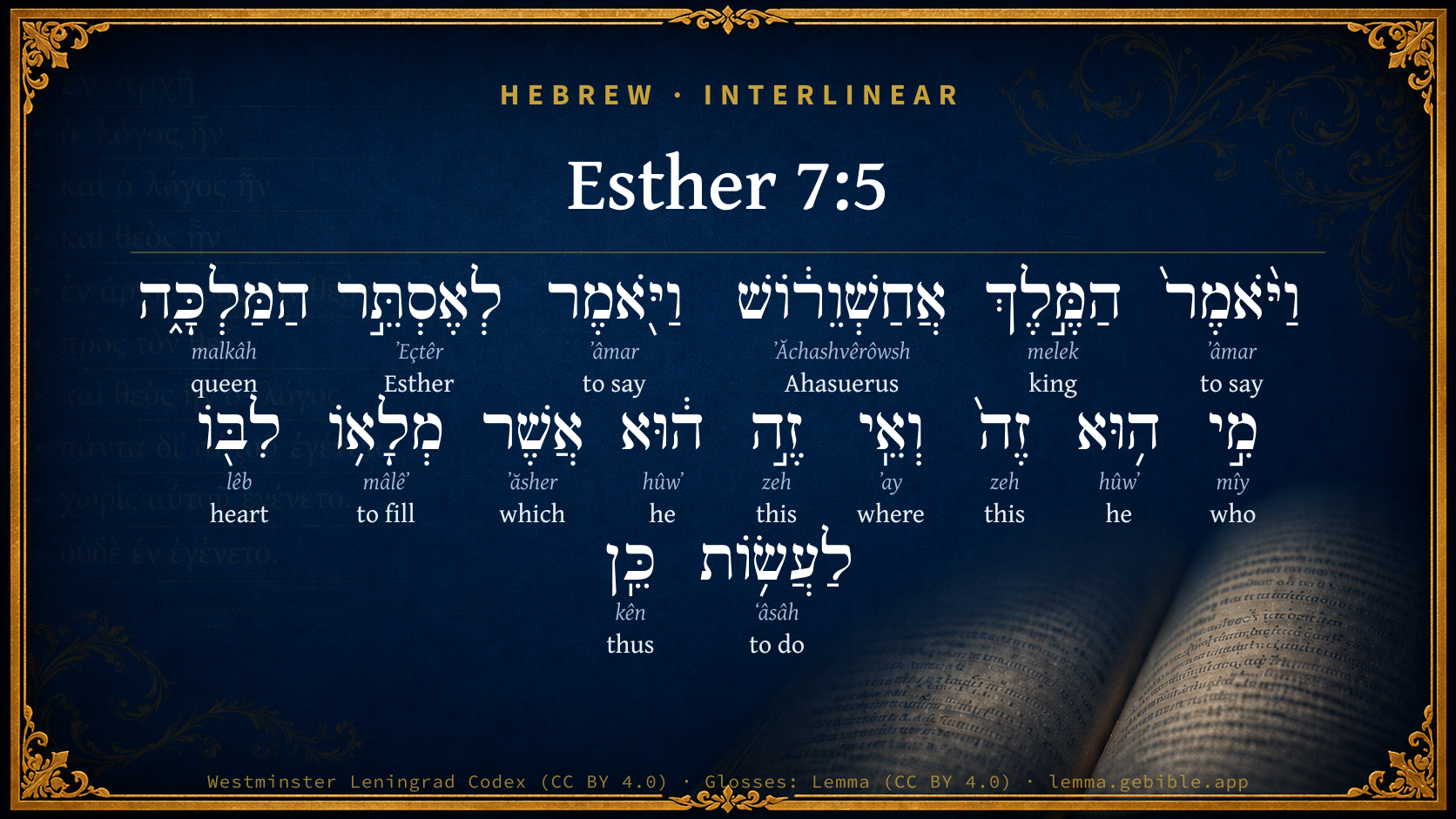
Hebrew (Westminster Leningrad Codex) Esther 7:5 appears in the Hebrew Old Testament. The text above is from the Westminster Leningrad Codex. Each word links to its Strong’s number, a concise gloss, and parsing drawn from the Open Scriptures Hebrew Bible morphology. Click any word for its full Brown-Driver-Briggs (BDB) entry.
Download image
Cite this verse

Esther 7:5 (World English Bible). Public Domain. Lemma interlinear Bible study tool, https://lemma.gebible.app/v/esther/7/5.

Show BibTeX & RIS
BibTeX
RIS
English Translation
Then spoke the king Ahasuerus and said to Esther the queen, Who is he, and where is he, that dared presume in his heart to do so?
World English Bible · Public Domain
Download a study sheet

One document with this verse’s original text, its word-by-word gloss line, the meaning frame, cross-references with their text, attributed commentary, and full source and license credits — printable, and it pastes into notes with its structure intact.

This verse Autodidact and up

Study sheet (.html) Plain text (.txt)

A passage Seminary Student

Up to 50 verses in one chapter. A passage sheet keeps up to 6 commentary sources and 12 cross-references per verse, in the order this page ranks them, and says so on the sheet whenever that leaves anything out. Ask for a single verse and you get the Autodidact verse sheet above.

Everything on this page stays free to read, with no account — the sheet is a download of what is already on screen, not access to it.

Want to remove ads? Support Godless Engineer
Compare translations 3

The same verse in 3 English versions, stacked beneath the original-language interlinear above. Click any original word for its lexicon entry.

Each is an independent rendering of the whole verse — the interlinear is not word-aligned to these translations.

Highlighted words mark where these versions differ — a whole-verse word diff, not a word-by-word alignment.

  • World English Bible Public Domain
    Then spoke the king Ahasuerus and said to Esther the queen, Who is he, and where is he, that dared presume in his heart to do so?
  • King James Version Public Domain
    Then the king Ahasuerus answered and said unto Esther the queen, Who is he, and where is he, that durst presume in his heart to do so?
  • unfoldingWord Literal Text CC BY-SA 4.0
    And the king Ahasuerus spoke and said to Esther the queen, “Who is he, this man? Where is this man, he whose heart is full to do thus?”

unfoldingWord Literal Text — © unfoldingWord, licensed CC BY-SA 4.0. Word-aligned USFM3 via Door43 (git.door43.org/unfoldingWord/en_ult).

Versions to compare (up to 4)

3 of 4 selected

Show all 18 translations

Every available English version of this verse, each an independent rendering of the whole verse.

  • World English Bible Public Domain
    Then spoke the king Ahasuerus and said to Esther the queen, Who is he, and where is he, that dared presume in his heart to do so?
  • Berean Standard Bible Public Domain
    Then King Xerxes spoke up and asked Queen Esther, “Who is this, and where is the one who would devise such a scheme?”
  • Majority Standard Bible Public Domain
    Then King Xerxes spoke up and asked Queen Esther, “Who is this, and where is the one who would devise such a scheme?”
  • King James Version Public Domain
    Then the king Ahasuerus answered and said unto Esther the queen, Who is he, and where is he, that durst presume in his heart to do so?
  • American Standard Version (1901) Public Domain
    Then spake the king Ahasuerus and said unto Esther the queen, Who is he, and where is he, that durst presume in his heart to do so?
  • Revised Version (1885) Public Domain
    Then spake the king Ahasuerus and said unto Esther the queen, Who is he, and where is he, that durst presume in his heart to do so?
  • Geneva Bible (1599) Public Domain
    Then King Ahashuerosh answered, and said vnto the Queene Ester, Who is he? and where is he that presumeth to doe thus?
  • Douay-Rheims (1899) Public Domain
    And king Assuerus answered and said: Who is this, and of what power, that he should do these things?
  • Young's Literal Translation Public Domain
    And the king Ahasuerus saith, yea, he saith to Esther the queen, `Who `is' he -- this one? and where `is' this one? -- he whose heart hath filled him to do so?'
  • Literal Standard Version CC BY-SA 4.0
    And King Ahasuerus says, indeed, he says to Esther the queen, “Who [is] he—this one? And where [is] this one whose heart has filled him to do so?”
  • Unlocked Literal Bible CC BY-SA 4.0
    Then King Ahasuerus said to Esther the queen, “Who is he? Where is this person to be found who has filled his heart to do such a thing?”
  • unfoldingWord Literal Text CC BY-SA 4.0
    And the king Ahasuerus spoke and said to Esther the queen, “Who is he, this man? Where is this man, he whose heart is full to do thus?”
  • Darby Bible Public Domain
    And king Ahasuerus spoke and said to Esther the queen, Who is he, and where is he that has filled his heart to do so?
  • World Messianic Bible Public Domain
    Then King Ahasuerus said to Esther the queen, “Who is he, and where is he who dared presume in his heart to do so?”
  • Webster's Bible Public Domain
    Then the king Ahasuerus answered and said to Esther the queen, Who is he, and where is he, that durst presume in his heart to do so?
  • Free Bible Version CC BY-SA 4.0
    The king asked Queen Esther, demanding to know, “Who is this? Where is the man who has dared to do this?”
  • Bible in Basic English Public Domain
    Then King Ahasuerus said to Esther the queen, Who is he and where is he who has had this evil thought in his heart?
  • JPS Tanakh (1917) Public Domain
    Then spoke the king Ahasuerus and said unto Esther the queen: 'Who is he, and where is he, that durst presume in his heart to do so?'

Literal Standard Version (2020), Covenant Press — licensed CC BY-SA 4.0. Text via the HelloAO Bible API (eBible.org). Unlocked Literal Bible (unfoldingWord) — licensed CC BY-SA 4.0. Text via the HelloAO Bible API (eBible.org). unfoldingWord Literal Text — © unfoldingWord, licensed CC BY-SA 4.0. Word-aligned USFM3 via Door43 (git.door43.org/unfoldingWord/en_ult). Free Bible Version, Dr. Jonathan Gallagher — licensed CC BY-SA 4.0. Text via the HelloAO Bible API (eBible.org).

Word by word

More ways to search: Search by grammar → Find every occurrence → Compare this word →

Practice this passage: Drill this verse → Learn its vocabulary →

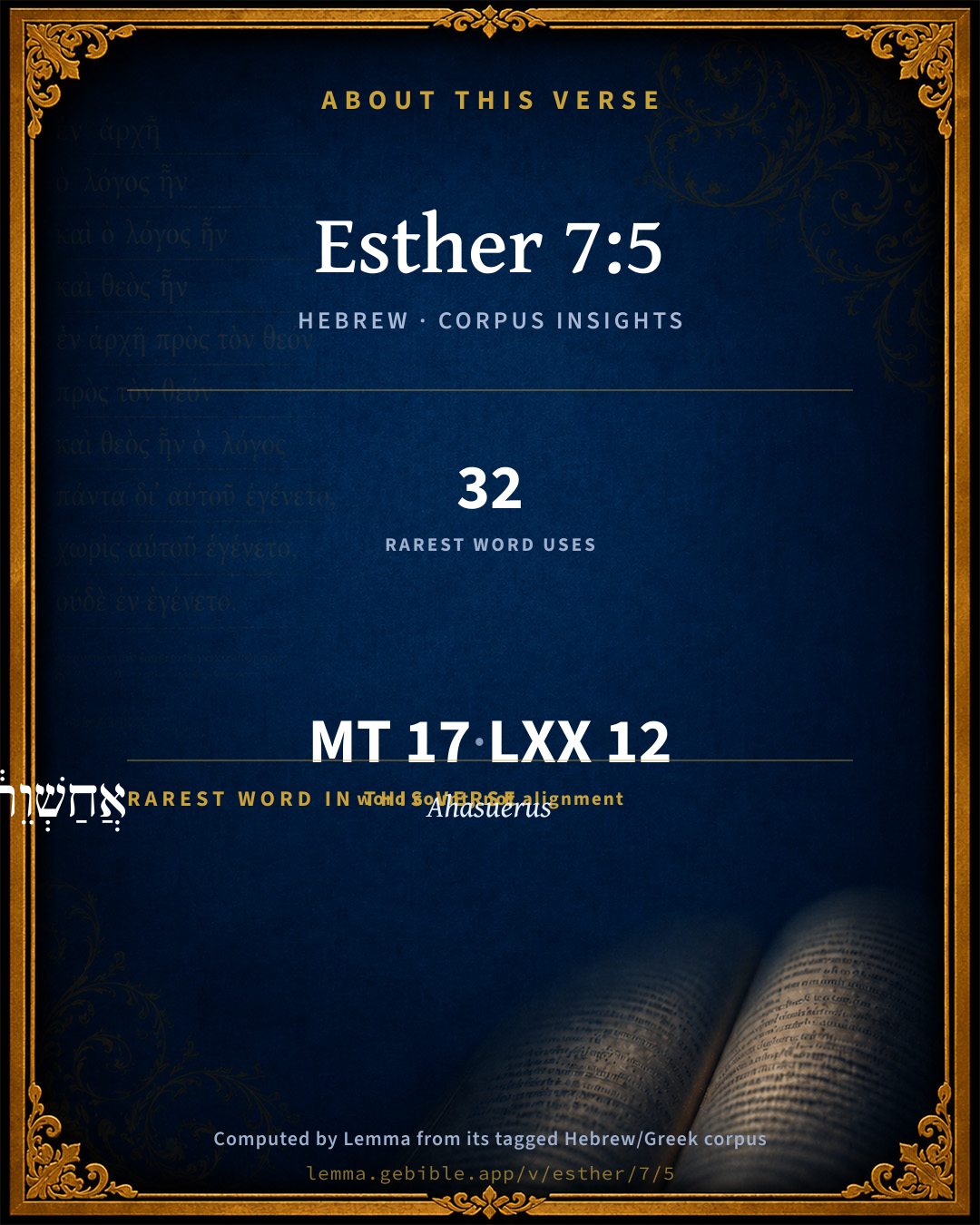
אֲחַשְׁוֵר֔וֹשׁ
ʼĂchashvêrôwsh
H325
“Ahasuerus”
Noun, Proper
Part of Speech
Noun
Type
Proper
Full BDB Definition

Origin: of Persian origin

TWOT: None

Ahasuerus = "I will be silent and poor" - title of the king of Persia, probably Xerxes
  1. וַיֹּ֨אמֶר֙ ʼâmar H559 “and · to say” Conjunction + Verb, Qal, Sequential Imperfect, 3rd Person, Masculine, Singular
  2. הַמֶּ֣לֶךְ melek H4428 “the · king” Particle, Definite Article + Noun, Common, Masculine, Singular, Absolute
  3. וַיֹּ֖אמֶר ʼâmar H559 “and · to say” Conjunction + Verb, Qal, Sequential Imperfect, 3rd Person, Masculine, Singular
  4. לְאֶסְתֵּ֣ר ʼEçtêr H635 “to/for · Esther” Preposition + Noun, Proper
  5. הַמַּלְכָּ֑ה malkâh H4436 “the · queen” Particle, Definite Article + Noun, Common, Feminine, Singular, Absolute
  6. מִ֣י mîy H4310 “who” Particle, Interrogative
  7. ה֥וּא hûwʼ H1931 “he” Pronoun, Personal, 3rd Person, Masculine, Singular
  8. זֶה֙ zeh H2088 “this” Pronoun, Demonstrative, Masculine, Singular
  9. וְאֵֽי ʼay H335 “and · where” Conjunction + Particle, Interrogative
  10. זֶ֣ה zeh H2088 “this” Pronoun, Demonstrative, Masculine, Singular
  11. ה֔וּא hûwʼ H1931 “he” Pronoun, Personal, 3rd Person, Masculine, Singular
  12. אֲשֶׁר ʼăsher H834 “which” Particle, Relative
  13. מְלָא֥וֹ mâlêʼ H4390 “to fill · him” Verb, Qal, Perfect, 3rd Person, Masculine, Singular + Suffix, Personal, 3rd Person, Masculine, Singular
  14. לִבּ֖וֹ lêb H3820 “heart · his” Noun, Common, Masculine, Singular, Construct + Suffix, Personal, 3rd Person, Masculine, Singular
  15. לַעֲשׂ֥וֹת ʻâsâh H6213 “to do” Preposition + Verb, Qal, Infinitive Construct
  16. כֵּֽן kên H3651 “thus” Particle, Demonstrative

About this verse

These counts appear in no published source. They are computed here, from the morphology-tagged text and Lemma’s own curated glosses. What Lemma adds →

17
words
14
distinct lemmas
Historical
section

Shared distinctive vocabulary

אֲחַשְׁוֵר֔וֹשׁ Ahasuerus H325 occurs in 30 verses of the Hebrew Bible. Also found in:

Grammatical profile

  • 4 verbs
  • 5 nouns
  • 4 pronouns
  • 4 particles

Verb forms

  • וַיֹּ֨אמֶר֙ Qal · Sequential Imperfect
  • וַיֹּ֖אמֶר Qal · Sequential Imperfect
  • מְלָא֥וֹ Qal · Perfect
  • לַעֲשׂ֥וֹת Qal · Infinitive Construct

Repetition

Words recur within this verse — often emphatic in Hebrew:

  • וַיֹּ֨אמֶר֙ to say H559 ×2
  • ה֥וּא he H1931 ×2
  • זֶה֙ this H2088 ×2

Hebrew & Septuagint length

In English translation the verse runs 27 words from the Hebrew and 14 from the Septuagint (LXX English) — the Septuagint runs noticeably shorter here. See the side-by-side →

A rough comparison of the two English renderings, which tokenize alike — not a word-level alignment.

Word counts can differ between the Hebrew and the Greek without any difference in meaning — e.g. the Hebrew direct-object marker אֵת has no separate Greek word, and Greek often adds the article ὁ.

In the original languages it is 17 Hebrew tokens and 12 Greek tokens — but the two are counted differently (Hebrew bundles its prefixes and suffixes into one token; the Greek is in lemma form), so that isn’t a like-for-like length.

Cross-references

3

Topical passages linked to Esther 7:5 in the Treasury of Scripture Knowledge — connected by theme and wording, ordered by reader-vote popularity; previews shown in the World English Bible.

  • Genesis 27:33 Isaac trembled violently, and said, "Who, then, is he who has taken venison, and brought it me, and I have eaten of all before you came, and have blessed him? Yes, he will be blessed."
  • Job 9:24 The earth is given into the hand of the wicked. He covers the faces of the judges of it. If not he, then who is it?
  • Acts 5:3 But Peter said, "Ananias, why has Satan filled your heart to lie to the Holy Spirit, and to keep back part of the price of the land?

Cross-references courtesy of OpenBible.info (CC BY 4.0).

Hebrew and Greek witnesses Masoretic Hebrew ↔ Greek Septuagint

The same verse in the two great witnesses to the Old Testament, shown verse-for-verse.

Here the Septuagint runs noticeably shorter than the Hebrew — LXX2012 (modern English Septuagint) 14 words vs World English Bible 27. A rough length comparison of the two English translations, not a word-level alignment — read both below.

These are two independent witnesses, not word-aligned to each other, and the Septuagint is shown in lemma (dictionary) form.

Hebrew Esther 7:5 Masoretic · Westminster Leningrad Codex

וַיֹּ֨אמֶר֙ הַמֶּ֣לֶךְ אֲחַשְׁוֵר֔וֹשׁ וַיֹּ֖אמֶר לְאֶסְתֵּ֣ר הַמַּלְכָּ֑ה מִ֣י ה֥וּא זֶה֙ וְאֵֽי זֶ֣ה ה֔וּא אֲשֶׁר מְלָא֥וֹ לִבּ֖וֹ לַעֲשׂ֥וֹת כֵּֽן

Then spoke the king Ahasuerus and said to Esther the queen, Who is he, and where is he, that dared presume in his heart to do so?

World English Bible · Public Domain

Greek LXX Esther 7:5 Septuagint · lemma form

εἶπον δέ ὁ βασιλεύς τίς οὗτος ὅστις τολμάω ποιέω ὁ πρᾶγμα οὗτος

And the king said, Who is this that has dared to do this thing?

LXX2012 (modern English Septuagint) · Public Domain

On this verse, The Pulpit Commentary discusses the Septuagint’s reading. Read the note in Commentary ↓

Hebrew: Westminster Leningrad Codex (CC BY 4.0). Greek: Septuagint (public domain); English from LXX2012 (modern English Septuagint) (Public Domain). How the Septuagint differs from the Hebrew →

Commentary

Notes on Esther 7:5 from classic Christian and Jewish commentators (each source and its license shown beneath its notes). The classic Christian expositions comment on the surrounding passage and are grouped to its opening verse, so a note may address several verses; the Jewish commentaries on the Tanakh (Rashi and others) are per-verse, so they appear only where the commentator wrote on this verse.

Lemma curates 59 commentaries, every one of them public domain or Creative Commons licensed, each selected and text-cleaned for this edition rather than reprinted as found. About our sources →

Trapp's Complete Commentary

John Trapp

Est 7:5 Then the king Ahasuerus answered and said unto Esther the queen, Who is he, and where is he, that durst presume in his heart to do so?

Ver. 5. Then the king Ahasuerus answered, &c.] It seems he did not yet, by all that Esther had said, understand whom she meant; so high an opinion he had of Haman his minion, the only ornament and bulwark of the empire, the greatest publicola, and most esteemed patriot. The king, therefore, as not thinking him so near at hand, hastily asketh, He said and said (so the Heb. hath it) to the queen.

Who is he, and where is he] Who is that sirrah, he, and where is that sirrah, he? Quis hic ipse, et ubi hic ille? words of utmost indignation and readiness to be revenged; such as were those of Charles V emperor: If that villain were here (speaking of Farnesius, the pope’s general, who had ravished certain ladies) I would kill him with mine own hand; or those of fiery Friar, who, openly in the pulpit at Antwerp, preaching to the people, wished that Luther were there, that he might tear him with his teeth (Paraei Medul. Hist. profan. Erasm. Eph 1:16, ad obtrectat). But could this king possibly so soon forget what himself had not two months before granted to be done against Esther’s people (which was with his right hand to cut off his left)? or did he not all this while know what countrywoman his beloved Esther was? and might he not expect that the Hamanists should come and take her forcibly from him to execution, by virtue of his own edict, as Daniel’s adversaries had dealt by him, though Darius laboured till the going down of the sun to deliver him, but could not? Dan 6:14; and as Stephen Gardiner and his complices attempted to do by Queen Catharine Parr, had not her husband, Henry VIII, rated them away, and graciously rescued her out of their bloody fingers?

That durst presume in his heart to do so?] Heb. Whose heart hath filled him to do so? Cuius cor persuasit ipsi, so Vatablus. Whose heart hath persuaded him thus to do. The devil had filled Haman’s heart, sitting abrood thereon, and hatching there this horrid plot, Act 5:3. But (to do the devil right) Haman had suffered the sun (nay, many suns) to go down upon his wrath, and thereby given place to the devil, Eph 4:26-27. Nemo sibi de suo palpet (saith an ancient), quisque sibi Satan est; Let no man deceive his own heart, each man is a Satan to himself; and though men bless themselves from having to do with the devil, and spit at his very name, yet they fetch not up their spittle low enough; they spit him out of their mouths, but not out of their hearts, as "being filled with all unrighteousness, fornication, wickedness, covetousness, maliciousness; full of envy, murder, debate, deceit, malignity," Rom 1:29. Haman’s heart thus stuffed might well have said to him at the gallows, as the heart of Apollodorus the tyrant seemed to say to him, who dreamed one night that he was flayed by the Scythians, and boiled in a cauldron, and that his heart spake to him out of the kettle, It is I that have drawn thee to all this. Eγω σοι τουτων αιτια. Those in hell cry so surely.

John Trapp, A Commentary or Exposition upon All the Books of the Old and New Testament (1647–1656) — public domain. Text from a community e-Sword module.

Joseph Benson's Commentary

Est 7:5. Then the king said, Who is he, and where is he, that durst presume in his heart to do so? — What! contrive the murder of the queen and all her friends? Is there such a man, or such a monster, rather, in nature? The expressions are short and doubled, as proceeding from a discomposed and enraged mind. The Hebrew is, Whose heart has filled him, as in the margin; or, Who hath filled his heart, to do so? He wonders that any one should be so wicked as to conceive such a thing, or that any one should be so bold as to attempt to effect it; that is, to circumvent him, and procure a decree, whereby not only his revenue should be so much injured, and so many of his innocent subjects destroyed, but his queen also involved in the same destruction. We sometimes startle at that evil which we ourselves are chargeable with. Ahasuerus is amazed at that wickedness which he himself was guilty of: for he had consented to the bloody edict; so that Esther might have said, Thou art the man!

Joseph Benson's Commentary on the Old and New Testaments (1811–1818) — public domain. Text from a community e-Sword module.

The Preacher's Complete Homiletical Commentary

Joseph S. Exell (gen. ed.)

CRITICAL NOTES.]

Est_7:5. Who is he] Ahasuerus could not really have doubted; but he affects to doubt, that he may express his anger at the act, apart from all personal considerations.—Rawlinson. Who … is he that durst presume] Lit., as the margin, whose heart has filled him to do this. The evil and ambitious man is filled with foul thoughts and purposes from the corrupt fountain of his own wicked heart.

Est_7:6.] Esther replies, “The adversary and enemy is this wicked Haman. Then was Haman afraid before the king and the queen.”

MAIN HOMILETICS OF THE PARAGRAPH. Est_7:5-6

THE DOINGS OF A WICKED HEART

Ahasuerus was yet in the dark. He had signed the decree for the extermination of the Jews at the instigation of Haman, he had seen Haman’s great ambition, he had heard Esther’s piteous appeal, but still he is not sharp enough to fix upon Haman as the offender. Perhaps it is that he does know, but waits to have a clear declaration from Esther’s own lips, but waits to see the case plainly settled that Haman was the guilty one.

I. A wicked heart induces foolhardiness. There is wisdom apparent in the renderings given by the translators of the Bible. They speak, for the most part, as if inspired by the Holy Ghost. Very suggestive is their rendering of the question uttered by Ahasuerus. “Who is he, and where is he, that durst presume in his heart to do so?” The daring presumption of those impelled by wicked hearts is indeed appalling. A wicked heart is both deceitful and deceiving. Haman’s wicked heart must have deceived him as to the daring nature of the course he had been pursuing. He only thought of gratifying an evil nature, and did not calmly consider the possible and very probable bitter consequences. This is characteristic of wicked hearts through all time. The foolhardiness of the wicked is astonishing. They appear as if bereft of their senses. When we see how clumsily they proceed to work, we ask, How could they hope to escape detection? What induced them to take the fatal step? How is it that they actually permit themselves to be caught in their own toils?

II. A wicked heart, sooner or later, meets with open condemnation. “And Esther said, The adversary and enemy is this wicked Haman.” It may be true that the wicked heart does not always meet with a righteous and indignant Esther come to judgment. Yet it cannot escape either here or hereafter. It will either discover itself or be discovered. The wicked heart will discover itself by its wicked fruits. For a long time it may work in secret, but ultimately all will be revealed. He that doeth evil may avoid the light, but he cannot always escape its detecting rays. There is only one way of escape, but there is one way, and it is all-sufficient. That one way is repentance towards God and faith in our Lord Jesus Christ. If the light shines upon the wicked heart, and the man sees with holy remorse the evil of his nature, then there may be, and is, a way of escape. If we say the wicked heart must meet with open condemnation, we mean if that wicked heart will not condemn itself, but continues obdurate and impenitent.

III. A wicked heart leads to fearfulness. “Then Haman was afraid before the king and the queen.” The wicked flee when no man pursueth. If a man has not his sensibilities all deadened, then he must be afraid in the midst of his wickedness. All the annals of crime tell us that fearfulness surprises the wicked. They live in constant terrors. Haman, however, had now outward reason for fear. How greatly was he troubled at this crisis! He had fears within. There were fightings against him without. Easy it is for us to say that Haman was a coward. Who would not have been a coward under the trying circumstances? A virtuous soul may be calm and brave in the face of outward terrors; but strange would it be if a vicious soul did not give way to fear. Hardened sinners may pass through the terrors of time with apparently unmoved natures; but in the great day of Divine wrath they will say to the mountains and rocks, Fall on us, and hide us from the face of him that sitteth on the throne, and from the wrath of the Lamb.

SUGGESTIVE COMMENTS ON Est_7:5-6

Now Queen Esther musters up her inward forces, and, with an undaunted courage, fixing her angry eyes upon the hated Agagite, she says, “The adversary and enemy is this wicked Haman.” The word was loath to come forth, but it strikes home at the last. Never till now did Haman hear his true title; before, some had styled him noble, others great, others magnificent, and some, perhaps, virtuous; only Esther gave him his own, “Wicked Haman.” Ill-deserving greatness doth in vain promise to itself a perpetuity of applause. If our ways be foul, the time shall come when, after all vain flattery, after all our momentary glory, our sins shall be ripped up, and our iniquities laid before us, to our utter confusion. With what consternation did Haman now stand! How do we think he looked to hear himself thus enstyled, thus accused, yea, thus condemned? Certainly death was in his face, and horror in every one of his joints. No sense, no limb knows his office. Fain would he speak; but his tongue falters, and his lips tremble. Fain would he make apologies upon his knees; but his heart fails him, and tells him the evidence is too great. Only guiltiness and fear look through his eyes upon the enraged countenance of his master, which now bodes nothing to him but revenge and death.—Bishop Hall.

Est_7:5. Then the king Ahasuerus answered and said unto Esther the queen, Who is he, and where is he, that durst presume in his heart to do so?

What! to compass the death of the queen, and, as if that were too small a wickedness, the destruction of all her people also! Was a man so wicked to be found in any of the hundred and twenty-seven provinces of the king’s dominions? If there were such a daring criminal to be found, no death was too terrible for him.

What, then, will our Lord do when he rises up to revenge the wrongs done to himself in the persons of his brethren; of those who are espoused to him in righteousness, and in judgment, and in loving-kindness, and in mercies? Will he not account the wrongs done to them to have been done to himself? When he maketh inquisition for blood, woe to them that are stained with bloody crimes against his people. The wrath of Ahasuerus against the enemies of the Jews was a fruit of God’s wrath against them. He forgot not his promise to Abraham, “I will bless him that blesseth thee, and I will curse him that curseth thee.”

“What and where is he that durst do this thing?”—What if Ahasuerus himself is the man, although it would have been unwise in the queen to tell him that he was. He was certainly, though unconscious of it, a partner in this wickedness; and yet he was filled with horror at hearing that any person could dare to load himself with such guilt. Thus David was filled with anger against a man who was only the emblem of himself.* Consider what abhorrence you have of the sins of other men, and consider how like your own sins are to theirs, and let your souls be humbled within you. Take care how you speak of the sins of other men, lest your tongues condemn yourselves. Your sins are probably much liker to theirs than you imagine, till you have well considered the matter. Perhaps they are a great deal worse, when every circumstance is considered.

Est_7:6. And Esther said, The adversary and enemy is this wicked Haman. Then Haman was afraid before the king and the queen.

Haman now finds for what reason he was invited by the queen to her banquet. It was, to be accused to his face of the blackest crime. He had an opportunity of saying what could be said (if anything could be said) in his own vindication, or in mitigation of his offence. But if he had nothing to say, it was to be expected that the confusion of his face would be a witness against him.

This was actually the case. “Then Haman was afraid before the king and the queen.” He had too good reason to tremble for his life. The queen had brought a dreadful accusation against him, and his guilt was too apparent to be denied or to be extenuated. It was, besides, of a nature fitted to excite the king’s fiercest indignation and bitterest rage.—Lawson.

The Preacher's Complete Homiletical Commentary (gen. ed. Joseph S. Exell; Funk & Wagnalls, c. 1892) — public domain (pre-1929). A full-Bible homiletical/sermon-outline anthology covering 65 of 66 books (2 John is absent from the source module). Text from a community e-Sword module.

Tyndale Open Study Notes

Tyndale Open Resources

7:5 Who would do such a thing? The king could hardly believe what he was hearing and could not imagine someone trying to do this atrocious thing. He asks for no details about Esther’s accusations, assuming they were all true (cp. 3:10).

Tyndale Open Study Notes — © Tyndale Open Resources, licensed CC BY-SA 4.0. Text via the HelloAO Bible API.

Geneva Bible (1599)

Geneva Bible translators

Hebrew, filleth his heart.

Geneva Bible (1599) marginal notes — public domain. Text via Bolls.life.

Adam Clarke's Commentary

Verse 5. Who is he, and where is he] There is a wonderful abruptness and confusion in the original words, highly expressive of the state of mind in which the king then was:

מי הוא זה ואי זה הוא אשר מלאו לבו לעשות כן mi hu zeh veey zeh hu asher melao libbo laasoth ken.

"Who? He? This one? And where? This one? He? Who hath filled his heart to do thus?"

He was at once struck with the horrible nature of a conspiracy so cruel and diabolic.

Adam Clarke's Commentary on the Bible (1810–1826) — public domain. Text from a community e-Sword/MySword module.

John Gill's Exposition

Then the King Ahasuerus answered and said unto Esther the queen,.... The words in the original text lie thus, "and the King Ahasuerus said, and he said to Esther the queen"; which doubling of the word does not signify, as Jarchi suggests, that before he spoke to her by a messenger, or middle person, but, now he knew she was of a royal family, he spoke to her himself; but it is expressive of the ruffle of his mind, and the wrath and fury he was in, that he said it again and again, with a stern countenance and great vehemence of speech:

who is he? and where is he? who is the man? and where does he live?

that durst presume in his heart to do so; that has boldness, impudence, and courage enough to perpetrate so vile an action: or "that has filled his heart" (i); the devil no doubt filled his heart to do it, see Act 5:3, but the king had either forgot the decree he had granted, and the countenance he had given him to execute it; or, if he remembered it, he was now enraged that he should be drawn in to such an action by him; and perhaps till now was ignorant of Esther's descent, and knew not that she would be involved in the decree.

(i) "qui replevit cor suum", Drusius; "implevit", De Dieu.

John Gill's Exposition of the Whole Bible (1746–1763) — public domain (CC PDM 1.0). Text via the HelloAO Bible API.

Haydock's Catholic Bible Commentary

What. Hebrew, "where, who durst entertain this design?" (Haydock)

George Leo Haydock (1774–1849), Haydock's Catholic Family Bible and Commentary, 1859 edition — public domain. Excludes Psalms (Douay-Rheims chapter numbering differs from Protestant) and Deuterocanonical books (Catholic canon only).

Matthew Poole's English Annotations

Who is he? and

where is he? The expressions are short and doubled, as proceeding from a discomposed and enraged mind.

To do so, i.e. to circumvent me, and by subtlety to procure an irrevocable decree, whereby not only my estate should be so much impaired, and so many of my innocent subjects be destroyed without mercy, but my queen also should be involved in the same danger and destruction.

Matthew Poole's English Annotations on the Holy Bible (1683–1685) — public domain. Text from a community e-Sword/MySword module.

Whedon's Commentary on the Bible

Daniel D. Whedon

5. Who is he — If the king now suspected, as probably he did, who the guilty person was, he would naturally, first, express his emotion and surprise as here represented. “He affects to doubt,” says Rawlinson, “that he may express his anger at the act apart from all personal considerations.”

Probably both Haman and the king now first learned, and were surprised to find, that Esther was a Jewess.

Who… is he that durst presume — Literally, as the margin, whose heart has filled him to do thus. The evil and ambitious man is filled with foul thoughts and purposes from the corrupt fountain of his own wicked heart. Comp. Mat_15:19.

Daniel D. Whedon (gen. ed.), Commentary on the Old and New Testaments (1874–1909) — public domain. Text from a community e-Sword module.

The Pulpit Commentary

Who is he? Ahasuerus asks the question to "make sure," as we say not that he could really be in any doubt. That durst presume. Rather, "that hath presumed" (ostiv ejtolmhse. LXX).

The Pulpit Commentary (1880–1919), ed. H.D.M. Spence-Jones & Joseph S. Exell — public domain. Text from a community e-Sword module.

John Wesley's Explanatory Notes

Who, &c. - The expressions are short and doubled, as proceeding from a discomposed and enraged mind. Durst - That is, to circumvent me, and procure a decree, whereby not only my estate should be so much impaired, and so many of my innocent subjects destroyed, but my queen also involved in the same destruction. We sometimes startle at that evil, which we ourselves are chargeable with. Ahasuerus is amazed at that wickedness, which he himself was guilty of. For he consented to the bloody edict. So that Esther might have said, Thou art the man!

John Wesley, Explanatory Notes Upon the Whole Bible (1754–1765) — public domain. Text via the GEBible commentary corpus.

Rashi

Rabbi Shlomo Yitzchaki (Rashi)

And King Ahasuerus said, and he said to Queen Esther Wherever it says, “And he said, and he said,” twice, it is to be expounded upon, and the midrashic interpretation of this is: Originally, he would speak to her by messenger, but now that he knew that she was of a royal family, he spoke to her personally.

Rashi on the Tanakh — English translations: “The Judaica Press complete Tanach with Rashi, translated by A. J. Rosenberg” (CC BY 4.0); “Pentateuch with Rashi's commentary by M. Rosenbaum and A.M. Silbermann, 1929-1934” (public domain); “The Metsudah Tanach series, Lakewood, N.J” (CC BY 4.0); and “The Book of Joshua, Metsudah Publications, 1997” (CC BY 4.0). Text via Sefaria.

Lesson kit

Teaching starters — assembled from the data on this page, not authored interpretation. Every prompt links to the verse data it draws on. Edit before teaching.

Esther, in the Historical, opens this verse with 17 words (14 distinct Hebrew lemmas). Its most distinctive word is ʼĂchashvêrôwsh (“Ahasuerus”). The Greek Septuagint runs shorter here. A historical commentator’s framing appears above. Read the whole chapter for the surrounding context.

Discussion questions

  1. The word ʼĂchashvêrôwsh carries the sense “Ahasuerus.” How does it shape the verse?
  2. How does Ezra 4:6, which shares the word «Ahasuerus», read alongside this verse?
  3. What does the repetition of “to say” (2× in this one verse) do in this verse?
  4. The Septuagint runs shorter here than the Hebrew. What might account for the difference?
  5. The translations on this page render this verse differently — a whole-verse word diff, not a word-by-word alignment. What might account for the different wordings?
  6. «וַיֹּ֨אמֶר֙» is a Qal Sequential Imperfect verb. How does that grammatical form shape the action described?
  7. Compare how Trapp's Complete Commentary and Joseph Benson's Commentary read this verse. Where do they agree or differ?

Things to notice

Reading settings

Reading text

Shown beneath each verse's original-language words.

Old Testament
Old Testament edition

Read the OT as the Masoretic Hebrew (MT) or the Greek Septuagint (LXX).

English shown for the Greek Septuagint (in the Hebrew ↔ Greek comparison).

Comparing translations? Open the Compare panel on any verse page to stack up to four side by side.