

Colossians 2:23
Greek (Tischendorf 8th ed.) Colossians 2:23 appears in the Greek New Testament. The text above is from the Tischendorf 8th edition. Each word links to its Strong’s number and a concise gloss. Click any word for its full Thayer’s Greek Lexicon entry.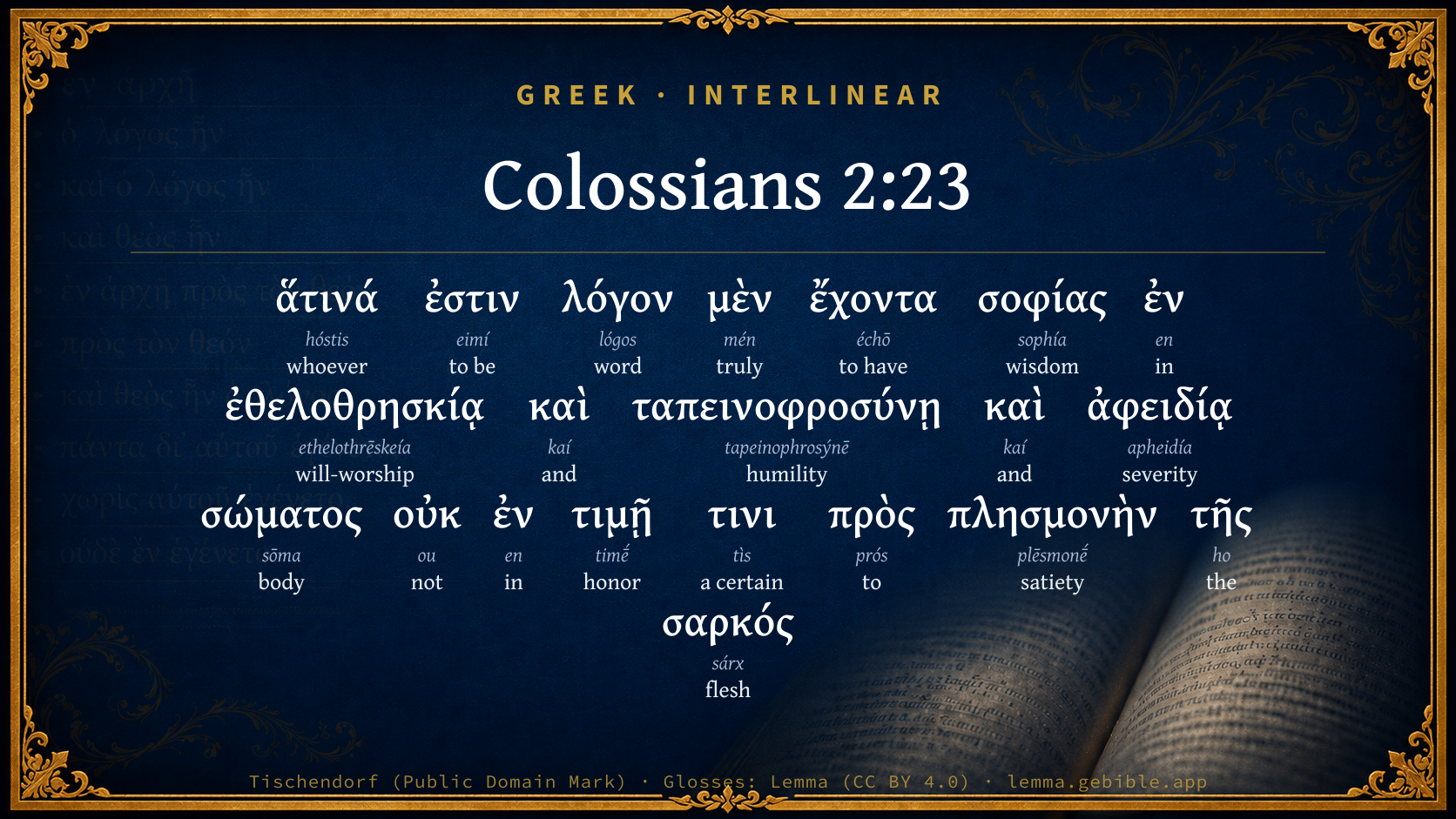
Which things indeed appear like wisdom in self-imposed worship, and humility, and severity to the body; but aren't of any value against the indulgence of the flesh.
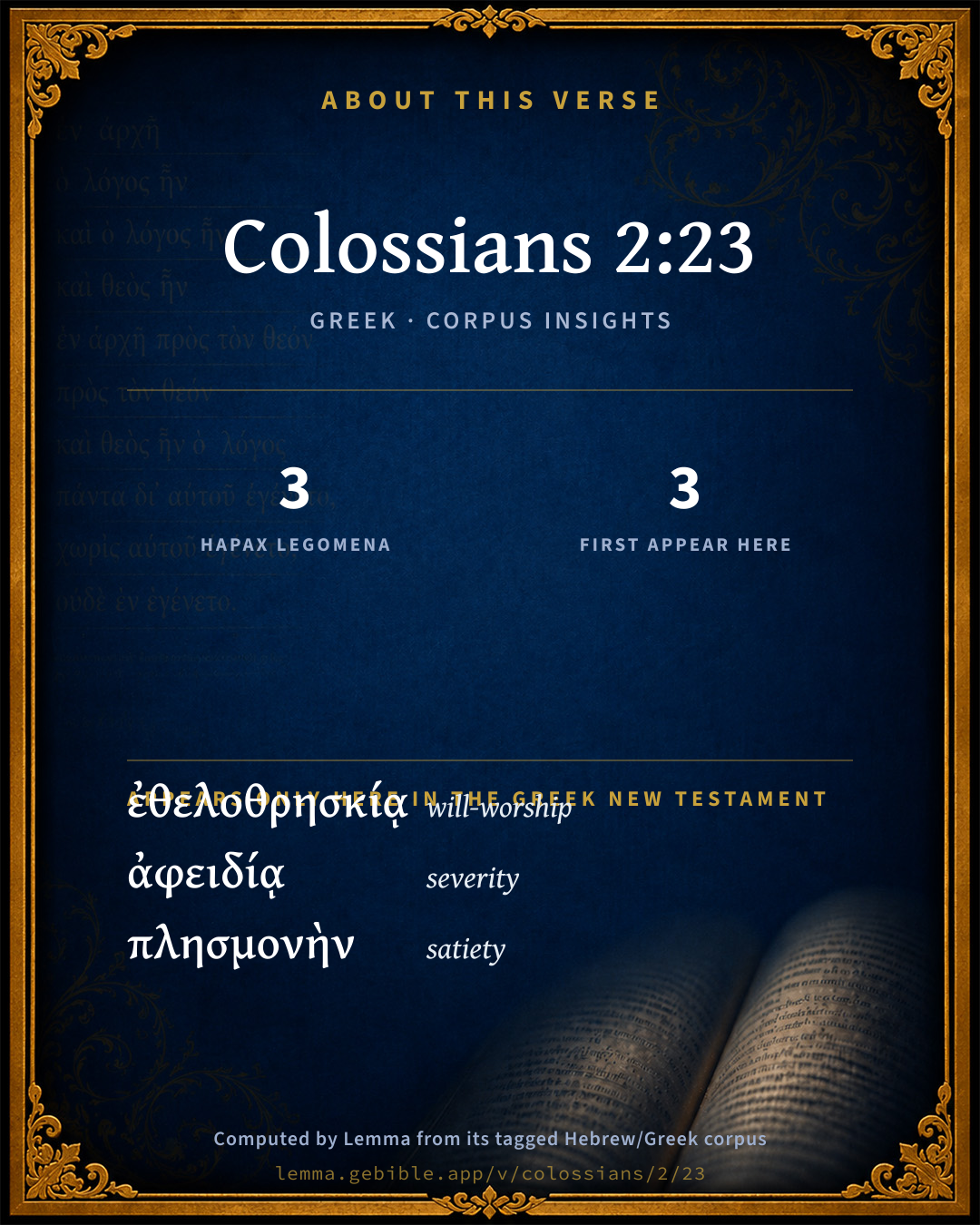
- 3 hapax legomena — only here in the Greek New Testament
- 3 first appearances in the Greek New Testament
Download a study sheet
One document with this verse’s original text, its word-by-word gloss line, the meaning frame, cross-references with their text, attributed commentary, and full source and license credits — printable, and it pastes into notes with its structure intact.
This verse Autodidact and up
A passage Seminary Student
Up to 50 verses in one chapter. A passage sheet keeps up to 6 commentary sources and 12 cross-references per verse, in the order this page ranks them, and says so on the sheet whenever that leaves anything out. Ask for a single verse and you get the Autodidact verse sheet above.
Everything on this page stays free to read, with no account — the sheet is a download of what is already on screen, not access to it.
Compare translations 3
The same verse in 3 English versions, stacked beneath the original-language interlinear above. Click any original word for its lexicon entry.
Each is an independent rendering of the whole verse — the interlinear is not word-aligned to these translations.
Highlighted words mark where these versions differ — a whole-verse word diff, not a word-by-word alignment.
-
World English Bible Public Domain
Which things indeed appear like wisdom in self-imposed worship, and humility, and severity to the body; but aren't of any value against the indulgence of the flesh.
-
King James Version Public Domain
Which things have indeed a shew of wisdom in will worship, and humility, and neglecting of the body: not in any honour to the satisfying of the flesh.
-
unfoldingWord Literal Text CC BY-SA 4.0
which, having indeed a word of wisdom in self-made religion and false humility severity of the body, are not of any value against indulgence of the flesh.
unfoldingWord Literal Text — © unfoldingWord, licensed CC BY-SA 4.0. Word-aligned USFM3 via Door43 (git.door43.org/unfoldingWord/en_ult).
Show all 19 translations
Every available English version of this verse, each an independent rendering of the whole verse.
-
World English Bible Public Domain
Which things indeed appear like wisdom in self-imposed worship, and humility, and severity to the body; but aren't of any value against the indulgence of the flesh.
-
Berean Standard Bible Public Domain
Such restrictions indeed have an appearance of wisdom, with their self-prescribed worship, their false humility, and their harsh treatment of the body; but they are of no value against the indulgence of the flesh.
-
Majority Standard Bible Public Domain
Such restrictions indeed have an appearance of wisdom, with their self-prescribed worship, their false humility, and their harsh treatment of the body; but they are of no value against the indulgence of the flesh.
-
King James Version Public Domain
Which things have indeed a shew of wisdom in will worship, and humility, and neglecting of the body: not in any honour to the satisfying of the flesh.
-
American Standard Version (1901) Public Domain
Which things have indeed a show of wisdom in will-worship, and humility, and severity to the body; `but are' not of any value against the indulgence of the flesh.
-
Revised Version (1885) Public Domain
Which things have indeed a show of wisdom in will-worship, and humility, and severity to the body; but are not of any value against the indulgence of the flesh.
-
Geneva Bible (1599) Public Domain
Which thinges haue in deede a shewe of wisdome, in voluntarie religion and humblenesse of minde, and in not sparing the body, which are thinges of no valewe, sith they perteine to the filling of the flesh.
-
Douay-Rheims (1899) Public Domain
Which things have indeed a shew of wisdom in superstition and humility, and not sparing the body; not in any honour to the filling of the flesh.
-
Young's Literal Translation Public Domain
which are, indeed, having a matter of wisdom in will-worship, and humble-mindedness, and neglecting of body -- not in any honour, unto a satisfying of the flesh.
-
Literal Standard Version CC BY-SA 4.0
which are, indeed, having a matter of wisdom in self-willed religion, and humble-mindedness, and neglecting of body—not of any value to satisfying the flesh.
-
Unlocked Literal Bible CC BY-SA 4.0
These rules have the wisdom of self-made religion and humility and severity of the body. But they have no value against the indulgence of the flesh.
-
unfoldingWord Literal Text CC BY-SA 4.0
which, having indeed a word of wisdom in self-made religion and false humility severity of the body, are not of any value against indulgence of the flesh.
-
Darby Bible Public Domain
(which have indeed an appearance of wisdom in voluntary worship, and humility, and harsh treatment of the body, not in a certain honour,) to [the] satisfaction of the flesh.
-
World Messianic Bible Public Domain
These things indeed appear like wisdom in self-imposed worship, humility, and severity to the body, but aren’t of any value against the indulgence of the flesh.
-
Webster's Bible Public Domain
Which things have indeed a show of wisdom in will-worship, and humility, and neglecting of the body; not in any honor to the satisfying of the flesh.
-
Free Bible Version CC BY-SA 4.0
Such rules may make some kind of sense to those who practice self-centered piety, who are so proud of being humble, and who “mortify the body;” but in reality they don't help at all in dealing with sinful desires.
-
Bible in Basic English Public Domain
These things seem to have a sort of wisdom in self-ordered worship and making little of oneself, and being cruel to the body, not honouring it by giving it its natural use.
-
Text-Critical English NT CC BY 4.0
Although these regulations have a semblance of wisdom in self-imposed piety, false humility, and severe treatment of the body, they are of no value in restraining fleshly indulgence.
-
Tyndale New Testament (1534) Public Domain
which thinges have the similitude of wisdome in chosen holynes and humblenes and in that they spare not the body and do the flesshe no worshype vnto his nede.
Literal Standard Version (2020), Covenant Press — licensed CC BY-SA 4.0. Text via the HelloAO Bible API (eBible.org). Unlocked Literal Bible (unfoldingWord) — licensed CC BY-SA 4.0. Text via the HelloAO Bible API (eBible.org). unfoldingWord Literal Text — © unfoldingWord, licensed CC BY-SA 4.0. Word-aligned USFM3 via Door43 (git.door43.org/unfoldingWord/en_ult). Free Bible Version, Dr. Jonathan Gallagher — licensed CC BY-SA 4.0. Text via the HelloAO Bible API (eBible.org).
Word by word
More ways to search: Search by grammar → Find every occurrence → Compare this word →
Practice this passage: Drill this verse → Learn its vocabulary →
- Appears 1× in the Greek New Testament
- First appears here
- Part of Speech
- Noun
- Case
- Dative
- Number
- Singular
- Gender
- Feminine
Full Thayer's Definition
- ἅτινά hóstis G3748 “whoever” Relative pronoun, Nominative, Plural, Neuter
- ἐστιν eimí G1510 “to be” Verb, Present, Active, Indicative, 3rd person, Singular
- λόγον lógos G3056 “word” Noun, Accusative, Singular, Masculine
- μὲν mén G3303 “truly” Particle
- ἔχοντα échō G2192 “to have” Verb, Present, Active, Participle, Nominative, Plural, Neuter
- σοφίας sophía G4678 “wisdom” Noun, Genitive, Singular, Feminine
- ἐν en G1722 “in” Preposition
- ἐθελοθρησκίᾳ ethelothrēskeía G1479 “will-worship” Noun, Dative, Singular, Feminine
- καὶ kaí G2532 “and” Conjunction
- ταπεινοφροσύνῃ tapeinophrosýnē G5012 “humility” Noun, Dative, Singular, Feminine
- καὶ kaí G2532 “and” Conjunction
- ἀφειδίᾳ apheidía G857 “severity” Noun, Dative, Singular, Feminine
- σώματος sōma G4983 “body” Noun, Genitive, Singular, Neuter
- οὐκ ou G3756 “not” Particle, Negative
- ἐν en G1722 “in” Preposition
- τιμῇ timḗ G5092 “honor” Noun, Dative, Singular, Feminine
- τινι tìs G5100 “a certain” Indefinite pronoun, Dative, Singular, Feminine
- πρὸς prós G4314 “to” Preposition
- πλησμονὴν plēsmonḗ G4140 “satiety” Noun, Accusative, Singular, Feminine
- τῆς ho G3588 “the” Article, Genitive, Singular, Feminine
- σαρκός sárx G4561 “flesh” Noun, Genitive, Singular, Feminine
About this verse
These counts appear in no published source. They are computed here, from the morphology-tagged text and Lemma’s own curated glosses. What Lemma adds →
- 21
- words
- 19
- distinct lemmas
- Pauline Epistles
- section
Notable vocabulary
3 hapax legomena — words that appear only here in the entire Greek New Testament:
First appearance in Scripture
These words make their first canonical appearance in the Greek New Testament here:
Shared distinctive vocabulary
ταπεινοφροσύνῃ humility G5012 occurs in 8 verses of the Greek New Testament. Also found in:
Cross-references
9Topical passages linked to Colossians 2:23 in the Treasury of Scripture Knowledge — connected by theme and wording, ordered by reader-vote popularity; previews shown in the World English Bible.
- 1 Timothy 4:8 For bodily exercise has some value, but godliness has value for all things, having the promise of the life which is now, and of that which is to come.
- Colossians 2:8 Be careful that you don't let anyone rob you through his philosophy and vain deceit, after the tradition of men, after the elements of the world, and not after Christ.
- Colossians 2:18 Let no one rob you of your prize by a voluntary humility and worshipping of the angels, dwelling in the things which he has not seen, vainly puffed up by his fleshly mind,
- Colossians 2:22 (all of which perish with use), according to the precepts and doctrines of men?
- Matthew 23:27–28 "Woe to you, scribes and Pharisees, hypocrites! For you are like whitened tombs, which outwardly appear beautiful, but inwardly are full of dead men's bones, and of all uncleanness.
- 2 Corinthians 11:13–15 For such men are false apostles, deceitful workers, masquerading as Christ's apostles.
- Ephesians 5:29 For no man ever hated his own flesh; but nourishes and cherishes it, even as the Lord also does the assembly;
- 1 Timothy 4:3 forbidding marriage and commanding to abstain from foods which God created to be received with thanksgiving by those who believe and know the truth.
- Genesis 3:5–6 for God knows that in the day you eat it, your eyes will be opened, and you will be like God, knowing good and evil."
Cross-references courtesy of OpenBible.info (CC BY 4.0).
Lesson kit
Teaching starters — assembled from the data on this page, not authored interpretation. Every prompt links to the verse data it draws on. Edit before teaching.
Colossians, in the Pauline Epistles, opens this verse with 21 words (19 distinct Greek lemmas). Its most distinctive word is ethelothrēskeía (“will-worship”). A historical commentator’s framing appears above. Read the whole chapter for the surrounding context.
Discussion questions
- What does “will-worship” (ethelothrēskeía) contribute to the verse as a whole?
- 3 words here appear nowhere else in the Greek New Testament. Why might the author reach for such rare wording?
- 3 words make their first appearance in Scripture here. What does this debut establish?
- How does Acts 20:19, which shares the word «humility», read alongside this verse?
- What does the repetition of “in” (2× in this one verse) do in this verse?
- These translations render this verse differently; the difference is in the English rendering, not the original. What questions does that raise?
- Compare how Tyndale Open Study Notes and Bengel's Gnomon read this verse. Where do they agree or differ?
Things to notice
- 3 words in this verse appear nowhere else in the Greek New Testament.
- 3 words make their first canonical appearance in Scripture here.
- These translations choose different wording for 21 words in this verse.
- “in” occurs 2× in this single verse.
- 19 distinct Greek lemmas span 21 words in this verse.
Commentary
Notes on Colossians 2:23 from classic Christian and Jewish commentators (each source and its license shown beneath its notes). The classic Christian expositions comment on the surrounding passage and are grouped to its opening verse, so a note may address several verses; the Jewish commentaries on the Tanakh (Rashi and others) are per-verse, so they appear only where the commentator wrote on this verse.
Lemma curates 59 commentaries, every one of them public domain or Creative Commons licensed, each selected and text-cleaned for this edition rather than reprinted as found. About our sources →
Tyndale Open Study Notes
Tyndale Open Resources
Tyndale Open Study Notes — © Tyndale Open Resources, licensed CC BY-SA 4.0. Text via the HelloAO Bible API.
Bengel's Gnomon
Johann Albrecht Bengel
Bengel's Gnomon of the New Testament — English translation (T&T Clark, Edinburgh, 1860) — public domain. Text from a community e-Sword module.
Meyer's Critical & Exegetical Commentary
Heinrich August Wilhelm Meyer
Meyer — Critical and Exegetical Commentary on the New Testament — English translation by Peter Christie, edited by Frederick Crombie (T&T Clark, 1880) — public domain. Text from a community e-Sword module.
Expositor's Greek Testament
ed. W. Robertson Nicoll
The Expositor's Greek Testament, edited by W. Robertson Nicoll (1897–1910) — public domain. Text from a community e-Sword module.
Geneva Bible (1599)
Geneva Bible translators
Geneva Bible (1599) marginal notes — public domain. Text via Bolls.life.
Jamieson, Fausset & Brown
Robert Jamieson, A. R. Fausset & David Brown
Jamieson, Fausset & Brown — Commentary Critical and Explanatory on the Whole Bible (1871) — public domain (CC PDM 1.0). Text via the HelloAO Bible API.
Adam Clarke's Commentary
Adam Clarke's Commentary on the Bible (1810–1826) — public domain. Text from a community e-Sword/MySword module.
John Calvin's Commentaries
John Calvin's Commentaries (1540-1563) — public domain. Text from the Calvin Translation Society English edition (1840s-50s) via the Christian Classics Ethereal Library (ccel.org). Calvin's coverage is partial (roughly two-thirds of the Bible); uncommented books and verses are honest gaps, never fabricated. The 19th-century editor's footnotes and remarks are omitted so the notes are faithfully Calvin's own voice.
Ellicott's Commentary for English Readers
A Bible Commentary for English Readers, edited by Charles John Ellicott (1878–1897) — public domain. Text from a community e-Sword module.
The Cambridge Bible for Schools and Colleges
gen. ed. J. J. S. Perowne
The Cambridge Bible for Schools and Colleges (gen. ed. J. J. S. Perowne; Cambridge University Press, 1878–1918) — public domain. Text from a community e-Sword module.
John Gill's Exposition
John Gill's Exposition of the Whole Bible (1746–1763) — public domain (CC PDM 1.0). Text via the HelloAO Bible API.
Trapp's Complete Commentary
John Trapp
John Trapp, A Commentary or Exposition upon All the Books of the Old and New Testament (1647–1656) — public domain. Text from a community e-Sword module.
Albert Barnes' Notes on the Bible
Albert Barnes' Notes on the Bible (1834–1885) — public domain. Text from a community e-Sword/MySword module.
Haydock's Catholic Bible Commentary
George Leo Haydock (1774–1849), Haydock's Catholic Family Bible and Commentary, 1859 edition — public domain. Excludes Psalms (Douay-Rheims chapter numbering differs from Protestant) and Deuterocanonical books (Catholic canon only).
Matthew Poole's English Annotations
Matthew Poole's English Annotations on the Holy Bible (1683–1685) — public domain. Text from a community e-Sword/MySword module.
Whedon's Commentary on the Bible
Daniel D. Whedon
Daniel D. Whedon (gen. ed.), Commentary on the Old and New Testaments (1874–1909) — public domain. Text from a community e-Sword module.
The Pulpit Commentary
The Pulpit Commentary (1880–1919), ed. H.D.M. Spence-Jones & Joseph S. Exell — public domain. Text from a community e-Sword module.
John Wesley's Explanatory Notes
John Wesley, Explanatory Notes Upon the Whole Bible (1754–1765) — public domain. Text via the GEBible commentary corpus.
Scofield Reference Notes
C. I. Scofield
The Scofield Reference Bible (1917 edition), notes by C. I. Scofield — public domain. Text from a community e-Sword module.
The People's New Testament
B. W. Johnson
B. W. Johnson's The People's New Testament with Notes (1889–1891) — public domain. Electronic text from the Christian Classics Ethereal Library (CCEL) ThML edition.
Cambridge Greek Testament for Schools and Colleges
Cambridge Greek Testament for Schools and Colleges (Cambridge University Press, 1896; 21 vols, various authors incl. Carr, Maclear, Plummer, Farrar, Lumby, Moule, M. R. James, Simcox) — public domain. Text from a community e-Sword module.
International Critical Commentary
International Critical Commentary — older volumes (1896–1929), various authors — public domain. Text from a community e-Sword module.
Lightfoot's Colossians and Philemon
J. B. Lightfoot
J. B. Lightfoot, St Paul's Epistles to the Colossians and Philemon: a revised text with introductions, notes and dissertations (London: Macmillan, 1875) — public domain. Electronic text from Project Gutenberg (ebook #50857). Covers Colossians and Philemon only (the verse-by-verse notes; introductions and dissertations are omitted); Lightfoot's companion Galatians and Philippians volumes are not included, as the available public-domain scans carry garbled Greek that cannot be faithfully reproduced.