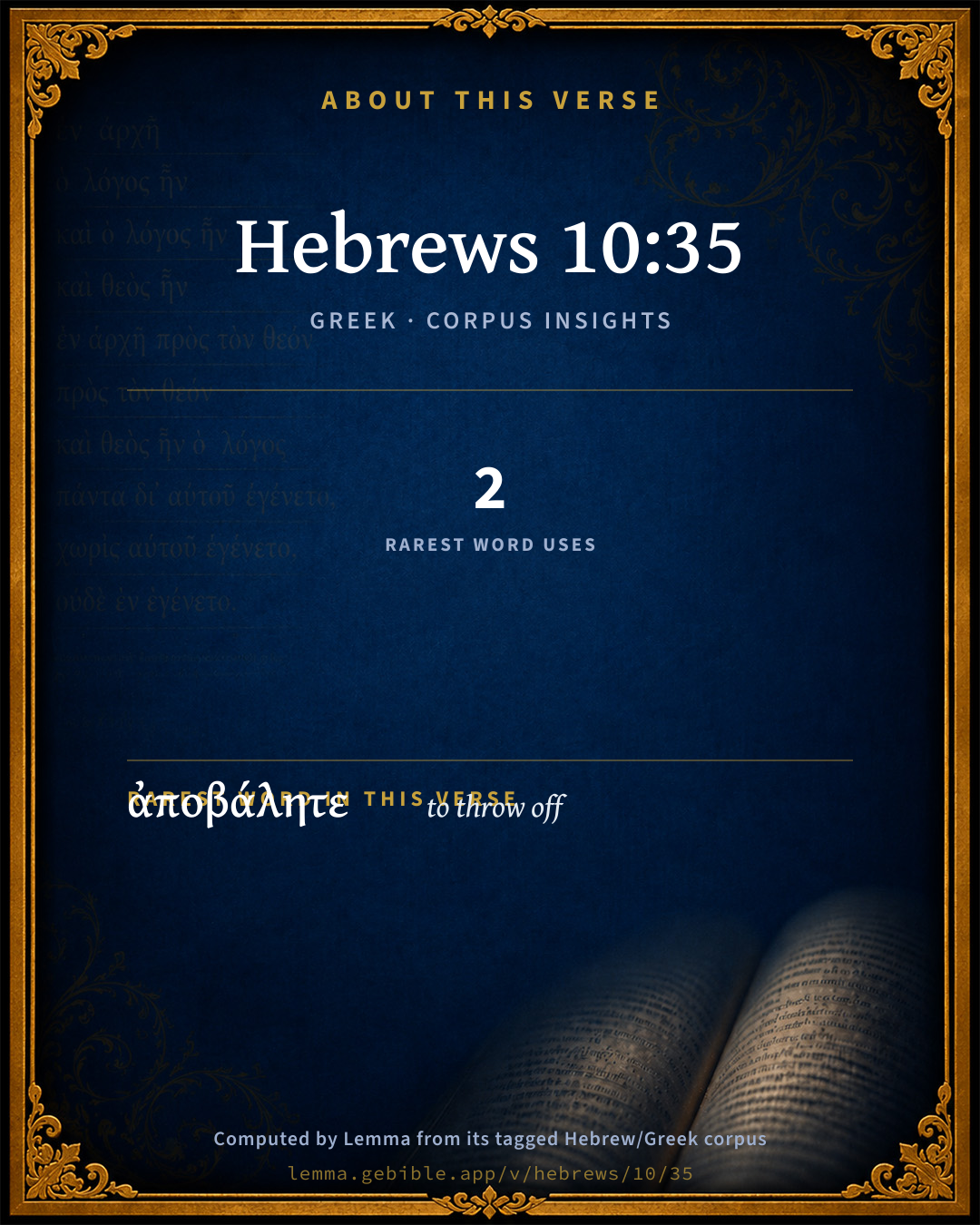
Hebrews 10:35

Greek (Tischendorf 8th ed.) Hebrews 10:35 appears in the Greek New Testament. The text above is from the Tischendorf 8th edition. Each word links to its Strong’s number and a concise gloss. Click any word for its full Thayer’s Greek Lexicon entry.
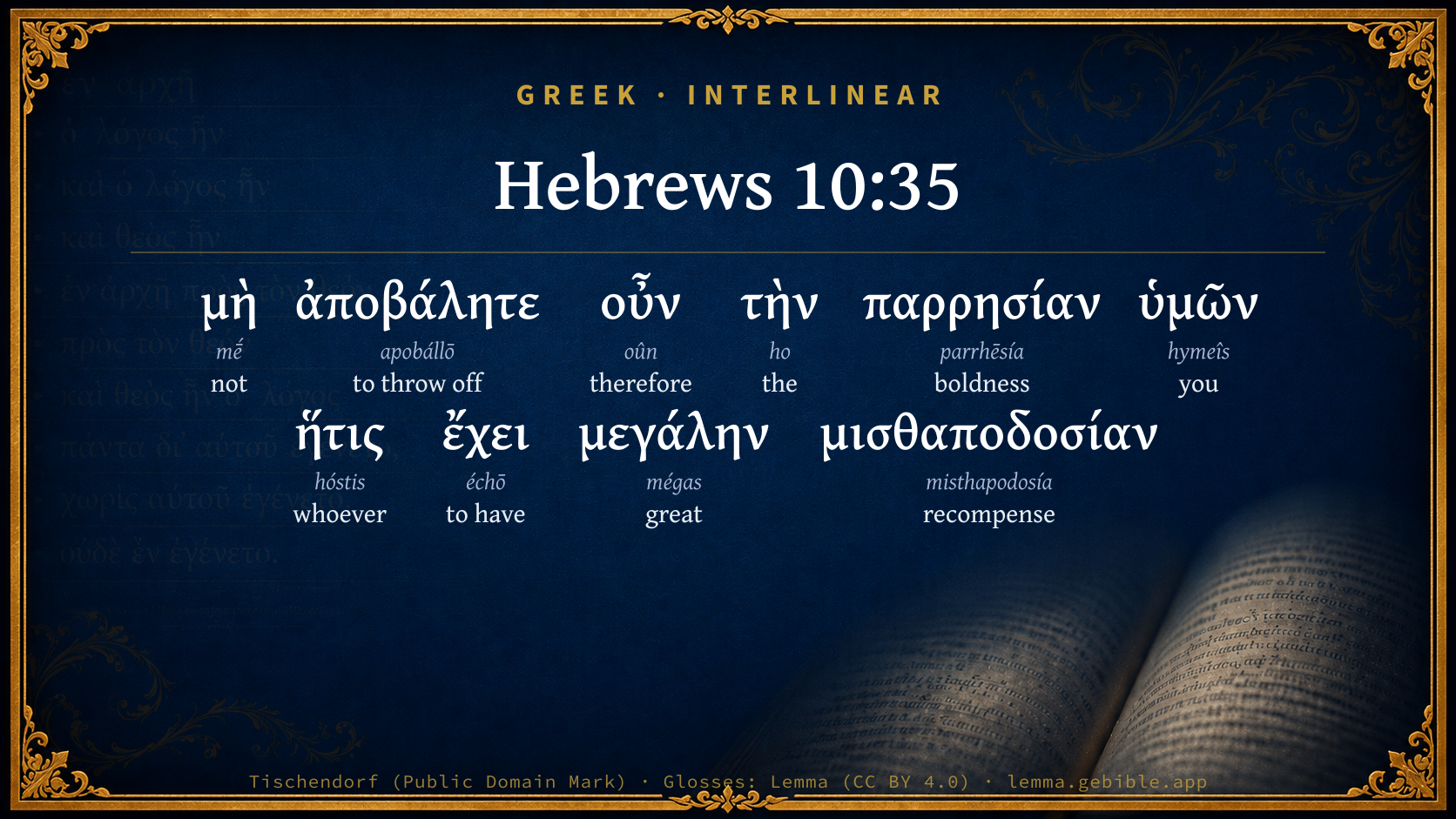
Download image
Cite this verse

Hebrews 10:35 (World English Bible). Public Domain. Lemma interlinear Bible study tool, https://lemma.gebible.app/v/hebrews/10/35.

Show BibTeX & RIS
BibTeX
RIS
English Translation
Therefore don't throw away your boldness, which has a great reward.
World English Bible · Public Domain
Download a study sheet

One document with this verse’s original text, its word-by-word gloss line, the meaning frame, cross-references with their text, attributed commentary, and full source and license credits — printable, and it pastes into notes with its structure intact.

This verse Autodidact and up

Study sheet (.html) Plain text (.txt)

A passage Seminary Student

Up to 50 verses in one chapter. A passage sheet keeps up to 6 commentary sources and 12 cross-references per verse, in the order this page ranks them, and says so on the sheet whenever that leaves anything out. Ask for a single verse and you get the Autodidact verse sheet above.

Everything on this page stays free to read, with no account — the sheet is a download of what is already on screen, not access to it.

Want to remove ads? Support Godless Engineer
Compare translations 3

The same verse in 3 English versions, stacked beneath the original-language interlinear above. Click any original word for its lexicon entry.

Each is an independent rendering of the whole verse — the interlinear is not word-aligned to these translations.

Highlighted words mark where these versions differ — a whole-verse word diff, not a word-by-word alignment.

  • World English Bible Public Domain
    Therefore don't throw away your boldness, which has a great reward.
  • King James Version Public Domain
    Cast not away therefore your confidence, which hath great recompence of reward.
  • unfoldingWord Literal Text CC BY-SA 4.0
    So you must not throw away your confidence, which has a great reward.

unfoldingWord Literal Text — © unfoldingWord, licensed CC BY-SA 4.0. Word-aligned USFM3 via Door43 (git.door43.org/unfoldingWord/en_ult).

Versions to compare (up to 4)

3 of 4 selected

Show all 19 translations

Every available English version of this verse, each an independent rendering of the whole verse.

  • World English Bible Public Domain
    Therefore don't throw away your boldness, which has a great reward.
  • Berean Standard Bible Public Domain
    So do not throw away your confidence; it holds a great reward.
  • Majority Standard Bible Public Domain
    So do not throw away your confidence; it holds a great reward.
  • King James Version Public Domain
    Cast not away therefore your confidence, which hath great recompence of reward.
  • American Standard Version (1901) Public Domain
    Cast not away therefore your boldness, which hath great recompense of reward.
  • Revised Version (1885) Public Domain
    Cast not away therefore your boldness, which hath great recompense of reward.
  • Geneva Bible (1599) Public Domain
    Cast not away therefore your confidence which hath great recompense of reward.
  • Douay-Rheims (1899) Public Domain
    Do not therefore lose your confidence, which hath a great reward.
  • Young's Literal Translation Public Domain
    Ye may not cast away, then, your boldness, which hath great recompense of reward,
  • Literal Standard Version CC BY-SA 4.0
    You may not cast away, then, your boldness, which has great repayment of reward,
  • Unlocked Literal Bible CC BY-SA 4.0
    So do not throw away your confidence, which has a great reward.
  • unfoldingWord Literal Text CC BY-SA 4.0
    So you must not throw away your confidence, which has a great reward.
  • Darby Bible Public Domain
    Cast not away therefore your confidence, which has great recompense.
  • World Messianic Bible Public Domain
    Therefore don’t throw away your boldness, which has a great reward.
  • Webster's Bible Public Domain
    Cast not away therefore your confidence, which hath great recompense of reward.
  • Free Bible Version CC BY-SA 4.0
    So don't lose your confidence in God—it will be richly rewarded.
  • Bible in Basic English Public Domain
    So do not give up your hope which will be greatly rewarded.
  • Text-Critical English NT CC BY 4.0
    Therefore do not throw away your confidence, which has a great reward.
  • Tyndale New Testament (1534) Public Domain
    Cast not awaye therfore youre confidence which hath great rewarde to recompence.

Literal Standard Version (2020), Covenant Press — licensed CC BY-SA 4.0. Text via the HelloAO Bible API (eBible.org). Unlocked Literal Bible (unfoldingWord) — licensed CC BY-SA 4.0. Text via the HelloAO Bible API (eBible.org). unfoldingWord Literal Text — © unfoldingWord, licensed CC BY-SA 4.0. Word-aligned USFM3 via Door43 (git.door43.org/unfoldingWord/en_ult). Free Bible Version, Dr. Jonathan Gallagher — licensed CC BY-SA 4.0. Text via the HelloAO Bible API (eBible.org).

Word by word

More ways to search: Search by grammar → Find every occurrence → Compare this word →

Practice this passage: Drill this verse → Learn its vocabulary →

About this verse

These counts appear in no published source. They are computed here, from the morphology-tagged text and Lemma’s own curated glosses. What Lemma adds →

10
words
10
distinct lemmas
General Epistles
section

Notable vocabulary

The rarest word here is ἀποβάλητε to throw off G577 — appearing just 2 times in the whole Greek New Testament.

Shared distinctive vocabulary

ἀποβάλητε to throw off G577 occurs in 2 verses of the Greek New Testament. Also found in:

Cross-references

12

Topical passages linked to Hebrews 10:35 in the Treasury of Scripture Knowledge — connected by theme and wording, ordered by reader-vote popularity; previews shown in the World English Bible.

  • 1 Corinthians 15:58 Therefore, my beloved brothers, be steadfast, immovable, always abounding in the Lord's work, because you know that your labor is not in vain in the Lord.
  • Galatians 6:8–10 For he who sows to his own flesh will from the flesh reap corruption. But he who sows to the Spirit will from the Spirit reap eternal life.
  • Hebrews 3:6 but Christ is faithful as a Son over his house; whose house we are, if we hold fast our confidence and the glorying of our hope firm to the end.
  • Luke 14:14 and you will be blessed, because they don't have the resources to repay you. For you will be repaid in the resurrection of the righteous."
  • Hebrews 11:26 accounting the reproach of Christ greater riches than the treasures of Egypt; for he looked to the reward.
  • Matthew 5:12 Rejoice, and be exceedingly glad, for great is your reward in heaven. For that is how they persecuted the prophets who were before you.
  • Hebrews 4:14 Having then a great high priest, who has passed through the heavens, Jesus, the Son of God, let us hold tightly to our confession.
  • Hebrews 3:14 For we have become partakers of Christ, if we hold fast the beginning of our confidence firm to the end:
  • Matthew 10:32 Everyone therefore who confesses me before men, him I will also confess before my Father who is in heaven.
  • Psalms 19:11 Moreover by them is your servant warned. In keeping them there is great reward.
  • Matthew 10:42 Whoever gives one of these little ones just a cup of cold water to drink in the name of a disciple, most assuredly I tell you he will in no way lose his reward."
  • Hebrews 2:2 For if the word spoken through angels proved steadfast, and every transgression and disobedience received a just recompense;

Cross-references courtesy of OpenBible.info (CC BY 4.0).

Commentary

Notes on Hebrews 10:35 from classic Christian and Jewish commentators (each source and its license shown beneath its notes). The classic Christian expositions comment on the surrounding passage and are grouped to its opening verse, so a note may address several verses; the Jewish commentaries on the Tanakh (Rashi and others) are per-verse, so they appear only where the commentator wrote on this verse.

Lemma curates 59 commentaries, every one of them public domain or Creative Commons licensed, each selected and text-cleaned for this edition rather than reprinted as found. About our sources →

The Biblical Illustrator

Joseph S. Exell

Heb_10:35

Cast not away, therefore, your confidence

Spiritual confidence

I.

WHAT THIS SPIRITUAL CONFIDENCE IS.

1. Confidence in Christ.

(1) In His inherent goodness.

(2) In His power and will to save.

2. Confidence in the riches which Christ will give.

II. SPIRITUAL CONFIDENCE IS TO BE FIRMLY HELD. For the better understanding of this, it is well to bear in mind the difference there is between confidence and faith. They are much the same in their exercise; still they are different. Confidence is the outcome of faith. Confidence is stronger than faith, and leads the soul onward to be bold and daring. Faith is as the root; confidence the branch springing out of the root. Confidence grows on faith, and cannot live without it; but faith may exist without confidence, though there can be no doubt that the one is affected by the other, and that as the one strengthens the other strengthens, or that as the one wanes the other also wanes. We see, therefore, that we may cast away our confidence by unbelief. Once begin to doubt the power and will of Christ to bless us, and our confidence is gone. The faith may not altogether have departed, but confidence is thrown away. In fact, it seems to be possible for one to have all the evidences of Christs character and goodness set before him, so that he cannot doubt, but must believe in Christs divinity and salvation; and yet to have no real confidence in Him, no confidence which leads one to trust Him fully, and to go forth in His name in all boldness and with Christian courage. If, then, you are a possessor of this confidence, hold it fast. It is a step in advance of the ordinary Christian plan. It leads to something more, something higher, bolder, and grinder, for Christ and for His cause. Hold it fast, and exercise it. The more it is cultivated and exercised, the more it will grow and the stronger it will become.

III. SPIRITUAL CONFIDENCE BRINGS ITS OWN REWARD.

1. We have it here upon earth. You cannot confide in Christ one single hour without receiving some blessing. If you have this confidence, it matters but little what may befall you here. There may be war, or jealousies, or collapses in business, or bodily suffering, or temptation, or any other kind of trial as sharp as death itself, yet your mind is calm amidst it all; and, like the bird which sits on some secluded twig and sings sweetly while the thunder roars and the lightning flashes, so you are joyful in the Lord, and amidst every storm can sing to the praise of your Saviour.

2. We shall have a further reward hereafter. Self-devoting unselfishness for Christs sake will be its own reward in heaven. Can any soul absolutely confide in Christ and not be made holier in heaven than he is here? He will also be rewarded with the rest of heaven--blessed, peaceful rest, after his toils and sufferings here. He will have the glories of heaven poured upon him in such a measure as he never anticipated, and of a kind of which he had not conceived. (H. F. Walker.)

The Christians confidence

The confidence here mentioned is not merely that trust in the personal sacrifice of Christ whence springs pardon of sin. It is the filial trust of a believing heart, washed from guilt in the redeeming blood, already an heir of God, and joint-heir with Christ. And in what is this confidence placed? In self-goodness, or self-power? No; but in God, through Jesus Christ alone. The more of this confidence the Christian possesses, the more humble will he be; for it makes Christ supreme in the heart. And on what is it immediately grounded? This rejoicing confidence is not founded on dim speculations, on vague hopes, on boasted deeds, but on the clear testimony of the Divine Spirit. In this must be the basis of all the enjoyment in the blessings of the kingdom of grace here, and all for which we may look in the glory hereafter. In hours of distress it ministers consolation. In danger it brings preservation and rescue. In trouble it gives support and relief. It realises not only a deliverance from all evil, but a communication of all that is good. Who can tell how rich in delight earth may be, with this confidence in God keeping the soul; with the kingdom of righteousness, and peace, and joy as its government; with the sure promise that the maintenance of this confidence is constantly adding to the lustre of our heavenly crown! But its highest, its supremely great recompense of reward is beyond the grave. With expanding and quickened facilities, with ever-opening objects for thought and feeling, with closer approach to the infinite, and changing into the Divine likeness, the faithful saints shall reap the eternity of their reward. The apostle here alludes to the conduct of the ancient warrior. The Lacedaemonians were celebrated for a valour which chose death before an ignominious defeat; therefore they threw their lives away rather than shrink from the foe. The mothers of their young men often gave them, as they departed for the fight, the shield of the father, and commanded them to bring it back, or be brought back upon it--that is, to return victorious or slain. So the loyal, valiant Paul bids the soldier of the cross never to give up his shield, never cast it away in foul retreat. Ours is a mighty moral conflict. If we Can cast this away, we can have no hope of succour and deliverance from Him. We must fall a prey to the devourer. Let us, then, resist the various devices to ensnare us. Cast not away your confidence in any sore temptation. Cast it not away should the prosperity and flattery of the world try to attract you from it. Perhaps this is the least dreaded, but it is the most dangerous combatant; for, like Judas, it first kisses, then betrays. (S. B. Bangs.)

Hold fast your shield

I. WHAT ARE THE ELEMENTS OF THIS CONFIDENCE of which the apostle speaks? It is not very easy to explain this word in one English word. It means that freedom, that peace, that at-homeness which makes a man feel bold, free, confident. The elements of it seem to me to be these.

1. Confidence in the principles which you have espoused. There must be certain undoubted truths about which you can sing, O God, my heart is fixed, my heart is fixed; I will sing and give praise--things which you perceive to be plainly taught in the Scriptures--things brought home by the power of the Holy Spirit.

2. This is the groundwork of true confidence but to make it complete there must be an open avowal of our belief in our Lord Jesus.

3. To do all this you must know your own interest in those truths man will readily let go a truth which may condemn him. Who will die for a truth in which he has no share? The man who can live and die for Christ is the man who believes that Christ has lived and died for him.

4. This means, besides, a full and firm reliance upon the faithfulness of God, so that we are free from all mistrusts and fears, and simply rest in God.

5. Where this confidence really reigns in the soul, it takes the form of full acceptance before God.

6. Upon this there follows that further confidence, of which John says, This is the confidence that we have in Him, that if we ask anything according to His will He heareth us--confidence that when we pray we shall be heard.

7. Over and above that, how delightful to feel that even what we do not pray for, by reason of our ignorance or forgetfulness, our gracious God will bestow.

8. You may add to all this the confidence that He is able to keep that which you have committed to Him; for we have this confidence--that whether we sleep or wake we shall be together with Him.

II. How THIS CONFIDENCE MAY BE CAST AWAY.

1. By changing it for self-confidence. Be empty, and Christ will be your fulness, but if you become full in yourself you have done with Christ. Cast not away your confidence by leaving your simple reliance upon Jesus Christ.

2. Some, however, cast away their confidence by giving way to sin. Old Master Brooks says, Assurance will make us leave off sinning, or sinning will make us leave off assurance. You cannot grieve your Heavenly Father and yet feel the same confidence towards Him.

3. Another way of losing our confidence is by getting into worldly company and mixing up with the gay and frivolous. A child would soon lose his loving, confident feeling towards his father if his father had an enemy opposite, and he constantly went into that enemys house, and heard all the language that was used there.

4. You can very easily lose your confidence by changing your aim in life. While your object is God you will be bold as a lion, but a sordid motive is the mother of cowardice.

5. Some unhappy professors have apparently cast away their confidence in utter unbelief.

III. THE REASONS GIVEN FOR HOLDING FAST OUR CONFIDENCE.

1. Cast not away therefore you confidence. What does this therefore mean? Why, it means this--because you have already endured so much. Do not lose the victories which you have already gained. If it was wise to go so far, it will be wise to go on to the end. I recollect going over the Col DObbia on the Alps, and when I got a little way down I found myself on a steep mountain side upon a mass of loose earth and slates. There seemed to me to be some miles of almost perpendicular descent and no road. My head began to swim. I set my feet fast down in the loose soil, turned my back to the scene below me, and my face to the hill-side, and stuck my hands into the earth to hold as best I could. I cried to my friend, I shall never go down there: I will go back. He coolly replied, Just look where you have come from. When I looked up it appeared to be much worse to try and clamber up than it could possibly be to go down, and so he remarked, I think you had better go on, for it is worse going back. So we must go on, for it will be worse going back. Let us gird up the loins of our mind, and push onward with firm resolution, by the help of the Spirit of God.

2. Do not cast away your confidence, for it has great recompense of reward. There is a reward in it now: for it makes us happy. Do not cast away your confidence, since it yields you such pure delight. But it makes you strong both to bear and labour. When you are like a child in confidence before God, you can endure pain and reproach right bravely. And, moreover, it makes you victorious. And, best of all, there is a recompense of reward to come. (C. H. Spurgeon.)

Discouragements and comforts in Christian life

1. There are many discouragements which follow false conceptions of life, and which result from the practical rectification of those conceptions. There are those who enter upon a Christian life expecting to be borne, as it were, by the Divine afflatus, straight through their course. When they find, on the other hand, that God only works in them to will and to do, and that the effect of the Divine influence upon them is to make the necessity of work in them still more emphatic, they are disappointed. There are those who have supposed a religious life to be a tide of joyful emotion. They thought religion was some Cleopatras barge of ivory and gold, with purple sails, and with music and joyfulness within; and though there would be savage barbarians along either shore, that would shoot arrows at them, they meant to fire out of the barge a great deal better than was sent at them; and when they find that instead of being a Cleopatras barge, it is a galley, as it were, and that they are galley-slaves, they are despondent. The dispersion of these illusions destroys all that they stood on; and yet, at that, it is far better. There is many a man who is much nearer the kingdom of

God at the point of discouragement than he was at the point of hope. The point of hope was the point of misconception; this discouragement is more wholesome than was their hopefulness, because it is nearer to the truth.

2. There are those who begin a religious life upon the nourishment abundantly supplied to them in the peculiar circumstances in which they are born, but who have a slender capacity for supplying themselves with nourishment. They lack that motive force which makes religion, and that inspiration which gives them vital courage. Those who are slenderly endowed in this respect, find, as soon as they begin to live a Christian life for themselves, that it is very dull. It is for such persons that the external routine of church duties is peculiarly useful. If they could be held to some set, stated exercises allied to religion, they would find themselves, both by the regularity of these exercises and by their routine nature, to be greatly sustained and helped. For they are persons that are living upon a low plane.

3. Men suffer discouragements arising from the misconception of the relations of joy to the Christian life. They think while they are joyful that they are growing, and when they are not joyful, then they are going behind-hand. But pain is a far more growing element than joy. Sunshine is not more indispensable to harvests than rains and cloudy days. And in the Christian life the yoke and the burden are eminently profitable to men. There are many men who think that religion is an invitation to go into the house and sit before a great fire that has been built for them. Religion is an invitation to more than that. It is also an invitation to the felling, hauling, and preparing of the fuel. And is not this rational? Is not this the way to make true and wholesome natures?

4. There are discouragements arising from conflicts and rivalries between lawful secular occupations and religious emotions. Our whole life is a religious life. The experiences of inspiration may be spiritual in the closet; but the real life of every man is that into which he puts his energy, his strength, his vitality, his power. Wherever men are, there they ought to put their power of understanding, their power of sentiment, their power of feeling, their power of planning and execution. That is the thing for a Christian man to do. And the kind of power which he has, and the moral quality of it, depend upon the influence of the interior and invisible life.

5. A large element of discouragement arises in minds of fine temper, on account of the discrepancy which must always exist between ideality and practical reality. There will always be a chasm between duty and performance. The higher our conception of justice is, the harder it will be to reach it. The fact is, a person of a vivid imagination will conceive of an amount of duty and a fineness of experience which it would be impossible, except by a tutoring of years and years, to meet. Do not you suppose that Raphaels mind, before his hand was trained to paint, painted pictures that were infinitely more beautiful than any that his hand painted? No men are so apt to be discouraged as those who are living far up along the scale. They judge themselves by a high ideal of life. I would not have them discouraged finally; but it does not do any hurt for a man to be enough discouraged to keep down pride and vanity. Men are discouraged, frequently, from a perception of the weakness and unfruitfulness of their will-power--their power of executing what they mean to do. Men resolve, and do not accomplish. The relation between the power of the will and the thing to be executed is different in different people. I have often said that moral stamina lay in the will more than anywhere else. The will is like a rudder. Some ships are very hard to steer, and some are very easy. Some you can hardly turn from their course, and some you can set about by the least touch of the wheel. So it is with men. And they are discouraged, usually, if they find it hard to direct their course aright, because they think it is owing to some wickedness in them. Persevere, and work manfully, with weakness and temptation, in darkness and light, and you will reach your Heavenly Father soon. No father on earth was ever so lenient with the faults of his boy who wanted to do right, as God is with your faults if you want to do right, and will try to do right. In a little time you will know that this is so. Not to mention the other classes of discouragement, I remark, in closing, that behind and within all our personal labour is our God. No man will ever reach heaven that does not himself strive; but no man will ever reach heaven simply through his own striving. There are two co-ordinate lives; there is power within a power; there is God in us; and that is the secret of the power by which we are saved. It looks as though the pointers of a watch kept time; but is it the strength of the pointers that carries them round? No. Down deep below there is the coiled spring that moves the wheel, and, in obedience, the pointers move and register the time. But suppose the pointers were taken off? Then all the springs in the world, though they might set the wheels playing round, would not indicate the time. The measuring power would be gone. Both of them, the spring and the pointers, must be concurrently adjusted in order to keep time. It is God that is the mighty spring within us; and it is we that on the great dial of time are moving round in obedience to this interior force. There is, behind our own will and within our own purposes, the Divine influence; and this truth affords a ground whereon we may comfort ourselves in discouragement. (H. W. Beecher.)

Carrying the sword a little further

I recollect a brother minister saying to me when I was a very young man, I remember being sent for, and going to see a very blessed old man. I had never seen a dying Christian; and as I had read a lot of poetry about the deathbeds of the Lords people, I had got the notion that they all died very quietly. As I drew near to his bedside, I said, Oh, sir I it is all peace now. It took the old man a little while to get breath enough to speak; and when be did, the sound of his voice seemed to come from beneath the bed-clothes, and chilled me. I could almost have fallen, but I waited a minute, and I then heard what he said. He said, No, it is not all peace yet. I must wear the halbert a little longer, and I must carry the sword a little further. It is a hard fight; but I shall get the white robe and the crown by-and-by. It is a hard fight; but it is worth it. I have never forgotten the lesson I learned at that death-bed. (S. Coley.)

Christian confidence

The celebrated Philip de Morney, Prime Minister of Henry IV. of France, one of the greatest statesmen, and the most exemplary Christian of his age, being asked, a little before his death, if he still retained the same assured hope of future bliss which he had so comfortably enjoyed during his illness, he made this memorable reply: I am as confident of it from the incontestable evidence of the Spirit of God, as I ever was of any mathematical truth from all the demonstrations of Euclid.

The Biblical Illustrator, edited by Joseph S. Exell (c. 1880s–1900s) — public domain. Text from a community e-Sword module.

Joseph Benson's Commentary

Heb 10:35-37. Therefore, having formerly behaved with such fortitude, cast not away your confidence — As cowardly soldiers cast away their shields, and flee in the day of battle; but since God has supported you under, and brought you through all your sufferings hitherto, with much patience and joy maintain and improve your confidence and courage against all difficulties and dangers; which hath — That is, will receive; great recompense of reward — That is, a great reward, (namely, eternal glory,) by way of recompense for your obedience. For ye have need of patience — Or, of perseverance, as υπομονης may be properly rendered; that is, ye have need of the continual exercise thereof in well-doing, and waiting for the accomplishment of the promises; that after ye have done the will of God — Have conducted yourselves as it is God’s will you should, by enduring whatsoever he is pleased to lay upon you; ye might receive the promise — The promised reward of glory. For yet a little while — Μικρον οσον οσον, a little, a very little time. And he that shall come — Ο ερχομενος, he who is coming; the appellation given by the Jews to Messiah, Mat 11:3, Art thou he, ο ερχομενος, who should come? will come — As if he had said, Be patient, for it will not be long before he will take you hence by death, and release you from all your trials. Or rather, It will not be long before Christ will come to take vengeance on your persecutors, the unbelieving and obdurate Jews, and deliver you from all the sufferings to which you are exposed from them; and will not tarry — Beyond the appointed time. It must be observed, though the apostle in this verse uses some words of the Prophet Habakkuk, (Hab 2:3,) he doth not introduce them as a quotation from him, containing a prophecy of any coming of Christ. There is therefore no necessity of endeavouring to show that, as they stand in Habakkuk, they may be interpreted of Christ’s coming to destroy Jerusalem. In the passage where they are found, the prophet exhorted the Jews to trust in God for deliverance from the Chaldeans, by putting them in mind of the faithfulness of God in performing his promises. Wherefore, as the faithfulness and power of God are a source of consolation to which good men, at all times, may have recourse in their distresses, the apostle might, with great propriety, apply Habakkuk’s words, by way of accommodation, to Christ’s coming to destroy Jerusalem and the Jewish state. Christ had promised to come for that purpose before the generation then living went off the stage; and as the believing Hebrews could entertain no doubt of his being faithful to his promise, the apostle, to encourage them to bear their afflictions with patience, very fifty put them in mind of that event in the words of this prophet, because it assured them that the power of their persecutors would soon be at an end.

Joseph Benson's Commentary on the Old and New Testaments (1811–1818) — public domain. Text from a community e-Sword module.

Tyndale Open Study Notes

Tyndale Open Resources

10:35-36 Based on their exemplary faithfulness in the past (10:32-34), the author urges them not to throw away this confident trust in the Lord. The word translated confident trust is also used in Hebrews to speak of boldness in entering the presence of God (4:16; 10:19; cp. 3:6). Those who remain faithful receive a great reward (see 1:14; 6:12; 9:15; Jas 1:12). Patient endurance is the key response needed in the face of persecution, as the author argues in Heb 10:32–12:17.

Tyndale Open Study Notes — © Tyndale Open Resources, licensed CC BY-SA 4.0. Text via the HelloAO Bible API.

Bengel's Gnomon

Johann Albrecht Bengel

Heb 10:35. Μὴ ἀποβάλητε, cast not away) Liberty of speech, boldness, confidence, where once it finds a place, only withdraws, when it is driven out; but it is driven out and cast away, as if it were something vile, by those who do not persevere.—ἔχει, has) The 37th verse is to be referred [has reference] to this present.—μισθαποδοσίαν, a recompence of reward) So ch. Heb 2:2, Heb 11:26; and μισθαποδότης, he who bestows the reward, ibid. Heb 10:6.

Bengel's Gnomon of the New Testament — English translation (T&T Clark, Edinburgh, 1860) — public domain. Text from a community e-Sword module.

Meyer's Critical & Exegetical Commentary

Heinrich August Wilhelm Meyer

Heb_10:35. Exhortation deduced from Heb_10:32-34. The self-sacrificing zeal for Christianity displayed in the past ought to animate the readers to a joyful maintenance of the same likewise in the present, since of a truth this very stedfastness in zeal leads to the longed-for goal.

ἀποβάλλειν] here not the involuntary losing (Jac. Cappellus, Lösner, and others), but the voluntary casting from one, or letting fall away (comp. Mar_10:50), as though it were a question only of a worthless, useless thing; μὴ ἀποβάλλειν thus the same as κατέχειν, Heb_10:23; Heb_3:6; Heb_3:14, and κρατεῖν, Heb_4:14, Heb_6:18.

τὴν παῤῥησίαν ὑμῶν] your joyful confidence, sc. towards Christ as your Saviour. The free, courageous confession of Christianity before the world, of which Beza, Grotius, and others understand the expression, is only the consequence of the παῤῥησία, which here, too, as Heb_10:19; Heb_3:6; Heb_4:16, denotes a frame of the mind.

ἥτις] which of a truth. Introduction of a well-known, indisputable verity.

μεγάλην μισθαποδοσίαν] great rewarding retribution (see at Heb_2:2), namely, the promised everlasting blessedness (Heb_10:36).

The present ἔχει, although the μισθαποδοσία is as yet something future, of the undoubted certainty of its containing in itself, or having as a consequence.

Meyer — Critical and Exegetical Commentary on the New Testament — English translation by Peter Christie, edited by Frederick Crombie (T&T Clark, 1880) — public domain. Text from a community e-Sword module.

Expositor's Greek Testament

ed. W. Robertson Nicoll

Heb 10:35 . μὴ ἀποβάλητε οὖν τὴν παρρησίαν … “Cast not away, then, your confidence, for it has great recompense of reward”. The exhortation begun in Heb 10:19 is resumed, with now the added force springing from their remembrance of what they have already endured and from their consciousness of a great possession in heaven. A reason for holding fast their confidence is now found in the result of so doing. It has great reward. μισθαποδοσία used in Heb 2:2 of requital of sin, here and in Heb 11:26 of reward. Cf. Clem. ad Cor . 6, γέρας γενναῖον , and Wis 3:5 . Therefore, μὴ ἀποβάλητε , do not throw it away as a worthless thing you have no further need of. Retain it, ὑπομονῆς γὰρ ἔχετε χρείαν , “for ye have need of endurance,” of maintaining your hopeful confidence to the end under all circumstances. Without endurance the promise which secures to them the enduring possession cannot be enjoyed, for before entering upon its enjoyment, the whole will of God concerning them must be done and borne. ἵνα τὸ θέλημα τ . θεοῦ ποιήσαντες κομίσησθε τὴς ἐπαγγελίαν , Davidson and Weiss agree in thinking that “the will of God is His will that they should hold fast their confidence”. Rather, that accepting all privation, as they once did (Heb 10:32 ) and recognising all they were called to endure as God’s will concerning them, they should thus endure to the end ( cf. Heb 3:6 ) and so receive the promised good ( ἐπαγγελία = the thing promised as in Heb 6:12 ; Heb 6:15 ). κομίσησθε , the verb properly means to carry off or to recover what is one’s own. See Mat 25:27 ; 2Co 5:10 ; Heb 11:13 ; Heb 11:19 ; Heb 11:39 . And their entrance on the reward of their endurance will not long be delayed ἔτι γὰρ μικρὸν ὅσον ὅσον .… “For yet a little a very little while and He that cometh will have come and will not delay.” [“Es ist noch ein Kleines, wie sehr, wie sehr Klein” (Weiss), “noch eine kleine Zeit, ganz Klein” (Weizsäcker). “Adhuc enim modicum aliquantulum” (Vulg.). “For yet a little ever so little while” (Hayman)]. The phrase μικρὸν ὅσον ὅσον is found in Isa 26:20 , “Go, my people … hide thyself for a very little , till the indignation be overpast”. The double ὅσον is found in Aristoph. Wasps , 213, where however Rogers thinks the duplication due to the drowsiness of the speaker. Literally it means “a little, how very, how very”. The following words from ὁ ἐρχόμενος to ἐν αὐτῷ are from Heb 2:3-4 , with some slight alterations, the article being inserted before ἐρχόμενος , οὐ μὴ χρονίσῃ instead of the less forcible words in Hebrews, and the two clauses of Heb 10:4 being transposed. In Habakkuk the conditions are similar. God’s people are crushed under overwhelming odds. And the question with which Habakkuk opens his prophecy is ἕως τίνος κεκράξομαι και οὐ μὴ εἰσακούσεις ; The Lord assures him that deliverance will come and will not delay. By inserting the article, the writer of Hebrews identifies the deliverer as the Messiah, “the coming One”. Cf. Mat 11:3 ; Luk 7:19 ; Joh 6:14 . ὁ δὲ δίκαιος .… “And the just shall live by faith,” i.e. , shall survive these troublous times by believing that the Lord is at hand. Cf. Jas 5:7-9 . καὶ ἐὰν ὑποστείληται , “and if he withdraw himself” or “shrink”. The verb, as Kypke shows, means to shrink in fear, and it is thus used in Gal 2:12 . It is the very opposite of παρρησία . Accordingly it is thoroughly displeasing to God, whose purpose it is to bring men to Himself in confident hope. But the idea that any of the “Hebrews” can be in so ignominious and dangerous a position is at once repudiated. ἡμεῖς δὲ .… “But as for us we are not of those who shrink (literally of shrinking) to perdition but of faith to the gaining of the soul”. That is, we are not characterised by a timid abandonment of our confession (Heb 10:23 ) and confidence. Cf. 1Th 5:5 . What such timidity leads to ( εἰς ἀπώλειαν , cf. Act 8:20 ; Rom 9:22 ) is hopeless perdition. Cf. M. Aurelius on the δραπέτης , Heb 10:25 . ὁ φοβούμενος δραπέτης . But we are of faith whose end is περιποίησις ψυχῆς the acquisition of one’s soul. Very similar is Luk 21:19 , “By your endurance win your souls”. See also Jas 5:20 , and 1Th 5:9 . Like our word “acquisition” περιποίησις sometimes means the acquiring as in 1Th 5:9 and 2Th 2:14 ; sometimes the thing acquired as in Eph 1:14 . [In Isocrates, 2nd Ep., occurs the expression διὰ τὸ περιποιῆσαι τὴν αὐτοῦ ψυχήν (Wetstein)].

The Expositor's Greek Testament, edited by W. Robertson Nicoll (1897–1910) — public domain. Text from a community e-Sword module.

Jamieson, Fausset & Brown

Robert Jamieson, A. R. Fausset & David Brown

Consequent exhortation to confidence and endurance, as Christ is soon coming.

Cast not away--implying that they now have "confidence," and that it will not withdraw of itself, unless they "cast it away" wilfully (compare Heb 3:14).

which--Greek, "the which": inasmuch as being such as.

hath--present tense: it is as certain as if you had it in your hand (Heb 10:37). It hath in reversion.

recompense of reward--of grace not of debt: a reward of a kind which no mercenary self-seeker would seek: holiness will be its own reward; self-devoting unselfishness for Christ's sake will be its own rich recompense (see on Heb 2:2; Heb 11:26).

Jamieson, Fausset & Brown — Commentary Critical and Explanatory on the Whole Bible (1871) — public domain (CC PDM 1.0). Text via the HelloAO Bible API.

Adam Clarke's Commentary

Verse 35. Cast not away therefore your confidence] Την παρῥησιαν ὑμων· Your liberty of access to God; your title and right to approach his throne; your birthright as his sons and daughters; and the clear evidence you have of his favour, which, if you be not steady and faithful, you must lose. Do not throw it away, μη αποβαλητε. neither men nor devils can take it from you, and God will never deprive you of it if you continue faithful. There is a reference here to cowardly soldiers, who throw away their shields, and run away from the battle. This is your shield, your faith in Christ, which gives you the knowledge of salvation; keep it, and it will keep you.

The Lacedemonian women, when they presented the shields to their sons going to battle, were accustomed to say: Η ταν, η επι τας· "Either bring this back, or be brought back upon it;" alluding to the custom of bringing back a slain soldier on his own shield, a proof that he had preserved it to the last, and had been faithful to his country. They were accustomed also to excite their courage by delivering to them their fathers' shields with the following short address. Ταυτην ὁ πατηρ σοι αει εσωζε· και συ ουν ταυταν σωζε, η μη εσο· "This shield thy father always preserved; do thou preserve it also, or perish;" Lacaenarum Apophthegmata, PLUT. OPERA, a Wittenbach, vol. i. p. 682. Thus spake the Lacedemonian mothers to their sons; and what say the oracles of God to us? Μη αποβαλητε την παρῥησιαν ὑμων· Cast not away your confession of faith. This is your shield; keep it, and it will ever be your sure defence; for by it you will quench every fiery dart of the wicked one. The Church of Christ speaks this to all her sons, and especially to those employed in the work of the ministry. Of this shield, of this glorious system of salvation by Jesus Christ, illustrated and defended in this work, I say to each of my children: Ταυτην ὁ πατηρ σοι αει εσωζε· και συ ουν ταυταν σωζε, η μη εσο· This faith, thy father, by the grace of God, hath always kept; keep thou it also, or thou must expect to perish! May this be received both as a warning and encouragement!

Great recompense of reward.] No less than God's continual approbation; the peace that passeth all understanding ruling the heart here; and the glories of heaven as an eternal portion. Conscientiously keep the shield, and all these shall be thine. This will be thy reward; but remember that it is the mercy of God that gives it.

Adam Clarke's Commentary on the Bible (1810–1826) — public domain. Text from a community e-Sword/MySword module.

John Calvin's Commentaries

35. Cast not away, therefore, etc. He shows what especially makes us strong to persevere, even the retaining of confidence; for when that is lost, we lose the recompense set before us. It hence appears that confidence is the foundation of a godly and holy life. By mentioning reward, he diminishes nothing from the gratuitous promise of Salvation; for the faithful know that their labor is not vain in the Lord in such a way that they still rest on God’s mercy alone. But it has been often stated elsewhere how reward is not incompatible with the gratuitous imputation of righteousness.

John Calvin's Commentaries (1540-1563) — public domain. Text from the Calvin Translation Society English edition (1840s-50s) via the Christian Classics Ethereal Library (ccel.org). Calvin's coverage is partial (roughly two-thirds of the Bible); uncommented books and verses are honest gaps, never fabricated. The 19th-century editor's footnotes and remarks are omitted so the notes are faithfully Calvin's own voice.

Ellicott's Commentary for English Readers

(35) Cast not away therefore your confidence.—Rather, Cast not away therefore your boldness, seeing it hath a great recompence. To “cast away boldness” is the opposite of “holding fast the boldness of the hope” (Heb_3:6); the one belongs to the endurance of the faithful servant (Heb_10:32; Heb_10:36), the other to the cowardice of the man who draws back (Heb_10:38). This verse and the next are closely connected: Hold fast your boldness, seeing that to it belongs great reward; hold it fast, for “he that endureth to the end shall be saved.” On the last word, “recompence,” see Heb_2:2.

A Bible Commentary for English Readers, edited by Charles John Ellicott (1878–1897) — public domain. Text from a community e-Sword module.

The Cambridge Bible for Schools and Colleges

gen. ed. J. J. S. Perowne

35. your confidence] Heb_3:6, Heb_4:16.

which hath] The Greek relative implies “seeing that it has” (quippe quae).

recompence of reward] The compound misthapodosia as before for the simple misthos (Heb_2:2, Heb_11:26; comp. Heb_11:6).

The Cambridge Bible for Schools and Colleges (gen. ed. J. J. S. Perowne; Cambridge University Press, 1878–1918) — public domain. Text from a community e-Sword module.

John Gill's Exposition

Now the just shall live by faith,.... The "just" man is one not in appearance only, but in reality; not by his obedience to the law, but by the obedience of Christ; and he is evidently so by the Spirit, and by faith: and he is one, who lives soberly and righteously; and the life he lives, and shall live, at present, is, not eternal life; for though he shall live that life, yet this is not intended; for it is a living by faith that is spoken of, and as antecedent to the coming of Christ; but a spiritual life is meant, a life of justification in Christ, a life of communion with Christ, and a life of holiness from Christ, with peace, joy, and comfort through him: and the manner of this just man's living is "by faith"; not upon his faith, but upon Christ, the object of it; and by "his faith", as in Hab 2:4 his own, and not another's; or by the faith of Christ: the Syriac version here renders it, "by the faith of myself"; that is, by the faith of Christ, who speaks, and who is the author and object of faith: the Alexandrian copy and the Vulgate Latin version read, "my just man shall live by faith"; and this life is to be now, in the mean while, until Christ comes, and because he will certainly come:

but if any man draw back, my soul shall have no pleasure in him. The Hebrew word used in Hab 2:4 and which, by the Septuagint there, and by the apostle here, is translated by and rendered "draw back", according to R. David Kimchi (c) signifies, pride and haughtiness of heart; and, according to R. Sol. Jarchi (d) it signifies impudence; R. Moses Kimchi (e) takes it to be the same with which is used for a tower, or fortified place; and thinks it designs one who betakes himself to such a place for safety from the enemy, and seeks not to God for deliverance: so that such a person seems to be designed, who swells with pride and confidence in his own righteousness; who betakes himself to some fortress of his own for safety; who withdraws from the assembly of the saints, through fear of reproach and persecution; who withholds the truth, shuns to declare it, or maintain a profession of it; plays the hypocrite, and deals deceitfully in religious things; and, in short, it may intend one, who finally and totally apostatizes from the doctrine of faith, and the profession of it: and in such persons God has no pleasure, never had, nor never will have; but, on the contrary, they are abominable to him, and will lie under his sore displeasure, and feel the keen resentments of it; such stand opposed to the just man, that lives by faith, walks humbly with God, in a dependence, not on his own righteousness, but on the righteousness of Christ, in which he is safe from condemnation, and secure of the divine favour; for drawing back is not supposed of the just man, but of any man, as we, with the Ethiopic version, rightly supply; and is to be understood of anyone of the external professors of religion, who forsake the assembling of the saints, Heb 10:25 and is denied of the truly righteous in the following words.

(c) In Hab. ii. 4. (d) In ib. (e) Apud R. David Kimchi in ibid. & in Sepher Shorashim, rad.

John Gill's Exposition of the Whole Bible (1746–1763) — public domain (CC PDM 1.0). Text via the HelloAO Bible API.

Trapp's Complete Commentary

John Trapp

35 Cast not away therefore your confidence, which hath great recompence of reward.

Ver. 35. Cast not away your confidence] Since it is your shield and buckler, Eph 6:16; but if battered with temptations, beat it out again. Demosthenes was branded with the name of Ριψασπις, one that had lost his buckler.

John Trapp, A Commentary or Exposition upon All the Books of the Old and New Testament (1647–1656) — public domain. Text from a community e-Sword module.

Albert Barnes' Notes on the Bible

Cast not away therefore your confidence - Greek “your boldness;” referring to their confident hope in God. They were not to cast this away, and to become timid, disheartened, and discouraged. They were to bear up manfully under all their trials, and to maintain a steadfast adherence to God and to his cause. The command is not to “cast this away.” Nothing could take it from them if they trusted in God, and it could be lost only by their own neglect or imprudence. Rosenmuller supposes (Alte und Neue Morgenland, “in loc.”) that there may be an allusion here to the disgrace which was attached to the act of a warrior if he cast away his shield. Among the Greeks this was a crime which was punishable with death. Alexander ab Alexand. Gen. Dier. L. ii c. 13. Among the ancient Germans, Tacitus says, that to lose the shield in battle was regarded as the deepest dishonor, and that those who were guilty of it were not allowed to be present at the sacrifices or in the assembly of the people. Many, says he, who had suffered this calamity, closed their own lives with the baiter under the loss of honor. Tac. Germ. c. 6. A similar disgrace would attend the Christian soldier if he should cast away his shield of faith; compare the notes, Eph 6:16.

Which hath great recompense of reward - It will furnish a reward by the peace of mind which it gives here, and will be connected with the rewards of heaven.

Albert Barnes' Notes on the Bible (1834–1885) — public domain. Text from a community e-Sword/MySword module.

Matthew Poole's English Annotations

Cast not away therefore your confidence: this introduceth the last direction for helping on their perseverance in Christianity. Μη αποβαλλητε denieth all degrees of apostacy, from secret undervaluing to an utter renouncing, not to slight, despise, or reject; they had endured already so much as might steel and fortify them against what remained, and implieth the bold, resolute, and courageous retention, Eph 6:10,16, of the boldness of their confession of the Christian faith. It is an ingenuous, free, bold, and daring profession of it, which no brow beating nor violence can dash out of countenance, the fruit of a mighty, invincible faith, and hope of eternal life. This makes them persevere courageously in their religion, notwithstanding their being laden with reproaches and sufferings for it, as Christ himself gave them a pattern, Mar 8:31,32; Ac 4:13,29,31.

Which hath great recompence of reward: what greater encouragement can there be to the retaining this confidence, than the great remuneration secured in the New Testament to them: God himself, in all his fulness, to be their exceeding great reward, seen and enjoyed by them; and which for quality and quantity is inexpressible, Gen 15:1; Mat 5:12; 10:32.

Matthew Poole's English Annotations on the Holy Bible (1683–1685) — public domain. Text from a community e-Sword/MySword module.

Whedon's Commentary on the Bible

Daniel D. Whedon

35. Therefore—Inasmuch as these noble antecedents show you to be heirs of a heavenly inheritance, do not cast away your trust and boldness, and so wane into apostasy. This true heroic confidence, based on faith and good works, and basis of glorious hopes, (note Heb_11:1,) has a final reward appended to it.

Daniel D. Whedon (gen. ed.), Commentary on the Old and New Testaments (1874–1909) — public domain. Text from a community e-Sword module.

The Pulpit Commentary

Vers. 35, 36. Cast not away therefore your confidence, which hath great recompense of reward. For ye have need of patience (or, endurance), that, having done the will of God, ye may receive the promise; or, doing the will of God, ye may receive, etc. The aorist participle poihsantev does not of necessity express priority to the receiving. (cf. Heb_6:15, makroyumhsav epetuce) The meaning is that by endurance in doing the will they would receive. The full and final enjoyment of what is promised is still future and conditioned by perseverance. Observe the difference between the words komizesyai , here used, and epotugcanein , used in Heb_6:15. The former (occ. Heb_11:19, Heb_11:39; also 2Co_5:10 Eph_6:8 Col_3:25; and 1Pe_1:9) means the actual reception of what is denoted, equivalent to sibi acquirere; the latter (etc. Heb_6:15 Heb_11:33; also Rom_11:7 Jam_4:2) means only "to attain to," without involving full possession. It is not said of Abraham (Heb_6:15) that he ekomisato , only that he epetuce . So also of all the faithful of old described in the following chapter. (Heb_11:39) And even to believing Christians, as this verse shows, the komizesyai is still future and contingent.

Vers. 35-37. Christian fidelity and its reward. "Cast not away therefore your confidence, which hath," etc. We have in our text

I A GREAT REWARD PROMISED. "Great recompense of reward.... Ye might receive the premise." By "the promise" is meant here, not the promise itself, but the blessings promised; not the word of promise, for this they had already, but the good things which that word assured unto them. By the recompense of reward and the promised blessings we understand one and the same thing; i.e. "the promise of the eternal inheritance", (Heb_9:15) "the better and enduring substance" (ver. 34). It is the promise of eternal life in Jesus Christ. The life is characterized by

(1) purity;

(2) progress;

(3) blessedness;

(4) perpetuity. "A perpetuity of bliss is bliss." This life is promised to every believer in our Lord and Savior. "Whosoever believeth on him shall have eternal life." This life the Christian believer has now in its imperfect and early stages; he will have it hereafter in its fullness and perfection. "Your life is hid with Christ in God. When Christ, who is our Life," etc. (Col_3:3)

II A GREAT DUTY MENTIONED. To do the will of God. This must precede the reception of the promised blessings. "Having done the will of God, ye may receive the promise." If we combine the interpretation of several expositors, we obtain what we regard as the true interpretation of "the will of God" here. Thus M. Stuart: "To do the will of God here, is to obey the requirement, to believe and trust in Christ". (cf. Joh_6:40) Ebrard: "By the will of God, in this context, is to be understood his will that we should confess Christ"s Name before men." And Delitzsch: "The will of God is... our steadfast perseverance in faith and hope." It seems to us that the doing the will of God includes each and all of these things faith in Christ, confession of Christ, and continuance in Christ. Moreover, the Christian accepts the will of God as the authoritative and supreme rule of his life. This will is sovereign, gracious, and universally binding. Let us endeavor to do it willingly, patiently, and cheerfully; for in so doing it our duty will become our freedom, dignity, and delight. We must do this will if we would receive the recompense of reward. "Not every one that saith unto me, Lord, Lord, shall enter into the kingdom of heaven; but he that doeth the will of my Father which is in heaven.

III A GREAT NEED EXPERIENCED. "Cast not away therefore your confidence.... For ye have need of patience," or endurance. The confidence which is not to be cast away and the endurance which we need are, not identical, closely related. The confidence is perhaps (as Ebrard suggests) the root, and patience the fruit, the endurance growing out of the confidence. The confidence is the joyous assurance "of faith and hope, and boldness in confessing Christ." We must not cast this away, as a dismayed soldier casts away his weapons; for we shall need it in the conflicts which yet await us. And the patience is "that unshaken, unyielding, patient endurance under the pressure of trial and persecution, that steadfastness of faith, apprehending present blessings, and of hope, with heaven-directed eye anticipating the glorious future, which obtains what it waits for." Now we need both these things, the confidence and the patience, the boldness and the endurance; for:

1. Our spiritual battles are not all fought yet. We still have foes to encounter; therefore we shall need our confidence and courage, our faith and hope.

2. Our various trials are not all passed through yet. We shall have to meet with losses and sorrows, to suffer afflictions, to be beset with difficulties, to bear disappointments; hence we "have need of patience.

3. Our possession of the promised inheritance is not attained yet. Perfect purity and peace, progress and blessedness, are not ours as yet. There are times when the recompense of reward seems long delayed, and our spiritual advancement towards it seems slow; and we have need of patience to wait and hope, and to work while we wait.

IV A GREAT ENCOURAGEMENT PRESENTED. "For yet a very little while, and he that cometh shall come, and will not tarry." The end of our trials is very near. The inheritance of the promised blessing will speedily be ours. "The recompense of the reward comes as certainly as the Lord himself, who is already on the way." "Be patient therefore, brethren,... for the coming of the Lord is at hand? Stand up! stand up for Jesus! The strife will not be long; This day the noise of battle, The next the victor"s song. (Duffield.) W.J.

The Pulpit Commentary (1880–1919), ed. H.D.M. Spence-Jones & Joseph S. Exell — public domain. Text from a community e-Sword module.

John Wesley's Explanatory Notes

Cast not away therefore this your confidence - Your faith and hope; which none can deprive you of but yourselves.

John Wesley, Explanatory Notes Upon the Whole Bible (1754–1765) — public domain. Text via the GEBible commentary corpus.

Kretzmann's Popular Commentary

Paul E. Kretzmann

The need of steadfastness:

v. 35. Cast not away, therefore, your confidence, which hath great recompense of reward.

v. 36. For ye have need of patience, that, after ye have done the will of God, ye might receive the promise.

v. 37. For yet a little while, and he that shall come will come, and will not tarry.

v. 38. Now the just shall live by faith; but if any man draw back, My soul shall have no pleasure in him.

v. 39. But we are not of them who draw back unto perdition, but of them that believe to the saving of the soul.

With all these facts to stimulate them in their Christian life, the writer may well add the concluding exhortation: Do not cast away, then, your confidence, for it has a rich hope of reward; for you have need of patience, in order that, after having done the will of God, you might receive the promise. The remembrance of what they had already endured and the consciousness of their lasting possession in heaven are the best and most urgent motives to keep the Christians firmly and cheerfully confident. For this hope will most assuredly not make ashamed, since it has the promise of the most wonderful reward of grace, namely, that of eternal salvation through the merits of Jesus Christ. Thus the result and reward following their steadfast confidence is in itself a reason which should incite them to the greatest fervor and the highest efforts. At the same time they have need of this patient endurance, for circumstances and conditions certainly do not favor the Christians in their position in the midst of a world that is inimical to the cause of Christ. But it is only by enduring to the end, by holding fast to the faith in Christ and doing the will of God as long as life lasts, that the promised reward will be forthcoming, Rev 2:10.

That this prospect, which holds out the idea of the cross, which is the lot of the Christians, might not discourage them, the author adds: For yet a little, a very little while, and He that is coming will have come and will not delay. See Hos 2:3-4: Isa 26:20. It may often seem to the believers as though they were about to be crushed under over whelming odds; but their final deliverance is near. It is only a little, a very little while, and the Lord will come for His second great advent, to judge the quick and the dead, to bring the enjoyment of everlasting salvation to His people. It may seem to some that He is delaying, that His promise will not come true; however, His day is coming just as sure as His word is the truth, 2Pe 3:8-9. Keeping this in mind, the Christian will be upheld in his faith by the words of the Lord, Hab 2:4: Rom 1:17; Gal 3:11: But My just one shall live by faith, and if he draw back, My soul has no pleasure in him. Only he that to the end remains in the faith in Jesus Christ, that clings without wavering to the consolation of Christ’s perfect merit, and does not permit himself to be turned aside by any consideration from within nor by any attack from without, shall live. Faithfulness and loyalty are the two virtues which must stand out in every believer.

Very diplomatically and tactfully the sacred writer concludes his admonition: But as for us, we are not of those that shrink to perdition, but of faith to the gaining of the soul. By including himself with his readers, the author makes his appeal all the more effective. The true believers are not characterized by such timid shrinking which results in giving up the confession of faith. Their faith may sometimes grow weak under the constant battering to which it is subjected, and may have anything but a heroic aspect. Men of faith the Christians must be in spite of all attacks; for it is only thus that they acquire and hold their soul’s salvation, that they obtain the deliverance of their souls, to be held as the most precious possession throughout eternity.

Summary

The inspired author compares the insufficiency of the Old Testament cult with the one willing and perfect offering of Christ, adding an urgent admonition to be firm and patient in faith and thus to obtain the salvation of souls.

Paul E. Kretzmann, Popular Commentary of the Bible (1921–1924) — public domain. Text from a community e-Sword module.

Burkitt's Expository Notes on the New Testament

William Burkitt

As if he had said, "Seeing you have endured so much, never shrink back from a bold and courageous profession of Christ and his holy religion, which will be crowned with a great recompence of reward."

Observe, 1. The exhortation, Cast not away your confidence and courage in the free profession of Christianity, like cowardly soldiers, that in the heat of the battle do cast down their shields and armour, and run away. The Christian is a spiritual soldier; he must not shrink, or give back, but die a conqueror rather than be taken prisoner.

Observe, 2. The reason which enforces the exhortation, (which hath great recompence of reward,) mark, the reward is certain, and that it is due to such as persevere. Perseverance and the reward are in separably joined together, so that the one shall infallibly follow the other.

Hence learn, That in times of suffering, and in the approaches of them, it is the duty of believers to look upon the glory of heaven, under the notion of a refeshing and all-sufficient reward; cast not away your confidence, which hath great recompence of reward.

William Burkitt's Expository Notes on the New Testament (1700–1703) — public domain. Text from a community e-Sword module.

Godbey's Commentary on the New Testament

William B. Godbey

35. “Therefore cast not away your confidence which hath great recompense of reward.” Reader, be sure you obey this command. Come what may, never let go your hold on God, never in the least relax your grip on faith. Though Satan uptrip you a thousand times, hold on to Jesus amid all, with the pertinacity of a drowning man.

William B. Godbey, Commentary on the New Testament (1896–1900) — public domain. Text from a community e-Sword module.

The People's New Testament

B. W. Johnson

35. Cast not away therefore. In as much as formerly ye endured so well, be faithful now. Some great period of trial was evidently being endured.

B. W. Johnson's The People's New Testament with Notes (1889–1891) — public domain. Electronic text from the Christian Classics Ethereal Library (CCEL) ThML edition.

unfoldingWord translationNotes

Door43 World Missions Community

General Information:

In Heb 10:37 is a quotation from the prophet Isaiah in the Old Testament.

do not throw away your confidence, which has a great reward

A person no longer having confidence is spoken of as if the person were to throw confidence away, like a person would discard something worthless. The abstract noun "confidence" can be translated with the adjective "confident" or the adverb "confidently." AT: "do not stop being confident, because you will receive a great reward for being confident" or "do not stop confidently trusting in God, who will reward you greatly" (See: Metaphor and Abstract Nouns)

For in a very little while

You can make this explicit. AT: "As God said in the scriptures, 'For in a very little while" (See: Assumed Knowledge and Implicit Information)

in a very little while

"very soon"

translationWords

confidence

reward

patient

promise

will of God

unfoldingWord translationNotes — © Distant Shores Media and the Door43 World Missions Community, licensed CC BY-SA 4.0. Source: git.door43.org/Door43/en_tn.

Cambridge Greek Testament for Schools and Colleges

35. παρρησίαν. Heb 3:6, Heb 4:16.

ἥτις. “Seeing that it has” (quippe quae).

μισθαποδοσίαν. Heb 2:2, Heb 11:26; comp. Heb 11:6.

Cambridge Greek Testament for Schools and Colleges (Cambridge University Press, 1896; 21 vols, various authors incl. Carr, Maclear, Plummer, Farrar, Lumby, Moule, M. R. James, Simcox) — public domain. Text from a community e-Sword module.

Alford’s Greek Testament

Henry Alford

35-39.] Hortatory conclusion, enforced by (ver. 36) the need of endurance, which itself is recommended by the assurance of the speedy coming of the Lord, and the knowledge that we are not of the number of the backsliders, but of those who live by that faith by which our hope is substantiated.

35.] Cast not away therefore (it is better to keep the active, intentional sense of ἀποβάλλω, to cast away, than to take the accidental and involuntary sense, ‘lose not,’ with the vulg., “nolite amittere.” This latter sense is common enough, e. g. Herod. viii. 65, τὸν ναυτικὸν στρατὸν κινδυνεύσει βασιλεὺς ἀποβαλέειν: see many more examples in Bleek: and Dio Chrys. (in Wetst.) xxxiv. p. 425, ἐὰν γὰρ ἀλόγως ἐνίοτε ἐγκαλεῖν δόξητε καί τις ὑμῶν περιγένηται, … δέδοικα μὴ τελέως ἀποβάλητε τὴν παῤῥησίαν. But seeing that we have such expressions as κατέχειν τὴν παῤῥησίαν, ch. 3:6, it is more probable that the other meaning is intended. So in ref. Mark: so Ælian, Var. Hist. x. 13, τὴν ἀσπίδα ἀπέβαλλεν, &c.) your confidence (on the subjective sense of παῤῥησία, see ch. 3:6, note), the which (ἥτις, not ἥ. The simple relative would predicate what follows of the one preceding individual antecedent only, whereas ἥτις predicates it of a whole class of which that antecedent is one. The Latin ‘quippe quæ’ expresses it well: ‘being of such sort, as …’) hath (present, although the reward is future: hath, set down over against it: possesses in reversion) great recompense of reward (see on μισθαποδοσία, ch. 2:2, note; also reff.).

Henry Alford, The Greek Testament (1849–1861) — public domain. Text from a community e-Sword module.

Vincent's Word Studies in the New Testament

Marvin R. Vincent

Confidence [την παρρησιαν] . Rend. boldness. The boldness and courage which you manifested under persecution.

Marvin R. Vincent, Word Studies in the New Testament (1887–1900) — public domain. Text from a community e-Sword/MySword module.

Westcott on Hebrews & the Epistles of John

Brooke Foss Westcott

35. μὴ ἀποβάλητε ody] Vulg. Nolite ttaque amittere.... The Latin rendering can be justified, but the context evidently requires the stronger sense Do not therefore cast (fling) away (Mark x. 50), as though it were of no value, the boldness which you once made you own. The opposite is expressed c. iii. 6 τὴν παρρησίαν κατασχεῖν. The exact phraso occurs in Dion Chrys. xxxiv. p. 425; and a fragment of Nicostratus gives the image with singular force: ταύτην [τὴν wapρησίαν] ἐάν τις ἀπολέσῃ, τὴν ἀσπίδ᾽ ἀποβέβληκεν οὗτος τοῦ βίον Fragm.Ine.5).

Chrysostom remarks on the encouraging form of the addroas: οὐκ εἶπεν... ἀνακτήσασθε... ἀλλὰ... μὴ ἀποβάλητε, ὃ μᾶλλον αὐτοὺς ἐψυχαγώγει καὶ ἑποίει ῥωσθῆναι.

τὴν παρρησίαν] The Apostle first chooses the term which describes endurance undor its most commanding aspoct, as ready to proclaim the hope on which it rests and as secure of victory; and thon afterwards (0. 36) he presente the idea of simple endurance. Comp. c. fii. 6 note.

ἥτις ἔχει] sesing that tt hath great recompense. The recompense is included even now in tho spirit of the believer who has learnt to rate outward afflictions at their true value (Rom. viii. 37).

For μισθαποδοσία compare c. ii. 2 note; and for one aspect of the thought ¢. vi. 10.

46. ὑπομ. γὰρ @. x. for of patience

14; Eph. i. 13) and ‘tho presonce of the Lord’ (2 Pet. iii. 4, 9) were pledges. Compare c. vi. 12 note.

37 f. The writer of the Epistle uses freely the language of ancient prophecy to express the general truth which he wishes to enforce, that the purpose of God will bo fulfillod in its due time even if it seems to linger. So it was when Isaiah charged the peoplo to withdraw for a space and wait till the divine wrath was spent. So it was when the Chaldseans threatened Israel with utter destruction.

In old times the faithful had to wait for the manifestation of the salvation of God. It must be so always; and past experience furnishes a sufficient support for hope.

Brooke Foss Westcott (1825–1901), The Epistle to the Hebrews (1889) and The Epistles of St John (1883) — public domain (pre-1929). Text recovered from Internet Archive / Google Books OCR scans. Westcott’s Gospel of John commentary is not included (its OCR lost the chapter running-heads required for reliable verse-keying). Some Greek quoted in the Hebrews volume is imperfectly rendered by the OCR.

Lesson kit

Teaching starters — assembled from the data on this page, not authored interpretation. Every prompt links to the verse data it draws on. Edit before teaching.

Hebrews, in the General Epistles, opens this verse with 10 words (10 distinct Greek lemmas). Its most distinctive word is apobállō (“to throw off”). A historical commentator’s framing appears above. Read the whole chapter for the surrounding context.

Discussion questions

  1. How does “to throw off” (apobállō) shape what this verse is saying?
  2. How does Mark 10:50, which shares the word «to throw off», read alongside this verse?
  3. The translations on this page render this verse differently — a whole-verse word diff, not a word-by-word alignment. What might account for the different wordings?
  4. Compare how The Biblical Illustrator and Joseph Benson's Commentary read this verse. Where do they agree or differ?

Things to notice

Reading settings

Reading text

Shown beneath each verse's original-language words.

Old Testament
Old Testament edition

Read the OT as the Masoretic Hebrew (MT) or the Greek Septuagint (LXX).

English shown for the Greek Septuagint (in the Hebrew ↔ Greek comparison).

Comparing translations? Open the Compare panel on any verse page to stack up to four side by side.