
Luke 10:42

Greek (Tischendorf 8th ed.) Luke 10:42 appears in the Greek New Testament. The text above is from the Tischendorf 8th edition. Each word links to its Strong’s number and a concise gloss. Click any word for its full Thayer’s Greek Lexicon entry.
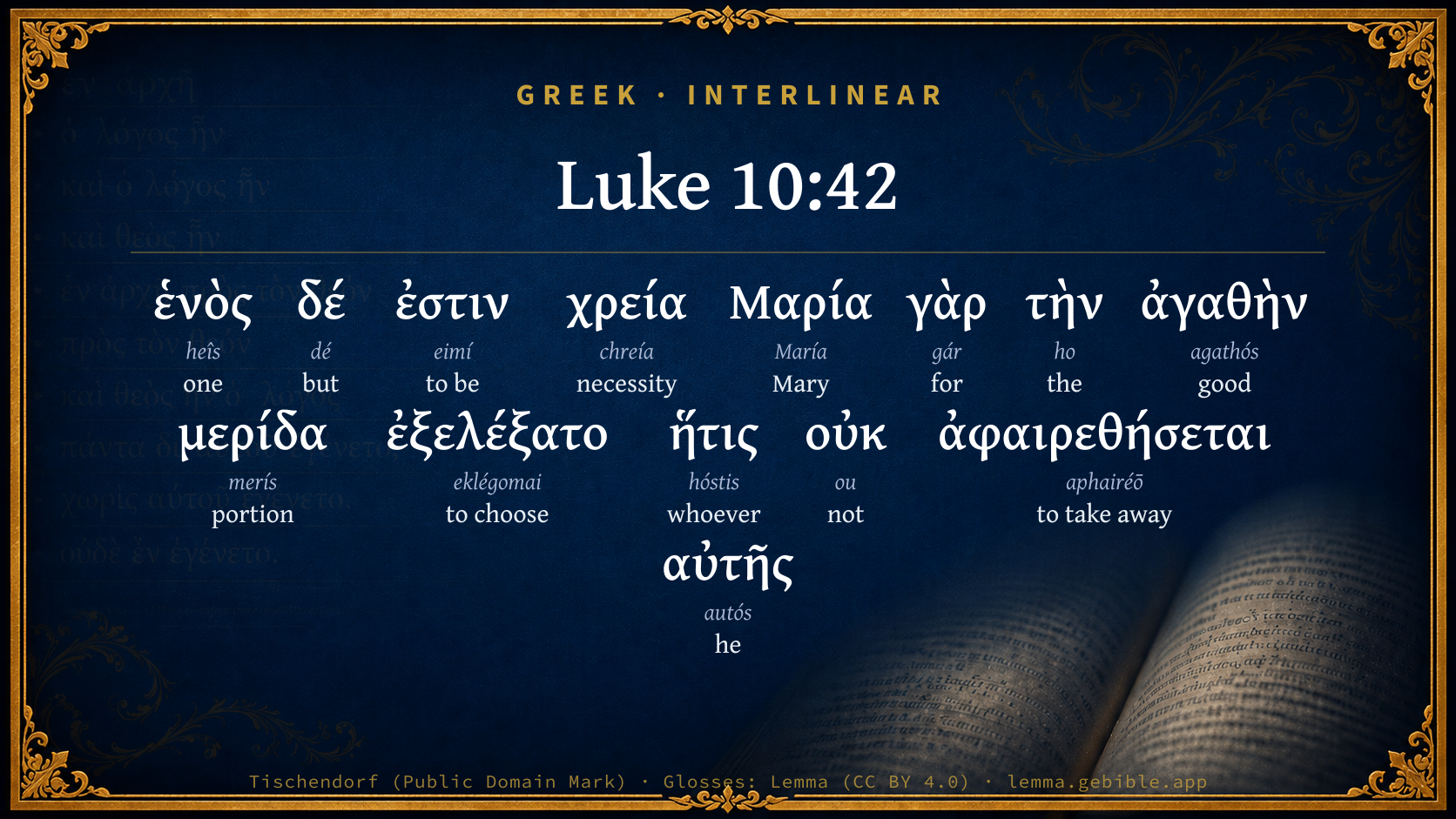
Download image
Cite this verse

Luke 10:42 (World English Bible). Public Domain. Lemma interlinear Bible study tool, https://lemma.gebible.app/v/luke/10/42.

Show BibTeX & RIS
BibTeX
RIS
English Translation
but one thing is needed. Mary has chosen the good part, which will not be taken away from her."
World English Bible · Public Domain
Highlights
  • 1 first appearance in the Greek New Testament
Full analysis ↓
Download a study sheet

One document with this verse’s original text, its word-by-word gloss line, the meaning frame, cross-references with their text, attributed commentary, and full source and license credits — printable, and it pastes into notes with its structure intact.

This verse Autodidact and up

Study sheet (.html) Plain text (.txt)

A passage Seminary Student

Up to 50 verses in one chapter. A passage sheet keeps up to 6 commentary sources and 12 cross-references per verse, in the order this page ranks them, and says so on the sheet whenever that leaves anything out. Ask for a single verse and you get the Autodidact verse sheet above.

Everything on this page stays free to read, with no account — the sheet is a download of what is already on screen, not access to it.

Want to remove ads? Support Godless Engineer
Compare translations 3

The same verse in 3 English versions, stacked beneath the original-language interlinear above. Click any original word for its lexicon entry.

Each is an independent rendering of the whole verse — the interlinear is not word-aligned to these translations.

Highlighted words mark where these versions differ — a whole-verse word diff, not a word-by-word alignment.

  • World English Bible Public Domain
    but one thing is needed. Mary has chosen the good part, which will not be taken away from her."
  • King James Version Public Domain
    But one thing is needful: and Mary hath chosen that good part, which shall not be taken away from her.
  • unfoldingWord Literal Text CC BY-SA 4.0
    but one thing is necessary. For Mary has chosen the good part, which will not be taken away from her.”

unfoldingWord Literal Text — © unfoldingWord, licensed CC BY-SA 4.0. Word-aligned USFM3 via Door43 (git.door43.org/unfoldingWord/en_ult).

Versions to compare (up to 4)

3 of 4 selected

Show all 19 translations

Every available English version of this verse, each an independent rendering of the whole verse.

  • World English Bible Public Domain
    but one thing is needed. Mary has chosen the good part, which will not be taken away from her."
  • Berean Standard Bible Public Domain
    But only one thing is necessary. Mary has chosen the good portion, and it will not be taken away from her.”
  • Majority Standard Bible Public Domain
    But only one thing is necessary. Mary has chosen the good portion, and it will not be taken away from her.”
  • King James Version Public Domain
    But one thing is needful: and Mary hath chosen that good part, which shall not be taken away from her.
  • American Standard Version (1901) Public Domain
    but one thing is needful: for Mary hath chosen the good part, which shall not be taken away from her.
  • Revised Version (1885) Public Domain
    but one thing is needful: for Mary hath chosen the good part, which shall not be taken away from her.
  • Geneva Bible (1599) Public Domain
    But one thing is needefull, Marie hath chosen the good part, which shall not be taken away from her.
  • Douay-Rheims (1899) Public Domain
    But one thing is necessary. Mary hath chosen the best part, which shall not be taken away from her.
  • Young's Literal Translation Public Domain
    but of one thing there is need, and Mary the good part did choose, that shall not be taken away from her.'
  • Literal Standard Version CC BY-SA 4.0
    but of one thing there is need, and Mary chose the good part; that will not be taken away from her.”
  • Unlocked Literal Bible CC BY-SA 4.0
    but only one thing is necessary. Mary has chosen what is best, which will not be taken away from her.”
  • unfoldingWord Literal Text CC BY-SA 4.0
    but one thing is necessary. For Mary has chosen the good part, which will not be taken away from her.”
  • Darby Bible Public Domain
    but there is need of one, and Mary has chosen the good part, the which shall not be taken from her.
  • World Messianic Bible Public Domain
    but one thing is needed. Miriam has chosen the good part, which will not be taken away from her.”
  • Webster's Bible Public Domain
    But one thing is needful; and Mary hath chosen that good part, which shall not be taken away from her.
  • Free Bible Version CC BY-SA 4.0
    But only one thing is really necessary. Mary has chosen the right thing, and it shall not be taken away from her.”
  • Bible in Basic English Public Domain
    Little is needed, or even one thing only: for Mary has taken that good part, which will not be taken away from her.
  • Text-Critical English NT CC BY 4.0
    but only one thing is necessary. Mary has chosen the good portion, and it will not be taken away from her.”
  • Tyndale New Testament (1534) Public Domain
    verely one is nedfull. Mary hath chosen her that good parte which shall not be taken awaye from her.

Literal Standard Version (2020), Covenant Press — licensed CC BY-SA 4.0. Text via the HelloAO Bible API (eBible.org). Unlocked Literal Bible (unfoldingWord) — licensed CC BY-SA 4.0. Text via the HelloAO Bible API (eBible.org). unfoldingWord Literal Text — © unfoldingWord, licensed CC BY-SA 4.0. Word-aligned USFM3 via Door43 (git.door43.org/unfoldingWord/en_ult). Free Bible Version, Dr. Jonathan Gallagher — licensed CC BY-SA 4.0. Text via the HelloAO Bible API (eBible.org).

Word by word

More ways to search: Search by grammar → Find every occurrence → Compare this word →

Practice this passage: Drill this verse → Learn its vocabulary →

μερίδα
merís
G3310
“portion”
Noun, Accusative, Singular, Feminine
Part of Speech
Noun
Case
Accusative
Number
Singular
Gender
Feminine
Full Thayer's Definition

Origin: from G3313

TDNT: None

1. a part as distinct from the whole 2. an assigned part, a portion, share
  1. ἑνὸς heîs G1520 “one” Adjective, Genitive, Singular, Neuter
  2. δέ dé G1161 “but” Conjunction
  3. ἐστιν eimí G1510 “to be” Verb, Present, Active, Indicative, 3rd person, Singular
  4. χρεία chreía G5532 “necessity” Noun, Nominative, Singular, Feminine
  5. Μαρία María G3137 “Mary” Noun, Nominative, Singular, Feminine
  6. γὰρ gár G1063 “for” Conjunction
  7. τὴν ho G3588 “the” Article, Accusative, Singular, Feminine
  8. ἀγαθὴν agathós G18 “good” Adjective, Accusative, Singular, Feminine
  9. ἐξελέξατο eklégomai G1586 “to choose” Verb, Aorist, Middle, Indicative, 3rd person, Singular
  10. ἥτις hóstis G3748 “whoever” Relative pronoun, Nominative, Singular, Feminine
  11. οὐκ ou G3756 “not” Particle, Negative
  12. ἀφαιρεθήσεται aphairéō G851 “to take away” Verb, Future, Passive, Indicative, 3rd person, Singular
  13. αὐτῆς autós G846 “he” Personal pronoun, Genitive, Singular, Feminine

About this verse

These counts appear in no published source. They are computed here, from the morphology-tagged text and Lemma’s own curated glosses. What Lemma adds →

14
words
14
distinct lemmas
Gospels
section

Notable vocabulary

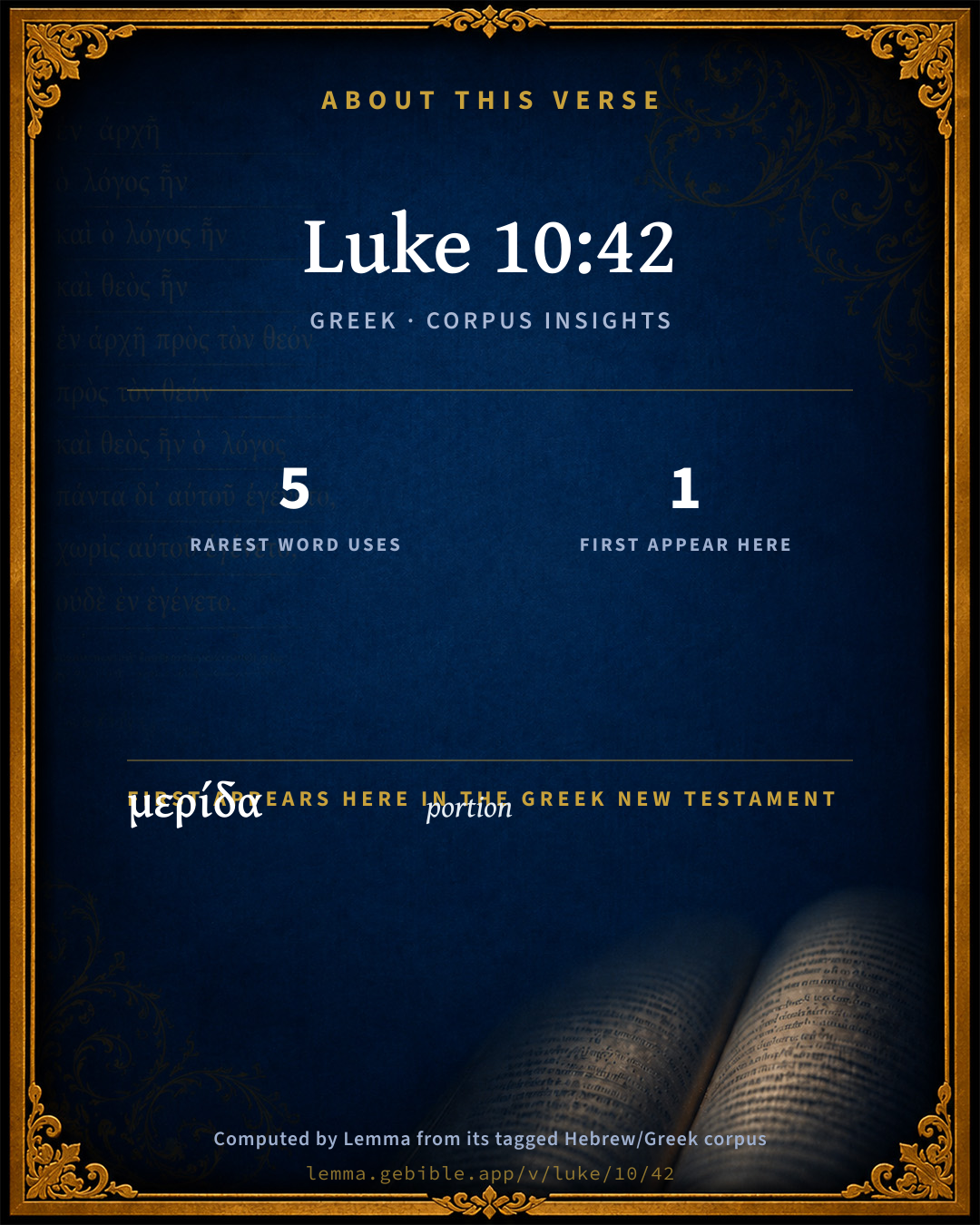
The rarest word here is μερίδα portion G3310 — appearing just 5 times in the whole Greek New Testament.

First appearance in Scripture

This word makes its first canonical appearance in the Greek New Testament here:

  • μερίδα portion G3310

Shared distinctive vocabulary

μερίδα portion G3310 occurs in 5 verses of the Greek New Testament. Also found in:
Cross-references

29

Topical passages linked to Luke 10:42 in the Treasury of Scripture Knowledge — connected by theme and wording, ordered by reader-vote popularity; previews shown in the World English Bible.

  • Psalms 27:4 One thing I have asked of Yahweh, that I will seek after, That I may dwell in the house of Yahweh all the days of my life, To see Yahweh's beauty, And to inquire in his temple.
  • Psalms 16:5–6 Yahweh assigned my portion and my cup. You made my lot secure.
  • John 10:27–28 My sheep hear my voice, and I know them, and they follow me.
  • John 4:14 but whoever drinks of the water that I will give him will never thirst again; but the water that I will give him will become in him a well of water springing up to eternal life."
  • Psalms 73:25 Who do I have in heaven? There is no one on earth who I desire besides you.
  • John 5:24 "Most assuredly I tell you, he who hears my word, and believes him who sent me, has eternal life, and doesn't come into judgment, but has passed out of death into life.
  • Luke 18:22 When Jesus heard these things, he said to him, "You still lack one thing. Sell all that you have, and distribute it to the poor. You will have treasure in heaven. Come, follow me."
  • Psalms 17:15 As for me, I shall see your face in righteousness; I shall be satisfied, when I awake, with seeing your form.
  • Psalms 142:5 I cried to you, Yahweh. I said, "You are my refuge, My portion in the land of the living."
  • John 17:3 This is eternal life, that they should know you, the only true God, and him whom you sent, Jesus Christ.
  • Mark 8:36 For what does it profit a man, to gain the whole world, and forfeit his life?
  • Deuteronomy 30:19 I call heaven and earth to witness against you this day, that I have set before you life and death, the blessing and the curse: therefore choose life, that you may live, you and your seed;
  • Psalms 119:30 I have chosen the way of truth. I have set my heart on your law.
  • 1 John 5:11–12 The testimony is this, that God gave to us eternal life, and this life is in his Son.
  • Romans 8:35–39 Who shall separate us from the love of Christ? Could oppression, or anguish, or persecution, or famine, or nakedness, or peril, or sword?
  • Luke 12:20 "But God said to him, 'You foolish one, tonight your soul is required of you. The things which you have prepared--whose will they be?'
  • Luke 12:33 Sell that which you have, and give gifts to the needy. Make for yourselves purses which don't grow old, a treasure in the heavens that doesn't fail, where no thief approaches, neither moth destroys.
  • Colossians 3:3–4 For you died, and your life is hidden with Christ in God.
  • Psalms 119:111 I have taken your testimonies as a heritage forever, For they are the joy of my heart.
  • Ecclesiastes 12:13 This is the end of the matter. All has been heard. Fear God, and keep his commandments; for this is the whole duty of man.
  • Luke 8:18 Be careful therefore how you hear. For whoever has, to him will be given; and whoever doesn't have, from him will be taken away even that which he thinks he has."
  • 1 Peter 1:4–5 to an incorruptible and undefiled inheritance that doesn't fade away, reserved in heaven for you,
  • Joshua 24:15 If it seem evil to you to serve Yahweh, choose you this day whom you will serve; whether the gods which your fathers served that were beyond the River, or the gods of the Amorites, in whose land you dwell: but as for me and my house, we will serve Yahweh.
  • 1 Corinthians 13:3 If I dole out all my goods to feed the poor, and if I give my body to be burned, but don't have love, it profits me nothing.
  • Luke 16:25 "But Abraham said, 'Son, remember that you, in your lifetime, received your good things, and Lazarus, in like manner, bad things. But now here he is comforted and you are in anguish.
  • Colossians 2:10–19 and in him you are made full, who is the head of all principality and power;
  • Joshua 24:22 Joshua said to the people, You are witnesses against yourselves that you have chosen you Yahweh, to serve him. They said, We are witnesses.
  • Psalms 119:173 Let your hand be ready to help me, For I have chosen your precepts.
  • Galatians 5:6 For in Christ Jesus neither circumcision amounts to anything, nor uncircumcision, but faith working through love.

Cross-references courtesy of OpenBible.info (CC BY 4.0).

Where the printed editions differ

2 variants

Places in this verse where the major printed Greek editions disagree on the wording in a way that affects the translation — a comparison of editions, not a manuscript-by-manuscript collation. The editions are the modern critical texts (Nestlé-Aland 28/27, SBL, Westcott-Hort, Tregelles, Tyndale House) and the traditional texts behind the KJV (the Textus Receptus and the Byzantine/Majority text). It is not a claim about which reading is original.

  1. Extra text
    ὀλίγων

    “few”

    In SBLWH Not in NA28NA27TynTregTRByz
  2. Extra text
    ἢ

    “or”

    In SBL»4WH»4 Not in NA28NA27TynSBLWHTregTRByz

    ὀλίγων ἢ (oligōn ē) 'few or' is only in a few manuscripts (SBL+WH)

Textual data: Translators Amalgamated Greek New Testament (STEPBible TAGNT) · CC BY 4.0.

Commentary

Notes on Luke 10:42 from classic Christian and Jewish commentators (each source and its license shown beneath its notes). The classic Christian expositions comment on the surrounding passage and are grouped to its opening verse, so a note may address several verses; the Jewish commentaries on the Tanakh (Rashi and others) are per-verse, so they appear only where the commentator wrote on this verse.

Lemma curates 59 commentaries, every one of them public domain or Creative Commons licensed, each selected and text-cleaned for this edition rather than reprinted as found. About our sources →

Adam Clarke's Commentary

Verse 42. One thing is needful] This is the end of the sentence, according to Bengel. "Now Mary hath chosen, c.," begins a new one. One single dish, the simplest and plainest possible, is such as best suits me and my disciples, whose meat and drink it is to do the will of our heavenly Father.

Mary hath chosen that good part] That is, of hearing my word, of which she shall not be deprived it being at present of infinitely greater importance to attend to my teaching than to attend to any domestic concerns. While thou art busily employed in providing that portion of perishing food for perishing bodies, Mary has chosen that spiritual portion which endures for ever, and which shall not be taken away from her; therefore I cannot command her to leave her present employment, and go and help thee to bring forward a variety of matters, which are by no means necessary at this time. Our Lord both preached and practised the doctrine of self-denial; he and his disciples were contented with a little, and sumptuous entertainments are condemned by the spirit and design of his Gospel.

Multos morbos, multa fercula fecerunt. SENECA.

"Many dishes, many diseases."

Bishop PEARCE remarks that the word χρεια, needful, is used after the same manner for want of food in Mr 2:25, where of David it is said, χρειαν εσχε, he had need, when it means he was hungry. I believe the above to be the true meaning of these verses; but others have taken a somewhat different sense from them: especially when they suppose that by one thing needful our Lord means the salvation of the soul. To attend to this is undoubtedly the most necessary of all things, and should be the first, the grand concern of every human spirit; but in my opinion it is not the meaning of the words in the text. It is only prejudice from the common use of the words in this way that could make such an interpretation tolerable. KYPKE in loc. has several methods of interpreting this passage. Many eminent commentators, both ancient and modern, consider the text in the same way I have done. But this is termed by some, "a frigid method of explaining the passage;" well, so let it be; but he that fears God will sacrifice every thing at the shrine of TRUTH. I believe this alone to be the true meaning of the place, and I dare not give it any other. Bengelius points the whole passage thus: Martha, Martha, thou art careful and troubled about many things: but one thing is needful. Now, Mary hath chosen that good portion, which shall not be taken away from her.

THAT the salvation of the soul is the first and greatest of all human concerns, every man must acknowledge who feels that he has a soul; and in humility of mind to hear Jesus, is the only way of getting that acquaintance with the doctrine of salvation without which how can he be saved? While we fancy we are in no spiritual necessity, the things which concern salvation will not appear needful to us! A conviction that we are spiritually poor must precede our application for the true riches. The whole, says Christ, need not the physician, but those who are sick. Martha has been blamed, by incautious people, as possessing a carnal, worldly spirit; and as Mary Magdalene has been made the chief of all prostitutes, so has Martha of all the worldly-minded. Through her affectionate respect for our Lord and his disciples, and through that alone, she erred. There is not the slightest intimation that she was either worldly-minded or careless about her soul; nor was she at this time improperly employed, only so far as the abundance of her affection led her to make a greater provision than was necessary on the occasion. Nor are our Lord's words to be understood as a reproof; they are a kind and tender expostulation, tending to vindicate the conduct of Mary. The utmost that can be said on the subject is, Martha was well employed, but Mary, on this occasion, better.

If we attend to the punctuation of the original text, the subject will appear more plain. I shall transcribe the text from Bengel's own edition, Stutgardiae, 1734, 12mo. Luke 10:41; Luke 10:42, v. 41. αποκριθεις δε ειπεν αυτῃ ὁ Ιησους, Μαρθα, Μαρθα, μεριμνᾳς και τυρβαζῃ περι πολλα· ἑνος δε εϚι χρεια. Μαρια δε την αγαθην μεριδα εξελεξατο, ἡτις ουκ αφαιρεθησεται απ' αυτης. "Then Jesus answered her, Martha, Martha, thou art anxiously careful and disturbed about many things; but one thing is necessary. But Mary hath chosen that good portion which shall not be taken away from her." I have shown, in my notes, that Martha was making a greater provision for her guests than was needful; that it was in consequence of this that she required her sister's help; that Jesus tenderly reproved her for her unnecessary anxiety and superabundant provision, and asserted that but one thing, call it course or dish, was necessary on the occasion, yet she had provided many; and that this needless provision was the cause of the anxiety and extra labour. Then, taking occasion, from the circumstances of the case, to vindicate Mary's conduct, and to direct his loving reproof more pointedly at Martha's heart, he adds, Mary hath chosen a good portion; that is, she avails herself of the present opportunity to hear my teaching, and inform herself in those things which are essential to the salvation of the soul. I cannot, therefore, order her to leave my teaching, to serve in what I know to be an unnecessary service, however kindly designed: for it would be as unjust to deprive her of this bread of life, after which she so earnestly hungers, as to deprive thee, or thy guests, of that measure of common food necessary to sustain life. All earthly portions are perishing: "Meats for the belly, and the belly for meats, but God will destroy both it and then; but the work of the Lord abideth for ever;" her portion, therefore, shall not be taken away from her. This is my view of the whole subject; and all the terms in the original, not only countenance this meaning, but necessarily require it. The words, one thing is needful, on which we lay so much stress, are wanting in some of the most ancient MSS., and are omitted by some of the fathers, who quote all the rest of the passage: a plain proof that the meaning which we take out of them was not thought of in very ancient times; and in other MSS., versions, and fathers, there is an unusual variety of readings where even the thing, or something like it, is retained. Some have it thus; Martha, Martha, thou labourest much, and yet a little is sufficient, yea, one thing only. Others: And only one thing is required. Others: Thou art curious and embarrassed about many things, when that which is needful is very small. Others: But here there need only a few things. Others: But a few things, or one only, is necessary. Now these are the readings of almost all the ancient versions; and we plainly perceive, by them, that what we term the one thing needful, is not understood by one of them as referring to the salvation of the soul, but to the provision THEN to be made. It would be easy to multiply authorities, but I spare both my own time and that of my reader. In short, I wonder how the present most exceptionable mode of interpretation ever obtained; as having no countenance in the text, ancient MSS. or versions, and as being false in itself; for even Christ himself could not say, that sitting at his feet, and hearing his word, was the ONE thing NEEDFUL. Repentance, faith, prayer, obedience, and a thousand other things are necessary to our salvation, besides merely hearing the doctrines of Christ, even with the humblest heart.

Adam Clarke's Commentary on the Bible (1810–1826) — public domain. Text from a community e-Sword/MySword module.

Tyndale Open Study Notes

Tyndale Open Resources

10:42 There is only one thing worth being concerned about. Mary has discovered it: Jesus’ words were shocking. Women were expected to serve domestically and were forbidden to learn as disciples from a rabbi. Jesus validated Mary’s desire to be his disciple.

Tyndale Open Study Notes — © Tyndale Open Resources, licensed CC BY-SA 4.0. Text via the HelloAO Bible API.

Bengel's Gnomon

Johann Albrecht Bengel

Luk 10:42. Ἑνὸς δέ ἐστι χρεία, whereas there is need of but one thing) The antithesis is περὶ πολλά, about many things, Luk 10:41. Comp. Sir. (Ecclus.) Luk 11:11; Luk 11:10 in the Greek. This one thing seems to be said of the same kind (class, genus) as the many things. One thing (ἓν is the original, not τὸ ἓν, the one thing) in relation to the necessities of food (living), without the distracting varieties of a great feast.[103] The ΔῈ, but, twice employed, accords with this view. One needful thing, in the class (genus) of spiritual things, is equally commended [at the same time that the one needful thing in the way of food is praised], when it is termed ἡ ἀγαθὴ μερὶς, that good part: and therefore, if you refer the ἓν, one thing, to frugality in the viands of the entertainment, not only is the doctrinal lesson in the whole passage[104] not attenuated, but it is rendered the more full and fruitful by this interpretation. However, I do not dogmatically assert this view. I have said, ‘seems.’ As concerns the thing itself, the force of the sentiment is not diminished thereby.—ἀγαθὴν, good) better than Martha thought: tranquillizing, enriching.—μερίδα, portion) A metaphor from a feast.—ἐξελέξατο, hath chosen out for herself) What each soul chooses out, that it enjoys. The elect soul is accounted to have chosen the good part. So great is the goodness of the Lord towards those who are willing to receive it.—οὐκ ἀφαιρεθήσεται, shall not be taken away) Comp. Mar 4:25. The exemption from worldly service was thus confirmed to Mary.

[103] Called by the Latins “dubia cœna;” ubi dubites quid capias, where you are puzzled by the variety what to take.—ED. and TRANSL.

[104] In a similar way, ch. Luk 17:21, there is no disparagement to the truth that the kingdom of God possesses the whole inner man of believers, even though the discourse, addressed directly to the Pharisees (and not to believers), is thus to be understood: The kingdom of God and the Messiah Himself is even already near at hand and in the midst of you. So also in Php 1:21, Christ does not cease to be the life of Paul, although Paul says in that particular passage, “My life, wherein I must remain in the world for some time longer, altogether aims towards Christ as its object and mark.” There is no reason that we should try to gain for the meaning and intention of the sacred words of Scripture, which are never void of the power of the Spirit, a richness of meaning even fuller than was designed. The denial of mere human caprice and fancy is certainly better than giving scope to such exercises of religious devotion.—V. g.

Bengel's Gnomon of the New Testament — English translation (T&T Clark, Edinburgh, 1860) — public domain. Text from a community e-Sword module.

Expositor's Greek Testament

ed. W. Robertson Nicoll

Luk 10:42 . ὀλίγων δέ ἐστιν χρεία ἢ ἑνός . With this reading the sense is: there is need of few things (material); then, with a pause or rather of one thing (spiritual). Thus Jesus passes, as was His wont, easily and swiftly from the natural to the spiritual. The notion that it was beneath the dignity of Jesus to refer to dishes , even as a stepping stone to higher things, is the child of conventional reverence. τὴν ἀγαθὴν μερίδα , the good portion, conceived of as a share in a banquet (Gen 43:34 ). Mary, having chosen this good portion, may not be blamed ( γὰρ ), and cannot be deprived of it, shall not with my sanction, in deference to the demands of a lower vocation.

The Expositor's Greek Testament, edited by W. Robertson Nicoll (1897–1910) — public domain. Text from a community e-Sword module.

Jamieson, Fausset & Brown

Robert Jamieson, A. R. Fausset & David Brown

one thing, &c.--The idea of "Short work and little of it suffices for Me" is not so much the lower sense of these weighty words, as supposed in them, as the basis of something far loftier than any precept on economy. Underneath that idea is couched another, as to the littleness both of elaborate preparation for the present life and of that life itself, compared with another.

chosen the good part--not in the general sense of Moses' choice (Heb 11:25), and Joshua's (Jos 24:15), and David's (Psa 119:30); that is, of good in opposition to bad; but, of two good ways of serving and pleasing the Lord, choosing the better. Wherein, then, was Mary's better than Martha's? Hear what follows.

not be taken away--Martha's choice would be taken from her, for her services would die with her; Mary's never, being spiritual and eternal. Both were true-hearted disciples, but the one was absorbed in the higher, the other in the lower of two ways of honoring their common Lord. Yet neither despised, or would willingly neglect, the other's occupation. The one represents the contemplative, the other the active style of the Christian character. A Church full of Marys would perhaps be as great an evil as a Church full of Marthas. Both are needed, each to be the complement of the other.

Next: Luke Chapter 11

Jamieson, Fausset & Brown — Commentary Critical and Explanatory on the Whole Bible (1871) — public domain (CC PDM 1.0). Text via the HelloAO Bible API.

Ellicott's Commentary for English Readers

(42) But one thing is needful.—Some of the better MSS. present a singular various-reading, There is need of few things, or of one only. It is obvious that this might be taken either literally or spiritually. They might mean (1) that He who spoke, and the others who were coming, needed not the many things about which Martha was troubled, but a few only, or even but a single dish, to supply their wants; or (2) that the true life of men needed but a few things, such as faith, obedience, the fear of God, or even but one only, the devout and intent love which Mary was then showing. The latter interpretation is clearly most in harmony with our Lord’s usual teaching, though the former has something like a parallel in the teaching of Luk_10:7 of this very chapter. It is not improbable that our Lord designedly used words which had an outer and an inner meaning, the latter intended chiefly for those who “had ears to hear.” There is a singular coincidence between the words here spoken to Martha and those addressed to the young ruler (“one thing thou lackest”), whom we have seen reason to identify with her brother. (See Note on Mat_19:16.) The omission of “few things” in the received text, may have originated in the wish to give an exclusive prominence to the higher meaning.

Mary hath chosen that good part.—The Greek noun is very nearly the same as that which the younger son, in Luk_15:12, uses for “the portion of goods,” the good part or portion here being nothing less than the eternal life which is the gift of God. Here too we may trace something approaching to a half-playful mingling of the higher and lower meanings of the word which was used in the Greek version of the Old Testament at once for Benjamin’s mess, i.e., portion of food (Gen_43:34), and for God as the “portion” of His people (Psa_73:26). Even on the assumption that our Lord spoke in Aramaic, and not in Greek, a like play upon the word would have been equally possible.

The two sisters have come to be regarded as the representatives respectively of the active and the contemplative forms of the religious life, and there is, of course, a certain measure of truth in this view. On the other hand, however, it must be remembered that Martha’s activity, with its manifold distractions, was not Christian activity, and that Mary’s contemplation passed, when the time came for it, as in Joh_12:3, into full and intense activity. The contrast is rather that between singleness of heart and the character which St. James describes as “double-minded” (Jas_1:8), i.e., divided in its affections.

A Bible Commentary for English Readers, edited by Charles John Ellicott (1878–1897) — public domain. Text from a community e-Sword module.

Trapp's Complete Commentary

John Trapp

42 But one thing is needful: and Mary hath chosen that good part, which shall not be taken away from her.

Ver. 42. But one thing is necessary] That bonum hominis, good of humanity, Mic 6:8, that totum hominis, Ecc 12:13; the happiness, the whole of a man, viz. to hear the word of God and keep it. The original hath it thus, there is need of one thing; that is, say some, of one dish only: but the other sense is the better.

That good part] Non tu malam, sed illa meliorem, saith Augustine. Thou hast done well, but she better.

John Trapp, A Commentary or Exposition upon All the Books of the Old and New Testament (1647–1656) — public domain. Text from a community e-Sword module.

Albert Barnes' Notes on the Bible

But one thing is needful - That is, religion, or piety. This is eminently and especially needful. Other things are of little importance. This should be secured first, and then all other things will be added. See 1Ti 4:8; Mat 6:33.

That good part - The portion of the gospel; the love of God, and an interest in his kingdom. She had chosen to be a Christian, and to give up her time and affections to God.

Which shall not be taken away - God will not take away his grace from his people, neither shall any man pluck them out of his hand, Joh 10:28-29.

From this interesting narrative we learn:

1. That the cares of this life are dangerous, even when they seem to be most lawful and commendable. Nothing of a worldly nature could have been more proper than to provide for the Lord Jesus and supply his wants. Yet even “for this,” because it too much engrossed her mind, the Lord Jesus gently reproved Martha. So a care for our families may be the means of our neglecting religion and losing our souls.

2. It is of more importance to attend to the instructions of the Lord Jesus than to be engaged in the affairs of the world. The one will abide forever; the other will be but for a little time.

3. There “are” times when it is proper to suspend worldly employments, and to attend to the affairs of the soul. It “was” proper for Mary to do it. It would have been proper for Martha to have done it. It “is” proper for all on the Sabbath and at other occasional seasons - seasons of prayer and for searching the word of God - to suspend worldly concerns and to attend to religion.

4. If attention to religion be omitted at “the proper time,” it will always be omitted. If Mary had neglected to hear Jesus “then,” she might never have heard him.

5. Piety is the chief thing needed. Other things will perish. We shall soon die. All that we can gain we must leave. But the “soul” will live. There is a judgment-seat; there is a heaven; there is a hell; and “all” that is needful to prepare us to die, and to make us happy forever, is to be a friend of Jesus, and to listen to his teaching.

6. Piety is the chief ornament in a female. It sweetens every other virtue; adorns every other grace; gives new loveliness to the tenderness, mildness, and grace of the female character. Nothing is more lovely than a female sitting at the feet of the meek and lowly Jesus, like Mary; nothing more unlovely than entire absorption in the affairs of the world, like Martha. The most lovely female is she who has most of the spirit of Jesus; the least amiable, she who neglects her soul - who is proud, frivolous, thoughtless, envious, and unlike the meek and lowly Redeemer. At his feet are peace, purity, joy. Everywhere else an alluring and wicked world steals the affections and renders us vain, frivolous, wicked, proud, and unwilling to die.

Albert Barnes' Notes on the Bible (1834–1885) — public domain. Text from a community e-Sword/MySword module.

Haydock's Catholic Bible Commentary

One thing is necessary. Some think that Christ’s meaning was, that Martha was preparing many dishes, when one was sufficient. But others, that this one thing necessary, was to learn, and comply with the will of God; which Mary was employed about. (Witham)

====================

George Leo Haydock (1774–1849), Haydock's Catholic Family Bible and Commentary, 1859 edition — public domain. Excludes Psalms (Douay-Rheims chapter numbering differs from Protestant) and Deuterocanonical books (Catholic canon only).

Whedon's Commentary on the Bible

Daniel D. Whedon

42. One thing is needful—That is, one thing is a necessity. Your mind, in attending to a multiplicity, is forgetting the great one. These are desirable; that is indispensable. To make Jesus here say, as some commentators do, that but one dish instead of many is needful, is scarce less than burlesque; and such an interpretation should be carried out by making Mary’s good part signify the best bit in the dish! How unjustifiable is this low interpretation, (ancient though it be,) is clear from this fact, that neither dish nor food has been once named in the narrative. The many to which the one thing is contrasted does not indicate either. It is properly supplemented by our translators with the word things; as including the total multiplicity of her household cares. Against this distracting earthly many our Lord solemnly opposes the heavenly but forgotten one.

The term needful in the Greek is a noun—necessity. What profit earthly activities, pre-eminences, gains, and enjoyments, if we miss that one absolute necessity, without which our all is lost!

Chosen that good part—Our Lord does not imply that Martha has not so chosen; he only asserts that Mary has. His purpose is not accusation; but, after gentle reproof of the accuser, to vindicate the accused. In preference to the distracting many things, she has chosen the one good part, a share in the blessed eternal things.

Chosen—It was the act of her own free will. Neither the good part, nor the choice, nor the will, was imposed upon her by any arbitrary decree or purpose of God, or any necessity of her own inward nature. As amiable natures as she, with as good opportunities, doubtless, rejected the Saviour; as with all her loveliness and opportunities it was in her power to do. And, hereby, we do not depreciate the grace of God, and the operations of the Spirit, or the fullness or the freeness of the Saviour’s atonement; all which enabled and offered, but never imposed or necessitated, her acceptance or her salvation.

Not be taken away from her—As her free choice, through God’s grace, accepted and made that good part her own, so that same free choice can ever retain it. As God never will take it from her, so neither men nor devils ever can. She may renounce and throw it away; but not all the powers of evil can ever take it from her.

Daniel D. Whedon (gen. ed.), Commentary on the Old and New Testaments (1874–1909) — public domain. Text from a community e-Sword module.

The Pulpit Commentary

But one thing is needful. Jesus had been saying to this kindly but over-fussy friend, "Are you not too anxious about these household cares of yours?" and then he adds, "See, only one thing is really needful." Now, what is the exact meaning of these last words? Some expositors have taken the expression to mean "a single dish is sufficient" for my entertainment; so much careful, anxious thought is thrown away. A curious variation in the reading occurs here in some, though not in all the oldest, authorities. It seems as though some of the early copyists of the text of the Gospel were wishful to make the words, which they possibly understood as a lesson of the Master"s on simplicity of food, clearer and more emphatic. This other reading is, "There is need of few things, or of one only." In other words, "Few things are enough for me and my friends to sit down to, or even one dish only." The teaching contained in ver. 7 gives a little colour to this quaint interpretation of the Master"s words here, which sees in them a general warning against taking thought for the pleasures of the table. But, on the whole, the old reading contained in the received text is preferable, and the old interpretation, too, viz. that the true life of man needs but one thing, or, if the other reading be adopted, needs but few things. If we must specify the one, we would call it" love," or "charity." So John, we know, in his old days, summed up all man"s duties in this "love." If, on the other hand, we are asked to name the few, then we would add to love, faith and hope. The parable of the "good Samaritan," that practical lesson of the love or charity the Master was alluding to, had just been spoken; it was Still, we may reverently assume, fresh in the Divine Teacher"s mind. And Mary hath chosen that good part, which shall not be taken away from her. And Mary, his dear Bethany friend, had made her happy choice of the one thing, that love or charity which never fails; or, perchance, had made her choice of the few things needful (if we prefer the longer reading of those old manuscripts we have spoken of) the few things would then mean that faith, hope, and charity which abide both now and in the ages of ages yet to come!

The Pulpit Commentary (1880–1919), ed. H.D.M. Spence-Jones & Joseph S. Exell — public domain. Text from a community e-Sword module.

John Wesley's Explanatory Notes

Mary hath chosen the good part - To save her soul. Reader, hast thou?

John Wesley, Explanatory Notes Upon the Whole Bible (1754–1765) — public domain. Text via the GEBible commentary corpus.

Cambridge Greek Testament for Schools and Colleges

42. ἑνὸς δέ ἐστιν χρεία. The context should sufficiently have excluded the very bald, commonplace, and unspiritual meaning which has been attached to this verse,—that only one dish was requisite, or that only one person was wanted to work in the kitchen. Clearly the lesson conveyed is the same as in Mat 6:33; Mat 16:26, even if our Lord’s first reference was the lower one. The various readings ‘but there is need of few things,’ or ‘of few things or of one’ (אB various versions, &c.) seem to have risen from the notion that even for the simplest meal more than one dish would be required. This, however, is not the case in the simple meals of the East.

Μαρία γάρ. The γὰρ implies ‘Nor can I rebuke her; for she, &c.’

μερίδα. ‘Portion’ (as of a banquet, Gen 43:34, LXX[228]; Joh 6:27) or ‘inheritance,’ Psa 73:26. ἥτις=quippe quae. The nature of the portion is such that, &c.

[228] LXX. Septuagint.

ἥτις οὐκ ἀφαιρεθήσεται αὐτῆς. To speak of such theological questions as ‘indefectible grace’ here, is to use the narrative otherwise than was intended. The general meaning is that of Php 1:6; 1Pe 1:5. It has been usual with Roman Catholic and other writers to see in Martha the type of the active, and in Mary of the contemplative disposition, and to exalt one above the other. This is not the point of the narrative, for both dispositions may and ought to be combined as in St Paul and in St John. The gentle reproof to Martha is aimed not at her hospitable activity, but at the ‘fret and fuss,’ the absence of repose and calm, by which it was accompanied; and above all, at the tendency to reprobate and interfere with excellence of a different kind.

Cambridge Greek Testament for Schools and Colleges (Cambridge University Press, 1896; 21 vols, various authors incl. Carr, Maclear, Plummer, Farrar, Lumby, Moule, M. R. James, Simcox) — public domain. Text from a community e-Sword module.

Alford’s Greek Testament

Henry Alford

42.] The repetition of her name indicates reproof.

μεριμνᾷς expresses the inner anxiety (from μερίζω), θορυβάζῃ the outer bustle and confusion. The latter word is not elsewhere found in Greek.

πολλά, many things.

ἑνός, of one thing; perhaps we should not express the two words more definitely, for fear of narrowing the wide sense in which they are spoken. I can hardly doubt that our Lord, in the first and most obvious meaning, indicated that simpler preparation would have been all that was needful, but the πολλά leads to the ἕν, and that to the ἀγαθὴ μερίς, the ἕν being the middle term of comparison between the natural πολλά and the spiritual ἀγαθὴ μερίς. So that the whole will imply—only within the circle of Christ’s disciples, those who act from love (mistaken or otherwise) to Him—much as Joh 6:27,—and will set before us the bread which perisheth on one hand, and that which endureth to everlasting life on the other. The ἀγαθὴ μερίς, the good portion, is the ἕν which is needful—see Joh 6:53,—the feeding on the bread of life by faith; which faith cometh by hearing, and hearing by the ῥῆμα χριστοῦ, which Mary was now receiving into her soul, and which (Joh 6:54) shall never be taken away, but result in everlasting life.

The two types of character have ever been found in the Church; both, caring for Him, and for love to Him doing what they do: but the one busy and restless, anxious and stirring; the other quiet and humble, content to sit at His feet and learn. We see here which of the two He praises. But on the other hand we must not derive any argument hence against an active Christian life of doing good: this is, in fact, to sit at His feet and learn—to take His yoke on us, and learn of Him. It is the bustling about the πολλά of which there is no need, which is blamed: not the working out the fruits of the Spirit, which are needful, being parts themselves of the ἀγαθὴ μερίς.

Henry Alford, The Greek Testament (1849–1861) — public domain. Text from a community e-Sword module.

International Critical Commentary

42. Μαριὰμ γάρ. Explanation of ἑνός, and hence the γάρ. Not many things are needed, but only one, as Mary’s conduct shows.

The γάρ (א B L Λ) would easily be smoothed into δέ (A C P), or omitted as difficult (D). Versions and Fathers support all three readings. WH. and RV. adopt γάρ.

τὴν ἀγαθὴν μερίδα. “The good part.” No comparison is stated; but it is implied that Martha’s choice is inferior. In comparison with Mary’s it cannot be called “the good part,” or “the one thing” necessary, although it is not condemned as bad. Her distracting anxiety was the outcome of affection. Ecce pars, Marthæ non reprehenditur, sed Mariæ laudatur (Bede). Confirmata Mariæ immunitas (Beng.). Comp. Joh 6:27.

ἥτις οὐκ ἀφαιρεθήσεται αὐτῆς. “Which is of such a character as not to be taken away from her.” Activa vita cum corpore deficit. Quis enim in æterna patria panem esurienti porrigat, ubi nemo sitit ? quis mortuum sepeliat, ubi nemo moritur ? Contemplativa autem hic incipitur, ut in cælesti patria perficiatur (Greg. Magn. in Ezech. ii. 34).

The omission of the prep. before the gen. (א B D L, ei a e, illi b i l q) is unusual. Hence A C R Γ Δ etc. insert ἀπʼ before αὐτῆς (ab ea Vulg. f).

In this narrative of the two sisters in the unnamed village Lk. unconsciously supplies historical support to the Johannine account of the raising of Lazarus. If that miracle is to be successfully discredited, it is necessary to weaken the support which this narrative supplies. The Tübingen school propose to resolve it into a parable, in which Martha represents Judaic Christianity, with its trust in the works of the Law; while Mary represents Pauline Christianity, reposing simply upon faith. Or, still more definitely, Martha is the impulsive Peter, Mary the philosophic Paul. But this is quite incredible. Even Lk. has not the literary skill to invent so exquisite a story for any purpose whatever. And Martha was not occupied with legal ceremonial, but with service in honour of Christ. This service was not condemned: it was her excitement and fault-finding my were rebuked. The story, whether an invention or not, is ill adapted to the purpose which is assumed as the cause of is production.

§ Found in Luke alone.

1 That the Jews regarded seventy as the normal number for a supreme court or council is shown by the conduct of Josephus, who in organizing Galilee “chose out seventy of the most prudent men, and those elders in age, and appointed them to be rulers of all Galilee” (B. J. ii. 20, 5; Vita, 14); and also of the Zealots at Jerusalem, who set up a tribunal of seventy chief men, to take the place of the courts which they had suppressed (B. J. iv. 5. 4). Comp. the legend of the Septuagint.

2 See n. 74 in Migna vol. i. p. 1267 (Clem. Recog. ii. 42).

1 Renan has a remarkable passage, in which he shows how the customs of Oriental hospitality aided the preaching and spread of the Gospel (V. de J. p. 293).

2 Peter is represented as saying: Nos ergo primos elegit duodectim sibicredentes, quos apostolos, nominavit, postmodum alios septuaginta duos probatissimos discipulos, ut vel hoc modo recognita imagine Moysis crederet multitudo, quia hic est, quem prædixit Moyses venturum prophetam (1:40). It is worth noting that in the Recognitions the number of the nations of the earth is given as seventy-two (2:42).

1 Steinhart in his ed. of the Scholia on Luke, by Abulfaraǵ Bar-Hebræus (p. 22., Berlin, 1895), questions the statement of Assemani (B.O. iii. , 320f, that Bar-Hebræus gives a list of the Seventy. Such lists have been invented.

Orig. Origen.

Beng. Bengel.

אԠא Cod. Sinaiticus, sæc. iv. Brought by Tischendorf from the Convent of St. Catherine on Mt. Sinai; now at St. Petersburg. Contains the whole Gospel complete.

A A. Cod. Alexandrinus, sæc. v. Once in the Patriarchal Library at Alexandria; sent by Cyril Lucar as a present to Charles 1. in 1628, and now in the British Museum. Complete.

C

C. Cod. Ephraemi Rescriptus, sæc. 5. In the National Library at Paris. Contains the following portions of the Gospel: 1:2-2:5, 2:42-3:21, 4:25-6:4, 6:37-7:16, or 17, 8:28-12:3, 19:42-20:27, 21:21-22:19, 23:25-24:7, 24:46-53.

These four MSS. are parts of what were once complete Bibles, and are designated by the same letter throughout the LXX and N.T.

D D. Cod. Bezae, sæc. vi. Given by Beza to the University Library at Cambridge 1581. Greek and Latin. Contains the whole Gospel.

Win. Winer, Grammar of N.T. Greek (the page refers to Moulton’s edition).

L L. Cod. Regius Parisiensis, sæc. viii. National Library at Paris. Contains the whole Gospel.

X X. Cod. Monacensis, sæc. ix. In the University Library at Munich. Contains 1:1-37, 2:19-3:38, 4:21-10:37, 11:1-18:43, 20:46-24:53.

Δ̠Δ. Cod. Sangallensis, sæc. ix. In the monastery of St. Gall in Switzerland. Greek and Latin. Contains the whole Gospel.

Ξ̠Ξ. Cod. Zacynthius Rescriptus, sæc. viii. In the Library of the Brit. and For. Bible Soc. in London. Contains 1:1-9, 19-23, 27, 28, 30-32, 36-66, 1:77-2:19, 21, 22, 33-39, 3:5-8, 11-20, 4:1, 2, 6-20, 32-43, 5:17-36, 6:21-7:6, 11-37, 39-47, 8:4-21, 25-35, 43-50, 9:1-28, 32, 33, 35, 9:41-10:18, 21-40, 11:1, 2, 3, 4, 24-30, 31, 32, 33.

Syrr. Syriac.

Goth. Gothic.

Aeth. Ethiopic.

Tert. Tertullian.

Eus. Eusebius of Cæsarea

B B. Cod. Vaticanus, sæc. 4. In the Vatican Library certainly since 15331 (Batiffol, La Vaticane de Paul 3, etc., p. 86).

M M. Cod. Campianus, sæc. ix. In the National Library at Paris. Contains the whole Gospel.

R R. Cod. Nitriensis Rescriptus, sæc. 8. Brought from a convent in the Nitrian desert about 1847, and now in the British Museum. Contains 1:1-13, 1:69-2:4, 16-27, 4:38-5:5, 5:25-6:8, 18-36, 39, 6:49-7:22, 44, 46, 47, 8:5-15, 8:25-9:1, 12-43, 10:3-16, 11:5-27, 12:4-15, 40-52, 13:26-14:1, 14:12-15:1, 15:13-16:16, 17:21-18:10, 18:22-20:20, 20:33-47, 21:12-22:15, 42-56, 22:71-23:11, 38-51. By a second hand 15:19-21.

Vulg. Vulgate.

Cur. Curetonian.

Sin. Sinaitic.

Arm. Armenian.

Epiph. Epipnamus.

Treg. Tregelles.

Tisch. Tischendorf.

K K. Cod. Cyprius, sæc. ix. In the National Library at Paris. Contains the whole Gospel.

RV. Revised Version.

AV. Authorized Version.

Burton. Burton, N.T. Moods and Tenses.

1 Comp. Non derelinquas nos sicut pastor gregem suum in manibus luporum malignorum (4 Esr. 5:18). Ovem lupo commisisti (Ter. Eunuch. v. I, 16). Other examples in Wetst. on Mat 10:16. Here ἄρνας ἐν μέσῳ λύκώ must be taken closely together: as certain of being attacked as lambs in the midst of wolves.

2 See Tristram, Eastern Customs in Bible Lands, p. 57, for a graphic illustration of the value of the precept, “Salute no man by the way.” Pulchra est salutatio, sed pulchrior matura exsecutio (Ambr. in loco).

Aug. Augustine.

1 Quod semel a dei opulentia exiit non frustra exiit, sed aliquem certi invenit, cui id obtingat. Solatium ministrorum, qui sibi videntur nil ædificare (Beng.). “Talk not of wasted affection; affection never is wasted” (Longlellow).

Lat. Vetus Latina.

D. B. Smith’s Dictionary of the Bible, 2nd edition.

Jos. Josephus.

1 Il cherchait de toute maniére á établir en principe que ses apôtres c’étail lui-même (Renan, V. de. J. p. 294).

D. B. Smith’s Dictionary of the Bible, 1st edition.

Edersh. Edersheim, Life and Times of Jesus the Messiah.

1 Comp. πρὸς οὐρανὸν βιβῶν (Soph. O.C. 381); Cæsar fertur in cælum (Cic. Phil. iv. 3), collegam de cælo detraxisti (Phil. ii. 42).

2 2 Cum vos nuper mitterem ad evangelizandum videbam dæmonem suâ potestate a me privatum quasi de cælo cadere, ac per vos magic casurum (Corn. à Lap.).

1 Thus Gregory the Great: Mire Dominus, ut in discipulorum cordibus slationem premeret, mox judicium ruinæ retulit, quod ipse magister elationis accepit; ut in auctore superbiæ discerent, quid de elationis vbitio formidarent (Moral. xxiii. 6, Migne, lxxvi. 259).

1 Justin Martyr says to the Roman Emperors, ὑμεῖς δʼ ἀποκτεῖναι μὲν δύνασθε, βλάψαι δʼ οὕ (Apol. i. 2). He is probably adapting Plat. Apol. 30 C.

2 Augustine seems to suggest it Enarr. in Psa_91. But Enarr. in Psa 130. he says well: Non omnes Christiani boni dæmonia ejiciunt; omnium tamen nomina scripta sunt in cælo. Non eos voluit gaudere ex eo quod proprium habebant, sed ex eo quod cum ceteris saluem tenebant.

Wetst. Wetstein.

Iren. Irenæus.

1 “This passage is one of the best authenticated in the Synoptic Gospels. It is found in exact parallelism both in Mt. and Lk., and is therefore known to have been part of that ‘collection of discourses’ (cf. Holtzmann, Synopt. Evangelien, p. 184; Ewald, Evangelien, pp. 20, 255; Weizsäcker, pp. 166-169), in all probability the composition of the Apostle St. Matthew, which many critics believe to be the oldest of all the Evangelical documents. And yet once grant the authenticity of this passage, and there is nothing in the Johannean Christology that it does not cover. Even the doctrine of pre-existence seems to be implicitly contained in it” (Sanday, Fourth Gospel, p. 109). Keim affirms that “There is no more violent criticism than that which Strauss has introduced” of repudiating a passage so strongly attested (Jes. of Naz. 4. p. 63).

TR. Textus Receptus.

Wsctt. Westcott.

Euthym. Euthymius Zigabenus.

1 “The spot indicated by our Lord as the scene of the parable is unmistakable. About half-way down the descent from Jerusalem to Jericho, close to the deep gorge of Wady Kelt, the sides of which are honeycombed by a labyrinth of caves, in olden times and to the present day the resort of freebooters and outlaws, is a heap of ruins, marking the site of an ancient khan. The Kahn el Ahmar, as the ruin is called, possessed a deep well, with a scanty supply of water. Not another building or trace of human habitation is to be found on any part of the road, which descends 3000 feet from the neighbourhood of Bethany to the entrance into the plain of Jordan. Irregular projecting masses of rock and frequent sharp turns of the road afford everywhere safe cover and retreat for robbers” (Tristram, Eastern Customs, p. 220).

2 It was near Jericho that Pompey destroyed strongholds of brigands (Strabo, Geogr. xvi. 2, 41). Jerome explains “the Going up to Adummim” or “Ascent of the Red” (Jos 15:7, Jos 18:17), which is identified with this road, as so called from the blood which is there shed by robbers. The explanation is probably wrong, but the evidence for the robbers holds good (De Locis Heb. s.v. Adummim). The Knights Templars protected pilgrims along this road. For a description of it see Stanley, Sin. & Pal. p. 44; Keim, Jes. of. Nas. v. p. 71 ; Hastings, D.C.G. art. ‘Jericho.”

Trench, Trench, New Testament Synonyms.

1 Blunt sees here a possible coincidence. Christ may have chosen a Samaritan for the benefactor, as a gentle rebuke to James and John for wishing just before this to call down fire on Samaritans (9:54). See Undesigned Coincidences, Pt. IV. 32. p. 300, 8th ed.

Luth. Luther.

Wordsw. Wordsworth (Chr.)

Trench, Trench, Parables.

1 Augustine’s attempt to prove the latter point is almost grotesque. The Jews said to Christ, “Thou art a Samaritan, and hast a devil” (Joh 8:48). Jesus might have replied, “Neither am I a Samaritan, nor have I a devil”: but He said only, “I have not a devil.” Therefore he admitted that He was a Samaritan (Serm clxxi. 2).

1 “But the characteristics of the two sisters are brought out in a very subtle way. In St. Luke the contrast is summed up, it were, in one definite incident; in St. John it is developed gradually in the course of a contiruous, narrative. In St. Luke the contrast is direct and trenchant, a contrast (one might almost say) of light and darkness. But in St. John the characters are shaded off, as it were, into one another” (Lft. Biblical Essays, p. 38).

1 Repetitio nominis indicium est delectationis, aut movendæ intentionis ut audirect intentius (Aug.). D doubles νεανίσκε in 7:4. It is not serving, but excess in it, that is rebuked; and this is not rebuked until Martha begins to find fault with her sister. See Wordsw. It is characteristic of Mary that she makes no reply, but leaves all to the Master.

WH. Westcott and Hort.

Boh. Bohairic.

1 Comp. Lucian, “But what if a guest at the same table neglects all that great variety of dishes, and chooses from those that are nearest to him one that suffices for his need, and is content with that alone, without even looking at all the rest is not he the stronger and the better man?” (Cynic. 7).

International Critical Commentary — older volumes (1896–1929), various authors — public domain. Text from a community e-Sword module.

Lesson kit

Teaching starters — assembled from the data on this page, not authored interpretation. Every prompt links to the verse data it draws on. Edit before teaching.

Luke, in the Gospels, opens this verse with 14 words (14 distinct Greek lemmas). Its most distinctive word is merís (“portion”). A historical commentator’s framing appears above. Read the whole chapter for the surrounding context.

Discussion questions

  1. The word merís carries the sense “portion.” How does it shape the verse?
  2. The word “portion” first appears here in Scripture. What is being introduced at this debut?
  3. Acts 8:21 shares the word «portion» with this verse. How do the two illuminate each other?
  4. The translations on this page render this verse differently — a whole-verse word diff, not a word-by-word alignment. What might account for the different wordings?
  5. Reading how Adam Clarke's Commentary and Tyndale Open Study Notes read this verse, where do the two commentators agree and where do they part?

Things to notice

  • 1 word makes its first canonical appearance in Scripture here.
  • These translations choose different wording for 6 words in this verse.
  • 14 distinct Greek lemmas span 14 words in this verse.

Reading settings

Reading text

Shown beneath each verse's original-language words.

Old Testament
Old Testament edition

Read the OT as the Masoretic Hebrew (MT) or the Greek Septuagint (LXX).

English shown for the Greek Septuagint (in the Hebrew ↔ Greek comparison).

Comparing translations? Open the Compare panel on any verse page to stack up to four side by side.