Philippians 3:7

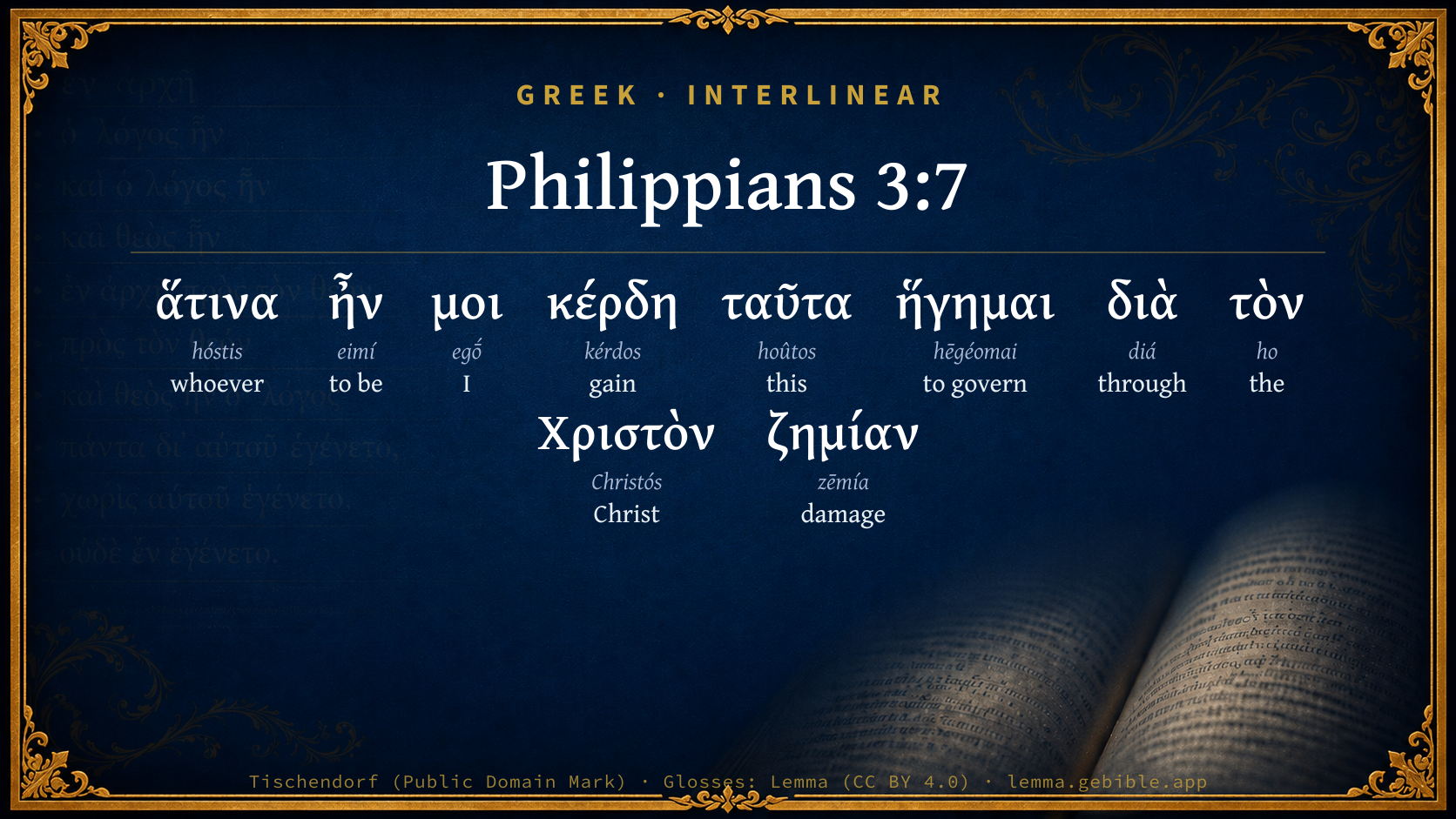
Greek (Tischendorf 8th ed.) Philippians 3:7 appears in the Greek New Testament. The text above is from the Tischendorf 8th edition. Each word links to its Strong’s number and a concise gloss. Click any word for its full Thayer’s Greek Lexicon entry.
Download image
Cite this verse

Philippians 3:7 (World English Bible). Public Domain. Lemma interlinear Bible study tool, https://lemma.gebible.app/v/philippians/3/7.

Show BibTeX & RIS
BibTeX
RIS
English Translation
However, what things were gain to me, these have I counted loss for Christ.
World English Bible · Public Domain
Download a study sheet

One document with this verse’s original text, its word-by-word gloss line, the meaning frame, cross-references with their text, attributed commentary, and full source and license credits — printable, and it pastes into notes with its structure intact.

This verse Autodidact and up

Study sheet (.html) Plain text (.txt)

A passage Seminary Student

Up to 50 verses in one chapter. A passage sheet keeps up to 6 commentary sources and 12 cross-references per verse, in the order this page ranks them, and says so on the sheet whenever that leaves anything out. Ask for a single verse and you get the Autodidact verse sheet above.

Everything on this page stays free to read, with no account — the sheet is a download of what is already on screen, not access to it.

Want to remove ads? Support Godless Engineer
Compare translations 3

The same verse in 3 English versions, stacked beneath the original-language interlinear above. Click any original word for its lexicon entry.

Each is an independent rendering of the whole verse — the interlinear is not word-aligned to these translations.

Highlighted words mark where these versions differ — a whole-verse word diff, not a word-by-word alignment.

  • World English Bible Public Domain
    However, what things were gain to me, these have I counted loss for Christ.
  • King James Version Public Domain
    But what things were gain to me, those I counted loss for Christ.
  • unfoldingWord Literal Text CC BY-SA 4.0
    Whatever things were gains for me, I consider these things loss for the sake of Christ.

unfoldingWord Literal Text — © unfoldingWord, licensed CC BY-SA 4.0. Word-aligned USFM3 via Door43 (git.door43.org/unfoldingWord/en_ult).

Versions to compare (up to 4)

3 of 4 selected

Show all 19 translations

Every available English version of this verse, each an independent rendering of the whole verse.

  • World English Bible Public Domain
    However, what things were gain to me, these have I counted loss for Christ.
  • Berean Standard Bible Public Domain
    But whatever was gain to me I count as loss for the sake of Christ.
  • Majority Standard Bible Public Domain
    But whatever was gain to me I count as loss for the sake of Christ.
  • King James Version Public Domain
    But what things were gain to me, those I counted loss for Christ.
  • American Standard Version (1901) Public Domain
    Howbeit what things were gain to me, these have I counted loss for Christ.
  • Revised Version (1885) Public Domain
    Howbeit what things were gain to me, these have I counted loss for Christ.
  • Geneva Bible (1599) Public Domain
    But the thinges that were vantage vnto me, the same I counted losse for Christes sake.
  • Douay-Rheims (1899) Public Domain
    But the things that were gain to me, the same I have counted loss for Christ.
  • Young's Literal Translation Public Domain
    But what things were to me gains, these I have counted, because of the Christ, loss;
  • Literal Standard Version CC BY-SA 4.0
    But what things were gains to me, these I have counted loss, because of the Christ;
  • Unlocked Literal Bible CC BY-SA 4.0
    But whatever things were a profit for me, I have considered them as loss because of Christ.
  • unfoldingWord Literal Text CC BY-SA 4.0
    Whatever things were gains for me, I consider these things loss for the sake of Christ.
  • Darby Bible Public Domain
    but what things were gain to me these I counted, on account of Christ, loss.
  • World Messianic Bible Public Domain
    However, I consider those things that were gain to me as a loss for Messiah.
  • Webster's Bible Public Domain
    But what things were gain to me, those I counted loss for Christ.
  • Free Bible Version CC BY-SA 4.0
    But in whatever way such things gained me anything, I count them as a loss for Christ.
  • Bible in Basic English Public Domain
    But those things which were profit to me, I gave up for Christ.
  • Text-Critical English NT CC BY 4.0
    But whatever was gain to me I have counted as loss for the sake of Christ.
  • Tyndale New Testament (1534) Public Domain
    But the thynges that were vauntage vnto me I counted losse for Christes sake.

Literal Standard Version (2020), Covenant Press — licensed CC BY-SA 4.0. Text via the HelloAO Bible API (eBible.org). Unlocked Literal Bible (unfoldingWord) — licensed CC BY-SA 4.0. Text via the HelloAO Bible API (eBible.org). unfoldingWord Literal Text — © unfoldingWord, licensed CC BY-SA 4.0. Word-aligned USFM3 via Door43 (git.door43.org/unfoldingWord/en_ult). Free Bible Version, Dr. Jonathan Gallagher — licensed CC BY-SA 4.0. Text via the HelloAO Bible API (eBible.org).

Word by word

More ways to search: Search by grammar → Find every occurrence → Compare this word →

Practice this passage: Drill this verse → Learn its vocabulary →

About this verse

These counts appear in no published source. They are computed here, from the morphology-tagged text and Lemma’s own curated glosses. What Lemma adds →

10
words
10
distinct lemmas
Pauline Epistles
section

Notable vocabulary

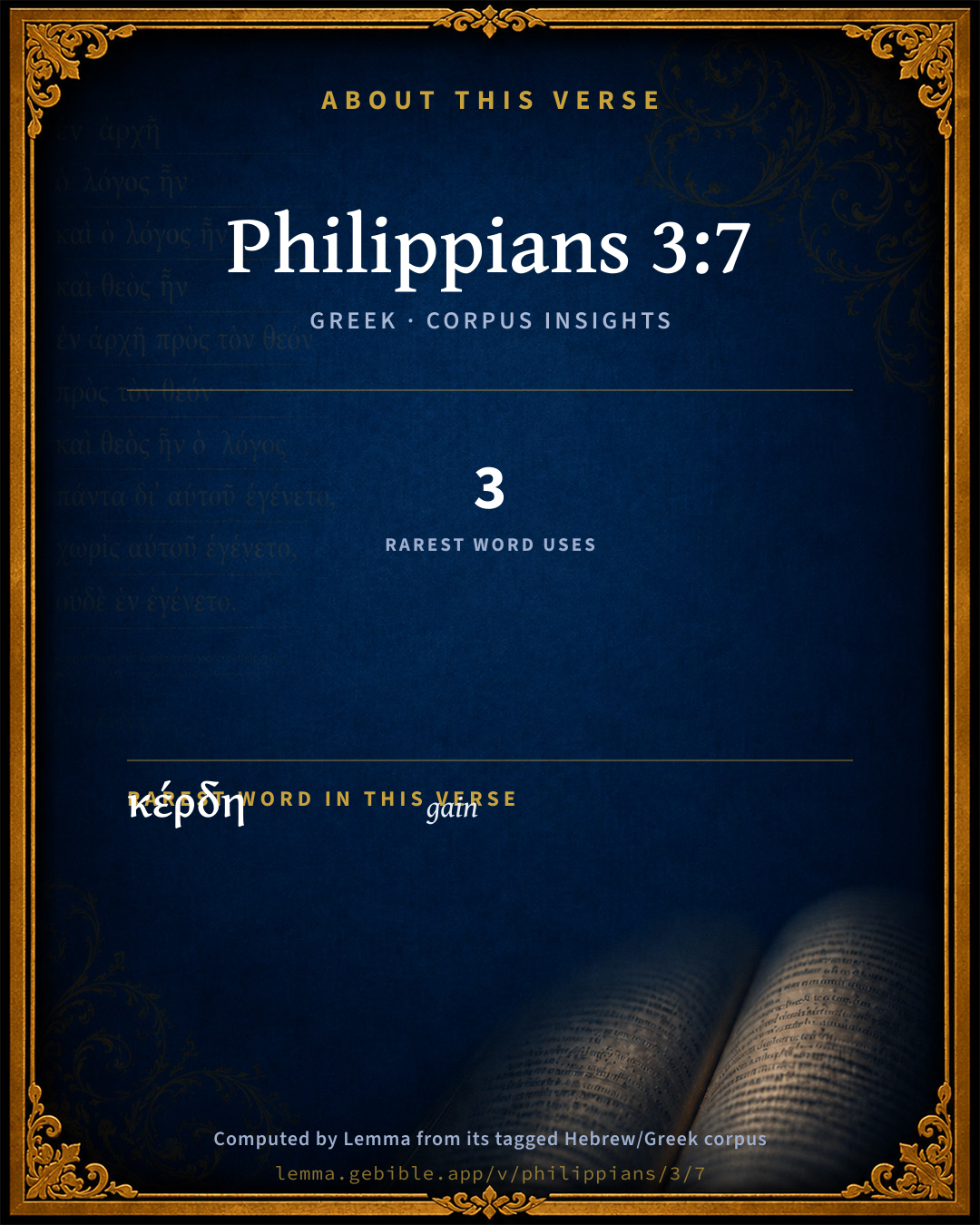
The rarest word here is κέρδη gain G2771 — appearing just 3 times in the whole Greek New Testament.

Shared distinctive vocabulary

κέρδη gain G2771 occurs in 3 verses of the Greek New Testament. Also found in:

Cross-references

17

Topical passages linked to Philippians 3:7 in the Treasury of Scripture Knowledge — connected by theme and wording, ordered by reader-vote popularity; previews shown in the World English Bible.

  • Luke 14:33 So therefore whoever of you who doesn't renounce all that he has, he can't be my disciple.
  • Matthew 16:26 For what will it profit a man, if he gains the whole world, and forfeits his life? Or what will a man give in exchange for his life?
  • Matthew 13:44–46 "Again, the Kingdom of Heaven is like a treasure hidden in the field, which a man found, and hid. In his joy, he goes and sells all that he has, and buys that field.
  • Proverbs 13:8 The ransom of a man's life is his riches, But the poor hear no threats.
  • Luke 14:26 "If anyone comes to me, and doesn't hate his own father, mother, wife, children, brothers, and sisters, yes, and his own life also, he can't be my disciple.
  • Philippians 3:8–10 Yes most assuredly, and I count all things to be loss for the excellency of the knowledge of Christ Jesus, my Lord, for whom I suffered the loss of all things, and count them nothing but refuse, that I may gain Christ
  • Luke 17:31–33 In that day, he who will be on the housetop, and his goods in the house, let him not go down to take them away. Let him who is in the field likewise not turn back.
  • Genesis 19:17 It came to pass, when they had taken them out, that he said, "Escape for your life! Don't look behind you, neither stay anywhere in the plain. Escape to the mountain, lest you be consumed!"
  • Galatians 2:15–16 "We, being Jews by nature, and not Gentile sinners,
  • Job 2:4 Satan answered Yahweh, and said, "Skin for skin. Yes, all that a man has will he give for his life.
  • Galatians 5:2–5 Behold, I, Paul, tell you that if you receive circumcision, Christ will profit you nothing.
  • Genesis 19:26 But his wife looked back from behind him, and she became a pillar of salt.
  • Luke 16:8 "His lord commended the dishonest manager because he had done wisely, for the children of this world are, in their own generation, wiser than the children of the light.
  • Philippians 3:4–6 though I myself might have confidence even in the flesh. If any other man thinks that he has confidence in the flesh, I yet more:
  • Proverbs 23:23 Buy the truth, and don't sell it: Get wisdom, discipline, and understanding.
  • Acts 27:18–19 As we labored exceedingly with the storm, the next day they began to throw things overboard.
  • Acts 27:38 When they had eaten enough, they lightened the ship, throwing out the wheat into the sea.

Cross-references courtesy of OpenBible.info (CC BY 4.0).

Commentary

Notes on Philippians 3:7 from classic Christian and Jewish commentators (each source and its license shown beneath its notes). The classic Christian expositions comment on the surrounding passage and are grouped to its opening verse, so a note may address several verses; the Jewish commentaries on the Tanakh (Rashi and others) are per-verse, so they appear only where the commentator wrote on this verse.

Lemma curates 59 commentaries, every one of them public domain or Creative Commons licensed, each selected and text-cleaned for this edition rather than reprinted as found. About our sources →

The Biblical Illustrator

Joseph S. Exell

Php_3:7-9

What things were gain to me those I counted loss for Christ

The Christians accounts

The Christian keeps an accurate account book.

He reckons up with an enlightened judgment his gains and losses. And most important is it that he should: for the question of questions is, What is gain to me and what is loss?

I. The answer given by the world. Examine the accounts of nine-tenths and you will find--

1. Health and money entered as clear gains, comfort, ease, tranquillity, prosperity, carried to the side of profit.

2. Sickness, disappointment, contraction of the means of pleasure, decay of trade, sorrow, bereavement, entered as unmixed loss.

3. And when we come to matters bearing on the interest of the soul we find that the natural heart has entered on the side of eternal gain, good character, punctuality of attendance at Christian ordinances, a conscience silent as to definite injuries against neighbours. And gain it is in a sense, for it is better to have a good conscience than a bad one, to be moral than immoral. St. Paul says no word about morality being a loss, or that he would have valued Christ more had he been a greater sinner.

II. The Christians answer. For Christs sake Paul now accounts as loss all that he had once accounted gain. He was an Israelite of direct descent. Would he have been a better man had he been born a Gentile and an idolater? He had been blameless in his observance of the ceremonial, and, as he understood it, of the moral law--does he regret that he had not habitually broken it? None of these things. The loss was that he had trusted in these things, and looked to them for salvation. He thought that God must be satisfied with so unexceptionable a genealogy, so diligent a worshipper.

2. In this point of view many of us need instruction and warning. What are we trusting in?

(1) Some of us are putting off the question altogether and saying, I will live while I can and die when I must; I will not torment myself before the time--many years hence I hope.

(2) But this childish and suicidal infatuation is not in all of us. There are those who have religion. What is it? Is it more than a moral life, a Sunday worship, a trusting in Gods mercy? But where is Christ in all this? What know you of the thought, What things were gain to me, etc? What of your own are you discarding in order to rest in Christ alone? Where are your transfers from one side of your reckoning to the other because of Christ? And many of us die in the strength of a gospel which has no Christ in it; no demolition of self, either of self-confidence or seeking, and no exaltation of Christ on the ruins of self, either as Saviour or Lord. We are at best what St. Paul was before his conversion--alas, without his good conscience or scrupulous obedience. (Dean Vaughan.)

A business-like account

Our Saviours advice to those who wished to be His servants was to count the cost. He did not wish to enlist any one by keeping him in ignorance of the requirements of His service. The exercise of our judgments in the gospel is required. Do not imagine that religion consists in wild fanaticism which never considers. The apostle here gives us the word count three times over. He was skilled in spiritual arithmetic and very careful in his reckoning. He seems here to be in a mercantile frame of mind, adding and subtracting and balancing.

I. The apostles calculations.

1. His counting at the outset of his Christian life What things were gain, etc.

(1) He dwelt on the several items, noting each with great distinctness. The list reads like a catalogue. His Jewish advantages had been as precious pearls to him once.

(2) What is there per contra. Nothing on the other side but one item; but that one outweighed the many. That one was not Christianity, the Church, or the orthodox faith, but Christ.

(3) Not only after putting the one under the other and making a subtraction did he find that his earthly advantages were less than Christ; he found these gains transformed into a loss. There was not a plus on that side to stand in proportion to a plus on this; they were turned into a minus of actual deficit. Not that he meant that to be a Hebrew of the Hebrews, etc., was in itself a loss--the advantage was much every way; but he meant that with respect to Christ those things became a disadvantage, because their tendency had been to keep him from trusting Christ. It is a grand thing to have led a virtuous life; but this blessing may, by our own folly, become a curse, if we place it in opposition to the righteousness of Christ, and dream that we have no need of a Saviour.

2. His estimate for the time then present. We are always anxious to hear what a man has to say about a thing after he has tried it. After twenty years of experience Paul had an opportunity of revising his balance sheet; and makes the strong affirmation--Yea, doubtless I count, etc. He has made the original summary even more comprehensive, but he stands to the same estimate and uses not barely the word Christ, but the fuller expression, the excellency of the knowledge, etc. Now he has come to know the Christ in whom before he had trusted. Christ is better loved as he is better known.

(1) The words show the points upon which he had fullest knowledge. He knew the Lord as--

(a) Christ, the Messiah anointed and sent of the Father.

(b) Jesus, the anointed and actual Saviour.

(c) My Lord. His was an appropriating knowledge.

(2) The text implies that he knew Christ by faith. He believed, and hence he knew.

(3) He knew Him by experience, and the power of His resurrection. This is excellent knowledge when the power of a fact is realized within and shown in the life.

(4) More than that Paul aimed to know more by a growing likeness to Him.

(5) There is no knowledge in this world comparable to this, for it concerns the highest conceivable object, and no man hath it but by the Holy Ghost.

(6) If you would see its excellency look at its effects--it makes us humble, delivers us from the power of sin, elevates the motives, sweetens the feelings, gives nobility to the life, and will continue to progress when every other knowledge is laid aside.

3. His third counting may be regarded as his life estimate. For whom I have, etc. Here his estimate sets out with actual test and practical proof. He is a prisoner, with nothing in the world; he has lost caste, has no longer his own righteousness: Christ is his all and nothing else. Does he regret the loss of all things? No, he counts it an actual deliverance to have lost them.

(1) In his first and second countings these things were loss, now they are dung.

(2) In his second estimate he spoke of knowing Christ, but now he speaks of winning Him, or rather gaining, for he keeps to the mercantile figure all through.

(3) Further, his aim is to be found in Him, as a bird in the air, a fish in the sea, a member in the body--as a fugitive shelters himself in his hiding place; so in Christ as never to come out of Him, so that whenever any one looks for him he may find him in Jesus.

(4) Notice how Paul keeps to what he began with, viz., his unrobing himself of his boastings in the flesh, and his arraying himself with Christ--not having mine own righteousness, etc.

II. our own calculations.

1. Do we join in Pauls earlier estimate. You will never be saved till you lose all your legal hopes.

2. After many years of profession do you still continue in the same mind and make the same estimate? Not if you have settled down on something other than Christ.

3. You cannot join Paul in the last calculation--I have suffered the loss of all things, but do you think you could have done so if required for Christs sake? Your forefathers did so.

4. Seeing God has left you your worldly comforts have you used all things for His sake.

5. If Christ be to you so that all things are dung and dross in comparison, do you not want Him for your children, your friends, etc. What a man values for himself he values for others. (C. H. Spurgeon.)

Christ is true gain

Earthly good--

I. Brings no peace, Christ does.

II. Can give no satisfaction, Christ can.

III. Loses its power to gratify, Christ never.

IV. Is attended with care and trouble. Christ is full of consolation.

V. At best of the earth earthly. Christ opens heaven.

VI. Has its limit. In Christ all fulness dwells.

VII. Must have its period. Christ lives forever. (J. Lyth, D. D.)

Life for Christ

The life which we owe to Christ and hold in Christ we are bound by the strongest claims to use for Christ. Life is a thing to be used. And if you admit that it was once forfeited, but that Christ has bought it back for you by His death, and that you keep it only by your connection with Him, then you hold it on false pretences if you use it in any other way but for Him. There are two ways in which life for Christ may be understood.

(1) In order to obtain Him--that I may win Christ, i.e., finally enjoy Him; or

(2) as the Master puts it, for My sake. We take it in the latter sense. A man may live a very good life--he may have a natural tendency towards it, or a conscientious feeling may lead him to it; but all the while he may fall short of this--that it is not for Christ. The motive is diluted by worldly motives and is very feeble, while God measures everything by the loving standard of the one motive--was it for Christ? This life for Christ--

I. Must not be an uncertain thing. Taken up and laid down at pleasure, by fits and starts, remembered and forgotten, but must be the result of deep conviction. To this end--

1. Consecrate your life to Christ in the most express and solemn way you can, on your knees. Lay the sacrifice upon the altar. Invest it with the sacredness of an irrevocable pledge.

2. Renew that act of self-dedication at not very long intervals.

3. Write it on everything you have and are, body, soul, time, talents, business, family, etc.

II. Must enter into your trials. When you are in bodily or mental distress, and when you are going through the discipline of bitter daily friction, think thus--I will sanctify and ennoble this suffering by bearing it for Christ. He bore much more for me, and these are the marks of the Lord Jesus now laid upon me.

III. Must eater into your happiness. Christ is happy in your happiness and for His sake you must be happy: and your happiness must not fail to make others happy.

IV. Must be a life of ministry.

1. In defence of Christ.

2. In the extension of His cause.

3. In having some positive work to do for Him. (J. Vaughan, M. A.)

The importance of spiritual accounts

Turning to the mercantile figure we are reminded of the paramount importance of having the record books of our inner life rightly kept. The great German satirist, Heinrich Heine, has scornfully depicted the mere worldling thus: Business men have the same religion throughout the whole world. They find in their office their church, in their desk their prayer cushion, in their ledger their Bible. The warehouse is their inner sanctuary; the exchange bell is their summons to prayer; their God is their gold; their faith is their credit. The apostle was never so low in the scale as these words represent justly the mere worldling to be. He was, even as Saul the persecutor, of a very different and a far higher type. None the less these scathing words describe too closely the character and conduct of countless thousands, who all the time are not ashamed and not afraid to bear the name of Christian. But in contrast to such a picture we have the new man, renewed in heart and life; he, too, has his all-engrossing concerns. He, too, has his books, recording the transactions which take place in his inmost soul. He keeps them rightly. No false entries are seen there. The things of the world, whatever their value in themselves may be, are, as related to the souls interests, entered as loss. The things of the kingdom alone appear as gain. True wealth--that which alone can claim the name of sub stance--is summed up in righteousness: life in Christ Jesus--life which in Him is everlasting. (J. Hutchison, D. D.)

The gain of loss

He who loses anything and gets wisdom by it is a gainer by the toss. (LEstrange.)

Loss for gain

When the captain leaves the harbour he has a cargo on board of which he takes great care, but when a tremendous wind is blowing and the ship labours, being too heavily laden, and there is great fear that she will not outride the storm, see how eagerly the sailors lighten the ship. They bring up from the hold with all diligence the very things which before they prized, and they seem rejoiced to heave them into the sea. Never men more eager to get than these are to throw away. There go the casks of flour, the bars of iron, the manufactured goods: overboard go valuable bales of merchandise; nothing seems to be worth keeping. How is this? Are not these things good? Yes, but nor good to a sinking ship. Anything must go to save life, anything to outride the storm. And so the apostle says that in order to win Christ and to be found in Him he flung the whole cargo of his beloved confidences over, and was as glad to get rid of them as if they were only dung. This he did to win Christ, and that fact suggests another picture: an English war ship of the olden times is cruising the ocean, and she spies a Spanish galleon in the distance laden with gold from the Indies. Captain and men are determined to overtake and capture her, for they have a relish for prize money; but their vessel sails heavily. What then? If she will not move because of her load they fling into the sea everything they can lay their hands on, knowing that if they can capture the Spanish vessel the booty will make amends for all they lose and vastly more. Do you wonder at their eagerness to lose the little to gain the great? Sailor, why cast overboard those useful things? Oh, says he, they are nothing compared with that prize over yonder. If we can but get side by side and board her we will soon make up for all that we now throw into the sea. And so it is with the man who is in earnest to win Christ and to be found in Him. Overboard go circumcision and Phariseeism, and the blamelessness touching the law, and all that, for he knows that he will find a better righteousness in Christ than any which he foregoes, yea, find everything in Christ which he now, for his Lords sake, counts but as the slag of the furnace. (C. H. Spurgeon.)

Self-renunciation for Christ not to be regretted

The poet George Herbert was so highly connected, and in such favour at court, that at one time a secretaryship of state seemed to him not unattainable. But he gave up all such prospects for the work of a humble clergy man, and in looking back upon the time he made his choice, he could say, I think myself more happy than if I had attained what then I had so ambitiously thirsted for. And I can now behold the court with an impartial eye, and see plainly that it is made up of frauds and bitters, and flattery, and many other such empty imaginary and painted pleasures--pleasures which are so empty as not to satisfy when they are enjoyed. But in God and His service is a fulness of all joy and pleasure and no satiety. (J. F. B. Tinling.)

Raymond Lully, or Lullius, to whom the Arabic professorship at Oxford owes its origin, was the first Christian missionary to the Moslems. When shipwrecked near Pisa, after many years of missionary labour, though upwards of seventy, his ardour was unabated. Once, he wrote, I was fairly rich; once I had a wife and children; once I tasted freely of the pleasures of this life. But all these things I gladly resigned that I might spread abroad a knowledge of the truth. I studied Arabic, and several times went forth to preach the gospel to the Saracens. I have been in prison, I have been scourged, for years I have striven to persuade the princes of Christendom to befriend the common cause of converting the Mohammedans. Now, though old and poor, I do not despair; I am ready, if it be Gods will, to persevere unto death. And he did so, being stoned to death at Bergia, in Africa, in 1314, after gathering a little flock of converts. (Sunday at Home.)

Worldly honour consecrated to Christ

T.A. Ragland, an eminent mathematician, and a devoted Christian, gained the silver cup at Corpus Christi College, Cambridge, four years in succession. One of these was dedicated to God for the communion service of a small native Church, mainly gathered by him in Southern India, and all were set apart for the same purpose in connection with his itinerating missionary service. (J. F. B. Tinling.)

Diverse estimates of Pauls sacrifices

Porphyry, the philosopher, said that it was a pity that such a man as Paul was thrown away upon our religion. And the monarch of Morocco told the English ambassador in King Johns time that he had lately read Pauls Epistles, which he liked so well that were he now to choose his religion, he would before any other embrace Christianity. But every one ought, said he, to die in his own religion; and the leaving of the faith in which he was born was the only thing he disliked in that apostle. (J. Trapp.)

The Biblical Illustrator, edited by Joseph S. Exell (c. 1880s–1900s) — public domain. Text from a community e-Sword module.

Joseph Benson's Commentary

Php 3:7. But what things — Of this nature; were once reputed gain to me — Which I valued myself upon, and confided in for acceptance with God, supposing them to constitute a righteousness sufficient to justify me in his sight; those, ever since I was made acquainted with the truth as it is in Jesus, and embraced the gospel, I have accounted loss — Things of no value; things which ought to be readily foregone for Christ, in order that, placing all my dependance on him for justification, I might through him be accepted of God, and be saved. The word ζημια, here used by the apostle, and rendered loss, properly signifies loss incurred in trade: and especially that kind of loss which is sustained at sea in a storm, when goods are thrown overboard for the sake of saving the ship and the people on board: in which sense the word is used Act 27:10; Act 27:21. To understand the term thus, gives great force and beauty to the passage. It is as if the apostle said, In making the voyage of life, for the purpose of gaining salvation, I proposed to purchase it with my circumcision, and my care in observing the ritual and moral precepts of the law; and I put a great value on these things, on account of the gain or advantage I was to make by them. But when I became a Christian, I willingly threw them all overboard, as of no value in purchasing salvation. And this I did for the sake of gaining salvation through faith in Christ as my only Saviour.

Joseph Benson's Commentary on the Old and New Testaments (1811–1818) — public domain. Text from a community e-Sword module.

Tyndale Open Study Notes

Tyndale Open Resources

3:7-8 As a Christian, Paul now regarded these things (3:5-6) as worthless because of what Christ has done: A believer’s relationship with God is defined by knowing Christ (cp. 3:10; John 17:3) and nothing else. The only important thing is to gain Christ, thus receiving the gift of eternal salvation (cp. John 3:16; 1 Jn 5:11-13). By comparison, all other things are meaningless garbage (or excrement).

Tyndale Open Study Notes — © Tyndale Open Resources, licensed CC BY-SA 4.0. Text via the HelloAO Bible API.

Bengel's Gnomon

Johann Albrecht Bengel

Php 3:7. Ἅτινα, those things which) Referring to the things just now enumerated.—κέρδη, gains) A very comprehensive plural.—ἥγημαι, I counted) A most Christian profession respecting the past, present, and future; extending as far as the 14th verse.—διὰ τὸν Χριστὸν, for the sake of Christ) To these words are to be referred the words following in Php 3:8-9, ἵνα, κ.τ.λ., that, etc.—ζημίαν) loss.

Bengel's Gnomon of the New Testament — English translation (T&T Clark, Edinburgh, 1860) — public domain. Text from a community e-Sword module.

Meyer's Critical & Exegetical Commentary

Heinrich August Wilhelm Meyer

Php_3:7. Now, with the antithetic ἀλλά, the apostle comes again to his real standpoint, far transcending any πεποιθέναι ἐν σαρκί, and says: No! everything that was gain to me, etc.

ἅτινα] quaecunque, the category of the matters specified in Php_3:5-6. [157] The emphasis is to be placed on this word; comp. ταῦτα subsequently.

ἮΝ ΜΟΙ ΚΈΡΔΗ] is not the dative of opinion (Erasmus, Beza, and many others, including Heinrichs, Rheinwald, Hoelemann, Matthies, de Wette, Hofmann; comp. van Hengel, who takes κέρδη as lucra opinata); but such things were to the apostle in his pre-Christian state really gain (κατὰ σάρκα). By means of them he was within the old theocracy put upon a path which had already brought him repute and influence, and promised to him yet far greater honours, power, and wealth in the future; a career rich in gain was opened up to him. The plural κέρδη denotes the various advantages dependent on such things as have been mentioned. Frequently used also in the classical writers.

ΤΑῦΤΑ] emphatically: these very things.

διὰ τὸν Χ.] for the sake of Christ, who had become the highest interest of my life. Paul explains himself more particularly in Php_3:8-9, explanations which are not to be here anticipated.

ζημίαν] as harm, that is, as disadvantageous (the contrast to κέρδος; comp. Plat, de lucri cup. p. 226 E, Leg. viii. p. 835 B), because, namely, they had been impediments to the conversion to Christ, and that owing to the false moral judgment and confidence attaching to them. Comp. Form. Conc. p. 708; Calvin on Php_3:8. This one disadvantage he has seen in everything of which he is speaking; hence the plural is not again used here as previously in κέρδη. The ἭΓΗΜΑΙ (perfect), however, has occurred, and is an accomplished fact since his conversion, to which the apostle here glances back. On ἡγεῖσθαι ζημίαν, comp. Sturz, Lex. Xen. II. p. 454; Lucian, Lexiph. 24; on the relation of the singular to the plural κέρδη, Eur. Cycl. 311: πολλοῖσι κέρδη πονηρὰ ζημίαν ἠμείψατο.

[157] The later heretical enemies of the law appealed to this passage, in which also, in their view, the law was meant to be included. On the other hand, Chrysostom and his successors asserted that the law was meant only in comparison with Christ. Estius, however, justly observes: non de ipsa lege loquitur, sed de justitia, quae in lege est.

Meyer — Critical and Exegetical Commentary on the New Testament — English translation by Peter Christie, edited by Frederick Crombie (T&T Clark, 1880) — public domain. Text from a community e-Sword module.

Expositor's Greek Testament

ed. W. Robertson Nicoll

Phi 3:7-9 . EARTHLY GAINS COUNTED LOSS THAT HE MIGHT WIN CHRIST.

Phi 3:7 . ἀλλʼ ἅτινα . Although in later Greek ὅστις had lost almost all its peculiar force and become simply = ὅς ( e.g. , Mat 22:2 , etc. Cf. Jebb in Vincent and Dickson’s Handbook , p. 302), one feels that something of that force is present here. “But these things, although they were of a class that was really gain to me.” Non de ipsa lege loquitur, sed de justitia quae in lege est (Estius). The prerogatives mentioned above were real privileges viewed from his old Jewish standpoint, might even be justly regarded as paving the way to salvation. κέρδη . In the plural it usually refers to money (see Jebb on Soph., Antig. , 1326). Perhaps the idea of separate items of profit is before the Apostle’s mind (so also Vaughan). For the antithesis between κέρδη and ζημίαν cf. Aristotle, Eth. Nicom. , 5, 4, 6, τὸ μὲν τοῦ ἀγαθοῦ πλέον τοῦ κακοῦ δὲ ἔλαττον κέρδος , τὸ δὲ ἐναντίον ζημία . ἥγημαι … ζημ . “I have considered and still consider.” Tersely, Thdrt [40] . , περιττὸς … ὁ λύχνος , τοῦ ἡλίου φανέντος .

[40] drt. Theodoret.

On Phi 3:8-11 see Rainy’s admirable exposition in Expos. Bible , pp. 200 256.

The Expositor's Greek Testament, edited by W. Robertson Nicoll (1897–1910) — public domain. Text from a community e-Sword module.

Geneva Bible (1599)

Geneva Bible translators

Which is accounted for vantage.

Geneva Bible (1599) marginal notes — public domain. Text via Bolls.life.

Jamieson, Fausset & Brown

Robert Jamieson, A. R. Fausset & David Brown

gain--rather as Greek, "gains"; including all possible advantages of outward status, which he had heretofore enjoyed.

I counted--Greek, "I have counted for Christ's sake loss." He no longer uses the plural as in "gains"; for he counts them all but one great "loss" (Mat 16:26; Luk 9:25).

Jamieson, Fausset & Brown — Commentary Critical and Explanatory on the Whole Bible (1871) — public domain (CC PDM 1.0). Text via the HelloAO Bible API.

Adam Clarke's Commentary

Verse 7. But what things were gain] The credit and respect which I had, as being zealously attached to the law, and to the traditions of the elders, I counted loss for Christ - I saw that this could stand me in no stead; that all my acts of righteousness were nothing on which I could depend for salvation; and that Christ crucified could alone profit me; for I found that it is impossible that the blood of bulls and goats could take away sin.

Adam Clarke's Commentary on the Bible (1810–1826) — public domain. Text from a community e-Sword/MySword module.

John Calvin's Commentaries

7. What things were gain to me He says, that those things were gain to him, for ignorance of Christ is the sole reason why we are puffed up with a vain confidence. Hence, where we see a false estimate of one’s own excellence, where we see arrogance, where we see pride, there let us be assured that Christ is not known. On the other hand, so soon as Christ shines forth all those things that formerly dazzled our eyes with a false splendor instantly vanish, or at least are disesteemed. Those things, accordingly, which had been gain to Paul when he was as yet blind, or rather had imposed upon him under an appearance of gain, he acknowledges to have been loss to him, when he has been enlightened. Why loss? Because they were hinderances in the way of his coming to Christ. What is more hurtful than anything that keeps us back from drawing near to Christ? Now he speaks chiefly of his own righteousness, for we are not received by Christ, except as naked and emptied of our own righteousness. Paul, accordingly, acknowledges that nothing was so injurious to him as his own righteousness, inasmuch as he was by means of it shut out from Christ.

John Calvin's Commentaries (1540-1563) — public domain. Text from the Calvin Translation Society English edition (1840s-50s) via the Christian Classics Ethereal Library (ccel.org). Calvin's coverage is partial (roughly two-thirds of the Bible); uncommented books and verses are honest gaps, never fabricated. The 19th-century editor's footnotes and remarks are omitted so the notes are faithfully Calvin's own voice.

Ellicott's Commentary for English Readers

(7) I counted loss . . .—Not merely worthless, but worse than worthless; because preventing the sense of spiritual need and helplessness which should bring to Christ, and so, while “gaining all the world,” tending to the “loss of his own soul.” St. Paul first applies this declaration to the Jewish privilege and dignity of which he had spoken. Then, not content with this, he extends it to “all things” which were his to sacrifice for Christ.

A Bible Commentary for English Readers, edited by Charles John Ellicott (1878–1897) — public domain. Text from a community e-Sword module.

The Cambridge Bible for Schools and Colleges

gen. ed. J. J. S. Perowne

7. what things] The Greek might almost be paraphrased, “the kind or class of things which”; including anything and everything, as ground of reliance, other than Christ. So more fully, Php_3:8.

gain] Lit. and better, gains. The plural suggests the proud and jealous care with which the religionist would count over the items of his merit and hope. One by one he had found them, or had won them; each with its separate value in the eyes of the old self.

those] There is emphasis and deliberation in the pronoun.

I counted] Lit. and better, I have counted. The perfect tense indicates not only the decisive conviction, but its lifelong permanence.

loss] A singular noun. The separate and carefully counted gains are heaped now into one ruthless estimate of loss. From the new point of view, they all sink together.

He does not mean that he discovered his circumcision, ancestry, energy, diligence, exactness, to be in themselves evil things. But he found them evil in respect of his having used them to shut out the true Messiah from his obedience, faith, and love. As substitutes for Him they were not only worthless, but positive loss. Every day of reliance on them had been a day of delay and deprivation in regard of the supreme blessing.

Wyclif’s word here is “apeiryngis,” and just below “peirement”; i.e. impairings, losses.

for Christ] Lit. and better, on account of the Christ; because of the discovery of Jesus as the true Messiah, and of the true Messiah as no mere supreme supernatural Jewish Deliverer, but as Son of God, Lamb of God, Lord of Life. He cast away entirely all the old reliance, but, observe, for something infinitely more than equivalent.

The Cambridge Bible for Schools and Colleges (gen. ed. J. J. S. Perowne; Cambridge University Press, 1878–1918) — public domain. Text from a community e-Sword module.

John Gill's Exposition

But what things were gain to me,.... As circumcision, and the observance of the ceremonial law, which he thought were necessary to salvation; and his natural and lineal descent from Abraham, which he supposed entitled him to the favour of God, and eternal life, as well as to outward privileges; and his being of that strict sect of religion, a Pharisee, which he doubted not, being brought up and continued in, would secure to him everlasting happiness; and his zeal in persecuting the church of Christ, in which he thought he did God good service, and merited heaven for himself; and his legal righteousness, which he fancied was perfect, and so justified him in the sight of God, and rendered him acceptable to him: for the apostle's meaning is, not only that these things were judged by him, while in an unconverted state, good in themselves, and in some respects useful, but that they were really gainful, and meritorious of happiness in another world. But being converted, he saw all those things in a different light, and had a different opinion of them:

those I counted loss for Christ; circumcision he saw was now abolished, and was nothing, and that the circumcision of the heart was the main thing; and that the other was so far from being useful and necessary to salvation, that it was hurtful, was a yoke of bondage, bound men over to keep the whole law, and made Christ of none effect to them; and the same opinion he had of the whole ceremonial law: as for natural descent, which he once valued and trusted in, he now rejected it, well knowing it signified not whether a man was a Greek, or a Jew, a Barbarian, or Scythian, provided he was but a believer in Christ, Col 3:11; and as for any outward form or sect of religion, he knew there was no salvation in it, nor in any other name but that of Christ, Act 4:12; and he was so far from thinking, that on account of his zeal in persecuting the church he was deserving of heaven, that for that reason he was not worthy to be called an apostle of Christ; and as for his legal righteousness, he now saw it to be as filthy rags, Isa 64:6; that many things in it were really evil in themselves, such as his observance of the traditions of the elders, whereby the commands of God were transgressed, and his mad zeal in persecuting the followers of Christ; and other things, which had the appearance of good works, were not truly so, did not spring from love, were not done in faith, and with a view to the glory of God; and that the best of them were very imperfect, and exceeding blamable; yea, that if they had been perfect, they could not have been meritorious of eternal life, as he once thought them to be; he saw now they were of no use in justification and salvation; nay, that they were hurtful and pernicious, being trusted to, as keeping persons off from Christ, and his righteousness: wherefore, he gladly suffered the loss of all his legal righteousness, and renounced and disclaimed it, and all pretensions to justification and salvation by it, for the sake of Christ; of life and salvation by him, and in comparison of him; of the knowledge of him, and of his justifying righteousness, as the following verses show. Hence, what before he pleased himself much with, and promised himself much from, he could not now reflect upon with any pleasure and satisfaction of mind; which is the sense of this phrase with Jewish writers (x): so it is observed of a drunken man, when he comes to himself; and it is told him what he did when in liquor, he grieves at it, , "and counts all loss and not gain"; i.e. can take no pleasure in a reflection on it,

(x) Sepher Cosri, p. 3, sect. 16. fol. 152. 1.

John Gill's Exposition of the Whole Bible (1746–1763) — public domain (CC PDM 1.0). Text via the HelloAO Bible API.

Trapp's Complete Commentary

John Trapp

7 But what things were gain to me, those I counted loss for Christ.

Ver. 7. Loss for Christ] Christ is to be sought and bought at any hand, at any rate. This is to play the wise merchant, Mat 13:44-46. {See Trapp on "Mat 13:44"} {See Trapp on "Mat 13:45"} {See Trapp on "Mat 13:46"} Esteem we Christ, as the people did David, 2Sa 18:3, more worth than ten thousand; as Naomi did Ruth, better than seven sons, Rth 4:15; as Pharaoh did Joseph, There is none so wise and worthy as thou, said he, Gen 41:39. Let burning, hanging, all the torments of hell befall me, tantummodo ut Iesum nansciscar, so that I may get my Jesus, said Ignatius. None but Christ, none but Christ, said Lambert, lifting up such hands as he had, and his fingers’ ends flaming. We cannot buy this gold too dear. Paul is well content to part with a sky full of stars for one Sun of righteousness. Nazianzen put this price upon his Athenian learning (wherein he was very famous), that he had something of value to part with for Christ. So did Galeacius Caraeciolus abandon all to enjoy the pure ordinances of Christ at Geneva. See that famous epistle written to him by Mr Calvin, prefixed before his Commentary on the First Epistle to the Corinthians.

John Trapp, A Commentary or Exposition upon All the Books of the Old and New Testament (1647–1656) — public domain. Text from a community e-Sword module.

Albert Barnes' Notes on the Bible

But what things were gain to me - The advantages of birth, of education, and of external conformity to the law. “I thought these to be gain - that is, to be of vast advantage in the matter of salvation. I valued myself on these things, and supposed that I was rich in all that pertained to moral character and to religion.” Perhaps, also, he refers to these things as laying the foundation of a hope of future advancement in honor and in wealth in this world. They commended him to the rulers of the nation; they opened before him a brilliant prospect of distinction; they made it certain that he could rise to posts of honor and of office, and could easily gratify all the aspirings of his ambition.

Those I counted loss - “I now regard them all as so much loss. They were really a disadvantage - a hindrance - an injury. I look upon them, not as gain or an advantage, but as an obstacle to my salvation.” He had relied on them. He had been led by these things to an improper estimate of his own character, and he had been thus hindered from embracing the true religion. He says, therefore, that he now renounced all dependence on them; that he esteemed them not as contributing to his salvation, but, so far as any reliance should be placed on them, as in fact so much loss.

For Christ - Greek, “On account of Christ.” That is, so far as Christ and his religion were concerned, they were to be regarded as worthless. In order to obtain salvation by him, it was necessary to renounce all dependence on these things.

Albert Barnes' Notes on the Bible (1834–1885) — public domain. Text from a community e-Sword/MySword module.

Matthew Poole's English Annotations

Having argued how he might have had as great a plea for confidence of his acceptance with God as any, if it would have held from the recited particulars, he now shows, how advantageous soever they had, in the judgment of others as well as himself, been reckoned to be, before he was effectually called, yet, since the scales fell off his eyes, that he could discern the truth, he was so far from accounting them profitable, that indeed he accounted them prejudicial; so far from an advantage, that they were a damage to him, looking for salvation by Christ alone, Mat 21:31; Rom 9:30. They were but as pebbles that hide the Pearl of price, Mat 13:46; as ciphers to this figure, that can make any thing valuable, therefore by Paul preferred to all before.

Matthew Poole's English Annotations on the Holy Bible (1683–1685) — public domain. Text from a community e-Sword/MySword module.

Whedon's Commentary on the Bible

Daniel D. Whedon

7. What things were gain—The whole class of things above-mentioned, which he had once deemed of great advantage, and upon which he had relied for acceptance with God, he had come to consider as of no real worth in that respect, but rather as injurious, for they shut him off from Christ.

Daniel D. Whedon (gen. ed.), Commentary on the Old and New Testaments (1874–1909) — public domain. Text from a community e-Sword module.

The Pulpit Commentary

But what things were gain to me, those I counted loss for Christ; literally, but such things as used to be gains to me, those I have counted as loss for Christs sake. He used to regard these outward privileges, one by one, as so many items of gain; now he has learned to regard them, all in the aggregate, as so much loss because of Christ. They were loss because confidence in outward things tends to keep the soul from Christ. Tou gaou fanetov , says Chrysostom, proskayhsyai tw lucnw zhmia .

Vers. 7, 8. All loss for Christ is gain.

No one of the early Christians was favored with richer religious endowments or with higher rank than those enjoyed by St. Paul, and no one was called to make more heavy social and ecclesiastical sacrifices in entering the Church. Yet the apostle regarded his former wealth of privileges as so much loss because it was a hindrance to his receiving true wealth in Christ, and the winning of Christ as not simply a balance of profit, but as wholly a gain; so that, though in the eyes of the world he had made an astounding sacrifice, in his own estimation he had made no sacrifice at all, but had got a pure and simple advantage from the exchange.

I RELIGIOUS PRIVILEGES MAY BECOME RELIGIOUS HINDRANCES. In their origin and primary purpose, of course, they could not be so, or they would never be privileges. But changing circumstances and abuse of them may make them of more harm than good. A pure Jewish birth, Pharisaism, and the Law were once all good. But in St. Paul"s day and in relation to Christianity they became positively injurious. So now a man"s position and education in religion may be converted into a hindrance to his real Christian life.

1. We may be satisfied with these privileges and so not care to go on to the higher blessings. The self-complacent Pharisee does not ask for and therefore misses the grace which the penitent publican seeks and therefore finds. The religious possessions of the former result in his poverty, the poverty of the latter in his wealth.

2. We may be prejudiced by the nature of these privileges or by our experience of them. An imperfect religion is in itself better than no religion, but it becomes worse when it prejudices us against a higher faith.

II THE GREATEST RELIGIOUS PRIVILEGES ARE OF NO USE WITHOUT CHRIST. St. Paul courts them as "but dung." To be born of Christian parents, to be educated in Christian truths, to be associated in Christian fellowship, and to be zealous in Christian work, all these things will count as nothing for our soul"s profit if we do not know, trust, love, and follow Christ. It is true that they who have not an opportunity of knowing Christ may be benefited by other religious aids. But when Christ is accessible a higher standard is set before us, and to live in the beggarly elements is worse than foolish it is fatal.

III WE MAY HAVE TO MAKE GREAT SACRIFICES IN ORDER TO RECEIVE CHRIST. We may have to give up worldly position, pleasant social connections, etc. We shall have to renounce all our Pharisaic righteousness. That structure which we have been building with so much care and admiring so devoutly must be razed to the ground. Let us count the cost.

IV TO GAIN CHRIST IS SO PROFITABLE THAT THE LOSS OF ALL THINGS ELSE COUNTS AS NOTHING IN COMPARISON. It is not simply that the scale dips. It is that the weight on the other side is not felt; nay, that the value of the things given up is converted into its opposite, because they hindered the reception of Christ. In the great equation, all earthly things that stayed us from seeking Christ are lumped together and a minus sign affixed to the whole. If we have truly won Christ at the greatest cost we are conscious of no sacrifice. It is all infinite gain. W.F.A.

The Pulpit Commentary (1880–1919), ed. H.D.M. Spence-Jones & Joseph S. Exell — public domain. Text from a community e-Sword module.

John Wesley's Explanatory Notes

But all these things, which I then accounted gain, which were once my confidence, my glory, and joy, those, ever since I have believed, I have accounted loss, nothing worth in comparison of Christ.

John Wesley, Explanatory Notes Upon the Whole Bible (1754–1765) — public domain. Text via the GEBible commentary corpus.

Kretzmann's Popular Commentary

Paul E. Kretzmann

The result of Paul’s conversion:

v. 7. But what things were gain to me, those I counted loss for Christ.

v. 8. Yea, doubtless, and I count all things but loss for the excellency of the knowledge of Christ Jesus, my Lord, for whom I have suffered the loss of all things, and do count them but dung that I may win Christ,

v. 9. and be found in Him, not having mine own righteousness, which is of the Law, but that which is through the faith of Christ, the righteousness which is of God by faith,

v. 10. that I may know Him, and the power of His resurrection, and the fellowship of His sufferings, being made conformable unto His death;

v. 11. if by any means I might attain unto the resurrection of the dead.

All these external advantages of which the apostle might have boasted with much greater right than his opponents, the entire class of things which, including anything and everything, as ground of reliance other than Christ, he now disregards: But what was to me gain, this I hold, for the sake of Christ, a detriment. Formerly he had held it a great gain to be high in the councils of the Pharisees, to have honor before men. But he had now learned the relation of true values, he had found that there was no true gain, no lasting worth in these external things. When he learned to know Christ, everything else was relegated to its proper place in his estimation; he knew now that all Pharisaical holiness resulted in detriment, in harm, to him. It was useless ballast, literally, what one throws overboard to save his life. It was worse than worthless when compared with things of real value, since it stood in the way when the gaining of lasting blessings was under consideration.

And so Paul emphasizes: Yea, altogether also I hold all things to be a detriment for the sake of the superabundance of the knowledge of Christ Jesus, my Lord, for whose sake I have counted all as loss, and hold it to be excrement, in order that I may gain Christ. It is a sweeping, emphatic statement, gushing forth with triumphant fervor. Everything in the wide world, no matter what it may offer and result in, so far as the present life is concerned, Paul regards as worse than useless, as a hindrance, an obstruction in the way of salvation and sanctification. For he has now learned to know Christ. The superabundance, the excellence, the exceeding greatness of the knowledge of Jesus has filled his whole heart and mind. He has cheerfully cast everything else away from him for the sake of Christ. He regards as dung, as refuse, whatever is not associated with Christ. For Christ’s sake he has counted all losses in things of this world as gain, that he might win Christ. This object he has now attained to; he has received the full, the thorough knowledge of Christ, he has gained Christ Himself, his Savior is his most precious possession,

No wonder that Paul’s exultant voice rises in praise of this glorious possession: And be found in Him, not having my righteousness, which is out of the Law, but that through faith in Christ, the righteousness out of God upon faith. To attain to this blessed state, that was Paul’s object when he turned to Christ through the power of God in conversion. His own righteousness no longer satisfied him, the righteousness of the Law could not measure up to the standard of God’s holiness; he must have a better righteousness and glory. If any believer is found in Christ, if he has accepted Christ in true faith, then he also has Christ’s righteousness. Christ and true righteousness are inseparably connected. He who gains Christ by faith has true, complete, perfect righteousness. This has been earned by the Redeemer through His work of atonement and is lying ready to be taken by faith, to be gained in and with Christ, who is received by faith. It is not a righteousness which is prepared and brought into existence by faith, nor one that is earned by faith, but one that is taken by faith. It is the righteousness out of God, on the basis of faith. It is not a righteousness which God simply gives or donates to man, not an absolute gift. No, it is a forensic righteousness, one which has been earned and therefore may be urged before the judgment-throne of God. God admits the believer’s right to this righteousness, He declares the believer to be righteous. Because faith accepts the righteousness of Jesus, God looks upon faith as the means of justifying. God gives to the believer the righteousness of Christ and looks upon him as just, while the unbeliever goes forth empty, having despised God’s gift of faith and righteousness.

Faith thus also becomes a means to an end: To know Him and the power of His resurrection and the communion of His sufferings, being brought into the like form with His death, if possibly I might attain to the resurrection of the dead. These are the results of faith, these are the gifts which are given to him that believes. He knows Christ, the Savior, is revealed before his wondering eyes. Day after day the beauty of the Redeemer is unrolled before him with greater clearness. He knows also the power of His resurrection, he experiences the divine power of Him who rose from the dead, who proved by His resurrection that salvation was truly and fully gained, and that God’s wrath was fully appeased, that He was completely satisfied with the vicarious work of Christ. This power of Christ’s resurrection is shown also in the influence it has upon the new man, in giving him strength to live in newness of life. The resurrection of Christ lives in the Christians, He is the Strength of their whole life. At the same time, however, the believers also understand the fellowship of His sufferings. They experience the power of His death, they become like Him in His sufferings and in His death. They undergo all manner of tribulation for Christ’s sake. They crucify their flesh with its affections and lusts, whereby they also gain a very valuable asset. And this spiritual life, manifesting itself in so many ways, has its object, finds its fulfillment, its completion, in the life after the final resurrection. After the great Day of Judgment, when all the dead will appear before the judgment-seat of Christ, the true life of the believers will begin. Toward this life all the longing of the believers is directed. It is toward this goal that we strive. It serves as an argument to the Christian himself, urging him to regard all else as worthless. All Judaizing influences endanger this gain, this faith. Note: If all Christians could learn to repeat these words after the apostle in the fullness of their faith, all complaints of lukewarmness in individual and congregational life would soon become unnecessary.

Paul E. Kretzmann, Popular Commentary of the Bible (1921–1924) — public domain. Text from a community e-Sword module.

Burkitt's Expository Notes on the New Testament

William Burkitt

That is, the fore-mentioned privileges, which heretofore he accounted gain, and thought to gain justification and salvation by, now, since his illumination, he counted them all loss; he saw he had lost his soul for ever, had he trusted to these; but Christ being made known to him as the only way to gain pardon of sin, and acceptance with God, he renounces all his former privileges, his former legal righteousness, he durst not lean upon these broken reeds, he would have no more confidence in the flesh, but in Christ only: What things were reputed gain to me, those I counted loss for Christ’s sake.

And he repeats the words over again with confidence and assurance, that he might not be thought to speak unadvisedlly, and in a hear; Yea, doubtless, and I count all things but loss. He did not only count them but loss, but he had actually renounced them as such; an illusion to a merchant, who is content to suffer the loss of all his goods to save his life.

But how did St. Paul suffer the loss of them?

Ans. He did not make shipwreck of holy duties, and cast off the performance of them, but he cast off all dependence upon them, and cast away all expectation of happiness and salvation from them, which he had before.

Observe farther, He did not only count them loss, but cast them away as dung, as filthy carrion, as garbage cast to dogs, as the word signifies. Such things as these the false teachers (whom he called dogs) might delight in; but as for himself, he could relish and savour nothing in them, in comparison of Jesus Christ.

In these words, observe, 1. The low esteem and mean account which St. Paul had, and every enlightened Christian has, of the greatest advantages which this world doth or can afford: In comparison of Jesus Christ, and him crucified, I count all things but loss; all my spiritual privileges, with all my worldly advantages, I do, upon the greatest deliberation and thought, undervalue them all for the sake of Christ and his grace.

Observe, 2. The high and honourable esteem which he had of the knowledge of Jesus Christ; he declares there was a transcendent excellency in it: For the excellency of the knowledge of Christ Jesus my Lord.

The knowledge of our Lord Jesus Christ, and of the way and method of salvation by and through him, is an excelling knowledge: every thing of Jesus Christ is excellent and worthy to be known; the dignity of his person, as God, as Man, as God-man, or Mediator between God and man; the dignity of his offices, as the great King, Priest, and Prophet of his church; the eminency of his example, the depth of his humiliation, the height of his exaltation, the transcendency of his love in all his undertakings for us, and the way and method of his justification of us by faith in his blood.

We may conclude of the act by the object; Christ is the most excellent object, therefore the knowledge of Christ is and must be the most excellent knowledge; not only all the excellences of the creatures are found in him in the most excelling manner, but all the excellences of the Godhead, dwell in him bodily, that is, personally and substantially.

Observe, 3. The effect which this knowledge of Christ had upon our apostle: it enabled him to suffer the loss of all things. Those that have attained the excellent knowledge of Jesus Christ, will not think much to suffer the loss of any thing; yea, of all things, for the obtaining of him, and salvation by him.

Observe, 4. The end and design of St. Paul, in parting with all for Christ, or the motive and encouragement which induced him thereunto, namely, that he might win Christ; that is, that he might obtain an interest in him, and the blessings purchased by him; for this was he willing to part with all his privileges, all his accomplishments, all his enjoyments, all his own righteousness, his exactness in the outward observation of the law; he renounced all, not in point of performance, but in point of dependence; he renounced all confidence in it for his justification before God: Yea, doubtless, I count all things but loss.

William Burkitt's Expository Notes on the New Testament (1700–1703) — public domain. Text from a community e-Sword module.

The People's New Testament

B. W. Johnson

7–11. What things were gain to me. These things which were counted as a gain he now counts as nothing; nay, as loss, instead of gain for Christ. Instead of saving him, a trust in them would have been eternal ruin.

B. W. Johnson's The People's New Testament with Notes (1889–1891) — public domain. Electronic text from the Christian Classics Ethereal Library (CCEL) ThML edition.

Cambridge Greek Testament for Schools and Colleges

7. ἀλλὰ. So (or ἀλλʼ) אcBD2*, the mass of cursives, vulg syrr copt, Aug. אAG, 17, Cyr Al6 om ἀλλὰ.

7. ἀλλὰ ἅτινα. Almost, “But the kind of things which.” Ἅτινα is just more than ἅ. He thinks not only of the things as things, but of their class and character.—On the reading ἀλλὰ, see critical note.

κέρδη. Observe the plural. He had counted over his items of privilege and pride, like a miser with his bags of gold.

ἥγημαι. “I have accounted”; we may say, “I have come to reckon.”

διὰ τὸν Χριστὸν. “On account of the” (almost, “our”) “Christ”; not “for His sake” (ὑπὲρ τοῦ Χ.) but “because of the fact of Him”; because of the discovery, in Him, of the infinitely more than equivalent of the κέρδη of the past. MESSIAH, found out in His true glory, was cause enough for the change of view.

ζημίαν. Observe the singular. The κέρδη are all fused now into one undistinguished ζημία. And ζημία imports not only “no gain,” but a positive detriment. True, some of the κέρδη at least were in themselves good things; pedigree, covenant-connexion, zeal, exactitude, self-discipline. But as a fact, viewed as he had viewed them, they had been shutting out Christ from his soul, and so every day of reliance on them was a day of deprivation of the supreme Blessing.

Cambridge Greek Testament for Schools and Colleges (Cambridge University Press, 1896; 21 vols, various authors incl. Carr, Maclear, Plummer, Farrar, Lumby, Moule, M. R. James, Simcox) — public domain. Text from a community e-Sword module.

Alford’s Greek Testament

Henry Alford

7.] But whatsoever things (emphatic (cf. ταῦτα below) and general: these above mentioned, and all others. The law itself is not included among them, but only his κέρδη from this and other sources) were to me gains (different kinds of gain: cf. Herod. iii. 71, περιβαλλόμενος ἑωυτῷ κέρδεα, these (emphatic) I have esteemed, for Christ’s sake (see it explained below, vv. 8, 9), as loss (“this one loss he saw in all of which he speaks: hence no longer the plural, as before κέρδη.” Meyer. Ellicott remarks that the singular is regularly used in this formula, referring to Kypke and Elsner in loc. But the reason of this usage in analogous to that given above, and not surely lest ζημίαι should be mistaken to mean “punishments.” Thus, in the instance from Xen. in Kypke, ἐπὶ μὲν τοῖς οἰκέταις ἀχθομένους καὶ ζημίαν ἡγουμένους, the separate deaths of the servants are all massed together, and the loss thought of as one).

Henry Alford, The Greek Testament (1849–1861) — public domain. Text from a community e-Sword module.

International Critical Commentary

7. ἀλλὰ ἅτινα ἦν μοι κέρδη: ‘but such things as were gains to me.’

ἅτινα: instead of the simple ἃ, because of κέρδη: ‘things which were of such a kind that they could be called κέρδη.’ It presents a category of the things specified in vs. 5, 6. See for this usage Gal 4:24, Gal 4:5:19; Php 2:20; Col 2:23.

μοι: dative of advantage; not of judgment, ‘in my estimation.’

κέρδη: ‘gains,’ taken separately; the profits of descent, of legal strictness, of zeal, etc., each attended with its own particular gain.

ταῦτα: defining and emphasising κέρδη.

ἥγημαι: ‘I have counted’: with deliberate judgment. (See on 2:6.)

ζημίαν: ‘a loss.’ The several gains are massed in one loss. The word only in this epistle and Act 27:10, Act 27:21. See farther on ἐζημιώθην (vs. 8).

From his former experience he now turns to his present Christian ideal and his efforts to attain it.

International Critical Commentary — older volumes (1896–1929), various authors — public domain. Text from a community e-Sword module.

Vincent's Word Studies in the New Testament

Marvin R. Vincent

What things [ατινα] . The double relative classifies; things which came under the category of gain. Compare Gal 4:24; Col 2:23. Gain [κερδη] . Lit., gains. So Rev., in margin, and better. The various items of privilege are regarded separately.

I counted loss [ηγημαι ζημιαν] . Better, as Rev., have counted. The perfect tense implies that he still counts them as loss. See on ver. 8. Notice the singular number loss, and the plural gains. The various gains are all counted as one loss.

Marvin R. Vincent, Word Studies in the New Testament (1887–1900) — public domain. Text from a community e-Sword/MySword module.

Lesson kit

Teaching starters — assembled from the data on this page, not authored interpretation. Every prompt links to the verse data it draws on. Edit before teaching.

Philippians, in the Pauline Epistles, opens this verse with 10 words (10 distinct Greek lemmas). Its most distinctive word is kérdos (“gain”). A historical commentator’s framing appears above. Read the whole chapter for the surrounding context.

Discussion questions

  1. What does “gain” (kérdos) contribute to the verse as a whole?
  2. How does Philippians 1:21, which shares the word «gain», read alongside this verse?
  3. These translations render this verse differently; the difference is in the English rendering, not the original. What questions does that raise?
  4. Compare how The Biblical Illustrator and Joseph Benson's Commentary read this verse. Where do they agree or differ?

Things to notice

Reading settings

Reading text

Shown beneath each verse's original-language words.

Old Testament
Old Testament edition

Read the OT as the Masoretic Hebrew (MT) or the Greek Septuagint (LXX).

English shown for the Greek Septuagint (in the Hebrew ↔ Greek comparison).

Comparing translations? Open the Compare panel on any verse page to stack up to four side by side.