

1 Timothy 1:4
Greek (Tischendorf 8th ed.) 1 Timothy 1:4 appears in the Greek New Testament. The text above is from the Tischendorf 8th edition. Each word links to its Strong’s number and a concise gloss. Click any word for its full Thayer’s Greek Lexicon entry.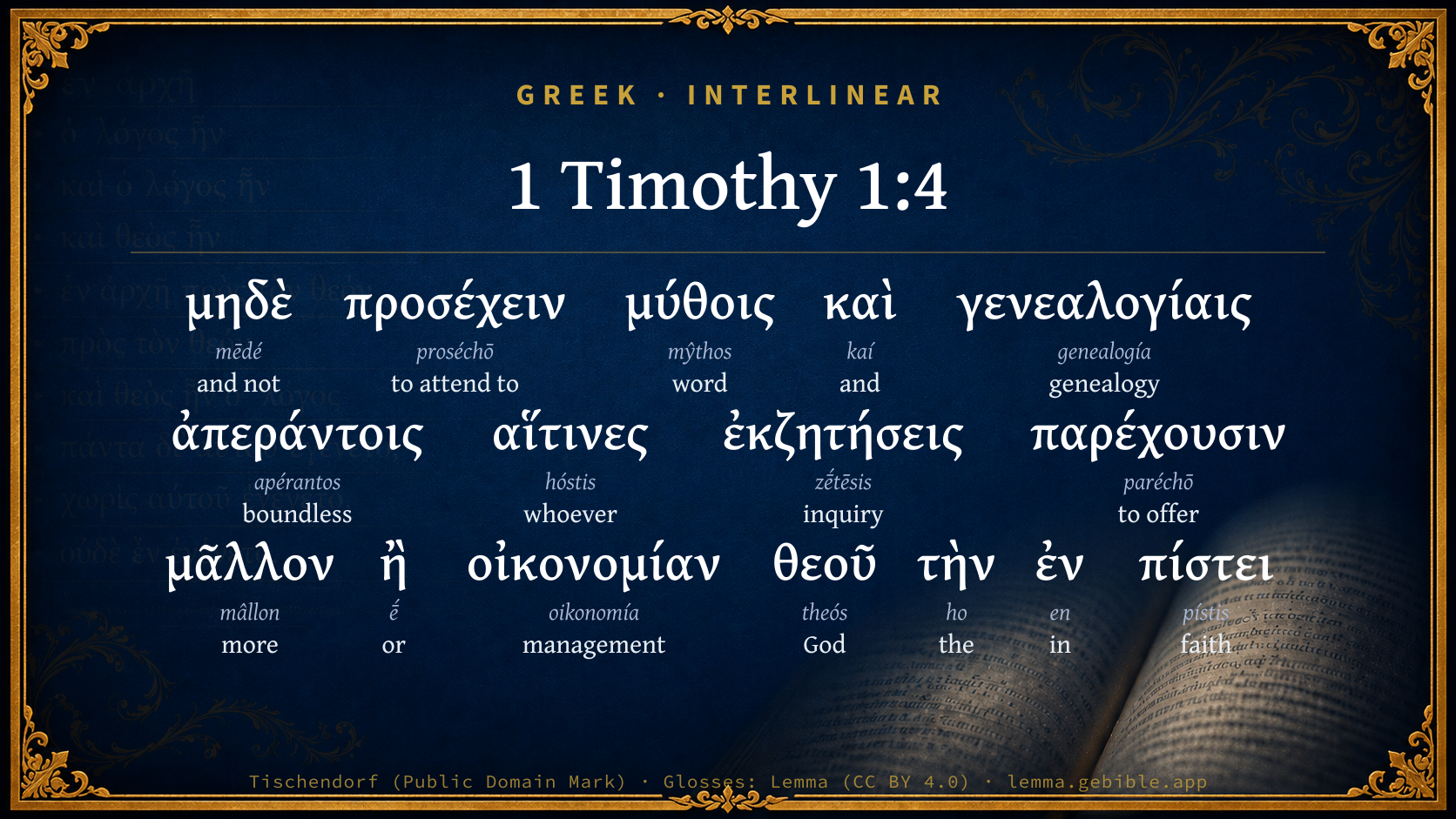
neither to pay attention to myths and endless genealogies, which cause disputes, rather than God's stewardship, which is in faith--
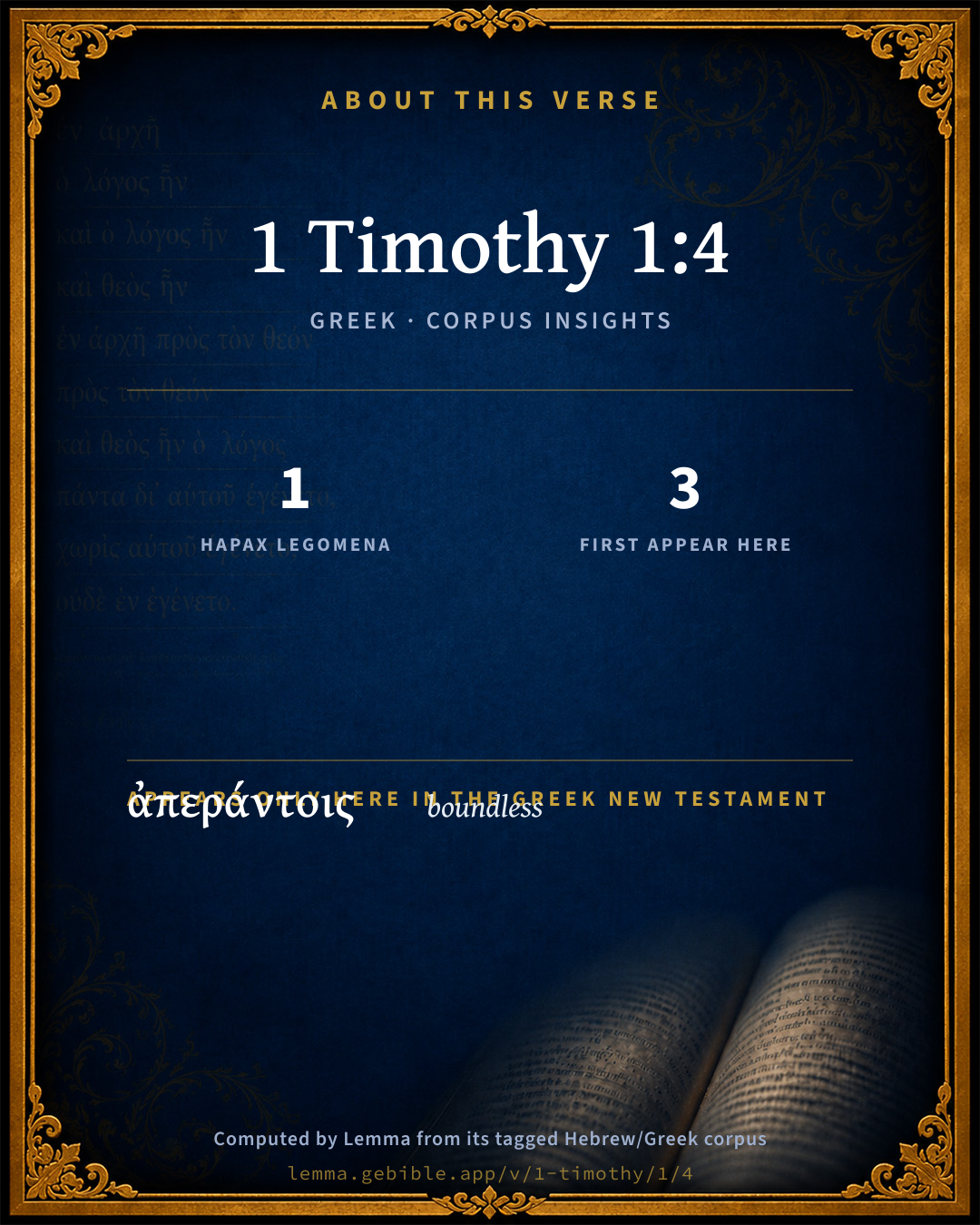
- 1 hapax legomenon — only here in the Greek New Testament
- 3 first appearances in the Greek New Testament
Download a study sheet
One document with this verse’s original text, its word-by-word gloss line, the meaning frame, cross-references with their text, attributed commentary, and full source and license credits — printable, and it pastes into notes with its structure intact.
This verse Autodidact and up
A passage Seminary Student
Up to 50 verses in one chapter. A passage sheet keeps up to 6 commentary sources and 12 cross-references per verse, in the order this page ranks them, and says so on the sheet whenever that leaves anything out. Ask for a single verse and you get the Autodidact verse sheet above.
Everything on this page stays free to read, with no account — the sheet is a download of what is already on screen, not access to it.
Compare translations 3
The same verse in 3 English versions, stacked beneath the original-language interlinear above. Click any original word for its lexicon entry.
Each is an independent rendering of the whole verse — the interlinear is not word-aligned to these translations.
Highlighted words mark where these versions differ — a whole-verse word diff, not a word-by-word alignment.
-
World English Bible Public Domain
neither to pay attention to myths and endless genealogies, which cause disputes, rather than God's stewardship, which is in faith--
-
King James Version Public Domain
Neither give heed to fables and endless genealogies, which minister questions, rather than godly edifying which is in faith: so do.
-
unfoldingWord Literal Text CC BY-SA 4.0
and not to pay attention to myths and endless genealogies, which promote arguments rather than the stewardship of God, by faith—.
unfoldingWord Literal Text — © unfoldingWord, licensed CC BY-SA 4.0. Word-aligned USFM3 via Door43 (git.door43.org/unfoldingWord/en_ult).
Show all 19 translations
Every available English version of this verse, each an independent rendering of the whole verse.
-
World English Bible Public Domain
neither to pay attention to myths and endless genealogies, which cause disputes, rather than God's stewardship, which is in faith--
-
Berean Standard Bible Public Domain
or devote themselves to myths and endless genealogies, which promote speculation rather than the stewardship of God’s work, which is by faith.
-
Majority Standard Bible Public Domain
or devote themselves to myths and endless genealogies, which promote speculation rather than the stewardship of God’s work, which is by faith.
-
King James Version Public Domain
Neither give heed to fables and endless genealogies, which minister questions, rather than godly edifying which is in faith: so do.
-
American Standard Version (1901) Public Domain
neither to give heed to fables and endless genealogies, which minister questionings, rather than a dispensation of God which is in faith; `so do I now'.
-
Revised Version (1885) Public Domain
neither to give heed to fables and endless genealogies, the which minister questionings, rather than a dispensation of God which is in faith; so do I now.
-
Geneva Bible (1599) Public Domain
Neither that they giue heede to fables and genealogies which are endles, which breede questions rather then godly edifying which is by fayth.
-
Douay-Rheims (1899) Public Domain
Not to give heed to fables and endless genealogies: which furnish questions rather than the edification of God, which is in faith.
-
Young's Literal Translation Public Domain
nor to give heed to fables and endless genealogies, that cause questions rather than the building up of God that is in faith: --
-
Literal Standard Version CC BY-SA 4.0
nor to give heed to fables and endless genealogies, that cause questions rather than [the] stewardship of God which [is] in faith.
-
Unlocked Literal Bible CC BY-SA 4.0
Neither should they pay attention to stories and endless genealogies. These cause arguments rather than helping the plan of God, which is by faith.
-
unfoldingWord Literal Text CC BY-SA 4.0
and not to pay attention to myths and endless genealogies, which promote arguments rather than the stewardship of God, by faith—.
-
Darby Bible Public Domain
nor to turn their minds to fables and interminable genealogies, which bring questionings rather than [further] God's dispensation, which [is] in faith.
-
World Messianic Bible Public Domain
and not to pay attention to myths and endless genealogies, which cause disputes rather than God’s stewardship, which is in faith.
-
Webster's Bible Public Domain
Neither give heed to fables and endless genealogies, which minister questions, rather than godly edifying which is in faith; so do.
-
Free Bible Version CC BY-SA 4.0
They shouldn't concern themselves with legends and never-ending obsessions about ancestry. Such ideas only lead to pointless debates, instead of understanding God as we trust in him.
-
Bible in Basic English Public Domain
Or to give attention to stories and long lists of generations, from which come questionings and doubts, in place of God's ordered way of life which is in faith;
-
Text-Critical English NT CC BY 4.0
or to occupy themselves with myths and endless genealogies, which promote disputes rather than the plan of God that operates by faith.
-
Tyndale New Testament (1534) Public Domain
nether geve hede to fables and genealogies which are endlesse and brede doutes more then godly edyfyinge which is by fayth:
Literal Standard Version (2020), Covenant Press — licensed CC BY-SA 4.0. Text via the HelloAO Bible API (eBible.org). Unlocked Literal Bible (unfoldingWord) — licensed CC BY-SA 4.0. Text via the HelloAO Bible API (eBible.org). unfoldingWord Literal Text — © unfoldingWord, licensed CC BY-SA 4.0. Word-aligned USFM3 via Door43 (git.door43.org/unfoldingWord/en_ult). Free Bible Version, Dr. Jonathan Gallagher — licensed CC BY-SA 4.0. Text via the HelloAO Bible API (eBible.org).
Word by word
More ways to search: Search by grammar → Find every occurrence → Compare this word →
Practice this passage: Drill this verse → Learn its vocabulary →
- Appears 1× in the Greek New Testament
- First appears here
- Part of Speech
- Adjective
- Case
- Dative
- Number
- Plural
- Gender
- Feminine
Full Thayer's Definition
- μηδὲ mēdé G3366 “and not” Conjunction, Negative
- προσέχειν proséchō G4337 “to attend to” Verb, Present, Active, Infinitive
- μύθοις mŷthos G3454 “word” Noun, Dative, Plural, Masculine
- καὶ kaí G2532 “and” Conjunction
- γενεαλογίαις genealogía G1076 “genealogy” Noun, Dative, Plural, Feminine
- ἀπεράντοις apérantos G562 “boundless” Adjective, Dative, Plural, Feminine
- αἵτινες hóstis G3748 “whoever” Relative pronoun, Nominative, Plural, Feminine
- ἐκζητήσεις zḗtēsis G2214 “inquiry” Noun, Accusative, Plural, Feminine
- παρέχουσιν paréchō G3930 “to offer” Verb, Present, Active, Indicative, 3rd person, Plural
- μᾶλλον mâllon G3123 “more” Adverb
- ἢ ḗ G2228 “or” Particle
- οἰκονομίαν oikonomía G3622 “management” Noun, Accusative, Singular, Feminine
- θεοῦ theós G2316 “God” Noun, Genitive, Singular, Masculine
- τὴν ho G3588 “the” Article, Accusative, Singular, Feminine
- ἐν en G1722 “in” Preposition
- πίστει pístis G4102 “faith” Noun, Dative, Singular, Feminine
About this verse
These counts appear in no published source. They are computed here, from the morphology-tagged text and Lemma’s own curated glosses. What Lemma adds →
- 16
- words
- 16
- distinct lemmas
- Pauline Epistles
- section
Notable vocabulary
1 hapax legomenon — a word that appears only here in the entire Greek New Testament:
- ἀπεράντοις boundless G562
First appearance in Scripture
These words make their first canonical appearance in the Greek New Testament here:
Shared distinctive vocabulary
γενεαλογίαις genealogy G1076 occurs in 2 verses of the Greek New Testament. Also found in:
Cross-references
17Topical passages linked to 1 Timothy 1:4 in the Treasury of Scripture Knowledge — connected by theme and wording, ordered by reader-vote popularity; previews shown in the World English Bible.
- 1 Timothy 4:7 But refuse profane and old wives' fables. Exercise yourself toward godliness.
- Titus 1:14 not paying attention to Jewish fables and commandments of men who turn away from the truth.
- Titus 3:9 but shun foolish questionings, genealogies, strife, and disputes about the law; for they are unprofitable and vain.
- 2 Timothy 4:4 and will turn away their ears from the truth, and turn aside to fables.
- 2 Peter 1:16 For we did not follow cunningly devised fables, when we made known to you the power and coming of our Lord Jesus Christ, but we were eyewitnesses of his majesty.
- 1 Timothy 6:3–5 If anyone teaches a different doctrine, and doesn't consent to sound words, the words of our Lord Jesus Christ, and to the doctrine which is according to godliness,
- 1 Timothy 6:20 Timothy, guard that which is committed to you, turning away from the empty chatter and oppositions of the knowledge which is falsely so called;
- 2 Timothy 2:14 Remind them of these things, charging them in the sight of the Lord, that they don't argue about words, to no profit, to the subverting of those who hear.
- Hebrews 13:9 Don't be carried away by various and strange teachings, for it is good that the heart be established by grace, not by food, through which those who were so occupied were not benefited.
- 1 Timothy 6:11 But you, man of God, flee these things, and follow after righteousness, godliness, faith, love, patience, and gentleness.
- 2 Timothy 2:22 Flee from youthful lusts; but pursue righteousness, faith, love, and peace with those who call on the Lord out of a pure heart.
- 2 Timothy 2:16–18 But shun empty chatter, for they will proceed further in ungodliness,
- 1 Timothy 3:16 Without controversy, the mystery of godliness is great: God was revealed in the flesh, Justified in the spirit, Seen by angels, Preached among the nations, Believed on in the world, And received up in glory.
- Ephesians 4:12–16 for the perfecting of the saints, to the work of serving, to the building up of the body of Christ;
- Titus 1:1 Paul, a servant of God, and an apostle of Jesus Christ, according to the faith of God's chosen ones, and the knowledge of the truth which is according to godliness,
- 2 Corinthians 1:12 For our boasting is this: the testimony of our conscience, that in holiness and sincerity of God, not in fleshly wisdom but in the grace of God we behaved ourselves in the world, and more abundantly toward you.
- 2 Corinthians 7:9–10 I now rejoice, not that you were made sorry, but that you were made sorry to repentance. For you were made sorry in a godly way, that you might suffer loss by us in nothing.
Cross-references courtesy of OpenBible.info (CC BY 4.0).
Lesson kit
Teaching starters — assembled from the data on this page, not authored interpretation. Every prompt links to the verse data it draws on. Edit before teaching.
1 Timothy, in the Pauline Epistles, opens this verse with 16 words (16 distinct Greek lemmas). Its most distinctive word is apérantos (“boundless”). A historical commentator’s framing appears above. Read the whole chapter for the surrounding context.
Discussion questions
- How does “boundless” (apérantos) shape what this verse is saying?
- This verse holds 1 word here found nowhere else in the Greek New Testament. What might the rare word draw attention to?
- 3 words here appear for the first time in Scripture. What is being introduced at this debut?
- Titus 3:9 shares the word «genealogy» with this verse. How do the two illuminate each other?
- The translations on this page render this verse differently — a whole-verse word diff, not a word-by-word alignment. What might account for the different wordings?
- Reading how The Biblical Illustrator and The Pulpit Commentary read this verse, where do the two commentators agree and where do they part?
Things to notice
- 1 word in this verse appears nowhere else in the Greek New Testament.
- 3 words make their first canonical appearance in Scripture here.
- These translations choose different wording for 19 words in this verse.
- 16 distinct Greek lemmas span 16 words in this verse.
Commentary
Notes on 1 Timothy 1:4 from classic Christian and Jewish commentators (each source and its license shown beneath its notes). The classic Christian expositions comment on the surrounding passage and are grouped to its opening verse, so a note may address several verses; the Jewish commentaries on the Tanakh (Rashi and others) are per-verse, so they appear only where the commentator wrote on this verse.
Lemma curates 59 commentaries, every one of them public domain or Creative Commons licensed, each selected and text-cleaned for this edition rather than reprinted as found. About our sources →
The Biblical Illustrator
Joseph S. Exell
The Biblical Illustrator, edited by Joseph S. Exell (c. 1880s–1900s) — public domain. Text from a community e-Sword module.
The Pulpit Commentary
The Pulpit Commentary (1880–1919), ed. H.D.M. Spence-Jones & Joseph S. Exell — public domain. Text from a community e-Sword module.
Burkitt's Expository Notes on the New Testament
William Burkitt
William Burkitt's Expository Notes on the New Testament (1700–1703) — public domain. Text from a community e-Sword module.
Tyndale Open Study Notes
Tyndale Open Resources
Tyndale Open Study Notes — © Tyndale Open Resources, licensed CC BY-SA 4.0. Text via the HelloAO Bible API.
Bengel's Gnomon
Johann Albrecht Bengel
Bengel's Gnomon of the New Testament — English translation (T&T Clark, Edinburgh, 1860) — public domain. Text from a community e-Sword module.
Expositor's Greek Testament
ed. W. Robertson Nicoll
The Expositor's Greek Testament, edited by W. Robertson Nicoll (1897–1910) — public domain. Text from a community e-Sword module.
Geneva Bible (1599)
Geneva Bible translators
Geneva Bible (1599) marginal notes — public domain. Text via Bolls.life.
Jamieson, Fausset & Brown
Robert Jamieson, A. R. Fausset & David Brown
Jamieson, Fausset & Brown — Commentary Critical and Explanatory on the Whole Bible (1871) — public domain (CC PDM 1.0). Text via the HelloAO Bible API.
Adam Clarke's Commentary
Adam Clarke's Commentary on the Bible (1810–1826) — public domain. Text from a community e-Sword/MySword module.
John Calvin's Commentaries
John Calvin's Commentaries (1540-1563) — public domain. Text from the Calvin Translation Society English edition (1840s-50s) via the Christian Classics Ethereal Library (ccel.org). Calvin's coverage is partial (roughly two-thirds of the Bible); uncommented books and verses are honest gaps, never fabricated. The 19th-century editor's footnotes and remarks are omitted so the notes are faithfully Calvin's own voice.
Ellicott's Commentary for English Readers
A Bible Commentary for English Readers, edited by Charles John Ellicott (1878–1897) — public domain. Text from a community e-Sword module.
The Cambridge Bible for Schools and Colleges
gen. ed. J. J. S. Perowne
The Cambridge Bible for Schools and Colleges (gen. ed. J. J. S. Perowne; Cambridge University Press, 1878–1918) — public domain. Text from a community e-Sword module.
John Gill's Exposition
John Gill's Exposition of the Whole Bible (1746–1763) — public domain (CC PDM 1.0). Text via the HelloAO Bible API.
Trapp's Complete Commentary
John Trapp
John Trapp, A Commentary or Exposition upon All the Books of the Old and New Testament (1647–1656) — public domain. Text from a community e-Sword module.
Albert Barnes' Notes on the Bible
Albert Barnes' Notes on the Bible (1834–1885) — public domain. Text from a community e-Sword/MySword module.
Haydock's Catholic Bible Commentary
George Leo Haydock (1774–1849), Haydock's Catholic Family Bible and Commentary, 1859 edition — public domain. Excludes Psalms (Douay-Rheims chapter numbering differs from Protestant) and Deuterocanonical books (Catholic canon only).
Matthew Poole's English Annotations
Matthew Poole's English Annotations on the Holy Bible (1683–1685) — public domain. Text from a community e-Sword/MySword module.
Whedon's Commentary on the Bible
Daniel D. Whedon
Daniel D. Whedon (gen. ed.), Commentary on the Old and New Testaments (1874–1909) — public domain. Text from a community e-Sword module.
John Wesley's Explanatory Notes
John Wesley, Explanatory Notes Upon the Whole Bible (1754–1765) — public domain. Text via the GEBible commentary corpus.
Godbey's Commentary on the New Testament
William B. Godbey
William B. Godbey, Commentary on the New Testament (1896–1900) — public domain. Text from a community e-Sword module.
The People's New Testament
B. W. Johnson
B. W. Johnson's The People's New Testament with Notes (1889–1891) — public domain. Electronic text from the Christian Classics Ethereal Library (CCEL) ThML edition.
Cambridge Greek Testament for Schools and Colleges
Cambridge Greek Testament for Schools and Colleges (Cambridge University Press, 1896; 21 vols, various authors incl. Carr, Maclear, Plummer, Farrar, Lumby, Moule, M. R. James, Simcox) — public domain. Text from a community e-Sword module.
International Critical Commentary
International Critical Commentary — older volumes (1896–1929), various authors — public domain. Text from a community e-Sword module.
Vincent's Word Studies in the New Testament
Marvin R. Vincent
Marvin R. Vincent, Word Studies in the New Testament (1887–1900) — public domain. Text from a community e-Sword/MySword module.