Ephesians 1:23

Greek (Tischendorf 8th ed.) Ephesians 1:23 appears in the Greek New Testament. The text above is from the Tischendorf 8th edition. Each word links to its Strong’s number and a concise gloss. Click any word for its full Thayer’s Greek Lexicon entry.
Download image
Cite this verse

Ephesians 1:23 (World English Bible). Public Domain. Lemma interlinear Bible study tool, https://lemma.gebible.app/v/ephesians/1/23.

Show BibTeX & RIS
BibTeX
RIS
English Translation
which is his body, the fullness of him who fills all in all.
World English Bible · Public Domain
Download a study sheet

One document with this verse’s original text, its word-by-word gloss line, the meaning frame, cross-references with their text, attributed commentary, and full source and license credits — printable, and it pastes into notes with its structure intact.

This verse Autodidact and up

Study sheet (.html) Plain text (.txt)

A passage Seminary Student

Up to 50 verses in one chapter. A passage sheet keeps up to 6 commentary sources and 12 cross-references per verse, in the order this page ranks them, and says so on the sheet whenever that leaves anything out. Ask for a single verse and you get the Autodidact verse sheet above.

Everything on this page stays free to read, with no account — the sheet is a download of what is already on screen, not access to it.

Want to remove ads? Support Godless Engineer
Compare translations 3

The same verse in 3 English versions, stacked beneath the original-language interlinear above. Click any original word for its lexicon entry.

Each is an independent rendering of the whole verse — the interlinear is not word-aligned to these translations.

Highlighted words mark where these versions differ — a whole-verse word diff, not a word-by-word alignment.

  • World English Bible Public Domain
    which is his body, the fullness of him who fills all in all.
  • King James Version Public Domain
    Which is his body, the fulness of him that filleth all in all.
  • unfoldingWord Literal Text CC BY-SA 4.0
    which is his body, the fullness of the one filling all in all.

unfoldingWord Literal Text — © unfoldingWord, licensed CC BY-SA 4.0. Word-aligned USFM3 via Door43 (git.door43.org/unfoldingWord/en_ult).

Versions to compare (up to 4)

3 of 4 selected

Show all 19 translations

Every available English version of this verse, each an independent rendering of the whole verse.

  • World English Bible Public Domain
    which is his body, the fullness of him who fills all in all.
  • Berean Standard Bible Public Domain
    which is His body, the fullness of Him who fills all in all.
  • Majority Standard Bible Public Domain
    which is His body, the fullness of Him who fills all in all.
  • King James Version Public Domain
    Which is his body, the fulness of him that filleth all in all.
  • American Standard Version (1901) Public Domain
    which is his body, the fulness of him that filleth all in all.
  • Revised Version (1885) Public Domain
    which is his body, the fulness of him that filleth all in all.
  • Geneva Bible (1599) Public Domain
    Which is his body, euen the fulnesse of him that filleth all in all things.
  • Douay-Rheims (1899) Public Domain
    Which is his body, and the fulness of him who is filled all in all.
  • Young's Literal Translation Public Domain
    which is his body, the fulness of Him who is filling the all in all,
  • Literal Standard Version CC BY-SA 4.0
    which is His body, the fullness of Him who is filling all in all.
  • Unlocked Literal Bible CC BY-SA 4.0
    The church is his body, the fullness of him who fills all in all.
  • unfoldingWord Literal Text CC BY-SA 4.0
    which is his body, the fullness of the one filling all in all.
  • Darby Bible Public Domain
    which is his body, the fulness of him who fills all in all:
  • World Messianic Bible Public Domain
    which is his body, the fullness of him who fills all in all.
  • Webster's Bible Public Domain
    Which is his body, the fullness of him that filleth all in all.
  • Free Bible Version CC BY-SA 4.0
    which is his body, filled full and made complete by Christ, who fills and brings everything to completion.
  • Bible in Basic English Public Domain
    Which is his body, the full measure of him in whom all things are made complete.
  • Text-Critical English NT CC BY 4.0
    which is his body, the fullness of him who fills everything in every way.
  • Tyndale New Testament (1534) Public Domain
    which is his body and the fulnes of him that filleth all in all thynges.

Literal Standard Version (2020), Covenant Press — licensed CC BY-SA 4.0. Text via the HelloAO Bible API (eBible.org). Unlocked Literal Bible (unfoldingWord) — licensed CC BY-SA 4.0. Text via the HelloAO Bible API (eBible.org). unfoldingWord Literal Text — © unfoldingWord, licensed CC BY-SA 4.0. Word-aligned USFM3 via Door43 (git.door43.org/unfoldingWord/en_ult). Free Bible Version, Dr. Jonathan Gallagher — licensed CC BY-SA 4.0. Text via the HelloAO Bible API (eBible.org).

Word by word

More ways to search: Search by grammar → Find every occurrence → Compare this word →

Practice this passage: Drill this verse → Learn its vocabulary →

πλήρωμα
plḗrōma
G4138
“fullness”
Noun, Nominative, Singular, Neuter
Part of Speech
Noun
Case
Nominative
Number
Singular
Gender
Neuter
Full Thayer's Definition

Origin: from G4137

TDNT: 10:58,9

1. that which is (has been) filled a. a ship inasmuch as it is filled (i.e. manned) with sailors, rowers, and soldiers b. in the NT, the body of believers, as that which is filled with the presence, power, agency, riches of God and of Christ 2. that which fills or with which a thing is filled a. of those things which a ship is filled, freight and merchandise, sailors, oarsmen, soldiers b. completeness or fulness of time 3. fulness, abundance 4. a fulfilling, keeping
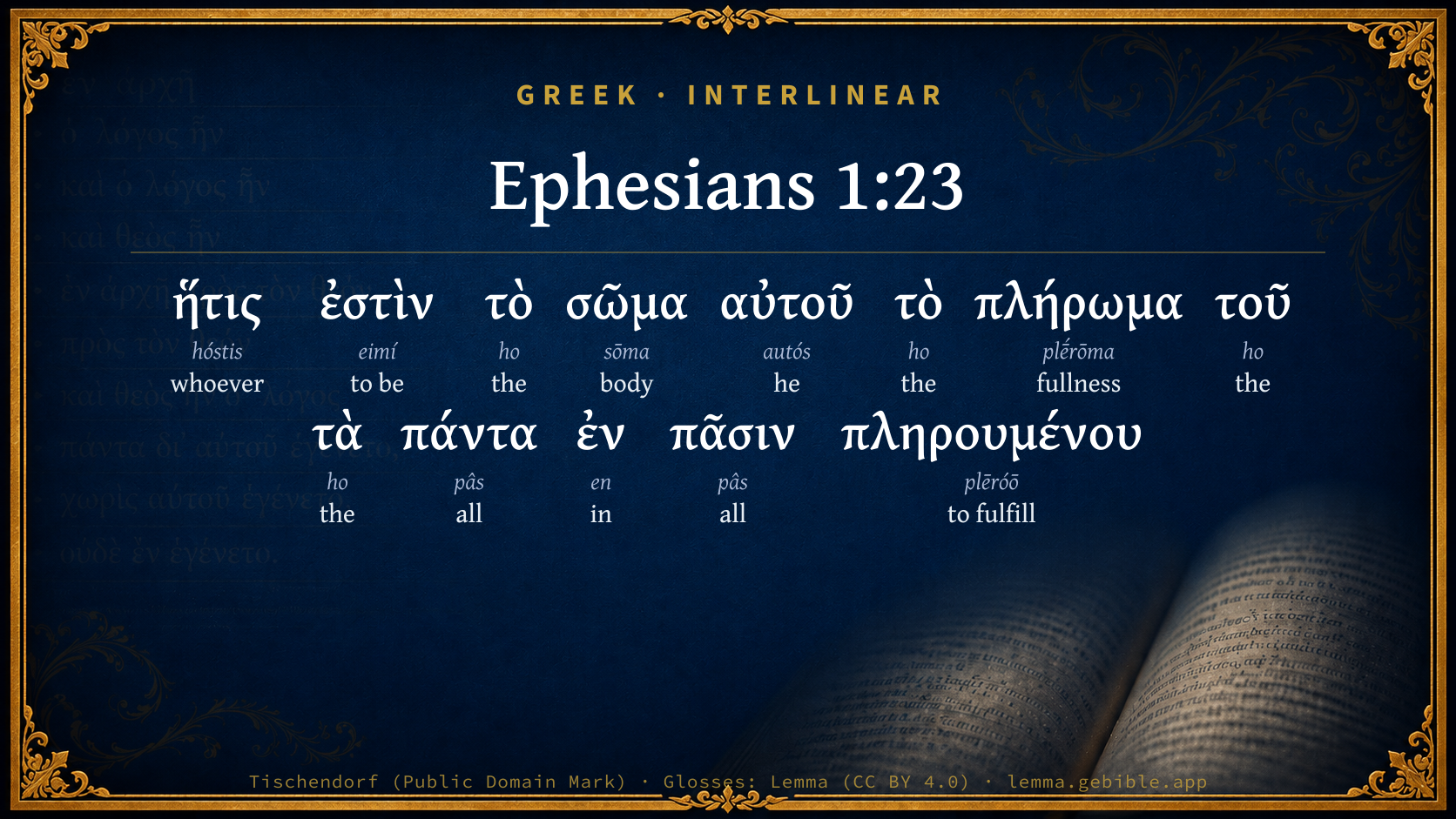
  1. ἥτις hóstis G3748 “whoever” Relative pronoun, Nominative, Singular, Feminine
  2. ἐστὶν eimí G1510 “to be” Verb, Present, Active, Indicative, 3rd person, Singular
  3. τὸ ho G3588 “the” Article, Nominative, Singular, Neuter
  4. σῶμα sōma G4983 “body” Noun, Nominative, Singular, Neuter
  5. αὐτοῦ autós G846 “he” Personal pronoun, Genitive, Singular, Masculine
  6. τὸ ho G3588 “the” Article, Nominative, Singular, Neuter
  7. τοῦ ho G3588 “the” Article, Genitive, Singular, Masculine
  8. τὰ ho G3588 “the” Article, Accusative, Plural, Neuter
  9. πάντα pâs G3956 “all” Adjective, Accusative, Plural, Neuter
  10. ἐν en G1722 “in” Preposition
  11. πᾶσιν pâs G3956 “all” Adjective, Dative, Plural, Neuter
  12. πληρουμένου plēróō G4137 “to fulfill” Verb, Present, Middle, Participle, Genitive, Singular, Masculine

About this verse

These counts appear in no published source. They are computed here, from the morphology-tagged text and Lemma’s own curated glosses. What Lemma adds →

13
words
9
distinct lemmas
Pauline Epistles
section

Notable vocabulary

The rarest word here is πλήρωμα fullness G4138 — appearing just 17 times in the whole Greek New Testament.

Shared distinctive vocabulary

πλήρωμα fullness G4138 occurs in 17 verses of the Greek New Testament. Also found in:

Repetition

Words recur within this verse:

Cross-references

16

Topical passages linked to Ephesians 1:23 in the Treasury of Scripture Knowledge — connected by theme and wording, ordered by reader-vote popularity; previews shown in the World English Bible.

  • Colossians 1:18–19 He is the head of the body, the assembly, who is the beginning, the firstborn from the dead; that in all things he might have the preeminence.
  • John 1:16 From his fullness we all received grace upon grace.
  • Colossians 2:9–10 For in him all the fullness of the Godhead dwells bodily,
  • Ephesians 4:12 for the perfecting of the saints, to the work of serving, to the building up of the body of Christ;
  • Ephesians 3:19 and to know Christ's love which surpasses knowledge, that you may be filled with all the fullness of God.
  • Ephesians 4:10 He who descended is the one who also ascended far above all the heavens, that he might fill all things.
  • 1 Corinthians 15:28 When all things have been subjected to him, then the Son will also himself be subjected to him who subjected all things to him, that God may be all in all.
  • Colossians 1:24 Now I rejoice in my sufferings for your sake, and fill up on my part that which is lacking of the afflictions of Christ in my flesh for his body's sake, which is the assembly;
  • 1 Corinthians 12:12–27 For as the body is one, and has many members, and all the members of the body, being many, are one body; so also is Christ.
  • Colossians 3:15 And let the peace of God rule in your hearts, to which also you were called in one body; and be thankful.
  • Ephesians 2:16 and might reconcile them both in one body to God through the cross, having killed the hostility thereby.
  • Ephesians 5:23–32 For the husband is the head of the wife, and Christ also is the head of the assembly, being himself the savior of the body.
  • Colossians 3:11 where there can't be Greek and Jew, circumcision and uncircumcision, barbarian, Scythian, bondservant, freeman; but Christ is all, and in all.
  • 1 Corinthians 12:6 There are various kinds of workings, but the same God, who works all things in all.
  • Ephesians 4:4 There is one body, and one Spirit, even as you also were called in one hope of your calling;
  • Romans 13:5 Therefore you need to be in subjection, not only because of the wrath, but also for conscience' sake.

Cross-references courtesy of OpenBible.info (CC BY 4.0).

Commentary

Notes on Ephesians 1:23 from classic Christian and Jewish commentators (each source and its license shown beneath its notes). The classic Christian expositions comment on the surrounding passage and are grouped to its opening verse, so a note may address several verses; the Jewish commentaries on the Tanakh (Rashi and others) are per-verse, so they appear only where the commentator wrote on this verse.

Lemma curates 59 commentaries, every one of them public domain or Creative Commons licensed, each selected and text-cleaned for this edition rather than reprinted as found. About our sources →

The Biblical Illustrator

Joseph S. Exell

Eph_1:23

Which is His body, the fulness of Him that filleth all in all.

Believers are the body of Christ

1. As Christ is the Head of believers, so they are His body, and every believing soul a member of this body whereof He is the Head. Believers are so said to be the body as the body stands in opposition to the head, not as it includes the head within its own compass. The multitude of believers are fitly so called; for, as in a body are divers members, having their several faculties for the good use of the whole, so in the Church there are divers kinds of members, some taught, some teaching, some governing, some governed, some distributing,--yea, every member has, as it were, his distinct grace whereby he may serve the well-being of the whole.

2. Christ does not count Himself full and complete, without all His faithful members.

(1) None of those who either live knit to Christ only by external profession, or who receive some of the effects of the Spirit which for a time only abide in them; none of all those who in the end shall hear the sentence, Depart from Me, were ever true parts of Christs body; for Christ is made full and complete by all His true members, and should be maimed if He lacked one of them. These, therefore, belonged to His body as a wooden leg or glass eye does to the body of a man; or, at the most, as an excrescence which is more inwardly continued, and has a kind of life, but is not quickened as a member of the body, which is more complete when it is cut off.

(2) Christ will keep those who are true members of Him, and not suffer anything to separate them from Him. What natural head would part with a member, were it in its power to keep it? But we know Christ has all power; so may assure ourselves that He will preserve us in that union and, communion which as members we have attained with Him.

(3) A ground of patience in face of the contempt which believers meet with from the world. Men often deem them the refuse and offal of all others; but Christ thinks so highly of them, that He counts Himself maimed and imperfect without them.

3. Whatever is in us as Christians, all of it is from Christ. In Him we are complete, filled with all heavenly gifts which serve to remove evil or set us in a state of blessedness.

(1) He fills us with all the fulness of God, which begins in grace, and is perfected in glory when God shall be all in all.

(2) How we come to be filled. All fulness is in Christ, who has received it without measure. As the sun has fulness of light in that perfection which agrees to light, and the moon has light from the sun in that measure wherein it is capable: so Christ, the Sun of Righteousness, has fulness without measure, but the Church with all her members are filled from Him according to their capacities as members under Him. By being partakers of Christ Himself we come to be filled with the fulness of grace and glory in Him, as by eating and taking the substance of earthly nourishment we come to have the virtue in them. These benefits are conveyed to us by the means of grace, viz., the Word and the Sacraments. We also receive Him partly by humility, which empties us of ourselves, and makes room for Him; partly by belief, which feeds on and applies Him; partly by walking in Christ, and exercising ourselves spiritually. Conclusion: Let this teach us to come to Christ. Bountiful lords want none to retain to them, happy is he who may shroud him self under their wings. Shall we not press with reverence to this Lord of lords who fills all with His spiritual blessings? As He complained of the Jews, How oft would I have gathered you but you would not, so may He say to us, how oft would I have had you, blind, naked, miserable by nature, come to Me, that you might be filled with righteousness and life, but ye have refused? Well, did we know what we are called to, and what we might find in Him, then would we come and be suitors to Him. But, alas! this is hid from our eyes. (Paul Bayne.)

Christs body

I. Who the persons here spoken of are: The Church. The Greek word ἐκκλησία simply means the called out. This is a title often given to the disciples of Christ. They are called to be saints. They are called unto His kingdom and glory. God hath saved them, and called them with a holy calling. The persons, then, who constitute the Church are those who have been called out.

II. We are now in a position to consider with profit what the connection is which subsists between Christ and His Church. The Church is His body; the fulness of Him who filleth all in all. The Church is His body; then He is its Head: the Church is His fulness, and He filleth all in all. Let us consider these weighty words.

1. The Lord Jesus Christ is the Head of His Church. Like the head in our natural body, He is the channel of all their perceptions, the source of all their desires, the guide of all their actions. Through Him they see and hear and think, by Him they live and move and have their being. As our text says, He filleth all in all--every member with all its life.

2. The reality and intimacy of this union will be more fully realized if we observe, not only what the Lord Jesus Christ is to His disciples, but also what they are to Him. Paul tells us not only that the Lord Jesus Christ is the Head of the Church, but also that the Church is His body--not only that Christ filleth all in all, but also that the Church is His fulness.

III. Let us now consider the inward blessings and the outward duties that are implied in this connection.

1. The inward spiritual blessings which are implied in the fact that the Lord Jesus Christ is the Head of the Church which is His body. These blessings, as we have seen, flow only to those who really are His disciples. Are we true members of the body of Christ? Then let us realize that we have suffered and died with Him on Calvary. Again, are we true members of the body of the Lord Jesus Christ? Then we are delivered, not only from the punishment due to past, sins, but also from the power of present sinfulness. Again, are we true members of the body of Christ? then let us remember that we are related, not only to Him, but also to one another as members of the same body. Again, are we true members of the body of Christ? then we need not fear anything that man can do unto us. We cannot suffer but Jesus suffers with us. He is afflicted in all our afflictions. He would lose in our loss. He rejoices in our joy. Once more, are we true members of the body of Christ? then our comfort reaches not only to the grave, but beyond it.

2. Of the duties which they owe to Him as the Head of government. Obedience--implicit obedience--is the duty of each member of His body individually--obedience in all things. I pass on to speak of the duty of the members of His body in their collective capacity--when associated together as churches. The Lord Jesus Christ is the Head, not merely of each member of His body separately, but of the, whole body. He has commanded His disciples to recognize each other, and to, associate themselves together for common work and for common worship. He has given rules for the government of His Church. All these and such like commandments are addressed to the Church in its collective capacity. (W. Grant.)

The connection between Christ and the Church

Head and body are correlative, and are organically connected. The body is no dull lump of clay, no loose coherence of hostile particles; but bone, nerve, and vessel give it distinctive form, proportion, and adaptation. The Church is not a fortuitous collection of believing spirits, but a society, shaped, prepared, and life endowed, to correspond to its Head. The Head is one, and though the corporeal members are many, yet all is marked out and curiously wrought with symmetry and grace to serve the one design. There is organization, and not merely juxtaposition.

1. There is, first, a connection of life: if the head be dissevered, the body dies. The life of the Church springs from its union to Christ by the Spirit, and if any member or community be separated from Christ it dies.

2. There is also a connection of mind: the purposes of the Head are wrought out by the corporeal organs--the tongue that speaks, or the foot that moves. The Church should have no purpose but Christs glory, and no work but the performance of His commands.

3. There is, at the same time, a connection of power: the organs have no faculty of self-motion, but move as they are directed by the governing principle within. The corpse lies stiff and motionless. Energy to do good, to move forward in spiritual contest and victory, and to exhibit aggressive influence against evil, is all derived from union with Christ.

4. There is, in fine, a connection of sympathy. The pain or disorder of the smallest nerve or fibre vibrates to the head, and there it is felt. Jesus has not only cognizance of us, but He has a fellow feeling with us in all our infirmities and trials. And the members of the body are at the same time reciprocally connected, and placed in living affinity, so that mutual sympathy, unity of action, cooperation and support, are anticipated and provided for. No organ is superfluous, and none can defy or challenge its fellow. (John Eadie, D. D.)

Christs fulness

Observe, there is an all to be filled, and an all and in all wherewith to be filled. Poor trembling believer in Jesus Christ, thou art a portion of the fulness of Him in whom all fulness dwelleth, a member of Him that filleth all in all, and the Lord hath need of thee. There is a special adaptation in His fulness for thy special need, for all His fulness must be displayed and communicated to His members. The head cannot say to the foot, I have no need of you. An infinite variety of needs in the members is essentially necessary in order to manifest the boundless supply in the fulness of the Head, that He may be glorified, even as the branches of the vine are necessary as its only channels for the display of its wealth of fruitfulness: It shall one day be fully manifested to heaven and earth, to angels and to men, that Christs people stand in Him alone, and that they have no resources or supplies whatever but in His fulness. Come then, bring empty vessels not a few, here are gilts laid up for all sorts, and no denial for any kind of sinner, in order that His fulness may be seen, and that each believer may be in his own case a living monument to show forth the perfections and praises of Him in whom all fulness dwelleth. One shall receive and display His fulness of strength who is evermore a strength to the needy in his distress. Another shall be an example of His patience; another, of His care; another, of His long-suffering; another, of His tenderness; another, of His power; another, of His guiding mercy and gentleness; and all, of His changeless love. There are gifts and graces inexhaustible, and boundless operations and treasures of salvation, wisdom, and knowledge for the filling, and all sorts of needy ones to be filled--all of them, all the parts of them, body, soul, and spirit; all the powers, faculties, and immortality of all of them, for He filleth all in all, that He may be glorified. Verily the consolations of God are contained in these facts. Consider a few of the consequences resulting from them:

1. If Christs believing people are His body and His fulness, then none of them shall be wanting when He shall come to be admired in His saints. If otherwise?--no fulness.

2. If Christs believing people are His body and His fulness, then not one of them shall be lacking in any matters essential for their perfection. If otherwise?--no fulness.

3. If Christs believing people are His body and His fulness, then no member shall be out of place, and no desire unsatisfied. If otherwise?--no fulness.

4. If Christs people are His body and His fulness, then no grace, or continuance of grace, laid up for us in Him, shall be unsupplied. If otherwise?--no fulness.

5. If Christs people are His body and His fulness, then shall there be no want of salvation, security, growth, attainment, station, proportion, or symmetry in any of them. If otherwise?--no fulness.

6. If we are His body and His fulness, all of us are absolutely necessary for the completeness of our glorious Christ Himself, and even the very hairs of our head must all be numbered. If otherwise?--no fulness.

7. If we are His body, then must His members be presented faultless, holy, unblameable, and unreprovable, and without spot or wrinkle. If otherwise?--no fulness.

8. Finally, if any member be absent or incomplete, misplaced, undeveloped, or deficient, either overgrown, or undergrown, or wanting in proportion, then would there be no fulness. (M. Rainsford, B. A.)

Christs fulness

The word pleroma, fulness, is used in a definite and almost technical sense in the Epistles of the Captivity, and especially in the Epistle to the Colossians, having clear reference to the speculations as to the Divine Nature and the emanations from it, already anticipating the future Gnosticism. The word itself is derived from a verb signifying, first, to fill; next (more frequently in the New Testament), to fulfil or complete. It is found

(1) in a physical sense of the full contents of the baskets, in Mar_6:43; Mar_8:20; and of the earth, in 1Co_10:26-28; and in Mat_9:16; Mar_2:21, it is applied to the patch of new cloth on an old garment. It is used next

(2) of fulness, in sense of the complete tale or number, of time and seasons, in chap. 1:10; Gal_4:4; of the Jews and Gentiles in Rom_11:12; Rom_11:25. In the third place

(3) it is applied to the full essence, including all the attributes, of a thing or Person; as of the Law (Rom_13:10), and of the blessing of Christ (Rom_15:29). Lastly

(4), in these Epistles it is applied, almost technically, to the fulness of the Divine Nature. Thus in Col_1:19 we have, It pleased the Father that in Christ all the fulness--i.e., all the fulness of the Divine Nature--should dwell; or (to take an admissible but less probable construction), In Him all the fulness is pleased to dwell; and this is explained in chap. 2:9, In Him dwelt all the fulness of the Godhead bodily. Similarly, though less strikingly, we read in this Epistle, that those who are in Christ are said (in Gal_3:19; Gal_4:13) to be filled up to all the fulness of God, and to come to the measure of the stature of the fulness of Christ. In which of these last senses is the Church here said to be the fulness of Christ? If in any, probably in the last of all. As the individual, so the Church, by the presence of Him who filleth up all things for Himself in all, comes to be His fulness, the complete image of Him in all His glorified humanity. But it may be questioned whether it is not better to take here a different sense, corresponding to the patch in Mat_9:16, and signifying the complement. In the original Greek of Euclid (in book 1, prop. 4), the cognate word, parapleroma, is used of the complements. In this compound word the idea is, no doubt, more unequivocally expressed. But of the simple word here employed it may be reasonably contended that, if one thing or person alone is contemplated, the pleroma must be the fulness of the one nature: if, as here, two are brought in, each will be the complement to the other--as the patch to the garment; and the garment to the patch. So here (says Chrysostom) the complement of the head is the body, and the complement of the body is the head. Thus, by a daring expression, St. Paul describes our Lord as conceiving His glorified humanity incomplete without His Church; and then, lest this should seem to derogate, even for a moment, from His dignity, He adds the strongest declaration of His transcendent power. to fill up for Himself all things in all, in order to show that we are infinitely more incomplete without Him than He without us. (A. Barry, D. D.)

Communion with Christ

What! is Christ thy Brother, and does He live in thine house, and yet thou hast not spoken to Him for a month? I fear there is little love between thee and thy Brother, for thou hast had no conversation with Him for so long. What! is Christ the Husband of His Church, and has she had no fellowship with Him for all this time? (C. H. Spurgeon.)

The Church is Christs body

Christ has but one Church. The second Adam, like the first, is the husband only of one wife. Just as the Church cannot have two heads, so the one Head cannot have two bodies; for as that body were a monster which had two heads, so the head which had two separate bodies. (F. Guthrie, D. D.)

The Head and the body

At a celebrated battle there was one position from which the enemy, after suffering defeat in every other part of the field, kept up an unabated fire. There, a huge twenty-four pounder vomited forth galling and continuous discharges; nor could our artillery, nor musketry, nor riflemen, silence it. That gun, said the commanding officer, addressing the men of two regiments, must be taken by the bayonet. I must have it; adding, as he placed himself at their head, No firing, and recollect that I am with you. There needed no more. They advanced; and in a short time they had taken the gun and the position. Let the Church go forth at the command of her glorious Head, and there is no position and weapon of the enemy but shall yield before their united assaults. (F. Guthrie, D. D.)

The freshness and fulness of Christ

In the square of the Doges palace are two wells, from which the sellers of water obtain their stock-in-trade, but we can hardly compare either of them with the overflowing spring from which the preacher of righteousness draws his supplies. One of the wells is filled artificially and is not much used for drinking, since the coldness and freshness of water springing naturally from earths deep fountains is lacking. It is to be feared that many preachers depend for their matter upon theological systems, books, and mere learning, and hence their teaching is devoid of the living power and refreshing influence which is found in communion with the spring of all our joys. The other well yields most delicious water, but its flow is scanty. In the morning it is full, but a crowd of eager persons drain it to the bottom, and during the day as it rises by driblets, every drop is contended for and borne away, long before there is enough below to fill a bucket. In its excellence, continuance, and naturalness, this well might be a fair picture of the grace of our Lord Jesus, but it fails to set Him forth from its poverty of supply. He has a redundance, an overflow, an infinite fulness, and there is no possibility of His being exhausted by the draughts made upon Him, even though ten thousand times ten thousand should come with a thirst as deep as the abyss. We could not help saying, Spring up, O well, as we looked over the margin covered with copper, into which strings and ropes--continually used by the waiting many--had worn deep channels. Very little of the coveted liquid was brought up each time, but the people were patient, and their tin vessels went up and down as fast as there was a cupful to be had. O that men were half as diligent in securing the precious gifts of the Spirit, which are priceless beyond compare. (C. H. Spurgeon.)

The witnessing Church

The Church is called the body of Christ. Through his body a man holds communication with the outer world and works in and on that outer world. So through His Church Jesus the Christ acts upon society, upon men in general. I do not say that this is She only medium through which He works and acts, but it is the principal medium. A Church, then, must be organically fitted to express the mind and will of Christ. In inquiring as to the nature of the Church of Christ, the following ideas demand recognition:

1. Jesus Christ is its Head; its sole Head, its source of doctrine, of law and of order. He only has authority. One is your Master even Christ, and all ye are brethren. Of course in every society there must be a head, even a mob must have a leader. There must in every society be law and order. Otherwise there can be no peace and no progress. The self-will of the individual becomes everything. And in such a state of things there can be no cooperated movement. The sole headship of Christ in the Church is the basis doctrine of all law and order.

2. The membership of the Church is a brotherhood. If we have the ability of the subordination of our own wills to the will of Christ, the practical result will be, that we shall be of the same feeling and disposition as all others dowered with the same ability. The spirit of brotherhood will be in us. For when anything of the love of God enters the heart, the love of man comes with it. And the love of man is not some sentimental feeling which is here today and gone tomorrow. It is the diametric opposite of the spirit of judgment and accusation. It is necessary to add further that the Church of Christ is not democratic, but theocratic. The people are not the fountain of law and order. This also must be added, that the Church is the dwelling place of the Holy Spirit of God, which fact is evidence by these fruits of the Spirit which hang thick and threefold upon it, as upon a tree of life. We must not omit to add, that the Church is Christs great Teacher to the nations. The last great command to the apostles runs thus: Go ye and male disciples of all the nations, baptizing, etc. And lastly, the Church is the beginning of that permanent society which God is organizing to embody and express His will. The Book of the Revelation of St. John gives intimations of a perfected society into which there enters nothing that defileth, neither that which believeth or maketh a lie, a society of the pure and true, or rather of those who are purified and made true, men from all ages and all nations, all kindreds and all tongues, a society of men like in sympathy and disposition though various in many other ways. The Christ of God is the centre of that society; its inspiration; its archetype; a society based on inward character not on anything else, the inward character being attested by outward allegiance to this Christ of God. In that society we shall get the perfection of communion, the ideal fellowship, all lovelessness gone, no envy there, no hatred, nothing that leads to schism, no insincere man there, no unbrotherly man, the society of which the Church on earth has been, in its best estate, only the promise and prefiguration. (Reuen Thomas.)

In what respects the Church is Christs fulness

1. The Church is Christs fulness, because it has grown out of Christ, and He has increased outwards so as to form the Church. He has developed into it. He has expanded into it; as a seed grows into a tree with its branches. First, Christ fills the Church and each true believer with His Spirit, and Christ thus lives, by His Spirit, in each and all. The Spirit and Christ are one. Another view, secondly, is that presented in the words, out of His fulness have we all received, and grace for grace. Faith is the instrument of receiving out of His fulness, or, the medium of communication. The Christian by faith receives a corresponding grace to every grace that was in Christ. And he is at length filled, according to his measure or capacity, out of Christ. But, thirdly, Christ imparts to the Church and to each believer all spiritual blessedness.

2. Let us now consider the idea of the Apostle in its other aspect. We have seen how the Church is the fulness of Christ, in the sense of its being the development, as it were, of the root, by which it grows up into a full body, to the measure of the stature of the fulness of Christ. The other side of the idea is embodied in the thought that the Church fills up, completes, and perfects Christ. We must still contemplate Christ and His Church as one. He, in condescension, has taken it to be part of Himself, and, in this view, without it, He would be incomplete. So Paul in one place calls the Church Christ (1Co_12:12). The body is Christ according to this passage. It forms part of Him, and completes Him. We are thus led to consider all true Christians as necessary parts of what Christ Himself has chosen for His own body; and the whole Church of the redeemed, when gathered together, will, together with the Head, make one Christ. (W. Alves, M. A.)

.

The Biblical Illustrator, edited by Joseph S. Exell (c. 1880s–1900s) — public domain. Text from a community e-Sword module.

Tyndale Open Study Notes

Tyndale Open Resources

1:23 it is made full and complete by Christ, who fills all things everywhere with himself (or it is the full expression of the one who fills everything everywhere): This difficult phrase probably means that the church, as his body, is the full expression of Christ in this world. His presence, which fills the entire universe (4:10), is reflected in and works through his body.

Tyndale Open Study Notes — © Tyndale Open Resources, licensed CC BY-SA 4.0. Text via the HelloAO Bible API.

Bengel's Gnomon

Johann Albrecht Bengel

Eph 1:23. Τὸ πλήρωμα τοῦ πὰ πάντα ἐν πᾶσι πληρουμένου, the fulness of Him, that filleth all in all) This is neither predicated of the Church, as most think, nor is it construed with gave, according to the opinion of others; but is put absolutely in the accusative, as τὸ μαρτύριον, the testimony, is construed in 1Ti 2:6. For it is an Epiphonema,[18] put after those things which are spoken of at Eph 1:20, and by it the apostle implies, that there is in Christ the fulness of the Father, who fills all in all. See on the fulness of God, of Christ, and of the Spirit, ch. Eph 3:19, Eph 4:13, Eph 5:18; likewise ch. Eph 4:10; Joh 1:14; on the fulness of the times, ch. Eph 1:10. The glory of Divine love fills all things, and in Christ extends itself over all. The passage has an analogy to 1Co 15:28. What I have just now explained, the apostle means to say, vividly exhibits to us the fulness, etc., which, as mathematicians say, was the thing to be demonstrated [quod erat demonstrandum]. The whole of this (the whole of the preceding statements) may be reduced to [be brought under] this title or brief description, τὸ πλήρωμα … ἐν πᾶσι, in all) The neuter including the power of the masculine.—πληρουμένου, i.e. πληροῦντος. But the force of the Middle voice is stronger [than that of the active] in denoting the mutual relation of Him who fills, and of those who are filled.

[18] See App. An exclamation subjoined to the relation or proof of some important topic.

Bengel's Gnomon of the New Testament — English translation (T&T Clark, Edinburgh, 1860) — public domain. Text from a community e-Sword module.

Meyer's Critical & Exegetical Commentary

Heinrich August Wilhelm Meyer

Eph_1:23 gives information (ἥτις, ut quae, denotes the attribute as belonging to the nature of the ἐκκλησία; see Kühner, II. p. 497) as to the relation in which the church stands to this Head given to it. It is the body of the Head.

τὸ σῶμα αὐτοῦ] namely, in the mystical sense, according to the essential fellowship of spirit and of life, which unites the collective mass of believers with Christ, their Ruler, into an integrant and organic unity, wherein each single individual is a member of Christ in Christs body. Comp. Eph_2:16, Eph_4:4; Eph_4:12; Eph_4:16, Eph_5:23; Eph_5:30; Col_1:18; Col_1:24; Col_2:19; Col_3:15; Rom_12:5; 1Co_6:15; 1Co_10:17; 1Co_12:13; 1Co_12:27.

τὸ πλήρωμα τοῦ τὰ πάντα ἐν πᾶσι πληρουμ.] a significant explanatory parallel to τὸ σῶμα αὐτοῦ, which more precisely characterizes the relation of the church to Christ, in so far as the latter, as Head over all, is also its Head; and that in non-figurative language. The church, namely, is the Christ-filled, i.e. that which is filled by Him,[118] in so far, namely, as Christ, by the Holy Spirit, dwells and rules in the Christians, penetrates the whole Christian mass with His gifts and life-powers, and produces all Christian life (Rom_8:9-10; 2Co_3:17; Joh_15:5; Eph_3:17; Col_1:27). His presence and activity, through the medium of the Spirit, fills the collective Christian body. And Christ, by whom the Christian church is filled, is the same who filleth the all (i.e. the rerum universitas, whose Head He is, Eph_1:22) with all (omnibus rebus); for by Him was the world created, and by Him, as the immanent ground of life (Heb_1:3), is it maintained and governed (1Co_8:6; Col_1:16 ff.; Usteri, Lehrbegr. p. 315 ff.); hence this interpretation of ἐν πᾶσι yields no intolerable sense (Schenkel), but is entirely Pauline. Accordingly, by the fact that the church is named the πλήρωμα of Christ, the idea that Christ is the Head of the church, of His body, receives elucidation; and by the characteristic designation τοῦ τὰ πάντα ἐν πᾶσι πληρουμ., is elucidated the conception, that He as Head over all is Head of the church, Eph_1:22.

τὸ πλήρωμα is here (comp. generally on Eph_1:10) equivalent to τὸ πεπληρωμένον. Thus, as is well known, not only are ships cargoes or crews (Dem. 565, 1), but also the ships themselvesso far as they are freighted or mannedcalled πληρώματα (Lucian, V. H. ii. 37, 38); thus it is said in Philo, de praem. et poen. p. 920, of the soul: γενομένη δὲ πλήρωμα ἀρετῶν; thus among the Gnostics the supersensible world is called τὸ πλήρωμα, the filled, in opposition to τὸ κένωμα, the empty, the world of the senses (Baur, Gnosis, pp. 157, 462 ff.). See also Fritzsche, ad Rom. II. p. 470. ἐν πᾶσι is not: everywhere (Baumgarten-Crusius), in all modes of manifestation (de Wette, Bleek), in all points (Harless), or the like; but instrumental,[119] as at Eph_5:18 : with all; and πληρουμένου is middle, as in Xen. Hell. v. 4. 56, vi. 2. 14; Dem. p. 1208, 14; 1221, 12, in connection with which the medial sense is not to be overlooked: qui sibi implet; for Christ is Lord and final aim (Eph_1:22; Col_1:16; Heb_2:10) of all. Comp. Barnabas, Ep. 12: ἔχεις καὶ ἐν τούτῳ τὴν δόξαν τοῦ Ἰησοῦ, ὅτι ἐν αὐτῷ πάντα καὶ εἰς αὐτόν. The ubiquity of the body of Christ, which our text was formerly employed to defend (see especially Calovius), and even now is once more adduced to prove (Philippi, Dogm. IV. 1, p. 434), is the less to be found here, seeing that the ἐν πᾶσι, to be taken instrumentally, makes us think only of the all-penetrating continuous activity of Christ. The continuity of this activity is implied in the present πληρουμ., in which Hofmann, II. 1, p. 539, finds a gradual development, and that of the restoration of the world; of which last there is here no mention at all, but, on the contrary, of the upholding and governing of the world, as Col_1:17; Heb_1:3. Comp. Hermas, Past. sim. iii. 9. 14. As regards the explanations that differ from ours, we may remark(1) Many, who have rightly apprehended τὸ πλήρωμα and ΠΛΗΡΟΥΜΈΝΟΥ, wrongly restrict ΤᾺ ΠΆΝΤΑ ἘΝ ΠᾶΣΙ to the spiritual operations in the Christians, either, as Grotius: Christus in omnibus, credentibus sc., implet omnia, mentem luce, voluntatem piis affectibus, corpus ipsum obsequendi facultate, ad quae dona perpetua accedebant primis temporibus etiam χαρίσματα illa ΠΝΕΥΜΑΤΙΚΆ, etc., or, as Flatt (comp. Zachariae and Morus): who fills all without distinction of nations, Jews and Gentiles, everywhere, or always [ἘΝ ΠᾶΣΙ?], with good. In this view the fact is overlooked that ΤᾺ ΠΆΝΤΑ, after the preceding ΚΕΦΑΛῊΝ ὙΠῈΡ ΠΆΝΤΑ, admits of no sort of limitation, and that, if ΤΟῦ … ΠΛΗΡΟΥΜΈΝΟΥ were designed only to say how far the church is the ΠΛΉΡΩΜΑ of Christ, this whole addition would be quite as superfluous for the Christian consciousness as it would be indistinctly expressed. We have, on the contrary, in ΤῸ ΠΛΉΡΩΜΑ ΤΟῦ Κ.Τ.Λ. a climax of the representation, which advances from that which the church is in relation to Christ (τό πλήρωμα αὐτοῦ) to His relation towards the universe (hence, too, τὰ πάντα is prefixed).[120] (2) Since αὐτοῦ and ΤΟῦ ΤᾺ Π. ἘΝ Π. ΠΛΗΡΟΥΜ. are significantly parallel, and no change of subject is indicated; and since, on the other hand, the thought, that the church is the ΠΛΉΡΩΜΑ of God, would be inappropriate here, where the idea: Christ is its head, is dwelt on,all explanations fall to the ground which refer τοῦ πληρουμ. to God, such as that of Theodoret: ἐκκλησίαν … προσηγόρευσε τοῦ μὲν Χριστοῦ σῶμα, τοῦ δὲ πατρὸς πλήρωμα· ἐπλήρωσε γὰρ αὐτὴν παντοδαπῶν χαρισμάτων κ.τ.λ., and of Koppe, by whom the sense is alleged to be: the whole wide realm of the All-Ruler! Comp. Rosenmüller. Homberg, Parerg. p. 289, Wetstein (Christus est plenitudo, gloria patris omnia in omnibus implentis), and Meier refer the genitive to God, but regard τὸ πλήρωμα as apposition to ΑὐΤΌΝ; Meier: Him, the fulness of Him who filleth all in all; for in Christ there dwells the fulness of God (Col_2:9), and it is God who fills the universe (Jer_23:24, al.). This explanation is manifestly involved, makes ἥτις ἐστὶ τὸ σῶμα αὐτοῦ an insertion which, if nothing further were to be added to it, would be after ἜΔΩΚΕ ΚΕΦΑΛῊΝ … Τῇ ἘΚΚΛΗΣΊᾼ quite aimless and idle, and leaves ΤᾺ ΠΆΝΤΑ ἘΝ ΠᾶΣΙ without more precise analysis. The same reasons hold also in opposition to Bengel, who regards ΤῸ ΠΛΉΡΩΜΑ as accusative absolute (comp. on Rom_12:1), as epiphonema of what was said from Eph_1:20 onwards: Hoc, quod modo explanavi, inquit apostolus, repraesentat nobis plenitudinem Patris omnia implentis in omnibus, ut mathematici dicunt: id quod erat demonstrandum. (3) Since it is self-evident that Christ, as Head of the church, is not without this His body, and since it could not therefore enter the apostles mind, at the solemn close, too, of the section, to bring forward the fact that the body belongs to the completeness of the head,all those explanations fell to the ground as quite inappropriate, which take τὸ πλήρωμα as supplementum (Mat_9:16; Mar_2:21),[121] in which case some were consistent enough to take πληρουμένου likewise in the sense of completing, as Chrysostom, Oecumenius, Theophylact, Menochius, Boyd, Estius,[122] and others; and some inconsistent enough to explain it, incompatibly with the paronomasia, by implere, and thus differently from πλήρωμα, as Beza,[123] Calovius, comp. Calvin, Balduin, Baumgarten; also Hahn, Theol. d. N.T. p. 219 f.: His destination, to fill all in all, is completely attained only in the church. (4) The necessity for taking πλήρωμα in one and the same sense is fatal to the explanation of πλήρωμα as equivalent to πλῆθος, copia, coetus numerosus (Storr, Morus, Stolz, Koppe, Rosenmüller[124]), or even: full measure (Cameron, Bos). Further, (5) the passive construction of πληρουμένου (Vulg.) leaves absolutely no tolerable explanation of τὰ πάντα ἐν πᾶσι; for which reason not only the exposition of Chrysostom, Theophylact, Estius, and others (see above, under No. 3), but also the similar one of Jerome[125] and that of Holzhausen, are to be rejected. The last-mentioned discovers the meaning: Christ carries in Himself the fulness of eternal blessings (τὰ πάντα ἐν πᾶσι, signifying the eternal!). Yet, again, (6) seeing that τὸ πλήρωμα neither in itself nor in accordance with the context, denotes the Divine δόξα, of which the שכינה was the real presence (Buxtorf, Lex. Talm. p. 2394 ff.), there falls to the ground not only the explanation of those who treat ΤῸ ΠΛΉΡΩΜΑ as equivalent in meaning to temple, like Michaelis and Bretschneider, but also that of Harless: the apostle designates the church with the same word, by which he elsewhere [?] designates the abundance of the glory dwelling in Christ and God, and issuing from Him. It, however, is the fulness of Christ, not as though it were the glory which dwelt in Him, but because He causes His glory to dwell, as in all the universe, so also in it. It is the glory, not of one who without it would starve, but of Him who fills the universe in all respects;[126] πλήρης πᾶσα ἡ γῆ δόξης αὐτοῦ (Isa_6:3); but it is the glory of Christ, because He is united with it alone, as the head with its body. Lastly, (7) Rückert also proved unsuccessful in his attempt to explain it: the church, in his view, is designated as the means (τὸ πλήρωμα, that whereby the ΠΛΗΡΟῦΝ comes about) by which Christ carries out in all (ΠᾶΣΙ, masculine) that which is committed to Him for completion (τὰ πάντα), as the means of His accomplishing the great destination which devolves upon Him, namely, the universal restoration and bringing back to God. Against this may be urged both the language itself, since ΤῸ ΠΛΉΡΩΜΑ never signifies the means of accomplishment, and the context, which neither speaks of a restoration and bringing back to God nor furnishes any limitation of ΤᾺ ΠΆΝΤΑ to that which is implied in the divine plan.

We may add that there cannot be shown here as regards the use of ΠΛΉΡΩΜΑ, any more than previously as regards the classes of angels, any direct or indirect polemic preference to Gnosticism. To the later speculations of Gnosticism, however, the forms of the transcendent doctrines of the apostle could not but be welcome; not as if Gnosticism had thought out its material in accordance with such Scriptural forms (Tertull. de praescr. 38), but it poured it into their mould, and, moreover, further developed and amplified the forms which it found ready to hand.

[118] Not, as Elsner (Obss. p. 204) would take it: that, by which Christ is filled, against which there would be doubtless no linguistic objection (see Fritzsche, ad Rom. II. p. 469 f.), but it may be urged that the church is not to be thought of as dwelling in Christ, but Christ as dwelling in the church (1Co_3:16; 2Co_6:12; Eph_2:22), and that the following paraphrastic designation of Christ would not be in keeping with that conception.

[119] Comp. Plut. de plac. phil. i. 7. 9: ἐπλήρωτο ἐν μακαριότητι. Paul himself has employed πληροῦν with such varied construction (with the dative, Rom_1:29; with the genitive, Rom_15:14; with the accusative, Col_1:9), that even the combination with ἐν cannot surprise us,a combination which he has also in Php_4:19.

[120] It is the more mistaken a course, in spite of this advance, yet again to refer ἐν πᾶσι to the Christians. This error has misled Schenkel to put into our passage the thought: in all members of the Christian community [ἐν πᾶσι] the Divine aim of the Creator, underlying the structure of the universe, receives its accomplishment through the life of the exalted Redeemer flowing into them. But little skill is attributed to the apostle, when it is supposed that he designed to express this thought by means of the words he has written.

[121] So also Schwegler in Zellers Jahrb. 1844, p. 387, where, moreover, the comparison of the union of Christ and the church to marriage (Eph_5:25 ff.) is brought in quite unwarrantably. As man and wife supplement each other to form the totality of the species (as head and body), so, too, the church (as the body of Christ) is held to be the complementum of Christ (as the head of the church). Baur, too (Paulus, p. 426), takes the union of Christ with the church here as marriage (as a syzygy), and explains πλήρωμα entirely from the Gnostic point of view. By τὸ πλήρ. τοῦ τὰ πάντα ἐν πᾶσι πληρουμ., in his view, nothing else is affirmed than that Christ is the πλήρωμα (the totality of the aeons) in the highest absolute sense, in so far as it is all in an absolute manner (τὰ πάντα ἐν πᾶσι), which He fills with Himself as the absolute contents thereof. Accordingly, πλήρωμα is to be taken neither simply in an active nor simply in a passive sense, but in such wise that the two notions pass over the one into the other; because, in fact, that which makes full is in turn that which is made full,that which is filled with its definite contents. As πληρούμενος τὰ πάντα ἐν πᾶσι, Christ is the πλήρωμα, filling the πάντα ἐν πᾶσι with its definite contents; and this πλήρωμα itself is the absolute totality filled with its absolute contents. Comp. Baur, d. Christenth. d. drei ersten Jahrh. p. 296, and Neutest. Theol. p. 258. Operations of this sort, which do not exegetically educe their results, but import them, are too much dominated by the presupposition of post-apostolic relations not to be safely left to their own fate, to which they have already been consigned.

[122] Qui secundum omnia, s. quoad omnia in omnibus sui corporis membris adimpletur. Nisi enim essent hic quidem pes ejus, ille vero manus, alius autem aliud membrum … non perficeretur Christus secundum rationem capitis, Estius. He is followed by Bisping, who here finds the basis and germ of the doctrine of the treasure of the merits of the saints!

[123] Omnino autem hoc addidit apostolus, ut sciamus Christum per se non indigere hoc supplemento, ut qui efficiat omnia in omnibus re vera, Beza.Calovius: Tanto in pretio Christus suam habet ecclesiam, tam tenere amat, ut se quodammodo imperfectum et mancum reputet, nisi nobis conjungatur, et nos ipsi tanquam corpus capiti uniamur ceu πλήρωμα ejus. Comp. Luthers gloss; also Apol. Conf. A, p. 145. Calvin, moreover, prefers to limit τὰ πάντα to the spiritualis gubernatio ecclesiae.

[124] Morus: Quae proinde est societas subditorum ejus et hominum magna copia, quae colit hunc (quae subest huic, quae sub hoc rege vivit), qui omnes omnino in hoc coetu omnibus generibus bonorum accumulare de die in diem solet. Rosenmüller: Coetus numerosus illius, qui omnes (homines) omnibus bonis replet, by which God is held to be meant.

[125] Sicut adimpletur imperator, si quotidie ejus augetur exercitus, … ita et Dominus noster Jesus Christus in eo, quod sibi credunt omnia et per dies singulos ad fidem ejus veniunt, ipse adimpletur in omnibus, sic tamen, ut omnia adimpleantur in omnibus, i.e. ut qui in eum credunt, cunctis virtutibus pleni sint.

[126] According to Harless, ἐν πᾶσι means in every way, and implies that not in one way (only) is the sphere of earth full of the glory of Christ; the glory of the Creator is one, that of the Enlightener before the incarnation (Joh_1:3) another, that of the Redeemer another. But how is the limitation of τὰ πάντα to the earth to be justified? And are, then, these three modes of glory adduced, which after all the reader must have guessed at without any hint, sufficient to exhaust the quite unlimited ἐν πᾶσι? and is the thought of the glory of the Creator and the Enlightener before the incarnation in keeping with the present participle? The whole explanation pours into the simple words a series of thoughts and reservations, in presence of which the words remain a very riddle of the Sphinx.

Meyer — Critical and Exegetical Commentary on the New Testament — English translation by Peter Christie, edited by Frederick Crombie (T&T Clark, 1880) — public domain. Text from a community e-Sword module.

Expositor's Greek Testament

ed. W. Robertson Nicoll

Eph 1:23 . ἥτις ἐστὶν τὸ σῶμα αὐτοῦ : which is His body . The ἥτις (not ἥ ) introduces a profound statement, the interpretation of which is much contested. It is supplementary to the preceding, and further defines the relation between Christ and the Church in respect of His Headship. The ἥτις , therefore, has something of its qualitative force, pointing to what belongs to the nature of the Church (Meyer), and in that way giving the ground of God’s gift of Christ to the ἐκκλησία . Or (with Ell., etc.) it may be taken in the subdued, explanatory sense “which indeed”. The word σῶμα , which passes readily from its literal meaning into the figurative sense of a society , a number of men constituting a social or ethical union ( cf. Eph 4:4 ), is frequently applied in the NT Epistles to the Church, with or without τοῦ Χριστοῦ , as the mystical body of Christ, the fellowship of believers regarded as an organic, spiritual unity in a living relation to Christ, subject to Him, animated by Him, and having His power operating in it. The relation between Christ and the Church, therefore, is not an external relation, or one simply of Superior and inferior, Sovereign and subject, but one of life and incorporation. The Church is not merely an institution ruled by Him as President, a Kingdom in which He is the Supreme Authority, or a vast company of men in moral sympathy with Him, but a Society which is in vital connection with Him, having the source of its life in Him, sustained and directed by His power, the instrument also by which He works. τὸ πλήρωμα τοῦ πάντα ἐν πᾶσιν πληρουμένου : the fulness of Him that filleth all in all . The preceding sentence carries the idea of the Church far beyond the limited conception of a concrete institution or outward, visible organisation, and lifts us to the grander conception of a great spiritual fellowship, which is one under all varieties of external form and constitution in virtue of the presence of Christ’s Spirit in it, and catholic as embracing all believers and existing wherever any such are found. It is the conception of the Church which pervades this Epistle ( cf. Eph 3:10 ; Eph 3:21 ; Eph 5:23-25 ; Eph 5:27 ; Eph 5:29 ; Eph 5:32 ). It appears again in similar terms in the sister Epistle (Col 1:18 ; Col 1:24 ), and elsewhere in the varied phraseology of the “royal priesthood” (1Pe 2:9 ) and the “Church of the Firstborn” (Heb 12:23 ). It is this supreme idea of the Church as a spiritual order the essence of which is a living relation to Christ, that receives further expression in the profound sentence with which the paragraph closes. The great difficulty here is with the term πλήρωμα itself. The other terms are easier. For the πάντα of the TR, which has the most meagre attestation, τὰ πάντα (supported by the great uncials, etc.) must be substituted (with Beng., Griesb., LTTr WRV). The “all” therefore must be taken here in the sense which it has in Eph 1:10 “ the all,” the whole system of things, made by Christ and having in Him the ground of its being, its continuance, its order (Heb 1:3 ; Col 1:16-17 ; 1Co 8:6 ). The ἐν πᾶσιν will have a corresponding extension of meaning, “with all things ” not merely with all blessings, gifts or spiritual requirements . The universe itself and all the things that make its fulness ( cf. “the earth … and the fulness thereof,” Psa 24:1 ) are alike made and maintained by Christ. The prep, is taken by some in its primary force of in . But it is difficult then to find a natural sense for the clause; the interpretations proposed, e.g. , “in all points” (Harless), “in all modes of manifestation” (Bleek), etc., going beyond the actual terms. It is best to understand it as the instrumental ἐν , of which we have an instance in ch. Eph 5:18 (Mey., Ell., Alf., and most) “with all things”. Some strangely take ἐν πᾶσιν as masc. here, supposing the point to be that Christ supplies in all His believing members all the things with which they need to be provided (Haupt, Moule). The πληρουμένου may be a pure passive, and so it is taken by some (Vulg., Chrys., etc.). In that case Christ would be described as Himself “filled as to all things”. It occurs, however, also as a middle with an active sense (Xen., Hell. , v., 4, 56; vi., 2, 14, etc.). So it is rendered here by some of the Versions (Syr., Copt., Goth., Arm.), and the sense of “filling” best suits the context. The middle, however, probably retains something of its proper reciprocal or reflexive force, conveying the idea of filling the totality of things for Himself .

What is to be said now of the term πλήρωμα itself? There are some interpretations which may at once be set aside, e.g., the means of fulfilling (Rück.), the Church being described as the medium or instrument by which Christ accomplishes His destined work of bringing all things back to God; coetus numerosus , with reference to the multitude of those who are subject to Christ (Storr, Rosenm., etc.); perfection , in the objective sense of the term, the Church being Christ’s perfect work (Oltr.) a meaning which goes beyond the term itself; the totality of the aeons , in the Gnostic sense, Christ and the Church being viewed here in union and the two ideas, “that which makes full” and “that which is made full,” being supposed to pass over the one into the other (Baur). The choice is between the active sense of “that which fills or completes” and the passive sense of “that which is filled”. The former is favoured by Chrys., Œcum., Aquin., Schwegler, Abb., etc., and it must be admitted to be linguistically possible. Verbals in - μα , it is true, have usually the pass, sense, and this one formed from πληοῦν (which means both to fill and to fulfil ) would most naturally be taken as = “that which is filled,” or “that which is fulfilled or completed”. It is argued indeed by Light, in a weighty dissertation on “The meaning of πλήρωμα ” ( Saint Paul’s Epistles to the Colossians and to Philemon , pp. 257 273) that nouns of this formation are always passive, expressing either the product of the action denoted by the active verb, or that action itself regarded as a completed thing; and further that in the case of πλήρωμα , if we follow out the idea of fulfilling rather than that of filling , we shall not require to give it now an active sense and again a passive, but shall be able to take it in all its occurrences as a real passive , denoting result in one aspect or another. But, while it is possible enough to understand it in this way in all the passages in the Epistles, it is difficult to carry the passive sense through the various occurrences in the Gospels ( e.g. , Mat 9:16 ; Mar 2:27 ; Mar 8:20 ). Nor does it seem easy to adjust the properly passive sense to all the passages either in the LXX ( cf. Eze 5:2 ; Dan 10:3 ), or in profane Greek ( e.g. , Soph., Trach. , 1203; Eurip., Troad. , 824; Philo, de Abr. , ii., p. 39), without putting somewhat strained interpretations on some of the cases. The idea, however, that results from allowing πλήρωμα to have the active sense here is not germane to the general scope of the paragraph. That idea is that the Church is that which makes Christ Himself complete. A head, however perfect in itself, if it is without members, is something incomplete. So Christ, who is the Head of the Church, requires the Church to make His completeness, just as the Church which is His body requires Him as the Head to make it a complete and living thing. But the main thought of the whole paragraph is what Christ is and does in relation to the universe and the Church, not what the Church is to Him or does for Him, and the πληρουμένου cannot have the sense of “Him who is being filled” without putting a forced meaning on the τὰ πάντα ἐν πᾶσιν . Hence πλήρωμα is to be taken in the passive sense here, as is done by most commentators, and the idea is that the Church is not only Christ’s body but that which is filled by Him . In Col 1:19 ; Col 2:9 the whole πλήρωμα , or every plenitude of the Godhead, the very fulness of the Godhead, the totality of the Divine powers and qualities, is said to be in Christ, so that He alone is to be recognised as Framer and Governor of the world, and there is neither need nor place for any intermediate beings as agents in those works of creating, upholding and administering. Here the conception is that this plenitude of the Divine powers and qualities which is in Christ is imparted by Him to His Church, so that the latter is pervaded by His presence, animated by His life, filled with His gifts and energies and graces. He is the sole Head of the universe, which is supplied by Him with all that is needed for its being and order. He is also the sole Head of the Church, which receives from Him what He Himself possesses and is endowed by Him with all that it requires for the realisation of its vocation.

The Expositor's Greek Testament, edited by W. Robertson Nicoll (1897–1910) — public domain. Text from a community e-Sword module.

Hodge's Commentary on Romans, Ephesians & First Corinthians

Charles Hodge

Eph_1:23

Which is his body. This is the radical, or formative idea of the church. From this idea are to be developed its nature, its attributes, and its prerogatives. It is the indwelling of the Spirit of Christ, that constitutes the church his body. And, therefore, those only in whom the Spirit dwells are constituent members of the true church. But the Spirit does not dwell in church officers, nor especially in prelates, as such; nor in the baptized, as such; nor in the mere external professors of the true religion, but in true believers, who therefore constitute that church which is the body of Christ, and to which its attributes and prerogatives belong.

The main question which this verse presents for consideration is: In what sense is the church the fullness of Christ? There are, however, two other points which must be previously determined. In the first place, it is the church, and not Christ to whom the word fullness here refers. Some commentators adopt the following interpretation of the passage: Christ, the supreme head to the church (which is his body), the fullness, i.e. Christ is the fullness, of him that filleth all in all. But

1. This interpretation violates the grammatical construction of the passage.

2. It rends the clauses very unnaturally asunder.

3. It assumes that the last clause of the verse, viz. who fills all in all, refers to God, whereas it refers to Christ.

4. The sense thus obtained is unscriptural. The fullness of the Godhead is said to be in Christ; but Christ is never said to be the fullness of God.

In the second place, the church is here declared to be the fullness of Christ, and not the fullness of God. Some commentators understand the passage thus: The church, which is the body of Christ, is the fullness of him who fills all in all, i.e. of God. But to this it is objected,

1. That the construction of the passage requires that the last clause in the verse be referred to Christ; and

2. This interpretation supposes the word πλήρωμα, fullness, to mean multitude. The multitude belonging to him who fills all in all.

But this is a signification which the word never has in itself, but only in virtue of the word with which it is at times connected. The expression πλήρωμα τῆς πόλεως may be freely rendered, the multitude of the city, because that which fills a city is a multitude. But this does not prove that the word πλήρωμα itself signifies a multitude. There is no good reason then for departing from the ordinary interpretation, according to which, the church is declared to be the fullness of Christ.

There are two opinions as to the meaning of this phrase, between which commentators are principally divided. First, the church may be called the fullness of Christ, because it is filled by him. As the body is filled, or pervaded by the soul, so the church is filled by the Spirit of Christ. Or, as God of old dwelt in the temple, and filled it with his glory, so Christ now dwells in his church and fills it with his presence. The sense is then good and scriptural. The church is filled by him, who fills all in all. Or secondly, the church is the fullness of Christ, because it fills him, i.e. completes his mystical person. He is the head, the church is the body. It is the complement, or that which completes, or renders whole. As both these interpretations give a sense that is scriptural and consistent with the context, the choice between them must be decided principally by the New Testament usage of the word πλήρωμα. The former interpretation supposes the word to have a passive signification that which is filled. But in every other case in which it occurs in the New Testament, it is used actively that which does fill. Mat_9:16, the piece put into an old garment is called its fullness. i.e. that which is put in to fill it up. Mar_6:43, the fragments which filled the baskets are called their fullness. Joh_1:16, Of his fullness, means the plenitude of grace and truth that is in him. Gal_4:4, the fullness of the time, is that which renders full the specified time. Col_2:9, the fullness of the Godhead, is all that is in the Godhead. Eph_3:19, the fullness of God, is that of which God is full the plenitude of divine perfections. 1Co_10:26, the fullness of the earth, is that which fills the earth. The common usage of the word in the New Testament is therefore clearly in favor of its being taken in an active sense here. The church is the fullness of Christ in that it is the complement of his mystic person. He is the head, the church is his body.

In favor of the other interpretation it may be urged,

1. That πλήρωμα has in the Classics, in Philo, in the writings of the Gnostics, at times, a passive sense.

2. The meaning thus afforded is preferable. It is a more scriptural and more intelligible statement, to say that Christ fills his church, as the soul pervades the body or as the glory of the Lord filled the temple, than to say that the church in any sense fills Christ.

3. Πλήρωμα must be taken in a sense which suits the participle πληρουμένου; the church is filled by him who fills all things. The second and third of these reasons are so strong as to give this interpretation the preference in the minds of those to whom the usus loquendi of the New Testament is not an insuperable objection.

That filleth all in all, τοῦ τὰ πάντα ἐν πᾶσιν πληρουμένου. This clause, as before remarked, refers to Christ, as the construction obviously demands. The participle πληρουμένου is by almost all commentators assumed to have in this case an active signification. This assumption is justified by the exigency of the place, and by the fact that in common Greek the passive forms of this verb are at times used in an active sense. That there is no such case in the New Testament, is not therefore a sufficient reason for departing from the ordinary interpretation.

The expression τὰ πάντα ἐν πᾶσιν, all in all, or, all with all, does not mean all the church in all its members, or with all grace, but the universe in all its parts. There is nothing in the context to restrict or limit τὰ πάντα. The words must have the latitude here which belongs to them in the preceding verses. The analogy of Scripture is in favor of this interpretation. Gods relation to the world, or totality of things external to himself, is elsewhere expressed in the same terms. Jer_23:24, Do not I fill heaven and earth? saith the Lord. Compare 1Ki_8:27; Psa_139:7. In the New Testament Christ is set forth as creating, sustaining, and pervading the universe. Col_1:16, Col_1:17; Heb_1:3; Eph_4:10. This, therefore, determines the sense in which he is here said to fill all things. It is not that he replenishes all his people with his grace; but that he fills heaven and earth with his presence. There is no place where he is not. There is no creature from which he is absent. By him all things consist: they are upheld by his presence in them and with them. The union, therefore, which the church sustains, and which is the source of its life and blessedness, is not with a mere creature, but with Christ, God manifested in the flesh, who pervades and governs all things by his omnipresent power. The source of life, therefore, to the church is inexhaustible and immortal.

Charles Hodge — Commentary on Romans (1835), First Corinthians (1857), and Ephesians (1856) — public domain. Text from a community e-Sword module.

Geneva Bible (1599)

Geneva Bible translators

For the love of Christ is so great toward the Church, that though he do fully satisfy all with all things, yet he esteemeth himself but a maimed and unperfect head, unless he have the Church joined to him as his body.

Geneva Bible (1599) marginal notes — public domain. Text via Bolls.life.

Jamieson, Fausset & Brown

Robert Jamieson, A. R. Fausset & David Brown

his body--His mystical and spiritual, not literal, body. Not, however, merely figurative, or metaphorical. He is really, though spiritually, the Church's Head. His life is her life. She shares His crucifixion and His consequent glory. He possesses everything, His fellowship with the Father, His fulness of the Spirit, and His glorified manhood, not merely for Himself, but for her, who has a membership of His body, of His flesh, and of His bones (Eph 5:30).

fulness--"the filled-up receptacle" [EADIE]. The Church is dwelt in and filled by Christ. She is the receptacle, not of His inherent, but of His communicated, plenitude of gifts and graces. As His is the "fulness" (Joh 1:16; Col 1:19; Col 2:9) inherently, so she is His "fulness" by His impartation of it to her, in virtue of her union to Him (Eph 5:18; Col 2:10). "The full manifestation of His being, because penetrated by His life" [CONYBEARE and HOWSON]. She is the continued revelation of His divine life in human form; the fullest representative of His plenitude. Not the angelic hierarchy, as false teachers taught (Col 2:9-10, Col 2:18), but Christ Himself is the "fulness of the Godhead," and she represents Him. KOPPE translates less probably, "the whole universal multitude."

filleth all in all--Christ as the Creator, Preserver, and Governor of the world, constituted by God (Col 1:16-19), fills all the universe of things with all things. "Fills all creation with whatever it possesses" [ALFORD]. The Greek is, "filleth for Himself."

Next: Ephesians Chapter 2

Jamieson, Fausset & Brown — Commentary Critical and Explanatory on the Whole Bible (1871) — public domain (CC PDM 1.0). Text via the HelloAO Bible API.

Adam Clarke's Commentary

Verse 23. Which is his body] As he is head over all things, he is head to the Church; and this Church is considered as the body of which he is especially the head; and from him, as the head, the Church receives light, life, and intelligence.

And is the fulness of him] That in which he especially manifests his power, goodness, and truth; for though he fills all the world with his presence, yet he fills all the members of his mystical body with wisdom, goodness, truth, and holiness, in an especial manner. Some understand the fulness or πληρωμα, here, as signifying the thing to be filled; so the Christian Church is to be filled by him, whose fulness fills all his members, with all spiritual gifts and graces. And this corresponds with what St. John says, Joh 1:16: And of his fulness have all we received, and grace for grace. And with what is said, 2Co 2:9; 1Co 2:10: Ye are complete in him; και εστε εν αυτῳ πεπληρωμενοι· And ye are in him filled full; i.e. with gifts and grace.

How, in any other sense, the Church can be said to be the fulness of him who fills all in all, is difficult to say. However, as Jesus Christ is represented to be the head, and the Church, the body under that head, the individuals being so many members in that body; and as it requires a body and members to make a head complete; so it requires a Church, or general assembly of believers, to make up the body of Christ. When, therefore, the Jews and Gentiles are brought into this Church, the body may be said to be complete; and thus Christ has his visible fulness upon earth, and the Church may be said to be the fulness of him, &c. See Eph 1:10.

Adam Clarke's Commentary on the Bible (1810–1826) — public domain. Text from a community e-Sword/MySword module.

John Calvin's Commentaries

23. The fullness of him that filleth all in all. This is the highest honor of the Church, that, until He is united to us, the Son of God reckons himself in some measure imperfect. What consolation is it for us to learn, that, not until we are along with him, does he possess all his parts, or wish to be regarded as complete! Hence, in the First Epistle to the Corinthians, [1Co 12:12-31] when the apostle discusses largely the metaphor of a human body, he includes under the single name of Christ the whole Church.

That filleth all in all. This is added to guard against the supposition that any real defect would exist in Christ, if he were separated from us. His wish to be filled, and, in some respects, made perfect in us, arises from no want or necessity; for all that is good in ourselves, or in any of the creatures, is the gift of his hand; and his goodness appears the more remarkably in raising us out of nothing, that he, in like manner, may dwell and live in us. There is no impropriety in limiting the word all to its application to this passage; for, though all things are regulated by the will and power of Christ, yet the subject of which Paul particularly speaks is the spiritual government of the Church. There is nothing, indeed, to hinder us from viewing it as referring to the universal government of the world; but to limit it to the case in hand is the more probable interpretation.

John Calvin's Commentaries (1540-1563) — public domain. Text from the Calvin Translation Society English edition (1840s-50s) via the Christian Classics Ethereal Library (ccel.org). Calvin's coverage is partial (roughly two-thirds of the Bible); uncommented books and verses are honest gaps, never fabricated. The 19th-century editor's footnotes and remarks are omitted so the notes are faithfully Calvin's own voice.

Ellicott's Commentary for English Readers

(23) The fulness of him that filleth all in all.—The word pleroma, “fulness,” is used in a definite and almost technical sense in the Epistles of the Captivity, and especially in the Epistle to the Colossians, having clear reference to the speculations as to the Divine Nature and the emanations from it, already anticipating the future Gnosticism. The word itself is derived from a verb signifying, first, to “fill;” next (more frequently in the New Testament), to “fulfil” or complete. It is found (1) in a physical sense of the “full contents” of the baskets, in Mar_6:43; Mar_8:20; and of the earth, in 1Co_10:26-28; and in Mat_9:16, Mar_2:21, it is applied to the patch of new cloth on an old garment. It is used next (2) of fulness, in sense of the “complete tale or number,” “of time” and “seasons,” in Eph_1:10, Gal_4:4; of the Jews and Gentiles in Rom_11:12; Rom_11:25. In the third place (3) it is applied to the full essence, including all the attributes, of a thing or person; as of the Law (Rom_13:10), and of the blessing of Christ (Rom_15:29). Lastly (4), in these Epistles it is applied, almost technically, to the fulness of the Divine Nature. Thus, in Col_1:19 we have, “It pleased the Father that in Christ all the fulness”—i.e., all the fulness of the Divine Nature—“should dwell;” or (to take an admissible but less probable construction) “In Him all the fulness is pleased to dwell;” and this is explained in Eph_2:9, “In Him dwelt all the fulness of the Godhead bodily.” Similarly, though less strikingly, we read in this Epistle, that those who are in Christ are said (in Eph_3:19; Eph_4:13) “to be filled up to all the fulness of God,” and “to come to the measure of the stature of the fulness of Christ. In which of these last senses is the Church here said to be the “fulness of Christ?” If in any, probably in the last of all. As the individual, so the Church, by the presence “of Him who filleth up all things for Himself in all,” comes to be “His fulness,” the complete image of Him in all His glorified humanity. But it may be questioned whether it is not better to take here a different sense, corresponding to the “patch” in Mat_9:16, and signifying the “complement.” In the original Greek of Euclid (in Book 1., Prop. 4), the cognate word, parapleroma, is used of “the complements.” In this compound word the idea is, no doubt, more unequivocally expressed. But of the simple word here employed it may be reasonably contended that, if one thing or person alone is contemplated, the pleroma must be the fulness of the one nature; if, as here, two are brought in, each will be the “complement” to the other—as the patch to the garment, and the garment to the patch. So here (says Chrysostom) “the complement of the Head is the Body, and the complement of the Body is the Head.” Thus by a daring expression, St. Paul describes our Lord as conceiving His glorified humanity incomplete without His Church; and then, lest this should seem to derogate even for a moment from His dignity, he adds the strongest declaration of His transcendent power, “to fill up for Himself all things in all,” in order to show that we are infinitely more incomplete without Him than He without us. This sense, bold as it is, certainly suits exactly the great idea of this Epistle, which differs from the parallel Colossian Epistle in this—that while both dwell emphatically on Christ the Head, and the Church as His Body, there the chief stress is laid on the true Deity of the Head, here on the glory and privileges of the Body.

A Bible Commentary for English Readers, edited by Charles John Ellicott (1878–1897) — public domain. Text from a community e-Sword module.

John Gill's Exposition

Which is his body,.... That is, which church is the body of Christ; as an human body is but one, consisting of various members, united to each other, and set in an exact proportion and symmetry, and in a proper subservience to one another, and which must be neither more nor fewer than they are; so the church of Christ is but one general assembly, which consists of many persons, of different gifts and usefulness, and are all united together under one head, Christ, whose name they bear, and are made to drink of the same Spirit; and these are placed in such order, as throw a glory and comeliness on each other, and to be useful to one another, so that it cannot be said of the meanest member, that there is no need of it; and the number of them can neither be increased nor diminished; and this is Christ's body, his mystical body, which becomes his by the Father's gift to him, and by his own purchase; to which he is united, and of which he is the only head; and which he loves as his own body, and supplies, directs, and defends:

the fulness of him that filleth all in all; besides the personal fulness which Christ has as God, and his fulness of ability and fitness for his work as Mediator, and his dispensatory fulness, which dwells in him for the use of his people, the church is his relative fulness, which fills him, and makes up Christ mystical; and which is filled by him, and is complete in him: and then will the church appear to be Christ's fulness, when all the elect, both Jews and Gentiles, shall be gathered in; and when these are all filled with the grace designed for them; and when they are all grown up to their full proportion, or are arrived to the measure of the stature of the fulness of Christ; which will be a glorious sight to see, and very desirable: and this shows the certainty of the saints' perseverance and salvation: for if anyone member, even the meanest, could be lost, the church would not be the fulness of Christ: and this may be further concluded, from its being his fulness, who

filleth all in all; which may be understood either more extensively; for he fills both worlds with inhabitants; he fills all places with his omnipresence, and all creatures with proper food and sustenance: or with a limitation to the church and people of God; he fills all his churches and ordinances with his gracious presence; and he fills the various societies of his saints with members and with officers; and these with the gifts and graces of his Spirit, suitable to their place and station; he fills all and every of the saints, all the vessels of mercy, whether greater or lesser, all sorts of them, of larger or meaner capacities; he fills all the powers and faculties of their souls, their hearts with joy, their minds with knowledge, their consciences with peace, their wills with spiritual desires, submission and resignation, and their affections with love to himself and people: in short, he fills them with all grace and goodness, and the fruits of righteousness; and so makes them meet for usefulness here, and for happiness hereafter; the fulness of the earth in Psa_24:1 is by the Jews interpreted of the souls of the righteous, and of the congregation of Israel (h).

(h) Zohar in Gen. fol. 50. 2. & in Exod. fol. 21. 2.

Next: Ephesians Chapter 2

John Gill's Exposition of the Whole Bible (1746–1763) — public domain (CC PDM 1.0). Text via the HelloAO Bible API.

Trapp's Complete Commentary

John Trapp

22 And hath put all things under his feet, and gave him to be the head over all things to the church,

23 Which is his body, the fulness of him that filleth all in all.

Ver. 23. The fulness of him] That is, of Christ, who having voluntarily subjected himself to be our Head, accounts not himself complete without his members. In which respect we have the honour of making Christ perfect as the members do the body.

That filleth all in all] Not only all the saints, but all of the saints; all their capacities, all their powers, parts, desires, endeavours. Thus he filleth παντα, εν πασι, all, and in all ordinances, occurrences, providences, relations, comforts, &c.

John Trapp, A Commentary or Exposition upon All the Books of the Old and New Testament (1647–1656) — public domain. Text from a community e-Sword module.

Albert Barnes' Notes on the Bible

Which is his body - This comparison of the church with “a person” or body, of which the Lord Jesus is the head, is not uncommon in the New Testament; compare the notes at 1Co 11:3; 1Co 12:27, note; Eph 4:15-16, notes.

The fulness of him - The word rendered here as “fulness” - πλήρωμα plērōma - means properly, that with which anything is filled; the filling up; the contents; notes, Rom 11:12. The exact idea here, however, is not very clear, and interpreters have been by no means united in their opinions of the meaning. It seems probable that the sense is, that the church is the “completion or filling up” of his power and glory. It is that without which his dominion would not be complete. He has control over the angels and over distant worlds, but; his dominion would not be complete without the control over his church, and that is so glorious, that it “fills up” the honor of the universal dominion, and makes his empire complete. According to Rosenmuller, the word “fulness” here means a “great number” or multitude; a multitude, says he, which, not confined to its own territory, spreads afar, and fills various regions.

Koppe also regards it as synonymous with “multitude or many,” and supposes it to mean all the dominion of the Redeemer over the body - the church. He proposes to translate the whole verse, “He has made him the Head over his church, that he might rule it as his own body - the whole wide state of his universal kingdom.” “This,” says Calvin (in loc.), “is the highest honor of the church, that the Son of God regards himself as in a certain sense imperfect unless he is joined to us.” The church constitutes the “complete body” of the Redeemer. A body is complete when it has all its members and limbs in proper proportions, and those members might be said to be the “completion,” or the filling-up, or the “fulness” - πλήρωμα plērōma - of the body or the person. This language would not, indeed, be such as would usually be adopted to express the idea now; but this is evidently the sense in which Paul uses it here.

The meaning is, that the church sustains the same relation to Christ, which the body does to the head. It helps to form the entire person. There is a close and necessary union. The one is not complete without the other. And one is dependent on the other. When the body has all its members in due proportion, and is in sound and vigorous health, the whole person then is complete and entire. So it is to be in the kingdom of the Redeemer. He is the head; and that redeemed Church is the body, the fulness, the completion, the filling-up of the entire empire over which he presides, and which he rules. On the meaning of the word “fulness” - πλήρωμα plērōma - the reader may consult Storr’s Opuscula, vol. i. pp. 144-187, particularly pp. 160-183. Storr understands the word in the sense of full or abundant mercy, and supposes that it refers to the great benignity which “God” has shown to his people, and renders it, “The great benignity of him who filleth all things with good, as he called Jesus from tile dead to life and placed him in heaven, so even you, sprung from the pagan, who were dead in sin on account of your many offences in which you formerly lived, etc. - hath he called to life by Christ.” This verse, therefore, he would connect with the following chapter, and he regards it all as designed to illustrate the great power and goodness of God. Mr. Locke renders it, “Which is his body, which is completed by him alone,” and supposes it means, that Christ is the head, who perfects the church by supplying all things to all its members which they need.

Chandler gives an interpretation in accordance with that which I have first suggested, as meaning that the church is the full “complement” of the body of Christ; and refers to Aelian and Dionysius Halicarnassus, who use the word “fulness” or πλήρωμα plērōma as referring to the rowers of a ship. Thus also we say that the ship’s crew is its “complement,” or that a ship or an army has its “complement” of people; that is, the ranks are filled up or complete. In like manner, the church will be the filling-up, or the complement, of the great kingdom of the Redeemer - that which will give “completion” or perfectness to his universal dominion.

Of him - Of the Redeemer.

That filleth all in all - That fills all things, or who pervades all things; see the notes, 1Co 12:6; 1Co 15:28, note; compare Col 3:11. The idea is, that there is no place where he is not, and which he does not fill; and that he is the source of all the holy and happy influences that are abroad in the works of God. It would not be easy to conceive of an expression more certainly denoting omnipresence and universal agency than this; and if it refers to the Lord Jesus, as seems to be indisputable, the passage teaches not only his supremacy, but demonstrates his universal agency, and his omnipresence - things that pertain only to God. From this passage we may observe:

(1) That just views of the exaltation of the Redeemer are to be obtained only by the influence of the Spirit of God on the heart; Eph 1:17-19. Man, by nature, tins no just conceptions of the Saviour, and has no desire to have. It is only as the knowledge of that great doctrine is imparted to the mind by the Spirit of God, that we have any practical and saving acquaintance with such an exaltation. The Christian sees him, by faith, exalted to the right hand of God, and cheerfully commits himself and his all to him, and feels that all his interests are safe in his hands.

(2) It is very desirable to have such views of an exalted Saviour. So Paul felt When he earnestly prayed that God would give such views to the Ephesians, Eph 1:17-20. It was desirable in order that they might have a right understanding of their privileges; in order that they might know the extent of the power which had been manifested in their redemption; in order that they might commit their souls with confidence to him. In my conscious weakness and helplessness; when I am borne down by the labors and exposed to the temptations of life; when I contemplate approaching sickness and death, I desire to feel that that Saviour to whom I have committed my all is exalted far above principalities and powers, and every name that is named. When the church is persecuted and opposed; when hosts of enemies rise up against it and threaten its peace and safety, I rejoice to feel assured the Redeemer and Head Of the church is over all, and that he has power to subdue all her foes and his.

(3) The church is safe. Her great Head is on the throne of the universe, and no weapon that is formed against her can prosper. He has defended it hitherto in all times of persecution, and the past is a pledge that he will continue to protect it to the end of the world.

(4) Let us commit our souls to this exalted Redeemer. Such a Redeemer we need - one who has all power in heaven and earth. Such a religion we need - that can restore the dead to life. Such hope and confidence we need as he can give - such peace and calmness as shall result from unwavering confidence in him who filleth all in all.

Albert Barnes' Notes on the Bible (1834–1885) — public domain. Text from a community e-Sword/MySword module.

Haydock's Catholic Bible Commentary

Who is filled all in all.[5] In the Latin the words have a passive signification, is filled; in the Greek may be signified, who filleth all in all. (Witham)

===============================

[BIBLIOGRAPHY]

Qui omnia in omnibus adimpletur, Greek: panta en pasi pleroumenou; which may either be in the passive or middle voice. St. Jerome, in his exposition, (p. 337) expressly says: Non ait, qui omnia in omnibus adimplet, sed qui omnia in omnibus adimpletur....sicut ergo adimpletur Imperator, si quotidie ejus impleatur exercitus, sic dominus Jesus, &c. See St. John Chrysostom in Lat. edit. (p. 869) and in the Greek, (p. 776. lin. 31) Greek: dia panton oun pleroutai to soma, where the whole text requires a passive sense.

====================

George Leo Haydock (1774–1849), Haydock's Catholic Family Bible and Commentary, 1859 edition — public domain. Excludes Psalms (Douay-Rheims chapter numbering differs from Protestant) and Deuterocanonical books (Catholic canon only).

Matthew Poole's English Annotations

Which is his body; i.e. a mystical one, whereof every member is influenced by the Spirit of Christ the Head, as in the natural body the members are influenced by spirits derived from the natural head.

The fulness of him: the church is called the fulness of Christ, not personally, but relatively considered, and as Head of the church. The head is incomplete without the body; Christ in his relative capacity as a Head, would not be complete without his mystical body the church.

That filleth all in all: lest Christ should be thought to have any need of the church, because of her being said to be his fulness, it is added, that she herself is filled by Christ. Christ fills all his body, and all the members of it, with the gifts and graces of his Spirit, Eph 4:10.

Matthew Poole's English Annotations on the Holy Bible (1683–1685) — public domain. Text from a community e-Sword/MySword module.

Whedon's Commentary on the Bible

Daniel D. Whedon

23. His body—So that he and the Church are one conceptual person. He unifies, vivifies, inspires that body with which, as its head, he is identical and one. All in all, is expressly limited in the parallel passage. 1Co_15:28. (see note,) to God the Father, or the whole Trinity. That the passages are parallel is clear from the same quotation from the Psalm being used in both. Him, therefore, refers not, we think, to Christ, but to God. Paul’s words regarding Christ in Eph_4:10, “fill all things,” are by no means equivalent, as Alford quotes them, to this repeated all in all of God. Besides, through this whole chapter and the next, the eternal origination of the Church is ascribed to God. Filleth, in the Greek, is passive in form, and most properly signifies is filled; or, (as the same word is rendered in Col_4:12; Joh_3:29, and elsewhere,) filled in the sense of complete, perfected, filled-out. Hence we understand that while the Church is Christ’s body, it is also the fulness of God, who is the full-orbed all in all. It is a question whether Paul intends fulness as imparted to Christ, or fulness as ever dwelling in God. By a comparison of the word as occurring in Eph_3:19, and Col_1:19, it seems to include both God’s fulness as indwelling, and as overflowing, by impartation, unto Christ. It is by that fulness, from God imparted, that the Church becomes Christ’s body. And so throughout both these chapters Christ is presented in his glorious subordination to God.

Daniel D. Whedon (gen. ed.), Commentary on the Old and New Testaments (1874–1909) — public domain. Text from a community e-Sword module.

The Pulpit Commentary

Which is his body. The Church is Christ"s body in a real though spiritual sense. He is the Head, his people the members; he the Vine, they the branches. He dwells in the Church as life dwells in a living body. He fills it with his life, replenishes it with his strength, feeds it with his body and blood, beautifies it with his comeliness, calms it with his peace, brightens it with his holiness, and finally glorifies it with his glory. All things are delivered unto him of the Father; and all that he has he has for the Church: "My beloved is mine, and I am his." The fullness of him that filleth all in all. The grammatical structure of the words would lead us to construe "fullness" with "the Church," and to regard the Church as Christ"s plhrwma. Some object to this, inasmuch as, in point of fact, the Church is often very empty, and therefore not worthy of the term "fullness." But it is not meant that the Church has actually received all the fullness of him who filleth all in all, but only that she is in the course of receiving it. The Church on earth is an ever-changing body, perpetually receiving new members, who are at first empty; so that it must always in this state be in the course of filling, never filled. It is in the course of being filled with all Divine things with all the treasures of heaven. As the empty cells of the honeycomb are being filled with the sweet essences of flowers, so the empty vessels of the Church are being filled with the glorious treasures of God; or, as the courts and compartments of a great international exhibition get filled up with the choicest products of the lands, so the Church gets filled with the handiwork of the grace of God. When the Church is completed, it will be a representation of the fullness of God; all of God that can be communicated to men will be made manifest in the Church. For he whose fullness the Church is, is he that filleth all in all, or filleth all with all. He possesses all things, and he fills all space with the all things. He fills the ocean with water, the organic world with life, the firmament with stars, the entire creation with forms innumerable, alike beautiful and useful. So also he fills the Church. Thus appropriately concludes this chapter, beginning (ver. 3) with thanksgiving to him who had blessed the Ephesians with every blessing of the Spirit in Christ Jesus, and now ending with a sublime picture of the Infinite One filling the Church with these Divine blessings out of the infinite stores of the kingdom of heaven. Thus we see the quality of richness, exuberance, overflowing abundance which is so conspicuously ascribed in this Epistle to the grace of God. (comp. Psa_36:8 Psa_103:3-5; Mat_5:3, etc.)

The Church the fullness of Christ.

The Church, when completed, will show the fullness of Christ"s love, grace, wisdom; it will reflect the fullness of his meekness, self-sacrifice, forbearance, and bountifulness; it will show the fullness of his power to bless the individual and to regenerate the world.

The Church as the body and the fullness of Christ.

We have here the intimate relation of Christ with his Church described in two aspects first external, and then internal.

I EXTERNALLY, THE CHURCH IS A BODY OF WHICH CHRIST IS THE HEAD.

1. The Church is joined to Christ. Christ maintains the closest possible relations with his people. His ascension, instead of removing him from us, by taking him to a distant heaven, brings him nearer to us, by his passing into the spiritual universe, through which he can have immediate contact with individual souls.

2. There is one life in Christ and the Church. The same blood pulsates through the head and through the members of the body. The blood of Christ must not only be "applied to" Christians, as some people say, but in them, drunk as wine of life. (Joh_6:56) Thus, by close communion with Christ in faith, submission, and obedience, the very life of Christ will flow through us, so that we can say, "Not I, but Christ liveth in me.

3. Christ presides over the Church. He is the Head of the body. The Church is not a republic; it is a kingdom, and Christ is its King. His thought teaches, his will commands, his Spirit gives grace and order to all the movements of the body.

4. The Church is one in Christ. The head has but one body. Through Christ a common sympathy should spring up among Christians, just as, through their connection with the head, the various organs of the body co-operate harmoniously. When the influence of the head is lost, convulsions or confused movements are the consequence. So sectarian enmity is a proof of severance from Christ. Nevertheless, variety is possible and even necessary in a highly organized body. There are many members, and all the members have not the same office. The essential unity consists in the subordination of all the parts to the one head.

5. Severance from Christ is death to the Church. A Christless Church is a headless trunk. We may retain the doctrine and ethic of the New Testament, but, nevertheless, amputation of the Head means death. Even a partial severance of connection involves paraylsis loss of spiritual power and loss of spiritual feeling.

II INTERNALLY, THE CHURCH IS THE FULLNESS OF CHRIST. It is filled with Christ. He is not only the Head above it; he is the life within it. He does not only teach, bless, command, and lead from without; he inspires his people and lives in his Church. Christ fills all in all;" i.e. the Spirit that was in Jesus of Nazareth is in the whole universe, inspiring all creation and all providence with wisdom and goodness, purity and grace. The same Spirit is in the Church. As yet, unhappily, the Church is not filled with Christ. Though Christ is received into the heart of Christians, every door within is not yet flung open to the gracious Guest. But in the perfect time, when his authority is everywhere established, his presence will be universally immanent. In the ideal Church, Christ fills the affections with holy love, the thoughts with higher truths, the imagination with heavenly visions, the will with obedient actions. He fills all and his graces are seen in all. Already he begins the blessed indwelling. We look forward to his great triumph, when he will as fully fill his people as he will absolutely conquer his foes. W.F.A.

The Pulpit Commentary (1880–1919), ed. H.D.M. Spence-Jones & Joseph S. Exell — public domain. Text from a community e-Sword module.

John Wesley's Explanatory Notes

The fulness of him that filleth all in all - It is hard to say in what sense this can be spoken of the church; but the sense is easy and natural, if we refer it to Christ, who is the fulness of the Father.

John Wesley, Explanatory Notes Upon the Whole Bible (1754–1765) — public domain. Text via the GEBible commentary corpus.

The People's New Testament

B. W. Johnson

23. Which is his body. His spiritual body, living by union with the Head, pervaded by the life of Christ. The fulness of him. The church is a manifestation of the fulness of Christ, the body filled by his life, who filleth all in all. Filleth all things with his majesty and power. The object of the last four verses is to describe Christ's glories. These are: (1) His resurrection; (2) His Exaltation to God's Right Hand; (3) His Supreme Dominion; (4) His Headship to the Church, his Body, filled with His Fulness. These glories all follow his stooping unto the death of the cross. He abased himself that he might be exalted. “For the joy that was set before him endured the cross, despising the shame, and is set down at the right hand of the throne of God.”

B. W. Johnson's The People's New Testament with Notes (1889–1891) — public domain. Electronic text from the Christian Classics Ethereal Library (CCEL) ThML edition.

Cambridge Greek Testament for Schools and Colleges

23. ἥτις ἐστὶν τὸ σῶμα αὐτοῦ, Eph 4:16; Col 1:18. This figure is used of the single local Ecclesia, 1Co 12:12; Rom 12:5. See Hort, u. s., p. 161.

τὸ πλήρωμα τοῦ τὰ πάντα ἐν πᾶσιν πληρουμένου, ‘the fulfilment (perfect expression) of Him who is being fulfilled (perfectly expressed) in respect of every thing in all things or persons.’ On πλήρωμα see Additional Note. πληρουμένου: this must, as Robinson shows, be taken as a passive. The fact that Origen and Chrysostom took it so without hesitation is a clear proof that they found nothing to stumble at in the construction of τὰ πάντα. on that hypothesis. τὰ πάντα, adverbial as in Eph 4:15. It does not here, as in Eph 1:11, = the universe. ἐν πᾶσιν: the parallel passages (1Co 12:6; 1Co 15:28; Col 3:11) show that this part of the phrase preserves its full force. It is not a mere reduplication of τὰ πάντα. It is not easy to say whether it is masc., as in Eph 4:6, or neut., as in Eph 6:16. Perhaps Bengel’s is the best solution, neutrum masculini potestatem includens.

Cambridge Greek Testament for Schools and Colleges (Cambridge University Press, 1896; 21 vols, various authors incl. Carr, Maclear, Plummer, Farrar, Lumby, Moule, M. R. James, Simcox) — public domain. Text from a community e-Sword module.

Vincent's Word Studies in the New Testament

Marvin R. Vincent

Which is His body [ητις] . The double relative is explanatory, seeing it is : by which I mean. Body, a living organism of which He is the head. See on Col 1:18.

The fullness. See on Joh 1:16; Rom 11:12; Col 1:19. That which is filled. The Church, viewed as a receptacle. Compare ch. 3 10. That filleth all in all (ta panta ejn pasin plhroumenou). Better, that filleth all things with all things. The expression is somewhat obscure. All things are composed of elements. Whatever things exist, God from His fullness fills with all those elements which belong to their being or welfare. The whole universe is thus filled by Him.

Marvin R. Vincent, Word Studies in the New Testament (1887–1900) — public domain. Text from a community e-Sword/MySword module.

Lesson kit

Teaching starters — assembled from the data on this page, not authored interpretation. Every prompt links to the verse data it draws on. Edit before teaching.

Ephesians, in the Pauline Epistles, opens this verse with 13 words (9 distinct Greek lemmas). Its most distinctive word is plḗrōma (“fullness”). A historical commentator’s framing appears above. Read the whole chapter for the surrounding context.

Discussion questions

  1. What does “fullness” (plḗrōma) contribute to the verse as a whole?
  2. Matthew 9:16 shares the word «fullness» with this verse. How do the two illuminate each other?
  3. “all” occurs 2× in this one verse. What is the effect of the repetition?
  4. These translations render this verse differently. What is at stake in choosing one wording over another?
  5. Reading how The Biblical Illustrator and Tyndale Open Study Notes read this verse, where do the two commentators agree and where do they part?

Things to notice

  • These translations choose different wording for 8 words in this verse.
  • “all” occurs 2× in this single verse.
  • 9 distinct Greek lemmas span 13 words in this verse.

Reading settings

Reading text

Shown beneath each verse's original-language words.

Old Testament
Old Testament edition

Read the OT as the Masoretic Hebrew (MT) or the Greek Septuagint (LXX).

English shown for the Greek Septuagint (in the Hebrew ↔ Greek comparison).

Comparing translations? Open the Compare panel on any verse page to stack up to four side by side.