Luke 9:30

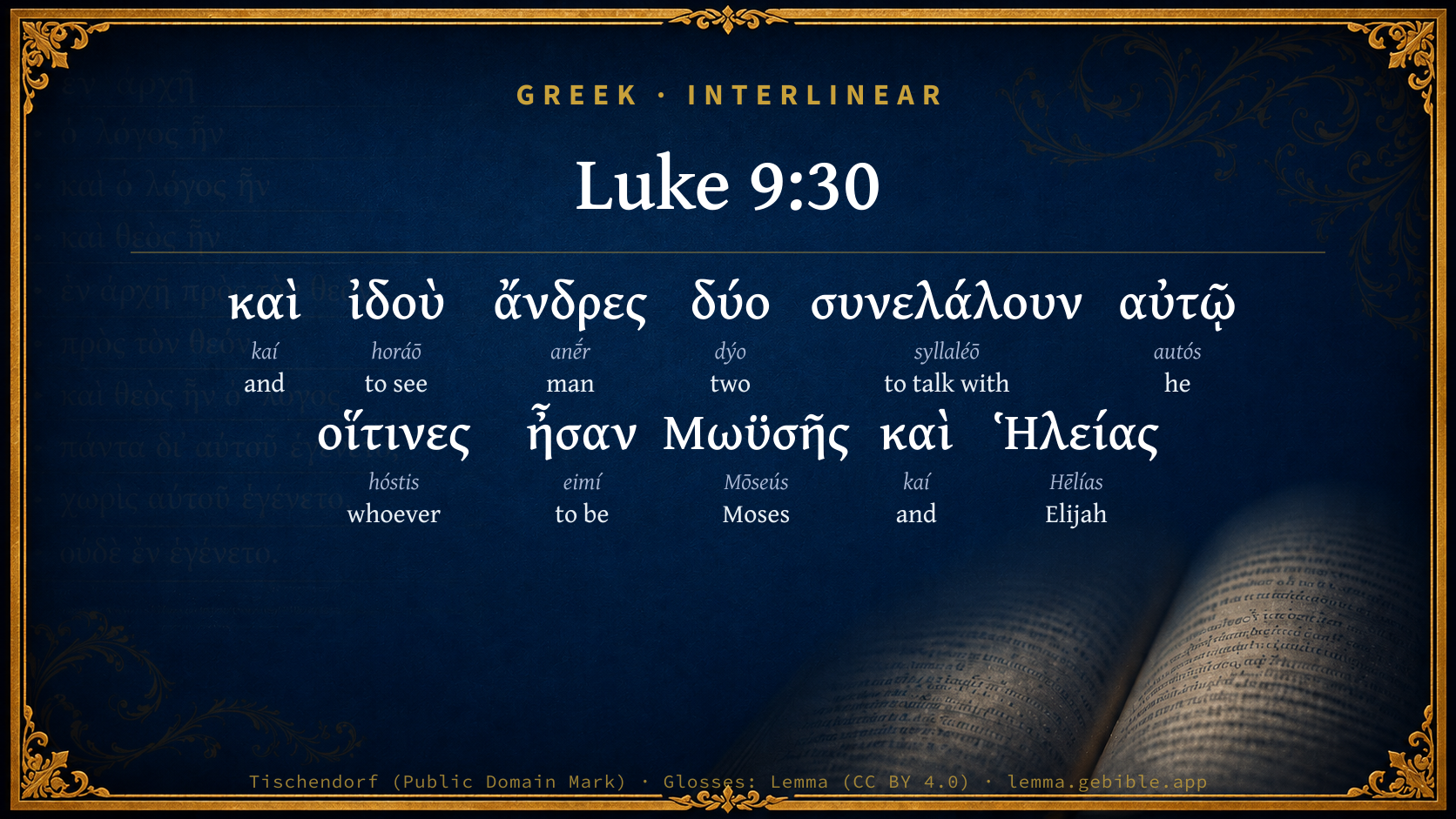
Greek (Tischendorf 8th ed.) Luke 9:30 appears in the Greek New Testament. The text above is from the Tischendorf 8th edition. Each word links to its Strong’s number and a concise gloss. Click any word for its full Thayer’s Greek Lexicon entry.
Download image
Cite this verse

Luke 9:30 (World English Bible). Public Domain. Lemma interlinear Bible study tool, https://lemma.gebible.app/v/luke/9/30.

Show BibTeX & RIS
BibTeX
RIS
English Translation
Behold, two men were talking with him, who were Moses and Elijah,
World English Bible · Public Domain
Download a study sheet

One document with this verse’s original text, its word-by-word gloss line, the meaning frame, cross-references with their text, attributed commentary, and full source and license credits — printable, and it pastes into notes with its structure intact.

This verse Autodidact and up

Study sheet (.html) Plain text (.txt)

A passage Seminary Student

Up to 50 verses in one chapter. A passage sheet keeps up to 6 commentary sources and 12 cross-references per verse, in the order this page ranks them, and says so on the sheet whenever that leaves anything out. Ask for a single verse and you get the Autodidact verse sheet above.

Everything on this page stays free to read, with no account — the sheet is a download of what is already on screen, not access to it.

Want to remove ads? Support Godless Engineer
Compare translations 3

The same verse in 3 English versions, stacked beneath the original-language interlinear above. Click any original word for its lexicon entry.

Each is an independent rendering of the whole verse — the interlinear is not word-aligned to these translations.

Highlighted words mark where these versions differ — a whole-verse word diff, not a word-by-word alignment.

  • World English Bible Public Domain
    Behold, two men were talking with him, who were Moses and Elijah,
  • King James Version Public Domain
    And, behold, there talked with him two men, which were Moses and Elias:
  • unfoldingWord Literal Text CC BY-SA 4.0
    And behold, two men began talking with him, who were Moses and Elijah,

unfoldingWord Literal Text — © unfoldingWord, licensed CC BY-SA 4.0. Word-aligned USFM3 via Door43 (git.door43.org/unfoldingWord/en_ult).

Versions to compare (up to 4)

3 of 4 selected

Show all 19 translations

Every available English version of this verse, each an independent rendering of the whole verse.

  • World English Bible Public Domain
    Behold, two men were talking with him, who were Moses and Elijah,
  • Berean Standard Bible Public Domain
    Suddenly two men, Moses and Elijah, began talking with Jesus.
  • Majority Standard Bible Public Domain
    Suddenly two men, Moses and Elijah, began talking with Jesus.
  • King James Version Public Domain
    And, behold, there talked with him two men, which were Moses and Elias:
  • American Standard Version (1901) Public Domain
    And behold, there talked with him two men, who were Moses and Elijah;
  • Revised Version (1885) Public Domain
    And behold, there talked with him two men, which were Moses and Elijah;
  • Geneva Bible (1599) Public Domain
    And beholde, two men talked with him, which were Moses and Elias:
  • Douay-Rheims (1899) Public Domain
    And behold two men were talking with him. And they were Moses and Elias,
  • Young's Literal Translation Public Domain
    And lo, two men were speaking together with him, who were Moses and Elijah,
  • Literal Standard Version CC BY-SA 4.0
    And behold, two men were speaking together with Him, who were Moses and Elijah,
  • Unlocked Literal Bible CC BY-SA 4.0
    Behold, two men were talking with him, Moses and Elijah,
  • unfoldingWord Literal Text CC BY-SA 4.0
    And behold, two men began talking with him, who were Moses and Elijah,
  • Darby Bible Public Domain
    And lo, two men talked with him, who were Moses and Elias,
  • World Messianic Bible Public Domain
    Behold, two men were talking with him, who were Moses and Elijah,
  • Webster's Bible Public Domain
    And behold, there talked with him two men, who were Moses and Elijah.
  • Free Bible Version CC BY-SA 4.0
    Two men appeared in brilliant glory. They were Moses and Elijah, and they began to talk with Jesus.
  • Bible in Basic English Public Domain
    And two men, Moses and Elijah, were talking with him;
  • Text-Critical English NT CC BY 4.0
    And behold, two men were talking with him; they were Moses and Elijah,
  • Tyndale New Testament (1534) Public Domain
    And beholde two men talked with him and they were Moses and Helyas

Literal Standard Version (2020), Covenant Press — licensed CC BY-SA 4.0. Text via the HelloAO Bible API (eBible.org). Unlocked Literal Bible (unfoldingWord) — licensed CC BY-SA 4.0. Text via the HelloAO Bible API (eBible.org). unfoldingWord Literal Text — © unfoldingWord, licensed CC BY-SA 4.0. Word-aligned USFM3 via Door43 (git.door43.org/unfoldingWord/en_ult). Free Bible Version, Dr. Jonathan Gallagher — licensed CC BY-SA 4.0. Text via the HelloAO Bible API (eBible.org).

Word by word

More ways to search: Search by grammar → Find every occurrence → Compare this word →

Practice this passage: Drill this verse → Learn its vocabulary →

About this verse

These counts appear in no published source. They are computed here, from the morphology-tagged text and Lemma’s own curated glosses. What Lemma adds →

11
words
10
distinct lemmas
Gospels
section

Notable vocabulary

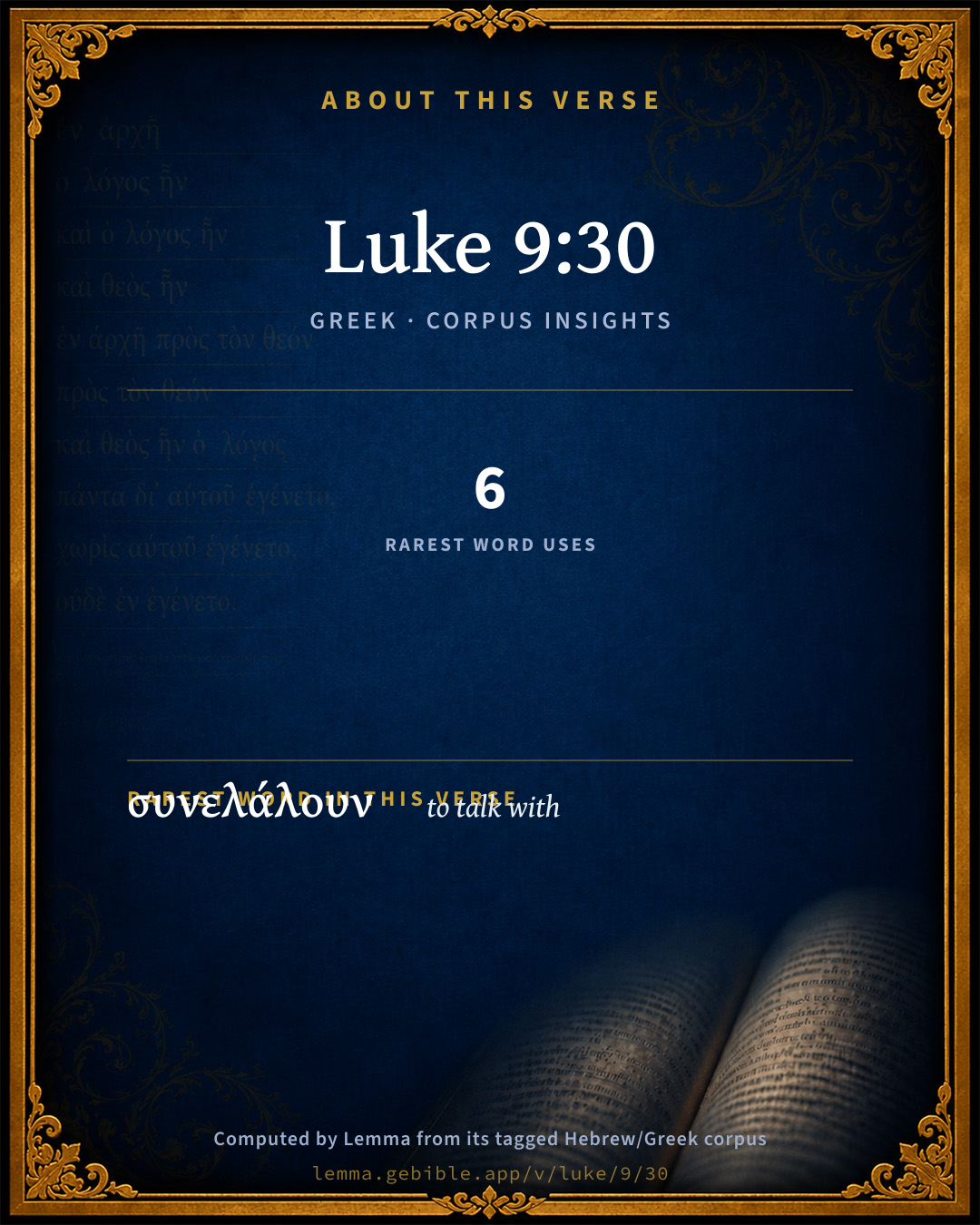
The rarest word here is συνελάλουν to talk with G4814 — appearing just 6 times in the whole Greek New Testament.

Shared distinctive vocabulary

συνελάλουν to talk with G4814 occurs in 6 verses of the Greek New Testament. Also found in:

Repetition

A word recurs within this verse:

Cross-references

11

Topical passages linked to Luke 9:30 in the Treasury of Scripture Knowledge — connected by theme and wording, ordered by reader-vote popularity; previews shown in the World English Bible.

  • Luke 1:17 He will go before him in the spirit and power of Elijah, 'to turn the hearts of the fathers to the children,' and the disobedient to the wisdom of the just; to make ready a people prepared for the Lord."
  • John 1:17 For the law was given through Moses. Grace and truth came through Jesus Christ.
  • 2 Corinthians 3:7–11 But if the service of death, written engraved on stones, came with glory, so that the children of Israel could not look steadfastly on the face of Moses for the glory of his face; which was passing away:
  • Hebrews 3:3–6 For he has been counted worthy of more glory than Moses, inasmuch as he who built the house has more honor than the house.
  • Matthew 17:3–4 Behold, Moses and Elijah appeared to them talking with him.
  • Mark 9:4–6 Elijah and Moses appeared to them, and they were talking with Jesus.
  • Luke 9:19 They answered, "'John the Baptizer,' but others say, 'Elijah,' and others, that one of the old prophets is risen again."
  • Luke 24:27 Beginning from Moses and from all the prophets, he explained to them in all the Scriptures the things concerning himself.
  • Luke 24:44 He said to them, "This is what I told you, while I was still with you, that all things which are written in the law of Moses, the prophets, and the psalms, concerning me must be fulfilled."
  • Romans 3:21–23 But now apart from the law, a righteousness of God has been revealed, being testified by the law and the prophets;
  • James 5:17–18 Elijah was a man with a nature like ours, and he prayed earnestly that it might not rain, and it didn't rain on the earth for three years and six months.

Cross-references courtesy of OpenBible.info (CC BY 4.0).

Commentary

Notes on Luke 9:30 from classic Christian and Jewish commentators (each source and its license shown beneath its notes). The classic Christian expositions comment on the surrounding passage and are grouped to its opening verse, so a note may address several verses; the Jewish commentaries on the Tanakh (Rashi and others) are per-verse, so they appear only where the commentator wrote on this verse.

Lemma curates 59 commentaries, every one of them public domain or Creative Commons licensed, each selected and text-cleaned for this edition rather than reprinted as found. About our sources →

The Biblical Illustrator

Joseph S. Exell

Luk_9:30; Luk_9:32

Moses and Elias: who appeared in glory, and spake of His decease

The decease at Jerusalem

I. IN THE DECEASE AT JERUSALEM, THERE IS THE DEATH OF THE SINLESS CHRIST.

II. THIS DECEASE AT JERUSALEM WAS A DEATH PURELY AND PERFECTLY VOLUNTARY.

III. IN THE DECEASE AT JERUSALEM WE HAVE A DEATH WHICH APPEARS TO BE MORE IMPORTANT AND PRECIOUS THAN EVEN LIFE.

IV. IN THIS DECEASE AT JERUSALEM, WE HAVE THE ONLY INSTANCE OF A MAN BEING A SACRIFICE FOR SIN.

V. IN THIS DECEASE AT JERUSALEM, WE HAVE A DEATH THAT IS TO BE REMEMBERED AND COMMEMORATED FOR EVER. (H. J. Bevis.)

The conference on the Mount

1. What they spake of none could Divine, unless it had been told us, and the Evangelist Luke telleth us, that it was of His death. This argument was chosen--

(1) Because it was at hand. The next solemn mediatory action after this was His death and bloody sufferings; after He was transfigured in the Mount, He went down to suffer at Jerusalem.

(2) This was an offence to the apostles that their Master should die Mat_16:22-23).

(3) This was the Jews stumbling-block (1Co_1:23).

(4) This was prefigured in the rites of the Law, foretold in the writings of the Prophets.

(5) It was necessary that by death He should come to His glory, of which now some glimpse and foretaste was given to Him.

(6) The redemption of the Church by Christ is the talk and discourse we shall have in heaven. The angels and glorified saints are blessing and praising Him for this (Rev_5:9; Rev_5:12).

(7) It is an instructive pattern to us, that Christ in the midst of His Transfiguration, and the glory which was then put upon Him, forgat not His death. In the greatest advancement we should think of our dissolution. If Christ, in all His glory, discoursed of His death, surely it more becometh us, as necessary for us to prevent the surfeit of worldly pleasures; we should think of the change that is coming, for Surely every man at his best estate is vanity (Psa_39:5). In some places they were wont to present a deaths head at their solemn feasts; merry days will not always last, death will soon put an end to the vain pleasures we enjoy here, and the most shining glory will be burnt out to a snuff.

2. The notion by which His death is expressed, His decease ἔξοδον, which signifies the going out of this life into another, which is to be noted.

(1) In respect unto Christ His death was an exodus, for He went out of this mortal life into glory, and so it implieth both His suffering death, and also His resurrection (Act_2:24).

(2) With respect to us; Peter (2Pe_1:15) calls His death an exodus. The death of the godly is a going out, but from sin and sorrow, to glory and immortality. The soul dwelleth in the body as a man in a house, and death is but a departure out of one house into another; not an extinction, but a going from house to house.

3. The necessity of undergoing it. Accomplishing.

(1) His mediatorial duty, with a respect to Gods ordination and decree declared in the prophecies of the Old Testament, which, when they are fulfilled, are said to be accomplished. Whatsoever Christ did in the work of redemption was with respect to Gods will and eternal decree (Act_4:28).

(2) His voluntary submission which He should accomplish, noteth His active and voluntary concurrence; it is an active word Dot passive, not to be fulfilled upon Him, but by Him.

(3) That it was the eminent act of His humiliation; for this cause He assumed human nature. His humiliation began at His birth, continued in His life, and was accomplished in dying; all was nothing without this, therefore there is a consummation or perfection attributed to the death of Christ Heb_10:14). (T. Manton, D. D.)

A revelation of the heavenly life

Moses and Elias are standing humbly in the presence of Jesus Christ (as He had once sat at the feet of the Rabbi in the Temple), holding converse with Him, acknowledging all their ignorance, telling Him all their perplexities, responding to Him with the response of perfect assent to His every utterance. Of what did they speak! They spoke of His decease, which He should accomplish at Jerusalem. This word decease should, in my opinion, have a larger application; it is the same word as St. Peter used when he spoke of the death which he was about to die, which is also translated as decease; it should be rather exodus. We may be certain of this; it was not merely of the historic fact of Christs death of which they spoke, they wanted to know the deep meaning underlying that fact, and this could only be understood when His death was studied in connection with the many mysteries before and after. Of this, of all those mysteries which found their centre in the Cross of Calvary, did they speak on the Mount of Transfiguration, and thus revealed to the apostles and to us what is the heavenly life of which our life here is the prelude, what is that eternal state to which we are all rapidly journeying. First, then, it is of primary importance to consider that heaven is a state rather than a locality. Dont misunderstand me. I do not say there is no space which we call heaven to-day, no space where that sacred humanity still exists which the Incarnate Saviour took upon Himself, and which has since been in some sense subject to laws of creaturely existence, and therefore subject to space. Wherever Jesus Christ is there is heaven, and yet if you ask where this heavenly life will be lived, in what locality the heavenly life will be lived, then I shall answer that probably, though of this no one can be certain, probably the sphere of that life will be mainly this earth. The last vision in the Apocalypse is not the vision of the Church ascending, but her advent on the new earth. I saw the holy city, new Jerusalem, coming down from heaven, prepared as a bride adorned for her husband. Insignificant as this planet is in the wonderful cosmos, yet it has been chosen among Gods creations as the scene in which the great mystery of love should be carried out, in which the incarnate life of the Son of God should be lived; out of the dust of this earth His sacred body was formed, on this earth He lived His life, on this earth He died His death, and from this earth He ascended into heaven, and carried into the presence of the Father, to be for ever there, the body formed of the dust of this earth. This earth is the scene of the humiliation of Jesus Christ, of the humiliation of His Church, of the whole family of mankind; is it not likely to be the centre of that plan in which the glory of Jesus Christ, the glory of His Church and of mankind, shall be consummated? I state, then, as a pious opinion, that this earth will be the centre of that life of bliss which the glorified Church will live. And where more fitting? We have no reason to believe that the great work of Redemption has been carried out in any of the other worlds in Gods great plan of creation, nor do we even know that those worlds are inhabited by living souls. And yet the great question is, not where shall that heavenly life be spent, but what is that life? And the answer is plainly and distinctly given in the Revelation which we are studying, that the heavenly life is a state of conformity to God. Church life is revealed to us as lived under three conditions, of which two are present conditions and one future: the first is the militant life on earth; the second is the waiting life in paradise--the life of souls waiting in that dear place of rest for the coming of their Lord in glory--and the third is the life of perfect conformity to Jesus Christ. Here we are ever reaching forward to that conformity, and yet none of us can ever be perfect; in paradise I venture to believe that there will be growth for those waiting souls, an ever-increasing conformity with Jesus; for the path of the just is as the shining light, that shineth more and more unto the perfect day. That perfect day is the coming of our Lord, when we shall see Him as He is, when we shall be wholly conformed to God, when, waking up after His likeness, we shall be satisfied. By the heavenly life we understand that state of glory which is entered on by the resurrection--for as baptism is our birth into the Church militant, so death is our birth into the Church expectant, and the resurrection our birth into the Church glorified. The state of expectation is only over when He, whom we look for, shall appear, and we shall enter into the state of conformity. What is this conformity? I answer, that my perfect conformity is my attainment of my perfect individuality; no one can be perfectly conformed to God in the sense that they can express in themselves every beauty that is in Him; for is it not true that He is the Sun and we are only the stars, and we know that one star differeth from another star in glory? Conformity to Christ is this, my perfect realization of the Divine thought for me; God is not mirrored in each member of the Church, but in the whole Church; one ray of His beauty is mirrored in one, and one in another; I was created to reflect one ray; He who created me telleth the number of the stars, and calleth them all by their names, and, as one star differeth from another, so one man from another man. If I may say it, the great Creator never uses the same mould twice; having used it once He throws it away, and so the characteristics of one are not the same as another. God has placed me in this world with an individual purpose of life to develop, and any system which takes Gods creations, on whom is stamped individuality, and forces them into the same pattern, is immoral, is a marring of Gods plan. There must be space in His Church: Thou has set my feet in a large room. So, when I am truly myself when I can fulfil my highest aspirations, when I can live out my fullest resolves when I can perfectly express the idea of my individual being which God has revealed to me, then at last I have gained conformity to Christ, then I know what it is to rest in the heaven of God. Oh! joy to be my ideal self! joy when conduct shall square with conviction, when conviction shall square with aspiration, and aspiration shall square with resolve! Oh! the utter rest to lie at the feet of Jesus, true to Him because utterly true to myself! Moses will be Moses there, Elias will be Elias there, each before Jesus Christ in His own individuality and personality. But what is the life which awaits me there? The answer comes clearly and distinctly--a life lived in the power of Jesus Christ. The first great hunger of each human creature is heart-hunger, the first great thirst is heart-thirst; if love, then, is our greatest need, be sure of this, God created us to beloved, and, therefore, He created us to possess and to be possessed by Himself, who is absolute Beauty and perfect Love; and so, whether our love flows out first to those dear ones whom He has given us to love, whether our first love is given to Him or only indirectly to Him, of this be sure, we cannot know heart-rest until we rest wholly in His love.

The time will come when we shall have not only an intellectual but an actual apprehension of His love, when we shall live by sight and not by faith, and as we gaze on the Word Incarnate, the sight of Gods beauty mirrored there will draw up to us His embrace, and the joy of Gods love will attract us to Him eternally. This, then, is heaven, to rest in the love of God. Then if our first great longing is for love, our second is for knowledge. The heart longs for love, the mind for knowledge: and here, in time, we cannot satisfy this longing. The more we know, the more we become conscious of our ignorance; the more we feed the mind, the more it hungers for that which it has not. Here we know in part. But there, in the heavenly life, the partial knowledge shall be made complete; and I shall study the truth, not only as it has been revealed, but with the aid of the great First Cause, of God Himself; and as I see God I shall know the rest that comes with the perfect knowledge of the truth as it is in Him. And how shall we study to know God? As we can see the Father only as He is mirrored in the Son, so we can only hear His voice as revealed to us through the Incarnate Word. And our study will surely be the study of those mysteries which gather round His sacred form--the mystery of His Incarnation, the mystery of His Death, the infinite mystery of His Resurrection and of His Ascension (for in each is a manifestation of the Infinite). And so, through all the ages of eternity, there will be an eternal festival--an eternal Christmas, an eternal Lady Day, an eternal Easter, and an eternal Ascension--that I may receive into my mind the meaning of these mysteries, and give back to God my mental satisfaction by uttering heavens eternal creed and offering heavens ceaseless worship. Then, thirdly, if in heaven the cravings of our heart for love and of our intellects for knowledge will be satisfied, so, too, will our desire for unity. To some the thought of individuality is not attractive; it is not personal isolation they long for, but corporate union. The two ideas are not antagonistic. True, the Kings daughter is all glorious within, her clothing is of wrought gold. But why? Because each separate thread is of wrought gold. We see in the Revelation how every precious stone was used in the completion of the heavenly city, which could not be perfect without the perfection of each stone; and so here a life of perfected individuality may be the same as a life of perfected unity. Moses and Elias stood side by side, they knew one another, they shared a common study, they asked common questions, they received the common truth, though Peter and James and John, with their own individual characteristics of zeal and love and patience, as they stood there with them, and heard the Voice out of the cloud, This is My beloved Son, knew Moses to be Moses, and Elias Elias; so in heaven ours will be no mere life of individual isolation, in which the enjoyment of personal love, the tasting of personal truth, the offering of personal worship, will be our one thought. No; the perfection of the lives of the saints blends in one perfect communion: there saint with saint holds converse, lives a common life, offers a common worship. (Canon Body.)

Christ crucified

Such words never were, never could with truth and fitness, be applied to any but the one death.

I. The first point to be noted here is, THE VOLUNTARY CHARACTER OF THIS DEATH. There was no power, no law of nature that made death a necessity to the Lord Jesus. That pilgrimage into the regions of the tomb He could undertake or decline, according to His own pleasure. He died simply because He willed to die. He might have left the world in a very different way. Like His own servant Elias, with whom He conversed of this decease, He might have returned to heaven in a chariot of fire; or, if He must taste death in order that He might be perfectly like unto His brethren, His departure might have been calm and tranquil, in the stillness of home, amid the sympathies and tears of loving friends. Such a death would surely have been sufficient, if the end of His ministry had been simply the manifestation of God in the flesh. Instead of a close so fitting to a life of purity, He chose to accomplish a decease, in which He should be numbered with the transgressors. Surely for this there must have been wise and sufficient reason. The fact that He died thus, is the proof that the great design of His advent could be fulfilled only by such a death. With Him it was the centre-fact of His whole history.

II. THE IMPORTANCE ATTACHED TO THIS DEATH. He had work to do in the world beside, a bright example to give; the true ideal of a human life to set before man; a perfect righteousness to win; a thousand blessings to scatter; His own deep love and sympathy with human sorrows to discover: but His great work was this--to die.

III. THE TRUE MEANING OF THIS DEATH. The New Testament speaks in various ways--sometimes it employs the language of type and symbol--sometimes it gives us distinct and explicit statements but all its representations of this death converge to one point, and enforce one grand idea. Christ our Passover is sacrificed for us. Here is an expressive metaphor--one whose signification it cannot be hard to discover. What is the meaning of the apostle? The Paschal Lamb died for the deliverance of the nation--through his death the nation escaped the sword of the destroying angel--the animal was slain, the blood was sprinkled, and the people were saved. So was Christ our Passover sacrificed, that we might be delivered--His death is our life--in virtue of His blood of sprinkling we are purified and accepted. The decease which He should accomplish at Jerusalem. Thus, then, did the man Christ Jesus ever keep before Him that goal of suffering and humiliation to which His steps were tending. Not ignorantly did He rush on perils and death, entering on a path whose end He did not discern until retreat had become impossible. Knowing what the work was, He had deliberately undertaken it, and throughout all its stages, the issue was ever present to His eye. Very early in His ministry did He indicate that He was set apart to this service--was anointed unto sacrifice. (J. G. Rogers, B. A.)

Two divisions in the glorified Church

Why were these two men with Jesus in the vision? Is it not because when at length the Church shall reach her state of glory there will be within her two distinct classes? We are told, that when our Lord comes, the dead in Christ shall rise first, and at the sound of the trump, and at the call of His voice, the fields of Paradise shall be deserted, and they shall all be caught up to meet their Lord in the air, henceforth to seek Him in His beauty and to be His daily delight. But what of those who are not in the fields of Paradise at the time of the coming of our Lord? Shall they die? Shall they know that mysterious experience which we call death, the separation of the soul from the body? No, for then it would be a purposeless experience. They shall not die, but shall be caught up together with them in the clouds, and shall be ever with the Lord. Therefore the glorified Church shall be the assembly of those who, some from life and some from Paradise, are gathered into the presence of Christ. And do we not see these two classes represented in the ancient saints who talked with our Lord on the Mount of Transfiguration? Moses, we know, died; and we remember the cause of his death there in the wilderness, and the mysterious conflict over his body between Michael the archangel and Satan. Elijah died not; he never experienced this crisis of existence, but, we are told, went up by a whirlwind into heaven. So the two great divisions of the glorified Church are fittingly represented by these two Old Testament characters, one of whom died the most arresting death there recorded, and the other died not. (Canon Body.)

Death an exodus

1. It is strange how much we can find in that great scene on the Holy Mount, to illustrate this conception, and to impress it on our minds. Look at the speakers--Moses, Elijah, Christ. Was not the death of Moses an exodus? A sacred mystery hangs over the decease of the Man of God. He who died by the kiss of the Eternal is a not infrequent synonym for Moses in the Rabbinical schools. Elijah, again, was rapt, we are told, and carried up into heaven, as by a whirling cloud of fiery chariots. If, therefore, any of the sons of men should be permitted to pass from the spiritual world to hold converse with Christ in the moment of His glory, these were the two men. They had already and fully achieved the exodus or journey of death, and had passed into the large fair land beyond. They talked with Him of the exodus He should accomplish at Jerusalem. If we love and follow Him, we need not doubt that we shall be made partakers of His death in this high sense--that for us, as for Him, death will be an exodus, a journey home.

2. The more we study this conception of death the more instructive and suggestive we shall find it to be. The illustration which the figure suggests, and was intended to suggest, is the exodus of Israel from Egypt. If we consider what that exodus was and implies, if we then proceed to infer that death will be to us very much what their exodus was to the captive Hebrew race, we shall reach some thoughts of death, and of the life that follows death, which can hardly fail to be new and helpful to us. The exodus was a transition from bondage to freedom, from grinding and unrequited toil to comparative rest, from ignorance to knowledge, from shame to honour, from a life distracted by care and pain and fear to a life in which men were fed by the immediate bounty of God, guided by His wisdom, guarded by His omnipotence, consecrated to His service. And if death be an exodus, we may say that, by the gate and avenue of death, we shall pass from bondage to freedom, &c. (S. Cox, D. D.)

The central truth of the Transfiguration

I. CHRIST GLORIFIED IN CONNECTION WITH HIS DEATH. There are two transfigurations--that of the Mount and that of the Cross; and it is impossible to understand either, save in the light of the other. He who was on the Mount was still the Man of Sorrows, and He who was on the Cross was still the Divine Son. The death on the Cross gave its glory to the mountain-scene; the declaration on the Mount makes the death all-radiant with triumph.

II. CHRIST GLORIFIED THROUGH HIS DEATH, REFLECTS BACK A RADIANCE ON MOSES AND ELIJAH.

III. AS MOSES AND ELIJAH ARE THUS GLORIFIED BY CHRIST, THEY RETIRE FROM VIEW AND GIVE PLACE TO HIM. (W. M. Taylor, D. D.)

Celestial visitors

When we read of the reappearance of Moses and Elias after their long absence, our first feeling is that of wonder; it is to us a miracle, a strange thing, for the dead do not return. But why view it thus? The wonder is, not that Moses and Elias were seen in the holy Mount, but that the separation between us and the blessed dead should be so complete. Their long unbroken silence is the strange thing when you think of it. We long to know more of them and of the world in which they dwell. We know from this narrative--

1. That human spirits are not annihilated when they disappear from this world.

2. That human spirits have a personal existence after death.

3. We see in Moses and Elias what all faithful souls shall be, when the great redemption is completed--as like unto God as possible. (Thomas Jones.)

The thought of death amid the raptures of the Transfiguration

Jesus was lifted by His rapture above the fear of death. He spoke calmly of His decease with the messengers from the unseen world, whose very presence testified of death conquered and the grave despoiled. His acutest pain was transformed into His highest joy, as the body of His humiliation was transfigured by the glory of heaven; and at that supreme moment, when His life was at the brightest, He could have willingly lain it down, and passed into the dark shadow feared of man. This true to human experience. Jacob on seeing Joseph again--Now let me die; Simeon, with the infant Saviour in his aged arms--Now lettest Thou Thy servant depart in peace. And outside the domain of Scripture we find numerous examples of the same strange intermingling of the highest glory of life with the thought of sorrow and death. It is indeed on mounts of transfiguration, when our nature is irradiated by some great joy, that we love to speak of our decease. We fear not to enter into the cloud of death when we are transfigured by the passionate intensity of our feelings. Our joy transforms the pain of dying into its own splendour, as the sun changes the very cloud into sunshine. All thoughtful writers have described this remarkable human experience, AEschylus, in his Agamemnon , pictures the herald returning from the Trojan War as so overjoyed at revisiting his native land that he was willing to die. Goethe represents one of his most beautiful creations--the loved and loving Clara--as wishing to die in the hour of her purest joy; for earth had nothing beyond the rapture of that experience. Shakespeare puts into the lips of Othello, at his joyful meeting with Desdemona, after the perils of his voyage to Cyprus were over, the passionate exclamation:--

If it were now to die

Twere now to be most happy: for I fear

My soul hath her content so absolute,

That not another comfort like to this

Succeeds in unknown fate.

It is said of Benjamin Franklin that his exultation was so great when he succeeded in attracting the lightning from the clouds by means of his kite, and thus proving its identity with the electricity of the earth, that he could willingly have died that very moment. Miss Martineau, in her Retrospect of Western Travel, describes the grandeur of a storm which she encountered on the Atlantic, as producing a similar triumph over the fear of death. In the excitement of such an hour, she says, one feels as if one would as soon go down in those magnificent waters as die any other death. I remember, on one occasion, having something of the same feeling. I was travelling at night in a mountain region, when a terrible storm came on. The rain poured in torrents; the thunder pealed among the rocks; flash after flash of lightning linked the hills together, as with chains of fire. A pall of blackness covered the sky from end to end. Hundreds of torrents poured down the heights into a lake, as if direct from the clouds; the sheen of their foam looked weird and ghastly in the illumination of the lightning, and their roar drowning the crash of the thunder; the sound of many waters, here, there, and everywhere, filling earth and sky. Amid all this appalling elemental war, I felt a strange excitement and uplifting of soul, which made me indifferent to danger, careless what became of me. Such moments reveal to us the greatness of our nature, and fill us with the intoxication of immortality. Death in such glorious circumstances seems an apotheosis. He comes to us as it were with the whirlwind and the chariot of fire, to lift us above the slow pain of dying, in the rapture of translation. (H. Macmillan, LL. D.)

The conference during the transfiguration

In this discourse I shall first direct your attention to the account given of the persons who conversed with our Lord, and then to the subject of their conference.

I. THE PERSONS WHO CONVERSED WITH OUR LORD WERE TWO MEN.

1. It may be thought that two angels would have rendered the scene more splendid, but there was a peculiar propriety in employing men.

2. They were men of high eminence under the former dispensation.

3. We are told that these visitants appeared in glory. They came from heaven, and though their honour and felicity there were very high, they felt no reluctance to descend to this mountain. They were not called to relinquish their splendour or to cover it with a veil, as our Lord is said to have emptied Himself, when he appeared in our world. The glory which invested them must have been very great, since it was visible amidst the brightness spread around our Lord.

4. They talked with Jesus. It is not said that they talked with one another. They descended, not to hold intercourse with the disciples, but with their Master.

II. Let us now attend to THE SUBJECT OF THEIR CONFERENCE. It was the decease which He should accomplish at Jerusalem.

1. They spake of the moral glory which Jesus should exhibit in His departure. Great was the glory of Moses in the going forth from Egypt.

2. They spoke of the important ends to be gained by His death. It reconciles the mind to labours and sufferings, when we are assured that valuable ends will be gained by them. Let me specify some of these ends. They talked of the glory which would result from His death to all the Divine perfections. The expiation to be made for sin was another end. I must mention further, the salvation to be gained by His death for millions of human beings.

3. We may consider them as speaking of the influence of His death.

4. They spoke of the rewards which would be conferred on Him for His obedience to the death.

Let me now state shortly, some of the reasons why this theme was chosen for conference on the Mount.

1. It was done to animate and invigorate the Son of Man for the scene before Him.

2. We may find another reason for the choice of the topic in its peculiar importance.

3. They talked of this subject for the sake of the disciples.

4. They did it for the benefit of the Church in all ages.

1. Let Christians live more under the influence of this death than ever.

2. Let good men prepare for their departure.

3. Let me call on the disciples of Jesus, with kindred feelings to those of Moses and Elias, to commemorate their Saviours decease. And let those who never approach the Lords table consider that, were their conduct general, the death of Christ might sink into oblivion on earth. (H. Belfrage.)

The Biblical Illustrator, edited by Joseph S. Exell (c. 1880s–1900s) — public domain. Text from a community e-Sword module.

MacLaren's Expositions of Holy Scripture

Alexander MacLaren

Luke

‘IN THE HOLY MOUNT’

Luk 9:30 - Luk 9:31.

The mysterious incident which is commonly called the Transfiguration contained three distinct portions, each having its own special significance and lesson. The first was that supernatural change in the face and garments of our Lord from which the whole incident derives its name. The second was the appearance by His side of these two mighty dead participating in the strange lustre in which He walked, and communing with Him of His death. And the last was the descent of the bright cloud, visible as bright even amidst the blazing sunshine on the lone hillside, and the mysterious attesting Voice that spoke from out of its depths.

I leave untouched altogether the first and the last of these three portions, and desire briefly to fix our attention on this central one. Now it is to be observed that whilst all the three Synoptic Evangelists tell us of the Transfiguration, of the appearance of Moses and Elias, and of the Cloud and the Voice, only Luke knows, or at least records, and therefore alone probably knows, what it was that they spoke of. Peter and James and John, the only human witnesses, were lying dazed and drunken with sleep, whilst Christ’s countenance was changed; and during all the earlier portion at all events of His converse with Moses and Elias. And it was only when these were about to depart that the mortals awoke from their slumber. So they probably neither heard the voices nor knew their theme, and it was reserved for this Evangelist to tell us the precious truth that the thing about which Lawgiver, Prophet, and the Greater than both spake in that mysterious communion was none other than the Cross.

I think, then, that if we look at this incident from the point of view which our Evangelist enables us to take, we shall get large and important lessons as to the significance of the death of Jesus Christ, in many aspects, and in reference to very many different persons. I see at least four of these. This incident teaches us what Christ’s death was to Himself; what it was in reference to previous revelation; what it was in reference to past generations; and what it may be in reference to His servants’ death. And upon these four points I desire briefly to touch now.

I. First, then, I see here teaching as to what the death of the Lord Jesus Christ was in reference to Himself.

What was it that brought these men-the one who had passed in a whirlwind to heaven, and the other who had been led by a mysterious death to slumber in an unknown grave-what was it that brought these men to stand there upon the side of the slopes of Hermon? It was not to teach Christ of the impending Cross. For, not to touch upon other points, eight days before this mysterious interview He had foretold it in the minutest details to His disciples. It was not for the sake of Peter and James and John, lying coiled in slumber there, that they broke the bands of death, and came back from ‘that bourne from which no traveller returns,’ but it was for Christ, or for themselves, or perhaps for both, that they stood there.

You remember that in Gethsemane ‘there appeared an angel from heaven strengthening Him.’ And one of the old devout painters has marvellously embraced the deepest meaning of that vision when he has painted for us the strengthening angel displaying in the heavens the Cross on which He must die, as if the holding of it up before Him as the divine will gave the strength that He needed. And I think in some analogous way we are to regard the mission and message to Jesus of these two men in our text. We know that clear before Him, all His life long, there stood the certainty of the Cross. We know that He came, not merely to teach, to minister, to bless, to guide, but that He came to give His life a ransom for many. But we know, too, that from about this point of time in His life the Cross stood more distinctly, if that may be, before Him; or at all events, that it pressed more upon His vision and upon His spirit. And doubtless after that time when He spoke to the disciples so plainly and clearly of what was coming upon Him, His human nature needed the retirement of the mountain-side and prayer which preceded and occasioned this mysterious incident. Christ shrank from His Cross with sinless, natural, human shrinking of the flesh. That never altered His purpose nor shook His will, but He needed, and He got, strength from the Father, ministered once by an angel from heaven, and ministered, as I suppose, another time by two men who looked at death from the other side, and ‘who spoke to Him of His decease which He should accomplish at Jerusalem.’

And now it is to be noticed that the words which our Evangelist employs are remarkable, and one of them, at least, is all but unique. The expression translated in my text ‘decease’ is the same Greek word which, untranslated, names the second book of the Old Testament-Exodus. And it literally means neither more nor less than a departure or ‘going out.’ It is only employed in this one passage and in another one to which I shall have occasion to refer presently, which is evidently based and moulded upon this one, to signify death. And the employment of it, perhaps upon these undying tongues of the sainted dead-or, at all events, in reference to the subject of their colloquy-seems to us to suggest that part of what they had to say to the Master and what they had to hear from Him was that His death was His departure in an altogether unique, solitary, and blessed sense. ‘I came forth from the Father, and I am come into the world. Again, I leave the world and go to the Father.’ Not dragged by any necessity, but of His own sovereign will, He passes from earth to the state where He was before. And as He stands there on the mountain with His radiant face and His white robes, this thought as to His death brings to Him comfort and strength, even whilst He thinks of the suffering of the Cross.

But, still further, the other word which is here employed helps us to understand what our Lord’s death was to Him; ‘He should accomplish’ it as a thing to be fulfilled. And that involves two ideas, the one that Christ in His death was consciously submitting to a gladly accepted divine must, and was accomplishing the purpose of Love which dwelt in the heavens and sent Him, as well as His own purpose of love which would redeem and save. The necessity of the death of Christ if sin is to be put away, if we are ever to have a hope of immortality, the necessity of the death of Christ if the mercy of God is to pour out upon a sinful and rebellious world, the necessity of the death of Christ, if the deep purposes of the divine heart are ever to be realised, and the yearning compassion of the Saviour’s soul is ever to reach its purpose-all lie in that great word that ‘His decease’ was by Him to be ‘accomplished.’ This is the fulfilling of the heart of God, this is the fulfilling of the compassion of the Christ. It is the accomplishment of the divine purpose from eternity.

Still further, the word, as I think, suggests another kind of fulfilment. He was to ‘accomplish’ His death. That is to say, every drop of that bitter cup, drop by drop, bitterness by bitterness, pang by pang, desolation by desolation, He was to drink; and He drank it. Every step of that road sown with ploughshares and live coals He was to tread, with bleeding, blistered, slow, unshrinking feet. And He trod it. He accomplished it; hurrying over none of the sorrow, perfunctorily doing none of the tasks. And after the weary moments had ticked themselves away, and the six hours of agony, when the minutes were as drops of blood falling slowly to the ground, were passed, He inverted the cup, and it was empty, and He said ‘It is finished’; and He gave up the ghost, having accomplished His decease in Jerusalem.’

II. Further, note in this incident what that death is in regard to previous revelation.

I need not remind you, I suppose, that we have here the two great representative figures of the past history of Israel-the Lawgiver, who, according to the Old Testament, was not only the medium of declaring the divine will, but the medium of establishing Sacrifice as well as Law, and the Prophet, who, though no written words of his have been preserved, and nothing of a predictive and Messianic character seems to have dropped from His lips, yet stood as the representative and head of the great prophetic order to which so much of the earlier revelation was entrusted. And now here they two stand with Christ on the mountain; and the theme about which they spake with Him there is the theme of which the former revelation had spoken in type and shadow, in stammering words, ‘at sundry times and in divers manners,’ to the former generations-viz. the coming of the great Sacrifice and the offering of the great Propitiation. All the past of Israel pointed onwards to the Cross, and in that Cross its highest word was transcended, its faintest emblems were explained and expressed, its unsolved problems which it had raised in order that they might be felt to be unsolved, were all answered, and that which had been set forth but in shadow and symbol was given to the world in reality for evermore. In Moses Law and Sacrifice, and in Elijah the prophetic function, met by the side of Christ, ‘and spake of His decease.’

Now, dear friends, let me say one word here before I pass on. There is a great deal being said nowadays about the position of the Old Testament, the origin of its ritual, and other critical, and, to some extent, historical, questions. I have no doubt that we have much to learn upon these subjects; but what I would now insist upon is this, that all these subjects, about which people are getting so excited, and some of them so angry, stand, and may be dealt with, altogether apart from this central thought, that the purpose and meaning, the end and object of the whole preliminary and progressive revelation of God from the beginning, are to lead straight up to Jesus Christ and to His Cross. And if we understand that, and feel that ‘the testimony of Jesus is the spirit of prophecy,’ and that law and sacrifice, commandments and altar, Sinai and Zion, the fiery words that were spoken in the wilderness, and the perpetual burnt-offering that went up in the Temple, had one mission-viz. to ‘prepare the way of the Lord’-we have grasped the essential truth as to the Old Revelation; and if we do not understand that, we may be as scholarly and erudite and original as we please, but we miss the one truth which is worth grasping. The relation between the Old revelation and the New is this, that Christ was pointed to by it all, and that in Himself He sums up and surpasses and antiquates, because He fulfils, all the past.

Therefore Moses and Elijah came to witness as well as to encourage. Their presence proclaimed that Christ was the meaning of all the past, and the crown of the divine revelation. And they faded away, and Jesus was found alone standing there, as He stands for ever before all generations and all lands, the sole, the perfect, the eternal Revealer of the heart and will of God. ‘God, who at sundry times and in divers manners spake unto the fathers by the prophets, hath in these last days spoken unto us by His Son.’

III. Again, we have here set before us the death of Christ in its relation to past generations.

I need not dwell upon anything that was mysterious or anomalous in the last moments upon earth of either Moses or Elijah. I do not suppose that there is any reference to the undoubted peculiarities which existed in the case of both. But they came from that dim region where the dead were waiting for the coming of the Saviour, and by some means, we know not how, were clothed with something that was like an immortal body, and capable of entering into this material universe. There they stood, witnesses that Christ’s death was of interest to all those sleeping generations in the past. We know not anything, or scarcely anything, of the condition of the sainted dead who died before Christ came. But this is clear, that these two came from the land where silent expectancy had ruled, and came perhaps to carry back to their brethren the tidings that the hour was ready to strike, and that soon amongst them there would stand the Eternal Life.

But, be that as it may, does not that group on the mountain-side teach us this, that the Cross of Jesus Christ had a backward as well as a forward power, and that for all the generations who had died, ‘not having received the promises, but having seen them and saluted them from afar,’ the influence of that Sacrifice had opened the gates of the Kingdom where they were gathered in hope, even as it opens for us, and all subsequent generations, the gates of the paradise of God?

I know not whether there be truth in the ancient idea that when the Master died He passed into that Hades where were assembled the disembodied spirits of the righteous dead, and led captivity captive, taking them with Him into a loftier Paradise. But this I am sure of, that Christ’s Cross has always been the means and channel whereby forgiveness and hope and heaven have been given to men, and that the old dream of the devout painter which he has breathed upon the walls of the convent in Florence is true in spirit whatever it may be in letter, that the Christ who died went down into the dark regions, burst the bars and broke the gates of iron, and crushed the demon porter beneath the shattered portal, and that out of the dark rock-hewn caverns there came streaming the crowds of the sainted dead, with Adam at their head, and many another who had seen His day afar off and been glad, stretching out eager hands to grasp the life-giving hand of the Redeemer that had come to them too.

Moses and Elias were the ‘first-fruits of them that slept,’ and there were others, when the bodies of the saints rose from the grave and appeared in the Holy City unto many. And their presence, and the presence of these two there, typified for us the great fact that the Cross of Christ is the redemption of pre-Christian as well as of Christian ages; and that He is the Lord both of the dead and of the living.

IV. And so, lastly, this incident may suggest also what that death of Jesus Christ may be in reference to the deaths of His servants.

I do not find that thought in the words of our text, but in the reference to them which is made in the second epistle attributed to Peter, who was present at the Transfiguration. There is a very remarkable passage in that Epistle, in the context of which there are distinct verbal allusions to the narrative of the Transfiguration, and in it the writer employs the same word to describe his own death which is employed here. It is the only other instance in Scripture of its use in that sense. And so I draw this simple lesson; that mighty death which was accomplished upon Calvary, which is the crown and summit of all Revelation, beyond which God has nothing that He can say or do to make men sure of His heart and recipients of forgiveness, which was the channel of pardon for all past ages, and the hope of the sainted dead-that death may turn for us our departure into its own likeness. For us, too, all the grimness, all the darkness, all the terror, may pass away, and it may become simply a change of place, and a going home to God. If we believe that Jesus died, we believe that He has thereby smoothed and softened and lessened our death into a sleep in Him.

Nor need we forget the special meaning of the word. If we have set our hopes upon Christ, and, as sinful men and women, have cast the burden of our sins, and the weight of our salvation, on His strong arm, then life will be blessed, and death, when it comes, will be a true Exodus, the going out of the slaves from the land of bondage, and passing through the divided sea, not into a weary wilderness, but into the light of the love and the blessedness of the land where our Brother is King, and where we shall share His reign.

I have been speaking to you of what Christ’s death is in many regions of the universe, in many eras of time. My brother, what is Christ’s death to you? Can you say, ‘The life that I live in the flesh I live by the faith of the Son of God, who loved me, and gave Himself for me?’

Alexander MacLaren, Expositions of Holy Scripture (1904–1910) — public domain. Text from a community e-Sword module.

Bengel's Gnomon

Johann Albrecht Bengel

Luk 9:30. Ἄνδρες δύο, two men) Who would believe that these were not angels, but that their names as men are added?

Bengel's Gnomon of the New Testament — English translation (T&T Clark, Edinburgh, 1860) — public domain. Text from a community e-Sword module.

Godet's Commentaries

Frédéric Louis Godet

2 d. Luk 9:30-33. The Appearing of Moses and Elijah.

Not only do we sometimes see the eye of the dying lighted up with celestial brightness, but we hear him conversing with the dear ones who have gone before him to the heavenly home. Through the gate which is opened for him, heaven and earth hold fellowship. In the same way, at the prayer of Jesus, heaven comes down or earth rises. The two spheres touch. Keim says: “A descent of heavenly spirits to the earth has no warrant either in the ordinary course of events or in the Old or New Testament.” Gess very properly replies: “Who can prove that the appearing of these heroes of the Old Covenant was in contradiction to the laws of the upper world? We had far better confess our ignorance of those laws.”

Moses and Elijah are there, talking with Him. Luke does not name them at first. He says two men. This expression reflects the impression which must have been experienced by the eye-witnesses of the scene. They perceived, first of all, the presence of two persons unknown; it was only afterwards that they knew them by name. ᾿Ιδού, behold, expresses the suddenness of the apparition. The imperf., they were talking, proves that the conversation had already lasted some time when the disciples perceived the presence of these strangers. Οἵτινες is emphatic: who were no other than...Moses and Elijah were the two most zealous and powerful servants of God under the Old Covenant. Moreover, both of them had a privileged end: Elijah, by his ascension, was preserved from the unclothing of death; there was something equally mysterious in the death and disappearance of Moses. Their appearing upon the mountain is perhaps connected with the exceptional character of the end of their earthly life. But how, it is asked, did the apostles know them? Perhaps Jesus addressed them by name in the course of the conversation, or indicated who they were in a way that admitted of no mistake. Or, indeed, is it not rather true that the glorified bear upon their form the impress of their individuality, their new name (Rev 2:17)? Could we behold St. John or St. Paul in their heavenly glory for any length of time without giving them their name?

The design of this appearing is only explained to us by Luke: “They talked,” he says literally, “of the departure which Jesus was about to accomplish at Jerusalem.” How could certain theologians imagine that Moses and Elijah came to instruct Jesus respecting His approaching sufferings, when only six days before He had Himself informed the Twelve about them? It is rather the two heavenly messengers who are learning of Jesus, as the apostles were six days before, unless one imagines that they talked with Him on a footing of equality. In view of that cross which is about to be erected, Elijah learns to know a glory superior to that of being taken up to heaven,—the glory of renouncing, through love, such an ascension, and choosing rather a painful and ignominious death. Moses comprehends that there is a sublimer end than that of dying, according to the fine expression which the Jewish doctors apply to his death, “from the kiss of the Eternal;” and this is to deliver up one’s soul to the fire of divine wrath. This interview, at the same time, gave a sanction, in the minds of the disciples, to an event from the prospect of which only six days before they shrank in terror. The term ἔξοδος, going out, employed by Luke, is chosen designedly; for it contains, at the same time, the ideas both of death and ascension. Ascension was as much the natural way for Jesus as death is for us. He might ascend with the two who talked with Him. But to ascend now would be to ascend without us. Down below, on the plain, He sees mankind crushed beneath the weight of sin and death. Shall He abandon them? He cannot bring Himself to this. He cannot ascend unless He carry them with Him; and in order to do this, He now braves the other issue, which He can only accomplish at Jerusalem. Πληροῦν, to accomplish, denotes not the finishing of life by dying (Bleek), but the completion of death itself. In such a death there is a task to accomplish. The expression, at Jerusalem, has deep tragedy in it; at Jerusalem, that city which has the monopoly of the murder of the prophets (Luk 13:33).

This single word of Luke’s on the subject of the conversation throws light upon the scene, and we can appraise at its true value the judgment of the critics (Meyer, Holtzmann), who regard it as nothing more than the supposition of later tradition?

Further, it is through Luke that we are able to form an idea of the true state of the disciples during this scene. The imperf., they talked, Luk 9:30, has shown us that the conversation had already lasted some time when the disciples perceived the presence of the two heavenly personages. We must infer from this that they were asleep during the prayer of Jesus. This idea is confirmed by the plus-perfect ἦσαν βεβαρημένοι, they had been weighed down, Luk 9:32. They were in this condition during the former part of the interview, and they only came to themselves just as the conversation was concluding. The term διαγρηγορεῖν is used nowhere else in the N. T. In profane Greek, where it is very little used, it signifies: to keep awake. Meyer would give it this meaning here: “persevering in keeping themselves awake, notwithstanding the drowsiness which oppressed them.” This sense is not inadmissible; nevertheless the δέ, but, which denotes an opposition to this state of slumber, rather inclines us to think that this verb denotes their return to self-consciousness through (διά) a momentary state of drowsiness. Perhaps we should regard the choice of this unusual term as indicating a strange state, which many persons have experienced, when the soul, after having sunk to sleep in prayer, in coming to itself, no longer finds itself in the midst of earthly things, but feels raised to a higher sphere, in which it receives impressions full of unspeakable joy.

Ver. 33 also enables us to see the true meaning of Peter’s words mentioned in the three narratives. It was the moment, Luke tells us, when the two heavenly messengers were preparing to part from the Lord. Peter, wishing to detain them, ventures to speak. He offers to construct a shelter, hoping thereby to induce them to prolong their sojourn here below; as if it were the fear of spending the night in the open air that obliged them to withdraw! This enables us to understand Luke’s remark (comp. also Mark): not knowing what he said. This characteristic speech was stereotyped in the tradition, with this trifling difference, that in Matthew Peter calls Jesus Lord (κύριε), in Mark Master (ῥαββί), in Luke Master (ἐπιστάτα). And it is imagined that our evangelists amused themselves by making these petty changes in a common text!

Frédéric Louis Godet — Commentaries on Luke, John, Romans, and 1 Corinthians — English translation (T&T Clark, Edinburgh, 1870s–1890s) — public domain. Text from a community e-Sword module.

Jamieson, Fausset & Brown

Robert Jamieson, A. R. Fausset & David Brown

there talked with him two men . . . Moses and Elias . . . appeared in glory--"Who would have believed these were not angels had not their human names been subjoined?" [BENGEL]. (Compare Act 1:10; Mar 16:5). Moses represented "the law," Elijah "the prophets," and both together the whole testimony of the Old Testament Scriptures, and the Old Testament saints, to Christ; now not borne in a book, but by living men, not to a coming, but a come Messiah, visibly, for they "appeared," and audibly, for they "spake."

Jamieson, Fausset & Brown — Commentary Critical and Explanatory on the Whole Bible (1871) — public domain (CC PDM 1.0). Text via the HelloAO Bible API.

The Cambridge Bible for Schools and Colleges

gen. ed. J. J. S. Perowne

30. two men, which were Moses and Elias] The great Lawgiver and the great Prophet, of whom we are told that God buried the one (Deu_34:6) and the other had passed to heaven in a chariot of fire (2Ki_2:1; 2Ki_2:11). The two were the chief representatives of the Old Dispensation. The former, had prophesied of Christ (Act_3:22; Deu_18:18); of the latter it had been prophesied that he should be His forerunner. “The end of the Law is Christ; Law and Prophecy are from the Word; and things which began from the Word, cease in the Word.” St Ambrose.

The Cambridge Bible for Schools and Colleges (gen. ed. J. J. S. Perowne; Cambridge University Press, 1878–1918) — public domain. Text from a community e-Sword module.

John Gill's Exposition

But Peter, and they that were with him,.... The other two disciples, James and John;

were heavy with sleep; as they afterwards were in the garden, while Christ was praying, as he had been now; being weary with the labours of the day past, and it being now night, as is very probable, since that was an usual time Christ spent in prayer:

and when they were awake, The Syriac version reads, "scarcely awake"; they were so heavy with sleep, that it was with difficulty they were awaked out of it, even by the rays of light and glory that were about them. The Ethiopic version adds, "suddenly"; such a lustre darted from these glorious forms, especially from the body of Christ, as at once surprised them out of their sleep; and being thoroughly awake,

they saw his glory; the brightness of his countenance, and the whiteness of his raiment: and the two men that stood with him: Moses and Elias, and the glory in which they appeared.

John Gill's Exposition of the Whole Bible (1746–1763) — public domain (CC PDM 1.0). Text via the HelloAO Bible API.

Haydock's Catholic Bible Commentary

And behold two men. Moses and Elias, by ministering to our Lord in his glory, shewed him to be the Lord of both the Old and New Testament. The disciples also, upon seeing the glory of their fellow-creatures, would be filled with admiration at the condescension of their divine Master; and considering the delights of future happiness, be stirred up to a holy emulation of those who had laboured before them, and be fortified in their ensuing conflicts; for nothing so much lightens the present labour, as the consideration of the future recompense. (St. Cyril)

George Leo Haydock (1774–1849), Haydock's Catholic Family Bible and Commentary, 1859 edition — public domain. Excludes Psalms (Douay-Rheims chapter numbering differs from Protestant) and Deuterocanonical books (Catholic canon only).

The Pulpit Commentary

And, behold, there talked with him two men, which were Moses and Elias; literally, there were talking. Evidently these two glorified beings had been conversing with Jesus some time before the three apostles, heavy with sleep, had noticed their presence; wearied and tired, slumber had overtaken them; we are not told how long they slept. The glorious light which environed them and the murmur of voices probably roused them, and in after-days they recounted what, after they were awake, they saw, and something of what they heard.

The Pulpit Commentary (1880–1919), ed. H.D.M. Spence-Jones & Joseph S. Exell — public domain. Text from a community e-Sword module.

unfoldingWord translationNotes

Door43 World Missions Community

Behold

The word "Behold" here alerts us to pay attention to the surprising information that follows. AT: "Suddenly"

who appeared in glorious splendor

This phrase gives information about how Moses and Elijah looked. Some languages would translate it as a separate clause. AT: "and they appeared in glorious splendor" or "and they were shining brightly" (See: Distinguishing versus Informing or Reminding)

his departure

"his leaving" or "how Jesus would leave this world." This was a polite way of talking about his death. AT: "his death" (See: Euphemism)

translationWords

Moses

Elijah

glory

fulfill

Jerusalem

unfoldingWord translationNotes — © Distant Shores Media and the Door43 World Missions Community, licensed CC BY-SA 4.0. Source: git.door43.org/Door43/en_tn.

Cambridge Greek Testament for Schools and Colleges

30. Μωϋσῆς καὶ Ἡλίας. The great Lawgiver and the great Prophet, of whom we are told that God buried the one (Deu 34:6) and the other had passed to heaven in a chariot of fire (2Ki 2:1; 2Ki 2:11). The two were the chief representatives of the Old Dispensation. The former had prophesied of Christ (Act 3:22; Deu 18:18); of the latter it had been prophesied that he should be His forerunner. “The end of the Law is Christ; Law and Prophecy are from the Word; and things which began from the Word, cease in the Word.” St Ambrose.

Cambridge Greek Testament for Schools and Colleges (Cambridge University Press, 1896; 21 vols, various authors incl. Carr, Maclear, Plummer, Farrar, Lumby, Moule, M. R. James, Simcox) — public domain. Text from a community e-Sword module.

International Critical Commentary

30. Both ἄνδρες and οἵτινες are peculiar to Lk. here: see 2:4. The three Apostles saw the forms of two men who were such as to be recognized as Moses and Elijah,—the representatives of the Law and the Prophets. The power to recognize them was granted with the power to see them; otherwise the sight would have been meaningless. In the same way S. Paul recognized Ananias in a vision, although he had not previously known him (Act 9:12). We might render the οἵτινες “who were no others than.” That Moses was to reappear as well as Elijah at the beginning of the Messianic Kingdom, was a later dream of the Rabbis. See Lightfoot, Hor. Heb. ad loc. See small print on 2:22 for the form Μωυσῆς.

International Critical Commentary — older volumes (1896–1929), various authors — public domain. Text from a community e-Sword module.

Vincent's Word Studies in the New Testament

Marvin R. Vincent

There talked [συνελαλουν] . The imperfect is graphic; as the vision revealed itself, the two were in the act of talking.

Marvin R. Vincent, Word Studies in the New Testament (1887–1900) — public domain. Text from a community e-Sword/MySword module.

Lesson kit

Teaching starters — assembled from the data on this page, not authored interpretation. Every prompt links to the verse data it draws on. Edit before teaching.

Luke, in the Gospels, opens this verse with 11 words (10 distinct Greek lemmas). Its most distinctive word is syllaléō (“to talk with”). A historical commentator’s framing appears above. Read the whole chapter for the surrounding context.

Discussion questions

  1. How does “to talk with” (syllaléō) shape what this verse is saying?
  2. How does Matthew 17:3, which shares the word «to talk with», read alongside this verse?
  3. What does the repetition of “and” (2× in this one verse) do in this verse?
  4. These translations render this verse differently; the difference is in the English rendering, not the original. What questions does that raise?
  5. Compare how The Biblical Illustrator and MacLaren's Expositions of Holy Scripture read this verse. Where do they agree or differ?

Things to notice

Reading settings

Reading text

Shown beneath each verse's original-language words.

Old Testament
Old Testament edition

Read the OT as the Masoretic Hebrew (MT) or the Greek Septuagint (LXX).

English shown for the Greek Septuagint (in the Hebrew ↔ Greek comparison).

Comparing translations? Open the Compare panel on any verse page to stack up to four side by side.