
1 John 1:2

Greek (Tischendorf 8th ed.) 1 John 1:2 appears in the Greek New Testament. The text above is from the Tischendorf 8th edition. Each word links to its Strong’s number and a concise gloss. Click any word for its full Thayer’s Greek Lexicon entry.
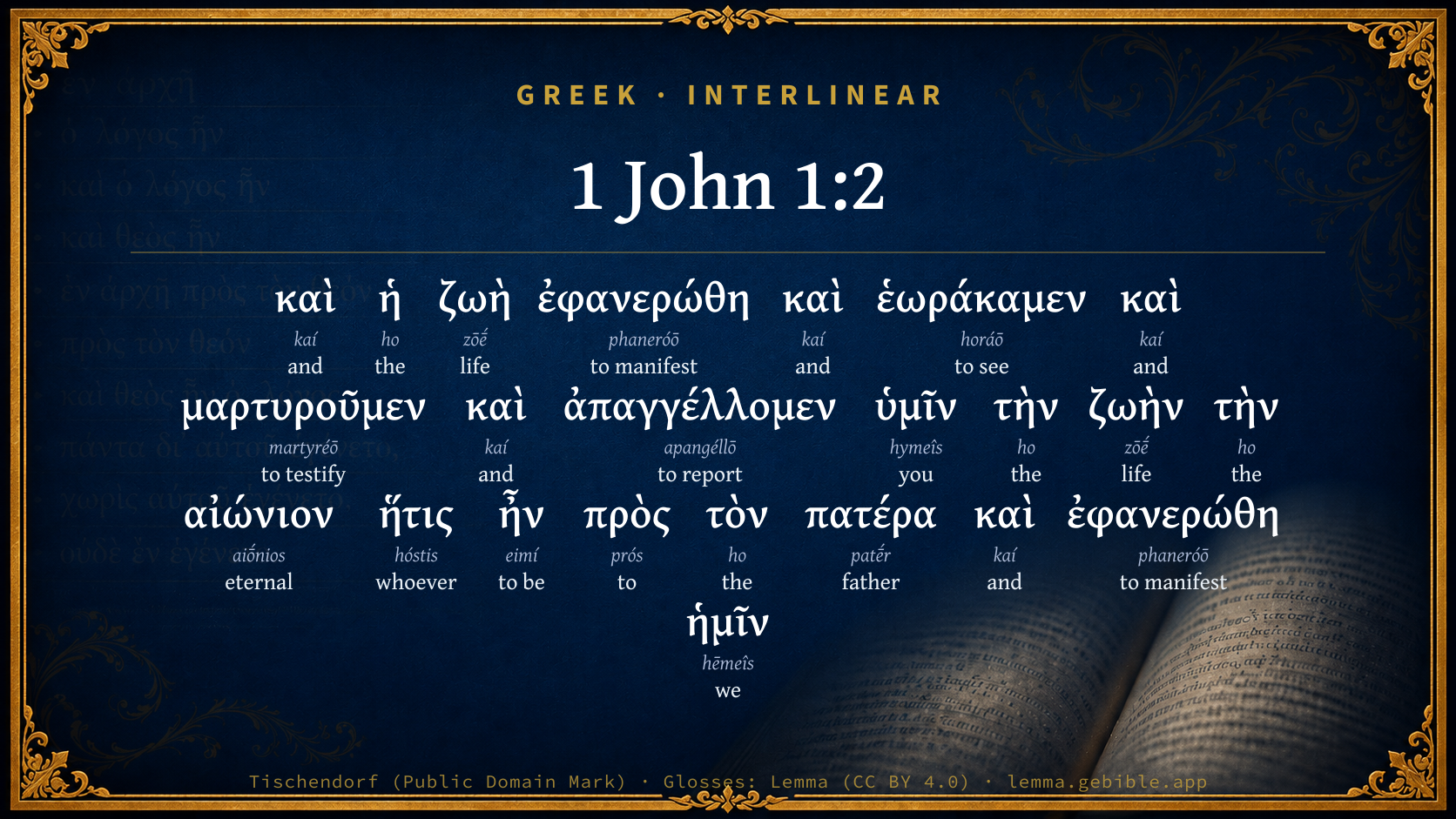
Download image
Cite this verse

1 John 1:2 (World English Bible). Public Domain. Lemma interlinear Bible study tool, https://lemma.gebible.app/v/1-john/1/2.

Show BibTeX & RIS
BibTeX
RIS
English Translation
(and the life was revealed, and we have seen, and testify, and declare to you the life, the eternal life, which was with the Father, and was revealed to us);
World English Bible · Public Domain
Download a study sheet

One document with this verse’s original text, its word-by-word gloss line, the meaning frame, cross-references with their text, attributed commentary, and full source and license credits — printable, and it pastes into notes with its structure intact.

This verse Autodidact and up

Study sheet (.html) Plain text (.txt)

A passage Seminary Student

Up to 50 verses in one chapter. A passage sheet keeps up to 6 commentary sources and 12 cross-references per verse, in the order this page ranks them, and says so on the sheet whenever that leaves anything out. Ask for a single verse and you get the Autodidact verse sheet above.

Everything on this page stays free to read, with no account — the sheet is a download of what is already on screen, not access to it.

Want to remove ads? Support Godless Engineer
Compare translations 3

The same verse in 3 English versions, stacked beneath the original-language interlinear above. Click any original word for its lexicon entry.

Each is an independent rendering of the whole verse — the interlinear is not word-aligned to these translations.

Highlighted words mark where these versions differ — a whole-verse word diff, not a word-by-word alignment.

  • World English Bible Public Domain
    (and the life was revealed, and we have seen, and testify, and declare to you the life, the eternal life, which was with the Father, and was revealed to us);
  • King James Version Public Domain
    (For the life was manifested, and we have seen it, and bear witness, and shew unto you that eternal life, which was with the Father, and was manifested unto us;)
  • unfoldingWord Literal Text CC BY-SA 4.0
    indeed, the life appeared, and we have seen, and we are testifying, and we are announcing to you the eternal life that was with the Father and appeared to us—

unfoldingWord Literal Text — © unfoldingWord, licensed CC BY-SA 4.0. Word-aligned USFM3 via Door43 (git.door43.org/unfoldingWord/en_ult).

Versions to compare (up to 4)

3 of 4 selected

Show all 19 translations

Every available English version of this verse, each an independent rendering of the whole verse.

  • World English Bible Public Domain
    (and the life was revealed, and we have seen, and testify, and declare to you the life, the eternal life, which was with the Father, and was revealed to us);
  • Berean Standard Bible Public Domain
    And this is the life that was revealed; we have seen it and testified to it, and we proclaim to you the eternal life that was with the Father and was revealed to us.
  • Majority Standard Bible Public Domain
    And this is the life that was revealed; we have seen it and testified to it, and we proclaim to you the eternal life that was with the Father and was revealed to us.
  • King James Version Public Domain
    (For the life was manifested, and we have seen it, and bear witness, and shew unto you that eternal life, which was with the Father, and was manifested unto us;)
  • American Standard Version (1901) Public Domain
    (and the life was manifested, and we have seen, and bear witness, and declare unto you the life, the eternal `life', which was with the Father, and was manifested unto us);
  • Revised Version (1885) Public Domain
    (and the life was manifested, and we have seen, and bear witness, and declare unto you the life, the eternal life, which was with the Father, and was manifested unto us);
  • Geneva Bible (1599) Public Domain
    (For that life was made manifest, and wee haue seene it, and beare witnes, and shewe vnto you that eternall life, which was with the Father, and was made manifest vnto vs)
  • Douay-Rheims (1899) Public Domain
    For the life was manifested; and we have seen and do bear witness, and declare unto you the life eternal, which was with the Father, and hath appeared to us:
  • Young's Literal Translation Public Domain
    and the Life was manifested, and we have seen, and do testify, and declare to you the Life, the age-during, which was with the Father, and was manifested to us --
  • Literal Standard Version CC BY-SA 4.0
    and the Life appeared, and we have seen, and testify, and declare to you the continuous Life, which was with the Father, and was revealed to us—
  • Unlocked Literal Bible CC BY-SA 4.0
    Also, the life was made known, and we have seen it, and we bear witness to it. We are announcing to you the eternal life, which was with the Father, and which has been made known to us.
  • unfoldingWord Literal Text CC BY-SA 4.0
    indeed, the life appeared, and we have seen, and we are testifying, and we are announcing to you the eternal life that was with the Father and appeared to us—
  • Darby Bible Public Domain
    (and the life has been manifested, and we have seen, and bear witness, and report to you the eternal life, which was with the Father, and has been manifested to us:)
  • World Messianic Bible Public Domain
    (and the life was revealed, and we have seen, and testify, and declare to you the life, the eternal life, which was with the Father, and was revealed to us);
  • Webster's Bible Public Domain
    (For the life was manifested, and we have seen it, and testify, and show to you that eternal life which was with the Father, and was manifested to us;)
  • Free Bible Version CC BY-SA 4.0
    This Life was revealed to us; we saw it and give evidence about it. We are telling you about the one who is Eternal Life, who was with the Father, and who was revealed to us.
  • Bible in Basic English Public Domain
    (And the life was made clear to us, and we have seen it and are witnessing to it and giving you word of that eternal life which was with the Father and was seen by us);
  • Text-Critical English NT CC BY 4.0
    This life was revealed; we have seen it, and we testify and declare to you the eternal life that was with the Father and that was revealed to us.
  • Tyndale New Testament (1534) Public Domain
    For the lyfe appered and we have sene and beare witnes and shewe vnto you that eternall lyfe which was with the father and appered vnto vs.

Literal Standard Version (2020), Covenant Press — licensed CC BY-SA 4.0. Text via the HelloAO Bible API (eBible.org). Unlocked Literal Bible (unfoldingWord) — licensed CC BY-SA 4.0. Text via the HelloAO Bible API (eBible.org). unfoldingWord Literal Text — © unfoldingWord, licensed CC BY-SA 4.0. Word-aligned USFM3 via Door43 (git.door43.org/unfoldingWord/en_ult). Free Bible Version, Dr. Jonathan Gallagher — licensed CC BY-SA 4.0. Text via the HelloAO Bible API (eBible.org).

Word by word

More ways to search: Search by grammar → Find every occurrence → Compare this word →

Practice this passage: Drill this verse → Learn its vocabulary →

ἀπαγγέλλομεν
apangéllō
G518
“to report”
Verb, Present, Active, Indicative, 1st person, Plural
Part of Speech
Verb
Tense
Present
Voice
Active
Mood
Indicative
Person
1st person
Number
Plural
Full Thayer's Definition

Origin: from G575 and the base of G32

TDNT: 02:04,1

1. to bring tidings (from a person or a thing), bring word, report 2. to proclaim, to make known openly, declare
  1. καὶ kaí G2532 “and” Conjunction
  2. ἡ ho G3588 “the” Article, Nominative, Singular, Feminine
  3. ζωὴ zōḗ G2222 “life” Noun, Nominative, Singular, Feminine
  4. ἐφανερώθη phaneróō G5319 “to manifest” Verb, Aorist, Passive, Indicative, 3rd person, Singular
  5. καὶ kaí G2532 “and” Conjunction
  6. ἑωράκαμεν horáō G3708 “to see” Verb, Perfect, Active, Indicative, 1st person, Plural, Attic form
  7. καὶ kaí G2532 “and” Conjunction
  8. μαρτυροῦμεν martyréō G3140 “to testify” Verb, Present, Active, Indicative, 1st person, Plural
  9. καὶ kaí G2532 “and” Conjunction
  10. ὑμῖν hymeîs G5210 “you” Personal pronoun, 2nd person, Dative, Plural
  11. τὴν ho G3588 “the” Article, Accusative, Singular, Feminine
  12. ζωὴν zōḗ G2222 “life” Noun, Accusative, Singular, Feminine
  13. τὴν ho G3588 “the” Article, Accusative, Singular, Feminine
  14. αἰώνιον aiṓnios G166 “eternal” Adjective, Accusative, Singular, Feminine
  15. ἥτις hóstis G3748 “whoever” Relative pronoun, Nominative, Singular, Feminine
  16. ἦν eimí G1510 “to be” Verb, Imperfect, Active, Indicative, 3rd person, Singular
  17. πρὸς prós G4314 “to” Preposition
  18. τὸν ho G3588 “the” Article, Accusative, Singular, Masculine
  19. πατέρα patḗr G3962 “father” Noun, Accusative, Singular, Masculine
  20. καὶ kaí G2532 “and” Conjunction
  21. ἐφανερώθη phaneróō G5319 “to manifest” Verb, Aorist, Passive, Indicative, 3rd person, Singular
  22. ἡμῖν hēmeîs G2249 “we” Personal pronoun, 1st person, Dative, Plural

About this verse

These counts appear in no published source. They are computed here, from the morphology-tagged text and Lemma’s own curated glosses. What Lemma adds →

23
words
14
distinct lemmas
General Epistles
section

Shared distinctive vocabulary

ἀπαγγέλλομεν to report G518 occurs in 47 verses of the Greek New Testament. Also found in:
Repetition

Words recur within this verse:

  • ζωὴ life G2222 ×2
  • ἐφανερώθη to manifest G5319 ×2
  • καὶ and G2532 ×5
  • ἡ the G3588 ×4

Cross-references

31

Topical passages linked to 1 John 1:2 in the Treasury of Scripture Knowledge — connected by theme and wording, ordered by reader-vote popularity; previews shown in the World English Bible.

  • John 1:4 In him was life, and the life was the light of men.
  • 1 John 5:20 We know that the Son of God has come, and has given us an understanding, that we know him who is true, and we are in him who is true, in his Son Jesus Christ. This is the true God, and eternal life.
  • 1 Timothy 3:16 Without controversy, the mystery of godliness is great: God was revealed in the flesh, Justified in the spirit, Seen by angels, Preached among the nations, Believed on in the world, And received up in glory.
  • John 17:3 This is eternal life, that they should know you, the only true God, and him whom you sent, Jesus Christ.
  • John 14:6 Jesus said to him, "I am the way, the truth, and the life. No one comes to the Father, except through me.
  • Titus 1:2 in hope of eternal life, which God, who can't lie, promised before eternal times;
  • 1 John 3:8 He who sins is of the devil, for the devil has been sinning from the beginning. To this end the Son of God was revealed, that he might destroy the works of the devil.
  • 1 John 3:5 You know that he was revealed to take away our sins, and in him is no sin.
  • 1 John 5:11 The testimony is this, that God gave to us eternal life, and this life is in his Son.
  • John 11:25–26 Jesus said to her, "I am the resurrection and the life. He who believes in me, though he die, yet will he live.
  • John 15:27 You will also testify, because you have been with me from the beginning.
  • Galatians 4:4 But when the fullness of the time came, God sent out his Son, born to a woman, born under the law,
  • 2 Timothy 1:10 but has now been revealed by the appearing of our Savior, Christ Jesus, who abolished death, and brought life and immortality to light through the Gospel.
  • John 1:1–2 In the beginning was the Word, and the Word was with God, and the Word was God.
  • Acts 3:15 and killed the Prince of life, whom God raised from the dead, to which we are witnesses.
  • John 1:18 No one has seen God at any time. The one and only Son, who is in the bosom of the Father, he has declared him.
  • John 3:13 No one has ascended into heaven, but he who descended out of heaven, the Son of Man, who is in heaven.
  • John 7:29 I know him, because I am from him, and he sent me."
  • John 8:38 I say the things which I have seen with my Father; and you also do the things which you have seen with your father."
  • John 16:28 I came out from the Father, and have come into the world. Again, I leave the world, and go to the Father."
  • John 17:5 Now, Father, glorify me with your own self with the glory which I had with you before the world existed.
  • John 21:14 This is now the third time that Jesus was revealed to his disciples, after he had risen from the dead.
  • Acts 1:22 beginning from the baptism of John, to the day that he was received up from us, of these one must become a witness with us of his resurrection."
  • Acts 2:32 This Jesus God raised up, to which we all are witnesses.
  • Acts 5:32 We are His witnesses of these things; and so also is the Holy Spirit, whom God has given to those who obey him."
  • Acts 10:41 not to all the people, but to witnesses who were chosen before by God, to us, who ate and drank with him after he rose from the dead.
  • Romans 8:3 For what the law couldn't do, in that it was weak through the flesh, God did, sending his own Son in the likeness of sinful flesh and for sin, he condemned sin in the flesh;
  • Romans 16:25–26
  • 1 Peter 5:1 I exhort the elders among you, as a fellow elder, and a witness of the sufferings of Christ, and who will also share in the glory that will be revealed.
  • Proverbs 8:22–30 "Yahweh possessed me in the beginning of his work, Before his deeds of old.
  • 1 John 1:1 That which was from the beginning, that which we have heard, that which we have seen with our eyes, that which we saw, and our hands touched, concerning the Word of life

Cross-references courtesy of OpenBible.info (CC BY 4.0).

Commentary

Notes on 1 John 1:2 from classic Christian and Jewish commentators (each source and its license shown beneath its notes). The classic Christian expositions comment on the surrounding passage and are grouped to its opening verse, so a note may address several verses; the Jewish commentaries on the Tanakh (Rashi and others) are per-verse, so they appear only where the commentator wrote on this verse.

Lemma curates 59 commentaries, every one of them public domain or Creative Commons licensed, each selected and text-cleaned for this edition rather than reprinted as found. About our sources →

Albert Barnes' Notes on the Bible

For the life was manifested - Was made manifest or visible unto us. He who was the life was made known to people by the incarnation. He appeared among people so that they could see him and hear him. Though originally with God, and dwelling with him, Joh 1:1-2, yet he came forth and appeared among people. Compare the Rom 1:3 note; 1Ti 3:16 note. He is the great source of all life, and he appeared on the earth, and we had an opportunity of seeing and knowing what he was.

And we have seen it - This repetition, or turning over the thought, is designed to express the idea with emphasis, and is much in the manner of John. See Joh 1:1-3. He is particularly desirous of impressing on them the thought that he had been a personal witness of what the Saviour was, having had every opportunity of knowing it from long and familiar contact with him.

And bear witness - We testify in regard to it. John was satisfied that his own character was known to be such that credit would be given to what he said. He felt that he was known to be a man of truth, and hence he never doubts that faith would be put in all his statements. See Joh 19:35; Joh 21:24; Rev 1:2; 3Jo 1:12.

And shew unto you that eternal life - That is, we declare unto you what that life was - what was the nature and rank of him who was the life, and how he appeared when on earth. He here attributes eternity to the Son of God - implying that he had always been with the Father.

Which was with the Father - Always before the manifestation on the earth. See Joh 1:1. “The word was with God.” This passage demonstrates the pre-existence of the Son of God, and proves that he was eternal. Before he was manifested on earth he had an existence to which the word life could be applied, and that was eternal. He is the Author of eternal life to us.

And was manifested unto us - In the flesh; as a man. He who was the life appeared unto people. The idea of John evidently is,

(1)That the Being here referred to was forever with God;

(2)That it was proper before the incarnation that the word life should be given to him as descriptive of his nature;

(3)That there was a manifestation of him who was thus called life, on earth; that he appeared among people; that he had a real existence here, and not a merely assumed appearance; and,

(4)That the true characteristics of this incarnate Being could be borne testimony to by those who had seen him, and who had been long with him. This second verse should be regarded as a parenthesis.

Albert Barnes' Notes on the Bible (1834–1885) — public domain. Text from a community e-Sword/MySword module.

The Biblical Illustrator

Joseph S. Exell

1Jn_1:2

For the life was manifested

Christ the manifestation of the eternal

1.

We may think of Christ as the manifestation of that eternal life whence has come all that has ever been--all creation, all nature, all time, all history; of that mysterious life which ever beats at the heart of the universe, which ever feeds its unfailing springs.

2. Christ is the manifestation of the eternal, in the extent to which He has brought more fully to light, and more practically established, the spiritual kingdom of likeness to God, of fellowship with God, for which all hearts are intended and required. He at once so guaranteed and illustrated its existence and meaning, as everywhere to lift this spiritual kingdom to a higher plane. He made it far more possible and certain than any other teacher or messenger from God had ever desired or conceived. He brought it within the reach not alone of the chiefest and the best, but also of the commonest and the lowest. He showed it to be the proper life of every man--showed that purity, righteousness, justice, mercy, patience, love, are as essential and necessary to every man as they are to God; that the true and blessed life for man means supremely this--after His own example, fellowship with God, likeness to God, sonship to God.

3. Christ manifested the eternal, not alone by the transcendent excellence and spiritual elevation of His life, but also by the power which He displayed of showing the inherent oneness of material and moral forces--in other words, of proving the rightful control of spirit over matter. What to us may look like signs or wonders or unusual phenomena, to Him were but natural facts, natural revelations or efforts of the deep, underlying oneness between things outward and inward, between all nature and life.

4. Christ manifested the eternal by revealing to us the afterlife, the future world. Of the two, that world seemed to Him even more real than this. He spoke of it with even the same deep intensity, and yet with the same calm, self-evident truthfulness as He did of the existence, and name, and character, and purpose of His Father. To Him the future world, the immortal life, were but the natural outcome of the existence and kingdom and purpose of His Father. To Him, because God is, and ever will be, man, His child, will continue to be as living, as personal as He. Jesus, knowing Himself to be the outcome, the evidence, the gift of all spiritual and eternal realities, could look beyond the seeming defeat and dread suffering of His last days, beyond the bitterness and sting of His own death, beyond the gloom and corruption of His own grave, to an existence for Himself that should be as changeless and lasting as the Fathers, whose presence and truth and love He declared; nay, more--He could look beyond all the failure, pain, and death with which any of His brothers or sisters on earth should have to struggle, or to which they should succumb, and could give to them the offer, the assurance, the possession of a life as spiritual, as blessed, as immortal as His own. (J. T. Stannard.)

The only life worth living

What is the conception that St. John had of the Incarnation of the Lord Jesus Christ? In his gospel he looks upon it as the manifestation of God: The Word was made flesh and dwelt among us (and we beheld His glory, the glory as of the only begotten of the Father), full of grace and truth. But in the Epistle he looks upon the Incarnation as the manifestation of life. He here declares the life was manifested, and we have seen it, and bear witness, and show unto you that eternal life which was toward the Father--for so it literally should be--which was Fatherward and was manifested unto us. Now, it is no uncommon thing for a young man setting out in life to set some high ideal before him. You can understand a young man in business setting before him the ideal of a George Peabody or a George Moore. It is not so much the success the man has achieved, as the way in which he spent the well-earned wealth, which fires the ambition of the youth. But what was St. Johns ideal? The Lord Jesus Christ. There was the life. The life was manifested, and we have seen it. It is a question often asked, Is life worth living? And that depends very much upon the kind of life you mean to live. If you mean a life of selfishness and self-pleasing, the answer must be distinctly, No! Or a life of worldliness or luxury? No! A life of avarice and covetousness? No! For these kinds of lives are very disappointing now, and the issue of them hereafter is terrible to contemplate. If you think of life simply as amassing wealth, if you think of life simply as acquiring esteem, as winning pleasure, you have not seen life. But the life has been manifested, the only life worth living, and he points you back to the Lord Jesus Christ. Now, what were the characteristics of the life which was thus manifested to us? It was a life Fatherward, that was the life, that eternal life, which was toward the Father. There are some who live a life towards the world; their whole inspiration is drawn from the world; their whole pleasure is found in the world. You have a very striking picture of such a life in Eze_17:6, where Israel is likened unto a spreading vine of low stature, whose branches turned toward him. Towards whom? Toward the great Assyrian power, and so it became a vine, and brought forth branches and shot forth sprigs. Instead of seeking all their strength from God, they turned their roots towards Assyria, and tried to draw strength from Assyria. Now, there are a great number of people living who have these earthward lives, their roots turning towards the world--drawing in all their strength, all their sustenance, all their pleasure from the world. St. John says: Life which was manifested was not towards the world, it was towards the Father. This implies absolute obedience. The work that my Father hath given me to do, shall I not do it? This life implies perfect trust. Your heavenly Father knoweth what things ye have need of before ye ask Him. This life implies perfect, complete resignation. Father, not My will, but Thine be done. This life implies the most blessed intercourse. Our Lord Jesus Christ is able to go out on the mountainside and continue all night in prayer to God. Why? Because God was His Father. This life Fatherward means also love to the brethren, for if God is our Father we must love one another. It is not our Fathers will that one of these little ones should perish. This life Fatherward implies ambition for the Fathers glory. We must let our light so shine before men that they may glorify our Father which is in heaven. And this life Fatherward contains the blessed hope of a reunion. I go to My Father. If ye loved Me ye would rejoice, because I said, I go unto the Father. So you see how, during all our Lord Jesus Christs life, it was a life Father-wards. And St. John says, We have seen it. Oh, it is a different life to what we see in the world. If you look at a man living towards the world, what a life of fear it is, what a life of terror: he is afraid lest he should break the customs of the world; he is afraid lest he should endure obloquy from the world. A life which is lived towards the world is always a slavish life, because it must be in entire accord with the dictates of worldly policy, But a life towards the Father is without fear. Perfect love casteth out fear. Now St. John says, We have seen that life; we walked with Him three and a half years, and we saw all through His life this was His great characteristic--What would my Father wish Me to do? And he goes on to say, Not only did we see it, but we bear witness of it--that is to say, We have tried to follow it ourselves; and now we want to tell you that there is no life worth living compared with this; that we can bear witness to it, and have learned something of what it means. More than that, we come to tell you about it, because we want you to have fellowship in this life. We have seen this life towards the Father; we have tasted it, and can bear witness that it is the sweetest life, that it is the purest life, that it is the life most worth living, and now we want you to have fellowship with us. And one thing more he goes on to say: And this is eternal life. It is life not only on the earth here, but in heaven. (E. A. Stuart, M. A.)

Christ the life

Christ, God-man, Mediator, is the life, that eternal life, in respect of His threefold offices of king, priest, and prophet. As prophet, He is the life by way of revelation, discovering this eternal life to us; as priest, by way of impetration; securing this eternal life for us; as king, by way of collation, conferring this eternal life on us. And as the fulness of water is dispensed by the sea to the earth, and the fulness of light is communicated by the sun to the air, and the fulness of corn was divided by Joseph among the people, so the fulness of grace and glory, of life, even eternal life, is conveyed by Christ to His Church, and therefore very justly doth this character belong to Him. And now, what should this consideration teach us?

1. To bewail our sad condition whilst we are without Christ; for if Christ be the life, all that know Him not, or believe not in Him, must needs be in a state of death and damnation.

2. To seek after this life, because it is eternal, and to seek it by union with Christ, who is the life.

3. To set an high value upon Christ, and give Him the glory of this great mercy, even eternal life. (N. Hardy, D. D.)

The incarnate life

I. The person spoken of, the titles given Him, and what is here said concerning Him. For the life was manifested--that Eternal Life which was with the Father.

1. It is Christ, God-Man, is the Person spoken of.

2. I will next glance at the titles given Him in the words before us. He is entitled, The Life. He is so most emphatically. He is expressly called the living God by the apostle (Heb_3:12). He is life essentially, He is life communicatively, He is life spiritually, He is life eternally. He is the life of the whole creation, the life of grace, the life of glory. And He is all this as God-Man, the Lord, the Creator, the Proprietor of every creature. He is Eternal Life. His life never decays. He lives in all generations, and His Name and memorial are from everlasting to everlasting. Our spiritual and eternal life cometh from Christ only. He is the fountain of it. The knowledge of Him is our eternal life. Communion with Him is the means whereby the blessedness contained in the knowledge of Him is imparted to us and enjoyed by us.

II. The apostles having seen this great sight, God incarnate. We have seen it, or rather Him. We have seen Him as manifested in the flesh. We have seen and bear witness, and show the truth of this in our ministry of the gospel unto you. To have seen Christ, God manifest in the flesh, must have been a great sight. To retain the true sense and apprehension of what they saw in Him, and heard and received from Him, must have been to them life everlasting. Their whole ministry was filled up with giving a simple narrative of the Person, Incarnation, Life and Actions, Crucifixion, Death, Burial, Resurrection, Ascension and Exaltation of the Lord Jesus. This they were called to bear their immediate testimony unto. This forms the foundation of the four Gospels. And it is by the spiritual apprehension of Christ, as set forth therein, we live. Nor must the history, nor the mystery of Christ be rejected, nor neglected by us. The one being the foundation of the other, therefore the one must be of as great importance as the other.

III. What the apostles declared of Him, which was what they knew, from the Divine knowledge which they had of Him, that He was that Eternal Life which was with the Father. This must be the fruit of Divine revelation and inspiration: by which, their minds being renewed by the Holy Ghost, they were, under His further illumination, enabled to receive true apprehensions of the Person, Incarnation, Mission and Commission of the Lord Jesus Christ into their minds. They found real blessedness in the subject--in declaring the same, in bearing their witness and testimony to the truth thereof, in showing forth the eternity, the dignity, the personal glories of their, and our, Lord Jesus Christ.

IV. This was a very particular part of the witness which they dare of Him--that He was manifested unto them. A very singular favour. Such as I conceive we can form no adequate ideas of. How should we? That age is past. It will never return. All the Lords ministers and people, and that to the end of time, will be witnesses for Him, and show forth the truths of His gospel, some in a greater, some in a less measure and degree, yet not in the same way, nor to answer the same end, for which the apostles were appointed. (S. E. Pierce.)

The manifested life

This chapter, this verse, concerning the life which was manifested, is the record of St. Johns whole Christian experience given in the last years of his life; it is St. Johns full thought, his mature, final testimony to the Christ. Think of the phrase which he uses--the word of life. A word is a means of expression, a way of disclosing some secret thought, a manifestation of mind to mind. The word of life, then, is the expression of life, the means of making the life known, the revelation of its nature. And the word, or revealing, of life, of which John speaks, was not a writing from heaven, not even a voice becoming articulate from out the skies; it was the life manifested in a person, it was the personal Word of God; it was the eternal life, the life with the Father, making itself known in the person of the Lord. The life--what is it? What is its nature? What has it been from the beginning? We have seen and heard, says John, what it is, what it has been from the beginning--it is such a life as we have seen Christ live; He is its spoken word, He is its manifestation; we declare unto you that which we have seen and heard. So much, then, in general as to what this text meant to John himself. Following the leading of St. Johns experience of the Christ in this passage, let us think, in the second place, what it may mean to us. John saw the life in its personal manifestation in the Christ; we see it in its increasing spiritual attraction and universal beneficence. Let us think more closely what this eternal life, which was with the Father, may be, the life from the beginning, concerning the personal word of which St. John bore witness, and of whose continuous and increasing power the world, becoming Christian, witnesses. The word life, which St. John uses, is still, even in its lowest physical manifestations, the unexplained word of our science. Our best definitions of life are but learned words thrown out into the darkness. Our clearest cut conceptions of the nature of living matter run out into the indefinite and the unimaginable. The life that awakens from the wintry sleep, that gives colour and grace to the tops of the elm trees which we have seen for months as dark lines etched against the sky; the life that turns the prose of the dull landscape into the poetry of fresh meadows and waving forests; the life with which this earth has been for ages richly endowed, and whose abundant energy fails not nor grows dim with the centuries; it is a manifestation of energy which even more directly than other forms of force seems to be the touch thrilling through nature of the living God! And this life which we behold manifested in the world around us, we know more intimately in our own self-consciousness. For this is the additional marvel, this the wonder of it all--that the life which was from the beginning, which stirs in the least portion of living matter, at last feels itself throbbing in our veins, and grows conscious of its own power in our wills, and rises to its perfection of spirit in the love of our human hearts. And beyond our knowledge of personal life in us, according to the witness of the apostles, and all the worlds subsequent spiritual verification of the truth of their gospel, another even higher, richer manifestation has been given of the life which was from the beginning. The life, the eternal life, which was with the Father, has summed up all its revelations, completed its ages of working, carried its whole manifestation to utmost perfection in the word of life, in Him who at last, standing upon this earth, could say, I am the life of the world! I am come that ye might have life, and that ye might have it abundantly. Thus the world leads at last to the perfect man, and the perfect man is Gods explanation of the world. Thus the manifested life of the world reveals its eternal purpose and end. It is from the Father, and it goes to the Father. But from these thoughts which carry us far and deep, let me turn to some nearer, perhaps plainer, applications of our Scripture. One immediately following is this: it is of the utmost practical importance for us to be impressed with the fact that the life which we may live is the sacred thing. Death is not the supreme power, but the life is. Death is not the end, but the new beginning of life. It was not possible for the Holy One to see corruption. Henceforth life shall be strong and pure, sacred as the true word of the living God, and full of promise as of love, because Christ has shown how life may be lived and death over come; and Christ is risen as the firstfruits of the resurrection. The one further application which I would now make of this most fruitful subject is this: The one single object of all the Scriptures, of the whole gospel, of all true preaching of it, is to bring us into fellowship with the life, even that life which from the beginning was with the Father, and which has been lived perfectly in the Son, and which is glorified in Him and all who live with Him. (N. Smyth, D. D.)

The manifested life

Like draws to like, is mans maxim, and mans principle of action. But such is not the heavenly law. The principle of Divine action, the regulating power of the infinite heart above, is the reverse of this. The law of grace is what man would call the law of unfitness, and unworthiness, and unlikeness. Well for us that it is so! What would have been our hope had it been otherwise? In Gods dealings with man, it is the unlike that we see uniting. What more dissimilar than heaven and earth? yet they have come together! The life has been manifested! This is our gospel. It is not the life is, but the life has come forth from its eternal mystery. The life has been manifested! What has given it opportunity to come forth? Death! It is not life that has attracted life, nor light that has given occasion for the outshining of light. Thus God, the God of all grace, revealed to us the breadth and length of His infinite love. As it needs darkness to bring out the glory of the starry heavens, so it needed death to show forth the life--life such as had not been possessed before, nor could be, by man unfallen, or upon a sinless earth. Hence the deep significance of the Lords words (Joh_10:10). Thus and then the life entered! Not like a monarch, to take possession of a fitting palace; but like a physician, to take possession of an hospital; like spring, coming to take possession of a wintry earth; like dayspring, coming to take possession of the darkened skies. What an entrance! Not invited by kindred life, still lingering among men; but uninvited, nay, repelled. It is the absence of life here that is the cause of its manifestation from on high. The life was manifested! And we have seen it! Life in the realms of the dead; light in the land of darkness; God manifest in flesh: this is what our eyes have seen. Yes; at the cradle, and the cross, and the tomb, the life has been manifested! Blessed manifestation for us, the dead in sin! The life has come; and because He liveth, we shall live also; for he that hath the Son hath life. Surely there is no lack of life for us. But what if it be rejected and despised? Here is life for you; but is it in you? Here is life come down to earth; but has it quickened you? Life died that death might live. Immortality went down into the tomb, to bring up thence for us immortality and incorruption. Life for the dead! This is our message to the sons of men. This is our gospel; a gospel for the dead, not for the living. It is the gospel of the manifested life. You say, perhaps, that it is just your state of death that makes this no gospel to you. Your consciousness of death leads to despondency. Ah! were you not so dead you would not need the life, and would present fewer attractions, as well as fewer necessities, to the living One; there would be less in you to call out the life. The danger lies, not in your being too dead, but in your not knowing how thoroughly dead you are. So long as there is the unconsciousness of death, there is a barrier, a non-conducting medium between you and the Life. The Holy Spirit, in revealing to you your true condition of utter death, is throwing down that barrier, and substituting a conducting for a non-conducting medium. This is the record, that God hath given to us eternal life, and this life is in His Son. His Son is the manifested life, the resurrection and the life, and he that hath the Son hath life. What have you found in it? Have you read in it the love of God? Have you obtained from it the life of your soul? But the manifestation of this Life is not yet over. The Life has, as it were, retired for a season, and gone within the veil; but this same Jesus, who came the first time, as the Life, shall come, as such, the second time also; and that day of His manifestation shall be the day of ours as well. The resurrection unto life shall be the completion of the great manifestation. As His first coming was its alpha, or beginning, so shall His second coming be its omega, or end. He comes to give His Church the full benefit of the manifested life. (H. Boxcar, D. D.)

The manifested life to be observed

I know a great scientific man whose greatest cause of regret is that on one occasion there were brought under his observation certain phenomena of human disease which might have enabled him to anticipate a great discovery which was made in Germany in late years. He had the very facts under his eye, and he did not notice them. What would be our feeling if we should find that in a region more important than any with which science is concerned, we had had under our eye, in the intelligible revelation of Jesus Christ, a disclosure of the character of God, and from mere lack of moral observation, had refused to take notice of it? (Canon Gore, M. A.)

The eternal life manifested

His unlikeness to this world implies His likeness to another world. One evening you find among the reeds of your lake an unknown bird, whose broad breast and powerful pinions are not meant for this inland scene. It is resting midway between two oceans, and by tomorrow will have gone. Does not that bird prove the ocean it left? does it not prove the ocean whither it has flown? Jesus, knowing … that He was come from God, and went to God, is the revelation and confirmation of ageless life. (John Watson, M. A.)

The Biblical Illustrator, edited by Joseph S. Exell (c. 1880s–1900s) — public domain. Text from a community e-Sword module.

Joseph Benson's Commentary

1Jn 1:2. For the life — The living Word; was manifested — In the flesh to our very senses; and we have seen it — In its full evidence; and bear witness — Testify by declaring, by preaching, and writing, 1Jn 1:3-4. Preaching lays the foundation, writing builds thereon: and show unto you — Who have not seen; the eternal life — The eternal Word and Son of God, who lives himself for ever, and is the author of eternal life to us, Joh 10:28; Heb 5:9; which was with the Father — Joh 1:1-2; in his bosom, Joh 1:18; of the same nature and essence with himself, and was with him from eternity; and was manifested to us — With all the genuine characters of the Son of God and the promised Messiah. That the apostle speaks of his eternity a parte ante, (as they say,) and as from everlasting, is evident, in that he speaks of him as he was in and from the beginning; when he was with the Father, before his manifestation to us; yea, before the making of all things that were made, as Joh 1:2-3. So that he is the eternal, vital, intellectual Word and Son of the eternal, living Father. Now here was condescension and kindness indeed! that a person possessed of eternal, essential life, should put on flesh and blood, or the entire human nature; should assume infirmity, affliction, and mortality, in order to visit sinful mortals, to dwell among and converse with them; to reveal to them, procure for them, and then confer on them, eternal life; even felicity and glory unspeakable with himself for ever!

Joseph Benson's Commentary on the Old and New Testaments (1811–1818) — public domain. Text from a community e-Sword module.

Burkitt's Expository Notes on the New Testament

William Burkitt

As if the apostle had said, "Christ Jesus, that eternal life which was with the Father from eternity, as being his eternal Son, was in the fulness of time manifested in the flesh, and we his apostles saw him in his assumed human nature, and do now testify, publish, and declare him unto you; he was pleased to subject himself to the notice of our senses; and what we have heard, seen, and felt, and has been manifested unto us, that we do with all integrity declare and manifest unto others."

Note here, 1. The title given to Christ, he is life, eternal life, he is so in himself, and he is the fountain of life to us; we now live by him a life of justification; and we hope to live with him a life of glorification.

Note, 2. This eternal life was from all eternity with the Father, and distinct from him; he was with the Father, not as an instrument but as an agent, in making of the world, Heb 1:2-3 And as his Father’s delight, Pro 8:31.

Note, 3. This eternal life which from the beginning was with the Father, in the fulness of time was manifested to the sons of men; manifested, not as he was to the prophets by faith, so they rejoiced to see him, John 8; nor in the similtude and likeness of flesh, so he sometimes manifested himself to the patriarchs, Genesis 18; but manifested in the flesh to his apostles, who eat and drank, discoursed and conversed with him.

Note, 4. That what the apostles saw of Christ they made manifest to others; they had themselves sufficient satisfaction of the verity of Christ’s human nature, and of the certainty of his doctrine, and therefore with mighty assurance they declare it unto others, and the reason of that declaration follows in the next verse.

William Burkitt's Expository Notes on the New Testament (1700–1703) — public domain. Text from a community e-Sword module.

Tyndale Open Study Notes

Tyndale Open Resources

1:2 life itself (Greek zōē): Throughout the New Testament, this word is used to designate the eternal life of God (e.g., Eph 4:18). This life resides in Christ, and he makes it available to all who believe in him. • This one . . . was revealed to us: Jesus, the Christ, was known to his apostles as a human being during his earthly ministry.

Tyndale Open Study Notes — © Tyndale Open Resources, licensed CC BY-SA 4.0. Text via the HelloAO Bible API.

Bengel's Gnomon

Johann Albrecht Bengel

1Jn 1:2. Ἐφανερώθη, was manifested) gave Himself in the flesh to our eyes, ears, and hands: Joh 1:14. The same word is used of His coming in glory: ch. 1Jn 2:28.—καὶ μαρτυροῦμεν καὶ ἀπαγγέλλομεν, and we testify and declare) Testimony is the genus; there are two species, declaration and writing, 1Jn 1:3-4. Declaration lays the foundation, 1Jn 1:5-10; writing builds upon it, 1Jn 1:4, note.—ὑμῖν, to you) who have not seen.—τὴν ζωὴν τὴν αἰώνιον, Life eternal) In the beginning of the epistle mention is made of that Life eternal, which always existed, and afterwards appeared to us: at the end of the epistle mention is made of the same Life eternal, which we shall always enjoy. This title of itself teaches, that the goodness of Jesus in its highest sense is not denied: Mar 10:18, note.—ἦν, was) A repetition by the figure Epanodos; comp. 1Jn 1:1, at the beginning.—πρὸς τὸν πατέρα, with the Father) So Joh 1:1, with God.

Bengel's Gnomon of the New Testament — English translation (T&T Clark, Edinburgh, 1860) — public domain. Text from a community e-Sword module.

Meyer's Critical & Exegetical Commentary

Heinrich August Wilhelm Meyer

1Jn_1:2. Without bringing to an end the thought begun in 1Jn_1:1, from the exact continuation of which he has already digressed in περὶ τοῦ λόγου τ. ζ., the apostle in this verse expresses the double thought, that the life was manifested, and that this eternal life which was with the Father and was manifested, has been seen and is declared by him; so that in this both ὃ ἦν ἀπʼ ἀρχῆς and ὃ ἀκηκόαμεν, how the former, namely, could have been the subject of sensuous perception, find their more particular determination. This whole verse is of course parenthetical; but that it is not regarded by John as mere parenthesis (contrary to Düsterdieck) is clear, partly from the connecting καὶ, and partly from this, that in 1Jn_1:3 it is not ὃ ἦν ἀπʼ ἀρχῆς, but only ὃ ἀκηκόαμεν κ.τ.λ., that is resumed, while the former is fully dealt with in this verse.

καί] is not put for γάρ, but is copulative, not disjunctive, but conjunctive (Lücke); the thought with which it is connected is that which lies in ὃ ἦν ἀπʼ ἀρχῆς, that the life, before it became subject of perception, was, as it is afterwards put, πρὸς τὸν πατέρα.[36]

ἡ ζωὴ ἐφανερώθη] Instead of a relative, the noun is repeated, as is peculiar to the diction of John; ἡ ζωή instead of ὁ λόγος τῆς ζωῆς, because the emphasis, as has been already remarked, is on ζωή, is analogous to Gospel of Joh_1:4, where also, after it is said of the λόγος: ἐν αὐτῷ ζωὴ ἦν, it is not ὁ λόγος, but ἡ ζωή, that is the subject of the following sentence.[37] It is plainly incorrect to understand by ΖΩΉ the doctrina de felicitate nova = evangelium (Semler), or, with others: the felicitas of believers; but neither is S. G. Langes explanation, according to which ΖΩΉ = auctor vitae, the Life-giver, sufficient, for Christ is so designated not merely according to the operation that proceeds from Him, but at the same time according to the peculiarity of His nature.[38]

ἘΦΑΝΕΡΏΘΗ] In what way the ΦΑΝΈΡΩΣΙς took place is taught in chap. 1Jn_4:2 and Joh_1:14. In this way, that the life which was in itself hidden appeared in the flesh or became flesh, did it become perceptible by sense, subject of the ἈΚΟΎΕΙΝ, ὉΡᾶΝ Κ.Τ.Λ. Ebrard rightly remarks: the ΣᾺΡΞ ΓΊΓΝΕΣΘΑΙ indicates the objective event of the incarnation as such; the ΦΑΝΕΡΩΘῆΝΑΙ, the result of it for our faculty of perception.

ΚΑῚ ἙΩΡΆΚΑΜΕΝ ΚΑῚ Κ.Τ.Λ.] The object that belongs to the verbs is ΤῊΝ ΖΩῊΝ ΤῊΝ ΑἸΏΝΙΟΝ; according to de Wette, Brückner, and Düsterdieck, this object is only attracted to ἈΠΑΓΓΈΛΛΟΜΕΝ, and the object is to be supplied to both of the first verbs from what precedes (ΖΩΉ); but the two ideas ΜΑΡΤΥΡΟῦΜΕΝ and ἈΠΑΓΓ. are thereby unduly separated from each other; there is more in favour of supplying only an ΑὐΤΉΝ with ἙΩΡΆΚΑΜΕΝ (1st ed. of this comm., Myrberg), by which the idea of this verb is significantly brought out: the life was manifested, and we have seen it; but as in the context even this construction is not indicated, it is better, with most commentators, to connect ΤῊΝ ΖΩῊΝ Τ. ΑἸΏΝ. also with ἙΩΡΆΚΑΜΕΝ.

By ἙΩΡΆΚΑΜΕΝ the apostle brings out that the eternal Life which was made manifest and perceptible was seen by himself; the verb ΜΑΡΤΥΡΟῦΜΕΝ, which signifies the utterance of that which one has personally seen or experienced (comp. Gospel of Joh_19:35; also 1Jn_1:3-4; 1Jn_3:23),[39] is directly connected with this, and thereupon first follows the more general idea ἀπαγγέλλομεν; Baumgarten-Crusius incorrecty refers ΜΑΡΤΥΡΟῦΜΕΝ specially to ἘΦΑΝΕΡΏΘΗ and ἈΠΑΓΓΈΛΛΟΜΕΝ to ἙΩΡΆΚΑΜΕΝ, with the assertion that the former two have more objective, the latter more subjective meaning. Myrbergs explanation also: ΜΑΡΤΥΡΊΑ est expertae veritatis simplex confessio, qua homo sibi ipsi potius, quam aliis consulat: ἈΠΑΓΓΕΛΊΑ annuntiatio veritatis cognitae, qua aliis potius, quam sibi ipsi providere studeat, is without grammatical justification.

By ὙΜῖΝ, ἈΠΑΓΓΈΛΛΟΜΕΝ is put in reference to the readers of the Epistle; hence it does not follow, however, that it is to be understood only of the writing of this Epistle, and is therefore simply resumed by ΤΑῦΤΑ ΓΡΆΦΟΜΕΝ in 1Jn_1:4; but the former is the more general idea, in which the more special one of the writing of the Epistle is embraced; the ΓΡΆΦΕΙΝ is a particular kind of the ἈΠΑΓΓΈΛΛΕΙΝ.[40] Ebrard incorrectly separates the two, by referring ἀπαγγέλλομεν to the written Gospel of John, and ΓΡΆΦΟΜΕΝ to this Epistle.

ΤῊΝ ΖΩῊΝ ΤῊΝ ΑἸΏΝΙΟΝ] The noun is here put for the pronoun ΑὐΤΉΝ, not only in accordance with Johns usual mode of expression, but because the idea of ΖΩΉ was to be more particularly defined by ΑἸΏΝΙΟς. Baumgarten-Crusius erroneously explains Ἡ ΖΩῊ Ἡ ΑἸΏΝΙΟς by bestowing higher, unending life; rather the ΖΩΉ, which Christ is, is marked by ΑἸΏΝΙΟς as such as ἮΝ ἈΠʼ ἈΡΧῆς, orstill more comprehensivelyas such as, though by the incarnation it entered into time, is in itself nevertheless without measure of time, eternal (Brückner; similarly Braune). It is true, the idea ΖΩῊ ΑἸΏΝΙΟς has elsewhere in the N. T. admittedly another signification, but this does not justify the explanation of Calvin: ubi secundo repetit: annuntiamus vitam aeternam, non dubito quin de effectu loquatur, nempe quod annuntiet: beneficio Christi partam nobis esse vitam. De Wettes explanation also, that Ἡ ΖΩῊ Ἡ ΑἸΏΝΙΟς is an idea which hovers in the middle between the eternal true life which is to be appropriated by believers (Joh_17:3), and life in Christ, so that the first is to be considered in closest connection with ἈΠΑΓΓΈΛΛΟΜΕΝ, but the second in reference to the reflexive ἭΤΙς ἮΝ, can so much the less be held correct as the simple and clear thought of the apostle is thereby rendered complicated and obscure. Of that which the believer possesses in Christ there is here no mention at all, but only of Christ Himself; and, besides, that Ἡ ΖΩῊ Ἡ ΑἸΏΝ. is to the Apostle John not merely a subjective, but also an objective conception, is proved by chap. 1Jn_5:11.

ἭΤΙς ἮΝ] ἭΤΙς is more significant than the simple Ἥ, inasmuch as it makes the twofold relative clause as containing a confirmation of the preceding statement: ἙΩΡΆΚΑΜΕΝ Κ.Τ.Λ., ΤῊΝ ΖΩῊΝ ΤῊΝ ΑἸΏΝΙΟΝ.[41]

The imperfect ἦν also does not here indicate the intemporal existence, but is used in reference to ἐφανερώθη: ere the ζωή appeared, it was with the Father.

πρὸς τὸν πατέρα] comp. Gospel of Joh_1:1 : πρὸς τὸν Θεόν. The preposition πρός is often combined with the accusative in the N. T. in the sense of with: comp. Mat_13:56; Mat_26:55; but πρός with the accusative differs from πρός with the dative in this, that it describes being with one another not as a mere being beside one another, but as a living connection, a being in intercourse with one another (so also Braune); but we put too much into it, if we find the relationship of love directly expressed by πρός.[42] John does not mean to bring out that the ΖΩΉ (Christ) was connected with the Father in love, but that Christ already was, before He appeared (ἐφανερώθη); before He was ἘΝ Τῷ ΚΌΣΜῼ with men, He was therefore in heaven with God, and indeed in lively union with God as He afterwards entered into a lively communion with men. Quite erroneously, Socin, Grotius, and others understand the expression of the concealment of the ΖΩῊ ΑἸΏΝ. in the decree of God. From the fact that John here calls God in His relation to Christ ΠΑΤΉΡ, it follows that the sonship of Christ to God is to be regarded not as first begun with His incarnation, but as premundane.

ΚΑῚ ἘΦΑΝΕΡΏΘΗ ἩΜῖΝ] is not a mere repetition of what has been already said, but in ἩΜῖΝ a new element is added, by which ἙΩΡΆΚΑΜΕΝ and Ὃ ἈΚΗΚΌΑΜΕΝ Κ.Τ.Λ., 1Jn_1:1, find their explanation.

[36] Ebrard wrongly conceives the logical relation thus, that by καί the thought that is latent in the preceding verse: that Christ was of eternal being, but became incarnate and was manifested, is confirmed.

[37] Groundlessly Baumgarten-Crusius asserts that ζωή has here more inner, spiritual meaning than in Gospel Joh_1:14; this is to mistake the meaning which the word has in that passage.

[38] The chief elements which are contained in the idea ζωή are differently stated by the commentators; Frommann mentions as such: the truth, perfection, or the living and happy character of being; Köstlin: the mightiness, blessedness, and endlessness of being. If we keep to the scriptural mode of conception, the chief elements appear to be consciousness, activity, and happiness; true activity is only where consciousness is, and happiness is activity which is not disturbed or hindered by any opposition.Weiss wrongly infers from Joh_17:3, that by ζωή is to be understood only the knowledge of God, and it is erroneous for him to maintain that ἡ ζωή does not here signify Christ Himself, but His peculiar knowledge of God, which He possessed even before His φανέρωσις. The relative clause ἥτις ἦν πρὸς τὸν πατέρα, which is connected with τὴν ζωὴν τὴν αἰώνιον, is opposed to this interpretation; inasmuch as it shows that here ἡ ζωὴ ἡ αἰώνιος, and just as much ἡ ζωή, is to be considered as the same subject which John in the prooemium of the Gospel calls ὁ λόγος, and of which he says there that it ἦν πρὸς τὸν Θεόν.

[39] Incorrectly a Lapide: quasi martyres i.e. testes Dei tum voce, tum vita, tum passione, morte et martyrio.

[40] Bengels interpretation: Testimonium, genus; species duae: annuntiatio et Scriptio; annuntiatio ponit fundamentum, scriptio superaedificat, is inadmissible.

[41] The statement of Ebrard is inapposite, that by ἥτις the subject-matter of the relative clause is stated as an already (from ver. 1) known and at the same time acknowledged element of the substantive idea on which the relative clause depends. The right view seems to lie at the base of the explanation of Sander: I declare unto you eternal life, even as such as, etc., at least it is not touched at by the remark of Ebrard in opposition: The meaning of John is plainly this, that the ζ. αἰών. is really and in itself one which was with the Father and was manifested to us, and is by no means represented as such merely in the proclamation of it. Düsterdieck rightly says: By ἥτις the twofold extension of the predicate is connected with the subject ἡ ζ. ἡ αἰών., not merely in simply relative manner, but in such a way that the extension of the predicate contains at the same time an explanatory and confirmatory reference; but it is difficult to admit that by virtue of ἥτις the καὶ ἐφανερώθη ἡμῖν in its close connection with ἦν πρ. τ. πατ. is marked as the connecting link which unites to ὃ ἦν ἀπʼ ἀρχ. the accessory elements ὃ ἀκηκόαμεν κ.τ.λ.

[42] Besser: The Word was with God, related to the Father in filial love. Still less justifiable is Ebrards explanation: The ζωή was a life flowing forth indeed from the bosom of the Father, but immediately returning into it, floating in the inner circulation of the life of God. (!)

Meyer — Critical and Exegetical Commentary on the New Testament — English translation by Peter Christie, edited by Frederick Crombie (T&T Clark, 1880) — public domain. Text from a community e-Sword module.

Expositor's Greek Testament

ed. W. Robertson Nicoll

1Jn 1:2 . A parenthesis reiterating the assurance of the reality of the manifestation. The Apostle heaps assurance upon assurance with elaborate emphasis, and the cumbrousness of his language should not be removed by devices of construction or punctuation, making 1Jn 1:1 a complete sentence: (1) “That which was from the beginning (is) that which we have heard, etc.”; (2) “That which was from the beginning, which we have seen … beheld, our hands also handled”. Cf. Tert. in crit. n. μαρτυροῦμεν , according to the Lord’s parting charge ( cf. Joh 15:27 ; Luk 24:48 ; Act 1:8 ). ἡ μαρτυρία Ἰησοῦ Χριστοῦ (Rev 1:2 ; Rev 1:9 ; Rev 19:10 ) was the apostolic ἀπαγγελία . ἀπαγγέλλομεν , κ . τ . λ .: “Whence we gather that Christ cannot be preached to us without the Heavenly Kingdom being opened to us, so that, being wakened from death, we may live the life of God” (Calvin). Observe the note of wonder in the Apostle’s language. Speech fails him. He labours for expression, adding definition to definition.

The Expositor's Greek Testament, edited by W. Robertson Nicoll (1897–1910) — public domain. Text from a community e-Sword module.

Cambridge Greek Testament for Schools and Colleges

2. καὶ ἡ ζωὴ ἐφανερώθη. Trebly characteristic of S. John 1. The connexion by means of the simple conjunction. 2. The repetition of ζωή from 1Jn 1:1, carrying on part of one sentence into the next for further elucidation and development, without the use of relatives. 3. The verb φανεροῦν, frequent in Gospel and Epistle and occurring twice in Revelation. Points which connect the Epistle with the Gospel, or either of these with the Apocalypse, should be carefully noted. The verbs are in logical order: the manifestation must precede the seeing, which must precede witness and announcement. Ἡ ζωὴ ἐφανερώθη is a less definite expression than ὁ λόγος σὰρξ ἐγένετο (Joh 1:14), but refers to the same fact. For ‘the Life’ as a name for the Christ comp. Joh 11:25; Joh 14:6. Μαρτυρεῖν is another word which, by its frequency in all three, connects together Gospel, Epistle, and Revelation. Witness to the truth, to produce faith in the Truth, on which eternal life depends, is a favourite thought with S. John. But the frequency of μαρτυρεῖν in his writings is obscured in A.V. by rendering it, ‘bear record’ (1Jn 5:7), ‘give record’ (1Jn 5:10), and ‘testify’ (1Jn 4:14, 1Jn 5:9), as well as ‘bear witness’; and so also in Gospel and Revelation. Similarly μαρτυρία is translated ‘record’ (1Jn 5:10-11) and ‘testimony’ (Rev 1:2; Rev 1:9; Rev 6:9, &c.), as well as ‘witness.’ The R.V. has made great improvements in this respect. Comp. Act 1:22; Act 2:32.

ἀπαγγέλλομεν. We declare, as in 1Jn 1:3. The verb is frequent in S. Luke, but rare in S. John (Joh 16:25, but not Joh 4:51 or Joh 20:18). As in 1Jn 1:1; 1Jn 1:3 the Apostle emphatically states that what he has to declare is guaranteed by full personal experience. Comp. Joh 19:35; Joh 20:30-31; Joh 21:24. “Let us firmly hold that which we see not; because those tell us who have seen” (Augustine). Note the sequence here and in 1 John 1 :1Jn 3:1. the evidence which produced conviction in them, ἑωράκαμεν; 2. their declaration of their conviction as Apostles, μαρτυροῦμεν; 3. their declaration of it as Evangelists, ἀπαγγέλλομεν. τὴν ζωὴν τὴν αἰωνιον. The life, the eternal life. The repetition of the article in this phrase occurs only here and 1Jn 2:25. Its effect is to present life and eternity as two distinct ideas: comp. 1Jn 2:7-8. The more general expression, ζωὴ αἰώνιος, is the common form. It is another of S. John’s phrases; but its frequency is blurred in A.V., which rings the changes on ‘eternal life,’ ‘life eternal,’ ‘everlasting life,’ and ‘life everlasting.’ ‘Eternal’ is preferable to ‘everlasting,’ although in popular usage the words are nearly synonymous. And it is worth remembering that ‘eternal’ is etymologically identical with αἰώνιος. Aeternus through aeviternus comes from aevum, which is the same word as αἰών with the digamma. The phrase ζωὴ αἰώνιος occurs first Dan 12:2. S. John’s ζωὴ αἰώνιος has nothing to do with time, but depends on our relation to Jesus Christ. He tells us repeatedly that eternal life can be possessed in this world (1Jn 5:11; 1Jn 5:13; 1Jn 5:20; 1Jn 3:15: see on Joh 3:36; Joh 5:24; Joh 6:47). Excepting in Rev 14:6, where he speaks of a εὐαγγέλιον αἰώνιον, he never applies αἰώνιος to anything but ζωή. With the subject of eternal life this Epistle begins and ends (1Jn 5:20). It is remarkable that S. Paul in the same sentence (Rom 16:25-26) applies the epithet αἰώνιος to two such different subjects as χρόνοι and Θεός. In N.T. αἰώνιος is generally of two terminations; but αἰωνίαν occurs 2Th 2:16; Heb 9:12. In Plato (Timaeus 37) we have αἰώνιος φύσις, and this is perhaps the earliest appearance of the word. For a full discussion of it see Plumptre’s Spirits in Prison 356–371.

ἥτις ἦν πρὸς τ. πατέρα. The compound qualitative relative denotes that what follows is a special attribute: ‘which was such as to be with the Father.’ Comp. ἅτινά ἐστιν ἀλληγορούμενα, ‘which class of things contain an allegory; ἥτις ἐστὶν Ἄγαρ, ‘inasmuch as she is Hagar’ (Gal 4:24); ἥτις ἐστὶν εἰδωλολατρεία, ‘inasmuch as it is idolatry’ (Col 3:5). In N.T. ὅστις occurs only in nom., neut. acc., and contracted gen. (ἕως ὅτου). For the ἦν see on 1Jn 1:1. Πρὸς τ. πατέρα is exactly parallel to πρὸς τ. Θεόν (Joh 1:1-2). It indicates the distinct Personality of ἡ ζωή. Had S. John written ἥτις ἦν ἐν τῷ π., we might have taken ‘the Life’ to mean a mere attribute of God. Πρὸς τ. π. is apud Patrem, ‘face to face’ or ‘at home with the Father.’ Comp. 1Co 16:7; Gal 1:18; 1Th 3:4; Phm 1:13. “The simple title ὁ πατήρ occurs rarely in the Synoptic Gospels, and always with reference to ‘the Son’ … In the Acts only Act 1:4; Act 1:7; Act 2:33. In S. Paul only Rom 6:4; 1Co 8:6; Eph 2:18; and not at all in the Epistles of S. Peter, S. James or S. Jude, or in the Apocalypse. In S. John’s Gospel on the contrary, and in his Epistles, the term is very frequent” (Westcott). In ἐ φ α ν. ἡμῖν the statement with which the parenthesis began is repeated. But S. John’s repetitions generally carry us a stage further. The manifestation was not only made, but made to us. Note the contrast between the imperfect of the continuous pre-existence of Christ and the aorist of the temporary manifestation. He who was from everlasting with the Father has been made known, and made known to men, as the source of all life, physical, intellectual, moral, and spiritual.

Cambridge Greek Testament for Schools and Colleges (Cambridge University Press, 1896; 21 vols, various authors incl. Carr, Maclear, Plummer, Farrar, Lumby, Moule, M. R. James, Simcox) — public domain. Text from a community e-Sword module.

International Critical Commentary

2. For the use of parenthesis to emphasize or explain a specially important word, cf. Joh 19:35. In this parenthesis the emphatic word is ἐφανερώθη, which is repeated at the end of the verse. The writer and his circle could bear their witness about the word of life, because the life had been manifested, to men and under conditions which made it possible for men to apprehend its nature. The reference is in quite general terms. ἡ ζωή is never used to express the being of the (personal) Logos, or pre-existent Christ.

According to Weiss, φανεροῦν never denotes the becoming visible of that which was before invisible, but the making clear of what was hitherto unknown (he compares Joh 2:11, Joh 3:21, Joh 7:4, Joh 9:3, Joh 17:6). But the distinction is hard to maintain in view of the Johannine usage of verbs of sight to include the understanding of that which falls under the ocular vision (cf. Joh 3:3). φανεροῦν may be used of all processes of making known, whether intellectual or sensible.

ἀπαγγέλλομεν] It is doubtful whether a distinction can be maintained between ἀπαγγέλλειν, “to repeat with reference to the source from which the message comes,” and ἀναγγέλλειν, “to report with reference to the persons addressed” (ver. 5). See ver. 3, ἀπαγγέλλομεν καὶ ὑμῖν ἵνα καὶ ὑμεῖς κ.τ.λ.

τὴν ζωὴν τὴν αἰώνιον] For the double article, cf. 2:25, and ver. 3, ἡ κοινωνία ἡ ἡμετέρα: Joh 10:11, ὁ ποιμὴν ὁ καλός. The idea is first put forward generally, and then more particularly defined.

It is strange to find it stated (Weiss, Comm. p. 28) that αἰώνιος is always used in the N.T. in the sense of endless duration, or even that ζωὴ αἰώνιος denotes in S. John (as in S. Paul) “our everlasting further life (ewiges weiterleben) after the death of the body” (Karl, p. 6). It would be truer to say that it never has the sense of endless duration. On the other hand, it does not denote what is supra-temporal. It can only mean “belonging to the age” of which the writer is speaking or thinking, and so comes to mean possessed of the characteristics of that age. If the “age to come” is supra-temporal, then αἰώνιος denotes that the subject which it qualifies has this characteristic.“Spiritual” probably suggests its meaning most clearly in popular language. The words which it is used in the N.T. to qualify are: πῦρ, ζωή, κόλασις, κρίσις, ἁμάρτημα (Mar 3:29, v.l. κρίσεως), σκηναί, χρόνοι, θεός, βάρος, δόξης, οἰκιά, ὀλεθρος, παράκλησις, κράτος, δόξα, ἐλπίς, σωτηρία, κρίμα, λύτρωσις, πνεῦμα, κληρονομία, διαθήκη, βασιλεία, εὐαγγέλιον. Of the 71 instances of its use in the N.T., 44 are passages in which it qualifies ζωή. Its meaning is best considered in the light of this fact. It is noticeable that in the Johannine Gospel and Epistles, where it occurs 23 times, it is never used in any other connection.

ἥτις] The life manifested in Christ, to which His personal disciples could bear witness on the strength of what they had seen and heard, is eternal, inasmuch as it is in union with the Father that it attains to its true realization. The distinction between ὅς and ὅστις, which disappears altogether in late Greek, can still, as a rule, be traced in the New Testament, where in all probability ὅστις is never a mere substitute for the relative. It either suggests a reason for what has been stated before, as here, or it introduces the designation of a class to which the antecedent belongs. (Cf. Mat 7:26, Mat 13:52.)

πρός] Cf. Joh 1:2, ἦν πρὸς τὸν θεόν, and Dr. Westcott’s note on the differences of meaning between πρός and other prepositions denoting relations. Expressed in simpler language, the particular force of πρός would seem to be that it suggests a relation realized in active communion and intercourse. Cf. Mar 6:3, οὐκ εἰσὶν αἱ ἀδελφαὶ αὐτοῦ ὧδε πρὸς ἡμᾶς; 9:19. The true life of the Son was realized in union and communion with the Father. By means of the Incarnation it was manifested to men.

2. εωρακαμεν] pr. ο B 3 40: + και ακηκοαμπεν40 | την ζωην] om. K | τηναιωνιον] om. boh-cod.

International Critical Commentary — older volumes (1896–1929), various authors — public domain. Text from a community e-Sword module.

Geneva Bible (1599)

Geneva Bible translators

Being sent by him: and that doctrine is rightly said to be showed, for no man could so much as have thought of it, if it had not been thus showed.

Geneva Bible (1599) marginal notes — public domain. Text via Bolls.life.

Jamieson, Fausset & Brown

Robert Jamieson, A. R. Fausset & David Brown

the life--Jesus, "the Word of life."

was manifested--who had previously been "with the Father."

show--Translate as in Jo1 1:3, "declare" (compare Jo1 1:5). Declare is the general term; write is the particular (Jo1 1:4).

that eternal life--Greek, "the life which is eternal." As the Epistle begins, so it ends with "eternal life," which we shall ever enjoy with, and in, Him who is "the life eternal."

which--Greek, "the which." the before-mentioned (Jo1 1:1) life which was with the Father "from the beginning" (compare Joh 1:1). This proves the distinctness of the First and Second Persons in the one Godhead.

Jamieson, Fausset & Brown — Commentary Critical and Explanatory on the Whole Bible (1871) — public domain (CC PDM 1.0). Text via the HelloAO Bible API.

Adam Clarke's Commentary

Verse 2. For the Life was manifested] The Lord Jesus, who is the creator of all things, and the fountain of life to all sentient and intellectual beings, and from whom eternal life and happiness come, was manifested in the flesh, and we have seen him, and in consequence bear witness to him as the fountain and author of eternal life; for he who was from eternity with the Father was manifested unto us his apostles, and to the whole of the Jewish nation, and preached that doctrine of eternal life which I have before delivered to the world in my gospel, and which I now farther confirm by this epistle.

Adam Clarke's Commentary on the Bible (1810–1826) — public domain. Text from a community e-Sword/MySword module.

John Calvin's Commentaries

2 For (or, and) the life was manifested The copulative is explanatory, as though he had said, “We testify of the vivifying Word, as life has been manifested.” The sense may at the same time be twofold, that Christ, who is life and the fountain of life, has been manifested, or, that life has been openly offered to us in Christ. The latter, indeed, necessarily follows from the former. Yet as to the meaning, the two things differ, as cause and effect. When he repeats, We shew, or announce eternal life, he speaks, I have no doubt, of the effect, even that he announces that life is obtained for us in Christ.

We hence learn, that when Christ is preached to us, the kingdom of heaven is opened to us, so that being raised from death we may live the life of God.

Which was with the Father. This is true, not only from the time when the world was formed, but also from eternity, for he was always God, the fountain of life; and the power and the faculty of vivifying was possessed by his eternal wisdom: but he did not actually exercise it before the creation of the world, and from the time when God began to exhibit the Word, that power which before was hid, diffused itself over all created things. Some manifestation had already been made; the Apostle had another thing in view, that is, that life was then at length manifested in Christ, when he in our flesh completed the work of redemption. For though the fathers were even under the law associates and partakers of the same life, yet we know that they were shut up under the hope that was to be revealed. It was necessary for them to seek life from the death and resurrection of Christ; but the event was not only far remote from their eyes, but also hid from their minds. They depended, then, on the hope of revelation, which at length in due time followed. They could not, indeed, have obtained life, except it was in some way manifested to them; but the difference between us and them is, that we hold him already revealed as it were in our hands, whom they sought obscurely promised to them in types.

But the object of the Apostle is, to remove the idea of novelty, which might have lessened the dignity of the Gospel; he therefore says, that life had not now at length began to be, though it had but lately appeared, for it was always with the Father.

John Calvin's Commentaries (1540-1563) — public domain. Text from the Calvin Translation Society English edition (1840s-50s) via the Christian Classics Ethereal Library (ccel.org). Calvin's coverage is partial (roughly two-thirds of the Bible); uncommented books and verses are honest gaps, never fabricated. The 19th-century editor's footnotes and remarks are omitted so the notes are faithfully Calvin's own voice.

The Cambridge Bible for Schools and Colleges

gen. ed. J. J. S. Perowne

2. For the life was manifested] Better, And the life &c. It is S. John’s characteristic use of the simple conjunction. ‘Manifest’ (φανεροῦν) also is one of S. John’s characteristic words, frequent in Gospel and Epistle and occurring twice in Revelation. Words and phrases which connect the Epistle with the Gospel, or either of these with the Apocalypse, should be carefully noted. ‘Was manifested’ means became such that He could be known by man. Note that the sentence does not begin with a relative, ‘which was manifested’, but that the noun is repeated. This repetition, carrying on a part of one sentence into the next for further elucidation and development, is quite in S. John’s style.

have seen] This is the result of the manifestation: the Divine Life has become perceptible by the senses. In what way this took place is told us in 1Jn_4:2 and Joh_1:14.

and bear witness] The simple connexion of these sentences by ‘and’ is also in S. John’s style; and ‘bear witness’ (μαρτυρεῖν) is another of his favourite words, occurring frequently in Gospel, Epistle, and Apocalypse. Testimony to the truth, with a view to producing belief in the Truth, on which eternal life depends, is one of his frequent thoughts. But the frequency of ‘bear witness’ in his writings is much obscured in A. V., where the same verb is sometimes rendered ‘bear record’ (1Jn_5:7), ‘give record’ (1Jn_5:10), and ‘testify’ (1Jn_4:14, 1Jn_5:9), and so also in the Gospel and the Revelation. Similarly the substantive ‘witness’ (μαρτυρία) is sometimes translated ‘record’ (1Jn_5:10-11) and sometimes ‘testimony’. The R.V. in this respect has made great improvements. Comp. ‘This Jesus did God raise up, whereof (or, of whom) we all are witnesses’ (Act_2:32).

and shew unto you] Better, and declare unto you: it is the same verb as occurs in the next verse; rare in S. John (Joh_16:25, but not Joh_4:51 or Joh_20:18) but frequent in S. Luke. In this parenthetical verse, as in the main sentence of 1Jn_1:1; 1Jn_1:3, the Apostle emphatically reiterates that what he has to communicate is the result of his own personal experience. ‘He that hath seen hath borne witness, and his witness is true: and he knoweth that he saith true, that ye also may believe’ (Joh_19:35 : comp. Joh_20:30-31, Joh_21:24).

that eternal life] Rather, the life, the eternal (life). “The repetition of the article brings forward separately and distinctly the two notions of life and eternity” (Jelf). It is well known that the translators of 1611 did not perfectly understand the Greek article. Sometimes they ignore it, sometimes they insert it unwarrantably, sometimes (as here and 1Jn_5:18) they exaggerate it by turning it into a demonstrative pronoun. Comp. ‘that Prophet’, ‘that Christ’, ‘that bread’ (Joh_1:21; Joh_1:25; Joh_6:14; Joh_6:48; Joh_6:69; Joh_7:40). For ‘the Life’ as a name for Christ comp. ‘I am the Resurrection and the Life’: ‘I am the Way, and the Truth, and the Life’ (Joh_11:25; Joh_14:6). ‘Eternal life’ is another of S. John’s characteristic phrases, a fact somewhat obliterated in A.V. by the Greek phrase being often rendered ‘everlasting life’ or ‘life everlasting’. ‘Eternal’ is better than ‘everlasting’, although in popular language the two words are synonymous. S. John’s ‘eternal life’ has nothing to do with time, but depends on our relation to Jesus Christ. S. John tells us over and over again that eternal life can be possessed in this world (1Jn_5:11; 1Jn_5:13; 1Jn_5:20, 1Jn_3:15 : see on Joh_3:36; Joh_5:24; Joh_6:47). He never applies ‘eternal’ (αἰώνιος) to anything but life, excepting in Rev_14:6, where he speaks of an ‘eternal gospel’.

which was with the Father] Or, which indeed was with the Father: it is not the simple but compound relative, denoting that what follows is a special attribute; ‘which was such as to be with the Father’. For the ‘was’ see on 1Jn_1:1. ‘With the Father’ is exactly parallel to ‘with God’ in Joh_1:1. It is anticipated in the passage on the Divine Wisdom; ‘Then I was by Him as one brought up with Him’ (Pro_8:30). It indicates the distinct Personality of ‘the Life’. Had the Apostle written ‘which was in God’, we might have thought that he meant a mere attribute of God. ‘With the Father’ is apud Patrem, ‘face to face’ or ‘at home with the Father’. Comp. ‘to tarry a while with you’ (1Co_16:7); ‘when we were with you’ (1Th_3:4); ‘whom I would fain have kept with me’ (Phm_1:13).

was manifested unto us] Repeated from the beginning of the verse. In both cases we have a change from the imperfect tense (of the continuous preexistence of Christ) to the aorist (of the comparatively momentary manifestation). But S. John’s repetitions generally carry us a step further. The manifestation would be little to us, if we had no share in it. But that Being who was from all eternity with the Father, has been made known, and made known to us.

The Cambridge Bible for Schools and Colleges (gen. ed. J. J. S. Perowne; Cambridge University Press, 1878–1918) — public domain. Text from a community e-Sword module.

John Gill's Exposition

For the life was manifested,.... That is, the Word of life, who is life itself, the fountain of life, having it as God, in and of himself, without derivation from, and independent of another, originally and eternally, and who is the cause, author, and giver of life in every sense to others; this living God, who from all eternity was invisible, was in the fulness of time manifested in human nature; see Joh 1:14.

And we have seen it; as before with the eyes of their bodies:

and bear witness; for they were both eye and ear witnesses of the Word, and of the truth of his incarnation, and bore a faithful record to his proper deity, and real humanity:

and show unto you that eternal life; Jesus Christ, the true God, and eternal life, as in Jo1 5:20; so called, because he has everlasting life in himself; as he is the living God, and because he has eternal life for all his people; not only the purpose and promise of it are in him, but the thing itself; and it is in his power and gift to bestow it on all the Father hath given to him, and to them he does give it. The beginning of it lies in the knowledge of him, and the consummation of it will be in the lasting vision and enjoyment of him:

which was with the Father; that is, which life, eternal life, and Word of life, was from the beginning, or from all eternity with God the Father; which phrase is expressive of the eternal existence of Christ, as the Word and Son of God, with his Father, his relation to him, his oneness in nature, and equality with him, and his personal distinction from him; see Joh 1:1;

and was manifested unto us; in human nature, as before observed, and that to the apostles, as he was not to the patriarchs and prophets; for though they saw him in promise, in prophecy, in type, and figure, and he sometimes appeared in an human form for a short time to them, yet they did not see him incarnate, in actual union with human nature; nor had they him dwelling among them, and conversing with them, as the apostles had; this was an happiness peculiar to them.

John Gill's Exposition of the Whole Bible (1746–1763) — public domain (CC PDM 1.0). Text via the HelloAO Bible API.

Trapp's Complete Commentary

John Trapp

2 (For the life was manifested, and we have seen it, and bear witness, and shew unto you that eternal life, which was with the Father, and was manifested unto us;)

Ver. 2. For the life was manifested] Christ, who is "life essential," swallowed up death in victory, and "brought life and immortality to light by the gospel," 2Ti 1:10.

John Trapp, A Commentary or Exposition upon All the Books of the Old and New Testament (1647–1656) — public domain. Text from a community e-Sword module.

Matthew Poole's English Annotations

He interrupts the stream of his discourse by this seasonable parenthesis, while he therein gives an account how the Word of life, the life, that eternal life, ( already noted to be here all one, and chiefly to mean the Son of God), which being

with the Father must be to us invisible, came to be so sensibly known to mortal men on earth; which he doth by telling us he

was manifested; and that was sufficiently done, both who he was, and what he designed, in his partaking with us of flesh and blood, and being found in fashion as a man, whereby he subjected himself to the notice of our senses; and was hereupon said to have been manifested in the flesh, 1Jo 3:5; 1Ti 3:16; the glory of his Divinity also shining forth most conspicuously in his God-like conversation, and wonderful works, through this veil, and confirming the truth of his heavenly doctrine, which more distinctly declared both that it was the Son of God who was come down into this wretched world of ours, and what the kind design was of his descent hither. So that what here the apostle says more briefly, that he was manifested, well admits the larger account which he gives of it in his Gospel, Joh 1:14; And the Word was made flesh, and dwelt among us, (and we beheld his glory, the glory as of the only begotten of the Father), full of grace and truth. Whereupon (as he adds) he bears witness, and shows forth what he had seen so manifested, as it belonged to his apostolical office to do.

Matthew Poole's English Annotations on the Holy Bible (1683–1685) — public domain. Text from a community e-Sword/MySword module.

Whedon's Commentary on the Bible

Daniel D. Whedon

2. For—St. John interrupts himself with this parenthesis to guard us against supposing, for a moment, that his material phrases overlook the true eternal spiritual nature of Christ. He holds that the apostles handled that eternal Word, existing even from the beginning, when they touched his bodily person. Word of life, I say, for that essential life which he originally was became corporeally realized in him to whom we bear witness.

That eternal life—A life which has neither beginning of existence nor end. And this light was so manifested that we saw it and touched it as a human person.

With the Father—Just as in Joh_1:1, the “Word” was “with God.”

Daniel D. Whedon (gen. ed.), Commentary on the Old and New Testaments (1874–1909) — public domain. Text from a community e-Sword module.

The Pulpit Commentary

Parenthetical. The main thought of verses 1 and 3 is, "We declare to you a Being both eternal and yet seen and known by us." That of verse 2 is, "This Being, in his character of the Life, became visible, and in him are centered all the relations between God and man." Quite in St. John"s style, verse 2 takes up and develops a portion of verse 1, using its last word as the basis of a new departure (comp. qh ejfanerw; Joh_1:14) gives the same fact as sarx ejgeneto from another point of view). Became flesh is the fact in itself; the incarnation of the Logov. "Was manifested" is the fact in reference to mankind; their admission to the knowledge of it. The union of "see" with "bear witness" recalls Joh_19:35; and here, again, verse 2 resumes and develops part of verse 1. Have seen sums up the four verbs in verse 1; for in all languages sight is used of experience generally. Bear witness and declare carries us a stage further the communicationof the experience. It is doubtful whether thn zwhn thnion is the object of all four verbs or of ajpaggellomen only. Note the double article: the life, the eternal life. The Epistle begins and ends with this theme. (1Jn_5:20) (For htiv and prov, cf. Joh_8:53 Joh_1:1) Which indeed (as all must know) was with the rather. The verse ends as it began, but not with a mere repetition; the Life was manifested, and in particular to us.

The Pulpit Commentary (1880–1919), ed. H.D.M. Spence-Jones & Joseph S. Exell — public domain. Text from a community e-Sword module.

John Wesley's Explanatory Notes

For the life - The living Word. Was manifested - In the flesh, to our very senses. And we testify and declare - We testify by declaring, by preaching, and writing, 1 John i, 3, 4. Preaching lays the foundation, 1 John i, 5-x, writing builds there on. To you - Who have not seen. The eternal life - Which always was, and afterward appeared to us. This is mentioned in the beginning of the epistle. In the end of it is mentioned the same eternal life, which we shall always enjoy.

John Wesley, Explanatory Notes Upon the Whole Bible (1754–1765) — public domain. Text via the GEBible commentary corpus.

The People's New Testament

B. W. Johnson

2. The life was manifested. They had seen the Life manifested in the person of Christ. And bear witness. The office of the apostle, having seen and known the Eternal Life as he lived on earth, was to bear witness of him to the world.

B. W. Johnson's The People's New Testament with Notes (1889–1891) — public domain. Electronic text from the Christian Classics Ethereal Library (CCEL) ThML edition.

Vincent's Word Studies in the New Testament

Marvin R. Vincent

This verse is parenthetical. Compare, for similar interruptions of the construction, ver. 3, Joh 1:14, Joh 3:16, 31; Joh 19:35.

And [και] . See on Joh 1:10; Joh 8:20.

The Life [η ζωη] . The Word Himself who is the Life. 59 Compare Joh 14:6; Joh 5:26; 1Jo 5:11, 12. Life expresses the nature of the Word (Joh 1:4). The phrase, the Life, besides being equivalent to the Word, also indicates, like the Truth and the Light, an aspect of His being.

Was manifested [εφανερωθη] . See on Joh 21:1. Corresponding with the Word was made flesh (Joh 1:14). The two phrases, however, present different aspects of the same truth. The Word became flesh, contemplates simply the historic fact of incarnation. The life was manifested, sets forth the unfolding of that fact in the various operations of life. The one denotes the objective process of the incarnation as such, the other the result of that process as related to human capacity of receiving and understanding it. "The reality of the incarnation would be undeclared if it were said, 'The Life became flesh. ' The manifestation of the Life was a consequence of the incarnation of the Word, but it is not coextensive with it" (Westcott). Have seen - bear witness - shew. Three ideas in the apostolic message : experience, testimony, announcement.

Bear witness. See on Joh 1:7.

Shew [απαγγελλομεν] Better, as Rev., declare. See on Joh 16:25. So here. The message comes from [απο] God.

That eternal life [την ζωην την αιωνιον] . A particularly faulty translation, since it utterly fails to express the development of the idea of life, which is distinctly contemplated by the original. Render, as Rev., the life, the eternal life; or the life, even the eternal life. For a similar repetition of the article compare 1Jo 2:8; 1Jo 4:9; 2 John 11. This particular phrase occurs only here and 1Jo 2:25. John uses zwh aijwniov eternal life, and hJ aijwniov zwh the eternal life, the former expressing the general conception of life eternal, and the latter eternal life as the special gift of Christ. Aijwniov eternal, describes the life in its quality of not being measured by time, a larger idea than that of mere duration.

Which [ητις] . Not the simple relative h which, but defining the quality of the life, and having at the same time a kind of confirmatory and explanatory force of the word eternal : seeing that it was a life divine in its nature - "with the Father" - and therefore independent of temporal conditions.

With the Father [προς τον πατερα] . See on with God (Joh 1:1). In living, active relation and communion with the Father. "The preposition of motion with the verb of repose involves eternity of relation with activity and life" (Coleridge). The life eternally tended to the Father, even as it emanated from Him. It came forth from Him and was manifested to men, but to the end that it might take men into itself and unite them with the Father. The manifestation of life to men was a revelation of life, as, first of all and beyond all, centering in God. Hence, though life, abstractly, returns to God, as it proceeds from God, it returns bearing the redeemed world in its bosom. The complete divine ideal of life includes impartation, but impartation with a view to the practical development of all that receives it with reference to God as its vivifying, impelling, regulating, and inspiring center.

The Father. See on Joh 12:26. The title "the Father" occurs rarely in the Synoptists, and always with reference to the Son. In Paul only thrice (Rom 6:4; 1Co 8:6; Eph 2:18). Nowhere in Peter, James, Jude, or Revelation. Frequent in John's Gospel and Epistles, and in the latter, uniformly. 60

Marvin R. Vincent, Word Studies in the New Testament (1887–1900) — public domain. Text from a community e-Sword/MySword module.

Lesson kit

Teaching starters — assembled from the data on this page, not authored interpretation. Every prompt links to the verse data it draws on. Edit before teaching.

1 John, in the General Epistles, opens this verse with 23 words (14 distinct Greek lemmas). Its most distinctive word is apangéllō (“to report”). A historical commentator’s framing appears above. Read the whole chapter for the surrounding context.

Discussion questions

  1. The word apangéllō carries the sense “to report.” How does it shape the verse?
  2. How does Matthew 2:8, which shares the word «to report», read alongside this verse?
  3. What does the repetition of “life” (2× in this one verse) do in this verse?
  4. The translations on this page render this verse differently — a whole-verse word diff, not a word-by-word alignment. What might account for the different wordings?
  5. Compare how Albert Barnes' Notes on the Bible and The Biblical Illustrator read this verse. Where do they agree or differ?

Things to notice

Reading settings

Reading text

Shown beneath each verse's original-language words.

Old Testament
Old Testament edition

Read the OT as the Masoretic Hebrew (MT) or the Greek Septuagint (LXX).

English shown for the Greek Septuagint (in the Hebrew ↔ Greek comparison).

Comparing translations? Open the Compare panel on any verse page to stack up to four side by side.