
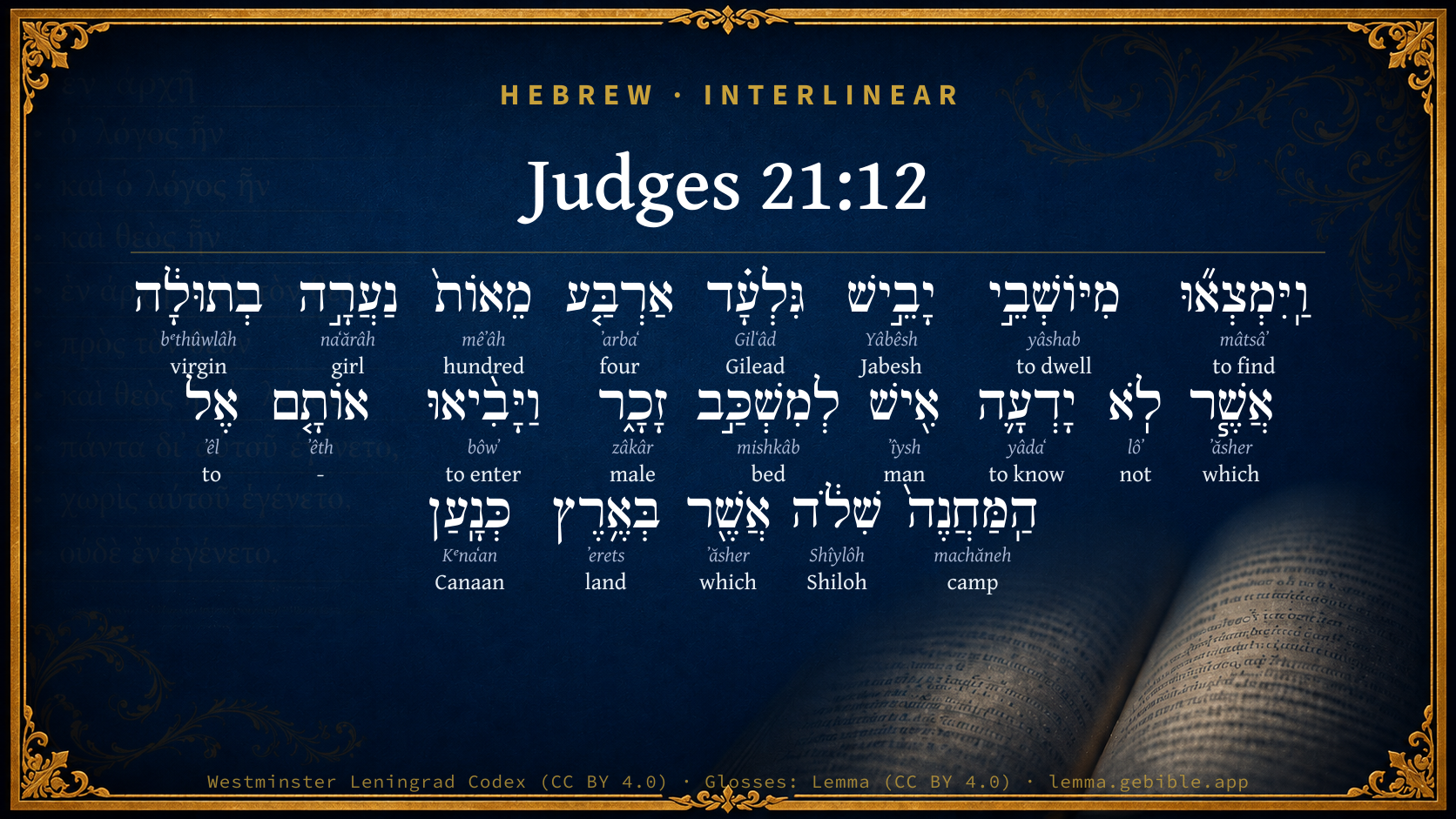
Judges 21:12

Hebrew (Westminster Leningrad Codex) Judges 21:12 appears in the Hebrew Old Testament. The text above is from the Westminster Leningrad Codex. Each word links to its Strong’s number, a concise gloss, and parsing drawn from the Open Scriptures Hebrew Bible morphology. Click any word for its full Brown-Driver-Briggs (BDB) entry.
Download image
Cite this verse

Judges 21:12 (World English Bible). Public Domain. Lemma interlinear Bible study tool, https://lemma.gebible.app/v/judges/21/12.

Show BibTeX & RIS
BibTeX
RIS
English Translation
They found among the inhabitants of Jabesh Gilead four hundred young virgins, who had not known man by lying with him; and they brought them to the camp to Shiloh, which is in the land of Canaan.
World English Bible · Public Domain
Download a study sheet

One document with this verse’s original text, its word-by-word gloss line, the meaning frame, cross-references with their text, attributed commentary, and full source and license credits — printable, and it pastes into notes with its structure intact.

This verse Autodidact and up

Study sheet (.html) Plain text (.txt)

A passage Seminary Student

Up to 50 verses in one chapter. A passage sheet keeps up to 6 commentary sources and 12 cross-references per verse, in the order this page ranks them, and says so on the sheet whenever that leaves anything out. Ask for a single verse and you get the Autodidact verse sheet above.

Everything on this page stays free to read, with no account — the sheet is a download of what is already on screen, not access to it.

Want to remove ads? Support Godless Engineer
Compare translations 3

The same verse in 3 English versions, stacked beneath the original-language interlinear above. Click any original word for its lexicon entry.

Each is an independent rendering of the whole verse — the interlinear is not word-aligned to these translations.

Highlighted words mark where these versions differ — a whole-verse word diff, not a word-by-word alignment.

  • World English Bible Public Domain
    They found among the inhabitants of Jabesh Gilead four hundred young virgins, who had not known man by lying with him; and they brought them to the camp to Shiloh, which is in the land of Canaan.
  • King James Version Public Domain
    And they found among the inhabitants of Jabeshgilead four hundred young virgins, that had known no man by lying with any male: and they brought them unto the camp to Shiloh, which is in the land of Canaan.
  • unfoldingWord Literal Text CC BY-SA 4.0
    And they found among the dwellers of Jabesh Gilead 400 young women, a virgin who had not known a man by the lying of a male, and they brought them to the camp Shiloh, which was in the land of Canaan.

unfoldingWord Literal Text — © unfoldingWord, licensed CC BY-SA 4.0. Word-aligned USFM3 via Door43 (git.door43.org/unfoldingWord/en_ult).

Versions to compare (up to 4)

3 of 4 selected

Show all 18 translations

Every available English version of this verse, each an independent rendering of the whole verse.

  • World English Bible Public Domain
    They found among the inhabitants of Jabesh Gilead four hundred young virgins, who had not known man by lying with him; and they brought them to the camp to Shiloh, which is in the land of Canaan.
  • Berean Standard Bible Public Domain
    So they found among the inhabitants of Jabesh-gilead four hundred young women who had not had relations with a man, and they brought them to the camp at Shiloh in the land of Canaan.
  • Majority Standard Bible Public Domain
    So they found among the inhabitants of Jabesh-gilead four hundred young women who had not had relations with a man, and they brought them to the camp at Shiloh in the land of Canaan.
  • King James Version Public Domain
    And they found among the inhabitants of Jabeshgilead four hundred young virgins, that had known no man by lying with any male: and they brought them unto the camp to Shiloh, which is in the land of Canaan.
  • American Standard Version (1901) Public Domain
    And they found among the inhabitants of Jabesh-gilead four hundred young virgins, that had not known man by lying with him; and they brought them unto the camp to Shiloh, which is in the land of Canaan.
  • Revised Version (1885) Public Domain
    And they found among the inhabitants of Jabesh-gilead four hundred young virgins, that had not known man by lying with him: and they brought them unto the camp to Shiloh, which is in the land of Canaan.
  • Geneva Bible (1599) Public Domain
    And they found among the inhabitants of Iabesh Gilead foure hundreth maides, virgins that had knowne no man by lying with any male: and they brought them vnto the hoste to Shiloh, which is in the land of Canaan.
  • Douay-Rheims (1899) Public Domain
    And there were found of Jabes Galaad four hundred virgins, that had not known the bed of a man, and they brought them to the camp Silo, into the land of Chanaan.
  • Young's Literal Translation Public Domain
    And they find out of the inhabitants of Jabesh-Gilead four hundred young women, virgins, who have not known man by the lying of a male, and they bring them in unto the camp at Shiloh, which `is' in the land of Canaan.
  • Literal Standard Version CC BY-SA 4.0
    And they find four hundred young women, virgins, out of the inhabitants of Jabesh-Gilead, who have not known man by the lying of a male, and they bring them to the camp at Shiloh, which [is] in the land of Canaan.
  • Unlocked Literal Bible CC BY-SA 4.0
    The men found among those living in Jabesh Gilead four hundred young women who had never slept with a man, and they took them to the camp at Shiloh, in Canaan.
  • unfoldingWord Literal Text CC BY-SA 4.0
    And they found among the dwellers of Jabesh Gilead 400 young women, a virgin who had not known a man by the lying of a male, and they brought them to the camp Shiloh, which was in the land of Canaan.
  • Darby Bible Public Domain
    And they found among the inhabitants of Ja'besh-gil'ead four hundred young virgins who had not known man by lying with him; and they brought them to the camp at Shiloh, which is in the land of Canaan.
  • World Messianic Bible Public Domain
    They found among the inhabitants of Jabesh Gilead four hundred young virgins who had not known man by lying with him; and they brought them to the camp to Shiloh, which is in the land of Canaan.
  • Webster's Bible Public Domain
    And they found among the inhabitants of Jabesh-gilead four hundred young virgins that had known no man by lying with any male: and they brought them to the camp to Shiloh, which is in the land of Canaan.
  • Free Bible Version CC BY-SA 4.0
    They managed to find among the inhabitants of Jabesh-gilead four hundred virgins who had not had sex with a man. They took them to the camp in Shiloh, in the land of Canaan.
  • Bible in Basic English Public Domain
    Now there were among the people of Jabesh-gilead four hundred young virgins who had never had sex relations with a man; these they took to their tents in Shiloh in the land of Canaan.
  • JPS Tanakh (1917) Public Domain
    And they found among the inhabitants of Jabesh-gilead four hundred young virgins, that had not known man by lying with him; and they brought them unto the camp to Shiloh, which is in the land of Canaan.

Literal Standard Version (2020), Covenant Press — licensed CC BY-SA 4.0. Text via the HelloAO Bible API (eBible.org). Unlocked Literal Bible (unfoldingWord) — licensed CC BY-SA 4.0. Text via the HelloAO Bible API (eBible.org). unfoldingWord Literal Text — © unfoldingWord, licensed CC BY-SA 4.0. Word-aligned USFM3 via Door43 (git.door43.org/unfoldingWord/en_ult). Free Bible Version, Dr. Jonathan Gallagher — licensed CC BY-SA 4.0. Text via the HelloAO Bible API (eBible.org).

Word by word

More ways to search: Search by grammar → Find every occurrence → Compare this word →

Practice this passage: Drill this verse → Learn its vocabulary →

יָבֵ֣ישׁ
Yâbêsh
H3003
“Jabesh”
Noun, Proper
Part of Speech
Noun
Type
Proper
Full BDB Definition

Origin: the same as H3002 (also Yabeysh yaw-bashe')

TWOT: None

Jabesh = "dry" - a town in the territory of Gilead; according to Eusebius, it is beyond the Jordan, 6 miles (10 kilometers) from Pella, on the mountain road to Gerasa; site unknown but may be modern 'Wadi Yabes' (noun proper locative) - father of Shallum, the 15th king of the northern kingdom (noun proper masculine)
  1. וַֽיִּמְצְא֞וּ mâtsâʼ H4672 “and · to find” Conjunction + Verb, Qal, Sequential Imperfect, 3rd Person, Masculine, Plural
  2. מִיּוֹשְׁבֵ֣י yâshab H3427 “from · dwelling” Preposition + Verb, Qal, Participle Active, Masculine, Plural, Construct
  3. גִּלְעָ֗ד Gilʻâd H1568 “Gilead” Noun, Proper
  4. אַרְבַּ֤ע ʼarbaʻ H702 “four” Adjective, Cardinal number, Feminine, Singular, Absolute
  5. מֵאוֹת֙ mêʼâh H3967 “hundred” Adjective, Cardinal number, Both, Plural, Absolute
  6. נַעֲרָ֣ה naʻărâh H5291 “girl” Noun, Common, Feminine, Singular, Absolute
  7. בְתוּלָ֔ה bᵉthûwlâh H1330 “virgin” Noun, Common, Feminine, Singular, Absolute
  8. אֲשֶׁ֧ר ʼăsher H834 “which” Particle, Relative
  9. לֹֽא lôʼ H3808 “not” Particle, Negative
  10. יָדְעָ֛ה yâdaʻ H3045 “to know” Verb, Qal, Perfect, 3rd Person, Feminine, Singular
  11. אִ֖ישׁ ʼîysh H376 “man” Noun, Common, Masculine, Singular, Absolute
  12. לְמִשְׁכַּ֣ב mishkâb H4904 “to/for · bed of” Preposition + Noun, Common, Masculine, Singular, Construct
  13. זָכָ֑ר zâkâr H2145 “male” Adjective, Adjective, Masculine, Singular, Absolute
  14. וַיָּבִ֨יאוּ bôwʼ H935 “and · to enter” Conjunction + Verb, Hiphil, Sequential Imperfect, 3rd Person, Masculine, Plural
  15. אוֹתָ֤ם ʼêth H853 “- · them” Particle, Direct Object + Suffix, Personal, 3rd Person, Masculine, Plural
  16. אֶל ʼêl H413 “to” Preposition
  17. הַֽמַּחֲנֶה֙ machăneh H4264 “the · camp” Particle, Definite Article + Noun, Common, Both, Singular, Absolute
  18. שִׁלֹ֔ה Shîylôh H7887 “Shiloh” Noun, Proper
  19. אֲשֶׁ֖ר ʼăsher H834 “which” Particle, Relative
  20. בְּאֶ֥רֶץ ʼerets H776 “in/at · land of” Preposition + Noun, Common, Both, Singular, Construct
  21. כְּנָֽעַן Kᵉnaʻan H3667 “Canaan” Noun, Proper

About this verse

These counts appear in no published source. They are computed here, from the morphology-tagged text and Lemma’s own curated glosses. What Lemma adds →

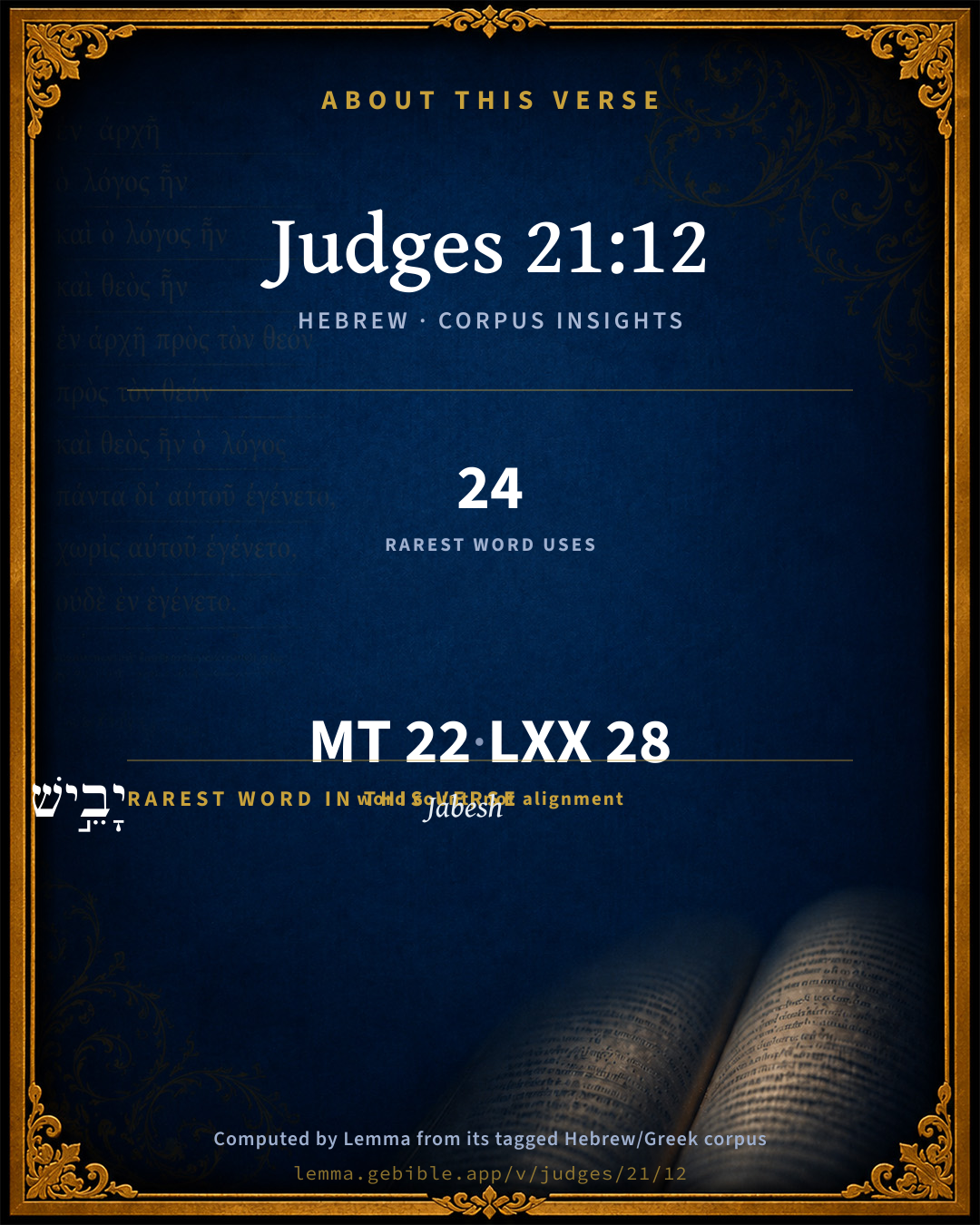
22
words
21
distinct lemmas
Historical
section

Notable vocabulary

The rarest word here is יָבֵ֣ישׁ Jabesh H3003 — appearing just 24 times in the whole Hebrew Bible.

Shared distinctive vocabulary

יָבֵ֣ישׁ Jabesh H3003 occurs in 21 verses of the Hebrew Bible. Also found in:

Grammatical profile

  • 4 verbs
  • 10 nouns
  • 3 adjectives
  • 1 preposition
  • 4 particles

Verb forms

  • וַֽיִּמְצְא֞וּ Qal · Sequential Imperfect
  • מִיּוֹשְׁבֵ֣י Qal · Participle Active
  • יָדְעָ֛ה Qal · Perfect
  • וַיָּבִ֨יאוּ Hiphil · Sequential Imperfect

Repetition

A word recurs within this verse — often emphatic in Hebrew:

  • אֲשֶׁ֧ר which H834 ×2

Hebrew & Septuagint length

In English translation the verse runs 37 words from the Hebrew and 33 from the Septuagint (LXX English) — closely comparable.

A rough comparison of the two English renderings, which tokenize alike — not a word-level alignment.

Word counts can differ between the Hebrew and the Greek without any difference in meaning — e.g. the Hebrew direct-object marker אֵת has no separate Greek word, and Greek often adds the article ὁ.

In the original languages it is 22 Hebrew tokens and 28 Greek tokens — but the two are counted differently (Hebrew bundles its prefixes and suffixes into one token; the Greek is in lemma form), so that isn’t a like-for-like length.

Cross-references

5

Topical passages linked to Judges 21:12 in the Treasury of Scripture Knowledge — connected by theme and wording, ordered by reader-vote popularity; previews shown in the World English Bible.

  • Joshua 18:1 The whole congregation of the children of Israel assembled themselves together at Shiloh, and set up the tent of meeting there: and the land was subdued before them.
  • Psalms 78:60 So that he forsook the tent of Shiloh, The tent which he placed among men;
  • Judges 20:18 The children of Israel arose, and went up to Bethel, and asked counsel of God; and they said, Who shall go up for us first to battle against the children of Benjamin? Yahweh said, Judah [shall go up] first.
  • Judges 20:23 The children of Israel went up and wept before Yahweh until even; and they asked of Yahweh, saying, Shall I again draw near to battle against the children of Benjamin my brother? Yahweh said, Go up against him.
  • Jeremiah 7:12 But go you now to my place which was in Shiloh, where I caused my name to dwell at the first, and see what I did to it for the wickedness of my people Israel.

Cross-references courtesy of OpenBible.info (CC BY 4.0).

Hebrew and Greek witnesses Masoretic Hebrew ↔ Greek Septuagint

The same verse in the two great witnesses to the Old Testament, shown verse-for-verse.

These are two independent witnesses, not word-aligned to each other, and the Septuagint is shown in lemma (dictionary) form.

Hebrew Judges 21:12 Masoretic · Westminster Leningrad Codex

וַֽיִּמְצְא֞וּ מִיּוֹשְׁבֵ֣י יָבֵ֣ישׁ גִּלְעָ֗ד אַרְבַּ֤ע מֵאוֹת֙ נַעֲרָ֣ה בְתוּלָ֔ה אֲשֶׁ֧ר לֹֽא יָדְעָ֛ה אִ֖ישׁ לְמִשְׁכַּ֣ב זָכָ֑ר וַיָּבִ֨יאוּ אוֹתָ֤ם אֶל הַֽמַּחֲנֶה֙ שִׁלֹ֔ה אֲשֶׁ֖ר בְּאֶ֥רֶץ כְּנָֽעַן

They found among the inhabitants of Jabesh Gilead four hundred young virgins, who had not known man by lying with him; and they brought them to the camp to Shiloh, which is in the land of Canaan.

World English Bible · Public Domain

Greek LXX Judges 21:12 Septuagint · lemma form

καί εὑρίσκω ἀπό οἰκέω ιαβις γαλαάδ τετρακόσιοι νεᾶνις παρθένος ὅστις οὐ γιγνώσκω ἀνήρ εἰς κοίτη ἄρσην καί φέρω αὐτός εἰς ὁ παρεμβολή εἰς σηλων ὁ ἐν γῆ χανααν

And they found among the inhabitants of Jabis Galaad four hundred young virgins, who had not known man by lying with him; and they brought them to Selom in the land of Chanaan.

LXX2012 (modern English Septuagint) · Public Domain

Hebrew: Westminster Leningrad Codex (CC BY 4.0). Greek: Septuagint (public domain); English from LXX2012 (modern English Septuagint) (Public Domain). How the Septuagint differs from the Hebrew →

Targum (Aramaic paraphrase)

1

The Targum is the ancient Jewish Aramaic paraphrase of the Hebrew Scriptures — an interpretive translation, not the Hebrew text itself. Onkelos (literal) and Pseudo-Jonathan (expansive) render the Torah, and Jonathan the Prophets. Coverage is partial: where no permissively-licensed English translation exists for a verse, only the Aramaic is shown. This is verse-level text, not a word-by-word alignment to the Hebrew.

  1. Targum Jonathan Prophets (Joshua–Malachi)
    וְאַשְׁכָּחוּ מִיַתְבֵי יָבֵשׁ גִלְעָד אַרְבַּע מְאָה עוּלֵימָן בְּתוּלָן דְלָא יָדְעָא גְבַר מִשְׁכְּבֵי דְכוּרָא וְאַיְתִיאוּ יַתְהוֹן לְמַשְׁרִיתָא לְשִׁילוֹ דִי בְּאַרְעָא דִכְנָעַן:

    (no public-domain English translation for this verse)

    Targum Jonathan — Aramaic: “Mikraot Gedolot” (public domain). English: “Sefaria Community Translation” (CC0 1.0 (public-domain dedication)); “London "Chaldee Paraphrase," 1871” (public domain). Text via Sefaria.

Commentary

Notes on Judges 21:12 from classic Christian and Jewish commentators (each source and its license shown beneath its notes). The classic Christian expositions comment on the surrounding passage and are grouped to its opening verse, so a note may address several verses; the Jewish commentaries on the Tanakh (Rashi and others) are per-verse, so they appear only where the commentator wrote on this verse.

Lemma curates 59 commentaries, every one of them public domain or Creative Commons licensed, each selected and text-cleaned for this edition rather than reprinted as found. About our sources →

Trapp's Complete Commentary

John Trapp

Jdg 21:12 And they found among the inhabitants of Jabeshgilead four hundred young virgins, that had known no man by lying with any male: and they brought them unto the camp to Shiloh, which [is] in the land of Canaan.

Ver. 12. That had known no man by lying with any male.] At least that any one else knew of: for many pass for virgins that are not so. See Pro 30:18-20. But what a base slander is that of Sylvester Petrasancta the Jesuit, who saith that among the Protestants few maids are married that have not been first lain with by other men! {a} Jesuits of all others may hold their tongues with shame enough, as being noted for Connubi, sanctifugae, commeretricitegae.

Unto the camp to Shiloh, which is.] Which lieth within the land of Canaan, and not beyond Jordan, as Jabeshgilead did. Or thus it may be rendered, Unto Shiloh to the camp, which abode in the land of Canaan, and went not over Jordan to fight against Jabeshgilead.

{a} Rivetti Jesuita Vapulans, p. 146.

John Trapp, A Commentary or Exposition upon All the Books of the Old and New Testament (1647–1656) — public domain. Text from a community e-Sword module.

Joseph Benson's Commentary

Jdg 21:12. They brought them into the camp — If the vow they had made would admit of their sparing the virgins, why could they not also, in consistency with that oath, have spared the other women and children, and innocent persons, and only punished the guilty? But it is evident “that convenience, rather than justice or piety, induced them to spare the virgins, that they might extricate themselves from the difficulties in which their rash oath had involved them.” — Scott.

Joseph Benson's Commentary on the Old and New Testaments (1811–1818) — public domain. Text from a community e-Sword module.

Ellicott's Commentary for English Readers

(12) They brought them.—It can hardly be doubted that the “them” means the young virgins, although the pronoun is masculine (otham), as in Jdg_21:22. If so, the idiom is like the Greek one in which a woman speaking of herself in the plural uses the masculine (Brief Greek Syntax, p. 61). There is no other trace of this idiom in Hebrew, but we can hardly suppose that many Jabesh-Gileadite captives were brought to Shiloh, and then put to death in cold blood in accordance with the ban.

Unto the camp to Shiloh.—The Israelites, now that the war with Benjamin was over, appear to have moved their stationary camp to Shiloh, the normal and more central seat of the tabernacle at this period (Jdg_18:31).

Which is in the land of Canaan.—We find the same addition in Jos_21:2; Jos_22:9. Perhaps there was another Shiloh on the east of the Jordan; but see Note on Jdg_21:19. The mere fact of Jabesh being in Gilead does not seem sufficient to account for it.

A Bible Commentary for English Readers, edited by Charles John Ellicott (1878–1897) — public domain. Text from a community e-Sword module.

The Cambridge Bible for Schools and Colleges

gen. ed. J. J. S. Perowne

12. unto the camp] From the foregoing one would naturally conclude that the main body of the Israelites was at Beth-el.

to Shiloh, which is in the land of Canaan] What can be the point of this remark? ‘which is in the land of Canaan,’ by way of contrast to the Israelite territory E. of the Jordan, is intelligible in Jos_22:9 but not so suitable here. The sentence can hardly have stood originally in B; it looks like an editorial addition designed to prepare the way for A’s narrative: all Israel must be brought upon the scene of Jdg_21:23. Probably the words were borrowed from Jos_21:2; Jos_22:9; cf. Jos_18:9; behind them lies the tradition that Shiloh was the meeting-place and sanctuary of the tabernacle for all Israel after the conquest under Joshua; Joshua 18 :1 P.

The Cambridge Bible for Schools and Colleges (gen. ed. J. J. S. Perowne; Cambridge University Press, 1878–1918) — public domain. Text from a community e-Sword module.

John Gill's Exposition

And they found among the inhabitants of Jabeshgilead four hundred young virgins,.... Or damsel virgins (e); damsels that were virgins: that had known no man by lying with any male: which was judged of by their age, and by their unmarried state, and by common report, unless it can be thought they were examined by matrons; but how it was that they were not obliged, or did not think themselves obliged by their oath to put these to death, as well as others, is not easy to say; whether they thought the necessity of the case would excuse it, or they had a dispensation from the Lord for it, on consulting him; however, so it was:

and they brought them unto the camp to Shiloh, which is in the land of Canaan; this is observed because that Jabeshgilead was not in the land of Canaan, from whence they were brought, but in the land of Og king of Bashan; only what was on this side Jordan was the land of Canaan, and in that Shiloh was, to which they were brought; and this shows that not the city Bethel, but Shiloh, was the place whither the people or army of Israel came to offer sacrifice after the war was ended.

(e) "puellam viginem", Montanus; "puellas virgines", Pagninus, Tigurine version, Drusius, Junius & Tremellius, Piscator.

John Gill's Exposition of the Whole Bible (1746–1763) — public domain (CC PDM 1.0). Text via the HelloAO Bible API.

Albert Barnes' Notes on the Bible

To Shiloh - Whither, as the usual place of meeting for the national assembly, the Israelites had moved from Bethel (a distance of about 10 miles), during the expedition of the 12,000 to Jabesh-Gilead.

Albert Barnes' Notes on the Bible (1834–1885) — public domain. Text from a community e-Sword/MySword module.

Matthew Poole's English Annotations

Young virgins; not married, yet marriageable. It is probable there were other and younger virgins; but whether they were slain or spared Scripture determines not, and the learned do not agree. But these could not serve the present and urgent occasion, and therefore he takes notice only of these four hundred which were of riper age.

Matthew Poole's English Annotations on the Holy Bible (1683–1685) — public domain. Text from a community e-Sword/MySword module.

Whedon's Commentary on the Bible

Daniel D. Whedon

12. Brought them unto the camp to Shiloh — Shiloh was the seat of the tabernacle, and lay ten miles north of Beth-el, and hither, after sending the twelve thousand to smite Jabesh-gilead, the rest of the people seem to have removed their camp. The ark and Phinehas the high priest probably accompanied them on this occasion.

Daniel D. Whedon (gen. ed.), Commentary on the Old and New Testaments (1874–1909) — public domain. Text from a community e-Sword module.

The Pulpit Commentary

To Shiloh, whither it should seem they had now taken the tabernacle back, the war with Benjamin no longer requiring its presence at Bethel Them. It is masculine in the Hebrew, though it refers to the women. So again in ver. 22, their fathers and their brothers in the masculine. (see Jud_1:19:23, and vers. 21, 22) It is perhaps an archaism. In the land of Canaan. This is inserted to contrast it with Jabesh in Gilead. (Gen_33:17, Gen_33:18, and Jud_1:8:5, note)

The Pulpit Commentary (1880–1919), ed. H.D.M. Spence-Jones & Joseph S. Exell — public domain. Text from a community e-Sword module.

Rashi

Rabbi Shlomo Yitzchaki (Rashi)

Four hundred virgin maids They placed them over the openings of wine barrels. Those with carnal knowledge emitted an aroma, the virgins did not.

Rashi on the Tanakh — English translations: “The Judaica Press complete Tanach with Rashi, translated by A. J. Rosenberg” (CC BY 4.0); “Pentateuch with Rashi's commentary by M. Rosenbaum and A.M. Silbermann, 1929-1934” (public domain); “The Metsudah Tanach series, Lakewood, N.J” (CC BY 4.0); and “The Book of Joshua, Metsudah Publications, 1997” (CC BY 4.0). Text via Sefaria.

Lesson kit

Teaching starters — assembled from the data on this page, not authored interpretation. Every prompt links to the verse data it draws on. Edit before teaching.

Judges, in the Historical, opens this verse with 22 words (21 distinct Hebrew lemmas). Its most distinctive word is Yâbêsh (“Jabesh”). A historical commentator’s framing appears above. Read the whole chapter for the surrounding context.

Discussion questions

  1. How does “Jabesh” (Yâbêsh) shape what this verse is saying?
  2. Judges 21:8 shares the word «Jabesh» with this verse. How do the two illuminate each other?
  3. “which” occurs 2× in this one verse. What is the effect of the repetition?
  4. These translations render this verse differently; the difference is in the English rendering, not the original. What questions does that raise?
  5. The verb «וַֽיִּמְצְא֞וּ» is Qal Sequential Imperfect. How does its form color the action?
  6. Reading how Trapp's Complete Commentary and Joseph Benson's Commentary read this verse, where do the two commentators agree and where do they part?

Things to notice

Reading settings

Reading text

Shown beneath each verse's original-language words.

Old Testament
Old Testament edition

Read the OT as the Masoretic Hebrew (MT) or the Greek Septuagint (LXX).

English shown for the Greek Septuagint (in the Hebrew ↔ Greek comparison).

Comparing translations? Open the Compare panel on any verse page to stack up to four side by side.