
Deuteronomy 20:6

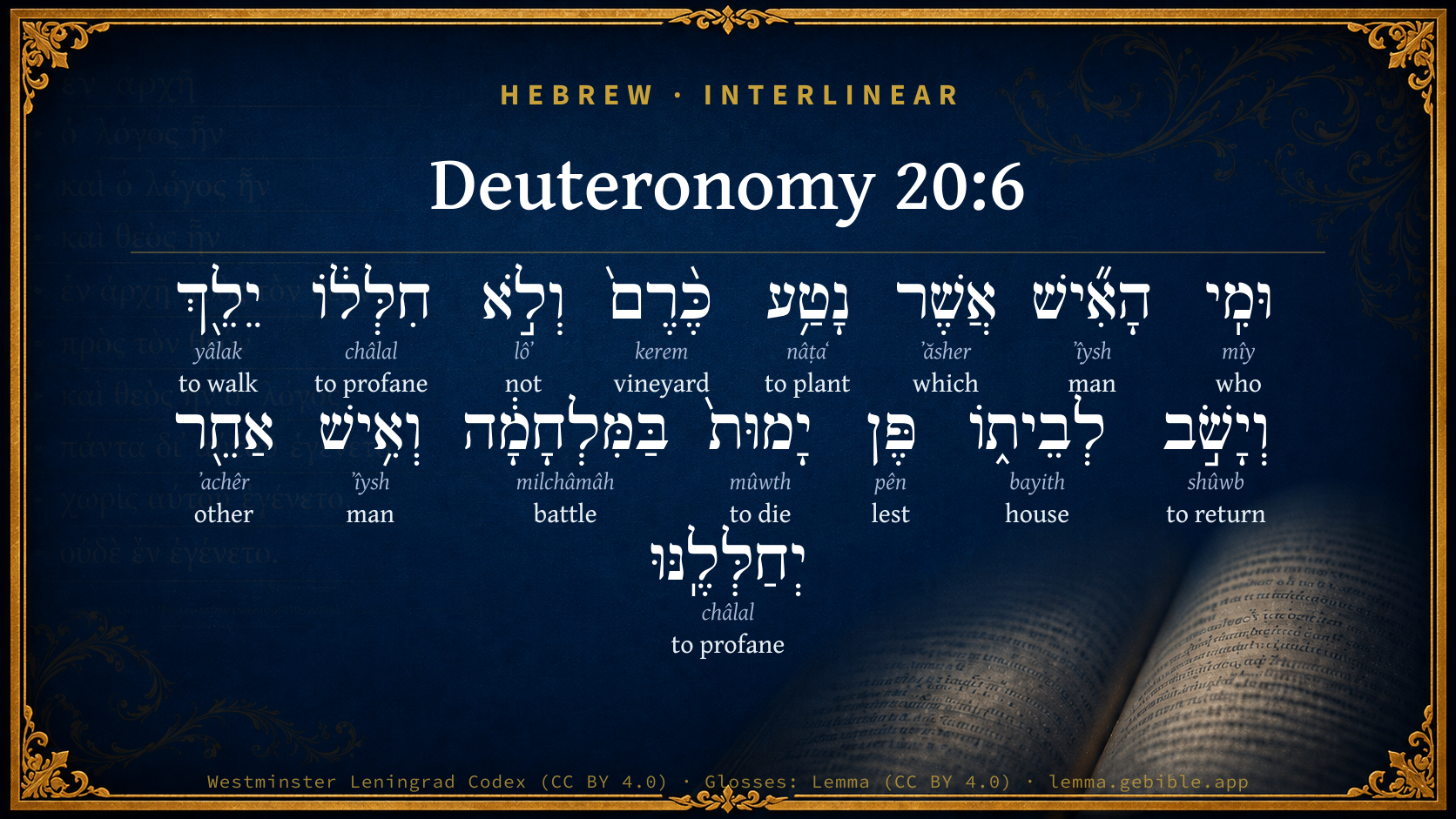
Hebrew (Westminster Leningrad Codex) Deuteronomy 20:6 appears in the Hebrew Old Testament. The text above is from the Westminster Leningrad Codex. Each word links to its Strong’s number, a concise gloss, and parsing drawn from the Open Scriptures Hebrew Bible morphology. Click any word for its full Brown-Driver-Briggs (BDB) entry.
Download image
Cite this verse

Deuteronomy 20:6 (World English Bible). Public Domain. Lemma interlinear Bible study tool, https://lemma.gebible.app/v/deuteronomy/20/6.

Show BibTeX & RIS
BibTeX
RIS
English Translation
What man is there who has planted a vineyard, and has not used the fruit of it? let him go and return to his house, lest he die in the battle, and another man use the fruit of it.
World English Bible · Public Domain
Download a study sheet

One document with this verse’s original text, its word-by-word gloss line, the meaning frame, cross-references with their text, attributed commentary, and full source and license credits — printable, and it pastes into notes with its structure intact.

This verse Autodidact and up

Study sheet (.html) Plain text (.txt)

A passage Seminary Student

Up to 50 verses in one chapter. A passage sheet keeps up to 6 commentary sources and 12 cross-references per verse, in the order this page ranks them, and says so on the sheet whenever that leaves anything out. Ask for a single verse and you get the Autodidact verse sheet above.

Everything on this page stays free to read, with no account — the sheet is a download of what is already on screen, not access to it.

Want to remove ads? Support Godless Engineer
Compare translations 3

The same verse in 3 English versions, stacked beneath the original-language interlinear above. Click any original word for its lexicon entry.

Each is an independent rendering of the whole verse — the interlinear is not word-aligned to these translations.

Highlighted words mark where these versions differ — a whole-verse word diff, not a word-by-word alignment.

  • World English Bible Public Domain
    What man is there who has planted a vineyard, and has not used the fruit of it? let him go and return to his house, lest he die in the battle, and another man use the fruit of it.
  • King James Version Public Domain
    And what man is he that hath planted a vineyard, and hath not yet eaten of it? let him also go and return unto his house, lest he die in the battle, and another man eat of it.
  • unfoldingWord Literal Text CC BY-SA 4.0
    And who the man who has planted a vineyard and has not put it into use? Let him go and return to his house, lest he die in battle and another man put it to use.

unfoldingWord Literal Text — © unfoldingWord, licensed CC BY-SA 4.0. Word-aligned USFM3 via Door43 (git.door43.org/unfoldingWord/en_ult).

Versions to compare (up to 4)

3 of 4 selected

Show all 18 translations

Every available English version of this verse, each an independent rendering of the whole verse.

  • World English Bible Public Domain
    What man is there who has planted a vineyard, and has not used the fruit of it? let him go and return to his house, lest he die in the battle, and another man use the fruit of it.
  • Berean Standard Bible Public Domain
    Has any man planted a vineyard and not begun to enjoy its fruit? Let him return home, or he may die in battle and another man enjoy its fruit.
  • Majority Standard Bible Public Domain
    Has any man planted a vineyard and not begun to enjoy its fruit? Let him return home, or he may die in battle and another man enjoy its fruit.
  • King James Version Public Domain
    And what man is he that hath planted a vineyard, and hath not yet eaten of it? let him also go and return unto his house, lest he die in the battle, and another man eat of it.
  • American Standard Version (1901) Public Domain
    And what man is there that hath planted a vineyard, and hath not used the fruit thereof? let him go and return unto his house, lest he die in the battle, and another man use the fruit thereof.
  • Revised Version (1885) Public Domain
    And what man is there that hath planted a vineyard, and hath not used the fruit thereof? let him go and return unto his house, lest he die in the battle, and another man use the fruit thereof.
  • Geneva Bible (1599) Public Domain
    And what man is there that hath planted a vineyarde, and hath not eaten of the fruite? let him go and returne againe vnto his house, least he die in the battel, and another eate the fruite.
  • Douay-Rheims (1899) Public Domain
    What man is there, that hath planted a vineyard, and hath not as yet made it to be common, whereof all men may eat? let him go, and return to his house, lest he die in the battle, and another man execute his office.
  • Young's Literal Translation Public Domain
    `And who `is' the man that hath planted a vineyard, and hath not made it common? -- let him go and turn back to his house, lest he die in battle, and another man make it common.
  • Literal Standard Version CC BY-SA 4.0
    And who [is] the man that has planted a vineyard and has not made it common? Let him go and return to his house, lest he die in battle, and another man make it common.
  • Unlocked Literal Bible CC BY-SA 4.0
    Is there anyone who has planted a vineyard and has not enjoyed its fruit? Let him go home, so he will not die in battle and another man enjoy its fruit.
  • unfoldingWord Literal Text CC BY-SA 4.0
    And who the man who has planted a vineyard and has not put it into use? Let him go and return to his house, lest he die in battle and another man put it to use.
  • Darby Bible Public Domain
    And what man is there that hath planted a vineyard, and hath not eaten of it? let him go and return unto his house, lest he die in the battle, and another man eat of it.
  • World Messianic Bible Public Domain
    What man is there who has planted a vineyard, and has not used its fruit? Let him go and return to his house, lest he die in the battle, and another man use its fruit.
  • Webster's Bible Public Domain
    And what man is he that hath planted a vineyard, and hath not yet eaten of it? let him also go and return to his house, lest he should die in the battle, and another man should eat of it.
  • Free Bible Version CC BY-SA 4.0
    Is there any man here who has planted a vineyard and hasn't yet enjoyed its fruit? He can go home, otherwise he might die in battle and another man will enjoy its fruit.
  • Bible in Basic English Public Domain
    Or if any man has made a vine-garden without taking the first-fruits of it, let him go back to his house, so that in the event of his death in the fight, another may not be the first to make use of the fruit.
  • JPS Tanakh (1917) Public Domain
    And what man is there that hath planted a vineyard, and hath not used the fruit thereof? let him go and return unto his house, lest he die in the battle, and another man use the fruit thereof.

Literal Standard Version (2020), Covenant Press — licensed CC BY-SA 4.0. Text via the HelloAO Bible API (eBible.org). Unlocked Literal Bible (unfoldingWord) — licensed CC BY-SA 4.0. Text via the HelloAO Bible API (eBible.org). unfoldingWord Literal Text — © unfoldingWord, licensed CC BY-SA 4.0. Word-aligned USFM3 via Door43 (git.door43.org/unfoldingWord/en_ult). Free Bible Version, Dr. Jonathan Gallagher — licensed CC BY-SA 4.0. Text via the HelloAO Bible API (eBible.org).

Word by word

More ways to search: Search by grammar → Find every occurrence → Compare this word →

Practice this passage: Drill this verse → Learn its vocabulary →

נָטַ֥ע
nâṭaʻ
H5193
“to plant”
Verb, Qal, Perfect, 3rd Person, Masculine, Singular
Part of Speech
Verb
Stem
Qal
Form
Perfect
Person
3rd Person
Gender
Masculine
Number
Singular
Full BDB Definition

Origin: a primitive root

TWOT: 1354

to plant, fasten, fix, establish - (Qal) - to plant - to plant, establish (figuratively) - (Niphal) - to be planted - to be established (figuratively)
  1. וּמִֽי mîy H4310 “and · who” Conjunction + Particle, Interrogative
  2. הָאִ֞ישׁ ʼîysh H376 “the · man” Particle, Definite Article + Noun, Common, Masculine, Singular, Absolute
  3. אֲשֶׁר ʼăsher H834 “which” Particle, Relative
  4. כֶּ֨רֶם֙ kerem H3754 “vineyard” Noun, Common, Both, Singular, Absolute
  5. וְלֹ֣א lôʼ H3808 “and · not” Conjunction + Particle, Negative
  6. חִלְּל֔וֹ châlal H2490 “to profane · him” Verb, Piel, Perfect, 3rd Person, Masculine, Singular + Suffix, Personal, 3rd Person, Masculine, Singular
  7. יֵלֵ֖ךְ yâlak H3212 “to walk” Verb, Qal, Imperfect, 3rd Person, Masculine, Singular
  8. וְיָשֹׁ֣ב shûwb H7725 “and · to return” Conjunction + Verb, Qal, Imperfect, 3rd Person, Masculine, Singular
  9. לְבֵית֑וֹ bayith H1004 “to/for · house · his” Preposition + Noun, Common, Masculine, Singular, Construct + Suffix, Personal, 3rd Person, Masculine, Singular
  10. פֶּן pên H6435 “lest” Conjunction
  11. יָמוּת֙ mûwth H4191 “to die” Verb, Qal, Imperfect, 3rd Person, Masculine, Singular
  12. בַּמִּלְחָמָ֔ה milchâmâh H4421 “in/at the · battle” Preposition, Determined + Noun, Common, Feminine, Singular, Absolute
  13. וְאִ֥ישׁ ʼîysh H376 “and · man” Conjunction + Noun, Common, Masculine, Singular, Absolute
  14. אַחֵ֖ר ʼachêr H312 “other” Adjective, Adjective, Masculine, Singular, Absolute
  15. יְחַלְּלֶֽנּוּ châlal H2490 “to profane · him” Verb, Piel, Imperfect, 3rd Person, Masculine, Singular + Suffix, Personal, 3rd Person, Masculine, Singular

About this verse

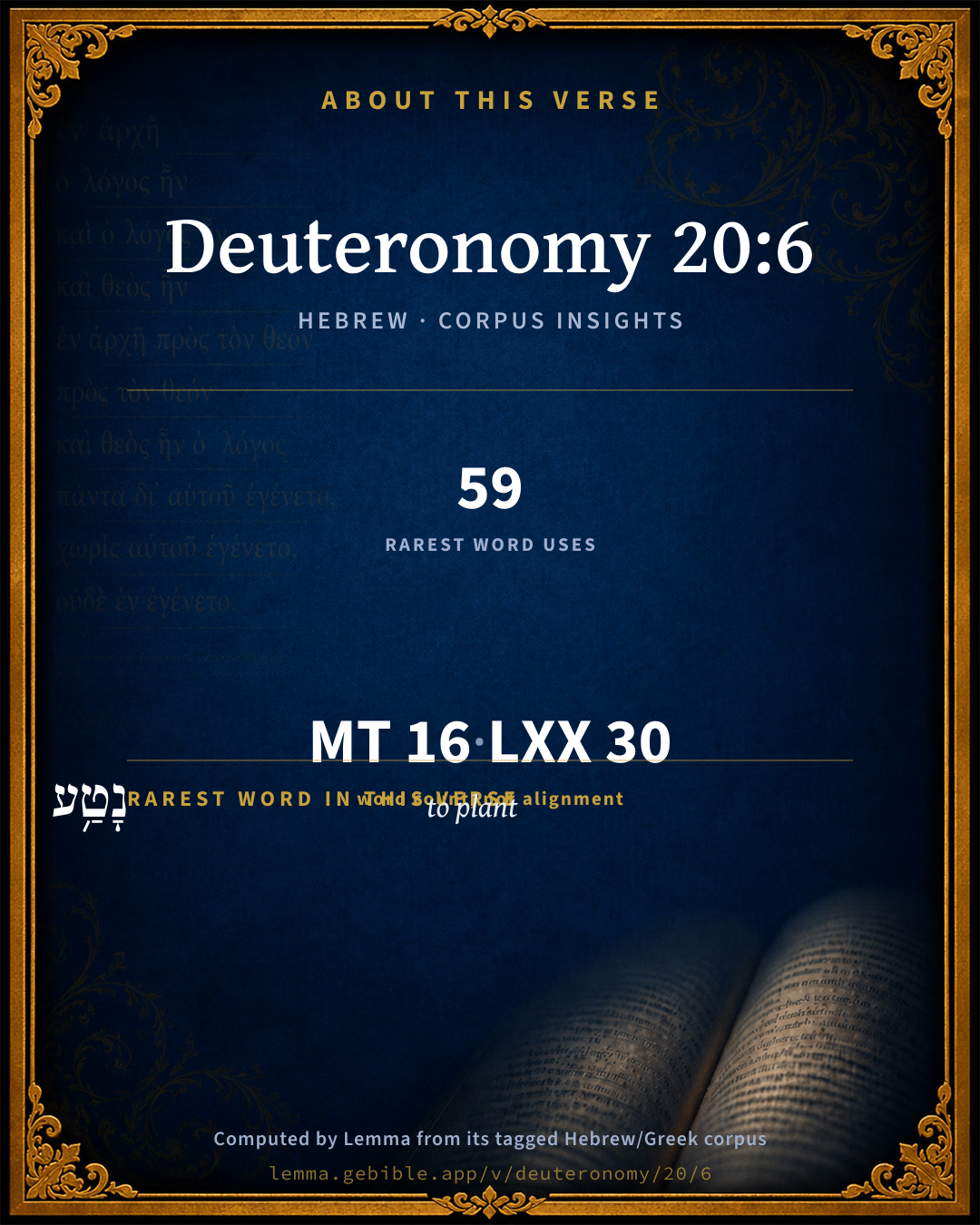
These counts appear in no published source. They are computed here, from the morphology-tagged text and Lemma’s own curated glosses. What Lemma adds →

16
words
14
distinct lemmas
Pentateuch
section

Shared distinctive vocabulary

נָטַ֥ע to plant H5193 occurs in 55 verses of the Hebrew Bible. Also found in:

Grammatical profile

  • 6 verbs
  • 5 nouns
  • 1 adjective
  • 1 conjunction
  • 3 particles

Verb forms

  • נָטַ֥ע Qal · Perfect
  • חִלְּל֔וֹ Piel · Perfect
  • יֵלֵ֖ךְ Qal · Imperfect
  • וְיָשֹׁ֣ב Qal · Imperfect
  • יָמוּת֙ Qal · Imperfect
  • יְחַלְּלֶֽנּוּ Piel · Imperfect

Repetition

Words recur within this verse — often emphatic in Hebrew:

  • הָאִ֞ישׁ man H376 ×2
  • חִלְּל֔וֹ to profane H2490 ×2

Hebrew & Septuagint length

In English translation the verse runs 39 words from the Hebrew and 39 from the Septuagint (LXX English) — the same length.

A rough comparison of the two English renderings, which tokenize alike — not a word-level alignment.

Word counts can differ between the Hebrew and the Greek without any difference in meaning — e.g. the Hebrew direct-object marker אֵת has no separate Greek word, and Greek often adds the article ὁ.

In the original languages it is 16 Hebrew tokens and 30 Greek tokens — but the two are counted differently (Hebrew bundles its prefixes and suffixes into one token; the Greek is in lemma form), so that isn’t a like-for-like length.

Cross-references

1

Topical passages linked to Deuteronomy 20:6 in the Treasury of Scripture Knowledge — connected by theme and wording, ordered by reader-vote popularity; previews shown in the World English Bible.

  • Leviticus 19:23–25 "'When you come into the land, and have planted all kinds of trees for food, then you shall count their fruit as forbidden. Three years shall they be forbidden to you. It shall not be eaten.

Cross-references courtesy of OpenBible.info (CC BY 4.0).

Hebrew and Greek witnesses Masoretic Hebrew ↔ Greek Septuagint

The same verse in the two great witnesses to the Old Testament, shown verse-for-verse.

These are two independent witnesses, not word-aligned to each other, and the Septuagint is shown in lemma (dictionary) form.

Hebrew Deuteronomy 20:6 Masoretic · Westminster Leningrad Codex

וּמִֽי הָאִ֞ישׁ אֲשֶׁר נָטַ֥ע כֶּ֨רֶם֙ וְלֹ֣א חִלְּל֔וֹ יֵלֵ֖ךְ וְיָשֹׁ֣ב לְבֵית֑וֹ פֶּן יָמוּת֙ בַּמִּלְחָמָ֔ה וְאִ֥ישׁ אַחֵ֖ר יְחַלְּלֶֽנּוּ

What man is there who has planted a vineyard, and has not used the fruit of it? let him go and return to his house, lest he die in the battle, and another man use the fruit of it.

World English Bible · Public Domain

Greek LXX Deuteronomy 20:6 Septuagint · lemma form

καί τίς ὁ ἄνθρωπος ὅστις φυτεύω ἀμπελών καί οὐ εὐφραίνω ἐκ αὐτός πορεύομαι καί ἀποστρέφω εἰς ὁ οἰκία αὐτός μή ἀποθνήσκω ἐν ὁ πόλεμος καί ἄνθρωπος ἕτερος εὐφραίνω ἐκ αὐτός

And what man is he that has planted a vineyard, and not been made merry with it? let him go and return to his house, lest he die in the battle, and another man be made merry with it.

LXX2012 (modern English Septuagint) · Public Domain

On this verse, John Gill's Exposition discusses the Septuagint’s reading. Read the note in Commentary ↓

Hebrew: Westminster Leningrad Codex (CC BY 4.0). Greek: Septuagint (public domain); English from LXX2012 (modern English Septuagint) (Public Domain). How the Septuagint differs from the Hebrew →

Targum (Aramaic paraphrase)

2

The Targum is the ancient Jewish Aramaic paraphrase of the Hebrew Scriptures — an interpretive translation, not the Hebrew text itself. Onkelos (literal) and Pseudo-Jonathan (expansive) render the Torah, and Jonathan the Prophets. Coverage is partial: where no permissively-licensed English translation exists for a verse, only the Aramaic is shown. This is verse-level text, not a word-by-word alignment to the Hebrew.

  1. Targum Onkelos Torah (Genesis–Deuteronomy)
    וּמָן גַבְרָא דִי נְצִיב כַּרְמָא וְלָא אַחֲלֵהּ יְהַךְ וִיתוּב לְבֵיתֵהּ דִילְמָא יְמוּת בַּאֲגָחָא קְרָבָא וּגְבַר אָחָרָן יְחַלִנֵהּ

    (no public-domain English translation for this verse)

    Targum Onkelos — Aramaic: “Onkelos Genesis” (public domain); “Onkelos Exodus” (public domain); “Onkelos Leviticus” (public domain); “Onkelos Numbers” (public domain); “Onkelos Deuteronomy” (public domain). English: “Sefaria Community Translation” (CC0 1.0 (public-domain dedication)); “J.W. Etheridge. The Targums of Onkelos and Jonathan Ben Uzziel on the Pentateuch. London: Longmans, Green, 1862” (public domain). Text via Sefaria.

  2. Targum Pseudo-Jonathan Torah (Genesis–Deuteronomy)
    וּמַאן גַּבְרָא דִּי נְצַב כַּרְמָא וְלָא פַרְקֵיהּ מִן כַּהֲנָא וְאַחֲלֵיהּ יְהַךְ וִיתוּב לְבֵיתֵיהּ דִּלְמָא יִגְרוֹם לֵיהּ חוֹבָא דְלָא פָּרְקֵיהּ וְיִתְקְטֵיל בִּקְרָבָא וּגְבַר חוֹרַן יַחְלִינֵיהּ

    Or, what man hath planted a vineyard, and hath not redeemed it from the priest to make it common? let him go and return to his house, lest sin be the occasion of his not redeeming it, but he be slain in the battle, and another make it common.

    Targum Pseudo-Jonathan — Aramaic: “Targum Jonathan on Genesis” (public domain); “Targum Jonathan on Exodus” (public domain); “Targum Jonathan on Leviticus” (public domain); “Targum Jonathan on Numbers” (public domain); “Targum Jonathan on Deuteronomy” (public domain). English: “The Targum of Jonathan ben Uzziel, trans. J. W. Etheridge, London, 1862” (public domain). Text via Sefaria.

Commentary

Notes on Deuteronomy 20:6 from classic Christian and Jewish commentators (each source and its license shown beneath its notes). The classic Christian expositions comment on the surrounding passage and are grouped to its opening verse, so a note may address several verses; the Jewish commentaries on the Tanakh (Rashi and others) are per-verse, so they appear only where the commentator wrote on this verse.

Lemma curates 59 commentaries, every one of them public domain or Creative Commons licensed, each selected and text-cleaned for this edition rather than reprinted as found. About our sources →

Trapp's Complete Commentary

John Trapp

Deu 20:6 And what man [is he] that hath planted a vineyard, and hath not [yet] eaten of it? let him [also] go and return unto his house, lest he die in the battle, and another man eat of it.

Ver. 7. That hath betrothed a wife.] A commendable custom, even among heathens also: Placuit, despondi; nuptiis hic dictus est dies, said he in Terence.

John Trapp, A Commentary or Exposition upon All the Books of the Old and New Testament (1647–1656) — public domain. Text from a community e-Sword module.

Geneva Bible (1599)

Geneva Bible translators

The Hebrew word signifieth to make common or profane, Lev. 19:25.

Geneva Bible (1599) marginal notes — public domain. Text via Bolls.life.

The Cambridge Bible for Schools and Colleges

gen. ed. J. J. S. Perowne

6. not used the fruit thereof] As in Deu_28:30 EVV. paraphrase the Heb. ḥalal, a ritual term for bringing into common use. In the 5th year after planting the vine, one might use the fruits which in the 4th were reserved for the Deity, and for the three previous years were left alone. See Lev_19:23 ff.

The Cambridge Bible for Schools and Colleges (gen. ed. J. J. S. Perowne; Cambridge University Press, 1878–1918) — public domain. Text from a community e-Sword module.

John Gill's Exposition

And what man is he that hath planted a vineyard, and hath not yet eaten of it?.... Which he has a right to do, and it is hard for him to be deprived of it, Co1 9:7 or "hath not made it common" (k); according to the law in Lev 19:23. Three years the fruit of trees, and so of vines, might not be eaten; in the fourth, they were devoted to the Lord, and might be redeemed from the priest, and so made common; and on the fifth year were eaten in course; so the Targums of Jerusalem, Jonathan, and Jarchi, interpret it: "let him also go and return unto his house, lest he die in the battle, and another man eat of it"; or make it common, according to the above law: Aben Ezra seems to have another sense of this passage, deriving the word from another, which signifies piping and dancing, and observes, that it was a custom to sing, pipe, and dance in vineyards; and the Septuagint version is, "hath not been made merry of it"; though that may signify not having drank of the wine of it, to be made merry with it.

(k) "necdum fecit eam esse communem", V. L. "et non fecit eam communem", Vatablus, Fagius.

John Gill's Exposition of the Whole Bible (1746–1763) — public domain (CC PDM 1.0). Text via the HelloAO Bible API.

Albert Barnes' Notes on the Bible

See the margin and references. The fruit of newly-planted trees was set apart from common uses for four years.

Albert Barnes' Notes on the Bible (1834–1885) — public domain. Text from a community e-Sword/MySword module.

Haydock's Catholic Bible Commentary

Common. Hebrew, "hath not profaned it." (Menochius) --- During the three first years, the fruit was not eaten. In the fourth it was sacred to the Lord, and given to the priests, so that the owner could not partake of the fruit till the fifth year, when it ceased to be in a manner sacred. Jonathan translates, "and has not redeemed it," by paying the first-fruits of the fifth year. Septuagint, "has not rejoiced in it," by feasting, as was probably the custom at the first vintage. Other fruit-trees entitled the owner to the like privilege. (Schikard., Jus. reg. 5.) --- Whereof all may eat, is added by the Vulgate to explain what is meant by common. (Calmet)

George Leo Haydock (1774–1849), Haydock's Catholic Family Bible and Commentary, 1859 edition — public domain. Excludes Psalms (Douay-Rheims chapter numbering differs from Protestant) and Deuterocanonical books (Catholic canon only).

Matthew Poole's English Annotations

This and the former dispensation were generally convenient, but more necessary in the beginning of their settlement in Canaan, for the encouragement of those who should build houses or plant vineyards, which was chargeable to them, and beneficial to the commonwealth.

Eaten of it, Heb. made it common, to wit, for the use of himself and family and friends, which it was not till the fifth year, Lev 19:23; Jer 31:5.

Matthew Poole's English Annotations on the Holy Bible (1683–1685) — public domain. Text from a community e-Sword/MySword module.

Whedon's Commentary on the Bible

Daniel D. Whedon

6. Planted a vineyard — The word כרם is not to be restricted to vineyards. The same term is applied to olive groves.

Hath not yet eaten of it — The Hebrew term חלל, to make common, is here used in the sense of to apply to common use. The fruit of the vine, or of fruit trees in general, was not to be gathered for use for the first three years. In the fourth year the fruit was to be consecrated to Jehovah. It was not till the fifth year that the fruit could be gathered for common use.

Daniel D. Whedon (gen. ed.), Commentary on the Old and New Testaments (1874–1909) — public domain. Text from a community e-Sword module.

John Wesley's Explanatory Notes

A vineyard - This and the former dispensation were generally convenient, but more necessary in the beginning of their settlement in Canaan, for the encouragement of those who should build houses or plant vineyards, which was chargeable to them, and beneficial to the common-wealth. Eaten of it - Hebrew. made it common, namely, for the use of himself and family and friends, which it was not, 'till the fifth year.

John Wesley, Explanatory Notes Upon the Whole Bible (1754–1765) — public domain. Text via the GEBible commentary corpus.

unfoldingWord translationNotes

Door43 World Missions Community

General Information:

Moses continues describing situations that allow a man to leave the military.

Is there anyone who has planted ... Let him go home

"If any soldier here has a new vineyard, but has not yet harvested its grapes, he should go back to his house"

so he will not die in battle and another man enjoy its fruit

The officer is describing a situation that could possibly happen to a soldier. AT: "so that, if he dies in battle, another man will not harvest its fruit instead of him" (See: Hypothetical Situations)

What man is there who is engaged to marry a woman ... Let him go home

"If any soldier here has promised to marry a woman, but has not yet married her, he should go back to his house"

so that he does not die in battle and another man marries her

The officer is describing a situation that could possibly happen to a soldier. AT: "so that, if he dies in battle, another man does not marry her instead of him" (See: Hypothetical Situations)

translationWords

vineyard

fruit

unfoldingWord translationNotes — © Distant Shores Media and the Door43 World Missions Community, licensed CC BY-SA 4.0. Source: git.door43.org/Door43/en_tn.

Rashi

Rabbi Shlomo Yitzchaki (Rashi)

ולא חללו [AND WHAT MAN IS THERE THAT HATH PLANTED A VINEYARD] AND HATH YET NOT EATEN OF IT — לא חללו means, has not yet redeemed it in the fourth year of its growth, for the fruits had either to be eaten in Jerusalem or to be given a non-holy character (חולין), by exchanging them for money and the money’s worth to be consumed in Jerusalem (The phrase therefore means no more than: who hath not eaten of it).

Rashi on the Tanakh — English translations: “The Judaica Press complete Tanach with Rashi, translated by A. J. Rosenberg” (CC BY 4.0); “Pentateuch with Rashi's commentary by M. Rosenbaum and A.M. Silbermann, 1929-1934” (public domain); “The Metsudah Tanach series, Lakewood, N.J” (CC BY 4.0); and “The Book of Joshua, Metsudah Publications, 1997” (CC BY 4.0). Text via Sefaria.

Ramban (Nachmanides)

Rabbi Moshe ben Nachman (Ramban / Nachmanides)

V’LO CHIL’LO’ — the fourth year [since the vineyard was planted] had not yet arrived. For the custom regarding a vineyard used to be that when the produce was ripe they would dance there and walk in it with chalilim (flutes). Now, Scripture commanded that all the fruits thereof [of the fourth year] shall be holy, for giving praise unto the Eternal, that they should praise the Glorious Name at that celebration. It is possible that the meaning of v’lo chil’lo is “that he has not made it chulin (secular),” this referring to the “redemption” [i.e., exchanging the fruits for money in case he cannot transport them to Jerusalem] which our Rabbis have mentioned, it being similar to the expressions: for Judah ‘chileil’ (hath profaned) the holiness of the Eternal [which means Israel has exchanged Him for other gods]; and he shall not ‘yechaleil’ (profane) his seed [which also means that he shall not exchange his holy seed by taking a woman forbidden to him].

Ramban (Nachmanides) on the Tanakh — English translation: “Commentary on the Torah by Ramban (Nachmanides). Translated and annotated by Charles B. Chavel. New York, Shilo Pub. House, 1971-1976” (CC BY 4.0). Text via Sefaria.

Lesson kit

Teaching starters — assembled from the data on this page, not authored interpretation. Every prompt links to the verse data it draws on. Edit before teaching.

Deuteronomy, in the Pentateuch, opens this verse with 16 words (14 distinct Hebrew lemmas). Its most distinctive word is nâṭaʻ (“to plant”). A historical commentator’s framing appears above. Read the whole chapter for the surrounding context.

Discussion questions

  1. How does “to plant” (nâṭaʻ) shape what this verse is saying?
  2. How does Genesis 2:8, which shares the word «to plant», read alongside this verse?
  3. What does the repetition of “man” (2× in this one verse) do in this verse?
  4. These translations render this verse differently; the difference is in the English rendering, not the original. What questions does that raise?
  5. «נָטַ֥ע» is a Qal Perfect verb. How does that grammatical form shape the action described?
  6. Compare how Trapp's Complete Commentary and Geneva Bible (1599) read this verse. Where do they agree or differ?

Things to notice

Reading settings

Reading text

Shown beneath each verse's original-language words.

Old Testament
Old Testament edition

Read the OT as the Masoretic Hebrew (MT) or the Greek Septuagint (LXX).

English shown for the Greek Septuagint (in the Hebrew ↔ Greek comparison).

Comparing translations? Open the Compare panel on any verse page to stack up to four side by side.