Colossians 4:11

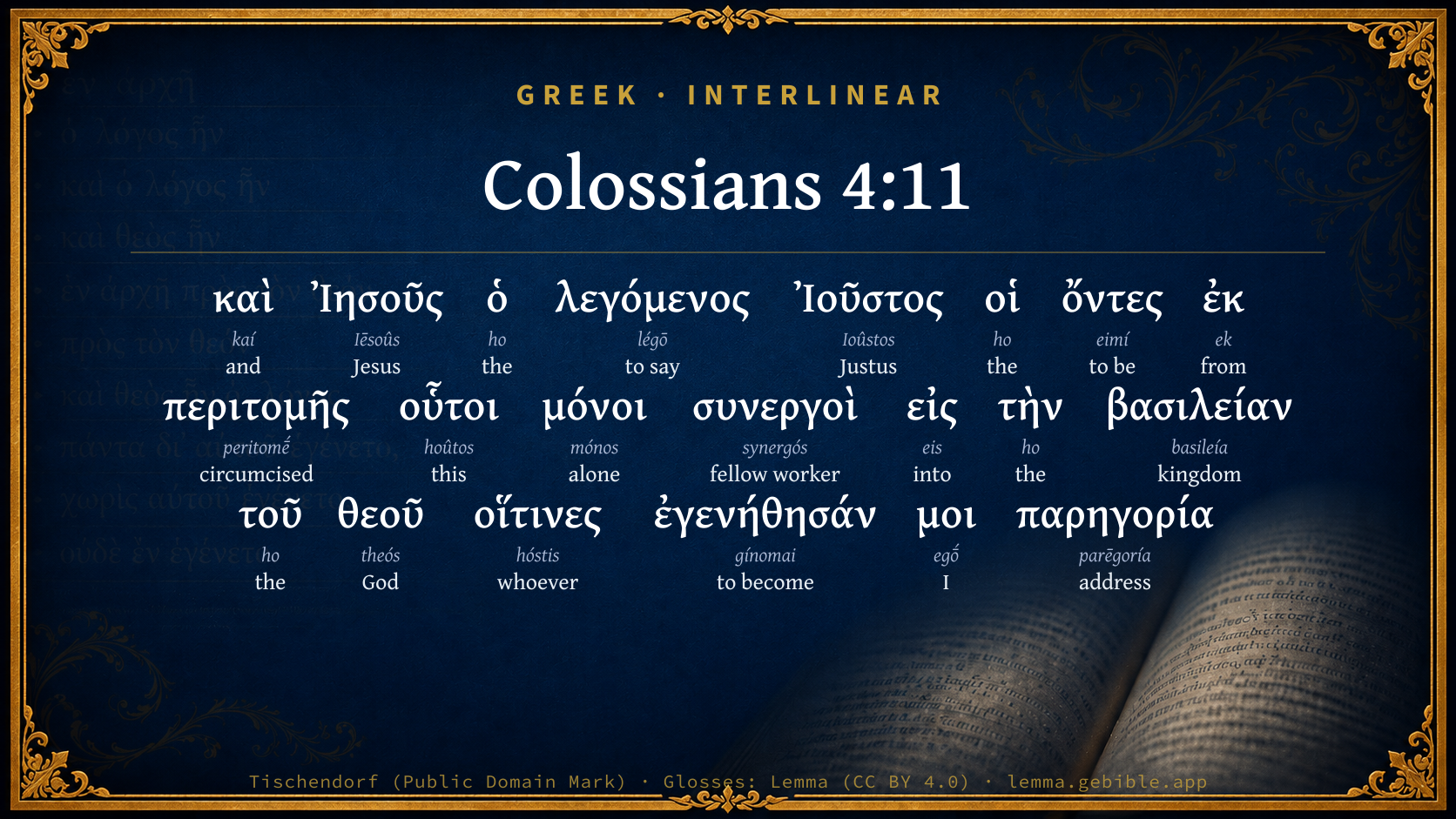
Greek (Tischendorf 8th ed.) Colossians 4:11 appears in the Greek New Testament. The text above is from the Tischendorf 8th edition. Each word links to its Strong’s number and a concise gloss. Click any word for its full Thayer’s Greek Lexicon entry.
Download image
Cite this verse

Colossians 4:11 (World English Bible). Public Domain. Lemma interlinear Bible study tool, https://lemma.gebible.app/v/colossians/4/11.

Show BibTeX & RIS
BibTeX
RIS
English Translation
and Jesus who is called Justus, who are of the circumcision. These are my only fellow workers for the Kingdom of God, men who have been a comfort to me.
World English Bible · Public Domain
Highlights
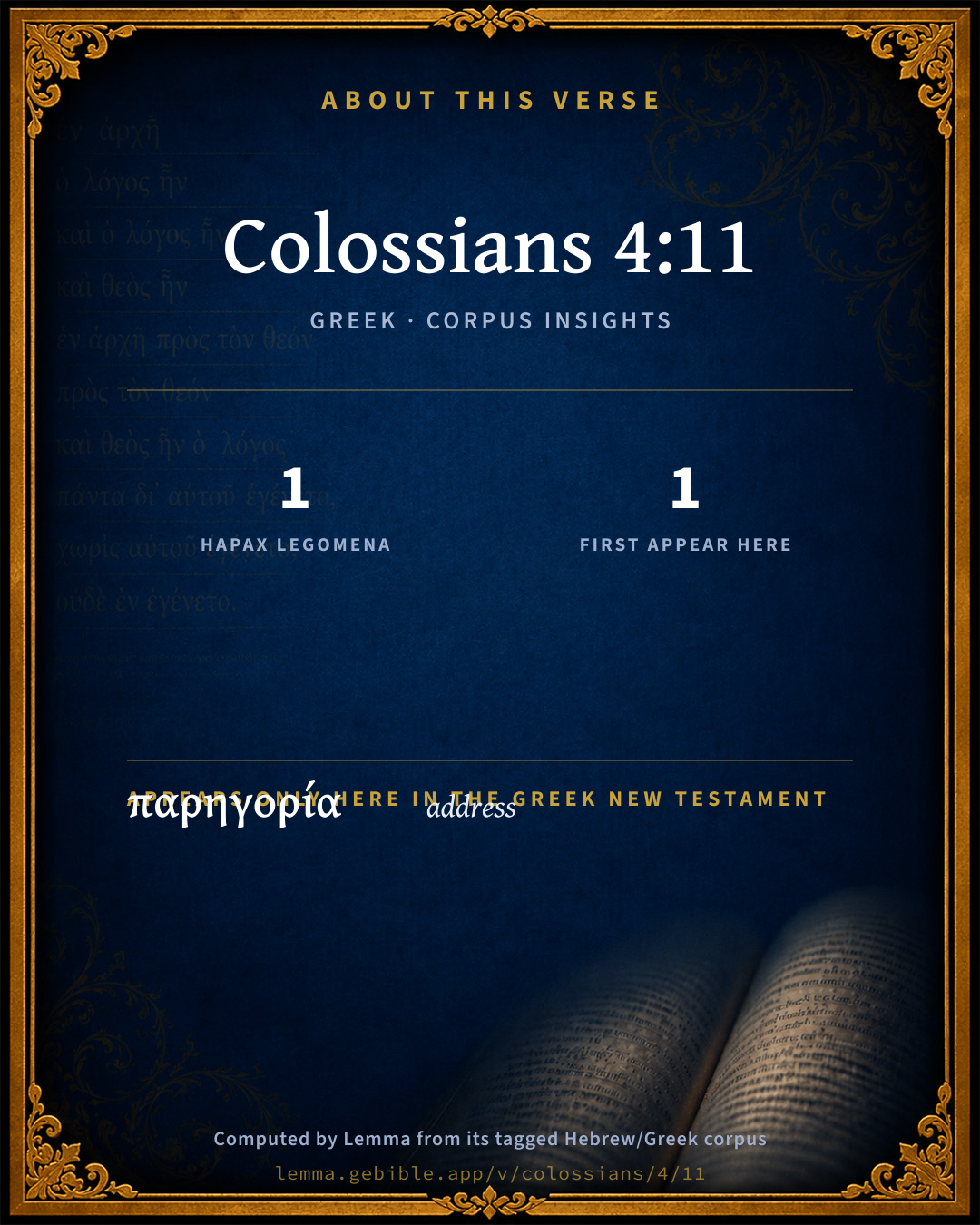
  • 1 hapax legomenon — only here in the Greek New Testament
  • 1 first appearance in the Greek New Testament
Full analysis ↓
Download a study sheet

One document with this verse’s original text, its word-by-word gloss line, the meaning frame, cross-references with their text, attributed commentary, and full source and license credits — printable, and it pastes into notes with its structure intact.

This verse Autodidact and up

Study sheet (.html) Plain text (.txt)

A passage Seminary Student

Up to 50 verses in one chapter. A passage sheet keeps up to 6 commentary sources and 12 cross-references per verse, in the order this page ranks them, and says so on the sheet whenever that leaves anything out. Ask for a single verse and you get the Autodidact verse sheet above.

Everything on this page stays free to read, with no account — the sheet is a download of what is already on screen, not access to it.

Want to remove ads? Support Godless Engineer
Compare translations 3

The same verse in 3 English versions, stacked beneath the original-language interlinear above. Click any original word for its lexicon entry.

Each is an independent rendering of the whole verse — the interlinear is not word-aligned to these translations.

Highlighted words mark where these versions differ — a whole-verse word diff, not a word-by-word alignment.

  • World English Bible Public Domain
    and Jesus who is called Justus, who are of the circumcision. These are my only fellow workers for the Kingdom of God, men who have been a comfort to me.
  • King James Version Public Domain
    And Jesus, which is called Justus, who are of the circumcision. These only are my fellowworkers unto the kingdom of God, which have been a comfort unto me.
  • unfoldingWord Literal Text CC BY-SA 4.0
    and Jesus, the one called Justus. These the only fellow workers for the kingdom of God being from the circumcision, who were a comfort to me.

unfoldingWord Literal Text — © unfoldingWord, licensed CC BY-SA 4.0. Word-aligned USFM3 via Door43 (git.door43.org/unfoldingWord/en_ult).

Versions to compare (up to 4)

3 of 4 selected

Show all 19 translations

Every available English version of this verse, each an independent rendering of the whole verse.

  • World English Bible Public Domain
    and Jesus who is called Justus, who are of the circumcision. These are my only fellow workers for the Kingdom of God, men who have been a comfort to me.
  • Berean Standard Bible Public Domain
    Jesus, who is called Justus, also sends greetings. These are the only Jews among my fellow workers for the kingdom of God, and they have been a comfort to me.
  • Majority Standard Bible Public Domain
    Jesus, who is called Justus, also sends greetings. These are the only Jews among my fellow workers for the kingdom of God, and they have been a comfort to me.
  • King James Version Public Domain
    And Jesus, which is called Justus, who are of the circumcision. These only are my fellowworkers unto the kingdom of God, which have been a comfort unto me.
  • American Standard Version (1901) Public Domain
    and Jesus that is called Justus, who are of the circumcision: these only `are my' fellow-workers unto the kingdom of God, men that have been a comfort unto me.
  • Revised Version (1885) Public Domain
    and Jesus, which is called Justus, who are of the circumcision: these only are my fellow-workers unto the kingdom of God, men that have been a comfort unto me.
  • Geneva Bible (1599) Public Domain
    And Iesus which is called Iustus, which are of the circumcision. These onely are my worke fellowes vnto the kingdome of God, which haue bene vnto my consolation.
  • Douay-Rheims (1899) Public Domain
    And Jesus, that is called Justus: who are of the circumcision: these only are my helpers in the kingdom of God; who have been a comfort to me.
  • Young's Literal Translation Public Domain
    and Jesus who is called Justus, who are of the circumcision: these only `are' fellow-workers for the reign of God who did become a comfort to me.
  • Literal Standard Version CC BY-SA 4.0
    and Jesus who is called Justus, who are of circumcision: these [are the] only fellow-workers for the Kingdom of God who become a comfort to me.
  • Unlocked Literal Bible CC BY-SA 4.0
    and also Jesus who is called Justus. These alone of the circumcision are my fellow workers for the kingdom of God. They have been a comfort to me.
  • unfoldingWord Literal Text CC BY-SA 4.0
    and Jesus, the one called Justus. These the only fellow workers for the kingdom of God being from the circumcision, who were a comfort to me.
  • Darby Bible Public Domain
    and Jesus called Justus, who are of the circumcision. These [are the] only fellow-workers for the kingdom of God who have been a consolation to me.
  • World Messianic Bible Public Domain
    and Yeshua who is called Justus. These are my only fellow workers for God’s Kingdom who are of the circumcision, men who have been a comfort to me.
  • Webster's Bible Public Domain
    And Jesus, who is called Justus, who are of the circumcision. These only are my fellow-workers to the kingdom of God, who have been a comfort to me.
  • Free Bible Version CC BY-SA 4.0
    and Jesus—also called Justus—who are the only Jewish Christians among those working with me here for the kingdom of God, men who have been a great help to me.
  • Bible in Basic English Public Domain
    And Jesus, whose other name is Justus; these are of the circumcision: they are my only brother-workers for the kingdom of God, who have been a comfort to me.
  • Text-Critical English NT CC BY 4.0
    Jesus who is called Justus also greets you. These men are my only fellow workers for the kingdom of God who are of the circumcision, and they have been a comfort to me.
  • Tyndale New Testament (1534) Public Domain
    and Iesus which is called Iustus which are of the circumcision. These only are my workefelowes vnto the kyngdome of God which were vnto my consolacion.

Literal Standard Version (2020), Covenant Press — licensed CC BY-SA 4.0. Text via the HelloAO Bible API (eBible.org). Unlocked Literal Bible (unfoldingWord) — licensed CC BY-SA 4.0. Text via the HelloAO Bible API (eBible.org). unfoldingWord Literal Text — © unfoldingWord, licensed CC BY-SA 4.0. Word-aligned USFM3 via Door43 (git.door43.org/unfoldingWord/en_ult). Free Bible Version, Dr. Jonathan Gallagher — licensed CC BY-SA 4.0. Text via the HelloAO Bible API (eBible.org).

Word by word

More ways to search: Search by grammar → Find every occurrence → Compare this word →

Practice this passage: Drill this verse → Learn its vocabulary →

παρηγορία
parēgoría
G3931
“address”
Noun, Nominative, Singular, Feminine
Part of Speech
Noun
Case
Nominative
Number
Singular
Gender
Feminine
Full Thayer's Definition

Origin: from a compound of G3844 and a derivative of G58 (meaning to harangue an assembly)

TDNT: None

1. addressing, address a. exhortation b. comfort, solace, relief, alleviation, consolation
  1. καὶ kaí G2532 “and” Conjunction
  2. Ἰησοῦς Iēsoûs G2424 “Jesus” Noun, Nominative, Singular, Masculine
  3. ὁ ho G3588 “the” Article, Nominative, Singular, Masculine
  4. λεγόμενος légō G3004 “to say” Verb, Present, Passive, Participle, Nominative, Singular, Masculine
  5. Ἰοῦστος Ioûstos G2459 “Justus” Noun, Nominative, Singular, Masculine
  6. οἱ ho G3588 “the” Article, Nominative, Plural, Masculine
  7. ὄντες eimí G1510 “to be” Verb, Present, Active, Participle, Nominative, Plural, Masculine
  8. ἐκ ek G1537 “from” Preposition
  9. περιτομῆς peritomḗ G4061 “circumcised” Noun, Genitive, Singular, Feminine
  10. οὗτοι hoûtos G3778 “this” Demonstrative pronoun, Nominative, Plural, Masculine
  11. μόνοι mónos G3441 “alone” Adjective, Nominative, Plural, Masculine
  12. συνεργοὶ synergós G4904 “fellow worker” Adjective, Nominative, Plural, Masculine
  13. εἰς eis G1519 “into” Preposition
  14. τὴν ho G3588 “the” Article, Accusative, Singular, Feminine
  15. βασιλείαν basileía G932 “kingdom” Noun, Accusative, Singular, Feminine
  16. τοῦ ho G3588 “the” Article, Genitive, Singular, Masculine
  17. θεοῦ theós G2316 “God” Noun, Genitive, Singular, Masculine
  18. οἵτινες hóstis G3748 “whoever” Relative pronoun, Nominative, Plural, Masculine
  19. ἐγενήθησάν gínomai G1096 “to become” Verb, Aorist, Passive deponent, Indicative, 3rd person, Plural
  20. μοι egṓ G1473 “I” Personal pronoun, 1st person, Dative, Singular

About this verse

These counts appear in no published source. They are computed here, from the morphology-tagged text and Lemma’s own curated glosses. What Lemma adds →

21
words
18
distinct lemmas
Pauline Epistles
section

Notable vocabulary

1 hapax legomenon — a word that appears only here in the entire Greek New Testament:

  • παρηγορία address G3931

First appearance in Scripture

This word makes its first canonical appearance in the Greek New Testament here:

  • παρηγορία address G3931

Shared distinctive vocabulary

Ἰοῦστος Justus G2459 occurs in 3 verses of the Greek New Testament. Also found in:

Repetition

A word recurs within this verse:

Cross-references

15

Topical passages linked to Colossians 4:11 in the Treasury of Scripture Knowledge — connected by theme and wording, ordered by reader-vote popularity; previews shown in the World English Bible.

  • Acts 11:2 When Peter had come up to Jerusalem, those who were of the circumcision contended with him,
  • Acts 10:45 They of the circumcision who believed were amazed, as many as came with Peter, because the gift of the Holy Spirit was also poured out on the Gentiles.
  • Romans 4:12 The father of circumcision to those who not only are of the circumcision, but who also walk in the steps of that faith of our father Abraham, which he had in uncircumcision.
  • 2 Corinthians 6:1 Working together, we entreat also that you not receive the grace of God in vain,
  • 2 Corinthians 7:6–7 Nevertheless, he who comforts the lowly, God, comforted us by the coming of Titus;
  • Colossians 4:7 All my affairs will be made known to you by Tychicus, the beloved brother, faithful servant, and fellow bondservant in the Lord.
  • 1 Thessalonians 3:2 and sent Timothy, our brother and God's servant in the Gospel of Christ, to establish you, and to comfort you concerning your faith;
  • Titus 1:10 For there are also many unruly men, vain talkers and deceivers, especially those of the circumcision,
  • Philemon 1:1 Paul, a prisoner of Christ Jesus, and Timothy our brother, to Philemon, our beloved fellow worker,
  • Philemon 1:24 as do Mark, Aristarchus, Demas, and Luke, my fellow workers.
  • 1 Corinthians 3:5–9 Who then is Apollos, and who is Paul, but servants through whom you believed; and each as the Lord gave to him?
  • Galatians 2:7–8 but to the contrary, when they saw that I had been entrusted with the Gospel for the uncircumcision, even as Peter with the Gospel for the circumcision
  • Ephesians 2:11 Therefore remember that once you, the Gentiles in the flesh, who are called "uncircumcision" by that which is called "circumcision," (in the flesh, made by hands);
  • Philippians 4:3 Yes, I beg you also, true yoke-fellow, help these women, for they labored with me in the Gospel, with Clement also, and the rest of my fellow workers, whose names are in the book of life.
  • 1 Thessalonians 3:7 for this cause, brothers, we were comforted over you in all our distress and affliction through your faith.

Cross-references courtesy of OpenBible.info (CC BY 4.0).

Commentary

Notes on Colossians 4:11 from classic Christian and Jewish commentators (each source and its license shown beneath its notes). The classic Christian expositions comment on the surrounding passage and are grouped to its opening verse, so a note may address several verses; the Jewish commentaries on the Tanakh (Rashi and others) are per-verse, so they appear only where the commentator wrote on this verse.

Lemma curates 59 commentaries, every one of them public domain or Creative Commons licensed, each selected and text-cleaned for this edition rather than reprinted as found. About our sources →

Matthew Poole's English Annotations

And Jesus, which is called Justus, who are of the circumcision; a third person of those who had been Jews mentioned in this salutation, is Jesus, surnamed Justus, (probably from his just conversation), whether the same with him mentioned in Luke’s history of the Acts, Act 28:7, is not evident. The Greeks use Jesus for the Hebrew Joshua, Heb 4:8, it being common with them to more than one. However, the Christians, since the resurrection of Christ, out of reverence to their Lord and Master, (who is God as well as man), have forborne to call their children by the name of Jesus.

These only are my fellow workers unto the kingdom of God; these three alone, i.e. of the Jews, (as for Timothy, his father was a Greek or Gentile, Act 16:1,3, and others were Gentiles, Act 28:28), were assistant to hint at Rome (where it seems Peter was not) in expounding and preaching the gospel, enlarging the kingdom of grace in converting of souls, Mat 4:23; Mar 4:11.

Which have been a comfort unto me; the carrying on of which work did administer matter of great consolation to him in his bonds.

Matthew Poole's English Annotations on the Holy Bible (1683–1685) — public domain. Text from a community e-Sword/MySword module.

Tyndale Open Study Notes

Tyndale Open Resources

4:11 Jesus (the one we call Justus) is mentioned only here in the New Testament. The surname Justus is included because Jesus (which means the Lord saves) was a common name among Jews in the first century.

Tyndale Open Study Notes — © Tyndale Open Resources, licensed CC BY-SA 4.0. Text via the HelloAO Bible API.

Bengel's Gnomon

Johann Albrecht Bengel

Col 4:11. Οἱ ὄντες, who are) namely, Aristarchus, Marcus, Jesus.—μόνοι, alone) of the circumcision.—παρηγορία) The propriety of the word should be observed; what παραμυθία is in domestic sorrow, παρηγορία is in forensic danger.[32]

[32] Inasmuch as Παραμυθία comes from μύθος, word of advice: Παρηγορία, from ἀγόρα, the forum, ἀγορεύω.—ED.

Bengel's Gnomon of the New Testament — English translation (T&T Clark, Edinburgh, 1860) — public domain. Text from a community e-Sword module.

Meyer's Critical & Exegetical Commentary

Heinrich August Wilhelm Meyer

Col_4:11. Of this Jesus nothing further is known.

οἱ ὄντες ἐκ περιτ. is to be attached, with Lachmann (comp. also Steiger, Huther, Bleek), to what follows, so that a full stop is not to be inserted (as is usually done) after περιτ. Otherwise οἱ ὄντες ἐκ περιτ. would be purposeless, and the following οὗτοι μόνοι κ.τ.λ. too general to be true, and in fact at variance with the subsequent mention of Epaphras and Luke (Col_4:12-14). It is accordingly to be explained: Of those, who are from the circumcision, these alone (simply these three, and no others) are such fellow-labourers for the kingdom of the Messiah, as have become a comfort to me. The Jewish-Christian teachers, consequently, worked even at Caesarea to a great extent in an anti-Pauline sense. Comp. the complaint from Rome, Php_1:15; Php_1:17. The nominative οἱ ὄντες ἐκ περιτ. puts the generic subject at the head; but as something is to be affirmed not of the genus, but of a special part of it, that general subject remains without being followed out, and by means of the μετάβασις εἰς μέρος the special subject is introduced with οὗτοι, so that the verb (here the εἰσί to be supplied) now attaches itself to the latter. A phenomenon of partitive apposition, which is current also in classical authors. See Kühner, II. 1, p. 246; Nägelsbach and Faesi on Hom Il. iii. 211. Comp. Matthiae, p. 1307. Hence there is the less reason for breaking up the passage, which runs on simply, after the fashion adopted by Hofmann, who treats ἐκ περιτομῆς οὗτοι μόνοι as inserted parenthetically between οἱ ὄντες and συνεργοί. The complimentary affirmation is to be referred to all the three previously named, without arbitrary exclusion of Aristarchus (in opposition to Hofmann). At any rate, Caesarea was a city so important for the Christian mission, that many teachers, Jewish-Christian and Gentile-Christian, must have frequented it, especially while Paul was a prisoner there; and consequently the notice in the passage before us need not point us to Rome as the place of writing.

παρηγορία] consolation, comfort, only here in the N. T.; more frequently in Plutarch; see Kypke. Μέγιστον ἐγκώμιον τὸ τῷ ἀποστόλῳ γενέσθαι θυμηδίας πρόξενον, Theodoret Bengel imposes an arbitrary limitation: in forensi periculo.

Meyer — Critical and Exegetical Commentary on the New Testament — English translation by Peter Christie, edited by Frederick Crombie (T&T Clark, 1880) — public domain. Text from a community e-Sword module.

Expositor's Greek Testament

ed. W. Robertson Nicoll

Col 4:11 . Ἰησοῦς : otherwise unknown to us. Zahn has well pointed out that the mention of this name, in addition to those mentioned in Philemon, creates difficulties for the impugners of the authenticity. If Philemon was authentic why should an imitator venture to add an unknown person, and especially to give him the name Jesus, that so soon became sacred among Christians? If not authentic, why should he not have copied himself? οἱ ὄντες ἐκ περιτομῆς : to be taken with the following words, in spite of the awkwardness of the construction. What is meant is that these are the only ones of the circumcision who have been a help to him. If a stop is placed at περ ., we get the sense that these who have just been mentioned are his only fellow-workers, which is not true. Aristarchus is probably not included, for he went as one of the deputation sent by the Gentile Christians with the collection for the Church at Jerusalem. οὗτοι μόνοι : for the attitude of Jewish Christians in Rome towards Paul cf. Phi 1:15-17 ; Phi 2:19-24 . This is more natural in a letter from Rome than from Cæsarea. βασιλείαν τοῦ Θεοῦ . The phrase is intentionally chosen; the Jews were devoted to the kingdom; Paul should have found in the Jewish Christians his best helpers. ἐγενήθησαν : the aorist seems to point to some special incident.

The Expositor's Greek Testament, edited by W. Robertson Nicoll (1897–1910) — public domain. Text from a community e-Sword module.

Geneva Bible (1599)

Geneva Bible translators

Why then, Peter was not at that time at Rome.

In the Gospel.

Geneva Bible (1599) marginal notes — public domain. Text via Bolls.life.

Jamieson, Fausset & Brown

Robert Jamieson, A. R. Fausset & David Brown

Justus--that is, righteous; a common name among the Jews; Hebrew, "tzadik" (Act 1:23).

of the circumcision--This implies that Epaphras, Luke, and Demas (Col 4:12, Col 4:14) were not of the circumcision. This agrees with Luke's Gentile name (the same as Lucanus), and the Gentile aspect of his Gospel.

These only, &c.--namely, of the Jews. For the Jewish teachers were generally opposed to the apostle of the Gentiles (Phi 1:15). Epaphras, &c., were also fellow laborers, but Gentiles.

unto--that is, in promoting the Gospel kingdom.

which have been--Greek, "which have been made," or "have become," that is, inasmuch as they have become a comfort to me. The Greek implies comfort in forensic dangers; a different Greek word expresses comfort in domestic affliction [BENGEL].

Jamieson, Fausset & Brown — Commentary Critical and Explanatory on the Whole Bible (1871) — public domain (CC PDM 1.0). Text via the HelloAO Bible API.

Adam Clarke's Commentary

Verse 11. Jesus, which is called Justus] Jesus, Joshua, or Jehoshua, was his name among his countrymen the Jews; Justus was the name which he bore among the Greeks and Romans.

These only] That is, only Aristarchuss Marcus, and Jesus Justus, who were formerly Jews or proselytes; for οι οντες εκ περιτομης, they were of the circumcision, and assisted the apostle in preaching the Gospel. There were others who did preach Christianity, but they did it from envy and strife, in order to add affliction to the apostle's bonds. It is evident, therefore, that St. Peter was not now at Rome, else he certainly would have been mentioned in this list; for we cannot suppose that he was in the list of those who preached Christ in an exceptionable way, and from impure and unholy motives: indeed, there is no evidence that St. Peter ever saw Rome. And as it cannot be proved that he ever was bishop or pope of that city, the keystone of the triumphal arch of the pope of Rome is pulled out; this building, therefore, of his supremacy, cannot stand.

Adam Clarke's Commentary on the Bible (1810–1826) — public domain. Text from a community e-Sword/MySword module.

John Calvin's Commentaries

11. These only are fellow-workers, — that is, of the circumcision; for he afterwards names others, but they were of the uncircumcision. He means, therefore, that there were few Jews at Rome who shewed themselves to be helpers to the gospel, nay more, that the whole nation was opposed to Christ. At the same time, by workers he means those only who were endowed with gifts that were necessary for promoting the gospel. But where was Peter at that time? Unquestionably, he has either been shamefully passed over here, and not without injustice, or else those speak falsely who maintain that he was then at Rome. Farther, he calls the gospel the kingdom of God, for it is the scepter by which God reigns over us, and by means of it we are singled out to life eternal. But of this form of expression we shall treat more fully elsewhere.

John Calvin's Commentaries (1540-1563) — public domain. Text from the Calvin Translation Society English edition (1840s-50s) via the Christian Classics Ethereal Library (ccel.org). Calvin's coverage is partial (roughly two-thirds of the Bible); uncommented books and verses are honest gaps, never fabricated. The 19th-century editor's footnotes and remarks are omitted so the notes are faithfully Calvin's own voice.

Ellicott's Commentary for English Readers

(11) Jesus, which is called Justus.—The surname “Justus” is found in Act_1:23; Act_18:7; we learn from tradition that by it, or by its equivalent, St. James, “the Lord’s brother,” was known. In this case it is curious that one who bore our Lord’s name should also have been known by a surname which was His peculiar title, “the Just One.” (See Act_22:14; and comp. Luk_23:47.) Of this Justus there is no other notice, not even in the Epistle to Philemon, in which all the other names recur.

Who are of the circumcision. These only . . .—The juxtaposition of the two notices seems to indicate—what is in itself likely—that the brethren who held aloof from St. Paul in “strife and envy,” and whose conduct produced that sense of isolation of which he speaks so pathetically in Php_2:20, were “of the circumcision.” Out of them, only Aristarchus, Mark, and Justus were true fellow-workers, and as such “a comfort” to the Apostolic labourer.

A Bible Commentary for English Readers, edited by Charles John Ellicott (1878–1897) — public domain. Text from a community e-Sword module.

The Cambridge Bible for Schools and Colleges

gen. ed. J. J. S. Perowne

11. And Jesus] The Grecized form of Jehoshua (later, Jêshua), “Jehovah’s Help”; a very common Jewish proper name. In the N.T., besides the countless places where it is the name of our Blessed Lord, and this place, it occurs Act_7:45; Heb_4:8; (of Joshua); and (according to well-supported readings) Luk_3:29, where A. V. has “Jose”; and (perhaps) Mat_27:16; “Jesus Barabbas.”

Legend gives Jesus Justus a bishopric, that of Eleutheropolis, in Judea.

called Justus] A Latin name, like Marcus and Paulus; see note on Col_4:10.

Lightfoot (see his note in full) shews that this name, “Righteous,” was in common use among Jews and proselytes, as “denoting obedience to the law.” We find it Act_1:23; Act_18:7. The third bishop of Jerusalem, according to Eusebius (History, 111. 35) was “a Jew, named Justus”; and the eleventh (ibid. iv. 5) bore the same name. The name occurs, slightly modified (Youstî, Youstâ), in the Rabbinical writings. The feminine, Justa, is the name of the Syrophenician in the Clementine Homilies, a Judaizing book of cent. 3, where she appears as a proselytess.

“Called”:—implies that Jesus Justus was better known by his Latin than by his Hebrew name.

who] Aristarchus, Marcus, Jesus.

are of the circumcision] For the phrase cp. Act_10:45; Act_11:2; Rom_4:12; Gal_2:12; Tit_1:10. It appears to mean converts to Christianity of Jewish birth (or proselytism). In Acts 11, Gal., Tit., cited above, “the men of circumcision,” shew a more or less partizan-like spirit towards the freedom of the Gospel. But this does not prove that the phrase bore necessarily a party colour, only that exclusives, Judaizers, would naturally appear, if anywhere, among the Hebrew Christians.

These only] Probably he means, these only of all “the men of the circumcision” at Rome, while the large majority were acting as in Php_1:15-16. Alford takes the whole passage to be practically one statement, in loose grammatical connexion, as if it ran “Of the men of the circumcision these alone are &c.”—We must not press the word “only” too far; he probably speaks here of leaders, not of the mass.—Cp. Php_2:20; 2Ti_4:16.

my fellowworkers] Cp. for the word in similar connexion, Rom_16:3; Rom_16:9; Rom_16:21; 2Co_8:23; Php_2:25; Php_4:3; 1Th_3:2 (perhaps); Phm_1:24. He loves the thought of partnership in his work for his Lord, see e.g. Php_1:7.—The word “my” is not in the Greek, but it is evidently implied.

unto the kingdom of God] See above Col_1:13, and note; and our notes on Eph_5:5. The phrase here means, in effect, “so as to promote the reign of God, in Christ, over man and in him, here and hereafter.”

which have been] The Greek might almost be paraphrased, “proving,” or “as they have proved.” He means that their cooperation largely consisted in their proving “a comfort,” instead of acting in opposition.—“Have been”:—more exactly, “were,” or “did prove.” But the English perfect well represents the Greek aorist here. See note on Col_4:8.

a comfort] The Greek noun, parêgoria, occurs here only in the Greek Bible; the cognate verb occurs Job_16:2, in the Greek version of Symmachus. The English word, in its common use, exactly renders it. The Latin Versions have solatium; Wyclif, “solace.”—His heart, often wounded by Judaistic opposition, was specially consoled by the loving loyalty of these Jewish Christian friends.

The Cambridge Bible for Schools and Colleges (gen. ed. J. J. S. Perowne; Cambridge University Press, 1878–1918) — public domain. Text from a community e-Sword module.

John Gill's Exposition

And Jesus, which is called Justus,.... The former of these names is the same with Joshua, and was very frequent with the Jews, and the later a surname that was sometimes given to men remarkable for holiness and righteousness: so Joseph, called Barsabas, is surnamed Justus, Act 1:23 and James, the brother of our Lord, was called by the Jews James the Just (m): whether this man was not the same with Justus of Corinth, whose house joined to the synagogue, and into which Paul entered, Act 18:7 is not certain, but is likely: who are of the circumcision; were Jews, were circumcised persons, though not now sticklers for circumcision, and the rest of the ceremonies, as appears by what follows: this is to be understood of all the above persons, that sent their salutations to this church; though some confine it to Marcus, Barnabas's sister's son, and to Jesus, called Justus:

these only are my fellow workers unto the kingdom of God; who assisted him in preaching the Gospel of the kingdom of God, and in promoting the honour and interest of Christ. These were the only persons of the Jewish nation that were then at Rome under that character; from whence it appears that Peter was not there at that time: the apostle adds,

which have been a comfort unto me; under his afflictions and sufferings, by visiting him, conferring with him, praying for him, communicating to him, and labouring in the Gospel in his room and stead.

(m) Euseb. Eccl. Hist. l. 2. c. 1.

John Gill's Exposition of the Whole Bible (1746–1763) — public domain (CC PDM 1.0). Text via the HelloAO Bible API.

Trapp's Complete Commentary

John Trapp

11 And Jesus, which is called Justus, who are of the circumcision. These only are my fellowworkers unto the kingdom of God, which have been a comfort unto me.

Ver. 11. These only are my fellowworkers] St Paul complains of fickle and false friends, that forsook him in his distress, as Demas, 2Ti 4:10; 2Ti 4:16, that like Job’s friends proved miserable comforters, and as the brooks of Tema, which in a moisture swell, in a drought fail; or as the river Novanus in Lombardy, that at every midsummer solstice swelleth and runneth over the banks, but in mid-winter is clean dry. Howbeit Marcus, Aristarchus, Onesimus, Onesiphorus, and some few others, stuck to him. A great mercy: Optimum solatium, sodalitium, the greatest comfort and fraternity.

John Trapp, A Commentary or Exposition upon All the Books of the Old and New Testament (1647–1656) — public domain. Text from a community e-Sword module.

Albert Barnes' Notes on the Bible

And Jesus, who is called Justus - The name Jesus was probably that which he bore among the Jews. Justus is a Roman name, and was probably that by which he was known among the Romans. It was not uncommon thus to assume another name when one went among a foreign people; compare the notes at Act 13:9.

Who are of the circumcision - Jews, or Jewish Christians. Nothing more is known of Justus.

These only are my fellow-workers unto the kingdom of God - The word “only” here, probably refers to the fact that they only of all the Jews who were at Rome assisted Paul in his work. Epaphras and Luke were also with him at Rome, and doubtless aided him.

Which have been a comfort unto me - The more so because they were Jews. The other Jews in Rome stood aloof, and doubtless endeavored to augment the trials of the apostle; compare Act 28:23-29.

Albert Barnes' Notes on the Bible (1834–1885) — public domain. Text from a community e-Sword/MySword module.

Whedon's Commentary on the Bible

Daniel D. Whedon

11. Jesus—The Greek form of the Hebrew Joshua. Note, Mat_1:21. It was not an uncommon name among the Jews, but Christians at an early day came to disuse it through reverence for it as the name of the Redeemer. The surname Justus, given to the person here mentioned, was also frequent with the Jews. Nothing is known of him except as stated in the text, unless we receive the tradition that he was afterward bishop of Eleutheropolis.

Of the circumcision—Born Jews, or proselytes, but now Christian preachers. There were doubtless other Jewish Christians at Rome, but only the three named, Aristarchus, Mark, and Jesus Justus, assisted the apostle in his work. The rest opposed and thwarted him, becoming a sorrow rather than a comfort to him. The persons named below, who laboured in full sympathy with him, were Gentiles.

Daniel D. Whedon (gen. ed.), Commentary on the Old and New Testaments (1874–1909) — public domain. Text from a community e-Sword module.

The Pulpit Commentary

And Jesus, called Justus the only name of this list wanting in Philemon. Nor is this person mentioned elsewhere. "Jesus" ("Joshua," Act_7:45; Heb_4:8) was a common Jewish name. "Justus" ("just," "righteous") was frequently adopted by individual Jews, or conferred on them, as a Gentile (Latin) surname; (comp. Act_1:23 Act_18:7) it implied devotion to the Law, and was the equivalent of the Hebrew Zadok (see Lightfoot). Its Greek equivalent, dikaiov, is the standing epithet of James, the brother of the Lord, and the head of the Church at Jerusalem; and is emphatically applied to Christ himself (Act_3:14 Act_7:52 Act_22:14 1Pe_3:18; 1Jn_2:1) Who are of the circumcision, these only (my) fellow workers unto the kingdom of God, (men) who have been a comfort to me (Phm_1:1, Phm_1:24; 1Th_3:2; Rom_16:3, Rom_16:9, Rom_16:21; 2Co_8:23; Php_2:25 4:3) Aristarchus, therefore, was a Jew, as well as Mark and Jesus Justus. "These only," etc., must be read as in close apposition to the previous clause. This statement accords with the apostle"s complaint in Php_1:15-17 2:19-24; but the still stronger language of the latter passages seems to point to a later time when he was yet more solitary, having lost Tychicus and Mark, and perhaps Aristarchus also, and when he had a more definite prospect of release. The title "fellow worker" he frequently confers on his associates (see references) In Phm_1:24 it is applied, to Luke and Demas also. "The kingdom of God" was, in Col_1:13, "the kingdom of his Son;" as in Eph_5:5 it is "the kingdom of Christ and God." On his arrival at Rome, St. Paul is described as "testifying, and preaching the kingdom of (Act_28:23, 31: comp. Act_8:12 Act_14:22 Act_19:8; 1Th_2:12; 2Th_1:5) On the force of oitinev ("men who," "such as"), seeqhsan; (Col_2:23) and for ejgenh ("proved," "became in point of fact"), (comp. Col_3:15. Parhgori) comfort, a word found only here in the Greek Testament, is a medical term (compare "paregoric"), implying "soothing relief."

The Pulpit Commentary (1880–1919), ed. H.D.M. Spence-Jones & Joseph S. Exell — public domain. Text from a community e-Sword module.

John Wesley's Explanatory Notes

These - Three, Aristarchus, Marcus, and Justus. Of all the circumcision - That is, of all my Jewish fellowlabourers. Are the only fellowworkers unto the kingdom of God - That is, in preaching the gospel. Who have been a comfort to me - What, then, can we expect? that all our fellowworkers should be a comfort to us?

John Wesley, Explanatory Notes Upon the Whole Bible (1754–1765) — public domain. Text via the GEBible commentary corpus.

The People's New Testament

B. W. Johnson

11. And Jesus, which is called Justus. We only know of this man that, like Mark, he was a Jewish Christian, of the circumcision, and highly commended by Paul.

B. W. Johnson's The People's New Testament with Notes (1889–1891) — public domain. Electronic text from the Christian Classics Ethereal Library (CCEL) ThML edition.

Cambridge Greek Testament for Schools and Colleges

11. καὶ Ἰησοῦς ὁ λεγόμενος Ἰοῦστος. Nothing is known of him save from this passage. Besides our Lord the following bear the name Ἰησοῦς in the N.T.: (a) the son of Eliezer, Luk 3:29; (b) Joshua, Act 7:45; Heb 4:8; (c) possibly Barabbas, Mat 27:17, i.e. according to a few cursives, the Armenian version and the Latin translator of Origen; (d) Jesus called Justus.

Ἰοῦστος is used also of (a) Ἰωσὴφ τὸν καλούμενον Βαρσαββᾶν, ὅς ἐπεκλήθη Ἰοῦστος, Act 1:23; (b) a proselyte at Corinth, Τιτίου Ἰούστου, Act 18:7. Levy (Neuhebr. Wörterb. p. 231) gives examples of Justa as a man’s name, e.g. R. Justa bar Shunam; cf. also Dalman, Jüd. Pal. Aram. Gr. p. 148.

On examples of persons, particularly Jews, having an alternative name, see Deissmann, Bible Studies, pp. 313 sqq. At the present time all Jews have one name for religious purposes and another for use in daily life.

It is uncertain whether Ἰοῦστος is here a translation of a Jewish title, e.g. Zadok (cf. the modern Zaddik in Chassidism) or (as is more probable) was chosen merely because of its similarity in sound to Ἰησοῦς (like Ἰάσων), compare the modern Moses-Moss, Levi-Lewis.

οἱ ὄντες ἐκ περιτομῆς. Not “who are of the group of circumcised people,” i.e. the Jews (cf. Tit 1:10, οἱ ἐκ τῆς περιτομῆς), but “who are by origin circumcised”; so Act 10:45; Act 11:2; Gal 2:12.

Observe (1) the phrase doubtless includes Aristarchus. Act 20:4 is urged against this, but there is no need for all the persons mentioned there to have been carriers of the collection for the saints at Jerusalem, or even, if so, for all of such persons to have been Gentiles;

(2) There is no point in giving the Colossians this information about Aristarchus, Mark, and Jesus Justus, unless the phrase serves as a basis, either grammatically or in sense, for the next statement.

οὖτοι μόνοι, i.e. of Hebrew Christians, see last note. It would be glaringly untrue if it included Gentile Christians, in view of St Paul’s statement about Epaphras and indeed Luke (cf. also Phm 1:24). In these words we have a hint of that general opposition of Hebrew Christians to St Paul at Rome which we find mentioned more at length in Philippians 1.

συνεργοὶ. Cf. Phm 1:1; Phm 1:24. In σύνδουλος the common work is only implied, in συνεργός the fact that it is service is out of sight. See also Rom 16:3; Rom 16:9; Rom 16:21; Php 2:25; Php 4:3.

εἰς with συνεργός, 2Co 8:23, indicating there the persons, here the cause, which formed the object of the work.

τὴν βασιλείαν τοῦ θεοῦ. See Col 1:13 note.

οἵτινες, classifying (cf. Col 2:23, Col 3:5) them as men who, etc.

ἐγενήθησάν μοι. Became by their actions. When is not stated.

παρηγορία. Only here in the Greek Bible except 4Ma 5:12; 4Ma 6:1. The verb occurs only in 4Ma 12:3, and also not unfrequently is Symm., e.g. Gen 24:67, Isaac παρηγορήθη (LXX. παρεκλήθη). Lightfoot gives references for the use of the verb and its derivatives παρηγορία, παρηγόρημα, παρηγορικός, παρηγορητικός, by Hippocrates (430 B.C.), Galen (163 A.D.), and Plutarch as medical terms in the sense of “assuaging,” “alleviating” (our English “paregoric”). So perhaps here St Paul purposely uses a word which would suggest physical as well as mental help. Perhaps “soothing” would be nearest in modern English, though in derivation it is wholly unconnected with any such thought.

Cambridge Greek Testament for Schools and Colleges (Cambridge University Press, 1896; 21 vols, various authors incl. Carr, Maclear, Plummer, Farrar, Lumby, Moule, M. R. James, Simcox) — public domain. Text from a community e-Sword module.

Alford’s Greek Testament

Henry Alford

11. Ἰησοῦς … Ἰοῦστος] Entirely unknown to us. A Justus is mentioned Act 18:7, as an inhabitant of Corinth, and a proselyte: but there is no further reason to identify the two. The surname Justus (צדוק) was common among the Jews: cf. Act 1:23, and Jos. Vit. 9, 65, 76.

These alone who are of the circumcision (the construction is of the nature of an anacoluthon, οἱ ὄντες ἐκ π. being equivalent to ‘of those of the circumcision.’

We have a similar construction frequently in the classics: e.g. ἄμφω δʼ ἑζομένω γεραρώτερος ἦεν Ὀδυσσεύς, Il. γ. 211: ὅρκια πιστὰ ταμόντες ὁ μὲν βασιλευέτωαἰεί, Od. ω. 483. See many more examples in Kühner, ii. § 678. 2. This seems far better, with Meyer and Lachmann, than with rec. Ellic. al. to place the stop at περιτομῆς and attach the clause to the three preceding names. For thus we lose (in spite of the assertion by Ellic. that the μόνοι naturally refers the thought to the category last mentioned) the fact that there were other συνεργοί not of the circumcision who had been a comfort to him. The judaistic teachers were for the most part in opposition to St. Paul: cf. his complaint, Php 1:15, Php 1:17) are my fellow-workers towards the kingdom of God (the rest would not be called by this name—so that De W.’s objection to the construction does not apply, that the opponents would not be called συνεργοί; for they are not so called), man that proved (the passive meaning of ἐγενήθησαν is not safely to be pressed: see notes on Eph 3:7; 1Th 1:5, 1Th 1:6; 1Pe 1:15. The aor. alludes to some event recently passed: to what precisely, we cannot say) a comfort to me (they are my συνεργοί ‘quippe qui.…’ Hierocles, de nuptiis, apud Stob. (Kypke), has the same phrase: ἡ γυνὴ δὲ παροῦσα μεγάλη γίνεται κ. πρὸς ταῦτα παρηγορία: so Plutarch, de auditione, p. 43 (id.), νόσημα παρηγορίας … δεόμενον).

Henry Alford, The Greek Testament (1849–1861) — public domain. Text from a community e-Sword module.

Vincent's Word Studies in the New Testament

Marvin R. Vincent

Jesus Justus. Not mentioned elsewhere. The only one of these names not mentioned in the salutations of the Epistle to Philemon.

Have been a comfort [εγενηθησαν παρηγορια] . Parhgoria comfort, only here in the New Testament. Properly, an address, an exhortation : an exhortation for the purpose of encouraging : hence a comfort. Plutarch, in his "Life of Cimon," uses it with penqouv grief; a comfort, for grief; and in his "Life of Pericles," of consolation for a dead son. Aretaeus, a medical writer, of the assuaging of a paroxysm. This word, and the kindred adjectives parhgorikov and parhgorhtikov soothing, are common in medical writings. So Galen, of soothing fictions, pretenses to quiet the diseased. Have been is, more strictly, have proved.

Marvin R. Vincent, Word Studies in the New Testament (1887–1900) — public domain. Text from a community e-Sword/MySword module.

Lightfoot's Colossians and Philemon

J. B. Lightfoot

11. καὶ Ἰησοῦς] He is not mentioned elsewhere. Even in the Epistle to Philemon his name is omitted. Probably he was not a man of any prominence in the Church, but his personal devotion to the Apostle prompted this honourable mention. For the story which makes him bishop of Eleutheropolis in Palestine, see Le Quien Oriens Christ. in III. p. 633.

Ἰοῦστος] A common name or surname of Jews and proselytes, denoting obedience and devotion to the law. It is applied to two persons in the New Testament, besides this Jesus; (1) Joseph Barsabbas, Acts i. 23; (2) A proselyte at Corinth, Acts xviii. 7. It occurs twice in the list of early Jewish Christian bishops of Jerusalem, in Euseb. H.E. iii. 35, iv. 5. It was borne by a Jew of Tiberias who wrote the history of the Jewish war (Joseph. Vit. §§ 9, 65), and by a son of the historian Josephus himself (ib. § 1). It occurs in the rabbinical writings (יוסטא or יוסטי, Schöttgen on Acts. i. 23, Zunz Judennamen p. 20), and in monumental inscriptions from Jewish cemeteries in various places (Boeckh C. I. no. 9922, 9925; Revue Archéologique 1860, II. p. 348; Garrucci Dissertazioni Archeologiche II. p. 182). So also the corresponding female name Justa (Garrucci l.c. p. 180). In Clem. Hom. ii. 19, iii. 73, iv. 1, xiii. 7, the Syrophœnician woman of the Gospels is named Ἰοῦστα, doubtless because she is represented in this Judaizing romance as a proselytess προσήλυτος xiii. 7) who strictly observes the Mosaic ordinances ( τὴν νόμιμον ἀναδεξαμένη πολιτείαν ii. 20), and is contrasted with the heathen ‘dogs’ ( τὰ ἔθνη ἐοικότα κυσίν ii. 19) who disregard them. In some cases Justus might be the only name of the person, as a Latin rendering of the Hebrew Zadok; while in others, as here and in Acts i. 23, it is a surname. Its Greek equivalent, ὁ δίκαιος, is the recognised epithet of James the Lord’s brother: see Galatians, p. 348.

οἱ ὄντες κ.τ.λ.] i.e. ‘converts from Judaism’ (see the note Gal. ii. 12), or perhaps ‘belonging to the Circumcision’; but in this latter case περιτομῆς, though without the article, must be used in a concrete sense, like τῆς περιτομῆς, for ‘the Jews’. Of Mark and of Jesus the fact is plain from their name or their connexions. Of Aristarchus we could not have inferred a Jewish origin, independently of this direct statement.

μόνοι] i.e. of the Jewish Christians in Rome. On this antagonism of the converts from the Circumcision in the metropolis, see Philippians p. 16 sq. The words however must not be closely pressed, as if absolutely no Jewish Christian besides had remained friendly; they will only imply that among the more prominent members of the body the Apostle can only name these three as stedfast in their allegiance: comp. Phil. ii. 20 οὐδένα ἔχω ἰσόψυχον ... οἱ πάντες γὰρ κ.τ.λ. (with the note).

J. B. Lightfoot, St Paul's Epistles to the Colossians and Philemon: a revised text with introductions, notes and dissertations (London: Macmillan, 1875) — public domain. Electronic text from Project Gutenberg (ebook #50857). Covers Colossians and Philemon only (the verse-by-verse notes; introductions and dissertations are omitted); Lightfoot's companion Galatians and Philippians volumes are not included, as the available public-domain scans carry garbled Greek that cannot be faithfully reproduced.

Lesson kit

Teaching starters — assembled from the data on this page, not authored interpretation. Every prompt links to the verse data it draws on. Edit before teaching.

Colossians, in the Pauline Epistles, opens this verse with 21 words (18 distinct Greek lemmas). Its most distinctive word is parēgoría (“address”). A historical commentator’s framing appears above. Read the whole chapter for the surrounding context.

Discussion questions

  1. How does “address” (parēgoría) shape what this verse is saying?
  2. This verse holds 1 word here found nowhere else in the Greek New Testament. What might the rare word draw attention to?
  3. The word “address” first appears here in Scripture. What is being introduced at this debut?
  4. Acts 1:23 shares the word «Justus» with this verse. How do the two illuminate each other?
  5. “the” occurs 4× in this one verse. What is the effect of the repetition?
  6. The translations on this page render this verse differently — a whole-verse word diff, not a word-by-word alignment. What might account for the different wordings?
  7. Reading how Matthew Poole's English Annotations and Tyndale Open Study Notes read this verse, where do the two commentators agree and where do they part?

Things to notice

  • 1 word in this verse appears nowhere else in the Greek New Testament.
  • 1 word makes its first canonical appearance in Scripture here.
  • These translations choose different wording for 9 words in this verse.
  • “the” occurs 4× in this single verse.
  • 18 distinct Greek lemmas span 21 words in this verse.

Reading settings

Reading text

Shown beneath each verse's original-language words.

Old Testament
Old Testament edition

Read the OT as the Masoretic Hebrew (MT) or the Greek Septuagint (LXX).

English shown for the Greek Septuagint (in the Hebrew ↔ Greek comparison).

Comparing translations? Open the Compare panel on any verse page to stack up to four side by side.