
1 Timothy 6:9

Greek (Tischendorf 8th ed.) 1 Timothy 6:9 appears in the Greek New Testament. The text above is from the Tischendorf 8th edition. Each word links to its Strong’s number and a concise gloss. Click any word for its full Thayer’s Greek Lexicon entry.
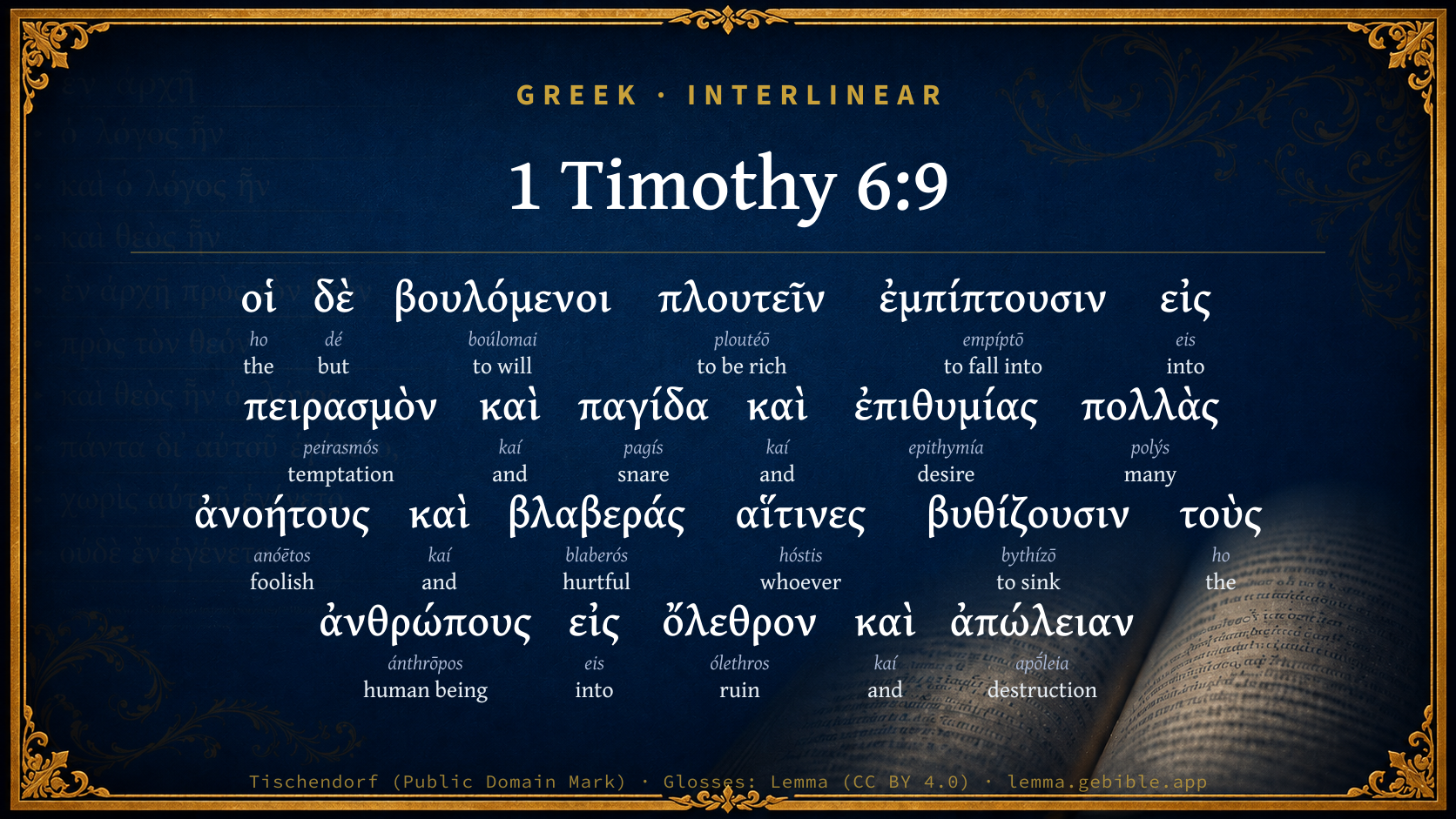
Download image
Cite this verse

1 Timothy 6:9 (World English Bible). Public Domain. Lemma interlinear Bible study tool, https://lemma.gebible.app/v/1-timothy/6/9.

Show BibTeX & RIS
BibTeX
RIS
English Translation
But those who are determined to be rich fall into a temptation and a snare and many foolish and harmful lusts, such as drown men in ruin and destruction.
World English Bible · Public Domain
Highlights
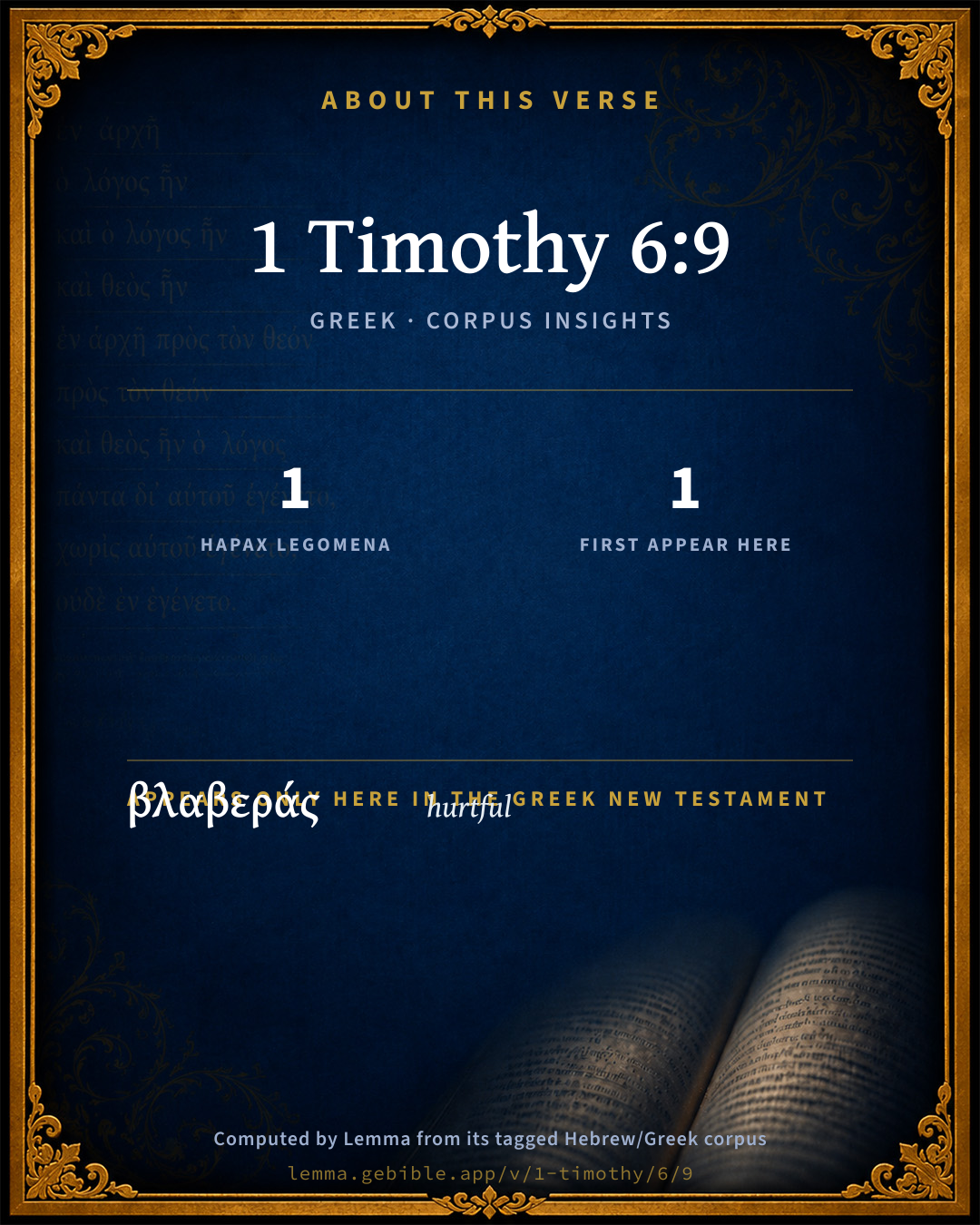
  • 1 hapax legomenon — only here in the Greek New Testament
  • 1 first appearance in the Greek New Testament
Full analysis ↓
Download a study sheet

One document with this verse’s original text, its word-by-word gloss line, the meaning frame, cross-references with their text, attributed commentary, and full source and license credits — printable, and it pastes into notes with its structure intact.

This verse Autodidact and up

Study sheet (.html) Plain text (.txt)

A passage Seminary Student

Up to 50 verses in one chapter. A passage sheet keeps up to 6 commentary sources and 12 cross-references per verse, in the order this page ranks them, and says so on the sheet whenever that leaves anything out. Ask for a single verse and you get the Autodidact verse sheet above.

Everything on this page stays free to read, with no account — the sheet is a download of what is already on screen, not access to it.

Want to remove ads? Support Godless Engineer
Compare translations 3

The same verse in 3 English versions, stacked beneath the original-language interlinear above. Click any original word for its lexicon entry.

Each is an independent rendering of the whole verse — the interlinear is not word-aligned to these translations.

Highlighted words mark where these versions differ — a whole-verse word diff, not a word-by-word alignment.

  • World English Bible Public Domain
    But those who are determined to be rich fall into a temptation and a snare and many foolish and harmful lusts, such as drown men in ruin and destruction.
  • King James Version Public Domain
    But they that will be rich fall into temptation and a snare, and into many foolish and hurtful lusts, which drown men in destruction and perdition.
  • unfoldingWord Literal Text CC BY-SA 4.0
    But the ones wanting to be rich fall into temptation and a trap and many foolish and harmful desires, whatever sinks men into ruin and destruction.

unfoldingWord Literal Text — © unfoldingWord, licensed CC BY-SA 4.0. Word-aligned USFM3 via Door43 (git.door43.org/unfoldingWord/en_ult).

Versions to compare (up to 4)

3 of 4 selected

Show all 19 translations

Every available English version of this verse, each an independent rendering of the whole verse.

  • World English Bible Public Domain
    But those who are determined to be rich fall into a temptation and a snare and many foolish and harmful lusts, such as drown men in ruin and destruction.
  • Berean Standard Bible Public Domain
    Those who want to be rich, however, fall into temptation and become ensnared by many foolish and harmful desires that plunge them into ruin and destruction.
  • Majority Standard Bible Public Domain
    Those who want to be rich, however, fall into temptation and become ensnared by many foolish and harmful desires that plunge them into ruin and destruction.
  • King James Version Public Domain
    But they that will be rich fall into temptation and a snare, and into many foolish and hurtful lusts, which drown men in destruction and perdition.
  • American Standard Version (1901) Public Domain
    But they that are minded to be rich fall into a temptation and a snare and many foolish and hurtful lusts, such as drown men in destruction and perdition.
  • Revised Version (1885) Public Domain
    But they that desire to be rich fall into a temptation and a snare and many foolish and hurtful lusts, such as drown men in destruction and perdition.
  • Geneva Bible (1599) Public Domain
    For they that will be rich, fall into tentation and snares, and into many foolish and noysome lustes, which drowne men in perdition and destruction.
  • Douay-Rheims (1899) Public Domain
    For they that will become rich, fall into temptation, and into the snare of the devil, and into many unprofitable and hurtful desires, which drown men into destruction and perdition.
  • Young's Literal Translation Public Domain
    and those wishing to be rich, do fall into temptation and a snare, and many desires, foolish and hurtful, that sink men into ruin and destruction,
  • Literal Standard Version CC BY-SA 4.0
    and those intending to be rich fall into temptation and a snare, and many desires, foolish and hurtful, that sink men into ruin and destruction,
  • Unlocked Literal Bible CC BY-SA 4.0
    Now those who want to become wealthy fall into temptation, into a trap. They fall into many foolish and harmful passions, and into whatever else makes people sink into ruin and destruction.
  • unfoldingWord Literal Text CC BY-SA 4.0
    But the ones wanting to be rich fall into temptation and a trap and many foolish and harmful desires, whatever sinks men into ruin and destruction.
  • Darby Bible Public Domain
    But those who desire to be rich fall into temptation and a snare, and many unwise and hurtful lusts, which plunge men into destruction and ruin.
  • World Messianic Bible Public Domain
    But those who are determined to be rich fall into a temptation, a snare, and many foolish and harmful lusts, such as drown men in ruin and destruction.
  • Webster's Bible Public Domain
    But they that will be rich, fall into temptation, and a snare, and into many foolish and hurtful lusts, which drown men in destruction and perdition.
  • Free Bible Version CC BY-SA 4.0
    Those who are determined to become rich fall into the trap of temptation, following many foolish and damaging impulses.
  • Bible in Basic English Public Domain
    But those who have a desire for wealth are falling into danger, and are taken as in a net by a number of foolish and damaging desires, through which men are overtaken by death and destruction.
  • Text-Critical English NT CC BY 4.0
    But those who wish to be rich fall into temptation and a snare, and into many senseless and harmful desires that sink people into ruin and destruction.
  • Tyndale New Testament (1534) Public Domain
    They that wilbe ryche faule into temptacion and snares and into many folysshe and noysome lustes which droune me in perdicion and destruccion.

Literal Standard Version (2020), Covenant Press — licensed CC BY-SA 4.0. Text via the HelloAO Bible API (eBible.org). Unlocked Literal Bible (unfoldingWord) — licensed CC BY-SA 4.0. Text via the HelloAO Bible API (eBible.org). unfoldingWord Literal Text — © unfoldingWord, licensed CC BY-SA 4.0. Word-aligned USFM3 via Door43 (git.door43.org/unfoldingWord/en_ult). Free Bible Version, Dr. Jonathan Gallagher — licensed CC BY-SA 4.0. Text via the HelloAO Bible API (eBible.org).

Word by word

More ways to search: Search by grammar → Find every occurrence → Compare this word →

Practice this passage: Drill this verse → Learn its vocabulary →

βλαβεράς
blaberós
G983
“hurtful”
Adjective, Accusative, Plural, Feminine
Part of Speech
Adjective
Case
Accusative
Number
Plural
Gender
Feminine
Full Thayer's Definition

Origin: from G984

TDNT: None

1. hurtful, injurious
  1. οἱ ho G3588 “the” Article, Nominative, Plural, Masculine
  2. δὲ dé G1161 “but” Conjunction
  3. βουλόμενοι boúlomai G1014 “to will” Verb, Present, Middle or Passive deponent, Participle, Nominative, Plural, Masculine
  4. πλουτεῖν ploutéō G4147 “to be rich” Verb, Present, Active, Infinitive
  5. ἐμπίπτουσιν empíptō G1706 “to fall into” Verb, Present, Active, Indicative, 3rd person, Plural
  6. εἰς eis G1519 “into” Preposition
  7. πειρασμὸν peirasmós G3986 “temptation” Noun, Accusative, Singular, Masculine
  8. καὶ kaí G2532 “and” Conjunction
  9. παγίδα pagís G3803 “snare” Noun, Accusative, Singular, Feminine
  10. καὶ kaí G2532 “and” Conjunction
  11. ἐπιθυμίας epithymía G1939 “desire” Noun, Accusative, Plural, Feminine
  12. πολλὰς polýs G4183 “many” Adjective, Accusative, Plural, Feminine
  13. ἀνοήτους anóētos G453 “foolish” Adjective, Accusative, Plural, Feminine
  14. καὶ kaí G2532 “and” Conjunction
  15. αἵτινες hóstis G3748 “whoever” Relative pronoun, Nominative, Plural, Feminine
  16. βυθίζουσιν bythízō G1036 “to sink” Verb, Present, Active, Indicative, 3rd person, Plural
  17. τοὺς ho G3588 “the” Article, Accusative, Plural, Masculine
  18. ἀνθρώπους ánthrōpos G444 “human being” Noun, Accusative, Plural, Masculine
  19. εἰς eis G1519 “into” Preposition
  20. ὄλεθρον ólethros G3639 “ruin” Noun, Accusative, Singular, Masculine
  21. καὶ kaí G2532 “and” Conjunction
  22. ἀπώλειαν apṓleia G684 “destruction” Noun, Accusative, Singular, Feminine

About this verse

These counts appear in no published source. They are computed here, from the morphology-tagged text and Lemma’s own curated glosses. What Lemma adds →

23
words
18
distinct lemmas
Pauline Epistles
section

Notable vocabulary

1 hapax legomenon — a word that appears only here in the entire Greek New Testament:

  • βλαβεράς hurtful G983

First appearance in Scripture

This word makes its first canonical appearance in the Greek New Testament here:

  • βλαβεράς hurtful G983

Shared distinctive vocabulary

βυθίζουσιν to sink G1036 occurs in 2 verses of the Greek New Testament. Also found in:
Repetition

Words recur within this verse:

Cross-references

36

Topical passages linked to 1 Timothy 6:9 in the Treasury of Scripture Knowledge — connected by theme and wording, ordered by reader-vote popularity; previews shown in the World English Bible.

  • 1 John 2:15–17 Don't love the world, neither the things that are in the world. If anyone loves the world, the Father's love isn't in him.
  • Proverbs 15:27 He who is greedy for gain troubles his own house, But he who hates bribes will live.
  • Proverbs 28:20–22 A faithful man is rich with blessings; But one who is eager to be rich will not go unpunished.
  • Acts 8:20 But Peter said to him, "May your silver perish with you, because you thought you could obtain the gift of God with money!
  • 1 Timothy 3:7 Moreover he must have good testimony from those who are outside, to avoid falling into reproach and the snare of the devil.
  • Mark 4:19 and the cares of this age, and the deceitfulness of riches, and the lusts of other things entering in choke the word, and it becomes unfruitful.
  • 2 Peter 2:3 In covetousness they will exploit you with deceptive words: whose sentence now from of old doesn't linger, and their destruction will not slumber.
  • Matthew 13:22 What was sown among the thorns, this is he who hears the word, but the cares of this age and the deceitfulness of riches choke the word, and he becomes unfruitful.
  • Ephesians 4:22 that you put away, as concerning your former way of life, the old man, that grows corrupt after the lusts of deceit;
  • James 5:1–4 Come now, you rich, weep and howl for your miseries that are coming on you.
  • Jude 1:11 Woe to them! For they went in the way of Cain, and ran riotously in the error of Balaam for hire, and perished in Korah's rebellion.
  • Numbers 22:17–19 for I will promote you to very great honor, and whatever you say to me I will do. Please come therefore, and curse this people for me.
  • Proverbs 1:17–19 For in vain is the net spread in the sight of any bird:
  • Proverbs 20:21 An inheritance quickly gained at the beginning, Won't be blessed in the end.
  • Proverbs 21:6 Getting treasures by a lying tongue Is a fleeting vapor for those who seek death.
  • Proverbs 22:16 Whoever oppresses the poor for his own increase and whoever gives to the rich, Both come to poverty.
  • Matthew 19:22 But when the young man heard the saying, he went away sad, for he was one who had great possessions.
  • 2 Peter 2:15–16 forsaking the right way, they went astray, having followed the way of Balaam the son of Beor, who loved the wages of wrong-doing;
  • Genesis 13:10–13 Lot lifted up his eyes, and saw all the plain of the Jordan, that it was well watered every where, before Yahweh destroyed Sodom and Gomorrah, like the garden of Yahweh, like the land of Egypt, as you go to Zoar.
  • Numbers 31:8 They killed the kings of Midian with the rest of their slain: Evi, and Rekem, and Zur, and Hur, and Reba, the five kings of Midian: Balaam also the son of Beor they killed with the sword.
  • Deuteronomy 7:25 The engraved images of their gods shall you burn with fire: you shall not covet the silver or the gold that is on them, nor take it to you, lest you be snared therein; for it is an abomination to Yahweh your God.
  • Joshua 7:11 Israel has sinned; yes, they have even transgressed my covenant which I commanded them: yes, they have even taken of the devoted thing, and have also stolen, and dissembled also; and they have even put it among their own stuff.
  • Joshua 7:24–26 Joshua, and all Israel with him, took Achan the son of Zerah, and the silver, and the mantle, and the wedge of gold, and his sons, and his daughters, and his oxen, and his donkeys, and his sheep, and his tent, and all that he had: and they brought them up to the valley of Achor.
  • 2 Kings 5:20–27 But Gehazi the servant of Elisha the man of God, said, Behold, my master has spared this Naaman the Syrian, in not receiving at his hands that which he brought: as Yahweh lives, I will run after him, and take somewhat of him.
  • Psalms 11:6 On the wicked he will rain blazing coals; Fire, sulfur, and scorching wind shall be the portion of their cup.
  • Proverbs 23:4 Don't weary yourself to be rich. In your wisdom, show restraint.
  • Isaiah 5:8 Woe to those who join house to house, Who lay field to field, until there is no room, And you are made to dwell alone in the midst of the land!
  • Hosea 12:7–8 A merchant has dishonest scales in his hand. He loves to defraud.
  • Amos 8:4–6 Hear this, you who desire to swallow up the needy, And cause the poor of the land to fail,
  • Zechariah 11:5 Their buyers slaughter them, and go unpunished. Those who sell them say, 'Blessed be Yahweh, for I am rich;' and their own shepherds don't pity them.
  • Matthew 26:15 and said, "What are you willing to give me, that I should deliver him to you?" They weighed out for him thirty pieces of silver.
  • Matthew 27:3–5 Then Judas, who betrayed him, when he saw that Jesus was condemned, felt remorse, and brought back the thirty pieces of silver to the chief priests and elders,
  • Luke 21:35 For it will come like a snare on all those who dwell on the surface of all the earth.
  • Acts 5:4–5 While you kept it, didn't it remain your own? After it was sold, wasn't it in your power? How is it that you have conceived this thing in your heart? You haven't lied to men, but to God."
  • 1 Timothy 1:9 as knowing this, that law is not made for a righteous man, but for the lawless and insubordinate, for the ungodly and sinners, for the unholy and profane, for murderers of fathers and murderers of mothers, for manslayers,
  • 2 Timothy 2:26 and they may recover themselves out of the devil's snare, having been taken captive by him to his will.

Cross-references courtesy of OpenBible.info (CC BY 4.0).

Commentary

Notes on 1 Timothy 6:9 from classic Christian and Jewish commentators (each source and its license shown beneath its notes). The classic Christian expositions comment on the surrounding passage and are grouped to its opening verse, so a note may address several verses; the Jewish commentaries on the Tanakh (Rashi and others) are per-verse, so they appear only where the commentator wrote on this verse.

Lemma curates 59 commentaries, every one of them public domain or Creative Commons licensed, each selected and text-cleaned for this edition rather than reprinted as found. About our sources →

The Biblical Illustrator

Joseph S. Exell

1Ti_6:9-11

But they that will be rich.

Covetousness

I. The dangers of this temper of mind are obvious.

1. It leads many to deception and dishonesty.

2. To get advantage to oneself is a false aim for any Christian life. If you know how insidious these and other perils are, you may well pray: Lead us not into temptation, but deliver us from evil.

II. Defences against such evils are within our knowledge, and many are finding moral security through using them.

1. Watch against the tendency to extravagant living. The absence of simplicity in some households leads to more evils than you think. Be brave enough to be simple in your habits. Seek to live without ostentation.

2. On the other hand, see to it that you do not bow down to worship the golden calf. No idolatry is more prevalent than this.

3. Cultivate love for higher things than the world offers. Good will conquer evil by its own inherent force.

4. Pray for the spirit of heroism in common life. (A. Rowland, LL. B.)

Temptation

A careful examination of our text will show that it is in no sense exclusive. Those addressed in it are not such as have riches, but such as want riches, and are determined, whether or no, to obtain them. By further consideration of the chapter you will see that the reference to such as would be rich in our text, is only made as an illustration of the great truth for which the apostle is endeavouring to find impressive utterance. He selected the simplest and commonest illustration. He might with equal truth have said: They that will be wise; they that will succeed; they that will get pleasure. I want to bring out into the light the general truth he illustrates, which appears to be this: There are certain kinds of character which are singularly exposed to the influence of temptation, and certain conditions of body and mind which seem to lay us open to the power of temptation. What Paul seems to say in our text, put into other words, is this: Those with this moral disposition, the wish to be rich, are, in consequence of that disposition, exposed to the force of peculiar temptations; and so he leaves us to infer that what is true of that particular state will apply to many other similar conditions. The laws which regulate our mental and spiritual natures can often be understood by the help of analogous laws which we observe to rule our bodily frames.

I. There are certain classes of character singularly exposed to temptation.

1. Strong-willed and ambitious men. These fall into temptation and a snare. From some points of view these strong-willed men may be regarded as the noble men of earth. They have a purpose in life, which holds in and guides, as with bit and bridle, all the forces of their being. They are the great men in our mills and warehouses; the foremost as statesmen, and in carrying out great social and national enterprises. Yet this disposition lays men open to peculiar dangers. It comes too often to be opposed to that spirit of contentment which the apostle here intimates is peculiarly suitable to godliness, and which is the result of a daily thaukful dependence on that living God, who giveth us all things richly to enjoy. Especially do we find that this strong-will is liable to become self-will. And if you observe these strong-willed men carefully, you will find they are sadly often falling into sin in relation to their dependents and servants; becoming imperious in their manners, forgetting the ordinary charities of social intercourse, and treating those who serve them as though they were an inferior kind of creature; which is, in the sight of the one God who made us all, a sad and mournful sin against the common brotherhood. They that will be anything fall thereby into temptation and a snare. If such is your disposition, remember, that is the side of your nature on which you are peculiarly exposed to danger. Do you then ask, May a Christian man be ambitious? May he say, I will--I will be rich; I will be great; I will be successful?--I reply, Yes, he may; but only when he can add, If God sees best. He may be ambitious if he can keep leaning on God all the while he pursues his ambitions.

2. Now, let us consider together two opposite classes of character--intense impulsive men, and inactive, sluggish men. These also fall into temptation and a snare. They are very liable to sins of commission. So feebly swayed by prudential considerations, they often do things which they live very greatly to regret. In connection with Christian life and work, they are exposed to the sins of discouragement and failing perseverance. They, too, often live a butterfly life, emptying the nectar from no flower on which they settle, but flying hither and thither from flower to flower, and gathering no stores of honey. They are like those streams which are only fed by mountain rains, or melting snows; they sometimes flow along in a very passion of excitement, but only for awhile; they soon subside; for weeks there is but a trick ling rill, and often the stones lie bleaching in the sun for months together. There are few things which do more injury to a Church than the ebb and flow of its hopes and efforts through the influence of its impulsive members. There are many of the opposite disposition. It is exceedingly difficult to arouse them at all. They seem to have no personal wills. They are always requiring to be urged and pressed. Such persons have their peculiar liabilities to temptation; mostly to sins of omission, the sins which come in connection with procrastination; sins arising from neglect of duty.

3. Only one other phase of character I will mention. Men who must have company. These also fall into temptation and a snare. God has set the solitary in families. It is not good that man should be alone. But you must have observed that this spirit possesses some men very much more than others. There are some who feel as if they could not live without company. They feel restless in their very homes if no one beside their family is found there. I do not say that, on the very face of it, this is wrong; but need I point out to you how perilous such a disposition becomes? Need I remind you how many have, through it, been led astray into drinking habits, and so ruined in heart and in home, in body and in soul?

II. There are certain times in a mans life when temptation has peculiar force. One of the wonderful discoveries of this scientific age is that of the successive changes through which our bodies pass in the course of our lives. Now, these bodily changes are very remarkably associated with our moral conditions; especially are they connected with the varying force of bodily passions. In some conditions of our frame, no temptation to the indulgence of any bodily lust would exert an effective power on us. In other conditions of our frame, the least exposure seems to involve our fall, we feel to be actually overtaken, overwhelmed. There are three periods of life in which, for the most part, men fall under the power of evil. Most men that fall, fall either into young mens peril, full-grown mens sins, or old mens sins. The devil never appears so much like an angel of light as when tie clothes himself to meet the rising passions of early manhood. A mourn ful proportion of our youth fall into temptation and a snare, and are drowned in destruction and perdition. Many a man has conquered the sins of youth, and then fallen before the sins of manhood. Sensual passion seems to acquire a new force then. The lust of gold. The thirst for position and fame urges men then. Men begin, for the most part, to be misers, or drunkards, or sensualists about this age. A hoary head is a crown of glory if it be found in the way of righteousness. Yet old age has its special evils. Temptations to those sins which the Bible gathers up in the word uncleanness. Often uncleanness of word and conversation; often, alas! of life and conduct also. It would appear that bodily lust and passion gathers itself in old age for one last struggle to gain the mastery. (R. Tuck, B. A.)

The love of money

You will notice, in the first place, the emphasis which is to be put upon the opening of this passage. They--not they that will be rich; because riches are ordained of God, and, rightly held and rightly used, are an instrument of most beneficent power, salutary to the possessor as well as the recipient of bounty--They that will be rich whether or not fall into temptation, etc. They are willing to give the whole force and power of their being; for they will have it. They are men who, because they will be rich, cannot be conscientious; and who learn soon to say that most beggarly of all things, A man cannot be a Christian and be in my business. How came you in it then? Yea, they have not time to cultivate refinement; they have not time for the amenities of life; they have not time for their household; they have not time for friendship; they have not time for love. And so, because they will be rich, they give up their heart also. And having given all these up, God blesses and blasts them: blesses, for they are rich, and that is what they call blessing; blasts, because it is not in the nature of God Himself, without an absolute change of the laws by which He works, to make a man happy who has, for the sake of gaining wealth, divested himself of those elements in which happiness consists. For what if the harp, in order to make itself blessed, should sell, first, its lowest base string, and then its next one, and then its next string, and then its next, and its next, until finally every string of the harp is sold? Then, when all the heaps of music are piled up before it, and it wants to play, it is mute. It has sold the very things out of which music must needs come. And men that will be rich give up sensibility, affection, faith, manhood, coining them all, emptying themselves: and when they get possession of their wealth, what is there left for them to enjoy it with? Their marrow is gone. There is no string in the harp on which joy can play. Not only will they who will be rich sacrifice everything, but they will not hesitate to do everything that is required--only, as men that will be rich require impunity, it must be safe. And so comes the long, detestable roe of mining, subterranean conduct, the secrecy of wickedness, collusions, plotting, unwhispered things, or things only whispered; that long train of webbing conduct which makes man insincere, pretentious hypocrites, whited sepulchres that are fair without, but that are inwardly full of death and dead mens bones. Men begin at first to make a little; they find how easy it is; they enlarge their ambition, and the conception dawns upon them, Why am not I one of those who are appointed to be millionaires. In the beginning of life, a few thousands would have satisfied their ambition. Now, hundreds of thousands seem to them but a morsel. They grow more and more intense. Temptations begin to fall upon them. You can no more make money suddenly and largely, and be unharmed by it, than a man could suddenly grow from a childs stature to a mans stature without harm. There is not a gardener who does not know that a plant may grow faster than it can make wood; that the cellular tissue may grow faster than the ligneous consolidation; and that then it cannot hold itself up. And many men grow faster in riches than they can consolidate. Men who are tempted to make money suddenly, are almost invariably obliged to traverse the canons of morality. Avarice in its earliest stages is not hideous, though at the bottom it is the same serpent thing that it is at last. In the beginning it is an artist, and the man begins to think, I will redeem my parents. Oh! I will repurchase the old homestead. Ah I will I not make my village to bud and blossom as a rose? How many things do men paint in the sky which clouds cover and winds blow away, and which fade out with the morning that painted them. But where do you find a man who begins to make money fast, that does not begin to have narrower, baser, and avaricious feelings? Such men begin to be tempted to believe that success atones for faults. Men are tempted as soon as they get into this terrific fire of avarice, to regard morality as of little avail compared with money-making. They are dazzled. You will recollect our Saviours words, The deceitfulness of riches. Men are snared when they are given up to fiery avarice. They are snared because the very things by which they propose to gain success become in the long run the means of their own destruction. Cheating is another snare. No man cheats once without cheating twice. Like a gun that fires at the muzzle and kicks over at the breach, the cheat hurts the cheater as much as the man cheated. Cheating is a snare, and will always be a snare. The cheater falls into it. Conceit is another snare. Men lose wisdom just in proportion as they are conceited. It is astonishing to see how conceited men are in power. I have noticed how soon those that will be rich at any hazard, fall into drinking habits. They have come into a sphere in which they begin to fall not simply into temptation and a snare, but into divers lusts. Now comes extravagance. With extravagance come many more mischievous lusts. And when you see a man given to licentious indulgence, you may be sure that he will come to want a crust. Mark that man. Poverty is on his track; and he shall be surely overcome and destroyed by it. We are not to understand that money is the root of all evil; but the love of it--bestowing that which we have a right to bestow only on undying and immortal qualities upon God, and angels, and men--bestowing love, idolatrously, upon material gain. It is not said that all evil springs from this cause; but at one time and another this may become the cause of all evil. It has corrupted in its time every faculty and every relation in which a man stands connected with his fellows. It has divided families, it has parted friendships, it has corrupted purity. The love of money, often, is stronger than the love of kindred. I observe that as men come into this, one of two things takes place; they forsake the house of God, they forsake religious society, because either they have no taste for it, or because it irritates them, or annoys them, and they will not bear the restraint or else, on the other hand, they betake themselves to religion because under certain circumstances, religion is an atonement for misconduct. It is a policy of life-insurance to men that are in iniquity. It is not, What is true? but, What will make me feel good while I am a wicked man? That they seek. They err from the faith. But now comes the solemn sentence, They pierce themselves through with many sorrows. I wish you could see what I have seen. A sword is merciful compared with the sorrows that pierce men with pain through life. You do not dare to adopt economic courses, because men would rush in on you, and take possession of you. And so men go under false appearances. How they suffer! Ah! if a man is going to be ruined, and has the testimony of his conscience that he has been an honest man, there is some alleviation to his suffering; but frequently it is a ruin carrying with it blight. Is it not a terrible thing to see a man, in the middle of life, count death better than life? Thank God, a man does not need to be very rich to be very happy, only so that he has a treasure in himself. A loving heart; a genuine sympathy; a pure unadulterated taste; a life that is not scorched by dissipation or wasted by untimely hours; a good sound body, and a clear conscience--these things ought to make a man happy. A man may be useful and not be rich. A man may be powerful and not be rich; for ideas are more powerful than even dollars. If God calls you to a way of making wealth, make it; but remember do not love money. If God calls you to make wealth, do not make haste to be rich; be willing to wait. If God calls you into the way of wealth, do not undertake to make yourself rich by gambling. (H. W. Beecher.)

The love of money

The passion exists under various modifications. In some few of its subjects, it appears to be pure, unmixed, exclusive; terminates and is concentrated upon just the money itself--(that is, the property) the delight of being the owner of so much. It is mine! so much I But, in much the greater number of instances, the passion involves a regard to some relative objects. In some it is combined with vanity; a stimulating desire of the reputation of being rich; to be talked of, admired, envied. In some it has very much a reference to that authority, weight, prevailing influence, in society, which property confers; here it is ambition rather than avarice. In some the passion has its incitement in an exorbitant calculation for competence. So much, and so much, they shall want; so much more they may want, for themselves or their descendants. So much more they should like to secure as a provision against contingencies. Some are avaricious from a direct dread of poverty. Amidst their thousands, they are haunted by the idea of coming to want. And this idea of danger, from being undefined, can always hover about a man, and force its way into his thoughts. So described, this spirit, possessing and actuating such a number of our fellow mortals, bears an ill and a very foolish aspect. Let us now specify a few of its evil effects, with a note of admonition on each of them. One obvious effect is--that it tends to arrogate, and narrow, and impel the whole action and passion of the soul toward one exclusive object, and that an ignoble one. Almost every thought that starts is to go that way. Silver and gold have a magnetic power over his whole being. The natural magnet selects its subject of attraction, and will draw only that; but this magnetism draws all that is in the little world of the mans being. Or it is an effect like that of a strong, steady wind; every thing that is stirred and moveable, that rolls on the ground, or floats on water or air, is driven in that one direction. If it were a noble principle--if it Were religion, that exerted over him this monopolizing and all-impelling power, what a glorious condition! The brief admonition upon this is, that if a man feel this to be mainly the state of his mind, it is a proof and warning to him that he is wrong. Observe, again, that this passion, when thus predominant, throws a mean character into the estimate of all things, as they are all estimated according to the standard of money-value, and in reference to gain. Thus another value which they may have, and, perhaps, the chief one, is overlooked, unseen, and lost. Again, this passion places a man in a very selfish relation to other men around him. He looks at them very much with the eyes of a slave-merchant. He cannot sell them, but the constant question is, What, and how, can I gain by them? When this principle has the full ascendency, it creates a settled hardness of character. The man lives, as to the kinder affections, in the region of perpetual ice. He is little accessible to the touches and emotions of sympathy; cannot give himself out in any generous expansion of the affections. And here observe, again, that the disposition in question operates, with a slow but continual effect, to pervert the judgment and conscience. It is constantly pressing the line that divides right from wrong; it removes it, bends it away, by slight degrees. The distinction becomes less positive to the judgment. Self-interested casuistry is put in operation. But it comes nearer to the object of Christian admonition to observe the operation of this evil principle in ways not incompatible with what may be called integrity. It withholds from all the generous and beneficent exertions and co-operations, in which pecuniary liberality is indispensable; and excites against them a spirit of criticism, exception, cavil, and detraction. They are sanguine, extravagant. This is not the time. They are unnecessary, impracticable. There are many evil consequences. It causes to forego opportunities for gaining a beneficial influence over mens minds. It puts an equivocal and inconsistent character on Providence. As to my own interests, Providence is not at all to be trusted--I must take the whole care on myself. We only add, it fatally counteracts and blasts internal piety, in all its vital sentiments. (J. Foster.)

The love of money

The love of money, says the apostle, is the root of all evil; not that all evils have, but that all may have, their root therein. Take a rapid glance of a fewer these, to which it certainly gives birth. And first, what root it is of idolatry; or rather it is not so much a root of this, as itself this idolatry--Covetousness, which is idolatry (Col_3:5). This sounds a hard saying, but it is one which can justify itself. For what is the essence of idolatry? Is it not a serving and loving of the creature more than the Creator; a giving to the lower what was due only to the higher, what was due only to Him who is the highest of all? And as this love of money disturbs the relations of men to God, drawing off to some meaner object affections due to Him, so it mingles continually an element of strife and division in the relations of men with one another. Again, what a root of unrighteousness, of untruthful dealing between man and man, of unfair advantage taken of the simple and the ignorant, of falsehood, fraud, and chicane, does the love of money continually show itself to be! And then--for time would fail me if I dwelt at large on all the mischiefs that spring from this, which even the heathen poet could style the accursed hunger of gold--what treading on the poor; what thrusting of them on unwholesome and dangerous occupations, with no due precautions taken for their health and safety; what shutting up of the bowels of compassion from the Lazarus lying at the gate; what wicked thoughts finding room in mens hearts, secret wishes for the death of those who stand between them and some coveted possession, have all their origin here. Consider, then, first, how powerless riches are against some of the worst calamities of our present life; how many of the sorrows which search men out the closest, which most drink up the spirit, these are utterly impotent to avert or to cure. Ask a man in a fit of the stone, or a victim of cancer, what his riches are worth to him; why, if he had the wealth of the Indies ten times told, he would exchange it all for ease of body, and a little remission of anguish. But why speak of bodily anguish? There is an anguish yet harder to bear, the anguish of the man whom the arrows of the Almighty, for they are His arrows, have pierced; who has learned what sin is, but has stopped short with the experience of the Psalmist, Day and night Thy hand is heavy upon me; my moisture is like the drought in summer (Psa_32:4), and never learned that there is also an atonement. What profits it such a one that all the world is for him, so long as he feels and knows that God is against him? Then, too, how often we see a man comparatively desolate in the midst of the largest worldly abundance. These considerations may do something; but take now another and a more effectual remedy against this sin. Let a greater love expel a less, a nobler affection supersede a meaner. Consider often the great things for which you were made, the unsearchable riches of which you have been made partakers in Christ; for coveteousness, the desire of having, and of having ever more and more, sin as it is, is yet the degeneration of something which is not a sin. Man was made for the infinite; with infinite longings, infinite cravings and desires. But finally, the habit of largely and liberally setting apart from our income to the service of God and the necessities of our poorer brethren is a great remedy against covetousness. (R. C. Trench.)

Fruit of covetousness--

(1) oppression:--The love of money is a root of every evil, and oppression is one of its many bitter fruits. The subject of this discourse is the multiform oppression of the poor, that results from a too eager pursuit of wealth. In ruder times, the rich often oppressed the poor in a very direct manner. When might took the place of right, they who had the power did not always take the trouble of covering their rapacity under legal forms. They kept back the labourers hire, or seized his patrimonial field, or enslaved his person, according to the measure of impunity which their circumstances permitted them to enjoy. In this country, and in the present day, such vulgar robbery cannot be perpetrated. Love of money, a spring in the heart, when one channel of issue is blocked up, will force its way by another. Accordingly, this passion as certainly, and perhaps we should say as extensively, oppresses the poor now, as in ruder nations at earlier times. The same native evil is compelled to adopt more refined modes of action: but the oppression may be as galling to the poor and as displeasing to God although it keep strictly within the letter of human law. I have no doubt the law of Christ is violated amongst us--thoughtlessly, in ignorance, and in company with a multitude, it may be--but still sinfully violated, to a most alarming extent, in connection with the money-making efforts of this mercantile community. You have seen a street thronged from side to side with human beings, men, women, and children, all moving in one direction. The mass moves like a river. If every one keep his own place and glide along with the current, the motion will be gentle and harmless. But two or three strong men in the midst of that crowd conceive a desire to proceed at a much quicker rate than their neighbours. Yielding to that impulse, they bound forward with might and main. Observe the effect of their effort. They press on the persons that are next them. If these be strong men too, the only effect will be to push them faster forward, and the greater pressure may be only a pleasant excitement. But the pressure extends on either side, and is felt even to the outer edge of the crowd. Wherever there is a woman, a child, or a cripple, the feeble goes to the wall. The person originating the pressure may not be in contact with that sickly passenger--there may be many persons between them; but the pressure goes through all the intermediate links, not hurting any till it come to one who is unable to bear it, and hurting the helpless. In such a crowd you may sometimes see the selfishness of human nature in all is undisguised odiousness. The man seeks his own advantage, heedless of the injury that his effort may inflict on others. He is not guilty of a direct deed of injustice. He would not lift his hand to strike the feeble; he would not illegally wrest away his property. He endeavours to act justly: nay, he sometimes opens his hand in charity to the distressed. But really, though indirectly, he is an oppressor. He wriggles forward, although his movements necessarily hurt the poor. He looks to his own things; and disregards the things of others. He breaks the law of Christ. The oppressions which abound in our day, as the fruits of covetousness, are chiefly of this nature. They are by no means so gross as the tyranny which the feudal lords of the Middle Ages exercised on their serfs; but they spring from the same source, and are essentially of the same character in the estimation of the Judge. I shall now enumerate and briefly illustrate some of the forms which oppression assumes in modern society.

1. The reduction of wages below the point at which a labouring man can support his family, or a woman support herself.

2. The labour of children is another evil more or less remotely an effect of the haste to be rich.

3. Sabbath labour is one of the oppressions that the prevalence of the money-interest inflicts upon mankind. It is an evil that cries loud to the Lord of Hosts.

4. Yet another oppression let me name--the poor are in a great measure cooped up in crowded lanes, and miserable houses. This is one bitter fruit of a general selfishness. Conceive the force operating now within this city in the direction of money-making. If all the energies that are expended in that direction were added, how vast would the sum of them be! I know not a speculation more interesting than this. It would represent a power which, if collected and united, and turned upon the citys filth, and poverty, and ignorance, would sweep them away, as the stream of a mighty river rolling down our streets would carry off the mire that accumulated on their surface. (W. Arnot.)

Fruit of covetousness--

(2) dishonesty:--

I. The path by which covetousness leads to dishonesty is marked off step by step by the apostle in the text.

1. They wilt be rich (verse 9). A class of persons are here characterized. They are described by the leading aim of their lives. It is not said what their religious profession was. Perhaps their belief was orthodox, and their zeal warm. All that we learn about them is, that in Gods sight money was their chief end. This is not a right--not a safe aim for an immortal being.

2. They fall into temptation. The word conveys the idea of an unexpected fall--a stumble into a pit which you did not expect to be there. If the real movement of a mans life be toward money, while he diligently keeps his face turned round to maintain the appearance of being a Christian, he will certainly fall into every pit that lies in his way. The motion, too, is uneasy. Those who set out in pursuit of riches, making no other profession, get on more smoothly.

3. They fall into temptation. A man does not all at once go into vicious practices. He glides, before he is aware, into a position where he is exposed to the pressure of a strong temptation. Those who have rightly measured their own strength will avoid persons and places that put it to a severe test. He that trusteth to his own heart is a fool.

4. A snare marks another stage of this downward progress. The man who has thoughtlessly and in foolhardiness placed himself in the way of temptation, is soon surrounded--the meshes of a net compass him about. He got easily in, but he finds it impossible to get out again. He has recourse to a false entry, a forgery, or some other of the thousand tricks that the wit of hard-pressed men has invented, and the complicated forms of business has served to conceal. Behold the desperate, helpless fluttering of the bird in the snare of the fowler--dashing itself on the sides of an iron cage!

5. The next step is into many foolish and hurtful lusts. These raging lusts are, as it were, watching, ready to fasten on their victim as soon as they see him in the toils of the net. You may have observed that a man whose pecuniary affairs are in a desperate position is peculiarly liable to fall into meaner vices. How frequently do the agonies and embarrassments that precede a shameful disclosure precipitate a man into the abyss of secret drunkenness! These lusts that covetousness leads to are foolish and hurtful; they pretend to cure, but they only deepen the wound. They apply a balsam that soothes the sore for a moment, but fixes disease more firmly in the flesh. I shall not trace this progress farther.

II. The dishonesty to which covetousness leads. Flee these things, but follow after righteousness. The vices that the love of money lands in are not named at length. In general, they are said to be foolish and hurtful. But the opposite graces are individually specified. The first on the list is righteousness. Of course, the opposite vice to which covetousness tends, and against which his warning is directed, is injustice. Righteousness is required in all our transactions--righteousness, not according to the conventional rules of society, which shift like the sand, but according to the immutable standard of the Divine law. The righteous Lord loveth righteousness. How many are at this day put to shame for detected dishonesty, who once would have resented the supposition of it as keenly and sincerely as you! I do not know your hearts: and what is more, you do not know them yourselves. One who does know them, however, testifies that they are deceitful above all things. Some forms of dishonesty, such as a false balance, that are prominently condemned in Scripture, we shall pass over without particular notice, because in modern society, though they still exist, they have been comparatively cast into the shade by other inventions. Dishonesty is obliged to hide itself now under more elaborate devices. I mean the adulteration of goods offered for sale by the mixture of other ingredients. A false representation to a customer as to the original cost of your wares, or the rate of your profit, is manifestly dishonest. Above all things, you who have others, especially young persons, employed in selling your goods, charge them to be true and honest. I speak now not for the purchasers, but for the salesmen. Breach of trust is a form of dishonesty alarmingly frequent in our day. Righteousness is one and unchangeable. It compasses about your mighty trafficking, and lays bonds on it, as completely and as easily as the smallest bargainings between a huckster and a peasant at the wayside: even as the same law with equal ease retains a little water in a cup, and the oceans wave within the oceans bed. (W. Arnot.)

Haste to be rich

Now, why should haste be condemned? for this is the voice of the Old Testament, not once or twice, but many times, either in direct terms or their equivalents. Why should haste to be rich be inveighed against, if riches are a great blessing? In the first place, riches may either be produced or collected. For the most part, the riches that bless men are the riches that are either produced, or are so improved by methods of ingenuity and industry that their service is much greater than it would be in the form of raw material. The foundation of all prosperity is production. The stone is good for nothing until it has been shaped. Now, the man that produces wealth is the foundation man. But that is a slow work. It is impossible to hasten nature very much. A man that could sow his wheat every night, and reap in the morning, would consider himself very fortunate and very happy. A man that, owning an iron mine, could draw metal as he did water from a fountain, and ship it abroad, would consider himself very fortunate. But a man can do neither. Man is the servant of the seasons. He sows in the autumn or spring. With long patience he waits, as James says, like the husbandman for the harvest; and little by little, and year by year, the man attains larger and larger means, greater competency, and, by and by, to riches; and any man that undertakes to run ahead of processes of this kind in producing runs against natural law. Natural, do we say? It is moral law, just as much as any other law. It is the law of the production of wealth, that a man should render an equivalent for every stage of value. Sudden wealth is not hasty wealth, necessarily; I am speaking of the production and development of riches. The production of wealth connects itself with benevolence, with sympathy. A man that manufactures agricultural implements receives a certain reward for that; but he is a benefactor; he abbreviates labour everywhere. What is left at the end of every year, that which was not necessary to maintain the conditions of life, is what we may call the permanent wealth of a man. It is a slow accumulation, taking the world at large. Collectors of wealth that other men have produced may get rich speedily and safely; but producers of wealth, by the very Divine law, must go patiently, and continue through long times. So he that makes haste to get rich is liable to fall into the violation of this fundamental law of equivalents--that is, into fraudulent ways. But every man that is developing or producing riches is, at the same time, educating himself in morals, or should be; for the fundamental conditions of increase lie in the man himself. So, the development of wealth requires time, not only from the nature of production, but also because God designed it to be an education in all the minor moral qualities--as, for example, in moderation, in industry, in temperance, in loyalty, in fidelity, in respect for others rights that co-operate with men; for in the immense complication of riches men are in partnership with men they never saw. Haste to be rich is also a great danger to men, because it tempts them to employ illegitimate means--sleights, crafts, disingenuous ways, greed, violations of honesty. Men have been fools to go through such long processes; they have taken these circuitous routes, and have had a superstitious observance of moralities; if they had the courage to go cross-lots they could come to the same results in less than half the time; and so they jump the boundary line, and run across the great roads that have been unfolded and developed by experience--and come to destruction. They think they are weaving cordage; but they are only running spiders webs up and down their ship; and the first storm will break and destroy the whole of them. A man, therefore, that is making haste to be rich is tempted to ostentation; for riches quickly earned are like new wine, which is strong. But ostentation is expensive, and there is many a man that is tempted to ostentation by the sudden increment of his riches, whether it be in houses, in lands, in equipage, in luxurious furnishings, in a sumptuous table, in yachts, in horses and hounds, in coaches, or what not. Men having sudden wealth are apt to become cruel through indifference to ether mens rights. There is such a thing as a society-robber. Then, too, anxiety, haste, is apt to change into idolatry; and the very ends which men have in life are neglected, and the mans wealth becomes as an idol which he worships. (H. W. Beecher.)

Peril in handling wealth

In Washington, U.S., recently, it was found that some lady clerks engaged in sorting bank bills in the Treasury department found sores breaking out on their face and hands, and were obliged to leave. This led to an inquiry, when it was found that the cause was the arsenic employed in the manufacture of the paper. I have known, says a journalist, a half-dozen cases where ladies have been compelled to resign their positions. There are three who were here six years before they were afflicted with sores. About three months ago they were so visited by them that they had to quit work. They have been away ever since, and the physicians certificate in each case says that their blood is poisoned with arsenic. This fact may be regarded as an illustration of the unnoticed peril sometimes lurking in handling wealth.

Wealth a fatal weight

At Long Branch, some visitors, strolling on the beach, observed a large fish hawk swoop down into the waters of the bay and strike its talons into a huge plaice. The bird rose with its prey, but its weight proved too great and dragged him down. Several times the bird struggled to ascend, but failed, and, exhausted, it finally fell into the water still clinging to its captive. Its talons were so embedded in the fish that it could not release them, and it was drowned. The fish died of its wounds, and both were washed ashore, where with difficulty they were separated. The death of the hawk in this effort to carry off its prize is typical of a disaster very common in life. Covetousness and avarice only too often prompt men to struggle for a great financial prize, and in the struggle they sacrifice honour, integrity, and sometimes even life, natural and eternal.

The Biblical Illustrator, edited by Joseph S. Exell (c. 1880s–1900s) — public domain. Text from a community e-Sword module.

The Preacher's Complete Homiletical Commentary

Joseph S. Exell (gen. ed.)

CRITICAL AND EXPLANATORY NOTES

1Ti_6:9. They that will be rich.—The cry of the day is against those who are rich; the danger is equally great for those who would be if they could,—a somewhat comprehensive saying. Which drown men.—The word is found again in Luk_5:7 only, to describe the swamping of the fishing-boats on Galilee.

1Ti_6:10. While some coveted after.—The word is the same as in 1Ti_3:1 is rendered “desire” or “seeketh.” The R.V. “reaching after” is more accurate. Many sorrows.—Sharp griefs; lit. “gnawing pains of remorse” (Blomfield). Ellicott denies that the word is derived from the Greek for a tooth. Grimm thinks they may have a common root.

MAIN HOMILETICS OF THE PARAGRAPH.—1Ti_6:9-10

Insatiable Avarice—

I. Has its root in the love of money.—“The love of money is the root of all evil” (1Ti_6:10). Not money, but the love of it, is the root of evil. Hence the warning, “If riches increase, set not thy heart upon them.” Money has been the bait that has enticed many astray. They ran well for a time, till, as in the fable of Atalanta, a golden ball was cast in their path, and, stooping to pick it up, they lost the race. The love of money kills all other love. Men have sold their consciences, their friends, their family, for pelf. Avarice degrades our manhood.

II. Weans the soul from the truth.—“Which while some coveted after, they have erred from the faith” (1Ti_6:10). Avarice is a master-passion which subdues and enthrals our better self. God is exchanged for gold, religion for money-getting. A relish for spiritual things cannot coexist with the love of lucre. Faith becomes dim in the presence of shining coins. An American millionaire was so enslaved with money-getting that he complained he was kept on the drive from morning to night. Wealth is a splendid opportunity for doing good, but to the best it is a dangerous temptation.

III. Curses the soul with the pangs of discontent.—“And pierced themselves through with many sorrows” (1Ti_6:10). The miser is in perpetual dread of poverty. The more he has the more he wants. Avarice is insatiable. Money cannot give health or happiness, nor can it prolong life by a single day. Cardinal Beaufort, Chancellor of England in the reign of Henry VI., as he lay dying exclaimed: “Wherefore should I die, being so rich? If the whole realm would save my life, I am able either by policy to get it or by riches to buy it. Fie! will not death be hired? Will money do nothing?” The miser is the most miserable of men, and of all men to be the most pitied.

IV. Plunges the soul into a course of sin that ends in perdition.—“Which drown men in destruction and perdition” (1Ti_6:9). Wealth leads to luxury, self-indulgence, and a host of sins that defile and then damn the soul. Few men can resist the allurements of sudden fortune: they plunge into excesses that soon end them, or their money. The bane of the avaricious man is often the instrument of his punishment. About the time the apostle was denouncing the sin of covetousness in this epistle, Seneca was decrying the same evil and composed his ethics; but as if to show the impotence of his own precepts, he was accused of having amassed the most ample riches—a circumstance that was no doubt the cause of his finally falling a victim to the jealousy and avarice of Nero.

Lessons.—

1. Avarice grows on what it feeds.

2. The sin of avarice is the parent of many other sins.

3. Avarice unfits the soul to appreciate the truth.

GERM NOTES ON THE VERSES

1Ti_6:9. The Danger of Riches.

I. Who are the rich?—

1. They who desire more than food and covering.

3. They who endeavour after more than food and covering.

3. They who lay up treasures on earth.

4. They who possess more of this world’s goods than they use according to the will of the donor.

5. They who delight in money.

II. Dangers of the rich.—

1. They enter into temptation.

2. They fall into silly and hurtful desires.

III. Duties of the rich.—

1. Gain all you Song of Solomon 2. Save all you Song of Solomon 3. Give all you Song of Solomon 4. All that is laid out in this manner is really given to God.—Wesley.

1Ti_6:10. The Love of Money—

I. Tends to arrogate and narrow and impel the whole action and passion of the soul toward one exclusive object, and that an ignoble one.

II. Throws a mean character into the estimation of all things.—They are all estimated according to a standard of money-value, and in reference to gain.

III. Places a man in a very selfish relation to other men around him.

IV. Creates a settled hardness of character.

V. Operates with a slow but continual effect to pervert the judgment and conscience.—J. Foster.

The Preacher's Complete Homiletical Commentary (gen. ed. Joseph S. Exell; Funk & Wagnalls, c. 1892) — public domain (pre-1929). A full-Bible homiletical/sermon-outline anthology covering 65 of 66 books (2 John is absent from the source module). Text from a community e-Sword module.

Bengel's Gnomon

Johann Albrecht Bengel

1Ti 6:9. Βουλόμενοι, wishing) This wish is the enemy of a mind contented with its lot; it is not the wealth itself (that is the enemy of contentment): rich men are not therefore commanded to cast away their wealth, 1Ti 6:17-18.—πλουτεῖν, to be rich) to have more than food and clothing.—ἐμπίπτουσι—βυθίζουσι, fall into—drown) A sad gradation.—πειρασμὸν) There is a Paronomasia [the signification of a word changed by a slight change of the letters]: πορισμὸς, πειρασμὸς. Temptation is opposed to ‘food,’ likewise to faith: a snare is opposed to ‘clothing’ and to righteousness: ‘lusts’ are opposed to “a contented mind.”—παγίδα, a snare) Therefore they do not find πόρον, true gain.—ὄλεθρον, destruction) of the body.—ἀπώλειαν, perdition) also of the soul: comp. of all, 1Ti 6:10. This is opposed to that expression, great gain, 1Ti 6:6.

Bengel's Gnomon of the New Testament — English translation (T&T Clark, Edinburgh, 1860) — public domain. Text from a community e-Sword module.

Meyer's Critical & Exegetical Commentary

Heinrich August Wilhelm Meyer

1Ti_6:9. Οἱ δὲ βουλόμενοι πλουτεῖν] δέ expresses opposition to what immediately preceded. πλουτεῖν is properly not become rich, but be rich.

ἐμπίπτουσιν (cf. 1Ti_3:7) εἰς πειρασμὸν καὶ παγίδα] De Wette explains it inaccurately: to whom enticing opportunities present themselves for unrighteous gain. In ἐμπίπτειν is contained the indication of the power which the πειρασμός (the temptation to enrich oneself unrighteously) exercises over them.

By παγίδα the πειρασμός is defined to be a power fettering and taking prisoner.

καὶ ἐπιθυμίας πολλὰς ἀνοήτους καὶ βλαβεράς] This is the consequence immediately connected with what precedes: by falling into πειρασμός, they fall into many foolish and hurtful lusts, i.e. these lusts are not only excited in them, but gain power over them. Thus the seductive power of the πειρασμός can be recognised in the ἐπιθυμίαις. These are also ἀνόητοι, because instead of the gain which was expected to come from satisfying them, they bring hurt only.

αἵτινες (explanatory: such as) βυθίζουσι εἰς ὄλεθρον καὶ ἀπώλειαν] βυθίζειν; in the literal sense at Luk_5:7; 2Ma_12:4.

Destruction is likewise the deep into which they are plunged by their desires. The expression is strengthened by bringing together the two synonymous ideas. There is no ground for van Oosterzees conjecture that ὄλεθρος denotes the destruction of the body, ἀπώλεια the destruction of the soul. De Wette incorrectly explains the words of moral ruin, against which Wiesinger justly observes: they are in that already. ὄλεθρος stands here as in 1Th_5:3, 2Th_1:9 (ὄλεθρος αἰώνιος); ἀπώλεια, as in Php_1:28 (opp. ἡ σωτηρία), Php_3:19, and other passages.

There is no good ground (with Olshausen in Wiesinger) for understanding ὄλεθρος exclusively of temporal destruction.

Meyer — Critical and Exegetical Commentary on the New Testament — English translation by Peter Christie, edited by Frederick Crombie (T&T Clark, 1880) — public domain. Text from a community e-Sword module.

Expositor's Greek Testament

ed. W. Robertson Nicoll

1Ti 6:9 . οἱ δὲ βουλόμενοι : St. Chrysostom calls attention to the fact that St. Paul does not say, They that are rich , but They that desire to be rich (R.V.), they that make the acquisition of riches their aim. The warning applies to all grades of wealth: all come under it whose ambition is to have more money than that which satisfies their accustomed needs. We are also to note that what is here condemned is not an ambition to excel in some lawful department of human activity, which though it may bring an increase in riches, develops character, but the having a single eye to the accumulation of money by any means. This distinction is drawn in Pro 28:20 : “A faithful man shall abound with blessings: But he that maketh haste to be rich shall not be unpunished”.

ἐμπίπτουσιν . Wetstein notes the close parallel in the words of Seneca: “Dum divitias consequi volumus in mala multa incidimus” ( Ep . 87). Cf. also Jas 1:2 , πειρασμοῖς περιπέσητε ποικίλοις . πειρασμόν refers rather to the consequencess of one’s money-grubbing spirit on others, παγίδα to its disastrous effect on one’s own character.

ἀνοήτους καὶ βλαβεράς : The desires in question are foolish, because they cannot be logically defended; they are hurtful, because they hinder true happiness. See Pro 23:4 , “Weary not thyself to be rich”.

αἵτινες : qualitative, such as .

βυθίζουσιν : The word is found in its literal signification in Luk 5:7 . Moulton and Milligan ( Expositor , vii., vi. 381) illustrate its use here from a papyrus of cent. 1 B.C., συνεχέσι πολέμοις καταβυθισθεῖ [ σαν ] τὴν πόλιν . Bengel notes on ἐμπίπτ . βυθίζ ., “ incidunt: mergunt . Tristis gradatio.” We must not lose sight of εἰς . Destruction and perdition are not, strictly speaking, the gulf in which the men are drowned. The lusts, etc., overwhelm them; and the issue is destruction , etc. See reff. on ἀπώλειαν .

The Expositor's Greek Testament, edited by W. Robertson Nicoll (1897–1910) — public domain. Text from a community e-Sword module.

Geneva Bible (1599)

Geneva Bible translators

He frayeth Timothy from covetousness after another sort, to wit, because it draweth with it an infinite sort of lusts, and those very hurtful, wherewith covetous men do torment themselves so far forth, that in the end they cast away from them their faith and salvation.

Geneva Bible (1599) marginal notes — public domain. Text via Bolls.life.

Jamieson, Fausset & Brown

Robert Jamieson, A. R. Fausset & David Brown

will be rich--have more than "food and raiment." Greek, "wish to be rich"; not merely are willing, but are resolved, and earnestly desire to have riches at any cost (Pro 28:20, Pro 28:22). This wishing (not the riches themselves) is fatal to "contentment" (Ti1 6:6). Rich men are not told to cast away their riches, but not to "trust" in them, and to "do good" with them (Ti1 6:17-18; Psa 62:10).

fall into temptation--not merely "are exposed to temptation," but actually "fall into" it. The falling into it is what we are to pray against, "Lead us not into temptation" (Jam 1:14); such a one is already in a sinful state, even before any overt act of sin. The Greek for "temptation" and "gain" contains a play on sounds--porasmus, peirasmus.

snare--a further step downwards (Ti1 3:7). He falls into "the snare of the devil."

foolish--irrational.

hurtful--to those who fall into the snare. Compare Eph 4:22, "deceitful lusts" which deceive to one's deadly hurt.

lusts--With the one evil lust ("wish to be rich") many others join themselves: the one is the "root of all evils" (Ti1 6:10).

which--Greek, "whatever (lusts)."

drown--an awful descending climax from "fall into"; this is the last step in the terrible descent (Jam 1:15); translated "sink," Luk 5:7.

destruction . . . perdition--destruction in general (temporal or eternal), and perdition in particular, namely, that of body and soul in hell.

Jamieson, Fausset & Brown — Commentary Critical and Explanatory on the Whole Bible (1871) — public domain (CC PDM 1.0). Text via the HelloAO Bible API.

Adam Clarke's Commentary

Verse 9. But they that will be rich] οι δε βουλομενοι πλουτειν. The words are emphatic, and refer to persons who are determined to get riches; who make this their object and aim in life; who live to get money; who get all they can, save all they can, and keep all they get; and yet are apprehensive of no danger, because they seek to be rich by honest means; for it is likely that the apostle does not refer to those who wish to get riches by robbery, plunder, extortion, c.

By the term rich it is very likely that the apostle refers to what he had said above: Having food and raiment, let us be therewith content. He that has more than these is rich in the sense in which the apostle uses the term.

Fall into temptation and a snare] του διαβολου, Of the devil, is added by D*FG, Vulgate, Itala, and many of the fathers. It is in consequence of the temptation of the devil that they have determined to be rich this temptation once received, others quickly succeed: and when they have swallowed down the temptation to the thing, then they drink in a thousand temptations to the means; and all these lead them εις παγιδα, into an unforeseen and concealed trap. παγις signifies a net, trap, gin, snare, springe, or pit dug in the ground filled with sharp stakes, and slightly covered over; so that when a man, or any animal, steps upon it, he tumbles in, and is taken or destroyed. Such a snare is that into which those who will be rich must necessarily fall. But who will believe this? See note on 1Ti 6:10.

And into many foolish and hurtful lusts] The whole conduct of such a person is a tissue of folly; scraping, gathering, and heaping up riches, and scarcely affording to take the necessaries of life out of them for himself. These lusts or desires are not only foolish, but they are hurtful; the mind is debased and narrowed by them; benevolent and generous feelings become extinct; charity perishes; and selfishness, the last and lowest principle in mental degradation, absorbs the soul; for these foolish and hurtful lusts drown men in destruction and perdition-the soul is destroyed by them here, and brought through them into a state of perdition hereafter. The apostle considers these persons like mariners in a storm; by the concurrence of winds, waves, and tide, they are violently driven among the rocks, the vessel is dashed to pieces, and in a moment they are all ingulfed in the great deep! Such is the lot and unavoidable catastrophe of them that will be rich, even though they should strive to accomplish their desires by means the most rigidly honest.

In this place I beg leave to refer the reader to a sermon on this text by the late Rev. JOHN WESLEY, in which the whole of this subject is treated by the hand of a master; and, for usefulness, the sermon is superior to every thing of the kind ever published. It is entitled, The Danger of Riches; and is found in his WORKS, Vol. 2, page 248, American edit.

Adam Clarke's Commentary on the Bible (1810–1826) — public domain. Text from a community e-Sword/MySword module.

John Calvin's Commentaries

9 They who wish to be rich After having exhorted him to be content, and to despise riches, he now explains how dangerous is the desire of having them, and especially in the ministers of the Church, of whom he expressly speaks in this passage. Now the cause of the evils, which the Apostle here enumerates, is not riches, but an eager desire of them, even though the person should be poor. And here Paul shews not only what generally happens, but what must always happen; for every man that has resolved to become rich gives himself up as a captive to the devil. Most true is that saying of the heathen poet, — “He who is desirous of becoming rich is also desirous of acquiring riches soon.” Hence it follows, that all who are violently desirous of acquiring wealth rush headlong.

Hence also those foolish, or rather, mad desires, which at length plunge them into perdition. This is, indeed, a universal evil; but in the pastors of the Church it is more easily seen; for they are so maddened by avarice, that they stick at nothing, however foolish, whenever the glitter of gold or silver dazzles their eyes.

John Calvin's Commentaries (1540-1563) — public domain. Text from the Calvin Translation Society English edition (1840s-50s) via the Christian Classics Ethereal Library (ccel.org). Calvin's coverage is partial (roughly two-thirds of the Bible); uncommented books and verses are honest gaps, never fabricated. The 19th-century editor's footnotes and remarks are omitted so the notes are faithfully Calvin's own voice.

Ellicott's Commentary for English Readers

(9) But they that will be rich.—Here St. Paul guards against the danger of his words being then or at any future time misinterpreted by any dreamy, unpractical school of asceticism, supposing that voluntary poverty was a state of life peculiarly pleasing to the Most High—the strange mistake upon which the great Mendicant orders were organised in the Middle Ages. Those who exposed themselves to the winning temptations and deadly sins he was about to speak of were not “the rich,” but those who longingly plan to be rich.

Fall into temptation.—Those longing to be rich will fall into the temptation to increase their worldly goods, even at the sacrifice of principle. Some unlawful method of gratifying their passion for gain will present itself; conscientious scruples will be thrown to the winds, and they who wish to be rich will fall into the temptation. We pray so often His prayer, “Lead us not into temptation.” In the same hour we long—perhaps even with the same breath we pray—that our worldly means may be increased, our position bettered, little thinking that the longing for an increase of riches and position will lead us into the most dangerous of all temptations!

And a snare.—A very tangle, as it has been well called, of conflicting motives—each fresh gratification of the ruling passion, perhaps excused under the plausible names of industry, home claims, praiseworthy and healthy enterprise, entangling the unhappy soul more completely.

And into many foolish and hurtful lusts.—The lusts or desires into which those who long to be rich fall, are well named “foolish,” because in so many instances they are passionate desires for things utterly undesirable, the possession of which can afford neither pleasure nor advantage—such, for instance, is the love of hoarding wealth, so common to those men who have longed for and obtained riches; and “hurtful” often to the body as well as to the soul do these rich find their “longings,” when gratified.

Which drown men in . . .—Better rendered, which plunge men into . . .

Destruction and perdition.—“Destruction” refers rather to wreck and ruin of the body, whilst “perdition” belongs rather to that more awful ruin of the eternal soul. The gratification of desires, whether these desires are centred in the lower animal passions of the table, or in the pursuit of yet baser and more selfish passions still, invariably leads to the destruction of the poor frail human body first. This premature breaking up of the earthly tabernacle is the herald and precursor of the final perdition of the immortal soul.

A Bible Commentary for English Readers, edited by Charles John Ellicott (1878–1897) — public domain. Text from a community e-Sword module.

The Cambridge Bible for Schools and Colleges

gen. ed. J. J. S. Perowne

9. they that will be rich] In so wealthy a city as Ephesus the temptation would be very great to the teacher to adapt his ‘wares’ of doctrine to the popular Asiatic speculations, so as to get and keep name and means; and his hearers would be equally tempted to accept such a compromise. There would be the genius loci to whisper ‘si possis, recte; si non, quocunque modo, rem;’ ‘ye know that by this business we have our wealth.’ Hence the specially appropriate warning now addressed to those that are desiring to be rich, as we must render exactly. Chrysostom’s words ‘not “the rich,” for one may have money and dispense it well and disesteem it all the while,’ are well quoted here. But G. Herbert’s words are still better (Priest to the Temple, c. 3), ‘The country parson is very circumspect in avoiding all covetousness, neither being greedy to get, nor niggardly to keep, nor troubled to lose any worldly wealth; but in all his words and actions slighting and disesteeming it, even to a wondering that the world should so much value wealth, which in the day of wrath hath not one dram of comfort for us.’

temptation and a snare] There seems no reason to depart from the usual rendering elsewhere of the phrase ‘into temptation’ as R.V. does ‘into a temptation,’ because of the words coupled with it; ‘a snare’ naturally follows, just as ‘deliver us from the evil one’ follows ‘bring us not into temptation,’ Mat_6:13; it is the thought present to the Apostle’s mind at this time; see above 1Ti_3:7, ‘lest he fall into reproach and the snare of the devil’ where the conjunction of words is very similar, and from whence some mss. have even added here ‘of the devil;’ and 2Ti_2:26, ‘that they may recover themselves out of the snare of the devil.’ See Appendix, K.

lusts, which drown men] The lengthened generalised relative here is properly ‘of a kind which,’ ‘which indeed naturally,’ so R.V. such as. Cf. 1Ti_3:15. The simple use of the passive of ‘drown’ in Luk_5:7, ‘they were being sunk,’ is the only other N. T. use of the verb; the noun from which it comes is used by St Paul of his (unrecorded) shipwreck, 2Co_11:25, ‘a night and a day I have been in the deep.’

destruction and perdition] The two words give solemnity to the idea of the ruin to be incurred, though it is too much to assign ‘ruin of body’ to the one and ‘ruin of soul’ to the other. The compound word is instinctively chosen (see 1Ti_6:8) to complete the terrible picture.

Chrysostom gives many instances of these ‘snares and lusts’ in his day leading to ‘destruction and perdition.’ To the example (almost forced upon the memory by the word) from Holy Scripture itself of ‘the son of perdition’ (Joh_17:12), may well be added G. Herbert’s searching words to his brethren; ‘they, who, for the hope of promotion, neglect any necessary admonition or reproof sell (with Judas) their Lord and Master.’ The Priest to the Temple, ch. 2.

The Cambridge Bible for Schools and Colleges (gen. ed. J. J. S. Perowne; Cambridge University Press, 1878–1918) — public domain. Text from a community e-Sword module.

John Gill's Exposition

But they that will be rich,.... Not they that are rich; for some rich men are good men; and do much good with their riches; and are as free from temptations and snares, and foolish and hurtful lusts, as other persons, as Abraham, Joseph of Arimathea, Gaius, and others were; but such that would be rich, who labour after, make haste for it, and are resolved upon it, at any rate, right or wrong, as there be thousands, who never attain to it; so that the apostle does not point at rich men particularly, but at such who are determined to be rich, whether they ever are so or not: these

fall into temptation; not in such sense in which the phrase is used in Jam 1:2 but in such sense as Christ uses it, Mat 6:13 namely, a falling into temptation to sin, so as to be drawn away by it, and overcome with it:

and a snare; the Vulgate Latin version reads, "the snare of the devil", and so Beza's Claromontane copy; which perhaps is taken from Ti1 3:7, and though this seems not to be the genuine reading, yet it may give the true sense: Satan may be compared to a fowler; his temptations to sin are his nets and snares; and they that will be rich, are the birds that are caught and entangled therein, out of which sometimes it is impracticable to extricate themselves:

and into many foolish and hurtful lusts; carnal and worldly lusts, the lusts of the flesh, the lust of the eye, and the pride of life, which are the things that are in the world and draw the affections to them; yea, what sin is there but such persons may, and do fall into; as defrauding of the neighbour, oppressing the poor, lying, perjury, theft, murder, rapine, violence, and injustice of every kind? so that they may be said to be "many", and some of them are "foolish". All sin is folly, and every wicked man is a foolish one, and acts a part quite contrary to reason; but some evil ways are notoriously silly, weak and foolish, and which they that will be rich make use of to get money; though others of them are sly and artful enough, and all of them are "hurtful" to their credit and reputation, or to the health of their bodies, and especially to the welfare of their immortal souls. So the phrase , "their foolish lust", is used by the Targumist in Eze 20:25 and the corruption of nature in general is by the Jews called the old and foolish king, in Ecc 4:13. They ask (p),

"why is he called a king? because all obey him; why is he called old? because he is joined to him (a man) from his birth to his old age; and why is he called "foolish?" because he teaches him an evil way, which he knows not how to warn him of again.''

Which drown men in destruction and perdition; that is, in utter ruin, in the ruin both of soul and body; and which is irrecoverable, like that of the drowning of a man in the sea, with a millstone about his neck; such folly and danger do those expose themselves to, who will be rich at any rate.

(p) Midrash Kohelet, fol. 70. 2.

John Gill's Exposition of the Whole Bible (1746–1763) — public domain (CC PDM 1.0). Text via the HelloAO Bible API.

Trapp's Complete Commentary

John Trapp

9 But they that will be rich fall into temptation and a snare, and into many foolish and hurtful lusts, which drown men in destruction and perdition.

Ver. 9. But they that will be rich] That are resolved to have it, howsoever- rem, rem, quocunque modo rem. {a} "He that hasteth to be rich shall not be innocent," Pro 28:20.

And a snare] As the panther, which so loveth man’s dung, that if it be hanged a height from it, it will leap, and never leave it till it have burst itseff in pieces to get it.

Drown men in destruction and perdition] Ita demergunt ut in aquae summitate rursus non ebulliant, So as they never show themselves above water any more. {b} We read of the inhabitants of Oenoe, a dry island beside Athens, that they bestowed much labour to draw into it a river to water it, and make it more fruitful. But when all the passages were opened, and the receptacles prepared, the water came in so plentifully, that it overflowed all; and at the first tide drowned the island and all the people. So fareth it with many covetous caitiffs, (wretches) who seem to be of Nevessan the lawyer’s mind, "He that will not venture his body shall never be valiant; he that will not venture his soul shall never be rich." Hubertus, an English cormorant, made this will: I yield my goods to the king, my body to the grave, my soul to the devil. How much better Aristippus and Crates the Theban, with their Hinc abite malae divitiae: satius enim eat a me vos demergi, &c.: they threw their riches into the sea, saying, Hence, hence, base trash! better we drown you in the sea than that you should drown us in perdition and destruction. Plutarch reports of one Philoxenus, that finding his heart too fast affected to his wealth, he made away with it; and said, nay, swore, that he would part with it rather than be undone for ever by it. {c} Christians have a better way to dispose of their riches than to throw them away, Psa 16:3; Luk 16:9. But many rich wretches do as Heliogabalus did, who provided silken halters to hang himself withal, ponds of sweet water to drown himself with, gilded poisons to poison himself with, rather than to fall into the hands of his enemies. So do these strangle, drown, poison their precious souls with profits, pleasures, and preferments, &c., and many times meet with perdition and destruction, that is, with a double destruction, temporal and eternal, as some expound it.

{a} Divis qui fieri vult, et cito vult fieri. Juv.

{b} βυθιζουσι, such a drowning as is desperate.

{c} μα ατους θεους εμε, ταυτα, τα αγαθα ουκ απολει, αλλ’ εγω τυτα. Plut.

John Trapp, A Commentary or Exposition upon All the Books of the Old and New Testament (1647–1656) — public domain. Text from a community e-Sword module.

Albert Barnes' Notes on the Bible

But they that will be rich - Further to enforce the duty of contentment, the apostle refers to some of the evils which necessarily attend a desire to be rich. Those evils have been so great and uniform in all ages, and are so necessary accompaniments of that desire, that, even amidst many inconveniences which may attend the opposite condition, we should he contented with our lot. Indeed, if we could see all, it would only be necessary to see the evils which the desire of wealth produces in the world, to make us contented with a most lowly condition of life. Perhaps nothing more would be necessary to make a poor man satisfied with his lot, and grateful for it, than to be acquainted with the perplexities and cares of a rich man. There is more emphasis to be placed on the word will, here, in the phrase, “will be rich,” than might be supposed from our translation. It is not the sign of the future tense, but implies an actual “purpose” or “design” to become rich - οἱ βουλόμενοι hoi boulomenoi. The reference is to those in whom this becomes the object of earnest desire, and who lay their plans for it.

Fall into temptation - That is, they are tempted to do wicked things in order to accomplish their purposes. It is extremely difficult to cherish the desire to be rich, as the leading purpose of the soul, and to he an honest man.

And a snare - Birds are taken in a snare, and wild beasts were formerly; see the notes on Job 18:8-9. The net was sprung suddenly upon them, and they could not escape. The idea here is, that they who have this desire become so entangled, that they cannot easily escape. They become involved in the meshes of worldliness and sin; their movements are so fettered by cares, and inordinate desires, and by artificial needs, that they are no longer freemen. They become so involved in these things, that they cannot well break away from them if they would; compare Pro 28:20.

And into many foolish and hurtful lusts - Desires, such as the love of wealth creates. They are foolish - as being not such as an intelligent and immortal being should pursue; and they are hurtful - as being injurious to morals, to health, and to the soul. Among those desires, are the fondness for display; for a magnificent dwelling, a train of menials, and a splendid equipage; for sumptuous living, feasting, the social glass, company, and riotous dissipation.

Which drown men in destruction and perdition - The word which is here rendered, “drown” - βυθίζω buthizō - means, to “sink in the” deep, or, “to cause to sink;” and the meaning here is, that they become submerged as a ship that sinks. The idea of drowning is not properly that of the apostle, but the image is that of a wreck, where a ship and all that is in it go down together. The destruction is complete. There is a total ruin of happiness, of virtue, of reputation, and of the soul. The ruling desire to be rich leads on a train of follies which ruins everything here, and hereafter. How many of the human family have thus been destroyed!

Albert Barnes' Notes on the Bible (1834–1885) — public domain. Text from a community e-Sword/MySword module.

Haydock's Catholic Bible Commentary

For they who wish to become rich.[4] He does not say, as St. John Chrysostom observes, they who are rich; as persons may be rich, and make good use of their riches to God’s honour, and the good of others. But such as would be rich, who see riches, and have their heart and affections upon riches, fall into various temptations of injustice, of pride, and vanity, into hurtful lusts, which drown and plunge[5] men into perdition, &c. (Witham)

===============================

[BIBLIOGRAPHY]

Qui volunt divites fieri, Greek: oi boulomenoi. St. John Chrysostom, (Greek: log. iz. p. 321.) Greek: ouk aplos eipen, oi ploutountes, all oi boulomenoi.

===============================

[BIBLIOGRAPHY]

Mergunt, Greek: buthizousi.

George Leo Haydock (1774–1849), Haydock's Catholic Family Bible and Commentary, 1859 edition — public domain. Excludes Psalms (Douay-Rheims chapter numbering differs from Protestant) and Deuterocanonical books (Catholic canon only).

Matthew Poole's English Annotations

But; or, for.

They that will be rich; they who, out of a covetous and immoderate desire of being rich in this world’s goods, will use any arts, and do any unlawful thing, without any just regard to the law of God.

Fall into temptation and a snare; fall into many temptations and snares, are exposed to impetuous inclinations and motions to that which is evil, and may and will be snares to their souls.

And into many foolish and hurtful lusts; kindling in them many foolish and pernicious desires, contrary to the law of God.

Which drown men in destruction and perdition; have a direct tendency to the eternal ruin of their souls, not to be prevented but by the force and powerful grace of God.

Matthew Poole's English Annotations on the Holy Bible (1683–1685) — public domain. Text from a community e-Sword/MySword module.

Whedon's Commentary on the Bible

Daniel D. Whedon

9. That will—That is, determine to be rich; who say, “At all events, honestly if I can, yet certainly, I will be rich.” The certainly will often dismiss the honestly.

Fall into temptation—Inducements seduce their will at every turn to get gain at the price of godliness. These inducements in an age of trade and successful venture are stupendous. Men are tempted with a million or half million which can be secretly pocketed; and even if known, the contempt for their dishonesty can be braved for such a price; or it can be dazzled away by the splendid display of the successful knave.

A snare—But, alas! the great man is caught, a victim in a net, in a trap; and by whom it is set is significantly hinted in 1Ti_3:7.

Hurtful lusts—The wealth acquired induces free gratification of appetites; luxuries, revelries, excesses, which call for gain to sustain them.

Drown men—So that a wealthy, luxurious age plunges itself into temporal and eternal destruction; not “mere moral degradation,” says Alford.

Daniel D. Whedon (gen. ed.), Commentary on the Old and New Testaments (1874–1909) — public domain. Text from a community e-Sword module.

The Pulpit Commentary

Desire to for will, A.V; a temptation for temptation, A.V; many for into many, A.V; such as for which, A.V A temptation. The reason of the insertion of the article before "temptation" in the R.V seems to be that, as the three substantives all depend upon the one preposition eijv, they ought all to be treated alike. But if so, the reasoning is not good, because "temptation" implies a state, not merely a single temptation. The prefixing of the article is therefore improper. It should be "temptation," as in the A.V and in Mat_6:13 Mat_26:41; da); Luk_22:40, etc. Snare (pagi) asv 1Ti_3:7, note. The concur-pence of the two words perirasmo and pagiv show that the agency of Satan was in the writer"s mind. Several good manuscripts, Fathers, and versions, add the words tou diabolou after pagida (Huther). Drown (buqizousi); only here and Luk_5:7 in the New Testament. Found also in RAPC 2Ma 12:4, and in Polybius sink," transitive. Destruction and perdition (uleqron kaileian). The two words taken together imply utter ruin and destruction of body and soul.

Oleqrov, very common in classical Greek, occurs in 1Co_5:5; 1Th_5:3; v. 2Th_1:9, and is limited in the first passage to the destruction of the body, by the words, thv sarko jApwleia, less common in classical Greek, is of frequent use in the New Testament, and, when applied to persons, seems to be always used (except in Act_25:16) in the sense of "perdition" (Mat_7:13; Joh_17:12; Rom_9:22; Php_3:19; 2Th_2:3; Heb_10:39; 2Pe_3:7; Rev_17:3, etc.)

The dangers of the eager haste to be rich.

I THE EAGER PURSUIT OF THE WORLD IS TO BE SHUNNED. "But they that will be rich fall into temptation and a snare.

1. The apostle does not condemn the possession of riches, which have, in reality, no moral character; for they are only evil where they are badly used. Neither does he speak of rich men; for he would not condemn such men as Abraham, Joseph of Arimathsea, Gains, and others; nor such rich men as use their wealth righteously as good stewards of God.

2. He condemns the haste to be rich, not only because wealth is not necessary for a life of godly contentment, but because of its scrim and moral risks.

II THE DANCERS OF THIS EAGER PURSUIT OF WEALTH. They "fall into temptation and a snare, and into many foolish and hurtful lusts, which drown men in destruction and perdition.

1. There is a temptation to unjust gain which leads men into the snare of the devil. There is a sacrifice of principle, the abandonment of conscientious scruples, in the hurry to accumulate wealth.

2. The temptation in its turn makes way for many lusts which are foolish," because they are unreasonable, and exercised upon things that are quite undesirable; and which are hurtful," because they injure both body and soul, and all a man"s best interests.

1. These lusts in turn carry their own retribution. They "drown men in destruction and perdition.

1. This is more than moral degradation.

2. It is a wreck of the body accompanied by the ruin of the immortal soul T.C.

The Pulpit Commentary (1880–1919), ed. H.D.M. Spence-Jones & Joseph S. Exell — public domain. Text from a community e-Sword module.

John Wesley's Explanatory Notes

They that desire to be rich - To have more than these; for then they would be so far rich; and the very desire banishes content, and exposes them to ruin. Fall-plunge - A sad gradation! Into temptation - Miserable food for the soul! And a snare - Or trap. Dreadful "covering!" And into many foolish and hurtful desires - Which are sown and fed by having more than we need. Then farewell all hope of content! What then remains, but destruction for the body, and perdition for the soul?

John Wesley, Explanatory Notes Upon the Whole Bible (1754–1765) — public domain. Text via the GEBible commentary corpus.

Fairbairn on Ezekiel, Jonah & the Pastoral Epistles

Patrick Fairbairn

Ver. 9. But they who aim at being rich (the opposite class of characters to the preceding, having their hearts set upon the superfluities of life, large possessions), such persons get into a perilous, and what usually becomes a downward and ruinous course: first, they fall into temptation—that is, are in danger of betaking to means of compassing their end which are not consistent with integrity of character; not only into temptation, but also a snare—their haste to be rich involving them in entanglements through which they find it impossible to work their way with a good conscience; then, as riches increase, the carnal desires and appetites to which these minister grow, they fall into many foolish and hurtful lusts, indulge in pleasures and gratifications which are in themselves unreasonable, and in their effects deteriorate the moral well-being of the soul. And these, again, have their downward and deepening tendency—they are such as (αἵτινες) sink men into destruction and perdition. Truly a tristis gradatio, as Bengel remarks; and one that in all ages, and within the pale also of the professing church, has ever-recurring exemplifications. We see it constantly proceeding before our eyes; nor can anything effectually arrest it but that grace of God which brings salvation, and carries the affections of the soul upwards to the things which are not seen and eternal.

Patrick Fairbairn — An Exposition of Ezekiel (1851), Jonah (1849), and The Pastoral Epistles (1874) — public domain. Text from a community e-Sword module.

Burkitt's Expository Notes on the New Testament

William Burkitt

Observe here, 1. The parties described: they that will be rich, that is, whether God will or no; their hearts are set upon the world, they feel it coming, and have it they will, if by any means, right or wrong, they can come at it, ask nobody’s leave, no, not God Almighty’s leave, but rich they are resolved to be.

Observe, 2. Their danger represented: they fall into temptation and a snare, and many foolish lusts, &c.

Learn hence, That a will and resolution to be rich, is the occasion of much mischief to those that cherish and allow it in themselves; a will to be rich, is to make riches our principal business, our main scope, our great work, to pursue the world with the full bent of our wills: now the bent of our wills is discovered, first, by intention, secondly, by industrious prosecution; when the mind is wholly intent upon getting wealth, and unwearied industry is found in the pursuit of it. Now this is to make a god of the world; for that which is a man’s aim, design, and end, is his chief good, and that which is our chiefest good is God. They that will be rich, &c.

Learn, 2. That an hot and over eager pursuit of the world lays a man open to endless temptations, so that it is not only difficult, but impossible, to keep his innocency; and that being irrecoverably lost, drowns a man in perdition and destruction.

William Burkitt's Expository Notes on the New Testament (1700–1703) — public domain. Text from a community e-Sword module.

The People's New Testament

B. W. Johnson

9, 10. They that will be rich. Who have set their heart on riches. Fall into temptation. Are tempted to do sinful things in order to build up wealth. It is not much the possession of wealth, as cupidity and a trust in riches, which constitute the danger. See notes on Mark 10:24.

B. W. Johnson's The People's New Testament with Notes (1889–1891) — public domain. Electronic text from the Christian Classics Ethereal Library (CCEL) ThML edition.

unfoldingWord translationNotes

Door43 World Missions Community

Now

This word marks a break in the teaching. Here Paul returns to the topic about those who think being godly will make them wealthy (See: 1 Timothy 6:5).

to become wealthy fall into temptation, into a trap

Paul speaks about those who let the temptation of money cause them to sin as if they are animals that have fallen into a hole that a hunter has used as a trap. AT: "to become wealthy will encounter more temptation than they can resist, and they will be like an animal in a trap (See: Metaphor)

They fall into many foolish and harmful passions

This continues the trap metaphor. This means that their foolish and harmful passions will overcome them. AT: "And as an animal falls into a hunter's trap, they will fall into many foolish and harmful passions" (See: Metaphor)

into whatever else makes people sink into ruin and destruction

Paul speaks about those that let sin destroy them as if they are a boat that sinks under the water. AT: "into other kinds of evil that ruin and destroy people as if they were a boat sinking under the water" (See: Metaphor)

For the love of money is a root of all kinds of evil

Paul speaks of the cause of evil as if it were a plant root. AT: "This happens because loving money is a cause of all kinds of evil" (See: Metaphor)

who desire it

"who desire money"

have been mislead away from the faith

Paul speaks of wrong desires as if they were evil guides who intentionally guide people down the wrong path. This can be stated in active form. AT: "have let their desires lead them away from the truth" or "have stopped believing the truth" (See: Metaphor and Active or Passive)

have pierced themselves with much grief

Paul speaks about grief as if it were a sword that a person uses to stab themselves. AT: "have caused themselves to be very sorrowful" (See: Metaphor)

translationWords

tempt

snare

fool

ruin

evil

faith

unfoldingWord translationNotes — © Distant Shores Media and the Door43 World Missions Community, licensed CC BY-SA 4.0. Source: git.door43.org/Door43/en_tn.

Cambridge Greek Testament for Schools and Colleges

9. παγίδα. D2G and the Old Latin Vss add τοῦ διαβόλου from 1Ti 3:7. Cp. 2Ti 2:26.

9. οἱ δὲ βουλόμενοι πλουτεῖν κ.τ.λ. But, on the other hand, they who desire (who are minded, a more definite word than θέλοντες) to be rich &c. It is not the mere possession of wealth, but the desire to be rich, the grasping after riches as the supposed end of life, whose ill results are now described.

ἐμπίπτουσιν εἰς πειρασμὸν κ.τ.λ., fall into a temptation and a snare. Again we have a close parallel in the words of Seneca: “Dum divitias consequi volumus in mala multa incidimus” (Ep. 87).

καἰ ἐπιθυμίας πολλὰς κ.τ.λ., and many foolish and hurtful lusts. βλαβερός is only found again in the Greek Bible at Pro 10:26.

αἵτινες, which indeed, cp. 1Ti 3:15.

βυθίζουσιν τοὺς ἀνθρώπους, drown men, sc. mankind in general, as the article τοὺς indicates. βυθίζειν only occurs again in Greek Bible at 2Ma 12:4 and Luk 5:7.

εἰς ὄλεθρον καὶ ἀπώλειαν, in destruction and perdition. The two words are not to be very sharply distinguished. ἀπώλεια = utter loss is the regular word for the soul’s perdition, e.g. Php 1:28; Php 3:19; but ὄλεθρος is also used in this sense, e.g. 1Th 5:3; 2Th 1:9, though also for “the destruction of the flesh” only (1Co 5:5).

Cambridge Greek Testament for Schools and Colleges (Cambridge University Press, 1896; 21 vols, various authors incl. Carr, Maclear, Plummer, Farrar, Lumby, Moule, M. R. James, Simcox) — public domain. Text from a community e-Sword module.

Alford’s Greek Testament

Henry Alford

9.] But (contrast to the last verse) they who wish to be rich (not simply, ‘they who are rich:’ cf. Chrys.: οὐχ ἁπλῶς εἶπεν, οἱ πλουτοῦντες, ἀλλʼ, οἱ βουλόμενοι· ἐστὶ γάρ τινα καὶ χρήματα ἔχοντα καλῶς οἰκονομεῖν καταφρονοῦντα αὐτῶν), fall (reff.) into temptation (not merely ‘are tempted,’ but are involved in, cast into and among temptations; “in ἐμπίπτειν is implied the power which the πειρασμός exercises over them.” Huther) and a snare (being entangled by the temptation of getting rich as by a net), and many foolish and hurtful lusts (foolish, because no reasonable account can be given of them (see Ellic. on Gal 3:1): hurtful, as inflicting injury on all a man’s best interests), such as sink men (mankind, generic) into destruction and perdition (temporal and eternal, but especially the latter: see the usage in reff. of both words by St. Paul: not mere moral degradation, as De W.).

Henry Alford, The Greek Testament (1849–1861) — public domain. Text from a community e-Sword module.

International Critical Commentary

9. βυθίζουσι] for the metaphor, cf. 1:19, and de Aleatoribus, § 1, “aleatores se in lacum mortis immergunt”; § 6, “aleæ tabula est diaboli venabulum et delicti vulnus insanabile.” The whole treatise is a comment on this verse.

εἰς ὄλ. καὶ ἀπωλ.] cf. 1Co 5:5, 2Th 1:9, 1Th 5:3. The combination (found here only) is emphatic, “loss for time and eternity.”

International Critical Commentary — older volumes (1896–1929), various authors — public domain. Text from a community e-Sword module.

Vincent's Word Studies in the New Testament

Marvin R. Vincent

They that will be rich [οι βουλομενοι πλουτειν] . Better, they that desire to be rich. lt is not the possession of richess but the love of them that leads men into temptation.

Fall [εμπιπτουσιν] . o P. Lit. fall into; but invariably in N. T. with eijv into. Temptation [πειρασμον] . See on Mt 6:13.

Foolish [ανοητους] . Foolish answers to several words in N. T., ajnohtov, ajsunetov, afrwn, mwrov. Anohtov not understanding; a want of proper application of the moral judgment or perception, as Luk 24:9 5; Gal 3:1. See notes on both. Afrwn is senseless, stupid, of images, beasts. Comp. Luk 12:20, note. Asunetov approaches the meaning of ajnohtov unintelligent. See Sir. 22 13, 15; 27 12. It also implies a moral sense, wicked, Wisd. 1 5; 11 15; Sir. 14 7. On the etymological sense, see on Mt 11:25; Mr 12:33; Luk 2:47. Mwrov is without forethought, as Mt 7:26; Mt 25:3; without learning, as 1Co 1:27; 1Co 3:18; with a moral sense, empty, useless, 2Ti 2:23; Tit 3:9; and impious, godless, Mt 5:22; Psa 43:8; Jer 5:21. Hurtful [βλαβερας] . N. T. o. LXX once, Pro 10:26.

Drown [βυθιζουσι] . Only here and Luk 5:7, note. A strong expression of the results of avarice.

Destruction [ολεθρον] . See on 1Th 1:9, and additional note. Perdition [απωλειαν] . It is unsafe to distinguish between oleqrov destruction in general, and ajpwleia as pointing mainly to destruction of the soul. Apwleia sometimes of spiritual destruction, as Phi 1:28; but also of destruction and waste in general, as Mr 14:4; Act 8:20. One is reminded of Virgil, Aen 3:56 : "Quid non mortalia pectora cogis, Auri sacra fames?"

Marvin R. Vincent, Word Studies in the New Testament (1887–1900) — public domain. Text from a community e-Sword/MySword module.

Lesson kit

Teaching starters — assembled from the data on this page, not authored interpretation. Every prompt links to the verse data it draws on. Edit before teaching.

1 Timothy, in the Pauline Epistles, opens this verse with 23 words (18 distinct Greek lemmas). Its most distinctive word is blaberós (“hurtful”). A historical commentator’s framing appears above. Read the whole chapter for the surrounding context.

Discussion questions

  1. What does “hurtful” (blaberós) contribute to the verse as a whole?
  2. This verse holds 1 word here found nowhere else in the Greek New Testament. What might the rare word draw attention to?
  3. The word “hurtful” first appears here in Scripture. What is being introduced at this debut?
  4. Luke 5:7 shares the word «to sink» with this verse. How do the two illuminate each other?
  5. “into” occurs 2× in this one verse. What is the effect of the repetition?
  6. The translations on this page render this verse differently — a whole-verse word diff, not a word-by-word alignment. What might account for the different wordings?
  7. Reading how The Biblical Illustrator and The Preacher's Complete Homiletical Commentary read this verse, where do the two commentators agree and where do they part?

Things to notice

  • 1 word in this verse appears nowhere else in the Greek New Testament.
  • 1 word makes its first canonical appearance in Scripture here.
  • These translations choose different wording for 18 words in this verse.
  • “into” occurs 2× in this single verse.
  • 18 distinct Greek lemmas span 23 words in this verse.

Reading settings

Reading text

Shown beneath each verse's original-language words.

Old Testament
Old Testament edition

Read the OT as the Masoretic Hebrew (MT) or the Greek Septuagint (LXX).

English shown for the Greek Septuagint (in the Hebrew ↔ Greek comparison).

Comparing translations? Open the Compare panel on any verse page to stack up to four side by side.