
Titus 1:11

Greek (Tischendorf 8th ed.) Titus 1:11 appears in the Greek New Testament. The text above is from the Tischendorf 8th edition. Each word links to its Strong’s number and a concise gloss. Click any word for its full Thayer’s Greek Lexicon entry.
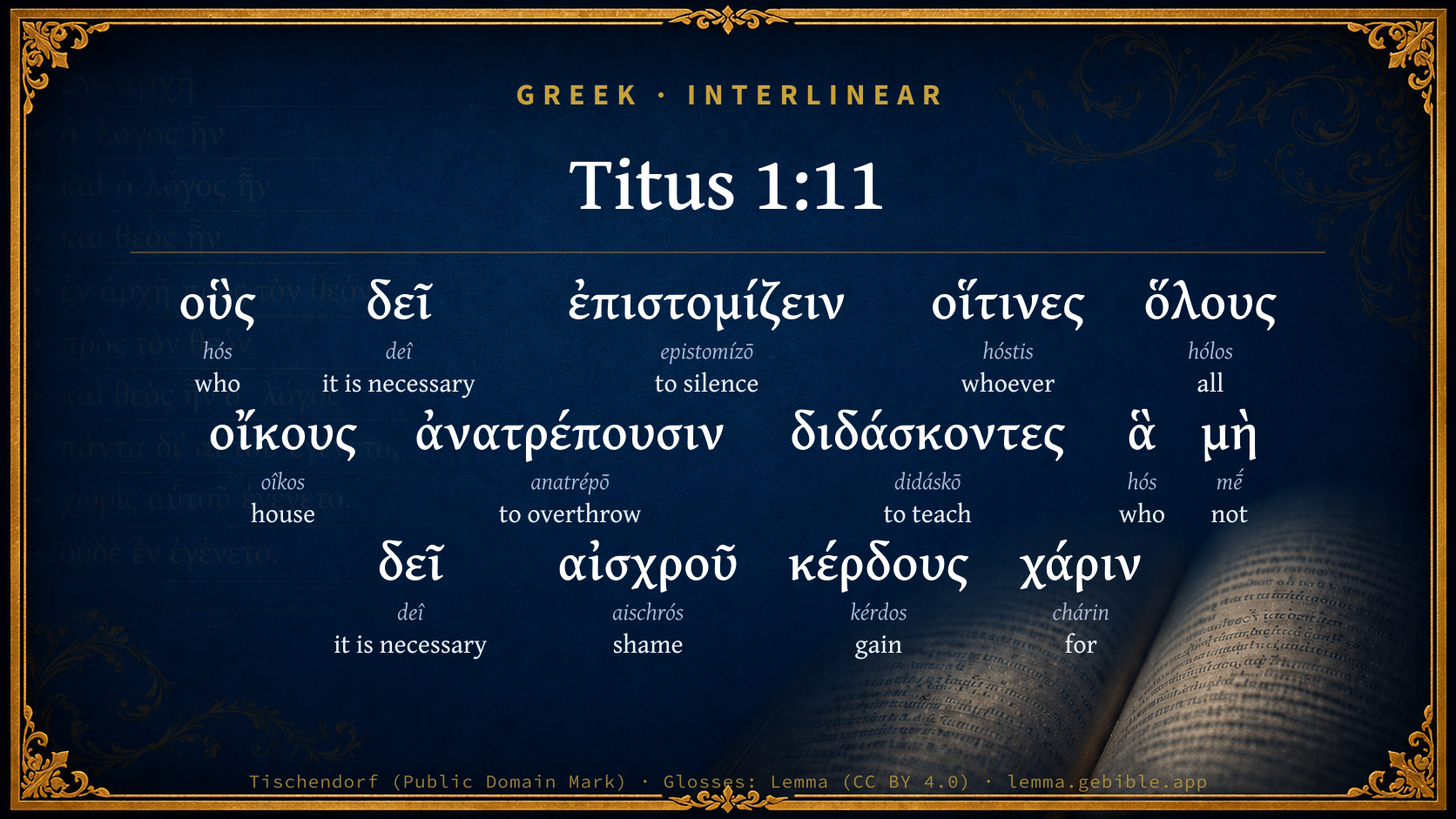
Download image
Cite this verse

Titus 1:11 (World English Bible). Public Domain. Lemma interlinear Bible study tool, https://lemma.gebible.app/v/titus/1/11.

Show BibTeX & RIS
BibTeX
RIS
English Translation
whose mouths must be stopped; men who overthrow whole houses, teaching things which they ought not, for dishonest gain's sake.
World English Bible · Public Domain
Highlights
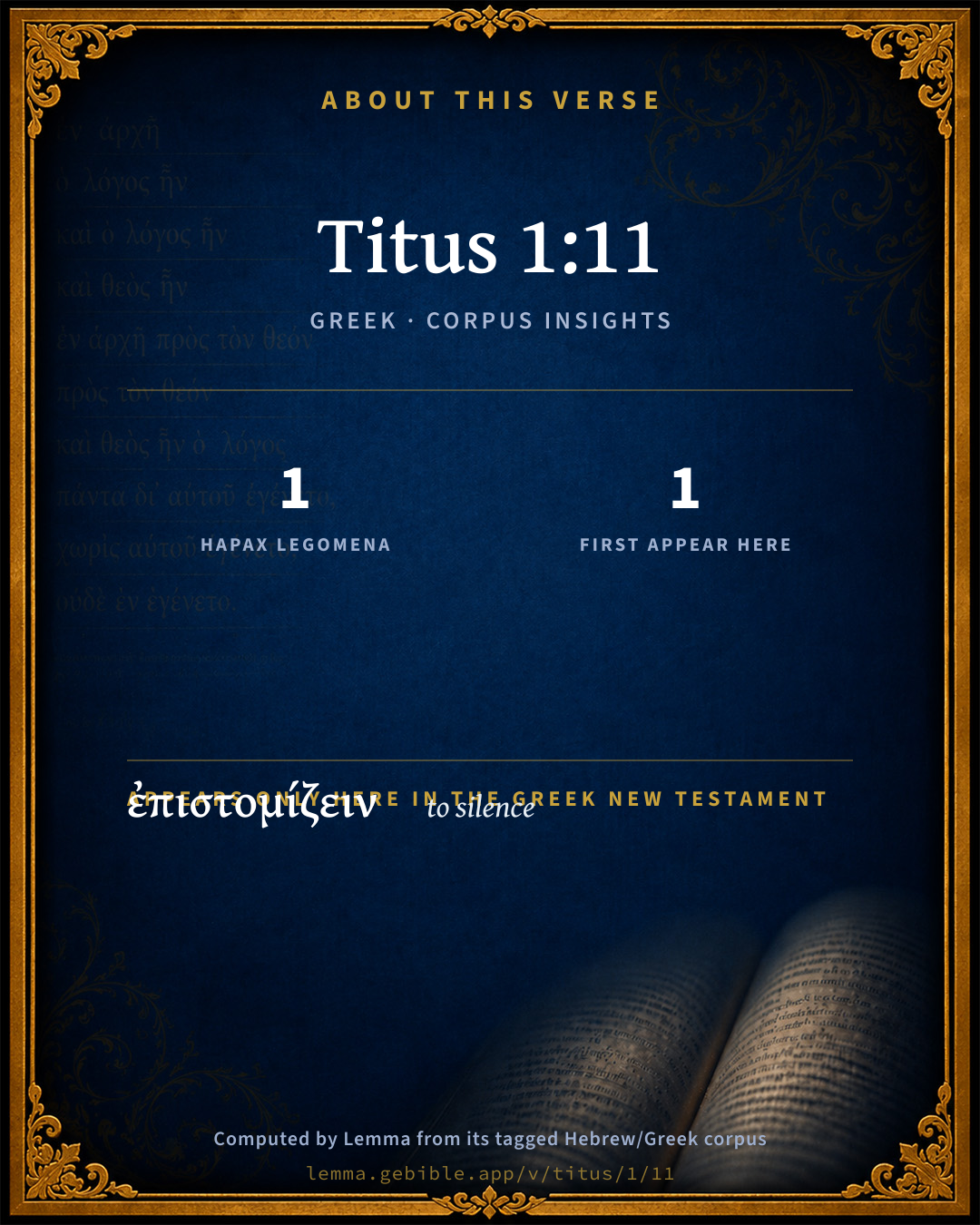
  • 1 hapax legomenon — only here in the Greek New Testament
  • 1 first appearance in the Greek New Testament
Full analysis ↓
Download a study sheet

One document with this verse’s original text, its word-by-word gloss line, the meaning frame, cross-references with their text, attributed commentary, and full source and license credits — printable, and it pastes into notes with its structure intact.

This verse Autodidact and up

Study sheet (.html) Plain text (.txt)

A passage Seminary Student

Up to 50 verses in one chapter. A passage sheet keeps up to 6 commentary sources and 12 cross-references per verse, in the order this page ranks them, and says so on the sheet whenever that leaves anything out. Ask for a single verse and you get the Autodidact verse sheet above.

Everything on this page stays free to read, with no account — the sheet is a download of what is already on screen, not access to it.

Want to remove ads? Support Godless Engineer
Compare translations 3

The same verse in 3 English versions, stacked beneath the original-language interlinear above. Click any original word for its lexicon entry.

Each is an independent rendering of the whole verse — the interlinear is not word-aligned to these translations.

Highlighted words mark where these versions differ — a whole-verse word diff, not a word-by-word alignment.

  • World English Bible Public Domain
    whose mouths must be stopped; men who overthrow whole houses, teaching things which they ought not, for dishonest gain's sake.
  • King James Version Public Domain
    Whose mouths must be stopped, who subvert whole houses, teaching things which they ought not, for filthy lucre's sake.
  • unfoldingWord Literal Text CC BY-SA 4.0
    It is necessary to stop them. They are upsetting whole households, teaching what they should not for the sake of shameful profit.

unfoldingWord Literal Text — © unfoldingWord, licensed CC BY-SA 4.0. Word-aligned USFM3 via Door43 (git.door43.org/unfoldingWord/en_ult).

Versions to compare (up to 4)

3 of 4 selected

Show all 19 translations

Every available English version of this verse, each an independent rendering of the whole verse.

  • World English Bible Public Domain
    whose mouths must be stopped; men who overthrow whole houses, teaching things which they ought not, for dishonest gain's sake.
  • Berean Standard Bible Public Domain
    who must be silenced. For the sake of dishonorable gain, they undermine entire households and teach things they should not.
  • Majority Standard Bible Public Domain
    who must be silenced. For the sake of dishonorable gain, they undermine entire households and teach things they should not.
  • King James Version Public Domain
    Whose mouths must be stopped, who subvert whole houses, teaching things which they ought not, for filthy lucre's sake.
  • American Standard Version (1901) Public Domain
    whose mouths must be stopped; men who overthrow whole houses, teaching things which they ought not, for filthy lucre's sake.
  • Revised Version (1885) Public Domain
    whose mouths must be stopped; men who overthrow whole houses, teaching things which they ought not, for filthy lucre’s sake.
  • Geneva Bible (1599) Public Domain
    Whose mouthes must bee stopped, which subuert whole houses, teaching things, which they ought not, for filthie lucres sake.
  • Douay-Rheims (1899) Public Domain
    Who must be reproved, who subvert whole houses, teaching things which they ought not, for filthy lucre's sake.
  • Young's Literal Translation Public Domain
    whose mouth it behoveth to stop, who whole households do overturn, teaching what things it behoveth not, for filthy lucre's sake.
  • Literal Standard Version CC BY-SA 4.0
    whose mouths must be covered, who overturn whole households, teaching what things it should not, for [the] sake of shameful gain.
  • Unlocked Literal Bible CC BY-SA 4.0
    It is necessary to stop them. They are upsetting whole families by teaching for shameful profit what they should not teach.
  • unfoldingWord Literal Text CC BY-SA 4.0
    It is necessary to stop them. They are upsetting whole households, teaching what they should not for the sake of shameful profit.
  • Darby Bible Public Domain
    who must have their mouths stopped, who subvert whole houses, teaching things which ought not [to be taught] for the sake of base gain.
  • World Messianic Bible Public Domain
    whose mouths must be stopped: men who overthrow whole houses, teaching things which they ought not, for dishonest gain’s sake.
  • Webster's Bible Public Domain
    Whose mouths must be stopped, who subvert whole houses, teaching things which they ought not, for the sake of sordid gain.
  • Free Bible Version CC BY-SA 4.0
    Their talking must stop, these people who throw whole families into turmoil, teaching things that aren't right for the sake of making money.
  • Bible in Basic English Public Domain
    By whom some families have been completely overturned; who take money for teaching things which are not right; these will have to be stopped.
  • Text-Critical English NT CC BY 4.0
    They must be silenced, because they are ruining entire households by teaching what they ought not to teach, for the sake of sordid gain.
  • Tyndale New Testament (1534) Public Domain
    whose mouthes must be stopped which pervert whole houses teachinge thinges which they ought not because of filthy lucre.

Literal Standard Version (2020), Covenant Press — licensed CC BY-SA 4.0. Text via the HelloAO Bible API (eBible.org). Unlocked Literal Bible (unfoldingWord) — licensed CC BY-SA 4.0. Text via the HelloAO Bible API (eBible.org). unfoldingWord Literal Text — © unfoldingWord, licensed CC BY-SA 4.0. Word-aligned USFM3 via Door43 (git.door43.org/unfoldingWord/en_ult). Free Bible Version, Dr. Jonathan Gallagher — licensed CC BY-SA 4.0. Text via the HelloAO Bible API (eBible.org).

Word by word

More ways to search: Search by grammar → Find every occurrence → Compare this word →

Practice this passage: Drill this verse → Learn its vocabulary →

ἐπιστομίζειν
epistomízō
G1993
“to silence”
Verb, Present, Active, Infinitive
Part of Speech
Verb
Tense
Present
Voice
Active
Mood
Infinitive
Full Thayer's Definition

Origin: from G1909 and G4750

TDNT: None

1. to bridle or stop up the mouth 2. metaph. to stop the mouth, reduce to silence
  1. οὓς hós G3739 “who” Relative pronoun, Accusative, Plural, Masculine
  2. δεῖ deî G1163 “it is necessary” Verb, Present, Active, Indicative, 3rd person, Singular
  3. οἵτινες hóstis G3748 “whoever” Relative pronoun, Nominative, Plural, Masculine
  4. ὅλους hólos G3650 “all” Adjective, Accusative, Plural, Masculine
  5. οἴκους oîkos G3624 “house” Noun, Accusative, Plural, Masculine
  6. ἀνατρέπουσιν anatrépō G396 “to overthrow” Verb, Present, Active, Indicative, 3rd person, Plural
  7. διδάσκοντες didáskō G1321 “to teach” Verb, Present, Active, Participle, Nominative, Plural, Masculine
  8. ἃ hós G3739 “who” Relative pronoun, Accusative, Plural, Neuter
  9. μὴ mḗ G3361 “not” Particle, Negative
  10. δεῖ deî G1163 “it is necessary” Verb, Present, Active, Indicative, 3rd person, Singular
  11. αἰσχροῦ aischrós G150 “shame” Adjective, Genitive, Singular, Neuter
  12. κέρδους kérdos G2771 “gain” Noun, Genitive, Singular, Neuter
  13. χάριν chárin G5484 “for” Adverb

About this verse

These counts appear in no published source. They are computed here, from the morphology-tagged text and Lemma’s own curated glosses. What Lemma adds →

14
words
12
distinct lemmas
Pauline Epistles
section

Notable vocabulary

1 hapax legomenon — a word that appears only here in the entire Greek New Testament:

  • ἐπιστομίζειν to silence G1993

First appearance in Scripture

This word makes its first canonical appearance in the Greek New Testament here:

  • ἐπιστομίζειν to silence G1993

Shared distinctive vocabulary

ἀνατρέπουσιν to overthrow G396 occurs in 3 verses of the Greek New Testament. Also found in:
Repetition

Words recur within this verse:

  • δεῖ it is necessary G1163 ×2
  • οὓς who G3739 ×2

Cross-references

19

Topical passages linked to Titus 1:11 in the Treasury of Scripture Knowledge — connected by theme and wording, ordered by reader-vote popularity; previews shown in the World English Bible.

  • 2 Timothy 3:6 For of these are those who creep into houses, and take captive gullible women loaded down with sins, led away by various lusts,
  • 1 Timothy 6:5 constant friction of people of corrupt minds and destitute of the truth, who suppose that godliness is a means of gain. Withdraw yourself from such.
  • Romans 3:19 Now we know that whatever things the law says, it speaks to those who are under the law, that every mouth may be closed, and all the world may be brought under the judgment of God.
  • Titus 3:10 Avoid a factious man after a first and second warning;
  • Psalms 63:11 But the king shall rejoice in God. Everyone who swears by him will praise him, For the mouth of those who speak lies shall be silenced.
  • Titus 1:9 holding to the faithful word which is according to the teaching, that he may be able to exhort in the sound doctrine, and to convict those who contradict him.
  • Psalms 107:42 The upright will see it, and be glad. All the wicked will shut their mouths.
  • Micah 3:5 Thus says Yahweh concerning the prophets who lead my people astray; for those who feed their teeth, they proclaim, "Peace!" and whoever doesn't provide for their mouths, they prepare war against him:
  • Titus 1:7 For the overseer must be blameless, as God's steward; not self-pleasing, not easily angered, not given to wine, not violent, not greedy for dishonest gain;
  • Isaiah 56:10–11 His watchmen are blind, they are all without knowledge; they are all mute dogs, they can't bark; dreaming, lying down, loving to slumber.
  • Jeremiah 8:10 Therefore will I give their wives to others, and their fields to those who shall possess them: for everyone from the least even to the greatest is given to covetousness; from the prophet even to the priest every one deals falsely.
  • Ezekiel 13:19 You have profaned me among my people for handfuls of barley and for pieces of bread, to kill the souls who should not die, and to save the souls alive who should not live, by your lying to my people who listen to lies.
  • Ezekiel 16:63 that you may remember, and be confounded, and never open your mouth any more, because of your shame, when I have forgiven you all that you have done, says the Lord Yahweh.
  • Micah 3:11 Her leaders judge for bribes, And her priests teach for a price, And her prophets of it tell forturnes for money: Yet they lean on Yahweh, and say, Isn't Yahweh in the midst of us? No disaster will come on us.
  • Luke 20:40 They didn't dare to ask him any more questions.
  • 2 Corinthians 11:10 As the truth of Christ is in me, no one will stop me from this boasting in the regions of Achaia.
  • 2 Peter 2:1–3 But there also arose false prophets among the people, as among you also there will be false teachers, who will secretly bring in destructive heresies, denying even the Master who bought them, bringing on themselves swift destruction.
  • Matthew 23:13 "Woe to you, scribes and Pharisees, hypocrites! For you devour widows' houses, and as a pretense you make long prayers. Therefore you will receive greater condemnation.
  • John 10:12 He who is a hired hand, and not a shepherd, who doesn't own the sheep, sees the wolf coming, leaves the sheep, and flees. The wolf snatches the sheep, and scatters them.

Cross-references courtesy of OpenBible.info (CC BY 4.0).

Commentary

Notes on Titus 1:11 from classic Christian and Jewish commentators (each source and its license shown beneath its notes). The classic Christian expositions comment on the surrounding passage and are grouped to its opening verse, so a note may address several verses; the Jewish commentaries on the Tanakh (Rashi and others) are per-verse, so they appear only where the commentator wrote on this verse.

Lemma curates 59 commentaries, every one of them public domain or Creative Commons licensed, each selected and text-cleaned for this edition rather than reprinted as found. About our sources →

Tyndale Open Study Notes

Tyndale Open Resources

1:11 turning whole families away: This also happened in Ephesus (cp. 1 Tim 4:3; 2 Tim 2:18; 3:6). • only for money: Elders must not have this characteristic (Titus 1:7; see also 1 Tim 6:5-10; 2 Cor 2:17; 1 Pet 5:2).

Tyndale Open Study Notes — © Tyndale Open Resources, licensed CC BY-SA 4.0. Text via the HelloAO Bible API.

Bengel's Gnomon

Johann Albrecht Bengel

Tit 1:11. Ἐπιστομίζειν) to stop the mouth; to reduce to silence by the power of the Spirit, as the unruly deserve.—ὅλους οἴκους, whole houses) A great loss to Paul. [But in the present day what takes place as regards whole streets? What is done regarding country hamlets and cities?—V. g.]—ἀνατρέπουσι, they subvert) as deceivers.—διδάσκοντες ἃ μὴ δεῖ, teaching things which they ought not) as vain-talkers.—αἰσχροῦ κέρδους χάριν, for the sake of filthy lucre) Construed with, they subvert. Baseness is seen most of all in (vile) contemptible gain; Eze 13:19. [1Ti 6:5.]

Bengel's Gnomon of the New Testament — English translation (T&T Clark, Edinburgh, 1860) — public domain. Text from a community e-Sword module.

Meyer's Critical & Exegetical Commentary

Heinrich August Wilhelm Meyer

Tit_1:11. Οὓς δεῖ ἐπιστομίζειν] goes back to the end of Tit_1:9.

ἐπιστομίζειν (ἅπ. λεγ.) is from ἐπιστόμιον, which denotes both the bridle-bit and the muzzle, and is equivalent either to freno compescere, coercere (synonymous with τοὺς χαλινοὺς εἰς τὰ στόματα βάλλειν, Jam_3:3), or to os obturare (= φιμοῦν, Mat_22:34). The latter signification is more usual (see Elsner, p. 332): put to silence. Theophylact: ἐλέγχειν σφοδρῶς, ὥστε ἀποκλείειν αὐτοῖς τὰ στόματα.

οἵτινες (= quippe qui, and giving the reason for οὓς δεῖ) ὅλους οἴκους ἀνατρέπουσι] The chief emphasis is laid on ὅλους: not merely individuals, but also whole families are misled by them into unbelief.

Ἀνατρέπειν] see 2Ti_2:18; the figure is here used in keeping with οἴκους (Wiesinger).

διδασκοντες ἃ μὴ δεῖ] teaching what should not be taught; this shows the means by which they exercise so destructive an influence; ἃ μὴ δεῖ, equivalent to τὰ μὴ δέοντα, 1Ti_5:13.

This refers to ΜΑΤΑΙΌΛΟΓΟΙ, just as ἈΝΑΤΡΈΠΟΥΣΙ does to ΦΡΕΝΑΠΆΤΑΙ.

The purpose is briefly set forth by ΑἸΣΧΡΟῦ ΚΈΡΔΟΥς ΧΆΡΙΝ. The disgrace of their gain consists in the means they employ for acquiring it. The apostle adds these words to point out the selfish conduct of the heretics, who work only for their own profit.

Meyer — Critical and Exegetical Commentary on the New Testament — English translation by Peter Christie, edited by Frederick Crombie (T&T Clark, 1880) — public domain. Text from a community e-Sword module.

Expositor's Greek Testament

ed. W. Robertson Nicoll

Tit 1:11 . οὓς δεῖ ἐπιστομίζειν : quos oportet redargui, whose mouths must be stopped by the unanswerable arguments of the orthodox controversialist. This is the result hoped for from the “conviction,” of Tit 1:9 .

ὅλους οἴκους ἀνατρέπουσιν : pervert whole families (Alf.); Moulton and Milligan give an apt illustration from a papyrus of second cent. B.C., τῆς πατρικῆς οἰκίας … ἔτι ἔνπροσθεν ἄρδην [ ἀ ] νατετραμμένης διʼ ἀσ [ ω ] τίας ( Expositor , vii., 1:269). This suggests the rendering upset . The whole family would be upset by the perversion of one member of it.

ἃ μὴ δεῖ : Normally, οὐ is used in relative sentences with the indicative. Other exceptions will be found in 2Pe 1:9 , 1Jn 4:3 (T.R.). It is possible that the force of μή here is given by translating, which ( we think ) they ought not . If the teaching had been absolutely indefensible by any one, he would have said, ἃ οὐ δεῖ . See Blass, Grammar , p. 254.

αἰσχροῦ κέρδους χάριν : The three reff. on αἰσχροῦ , the only other occurrences in N.T. of this adj., are instances of the phrase αἰσχρόν ἐστι . The reference is to the claim to support made by itinerating or vagrant prophets and apostles such as are referred to in the Didache , cc. 11, 12, and alluded to in 2Co 11:9-13 . All such abuses would exist in an aggravated form in Crete, the natives of which had an evil reputation for αἰσχροκέρδεια , according to Polybius, ὥστε παρὰ μόνοις Κρηταιεῦσι τῶν ἁπάντων ἀνθρώπων μηδέν αἰσχρὸν νομίζεσθαι κέρδος . ( Hist . vi. 46. 3, cited by Ell.). They get a bad character also from Livy (xliv. 45), and Plutarch ( Paul. Aemil . 23). The Cretans, Cappadocians, and Cilicians were τρία κάππα κάκιστα .

The Expositor's Greek Testament, edited by W. Robertson Nicoll (1897–1910) — public domain. Text from a community e-Sword module.

Jamieson, Fausset & Brown

Robert Jamieson, A. R. Fausset & David Brown

mouths . . . stopped--literally, "muzzled," "bridled" as an unruly beast (compare Psa 32:9).

who--Greek, "(seeing that they are) such men as"; or "inasmuch as they" [ELLICOTT].

subvert . . . houses--"overthrowing" their "faith" (Ti2 2:18). "They are the devil's levers by which he subverts the houses of God" [THEOPHYLACT].

for filthy lucre-- (Ti1 3:3, Ti1 3:8; Ti1 6:5).

Jamieson, Fausset & Brown — Commentary Critical and Explanatory on the Whole Bible (1871) — public domain (CC PDM 1.0). Text via the HelloAO Bible API.

Adam Clarke's Commentary

Verse 11. Whose mouths must be stopped] Unmask them at once; exhibit them to the people; make manifest their ignorance and hypocrisy; and let them be confounded before the people whom they are endeavouring to seduce.

Subvert whole houses] Turn whole Christian families from the faith, attributing to the broad way what belongs only to the strait gate; ministering to disorderly passions, and promising salvation to their proselytes, though not saved from their sins.

Adam Clarke's Commentary on the Bible (1810–1826) — public domain. Text from a community e-Sword/MySword module.

John Calvin's Commentaries

11 Whose mouth must be stopped A good pastor ought therefore to be on the watch, so as not to give silent permission to wicked and dangerous doctrines to make gradual progress, or to allow wicked men an opportunity of spreading them. But it may be asked, “How is it possible for a bishop to constrain obstinate and self-willed men to be silent? For such persons, even though they are vanquished in argument, still do not hold their peace; and it frequently happens that, the more manifestly they are refuted and vanquished, they become the more insolent; for not only is their malice strengthened and inflamed, but they give themselves up to indolence.” I reply, when they have been smitten down by the sword of God’s word, and overwhelmed by the force of the truth, the Church may command them to be silent; and if they persevere, they may at least be banished from the society of believers, so that they shall have no opportunity of doing harm. Yet by “shutting the mouth” Paul simply means — “to refute their vain talking,” even though they should not cease to make a noise; for he who is convicted by the word of God, however he may chatter, has nothing to say.

Who overturn whole houses. If the faith of one individual were in danger of being overturned, (for we are speaking of the perdition of a single soul redeemed by the blood of Christ) the pastor should immediately gird himself for the combat; how much less tolerable is it to see whole houses overturned?

Teaching things which they ought not. The manner in which they were overturned is described in these words. Hence we may infer how dangerous it is to make even the smallest departure from sound doctrine; for he does not say that the doctrines, by which they overturned the faith of many, were openly wicked; but we may understand by this designation every kind of corruptions, when there is a turning aside from the desire of edification. Thus it is in reality, that, amidst so great weakness of the flesh, we are exceedingly prone to fall; and hence it arises, that Satan easily and speedily destroys, by his ministers, what godly teachers had reared with great and long-continued toil.

He next points out the source of the evil, a desire of dishonest gain; by which he reminds us how destructive a plague avarice is in teachers; for, as soon as they give themselves up to the pursuit of gain, they must labor to obtain the favor and countenance of men. This is quickly followed by the corruption of pure doctrine.

John Calvin's Commentaries (1540-1563) — public domain. Text from the Calvin Translation Society English edition (1840s-50s) via the Christian Classics Ethereal Library (ccel.org). Calvin's coverage is partial (roughly two-thirds of the Bible); uncommented books and verses are honest gaps, never fabricated. The 19th-century editor's footnotes and remarks are omitted so the notes are faithfully Calvin's own voice.

Ellicott's Commentary for English Readers

(11)Whose mouths must be stopped, who subvert whole houses.—The translation should run here, seeing they subvert, &c. There was, indeed, grave cause why these men should be put to silence; the mischief they were doing in Crete to the Christian cause was incalculable. It was no longer individuals that their poisonous teaching affected, but they were undermining the faith of whole families. For an example how Titus and his presbyters were to stop the mouths of these teachers of what was false, compare Mat_22:34-46, where the Lord, by His wise, powerful, yet gentle words, first put the Sadducees to silence, and then so answered the Pharisees that “neither durst any man from that day forth ask Him any more questions.”

Teaching things which they ought not, for filthy lucre’s sake.—Here St. Paul goes to the root of the evil, when he shows what was the end and aim of these “teachers” life. It was a mean and sordid ambition, after all—merely base gain. When this is the main object of a religious teacher’s life, his teaching naturally accommodates itself to men’s tastes. He forgets the Divine Giver of his commission, and in his thirst for the popularity which brings with it gold, his true work, as the faithful watchman of the house of Israel, is forgotten and ignored.

A Bible Commentary for English Readers, edited by Charles John Ellicott (1878–1897) — public domain. Text from a community e-Sword module.

The Cambridge Bible for Schools and Colleges

gen. ed. J. J. S. Perowne

11. whose mouths must be stopped] The verb is so used in classical Greek often; the ‘stopping’ must have reference to the ‘convict’ of Tit_1:9; Tit_1:13. Compare the use of ‘to muzzle’ in the Gospels, e.g. Mar_4:39, ‘Peace, be still,’ and 1Pe_2:15, where the ‘ignorance of foolish men’ is ‘to be muzzled’ by ‘well-doing.’

who subvert whole houses] As R.V. men who, the compound relative implying the class to which they belong, and so the conduct for which they should be silenced; hence almost, ‘seeing that they.’ Cf. 1Ti_1:4, ‘the which.’ Render subvert whole households. Why should the Revisers give up the Latin word ‘subvert,’ which the A.V. has rendered familiar, and which gives the metaphorical overthrow more clearly?

teaching things which they ought not] The negative used implies the general class of wrong teachings rather than any definite and specific facts or views. The effect is a less positive statement than if the other negative had been used; and the rendering ‘things which they ought not to teach and which they know they ought not’ is impossible. It should be ‘things of a class which I think improper to be taught.’

for filthy lucre’s sake] Rather, for the sake of unfair gains, see Tit_1:7. Bp Ellicott quotes a striking passage from Polybius, Hist. vi. 46. 3, with respect to the Cretan character; ‘and generally their character as to unfair gains and covetousness is of this kind—they are the only nation in the world among whom no sort of gain is thought unfair.’

The Cambridge Bible for Schools and Colleges (gen. ed. J. J. S. Perowne; Cambridge University Press, 1878–1918) — public domain. Text from a community e-Sword module.

John Gill's Exposition

Whose mouths must be stopped,.... Or they be silenced, by reasons and arguments fetched out of the word of God; as were the Sadducees and Pharisees by Christ, so that they durst ask him no more questions; and as the Jews at Damascus were by Saul, who confounded them, proving in the clearest and strongest manner, that Jesus was the very Christ:

who subvert whole houses; into which they creep; that is, whole families, whose principles they corrupt, whose faith they overthrow, and carry them away with their own errors; and therefore, since this was the case not of a single person, or of a few, but of whole families, it was high time to attempt to convince them, and stop their mouths, that they might proceed no further:

teaching things which they ought not; which were not agreeable to the perfections of God, to the Scriptures of truth, to sound doctrine, and which were hurtful and pernicious to the souls of men: and that only

for filthy lucre's sake; having no regard to the glory of God, the honour and interest of Christ, or the good of immortal souls; only seeking to gain popular applause and honour from men, and to gather and increase worldly substance. Covetousness was a sin which the Cretians were remarkably guilty of (l).

(l) Cornel. Nepos, l. 23. c. 9.

John Gill's Exposition of the Whole Bible (1746–1763) — public domain (CC PDM 1.0). Text via the HelloAO Bible API.

Trapp's Complete Commentary

John Trapp

11 Whose mouths must be stopped, who subvert whole houses, teaching things which they ought not, for filthy lucre’s sake.

Ver. 11. Whose mouths must be stopped] Gr. επιστομιζειν, muzzled, as bandogs are. Frogs, they say, will leave croaking if but a light be hanged over the lake wherein they are. Let but the truth come clearly in place, and heretics will be soon silenced. But if they will not, another course must be taken with them.

John Trapp, A Commentary or Exposition upon All the Books of the Old and New Testament (1647–1656) — public domain. Text from a community e-Sword module.

Albert Barnes' Notes on the Bible

Whose mouths must be stopped - The word here rendered stopped - ἐπιστομιζειν epistomizein - occurs nowhere else in the New Testament. It means, properly, to check, or curb, as with a bridle; to restrain, or bridle in; and then, to put to silence. It is, of course, implied here that this was to be done in a proper way, and in accordance with the spirit of the gospel. The apostle gives Timothy no civil power to do it, nor does he direct him to call in the aid of the civil arm. All the agency which he specifies as proper for this, is that of argument and exhortation. These are the proper means of silencing the advocates of error; and the history of the church shows that the ministers of religion can be safely entrusted with no other; compare Psa 32:8-9.

Who subvert whole houses - Whole families; compare Mat 23:14; 2Ti 3:6. That is, they turn them aside from the faith.

Teaching things which they ought not, for filthy lucre’s sake - For gain. That is, they inculcate such doctrines as will make themselves popular, and as will give them access to the confidence of the people. They make it their first object to acquire influence as ministers of religion, and then abuse that in order to obtain money from the people. This they would doubtless do under many pretences; such as that it was needful for the support of the gospel, or for the relief of the poor, or perhaps for the assistance of distant Christians in persecution. Religion is the most powerful principle that ever governs the mind; and if a man has the control of that, it is no difficult thing to induce men to give up their worldly possessions. In all ages, there have been impostors who have taken advantage of the powerful principle of religion to obtain money from their deluded followers. No people can be too vigilant in regard to pretended religious teachers; and while it is undoubtedly their duty to contribute liberally for the support of the gospel, and the promotion of every good cause, it is no less their duty to examine with care every proposed object of benevolence, and to watch with an eagle eye those who have the disbursement of the charities of the church. It is very rare that ministers ought to have much to do with disposing of the funds given for benevolent purposes; and when they do, they should in all cases be associated with their lay brethren; see Paley’s Horae Paulinae, chap. iv., No. 1, 3, note; compare 1Co 16:3. On the phrase “filthy lucre,” see the notes at 1Ti 3:3.

Albert Barnes' Notes on the Bible (1834–1885) — public domain. Text from a community e-Sword/MySword module.

Haydock's Catholic Bible Commentary

Whole houses.[8]]

===============================

[BIBLIOGRAPHY]

Universas domos, Greek: olous oikous.

George Leo Haydock (1774–1849), Haydock's Catholic Family Bible and Commentary, 1859 edition — public domain. Excludes Psalms (Douay-Rheims chapter numbering differs from Protestant) and Deuterocanonical books (Catholic canon only).

Matthew Poole's English Annotations

Whose mouths must be stopped; the word is active; such ministers ought to be placed in cities as shall be able and fit to stop such persons’ mouths, by sound doctrine and arguments fit to convince them: or, thou oughtest to stop their mouths by silencing them; though I do not see how this was practicable in a pagan country, otherwise than by persuading Christians not to hear them.

Who subvert whole houses; who, as to the foundation of faith and its building, overturn whole families of Christians.

Teaching things which they ought not; infusing false doctrine into them.

For filthy lucre’s sake; and all for filthy gain: and all gain is so, that is got by deceiving and ruining of people’s souls, as to their faith and salvation.

Matthew Poole's English Annotations on the Holy Bible (1683–1685) — public domain. Text from a community e-Sword/MySword module.

Whedon's Commentary on the Bible

Daniel D. Whedon

11. Mouths must be stopped—Not by physical force, nor usually by pure ecclesiastical authority. Yet, while church authority is less peremptory as to what private members believe, it is rightly exerted over what the minister whom it authorizes shall preach. In the present verse the meaning is, that the gainsayers shall be silenced by the ability of the elder to convince. Tit_1:9. Who not only seduce individuals, but subvert, that is, overthrow, (a Greek word physically expressive of overthrowing a building,) whole houses, or families. St. Paul, doubtless, speaks from memory here, of houses like that of the Philippian jailer, all baptized, (Act_16:33;) or like that of Stephanas, baptized by himself, (1Co_1:16;) or like that of Onesiphorus, administering to and sustaining him, (2Ti_1:16;) but houses unlike those in being subverted and drawn from the Church into the Jewish or Gnostic fold.

Daniel D. Whedon (gen. ed.), Commentary on the Old and New Testaments (1874–1909) — public domain. Text from a community e-Sword module.

The Pulpit Commentary

Men who overthrow for who subvert, A.V Whose mouths must be stopped (ouv dei epistomizein); here only in the New Testament, not found in the LXX, but common in classical Greek. "To curb". (comp. Psa_32:9 Jam_3:2, Jam_3:3) The meaning is nearly the same as that of calinagwgew in Jam_1:26; some, however, assign to it the sense of "to muzzle" (Olshausen, etc.) or "stop the mouth," which Bishop Ellicott thinks is "perhaps the most common" and "the most suitable." So also Huther. It often means simply "to silence" (see Stephan, "Thesaur."), and is applied to wind instruments. Overthrow (anatrepousi); as 2Ti_2:18, which shows the kind of overthrow here meant, that viz. of the faith of whole families, well expressed in the A.V by "subvert." The phrase, oikiav anatrepein , of the literal overthrow of houses, occurs in Plato (Alford). For filthy lucre"s sake; contrary to the apostolic precept to bishops and deacons. (1Ti_3:3, 1Ti_3:8, and above, ver. 7) Polybius has a striking passage on the aiscrokerdeia Of the Cretans, quoted by Bishop Ellicott ("Hist.," 6:146.3).

The Pulpit Commentary (1880–1919), ed. H.D.M. Spence-Jones & Joseph S. Exell — public domain. Text from a community e-Sword module.

John Wesley's Explanatory Notes

Stopped - The word properly means, to put a bit into the mouth of an unruly horse.

John Wesley, Explanatory Notes Upon the Whole Bible (1754–1765) — public domain. Text via the GEBible commentary corpus.

The People's New Testament

B. W. Johnson

11. Whose mouths must be stopped. Muzzled. The way to stop them is for the churches to refuse to hear them. All false teachers, or bad men, should now be stopped from preaching in the same way. Subvert whole houses. Subvert their faith. For filthy lucre's sake. For base gain.

B. W. Johnson's The People's New Testament with Notes (1889–1891) — public domain. Electronic text from the Christian Classics Ethereal Library (CCEL) ThML edition.

Cambridge Greek Testament for Schools and Colleges

11. After χάριν the cursive 109 inserts the gloss τὰ τέκνα οἱ τοὺς ἱδίους γονεῖς ὑβρίζοντες ἥ τύπτοντες ἐπιστόμιζε καὶ ἔλεγχε καὶ νουθέτει ὡς πατὴρ τέκνα, which has no apparent relation to the context. It was probably a gloss about the duties of children, originally appended to Tit 1:8 of the next chapter, as advice on the management of children would come in appropriately after the discussion of the duties of wives and before the consideration of the duties of slaves (as in Ephesians 5, 6).

11. οὓς δεῖ ἐπιστομίζειν, whose mouths must be stopped, the felicitous translation of Tyndale, followed by A.V. and R.V. ἐπιστομίζειν does not occur elsewhere in the true text of the N.T. (or the LXX.), but it is the reading at Luk 11:53 of three cursive manuscripts (for ἀποστοματίζειν), and was the reading followed by Jerome at that place and rendered by him os eius opprimere.

οἴτινες, inasmuch as they, ‘quippe qui’; cp. 1Ti 1:4.

ὅλους οἴκους ἀνατρέπουσιν, subvert whole households. For ἀνατρέπειν see on 2Ti 2:18, and for οἷκος used as equivalent to ‘household’ cp. 1Ti 3:4; 2Ti 2:16.

διδάσκοντες ἅ μὴ δεῖ, teaching things which they ought not. In the N.T. we generally have οὐ in relative sentences with the indicative, even where the classical language would require μή; this verse is an exception to the general rule[512].

[512] See Blass, Grammar of N. T. Greek, § 75. 3.

αἰσχροῦ κέρδους χάριν, for sake of base gains. Tyndale’s “filthy lucre,” which has been followed in all our English versions, does not seem to bring out the exact point here, which is not that money is a despicable thing in itself, but that to teach ἃ μὴ δεῖ for the sake of money is disgraceful and dishonourable, a prostitution of the high gifts of a teacher, and that all ‘gain’ so acquired is ‘base.’ See 1Ti 3:8 for αἰσχροκερδής.

In like manner the heretical teachers of 1Ti 6:5 ‘suppose that godliness is a way of gain’: and no doubt greed for his wages is a mark of the hireling shepherd always (Joh 10:12). But there may have been special reason for mentioning it in a letter to the Chief Pastor of Crete. Livy (XLIV. 45) speaks of “Cretenses spem pecuniae secuti,” and Plutarch (Paul. Aemil. 23) and Polybius (VI. 46) bear similar testimony to their love of money.

Cambridge Greek Testament for Schools and Colleges (Cambridge University Press, 1896; 21 vols, various authors incl. Carr, Maclear, Plummer, Farrar, Lumby, Moule, M. R. James, Simcox) — public domain. Text from a community e-Sword module.

International Critical Commentary

11. ἐπιστομίζειν] (here only in N.T., though in some cursives of 11:53), perhaps anticipating κακὰ θήρια 12: either “to bridle,” “to guide aright,” “refrenari” (Jerome), cf. Jas 3:3; or more probably “to muzzle, to silence”: “redargui” (Vulg.), “silentium indici” (Jerome). This is more analogous to its classical usage; cf. illustrations in Wetstein and in M.M s.v.

ὅλους οἴκους] Where order and discipline need such careful guidance; cf. 6, 2:1-10.

ἀνατρέπουσι] “upset their faith”; cf. 2Ti 2:18 ἀνατρ. τήν τινων πίστιν, “pervert” (Tynd., Coverdale), or “upset their peace and harmony,” “subvert,” A.V.; contrast the teaching of 2:1-10.

αἰσχροῦ κέρδους] cf. 7 note, hoping for greater gifts from their hearers; cf. 1Ti 5:17, 1Ti 5:18, 1Ti 5:6:5, 2Co 12:14-18. For this tendency at Crete, cf. Polybius, vi. 46, 3, ὁ περὶ τὴν αἰσχροκέρδειαν καὶ πλεονεξίαν τρόπος οὕτως ἐπιχωριάζει ὥστε παρὰ μόνοις Κρηταιεῦσι τῶν ἁπάντων ἀνθρώπων μηδὲν αἰσχρὸν νομίζεσθαι κέρδος.

International Critical Commentary — older volumes (1896–1929), various authors — public domain. Text from a community e-Sword module.

Vincent's Word Studies in the New Testament

Marvin R. Vincent

Whose mouths must be stopped [ους δει επιστομιζειν] . Lit. whom it is necessary to silence. Epistomizein, N. T. o. o LXX Originally, to put something into the mouth, as a bit into a horse 's mouth. Epistomion is the stop of a water - pipe or of a hydraulic organ. Comp. fimoun 1Ti 5:18.

Who subvert [οιτινες ανατρεπουσιν] . The double relative is explanatory of must; in as much as they, etc. For subvert rend. overthrow. See on 2Ti 2:18.

Houses [οικους] . Families.

Marvin R. Vincent, Word Studies in the New Testament (1887–1900) — public domain. Text from a community e-Sword/MySword module.

Lesson kit

Teaching starters — assembled from the data on this page, not authored interpretation. Every prompt links to the verse data it draws on. Edit before teaching.

Titus, in the Pauline Epistles, opens this verse with 14 words (12 distinct Greek lemmas). Its most distinctive word is epistomízō (“to silence”). A historical commentator’s framing appears above. Read the whole chapter for the surrounding context.

Discussion questions

  1. How does “to silence” (epistomízō) shape what this verse is saying?
  2. This verse holds 1 word here found nowhere else in the Greek New Testament. What might the rare word draw attention to?
  3. The word “to silence” first appears here in Scripture. What is being introduced at this debut?
  4. John 2:15 shares the word «to overthrow» with this verse. How do the two illuminate each other?
  5. “it is necessary” occurs 2× in this one verse. What is the effect of the repetition?
  6. The translations on this page render this verse differently — a whole-verse word diff, not a word-by-word alignment. What might account for the different wordings?
  7. Reading how Tyndale Open Study Notes and Bengel's Gnomon read this verse, where do the two commentators agree and where do they part?

Things to notice

  • 1 word in this verse appears nowhere else in the Greek New Testament.
  • 1 word makes its first canonical appearance in Scripture here.
  • These translations choose different wording for 24 words in this verse.
  • “it is necessary” occurs 2× in this single verse.
  • 12 distinct Greek lemmas span 14 words in this verse.

Reading settings

Reading text

Shown beneath each verse's original-language words.

Old Testament
Old Testament edition

Read the OT as the Masoretic Hebrew (MT) or the Greek Septuagint (LXX).

English shown for the Greek Septuagint (in the Hebrew ↔ Greek comparison).

Comparing translations? Open the Compare panel on any verse page to stack up to four side by side.