
Acts 10:41

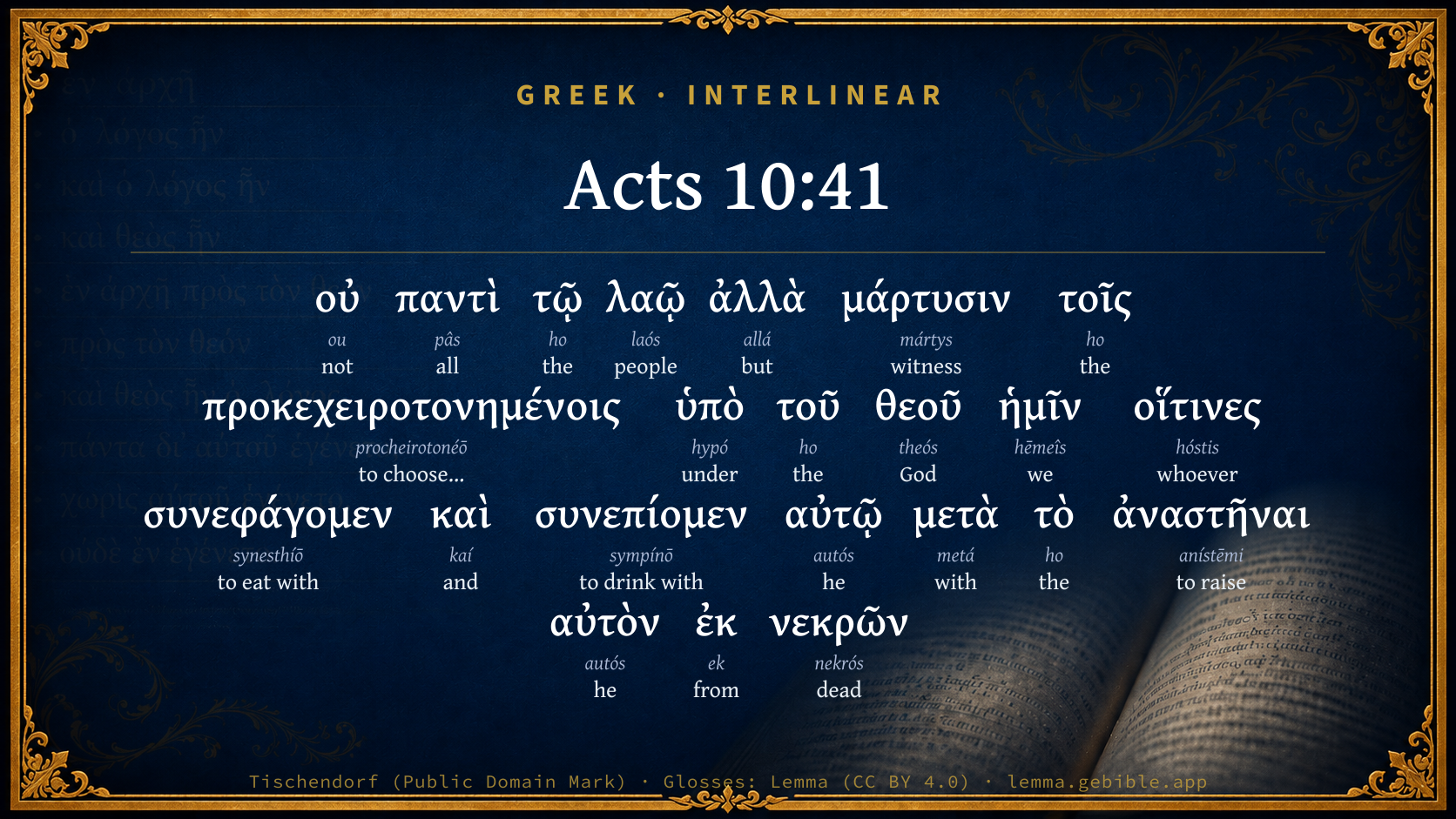
Greek (Tischendorf 8th ed.) Acts 10:41 appears in the Greek New Testament. The text above is from the Tischendorf 8th edition. Each word links to its Strong’s number and a concise gloss. Click any word for its full Thayer’s Greek Lexicon entry.
Download image
Cite this verse

Acts 10:41 (World English Bible). Public Domain. Lemma interlinear Bible study tool, https://lemma.gebible.app/v/acts/10/41.

Show BibTeX & RIS
BibTeX
RIS
English Translation
not to all the people, but to witnesses who were chosen before by God, to us, who ate and drank with him after he rose from the dead.
World English Bible · Public Domain
Highlights
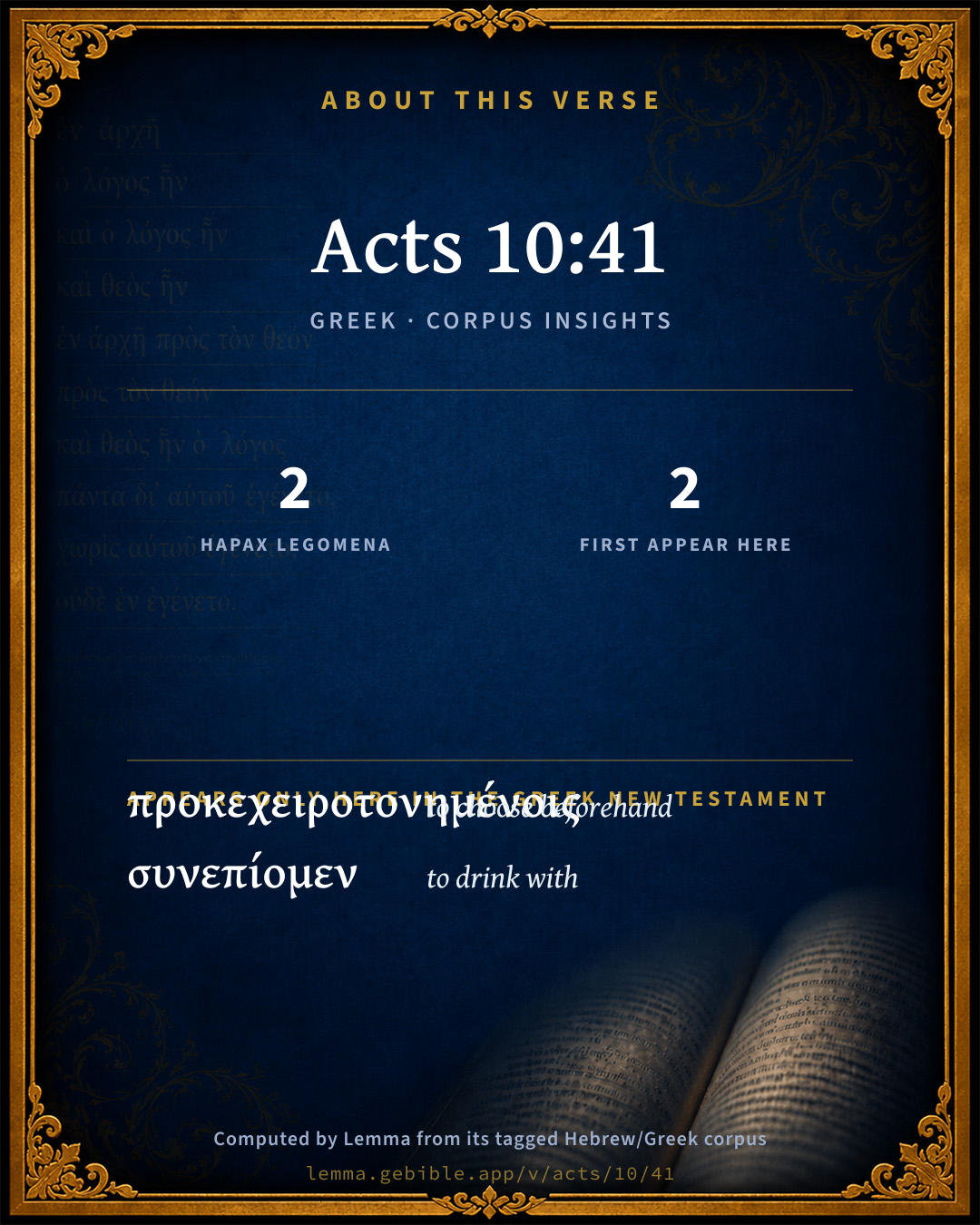
  • 2 hapax legomena — only here in the Greek New Testament
  • 2 first appearances in the Greek New Testament
Full analysis ↓
Download a study sheet

One document with this verse’s original text, its word-by-word gloss line, the meaning frame, cross-references with their text, attributed commentary, and full source and license credits — printable, and it pastes into notes with its structure intact.

This verse Autodidact and up

Study sheet (.html) Plain text (.txt)

A passage Seminary Student

Up to 50 verses in one chapter. A passage sheet keeps up to 6 commentary sources and 12 cross-references per verse, in the order this page ranks them, and says so on the sheet whenever that leaves anything out. Ask for a single verse and you get the Autodidact verse sheet above.

Everything on this page stays free to read, with no account — the sheet is a download of what is already on screen, not access to it.

Want to remove ads? Support Godless Engineer
Compare translations 3

The same verse in 3 English versions, stacked beneath the original-language interlinear above. Click any original word for its lexicon entry.

Each is an independent rendering of the whole verse — the interlinear is not word-aligned to these translations.

Highlighted words mark where these versions differ — a whole-verse word diff, not a word-by-word alignment.

  • World English Bible Public Domain
    not to all the people, but to witnesses who were chosen before by God, to us, who ate and drank with him after he rose from the dead.
  • King James Version Public Domain
    Not to all the people, but unto witnesses chosen before God, even to us, who did eat and drink with him after he rose from the dead.
  • unfoldingWord Literal Text CC BY-SA 4.0
    not by all the people, but by witnesses chosen beforehand by God—by us who ate and drank with him after he rose from the dead.

unfoldingWord Literal Text — © unfoldingWord, licensed CC BY-SA 4.0. Word-aligned USFM3 via Door43 (git.door43.org/unfoldingWord/en_ult).

Versions to compare (up to 4)

3 of 4 selected

Show all 19 translations

Every available English version of this verse, each an independent rendering of the whole verse.

  • World English Bible Public Domain
    not to all the people, but to witnesses who were chosen before by God, to us, who ate and drank with him after he rose from the dead.
  • Berean Standard Bible Public Domain
    not by all the people, but by the witnesses God had chosen beforehand, by us who ate and drank with Him after He rose from the dead.
  • Majority Standard Bible Public Domain
    not by all the people, but by the witnesses God had chosen beforehand, by us who ate and drank with Him after He rose from the dead.
  • King James Version Public Domain
    Not to all the people, but unto witnesses chosen before God, even to us, who did eat and drink with him after he rose from the dead.
  • American Standard Version (1901) Public Domain
    not to all the people, but unto witnesses that were chosen before of God, `even' to us, who ate and drank with him after he rose from the dead.
  • Revised Version (1885) Public Domain
    not to all the people, but unto witnesses that were chosen before of God, even to us, who did eat and drink with him after he rose from the dead.
  • Geneva Bible (1599) Public Domain
    Not to all the people, but vnto the witnesses chosen before of God, euen to vs which did eate and drinke with him, after he arose from the dead.
  • Douay-Rheims (1899) Public Domain
    Not to all the people, but to witnesses preordained by God, even to us, who did eat and drink with him after he arose again from the dead;
  • Young's Literal Translation Public Domain
    not to all the people, but to witnesses, to those having been chosen before by God -- to us who did eat with `him', and did drink with him, after his rising out of the dead;
  • Literal Standard Version CC BY-SA 4.0
    not to all the people, but to witnesses, to those having been chosen before by God—to us who ate with [Him], and drank with Him, after His rising out of the dead;
  • Unlocked Literal Bible CC BY-SA 4.0
    not by all the people, but to the witnesses who were chosen beforehand by God—by us who ate and drank with him after he rose from the dead.
  • unfoldingWord Literal Text CC BY-SA 4.0
    not by all the people, but by witnesses chosen beforehand by God—by us who ate and drank with him after he rose from the dead.
  • Darby Bible Public Domain
    not of all the people, but of witnesses who were chosen before of God, *us* who have eaten and drunk with him after he arose from among [the] dead.
  • World Messianic Bible Public Domain
    not to all the people, but to witnesses who were chosen before by God, to us, who ate and drank with him after he rose from the dead.
  • Webster's Bible Public Domain
    Not to all the people, but to witnesses chosen before by God, even to us, who ate and drank with him after he rose from the dead.
  • Free Bible Version CC BY-SA 4.0
    not to everyone, but to those witnesses chosen by God—including us, who ate and drank with him after he rose from the dead.
  • Bible in Basic English Public Domain
    Not by all the people, but by witnesses marked out before by God, even by us, who took food and drink with him after he came back from the dead.
  • Text-Critical English NT CC BY 4.0
    not by all the people, but by us, the witnesses who had been chosen beforehand by God, who ate and drank with him after he rose from the dead.
  • Tyndale New Testament (1534) Public Domain
    not to all the people but vnto vs witnesses chosyn before of God which ate and dronke with him after he arose from deeth.

Literal Standard Version (2020), Covenant Press — licensed CC BY-SA 4.0. Text via the HelloAO Bible API (eBible.org). Unlocked Literal Bible (unfoldingWord) — licensed CC BY-SA 4.0. Text via the HelloAO Bible API (eBible.org). unfoldingWord Literal Text — © unfoldingWord, licensed CC BY-SA 4.0. Word-aligned USFM3 via Door43 (git.door43.org/unfoldingWord/en_ult). Free Bible Version, Dr. Jonathan Gallagher — licensed CC BY-SA 4.0. Text via the HelloAO Bible API (eBible.org).

Word by word

More ways to search: Search by grammar → Find every occurrence → Compare this word →

Practice this passage: Drill this verse → Learn its vocabulary →

προκεχειροτονημένοις
procheirotonéō
G4401
“to choose beforehand”
Verb, Perfect, Passive, Participle, Dative, Plural, Masculine
Part of Speech
Verb
Tense
Perfect
Voice
Passive
Mood
Participle
Case
Dative
Number
Plural
Gender
Masculine
Full Thayer's Definition

Origin: from G4253 and G5500

TDNT: None

1. to choose or designate beforehand
  1. οὐ ou G3756 “not” Particle, Negative
  2. παντὶ pâs G3956 “all” Adjective, Dative, Singular, Masculine
  3. τῷ ho G3588 “the” Article, Dative, Singular, Masculine
  4. λαῷ laós G2992 “people” Noun, Dative, Singular, Masculine
  5. ἀλλὰ allá G235 “but” Conjunction
  6. μάρτυσιν mártys G3144 “witness” Noun, Dative, Plural, Masculine
  7. τοῖς ho G3588 “the” Article, Dative, Plural, Masculine
  8. ὑπὸ hypó G5259 “under” Preposition
  9. τοῦ ho G3588 “the” Article, Genitive, Singular, Masculine
  10. θεοῦ theós G2316 “God” Noun, Genitive, Singular, Masculine
  11. ἡμῖν hēmeîs G2249 “we” Personal pronoun, 1st person, Dative, Plural
  12. οἵτινες hóstis G3748 “whoever” Relative pronoun, Nominative, Plural, Masculine
  13. συνεφάγομεν synesthíō G4906 “to eat with” Verb, Aorist, Active, Indicative, 1st person, Plural
  14. καὶ kaí G2532 “and” Conjunction
  15. συνεπίομεν sympínō G4844 “to drink with” Verb, Aorist, Active, Indicative, 1st person, Plural
  16. αὐτῷ autós G846 “he” Personal pronoun, Dative, Singular, Masculine
  17. μετὰ metá G3326 “with” Preposition
  18. τὸ ho G3588 “the” Article, Accusative, Singular, Neuter
  19. ἀναστῆναι anístēmi G450 “to raise” Verb, Aorist, Active, Infinitive
  20. αὐτὸν autós G846 “he” Personal pronoun, Accusative, Singular, Masculine
  21. ἐκ ek G1537 “from” Preposition
  22. νεκρῶν nekrós G3498 “dead” Adjective, Genitive, Plural, Masculine

About this verse

These counts appear in no published source. They are computed here, from the morphology-tagged text and Lemma’s own curated glosses. What Lemma adds →

23
words
19
distinct lemmas
Acts
section

Notable vocabulary

2 hapax legomena — words that appear only here in the entire Greek New Testament:

  • προκεχειροτονημένοις to choose beforehand G4401
  • συνεπίομεν to drink with G4844

First appearance in Scripture

These words make their first canonical appearance in the Greek New Testament here:

  • προκεχειροτονημένοις to choose beforehand G4401
  • συνεπίομεν to drink with G4844

Shared distinctive vocabulary

συνεφάγομεν to eat with G4906 occurs in 5 verses of the Greek New Testament. Also found in:
Repetition

Words recur within this verse:

Cross-references

11

Topical passages linked to Acts 10:41 in the Treasury of Scripture Knowledge — connected by theme and wording, ordered by reader-vote popularity; previews shown in the World English Bible.

  • John 14:22 Judas (not Iscariot) said to him, "Lord, what has happened that you are about to reveal yourself to us, and not to the world?"
  • Acts 10:39 We are witnesses of everything he did both in the country of the Jews, and in Jerusalem; whom they also killed, hanging him on a tree.
  • John 14:17 the Spirit of truth, whom the world can't receive; for it doesn't see him, neither knows him. You know him, for he lives with you, and will be in you.
  • John 21:13 Then Jesus came and took the bread, gave it to them, and the fish likewise.
  • Acts 1:2–3 until the day in which he was received up, after he had given commandment through the Holy Spirit to the apostles whom he had chosen.
  • Acts 13:31 and he was seen for many days by those who came up with him from Galilee to Jerusalem, who are his witnesses to the people.
  • John 15:16 You didn't choose me, but I chose you, and appointed you, that you should go and bear fruit, and that your fruit should remain; that whatever you will ask of the Father in my name, he may give it to you.
  • Acts 1:22 beginning from the baptism of John, to the day that he was received up from us, of these one must become a witness with us of his resurrection."
  • Luke 24:30 It happened, that when he had sat down at the table with them, he took the bread and gave thanks. Breaking it, he gave to them.
  • Luke 24:41–43 While they still didn't believe for joy, and wondered, he said to them, "Do you have anything here to eat?"
  • John 20:1–21 Now on the first day of the week, Mary Magdalene went early, while it was still dark, to the tomb, and saw the stone taken away from the tomb.

Cross-references courtesy of OpenBible.info (CC BY 4.0).

Commentary

Notes on Acts 10:41 from classic Christian and Jewish commentators (each source and its license shown beneath its notes). The classic Christian expositions comment on the surrounding passage and are grouped to its opening verse, so a note may address several verses; the Jewish commentaries on the Tanakh (Rashi and others) are per-verse, so they appear only where the commentator wrote on this verse.

Lemma curates 59 commentaries, every one of them public domain or Creative Commons licensed, each selected and text-cleaned for this edition rather than reprinted as found. About our sources →

Bengel's Gnomon

Johann Albrecht Bengel

Act 10:41. Οὐ, not) Not now any longer, as He did before His death.—οὐ παντὶ τῷ λαῷ, not to all the people) His kingdom is a kingdom of faith, which was to be propagated by witnesses, and those witnesses persons divinely approved of and trustworthy: and it is a heavenly, not a worldly kingdom; not one of vain splendour, but (as Justus Jonas expresses it) one lying hid under the (various) forms of the cross.—ἡμῖν, to us) The Apposition of the noun (μάρτυσιν) and pronoun (ἡμῖν).—συνεφάγομεν καὶ συνεπίομεν αὐτῷ, did eat and drink with Him) during two years and more before His passion. There is denoted by this phrase (concerning which comp. Joh 15:27), long-continued converse: nor were the apostles wont at any time to mention that they did eat with Jesus after His resurrection; for Jesus did this for their own conviction, not for that of others: and He even had spoken more widely as to not afterwards drinking of wine, Luk 22:18; Luk 22:16, “I will not any more eat thereof [of the Passover, not of any food] until it be fulfilled in the kingdom of God,” than concerning the not eating of the Passover (in opposition to any se of food whatever). Therefore μετὰ, after, depends on Act 10:40 [“Showed Him openly, after He rose from the dead;” not, “We did eat and drink with Him after He rose”]. Christ appeared after His resurrection to those who before had believed on Him, and who could bear witness that He, who was said to have risen again, was truly the Christ whom they had known before.

Bengel's Gnomon of the New Testament — English translation (T&T Clark, Edinburgh, 1860) — public domain. Text from a community e-Sword module.

Expositor's Greek Testament

ed. W. Robertson Nicoll

Act 10:41 . οὐ παντὶ τῷ λαῷ , and therefore Cornelius could not have known the details fully. Theophylact well remarks, “If even the disciples were incredulous, and needed touch and talk, what would have happened in the case of the many?” προκεχειροτονημένοις , i.e. , by God; only here, not used in LXX or Apocrypha; in classical Greek in same sense as here, see Act 14:23 for the simple verb. The preposition points back to the choice of the disciples with a view to bearing their testimony, Act 1:18 , so that their witness was no chance, haphazard assertion. συνεφάγ ., cf. Luk 24:41 ; Luk 24:43 (Joh 21:13 ), see also Ignat., ad Smyrn. , iii., 3 ( Apost. Const. , vi., 30, 5). συνεπίομεν : it is surely a false method of criticism which cavils at this statement, because in St. Luke’s Gospel nothing is said of drinking, only of eating (see Plummer, in loco ). Bede comments: “here Peter mentions what is not in the Gospel, unless intimated when He says ‘until I drink it new’ ” etc.

The Expositor's Greek Testament, edited by W. Robertson Nicoll (1897–1910) — public domain. Text from a community e-Sword module.

Geneva Bible (1599)

Geneva Bible translators

This choosing of the Apostles is properly given to God: for though God be president in the lawful election of ministers, yet there is in this place a secret opposition and setting of God’s choosing, and men voice the one against the other, for the Apostles are immediately appointed of God, and the Church Ministers by means.

Geneva Bible (1599) marginal notes — public domain. Text via Bolls.life.

Adam Clarke's Commentary

Verse 41. Not to all the people] In the order of Divine providence, the public were to be no longer instructed by Jesus Christ personally; but it was necessary that those who were to preach redemption in his name should be thoroughly furnished to this good and great work; therefore, the time he spent on earth, after his resurrection, was devoted to the instruction of his disciples.

Witnesses chosen before of God] That is, God chose such men to attest this fact as were every way best qualified to give evidence on the subject; persons who were always to be found; who might at all times be confronted with those, if any such should offer themselves, who could pretend to prove that there was any imposture in this case; and persons who, from the very circumstances in which they were placed, must appear to have an absolute conviction of the truth of all they attested. The first preachers of the Gospel must be the witnesses of its facts; and these first preachers must be put in such circumstances as to demonstrate, not only that they had no secular end in view, nor indeed could have any, but also that they should be able to evince that they had the fullest conviction of the reality of the eternal world, and of their Master's existence in glory there; as they carried their lives continually in their hands, and regarded them not, so that they might fulfil the ministry which they had received from their Lord, and finish their course with joy.

But why was not Christ, after his resurrection, shown to all the people!

1. Because it was impossible that such a thing could be done without mob and tumult. Let it only be announced, "Here is the man who was dead three days, and who is risen from the dead!" what confusion would be the consequence of such an exposure! Some would say, This is he; others, He is like him; and so on; and the valid testimony must be lost in the confusion of the multitude.

2. God chose such witnesses whose testimony should be unimpeachable; the men who knew him best, and who by their depositions in proof of the fact should evidently risk their lives. And,

3. as multitudes are never called to witness any fact, but a few selected from the rest, whose knowledge is most accurate, and whose veracity is unquestionable, therefore, God showed not Christ risen from the dead to all the people, but to witnesses chosen by himself; and they were such as perfectly knew him before, and who ate and drank with him after his resurrection, and consequently had the fullest proof and conviction of the truth of this fact.

Adam Clarke's Commentary on the Bible (1810–1826) — public domain. Text from a community e-Sword/MySword module.

John Calvin's Commentaries

41. If any man demand here, Why God did not show his Son openly to all men after his resurrection? I answer, Although there could no reason be showed, yet ought the counsel of God alone to suffice sober and modest men, that they may assure themselves without all doubt that that is best which God hath thought meet. And yet, assuredly God used this moderation to a good end. For the certainty of the resurrection was proved by many and firm testimonies, and this was profitable to exercise the faith of the godly, to believe the gospel rather than their eyes. As touching the wicked and professed enemies of Christ seeing that being so often convict they would never yield to God, they were unworthy to have Christ to admit them to behold the glow of his resurrection. Though even they were sufficiently convict with the report of the soldiers, whom they had hired to keep the sepulcher; that I may omit other reasons which we may fet out of the Harmony. Therefore, let us assure ourselves of this, that the holy apostles were chosen by the holy decree of God, that by their testimony the truth of Christ’s resurrection might stand. Whosoever is not content with this approbation, let him take away and overthrow if he can that inviolable decree of God, which Peter commendeth to us in this place. And as for us, if we covet to have God the sure author of our faith let us learn to be content with the witnesses whom in due time he hath brought forth, as it were, by his hand, being ordained by him before the world was made.

Who did eat. And here it appeareth what great regard Christ had of our rudeness and ignorance, who did abase himself so far for our sake, that when he was now endued with heavenly glory, he did yet, notwithstanding, eat and drink as a mortal man. Wherefore, there is no cause why we should complain that the resurrection of Christ is obscure and doubtful; for he suffered his disciples to be slow and hard of belief for this cause, that being better confirmed, they might take from us all occasion of doubting. Yea, rather, we must endeavor ourselves that our unworthiness and unthankfulness do not darken so great kindness of the Son of God toward us. But when as the Scripture saith, that Christ did eat, curious men move a question, what became of that meat? But the answer is easy; that like as it was created out of nothing, so was it easily brought to nothing by the divine power of Christ. That meat which is taken for the sustenance of the body is concocted and afterward digested; but we know that Christ took this meat to feed our faith, and in this use was it spent. And those men are deceived who think that Christ did only seem to eat, For what good could such a visor or vain show have done? For when, as we say that Christ was not enforced with any necessity of his own to eat, but that he meant only to provide for those that were his, all occasion is cut off from the frivolous inventions of men.

John Calvin's Commentaries (1540-1563) — public domain. Text from the Calvin Translation Society English edition (1840s-50s) via the Christian Classics Ethereal Library (ccel.org). Calvin's coverage is partial (roughly two-thirds of the Bible); uncommented books and verses are honest gaps, never fabricated. The 19th-century editor's footnotes and remarks are omitted so the notes are faithfully Calvin's own voice.

Ellicott's Commentary for English Readers

(41) Unto witnesses chosen before.—Better, appointed. The precise word which St. Luke uses occurs nowhere else in the New Testament, but is connected with the word rendered “ordained” in Act_14:23.

Who did eat and drink with him.—The three recorded instances of this are found in Luk_24:30; Luk_24:42; Joh_21:13. This was, of course, the crucial test which showed that the Form on which the disciples had looked was no phantom of the imagination.

A Bible Commentary for English Readers, edited by Charles John Ellicott (1878–1897) — public domain. Text from a community e-Sword module.

The Cambridge Bible for Schools and Colleges

gen. ed. J. J. S. Perowne

41. not to all the people] For they, having rejected Moses and the prophets, who foretold Christ’s coming, and the nature of His Kingdom, were not likely, as Jesus Himself had said of some others of like character, to be converted by the rising of any one from the dead.

witnesses chosen before of God] Christ Himself speaks (Joh_17:6) of the Apostles as given unto Him by God.

even to us] Cp. 1Co_15:6-8.

who did eat and drink with him after he rose from the dead] See Luk_24:42-43. And in the narrative Joh_21:12-15 it is to be inferred, especially from the last verse, that Jesus Himself partook of the food which He gave to the rest.

The Cambridge Bible for Schools and Colleges (gen. ed. J. J. S. Perowne; Cambridge University Press, 1878–1918) — public domain. Text from a community e-Sword module.

John Gill's Exposition

Not to all the people,.... Of the Jews, who crucified him; nor to the whole body of the Christians, though at one time to a large number, even five hundred brethren at once:

but unto witnesses chosen before of God; by Christ himself, who is God:

even to us, who did eat and drink with him after he rose from the dead; namely, to the apostles, with whom he familiarly conversed by times, for the space of forty days after his resurrection; and Beza's most ancient copy; and the Ethiopic version here add, "forty days"; and particularly he did sometimes eat and drink with them; Luk 24:42 and though drinking is not mentioned, it is included in eating, as in Luk 7:36 wherefore there is no need to connect the last clause, "after he rose from the dead", with the latter part of the preceding verse, as some do, on that account.

John Gill's Exposition of the Whole Bible (1746–1763) — public domain (CC PDM 1.0). Text via the HelloAO Bible API.

Trapp's Complete Commentary

John Trapp

41 Not to all the people, but unto witnesses chosen before of God, even to us, who did eat and drink with him after he rose from the dead.

Ver. 41. Eat and drink with him] In nihilam abiit cibus post resurrectionem sumptus.

John Trapp, A Commentary or Exposition upon All the Books of the Old and New Testament (1647–1656) — public domain. Text from a community e-Sword module.

Albert Barnes' Notes on the Bible

Not to all the people - Not to the nation at large, for this was not necessary in order to establish the truth of his resurrection. He, however, showed himself to many persons. See the Harmony of the Accounts of the Resurrection of Jesus.

Chosen of God - Appointed by God, or set apart by his authority through Jesus Christ.

Who did eat and drink ... - And by doing this he furnished the clearest possible proof that he was truly risen; that they were not deceived by an illusion of the imagination or by a phantom. Compare Joh 21:12-13.

Albert Barnes' Notes on the Bible (1834–1885) — public domain. Text from a community e-Sword/MySword module.

Matthew Poole's English Annotations

Not to all the people: Christ after his resurrection appeared not to the wicked Jews, for being to suffer no more, his enemies were not vouchsafed a sight of him; and thus he did not manifest himself unto the world, Joh 14:22.

But unto witnesses; these witnesses were the apostles, who were chosen by God himself immediately; and the vacancy supplied by lot, which was at God’s direction, Act 1:24,26. The metaphor here used is taken from the ordinary way then in use of choosing men into offices, which is here alluded to.

Eat and drink with him: though in the gospel history we do not read that our Saviour drank after he rose again; yet it is sufficiently implied, being he did eat, and make a meal with his disciples, Luk 24:30,42,43; Jo 21:12; and eating is put in Scripture for the whole refection, Mat 15:2, compared with Luk 7:36.

Matthew Poole's English Annotations on the Holy Bible (1683–1685) — public domain. Text from a community e-Sword/MySword module.

Whedon's Commentary on the Bible

Daniel D. Whedon

41. Not to all the people—(See note introducing Matthew 28, vol. i, p. 345.)

Daniel D. Whedon (gen. ed.), Commentary on the Old and New Testaments (1874–1909) — public domain. Text from a community e-Sword module.

The Pulpit Commentary

That were chosen for chosen, A.V. Peter hero again brings forward the special apostolic office of being witnesses of Christ"s resurrection. (see Act_1:8, Act_1:21, 22 2:32 3:15 4:33 5:32 13:31 26:16, as well as vers. 39 and 42 of this chapter) This constant reference to the testimony of eye-witnesses is an indication of the thoroughly historical character of Christianity, and of the importance of Christian evidences. The new matter which Peter was to bring before Cornelius and his company begins at ver. 40, but with the prefatory remarks in ver. 39, which both attest the truth of what Cornelius already knew and prepare for the following revelation. Who did eat and drink. (see Luk_24:30, Luk_24:41-43; Joh_21:12, etc.)

The Pulpit Commentary (1880–1919), ed. H.D.M. Spence-Jones & Joseph S. Exell — public domain. Text from a community e-Sword module.

John Wesley's Explanatory Notes

Not now to all the people - As before his death; to us who did eat and drink with him - That is, conversed familiarly and continually with him, in the time of his ministry.

John Wesley, Explanatory Notes Upon the Whole Bible (1754–1765) — public domain. Text via the GEBible commentary corpus.

McGarvey & Pendleton's Commentaries

J. W. McGarvey

Seen notes on verse 40

J. W. McGarvey (with Philip Y. Pendleton), Commentaries on the New Testament (The Fourfold Gospel, 1914; Acts; and the epistles) — public domain. Text from a community e-Sword/MySword module.

Cambridge Greek Testament for Schools and Colleges

41. οὐ παντὶ τῷ λαῷ, not to all the people. For they, having rejected Moses and the prophets, who foretold Christ’s coming, and the nature of His kingdom, were not likely, as Jesus Himself had said of some others of like character, to be converted by the rising of any one from the dead.

μάρτυσιν τοῖς προκεχειροτονημένοις ὑπό τοῦ θεοῦ, to witnesses chosen before by God. The article joined with the participle, while the noun has none, gives special prominence to the fact of the previous choice of the Apostles by God, = ‘even those who were,’ &c. Christ Himself (Joh 17:6) calls them ‘those whom Thou hast given Me.’

ἡμῖν, to us. Cf. 1Co 15:6-8.

οἵτινες συνεφάγομεν κ.τ.λ. The relative is emphatic. Who (to make our testimony undeniable) did eat and drink with Him after He rose from the dead. See Luk 24:42-43. And in the narrative Joh 21:12-15 it is to be inferred, especially from the last verse, that Jesus Himself partook of the food which He gave to the rest.

Cambridge Greek Testament for Schools and Colleges (Cambridge University Press, 1896; 21 vols, various authors incl. Carr, Maclear, Plummer, Farrar, Lumby, Moule, M. R. James, Simcox) — public domain. Text from a community e-Sword module.

Alford’s Greek Testament

Henry Alford

41.] Bengel would understand συνεφ. κ. συνεπ. of previous intercourse during His ministry, and parenthesize οὐ παντὶ … αὐτῷ,—finding a difficulty in their having eaten and drunk with Him after His Resurrection. But this would make the significant οἵτινες (“people who”).… αὐτῷ very flat and unmeaning, especially after ver. 39: whereas the fact of their having eaten and drunk with Him after His Resurrection gives most important testimony to the reality and identity of His risen Body. And there is no real difficulty in it: Luk 24:41, Luk 24:43 and Joh 21:12 give us instances; and, even if συνεπίομεν is to be pressed, it is no contradiction to Luk 22:18, which only refers to one particular kind of drinking.

προκεχ. ὑπ. τ. θεοῦ] Had not Peter in his mind the Lord’s own solemn words,—οὓς δέδωκάς μοι ἐκ τοῦ κόσμου, Joh 17:6?

Henry Alford, The Greek Testament (1849–1861) — public domain. Text from a community e-Sword module.

Vincent's Word Studies in the New Testament

Marvin R. Vincent

Chosen before [προκεχειροτονημενοις] . Only here in New Testament. The simple verb ceirotonew, to appoint, occurs Act 14:23; 2Co 8:19; and originally means to stretch out the hand for the purpose of giving a vote. Hence to elect by show of hands, and generally to appoint. Plato uses the word of the election of leaders of choruses (" Laws, " 765). In later ecclesiastical usage it signified ordain, as bishops or deacons.

Who [οιτινες] . The compound pronoun marks them more strongly as belonging to the class of eye - witnesses.

Marvin R. Vincent, Word Studies in the New Testament (1887–1900) — public domain. Text from a community e-Sword/MySword module.

Lesson kit

Teaching starters — assembled from the data on this page, not authored interpretation. Every prompt links to the verse data it draws on. Edit before teaching.

Acts, in the Acts, opens this verse with 23 words (19 distinct Greek lemmas). Its most distinctive word is procheirotonéō (“to choose beforehand”). A historical commentator’s framing appears above. Read the whole chapter for the surrounding context.

Discussion questions

  1. The word procheirotonéō carries the sense “to choose beforehand.” How does it shape the verse?
  2. 2 words here appear nowhere else in the Greek New Testament. Why might the author reach for such rare wording?
  3. 2 words make their first appearance in Scripture here. What does this debut establish?
  4. How does Luke 15:2, which shares the word «to eat with», read alongside this verse?
  5. What does the repetition of “the” (4× in this one verse) do in this verse?
  6. These translations render this verse differently; the difference is in the English rendering, not the original. What questions does that raise?
  7. Compare how Bengel's Gnomon and Expositor's Greek Testament read this verse. Where do they agree or differ?

Things to notice

  • 2 words in this verse appear nowhere else in the Greek New Testament.
  • 2 words make their first canonical appearance in Scripture here.
  • These translations choose different wording for 10 words in this verse.
  • “the” occurs 4× in this single verse.
  • 19 distinct Greek lemmas span 23 words in this verse.

Reading settings

Reading text

Shown beneath each verse's original-language words.

Old Testament
Old Testament edition

Read the OT as the Masoretic Hebrew (MT) or the Greek Septuagint (LXX).

English shown for the Greek Septuagint (in the Hebrew ↔ Greek comparison).

Comparing translations? Open the Compare panel on any verse page to stack up to four side by side.