
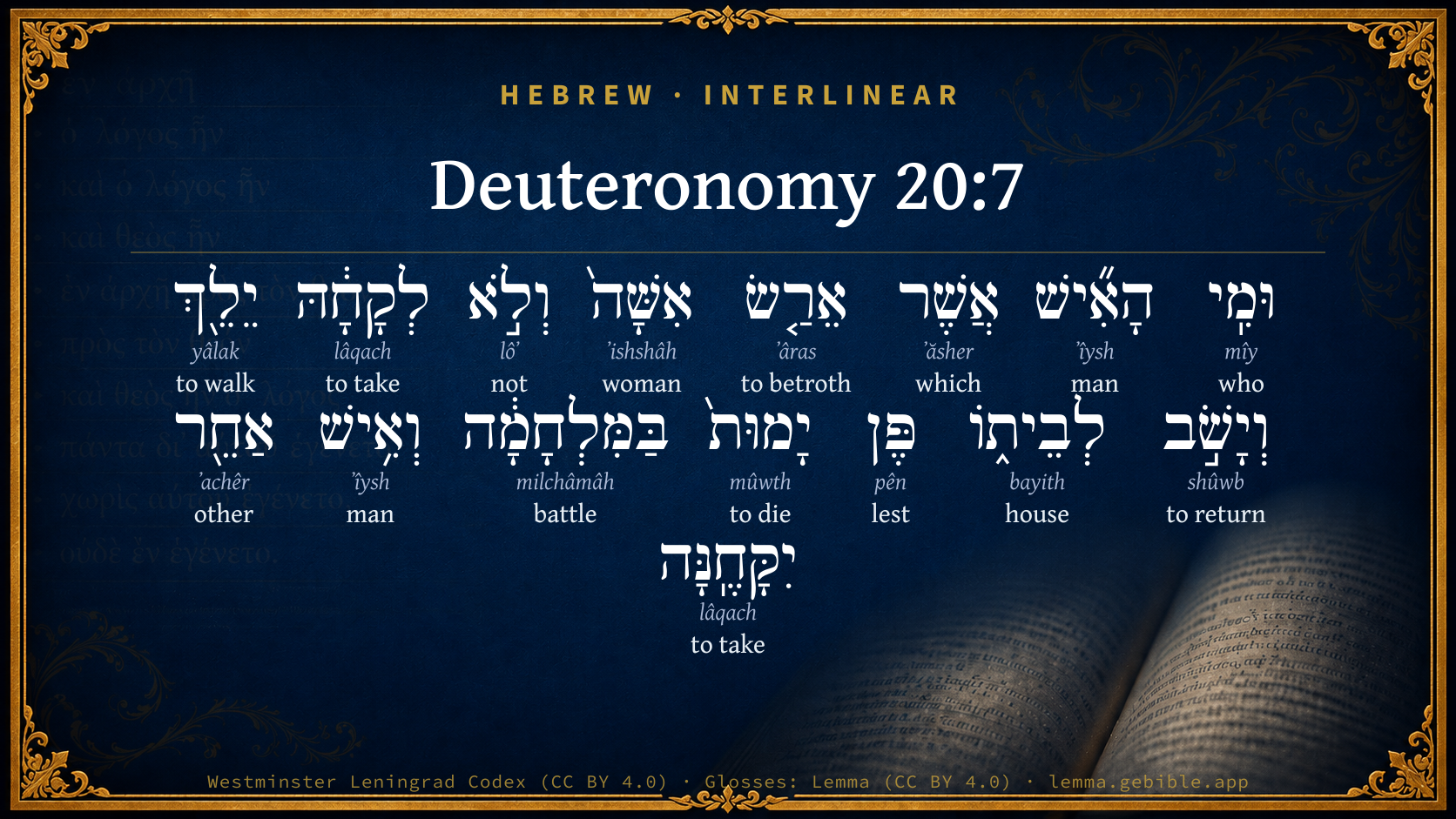
Deuteronomy 20:7

Hebrew (Westminster Leningrad Codex) Deuteronomy 20:7 appears in the Hebrew Old Testament. The text above is from the Westminster Leningrad Codex. Each word links to its Strong’s number, a concise gloss, and parsing drawn from the Open Scriptures Hebrew Bible morphology. Click any word for its full Brown-Driver-Briggs (BDB) entry.
Download image
Cite this verse

Deuteronomy 20:7 (World English Bible). Public Domain. Lemma interlinear Bible study tool, https://lemma.gebible.app/v/deuteronomy/20/7.

Show BibTeX & RIS
BibTeX
RIS
English Translation
What man is there who has pledged to be married a wife, and has not taken her? let him go and return to his house, lest he die in the battle, and another man take her.
World English Bible · Public Domain
Download a study sheet

One document with this verse’s original text, its word-by-word gloss line, the meaning frame, cross-references with their text, attributed commentary, and full source and license credits — printable, and it pastes into notes with its structure intact.

This verse Autodidact and up

Study sheet (.html) Plain text (.txt)

A passage Seminary Student

Up to 50 verses in one chapter. A passage sheet keeps up to 6 commentary sources and 12 cross-references per verse, in the order this page ranks them, and says so on the sheet whenever that leaves anything out. Ask for a single verse and you get the Autodidact verse sheet above.

Everything on this page stays free to read, with no account — the sheet is a download of what is already on screen, not access to it.

Want to remove ads? Support Godless Engineer
Compare translations 3

The same verse in 3 English versions, stacked beneath the original-language interlinear above. Click any original word for its lexicon entry.

Each is an independent rendering of the whole verse — the interlinear is not word-aligned to these translations.

Highlighted words mark where these versions differ — a whole-verse word diff, not a word-by-word alignment.

  • World English Bible Public Domain
    What man is there who has pledged to be married a wife, and has not taken her? let him go and return to his house, lest he die in the battle, and another man take her.
  • King James Version Public Domain
    And what man is there that hath betrothed a wife, and hath not taken her? let him go and return unto his house, lest he die in the battle, and another man take her.
  • unfoldingWord Literal Text CC BY-SA 4.0
    And who the man who is engaged a woman and has not taken her? Let him go and return to his house, lest he die in battle and another man take her.’

unfoldingWord Literal Text — © unfoldingWord, licensed CC BY-SA 4.0. Word-aligned USFM3 via Door43 (git.door43.org/unfoldingWord/en_ult).

Versions to compare (up to 4)

3 of 4 selected

Show all 18 translations

Every available English version of this verse, each an independent rendering of the whole verse.

  • World English Bible Public Domain
    What man is there who has pledged to be married a wife, and has not taken her? let him go and return to his house, lest he die in the battle, and another man take her.
  • Berean Standard Bible Public Domain
    Has any man become pledged to a woman and not married her? Let him return home, or he may die in battle and another man marry her.”
  • Majority Standard Bible Public Domain
    Has any man become pledged to a woman and not married her? Let him return home, or he may die in battle and another man marry her.”
  • King James Version Public Domain
    And what man is there that hath betrothed a wife, and hath not taken her? let him go and return unto his house, lest he die in the battle, and another man take her.
  • American Standard Version (1901) Public Domain
    And what man is there that hath betrothed a wife, and hath not taken her? let him go and return unto his house, lest he die in the battle, and another man take her.
  • Revised Version (1885) Public Domain
    And what man is there that hath betrothed a wife, and hath not taken her? let him go and return unto his house, lest he die in the battle, and another man take her.
  • Geneva Bible (1599) Public Domain
    And what man is there that hath betrothed a wife, and hath not taken her? let him go and returne againe vnto his house, lest he die in the battell, and another man take her.
  • Douay-Rheims (1899) Public Domain
    What man is there, that hath espoused a wife, and not taken her? let him go, and return to his house, lest he die in the war, and another man take her.
  • Young's Literal Translation Public Domain
    `And who `is' the man that hath betrothed a woman, and hath not taken her? -- let him go and turn back to his house, lest he die in battle, and another man take her.
  • Literal Standard Version CC BY-SA 4.0
    And who [is] the man that has betrothed a woman and has not taken her? Let him go and return to his house, lest he die in battle, and another man take her.
  • Unlocked Literal Bible CC BY-SA 4.0
    What man is there who is engaged to marry a woman but has not yet married her? Let him go home so that he does not die in battle and another man marries her.'
  • unfoldingWord Literal Text CC BY-SA 4.0
    And who the man who is engaged a woman and has not taken her? Let him go and return to his house, lest he die in battle and another man take her.’
  • Darby Bible Public Domain
    And what man is there that hath betrothed a wife, and hath not taken her? let him go and return unto his house, lest he die in the battle, and another man take her.
  • World Messianic Bible Public Domain
    What man is there who has pledged to be married to a wife, and has not taken her? Let him go and return to his house, lest he die in the battle, and another man take her.”
  • Webster's Bible Public Domain
    And what man is there that hath betrothed a wife, and hath not taken her? let him go and return to his house, lest he should die in battle, and another man should take her.
  • Free Bible Version CC BY-SA 4.0
    Is there any man here who is engaged to a woman and hasn't married her? He can go home, otherwise he might die in battle and another man will marry her.”
  • Bible in Basic English Public Domain
    Or if any man is newly married and has had no sex relations with his wife, let him go back to his house, so that in the event of his death in the fight, another man may not take her.
  • JPS Tanakh (1917) Public Domain
    And what man is there that hath betrothed a wife, and hath not taken her? let him go and return unto his house, lest he die in the battle, and another man take her.'

Literal Standard Version (2020), Covenant Press — licensed CC BY-SA 4.0. Text via the HelloAO Bible API (eBible.org). Unlocked Literal Bible (unfoldingWord) — licensed CC BY-SA 4.0. Text via the HelloAO Bible API (eBible.org). unfoldingWord Literal Text — © unfoldingWord, licensed CC BY-SA 4.0. Word-aligned USFM3 via Door43 (git.door43.org/unfoldingWord/en_ult). Free Bible Version, Dr. Jonathan Gallagher — licensed CC BY-SA 4.0. Text via the HelloAO Bible API (eBible.org).

Word by word

More ways to search: Search by grammar → Find every occurrence → Compare this word →

Practice this passage: Drill this verse → Learn its vocabulary →

אֵרַ֤שׂ
ʼâras
H781
“to betroth”
Verb, Piel, Perfect, 3rd Person, Masculine, Singular
Part of Speech
Verb
Stem
Piel
Form
Perfect
Person
3rd Person
Gender
Masculine
Number
Singular
Full BDB Definition

Origin: a primitive root

TWOT: 170

to betroth, engage - (Piel) to betroth (man or woman) - (Pual) to be betrothed
  1. וּמִֽי mîy H4310 “and · who” Conjunction + Particle, Interrogative
  2. הָאִ֞ישׁ ʼîysh H376 “the · man” Particle, Definite Article + Noun, Common, Masculine, Singular, Absolute
  3. אֲשֶׁר ʼăsher H834 “which” Particle, Relative
  4. אִשָּׁה֙ ʼishshâh H802 “woman” Noun, Common, Feminine, Singular, Absolute
  5. וְלֹ֣א lôʼ H3808 “and · not” Conjunction + Particle, Negative
  6. לְקָחָ֔הּ lâqach H3947 “to take · her” Verb, Qal, Perfect, 3rd Person, Masculine, Singular + Suffix, Personal, 3rd Person, Feminine, Singular
  7. יֵלֵ֖ךְ yâlak H3212 “to walk” Verb, Qal, Imperfect, 3rd Person, Masculine, Singular
  8. וְיָשֹׁ֣ב shûwb H7725 “and · to return” Conjunction + Verb, Qal, Imperfect, 3rd Person, Masculine, Singular
  9. לְבֵית֑וֹ bayith H1004 “to/for · house · his” Preposition + Noun, Common, Masculine, Singular, Construct + Suffix, Personal, 3rd Person, Masculine, Singular
  10. פֶּן pên H6435 “lest” Conjunction
  11. יָמוּת֙ mûwth H4191 “to die” Verb, Qal, Imperfect, 3rd Person, Masculine, Singular
  12. בַּמִּלְחָמָ֔ה milchâmâh H4421 “in/at the · battle” Preposition, Determined + Noun, Common, Feminine, Singular, Absolute
  13. וְאִ֥ישׁ ʼîysh H376 “and · man” Conjunction + Noun, Common, Masculine, Singular, Absolute
  14. אַחֵ֖ר ʼachêr H312 “other” Adjective, Adjective, Masculine, Singular, Absolute
  15. יִקָּחֶֽנָּה lâqach H3947 “to take · her” Verb, Qal, Imperfect, 3rd Person, Masculine, Singular + Suffix, Personal, 3rd Person, Feminine, Singular

About this verse

These counts appear in no published source. They are computed here, from the morphology-tagged text and Lemma’s own curated glosses. What Lemma adds →

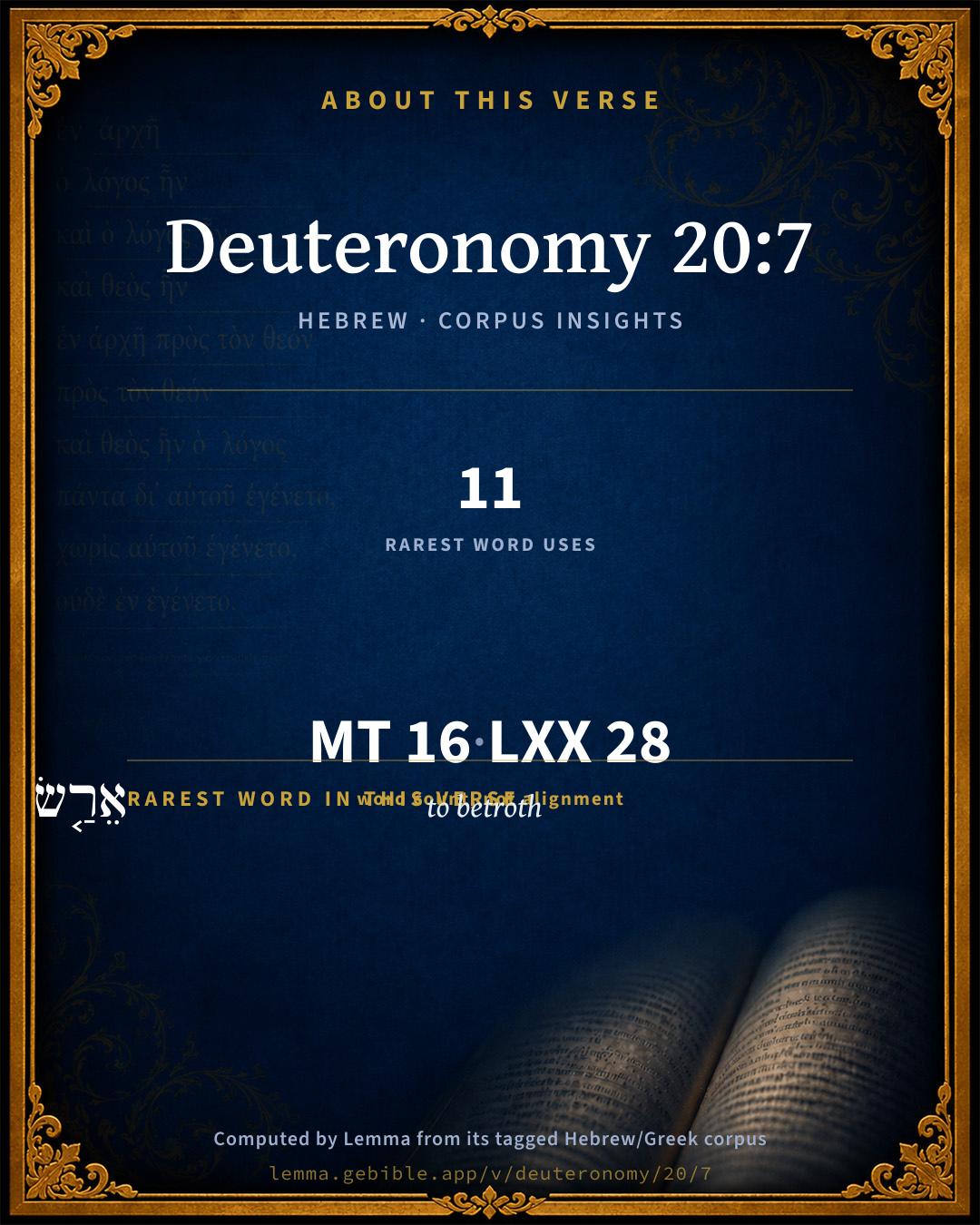
16
words
14
distinct lemmas
Pentateuch
section

Notable vocabulary

The rarest word here is אֵרַ֤שׂ to betroth H781 — appearing just 11 times in the whole Hebrew Bible.

Shared distinctive vocabulary

אֵרַ֤שׂ to betroth H781 occurs in 10 verses of the Hebrew Bible. Also found in:

Grammatical profile

  • 6 verbs
  • 5 nouns
  • 1 adjective
  • 1 conjunction
  • 3 particles

Verb forms

  • אֵרַ֤שׂ Piel · Perfect
  • לְקָחָ֔הּ Qal · Perfect
  • יֵלֵ֖ךְ Qal · Imperfect
  • וְיָשֹׁ֣ב Qal · Imperfect
  • יָמוּת֙ Qal · Imperfect
  • יִקָּחֶֽנָּה Qal · Imperfect

Repetition

Words recur within this verse — often emphatic in Hebrew:

  • הָאִ֞ישׁ man H376 ×2
  • לְקָחָ֔הּ to take H3947 ×2

Hebrew & Septuagint length

In English translation the verse runs 36 words from the Hebrew and 34 from the Septuagint (LXX English) — closely comparable.

A rough comparison of the two English renderings, which tokenize alike — not a word-level alignment.

Word counts can differ between the Hebrew and the Greek without any difference in meaning — e.g. the Hebrew direct-object marker אֵת has no separate Greek word, and Greek often adds the article ὁ.

In the original languages it is 16 Hebrew tokens and 28 Greek tokens — but the two are counted differently (Hebrew bundles its prefixes and suffixes into one token; the Greek is in lemma form), so that isn’t a like-for-like length.

Cross-references

6

Topical passages linked to Deuteronomy 20:7 in the Treasury of Scripture Knowledge — connected by theme and wording, ordered by reader-vote popularity; previews shown in the World English Bible.

  • Deuteronomy 24:5 When a man takes a new wife, he shall not go out in the host, neither shall he be charged with any business: he shall be free at home one year, and shall cheer his wife whom he has taken.
  • Deuteronomy 28:30 You shall betroth a wife, and another man shall lie with her: you shall build a house, and you shall not dwell therein: you shall plant a vineyard, and shall not use the fruit of it.
  • Deuteronomy 22:23–25 If there be a young lady who is a virgin pledged to be married to a husband, and a man find her in the city, and lie with her;
  • Matthew 1:18 Now the birth of Jesus Christ was like this; for after his mother, Mary, was engaged to Joseph, before they came together, she was found pregnant by the Holy Spirit.
  • Luke 14:18–20 They all as one began to make excuses. "The first said to him, 'I have bought a field, and I must go and see it. Please have me excused.'
  • 2 Timothy 2:4 No soldier on service entangles himself in the affairs of life, that he may please him who enrolled him as a soldier.

Cross-references courtesy of OpenBible.info (CC BY 4.0).

Hebrew and Greek witnesses Masoretic Hebrew ↔ Greek Septuagint

The same verse in the two great witnesses to the Old Testament, shown verse-for-verse.

These are two independent witnesses, not word-aligned to each other, and the Septuagint is shown in lemma (dictionary) form.

Hebrew Deuteronomy 20:7 Masoretic · Westminster Leningrad Codex

וּמִֽי הָאִ֞ישׁ אֲשֶׁר אֵרַ֤שׂ אִשָּׁה֙ וְלֹ֣א לְקָחָ֔הּ יֵלֵ֖ךְ וְיָשֹׁ֣ב לְבֵית֑וֹ פֶּן יָמוּת֙ בַּמִּלְחָמָ֔ה וְאִ֥ישׁ אַחֵ֖ר יִקָּחֶֽנָּה

What man is there who has pledged to be married a wife, and has not taken her? let him go and return to his house, lest he die in the battle, and another man take her.

World English Bible · Public Domain

Greek LXX Deuteronomy 20:7 Septuagint · lemma form

καί τίς ὁ ἄνθρωπος ὅστις μνηστεύω γυνή καί οὐ λαμβάνω αὐτός πορεύομαι καί ἀποστρέφω εἰς ὁ οἰκία αὐτός μή ἀποθνήσκω ἐν ὁ πόλεμος καί ἄνθρωπος ἕτερος λαμβάνω αὐτός

And what man is he that has betrothed a wife, and has not taken her? let him go and return to his house, lest he die in the battle, and another man take her.

LXX2012 (modern English Septuagint) · Public Domain

Hebrew: Westminster Leningrad Codex (CC BY 4.0). Greek: Septuagint (public domain); English from LXX2012 (modern English Septuagint) (Public Domain). How the Septuagint differs from the Hebrew →

Targum (Aramaic paraphrase)

2

The Targum is the ancient Jewish Aramaic paraphrase of the Hebrew Scriptures — an interpretive translation, not the Hebrew text itself. Onkelos (literal) and Pseudo-Jonathan (expansive) render the Torah, and Jonathan the Prophets. Coverage is partial: where no permissively-licensed English translation exists for a verse, only the Aramaic is shown. This is verse-level text, not a word-by-word alignment to the Hebrew.

  1. Targum Onkelos Torah (Genesis–Deuteronomy)
    וּמָן גַבְרָא דִי אֵרַס אִתְּתָא וְלָא נָסְבַהּ יְהַךְ וִיתוּב לְבֵיתֵהּ דִילְמָא יְמוּת בַּאֲגָחָא קְרָבָא וּגְבַר אָחֳרָן יִסְבִנַהּ

    (no public-domain English translation for this verse)

    Targum Onkelos — Aramaic: “Onkelos Genesis” (public domain); “Onkelos Exodus” (public domain); “Onkelos Leviticus” (public domain); “Onkelos Numbers” (public domain); “Onkelos Deuteronomy” (public domain). English: “Sefaria Community Translation” (CC0 1.0 (public-domain dedication)); “J.W. Etheridge. The Targums of Onkelos and Jonathan Ben Uzziel on the Pentateuch. London: Longmans, Green, 1862” (public domain). Text via Sefaria.

  2. Targum Pseudo-Jonathan Torah (Genesis–Deuteronomy)
    וּמַאן גַּבְרָא דְקָדִשׁ אִתְּתָא וְלָא נַסְבָהּ יְהַךְ וִיתוּב לְבֵיתֵיהּ דְּלָא יִגְרוֹם לֵיהּ חוֹבָא דְלָא חָדֵי בְּאִנְתְּתֵיהּ וְיִתְקְטֵיל בִּקְרָבָא וּגְבַר חוֹרַן יַסְבִינָהּ

    And what man hath betrothed a wife, but not taken her? let him go and return to his house, lest sin prevent him from rejoicing with his wife and he be slain in the battle, and another take her.

    Targum Pseudo-Jonathan — Aramaic: “Targum Jonathan on Genesis” (public domain); “Targum Jonathan on Exodus” (public domain); “Targum Jonathan on Leviticus” (public domain); “Targum Jonathan on Numbers” (public domain); “Targum Jonathan on Deuteronomy” (public domain). English: “The Targum of Jonathan ben Uzziel, trans. J. W. Etheridge, London, 1862” (public domain). Text via Sefaria.

Commentary

Notes on Deuteronomy 20:7 from classic Christian and Jewish commentators (each source and its license shown beneath its notes). The classic Christian expositions comment on the surrounding passage and are grouped to its opening verse, so a note may address several verses; the Jewish commentaries on the Tanakh (Rashi and others) are per-verse, so they appear only where the commentator wrote on this verse.

Lemma curates 59 commentaries, every one of them public domain or Creative Commons licensed, each selected and text-cleaned for this edition rather than reprinted as found. About our sources →

Trapp's Complete Commentary

John Trapp

Deu 20:7 And what man [is there] that hath betrothed a wife, and hath not taken her? let him go and return unto his house, lest he die in the battle, and another man take her.

Ver. 8. That is fearful and faint hearted.] This cowardly passion dispirits a man, expectorates his manliness, and exposeth him to the cruel mercy of an enemy. Better be temerarious than timorous! "Ye fugitives of Ephraim," is no small brand of dishonour; {Jdg 12:4} besides that melting and trying judgments follow such at heels as account one pair of heels worth two pair of hands. {Jer 9:3-7} The French fled so fast before the English at the battle of Terwin, that it was called the battle of Spurs. {a}

Lest his brethren’s hearts.] Cowardice is catching, and shows that men, like stags, have great horns, but want hearts.

{a} Paul Jovius.

John Trapp, A Commentary or Exposition upon All the Books of the Old and New Testament (1647–1656) — public domain. Text from a community e-Sword module.

Joseph Benson's Commentary

Deu 20:7-8. Hath betrothed a wife — The time allowed in this case was a year, Deu 24:5. This was a law of great humanity, that conjugal love might not be disturbed, but have time to knit into a firm and lasting affection. What man is fearful and faint-hearted — This fearfulness is to be understood, say the Jews, not only of a natural timorousness, which is incident to some constitutions, and makes a man tremble at every danger, but of the adventitious terrors of a guilty conscience. For they did not, as in the modern fashion, send the wickedest and most worthless into the wars; but if they knew any man to be a notorious villain, they thrust him out of the army, lest his example should corrupt and discourage the rest of the soldiery.

Joseph Benson's Commentary on the Old and New Testaments (1811–1818) — public domain. Text from a community e-Sword module.

Tyndale Open Study Notes

Tyndale Open Resources

20:7 someone else would marry her: In this situation, a man who died would be deprived of offspring to carry on his name, which was a great tragedy in ancient Israel.

Tyndale Open Study Notes — © Tyndale Open Resources, licensed CC BY-SA 4.0. Text via the HelloAO Bible API.

Adam Clarke's Commentary

Verse 7. Betrothed a wife, and hath not taken her?] It was customary among the Jews to contract matrimony, espouse or betroth, and for some considerable time to leave the parties in the houses of their respective parents: when the bridegroom had made proper preparations, then the bride was brought home to his house, and thus the marriage was consummated. The provisions in this verse refer to a case of this kind; for it was deemed an excessive hardship for a person to be obliged to go to battle, where there was a probability of his being slain, who had left a new house unfinished; a newly purchased heritage half tilled; or a wife with whom he had just contracted marriage. Homer represents the case of Protesilaus as very afflicting, who was obliged to go to the Trojan war, leaving his wife in the deepest distress, and his house unfinished.

Του δε και αμφιδρυφης αλοχος Φυλακῃ ελελειπτο,

Και δομος ἡμιτελης· τον δ' εκτανε Δαρδανος ανηρ,

Νηος αποθρωσκοντα πολυ πρωτιστον Αχαιων.

ILIAD, 1. ii., ver. 100.

"A wife he left,

To rend in Phylace her bleeding cheeks,

And an unfinish'd mansion: first he died

Of all the Greeks; for as he leap'd to land,

Long ere the rest, a Dardan struck him dead."

COWPER.

Adam Clarke's Commentary on the Bible (1810–1826) — public domain. Text from a community e-Sword/MySword module.

The Cambridge Bible for Schools and Colleges

gen. ed. J. J. S. Perowne

7. that hath betrothed, etc.] Cp. Deu_24:5, exempting the newly-married from service for a year. The reason can hardly be that he was unclean for, as in the case of other married men, this obstacle could be removed (2Sa_11:6 f.). Evidently the motive is humane, in the wife’s interests, or in order to secure descendants to the man himself.

The Cambridge Bible for Schools and Colleges (gen. ed. J. J. S. Perowne; Cambridge University Press, 1878–1918) — public domain. Text from a community e-Sword module.

John Gill's Exposition

And what man is there that hath betrothed a wife, and hath not taken her?.... Home to his house and bedded with her; has only betrothed her, but is not properly married to her, the nuptials are not completed; this the Jews understand of anyone betrothed to him, whether a virgin or a widow, or the wife of a deceased brother (yea, they say, if his brother is dead in war, he returns and comes home), but not of a former wife divorced and received again (m):

let him go and return unto his house, lest he die in battle, and another man take her; or marry her.

(m) Misn. Sotah, ib. sect. 2.

John Gill's Exposition of the Whole Bible (1746–1763) — public domain (CC PDM 1.0). Text via the HelloAO Bible API.

Haydock's Catholic Bible Commentary

Taken her. It was customary to leave the espoused virgin in her father’s house for the space of a year, (during which time, if she proved unfaithful, she was punished like an adulteress, chap. xxii. 23, &c.) and she could not be given till she was 12 years old. If she were 13 complete, when she was asked in marriage, she was only obliged to wait 30 days. (Selden, Uxor. ii. 1.) (Chap. xxv. 5.) Philo allows this immunity from war, only to those who had espoused a virgin. They were also freed from paying taxes, mending roads, &c., chap. xxix. 5. (Calmet) --- Those who are entangled with worldly cares, are apt to discourage the valiant, and to dissuade fighting, for fear of losing these advantages: much more are those in danger who have to fight for a heavenly kingdom, if they be too much attached to the things of the earth. (Worthington; Haydock) --- "That man who is enslaved to his wife, cannot serve in the warfare of the Lord." (St. Jerome, contra Jov. i.)

George Leo Haydock (1774–1849), Haydock's Catholic Family Bible and Commentary, 1859 edition — public domain. Excludes Psalms (Douay-Rheims chapter numbering differs from Protestant) and Deuterocanonical books (Catholic canon only).

Matthew Poole's English Annotations

Betrothing was done by a solemn and mutual promise, but not by an actual contract. See Gen 19:14; Deu 22:23.

Matthew Poole's English Annotations on the Holy Bible (1683–1685) — public domain. Text from a community e-Sword/MySword module.

Whedon's Commentary on the Bible

Daniel D. Whedon

7. What man… hath betrothed a wife — The exemption from military service to the betrothed is, in Deu_24:5, also applied to the newly married man, who was free from obligation to serve in the army for a year.

Daniel D. Whedon (gen. ed.), Commentary on the Old and New Testaments (1874–1909) — public domain. Text from a community e-Sword module.

Rashi

Rabbi Shlomo Yitzchaki (Rashi)

פן ימות במלחמה [LET HIM GO AND RETURN] LEST HE DIE IN THE WAR — The meaning is: let him return so that he not die, for if he will not hearken to the words of the priests he deserves death (Sifrei Devarim 194:5).

Rashi on the Tanakh — English translations: “The Judaica Press complete Tanach with Rashi, translated by A. J. Rosenberg” (CC BY 4.0); “Pentateuch with Rashi's commentary by M. Rosenbaum and A.M. Silbermann, 1929-1934” (public domain); “The Metsudah Tanach series, Lakewood, N.J” (CC BY 4.0); and “The Book of Joshua, Metsudah Publications, 1997” (CC BY 4.0). Text via Sefaria.

Lesson kit

Teaching starters — assembled from the data on this page, not authored interpretation. Every prompt links to the verse data it draws on. Edit before teaching.

Deuteronomy, in the Pentateuch, opens this verse with 16 words (14 distinct Hebrew lemmas). Its most distinctive word is ʼâras (“to betroth”). A historical commentator’s framing appears above. Read the whole chapter for the surrounding context.

Discussion questions

  1. How does “to betroth” (ʼâras) shape what this verse is saying?
  2. Exodus 22:16 shares the word «to betroth» with this verse. How do the two illuminate each other?
  3. “man” occurs 2× in this one verse. What is the effect of the repetition?
  4. These translations render this verse differently. What is at stake in choosing one wording over another?
  5. The verb «אֵרַ֤שׂ» is Piel Perfect. How does its form color the action?
  6. Reading how Trapp's Complete Commentary and Joseph Benson's Commentary read this verse, where do the two commentators agree and where do they part?

Things to notice

Reading settings

Reading text

Shown beneath each verse's original-language words.

Old Testament
Old Testament edition

Read the OT as the Masoretic Hebrew (MT) or the Greek Septuagint (LXX).

English shown for the Greek Septuagint (in the Hebrew ↔ Greek comparison).

Comparing translations? Open the Compare panel on any verse page to stack up to four side by side.