
Job 6:16

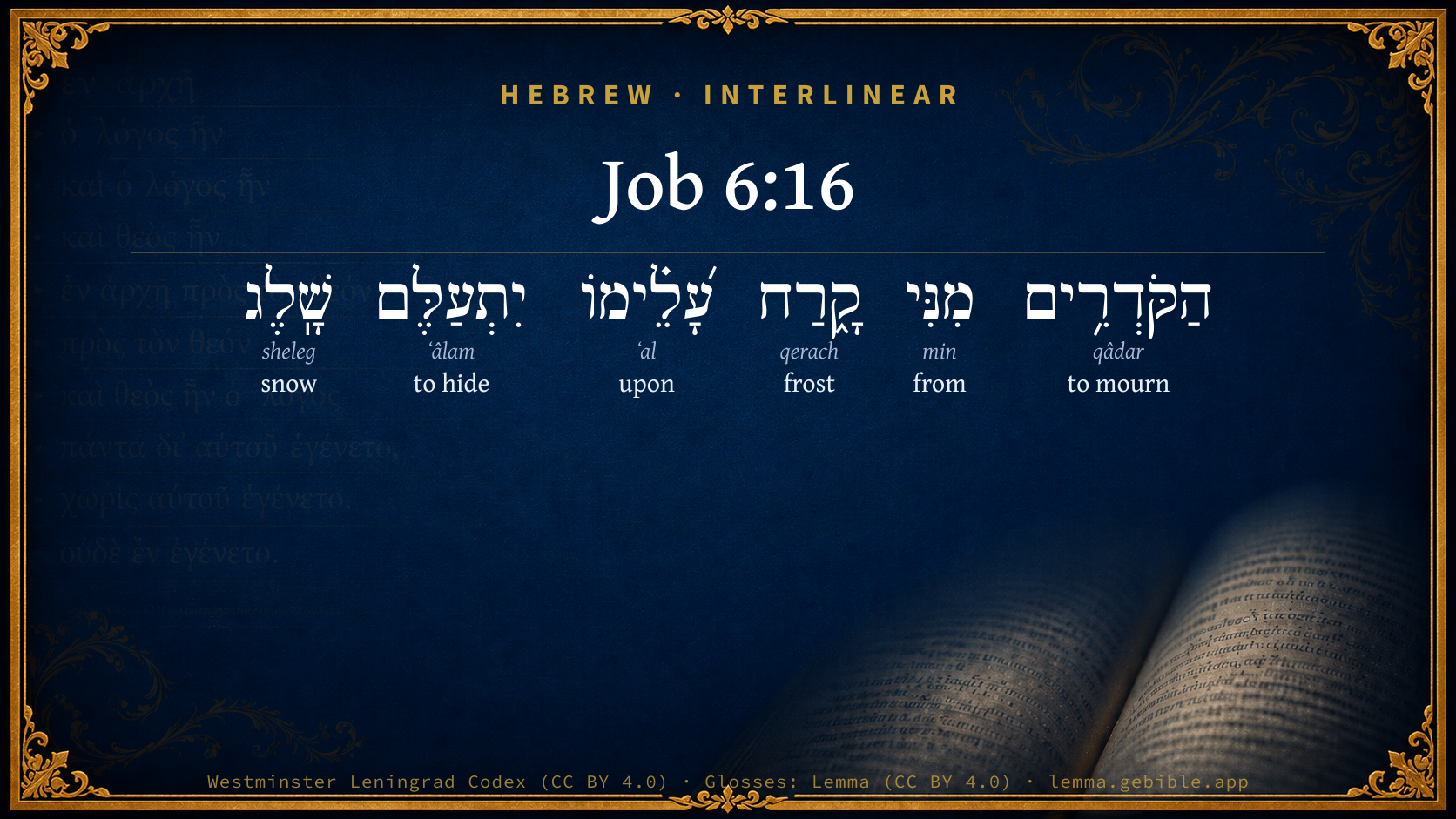
Hebrew (Westminster Leningrad Codex) Job 6:16 appears in the Hebrew Old Testament. The text above is from the Westminster Leningrad Codex. Each word links to its Strong’s number, a concise gloss, and parsing drawn from the Open Scriptures Hebrew Bible morphology. Click any word for its full Brown-Driver-Briggs (BDB) entry.
Download image
Cite this verse

Job 6:16 (World English Bible). Public Domain. Lemma interlinear Bible study tool, https://lemma.gebible.app/v/job/6/16.

Show BibTeX & RIS
BibTeX
RIS
English Translation
Which are black by reason of the ice, in which the snow hides itself:
World English Bible · Public Domain
Download a study sheet

One document with this verse’s original text, its word-by-word gloss line, the meaning frame, cross-references with their text, attributed commentary, and full source and license credits — printable, and it pastes into notes with its structure intact.

This verse Autodidact and up

Study sheet (.html) Plain text (.txt)

A passage Seminary Student

Up to 50 verses in one chapter. A passage sheet keeps up to 6 commentary sources and 12 cross-references per verse, in the order this page ranks them, and says so on the sheet whenever that leaves anything out. Ask for a single verse and you get the Autodidact verse sheet above.

Everything on this page stays free to read, with no account — the sheet is a download of what is already on screen, not access to it.

Want to remove ads? Support Godless Engineer
Compare translations 3

The same verse in 3 English versions, stacked beneath the original-language interlinear above. Click any original word for its lexicon entry.

Each is an independent rendering of the whole verse — the interlinear is not word-aligned to these translations.

Highlighted words mark where these versions differ — a whole-verse word diff, not a word-by-word alignment.

  • World English Bible Public Domain
    Which are black by reason of the ice, in which the snow hides itself:
  • King James Version Public Domain
    Which are blackish by reason of the ice, and wherein the snow is hid:
  • unfoldingWord Literal Text CC BY-SA 4.0
    the ones being dark from ice over it, it hides itself with snow.

unfoldingWord Literal Text — © unfoldingWord, licensed CC BY-SA 4.0. Word-aligned USFM3 via Door43 (git.door43.org/unfoldingWord/en_ult).

Versions to compare (up to 4)

3 of 4 selected

Show all 18 translations

Every available English version of this verse, each an independent rendering of the whole verse.

  • World English Bible Public Domain
    Which are black by reason of the ice, in which the snow hides itself:
  • Berean Standard Bible Public Domain
    darkened because of the ice and the inflow of melting snow,
  • Majority Standard Bible Public Domain
    darkened because of the ice and the inflow of melting snow,
  • King James Version Public Domain
    Which are blackish by reason of the ice, and wherein the snow is hid:
  • American Standard Version (1901) Public Domain
    Which are black by reason of the ice, `And' wherein the snow hideth itself:
  • Revised Version (1885) Public Domain
    Which are black by reason of the ice, and wherein the snow hideth itself:
  • Geneva Bible (1599) Public Domain
    Which are blackish with yee, and wherein the snowe is hid.
  • Douay-Rheims (1899) Public Domain
    They that fear the hoary frost, the snow shall fall upon them.
  • Young's Literal Translation Public Domain
    That are black because of ice, By them doth snow hide itself.
  • Literal Standard Version CC BY-SA 4.0
    That are black because of ice, || By them snow hides itself.
  • Unlocked Literal Bible CC BY-SA 4.0
    which are darkened because of ice over them, and because of the snow that hides itself in them.
  • unfoldingWord Literal Text CC BY-SA 4.0
    the ones being dark from ice over it, it hides itself with snow.
  • Darby Bible Public Domain
    Which are turbid by reason of the ice, in which the snow hideth itself:
  • World Messianic Bible Public Domain
    which are black by reason of the ice, in which the snow hides itself.
  • Webster's Bible Public Domain
    Which are blackish by reason of the ice, and in which the snow is hid:
  • Free Bible Version CC BY-SA 4.0
    The stream floods when it is full of dark ice and melting snow,
  • Bible in Basic English Public Domain
    Which are dark because of the ice, and the snow falling into them;
  • JPS Tanakh (1917) Public Domain
    Which are black by reason of the ice, and wherein the snow hideth itself;

Literal Standard Version (2020), Covenant Press — licensed CC BY-SA 4.0. Text via the HelloAO Bible API (eBible.org). Unlocked Literal Bible (unfoldingWord) — licensed CC BY-SA 4.0. Text via the HelloAO Bible API (eBible.org). unfoldingWord Literal Text — © unfoldingWord, licensed CC BY-SA 4.0. Word-aligned USFM3 via Door43 (git.door43.org/unfoldingWord/en_ult). Free Bible Version, Dr. Jonathan Gallagher — licensed CC BY-SA 4.0. Text via the HelloAO Bible API (eBible.org).

Word by word

More ways to search: Search by grammar → Find every occurrence → Compare this word →

Practice this passage: Drill this verse → Learn its vocabulary →

About this verse

These counts appear in no published source. They are computed here, from the morphology-tagged text and Lemma’s own curated glosses. What Lemma adds →

6
words
6
distinct lemmas
Wisdom
section

Notable vocabulary

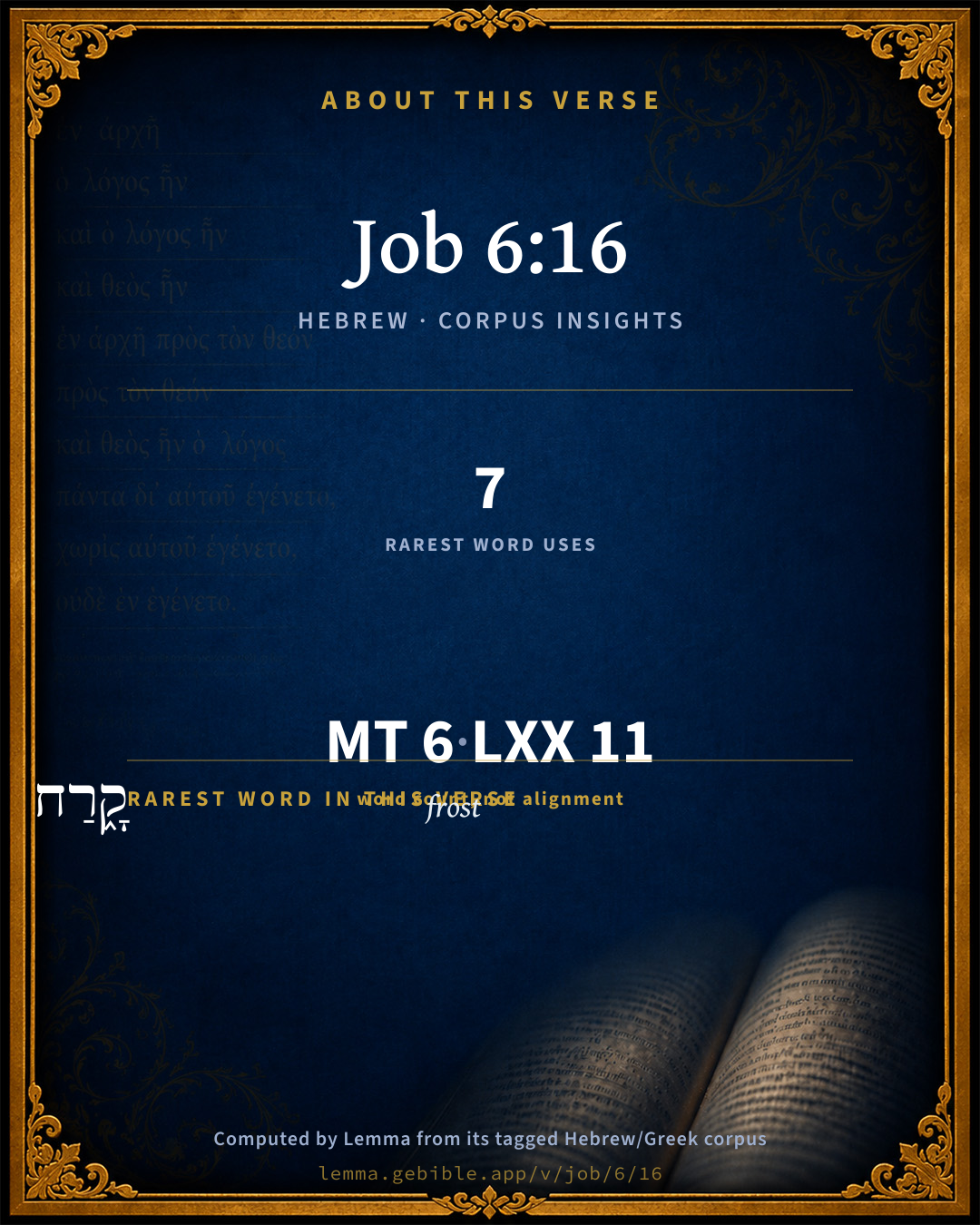
The rarest word here is קָ֑רַח frost H7140 — appearing just 7 times in the whole Hebrew Bible.

Shared distinctive vocabulary

קָ֑רַח frost H7140 occurs in 7 verses of the Hebrew Bible. Also found in:

Grammatical profile

  • 2 verbs
  • 2 nouns
  • 2 prepositions

Verb forms

  • הַקֹּדְרִ֥ים Qal · Participle Active
  • יִתְעַלֶּם Hithpael · Imperfect

Hebrew & Septuagint length

In English translation the verse runs 14 words from the Hebrew and 16 from the Septuagint (LXX English) — closely comparable.

A rough comparison of the two English renderings, which tokenize alike — not a word-level alignment.

Word counts can differ between the Hebrew and the Greek without any difference in meaning — e.g. the Hebrew direct-object marker אֵת has no separate Greek word, and Greek often adds the article ὁ.

In the original languages it is 6 Hebrew tokens and 11 Greek tokens — but the two are counted differently (Hebrew bundles its prefixes and suffixes into one token; the Greek is in lemma form), so that isn’t a like-for-like length.

Hebrew and Greek witnesses Masoretic Hebrew ↔ Greek Septuagint

The same verse in the two great witnesses to the Old Testament, shown verse-for-verse.

These are two independent witnesses, not word-aligned to each other, and the Septuagint is shown in lemma (dictionary) form.

Hebrew Job 6:16 Masoretic · Westminster Leningrad Codex

הַקֹּדְרִ֥ים מִנִּי קָ֑רַח עָ֝לֵ֗ימוֹ יִתְעַלֶּם שָֽׁלֶג

Which are black by reason of the ice, in which the snow hides itself:

World English Bible · Public Domain

Greek LXX Job 6:16 Septuagint · lemma form

ὅστις ἐγώ διαεὐλαβέομαι νῦν ἐπιπίπτω ἐγώ ὥσπερ χιών ἤ κρυστάλλος πήγνυμι

They who used to reverence me, now have come against me like snow or congealed ice.

LXX2012 (modern English Septuagint) · Public Domain

On this verse, Albert Barnes' Notes on the Bible discusses the Septuagint’s reading. Read the note in Commentary ↓

Hebrew: Westminster Leningrad Codex (CC BY 4.0). Greek: Septuagint (public domain); English from LXX2012 (modern English Septuagint) (Public Domain). How the Septuagint differs from the Hebrew →

Commentary

Notes on Job 6:16 from classic Christian and Jewish commentators (each source and its license shown beneath its notes). The classic Christian expositions comment on the surrounding passage and are grouped to its opening verse, so a note may address several verses; the Jewish commentaries on the Tanakh (Rashi and others) are per-verse, so they appear only where the commentator wrote on this verse.

Lemma curates 59 commentaries, every one of them public domain or Creative Commons licensed, each selected and text-cleaned for this edition rather than reprinted as found. About our sources →

Trapp's Complete Commentary

John Trapp

Job 6:16 Which are blackish by reason of the ice, [and] wherein the snow is hid:

Ver. 16. Which are blackish by reason of the ice] Or frost, a black frost we call it, which deceiveth those that tread upon it. Or if, hard enough to bear up passengers, it promise to be a storehouse of preserving snow and water against the scorching time of summer, yet there is no trusting to it; for these waters, as they are in winter locked up with frosts, so they will be in summer exhaled and dried up by the sun.

John Trapp, A Commentary or Exposition upon All the Books of the Old and New Testament (1647–1656) — public domain. Text from a community e-Sword module.

Joseph Benson's Commentary

Job 6:16. Which are blackish, &c. — Which in winter, when the traveller neither needs nor desires it, are full of water congealed by the frost. Wherein the snow is hid — Under which the water from snow, which formerly fell, and afterward was dissolved, lies hid. So he speaks not of those brooks which are fed by a constant spring, but of them which are filled by accidental falls of water or snow.

Joseph Benson's Commentary on the Old and New Testaments (1811–1818) — public domain. Text from a community e-Sword module.

Jamieson, Fausset & Brown

Robert Jamieson, A. R. Fausset & David Brown

blackish--literally, "Go as a mourner in black clothing" (Psa 34:14). A vivid and poetic image to picture the stream turbid and black with melted ice and snow, descending from the mountains into the valley. In the [second] clause, the snow dissolved is, in the poet's view, "hid" in the flood [UMBREIT].

Jamieson, Fausset & Brown — Commentary Critical and Explanatory on the Whole Bible (1871) — public domain (CC PDM 1.0). Text via the HelloAO Bible API.

Adam Clarke's Commentary

Verse 16. Blackish by reason of the ice] He represents the waters as being sometimes suddenly frozen, their foam being turned into the semblance of snow or hoar-frost: when the heat comes, they are speedily liquefied; and the evaporation is so strong from the heat, and the absorption so powerful from the sand, that they soon disappear.

Adam Clarke's Commentary on the Bible (1810–1826) — public domain. Text from a community e-Sword/MySword module.

The Cambridge Bible for Schools and Colleges

gen. ed. J. J. S. Perowne

16. are blackish] Rather, are black, that is, turbid.

is hid] lit. hides itself, that is, dissolves.

Pleasures are like poppies spread,

You seize the flower, its bloom is shed;

Or like the snow-falls in the river—

A moment white, then melts for ever.

The Cambridge Bible for Schools and Colleges (gen. ed. J. J. S. Perowne; Cambridge University Press, 1878–1918) — public domain. Text from a community e-Sword module.

John Gill's Exposition

What time they wax warm they vanish,.... The ice and the snow, which, when the weather becomes warm, they melt away and disappear; and in like manner, he suggests his friends ceased to be friends to him in a time of adversity; the sun of affliction having looked upon him, they deserted him, at least did not administer comfort to him:

when it is hot they are consumed out of their place; when it is hot weather, and the sun has great strength then the waters, which swelled through the floods and fall of rain and snow, and which when frozen, looked black and big as if they had great depth in them, were quickly dried up, and no more to be seen in the place where they were; which still expresses the short duration of friendship among men, which Job had a sorrowful experience of.

John Gill's Exposition of the Whole Bible (1746–1763) — public domain (CC PDM 1.0). Text via the HelloAO Bible API.

Albert Barnes' Notes on the Bible

Which are blackish - Or, rather, which are turbid. The word used here (קדרים qoderı̂ym) means to be turbid, foul, or muddy, spoken of a torrent, and then to be of a dusky color, to be dark-colored, as e. g. the skin scorched by the sun, Job 30:28; or to be dark - as when the sun is obscured; Joe 2:10; Joe 3:15. Jerome renders it, Qui timent pruinam - “which fear the frost, when the snow comes upon them.” The Septuagint renders it, “they who had venerated me now rushed upon me like snow or hoar frost, which melting at the approach of heat, it was not known whence it was.” The expression in the Hebrew means that they were rendered dark and turbid by the accumulated torrents caused by the dissolving snow and ice.

By reason of the ice - When it melts and swells the streams.

And wherein the snow is hid - That is, says Noyes, melts and flows into them. It refers to the melting of the snow in the spring, when the streams are swelled as a consequence of it. Snow, by melting in the spring and summer, would swell the streams, which at other times were dry. Lucretius mentions the melting of the snows on the mountains of Ethiopia, as one of the causes of the overflowing of the Nile:

Forsitan Aethiopum pentrue de montibus altis

Crescat, ubi in campos albas descendere ningues

Tahificiss subigit radiis sol, omnia lustrans.

vi. 734.

Or, from the Ethiop-mountains, the bright sun,

Now full matured, with deep-dissolving ray,

May melt the agglomerate snows, and down the plains

Drive them, augmenting hence the incipient stream.

Good

A similar description occurs in Homer, Iliad xi. 492:

Ὡς δ ̓ ὁπόε πλήφων ποταμός πεδίνδε κάτεισι

Χειμάῤῥους κατ ̓ ὄρεσφιν, κ. τ. λ.

Hōs d' hopote plēthōn potamos pedionde kateisi

Cheimarrous kat' oresfin, etc.

And in Ovid also, Fast. ii. 219:

Ecce, velut torrens andis pluvialibus auctus,

Ant hive, quae, Zephyro victa, repente fluit,

Per sara, perque vias, tertur; nec, ut ante solebat,

Riparum clausas margine finit aquas.

Albert Barnes' Notes on the Bible (1834–1885) — public domain. Text from a community e-Sword/MySword module.

Haydock's Catholic Bible Commentary

Them. They shall run from a less to a greater evil. (Calmet) --- Septuagint, "Those who respected me, have now fallen upon me, like snow or ice; (17) as when it is consumed with heat, it is no longer known where it was: (18) thus I have been abandoned by all, lost and expelled from my house." Consider, (19) Hebrew continues, in the comparison of the torrents, (15) "which are hidden by the ice and snow," and are left dry and of no service in summer, when most wanted. (Haydock) --- So these friends stood by me only in the days of my prosperity. (Calmet) --- Luther and the Dutch version follow the Vulgate, Amama says, improperly. He proposes that of Pagnin, "which (torrents) are darkened by the ice. Snow is concealed in (Montanus, upon) them." (Haydock)

George Leo Haydock (1774–1849), Haydock's Catholic Family Bible and Commentary, 1859 edition — public domain. Excludes Psalms (Douay-Rheims chapter numbering differs from Protestant) and Deuterocanonical books (Catholic canon only).

Matthew Poole's English Annotations

Which in winter, when the traveller neither needs nor desires it, are full of water, then congealed by the frost.

Wherein the snow is hid; either,

1. Under which the water, made of snow, which formerly fell, and afterwards was dissolved, lies hid. So he implies that he speaks not of those brooks which are fed by a constant spring, but of them which are filled by accidental and extraordinary falls of water, or snow melted, which run into them. Or,

2. Wherein there is abundance of snow mixed with or covered by the ice; or, in which the snow covers itself, i.e. where is snow upon snow; which gives the traveller hopes, that when he comes that way in summer, he shall find good store of water here for his refreshment.

Matthew Poole's English Annotations on the Holy Bible (1683–1685) — public domain. Text from a community e-Sword/MySword module.

The Pulpit Commentary

Which are blackish by reason of the ice. Job seems to have seen wadys where, in the winter-time, the water was actually frozen into hard black ice. This scarcely occurs now in the countries bordering on Palestine; but may have occurred in the region where Job dwelt, formerly. "Dark, turbid water" can scarcely be intended. And wherein the snow is hid. Some suppose melted snow to be meant; but the deep wadies in the Hauran and elsewhere would easily conceal snowdrifts.

The Pulpit Commentary (1880–1919), ed. H.D.M. Spence-Jones & Joseph S. Exell — public domain. Text from a community e-Sword module.

John Wesley's Explanatory Notes

Which - Which in winter when the traveler neither needs nor desires it, are full of water congealed by the frost. Snow - Under which the water from snow, which formerly fell, and afterward was dissolved, lies hid. So he speaks not of those brooks which are fed by a constant spring, but of them which are filled by accidental falls of water or snow.

John Wesley, Explanatory Notes Upon the Whole Bible (1754–1765) — public domain. Text via the GEBible commentary corpus.

Rashi

Rabbi Shlomo Yitzchaki (Rashi)

which wrinkle from the ice if ice comes upon them, they wrinkle and become like boards (Shem Ephraim),

and upon them the snow disappears—it is covered, for it falls with the ice. This is one betrayal, for it [the stream] is hidden from the eye, and a thirsty man does not find water to drink.

Rashi on the Tanakh — English translations: “The Judaica Press complete Tanach with Rashi, translated by A. J. Rosenberg” (CC BY 4.0); “Pentateuch with Rashi's commentary by M. Rosenbaum and A.M. Silbermann, 1929-1934” (public domain); “The Metsudah Tanach series, Lakewood, N.J” (CC BY 4.0); and “The Book of Joshua, Metsudah Publications, 1997” (CC BY 4.0). Text via Sefaria.

Lesson kit

Teaching starters — assembled from the data on this page, not authored interpretation. Every prompt links to the verse data it draws on. Edit before teaching.

Job, in the Wisdom, opens this verse with 6 words (6 distinct Hebrew lemmas). Its most distinctive word is qerach (“frost”). A historical commentator’s framing appears above. Read the whole chapter for the surrounding context.

Discussion questions

  1. The word qerach carries the sense “frost.” How does it shape the verse?
  2. Genesis 31:40 shares the word «frost» with this verse. How do the two illuminate each other?
  3. The translations on this page render this verse differently — a whole-verse word diff, not a word-by-word alignment. What might account for the different wordings?
  4. The verb «הַקֹּדְרִ֥ים» is Qal Participle Active. How does its form color the action?
  5. Reading how Trapp's Complete Commentary and Joseph Benson's Commentary read this verse, where do the two commentators agree and where do they part?

Things to notice

Reading settings

Reading text

Shown beneath each verse's original-language words.

Old Testament
Old Testament edition

Read the OT as the Masoretic Hebrew (MT) or the Greek Septuagint (LXX).

English shown for the Greek Septuagint (in the Hebrew ↔ Greek comparison).

Comparing translations? Open the Compare panel on any verse page to stack up to four side by side.