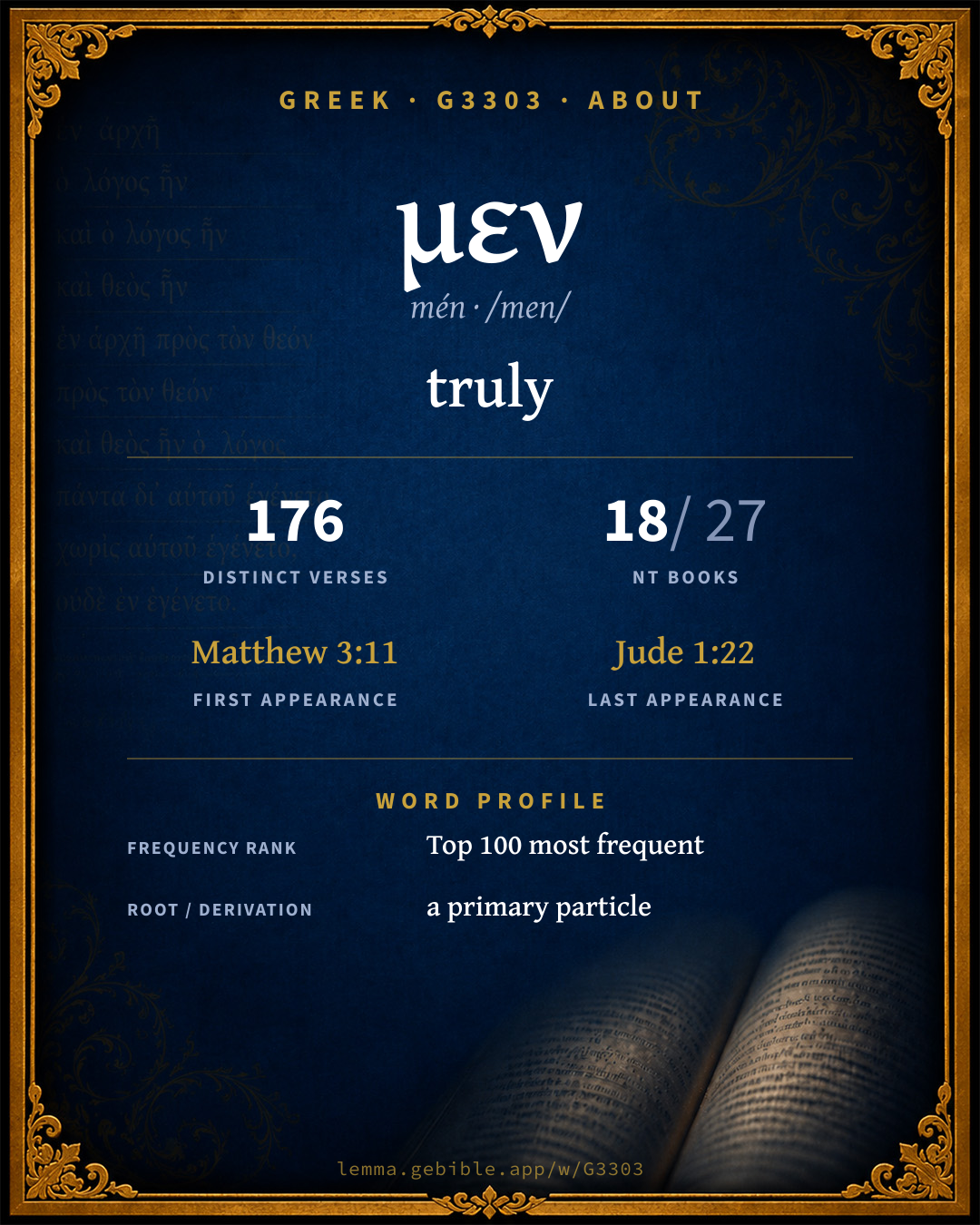
μέν
truly
Full lexicon entry — Thayer's Greek Lexicon
From Thayer's Greek Lexicon
Where this word appears
Grammar key — what these labels mean
Part of speech
- Particle
- A short, often untranslatable function word adding nuance or connection.
Every verse where G3303 appears — 176 distinct verses across 18 books. Click any verse to open its interlinear word-by-word view. Verse text shown in the World English Bible for context — . Each verse’s Greek form is shown with its reference; the English is not keyword-highlighted, since the data carries no word-level English alignment. Use “Compare translations” on any verse to read it across multiple English versions. This concordance covers the Greek New Testament; Septuagint (Greek Old Testament) occurrences of this word are not indexed here.
Matthew 20 verses
- Matthew 3:11 μὲν ptcl I indeed baptize you in water for repentance, but he who comes after me is mightier than I, whose shoes I am not worthy to carry. He will baptize you in the Holy Spirit.
- Matthew 9:37 μὲν ptcl Then he said to his disciples, "The harvest indeed is plentiful, but the laborers are few.
- Matthew 10:13 μὲν ptcl If the household is worthy, let your peace come on it, but if it isn't worthy, let your peace return to you.
- Matthew 13:4 μὲν ptcl As he sowed, some seeds fell by the roadside, and the birds came and devoured them.
- Matthew 13:8 μὲν ptcl and others fell on good soil, and yielded fruit: some one hundred times as much, some sixty, and some thirty.
- Matthew 13:23 μὲν ptcl What was sown on the good ground, this is he who hears the word, and understands it, who most assuredly bears fruit, and brings forth, some one hundred times as much, some sixty, and some thirty."
- Matthew 13:32 μέν ptcl which indeed is smaller than all seeds. But when it is grown, it is greater than the herbs, and becomes a tree, so that the birds of the air come and lodge in its branches."
- Matthew 16:3 μὲν ptcl In the morning, 'It will be foul weather today, for the sky is red and threatening.' Hypocrites! You know how to discern the appearance of the sky, but you can't discern the signs of the times!
- Matthew 16:14 μὲν ptcl They said, "Some say John the Baptizer, some, Elijah, and others, Jeremiah, or one of the prophets."
- Matthew 17:11 μὲν ptcl Jesus answered them, "Elijah indeed comes first, and will restore all things,
- Matthew 20:23 μὲν ptcl He said to them, "You will indeed drink my cup, and be baptized with the baptism that I am baptized with, but to sit on my right hand and on my left hand is not mine to give; but it is for whom it has been prepared by my Father."
- Matthew 21:35 μὲν ptcl The farmers took his servants, beat one, killed another, and stoned another.
- Matthew 22:5 μὲν ptcl But they made light of it, and went their ways, one to his own farm, another to his merchandise,
- Matthew 22:8 μὲν ptcl "Then he said to his servants, 'The wedding is ready, but those who were invited weren't worthy.
- Matthew 23:27 μὲν ptcl "Woe to you, scribes and Pharisees, hypocrites! For you are like whitened tombs, which outwardly appear beautiful, but inwardly are full of dead men's bones, and of all uncleanness.
- Matthew 23:28 μὲν ptcl Even so you also outwardly appear righteous to men, but inwardly you are full of hypocrisy and iniquity.
- Matthew 25:15 μὲν ptcl To one he gave five talents, to another two, to another one; to each according to his own ability. Then he went on his journey.
- Matthew 25:33 μὲν ptcl He will set the sheep on his right hand, but the goats on the left.
- Matthew 26:24 μὲν ptcl The Son of Man goes, even as it is written of him, but woe to that man through whom the Son of Man is betrayed! It would be better for that man if he had not been born."
- Matthew 26:41 μὲν ptcl Watch and pray, that you don't enter into temptation. The spirit indeed is willing, but the flesh is weak."
Mark 5 verses
- Mark 4:4 μὲν ptcl and it happened, as he sowed, some seed fell by the road, and the birds came and devoured it.
- Mark 12:5 μὲν ptcl Again he sent another; and they killed him; and many others, beating some, and killing some.
- Mark 14:21 μὲν ptcl For the Son of Man goes, even as it is written about him, but woe to that man by whom the Son of Man is betrayed! It would be better for that man if he had not been born."
- Mark 14:38 μὲν ptcl Watch and pray, that you may not enter into temptation. The spirit indeed is willing, but the flesh is weak."
- Mark 16:19 μὲν ptcl So then the Lord Jesus, after he had spoken to them, was received up into heaven, and sat down at the right hand of God.
Luke 10 verses
- Luke 3:16 μὲν ptcl John answered them all, "I indeed baptize you with water, but he comes who is mightier than I, the latchet of whose sandals I am not worthy to loosen. He will baptize you in the Holy Spirit and fire,
- Luke 3:18 μὲν ptcl Then with many other exhortations he preached good news to the people,
- Luke 8:5 μὲν ptcl "The farmer went out to sow his seed. As he sowed, some fell along the road, and it was trampled under foot, and the birds of the sky devoured it.
- Luke 10:2 μὲν ptcl Then he said to them, "The harvest is indeed plentiful, but the laborers are few. Pray therefore to the Lord of the harvest, that he may send out laborers into his harvest.
- Luke 11:48 μὲν ptcl So you testify and consent to the works of your fathers. For they killed them, and you build their tombs.
- Luke 13:9 μὲν ptcl If it bears fruit, fine; but if not, after that, you can cut it down.'"
- Luke 22:22 μὲν ptcl The Son of Man indeed goes, as it has been determined, but woe to that man through whom he is betrayed!"
- Luke 23:33 μὲν ptcl When they came to the place that is called The Skull, they crucified him there with the criminals, one on the right and the other on the left.
- Luke 23:41 μὲν ptcl And we indeed justly, for we receive the due reward for our deeds, but this man has done nothing wrong."
- Luke 23:56 μὲν ptcl They returned, and prepared spices and ointments. On the Sabbath they rested according to the commandment.
John 8 verses
- John 7:12 μὲν ptcl There was much murmuring among the multitudes concerning him. Some said, "He is a good man." Others said, "Not so, but he leads the multitude astray."
- John 10:41 μὲν ptcl Many came to him. They said, "John indeed did no sign, but everything that John said about this man is true."
- John 11:6 μὲν ptcl When therefore he heard that he was sick, he stayed two days in the place where he was.
- John 16:9 μέν ptcl about sin, because they don't believe in me;
- John 16:22 μὲν ptcl Therefore you now have sorrow, but I will see you again, and your heart will rejoice, and no one will take your joy away from you.
- John 19:24 μὲν ptcl Then they said to one another, "Let's not tear it, but cast lots for it to decide whose it will be," that the Scripture might be fulfilled, which says, "They parted my garments among them. For my cloak they cast lots." Therefore the soldiers did these things.
- John 19:32 μὲν ptcl Therefore the soldiers came, and broke the legs of the first, and of the other who was crucified with him;
- John 20:30 μὲν ptcl Therefore Jesus did many other signs in the presence of his disciples, which are not written in this book;
Acts 47 verses
- Acts 1:1 μὲν ptcl The first book I wrote, Theophilus, concerned all that Jesus began both to do and to teach,
- Acts 1:5 μὲν ptcl For John indeed baptized in water, but you will be baptized in the Holy Spirit not many days from now."
- Acts 1:6 μὲν ptcl Therefore, when they had come together, they asked him, "Lord, are you now restoring the kingdom to Israel?"
- Acts 1:18 μὲν ptcl Now this man obtained a field with the reward for his wickedness, and falling headlong, his body burst open, and all his intestines gushed out.
- Acts 2:41 μὲν ptcl Then those who gladly received his word were baptized. There were added that day about three thousand souls.
- Acts 3:13 μὲν ptcl The God of Abraham, Isaac, and Jacob, the God of our fathers, has glorified his Servant Jesus, whom you delivered up, and denied in the presence of Pilate, when he had determined to release him.
- Acts 3:21 μὲν ptcl whom heaven must receive until the times of restoration of all things, which God spoke long ago by the mouth of his holy prophets.
- Acts 3:22 μὲν ptcl For Moses indeed said to the fathers, 'The Lord God will raise up a prophet for you from among your brothers, like me. You shall listen to him in all things whatever he says to you.
- Acts 4:16 μὲν ptcl saying, "What shall we do to these men? Because indeed a notable miracle has been done through them, as can be plainly seen by all who dwell in Jerusalem, and we can't deny it.
- Acts 5:41 μὲν ptcl They therefore departed from the presence of the council, rejoicing that they were counted worthy to suffer dishonor for Jesus' name.
- Acts 8:4 μὲν ptcl Therefore those who were scattered abroad went around preaching the word.
- Acts 8:25 μὲν ptcl They therefore, when they had testified and spoken the word of the Lord, returned to Jerusalem, and preached the Gospel to many villages of the Samaritans.
- Acts 9:7 μὲν ptcl The men who traveled with him stood speechless, hearing the sound, but seeing no one.
- Acts 9:31 μὲν ptcl So the assemblies throughout all Judea and Galilee and Samaria had peace, and were built up. They were multiplied, walking in the fear of the Lord and in the comfort of the Holy Spirit.
- Acts 11:16 μὲν ptcl I remembered the word of the Lord, how he said, 'John indeed baptized in water, but you will be baptized in the Holy Spirit.'
- Acts 11:19 μὲν ptcl They therefore who were scattered abroad by the oppression that arose about Stephen traveled as far as Phoenicia, Cyprus, and Antioch, speaking the word to no one except to Jews only.
- Acts 12:5 μὲν ptcl Peter therefore was kept in the prison, but constant prayer was made by the assembly to God for him.
- Acts 13:4 μὲν ptcl So, being sent out by the Holy Spirit, they went down to Seleucia. From there they sailed to Cyprus.
- Acts 13:36 μὲν ptcl For David, after he had in his own generation served the counsel of God, fell asleep, and was laid with his fathers, and saw decay.
- Acts 14:3 μὲν ptcl Therefore they stayed there a long time, speaking boldly in the Lord, who testified to the word of his grace, granting signs and wonders to be done by their hands.
- Acts 14:4 μὲν ptcl But the multitude of the city was divided. Part sided with the Jews, and part with the apostles.
- Acts 15:3 μὲν ptcl They, being sent on their way by the assembly, passed through both Phoenicia and Samaria, declaring the conversion of the Gentiles. They caused great joy to all the brothers.
- Acts 15:30 μὲν ptcl So, when they were sent off, they came to Antioch. Having gathered the multitude together, they delivered the letter.
- Acts 16:5 μὲν ptcl So the assemblies were strengthened in the faith, and increased in number daily.
- Acts 17:12 μὲν ptcl Many of them therefore believed; also of the prominent Greek women, and not a few men.
- Acts 17:17 μὲν ptcl So he reasoned in the synagogue with the Jews and the devout persons, and in the marketplace every day with those who met him.
- Acts 17:30 μὲν ptcl The times of ignorance therefore God overlooked. But now he commands that all people everywhere should repent,
- Acts 17:32 μὲν ptcl Now when they heard of the resurrection of the dead, some mocked; but others said, "We want to hear you again concerning this."
- Acts 18:14 μὲν ptcl But when Paul was about to open his mouth, Gallio said to the Jews, "If indeed it were a matter of wrong or of wicked crime, you Jews, it would be reasonable that I should bear with you;
- Acts 19:32 μὲν ptcl Some therefore cried one thing, and some another, for the assembly was in confusion. Most of them didn't know why they had come together.
- Acts 19:38 μὲν ptcl If therefore Demetrius and the craftsmen who are with him have a matter against anyone, the courts are open, and there are proconsuls. Let them press charges against one another.
- Acts 21:39 μέν ptcl But Paul said, "I am a Jew, from Tarsus in Cilicia, a citizen of no insignificant city. I beg you, allow me to speak to the people."
- Acts 22:9 μὲν ptcl "Those who were with me indeed saw the light and were afraid, but they didn't understand the voice of him who spoke to me.
- Acts 23:8 μὲν ptcl For the Sadducees say that there is no resurrection, nor angel, nor spirit; but the Pharisees confess all of these.
- Acts 23:18 μὲν ptcl So he took him, and brought him to the commanding officer, and said, "Paul, the prisoner, summoned me and asked me to bring this young man to you, who has something to tell you."
- Acts 23:22 μὲν ptcl So the commanding officer let the young man go, charging him, "Tell no one that you have revealed these things to me."
- Acts 23:31 μὲν ptcl So the soldiers, carrying out their orders, took Paul and brought him by night to Antipatris.
- Acts 25:4 μὲν ptcl However Festus answered that Paul should be kept in custody at Caesarea, and that he himself was about to depart shortly.
- Acts 25:11 μὲν ptcl For if I have done wrong, and have committed anything worthy of death, I don't refuse to die; but if none of those things is true that they accuse me of, no one can give me up to them. I appeal to Caesar!"
- Acts 26:4 μὲν ptcl "Indeed, all the Jews know my way of life from my youth up, which was from the beginning among my own nation and at Jerusalem;
- Acts 26:9 μὲν ptcl "I myself most assuredly thought that I ought to do many things contrary to the name of Jesus of Nazareth.
- Acts 27:21 μέν ptcl When they had been long without food, Paul stood up in the middle of them, and said, "Sirs, you should have listened to me, and not have set sail from Crete, and have gotten this injury and loss.
- Acts 27:41 μὲν ptcl But coming to a place where two seas met, they ran the vessel aground. The bow struck and remained immovable, but the stern began to break up by the violence of the waves.
- Acts 27:44 μὲν ptcl and the rest should follow, some on planks, and some on other things from the ship. So it happened that they all escaped safely to the land.
- Acts 28:5 μὲν ptcl However he shook off the creature into the fire, and wasn't harmed.
- Acts 28:22 μὲν ptcl But we desire to hear from you what you think. For, as concerning this sect, it is known to us that everywhere it is spoken against."
- Acts 28:24 μὲν ptcl Some believed the things which were spoken, and some disbelieved.
Romans 17 verses
- Romans 1:8 μὲν ptcl First, I thank my God through Jesus Christ for all of you, that your faith is proclaimed throughout the whole world.
- Romans 2:7 μὲν ptcl to those who by patience in well-doing seek for glory and honor and incorruptibility, eternal life;
- Romans 2:25 μὲν ptcl For circumcision indeed profits, if you are a doer of the law, but if you are a transgressor of the law, your circumcision has become uncircumcision.
- Romans 3:2 μὲν ptcl Much in every way! Because first of all, they were entrusted with the oracles of God.
- Romans 5:16 μὲν ptcl The gift is not as through one who sinned: for the judgment came by one to condemnation, but the free gift came of many trespasses to justification.
- Romans 6:11 μὲν ptcl Thus also consider yourselves also to be dead to sin, but alive to God in Christ Jesus our Lord.
- Romans 7:12 μὲν ptcl Therefore the law indeed is holy, and the commandment holy, and righteous, and good.
- Romans 8:10 μὲν ptcl If Christ is in you, the body is dead because of sin, but the spirit is alive because of righteousness.
- Romans 8:17 μὲν ptcl and if children, then heirs; heirs of God, and joint-heirs with Christ; if indeed we suffer with him, that we may also be glorified with him.
- Romans 9:21 μὲν ptcl Or hasn't the potter a right over the clay, from the same lump to make one part a vessel for honor, and another for dishonor?
- Romans 10:1 μὲν ptcl Brothers, my heart's desire and my prayer to God is for Israel, that they may be saved.
- Romans 11:13 μὲν ptcl For I speak to you who are Gentiles. Since then as I am an apostle to Gentiles, I glorify my ministry;
- Romans 11:22 μὲν ptcl See then the goodness and severity of God. Toward those who fell, severity; but toward you, goodness, if you continue in his goodness; otherwise you also will be cut off.
- Romans 11:28 μὲν ptcl Concerning the Gospel, they are enemies for your sake. But concerning the election, they are beloved for the fathers' sake.
- Romans 14:2 μὲν ptcl One man has faith to eat all things, but he who is weak eats only vegetables.
- Romans 14:5 μὲν ptcl One man esteems one day as more important. Another esteems every day alike. Let each man be fully assured in his own mind.
- Romans 14:20 μὲν ptcl Don't overthrow God's work for food's sake. All things indeed are clean, however it is evil for that man who creates a stumbling block by eating.
1 Corinthians 20 verses
- 1 Corinthians 1:12 μέν ptcl Now I mean this, that each one of you says, "I follow Paul," "I follow Apollos," "I follow Cephas," and, "I follow Christ."
- 1 Corinthians 1:18 μὲν ptcl For the word of the cross is foolishness to those who are dying, but to us who are saved it is the power of God.
- 1 Corinthians 1:23 μὲν ptcl but we preach Christ crucified; a stumbling block to Jews, and foolishness to Greeks,
- 1 Corinthians 3:4 μέν ptcl For when one says, "I follow Paul," and another, "I follow Apollos," aren't you fleshly?
- 1 Corinthians 5:3 μὲν ptcl For I most assuredly, as being absent in body but present in spirit, have already, as though I were present, judged him who has done this thing.
- 1 Corinthians 6:4 μὲν ptcl If then, you have to judge things pertaining to this life, do you set them to judge who are of no account in the assembly?
- 1 Corinthians 6:7 μὲν ptcl Therefore it is already altogether a defect in you, that you have lawsuits one with another. Why not rather be wronged? Why not rather be defrauded?
- 1 Corinthians 7:7 μὲν ptcl Yet I wish that all men were like me. However each man has his own gift from God, one of this kind, and another of that kind.
- 1 Corinthians 9:24 μὲν ptcl Don't you know that those who run in a race all run, but one receives the prize? Run like that, that you may win.
- 1 Corinthians 9:25 μὲν ptcl Every man who strives in the games exercises self-control in all things. Now they do it to receive a corruptible crown, but we an incorruptible.
- 1 Corinthians 11:7 μὲν ptcl For a man indeed ought not to have his head covered, because he is the image and glory of God, but the woman is the glory of the man.
- 1 Corinthians 11:14 μὲν ptcl Doesn't even nature itself teach you that if a man has long hair, it is a dishonor to him?
- 1 Corinthians 11:18 μὲν ptcl For first of all, when you come together in the assembly, I hear that divisions exist among you, and I partly believe it.
- 1 Corinthians 11:21 μὲν ptcl For in your eating each one takes his own supper before others. One is hungry, and another is drunken.
- 1 Corinthians 12:8 μὲν ptcl For to one is given through the Spirit the word of wisdom, and to another the word of knowledge, according to the same Spirit;
- 1 Corinthians 12:20 μὲν ptcl But now they are many members, but one body.
- 1 Corinthians 12:28 μὲν ptcl God has set some in the assembly: first apostles, second prophets, third teachers, then miracle workers, then gifts of healings, helps, governments, and various kinds of languages.
- 1 Corinthians 14:17 μὲν ptcl For you most assuredly give thanks well, but the other person is not built up.
- 1 Corinthians 15:39 μὲν ptcl All flesh is not the same flesh, but there is one flesh of men, another flesh of animals, another of fish, and another of birds.
- 1 Corinthians 15:40 μὲν ptcl There are also celestial bodies, and terrestrial bodies; but the glory of the celestial differs from that of the terrestrial.
2 Corinthians 8 verses
- 2 Corinthians 2:16 μὲν ptcl to the one a stench from death to death; to the other a sweet aroma from life to life. Who is sufficient for these things?
- 2 Corinthians 8:17 μὲν ptcl For he indeed accepted our exhortation, but being himself very earnest, he went out to you of his own accord.
- 2 Corinthians 9:1 μὲν ptcl It is indeed unnecessary for me to write to you concerning the service to the saints,
- 2 Corinthians 10:1 μὲν ptcl Now I Paul, myself, entreat you by the humility and gentleness of Christ; I who in your presence am lowly among you, but being absent am of good courage toward you.
- 2 Corinthians 10:10 μέν ptcl For, "His letters," they say, "are weighty and strong, but his bodily presence is weak, and his speech is despised."
- 2 Corinthians 11:4 μὲν ptcl For if he who comes preaches another Jesus, whom we did not preach, or if you receive a different spirit, which you did not receive, or a different gospel, which you did not accept, you put up with that well enough.
- 2 Corinthians 12:1 μέν ptcl It is doubtless not profitable for me to boast. For I will come to visions and revelations of the Lord.
- 2 Corinthians 12:12 μὲν ptcl Truly the signs of an apostle were worked among you in all patience, in signs and wonders and mighty works.
Galatians 3 verses
- Galatians 4:8 μὲν ptcl However at that time, not knowing God, you were in bondage to those who by nature are not gods.
- Galatians 4:23 μὲν ptcl However, the son by the handmaid was born according to the flesh, but the son by the free woman was born through promise.
- Galatians 4:24 μὲν ptcl These things contain an allegory, for these are two covenants. One is from Mount Sinai, bearing children to bondage, which is Hagar.
Ephesians 1 verse
Philippians 5 verses
- Philippians 1:15 μὲν ptcl Some indeed preach Christ even out of envy and strife, and some also out of good will.
- Philippians 1:16 μὲν ptcl The former insincerly preach Christ from selfish ambition, thinking that they add affliction to my chains;
- Philippians 2:23 μὲν ptcl Therefore I hope to send him at once, as soon as I see how it will go with me.
- Philippians 3:1 μὲν ptcl Finally, my brothers, rejoice in the Lord. To write the same things to you, to me indeed is not tiresome, but for you it is safe.
- Philippians 3:14 μὲν ptcl I press on toward the goal for the prize of the high calling of God in Christ Jesus.
Colossians 1 verse
1 Thessalonians 1 verse
2 Timothy 3 verses
- 2 Timothy 1:10 μὲν ptcl but has now been revealed by the appearing of our Savior, Christ Jesus, who abolished death, and brought life and immortality to light through the Gospel.
- 2 Timothy 2:20 μὲν ptcl Now in a great house there are not only vessels of gold and of silver, but also of wood and of clay. Some are for honor, and some for dishonor.
- 2 Timothy 4:4 μὲν ptcl and will turn away their ears from the truth, and turn aside to fables.
Hebrews 19 verses
- Hebrews 1:7 μὲν ptcl Of the angels he says, "Who makes his angels winds, And his servants a flame of fire."
- Hebrews 3:5 μὲν ptcl Moses indeed was faithful in all his house as a servant, for a testimony of those things which were afterward to be spoken,
- Hebrews 7:2 μὲν ptcl to whom also Abraham divided a tenth part of all (being first, by interpretation, king of righteousness, and then also king of Salem, which is king of peace;
- Hebrews 7:5 μὲν ptcl They indeed of the sons of Levi who receive the priest's office have a commandment to take tithes of the people according to the law, that is, of their brothers, though these have come out of the loins of Abraham,
- Hebrews 7:8 μὲν ptcl Here people who die receive tithes, but there one receives tithes of whom it is testified that he lives.
- Hebrews 7:11 μὲν ptcl Now if there was perfection through the Levitical priesthood (for under it the people have received the law), what further need was there for another priest to arise after the order of Melchizedek, and not be called after the order of Aaron?
- Hebrews 7:18 μὲν ptcl For there is an annulling of a foregoing commandment because of its weakness and uselessness
- Hebrews 7:20 μὲν ptcl Inasmuch as he was not made priest without the taking of an oath
- Hebrews 7:23 μὲν ptcl Many, indeed, have been made priests, because they are hindered from continuing by death.
- Hebrews 8:4 μὲν ptcl For if he were on earth, he would not be a priest at all, seeing there are priests who offer the gifts according to the law;
- Hebrews 9:1 μὲν ptcl Now indeed even the first covenant had ordinances of divine service, and an earthly sanctuary.
- Hebrews 9:6 μὲν ptcl Now these things having been thus prepared, the priests go in continually into the first tabernacle, accomplishing the services,
- Hebrews 9:23 μὲν ptcl It was necessary therefore that the copies of the things in the heavens should be cleansed with these; but the heavenly things themselves with better sacrifices than these.
- Hebrews 10:11 μὲν ptcl Every priest indeed stands day by day ministering and often offering the same sacrifices, which can never take away sins,
- Hebrews 10:33 μὲν ptcl partly, being exposed to both reproaches and oppressions; and partly, becoming partakers with those who were treated so.
- Hebrews 11:15 μὲν ptcl If indeed they had been thinking of that country from which they went out, they would have had enough time to return.
- Hebrews 12:9 μὲν ptcl Furthermore, we had the fathers of our flesh to chasten us, and we paid them respect. Shall we not much rather be in subjection to the Father of spirits, and live?
- Hebrews 12:10 μὲν ptcl For they indeed, for a few days, punished us as seemed good to them; but he for our profit, that we may be partakers of his holiness.
- Hebrews 12:11 μὲν μὲν ptcl ptcl All chastening seems for the present to be not joyous but grievous; yet afterward it yields the peaceful fruit of righteousness to those who have been exercised thereby.
James 1 verse
1 Peter 4 verses
- 1 Peter 1:20 μὲν ptcl who was foreknown indeed before the foundation of the world, but was revealed at the end of times for your sake,
- 1 Peter 2:4 μὲν ptcl coming to him, a living stone, rejected indeed by men, but chosen by God, precious.
- 1 Peter 3:18 μὲν ptcl Because Christ also suffered for sins once, the righteous for the unrighteous, that he might bring you to God; being put to death in the flesh, but made alive in the spirit;
- 1 Peter 4:6 μὲν ptcl For to this end was the Gospel preached even to the dead, that they might be judged indeed as men in the flesh, but live as to God in the spirit.
Jude 3 verses
- Jude 1:8 μὲν ptcl Yet in like manner these also in their dreaming defile the flesh, despise authority, and slander celestial beings.
- Jude 1:10 μὲν ptcl But these speak evil of whatever things they don't know. What they understand naturally, like the creatures without reason, in these things are they destroyed.
- Jude 1:22 μὲν ptcl On some have compassion, making a distinction,
About this entry
At a glance — auto-summarized from this page’s data, not written by a person. Every figure links to its source below. This summary describes the numbers; it doesn’t interpret them.
μεν (mén) is a Greek word most often rendered “truly.” One archaism survives in the King James Version — “verily” — where modern Bibles read “indeed”; see the renderings breakdown. The Greek New Testament uses it across 176 verses — common. Acts dominates its distribution — 47 of 176 verses. Debuting at Matthew 3:11, it then recurs through the corpus. The sections below give every sense, occurrence, and version rendering.
Gloss history
Strong's 1890 vs modern scholarship

About this word
Strong's G3303 catalogs a Greek word from the Greek New Testament.
These counts are not copied from any lexicon or concordance. They are computed here, from the morphology-tagged Greek New Testament. What Lemma adds →
- 176
- distinct verses
- The word appears in 176 distinct verses.
- 18 / 27
- NT books
- The word appears in 18 of 27 New Testament books.
- #88
- by frequency
- Top 100 most frequent Greek words (rank 88 of 5,347 Greek words by occurrence).
View all 176 occurrences in the concordance →
Most concentrated in
- Acts 47 verses 27%
- Matthew 20 verses 11%
- 1 Corinthians 20 verses 11%
By section of the New Testament
By traditional corpus
Conventional, traditional groupings — biblical authorship is debated, so this is a traditional corpus grouping, not an authorship claim. Some books belong to more than one corpus (Luke is in both the Gospels and the Lukan corpus, and so on), so these shares overlap and need not total 100%. Each figure is a share of the word’s 176 distinct verses.
- Pauline corpus 59 verses · 34%
- Lukan (Luke–Acts) 57 verses · 32%
- Gospels 43 verses · 24%
- Hebrews 19 verses · 11%
- Johannine 8 verses · 5%
- General (Catholic) Epistles 8 verses · 5%
How translations render this word
Counts come from each version’s own published word-to-Strong’s tagging or interlinear alignment — an approximate guide to how each version renders this word, not a word-level alignment the data otherwise carries. Because each total is that version’s own tagged count, the per-version totals vary from one another and need not match the appearance or distinct-verse counts above. These counts may also differ from a printed concordance because Lemma counts each distinctly tagged rendering and does not collapse phrase taggings into a single head-word total. This is a fixed set of word-tagged versions (KJV, ASV, BSB, ULT) and does not change with the reading translation you choose elsewhere. Each version’s license is shown beside its name below (and on Sources).
- King James Version: Indeed 22×, Verily 13×, Truly 12×
- American Standard Version: Indeed 30×, Some 5×, Then 3×
- Berean Standard Bible: Indeed 5×, For 4×, Although 3×
- unfoldingWord Literal Text: Indeed 77×, One hand 5×, Both 2×
King James Version Public Domain
Renders G3303 across 104 tagged occurrences — most commonly:
Plus 32 renderings that appear only once — usually multi-word phrases or single function words the recovered tagging swept in, not distinct renderings. Not rendered by a distinct English word in 89 further occurrences.
American Standard Version Public Domain
Renders G3303 across 74 tagged occurrences — most commonly:
Plus 30 renderings that appear only once — usually multi-word phrases or single function words the recovered tagging swept in, not distinct renderings. Not rendered by a distinct English word in 8 further occurrences.
Berean Standard Bible Public Domain
Renders G3303 across 24 tagged occurrences — most commonly:
Plus 10 renderings that appear only once — usually multi-word phrases or single function words the recovered tagging swept in, not distinct renderings. Not rendered by a distinct English word in 142 further occurrences.
unfoldingWord Literal Text CC BY-SA 4.0
Renders G3303 across 116 tagged occurrences — most commonly:
Plus 22 renderings that appear only once — usually multi-word phrases or single function words the recovered tagging swept in, not distinct renderings.
Senses in Thayer's
The 1 sense Thayer's distinguishes for this word, in lexicon order (not ranked by frequency or importance). The full entry — with sub-senses — is in the Lexicon Entry tab.
- truly, certainly, surely, indeed
Word origin
Origin: a primary particle
A primary particle; properly indicative of affirmation or concession ( in fact ); usually followed by a contrasted clause with G1161 ( this one the former etc. : - even indeed so some truly verily. Often compounded with other particles in an intensive or asseverative sense.
— Strong’s Exhaustive Concordance (1890), public domain.
Forms in the corpus
The 2 distinct written forms G3303 takes in the Greek New Testament, most frequent first — each parse links to that case’s occurrences in the concordance.
| Form | Parsing | Example | Uses |
|---|---|---|---|
| μὲν mèn | Particle | Matthew 3:11 | 169 |
| μέν mén | Particle | Matthew 13:32 | 8 |
Same root — word family
Other Thayer's entries built from the same root as G3303, grouped by Strong’s listed origin. These share a root / origin per the lexicon — not necessarily a shared meaning. Each links to that word’s own entry.
Derived from this word
Compare all same-root words → They share a root, not necessarily a meaning.
Septuagint usage
The same Greek word μεν appears 55 times in the Greek Old Testament (Septuagint), across 54 verses in 15 books.
- 55
- LXX occurrences
- Tagged occurrences of this Greek word in the Septuagint.
- 54
- verses
- Distinct Septuagint verses containing this word.
- 15 / 39
- OT books
- The word appears in 15 of the 39 Old Testament books.
Sample Septuagint occurrences
- Genesis 18:12 μέν
- Exodus 1:16 μέν
- Leviticus 3:1 μέν
- Numbers 15:3 μέν
- Deuteronomy 20:11 μέν
- 1 Samuel 20:14 μέν
- 2 Samuel 11:25 μέν
- Esther 3:11 μέν
- Job 8:7 μέν
- Psalms 34:20 μέν
- Proverbs 6:10 μέν
- Isaiah 6:2 μέν
Septuagint occurrences (same lexeme)
Every verse where the same Strong’s number (G3303) appears in the Greek Septuagint — showing the first 50 of 54. Verse text shown in the World English Bible for context; the Greek form is the matched word — the English is not keyword-highlighted.
- Genesis 18:12 μέν Sarah laughed within herself, saying, "After I have grown old will I have pleasure, my lord being old also?"
- Genesis 27:22 μέν Jacob went near to Isaac his father. He felt him, and said, "The voice is Jacob's voice, but the hands are the hands of Esau."
- Genesis 38:23 μέν Judah said, "Let her keep it, lest we be shamed. Behold, I sent this kid, and you haven't found her."
- Genesis 43:4 μέν If you will send our brother with us, we will go down and buy you food,
- Genesis 43:14 μέν May God Almighty give you mercy before the man, that he may release to you your other brother and Benjamin. If I am bereaved of my children, I am bereaved."
- Genesis 44:8 μέν Behold, the money, which we found in our sacks' mouths, we brought again to you out of the land of Canaan. How then should we steal silver or gold out of your lord's house?
- Genesis 44:26 μέν We said, 'We can't go down. If our youngest brother is with us, then will we go down: for we may not see the man's face, unless our youngest brother is with us.'
- Exodus 1:16 μέν and he said, "When you perform the duty of a midwife to the Hebrew women, and see them on the birth stool; if it is a son, then you shall kill him; but if it is a daughter, then she shall live."
- Exodus 4:23 μέν and I have said to you, "Let my son go, that he may serve me;" and you have refused to let him go. Behold, I will kill your son, your firstborn.'"
- Exodus 9:2 μέν For if you refuse to let them go, and hold them still,
- Exodus 13:21 μέν Yahweh went before them by day in a pillar of cloud, to lead them on their way, and by night in a pillar of fire, to give them light, that they might go by day and by night:
- Exodus 32:32 μέν Yet now, if you will, forgive their sin-- and if not, please blot me out of your book which you have written."
- Leviticus 3:1 μέν "'If his offering is a sacrifice of peace offerings; if he offers it from the herd, whether male or female, he shall offer it without blemish before Yahweh.
- Leviticus 4:3 μέν if the anointed priest sins so as to bring guilt on the people, then let him offer for his sin, which he has sinned, a young bull without blemish to Yahweh for a sin offering.
- Leviticus 7:12 μέν If he offers it for a thanksgiving, then he shall offer with the sacrifice of thanksgiving unleavened cakes mixed with oil, and unleavened wafers anointed with oil, and cakes mixed with oil.
- Leviticus 27:7 μέν If the person is from sixty years old and upward; if it is a male, then your valuation shall be fifteen shekels, and for a female ten shekels.
- Numbers 15:3 μέν and will make an offering by fire to Yahweh, a burnt offering, or a sacrifice, to accomplish a vow, or as a freewill-offering, or in your set feasts, to make a sweet savor to Yahweh, of the herd, or of the flock;
- Numbers 22:33 μέν and the donkey saw me, and turned aside before me these three times: unless she had turned aside from me, surely now I had even slain you, and saved her alive.
- Deuteronomy 20:11 μέν It shall be, if it make you answer of peace, and open to you, then it shall be, that all the people who are found therein shall become tributary to you, and shall serve you.
- 1 Samuel 20:14 μέν You shall not only while yet I live show me the loving kindness of Yahweh, that I not die;
- 2 Samuel 11:25 μέν Then David said to the messenger, Thus shall you tell Joab, Don't let this thing displease you, for the sword devours one as well as another; make your battle more strong against the city, and overthrow it: and encourage you him.
- 2 Samuel 15:33 μέν David said to him, If you pass on with me, then you will be a burden to me:
- Esther 3:11 μέν The king said to Haman, The silver is given to you, the people also, to do with them as it seems good to you.
- Esther 8:14 μέν So the posts who rode on swift steeds that were used in the king's service went out, being hurried and pressed on by the king's commandment; and the decree was given out in Shushan the palace.
- Job 8:7 μέν Though your beginning was small, Yet your latter end would greatly increase.
- Job 9:19 μέν If it is a matter of strength, behold, he is mighty! If of justice, 'Who,' says he, 'will summon me?'
- Job 12:3 μέν But I have understanding as well as you; I am not inferior to you: Yes, who doesn't know such things as these?
- Job 12:11 μέν Doesn't the ear try words, Even as the palate tastes its food?
- Job 28:2 μέν Iron is taken out of the earth, And copper is smelted out of the ore.
- Job 31:26 μέν If I have seen the sun when it shined, Or the moon moving in splendor,
- Job 32:6 μέν Elihu the son of Barachel the Buzite answered, "I am young, and you are very old; Therefore I held back, and didn't dare show you my opinion.
- Job 41:19 μέν Out of his mouth go burning torches, Sparks of fire leap forth.
- Job 41:20 μέν Out of his nostrils a smoke goes, As of a boiling pot over a fire of reeds.
- Job 42:5 μέν I had heard of you by the hearing of the ear, But now my eye sees you.
- Job 42:14 μέν He called the name of the first, Jemimah; and the name of the second, Keziah; and the name of the third, Keren Happuch.
- Job 42:17 μέν So Job died, being old and full of days.
- Psalms 34:20 μέν He protects all of his bones. Not one of them is broken.
- Proverbs 6:10 μέν A little sleep, a little slumber, A little folding of the hands to sleep:
- Proverbs 11:31 μέν Behold, the righteous shall be repaid in the earth; How much more the wicked and the sinner!
- Proverbs 23:14 μέν Punish him with the rod, And save his soul from Sheol.
- Proverbs 25:10 μέν Lest one who hears it put you to shame, And your bad reputation never depart.
- Isaiah 6:2 μέν Above him stood the seraphim. Each one had six wings. With two he covered his face. With two he covered his feet. With two he flew.
- Isaiah 41:7 μέν So the carpenter encourages the goldsmith, [and] he who smoothes with the hammer him who strikes the anvil, saying of the soldering, It is good; and he fastens it with nails, that is should not be moved.
- Daniel 1:7 μέν The prince of the eunuchs gave names to them: to Daniel he gave [the name of] Belteshazzar; and to Hananiah, [of] Shadrach; and to Mishael, [of] Meshach; and to Azariah, [of] Abednego.
- Daniel 2:24 μέν Therefore Daniel went in to Arioch, whom the king had appointed to destroy the wise men of Babylon; he went and said thus to him: Don't destroy the wise men of Babylon; bring me in before the king, and I will show to the king the interpretation.
- Daniel 2:33 μέν its legs of iron, its feet part of iron, and part of clay.
- Daniel 2:41 μέν Whereas you saw the feet and toes, part of potters' clay, and part of iron, it shall be a divided kingdom; but there shall be in it of the strength of the iron, because you saw the iron mixed with miry clay.
- Daniel 2:42 μέν As the toes of the feet were part of iron, and part of clay, so the kingdom shall be partly strong, and partly broken.
- Daniel 3:15 μέν Now if you are ready whenever you hear the sound of the horn, flute, zither, lyre, harp, pipe, and all kinds of music to you fall down and worship the image which I have made, [well]: but if you don't worship, you shall be cast the same hour into the midst of a burning fiery furnace; and who is that god that shall deliver you out of my hands?
- Daniel 3:23 μέν These three men, Shadrach, Meshach, and Abednego, fell down bound into the midst of the burning fiery furnace.
These are occurrences of the same Greek lexeme (G3303) in the Septuagint — not a translation of any one Hebrew word. The store carries no word-level Hebrew↔Greek alignment, so no Hebrew original is asserted here. Counts come from the recovered LXX Strong's tagging — high-frequency vocabulary is well covered, while rare or late forms may be untagged — so they reflect tagged occurrences and may slightly undercount.