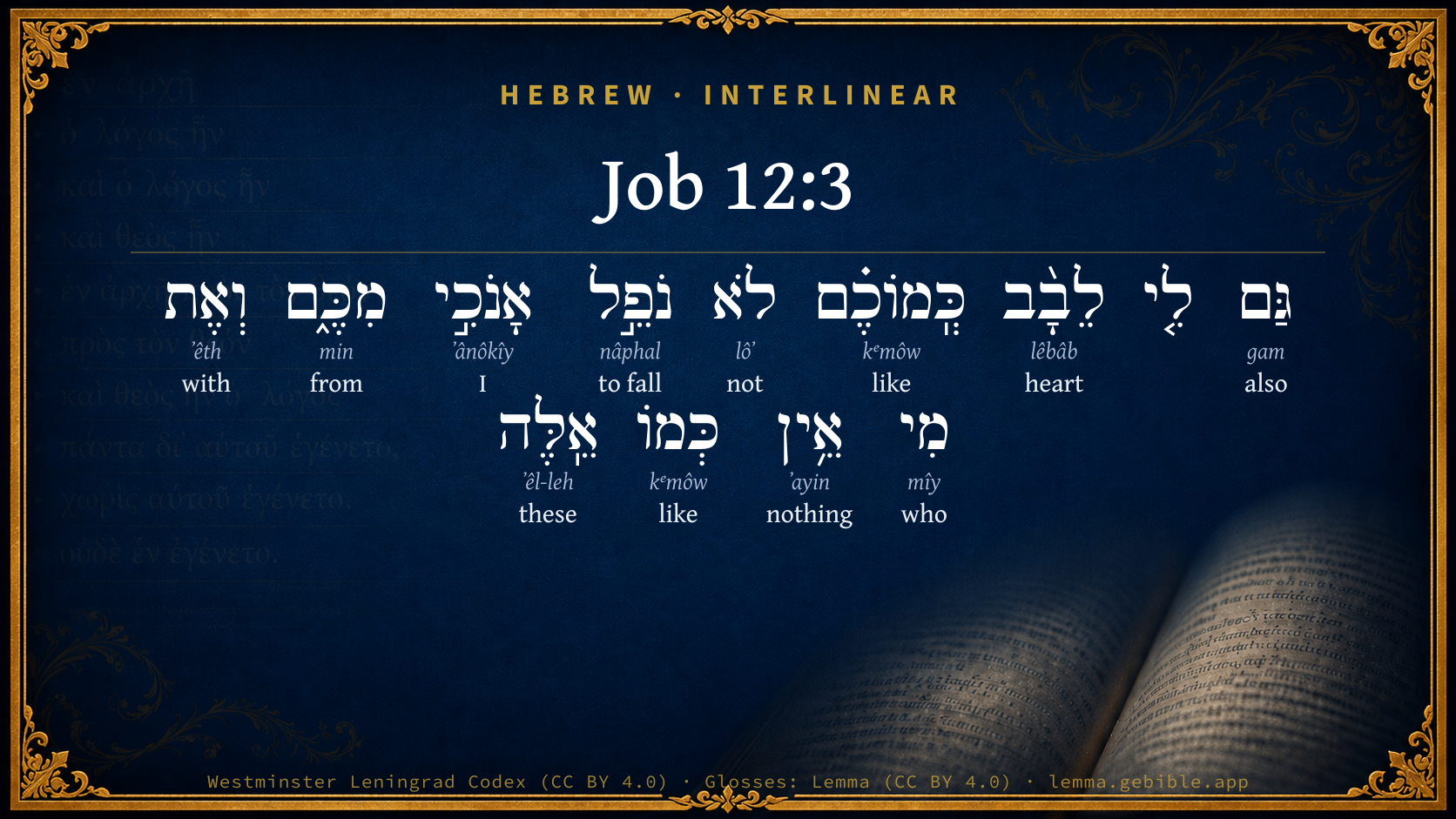
Job 12:3

Hebrew (Westminster Leningrad Codex) Job 12:3 appears in the Hebrew Old Testament. The text above is from the Westminster Leningrad Codex. Each word links to its Strong’s number, a concise gloss, and parsing drawn from the Open Scriptures Hebrew Bible morphology. Click any word for its full Brown-Driver-Briggs (BDB) entry.
Download image
Cite this verse

Job 12:3 (World English Bible). Public Domain. Lemma interlinear Bible study tool, https://lemma.gebible.app/v/job/12/3.

Show BibTeX & RIS
BibTeX
RIS
English Translation
But I have understanding as well as you; I am not inferior to you: Yes, who doesn't know such things as these?
World English Bible · Public Domain
Download a study sheet

One document with this verse’s original text, its word-by-word gloss line, the meaning frame, cross-references with their text, attributed commentary, and full source and license credits — printable, and it pastes into notes with its structure intact.

This verse Autodidact and up

Study sheet (.html) Plain text (.txt)

A passage Seminary Student

Up to 50 verses in one chapter. A passage sheet keeps up to 6 commentary sources and 12 cross-references per verse, in the order this page ranks them, and says so on the sheet whenever that leaves anything out. Ask for a single verse and you get the Autodidact verse sheet above.

Everything on this page stays free to read, with no account — the sheet is a download of what is already on screen, not access to it.

Want to remove ads? Support Godless Engineer
Compare translations 3

The same verse in 3 English versions, stacked beneath the original-language interlinear above. Click any original word for its lexicon entry.

Each is an independent rendering of the whole verse — the interlinear is not word-aligned to these translations.

Highlighted words mark where these versions differ — a whole-verse word diff, not a word-by-word alignment.

  • World English Bible Public Domain
    But I have understanding as well as you; I am not inferior to you: Yes, who doesn't know such things as these?
  • King James Version Public Domain
    But I have understanding as well as you; I am not inferior to you: yea, who knoweth not such things as these?
  • unfoldingWord Literal Text CC BY-SA 4.0
    A heart also to me, like you. I not falling below you. And with whom not such as these?

unfoldingWord Literal Text — © unfoldingWord, licensed CC BY-SA 4.0. Word-aligned USFM3 via Door43 (git.door43.org/unfoldingWord/en_ult).

Versions to compare (up to 4)

3 of 4 selected

Show all 18 translations

Every available English version of this verse, each an independent rendering of the whole verse.

  • World English Bible Public Domain
    But I have understanding as well as you; I am not inferior to you: Yes, who doesn't know such things as these?
  • Berean Standard Bible Public Domain
    But I also have a mind; I am not inferior to you. Who does not know such things as these?
  • Majority Standard Bible Public Domain
    But I also have a mind; I am not inferior to you. Who does not know such things as these?
  • King James Version Public Domain
    But I have understanding as well as you; I am not inferior to you: yea, who knoweth not such things as these?
  • American Standard Version (1901) Public Domain
    But I have understanding as well as you; I am not inferior to you: Yea, who knoweth not such things as these?
  • Revised Version (1885) Public Domain
    But I have understanding as well as you; I am not inferior to you: yea, who knoweth not such things as these?
  • Geneva Bible (1599) Public Domain
    But I haue vnderstanding aswel as you, and am not inferior vnto you: yea, who knoweth not such things?
  • Douay-Rheims (1899) Public Domain
    I also have a heart as well as you: for who is ignorant of these things, which you know?
  • Young's Literal Translation Public Domain
    I also have a heart like you, I am not fallen more than you, And with whom is there not like these?
  • Literal Standard Version CC BY-SA 4.0
    I also have a heart like you, I am not fallen more than you, || And with whom is there not like these?
  • Unlocked Literal Bible CC BY-SA 4.0
    But I have understanding as well as you; I am not inferior to you. Indeed, who does not know such things as these?
  • unfoldingWord Literal Text CC BY-SA 4.0
    A heart also to me, like you. I not falling below you. And with whom not such as these?
  • Darby Bible Public Domain
    I also have understanding as well as you; I am not inferior to you; and who knoweth not such things as these?
  • World Messianic Bible Public Domain
    But I have understanding as well as you; I am not inferior to you. Yes, who doesn’t know such things as these?
  • Webster's Bible Public Domain
    But I have understanding as well as you; I am not inferior to you: yes, who knoweth not such things as these?
  • Free Bible Version CC BY-SA 4.0
    But I too have insights, and you're no better than me. Doesn't everyone know the things you've said?
  • Bible in Basic English Public Domain
    But I have a mind as well as you; I am equal to you: yes, who has not knowledge of such things as these?
  • JPS Tanakh (1917) Public Domain
    But I have understanding as well as you; I am not inferior to you; yea, who knoweth not such things as these?

Literal Standard Version (2020), Covenant Press — licensed CC BY-SA 4.0. Text via the HelloAO Bible API (eBible.org). Unlocked Literal Bible (unfoldingWord) — licensed CC BY-SA 4.0. Text via the HelloAO Bible API (eBible.org). unfoldingWord Literal Text — © unfoldingWord, licensed CC BY-SA 4.0. Word-aligned USFM3 via Door43 (git.door43.org/unfoldingWord/en_ult). Free Bible Version, Dr. Jonathan Gallagher — licensed CC BY-SA 4.0. Text via the HelloAO Bible API (eBible.org).

Word by word

More ways to search: Search by grammar → Find every occurrence → Compare this word →

Practice this passage: Drill this verse → Learn its vocabulary →

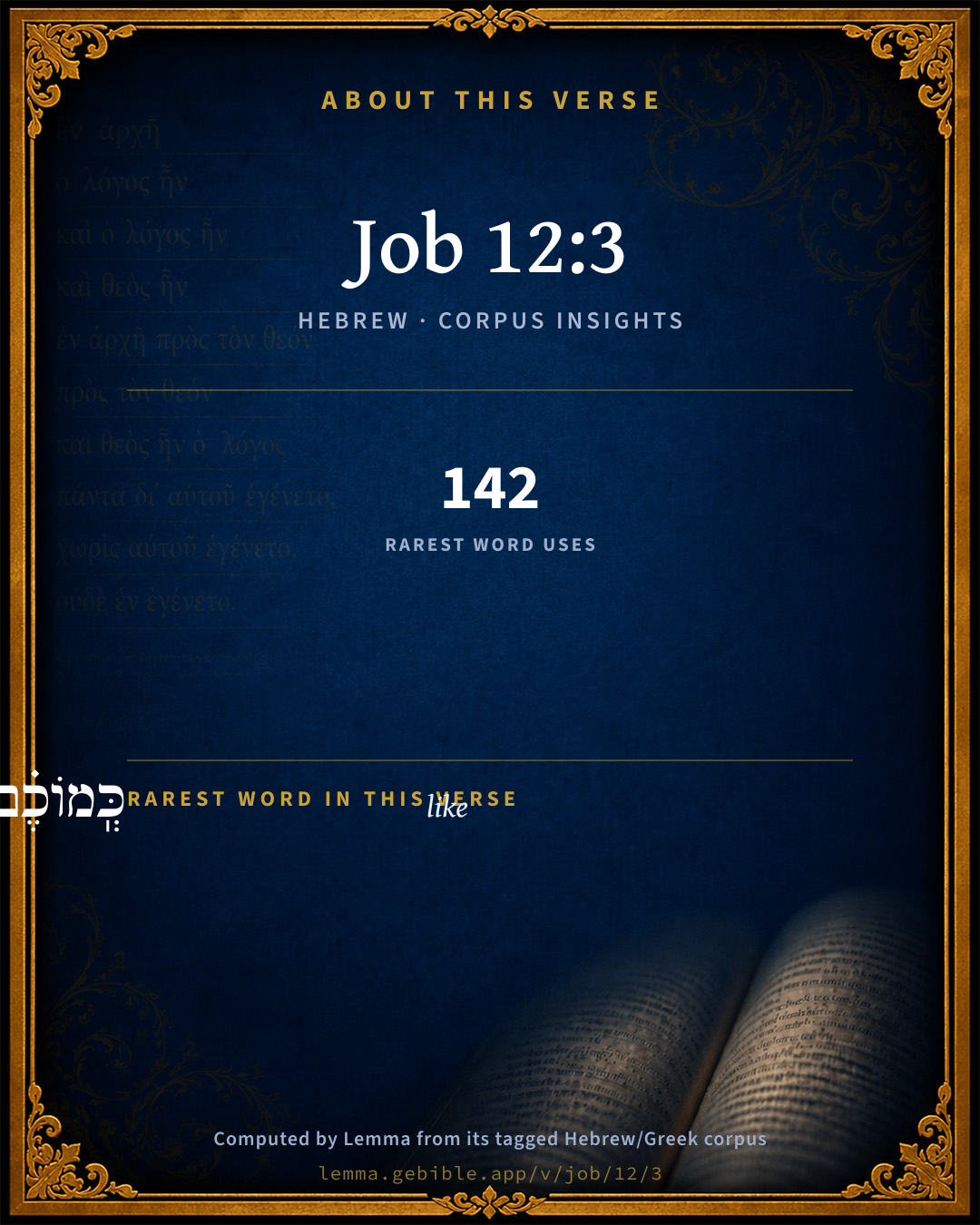
כְּֽמוֹכֶ֗ם
kᵉmôw
H3644
“like · you”
Preposition + Suffix, Personal, 2nd Person, Masculine, Plural
Part of Speech
Preposition
Full BDB Definition

Origin: a form of the prefix "k-", but used separately [compare H3651 ]

TWOT: TWOT - 938

like, as, the like of which (adverb) - when, according as, as it were (conjunction)
  1. גַּם gam H1571 “also” Particle, Accusative
  2. לֵבָ֨ב lêbâb H3824 “heart” Noun, Common, Masculine, Singular, Absolute
  3. לֹא lôʼ H3808 “not” Particle, Negative
  4. נֹפֵ֣ל nâphal H5307 “falling” Verb, Qal, Participle Active, Masculine, Singular, Absolute
  5. אָנֹכִ֣י ʼânôkîy H595 “I” Pronoun, Personal, 1st Person, Common, Singular
  6. מִכֶּ֑ם min H4480 “from · you” Preposition + Suffix, Personal, 2nd Person, Masculine, Plural
  7. וְאֶת ʼêth H854 “and · with” Conjunction + Preposition
  8. מִי mîy H4310 “who” Particle, Interrogative
  9. אֵ֥ין ʼayin H369 “nothing” Particle, Negative
  10. כְּמוֹ kᵉmôw H3644 “like” Preposition
  11. אֵֽלֶּה ʼêl-leh H428 “these” Pronoun, Demonstrative, Common, Plural

About this verse

These counts appear in no published source. They are computed here, from the morphology-tagged text and Lemma’s own curated glosses. What Lemma adds →

13
words
11
distinct lemmas
Wisdom
section

Grammatical profile

  • 1 verb
  • 1 noun
  • 2 pronouns
  • 5 prepositions
  • 4 particles

Verb forms

  • נֹפֵ֣ל Qal · Participle Active

Repetition

A word recurs within this verse — often emphatic in Hebrew:

  • כְּֽמוֹכֶ֗ם like H3644 ×2

Hebrew & Septuagint length

In English translation the verse runs 22 words from the Hebrew and 10 from the Septuagint (LXX English) — the Septuagint runs noticeably shorter here. See the side-by-side →

A rough comparison of the two English renderings, which tokenize alike — not a word-level alignment.

Word counts can differ between the Hebrew and the Greek without any difference in meaning — e.g. the Hebrew direct-object marker אֵת has no separate Greek word, and Greek often adds the article ὁ.

Cross-references

6

Topical passages linked to Job 12:3 in the Treasury of Scripture Knowledge — connected by theme and wording, ordered by reader-vote popularity; previews shown in the World English Bible.

  • Job 13:2–5 What you know, I know also. I am not inferior to you.
  • Proverbs 26:4 Don't answer a fool according to his folly, Lest you also be like him.
  • 2 Corinthians 11:21–23 I speak by way of disparagement, as though we had been weak. Yet however any is bold (I speak in foolishness), I am bold also.
  • Job 6:6–7 Can that which has no flavor be eaten without salt? Or is there any taste in the white of an egg?
  • Job 26:2–3 "How have you helped him who is without power! How have you saved the arm that has no strength!
  • 2 Corinthians 11:5 For I reckon that I am not at all behind the very best apostles.

Cross-references courtesy of OpenBible.info (CC BY 4.0).

Hebrew and Greek witnesses Masoretic Hebrew ↔ Greek Septuagint

The same verse in the two great witnesses to the Old Testament, shown verse-for-verse.

Here the Septuagint runs noticeably shorter than the Hebrew — LXX2012 (modern English Septuagint) 10 words vs World English Bible 22. A rough length comparison of the two English translations, not a word-level alignment — read both below.

These are two independent witnesses, not word-aligned to each other, and the Septuagint is shown in lemma (dictionary) form.

Hebrew Job 12:3 Masoretic · Westminster Leningrad Codex

גַּם לִ֤י לֵבָ֨ב כְּֽמוֹכֶ֗ם לֹא נֹפֵ֣ל אָנֹכִ֣י מִכֶּ֑ם וְאֶת מִי אֵ֥ין כְּמוֹ אֵֽלֶּה

But I have understanding as well as you; I am not inferior to you: Yes, who doesn't know such things as these?

World English Bible · Public Domain

Greek LXX Job 12:3 Septuagint · lemma form

καΐἐμός μέν καρδία κατά σύ εἰμί

But I also have a heart as well as you.

LXX2012 (modern English Septuagint) · Public Domain

Hebrew: Westminster Leningrad Codex (CC BY 4.0). Greek: Septuagint (public domain); English from LXX2012 (modern English Septuagint) (Public Domain). How the Septuagint differs from the Hebrew →

Commentary

Notes on Job 12:3 from classic Christian and Jewish commentators (each source and its license shown beneath its notes). The classic Christian expositions comment on the surrounding passage and are grouped to its opening verse, so a note may address several verses; the Jewish commentaries on the Tanakh (Rashi and others) are per-verse, so they appear only where the commentator wrote on this verse.

Lemma curates 59 commentaries, every one of them public domain or Creative Commons licensed, each selected and text-cleaned for this edition rather than reprinted as found. About our sources →

Trapp's Complete Commentary

John Trapp

Job 12:3 But I have understanding as well as you; I [am] not inferior to you: yea, who knoweth not such things as these?

Ver. 3. But I have understanding as well as you] Think not that you have engrossed all the knowledge, and that you have the monopoly of wisdom in your breasts; for surely I may come into the balance with you, and claim as great a share in understanding as yourselves. Zophar was pleased to call me hollow and heartless, Job 11:12; but I have a heart (so the Hebrew here hath it), that seat of understanding; and that shall appear in the ensuing discourse: where Job proveth that by solid arguments concerning which Zophar had but barely propounded. And whereas this patient man was not without his impatience, yet he discovereth more grace, even in his distempers, than his friends did in their seeming wise carnages. Breaking out in the body shows strength of nature. Some infirmities discover more good than some seeming beautiful actions.

I am not inferior to you] Heb. I fall not lower than you. See Neh 6:16 Est 6:13 Job 13:2. He meaneth that he was much their superior, and did better understand the doctrine of God’s providence than they. This he speaketh not out of any vain glory, or ambitious boasting, but as David, and Paul, and others after them did, commending themselves, either in defence of their own wronged innocence, or when it appeared unto them that the concealing of their good parts and practices might turn to the hindrance of the truth, or to the harm of the Church, or to the impairing and impeaching of God’s glory. In these cases self-commendation is not unseemly; but a Job may lawfully stand upon, not his comparisons only, but his disparisons also.

Yea, who knoweth not eueh things as these?] viz. That God rewardeth the righteous, and punisheth the ungodly. The heathen saw this by the rush candle of nature’s dim light. "Doth not nature itself teach you?" saith Paul, 1Co 11:14. And again, "This ye know, that no whoremonger, &c., hath any inheritance in the kingdom of God and of Christ," Eph 5:5.

John Trapp, A Commentary or Exposition upon All the Books of the Old and New Testament (1647–1656) — public domain. Text from a community e-Sword module.

Joseph Benson's Commentary

Job 12:3. But I have an understanding — Hebrew, a heart, which is often put for the understanding: God hath given me also the knowledge and ability to judge of these matters. I am not inferior to you — In these things; which he speaks, not in a way of boasting, but for the just vindication both of himself and of that cause of God, which, for the substance of it, he maintained rightly, as God himself attests, Job 42:6. Who knoweth not such things — The truth is, neither you nor I have any reason to be puffed up with our knowledge of these things; for the most barbarous nations know that God is infinite in wisdom, and power, and justice. But this is not the question between you and me.

Joseph Benson's Commentary on the Old and New Testaments (1811–1818) — public domain. Text from a community e-Sword module.

Jamieson, Fausset & Brown

Robert Jamieson, A. R. Fausset & David Brown

not inferior--not vanquished in argument and "wisdom" (Job 13:2).

such things as these--such commonplace maxims as you so pompously adduce.

Jamieson, Fausset & Brown — Commentary Critical and Explanatory on the Whole Bible (1871) — public domain (CC PDM 1.0). Text via the HelloAO Bible API.

Adam Clarke's Commentary

Verse 3. I am not inferior to you] I do not fall short of any of you in understanding, wisdom, learning, and experience.

Who knoweth not such things as these?] All your boasted wisdom consists only in strings of proverbs which are in every person's mouth, and are no proof of wisdom and experience in them that use them.

Adam Clarke's Commentary on the Bible (1810–1826) — public domain. Text from a community e-Sword/MySword module.

The Cambridge Bible for Schools and Colleges

gen. ed. J. J. S. Perowne

3. But I have understanding] Rather, I also have understanding, lit. heart; cf. on ch. Job_11:12, to the depreciating words of which Job refers.

who knoweth not such things as these] lit. with whom are not such things as these? i. e. such knowledge as this. The reference is to Zophar’s exhibition of the Divine wisdom and might, ch. Job_11:7-12.

The Cambridge Bible for Schools and Colleges (gen. ed. J. J. S. Perowne; Cambridge University Press, 1878–1918) — public domain. Text from a community e-Sword module.

John Gill's Exposition

I am as one mocked of his neighbour,.... That is, according to Sephorno, if I knew not, or denied those things you have been speaking of concerning God, his immensity, sovereignty, and wisdom, I should be derided by all my friends and acquaintance; but rather the sense is, Job instances in himself as a proof that good men are afflicted by God in this life; he was once in a very prosperous condition, when he was caressed by all, but now was fallen into such low and miserable circumstances as to be the scorn and contempt of his friends and neighbours; and even his being mocked was no small part of his afflictions; to endure cruel mockings has been the common lot of good men in all ages, and is reckoned one part of their distresses and sufferings for righteousness sake, Heb 11:36; and to be mocked by a neighbour, or a "friend" (g), as it may be rendered, greatly aggravates the affliction, see Psa 55:12; which was Job's case; his friends that came to comfort him mocked at him, at least so he understood them, and interpreted what they said unto him, see Job 16:20; and what made it still the heavier to bear, he was mocked by such a neighbour or friend,

who calleth upon God, and he answereth him; he was mocked at not by profane men only, but by a professor of religion, ong swept away with the flood, were cast into hell, where they have lain ever since, and will lie unto the judgment of the great day; between the place of the damned, and of the happy, in Abraham's bosom, is a great gulf, that there is no passing from one to the other, which is the immutable and unalterable decree of God, which has fixed the everlasting states of men, Luk 16:26.

(r) "super virum", Montanus, Mercerus, Bolducius;_super viro", Schmidt, Michaelis. Job 12:15.

Behold, he withholdeth the waters, and they dry up,.... Or "lays a restraint in" or "on the waters" (s); either in the ocean, as he did at the creation, when he gathered the waters that were upon the face of the earth into one place, and restrained them there, even in the decreed place he broke up for them, called the sea, and set bars and doors to keep them within bounds, whereby the places they left became dry and the dry land appeared called earth; and even such a man does not do good without sinning; only the man Christ Jesus is righteous in such sense; but then all that are made righteous, by the imputation of his righteousness to them, are perfectly justified from all things, and are become the spirits of just men made perfect and complete in him: the character here designs such who are really righteous, truly gracious, are upright in heart, sincere souls, who have the truth of grace in them, and walk uprightly; these become a prey, a laughing stock to wicked men, as Noah, Lot, and others, before the times of Job, had been, which he may have respect unto.

(g) "amico suo", Pagninus, Mercerus, Junius & Tremellius, Piscator; so Broughton. (h) "justus perfectus", Pagninus, Montanus; "justus absolutus", Mercerus; so Broughton.

John Gill's Exposition of the Whole Bible (1746–1763) — public domain (CC PDM 1.0). Text via the HelloAO Bible API.

Albert Barnes' Notes on the Bible

But I have understanding as well as you - Margin, as in the Hebrew “an heart.” The word “heart” in the Scriptures is often used to denote the understanding or mind. It seems to have been regarded as the source of that which was called life or soul. Indeed, I do not recollect a single instance in the Scriptures in which the word “head” is used, as with us, as the seat of the intellect, or where the distinction is adverted to that is so common with us, between the head and the heart. With us, the heart is the seat of the affections and emotions; with the Hebrews, it was the seat of understanding, and the σπλάγχνα splangchna - the viscera, the bowels, were the seat of the emotions; see the notes at Isa 16:11. A more correct physiology has taught us that the brain is the organ of the intellect, and we now speak of “the heart” as the seat of the affections. The Romans regarded the “breast” as the seat of the soul. Thus, Virgil, speaking of the death of Lucagus by the hand of Aeneas, says:

Tum latebras animae pectus mucrone recludit

Aeneid x. 601.

I am not inferior to you - Margin, “fall not lower than.” This is the literal translation: “I do not fall beneath you.” Job claims to be equal to them in the power of quoting the sayings. of the ancients; and in order to show this, he proceeds to adduce a number of proverbial sayings, occupying the remainder of this chapter, to show that he was familiar with that mode of reasoning, and that in this respect he was fully their equal. This may be regarded as a trial of skill, and was quite common in the East. Wisdom consisted in storing up a large amount of proverbs and maxims, and in applying them readily and pertinently on all public occasions; and in this controversy, Job was by no means disposed to yield to them.

Yea, who knoweth not such things as these? - Margin, “With whom” are “not such as these?” The meaning is, that instead of being original, the sentiments which they advanced were the most commonplace imaginable. Job not only said that he knew them, but that it would be strange if every body did not know them.

Albert Barnes' Notes on the Bible (1834–1885) — public domain. Text from a community e-Sword/MySword module.

Matthew Poole's English Annotations

An understanding, Heb. a heart; which is oft put for the understanding, as Job 34:34; Jer 5:21; Act 8:22; i.e. God hath given me also the knowledge and ability to judge of these matters.

I am not inferior to you in these things; which he speaketh, not in a way of vain-glorious boasting, but for the just and necessary vindication both of himself; and of that cause of God, which for the matter and substance of it he maintained rightly, as God himself attests, Job 42:7.

Who knoweth not such things as these? the truth is, neither you nor I have any reason to be puffed up with our knowledge of these things; for the most foolish and barbarous nations know that God is infinite in wisdom, and power, and justice. But this is not the question between you and me.

Matthew Poole's English Annotations on the Holy Bible (1683–1685) — public domain. Text from a community e-Sword/MySword module.

Whedon's Commentary on the Bible

Daniel D. Whedon

3. Understanding — Or, a heart. With the ancient Hebrews the heart was the seat of the understanding, and the bowels the seat of the emotions. “He also has a heart like them; he is, therefore, not ‘empty.’” — Delitzsch. Job thus courteously replies to Zophar’s savage onslaught. See note on Job_11:12. Inferior to you — Either in argument, or, perhaps, (ironically,) in the ability to bring forward proverbs. Who knoweth not, etc. — Your wisdom is commonplace. Common sense should have taught you this.

Daniel D. Whedon (gen. ed.), Commentary on the Old and New Testaments (1874–1909) — public domain. Text from a community e-Sword module.

The Pulpit Commentary

But I have understanding as well as you. "I, however, claim to have just as much understanding literally, "heart as you, and to be just as well entitled to speak, and to claim attention;" since I am not inferior to you. "I am not conscious," i.e. , "of any inferiority to you, intellectual or moral. I do not fall below you in either respect." Yea, who knoweth not such things as these? "Not," Job means to say, "that much understanding is necessary in such an ease as this; any man of common intelligence can form a correct judgment on the point in dispute between us." The special point, in Job"s mind, seems to be God"s complete mastery over the world, and absolute control over all that takes place in it (see the introductory paragraph).

The Pulpit Commentary (1880–1919), ed. H.D.M. Spence-Jones & Joseph S. Exell — public domain. Text from a community e-Sword module.

John Wesley's Explanatory Notes

But - In these things, which he speaks not in a way of boasting, but for the just vindication both of himself, and of that cause of God, which for the substance of it he maintained rightly, as God himself attests, chap. xlii, 7. Such things - The truth is, neither you nor I have any reason to be puffed up with our knowledge of these things: for the most barbarous nations know that God is infinite in wisdom, and power, and justice. But this is not the question between you and me.

John Wesley, Explanatory Notes Upon the Whole Bible (1754–1765) — public domain. Text via the GEBible commentary corpus.

Rashi

Rabbi Shlomo Yitzchaki (Rashi)

and with whom are there none comparable to these? (Who is it who does not know like these) that the Holy One, blessed be He, has power to perform His will and to allow the tranquility of the wicked to last? You are only mocking me, and I am...

Rashi on the Tanakh — English translations: “The Judaica Press complete Tanach with Rashi, translated by A. J. Rosenberg” (CC BY 4.0); “Pentateuch with Rashi's commentary by M. Rosenbaum and A.M. Silbermann, 1929-1934” (public domain); “The Metsudah Tanach series, Lakewood, N.J” (CC BY 4.0); and “The Book of Joshua, Metsudah Publications, 1997” (CC BY 4.0). Text via Sefaria.

Lesson kit

Teaching starters — assembled from the data on this page, not authored interpretation. Every prompt links to the verse data it draws on. Edit before teaching.

Job, in the Wisdom, opens this verse with 13 words (11 distinct Hebrew lemmas). Its most distinctive word is kᵉmôw (“like”). The Greek Septuagint runs shorter here. A historical commentator’s framing appears above. Read the whole chapter for the surrounding context.

Discussion questions

  1. The word kᵉmôw carries the sense “like.” How does it shape the verse?
  2. How does Job 13:2–5, which shares this passage’s theme, read alongside this verse?
  3. What does the repetition of “like” (2× in this one verse) do in this verse?
  4. The Septuagint runs shorter here than the Hebrew. What might account for the difference?
  5. The translations on this page render this verse differently — a whole-verse word diff, not a word-by-word alignment. What might account for the different wordings?
  6. «נֹפֵ֣ל» is a Qal Participle Active verb. How does that grammatical form shape the action described?
  7. Compare how Trapp's Complete Commentary and Joseph Benson's Commentary read this verse. Where do they agree or differ?

Things to notice

Reading settings

Reading text

Shown beneath each verse's original-language words.

Old Testament
Old Testament edition

Read the OT as the Masoretic Hebrew (MT) or the Greek Septuagint (LXX).

English shown for the Greek Septuagint (in the Hebrew ↔ Greek comparison).

Comparing translations? Open the Compare panel on any verse page to stack up to four side by side.