
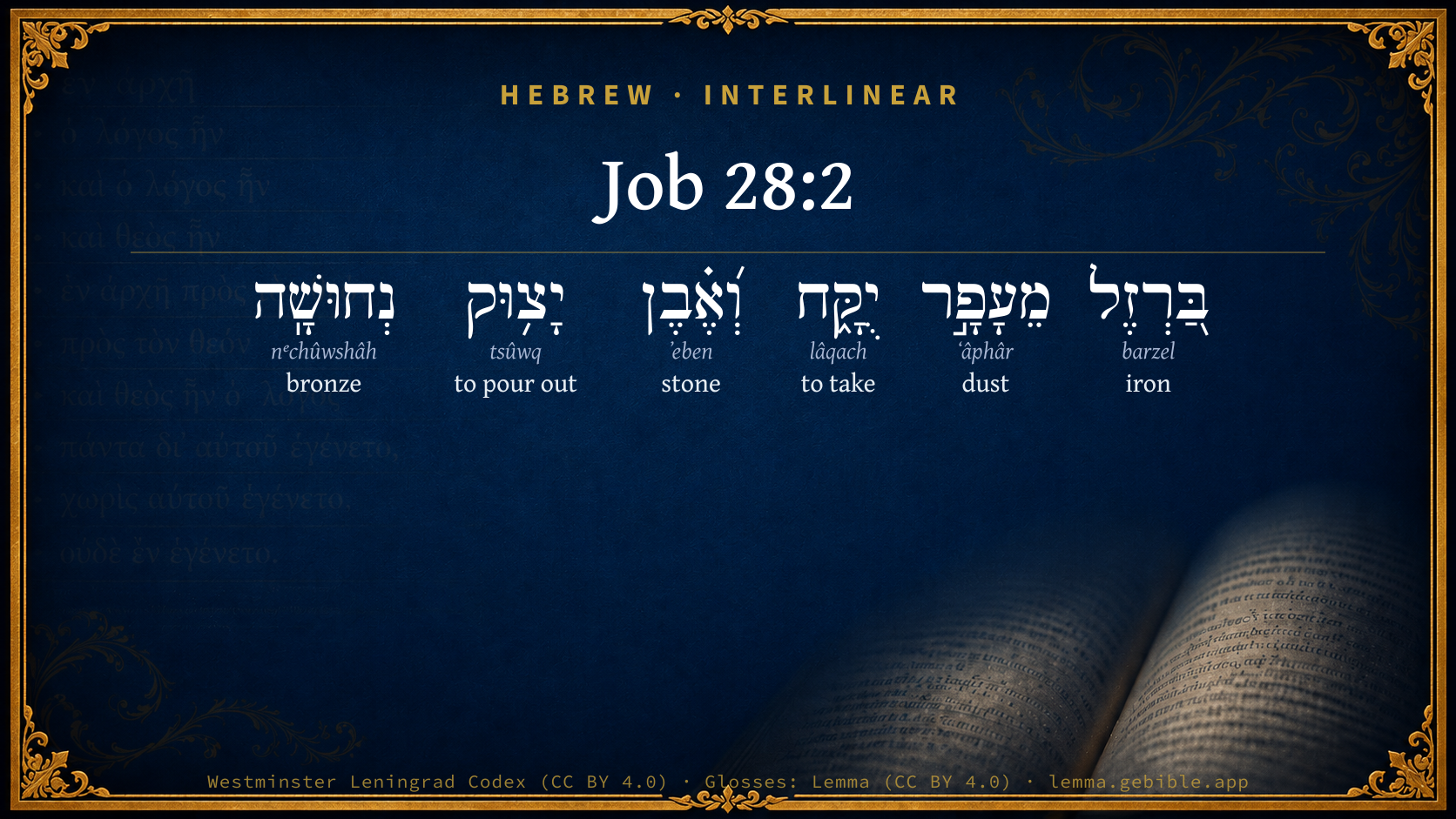
Job 28:2

Hebrew (Westminster Leningrad Codex) Job 28:2 appears in the Hebrew Old Testament. The text above is from the Westminster Leningrad Codex. Each word links to its Strong’s number, a concise gloss, and parsing drawn from the Open Scriptures Hebrew Bible morphology. Click any word for its full Brown-Driver-Briggs (BDB) entry.
Download image
Cite this verse

Job 28:2 (World English Bible). Public Domain. Lemma interlinear Bible study tool, https://lemma.gebible.app/v/job/28/2.

Show BibTeX & RIS
BibTeX
RIS
English Translation
Iron is taken out of the earth, And copper is smelted out of the ore.
World English Bible · Public Domain
Highlights
  • 1 first appearance in the Hebrew Bible
Full analysis ↓
Download a study sheet

One document with this verse’s original text, its word-by-word gloss line, the meaning frame, cross-references with their text, attributed commentary, and full source and license credits — printable, and it pastes into notes with its structure intact.

This verse Autodidact and up

Study sheet (.html) Plain text (.txt)

A passage Seminary Student

Up to 50 verses in one chapter. A passage sheet keeps up to 6 commentary sources and 12 cross-references per verse, in the order this page ranks them, and says so on the sheet whenever that leaves anything out. Ask for a single verse and you get the Autodidact verse sheet above.

Everything on this page stays free to read, with no account — the sheet is a download of what is already on screen, not access to it.

Want to remove ads? Support Godless Engineer
Compare translations 3

The same verse in 3 English versions, stacked beneath the original-language interlinear above. Click any original word for its lexicon entry.

Each is an independent rendering of the whole verse — the interlinear is not word-aligned to these translations.

Highlighted words mark where these versions differ — a whole-verse word diff, not a word-by-word alignment.

  • World English Bible Public Domain
    Iron is taken out of the earth, And copper is smelted out of the ore.
  • King James Version Public Domain
    Iron is taken out of the earth, and brass is molten out of the stone.
  • unfoldingWord Literal Text CC BY-SA 4.0
    Iron is taken from the dust, and one smelts copper stone.

unfoldingWord Literal Text — © unfoldingWord, licensed CC BY-SA 4.0. Word-aligned USFM3 via Door43 (git.door43.org/unfoldingWord/en_ult).

Versions to compare (up to 4)

3 of 4 selected

Show all 18 translations

Every available English version of this verse, each an independent rendering of the whole verse.

  • World English Bible Public Domain
    Iron is taken out of the earth, And copper is smelted out of the ore.
  • Berean Standard Bible Public Domain
    Iron is taken from the earth, and copper is smelted from ore.
  • Majority Standard Bible Public Domain
    Iron is taken from the earth, and copper is smelted from ore.
  • King James Version Public Domain
    Iron is taken out of the earth, and brass is molten out of the stone.
  • American Standard Version (1901) Public Domain
    Iron is taken out of the earth, And copper is molten out of the stone.
  • Revised Version (1885) Public Domain
    Iron is taken out of the earth, and brass is molten out of the stone.
  • Geneva Bible (1599) Public Domain
    Yron is taken out of the dust, and brasse is molten out of the stone.
  • Douay-Rheims (1899) Public Domain
    Iron is taken out of the earth, and stone melted with heat is turned into brass.
  • Young's Literal Translation Public Domain
    Iron from the dust is taken, And `from' the firm stone brass.
  • Literal Standard Version CC BY-SA 4.0
    Iron is taken from the dust, || And bronze [from] the firm stone.
  • Unlocked Literal Bible CC BY-SA 4.0
    Iron is taken out of the earth; copper is smelted out of the stone.
  • unfoldingWord Literal Text CC BY-SA 4.0
    Iron is taken from the dust, and one smelts copper stone.
  • Darby Bible Public Domain
    Iron is taken out of the dust, and copper is molten out of the stone.
  • World Messianic Bible Public Domain
    Iron is taken out of the earth, and copper is smelted out of the ore.
  • Webster's Bible Public Domain
    Iron is taken out of the earth, and brass is melted out of the stone.
  • Free Bible Version CC BY-SA 4.0
    Iron is extracted from the earth and copper is smelted from its ore.
  • Bible in Basic English Public Domain
    Iron is taken out of the earth, and stone is changed into brass by the fire.
  • JPS Tanakh (1917) Public Domain
    Iron is taken out of the dust, and brass is molten out of the stone.

Literal Standard Version (2020), Covenant Press — licensed CC BY-SA 4.0. Text via the HelloAO Bible API (eBible.org). Unlocked Literal Bible (unfoldingWord) — licensed CC BY-SA 4.0. Text via the HelloAO Bible API (eBible.org). unfoldingWord Literal Text — © unfoldingWord, licensed CC BY-SA 4.0. Word-aligned USFM3 via Door43 (git.door43.org/unfoldingWord/en_ult). Free Bible Version, Dr. Jonathan Gallagher — licensed CC BY-SA 4.0. Text via the HelloAO Bible API (eBible.org).

Word by word

More ways to search: Search by grammar → Find every occurrence → Compare this word →

Practice this passage: Drill this verse → Learn its vocabulary →

About this verse

These counts appear in no published source. They are computed here, from the morphology-tagged text and Lemma’s own curated glosses. What Lemma adds →

6
words
6
distinct lemmas
Wisdom
section

Notable vocabulary

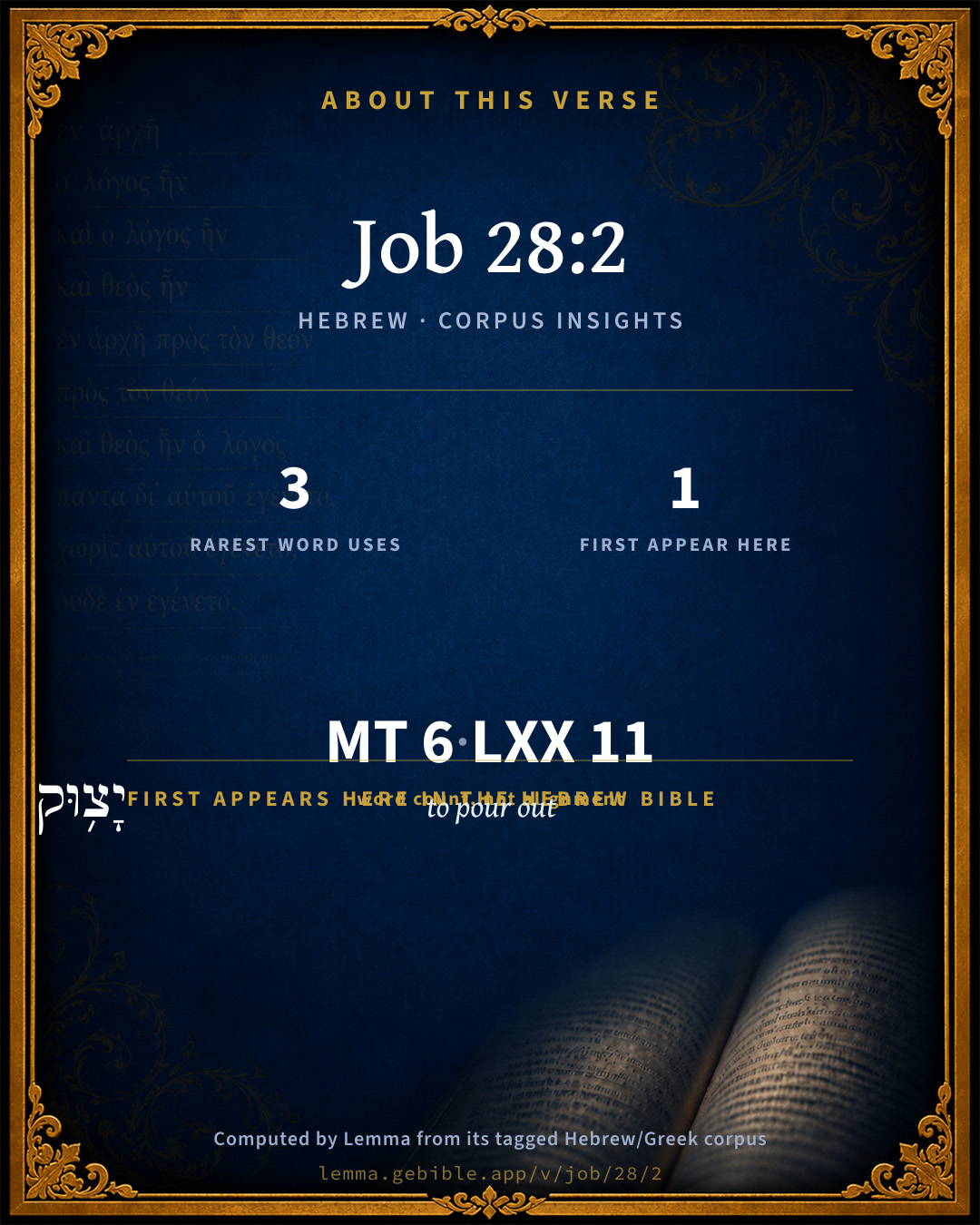
The rarest word here is יָצ֥וּק to pour out H6694 — appearing just 3 times in the whole Hebrew Bible.

First appearance in Scripture

This word makes its first canonical appearance in the Hebrew Bible here:

  • יָצ֥וּק to pour out H6694

Shared distinctive vocabulary

יָצ֥וּק to pour out H6694 occurs in 3 verses of the Hebrew Bible. Also found in:

Grammatical profile

  • 2 verbs
  • 4 nouns

Verb forms

  • יֻקָּ֑ח Qal Passive · Imperfect
  • יָצ֥וּק Qal · Imperfect

Hebrew & Septuagint length

In English translation the verse runs 15 words from the Hebrew and 14 from the Septuagint (LXX English) — closely comparable.

A rough comparison of the two English renderings, which tokenize alike — not a word-level alignment.

Word counts can differ between the Hebrew and the Greek without any difference in meaning — e.g. the Hebrew direct-object marker אֵת has no separate Greek word, and Greek often adds the article ὁ.

In the original languages it is 6 Hebrew tokens and 11 Greek tokens — but the two are counted differently (Hebrew bundles its prefixes and suffixes into one token; the Greek is in lemma form), so that isn’t a like-for-like length.

Cross-references

4

Topical passages linked to Job 28:2 in the Treasury of Scripture Knowledge — connected by theme and wording, ordered by reader-vote popularity; previews shown in the World English Bible.

  • Deuteronomy 8:9 a land in which you shall eat bread without scarceness, you shall not lack anything in it; a land whose stones are iron, and out of whose hills you may dig copper.
  • Genesis 4:22 Zillah also gave birth to Tubal Cain, the forger of every cutting instrument of brass and iron. Tubal Cain's sister was Naamah.
  • Numbers 31:22 however the gold, and the silver, the brass, the iron, the tin, and the lead,
  • 1 Chronicles 22:14 Now, behold, in my affliction I have prepared for the house of Yahweh one hundred thousand talents of gold, and one thousand thousand talents of silver, and of brass and iron without weight; for it is in abundance: timber also and stone have I prepared; and you may add to them.

Cross-references courtesy of OpenBible.info (CC BY 4.0).

Hebrew and Greek witnesses Masoretic Hebrew ↔ Greek Septuagint

The same verse in the two great witnesses to the Old Testament, shown verse-for-verse.

These are two independent witnesses, not word-aligned to each other, and the Septuagint is shown in lemma (dictionary) form.

Hebrew Job 28:2 Masoretic · Westminster Leningrad Codex

בַּ֭רְזֶל מֵעָפָ֣ר יֻקָּ֑ח וְ֝אֶ֗בֶן יָצ֥וּק נְחוּשָֽׁה

Iron is taken out of the earth, And copper is smelted out of the ore.

World English Bible · Public Domain

Greek LXX Job 28:2 Septuagint · lemma form

σίδηρος μέν γάρ ἐκ γῆ γίγνομαι χαλκός δέ ἴσος λίθος λατομέω

For iron comes out of the earth, and brass is hewn out like stone.

LXX2012 (modern English Septuagint) · Public Domain

On this verse, Albert Barnes' Notes on the Bible discusses the Septuagint’s reading. Read the note in Commentary ↓

Hebrew: Westminster Leningrad Codex (CC BY 4.0). Greek: Septuagint (public domain); English from LXX2012 (modern English Septuagint) (Public Domain). How the Septuagint differs from the Hebrew →

Commentary

Notes on Job 28:2 from classic Christian and Jewish commentators (each source and its license shown beneath its notes). The classic Christian expositions comment on the surrounding passage and are grouped to its opening verse, so a note may address several verses; the Jewish commentaries on the Tanakh (Rashi and others) are per-verse, so they appear only where the commentator wrote on this verse.

Lemma curates 59 commentaries, every one of them public domain or Creative Commons licensed, each selected and text-cleaned for this edition rather than reprinted as found. About our sources →

Trapp's Complete Commentary

John Trapp

Job 28:2 Iron is taken out of the earth, and brass [is] molten [out of] the stone.

Ver. 2. Iron is taken out of the earth] That is, out of the irony vein, which is said to be a drossy kind of earth, not sufficiently digested and hardened to make a stone. Of the generation of these inferior metals, see Pliny and the chemists; who yet are not to be hearkened unto when they tell us, that by their art they can turn these baser metals into gold, since they are here distinguished by their place, matter, form, &c. Neither is gold the end of other metals, every one of which is perfect in its kind; and, besides, the essence of everything is indivisible, and the use diverse. Iron can do that which gold and silver cannot. Historians tell us, that Alexander’s old soldiers, armed with shields of iron, conquered a great part of the world. But when, as growing rich, they made them shields of silver, and were there hence called Argyraspides, they were basely beaten by those whom they had formerly subdued. The first inventors of iron and brass Pliny will have to be the Chalybes, or Cyclopes. Diodorus, the Idaei, Dactyli, or Vulcan. Vulcanum, inquit, ferri, aeris, argenti, auri, omniumque quae igne fabricantur, artem invenisse, ferunt (Diod. Sic. 1. 6). And surely if Vulcan were the same as Tubalcain (as various commentators will have it), Diodorus was not far from the truth; for he taught men to work in brass and iron, Gen 4:22. Iron they had before, and the art of using it; how else could they have ploughed the accursed earth? But this man added to their skill by his invention, he sharply and wittily taught smith’s craft, and is therefore by the heathens feigned to be the god of smiths.

And brass is molten out of the stone] That is, out of the ore, which is like a stone, and is called cadmia, as Junius here noteth, perhaps from Cadmus, whom Pliny maketh the first that invented the use of these metals, which Aristotle ascribeth to Lydus, the Scythian, Theophrastus to Delas, the Phrygian. It is probable that these were the first that showed their countrymen the use of these metals, and so were by them accounted the first authors of what was elsewhere found out long before. Some render the text thus, And the stone is melted into brass; that is, by melting, is turned into brass. Many are of the opinion that there was anciently an art of melting stones, which is now lost. Brass is, as it were, incorporated into stone or harder matter; but forced forth by the heat of fire: Aes in mediis lapidibus latet: sed ignis vehementia lapides aeris usque adeo torquentur ut veluti flumen aes effundant (Bren.). Hence the Vulgate Latin thus rendereth this hemistich, Lapis solutus calore, in aes vertitur, The stone, dissolved by heat, is turned into brass. So excellently doth Job here set forth the nature of these chief metals, as Mercer would have us to take notice.

John Trapp, A Commentary or Exposition upon All the Books of the Old and New Testament (1647–1656) — public domain. Text from a community e-Sword module.

Joseph Benson's Commentary

Job 28:2-3. Iron is taken out of the earth, &c. — They invent means to extract iron and brass out of the earth and stone. He setteth an end to darkness, &c. — There is no mine so dismally dark, but there is some man or other who will undertake to work in it, and find out a method of conveying light into it: and searcheth out all perfection — He searches to the very bottom of it, and finds out all the valuable treasures contained therein; the stones of darkness, and the shadow of death — The precious stones, which lie hid in the dark bowels of the earth, where no living thing can dwell.

Joseph Benson's Commentary on the Old and New Testaments (1811–1818) — public domain. Text from a community e-Sword module.

Jamieson, Fausset & Brown

Robert Jamieson, A. R. Fausset & David Brown

brass--that is, copper; for brass is a mixed metal of copper and zinc, of modern invention. Iron is less easily discovered, and wrought, than copper; therefore copper was in common use long before iron. Copper-stone is called "cadmium" by PLINY [Natural History, 34:1; 36:21]. Iron is fitly said to be taken out of the "earth" (dust), for ore looks like mere earth.

Jamieson, Fausset & Brown — Commentary Critical and Explanatory on the Whole Bible (1871) — public domain (CC PDM 1.0). Text via the HelloAO Bible API.

Adam Clarke's Commentary

Verse 2. Iron is taken out of the earth] This most useful metal is hidden under the earth, and men have found out the method of separating it from its ore.

Brass is molten out of the stone.] As brass is a factitious metal, copper must be the meaning of the Hebrew word נחושה nechusah: literally, the stone is poured out for brass. If we retain the common translation, perhaps the process of making brass may be that to which Job refers; for this metal is formed from copper melted with the stone calamine; and thus the stone is poured out to make brass.

Adam Clarke's Commentary on the Bible (1810–1826) — public domain. Text from a community e-Sword/MySword module.

The Cambridge Bible for Schools and Colleges

gen. ed. J. J. S. Perowne

2. brass is molten out of the stone] lit. they (men) melt the stone into brass, i.e. copper. Men know how to possess themselves of the metals.

The Cambridge Bible for Schools and Colleges (gen. ed. J. J. S. Perowne; Cambridge University Press, 1878–1918) — public domain. Text from a community e-Sword module.

John Gill's Exposition

Iron is taken out of the earth,.... Very easily, and in great plenty, and is more common, being in most countries, is nearer the surface of the earth, and here said to be taken "out of the dust" (x); which, being melted in a furnace, produces iron, a metal very serviceable for various rises, and without which there is scarce any thing to be done, and therefore was with brass of early invention. Tubalcain, son of Lamech, supposed to be the Vulcan of the Heathens, a worker in iron, is said to be the instructor of every artificer in brass and iron, Gen 4:22;

and brass is molten out of the stone; out of a brassy stone, called "cadmai", as Pliny says, and also out of another, as he observes (y), called "chalcites", found in Cyprus, where was the first invention of brass, according to him, and hence perhaps copper had its name; but it is plain from Scripture, the places before referred to, that it was invented elsewhere, and long before Cyprus was known; or a "stone melted becomes brass", see Deu 8:9; of these four metals was the image in Nebuchadnezzar's vision, which represented the four monarchies of the world, Babylonian, Persian, Grecian, and Roman, Dan 2:30; and to them are compared, and by them are represented many things in Scripture.

(x) "e pulvere", V. L. Montanus, Junius & Tremellius, Piscator, Cocceius, Michaelis, Schultens. (y) Nat. Hist. l. 34. c. 1, 2.

John Gill's Exposition of the Whole Bible (1746–1763) — public domain (CC PDM 1.0). Text via the HelloAO Bible API.

Albert Barnes' Notes on the Bible

Iron - As has been remarked above, iron was early known, yet probably its common use indicates a more advanced state of civilization than that of gold and silver. The Mexicans were ignorant of the use of iron, though ornaments of gold and silver elegantly worked abounded among them. Iron is less easily discovered than copper, though more abundant, and is worked with more difficulty. Among the ancient nations, copper was in general use long before iron; and arms, vases, statues, and implements of every kind were made of this metal alloyed and hardened with tin, before iron came into general use. Tubal Cain is indeed mentioned Gen 4:22 as the “instructor of every artificer in brass and iron,” but no direct mention is made of iron arms Num 35:16 or tools Deu 27:5, until after the departure from Egypt. According to the Arundelian Marbles, iron was known one hundred and eighty-eight years before the Trojan war, about 1370 years B.C.; but Hesiod, Plutarch, and others, limit its discovery to a much later period. Homer, however, distinctly mentions its use, Iliad xxiii. 262:

Η δε γυνᾶικα ὲΰζώνα;, πολιον τε σίδηρον.

Hē de gunaikas euzōnas, polion te sidēron.

That by the “sideros” of the poet is meant iron, is clear, from a simile which he uses in the Odyssey, derived from the quenching of iron in water, by which he illustrates the hissing produced in the eye of Polyphemus by piercing it with the burning stake:

“And as when armorers temper in the ford

The keen edged pole-axe or the shining sword,

The red-hot metal hisses in the lake,

Thus in the eye-ball hissed the plunging stake.”

Odyssey ix. 391; Pope

Iron is mentioned in the time of Og king of Bashan, 1450 B.C. It was at first, however, regarded as of great value, and its use was very limited. It was presented in the temples of Greece as among the most valuable offerings, and rings of iron have been found in the tombs of Egypt that had been worn as ornaments, showing the value of the metal. One of the reasons why this metal comes so slowly into use, and why it was so rare in early times, was the difficulty of smelting the ore, and reducing it to a malleable state “Its gross and stubborn ore,” says Dr. Robertson (America, B. iv.) “must feel twice the force of fire, and go through two laborious pocesses, before it becomes fit for use.” It was this fact which made it to Job such a proof of the wisdom of man that he had invented the process of making iron, or of separating it from the earthy portions in which it is found.

Is taken out of the earth - Margin, “dust.” The form in which iron is found is too well known to need description. It is seldom, if ever, found in its purity, and the ore generally has so much the appearance of mere earth, that it requires some skill to distinguish them.

And brass - נחוּשׁה nechûshâh. Brass is early and frequently mentioned in the Bible (Gen 4:22; Exo 25:3; Exo 26:11, et al.), but there is little doubt that copper is meant in these places. Brass is a compound metal, made of copper and zinc - containing usually about one third of the weight in zinc - and it is hardly probable that the art of compounding this was early known; compare the notes at Job 20:24. Dr. Good renders this, “And the rock poureth forth copper.” Coverdale, “The stones resolved to metal.” Noyes, “The stone is melted into copper.” Prof. Lee, “Also the stone (is taken from the earth) from which one fuseth copper.” The Hebrew is, literally,” And stone is poured out יציק copper.” The Septuagint renders it, “And brass is cut like stones;” that is, is cut from the quarry. The word “stone” here in the Hebrew (אבן 'eben) means, doubtless, “ore” in the form of stone; and the fact mentioned here, that such ore is fused into the נחוּשׁה eht nechûshâh, is clear proof that copper is intended. Brass is never found in ore, and is never compounded in the earth. A similar idea is found in Pliny, who probably uses the word “aes” to denote copper, as it is commonly employed in the ancient writings. Aes fit ex lapide aeroso, quem vocant Cadmiam; et igne lapides in nes solvantur. Nat. Hist. xxxiv. i. 22. On the general subject of ancient metallurgy, see Wilkinsoh’s Manners and Customs of the Ancient Egyptians, vol. iii. chapter ix.

Albert Barnes' Notes on the Bible (1834–1885) — public domain. Text from a community e-Sword/MySword module.

Haydock's Catholic Bible Commentary

Stone. Protestants, "and brass is molten out of the stone." (Haydock) --- "When brass comes out of the mine it resembles stone, and being mixed with earth is refined in the fire." (Pliny, [Natural History?] xxxvi. 27.) (Menochius) --- All this process would require much ingenuity and time. Tubalcain was a great artist before the deluge; (Genesis iv. 22.) but we cannot tell who were the inventors of these things, though (Calmet) the Greeks have specified the names of some who introduced these metals into their respective countries. (Pliny vii. 56.) (Haydock)

George Leo Haydock (1774–1849), Haydock's Catholic Family Bible and Commentary, 1859 edition — public domain. Excludes Psalms (Douay-Rheims chapter numbering differs from Protestant) and Deuterocanonical books (Catholic canon only).

Matthew Poole's English Annotations

Iron is taken out of the earth; being made of earth, concocted by the heat of the sun into that hardness, and by miners digged out of the earth.

Brass; or, copper.

Is molten out of the stone, wherewith it is mixed and incorporated in the earth, and by fire and the art of the metallist it is separated from it, and taken out of it, as Pliny observes, Job 34:1,10; 36:27.

Matthew Poole's English Annotations on the Holy Bible (1683–1685) — public domain. Text from a community e-Sword/MySword module.

Whedon's Commentary on the Bible

Daniel D. Whedon

2. Iron… earth — Iron and brass are both alluded to in the final address of Moses as abounding in the Promised Land. Deu_8:9. The Jews do not seem to have worked these mines to any great extent, though it is now known that they were worked by the early Canaanitish races. (ROUGEMONT, L’Age du Bronze, 188.) Iron was certainly found in Lebanon, and Josephus speaks of an “iron mountain that runs in length as far as Moab.” — Wars, Job_4:8; Job_4:2. Pliny (xxxiv, 14) says, mines of iron are to be found almost everywhere.

Brass… stone — And stone is molten into copper. Brass, as is well known, is an alloy of copper and zinc. At Punon, between Petra and Zoar, were copper mines, to which, during the persecutions of the Roman emperors, many Christians were banished that they might fall victims to the excessive sufferings connected with mining. The numerous remains of smelting furnaces, which may still be seen, show that mining operations for copper were once carried on upon a very large scale in the outlying districts of Sinai, near Jebel Habashi. These operations probably antedated those of Magharah or Sarabit. See PALMER’S Desert of the Exodus, 234, 256.

Daniel D. Whedon (gen. ed.), Commentary on the Old and New Testaments (1874–1909) — public domain. Text from a community e-Sword module.

The Pulpit Commentary

Iron is taken out of the earth. (see the comment on Job_20:24) Iron was found in the hills of Palestine, (Deu_8:9) in the trans-Jordanic region (Josephus, "Bell. Jud," 4:8. in the sandstone of the Lebanon ("Hist. of Phoenicia," p. 47), and in Egypt ("Hist. of Ancient Egypt," vol. 1. p. 93), probably also in many other places. It is scarcely ever found except in the shape of iron ore, and so has to be "taken out of the earth." And brass is molten out of the stone. By "brass" we must understand copper, since the amalgam brass is never found in a natural state. Copper was yielded abundantly in very early times by the mines which the Egyptians worked in the Sinaitic peninsula ("Hist. of Ancient Egypt," vol. 1. pp. 93, 94). It was also obtainable from Palestine, (Deu_8:9) Cyprus ("Hist. of Phoenicia," p. 311), and Armenia. (Eze_27:13) Sometimes it is found pure, but generally in the shape of copper ore, which has to be "molten" for the pure metal to run off.

The Pulpit Commentary (1880–1919), ed. H.D.M. Spence-Jones & Joseph S. Exell — public domain. Text from a community e-Sword module.

Rashi

Rabbi Shlomo Yitzchaki (Rashi)

and copper is smelted from stone From the mountain the smith smelts the copper. Hence, everything has a beginning and an end, for the whole world will end with all that is therein.

Rashi on the Tanakh — English translations: “The Judaica Press complete Tanach with Rashi, translated by A. J. Rosenberg” (CC BY 4.0); “Pentateuch with Rashi's commentary by M. Rosenbaum and A.M. Silbermann, 1929-1934” (public domain); “The Metsudah Tanach series, Lakewood, N.J” (CC BY 4.0); and “The Book of Joshua, Metsudah Publications, 1997” (CC BY 4.0). Text via Sefaria.

Lesson kit

Teaching starters — assembled from the data on this page, not authored interpretation. Every prompt links to the verse data it draws on. Edit before teaching.

Job, in the Wisdom, opens this verse with 6 words (6 distinct Hebrew lemmas). Its most distinctive word is tsûwq (“to pour out”). A historical commentator’s framing appears above. Read the whole chapter for the surrounding context.

Discussion questions

  1. The word tsûwq carries the sense “to pour out.” How does it shape the verse?
  2. This is the first place “to pour out” appears in Scripture (first appears here). What does its debut here establish?
  3. How does Job 29:6, which shares the word «to pour out», read alongside this verse?
  4. These translations render this verse differently; the difference is in the English rendering, not the original. What questions does that raise?
  5. «יֻקָּ֑ח» is a Qal Passive Imperfect verb. How does that grammatical form shape the action described?
  6. Compare how Trapp's Complete Commentary and Joseph Benson's Commentary read this verse. Where do they agree or differ?

Things to notice

Reading settings

Reading text

Shown beneath each verse's original-language words.

Old Testament
Old Testament edition

Read the OT as the Masoretic Hebrew (MT) or the Greek Septuagint (LXX).

English shown for the Greek Septuagint (in the Hebrew ↔ Greek comparison).

Comparing translations? Open the Compare panel on any verse page to stack up to four side by side.