

Philippians 3:14
Greek (Tischendorf 8th ed.) Philippians 3:14 appears in the Greek New Testament. The text above is from the Tischendorf 8th edition. Each word links to its Strong’s number and a concise gloss. Click any word for its full Thayer’s Greek Lexicon entry.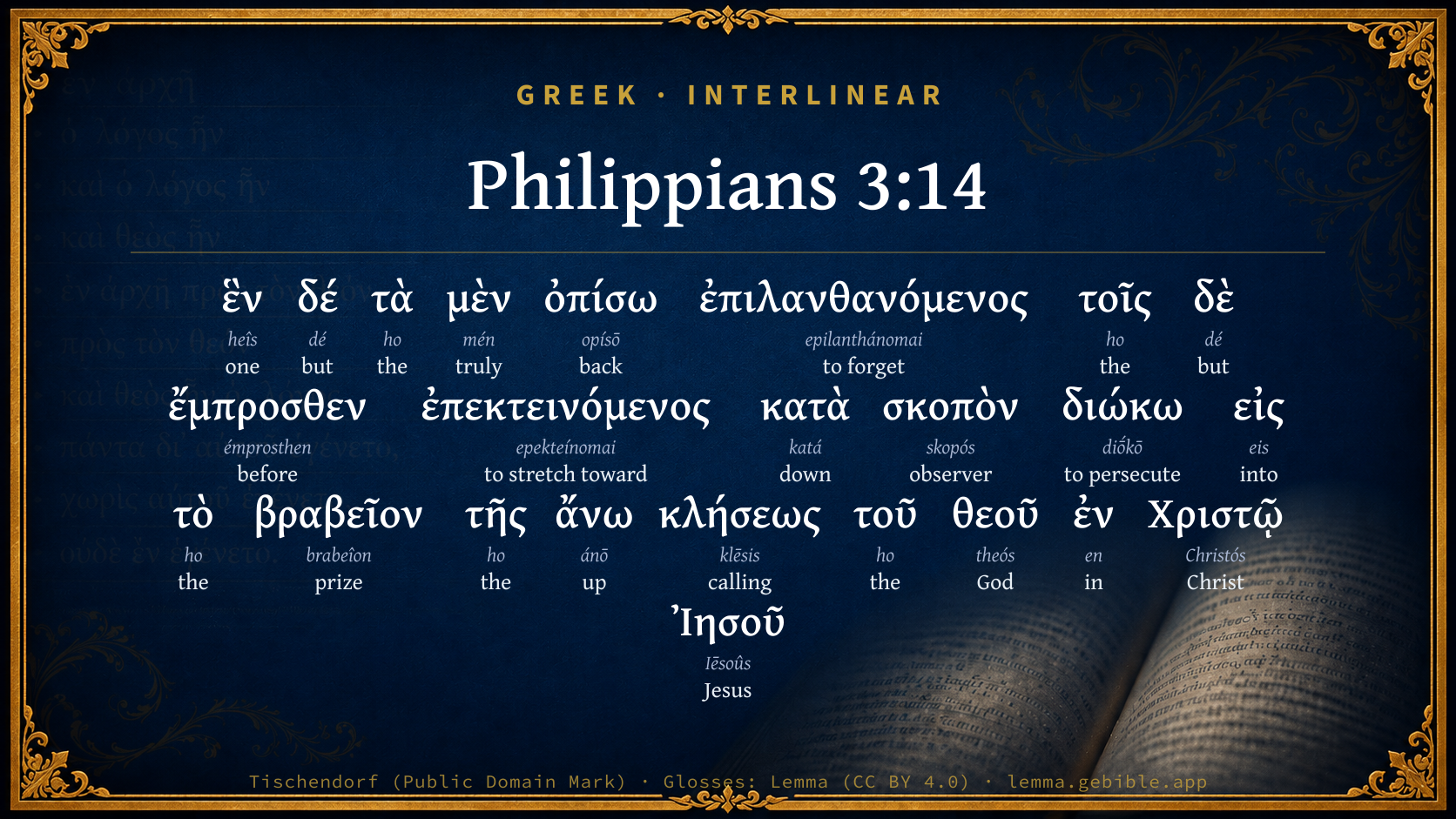
I press on toward the goal for the prize of the high calling of God in Christ Jesus.
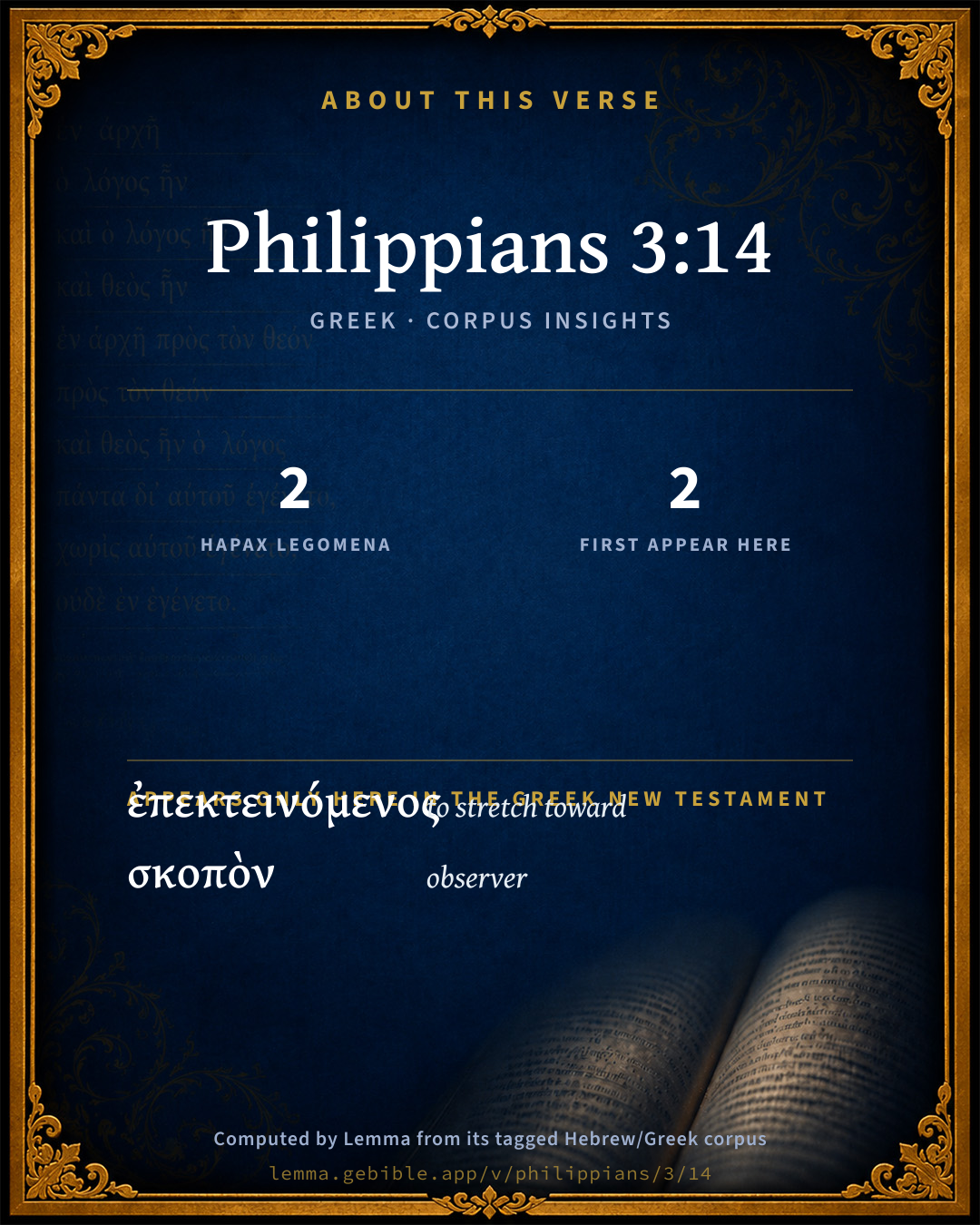
- 2 hapax legomena — only here in the Greek New Testament
- 2 first appearances in the Greek New Testament
Download a study sheet
One document with this verse’s original text, its word-by-word gloss line, the meaning frame, cross-references with their text, attributed commentary, and full source and license credits — printable, and it pastes into notes with its structure intact.
This verse Autodidact and up
A passage Seminary Student
Up to 50 verses in one chapter. A passage sheet keeps up to 6 commentary sources and 12 cross-references per verse, in the order this page ranks them, and says so on the sheet whenever that leaves anything out. Ask for a single verse and you get the Autodidact verse sheet above.
Everything on this page stays free to read, with no account — the sheet is a download of what is already on screen, not access to it.
Compare translations 3
The same verse in 3 English versions, stacked beneath the original-language interlinear above. Click any original word for its lexicon entry.
Each is an independent rendering of the whole verse — the interlinear is not word-aligned to these translations.
Highlighted words mark where these versions differ — a whole-verse word diff, not a word-by-word alignment.
-
World English Bible Public Domain
I press on toward the goal for the prize of the high calling of God in Christ Jesus.
-
King James Version Public Domain
I press toward the mark for the prize of the high calling of God in Christ Jesus.
-
unfoldingWord Literal Text CC BY-SA 4.0
I press on toward the goal for the prize of the upward calling of God in Christ Jesus.
unfoldingWord Literal Text — © unfoldingWord, licensed CC BY-SA 4.0. Word-aligned USFM3 via Door43 (git.door43.org/unfoldingWord/en_ult).
Show all 19 translations
Every available English version of this verse, each an independent rendering of the whole verse.
-
World English Bible Public Domain
I press on toward the goal for the prize of the high calling of God in Christ Jesus.
-
Berean Standard Bible Public Domain
I press on toward the goal to win the prize of God’s heavenly calling in Christ Jesus.
-
Majority Standard Bible Public Domain
I press on toward the goal to win the prize of God’s heavenly calling in Christ Jesus.
-
King James Version Public Domain
I press toward the mark for the prize of the high calling of God in Christ Jesus.
-
American Standard Version (1901) Public Domain
I press on toward the goal unto the prize of the high calling of God in Christ Jesus.
-
Revised Version (1885) Public Domain
I press on toward the goal unto the prize of the high calling of God in Christ Jesus.
-
Geneva Bible (1599) Public Domain
And follow hard toward the marke, for the prise of the hie calling of God in Christ Iesus.
-
Douay-Rheims (1899) Public Domain
I press towards the mark, to the prize of the supernal vocation of God in Christ Jesus.
-
Young's Literal Translation Public Domain
to the mark I pursue for the prize of the high calling of God in Christ Jesus.
-
Literal Standard Version CC BY-SA 4.0
I pursue to the mark for the prize of the high calling of God in Christ Jesus.
-
Unlocked Literal Bible CC BY-SA 4.0
I press on toward the goal to win the prize of the upward calling of God in Christ Jesus.
-
unfoldingWord Literal Text CC BY-SA 4.0
I press on toward the goal for the prize of the upward calling of God in Christ Jesus.
-
Darby Bible Public Domain
I pursue, [looking] towards [the] goal, for the prize of the calling on high of God in Christ Jesus.
-
World Messianic Bible Public Domain
I press on toward the goal for the prize of the high calling of God in Messiah Yeshua.
-
Webster's Bible Public Domain
I press towards the mark for the prize of the high calling of God in Christ Jesus.
-
Free Bible Version CC BY-SA 4.0
I run towards the finish line to win the prize of God's invitation to heaven through Christ Jesus.
-
Bible in Basic English Public Domain
I go forward to the mark, even the reward of the high purpose of God in Christ Jesus.
-
Text-Critical English NT CC BY 4.0
I press on toward the goal to win the prize of the upward call of God in Christ Jesus.
-
Tyndale New Testament (1534) Public Domain
and preace vnto the marke apoynted to obtayne the rewarde of the hye callynge of god in Christ Iesu.
Literal Standard Version (2020), Covenant Press — licensed CC BY-SA 4.0. Text via the HelloAO Bible API (eBible.org). Unlocked Literal Bible (unfoldingWord) — licensed CC BY-SA 4.0. Text via the HelloAO Bible API (eBible.org). unfoldingWord Literal Text — © unfoldingWord, licensed CC BY-SA 4.0. Word-aligned USFM3 via Door43 (git.door43.org/unfoldingWord/en_ult). Free Bible Version, Dr. Jonathan Gallagher — licensed CC BY-SA 4.0. Text via the HelloAO Bible API (eBible.org).
Word by word
More ways to search: Search by grammar → Find every occurrence → Compare this word →
Practice this passage: Drill this verse → Learn its vocabulary →
- Appears 1× in the Greek New Testament
- First appears here
- Part of Speech
- Verb
- Tense
- Present
- Voice
- Middle or Passive deponent
- Mood
- Participle
- Case
- Nominative
- Number
- Singular
- Gender
- Masculine
Full Thayer's Definition
- ἓν heîs G1520 “one” Adjective, Accusative, Singular, Neuter
- δέ dé G1161 “but” Conjunction
- τὰ ho G3588 “the” Article, Accusative, Plural, Neuter
- μὲν mén G3303 “truly” Particle
- ὀπίσω opísō G3694 “back” Adverb
- ἐπιλανθανόμενος epilanthánomai G1950 “to forget” Verb, Present, Middle or Passive deponent, Participle, Nominative, Singular, Masculine
- τοῖς ho G3588 “the” Article, Dative, Plural, Neuter
- δὲ dé G1161 “but” Conjunction
- ἔμπροσθεν émprosthen G1715 “before” Adverb
- ἐπεκτεινόμενος epekteínomai G1901 “to stretch toward” Verb, Present, Middle or Passive deponent, Participle, Nominative, Singular, Masculine
- κατὰ katá G2596 “down” Preposition
- σκοπὸν skopós G4649 “observer” Noun, Accusative, Singular, Masculine
- διώκω diṓkō G1377 “to persecute” Verb, Present, Active, Indicative, 1st person, Singular
- εἰς eis G1519 “into” Preposition
- τὸ ho G3588 “the” Article, Accusative, Singular, Neuter
- βραβεῖον brabeîon G1017 “prize” Noun, Accusative, Singular, Neuter
- τῆς ho G3588 “the” Article, Genitive, Singular, Feminine
- ἄνω ánō G507 “up” Adverb
- κλήσεως klēsis G2821 “calling” Noun, Genitive, Singular, Feminine
- τοῦ ho G3588 “the” Article, Genitive, Singular, Masculine
- θεοῦ theós G2316 “God” Noun, Genitive, Singular, Masculine
- ἐν en G1722 “in” Preposition
- Χριστῷ Christós G5547 “Christ” Noun, Dative, Singular, Masculine
- Ἰησοῦ Iēsoûs G2424 “Jesus” Noun, Dative, Singular, Masculine
About this verse
These counts appear in no published source. They are computed here, from the morphology-tagged text and Lemma’s own curated glosses. What Lemma adds →
- 24
- words
- 19
- distinct lemmas
- Pauline Epistles
- section
Notable vocabulary
2 hapax legomena — words that appear only here in the entire Greek New Testament:
First appearance in Scripture
These words make their first canonical appearance in the Greek New Testament here:
Shared distinctive vocabulary
βραβεῖον prize G1017 occurs in 2 verses of the Greek New Testament. Also found in:
Cross-references
15Topical passages linked to Philippians 3:14 in the Treasury of Scripture Knowledge — connected by theme and wording, ordered by reader-vote popularity; previews shown in the World English Bible.
- 1 Corinthians 9:24 Don't you know that those who run in a race all run, but one receives the prize? Run like that, that you may win.
- 1 Peter 5:10 But may the God of all grace, who called you to his eternal glory by Christ Jesus, after you have suffered a little while, perfect, establish, strengthen, and settle you.
- Revelation 3:21 He who overcomes, I will give to him to sit down with me on my throne, as I also overcame, and sat down with my Father on his throne.
- 2 Timothy 4:7–8 I have fought the good fight. I have finished the course. I have kept the faith.
- Romans 8:28–30 We know that all things work together for good for those who love God, to those who are called according to his purpose.
- 1 Thessalonians 2:12 to the end that you should walk worthily of God, who calls you into his own Kingdom and glory.
- 2 Peter 1:3 seeing that his divine power has granted to us all things that pertain to life and godliness, through the knowledge of him who called us by his own glory and virtue;
- Hebrews 3:1 Therefore, holy brothers, partakers of a heavenly calling, consider the Apostle and High Priest of our confession, Jesus;
- 1 Peter 1:3–4 Blessed be the God and Father of our Lord Jesus Christ, who according to his great mercy became our father again to a living hope through the resurrection of Jesus Christ from the dead,
- 1 Peter 1:13 Therefore, prepare your minds for action, be sober and set your hope fully on the grace that will be brought to you at the revelation of Jesus Christ--
- Hebrews 6:1 Therefore leaving the doctrine of the first principles of Christ, let us press on to perfection--not laying again a foundation of repentance from dead works, of faith toward God,
- 2 Corinthians 4:17–5:1 For our light affliction, which is for the moment, works for us more and more exceedingly an eternal weight of glory;
- 2 Thessalonians 2:13–14 But we are bound to always give thanks to God for you, brothers loved by the Lord, because God chose you from the beginning for salvation through sanctification of the Spirit and belief in the truth;
- Romans 9:23–24 and that he might make known the riches of his glory on vessels of mercy, which he prepared beforehand for glory,
- Luke 16:16 The law and the prophets were until John. From that time the Gospel of the Kingdom of God is preached, and everyone is forcing his way into it.
Cross-references courtesy of OpenBible.info (CC BY 4.0).
Lesson kit
Teaching starters — assembled from the data on this page, not authored interpretation. Every prompt links to the verse data it draws on. Edit before teaching.
Philippians, in the Pauline Epistles, opens this verse with 24 words (19 distinct Greek lemmas). Its most distinctive word is epekteínomai (“to stretch toward”). A historical commentator’s framing appears above. Read the whole chapter for the surrounding context.
Discussion questions
- The word epekteínomai carries the sense “to stretch toward.” How does it shape the verse?
- 2 words here appear nowhere else in the Greek New Testament. Why might the author reach for such rare wording?
- 2 words make their first appearance in Scripture here. What does this debut establish?
- How does 1 Corinthians 9:24, which shares the word «prize», read alongside this verse?
- What does the repetition of “the” (5× in this one verse) do in this verse?
- These translations render this verse differently; the difference is in the English rendering, not the original. What questions does that raise?
- Compare how John Gill's Exposition and Bengel's Gnomon read this verse. Where do they agree or differ?
Things to notice
- 2 words in this verse appear nowhere else in the Greek New Testament.
- 2 words make their first canonical appearance in Scripture here.
- These translations choose different wording for 4 words in this verse.
- “the” occurs 5× in this single verse.
- 19 distinct Greek lemmas span 24 words in this verse.
Commentary
Notes on Philippians 3:14 from classic Christian and Jewish commentators (each source and its license shown beneath its notes). The classic Christian expositions comment on the surrounding passage and are grouped to its opening verse, so a note may address several verses; the Jewish commentaries on the Tanakh (Rashi and others) are per-verse, so they appear only where the commentator wrote on this verse.
Lemma curates 59 commentaries, every one of them public domain or Creative Commons licensed, each selected and text-cleaned for this edition rather than reprinted as found. About our sources →
John Gill's Exposition
John Gill's Exposition of the Whole Bible (1746–1763) — public domain (CC PDM 1.0). Text via the HelloAO Bible API.
Bengel's Gnomon
Johann Albrecht Bengel
Bengel's Gnomon of the New Testament — English translation (T&T Clark, Edinburgh, 1860) — public domain. Text from a community e-Sword module.
Expositor's Greek Testament
ed. W. Robertson Nicoll
The Expositor's Greek Testament, edited by W. Robertson Nicoll (1897–1910) — public domain. Text from a community e-Sword module.
Cambridge Greek Testament for Schools and Colleges
Cambridge Greek Testament for Schools and Colleges (Cambridge University Press, 1896; 21 vols, various authors incl. Carr, Maclear, Plummer, Farrar, Lumby, Moule, M. R. James, Simcox) — public domain. Text from a community e-Sword module.
Jamieson, Fausset & Brown
Robert Jamieson, A. R. Fausset & David Brown
Jamieson, Fausset & Brown — Commentary Critical and Explanatory on the Whole Bible (1871) — public domain (CC PDM 1.0). Text via the HelloAO Bible API.
Adam Clarke's Commentary
Adam Clarke's Commentary on the Bible (1810–1826) — public domain. Text from a community e-Sword/MySword module.
Ellicott's Commentary for English Readers
A Bible Commentary for English Readers, edited by Charles John Ellicott (1878–1897) — public domain. Text from a community e-Sword module.
The Cambridge Bible for Schools and Colleges
gen. ed. J. J. S. Perowne
The Cambridge Bible for Schools and Colleges (gen. ed. J. J. S. Perowne; Cambridge University Press, 1878–1918) — public domain. Text from a community e-Sword module.
Trapp's Complete Commentary
John Trapp
John Trapp, A Commentary or Exposition upon All the Books of the Old and New Testament (1647–1656) — public domain. Text from a community e-Sword module.
Albert Barnes' Notes on the Bible
Albert Barnes' Notes on the Bible (1834–1885) — public domain. Text from a community e-Sword/MySword module.
Haydock's Catholic Bible Commentary
George Leo Haydock (1774–1849), Haydock's Catholic Family Bible and Commentary, 1859 edition — public domain. Excludes Psalms (Douay-Rheims chapter numbering differs from Protestant) and Deuterocanonical books (Catholic canon only).
Matthew Poole's English Annotations
Matthew Poole's English Annotations on the Holy Bible (1683–1685) — public domain. Text from a community e-Sword/MySword module.
Whedon's Commentary on the Bible
Daniel D. Whedon
Daniel D. Whedon (gen. ed.), Commentary on the Old and New Testaments (1874–1909) — public domain. Text from a community e-Sword module.
The Pulpit Commentary
The Pulpit Commentary (1880–1919), ed. H.D.M. Spence-Jones & Joseph S. Exell — public domain. Text from a community e-Sword module.
John Wesley's Explanatory Notes
John Wesley, Explanatory Notes Upon the Whole Bible (1754–1765) — public domain. Text via the GEBible commentary corpus.
Godbey's Commentary on the New Testament
William B. Godbey
William B. Godbey, Commentary on the New Testament (1896–1900) — public domain. Text from a community e-Sword module.
The People's New Testament
B. W. Johnson
B. W. Johnson's The People's New Testament with Notes (1889–1891) — public domain. Electronic text from the Christian Classics Ethereal Library (CCEL) ThML edition.
International Critical Commentary
International Critical Commentary — older volumes (1896–1929), various authors — public domain. Text from a community e-Sword module.
Vincent's Word Studies in the New Testament
Marvin R. Vincent
Marvin R. Vincent, Word Studies in the New Testament (1887–1900) — public domain. Text from a community e-Sword/MySword module.