

2 Corinthians 12:1
Greek (Tischendorf 8th ed.) 2 Corinthians 12:1 appears in the Greek New Testament. The text above is from the Tischendorf 8th edition. Each word links to its Strong’s number and a concise gloss. Click any word for its full Thayer’s Greek Lexicon entry.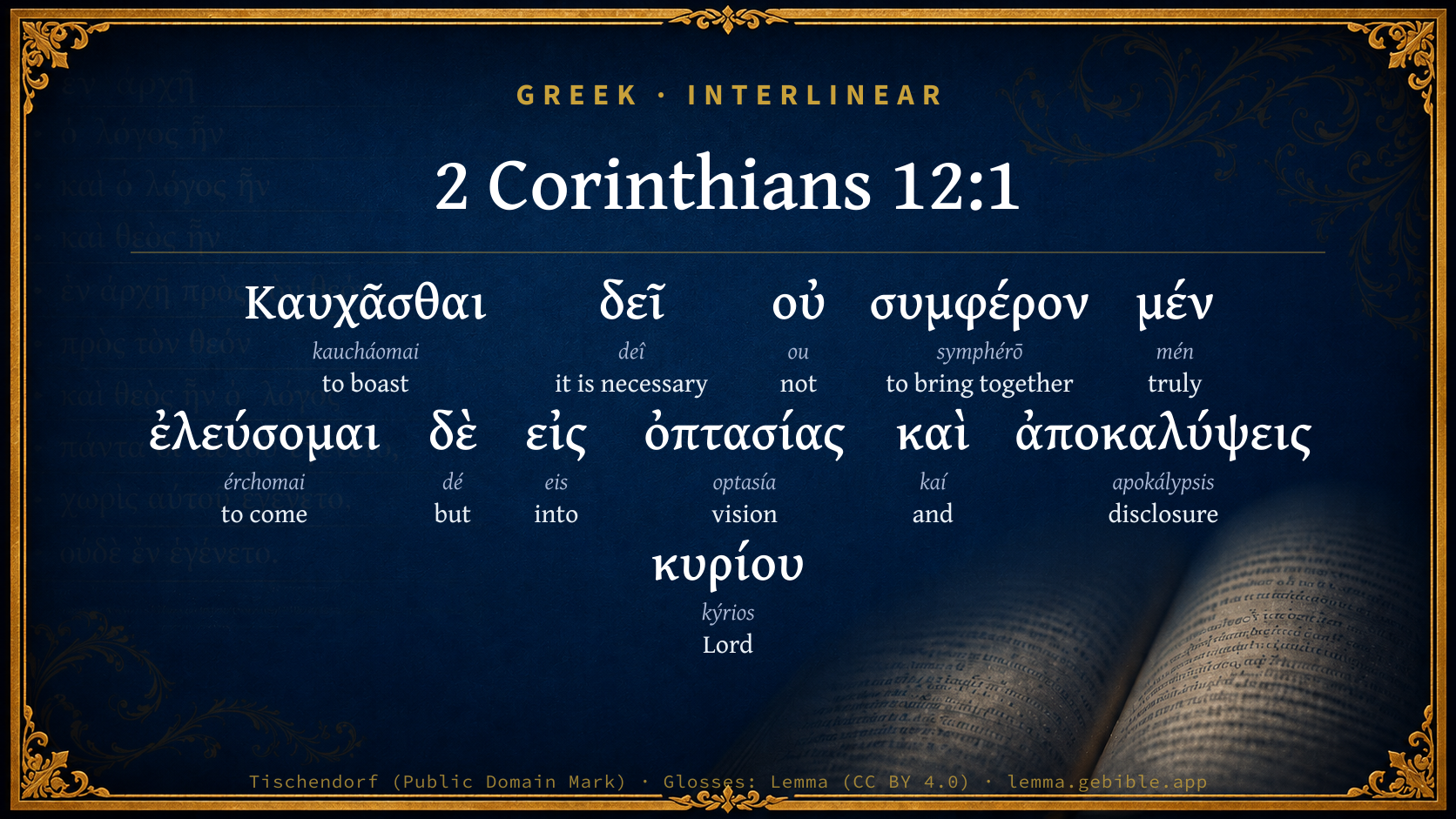
It is doubtless not profitable for me to boast. For I will come to visions and revelations of the Lord.
Download a study sheet
One document with this verse’s original text, its word-by-word gloss line, the meaning frame, cross-references with their text, attributed commentary, and full source and license credits — printable, and it pastes into notes with its structure intact.
This verse Autodidact and up
A passage Seminary Student
Up to 50 verses in one chapter. A passage sheet keeps up to 6 commentary sources and 12 cross-references per verse, in the order this page ranks them, and says so on the sheet whenever that leaves anything out. Ask for a single verse and you get the Autodidact verse sheet above.
Everything on this page stays free to read, with no account — the sheet is a download of what is already on screen, not access to it.
Compare translations 3
The same verse in 3 English versions, stacked beneath the original-language interlinear above. Click any original word for its lexicon entry.
Each is an independent rendering of the whole verse — the interlinear is not word-aligned to these translations.
Highlighted words mark where these versions differ — a whole-verse word diff, not a word-by-word alignment.
-
World English Bible Public Domain
It is doubtless not profitable for me to boast. For I will come to visions and revelations of the Lord.
-
King James Version Public Domain
It is not expedient for me doubtless to glory. I will come to visions and revelations of the Lord.
-
unfoldingWord Literal Text CC BY-SA 4.0
It is necessary to boast. not profitable, but I will go on to visions and revelations of the Lord.
unfoldingWord Literal Text — © unfoldingWord, licensed CC BY-SA 4.0. Word-aligned USFM3 via Door43 (git.door43.org/unfoldingWord/en_ult).
Show all 19 translations
Every available English version of this verse, each an independent rendering of the whole verse.
-
World English Bible Public Domain
It is doubtless not profitable for me to boast. For I will come to visions and revelations of the Lord.
-
Berean Standard Bible Public Domain
I must go on boasting. Although there is nothing to gain, I will go on to visions and revelations from the Lord.
-
Majority Standard Bible Public Domain
Surely it is not beneficial for me to boast, yet I will go on to visions and revelations from the Lord.
-
King James Version Public Domain
It is not expedient for me doubtless to glory. I will come to visions and revelations of the Lord.
-
American Standard Version (1901) Public Domain
I must needs glory, though it is not expedient; but I will come to visions and revelations of the Lord.
-
Revised Version (1885) Public Domain
I must needs glory, though it is not expedient; but I will come to visions and revelations of the Lord.
-
Geneva Bible (1599) Public Domain
It is not expedient for me no doubt to reioyce: for I will come to visions and reuelations of the Lord.
-
Douay-Rheims (1899) Public Domain
If I must glory (it is not expedient indeed): but I will come to visions and revelations of the Lord.
-
Young's Literal Translation Public Domain
To boast, really, is not profitable for me, for I will come to visions and revelations of the Lord.
-
Literal Standard Version CC BY-SA 4.0
To boast, really, is not profitable for me, for I will come to visions and revelations of the LORD.
-
Unlocked Literal Bible CC BY-SA 4.0
I must boast, but nothing is gained by it. But I will go on to visions and revelations from the Lord.
-
unfoldingWord Literal Text CC BY-SA 4.0
It is necessary to boast. not profitable, but I will go on to visions and revelations of the Lord.
-
Darby Bible Public Domain
Well, it is not of profit to me to boast, for I will come to visions and revelations of [the] Lord.
-
World Messianic Bible Public Domain
It is doubtless not profitable for me to boast, but I will come to visions and revelations of the Lord.
-
Webster's Bible Public Domain
It is not expedient for me doubtless to glory. I will come to visions and revelations of the Lord.
-
Free Bible Version CC BY-SA 4.0
I suppose I have to boast, even though it doesn't really help. Let me go on to visions and revelations from the Lord.
-
Bible in Basic English Public Domain
As it is necessary for me to take glory to myself, though it is not a good thing, I will come to visions and revelations of the Lord.
-
Text-Critical English NT CC BY 4.0
Surely it is not beneficial for me to boast, yet I will go on to visions and revelations from the Lord.
-
Tyndale New Testament (1534) Public Domain
It is not expediet for me (no dout to reioyce. Neverthelesse I will come to visions and revelacions of the lorde.
Literal Standard Version (2020), Covenant Press — licensed CC BY-SA 4.0. Text via the HelloAO Bible API (eBible.org). Unlocked Literal Bible (unfoldingWord) — licensed CC BY-SA 4.0. Text via the HelloAO Bible API (eBible.org). unfoldingWord Literal Text — © unfoldingWord, licensed CC BY-SA 4.0. Word-aligned USFM3 via Door43 (git.door43.org/unfoldingWord/en_ult). Free Bible Version, Dr. Jonathan Gallagher — licensed CC BY-SA 4.0. Text via the HelloAO Bible API (eBible.org).
Word by word
More ways to search: Search by grammar → Find every occurrence → Compare this word →
Practice this passage: Drill this verse → Learn its vocabulary →
- Appears 4× in the Greek New Testament
- First appears at Luke 1:22
- Part of Speech
- Noun
- Case
- Accusative
- Number
- Plural
- Gender
- Feminine
Full Thayer's Definition
- Καυχᾶσθαι kaucháomai G2744 “to boast” Verb, Present, Middle or Passive deponent, Infinitive
- δεῖ deî G1163 “it is necessary” Verb, Present, Active, Indicative, 3rd person, Singular
- οὐ ou G3756 “not” Particle, Negative
- συμφέρον symphérō G4851 “to bring together” Verb, Present, Active, Participle, Accusative, Singular, Neuter
- μέν mén G3303 “truly” Particle
- ἐλεύσομαι érchomai G2064 “to come” Verb, Future, Middle deponent, Indicative, 1st person, Singular
- δὲ dé G1161 “but” Conjunction
- εἰς eis G1519 “into” Preposition
- ὀπτασίας optasía G3701 “vision” Noun, Accusative, Plural, Feminine
- καὶ kaí G2532 “and” Conjunction
- ἀποκαλύψεις apokálypsis G602 “disclosure” Noun, Accusative, Plural, Feminine
- κυρίου kýrios G2962 “Lord” Noun, Genitive, Singular, Masculine
About this verse
These counts appear in no published source. They are computed here, from the morphology-tagged text and Lemma’s own curated glosses. What Lemma adds →
- 12
- words
- 12
- distinct lemmas
- Pauline Epistles
- section
Cross-references
22Topical passages linked to 2 Corinthians 12:1 in the Treasury of Scripture Knowledge — connected by theme and wording, ordered by reader-vote popularity; previews shown in the World English Bible.
- Galatians 1:12 For neither did I receive it from man, nor was I taught it, but it came to me through revelation of Jesus Christ.
- 2 Corinthians 12:7 By reason of the exceeding greatness of the revelations, that I should not be exalted excessively, there was given to me a thorn in the flesh, a messenger of Satan to buffet me, that I should not be exalted excessively.
- 1 John 5:20 We know that the Son of God has come, and has given us an understanding, that we know him who is true, and we are in him who is true, in his Son Jesus Christ. This is the true God, and eternal life.
- Numbers 12:6 He said, Hear now my words: if there be a prophet among you, I Yahweh will make myself known to him in a vision, I will speak with him in a dream.
- Ezekiel 11:24 The Spirit lifted me up, and brought me in the vision by the Spirit of God into Chaldea, to them of the captivity. So the vision that I had seen went up from me.
- Daniel 10:5–10 I lifted up my eyes, and looked, and, behold, a man clothed in linen, whose loins were girded with pure gold of Uphaz:
- Joel 2:28–29 "It will happen afterward, that I will pour out my Spirit on all flesh; And your sons and your daughters will prophesy. Your old men will dream dreams. Your young men will see visions.
- John 16:7 Nevertheless I tell you the truth: It is to your advantage that I go away, for if I don't go away, the Counselor won't come to you. But if I go, I will send him to you.
- Acts 9:10–17 Now there was a certain disciple at Damascus named Ananias. The Lord said to him in a vision, "Ananias!" He said, "Behold, it's me, Lord."
- Acts 18:9 The Lord said to Paul in the night by a vision, "Don't be afraid, but speak and don't be silent;
- Acts 22:17–21 "It happened that, when I had returned to Jerusalem, and while I prayed in the temple, I fell into a trance,
- Acts 23:11 The following night, the Lord stood by him, and said, "Cheer up, Paul, for as you have testified about me at Jerusalem, so you must testify also at Rome."
- Acts 26:13–19 at noon, O King, I saw on the way a light from the sky, brighter than the sun, shining around me and those who traveled with me.
- 1 Corinthians 10:23 "All things are lawful for me," but not all things are profitable. "All things are lawful for me," but not all things build up.
- 2 Corinthians 8:10 I give a judgment in this: for this is expedient for you, who were the first to start a year ago, not only to do, but also to be willing.
- 2 Corinthians 12:11 I have become foolish in boasting. You compelled me, for I ought to have been commended by you, for in nothing was I inferior to the very best apostles, though I am nothing.
- Galatians 2:2 I went up by revelation, and I laid before them the Gospel which I preach among the Gentiles, but privately before those who were respected, for fear that I might be running, or had run, in vain.
- Ezekiel 1:1–28 Now it happened in the thirtieth year, in the fourth [month], in the fifth [day] of the month, as I was among the captives by the river Chebar, that the heavens were opened, and I saw visions of God.
- John 18:14 Now it was Caiaphas who advised the Jews that it was expedient that one man should perish for the people.
- 1 Corinthians 6:12 "All things are lawful for me," but not all things are expedient. "All things are lawful for me," but I will not be brought under the power of anything.
- 2 Corinthians 11:16–30 I say again, let no one think me foolish. But if so, yet receive me as foolish, that I also may boast a little.
- Ephesians 3:3 how that by revelation the mystery was made known to me, as I wrote before in few words,
Cross-references courtesy of OpenBible.info (CC BY 4.0).
Where the printed editions differ
2 variantsPlaces in this verse where the major printed Greek editions disagree on the wording in a way that affects the translation — a comparison of editions, not a manuscript-by-manuscript collation. The editions are the modern critical texts (Nestlé-Aland 28/27, SBL, Westcott-Hort, Tregelles, Tyndale House) and the traditional texts behind the KJV (the Textus Receptus and the Byzantine/Majority text). It is not a claim about which reading is original.
-
Different wording
δεῖ,
“it behooves [me],”
In NA28NA27TynSBLWHTreg Not in TRByzδὴ (dē) 'indeed' occurs in traditional manuscripts (TR+Byz) instead of δεῖ, (dei) 'it behooves [me],' in older manuscripts (NA28+NA27+Tyn+SBL+WH+Treg)
-
Different wording
συμφέρον μέν,
“is it profitable indeed,”
In NA28NA27TynSBLWHTreg Not in TRByzσυμφέρει (sumpherei) 'it is better' occurs in traditional manuscripts (TR+Byz) instead of συμφέρον (sumpheron) 'is it profitable' in older manuscripts (NA28+NA27+Tyn+SBL+WH+Treg)
Textual data: Translators Amalgamated Greek New Testament (STEPBible TAGNT) · CC BY 4.0.
Lesson kit
Teaching starters — assembled from the data on this page, not authored interpretation. Every prompt links to the verse data it draws on. Edit before teaching.
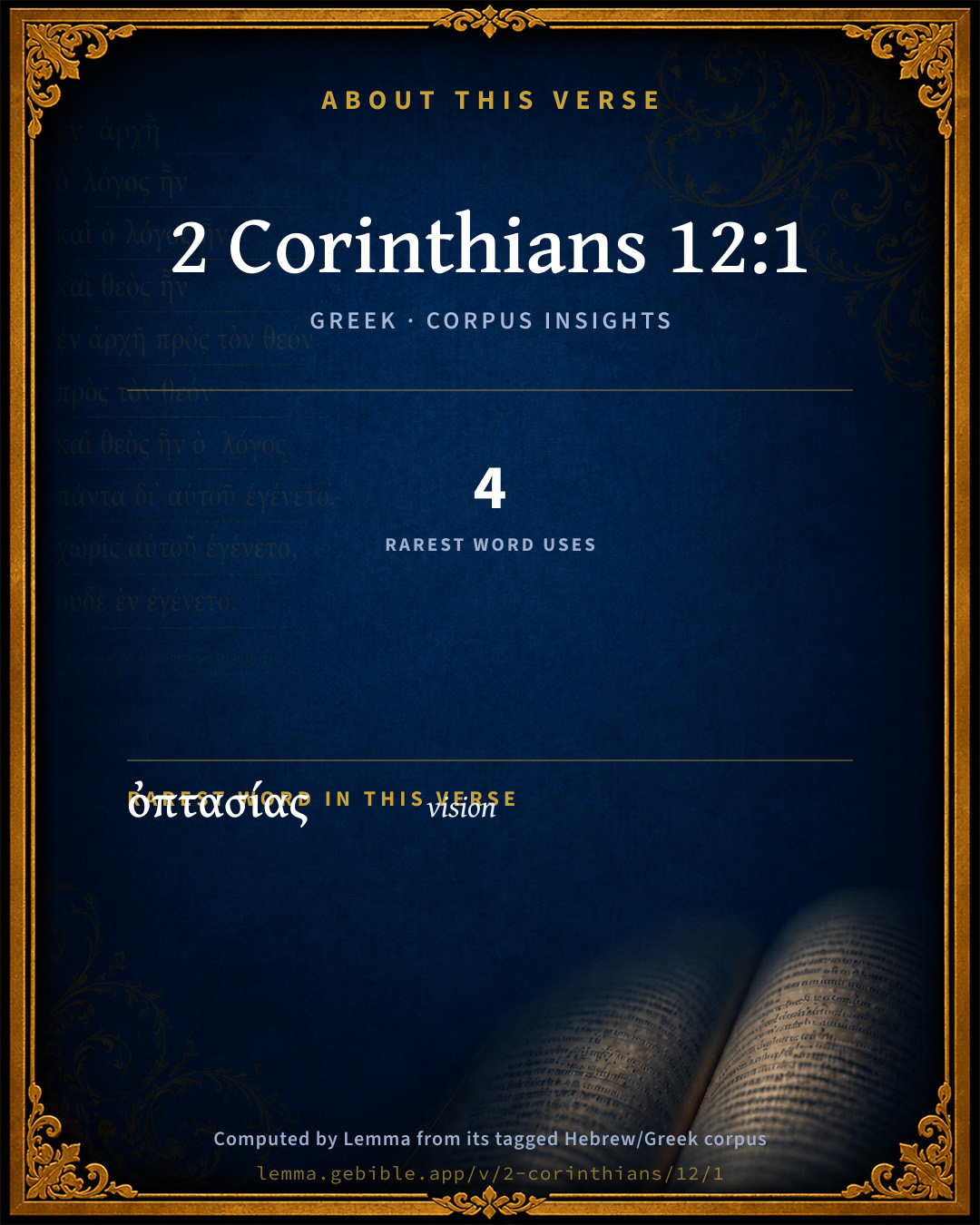
2 Corinthians, in the Pauline Epistles, opens this verse with 12 words (12 distinct Greek lemmas). Its most distinctive word is optasía (“vision”). A historical commentator’s framing appears above. Read the whole chapter for the surrounding context.
Discussion questions
- What does “vision” (optasía) contribute to the verse as a whole?
- Luke 1:22 shares the word «vision» with this verse. How do the two illuminate each other?
- The translations on this page render this verse differently — a whole-verse word diff, not a word-by-word alignment. What might account for the different wordings?
- Reading how Matthew Henry's Commentary and The Cambridge Bible for Schools and Colleges read this verse, where do the two commentators agree and where do they part?
Things to notice
- These translations choose different wording for 9 words in this verse.
- 12 distinct Greek lemmas span 12 words in this verse.
Commentary
Notes on 2 Corinthians 12:1 from classic Christian and Jewish commentators (each source and its license shown beneath its notes). The classic Christian expositions comment on the surrounding passage and are grouped to its opening verse, so a note may address several verses; the Jewish commentaries on the Tanakh (Rashi and others) are per-verse, so they appear only where the commentator wrote on this verse.
Lemma curates 59 commentaries, every one of them public domain or Creative Commons licensed, each selected and text-cleaned for this edition rather than reprinted as found. About our sources →
Matthew Henry's Commentary
Matthew Henry's Commentary on the Whole Bible (1708–1710) — public domain (CC PDM 1.0). Text via the HelloAO Bible API.
The Cambridge Bible for Schools and Colleges
gen. ed. J. J. S. Perowne
The Cambridge Bible for Schools and Colleges (gen. ed. J. J. S. Perowne; Cambridge University Press, 1878–1918) — public domain. Text from a community e-Sword module.
The Biblical Illustrator
Joseph S. Exell
The Biblical Illustrator, edited by Joseph S. Exell (c. 1880s–1900s) — public domain. Text from a community e-Sword module.
Joseph Benson's Commentary
Joseph Benson's Commentary on the Old and New Testaments (1811–1818) — public domain. Text from a community e-Sword module.
Whedon's Commentary on the Bible
Daniel D. Whedon
Daniel D. Whedon (gen. ed.), Commentary on the Old and New Testaments (1874–1909) — public domain. Text from a community e-Sword module.
The Preacher's Complete Homiletical Commentary
Joseph S. Exell (gen. ed.)
The Preacher's Complete Homiletical Commentary (gen. ed. Joseph S. Exell; Funk & Wagnalls, c. 1892) — public domain (pre-1929). A full-Bible homiletical/sermon-outline anthology covering 65 of 66 books (2 John is absent from the source module). Text from a community e-Sword module.
Lange's Commentary on the Holy Scriptures
Lange's Commentary on the Holy Scriptures (Critical, Doctrinal, and Homiletical), ed. John Peter Lange, English translation edited by Philip Schaff (1864–1880) — public domain. Text from a community e-Sword module.
The Annotated Bible
Arno C. Gaebelein
Arno C. Gaebelein, The Annotated Bible (1913–1922) — public domain. Text from a community e-Sword module.
The Sermon Bible
William Robertson Nicoll (ed.)
The Sermon Bible, ed. William Robertson Nicoll (1888–1900) — public domain. Text from a community e-Sword module.
F. W. Grant's Numerical Bible
F. W. Grant, The Numerical Bible (4th ed., 1903) — public domain. Text from a community e-Sword module.
Darby's Synopsis of the New Testament
John Nelson Darby
John Nelson Darby — Synopsis of the Books of the Bible: the New Testament (c. 1857–1862) — public domain. Text from a community e-Sword module.
Tyndale Open Study Notes
Tyndale Open Resources
Tyndale Open Study Notes — © Tyndale Open Resources, licensed CC BY-SA 4.0. Text via the HelloAO Bible API.
Bengel's Gnomon
Johann Albrecht Bengel
Bengel's Gnomon of the New Testament — English translation (T&T Clark, Edinburgh, 1860) — public domain. Text from a community e-Sword module.
Meyer's Critical & Exegetical Commentary
Heinrich August Wilhelm Meyer
Meyer — Critical and Exegetical Commentary on the New Testament — English translation by Peter Christie, edited by Frederick Crombie (T&T Clark, 1880) — public domain. Text from a community e-Sword module.
Expositor's Greek Testament
ed. W. Robertson Nicoll
The Expositor's Greek Testament, edited by W. Robertson Nicoll (1897–1910) — public domain. Text from a community e-Sword module.
Alford’s Greek Testament
Henry Alford
Henry Alford, The Greek Testament (1849–1861) — public domain. Text from a community e-Sword module.
International Critical Commentary
International Critical Commentary — older volumes (1896–1929), various authors — public domain. Text from a community e-Sword module.
Geneva Bible (1599)
Geneva Bible translators
Geneva Bible (1599) marginal notes — public domain. Text via Bolls.life.
Adam Clarke's Commentary
Adam Clarke's Commentary on the Bible (1810–1826) — public domain. Text from a community e-Sword/MySword module.
John Calvin's Commentaries
John Calvin's Commentaries (1540-1563) — public domain. Text from the Calvin Translation Society English edition (1840s-50s) via the Christian Classics Ethereal Library (ccel.org). Calvin's coverage is partial (roughly two-thirds of the Bible); uncommented books and verses are honest gaps, never fabricated. The 19th-century editor's footnotes and remarks are omitted so the notes are faithfully Calvin's own voice.
Ellicott's Commentary for English Readers
A Bible Commentary for English Readers, edited by Charles John Ellicott (1878–1897) — public domain. Text from a community e-Sword module.
John Gill's Exposition
John Gill's Exposition of the Whole Bible (1746–1763) — public domain (CC PDM 1.0). Text via the HelloAO Bible API.
Trapp's Complete Commentary
John Trapp
John Trapp, A Commentary or Exposition upon All the Books of the Old and New Testament (1647–1656) — public domain. Text from a community e-Sword module.
Albert Barnes' Notes on the Bible
Albert Barnes' Notes on the Bible (1834–1885) — public domain. Text from a community e-Sword/MySword module.
Haydock's Catholic Bible Commentary
George Leo Haydock (1774–1849), Haydock's Catholic Family Bible and Commentary, 1859 edition — public domain. Excludes Psalms (Douay-Rheims chapter numbering differs from Protestant) and Deuterocanonical books (Catholic canon only).
Matthew Poole's English Annotations
Matthew Poole's English Annotations on the Holy Bible (1683–1685) — public domain. Text from a community e-Sword/MySword module.
Dummelow's Commentary on the Holy Bible
J. R. Dummelow
J. R. Dummelow, A Commentary on the Holy Bible (Macmillan, 1909) — public domain. Text from a community e-Sword module.
The Pulpit Commentary
The Pulpit Commentary (1880–1919), ed. H.D.M. Spence-Jones & Joseph S. Exell — public domain. Text from a community e-Sword module.
John Wesley's Explanatory Notes
John Wesley, Explanatory Notes Upon the Whole Bible (1754–1765) — public domain. Text via the GEBible commentary corpus.
Kretzmann's Popular Commentary
Paul E. Kretzmann
Paul E. Kretzmann, Popular Commentary of the Bible (1921–1924) — public domain. Text from a community e-Sword module.
Burkitt's Expository Notes on the New Testament
William Burkitt
William Burkitt's Expository Notes on the New Testament (1700–1703) — public domain. Text from a community e-Sword module.
Godbey's Commentary on the New Testament
William B. Godbey
William B. Godbey, Commentary on the New Testament (1896–1900) — public domain. Text from a community e-Sword module.
McGarvey & Pendleton's Commentaries
J. W. McGarvey
J. W. McGarvey (with Philip Y. Pendleton), Commentaries on the New Testament (The Fourfold Gospel, 1914; Acts; and the epistles) — public domain. Text from a community e-Sword/MySword module.
The People's New Testament
B. W. Johnson
B. W. Johnson's The People's New Testament with Notes (1889–1891) — public domain. Electronic text from the Christian Classics Ethereal Library (CCEL) ThML edition.
unfoldingWord translationNotes
Door43 World Missions Community
unfoldingWord translationNotes — © Distant Shores Media and the Door43 World Missions Community, licensed CC BY-SA 4.0. Source: git.door43.org/Door43/en_tn.
Cambridge Greek Testament for Schools and Colleges
Cambridge Greek Testament for Schools and Colleges (Cambridge University Press, 1896; 21 vols, various authors incl. Carr, Maclear, Plummer, Farrar, Lumby, Moule, M. R. James, Simcox) — public domain. Text from a community e-Sword module.
Vincent's Word Studies in the New Testament
Marvin R. Vincent
Marvin R. Vincent, Word Studies in the New Testament (1887–1900) — public domain. Text from a community e-Sword/MySword module.