
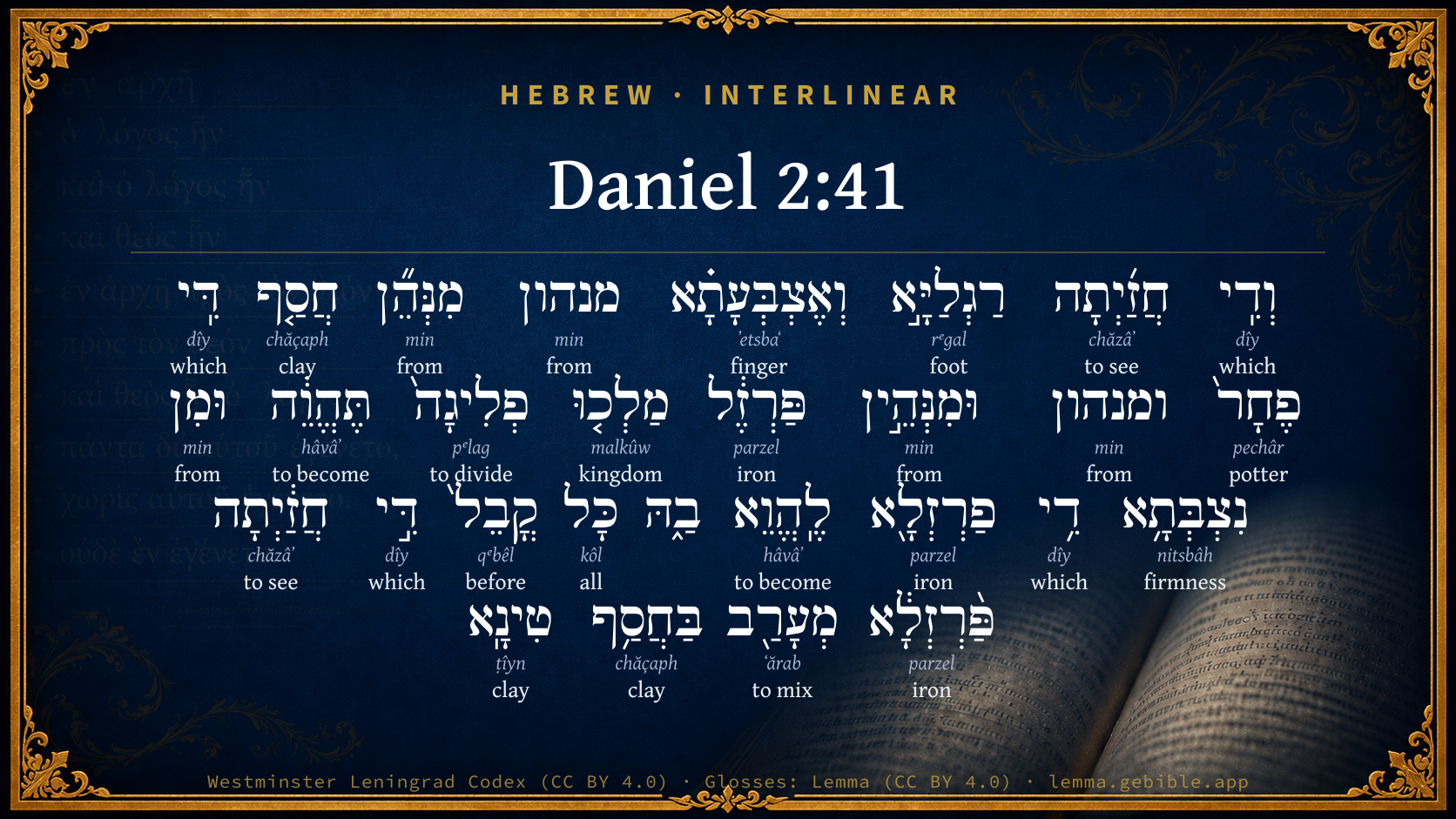
Daniel 2:41

Hebrew (Westminster Leningrad Codex) Daniel 2:41 appears in the Hebrew Old Testament. The text above is from the Westminster Leningrad Codex. Each word links to its Strong’s number, a concise gloss, and parsing drawn from the Open Scriptures Hebrew Bible morphology. Click any word for its full Brown-Driver-Briggs (BDB) entry.
Download image
Cite this verse

Daniel 2:41 (World English Bible). Public Domain. Lemma interlinear Bible study tool, https://lemma.gebible.app/v/daniel/2/41.

Show BibTeX & RIS
BibTeX
RIS
English Translation
Whereas you saw the feet and toes, part of potters' clay, and part of iron, it shall be a divided kingdom; but there shall be in it of the strength of the iron, because you saw the iron mixed with miry clay.
World English Bible · Public Domain
Highlights
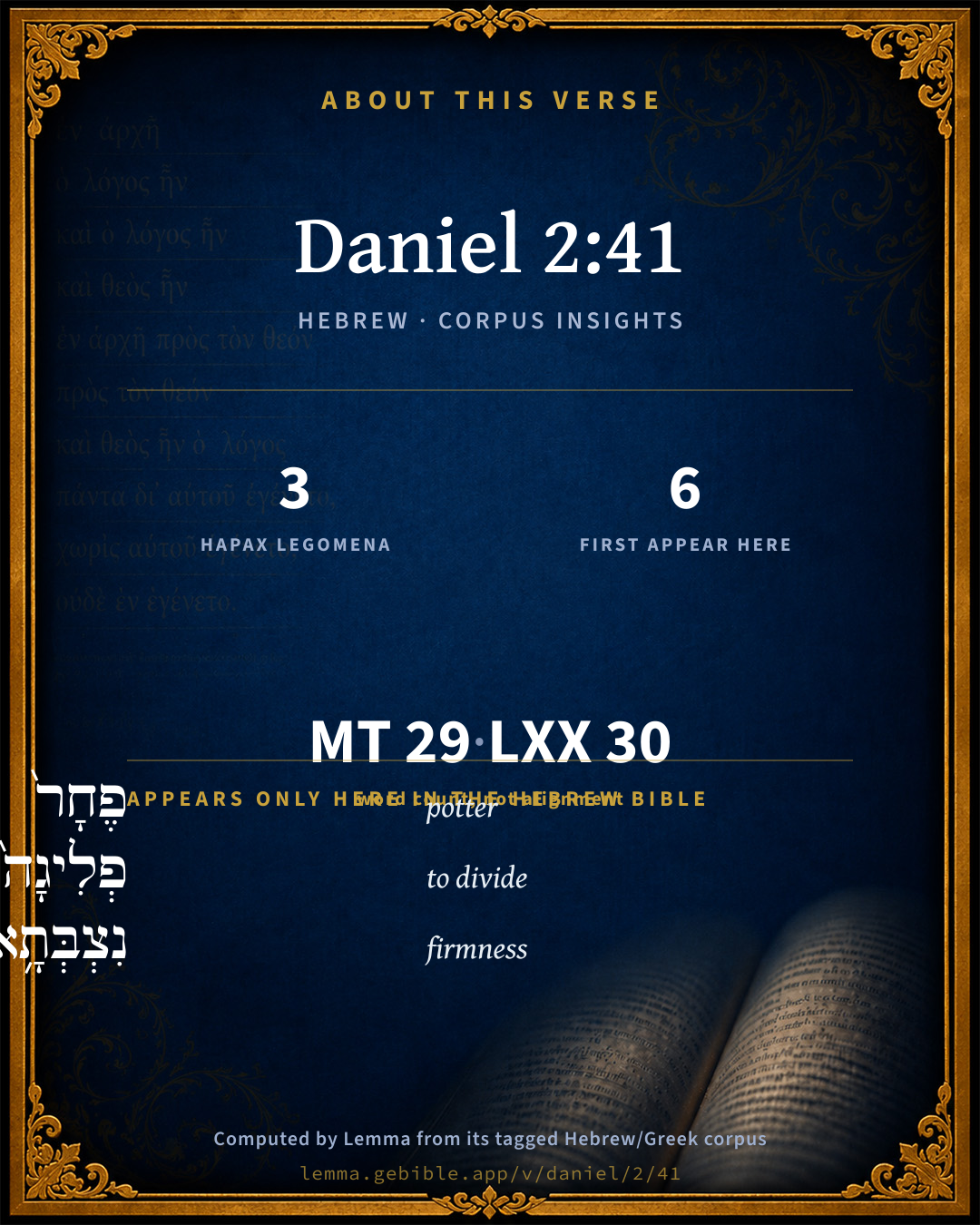
  • 3 hapax legomena — only here in the Hebrew Bible
  • 6 first appearances in the Hebrew Bible
Full analysis ↓
Download a study sheet

One document with this verse’s original text, its word-by-word gloss line, the meaning frame, cross-references with their text, attributed commentary, and full source and license credits — printable, and it pastes into notes with its structure intact.

This verse Autodidact and up

Study sheet (.html) Plain text (.txt)

A passage Seminary Student

Up to 50 verses in one chapter. A passage sheet keeps up to 6 commentary sources and 12 cross-references per verse, in the order this page ranks them, and says so on the sheet whenever that leaves anything out. Ask for a single verse and you get the Autodidact verse sheet above.

Everything on this page stays free to read, with no account — the sheet is a download of what is already on screen, not access to it.

Want to remove ads? Support Godless Engineer
Compare translations 3

The same verse in 3 English versions, stacked beneath the original-language interlinear above. Click any original word for its lexicon entry.

Each is an independent rendering of the whole verse — the interlinear is not word-aligned to these translations.

Highlighted words mark where these versions differ — a whole-verse word diff, not a word-by-word alignment.

  • World English Bible Public Domain
    Whereas you saw the feet and toes, part of potters' clay, and part of iron, it shall be a divided kingdom; but there shall be in it of the strength of the iron, because you saw the iron mixed with miry clay.
  • King James Version Public Domain
    And whereas thou sawest the feet and toes, part of potters' clay, and part of iron, the kingdom shall be divided; but there shall be in it of the strength of the iron, forasmuch as thou sawest the iron mixed with miry clay.
  • unfoldingWord Literal Text CC BY-SA 4.0
    And as you saw the feet and toes, partly of the clay of a potter and partly of iron, it will be a divided kingdom; some of the firmness of iron will be in it, just as you saw iron mixed with the soft clay.

unfoldingWord Literal Text — © unfoldingWord, licensed CC BY-SA 4.0. Word-aligned USFM3 via Door43 (git.door43.org/unfoldingWord/en_ult).

Versions to compare (up to 4)

3 of 4 selected

Show all 18 translations

Every available English version of this verse, each an independent rendering of the whole verse.

  • World English Bible Public Domain
    Whereas you saw the feet and toes, part of potters' clay, and part of iron, it shall be a divided kingdom; but there shall be in it of the strength of the iron, because you saw the iron mixed with miry clay.
  • Berean Standard Bible Public Domain
    And just as you saw that the feet and toes were made partly of fired clay and partly of iron, so this will be a divided kingdom, yet some of the strength of iron will be in it—just as you saw the iron mixed with clay.
  • Majority Standard Bible Public Domain
    And just as you saw that the feet and toes were made partly of fired clay and partly of iron, so this will be a divided kingdom, yet some of the strength of iron will be in it—just as you saw the iron mixed with clay.
  • King James Version Public Domain
    And whereas thou sawest the feet and toes, part of potters' clay, and part of iron, the kingdom shall be divided; but there shall be in it of the strength of the iron, forasmuch as thou sawest the iron mixed with miry clay.
  • American Standard Version (1901) Public Domain
    And whereas thou sawest the feet and toes, part of potters' clay, and part of iron, it shall be a divided kingdom; but there shall be in it of the strength of the iron, forasmuch as thou sawest the iron mixed with miry clay.
  • Revised Version (1885) Public Domain
    And whereas thou sawest the feet and toes, part of potters’ clay, and part of iron, it shall be a divided kingdom; but there shall be in it of the strength of the iron, forasmuch as thou sawest the iron mixed with miry clay.
  • Geneva Bible (1599) Public Domain
    Where as thou sawest the feete and toes, parte of potters clay, and part of yron: the kingdome shalbe deuided, but there shalbe in it of the strength of the yron, as thou sawest the yron mixt with the clay, and earth.
  • Douay-Rheims (1899) Public Domain
    Arid whereas thou sawest the feet, and the toes, part of potter's clay, and part of iron: the kingdom shall be divided, but yet it shall take its origin from the iron, according as thou sawest the iron mixed with the miry clay.
  • Young's Literal Translation Public Domain
    As to that which thou hast seen: the feet and toes, part of them potter's clay, and part of them iron, the kingdom is divided: and some of the standing of the iron `is' to be in it, because that thou hast seen the iron mixed with miry clay.
  • Literal Standard Version CC BY-SA 4.0
    As for that which you have seen: the feet and toes, part of them potter’s clay, and part of them iron, the kingdom is divided: and some of the standing of the iron [is] to be in it, because that you have seen the iron mixed with miry clay.
  • Unlocked Literal Bible CC BY-SA 4.0
    Just as you saw, the feet and toes were partly made of baked clay and partly made of iron, so it will be a divided kingdom; some of the strength of iron will be in it, just as you saw iron mixed with the soft clay.
  • unfoldingWord Literal Text CC BY-SA 4.0
    And as you saw the feet and toes, partly of the clay of a potter and partly of iron, it will be a divided kingdom; some of the firmness of iron will be in it, just as you saw iron mixed with the soft clay.
  • Darby Bible Public Domain
    And whereas thou sawest the feet and toes, part of potter's clay, and part of iron, the kingdom shall be divided; but there shall be in it of the strength of the iron, forasmuch as thou sawest the iron mixed with miry clay.
  • World Messianic Bible Public Domain
    Whereas you saw the feet and toes, part of potters’ clay and part of iron, it will be a divided kingdom; but there will be in it of the strength of the iron, because you saw the iron mixed with miry clay.
  • Webster's Bible Public Domain
    And whereas thou sawest the feet and toes, part of potter's clay, and part of iron, the kingdom shall be divided; but there shall be in it of the strength of the iron, forasmuch as thou sawest the iron mixed with the miry clay.
  • Free Bible Version CC BY-SA 4.0
    You saw the feet and toes made from iron and baked clay, and this indicates it will be a divided kingdom. It will have some of the strength of iron but mixed with clay.
  • Bible in Basic English Public Domain
    And as you saw the feet and toes, part of potter's work and part of iron, there will be a division in the kingdom; but there will be some of the strength of iron in it, because you saw the iron mixed with the potter's earth.
  • JPS Tanakh (1917) Public Domain
    And whereas thou sawest the feet and toes, part of potters' clay, and part of iron, it shall be a divided kingdom; but there shall be in it of the firmness of the iron, forasmuch as thou sawest the iron mixed with miry clay.

Literal Standard Version (2020), Covenant Press — licensed CC BY-SA 4.0. Text via the HelloAO Bible API (eBible.org). Unlocked Literal Bible (unfoldingWord) — licensed CC BY-SA 4.0. Text via the HelloAO Bible API (eBible.org). unfoldingWord Literal Text — © unfoldingWord, licensed CC BY-SA 4.0. Word-aligned USFM3 via Door43 (git.door43.org/unfoldingWord/en_ult). Free Bible Version, Dr. Jonathan Gallagher — licensed CC BY-SA 4.0. Text via the HelloAO Bible API (eBible.org).

Word by word

More ways to search: Search by grammar → Find every occurrence → Compare this word →

Practice this passage: Drill this verse → Learn its vocabulary →

פֶחָר֙
pechâr
H6353
“potter”
Adjective, N, Common
Part of Speech
Adjective
Gender
Common
Full BDB Definition

Origin: from an unused root probably meaning to fashion

TWOT: 2937

potter
  1. וְדִֽי dîy H1768 “and · which” Adjective, C + Conjunction
  2. חֲזַ֜יְתָה chăzâʼ H2370 “to see” Adjective, V, Plural
  3. רַגְלַיָּ֣א rᵉgal H7271 “feet · the” Adjective, N, Common + Particle, Definite Article
  4. וְאֶצְבְּעָתָ֗א ʼetsbaʻ H677 “and · fingers · the” Adjective, C + Noun, Common, Feminine, Plural, Determined + Particle, Definite Article
  5. מנהון min H4481 “from · them” Adjective, R + Suffix, Personal, 3rd Person, Masculine, Plural
  6. מִנְּהֵ֞ן min H4481 “from · them” Adjective, R + Suffix, Personal, 3rd Person, Feminine, Plural
  7. חֲסַ֤ף chăçaph H2635 “clay” Adjective, N, Common
  8. דִּֽי dîy H1768 “which” Adjective, T
  9. ומנהון min H4481 “and · from · them” Adjective, C + Preposition + Suffix, Personal, 3rd Person, Masculine, Plural
  10. וּמִנְּהֵ֣ין min H4481 “and · from · them” Adjective, C + Preposition + Suffix, Personal, 3rd Person, Feminine, Plural
  11. פַּרְזֶ֔ל parzel H6523 “iron” Adjective, N, Common
  12. מַלְכ֤וּ malkûw H4437 “kingdom” Adjective, N, Common
  13. פְלִיגָה֙ pᵉlag H6386 “divided” Adjective, V, Singular
  14. תֶּהֱוֵ֔ה hâvâʼ H1934 “to become” Adjective, V
  15. וּמִן min H4481 “and · from” Adjective, C + Preposition
  16. נִצְבְּתָ֥א nitsbâh H5326 “firmness · the” Adjective, N, Common + Particle, Definite Article
  17. דִ֥י dîy H1768 “which” Adjective, T
  18. פַרְזְלָ֖א parzel H6523 “iron · the” Adjective, N, Common + Particle, Definite Article
  19. לֶֽהֱוֵא hâvâʼ H1934 “to become” Adjective, V
  20. כָּל kôl H3606 “all” Adjective, C + Conjunction
  21. קֳבֵל֙ qᵉbêl H6903 “before” Adjective, C
  22. דִּ֣י dîy H1768 “which” Adjective, C
  23. חֲזַ֔יְתָה chăzâʼ H2370 “to see” Adjective, V, Plural
  24. פַּ֨רְזְלָ֔א parzel H6523 “iron · the” Adjective, N, Common + Particle, Definite Article
  25. מְעָרַ֖ב ʻărab H6151 “mixed” Adjective, V, Singular
  26. בַּחֲסַ֥ף chăçaph H2635 “in/at · clay of” Adjective, R + Noun, Common, Masculine, Singular, Construct
  27. טִינָֽא ṭîyn H2917 “clay · the” Adjective, N, Common + Particle, Definite Article

About this verse

These counts appear in no published source. They are computed here, from the morphology-tagged text and Lemma’s own curated glosses. What Lemma adds →

29
words
16
distinct lemmas
Prophets
section

Notable vocabulary

3 hapax legomena — words that appear only here in the entire Hebrew Bible:

  • פֶחָר֙ potter H6353
  • פְלִיגָה֙ to divide H6386
  • נִצְבְּתָ֥א firmness H5326

First appearance in Scripture

These words make their first canonical appearance in the Hebrew Bible here:

  • וְאֶצְבְּעָתָ֗א finger H677
  • פֶחָר֙ potter H6353
  • פְלִיגָה֙ to divide H6386
  • נִצְבְּתָ֥א firmness H5326
  • מְעָרַ֖ב to mix H6151
  • טִינָֽא clay H2917

Shared distinctive vocabulary

טִינָֽא clay H2917 occurs in 2 verses of the Hebrew Bible. Also found in:

Grammatical profile

  • 1 noun
  • 17 adjectives
  • 3 prepositions
  • 2 conjunctions
  • 6 particles

Repetition

Words recur within this verse — often emphatic in Hebrew:

  • פַּרְזֶ֔ל iron H6523 ×3
  • חֲזַ֜יְתָה to see H2370 ×2
  • חֲסַ֤ף clay H2635 ×2
  • תֶּהֱוֵ֔ה to become H1934 ×2
  • מנהון from H4481 ×5
  • וְדִֽי which H1768 ×4

Hebrew & Septuagint length

In English translation the verse runs 42 words from the Hebrew and 40 from the Septuagint (LXX English) — closely comparable.

A rough comparison of the two English renderings, which tokenize alike — not a word-level alignment.

Word counts can differ between the Hebrew and the Greek without any difference in meaning — e.g. the Hebrew direct-object marker אֵת has no separate Greek word, and Greek often adds the article ὁ.

In the original languages it is 29 Hebrew tokens and 30 Greek tokens — but the two are counted differently (Hebrew bundles its prefixes and suffixes into one token; the Greek is in lemma form), so that isn’t a like-for-like length.

Cross-references

6

Topical passages linked to Daniel 2:41 in the Treasury of Scripture Knowledge — connected by theme and wording, ordered by reader-vote popularity; previews shown in the World English Bible.

  • Revelation 17:12 The ten horns that you saw are ten kings who have received no kingdom as yet, but they receive authority as kings, with the beast, for one hour.
  • Daniel 2:33–35 its legs of iron, its feet part of iron, and part of clay.
  • Daniel 7:7 After this I saw in the night-visions, and, behold, a fourth animal, awesome and powerful, and strong exceedingly; and it had great iron teeth; it devoured and broke in pieces, and stamped the residue with its feet: and it was diverse from all the animals that were before it; and it had ten horns.
  • Daniel 7:24 As for the ten horns, out of this kingdom shall ten kings arise: and another shall arise after them; and he shall be diverse from the former, and he shall put down three kings.
  • Revelation 12:3 Another sign was seen in heaven. Behold, a great red dragon, having seven heads and ten horns, and on his heads seven crowns.
  • Revelation 13:1 Then I stood on the sand of the sea. I saw a beast coming up out of the sea, having ten horns and seven heads. On his horns were ten crowns, and on his heads, blasphemous names.

Cross-references courtesy of OpenBible.info (CC BY 4.0).

Hebrew and Greek witnesses Masoretic Hebrew ↔ Greek Septuagint

The same verse in the two great witnesses to the Old Testament, shown verse-for-verse.

These are two independent witnesses, not word-aligned to each other, and the Septuagint is shown in lemma (dictionary) form.

Hebrew Daniel 2:41 Masoretic · Westminster Leningrad Codex

וְדִֽי חֲזַ֜יְתָה רַגְלַיָּ֣א וְאֶצְבְּעָתָ֗א מנהון מִנְּהֵ֞ן חֲסַ֤ף דִּֽי פֶחָר֙ ומנהון וּמִנְּהֵ֣ין פַּרְזֶ֔ל מַלְכ֤וּ פְלִיגָה֙ תֶּהֱוֵ֔ה וּמִן נִצְבְּתָ֥א דִ֥י פַרְזְלָ֖א לֶֽהֱוֵא בַ֑הּ כָּל קֳבֵל֙ דִּ֣י חֲזַ֔יְתָה פַּ֨רְזְלָ֔א מְעָרַ֖ב בַּחֲסַ֥ף טִינָֽא

Whereas you saw the feet and toes, part of potters' clay, and part of iron, it shall be a divided kingdom; but there shall be in it of the strength of the iron, because you saw the iron mixed with miry clay.

World English Bible · Public Domain

Greek LXX Daniel 2:41 Septuagint · lemma form

καί ὡς ὁράω ὁ πούς αὐτός μέρος μέν τις ὄστρακον κεραμικός μέρος δέ τις σίδηρος βασιλεία ἄλλος διμερής εἰμί ἐν αὐτός καθάπερ ὁράω ὁ σίδηρος ἀναμίγνυμι ἅμα ὁ πήλινος ὄστρακον

And whereas you saw the feet and the toes, part of earthenware and part of iron, the kingdom shall be divided; yet there shall be in it of the strength of iron, as you saw the iron mixed with earthenware.

LXX2012 (modern English Septuagint) · Public Domain

On this verse, The Pulpit Commentary discusses the Septuagint’s reading. Read the note in Commentary ↓

Hebrew: Westminster Leningrad Codex (CC BY 4.0). Greek: Septuagint (public domain); English from LXX2012 (modern English Septuagint) (Public Domain). How the Septuagint differs from the Hebrew →

Commentary

Notes on Daniel 2:41 from classic Christian and Jewish commentators (each source and its license shown beneath its notes). The classic Christian expositions comment on the surrounding passage and are grouped to its opening verse, so a note may address several verses; the Jewish commentaries on the Tanakh (Rashi and others) are per-verse, so they appear only where the commentator wrote on this verse.

Lemma curates 59 commentaries, every one of them public domain or Creative Commons licensed, each selected and text-cleaned for this edition rather than reprinted as found. About our sources →

Trapp's Complete Commentary

John Trapp

Dan 2:41 And whereas thou sawest the feet and toes, part of potters’ clay, and part of iron, the kingdom shall be divided; but there shall be in it of the strength of the iron, forasmuch as thou sawest the iron mixed with miry clay.

Ver. 41. And whereas thou sawest the feet and toes, part of potters’ clay, &c.] These "feet and toes" are the Roman empire, yet continuing, but weaker than it was before, while it consisted of "legs of iron," being now but of "feet and toes." And this empire is divided as the feet and toes are. One part is the kingdom of the Pope in the West (he whom we call the emperor hath now little or nothing to do with the empire, which was of Rome); the other part is the Turk in the East, before whom three of the horns of the empire are rooted out. See Dan 7:8.

John Trapp, A Commentary or Exposition upon All the Books of the Old and New Testament (1647–1656) — public domain. Text from a community e-Sword module.

Tyndale Open Study Notes

Tyndale Open Resources

2:41-42 as weak as clay: Feet are crucial to stability; the feet were brittle and illustrate how precarious the whole image—that is, earthly kingdoms and their power—would be.

Tyndale Open Study Notes — © Tyndale Open Resources, licensed CC BY-SA 4.0. Text via the HelloAO Bible API.

Ibn Ezra

Rabbi Abraham ibn Ezra

[Daniel 2:41] v'di chazaita... chasaf di pachar (וְדִי חֲזַיְתָה... חֲסַף דִּי פֶחָר - And whereas you saw... potter's clay): [Means] an earthenware vessel of the potter (k'li cheres ha-yotzer - כְּלִי חֶרֶס הַיּוֹצֵר). And behold, because of this [mixture with weak clay], it explains: “it will be a divided kingdom” (malchu feliga - מַלְכוּ פְלִיגָא).

[Daniel 2:41] Nitzbeta (נִצְבְּתָא - stability): [Means] like strength/power (koach - כֹּחַ)....

[Daniel 2:41] meʿarab (מְעָרַב - mixed): [This Aramaic word for "mixed"] is like [the Hebrew cognate in]: “And they mingled (vayitʿarvu - וַיִּתְעָרְבוּ) among the nations” [Psalms 106:35].

Ibn Ezra on the Tanakh — English translations: “Sefaria Community Translation” (CC0 1.0 (public-domain dedication)); “Yalkut, Sifsei Chachomim Chumash, Metsudah Publications, 2009” (CC BY 4.0); and “Commentary of Ibn Ezra on Isaiah - trans. by M. Friedlander, 1873” (public domain). Text via Sefaria.

Geneva Bible (1599)

Geneva Bible translators

They shall have civil wars, and continual discords among themselves.

Geneva Bible (1599) marginal notes — public domain. Text via Bolls.life.

Jamieson, Fausset & Brown

Robert Jamieson, A. R. Fausset & David Brown

feet . . . toes . . . part . . . clay . . . iron--explained presently, "the kingdom shall be partly strong, partly broken" (rather, "brittle," as earthenware); and Dan 2:43, "they shall mingle . . . with the seed of men," that is, there will be power (in its deteriorated form, iron) mixed up with that which is wholly of man, and therefore brittle; power in the hands of the people having no internal stability, though something is left of the strength of the iron [TREGELLES]. NEWTON, who understands the Roman empire to be parted into the ten kingdoms already (whereas TREGELLES makes them future), explains the "clay" mixture as the blending of barbarous nations with Rome by intermarriages and alliances, in which there was no stable amalgamation, though the ten kingdoms retained much of Rome's strength. The "mingling with the seed of men" (Dan 2:44) seems to refer to Gen 6:2, where the marriages of the seed of godly Seth with the daughters of ungodly Cain are described in similar words. The reference, therefore, seems to be to the blending of the Christianized Roman empire with the pagan nations, a deterioration being the result. Efforts have been often made to reunite the parts into one great empire, as by Charlemagne and Napoleon, but in vain. Christ alone shall effect that.

Jamieson, Fausset & Brown — Commentary Critical and Explanatory on the Whole Bible (1871) — public domain (CC PDM 1.0). Text via the HelloAO Bible API.

Ellicott's Commentary for English Readers

(41) Shall be divided.—The meaning seems to be, “notwithstanding that there will be inward divisions in this last empire, as is signified by the divisions, first into two legs, then into two feet, and lastly into ten toes, yet the outward character of it will be the strength of iron.”

A Bible Commentary for English Readers, edited by Charles John Ellicott (1878–1897) — public domain. Text from a community e-Sword module.

The Cambridge Bible for Schools and Colleges

gen. ed. J. J. S. Perowne

41. The kingdom which began by being of iron, ended in being partly of iron and partly of clay, symbolizing its division, one part being stronger than the other.

it shall be a divided kingdom] alluding to the manner in which Alexander’s empire, immediately after his death (b.c. 332) was partitioned between his generals, the two who, in the end, divided it substantially between them being Seleucus and Ptolemy Lagi, who founded, respectively, dynasties which continued long in power at Antioch in Syria and in Egypt (see fuller particulars on Dan_9:5 ff). The stronger kingdom, represented by the iron, is that of the Seleucidae.

strength] an unusual word, more exactly firmness.

The Cambridge Bible for Schools and Colleges (gen. ed. J. J. S. Perowne; Cambridge University Press, 1878–1918) — public domain. Text from a community e-Sword module.

John Gill's Exposition

And whereas thou sawest the feet and toes, part of potter's clay, and part of iron,.... That is, some of the toes of the feet were of iron, and others of them of clay: these toes, which are ten, as the toes of men are, design the ten kings or kingdoms, into which the western Roman empire was divided, by the coming in of the Goths, and Hunns, and Vandals, into it; and are the same with the ten horns of the beast, and the ten kings which gave their kingdoms to it, Rev 13:1; see Gill on Rev 17:12, Rev 17:13, Rev 17:17, Dan 7:24, some of which were strong like iron, and continued long; others were like clay, and of a less duration:

the kingdom shall be divided; which some understand of the division of it into the eastern and western empires; but rather it means the division of the latter into the ten kingdoms, set up in it by the barbarous nations. Abarbinel and Jacchiades interpret it of the Roman empire being divided into Mahometans and Christians, very wrongly:

but there shall be in it of the strength the iron, forasmuch as thou sawest the iron mixed with miry clay; notwithstanding this irruption and inundation of the northern nations into the empire; yet still retained, something of the strength and power of the old Romans, which were mingled among those barbarous nations, comparable to miry clay.

John Gill's Exposition of the Whole Bible (1746–1763) — public domain (CC PDM 1.0). Text via the HelloAO Bible API.

Albert Barnes' Notes on the Bible

And whereas thou sawest the feet and toes, part of potters’ clay and part of iron - Dan 2:33. The Chaldee is, “of them clay of the potter, and of them iron;” that is, part was composed of one material and part of the other. The sense is, not that the feet were composed entirely of one, and the toes of the other, but that they were intermingled. There was no homogeneousness of material; nothing in one that would coalesce with the other, or that could be permanently united to it, as two metals might be fused or welded together and form one solid compound. Iron and clay cannot be welded; and the idea here clearly is, that in the empire here referred to there would be two main elements which could never be made to blend.

The kingdom shall be divided - That is, divided as the iron and clay were in the image. It does not necessarily mean that there would be an open rupture - an actual separation into two parts; but that there would be “such a diversity in the internal constitution” that, while there would be the element of great power, there would be also an element of weakness; there would be something which could never be blended with the element of strength, so as to produce one harmonious and homogeneous whole.

But there shall be in it of the strength of the iron, forasmuch as thou sawest the iron mixed with miry clay - The principal idea in this part of the description is, that there would be great “power;” that whatever elements of weakness there might be, yet the “power” of the empire would be apparent. No one can fail to perceive how this applies to the Roman empire; a mighty power which, through all its long history, was distinguished for the vigour with which it carried forward its plans, and pressed on to universal dominion. As to the element of “weakness” symbolized too by the clay, it may not be possible to determine, with absolute certainty, what is referred to. Any internal source of weakness; anything in the constitution of the state, whether originally existing and constituting heterogeneous material, or whether springing up in the empire itself, or whether arising from the intermingling of foreign elements that never amalgamated themselves with the state, any one of these suppositions would meet all that is fairly implied in this language.

From Dan 2:43, “they shall mingle themselves with the seed of men,” it would seem, however, that the reference is to some “foreign” admixture - like the intermingling of nations of other languages, laws, and customs, which were never truly amalgamated with the original materials, and which constantly tended to weaken and divide the kingdom. It is to be remarked, in the exposition of the passage, that in the previous three kingdoms there was comparative homogeneousness. In the fourth kingdom, there was to be something of a peculiar character in this respect by which it should be distinguished from the others. As a matter of fact, the other three kingdoms were comparatively homogeneous in their character. The predominant feature was “Oriental;” and though there were different nations and people intermingled in the Babylonian, the Medo-Persian, and the Macedonian kingdoms, yet there was the same general prevailing character in each; there was not such an intermingling of foreign nations as to produce disturbing elements, or to mar the symmetry and strength of the whole. It was not thus with Rome. In that empire there was the intermingling of all nations and tongues, and though the essential element of the empire remained always - “the Roman” - yet there was an intermingling of other influences under the same general government, which could be appropriately compared with clay united with iron, and which ultimately contributed to its fall (see the notes at Dan 2:43).

Albert Barnes' Notes on the Bible (1834–1885) — public domain. Text from a community e-Sword/MySword module.

Haydock's Catholic Bible Commentary

Clay. The iron was in a rude state, mixed with earth. The Roman power was at last partly exercised by consuls and partly by emperors. (Menochius) --- Florus (l.) compares it to the four states of a man, infancy, childhood, youth, and old age. Its youth may be dated from the conquest of all Italy to Tiberius; afterwards it fell to decay, while the eternal kingdom of Christ was forming. (ver. 44.)

George Leo Haydock (1774–1849), Haydock's Catholic Family Bible and Commentary, 1859 edition — public domain. Excludes Psalms (Douay-Rheims chapter numbering differs from Protestant) and Deuterocanonical books (Catholic canon only).

Matthew Poole's English Annotations

The kingdom shall be divided; partly strong and partly weak. The Roman kingdom was divided, partly, because tyranny followed aristocracy, and the government made up of both; partly, in their civil wars, when two competitors strove each for dominion, the common people against the senate, Sylla against Marius, Caesar against Pompey; also, partly, when conquered provinces and kingdoms cast off the Roman yoke, and set up kings of their own, and so the empire was divided into ten kingdoms or toes. The vision attributes two legs to the image, and to the fourth monarchy, because the Romans had sometimes duumvirs, two consuls, two emperors, one in the east, the other in the west.

Matthew Poole's English Annotations on the Holy Bible (1683–1685) — public domain. Text from a community e-Sword/MySword module.

Whedon's Commentary on the Bible

Daniel D. Whedon

41. Internal divisions and consequent weakness grew more and more pronounced during every generation which followed the breaking up of Alexander’s empire. Perhaps the iron may symbolize the Seleucidae and the clay the Ptolemies.

Daniel D. Whedon (gen. ed.), Commentary on the Old and New Testaments (1874–1909) — public domain. Text from a community e-Sword module.

The Pulpit Commentary

Vers. 41-43. And whereas thou sawest the feet and toes, part of potter"s clay, and part of iron, the kingdom shall be divided: but there shall be in it of the strength of the iron, forasmuch as thou sawest the iron mixed with miry clay. And as the toes of the feet were part of iron, and part of clay, so the kingdom shall he partly strong, and partly broken. And whereas thou sawest iron mixed with miry clay, they shall mingle themselves with the seed of men: but they shall not cleave one to another, even as iron is not mixed with clay. The version of the Septuagint is worthy of notice here, "And as thou sawest (hast seen, eJwrakav) its feet and toes were partly of potter"s clay, and partly of iron. Another kingdom shall be divided in itself, as thou sawest the iron mingled with the miry clay, and the toes of the feet were partly of iron and partly of clay, part of the kingdom shall be strong, and part shall be broken. And as thou sawest the iron mingled with the miry clay, there shall be mixings (summigeiv) to the generation (genesin) of mankind (ajnqrwpwn), but they shall not agree nor be well affected one to another, just as (wsper) iron cannot be compounded with clay." It may be observed here that a clause is omitted from ver. 41, "but there shall be in it of the strength of the iron." In the forty-third verse the difference is due to rz as infinitive of the verb "to sow," that is to say, the translator must have read rzml instead of yyzb whl. The addition of allh has had its origin in a false idea that the feet and toes of the image represented a new world-dominion.

Theodotion renders, "Because (oti) thou sawest the feet and the toes part of potter"s clay, and part of iron, a kingdom shall be divided, and there will be in it from the iron root in like manner as thou sawest the iron mingled with the potter"s clay. And the toes of the feet were partly iron, and partly clay, part of the kingdom shall be strong, and part of it shall be broken (being broken, suntribomenon); because thou sawest the iron mingled with the potter"s clay, there shall be mixings with the seed of men: but they shall not adhere one to another, even as iron is not mingled with clay." Neither in Syriac nor Chaldee has netzab the meaning "to be firm;" nitzebthah means, in later Aramaic, "a seedling." Originally, however, it meant "to confirm," "to set up," "to strengthen," as the Hebrew bxy; (yatzab) and bxn; (natzab). This meaning had been lost sight of by the time Theodotion wrote, or possibly before the translation was made which he revised. The Peshitta does not call for remark, save that it agrees with Theodotion in translating atbxn (nitzeba-thah) "root." Jerome renders it plantarium. This new development of the image is to be regarded, not as another empire, but as the outgrowth of the fourth kingdom. This is clear from the fact that there is no new substance introduced of which the feet and toes are wholly made up, but the iron is mingled with a new and inferior substance, potter"s clay. The numerical mark "ten," which is to be regarded as the peculiar distinctive sign of the fourth empire, is in the toes.

This last empire, whatever it may be taken to be, is one that splits itself up into approximately ten parts or sub-kingdoms. Further, there shall be a foreign element introduced which shall not harmonize with the original material. Professor Bevan is certain that the reference is "to the marriages of the Ptolemies with the Se-leucidae." Notwithstanding that Professor Bevan states this view as if it could not be doubted, it is evidently false. Both the Lagids and the Seleucids were Macedonians, and there was no natural incompatibility. If marriage is intended here, and if the fourth monarchy were the Hellenic, more sensible would have been the suggestion that it referred to the Hellenizing of South-Western Asia the miscegenation of the peoples inaugurated by Alexander the Great, only it did not proceed very far. Further, it did not signalize the end of the Greek rule, but really the beginning of it. We admit certainly that the LXX translates in a way that suggests the marriage of a superior with an inferior race. But there is no reference in reality to marriage, but to the mingling of two distinct culture-elements, the infusion of barbarous races into the midst of a civilized; and the barbarians taking on some of the outward forms of civilization would represent better the thing indicated. But to take this as referring to the marriage of the Seleucids and Lagids is certainly as wrong as wrong can be, although it is held by Moses Stuart, Hitzig, Ewald, as well as Professor Bevan. Not one of them shows which, the Seleucid or the Lagid, is "the clay," "the seed of men," and which the governing power or race that mingles with them. Yet the inferiority of the clay is an essential element in the symbolism. Hoffmann"s idea, that there is reference to the marriage of the Emperor Otto II and the Russian grandduke Wladimir with the daughters of the Byzantine emperor, is equally far-fetched. Certainly the intrusion into the Roman Empire of the Germanic tribes on the. one side, and of the Arabs and Turks on the other, is an interpretation much closer to the real meaning of the symbol. A good deal can be said for Dr. Bonnar"s theory, that it is the effort of monarchy to rest on democracy. As to the number, ten, it is not to be made absolute; it may be more than ten or fewer than ten. All that is necessary is that the number be considerably more than four, and not so numerous as to suggest an indefinite multitude. The fact of "the toes" occupying the same portion of the image, seems to signify that these ten divisions were simultaneously existing. What is symbolized is clearly a state of matters not unlike what was in Greece after the defeat of the Persians, and before the Macedonian domination a number of separate states forming part of one system. Such, to a certain extent, was the empire of the Diadochi, or successors of Alexander, only they were not generally more than four, five, or six mainly four, the Seleucids, the Lagids, the Attalids, and the Anti-gonids. Such was the state of matters under the Holy Roman Empire, when what are now the six great powers were gradually separating themselves off. A similar state of matters existed at the same time among the Mohammedan powers, which acknowledged a certain suzerainty in the Caliph of Bagdad, but warred with each other with great freedom. While we have said that there is an appearance of simultaneity given to these monarchs or dynasties, candour compels us to acknowledge that they may be successive. We would not desire to anticipate what we say below in a special excursus on the four monarchies of Daniel; yet we may be permitted to indicate two senses in which the number ten may indicate Rome. There were ten emperors to the capture of Jerusalem, and the end of Judaism as a civil power, and the consequent independence of the Church from the trammels of Judaism. Further, a fair case might be made out for the different magistrates that exercised authority, more or less supreme, in Rome consuls, praetors, dictators, magistri equitum, censors, tribunes. All these were replaced by the emperors. We merely indicate this, as we shall consider the subject more at large below.

The Pulpit Commentary (1880–1919), ed. H.D.M. Spence-Jones & Joseph S. Exell — public domain. Text from a community e-Sword module.

John Wesley's Explanatory Notes

Divided - Partly strong, and partly weak; the Roman kingdom was divided, partly by their civil wars, partly when conquered provinces and kingdoms cast off the Roman yoke, and set up king's of their own, and so the empire was divided into ten kingdoms or toes.

John Wesley, Explanatory Notes Upon the Whole Bible (1754–1765) — public domain. Text via the GEBible commentary corpus.

Scofield Reference Notes

C. I. Scofield

but there shall be

From the "head of gold" (Dan 2:38) to the "iron" of the "fourth kingdom" (Rome) there is deterioration in fineness, but increase of strength (Dan 2:40). Then comes the deterioration of the "fourth kingdom" in that very quality, strength.

(1) Deterioration by division: The kingdom is divided into two, the legs (Eastern and Western empires), and these are again divided into kingdoms, the number of which when the Stone smites the image will be ten toes, Dan 2:42; cf. Dan 7:23; Dan 7:24.

(2) Deterioration by admixture; the iron of the Roman imperium mixed with the clay of the popular will, fickle and easily moulded. This is precisely what has come to pass in the constitutional monarchies which, the Republic of France and the despotism of Turkey, cover the sphere of ancient Roman rule.

The Scofield Reference Bible (1917 edition), notes by C. I. Scofield — public domain. Text from a community e-Sword module.

unfoldingWord translationNotes

Door43 World Missions Community

General Information:

Daniel continues talking to the king.

Just as you saw

Nebuchadnezzar saw that the feet consisted of clay and iron. He did not see the process of making the feet.

were partly made of baked clay and partly made of iron

This can be stated in active form. AT: "were a mixture of baked clay and iron" (See: Active or Passive)

they will not stay together

"they will not remain united"

translationWords

kingdom

people group

unfoldingWord translationNotes — © Distant Shores Media and the Door43 World Missions Community, licensed CC BY-SA 4.0. Source: git.door43.org/Door43/en_tn.

Rashi

Rabbi Shlomo Yitzchaki (Rashi)

potter’s clay Aram. חֲסַף דִּי פֶחָר, a potter’s clay, and there are many instances of this in the Talmud (Taanith 7a): “vessels of a potter (מָאנֵי דְפַחְרָא).”

it will be a divided kingdom It will be a divided kingdom; two kings will rise from it at once, strong and weak, as explained below (verse 42): “part of the kingdom will be strong.”

and in it will be some of the strength of iron Even the weak one will be stronger than the other nations through the strength of his fellow, for they will fear him. And this is the meaning of וּמִן נִצְבְּתָא דִּי פַרְזְלָא לֶהֶוֵא בָהּ; some of the strength of the stability of iron will be in the weak king.

in view of what you saw in view of what you saw—iron mixed with clay.

Rashi on the Tanakh — English translations: “The Judaica Press complete Tanach with Rashi, translated by A. J. Rosenberg” (CC BY 4.0); “Pentateuch with Rashi's commentary by M. Rosenbaum and A.M. Silbermann, 1929-1934” (public domain); “The Metsudah Tanach series, Lakewood, N.J” (CC BY 4.0); and “The Book of Joshua, Metsudah Publications, 1997” (CC BY 4.0). Text via Sefaria.

Lesson kit

Teaching starters — assembled from the data on this page, not authored interpretation. Every prompt links to the verse data it draws on. Edit before teaching.

Daniel, in the Prophets, opens this verse with 29 words (16 distinct Hebrew lemmas). Its most distinctive word is pechâr (“potter”). A historical commentator’s framing appears above. Read the whole chapter for the surrounding context.

Discussion questions

  1. What does “potter” (pechâr) contribute to the verse as a whole?
  2. This verse holds 3 words here found nowhere else in the Hebrew Bible. What might the rare words draw attention to?
  3. 6 words here appear for the first time in Scripture. What is being introduced at this debut?
  4. Daniel 2:43 shares the word «clay» with this verse. How do the two illuminate each other?
  5. “iron” occurs 3× in this one verse. What is the effect of the repetition?
  6. The translations on this page render this verse differently — a whole-verse word diff, not a word-by-word alignment. What might account for the different wordings?
  7. Reading how Trapp's Complete Commentary and Tyndale Open Study Notes read this verse, where do the two commentators agree and where do they part?

Things to notice

  • 3 words in this verse appear nowhere else in the Hebrew Bible.
  • 6 words make their first canonical appearance in Scripture here.
  • This verse counts 29 Hebrew ↔ 30 Greek words.
  • These translations choose different wording for 19 words in this verse.
  • “iron” occurs 3× in this single verse.

Reading settings

Reading text

Shown beneath each verse's original-language words.

Old Testament
Old Testament edition

Read the OT as the Masoretic Hebrew (MT) or the Greek Septuagint (LXX).

English shown for the Greek Septuagint (in the Hebrew ↔ Greek comparison).

Comparing translations? Open the Compare panel on any verse page to stack up to four side by side.