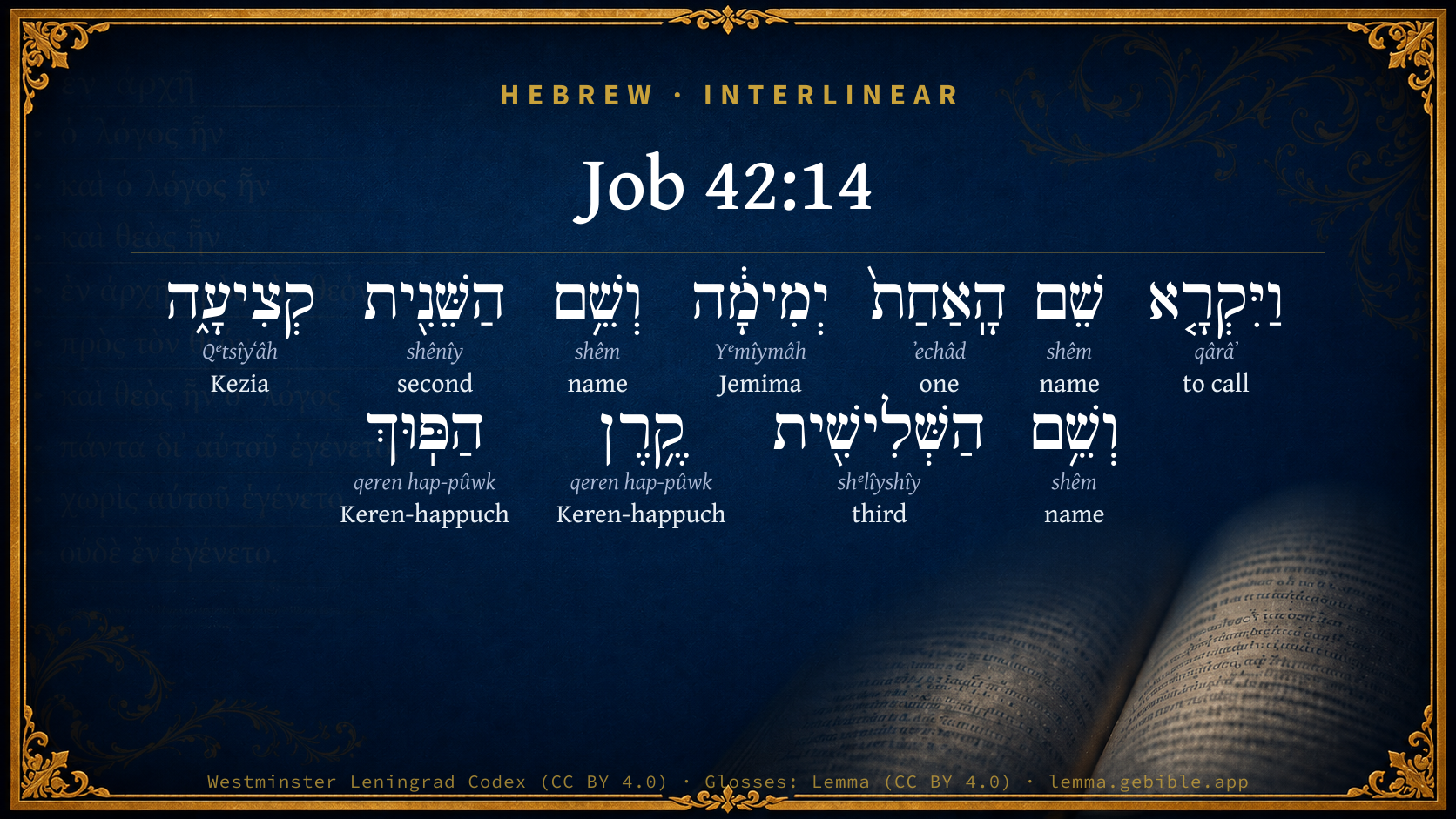
Job 42:14

Hebrew (Westminster Leningrad Codex) Job 42:14 appears in the Hebrew Old Testament. The text above is from the Westminster Leningrad Codex. Each word links to its Strong’s number, a concise gloss, and parsing drawn from the Open Scriptures Hebrew Bible morphology. Click any word for its full Brown-Driver-Briggs (BDB) entry.
Download image
Cite this verse

Job 42:14 (World English Bible). Public Domain. Lemma interlinear Bible study tool, https://lemma.gebible.app/v/job/42/14.

Show BibTeX & RIS
BibTeX
RIS
English Translation
He called the name of the first, Jemimah; and the name of the second, Keziah; and the name of the third, Keren Happuch.
World English Bible · Public Domain
Highlights Full analysis ↓
Download a study sheet

One document with this verse’s original text, its word-by-word gloss line, the meaning frame, cross-references with their text, attributed commentary, and full source and license credits — printable, and it pastes into notes with its structure intact.

This verse Autodidact and up

Study sheet (.html) Plain text (.txt)

A passage Seminary Student

Up to 50 verses in one chapter. A passage sheet keeps up to 6 commentary sources and 12 cross-references per verse, in the order this page ranks them, and says so on the sheet whenever that leaves anything out. Ask for a single verse and you get the Autodidact verse sheet above.

Everything on this page stays free to read, with no account — the sheet is a download of what is already on screen, not access to it.

Want to remove ads? Support Godless Engineer
Compare translations 3

The same verse in 3 English versions, stacked beneath the original-language interlinear above. Click any original word for its lexicon entry.

Each is an independent rendering of the whole verse — the interlinear is not word-aligned to these translations.

Highlighted words mark where these versions differ — a whole-verse word diff, not a word-by-word alignment.

  • World English Bible Public Domain
    He called the name of the first, Jemimah; and the name of the second, Keziah; and the name of the third, Keren Happuch.
  • King James Version Public Domain
    And he called the name of the first, Jemima; and the name of the second, Kezia; and the name of the third, Kerenhappuch.
  • unfoldingWord Literal Text CC BY-SA 4.0
    And he called the name of the first Jemimah and the name of the second Keziah and the name of the third Keren-Happuch.

unfoldingWord Literal Text — © unfoldingWord, licensed CC BY-SA 4.0. Word-aligned USFM3 via Door43 (git.door43.org/unfoldingWord/en_ult).

Versions to compare (up to 4)

3 of 4 selected

Show all 18 translations

Every available English version of this verse, each an independent rendering of the whole verse.

  • World English Bible Public Domain
    He called the name of the first, Jemimah; and the name of the second, Keziah; and the name of the third, Keren Happuch.
  • Berean Standard Bible Public Domain
    He named his first daughter Jemimah, his second Keziah, and his third Keren-happuch.
  • Majority Standard Bible Public Domain
    He named his first daughter Jemimah, his second Keziah, and his third Keren-happuch.
  • King James Version Public Domain
    And he called the name of the first, Jemima; and the name of the second, Kezia; and the name of the third, Kerenhappuch.
  • American Standard Version (1901) Public Domain
    And he called the name of the first, Jemimah: and the name of the second, Keziah; and the name of the third, Keren-happuch.
  • Revised Version (1885) Public Domain
    And he called the name of the first, Jemimah; and the name of the second, Keziah; and the name of the third, Keren-happuch.
  • Geneva Bible (1599) Public Domain
    And he called the name of one Iemimah, and the name of the seconde Keziah, and the name of the third Keren-happuch.
  • Douay-Rheims (1899) Public Domain
    And he called the names of one Dies, and the name of the second Cassia, and the name of the third Cornustibil.
  • Young's Literal Translation Public Domain
    and he calleth the name of the one Jemima, and the name of the second Kezia, and the name of the third Keren-Happuch.
  • Literal Standard Version CC BY-SA 4.0
    and he calls the name of the first Jemima, and the name of the second Kezia, and the name of the third Keren-Happuch.
  • Unlocked Literal Bible CC BY-SA 4.0
    He named the first daughter Jemimah, the second Keziah, and the third Keren-Happuch.
  • unfoldingWord Literal Text CC BY-SA 4.0
    And he called the name of the first Jemimah and the name of the second Keziah and the name of the third Keren-Happuch.
  • Darby Bible Public Domain
    And he called the name of the first, Jemimah; and the name of the second, Keziah; and the name of the third, Keren-happuch.
  • World Messianic Bible Public Domain
    He called the name of the first, Jemimah; and the name of the second, Keziah; and the name of the third, Keren Happuch.
  • Webster's Bible Public Domain
    And he called the name of the first, Jemima; and the name of the second, Kezia; and the name of the third, Keren-happuch.
  • Free Bible Version CC BY-SA 4.0
    Job called the first daughter Jemimah, the second Keziah, and the third Keren-Happuch.
  • Bible in Basic English Public Domain
    And he gave the first the name of Jemimah, the second Keziah, and the third Keren-happuch;
  • JPS Tanakh (1917) Public Domain
    And he called the name of the first, Jemimah; and the name of the second, Keziah; and the name of the third, Keren-happuch.

Literal Standard Version (2020), Covenant Press — licensed CC BY-SA 4.0. Text via the HelloAO Bible API (eBible.org). Unlocked Literal Bible (unfoldingWord) — licensed CC BY-SA 4.0. Text via the HelloAO Bible API (eBible.org). unfoldingWord Literal Text — © unfoldingWord, licensed CC BY-SA 4.0. Word-aligned USFM3 via Door43 (git.door43.org/unfoldingWord/en_ult). Free Bible Version, Dr. Jonathan Gallagher — licensed CC BY-SA 4.0. Text via the HelloAO Bible API (eBible.org).

Word by word

More ways to search: Search by grammar → Find every occurrence → Compare this word →

Practice this passage: Drill this verse → Learn its vocabulary →

יְמִימָ֔ה
Yᵉmîymâh
H3224
“Jemima”
Noun, Proper
Part of Speech
Noun
Type
Proper
Full BDB Definition

Origin: perhaps from the same as H3117

TWOT: None

Jemima = "day by day" - one of the daughters of Job born after the restoration
  1. וַיִּקְרָ֤א qârâʼ H7121 “and · to call” Conjunction + Verb, Qal, Sequential Imperfect, 3rd Person, Masculine, Singular
  2. שֵׁם shêm H8034 “name of” Noun, Common, Masculine, Singular, Construct
  3. הָֽאַחַת֙ ʼechâd H259 “the · one” Particle, Definite Article + Adjective, Cardinal number, Feminine, Singular, Absolute
  4. וְשֵׁ֥ם shêm H8034 “and · name of” Conjunction + Noun, Common, Masculine, Singular, Construct
  5. הַשֵּׁנִ֖ית shênîy H8145 “the · second” Particle, Definite Article + Adjective, Ordinal number, Feminine, Singular, Absolute
  6. קְצִיעָ֑ה Qᵉtsîyʻâh H7103 “Kezia” Noun, Proper
  7. וְשֵׁ֥ם shêm H8034 “and · name of” Conjunction + Noun, Common, Masculine, Singular, Construct
  8. הַשְּׁלִישִׁ֖ית shᵉlîyshîy H7992 “the · third” Particle, Definite Article + Adjective, Ordinal number, Feminine, Singular, Absolute
  9. קֶ֥רֶן qeren hap-pûwk H7163 “Keren-happuch” Noun, Proper
  10. הַפּֽוּךְ qeren hap-pûwk H7163 “Keren-happuch” Noun, Proper

About this verse

These counts appear in no published source. They are computed here, from the morphology-tagged text and Lemma’s own curated glosses. What Lemma adds →

11
words
8
distinct lemmas
Wisdom
section

Notable vocabulary

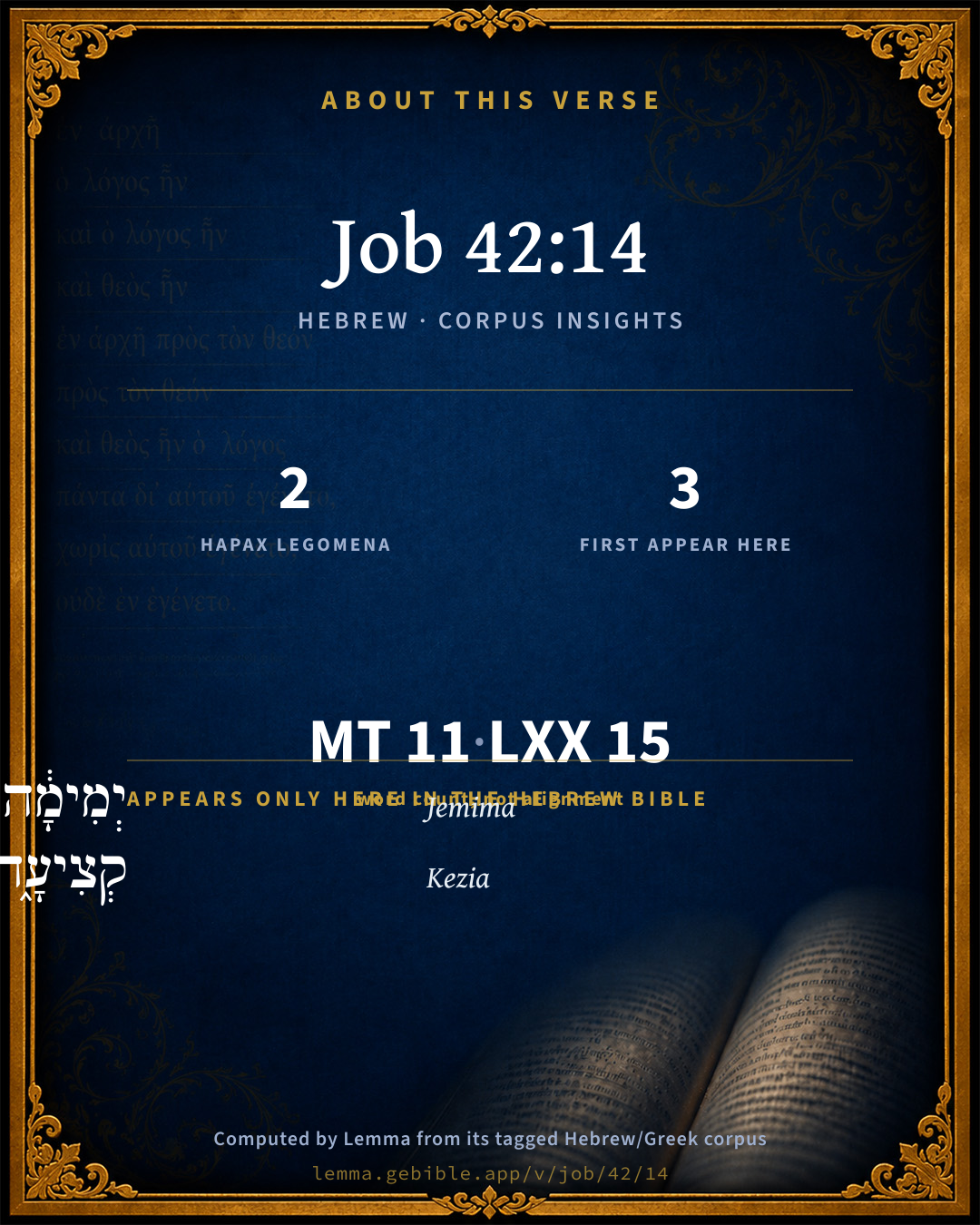
2 hapax legomena — words that appear only here in the entire Hebrew Bible:

  • יְמִימָ֔ה Jemima H3224
  • קְצִיעָ֑ה Kezia H7103

First appearance in Scripture

These words make their first canonical appearance in the Hebrew Bible here:

  • יְמִימָ֔ה Jemima H3224
  • קְצִיעָ֑ה Kezia H7103
  • קֶ֥רֶן Keren-happuch H7163

Grammatical profile

  • 1 verb
  • 7 nouns
  • 3 adjectives

Verb forms

  • וַיִּקְרָ֤א Qal · Sequential Imperfect

Repetition

Words recur within this verse — often emphatic in Hebrew:

  • שֵׁם name H8034 ×3
  • קֶ֥רֶן Keren-happuch H7163 ×2

Hebrew & Septuagint length

In English translation the verse runs 23 words from the Hebrew and 15 from the Septuagint (LXX English) — the Septuagint runs noticeably shorter here. See the side-by-side →

A rough comparison of the two English renderings, which tokenize alike — not a word-level alignment.

Word counts can differ between the Hebrew and the Greek without any difference in meaning — e.g. the Hebrew direct-object marker אֵת has no separate Greek word, and Greek often adds the article ὁ.

In the original languages it is 11 Hebrew tokens and 15 Greek tokens — but the two are counted differently (Hebrew bundles its prefixes and suffixes into one token; the Greek is in lemma form), so that isn’t a like-for-like length.

Hebrew and Greek witnesses Masoretic Hebrew ↔ Greek Septuagint

The same verse in the two great witnesses to the Old Testament, shown verse-for-verse.

Here the Septuagint runs noticeably shorter than the Hebrew — LXX2012 (modern English Septuagint) 15 words vs World English Bible 23. A rough length comparison of the two English translations, not a word-level alignment — read both below.

These are two independent witnesses, not word-aligned to each other, and the Septuagint is shown in lemma (dictionary) form.

Hebrew Job 42:14 Masoretic · Westminster Leningrad Codex

וַיִּקְרָ֤א שֵׁם הָֽאַחַת֙ יְמִימָ֔ה וְשֵׁ֥ם הַשֵּׁנִ֖ית קְצִיעָ֑ה וְשֵׁ֥ם הַשְּׁלִישִׁ֖ית קֶ֥רֶן הַפּֽוּךְ

He called the name of the first, Jemimah; and the name of the second, Keziah; and the name of the third, Keren Happuch.

World English Bible · Public Domain

Greek LXX Job 42:14 Septuagint · lemma form

καί καλέω ὁ μέν πρῶτος ἡμέρα ὁ δέ δεύτερος κασία ὁ δέ τρίτος ἀμάλθεια κέρας

And he called the first Day, and the second Casia, and the third Amalthaea's horn.

LXX2012 (modern English Septuagint) · Public Domain

On this verse, Joseph Benson's Commentary discusses the Septuagint’s reading. Read the note in Commentary ↓

Hebrew: Westminster Leningrad Codex (CC BY 4.0). Greek: Septuagint (public domain); English from LXX2012 (modern English Septuagint) (Public Domain). How the Septuagint differs from the Hebrew →

Commentary

Notes on Job 42:14 from classic Christian and Jewish commentators (each source and its license shown beneath its notes). The classic Christian expositions comment on the surrounding passage and are grouped to its opening verse, so a note may address several verses; the Jewish commentaries on the Tanakh (Rashi and others) are per-verse, so they appear only where the commentator wrote on this verse.

Lemma curates 59 commentaries, every one of them public domain or Creative Commons licensed, each selected and text-cleaned for this edition rather than reprinted as found. About our sources →

Trapp's Complete Commentary

John Trapp

Job 42:14 And he called the name of the first, Jemima; and the name of the second, Kezia; and the name of the third, Kerenhappuch.

Ver. 14. And he called the name of the first, Jemima] That is, day bright, from her oriental and glistering beauty; q.d. fair as the day (Diurno). Son 6:10, the Church is said to look forth as the morning, fair as the moon.

And the name of the second, Kezia] That is, Cassia; a kind of spice, whereof there are three sorts, saith Dioscorides, but all very sweet, and send forth a most pleasant smell, like that of the rose. This second daughter therefore seems to be so named from the sweetness of her breath, or perhaps of her whole body, proceeding from the goodness of her constitution, as it is reported of Alexander the Great. So sweet smelling Smyrna, the best of all the seven Churches of Asia, Rev 2:8-11

And the name of the third, Keren-happuch] That is, the horn of beauty (better than that which is borrowed) and of abundance; as whose cheeks Nature had painted with a most pleasing vermillion, far beyond any artificial tincture, which she had no need of, Utpote omnes aliarmn fucos et veneres superans. Some interpret it the horn of conversion; and think that Job herein would express and memorize the strange turn and alteration of his condition, as Joseph did, Gen 41:51-52. But the Chaldee paraphrase, the Jewish doctors, and most of our expositors, are for the former interpretation, favoured also by the words following:

John Trapp, A Commentary or Exposition upon All the Books of the Old and New Testament (1647–1656) — public domain. Text from a community e-Sword module.

Joseph Benson's Commentary

Job 42:14. And he called the name of the first, Jemima — Which the LXX., and Vulgate, as derived from יום, jom, interpret day. The Targum is, Her beauty was like that of the day. The name of the second, Kezia — Because she was precious like cassia, says the Targum. The meaning probably is, Pleasant as cassia, or fine spices. And the name of the third, Keren- happuch — Which the LXX. render, Αμαλθαιας κερας, Amalthea’s horn, or, The horn of plenty. The Targum, however, says she was so called, because the brightness of her face was like that of an emerald. Hence some interpret the name, The horn, or child, of beauty.

Joseph Benson's Commentary on the Old and New Testaments (1811–1818) — public domain. Text from a community e-Sword module.

Tyndale Open Study Notes

Tyndale Open Resources

42:14 The beautiful names of Job’s new daughters spoke of Job’s renewed and pleasant good fortunes. • Jemimah means “dove” (see Song 2:14). • Keziah means “cassia” or “cinnamon flower” (see Ps 45:8). • Keren-happuch means “horn of antimony,” which refers to a lustrous container for cosmetics.

Tyndale Open Study Notes — © Tyndale Open Resources, licensed CC BY-SA 4.0. Text via the HelloAO Bible API.

Geneva Bible (1599)

Geneva Bible translators

That is, of long life, or beautiful as the day.

As pleasant as cassia or sweet spice.

That is, the horn of beauty.

Geneva Bible (1599) marginal notes — public domain. Text via Bolls.life.

Jamieson, Fausset & Brown

Robert Jamieson, A. R. Fausset & David Brown

Names significant of his restored prosperity (Gen 4:25; Gen 5:29).

Jemima--"daylight," after his "night" of calamity; but MAURER, "a dove."

Kezia--"cassia," an aromatic herb (Psa 45:8), instead of his offensive breath and ulcers.

Keren-happuch--"horn of stibium," a paint with which females dyed their eyelids; in contrast to his "horn defiled in the dust" (Job 16:15). The names also imply the beauty of his daughters.

Jamieson, Fausset & Brown — Commentary Critical and Explanatory on the Whole Bible (1871) — public domain (CC PDM 1.0). Text via the HelloAO Bible API.

Adam Clarke's Commentary

Verse 14. The name of the first Jemima] ימימה yemimah, days upon days.

Kezia] קציעה ketsiah, cassia, a well-known aromatic plant. And,

Keren-happuch.] קרן הפוך keren happuch, the inverted or flowing horn, cornucopiae, the horn of plenty. The Chaldee will not permit these names to pass without a comment, to show the reason of their imposition: "He called the first Jemimah, because she was as fair as the day; the second Ketsiah, because she was as precious as cassia; the third Keren-happuch, because her face was as splendid as the emerald." Cardmarden's Bible, 1566, has the Hebrew names.

The Vulgate has, "He called the name of one Day, of the second Cassia, and of the third The Horn of Antimony."

The versions in general preserve these names, only the Septuagint, Syriac, and Arabic translate Jemimah, DAY; and the former for Keren-happuch has Αμαλθαιας κερας, the horn of Amalthea. This refers to an ancient fable. Amalthea was the nurse of Jupiter, and fed him with goat's milk when he was young. The goat having by accident her horn struck off, Jupiter translated the animal to the heavens, and gave her a place among the constellations, which she still holds; and made the horn the emblem of plenty: hence it is always pictured or described as filled with fruits, flowers, and the necessaries and luxuries of life. It is very strange how this fable got into the Septuagint.

Coverdale is singular: The first he called 'Daye', the seconde 'Poverte', the thirde, 'All plenteousnes'.

Adam Clarke's Commentary on the Bible (1810–1826) — public domain. Text from a community e-Sword/MySword module.

Ellicott's Commentary for English Readers

(14) Jemima.—This name perhaps means as fair as the day.

Kezia—i.e., cassia, an aromatic bark, much prized by the ancients. (See Psa_45:9.)

Kerenhappuch—i.e., the horn for containing kohl for the eyes. The Eastern women are in the habit of painting the upper part of the eyelids with stibium, so that a black edge is formed about them and they seem larger. (See 2Ki_9:30; Jer_4:30.) The meaning of this name is the paint-box for this purpose.

A Bible Commentary for English Readers, edited by Charles John Ellicott (1878–1897) — public domain. Text from a community e-Sword module.

John Gill's Exposition

And in all the land were no women found so fair as the daughters of Job,.... Either in the whole world, which is not improbable: or it may be rather in the land or country in which they dwelt; and which may be gathered from their names, as before observed. The people of God, and children of Christ, the antitype of Job, are all fair, and there is no spot in them; a perfection of beauty, perfectly comely, through the comeliness of Christ put upon them, and are without spot or wrinkle, or any such thing;

and their father gave them inheritance among their brethren; which was done not on account of their beauty or virtue; nor is this observed so much to show the great riches of Job, that he could give his daughters as much as his sons, as his impartiality to his children, and his strict justice and equity in distributing his substance to them all alike, making no difference between male and female. And so in Christ, the antitype of Job, there is neither male nor female, no difference between them, Gal 3:28, but being all children, they are heirs, heirs of God and joint heirs with Christ, and equally partake of the same inheritance with the saints in light, Rom 8:17.

John Gill's Exposition of the Whole Bible (1746–1763) — public domain (CC PDM 1.0). Text via the HelloAO Bible API.

Albert Barnes' Notes on the Bible

And he called the name of the first, Jemima - It is remarkable that in the former account of the family of Job, the names of none of his children are mentioned, and in this account the names of the daughters only are designated. “Why” the names of the daughters are here specified, is not intimated. They are significant, and they are “so” mentioned as to show that they contributed greatly to the happiness of Job on the return of his prosperity, and were among the chief blessings which gladdened his old age. The name Jemima (ימימה yemı̂ymâh) is rendered by the Vulgate “Diem,” and by the Septuagint, Ἡμέραν Hēmeran, “Day.” The Chaldee adds this remark: “He gave her the name Jemima, because her beauty was like the day.” The Vulgate, Septuagint, and Chaldee, evidently regarded the name as derived from יום yôm, “day,” and this is the most natural and obvious derivation. The name thus conferred would indicate that Job had now emerged from the “night” of affliction, and that returning light shone again on his tabernacle. It was usual in the earliest periods to bestow names because they were significant of returning prosperity (see Gen 4:25), or because they indicated hope of what would be in their time Gen 5:29, or because they were a pledge of some permanent tokens of the divine favor; see the notes at Isa 8:18. Thomas Roe remarks (“Travels,” 425), that among the Persians it is common to give names to their daughters derived from spices, unguents, pearls, and precious stones, or anything which is regarded as beautiful or valuable. See Rosenmuller, “Alte u. neue Morgenland,” No. 779.

And the name of the second Kezia - The name Kezia (קציעה qetsı̂y‛âh) means cassia, a bark resembling cinnamon, but less aromatic. “Gesenius.” It grew in Arabia, and was used as a perfume. The Chaldee paraphrasist explains this as meaning that he gave her this name because “she was as precious as cassia.” Cassia is mentioned in Psa 45:8. as among the precious perfumes. “All thy garments smell of myrrh, and aloes, and cassia.” The agreeableness or pleasantness of the perfume was the reason why the name was chosen to be given to a daughter.

And the name of the third, Keren-happuch - Properly, “horn of stibium.” The “stibium” (פוך pûk), was a paint or dye made originally, it is supposed, from sea-weed, and afterward from antimony, with which females tinged their eye-lashes; see the notes at Isa 54:11. It was esteemed as an ornament of great beauty, chiefly because it served to make the eye appear larger. Large eyes are considered in the East as a mark of beauty, and the painting of black borders around them gives them an enlarged appearance. It is remarkable that this species of ornament was known so early as the time of Job, and this is one of the cases, constantly occurring in the East, showing that fashions there do not change. It is also remarkable that the fact of painting in this manner should have been considered so respectable as to be incorporated into the name of a daughter; and this shows that there was no attempt at “concealing” the habit. This also accords with the customs which prevail still in the East. With us, the materials and instruments of personal adorning are kept in the back-ground, but the Orientals obtrude them constantly on the attention, as objects adapted to suggest agreeable ideas. The “process” of painting the eye is described by a recent traveler to be this: “The eye is closed, and a small ebony rod smeared with the composition is squeezed between the lids so as to tinge the edges with the color. This is considered to add greatly to the brilliancy and power of the eye, and to deepen the effect of the long black eye-lashes of which the Orientals are proud. The same drug is employed on their eye-brows; used thus, it is intended to elongate, not to elevate the arc, so that the inner extremities are usually represented as meeting between the eyes. To Europeans the effect is at first seldom pleasing; but it soon becomes so.” The foregoing cuts give a representation of the vessels of stibium now in use.

Albert Barnes' Notes on the Bible (1834–1885) — public domain. Text from a community e-Sword/MySword module.

Haydock's Catholic Bible Commentary

Dies, &c. "Day....cassia....and horn of antimony." (Hebrew) --- Yemima....Ketsiha....Keren hapuc. This last may signify (Haydock) "horn of change," (Pagnin) in allusion to Job’s different states. (Menochius) (Du Hamel) --- Sometimes we find the Latin names retained, and at other times translated. It would perhaps be as well to give their force uniformly in English, or rather to insert the original terms, if they could be now properly expressed. But that is impossible. Protestants, Jemima, "handsome as the day." Kezia, "superficies, angle, or cassia." Keren-happuch, "the horn or child of beauty." The marginal explanations are given at least in the edition Edinb. 1787. (Haydock) --- Cassia, an aromatic herb, which is perhaps not now found to be found in Europe, Matthiol. in Dios. i. 12. --- The Arabs like to give such names to their children. (Spanheim, Hist. Job.) --- Cornustibii, (Hebrew Puc) means a sort of paint, used to blacken the eyelids, (4 Kings ix. 30.) or a precious stone, Isaias liv. 11. Chaldean, "brilliant as an emerald." She was so styled, on account of her great beauty, (Calmet) in which she was not inferior to her two sisters. Septuagint, "Horn of Amalthea," (Haydock) or of plenty, (Calmet) which is not an approbation of the fable, but to show the abundance which Job now enjoyed. (Nicetas.) --- Cassia might remind him of the bad smells to which he had been exposed. (Menochius) (Tirinus)

George Leo Haydock (1774–1849), Haydock's Catholic Family Bible and Commentary, 1859 edition — public domain. Excludes Psalms (Douay-Rheims chapter numbering differs from Protestant) and Deuterocanonical books (Catholic canon only).

Matthew Poole's English Annotations

Giving them such excellent names as signify their excellent beauty, of which see my Latin Synopsis.

Matthew Poole's English Annotations on the Holy Bible (1683–1685) — public domain. Text from a community e-Sword/MySword module.

Whedon's Commentary on the Bible

Daniel D. Whedon

14. And he called the name — The grace and beauty of person of the three daughters are reflected in the descriptive names, given, not by the parent necessarily, but more probably by admiring friends. They were like the three graces of classic times. The subject of the word called is not defined. Sir Thomas Roe, the traveller, says of the Persians, “They call their women by the names of spices or odours, or of pearls or precious stones, or else by other names of pretty or pleasing signification.”

Jemima — (Sept., Day) was in former times supposed to be an Aramaic word. and to signify pure as daylight; but it is now regarded as kindred to the Arabic Jemaimat, which means a dove, and was given (so Delitzsch thinks) as a name “because of her dove’s eyes.” Compare Son_2:14; Son_5:2; Son_6:9.

Kezia — (Sept., Casia) Cassia, or, fine as the fragrance of cassia, “as if woven out of the odor of cinnamon.” — Delitzsch. Comp. Psa_45:8; Son_1:3. This bark is something like cinnamon, but not so aromatic. Its Hebrew name, ketsiah, expresses the fact that it is stripped from the trees. Excessive fondness for perfumes is characteristic of the people of the East unto the present day. “The people of the Hedjaz, especially the ladies,” says Burckhardt, “steep rose-buds in water, which they afterward use for their ablutions.” — Arabia, 1:68.

Keren-happuch — (Septuagint, Amalthaea’s horn,) is literally a horn of paint — boxes of pigment in those days being, as is supposed, sometimes made of horn, or in the shape of a horn. Oriental ladies from very ancient times have painted their eyes, in order to produce an apparent enlargement of the eye, and to promote its brilliancy. The accompanying engraving is copied from the sarcophagus of Oimenepthah, and is supposed to represent an Egyptian goddess whose eyebrows and eyelids have been painted with a black dye.

To the bright and languishing expression thus produced the writer of the Proverbs (Pro_6:25) is supposed to refer when he says, “Neither let her [the wanton] take thee with her eyelids.” Horns containing pigment have been found in Egyptian sarcophagi, with silver, ivory, and wooden needles, and minute brushes for applying the cosmetic to the eye. The Assyrian monuments also give evidence of the prevalence of the same custom. The art, in later times, became meretricious, as may be seen in 2Ki_9:30, (margin;) Jer_4:30; Eze_23:40. The Prophet Isaiah (Isa_54:11) makes the colouring matter (stibium, Hebrews pouk,) used in painting the eye the ground of an exquisite figure — the very cement of the stones which compose the new Jerusalem, he prophesies, shall be stibium, thus intimating that, as with the human eye artificially decorated, the beauty of these stones shall stand forth in greater splendour because of the dark background in which they also are set. The name of Keren-happuch, says Hengstenberg, is an irony upon the use of cosmetics. See further in RUSSELL’S History of Aleppo, i, pp. 111, 366.

Daniel D. Whedon (gen. ed.), Commentary on the Old and New Testaments (1874–1909) — public domain. Text from a community e-Sword module.

The Pulpit Commentary

And he called the name of the first, Jemima. The name "Jemima" is probably derived from yom ( "day," and means "Fair as the day." And the name of the second, Kesia. "Kezia" (rather, "Keziah") was the Hebrew name of the spice which the Greeks and Romans called "cassia," a spice closely allied to cinnamon, and much esteemed in the East (see Herod., 3:110). And the name of the third, Keren-happuch; literally, horn of stibium stibium being the dye (antimony) with which Oriental women have from a remote antiquity been in the habit of anointing the upper and lower eyelids in order to give lustre to the eye (compare the "Pulpit Commentary" on the "Second Book of Kings," p. 194). The three names, according to Oriental notions, implied either sweetness or beauty.

The Pulpit Commentary (1880–1919), ed. H.D.M. Spence-Jones & Joseph S. Exell — public domain. Text from a community e-Sword module.

John Wesley's Explanatory Notes

Jemima - The day, either because of her eminent beauty, or because she was born in the day of his prosperity, after a dark night of affliction. Kezia is the name of a spice of a very fragrant smell, commonly called Cassia. Keren-happuch signifies plenty restored.

John Wesley, Explanatory Notes Upon the Whole Bible (1754–1765) — public domain. Text via the GEBible commentary corpus.

Rashi

Rabbi Shlomo Yitzchaki (Rashi)

And he named the first Jemimah They were named according to their beauty.

Jemimah Bright and white as the sun (יום).

Keziah She had a fragrant and perfumed scent like the spice, cassia.

Keren-happuch Because of the horn in which they put stibium and lixivium, as it is stated (Jer. 4: 30): “that you enlarge your eye with paint (בפוך).”

Rashi on the Tanakh — English translations: “The Judaica Press complete Tanach with Rashi, translated by A. J. Rosenberg” (CC BY 4.0); “Pentateuch with Rashi's commentary by M. Rosenbaum and A.M. Silbermann, 1929-1934” (public domain); “The Metsudah Tanach series, Lakewood, N.J” (CC BY 4.0); and “The Book of Joshua, Metsudah Publications, 1997” (CC BY 4.0). Text via Sefaria.

Lesson kit

Teaching starters — assembled from the data on this page, not authored interpretation. Every prompt links to the verse data it draws on. Edit before teaching.

Job, in the Wisdom, opens this verse with 11 words (8 distinct Hebrew lemmas). Its most distinctive word is Yᵉmîymâh (“Jemima”). The Greek Septuagint runs shorter here. A historical commentator’s framing appears above. Read the whole chapter for the surrounding context.

Discussion questions

  1. What does “Jemima” (Yᵉmîymâh) contribute to the verse as a whole?
  2. This verse holds 2 words here found nowhere else in the Hebrew Bible. What might the rare words draw attention to?
  3. 3 words here appear for the first time in Scripture. What is being introduced at this debut?
  4. “name” occurs 3× in this one verse. What is the effect of the repetition?
  5. Compared with the Hebrew, the Septuagint runs shorter here. What questions does that raise?
  6. These translations render this verse differently; the difference is in the English rendering, not the original. What questions does that raise?
  7. The verb «וַיִּקְרָ֤א» is Qal Sequential Imperfect. How does its form color the action?
  8. Reading how Trapp's Complete Commentary and Joseph Benson's Commentary read this verse, where do the two commentators agree and where do they part?

Things to notice

  • 2 words in this verse appear nowhere else in the Hebrew Bible.
  • 3 words make their first canonical appearance in Scripture here.
  • This verse counts 11 Hebrew ↔ 15 Greek words.
  • These translations choose different wording for 8 words in this verse.
  • “name” occurs 3× in this single verse.

Reading settings

Reading text

Shown beneath each verse's original-language words.

Old Testament
Old Testament edition

Read the OT as the Masoretic Hebrew (MT) or the Greek Septuagint (LXX).

English shown for the Greek Septuagint (in the Hebrew ↔ Greek comparison).

Comparing translations? Open the Compare panel on any verse page to stack up to four side by side.