Acts 14:4

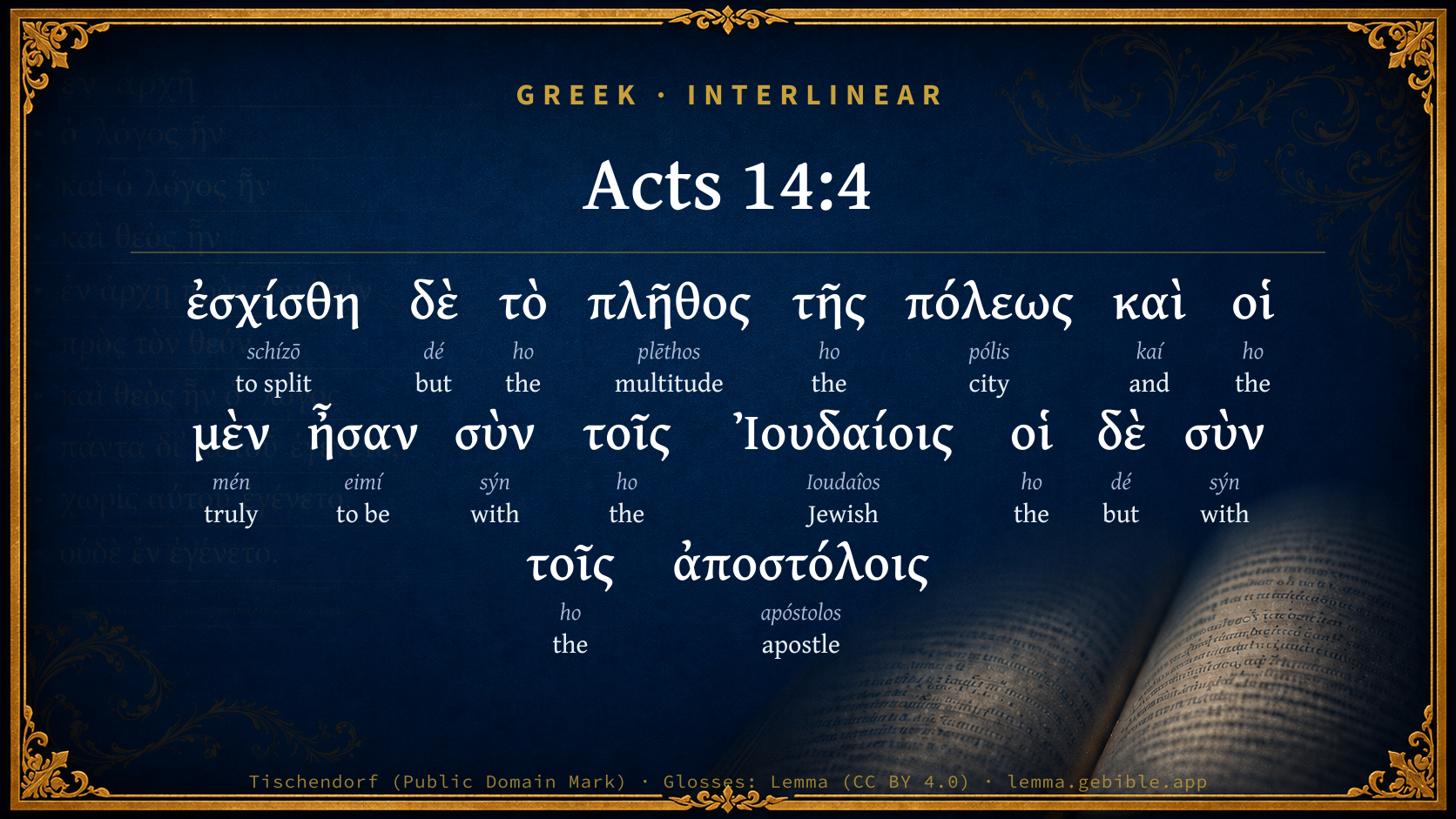
Greek (Tischendorf 8th ed.) Acts 14:4 appears in the Greek New Testament. The text above is from the Tischendorf 8th edition. Each word links to its Strong’s number and a concise gloss. Click any word for its full Thayer’s Greek Lexicon entry.
Download image
Cite this verse

Acts 14:4 (World English Bible). Public Domain. Lemma interlinear Bible study tool, https://lemma.gebible.app/v/acts/14/4.

Show BibTeX & RIS
BibTeX
RIS
English Translation
But the multitude of the city was divided. Part sided with the Jews, and part with the apostles.
World English Bible · Public Domain
Download a study sheet

One document with this verse’s original text, its word-by-word gloss line, the meaning frame, cross-references with their text, attributed commentary, and full source and license credits — printable, and it pastes into notes with its structure intact.

This verse Autodidact and up

Study sheet (.html) Plain text (.txt)

A passage Seminary Student

Up to 50 verses in one chapter. A passage sheet keeps up to 6 commentary sources and 12 cross-references per verse, in the order this page ranks them, and says so on the sheet whenever that leaves anything out. Ask for a single verse and you get the Autodidact verse sheet above.

Everything on this page stays free to read, with no account — the sheet is a download of what is already on screen, not access to it.

Want to remove ads? Support Godless Engineer
Compare translations 3

The same verse in 3 English versions, stacked beneath the original-language interlinear above. Click any original word for its lexicon entry.

Each is an independent rendering of the whole verse — the interlinear is not word-aligned to these translations.

Highlighted words mark where these versions differ — a whole-verse word diff, not a word-by-word alignment.

  • World English Bible Public Domain
    But the multitude of the city was divided. Part sided with the Jews, and part with the apostles.
  • King James Version Public Domain
    But the multitude of the city was divided: and part held with the Jews, and part with the apostles.
  • unfoldingWord Literal Text CC BY-SA 4.0
    But the multitude of the city was divided, and some indeed were with the Jews, but some with the apostles.

unfoldingWord Literal Text — © unfoldingWord, licensed CC BY-SA 4.0. Word-aligned USFM3 via Door43 (git.door43.org/unfoldingWord/en_ult).

Versions to compare (up to 4)

3 of 4 selected

Show all 19 translations

Every available English version of this verse, each an independent rendering of the whole verse.

  • World English Bible Public Domain
    But the multitude of the city was divided. Part sided with the Jews, and part with the apostles.
  • Berean Standard Bible Public Domain
    The people of the city were divided. Some sided with the Jews, and others with the apostles.
  • Majority Standard Bible Public Domain
    The people of the city were divided. Some sided with the Jews, and others with the apostles.
  • King James Version Public Domain
    But the multitude of the city was divided: and part held with the Jews, and part with the apostles.
  • American Standard Version (1901) Public Domain
    But the multitude of the city was divided; and part held with the Jews, and part with the apostles.
  • Revised Version (1885) Public Domain
    But the multitude of the city was divided; and part held with the Jews, and part with the apostles.
  • Geneva Bible (1599) Public Domain
    But the multitude of the city was deuided: and some were with the Iewes, and some with the Apostles.
  • Douay-Rheims (1899) Public Domain
    And the multitude of the city was divided; and some of them indeed held with the Jews, but some with the apostles.
  • Young's Literal Translation Public Domain
    And the multitude of the city was divided, and some were with the Jews, and some with the apostles,
  • Literal Standard Version CC BY-SA 4.0
    And the multitude of the city was divided, and some were with the Jews, and some with the apostles,
  • Unlocked Literal Bible CC BY-SA 4.0
    But the majority of the city was divided: some people sided with the Jews, and some with the apostles.
  • unfoldingWord Literal Text CC BY-SA 4.0
    But the multitude of the city was divided, and some indeed were with the Jews, but some with the apostles.
  • Darby Bible Public Domain
    And the multitude of the city was divided, and some were with the Jews and some with the apostles.
  • World Messianic Bible Public Domain
    But the multitude of the city was divided. Part sided with the Jews and part with the emissaries.
  • Webster's Bible Public Domain
    But the multitude of the city was divided: and part held with the Jews, and part with the apostles.
  • Free Bible Version CC BY-SA 4.0
    The inhabitants of the town were divided, with some supporting the Jews and some the apostles.
  • Bible in Basic English Public Domain
    But there was a division among the people of the town; some were on the side of the Jews and some on the side of the Apostles.
  • Text-Critical English NT CC BY 4.0
    But the population of the city was divided; some were with the Jews, and some were with the apostles.
  • Tyndale New Testament (1534) Public Domain
    The people of the cyte were devided: and parte helde with the Iewes and parte with the Apostles.

Literal Standard Version (2020), Covenant Press — licensed CC BY-SA 4.0. Text via the HelloAO Bible API (eBible.org). Unlocked Literal Bible (unfoldingWord) — licensed CC BY-SA 4.0. Text via the HelloAO Bible API (eBible.org). unfoldingWord Literal Text — © unfoldingWord, licensed CC BY-SA 4.0. Word-aligned USFM3 via Door43 (git.door43.org/unfoldingWord/en_ult). Free Bible Version, Dr. Jonathan Gallagher — licensed CC BY-SA 4.0. Text via the HelloAO Bible API (eBible.org).

Word by word

More ways to search: Search by grammar → Find every occurrence → Compare this word →

Practice this passage: Drill this verse → Learn its vocabulary →

ἐσχίσθη
schízō
G4977
“to split”
Verb, Aorist, Passive, Indicative, 3rd person, Singular
Part of Speech
Verb
Tense
Aorist
Voice
Passive
Mood
Indicative
Person
3rd person
Number
Singular
Full Thayer's Definition

Origin: apparently a primary verb

TDNT: 22:59,1

1. to cleave, cleave asunder, rend 2. to divide by rending 3. to split into factions, be divided
  1. δὲ dé G1161 “but” Conjunction
  2. τὸ ho G3588 “the” Article, Nominative, Singular, Neuter
  3. πλῆθος plēthos G4128 “multitude” Noun, Nominative, Singular, Neuter
  4. τῆς ho G3588 “the” Article, Genitive, Singular, Feminine
  5. πόλεως pólis G4172 “city” Noun, Genitive, Singular, Feminine
  6. καὶ kaí G2532 “and” Conjunction
  7. οἱ ho G3588 “the” Article, Nominative, Plural, Masculine
  8. μὲν mén G3303 “truly” Particle
  9. ἦσαν eimí G1510 “to be” Verb, Imperfect, Active, Indicative, 3rd person, Plural
  10. σὺν sýn G4862 “with” Preposition
  11. τοῖς ho G3588 “the” Article, Dative, Plural, Masculine
  12. Ἰουδαίοις Ioudaîos G2453 “Jewish” Adjective, Dative, Plural, Masculine
  13. οἱ ho G3588 “the” Article, Nominative, Plural, Masculine
  14. δὲ dé G1161 “but” Conjunction
  15. σὺν sýn G4862 “with” Preposition
  16. τοῖς ho G3588 “the” Article, Dative, Plural, Masculine
  17. ἀποστόλοις apóstolos G652 “apostle” Noun, Dative, Plural, Masculine

About this verse

These counts appear in no published source. They are computed here, from the morphology-tagged text and Lemma’s own curated glosses. What Lemma adds →

18
words
11
distinct lemmas
Acts
section

Notable vocabulary

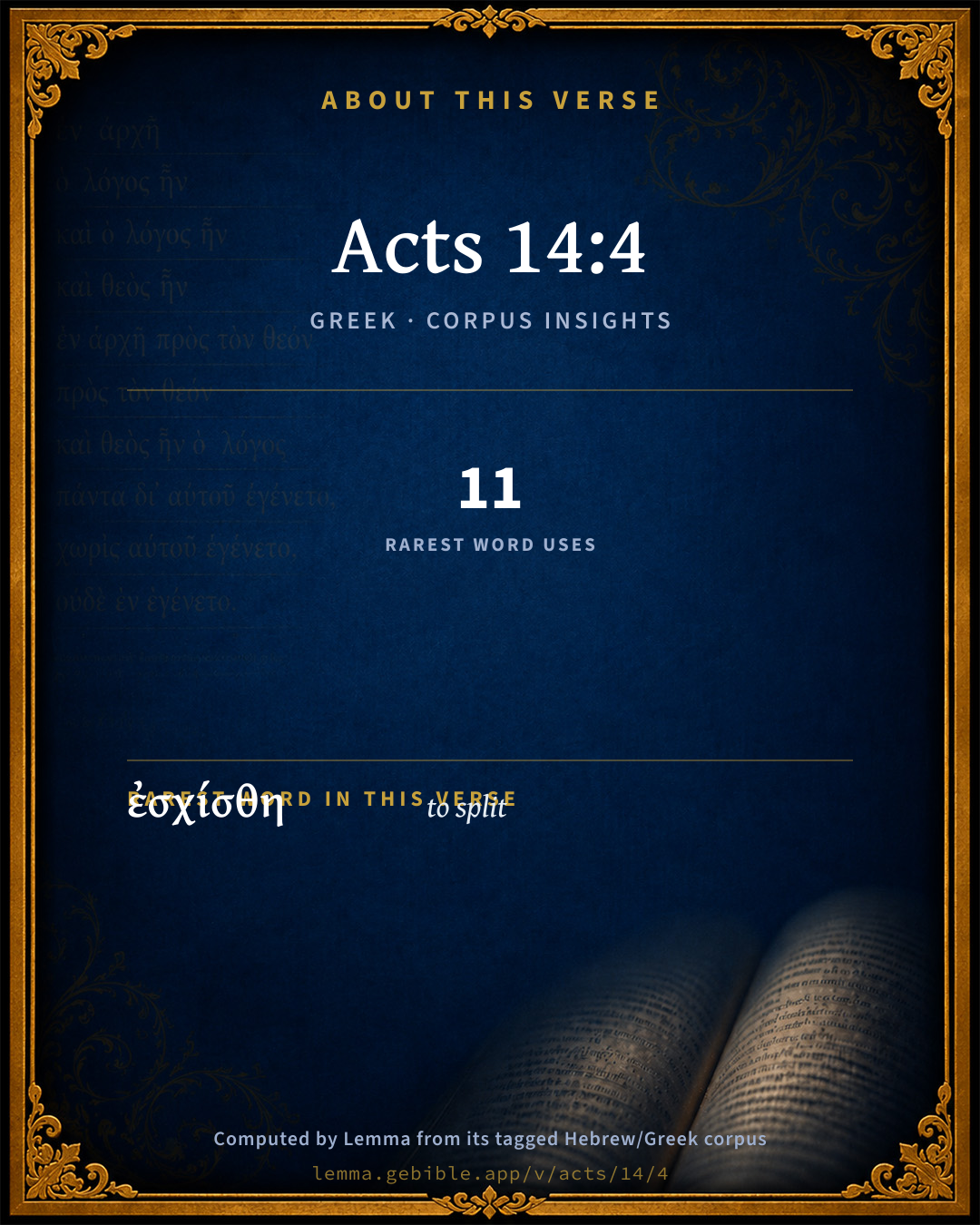
The rarest word here is ἐσχίσθη to split G4977 — appearing just 11 times in the whole Greek New Testament.

Shared distinctive vocabulary

ἐσχίσθη to split G4977 occurs in 9 verses of the Greek New Testament. Also found in:

Repetition

Words recur within this verse:

Cross-references

12

Topical passages linked to Acts 14:4 in the Treasury of Scripture Knowledge — connected by theme and wording, ordered by reader-vote popularity; previews shown in the World English Bible.

  • Acts 28:24 Some believed the things which were spoken, and some disbelieved.
  • Luke 11:21–23 "When the strong man, fully armed, guards his own dwelling, his goods are safe.
  • Acts 14:14 But when the apostles, Barnabas and Paul, heard of it, they tore their clothes, and sprang into the multitude, crying out,
  • Acts 17:4–5 Some of them were persuaded, and joined Paul and Silas, of the devout Greeks a great multitude, and not a few of the chief women.
  • Acts 19:9 But when some were hardened and disobedient, speaking evil of the Way before the multitude, he departed from them, and separated the disciples, reasoning daily in the school of Tyrannus.
  • Micah 7:6 For the son dishonors the father, The daughter rises up against her mother, The daughter-in-law against her mother-in-law; A man's enemies are the men of his own house.
  • Matthew 10:34–36 "Don't think that I came to send peace on the earth. I didn't come to send peace, but a sword.
  • Luke 2:34 and Simeon blessed them, and said to Mary, his mother, "Behold, this child is set for the falling and the rising of many in Israel, and for a sign which is spoken against.
  • Luke 12:51–53 Do you think that I have come to give peace in the earth? I tell you, no, but rather division.
  • John 7:43 So there arose a division in the multitude because of him.
  • Acts 13:2 As they served the Lord and fasted, the Holy Spirit said, "Separate Barnabas and Saul for me, for the work to which I have called them."
  • 1 Corinthians 9:5 Have we no right to take along a wife who is a believer, even as the rest of the apostles, and the brothers of the Lord, and Cephas?

Cross-references courtesy of OpenBible.info (CC BY 4.0).

Commentary

Notes on Acts 14:4 from classic Christian and Jewish commentators (each source and its license shown beneath its notes). The classic Christian expositions comment on the surrounding passage and are grouped to its opening verse, so a note may address several verses; the Jewish commentaries on the Tanakh (Rashi and others) are per-verse, so they appear only where the commentator wrote on this verse.

Lemma curates 59 commentaries, every one of them public domain or Creative Commons licensed, each selected and text-cleaned for this edition rather than reprinted as found. About our sources →

The Biblical Illustrator

Joseph S. Exell

Act_14:4-7

But the multitude of the city was divided.

The effects of the gospel

I. Division. Behold I come not to cause peace, but division. So said the Master; so felt the disciples.

1. The gospel causes division in--

(1) The man himself--between inclination and conviction; interest and conscience; intellect and passion.

(2) Families, between parents and children; brothers and sisters, etc.

(3) Society. The gospel has often sundered life-long friendships and associations.

2. Why?

(1) Because of the incessant vigilance and activity of the great enemy of the gospel, who stirs up opposition to it.

(2) Because of the revolutionary power of the gospel. Men do not like to have the old convictions, customs, etc., disturbed. There is no objection per se to the existence of the gospel, if its possessors will only keep quiet. Professing Christians who make no effort to disturb existing arrangements live quietly enough.

(3) Because of the intolerance of the gospel. Had Christians in ancient times been content with a place for Christ in the Pantheon there would have been no persecutions; it was because they claimed for Christ the only place, that excited the ire of heathendom. And men of all shades of opinion today would allow Christianity a place as a system of thought or ethics; but it is when she claims for herself absolute and undisputed supremacy in politics, society, business, etc., that the conflict begins.

II. Opposition. Part held with the Jews.

1. Sympathetically. There is an opposition nowadays which does not proceed to active antagonism. Indifference to the gospel is sympathy with its foes. He that is not for Me is against Me. This form of opposition is the most difficult to deal with. An army would sooner meet its enemy than pass through a country secretly at league with the enemy. What the gospel has to dread is not infidel propaganda, or blatant vice; but mere intangible negativism. This we find not only outside the Churches but within.

2. Actively. This opposition exists in various forms.

(1) Intellectual--controversy.

(2) Political--bad laws.

(3) Moral--vicious influence.

(4) Social--evil customs.

(5) Physical--persecution.

III. Acceptance. Part with the apostles. This acceptance is--

1. Secret. There are thousands like Nicodemus, in heathen and Christian lands, whose whole sympathy is with the gospel, but who, for domestic or social reasons, withhold profession. This is not to be commended, but condemned; nevertheless, in estimating the forces for and against the gospel it should be considered. If it shows a heart yet unrenewed, it is evidence of feelings touched, intellect convinced, and perhaps will trembling in the balance. Such should be encouraged to not only hold with the apostles, but to stand boldly by their side.

2. Public. To take part thoroughly with the apostles is--

(1) To defend their gospel.

(2) To assist them in their work. Something more is required than to listen to their teaching and to attend ordinances at which they preside once a week. Yet how many who profess to be decided Christians do no more. The work of the gospel requires the help of every disciple; as a matter of fact an average congregation yields one worker to ten members. (J. W. Burn.)

And when there was an assault made … they … fled unto Lystra and Derbe.--

The permitted flight of the servant of God

How it takes place.

I. After the conflict, as with the apostles here; not before, as with Jonah.

II. In obedience to the Lord, and not from fear of man or carnal tenderness.

III. With weapons in their hands, as the apostles continue to preach with unbroken courage, not after having cast their weapons away.

IV. To a new field of conflict (Derbe and Lystra), not to rest. (K. Gerok.)

And there they preached the gospel.--

Gospel preaching

A new and characteristic incident in the life of that sweet singer of Israel, Miss Havergal, comes to light in the recently published autobiography of her sister. The former was conversing with a minister who was not disposed to press home the gospel message. Oh, why dont you preach the gospel of Christ? she exclaimed. My congregation are well educated and well acquainted with the truths of salvation; if they were Zulus, I should preach differently, was the reply. Then let me be a Zulu next Sunday, was the rejoinder, and just preach at me. A real gospel sermon was the result. It might pay a minister now and then to imagine some Zulus among his auditors, and prepare his sermon accordingly.

The preaching of the gospel

I. The nature of the gospel. In etymology, the term signifies glad tidings. In theology, the thing signified is the glad tidings of salvation through Christ. The gospel is the new law as distinguished from the old; for there is much gospel in the old, and much law in the new. The gospel is the foundation of a sinners hope as distinguished from the rule of the creatures conduct. It is called the gospel of the grace of God, because the whole system originated in the free and unmerited favour of God; the everlasting gospel, because it occupied the mind of God from eternity, and its blessings extend to the end of time; the ministration of glory, because it combines the attributes of Jehovah; gospel of the kingdom, because it is the basis on which the whole empire of the Redeemer rests. It includes in itself our Lords divinity and atoning sacrifice, the justification of the sinner by faith, the renovation of the heart by the Holy Spirit, the universal invitation to all sinners to avail themselves of its provisions, the promise that all that believe shall be saved.

II. To preach the gospel is to exhibit--

1. The crucifixion of Christ as a fact, in connection with the design of that fact, as connected with the moral government of God.

2. Christ in the divinity of His person. The divinity of Christ is essential to His atonement.

3. The atonement and righteousness of Christ, as the exclusive foundation of the sinners hope of acceptance before God.

4. The death of Christ as the great means, in the hand of the Spirit, for the sanctification of the sinners heart.

5. An invitation of mercy co-extensive with the aspect of the atonement, and both as co-extensive with the wretchedness of human guilt and misery.

6. The supreme and ultimate object of the Christians hope, namely, the second advent of the Lord Jesus Christ, when He shall come without sin unto salvation.

III. The importance of preaching the gospel. Consider--

1. The sublimity of its ultimate design--the salvation of the soul. The proudest monuments of genius are not worth a thought, compared with the salvation of one of those children that belong to your Sunday school.

2. Its collateral benefits on the individual and society. I am aware that education is the idol of the day, that knowledge is sounded forth; and let it be sounded forth, for it is not good for the soul of man to be without it; but we are mistaken if we suppose that anything short of a preached gospel will purify society or elevate the human race, and meet the moral necessities of men.

3. Its adaptation to effect these things. Where can we find such a message from God to engage us? Where such power calculated to subdue our hearts? Where such a token of good-will towards the sinner as in the Cross of our Lord Jesus Christ?

4. Its effects in the world.

Conclusion: Learn--

1. The main purpose of a Christian place of worship--the preaching and hearing of the gospel.

2. The great business and duty of the minister of religion to preach Christ.

3. How important it is to private Christians, to feel their obligation to provide places of worship!

4. If it is our obligation to preach the gospel, it is yours to receive it. (J. Angell James.)

The gospel ministry

I. The subject which the text presents to our attention--The gospel. If you examine the gospel as it was preached by Christ and His apostles, you will discover that merely to inculcate Christian virtues or to describe a future state, is not preaching the gospel. Every system must have some leading principles which are essential to it, and when these are renounced or overlooked, the system itself is opposed or concealed. Look at the meaning of the word gospel--Glad tidings of great joy, etc. Therefore, to preach the gospel is to imitate the angelic host, to preach Christ. If there be not a full and plain declaration of Christ and Him crucified, then there is an awful void in the preachers message. We are as the heralds of mercy, to exhibit the atonement and righteousness of Christ, as the exclusive foundation of the Christians hope of acceptance before God. Without the doctrine of justification by faith there can be no gospel. Let it only be alleged, or even hinted, that there is something more than the work of Christ necessary for the reconciliation of a sinner to God, and the silver trumpet falls from the lips of the preacher, and, to be a little more particular, we may remark that the Christian minister must proclaim Christ to his hearers as--

1. A suitable Saviour. We are enslaved, and need a Redeemer; diseased, and need a physician; perishing, and require a benefactor; condemned, and want pardon. Christ is our King, Benefactor, Physician, Redeemer, Saviour.

2. An Almighty Saviour. He is the maker and upholder of all things. It pleased the Father that in Him all fulness should dwell. See whom He has saved! Many of the most guilty of the human race. And this assures us that He can save to the uttermost all who come unto God by Him.

3. A willing Saviour. His invitations are given to all sinners, without exception.

4. An everlasting Saviour. He is the Author of eternal salvation; He gives a kingdom that cannot be shaken--a crown of glory that fadeth not away.

II. The manner in which the gospel is to be proclaimed, namely, by preaching. When the Saviour ascended up on high, He received gifts for men. And He gave some apostles, etc. But for how long was this to continue? Until we all come to the unity of the faith, etc. The gospel trumpet is to be blown until its sound shall be succeeded by the voice of the archangel and the trump of God. The office of preaching is not only a wise institution, but one of paramount importance. This will be seen if we appeal to it.

1. The declarations of God. What was to crown, according to Jeremiah, the return of the Jews from the Babylonish captivity into their own land? I will give them, says God, pastors after Mine own heart, etc. What does Isaiah consider as a compensation for all the calamities of life? Though the Lord give you the bread of adversity … yet shall not thy teachers be removed into a corner any more.

2. The adaptation of preaching to extensive usefulness. There is no mode of communicating information that can awaken half the attention, or excite half the interest, that the ordinance of preaching does; it is not only the understanding speaking to the understanding, but the heart speaking to the heart, and the conscience to the conscience. So that by this engine, if rightly used, every power of the mind is effected, and every feeling of the soul is touched and excited.

3. Its design. The profession of a lawyer is important, because it affects our property; and that of a physician, because it concerns our health; but these are nothing, when compared with the soul and eternity; and with these, the ministerial office is peculiarly concerned; and by these, it is infinitely dignified.

III. The condition of those places in which the gospel has been proclaimed.

1. Every such place is peculiarly favoured. In other places there is no heavenly bread, no water of consolation for the support of the soul. Capernaum, a little fishing place, was exalted to heaven, because there Christ preached the gospel. You should think of this when you change your residence, and when you make excursions for health. On such occasions ask, not only, Is there a good air? Is there delightful scenery? but also, Is the gospel proclaimed there?

2. Its inhabitants are awfully responsible. If you perish, you will have no cloak for your sin, and no alleviation of your punishment. It will be more tolerable for Tyre and Sidon, at the day of judgment than for you, if you neglect the gospel. (T. Gibson, M. A.)

The gospel for all

Go into all the world, was our Lords command to His disciples, and preach the gospel to every creature. They might have said in objection, that some parts of the world were philosophical and refined; that other parts were uncivilised and rude. Their Master held those objections to be nothing worth. Hence we find them in Jerusalem, for one place; we find them by and by in Ephesus and Athens; and here in what may fairly be called a rural and outlandish place. There, exactly as in other places, they just did what that text declares. There they preached the gospel. Where? Anywhere.

I. Because in every place the gospel is wanted. Man may be regarded as addicted to religion. Man has never been found without having as to his intellect the power, and as to his heart the solicitude to use that power, of trusting to some objects which are superior to himself. Hence it is, that we have all manner of religions very generally. The Hottentot has his religion, and the Esquimaux has his. But now, how comes man to be thus affected everywhere? I believe that it is by a necessity of his nature. Men want to have strength found them for their weakness, and light for their darkness, and wisdom for their ignorance, and pardon for their sin. You may find Atheism trying to get that instinct out of mans nature; but you will find humanity revolting from it; and, if it has not got the true religion, it will somehow or other try to content itself with a false. Why is it that men will put up with heavy self-denial and sacrifice of the very best, and sometimes to an unknown God? Here lies the mystery of it all--they have sinned, and come short of the glory of God. They want to have their relations with their Maker rectified into the position whence sin took them. And unto that position the gospel offers to bring them. Whether a man be a peasant or a prince, whether he be a Pagan or a nominal Christian, the man stands in need of that gospel; let that be preached to him, and he accept it, and the aspirations of his humanity are all met; his troubled heart is tranquillised, and his guilt forgiven. There they preached the gospel: in the antipodes; here, in some mission room, aye, and by the side of some sick and dying bed, in a London attic, there they preach the gospel: why? Because nothing but the glad tidings of great joy would avail for the misery and spiritual want that are discovered there.

II. Because in every place under heaven the gospel may be proclaimed. Different forms of religion to a large extent have arisen out of the circumstances of the particular place, or have got associated almost exclusively with the peculiarities of some time, or apostle. There is, e.g., Hindooism, that needs such a place as Hindostan with its great rivers. The religion of the Caffre is well adapted to all the region of Caffraria. Mahomedanism tells all its votaries that they are not to touch food from sunrise to sunset. Now, how could that be attended to in those lands where the sun never sets and rises for weeks together? A disciple of Vishnu or Brahma could not proclaim his religion here so as to carry into operation all its requirements. It was not made for man, it will not do for man. But this heaven-born gospel of ours, the land does not exist to which you could not take it; the man cannot be found by whom its sacred precepts and doctrines might not be received and followed out. Spiritual ill its nature, and simple in its ritual, it can go anywhere. There they preached the gospel. There among the luxurious groves of the Asiatic; there among the consolidated snows of Lapland.

III. For everywhere the gospel is adapted to all the circumstances of mankind, be they what they may.

1. There are peculiarities touching age and with all those peculiarities there come corresponding necessities. The young man looks forward to his life; everything appears to him bright and auspicious: he is brimful and overrunning with human life. Now the gospel puts before him another medium, and in Gods light tells him to see light; tells him to understand that there are difficulties and adversities and vicissitudes, but bids him trust, and not be dismayed, for all that. There is the man of business, and there the gospel stands, not telling him to exchange commercial life for conventional, but to buy, sell, and get gain as seeing God who is invisible. Then there is the mother in the midst of her family, the old man, etc. There they preached the gospel. To be sure they did; whatever may be the variety of our necessities, the gospel has a word, and has provision for them all.

2. There are the differences of constitutional temperament. Some men are lively, others taciturn; and there are gradations between these two extremes. There they preached the gospel, because it was not a thing for a great occasion, or for the salvation of the soul only, but in this present evil world to be as a portion in due season. Is impulse required, or restraint, or equanimity? The gospel provides it all. I have seen it take a selfish man and make him generous; take a timid man and make him brave; take a man proud and austere, and make him congenial and kindly.

3. There are peculiarities in intellectual power, and in corresponding intellectual attainment. Now, take the man that is not very intellectual, and the man that is profoundly intellectual; they both want the glad tidings; to both of them are the tidings preached. There was The Dairymans Daughter, and there was Sir Isaac Newton. When the one was weary with his intellectual work, and the other with her unintellectual work, where did they go? They sat down by the same Book, read about the same Saviour, and both of them set their seal to it that God is true.

4. There are peculiarities as to guilt and criminality. All men are not alike bad; there is the minimum and there is the maximum of human guilt. The gospel is adapted to the drunkard, to the profane, to the voluptuous, to the outcast of every kind; not that he may go on living in sin that grace may abound; but suited to him, to bring him up out of the horrible pit and the miry clay.

IV. Because anywhere the blessings of the gospel may be proffered universally, and to individual persons. We must not call uncommon what God has called common; we must not restrict what God has left unlimited. (W. Brock, D. D.)

The insufficient and the efficacious

What will convince and convert men? What will revive and enlarge the Church of God? Many means are useful; one only is efficacious.

1. The voice of God in nature is not sufficient.

2. Miracles do not avail.

3. Zeal, however ardent, comes short.

4. Machinery, perfect though it be--good preaching, a strong Church, all the ordinances of Gods house, Sunday schools, etc.

does not convert souls or give life to the people of God.

The only efficacious instrument is Gods truth, the gospel of the grace of God, the gospel faithfully preached and made efficacious by the agency of the Holy Ghost, as it was at Lystra and at Jerusalem on the day of Pentecost, and as it is now wherever the conditions are faithfully observed. (Homiletic Review.)

The Biblical Illustrator, edited by Joseph S. Exell (c. 1880s–1900s) — public domain. Text from a community e-Sword module.

Tyndale Open Study Notes

Tyndale Open Resources

14:4 The apostolic message required a decision about belief in Jesus, and opinion was clearly split. • Paul and Barnabas are called apostles for the first time (also in 14:14), extending the idea of apostleship beyond the Twelve. Their message was in continuity with that of the original apostles, and they were prepared to suffer hardship and persecution for it as the earlier apostles had done (5:41; 14:19; 20:24; 21:13-14; see also Rom 8:35-38; 2 Cor 4:8-17).

Tyndale Open Study Notes — © Tyndale Open Resources, licensed CC BY-SA 4.0. Text via the HelloAO Bible API.

Bengel's Gnomon

Johann Albrecht Bengel

Act 14:4. Ἐσχίσθη, was divided) The great difference of religion and philosophy is apparent even from the divisions which there have been, and which in the case of the faith are of weighty moment, but in the case of philosophy almost ludicrous.

Bengel's Gnomon of the New Testament — English translation (T&T Clark, Edinburgh, 1860) — public domain. Text from a community e-Sword module.

Expositor's Greek Testament

ed. W. Robertson Nicoll

Act 14:4 . ἐσχίσθη δὲ , better “and the multitude” (see Page’s note on Act 14:3 ), cf. Act 23:7 , Joh 7:43 . There is no such marked success in Act 14:3 as in Ramsay’s view. In Thessalonica, Act 17:4-5 , a similar division, cf. Luk 12:51 . ἀποστόλοις : the note of Weiss here takes the word, not in its technical sense at all, but only as missionaries; but see above on Act 13:1 .

The Expositor's Greek Testament, edited by W. Robertson Nicoll (1897–1910) — public domain. Text from a community e-Sword module.

Adam Clarke's Commentary

Verse 4. The multitude of the city was divided] The Jews treated the apostles as false teachers, and their miracles as impositions; and many of the people held with them: while the others, who had not hardened their hearts against the truth, felt the force of it; and, being without prejudice, could easily discern the miracles to be the work of God, and therefore held with the apostles.

Adam Clarke's Commentary on the Bible (1810–1826) — public domain. Text from a community e-Sword/MySword module.

John Calvin's Commentaries

4. The multitude was divided. The most troublesome part of the tragedy followeth now, for the city is divided into two parts; and at length Paul and Barnabas (being enforced by the uproar of the people) depart unto another place. If it be demanded what was the original of the discord, assuredly it flowed from the gospel, to which, notwithstanding, there is nothing more contrary than to cause discord; but the forwardness of men causeth that the gospel, which ought to be the bond of unity, is (so soon as it cometh abroad) the occasion of tumults. Wherefore, so soon as any schism ariseth, before we condemn those who seem to be the authors, it behoveth us wisely to consider who ought to bear the blame. We hear here that one city was divided, whereby some were brought unto Christ. The Spirit of God pronounceth this to the praise, and not the shame, of Paul and Barnabas. The same rule must we observe at this day, lest the gospel be burdened with false envy, if it bring not men together unto God, but the wicked rage against it. It is assuredly a miserable matter to see division among men. But as the unity is accursed which doth separate us all from God, so it were better that a few should depart an hundred times from all the whole world, and, in the mean season, come in favor again with God, than that disagreeing with him continually, they should have peace with the world.

John Calvin's Commentaries (1540-1563) — public domain. Text from the Calvin Translation Society English edition (1840s-50s) via the Christian Classics Ethereal Library (ccel.org). Calvin's coverage is partial (roughly two-thirds of the Bible); uncommented books and verses are honest gaps, never fabricated. The 19th-century editor's footnotes and remarks are omitted so the notes are faithfully Calvin's own voice.

Ellicott's Commentary for English Readers

(4) The multitude of the city was divided.—The context shows that St. Luke writes of the bulk of the heathen population. No numbers are given, but we may fairly assume that the converts were in a minority, and that they belonged, as a rule, to the lower classes (1Co_1:26-27), and that the chief men and women of the city, as at the Pisidian Antioch (Act_13:50), were against them. The “rulers” who are named would seem, from the form of punishment selected, to have been those of the Jewish synagogue, and the crime of which the preachers were accused, as in the case of Stephen, to have been blasphemy. (See Notes on Act_7:58; Joh_10:31.)

A Bible Commentary for English Readers, edited by Charles John Ellicott (1878–1897) — public domain. Text from a community e-Sword module.

The Cambridge Bible for Schools and Colleges

gen. ed. J. J. S. Perowne

4. part held with the Jews, &c.] For a similar division see the history of the preaching at Thessalonica, Act_17:4-5. That His word should cause such division had been foretold by Jesus (Luk_12:51).

The Cambridge Bible for Schools and Colleges (gen. ed. J. J. S. Perowne; Cambridge University Press, 1878–1918) — public domain. Text from a community e-Sword module.

John Gill's Exposition

But the multitude of the city was divided,.... In their sentiments, about the apostles, their doctrines, and miracles; some approving them, others condemning their doctrines as false, and their miracles as delusions:

and part held with the Jews; that did not believe, but rejected the apostles, despised their doctrines, and disparaged their miracles:

and part with the apostles; these were the Jews and Greeks, that believed; which divisions in families, towns, and cities, though the common consequence of the preaching of the Gospel, are not owing to any fault in that, but to the depravity and corruption of human nature; and are what our Lord declared was, and foretold would be the case, Luk 12:51.

John Gill's Exposition of the Whole Bible (1746–1763) — public domain (CC PDM 1.0). Text via the HelloAO Bible API.

Trapp's Complete Commentary

John Trapp

4 But the multitude of the city was divided: and part held with the Jews, and part with the apostles.

Ver. 4. But the multitude was divided] εσχισθη, Scinditur incertum studia in contraria vulgus. Christ came not to send peace, but a sword. Yet is not he the cause of division, but the occasion only, and that by accident. (So sin is the occasion, not the cause, that grace aboundeth.) They that quarrel at God’s ordinances for this may as well quarrel at the Lord’s supper; which though a sacrament of love, a communion, yet hath occasioned much dissension: witness that bellum Sacramentarium, than the which never any kindled sooner is quenched slower.

John Trapp, A Commentary or Exposition upon All the Books of the Old and New Testament (1647–1656) — public domain. Text from a community e-Sword module.

Albert Barnes' Notes on the Bible

Was divided - Into parties. Greek: there was a schism - Ἐσχίσθη Eschisthē.

And part held with the Jews - Held to the doctrines of the Jews, in opposition to the apostles. A revival of religion often produces excitement by the bad passions of opposers. The enemies of the truth form parties, and organize opposition. It is no uncommon thing even now for such parties to be formed; but the fault is not in Christianity. It lies with those who form a party against religion, and who confederate themselves, as was done here, to oppose it.

Albert Barnes' Notes on the Bible (1834–1885) — public domain. Text from a community e-Sword/MySword module.

Matthew Poole's English Annotations

Was divided; as it was about our Saviour and his doctrine, Joh 7:43.

The apostles; Paul and Barnabas, who were called to be apostles, 1Co 9:5,6.

Matthew Poole's English Annotations on the Holy Bible (1683–1685) — public domain. Text from a community e-Sword/MySword module.

Whedon's Commentary on the Bible

Daniel D. Whedon

4. Multitude… divided—Powerful as the opposition is, the apostles divide the city with their opponents, yet probably being in a minority.

Daniel D. Whedon (gen. ed.), Commentary on the Old and New Testaments (1874–1909) — public domain. Text from a community e-Sword module.

The Pulpit Commentary

Was divided (ejscisqh); hence scisma a schism (see Joh_7:43; Joh_9:16; Joh_10:19; 1Co_1:10)

The Pulpit Commentary (1880–1919), ed. H.D.M. Spence-Jones & Joseph S. Exell — public domain. Text from a community e-Sword module.

Burkitt's Expository Notes on the New Testament

William Burkitt

Observe here, 1. How upon the preaching of the gospel there follow great divisions; The multitude was divided. Not that the gospel is the cause of division, but the occasion only, and that by accident too. The sacred institutions and ordinances of Christ, are not to be quarrelled with, or objected against, because through man’s corruption they breed differences, discords, and divisions.

Observe, 2. How this division was the cause of persecution: The city was divided, and an attempt was made to use the apostles despitefully, and to stone them.

Lord! what ill usage have thine ambassadors met with from the first publication of the gospel! The unkind world has treated them as if they were not fit to live, driving them from place to place, and persecuting them from city to city.

But observe, 3. The prudential care which the apostles use for their own preservation: They were ware of it, and fled to Lystra and Derbe: according to Christ’s command, When they persecute you in one city, flee unto another. Christ allows his ministers a liberty of flight in time of persecution, that they may preserve their lives for future service. We must not expect safety by a miracle, when we may have it in the use of means; yet probably it might not be fear, or a desire to save their lives, which made the apostles flee; but because they were unwilling to lose time there, when their ministry was obstructed, and when they saw the gospel was rejected. Accordingly they fled to Derbe and Lystra, and there preached the gospel.

From whence note, How greatly persecution, by scattering, tends to the increasing of the gospel. Thousands had never heard of Jesus Christ, if persecution had not driven the ministers of the gospel unto them. The wisdom of God well knows how to order those things which are designed for the prejudice, to tend to the furtherance, of the gospel. Php 1:12

William Burkitt's Expository Notes on the New Testament (1700–1703) — public domain. Text from a community e-Sword module.

McGarvey & Pendleton's Commentaries

J. W. McGarvey

See notes one verse 3

J. W. McGarvey (with Philip Y. Pendleton), Commentaries on the New Testament (The Fourfold Gospel, 1914; Acts; and the epistles) — public domain. Text from a community e-Sword/MySword module.

Cambridge Greek Testament for Schools and Colleges

4. οἱ μὲν ἧσαν σὺν τοῖς Ἰουδαίοις, part held with the Jews. For a similar division see the history of the preaching at Thessalonica, Act 17:4-5. That His word should cause such division had been foretold by Jesus (Luk 12:51).

Cambridge Greek Testament for Schools and Colleges (Cambridge University Press, 1896; 21 vols, various authors incl. Carr, Maclear, Plummer, Farrar, Lumby, Moule, M. R. James, Simcox) — public domain. Text from a community e-Sword module.

Alford’s Greek Testament

Henry Alford

4.] So Virg. Æn. ii. 39, ‘Scinditur incertum studia in contraria vulgus.’ Such a split into two factions was a common occurrence, on far less important occasions, in these cities of Oriental Greeks. (C. and H. i. p. 223.)

τοῖς ἀποστόλοις] This is the first place where Paul and Barnabas are so called. St. Paul constantly vindicates the title in his Epistles: cf. Rom 1:1; 1Co 1:1; 1Co 9:1; 1Co 15:9; 2Co 1:1; Gal 1:1; Col 1:1; 1Ti 1:1; 2Ti 1:1; Tit 1:1. It seems to have been borne in this higher sense also by James the Lord’s brother: see Gal 1:19, and note, and the prolegg. to the Epistle of James: and by Barnabas, here and in 1Co 9:5, 1Co 9:6: see also Gal 2:9. So that there were, widening the word beyond the Twelve, fifteen Apostles, usually so called. The word was also used in a still wider sense: see Rom 16:7; 2Co 8:23; 1Th 2:6: in which latter place Silvanus and Timotheus seem to be included in it.

Henry Alford, The Greek Testament (1849–1861) — public domain. Text from a community e-Sword module.

Lesson kit

Teaching starters — assembled from the data on this page, not authored interpretation. Every prompt links to the verse data it draws on. Edit before teaching.

Acts, in the Acts, opens this verse with 18 words (11 distinct Greek lemmas). Its most distinctive word is schízō (“to split”). A historical commentator’s framing appears above. Read the whole chapter for the surrounding context.

Discussion questions

  1. What does “to split” (schízō) contribute to the verse as a whole?
  2. Matthew 27:51 shares the word «to split» with this verse. How do the two illuminate each other?
  3. “the” occurs 6× in this one verse. What is the effect of the repetition?
  4. These translations render this verse differently; the difference is in the English rendering, not the original. What questions does that raise?
  5. Reading how The Biblical Illustrator and Tyndale Open Study Notes read this verse, where do the two commentators agree and where do they part?

Things to notice

Reading settings

Reading text

Shown beneath each verse's original-language words.

Old Testament
Old Testament edition

Read the OT as the Masoretic Hebrew (MT) or the Greek Septuagint (LXX).

English shown for the Greek Septuagint (in the Hebrew ↔ Greek comparison).

Comparing translations? Open the Compare panel on any verse page to stack up to four side by side.