Romans 11:28

Greek (Tischendorf 8th ed.) Romans 11:28 appears in the Greek New Testament. The text above is from the Tischendorf 8th edition. Each word links to its Strong’s number and a concise gloss. Click any word for its full Thayer’s Greek Lexicon entry.
Download image
Cite this verse

Romans 11:28 (World English Bible). Public Domain. Lemma interlinear Bible study tool, https://lemma.gebible.app/v/romans/11/28.

Show BibTeX & RIS
BibTeX
RIS
English Translation
Concerning the Gospel, they are enemies for your sake. But concerning the election, they are beloved for the fathers' sake.
World English Bible · Public Domain
Download a study sheet

One document with this verse’s original text, its word-by-word gloss line, the meaning frame, cross-references with their text, attributed commentary, and full source and license credits — printable, and it pastes into notes with its structure intact.

This verse Autodidact and up

Study sheet (.html) Plain text (.txt)

A passage Seminary Student

Up to 50 verses in one chapter. A passage sheet keeps up to 6 commentary sources and 12 cross-references per verse, in the order this page ranks them, and says so on the sheet whenever that leaves anything out. Ask for a single verse and you get the Autodidact verse sheet above.

Everything on this page stays free to read, with no account — the sheet is a download of what is already on screen, not access to it.

Want to remove ads? Support Godless Engineer
Compare translations 3

The same verse in 3 English versions, stacked beneath the original-language interlinear above. Click any original word for its lexicon entry.

Each is an independent rendering of the whole verse — the interlinear is not word-aligned to these translations.

Highlighted words mark where these versions differ — a whole-verse word diff, not a word-by-word alignment.

  • World English Bible Public Domain
    Concerning the Gospel, they are enemies for your sake. But concerning the election, they are beloved for the fathers' sake.
  • King James Version Public Domain
    As concerning the gospel, they are enemies for your sakes: but as touching the election, they are beloved for the father's sakes.
  • unfoldingWord Literal Text CC BY-SA 4.0
    Indeed, according to the gospel, enemies for your sake, but according to election, beloved for the sake of their forefathers.

unfoldingWord Literal Text — © unfoldingWord, licensed CC BY-SA 4.0. Word-aligned USFM3 via Door43 (git.door43.org/unfoldingWord/en_ult).

Versions to compare (up to 4)

3 of 4 selected

Show all 19 translations

Every available English version of this verse, each an independent rendering of the whole verse.

  • World English Bible Public Domain
    Concerning the Gospel, they are enemies for your sake. But concerning the election, they are beloved for the fathers' sake.
  • Berean Standard Bible Public Domain
    Regarding the gospel, they are enemies on your account; but regarding election, they are loved on account of the patriarchs.
  • Majority Standard Bible Public Domain
    Regarding the gospel, they are enemies on your account; but regarding election, they are loved on account of the patriarchs.
  • King James Version Public Domain
    As concerning the gospel, they are enemies for your sakes: but as touching the election, they are beloved for the father's sakes.
  • American Standard Version (1901) Public Domain
    As touching the gospel, they are enemies for your sake: but as touching the election, they are beloved for the fathers' sake.
  • Revised Version (1885) Public Domain
    As touching the gospel, they are enemies for your sake: but as touching the election, they are beloved for the fathers’ sake.
  • Geneva Bible (1599) Public Domain
    As concerning the Gospel, they are enemies for your sakes: but as touching the election, they are beloued for the fathers sakes.
  • Douay-Rheims (1899) Public Domain
    As concerning the gospel, indeed, they are enemies for your sake: but as touching the election, they are most dear for the sake of the fathers.
  • Young's Literal Translation Public Domain
    As regards, indeed, the good tidings, `they are' enemies on your account; and as regards the choice -- beloved on account of the fathers;
  • Literal Standard Version CC BY-SA 4.0
    As regards, indeed, the good tidings, [they are] enemies on your account; and as regards the [divine] selection—beloved on account of the fathers;
  • Unlocked Literal Bible CC BY-SA 4.0
    As far as the gospel is concerned, they are enemies for your sake. But as far as election is concerned, they are beloved because of their forefathers.
  • unfoldingWord Literal Text CC BY-SA 4.0
    Indeed, according to the gospel, enemies for your sake, but according to election, beloved for the sake of their forefathers.
  • Darby Bible Public Domain
    As regards the glad tidings, [they are] enemies on your account; but as regards election, beloved on account of the fathers.
  • World Messianic Bible Public Domain
    Concerning the Good News, they are enemies for your sake. But concerning the election, they are beloved for the fathers’ sake.
  • Webster's Bible Public Domain
    As concerning the gospel, they are enemies for your sakes: but as concerning the election, they are beloved for the father's sakes.
  • Free Bible Version CC BY-SA 4.0
    Though they are enemies of the good news—and this is to your benefit—they are still the chosen people, and loved because of their forefathers.
  • Bible in Basic English Public Domain
    As far as the good news is in question, they are cut off from God on account of you, but as far as the selection is in question, they are loved on account of the fathers.
  • Text-Critical English NT CC BY 4.0
    With respect to the gospel, the Israelites are enemies for your sake; but with respect to being chosen, they are beloved for the sake of the fathers.
  • Tyndale New Testament (1534) Public Domain
    As concernynge the gospell they are enemies for youre sakes: but as touchinge the election they are loved for the fathers sakes.

Literal Standard Version (2020), Covenant Press — licensed CC BY-SA 4.0. Text via the HelloAO Bible API (eBible.org). Unlocked Literal Bible (unfoldingWord) — licensed CC BY-SA 4.0. Text via the HelloAO Bible API (eBible.org). unfoldingWord Literal Text — © unfoldingWord, licensed CC BY-SA 4.0. Word-aligned USFM3 via Door43 (git.door43.org/unfoldingWord/en_ult). Free Bible Version, Dr. Jonathan Gallagher — licensed CC BY-SA 4.0. Text via the HelloAO Bible API (eBible.org).

Word by word

More ways to search: Search by grammar → Find every occurrence → Compare this word →

Practice this passage: Drill this verse → Learn its vocabulary →

ἐκλογὴν
eklogḗ
G1589
“choice”
Noun, Accusative, Singular, Feminine
Part of Speech
Noun
Case
Accusative
Number
Singular
Gender
Feminine
Full Thayer's Definition

Origin: from G1586

TDNT: 06:56,5

1. the act of picking out, choosing a. of the act of God's free will by which before the foundation of the world he decreed his blessings to certain persons b. the decree made from choice by which he determined to bless certain persons through Christ by grace alone 2. a thing or person chosen a. of persons: God's elect
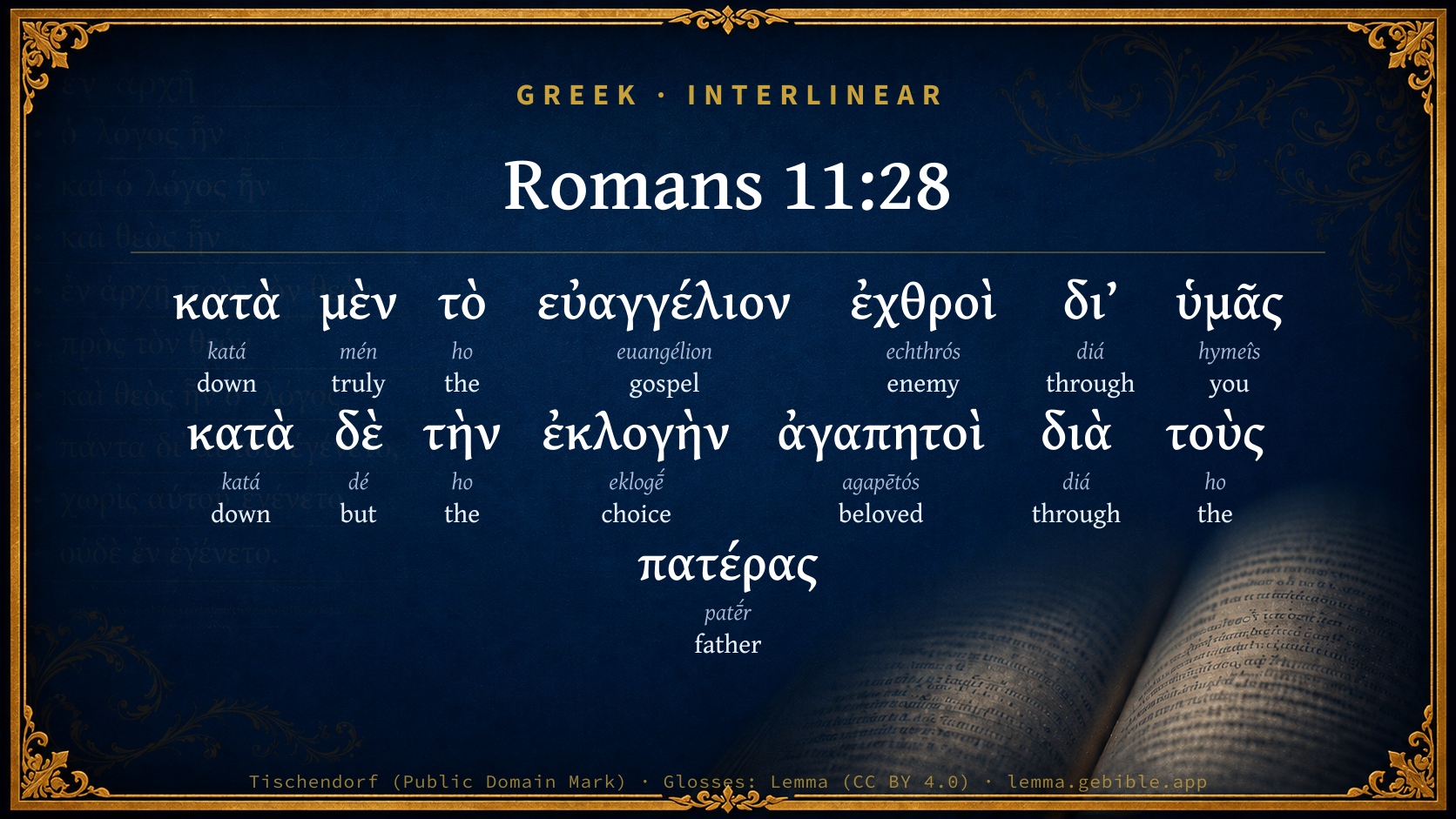
  1. κατὰ katá G2596 “down” Preposition
  2. μὲν mén G3303 “truly” Particle
  3. τὸ ho G3588 “the” Article, Accusative, Singular, Neuter
  4. εὐαγγέλιον euangélion G2098 “gospel” Noun, Accusative, Singular, Neuter
  5. ἐχθροὶ echthrós G2190 “enemy” Adjective, Nominative, Plural, Masculine
  6. δι’ diá G1223 “through” Preposition
  7. ὑμᾶς hymeîs G5210 “you” Personal pronoun, 2nd person, Accusative, Plural
  8. κατὰ katá G2596 “down” Preposition
  9. δὲ dé G1161 “but” Conjunction
  10. τὴν ho G3588 “the” Article, Accusative, Singular, Feminine
  11. ἀγαπητοὶ agapētós G27 “beloved” Adjective, Nominative, Plural, Masculine
  12. διὰ diá G1223 “through” Preposition
  13. τοὺς ho G3588 “the” Article, Accusative, Plural, Masculine
  14. πατέρας patḗr G3962 “father” Noun, Accusative, Plural, Masculine

About this verse

These counts appear in no published source. They are computed here, from the morphology-tagged text and Lemma’s own curated glosses. What Lemma adds →

15
words
11
distinct lemmas
Pauline Epistles
section

Notable vocabulary

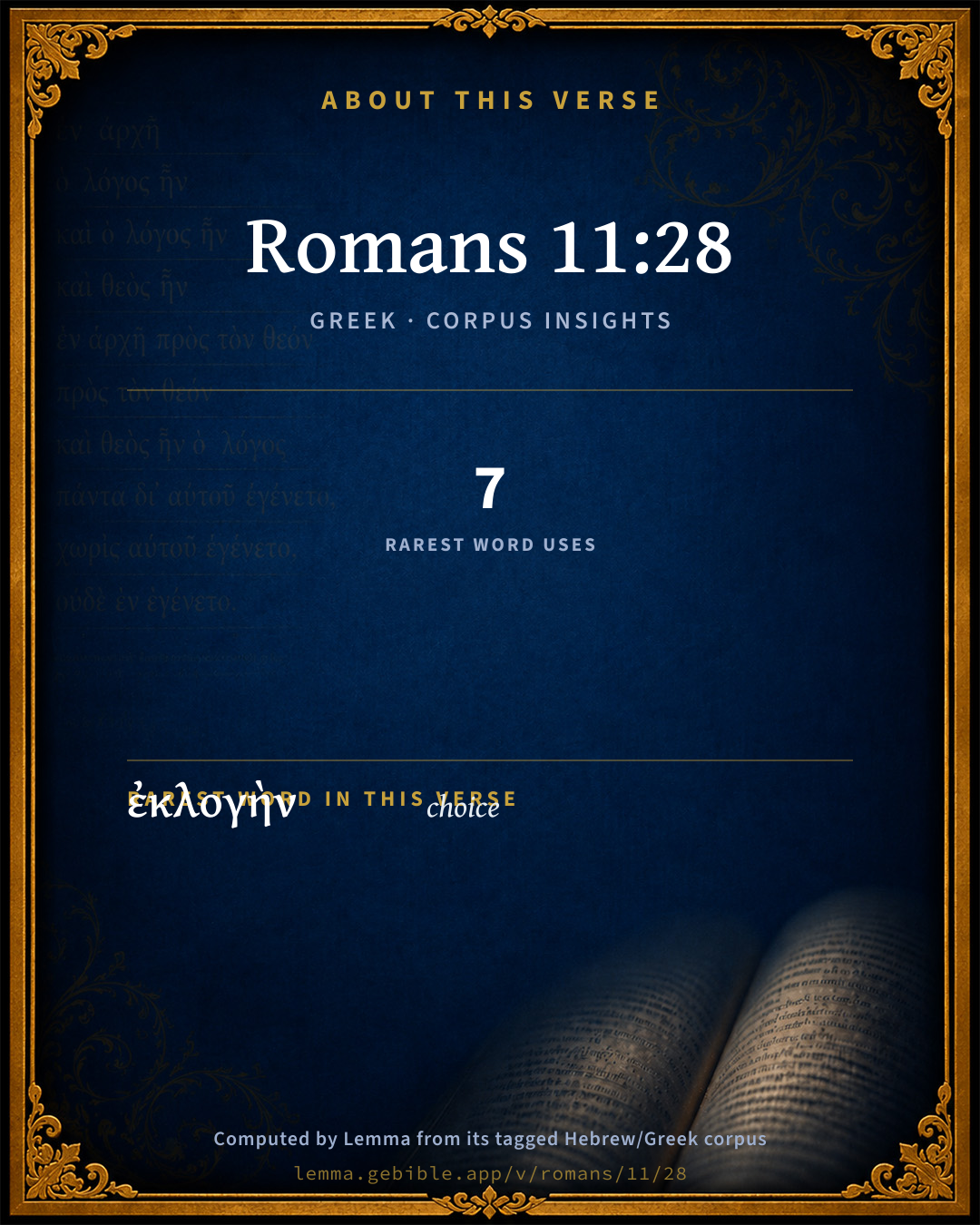
The rarest word here is ἐκλογὴν choice G1589 — appearing just 7 times in the whole Greek New Testament.

Shared distinctive vocabulary

ἐκλογὴν choice G1589 occurs in 7 verses of the Greek New Testament. Also found in:

Repetition

Words recur within this verse:

Cross-references

24

Topical passages linked to Romans 11:28 in the Treasury of Scripture Knowledge — connected by theme and wording, ordered by reader-vote popularity; previews shown in the World English Bible.

  • Deuteronomy 10:15 Only Yahweh had a delight in your fathers to love them, and he chose their seed after them, even you above all peoples, as at this day.
  • Deuteronomy 7:7–8 Yahweh didn't set his love on you, nor choose you, because you were more in number than any people; for you were the fewest of all peoples:
  • Matthew 21:43 "Therefore I tell you, the Kingdom of God will be taken away from you, and will be given to a nation bringing forth its fruits.
  • Romans 9:5 of whom are the fathers, and from whom is Christ as concerning the flesh, who is over all, God, blessed forever. Amen.
  • Romans 11:7 What then? That which Israel seeks for, that he didn't obtain, but the chosen ones obtained it, and the rest were hardened.
  • Luke 1:68–75 "Blessed be the Lord, the God of Israel, For he has visited and worked redemption for his people;
  • Acts 13:45–46 But when the Jews saw the multitudes, they were filled with jealousy, and contradicted the things which were spoken by Paul, and blasphemed.
  • Romans 11:11 I ask then, did they stumble that they might fall? May it never be! But by their fall salvation has come to the Gentiles, to provoke them to jealousy.
  • Leviticus 26:40–42 "'If they confess their iniquity, and the iniquity of their fathers, in their trespass which they trespassed against me, and also that, because they walked contrary to me,
  • Deuteronomy 4:31 for Yahweh your God is a merciful God; he will not fail you, neither destroy you, nor forget the covenant of your fathers which he swore to them.
  • Deuteronomy 8:18 But you shall remember Yahweh your God, for it is he who gives you power to get wealth; that he may establish his covenant which he swore to your fathers, as at this day.
  • Deuteronomy 9:5 Not for your righteousness, or for the uprightness of your heart, do you go in to possess their land; but for the wickedness of these nations Yahweh your God does drive them out from before you, and that he may establish the word which Yahweh swore to your fathers, to Abraham, to Isaac, and to Jacob.
  • Psalms 105:8–11 He has remembered his covenant forever, The word which he commanded to a thousand generations,
  • Isaiah 41:8–9 But you, Israel, my servant, Jacob whom I have chosen, the seed of Abraham my friend,
  • Jeremiah 31:3 Yahweh appeared of old to me, [saying], Yes, I have loved you with an everlasting love: therefore with loving kindness have I drawn you.
  • Micah 7:20 You will give truth to Jacob, and mercy to Abraham, As you have sworn to our fathers from the days of old.
  • 1 Thessalonians 2:15–16 who killed both the Lord Jesus and their own prophets, and drove us out, and didn't please God, and are contrary to all men;
  • Genesis 26:4 I will multiply your seed as the stars of the sky, and will give to your seed all these lands. In your seed will all the nations of the earth be blessed,
  • Genesis 28:14 Your seed will be as the dust of the earth, and you will spread abroad to the west, and to the east, and to the north, and to the south. In you and in your seed will all the families of the earth be blessed.
  • Luke 1:54 He has given help to Israel, his servant, that he might remember mercy,
  • Acts 14:2 But the disbelieving Jews stirred up and embittered the souls of the Gentiles against the brothers.
  • Acts 18:6 When they opposed him and blasphemed, he shook out his clothing and said to them, "Your blood be on your own heads! I am clean. From now on, I will go to the Gentiles!"
  • Romans 5:10 For if, while we were enemies, we were reconciled to God through the death of his Son, much more, being reconciled, we will be saved by his life.
  • Romans 11:30 For as you in time past were disobedient to God, but now have obtained mercy by their disobedience,

Cross-references courtesy of OpenBible.info (CC BY 4.0).

Commentary

Notes on Romans 11:28 from classic Christian and Jewish commentators (each source and its license shown beneath its notes). The classic Christian expositions comment on the surrounding passage and are grouped to its opening verse, so a note may address several verses; the Jewish commentaries on the Tanakh (Rashi and others) are per-verse, so they appear only where the commentator wrote on this verse.

Lemma curates 59 commentaries, every one of them public domain or Creative Commons licensed, each selected and text-cleaned for this edition rather than reprinted as found. About our sources →

The Biblical Illustrator

Joseph S. Exell

Rom_11:28-29

As concerning the gospel, they are enemies for your sakes.

Enemies may be unconscious helpers

During the siege of Sebastopol a Russian shell buried itself in the side of a hill without the city, and opened a spring. A little fountain bubbled forth where the cannon shot had fallen, and during the remainder of the siege afforded to the thirsty troops who were stationed in that vicinity an abundant supply of pure, cold water. Thus the missile of death from an enemy, under the direction of an overruling Providence, proved an almoner of mercy to the parched and weary soldiery of the allies. So often the efforts of men against Gods kingdom have been overruled to its furtherance. Every great attack upon the Bible has opened a new fountain of its truth to supply the wants of Gods people.

The relation of the Jewish nation to the Gentiles

I. Prior to the promulgation of the gospel. It was the relation of--

1. Sole depositories of the Word of God (Psa_76:1-12.; Amo_3:2). They had a revelation of Jehovah, while the others were in that ignorance at which the apostle declares God winked.

2. The channels for the transmission of the promised seed, in which all the nations of the earth were to be blessed. The tribe of Judah contained within it a sacred deposit, the God-man, the Saviour of the world. In this sense, salvation is of the Jews, the world was preserved for their sake. 3 The main spring of the politics of the world. Kings and empires were set up and cast down for their sakes.

II. Since the gospel. This must be regarded--

1. As it respects the remnant of the Jewish people converted to the Christian faith, according to the election of grace. These formed the stem of the Christian Church, Jesus Christ Himself, the founder of the Christian system, being a Jew according to the flesh. They were the first to be taken into union with Him; the first branches from Him the living stem; the first members of the body of which He is the head. They were not taken into fellowship with Gentiles, but Gentile converts were taken into fellowship with them (Eph_2:12-22; Eph_3:10). The relation, therefore, is that of brethen in Christ Jesus. And the relation which the Church, thus formed, bears to the world around is of the same nature as that which the Jews once bare to the Gentiles. The Christian Church--

(1) Is the sole depository of the truth. In this Church alone is Christ to be found; and in the Church alone, therefore, can God be known.

(2) Has deposited within her the true seed which is to become a blessing to all the earth.

(3) Is the main spring of the politics of the world. Can any man think on this subject with the Bible before him, and then deny that such men as Decius, Julian, Charlemagne, Napoleon, and others, were raised up for the promotion, in one way or other, of the interests of the Church.

2. As it respects the Jews as a nation. As concerning the gospel, they are enemies for your sakes; not the remnant--they are converted--but the nation. But though thus cast off for our sakes, they are not cast off beyond the reach of God; the same hand which put them off will protect and preserve them, for the gift and calling of God are without repentance. But they are enemies for our sakes: they bear the relation to us of poor outcasts--outcasts to make room for us; as if the tree could have but a certain number of branches, as if the body could have but a certain number of members, and God had cast off some of the branches, and removed some of the members, that we might become branches in Him who is the true Vine, and members united to Him who is the only head!

III. After the restoration.

1. Metropolitan pre-eminence (Isa_60:1-22; Mic_4:1-13.).

2. Spiritual blessing (Psa_67:1-7.). (H. M. McNeile, D.D.)

The mystery of God in relation to His ancient people

I. Its nature.

1. Enemies for your sakes.

2. Beloved for the fathers sakes.

II. Its immutable character

1. Depends on the immutable character of God.

2. And His unchangeable purpose. (J. Lyth, D.D.)

Beloved for the fathers sakes.

God loves when compelled to punish, and His affection for His ancient people should teach us to love them too. For the fathers sakes is Gods own reason for His love (Deu_7:7-8). There was nothing in Israel to attract it, for they were obstinate transgressors from the womb (Isa_48:4; Isa_48:8), and a disobedient and gainsaying people (Rom_10:21). So God loves sinners in Christ for His Sons sake. Gods love to the fathers remembered in behalf of the children (Lev_26:42). Blessing of godly ancestors. Children loved for their parents sakes. How privileged are the offspring of a godly stock; how great their responsibility; how deep should be their gratitude! (T. Robinson, D.D.)

For the gifts and calling of God are without repentance.--Without change of mind on Gods part; subject to no regret or change of purpose (2Co_7:10; Heb_12:17). God gives without variableness or shadow of turning (Jam_1:17). His gift to Israel only suspended or withdrawn for a season. He has not repented of calling Abraham and his seed as His people, nor regretted the promises made to the fathers. Mans conduct may change Gods manner but not His mind. Gods dealings may vary, but not His determinings; His providence may alter, but not His purposes. The Strength of Israel will not lie nor repent (1Sa_15:29). Gods unchangeableness the ground of Israels safety (Mal_3:6). God will not cast away His people (Deu_4:31; 1Sa_12:22). Israel is not to be permanently deprived of what God has promised them. (T. Robinson, D. D.)

The gifts and calling of God without repentance

They are so in respect to God the giver; He never repents that He hath called His people into the fellowship of His Son; and they are so on the believers part, who is never sorry, whatever afterwards he meets with, that he is brought to Christ. (J. Flavel.)

The immutability of God: a source of comfort

It is a source of comfort to the believer to reflect that that on which he puts his trust is established and immovable. Changes take place above and around the fortress, but its massive buttresses still stand unmoved, and its battlements frown defiance at the strength of the foe. The clouds above are fleeting past, it may be in silvery brightness, or it may be in pall-like gloom; the leaves are budding or fading, according to their seasons upon the earth but there stands the fortress, established and unchanged. (P. B. Power, M.A.)

The constancy of God

It has been supposed that the doctrine of Gods decrees would repel men, and drive them into infidelity. On the contrary, it draws men. Gods decrees may be taught so as to make men feel that they are oppressive; but the thought that the decrees of God run through time and eternity, and that He is true to them, so far from being repulsive, is exceedingly attractive. You might as well say that the laws of nature are repulsive as to say that Gods decrees are so. It is constancy that is the foundation of hope, and civilisation, and everything that is blessed in the world. Men are glad that light is always light, that electricity is always electricity, that all forces of nature are always true to their laws. Men are thankful that the stars revolve perpetually in their appointed courses. Men rejoice in the fact that there is fixity in all those methods by which the material universe is controlled. And the immutableness of God in the great elements of His character--truth, justice, goodness, and love--is subject-matter for profound gratulation. (H. W. Beecher.)

Gods purpose uninfluenced by difficulties

A man undertakes mining operations in such-and-such a place, he says, I shall dig for iron. Well, he meets with great difficulties, hard rocks to bore through, and so on. He comes to this conclusion, If I had known of this labour, and of the expense, I should not have sought for the metal here. But suppose the man to be well aware of everything, and that he meets with nothing but what he foresaw, then you may depend upon it that the man means business, and having commenced operations, he will continue working till he obtains that which he seeks after.

The Biblical Illustrator, edited by Joseph S. Exell (c. 1880s–1900s) — public domain. Text from a community e-Sword module.

Joseph Benson's Commentary

Rom 11:28-29. As concerning the gospel — That is, in reference to the gospel; they are enemies for your sakes — They reject it with the greater hatred, because you embrace it, or rather, (for they generally rejected the gospel before the Gentiles were called,) they reject the gospel, and thereby show that they are enemies to it, to God, and to themselves, which God permits for your sakes, and which turns to your advantage: (see on Rom 11:11; Rom 11:19; Rom 11:30:) but as touching the election, that part of them who believe, and therefore are chosen of God to be his people along with the believing Gentiles; they are beloved for the fathers’ sakes — God’s gracious regard to the memory of their pious ancestors, engages him peculiarly to love and favour them. Or, the election here spoken of may be that national election, whereby the Jews were made the church and people of God. See on chap, Rom 9:11. In respect of that election, the Jews, though unbelieving, and enemies in respect of the gospel, as is said in the former clause, are still beloved with a love of compassion and goodwill, for the special love God bore to Abraham and the rest of the patriarchs, from whom they are descended: and, in consequence of the promises made to their fathers, they shall, as a people, in some future period, become the people of God, by believing the gospel. It is justly observed by Whitby, that there is a two-fold election of the Jews spoken of in this chapter; one whereby they were made the people of God, through their natural descent from the fathers, and which Moses has described, Deu 7:6-8. The other, whereby such of them as believed on Christ, were made the people of God under the gospel dispensation. This election is mentioned Rom 11:7. For the gifts and calling of God, &c. — “The blessings which God freely bestowed on Abraham and his seed, and his calling, or making them his people, God will never repent of; but will restore to his natural seed the honour of being his people, after the Redeemer hath turned away their ungodliness of unbelief, Eze 16:60-62.” — Macknight.

Joseph Benson's Commentary on the Old and New Testaments (1811–1818) — public domain. Text from a community e-Sword module.

Bengel's Gnomon

Johann Albrecht Bengel

Rom 11:28. Ἐχθροὶ) enemies. Therefore the obstinacy of the Jews ought not to be alleged to the prejudice of their conversion. Moreover, they are called enemies, in an active sense; presently [by and by] they shall be called beloved in a passive sense (both in respect of God, not merely, of Paul); the evil is to be imputed to man; the good proceeds from God. So also mercy and unbelief are opposed to each other, Rom 11:30, etc.—διʼ ὑμᾶς, for your sakes, Rom 11:31; Rom 11:12; Rom 11:15.

Bengel's Gnomon of the New Testament — English translation (T&T Clark, Edinburgh, 1860) — public domain. Text from a community e-Sword module.

Meyer's Critical & Exegetical Commentary

Heinrich August Wilhelm Meyer

Rom_11:28 ff. Yet a final summary gathering up of the sacred-historical relation of Israel to God, and (Rom_11:29-32) discussion of it; in which, however, the reference, bearing on the apostles object, to the statement καὶ οὕτω πᾶς Ἰσραὴλ σωθήσεται does not require the parenthesizing of καθὼς γέγραπται κ.τ.λ. (Ewald), as in Rom_11:28 the substantive verb is easily and obviously supplied.

The unbelieving Israelites as such are the subject (αὐτῶν, Rom_11:27).

κατὰ τὸ εὐαγγ.] The relation is thereby designated, according to which they are ἐχθροί. The gospel was preached to them; but they rejected it, in which relation they are hated of God. In conformity with the message of salvation, which reached them, but was despised by them (comp. Rom_11:25), they must necessarily be ἐχθροί; since in fact, not accepting the δικαιοσύνη proffered in the gospel, they remained under the wrath of God (Rom_11:7). According to the context, we must think of the ἀπείθεια of the Jews, Rom_11:30; and therefore neither of their exclusion from the gospel (Fritzsche), nor even of the diffusion of the latter (Rückert).

ἐχθροί] not my enemies (Theodoret, Luther, Grotius, Semler, and others), nor yet enemies of the gospel (Chrysostom, Theophylact, Michaelis, Morus, Rosenmüller). That, on the contrary, Θεῷ (see on Gal_4:16) is to be supplied, as Θεοῦ with ἀγαπητοί, is evident generally from the connection with Rom_11:27; Rom_11:29; and that ἐχθροί is to be explained not in an active (Olshausen, van Hengel, Ritschl, and older interpreters), but in a passive sense (to whom God is hostile), is shown by the contrast of ἀγαπητοί. Comp. on Rom_5:10.

διʼ ὑμᾶς] for your sake, because you are thereby to attain to salvation, Rom_11:11.

κατὰ τὴν ἐκλ.] is usually taken: as fellow-members of the nation elected to be the people of God; comp. Rom_11:2. But ἐκλογήdifferently from the προέγνω, Rom_11:2has already been clearly defined in Rom_11:5; Rom_11:7 as the elect λεῖμμα, and hence, with Ewald, is here also to be taken in this sense. Consequently: in conformity with the fact, however, that among them is that elect remnant. This believing ἐκλογή is the living testimony of the undying love of God towards the people. Comp. Rom_11:5.

διὰ τοὺς πατ.] for the fathers sake. Calvin aptly remarks: Quoniam ab illis propagata fuerat Dei gratia ad posteros, secundum pacti formam: Deus tuus et seminis tui; comp. Rom_11:16; Luk_1:54-55.

Meyer — Critical and Exegetical Commentary on the New Testament — English translation by Peter Christie, edited by Frederick Crombie (T&T Clark, 1880) — public domain. Text from a community e-Sword module.

Expositor's Greek Testament

ed. W. Robertson Nicoll

Rom 11:28 . κατὰ μὲν τὸ εὐαγγέλιον . In both clauses κατὰ defines the rule by which God’s relation to Israel is determined. When He looks at the Gospel, which they have rejected, they are ἐχθροὶ , objects of His hostility, and that διʼ ὑμᾶς , for the sake of the Gentiles, to whom the Gospel in this way comes; when He looks at the ἐκλογὴ , the choice which He made of Israel to be His people, they are ἀγαπητοὶ , objects of His love, and that διὰ τοὺς πατέρας , on account of Abraham, Isaac and Jacob, with whom He made an everlasting covenant ( cf. Gen 17:19 , Luk 1:54 f.). The passive meaning of ἐχθροὶ is fixed by the contrast with ἀγαπητοὶ , as well as by the logic of the passage: cf. Rom 5:10 .

The Expositor's Greek Testament, edited by W. Robertson Nicoll (1897–1910) — public domain. Text from a community e-Sword module.

Godet's Commentaries

Frédéric Louis Godet

Vv. 28, 29. “As touching the gospel, they are, it is true, enemies for your sakes; but as touching the election, they are beloved for the fathers’ sake; for the gifts and calling of God are irrevocable.”

To sum up, Israel are in a two-fold relation to God, at once enemies and beloved; but the latter character will carry it in the end over the former. The term ἐχθρός, hated, opposed as it is here to ἀγαπητός, beloved, can only be taken in the passive sense: an object of the hatred, that is to say, of the just wrath of God; comp. chap. Rom 5:10. It needs not be said that when the feeling of hatred is applied to God, we must eliminate from it all admixture of personal resentment, or of the spirit of revenge. God hates the sinner in the same sense in which the sinner ought to hate himself, that is to say, his own life. This sentiment is only the hatred of holiness to evil; and then to the wicked man in so far as he is identified with evil.

The words: as concerning the gospel, refer to what was said above: that the Jews being once determined not to abandon their law and their monopoly founded on it, needed to be struck with blindness, so that they might not discern in Jesus their Messiah; otherwise a Judaized gospel would have hindered the offer of salvation to the Gentile nations. The apostle might therefore well add to the words: as concerning the gospel, the further clause: for your sakes.

But in every Jew there is not only an object of the wrath of God, there is an object of His love. If it is asked how these two sentiments can co-exist in the heart of God, we must remark, first, that the same is the case up to a certain point with respect to every man. In every man there co-exist a being whom God hates, the sinner, and a being whom He still loves, the man created in His image, and for whom His Son died. Then it must be considered that this duality of feelings is only transitory, and must issue finally either in absolute hatred or perfect love; for every man must arrive at the goal either absolutely good or absolutely bad of his moral development, and then the divine feeling will be simplified (see on chaps. Rom 5:9-10).

The words: as touching the election, must not be referred, as Meyer will have it, to the elect remnant, as if Paul meant that it is in consequence of this indestructible elect that God always loves Israel. The antithesis to the expression: as concerning the gospel, leads us rather to see in election the divine act by which God chose this people as the salvation people. This idea is reproduced in the following verse by the expression: ἡ κλῆσις τοῦ Θεοῦ, the calling of God.

This notion of election is closely connected with the explanatory regimen: for the fathers’ sake. It was in the persons of Abraham, Isaac, and Jacob that the divine election of Israel was originally realized, and through them that it was transmitted to the whole people. The love with which God loved the fathers continues toward their descendants “even to a thousand generations” (Exo 20:6). Only let the hearts of the children return to their fathers, that is to say, let them return to the sentiments of their fathers (Mal 4:6; Luk 1:17), and the beneficent cloud which is always spread over their head will again distil its dew on them.

Vv. 29. This verse justifies the assurance of salvation expressed in favor of Israel in the second proposition of Rom 11:28. The gifts of God might denote divine favors in general; but it seems to us more in harmony with the context, which refers throughout to the destination of Israel, to give this term the special meaning which it usually has in St. Paul’s Epistles. He there uses the word to denote the moral and intellectual aptitudes with which God endows a man with a view to the task committed to him. And who can fail to see that the people of Israel are really endowed with singular qualities for their mission as the salvation-people? The Greeks, the Romans, the Phoenicians had their special gifts in the different domains of science and art, law and politics, industry and commerce. Israel, without being destitute of the powers related to those spheres of mundane activity, have received a higher gift, the organ for the divine and the intuition of holiness. The calling of God is on the one hand the cause, on the other the effect of those gifts. It is because God called this people in His eternal counsel that He entrusted the gifts to them; and it is because he enriched them with those gifts that in the course of time He called them to fulfil the task of initiating the world in the way of salvation, and of preparing salvation for the world. Of this august mission they have for the time been deprived: instead of entering first, they will enter last. But their destination is nevertheless irrevocable; and through the overflowing of divine mercy (chap. Rom 5:20) it will be realized in them at the period announced by the apostle, when, saved themselves, they will cause a stream of life from above to flow into the heart of Gentile Christendom (Rom 15:12; Rom 15:15; Rom 15:25-26).

This irrevocable character of Israel’s destination has nothing in it contrary to individual liberty; no constraint will be exercised. God will let unbelieving generations succeed one another as long as shall be necessary, until that generation come which shall at length open its eyes and return freely to Him. And even then the movement in question will only be a national and collective one, from which those shall be able to withdraw who refuse decidedly to take part in it. Only it is impossible that the divine foreknowledge in regard to Israel as a people (“the people whom God foreknew,” Rom 11:2) should terminate otherwise than by being realized in history.

There is nothing in this passage pointing to a temporal restoration of the Jewish nation, or to an Israelitish monarchy having its seat in Palestine. The apostle speaks only of a spiritual restoration by means of a general pardon, and the outpouring of the graces which shall flow from it. Will there be a political restoration connected with this general conversion of the people? Or will it not even precede the latter? Will not the principle of the reconstitution of races, which in our day has produced Italian unity, German unity, and which is tending to the unity of the Slavs, also bring about Israelitish unity? These questions do not belong to exegesis, which confines itself to establishing these two things—(1) That according to apostolical revelation, Israel will be converted in a body; (2) That this event will be the signal of an indescribable spiritual commotion throughout the whole church.

The theme of the chapter is properly exhausted; we are furnished with light from all points of view, that of right, that of cause, and that of aim, on the mysterious dispensation of the rejection of Israel. Nothing remains but to gather up what has been said of the past and future of this elect people into a general view of God’s plan as to the religious progress of humanity. This is what the apostle does in Rom 11:30-32.

Frédéric Louis Godet — Commentaries on Luke, John, Romans, and 1 Corinthians — English translation (T&T Clark, Edinburgh, 1870s–1890s) — public domain. Text from a community e-Sword module.

Hodge's Commentary on Romans, Ephesians & First Corinthians

Charles Hodge

Rom_11:28

As concerning the gospel, they are enemies for your sakes; but as touching the election, they are beloved for the fathers sakes. In this and the few following verses, the apostle sums up what he had previously taught. The Jews, he says, were now, as far as the gospel was concerned, regarded and treated as enemies, for the benefit of the Gentiles; but, in reference to the election, they were still regarded as the peculiar people of God, on account of their connection with the patriarch. They are enemies, whether of the gospel, of the apostle, or of God, is not expressed, and therefore depends on the context. Each view of the clause has its advocates. The last is the correct one, because they are enemies to him, by whom, on one account, they are beloved. The word ἐχθροί; may be taken actively or passively; see Rom_5:10. They are inimical to God, or they are regarded and treated as enemies by him. The latter best suits the context. They are now aliens from their own covenant of promise.

As concerning the gospel, κατὰ τὸ ἐυαγγέλιον, that is, the gospel is the occasion of their being regarded as enemies. This is explained by a reference to Rom_11:11, Rom_11:15. By their punishment the progress of the gospel has been facilitated among the Gentiles; and therefore the apostle says, it is for your sakes they are thus treated. On the other hand, κατὰ δὲ τὴν ἐκλογήν, as it regards the election, or the covenant of God, they are still regarded with peculiar favor, because descended from those patriarchs to whom and to whose seed the promises were made. This is but expressing in a different form the idea which the apostle had previously presented, viz., that the covenant made with Abraham was inconsistent with the final rejection of the Jews, as a people. God foresaw and predicted their temporary defection and rejection from his kingdom, but never contemplated their being for ever excluded; see Rom_11:16, Rom_11:25-27. Paulus autum docet, ita (Judaeos) fuisse ad tempus Dei providentia excaecatos, ut via evangelio ad gentes sterneretur: caeterum non esse in perpetuum a Dei gratia exclusos. Fatetur ergo Deum non esse immemorem foederis, quod cum patribus eorum pepigit, et quo testatus est, se aeterno consilio gentem illam dilectione complexam esse. Calvin.

Charles Hodge — Commentary on Romans (1835), First Corinthians (1857), and Ephesians (1856) — public domain. Text from a community e-Sword module.

Geneva Bible (1599)

Geneva Bible translators

Forasmuch as they received it not.

Again, that he may join the Jews and Gentiles together as it were in one body, and especially may teach what duty the Gentiles owe to the Jews, he beateth this into their heads, that the nation of the Jews is not utterly cast off without hope of recovery.

In that, that God respecteth not what they deserve, but what he promised to Abraham.

Geneva Bible (1599) marginal notes — public domain. Text via Bolls.life.

Jamieson, Fausset & Brown

Robert Jamieson, A. R. Fausset & David Brown

As concerning the Gospel they are enemies for your sakes--that is, they are regarded and treated as enemies (in a state of exclusion through unbelief, from the family of God) for the benefit of you Gentiles; in the sense of Rom 11:11, Rom 11:15.

but as touching, the election--of Abraham and his seed.

they are beloved--even in their state of exclusion for the fathers' sakes.

Jamieson, Fausset & Brown — Commentary Critical and Explanatory on the Whole Bible (1871) — public domain (CC PDM 1.0). Text via the HelloAO Bible API.

Adam Clarke's Commentary

Verse 28. As concerning the Gospel] The unbelieving Jews, with regard to the Gospel which they have rejected, are at present enemies to God, and aliens from his kingdom, under his Son Jesus Christ, on account of that extensive grace which has overturned their peculiarity, by admitting the Gentiles into his Church and family: but with regard to the original purpose of election, whereby they were chosen and separated from all the people of the earth to be the peculiar people of God, they are beloved for the fathers' sake; he has still favour in store for them on account of their forefathers the patriarchs.

Adam Clarke's Commentary on the Bible (1810–1826) — public domain. Text from a community e-Sword/MySword module.

John Calvin's Commentaries

28. With regard indeed to the gospel, etc. He shows that the worst thing in the Jews ought not to subject them to the contempt of the Gentiles. Their chief crime was unbelief: but Paul teaches us, that they were thus blinded for a time by God’s providence, that a way to the gospel might be made for the Gentiles; and that still they were not for ever excluded from the favor of God. He then admits, that they were for the present alienated from God on account of the gospel, that thus the salvation, which at first was deposited with them, might come to the Gentiles; and yet that God was not unmindful of the covenant which he had made with their fathers, and by which he testified that according to his eternal purpose he loved that nation: and this he confirms by this remarkable declaration, — that the grace of the divine calling cannot be made void; for this is the import of the words, —

John Calvin's Commentaries (1540-1563) — public domain. Text from the Calvin Translation Society English edition (1840s-50s) via the Christian Classics Ethereal Library (ccel.org). Calvin's coverage is partial (roughly two-thirds of the Bible); uncommented books and verses are honest gaps, never fabricated. The 19th-century editor's footnotes and remarks are omitted so the notes are faithfully Calvin's own voice.

Ellicott's Commentary for English Readers

(28) The real position of the Jews is this: They have been suffered to fall into a state of estrangement in order to make room for the Gentiles. But this does not abrogate God’s original choice of them. They are still His beloved people, for the sake of their forefathers, the patriarchs, if not for their own.

A Bible Commentary for English Readers, edited by Charles John Ellicott (1878–1897) — public domain. Text from a community e-Sword module.

The Cambridge Bible for Schools and Colleges

gen. ed. J. J. S. Perowne

28. As concerning, &c.] This ver. and the next form a small detached paragraph: so do Rom_11:30-32. In both these paragraphs St Paul adds to his main argument and statement a few closing confirmations.—The phraseology of this verse is very brief in the Gr.; As to the Gospel indeed, enemies because of yon; but as to the election, beloved because of the fathers.

concerning the gospel] The verse may be paraphrased; “With a view to the spread of the Gospel, which is the message of salvation for every believer, Jew or Gentile, (Rom_1:16,) it pleased God in His sovereign plan to reject the great majority of the Jews—in order to open His kingdom wide to you. But with a view to the believing element, the elect Jews of every age, including the great multitude to be called to grace hereafter, the Jews are still dear to Him; for His Covenant with Abraham, Isaac, and Jacob is sovereign and unchangeable.”

enemies]. See on ch. Rom_5:10. The meaning here is that the Lord was (judicially) hostile to them; viewed them as hostile, “counted them His enemies in the sense of rejecting them from actual participation in His Gospel. Unbelief cut them off, and was their own sin; but it was judicially and sovereignly permitted to have its way. But meantime, in another aspect, they were still “beloved;” still included in a plan of mercy.

the election] The word “election” may mean either the act of choice, or the chosen persons. Here it is probably the latter. The word is with the definite article, as in Rom_11:7. The reference is to the whole number of Jews who had obtained, or should obtain, salvation by faith; whether gathered in one by one, as now, or in multitudes, as hereafter. “With a view to” these, the Jewish people is still, most emphatically, within the purposes of Divine Love.

for the fathers’ sakes] See Deu_7:8; Deu_9:5; Deu_10:15.

The Cambridge Bible for Schools and Colleges (gen. ed. J. J. S. Perowne; Cambridge University Press, 1878–1918) — public domain. Text from a community e-Sword module.

John Gill's Exposition

As concerning the Gospel,.... Whereas it might be objected to the call and conversion of the Jews, their implacable enmity to the Gospel, the apostle replies, by granting, that with respect to that,

they were enemies to God and Christ, to the Gospel, and the ministers of it, and particularly to the apostle:

for your sakes; the Gentiles, to whom it was preached, and by whom it was received, and which greatly irritated and provoked the Jews; or the sense is, that they were suffered to reject the Gospel, and treat it with hatred and virulence, that by this means it might be taken away from them, and carried to the Gentiles; so that the present enmity of the Jews to the Gospel, turned to the advantage of the Gentiles, and should not hinder the future conversion of God's elect among them in the latter day:

but as touching the election, they are beloved for the fathers' sakes; as many of them as belong to the election of grace, are beloved of God; and will appear to be so, when they are called by grace, as they will be, for the confirming of the promises concerning their future restoration made unto their fathers; not one of which shall ever fall to the ground, or they be deprived of any gifts and blessings of grace, which God has purposed for them, or promised to them, as is clear from what follows:

John Gill's Exposition of the Whole Bible (1746–1763) — public domain (CC PDM 1.0). Text via the HelloAO Bible API.

Trapp's Complete Commentary

John Trapp

28 As concerning the gospel, they are enemies for your sakes: but as touching the election, they are beloved for the fathers’ sakes.

Ver. 28. They are enemies] i.e. Hated of God, as appears by the opposition; and banished, as it were, by a common consent of nations, out of human society. See 1Th 2:15-16.

John Trapp, A Commentary or Exposition upon All the Books of the Old and New Testament (1647–1656) — public domain. Text from a community e-Sword module.

Albert Barnes' Notes on the Bible

As concerning the gospel - So far as the gospel is concerned; or, in order to promote its extension and spread through the earth.

They are enemies - The word “enemies” here stands opposed to “beloved;” and as in one respect, to wit, on account of “election,” they were still beloved, that is, beloved by God, so in another respect they were his enemies, i. e., opposed to him, or cast off from him. The enemies of God denote all who are not his true friends; Col 1:21; Rom 5:10; compare Rom 11:8. The word here is applied to the Jews because they had rejected the Messiah; had become opposed to God; and were therefore rejected by him.

For your sakes - For your advantage. Their rejection has become the occasion by which the gospel has been preached to you; compare Rom 11:11, Rom 11:19-20.

As touching the election - So far as the purpose of election is concerned. That is, the election of their fathers and of the nation to be the special people of God.

They are beloved - God still regards them with interest; has purposes of mercy toward them; intends still to do them good. This does not, mean that he approved of their conduct or character, or that he had for them the same kind of affection which he would have had if they had been obedient. God does not love a sinful character; but he may have still purposes of mercy, and regard people with deep interest on whom he intends yet to bestow mercy.

For the fathers’ sakes - Compare Deu 10:15. He had chosen their fathers to be His special people. He had made many promises to Abraham respecting his seed, and extended these premises to his remotest posterity. Though salvation is by grace, and not from human merit, yet God has respect to his covenant made with the fathers, and will not forget his promises. It is not on account of any merit of the fathers or of ancient saints, but solely because God had made a covenant with them; and this purpose of election would be manifest to their children in the latest times. As those contemplated in the covenant made with Abraham, God retained for them feelings of special interest; and designed their recovery to himself. It is clear here that the word “election” does not refer to external privileges; for Paul is not teaching the doctrine that they shall be restored to the external privileges of Jews, but that they shall be truly converted to God. Yet this should not be abused by others to lead them to security in sin. No man has any security of happiness, and of the favor of God, but he who complies with the terms of his mercy. His commands are explicit to repent and believe, nor can there be safety except in entire compliance with the terms on which he is willing to bestow eternal life.

Albert Barnes' Notes on the Bible (1834–1885) — public domain. Text from a community e-Sword/MySword module.

Haydock's Catholic Bible Commentary

According to the gospel, indeed, they are enemies for your sake. That is, enemies both to you, because they see the gospel preached and received by you, and enemies of God, because he has rejected them at present for their wilful blindness: yet according to election, God having once made them his elect, and because of their forefathers, the patriarchs, they are most dear for the sake of the fathers: for the gifts and the calling of God are without repentance, in as much as God is unchangeable, and his promises, made absolutely, cannot fail. (Witham)

George Leo Haydock (1774–1849), Haydock's Catholic Family Bible and Commentary, 1859 edition — public domain. Excludes Psalms (Douay-Rheims chapter numbering differs from Protestant) and Deuterocanonical books (Catholic canon only).

Whedon's Commentary on the Bible

Daniel D. Whedon

28. Regarding the Gospel, they are its enemies; yet it is for your sakes, as its offer thereby has come to you. Had the Jew accepted the gospel it would have come to the Gentile from the Jew. But this was postponed, and the entire kingdom of God put back to the latter day, when Jew, converted by Gentile, shall turn and convert Gentile.

The election—The election of the Abrahamic line treated in Rom_9:6-14. This election, as has been shown, was conditioned on faith.

Fathers’ sakes—The line, in the wonderful providence of God, is even to the present day maintained in its separateness, reserved to the day of faith and salvation.

Daniel D. Whedon (gen. ed.), Commentary on the Old and New Testaments (1874–1909) — public domain. Text from a community e-Sword module.

The Pulpit Commentary

Vers. 28, 29. As touching the gospel indeed (with regard to acceptance of the gospel now) they are enemies for your sakes (for their having become God"s enemies by rejecting and opposing it has been the occasion of your having been now called in): but as touching the election (God"s original choice of Israel to be his people. Eklogh here cannot well have a concrete sense, as in ver. 7), they are beloved for the fathers" sakes. For the gifts (carismata , meaning "free gifts," or "gifts of grace;" the word used to denote the special gifts of the Holy Ghost showered after Pentecost in the apostolic Church; but expressing generally, as here, whatever God, of his own good will, grants freely) and the calling of God are without repentance. (i.e. unrepented of by him and irrevocable; cf. Num_23:19, Num_23:20; also 1Sa_15:29) This denial of anthropopathy in God is asserted as a general truth, to be applied to his calling of "the fathers," i.e. the patriarchs, and their seed after them, to be his people. It is true that, as is shown in Ro 4, there is a spiritual seed of Abraham, not necessarily of the house of Israel, to whom the promises in their ultimate scope were to be fulfilled; but the apostle regards it as impossible that the promises made primarily to the chosen people themselves should be revoked or fail of eventual fulfilment to them.

The Pulpit Commentary (1880–1919), ed. H.D.M. Spence-Jones & Joseph S. Exell — public domain. Text from a community e-Sword module.

John Wesley's Explanatory Notes

They are now enemies - To the gospel, to God, and to themselves, which God permits. For your sake: but as for the election - That part of them who believe, they are beloved.

John Wesley, Explanatory Notes Upon the Whole Bible (1754–1765) — public domain. Text via the GEBible commentary corpus.

Kretzmann's Popular Commentary

Paul E. Kretzmann

God’s mercy upon all:

v. 28. As concerning the Gospel, they are enemies for your sakes; but as touching the election, they are beloved for the fathers’ sakes.

v. 29. For the gifts and calling of God are without repentance.

v. 30. For as ye in times past have not believed God, yet have now obtained mercy through their unbelief,

v. 31. even so have these also now not believed, that through your mercy they also may obtain mercy.

v. 32. For God hath concluded them all in unbelief that he might have mercy upon all.

This statement is parallel to the previous one; it makes practically the same assertion regarding the great mass of the unbelieving Jews. According to the Gospel, so far as the Gospel is concerned, they are enemies for your sakes, but according to the election, so far as the election is concerned, they are beloved because of the fathers. On the one hand, the Jews are enemies of God, because they are hostile in their attitude to the Gospel. And this attitude has resulted in the benefit of the Gentiles, it has given them salvation. This is true of unbelief in general. On the other hand, they are beloved of God, so far as the election is concerned. God loves the Jews, to whom the apostle here refers, because He has chosen them from the beginning, has selected them for His own. This act of God was done for the sake of, in the interest of, the fathers, the patriarchs; for unregretted are the gifts and the calling of God. What God has once decided upon with reference to the election of grace is not subject to change and recall on His part. In extending His gracious call to the patriarchs, in making them the bearers of the promise, He has called them to salvation in Christ. Because God has chosen the Jews from the beginning and called them by and in the promise given to the fathers unto salvation in Christ, and because this election and call of God must surely accomplish its object, therefore the Jews whom Paul here has in mind are even now, although as yet without faith, beloved of God. According to their unbelief, they are enemies of God, who must condemn their hatred of Him; but according to the election, they are His beloved, although not yet in possession of salvation.

This saying sounds so self-contradictory that Paul adds a further word of explanation: For even as you at one time were disobedient to God, but now have experienced His mercy through the unbelief of these Jews, thus also these now have become disobedient, in order that through the mercy which you have experienced they also now might receive mercy, vv. 30-31. The Gentile Christians before their conversion had been disobedient to the will of God, chap. 1:18 ff. But now, having heard the Gospel, these former Gentiles had experienced and received the mercy of God. And this great boon had come upon them through the disobedience of the Jews, because the Jews at that time did not want to accept the Messiah and the obedience of the Gospel. And in the same manner, St. Paul argues, the Jews have entered into the state of disobedience, of unbelief, and therefore may well be shown the mercy of God unto conversion, the same mercy and grace which the heathen have experienced. What God did to the Gentiles He is fully able to do for the Jews, who are now in the position with reference to God which the Gentiles formerly occupied; He is able to change the disobedience of the Jews into obedience, just as He did in the case of the Gentiles. For God-has comprehended, taken together, all these under disobedience, in order to have mercy upon all; He has abandoned all the people of whom the apostle has spoken to disobedience, that in His time He might bring them to faith and impart to them His mercy in Jesus Christ. What an untold wealth of mercy is that of our God in using even the obstinacy and the trespasses of men in order to bring the riches of His grace to others! Note: This mercy should have its effect upon us also in this way, that we make use of merciful patience in judging and in dealing with other people. God may well do for those that are now in the depths of unbelief and contradiction against God what He did for us, and thus bring them into the fellowship of His Son Jesus Christ.

Paul E. Kretzmann, Popular Commentary of the Bible (1921–1924) — public domain. Text from a community e-Sword module.

Burkitt's Expository Notes on the New Testament

William Burkitt

Here we have two farther arguments to prove the general conversion of the Jews: the first is taken from the dignity of the Jews, they being the ancient people of God, whose father Abraham he chose, and made his first covenant with him and his seed; and therefore as to making the election of that nation to be an holy people to himself, they are beloved by God for their father’s sake; that is, for the sake of Abraham their holy progenitor, who had the honour to be called the friend of God.

Though grace descends not from parent to child, yet many times the children of godly parents are very large sharers in outward privileges and blessings for their gracious parents’ sake. The Jews here are said to be beloved of God for their father Abraham’s sake, whilst for their unbelief and contempt of the gospel, they had rendered themselves the deserved object of God’s hatred.

The second argument is drawn from the immutability and unchangeable nature of God; His gifts and callings are without repentance; that is, although the Jews have rendered themselves unworthy of the favour of God, yet the covenant having been once made with the fathers, and they having had the honour to be his special and peculiar people, God will never repent of his kindness to them, nor of his covenant made with them; but will certainly restore them to their former privileges and happy state; for the gifts and calling of God are without repentance.

Take the words relatively, and the note is this, "That the gifts and calling of God, whereby he was pleased to adopt the posterity of Abraham, and to engage himself by covenant to them, are inviolable, and such as shall never be reversed or repented of."

Observe lastly, the sad and deplorable condition which the Jews are at present in and under; they are enemies to the gospel. As concerning the gospel, they are enemies for your sake; that is, because you Gentiles receive the gospel, therefore the Jews reject it, and for that reason are rejected by God. But this happened well to the poor Gentiles; for upon the Jews’ refusal, the gospel was brought the sooner to the Gentiles, and they were converted by it.

William Burkitt's Expository Notes on the New Testament (1700–1703) — public domain. Text from a community e-Sword module.

Godbey's Commentary on the New Testament

William B. Godbey

28. “Indeed, they are enemies touching the gospel for your sakes, but beloved as touching election for the fathers’ sake.” The Jews are God’s miracle of providence. They are a wonder in every land, unlike any other people, with no country on which to accumulate, vagabonds in the earth, yet getting rich where all others come to poverty. They are God’s elect; His covenant is with them.

William B. Godbey, Commentary on the New Testament (1896–1900) — public domain. Text from a community e-Sword module.

McGarvey & Pendleton's Commentaries

J. W. McGarvey

As touching the gospel, they [the unbelieving Israelites] are [regarded by God as] enemies for your sake [that their fall might enrich you. See Rom_11:12 ]: but as touching the election, they are beloved for the fathers' sake. [Or on account of the fathers. The call, or election, of Israel gave them national, hereditary rights (of which salvation was not an essential part; it being eternally designed to be an individual, not a national, matter) that were to last to the end of the world ( Lev_26:40-45 ); but which provided for, or anticipated, that break, interim or hiatus known as "the times of the Gentiles." During all the years of the Gentile dispensation God cast off his people and regarded them as enemies in every field of vision where they came in conflict with or interfered with the Christians, or New Covenant, Gentile people. Yet, notwithstanding, in all other respects they have been and will be loved and cared for by God, on account of his own love for the fathers, and his eternal covenants with them. This mixture of present enmity and future benevolence characterizes God's attitude toward every unrepentant sinner who is to become a future saint. So long as he abides in sin he is an enemy, yet loved for the sake of the Lord Jesus. The condition of the Jew is therefore well defined. His ancestral covenants have no value unto salvation, but they are invaluable as an assurance that he shall be continued as a people until he accepts the gospel which is the covenant unto salvation.]

J. W. McGarvey (with Philip Y. Pendleton), Commentaries on the New Testament (The Fourfold Gospel, 1914; Acts; and the epistles) — public domain. Text from a community e-Sword/MySword module.

The People's New Testament

B. W. Johnson

28–32. As touching the gospel, they are enemies for your sake. Their rejection of the gospel had proved a blessing to the Gentile world. See verse 11. Hence their enmity was allowed for the sake of the conversion of the Gentiles. As touching the election. The nation was a chosen nation. Though enemies of God, God still remembered that they were children of Abraham, Isaac and Jacob, and did not cast them off forever, but remembered them in love. To this day he has preserved Israel, and yet purposes the salvation of the nation.

B. W. Johnson's The People's New Testament with Notes (1889–1891) — public domain. Electronic text from the Christian Classics Ethereal Library (CCEL) ThML edition.

unfoldingWord translationNotes

Door43 World Missions Community

As far as the gospel is concerned

You can make explicit why Paul mentions the gospel. AT: "Because the Jews rejected the gospel" (See: Assumed Knowledge and Implicit Information)

they are enemies for your sake

You can make explicit whose enemies they are, and how this was for the Gentiles' sake. AT: "they are God's enemies for your sake" or "God has treated them as enemies in order that you also might hear the gospel" (See: Assumed Knowledge and Implicit Information)

as far as election is concerned

You can make explicit why Paul mentions election. AT: "because God has elected the Jews" or "because God has chosen the Jews" (See: Assumed Knowledge and Implicit Information)

they are beloved because of their forefathers

You can make explicit who loves the Jews and why Paul mentions their forefathers. You can also translate this in an active form. AT: "God still loves them because of what he promised to do for their ancestors" (See: Assumed Knowledge and Implicit Information and Active or Passive)

For the gifts and the call of God are unchangeable

Paul speaks of the spiritual and material blessings that God promised to give his people as if they were gifts. The call of God refers to the fact that God called the Jews to be his people. AT: "For God never changed his mind about what he has promised to give them, and about how he has called them to be his people" (See: Metaphor and Assumed Knowledge and Implicit Information)

translationWords

good news

God

beloved

gift

call

unfoldingWord translationNotes — © Distant Shores Media and the Door43 World Missions Community, licensed CC BY-SA 4.0. Source: git.door43.org/Door43/en_tn.

Cambridge Greek Testament for Schools and Colleges

28. κατὰ μὲν. The verse states in another form the fact laid down in 25 b. Hence the asyndeton. The Gospel preached by S. Paul, by its abolition of law and inclusion of Gentiles, involved, as a matter of fact, the throwing of the greater part of Israel into a state of hostility to GOD: that hostility was incurred for the sake of the Gentiles: but that does not involve a change in GOD’s original purpose in selecting Israel; His love still holds towards them for the sake of the fathers in whom that purpose found its first expression and a true response; cf. above Rom 11:1.

τὴν ἐκλογὴν. The choice made long before—of Abraham and Israel; cf. Rom 11:5, Rom 9:11.

τοὺς πατέρας, Rom 9:5; Act 3:25; Act 13:17; Act 13:32; infra, Rom 15:8; 1Co 10:1; Heb 1:1; Heb 8:9 (qu.). There seems no strong reason for limiting the reference to the Patriarchs. The plural seems to include the whole ancestry of Israel, here regarded as the object of GOD’s love shown in His earlier dispensation. It is for the sake of them, on whom He had lavished so much, that their wayward descendants are still not allowed to travel beyond the range of His love.

Cambridge Greek Testament for Schools and Colleges (Cambridge University Press, 1896; 21 vols, various authors incl. Carr, Maclear, Plummer, Farrar, Lumby, Moule, M. R. James, Simcox) — public domain. Text from a community e-Sword module.

Alford’s Greek Testament

Henry Alford

28.] With regard indeed to the gospel (i.e. ‘viewed from the gospel side,’ looked on as we must look on them if we confine our view solely to the principles and character of the Gospel), they (the Jewish people considered as a whole) are enemies (θεοῦ: not μου, as Theodoret, Luther, Grot., al.—scil. in a state of exclusion from God’s favour: not active, ‘enemies to God,’ as Grot., Bengel) for your sakes; but with regard to the election (viz. of Israel to be God’s people, see vv. 1, 2—not that of Christians, as Aug. al.:—i.e. ‘looked on as God’s elect people’), they are beloved for the fathers’ sakes (i.e. not for the merits of the fathers, but because of the covenant with Abraham, Isaac, and Jacob, so often referred to by God as a cause for His favourable remembrance of Israel).

Henry Alford, The Greek Testament (1849–1861) — public domain. Text from a community e-Sword module.

International Critical Commentary

28. κατὰ μὲν τὸ εὐαγγέλιον: ‘as regards the Gospel order, the principles by which God sends the Gospel into the world.’ This verse sums up the argument of vv. 11-24.

ἐχθροί: treated by God as enemies and therefore shut off from Him.

διʼ ὑμᾶς: ‘for your sake, in order that you by their exclusion may be brought into the Messianic Kingdom.’

κατὰ δὲ τὴν ἐκλογήν: ‘as regards the principle of election:’ ‘because they are the chosen race.’ That this is the meaning is shown by the fact that the word is parallel to εὐαγγέλιον. It cannot mean here, as in vv. 5, 6, ‘as regards the elect,’ i. e. the select remnant. It gives the grounds upon which the chosen people were beloved. With ἀγαπητοί, cf. 9:25; the quotation there probably suggested the word.

διὰ τοὺς πατέρας: cf. 9:4; 11:16 f.: ‘for the sake of the Patriarchs’ from whom the Israelites have sprung and who were well-pleasing to God.

International Critical Commentary — older volumes (1896–1929), various authors — public domain. Text from a community e-Sword module.

Lesson kit

Teaching starters — assembled from the data on this page, not authored interpretation. Every prompt links to the verse data it draws on. Edit before teaching.

Romans, in the Pauline Epistles, opens this verse with 15 words (11 distinct Greek lemmas). Its most distinctive word is eklogḗ (“choice”). A historical commentator’s framing appears above. Read the whole chapter for the surrounding context.

Discussion questions

  1. The word eklogḗ carries the sense “choice.” How does it shape the verse?
  2. Acts 9:15 shares the word «choice» with this verse. How do the two illuminate each other?
  3. “down” occurs 2× in this one verse. What is the effect of the repetition?
  4. These translations render this verse differently. What is at stake in choosing one wording over another?
  5. Reading how The Biblical Illustrator and Joseph Benson's Commentary read this verse, where do the two commentators agree and where do they part?

Things to notice

  • These translations choose different wording for 9 words in this verse.
  • “down” occurs 2× in this single verse.
  • 11 distinct Greek lemmas span 15 words in this verse.

Reading settings

Reading text

Shown beneath each verse's original-language words.

Old Testament
Old Testament edition

Read the OT as the Masoretic Hebrew (MT) or the Greek Septuagint (LXX).

English shown for the Greek Septuagint (in the Hebrew ↔ Greek comparison).

Comparing translations? Open the Compare panel on any verse page to stack up to four side by side.