1 Corinthians 6:4

Greek (Tischendorf 8th ed.) 1 Corinthians 6:4 appears in the Greek New Testament. The text above is from the Tischendorf 8th edition. Each word links to its Strong’s number and a concise gloss. Click any word for its full Thayer’s Greek Lexicon entry.
Download image
Cite this verse

1 Corinthians 6:4 (World English Bible). Public Domain. Lemma interlinear Bible study tool, https://lemma.gebible.app/v/1-corinthians/6/4.

Show BibTeX & RIS
BibTeX
RIS
English Translation
If then, you have to judge things pertaining to this life, do you set them to judge who are of no account in the assembly?
World English Bible · Public Domain
Download a study sheet

One document with this verse’s original text, its word-by-word gloss line, the meaning frame, cross-references with their text, attributed commentary, and full source and license credits — printable, and it pastes into notes with its structure intact.

This verse Autodidact and up

Study sheet (.html) Plain text (.txt)

A passage Seminary Student

Up to 50 verses in one chapter. A passage sheet keeps up to 6 commentary sources and 12 cross-references per verse, in the order this page ranks them, and says so on the sheet whenever that leaves anything out. Ask for a single verse and you get the Autodidact verse sheet above.

Everything on this page stays free to read, with no account — the sheet is a download of what is already on screen, not access to it.

Want to remove ads? Support Godless Engineer
Compare translations 3

The same verse in 3 English versions, stacked beneath the original-language interlinear above. Click any original word for its lexicon entry.

Each is an independent rendering of the whole verse — the interlinear is not word-aligned to these translations.

Highlighted words mark where these versions differ — a whole-verse word diff, not a word-by-word alignment.

  • World English Bible Public Domain
    If then, you have to judge things pertaining to this life, do you set them to judge who are of no account in the assembly?
  • King James Version Public Domain
    If then ye have judgments of things pertaining to this life, set them to judge who are least esteemed in the church.
  • unfoldingWord Literal Text CC BY-SA 4.0
    So then, if you have legal disputes about things of this life, why do you appoint as judges these ones of no account in the church?

unfoldingWord Literal Text — © unfoldingWord, licensed CC BY-SA 4.0. Word-aligned USFM3 via Door43 (git.door43.org/unfoldingWord/en_ult).

Versions to compare (up to 4)

3 of 4 selected

Show all 19 translations

Every available English version of this verse, each an independent rendering of the whole verse.

  • World English Bible Public Domain
    If then, you have to judge things pertaining to this life, do you set them to judge who are of no account in the assembly?
  • Berean Standard Bible Public Domain
    So if you need to settle everyday matters, do you appoint as judges those of no standing in the church?
  • Majority Standard Bible Public Domain
    So if you need to settle everyday matters, do you appoint as judges those of no standing in the church?
  • King James Version Public Domain
    If then ye have judgments of things pertaining to this life, set them to judge who are least esteemed in the church.
  • American Standard Version (1901) Public Domain
    If then ye have to judge things pertaining to this life, do ye set them to judge who are of no account in the church?
  • Revised Version (1885) Public Domain
    If then ye have to judge things pertaining to this life, do ye set them to judge who are of no account in the church?
  • Geneva Bible (1599) Public Domain
    If then ye haue iudgements of things perteining to this life, set vp them which are least esteemed in the Church.
  • Douay-Rheims (1899) Public Domain
    If therefore you have judgments of things pertaining to this world, set them to judge, who are the most despised in the church.
  • Young's Literal Translation Public Domain
    of the things of life, indeed, then, if ye may have judgment, those despised in the assembly -- these cause ye to sit;
  • Literal Standard Version CC BY-SA 4.0
    Of the things of life, indeed, then, if you may have judgment, those despised in the Assembly—these you cause to sit;
  • Unlocked Literal Bible CC BY-SA 4.0
    If then you have to make judgments that pertain to daily life, why do you lay such cases as these before those who have no standing in the church?
  • unfoldingWord Literal Text CC BY-SA 4.0
    So then, if you have legal disputes about things of this life, why do you appoint as judges these ones of no account in the church?
  • Darby Bible Public Domain
    If then ye have judgments as to things of this life, set those [to judge] who are little esteemed in the assembly.
  • World Messianic Bible Public Domain
    If then you have to judge things pertaining to this life, do you set them to judge who are of no account in the assembly?
  • Webster's Bible Public Domain
    If then ye have judgments of things pertaining to this life, set them to judge who are least esteemed in the church.
  • Free Bible Version CC BY-SA 4.0
    So if you have to judge things that relate to this life, how can you go to judges that are not respected by the church?
  • Bible in Basic English Public Domain
    If then there are questions to be judged in connection with the things of this life, why do you put them in the hands of those who have no position in the church?
  • Text-Critical English NT CC BY 4.0
    If then you have disputes about such matters, do you seat as judges those who have no standing in the church?
  • Tyndale New Testament (1534) Public Domain
    If ye have iudgementes of worldely matters take them which are despised in the congregacion and make them iudges.

Literal Standard Version (2020), Covenant Press — licensed CC BY-SA 4.0. Text via the HelloAO Bible API (eBible.org). Unlocked Literal Bible (unfoldingWord) — licensed CC BY-SA 4.0. Text via the HelloAO Bible API (eBible.org). unfoldingWord Literal Text — © unfoldingWord, licensed CC BY-SA 4.0. Word-aligned USFM3 via Door43 (git.door43.org/unfoldingWord/en_ult). Free Bible Version, Dr. Jonathan Gallagher — licensed CC BY-SA 4.0. Text via the HelloAO Bible API (eBible.org).

Word by word

More ways to search: Search by grammar → Find every occurrence → Compare this word →

Practice this passage: Drill this verse → Learn its vocabulary →

βιωτικὰ
biōtikós
G982
“relating to life”
Adjective, Accusative, Plural, Neuter
Part of Speech
Adjective
Case
Accusative
Number
Plural
Gender
Neuter
Full Thayer's Definition

Origin: from a derivative of G980

TDNT: None

1. pertaining to life and the affairs of this life
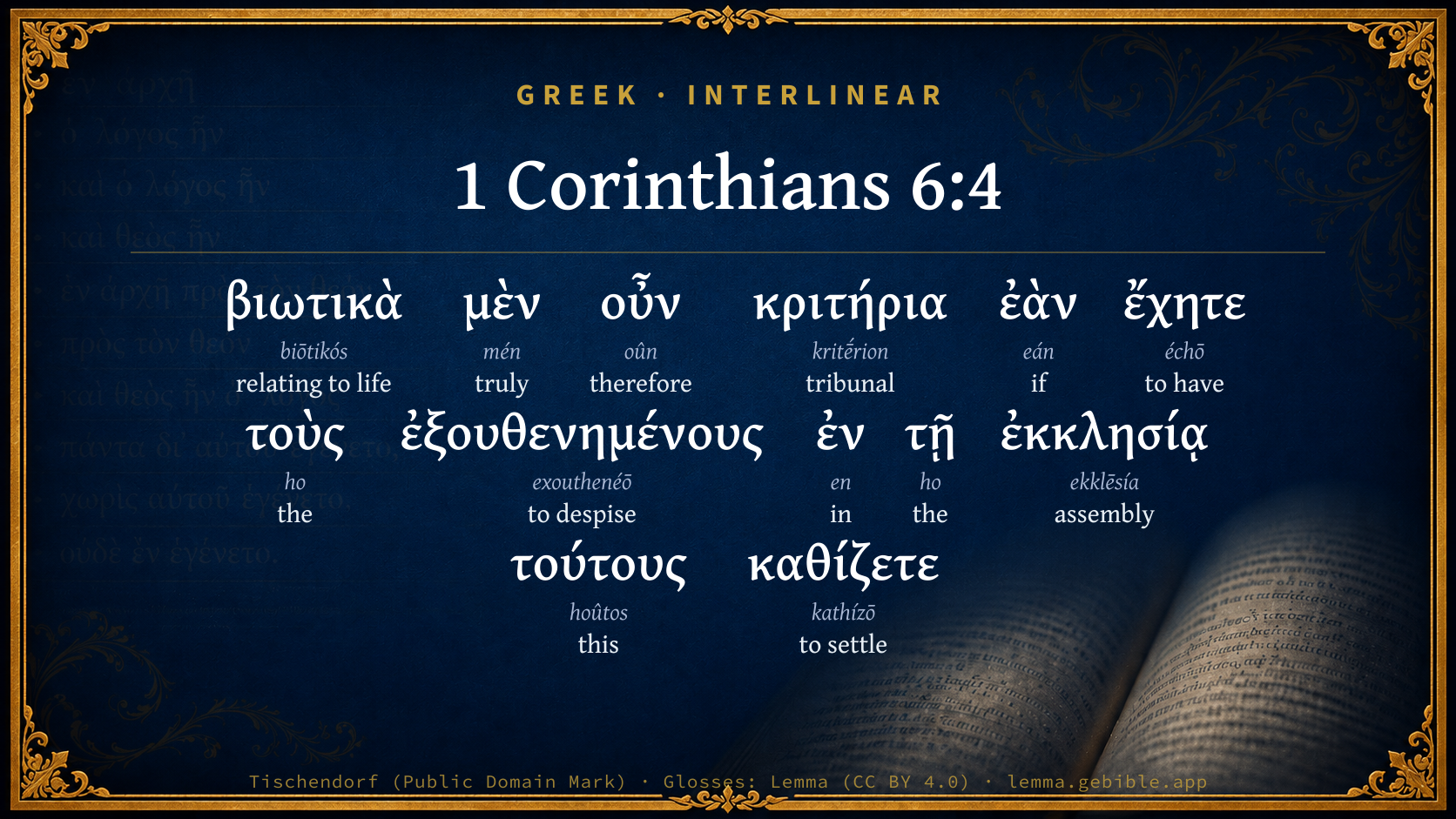
  1. μὲν mén G3303 “truly” Particle
  2. οὖν oûn G3767 “therefore” Conjunction
  3. κριτήρια kritḗrion G2922 “tribunal” Noun, Accusative, Plural, Neuter
  4. ἐὰν eán G1437 “if” Conditional
  5. ἔχητε échō G2192 “to have” Verb, Present, Active, Subjunctive, 2nd person, Plural
  6. τοὺς ho G3588 “the” Article, Accusative, Plural, Masculine
  7. ἐξουθενημένους exouthenéō G1848 “to despise” Verb, Perfect, Passive, Participle, Accusative, Plural, Masculine
  8. ἐν en G1722 “in” Preposition
  9. τῇ ho G3588 “the” Article, Dative, Singular, Feminine
  10. ἐκκλησίᾳ ekklēsía G1577 “assembly” Noun, Dative, Singular, Feminine
  11. τούτους hoûtos G3778 “this” Demonstrative pronoun, Accusative, Plural, Masculine
  12. καθίζετε kathízō G2523 “to settle” Verb, Present, Active, Indicative, 2nd person, Plural

About this verse

These counts appear in no published source. They are computed here, from the morphology-tagged text and Lemma’s own curated glosses. What Lemma adds →

13
words
12
distinct lemmas
Pauline Epistles
section

Notable vocabulary

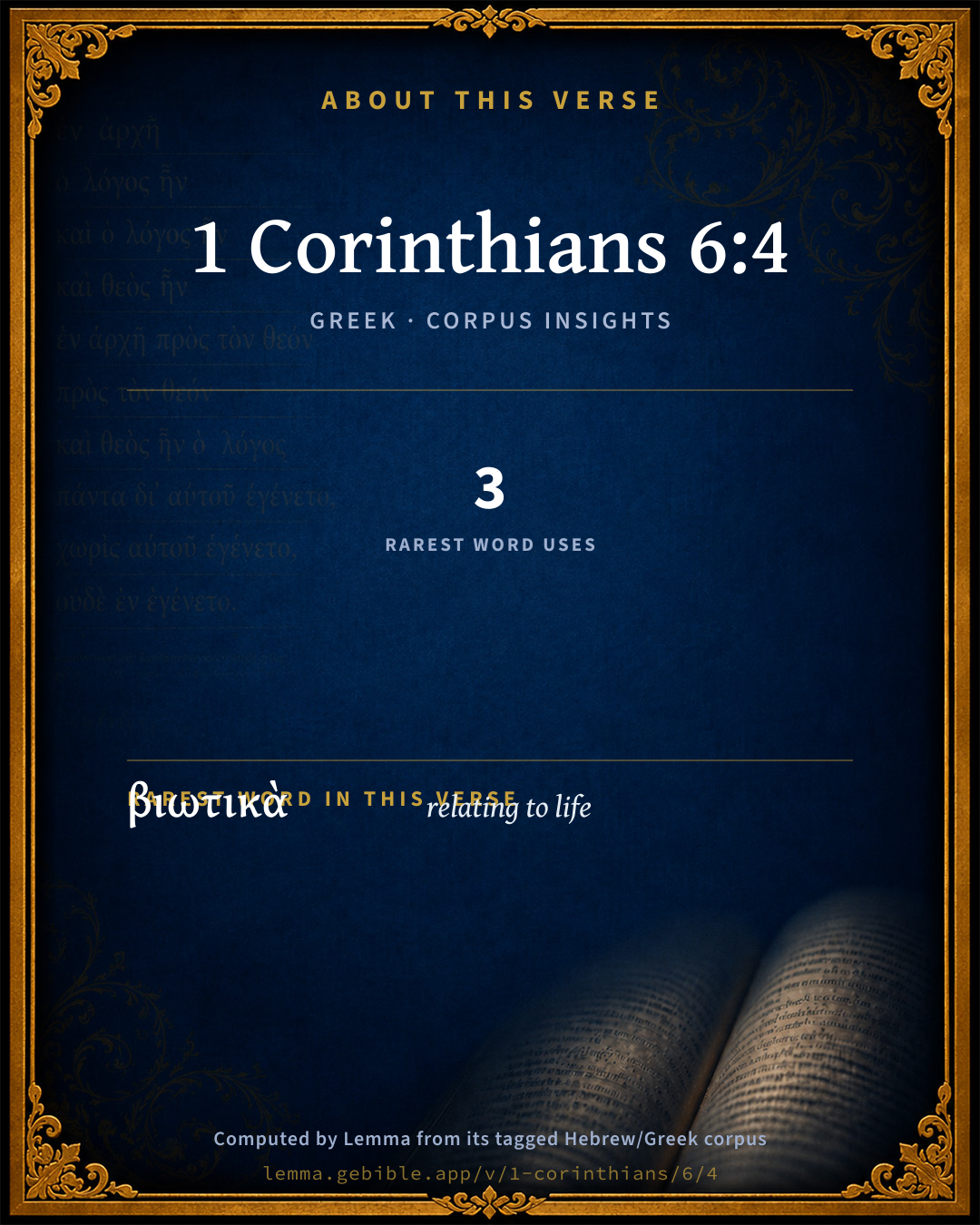
The rarest word here is βιωτικὰ relating to life G982 — appearing just 3 times in the whole Greek New Testament.

Shared distinctive vocabulary

βιωτικὰ relating to life G982 occurs in 3 verses of the Greek New Testament. Also found in:

Repetition

A word recurs within this verse:

  • τοὺς the G3588 ×2

Cross-references

2

Topical passages linked to 1 Corinthians 6:4 in the Treasury of Scripture Knowledge — connected by theme and wording, ordered by reader-vote popularity; previews shown in the World English Bible.

  • 1 Corinthians 5:12 For what have I to do with also judging those who are outside? Don't you judge those who are within?
  • Acts 6:2–4 The twelve summoned the multitude of the disciples and said, "It is not appropriate for us to forsake the word of God and serve tables.

Cross-references courtesy of OpenBible.info (CC BY 4.0).

Commentary

Notes on 1 Corinthians 6:4 from classic Christian and Jewish commentators (each source and its license shown beneath its notes). The classic Christian expositions comment on the surrounding passage and are grouped to its opening verse, so a note may address several verses; the Jewish commentaries on the Tanakh (Rashi and others) are per-verse, so they appear only where the commentator wrote on this verse.

Lemma curates 59 commentaries, every one of them public domain or Creative Commons licensed, each selected and text-cleaned for this edition rather than reprinted as found. About our sources →

Tyndale Open Study Notes

Tyndale Open Resources

6:4-6 I am saying this to shame you: It is a scandal for Christians to have to resolve their conflicts in secular courts, as if there were no one in the church sufficiently capable of resolving them.

Tyndale Open Study Notes — © Tyndale Open Resources, licensed CC BY-SA 4.0. Text via the HelloAO Bible API.

Bengel's Gnomon

Johann Albrecht Bengel

1Co 6:4. Τοὺς ἐξουθενημένους ἐν τῇ ἐκκλησίᾳ) those who are even least esteemed in the church, any persons whatever rather than the heathen. Every one, even the least, is capable of taking on him the decision of even the greatest interests in external affairs [and therefore is able to come to a decision, not indeed according to the ancient laws of the heathens, but on the true principles of equity.—V. g.]—Comp. 1Co 1:28, 1Co 11:22, and therefore καθίζετε, set ye, is the imperative. [It was not, however, to be thought of to give way at all in that matter to the jurisdiction of heathen judges.—V. g.]

Bengel's Gnomon of the New Testament — English translation (T&T Clark, Edinburgh, 1860) — public domain. Text from a community e-Sword module.

Meyer's Critical & Exegetical Commentary

Heinrich August Wilhelm Meyer

1Co_6:4. Βιωτικὰ μὲν οὖν κ.τ.λ[905]] takes up βιωτ. at once again with emphasis. Comp Herod. vii. 104: ΤᾺ ἊΝ ἘΚΕῖΝΟς ἈΝΏΓῌ· ἈΝΏΓΕΙ ΔῈ ΤΑὐΤῸ ἈΕΊ.

The sentence may be understood as a question (of astonishment), so de Wette, Tischendorf, Ewald, al[907]; or as a reproachful statement, so Lachmann. The former, if τ. ἐξουθ. be correctly explained, corresponds best with the whole structure of this animated address (see on 1Co_6:3). ΜῈΝ ΟὖΝ is the simple accordingly, thus.[908] Κριτήρια are here also not lawsuits, but judicia, as in 1Co_6:2. The meaning therefore is: If ye then have courts of trial as to private matters, i.e. if ye are in such circumstances as to have to hold courts of that kind. Comp Dem. 1153. 4 : ἘΧΌΝΤΩΝ ΤᾺς ΔΊΚΑς, qui lites habent administrandas. Hofmanns rendering is a most involved one, making βιωτ. κριτ. predicate to τοὺς ἐξουθ. ἐν τ. ἐκκλ., and ἘᾺΝ ἘΧ. a parenthetical clause, to which we are to supply as its object ἐχουθενημένους.[910]

καθίζετε] do yeinstead of taking some from among yourselves for this purposeset those down, etc.? namely, upon the judgment-seat as judges, which follows from κριτήρια. Comp Plato, Legg. ix. p. 873 E; Dem. 997. 23; Polyb. ix. 33. 12. It is the indicative, and the ἐξουθενήμ. ἐν τ. ἐκκλ. are the heathen. So in substance Valla, Faber, Castalio, Luther, Calovius, Wolf, al[912], including Pott, Flatt, Heydenreich, Schrader, Rückert, Olshausen, de Wette, Ewald, Maier, Neander, Weiss; Osiander is undecided. To this it is objected that ΚΑΘΊΖ. does not suit heathen magistrates, and that ἘΝ Τ. ἘΚΚΛ, indicates the ἘΞΟΥΘ. as members of the church (see especially Kypke, II. p. 201). But neither objection is valid; for the term ΚΑΘΊΖΕΤΕ is purposely selected as significant of the strange audacity shown in making the matter in dispute dependent on the decision of a heathen court, and that in special keeping with the contrast (τοὺς ἐξουθ.), while the text does not give ΤΟῪς ἘΝ Τῇ ἘΚΚΛ. Moreover, by Τ. ἘΞΟΥΘ., Paul does not mean to describe the contempt for the heathen as justifiable (Hofmanns objection), but simply as existing, as a fact, however, the universal existence of which made the absurdity of the procedure here censured very palpable. Other interpreters make καθίζ. imperative, and the ἐξουθ. members of the church held in small account: take (rather) minimos de piorum plebe as arbiters. So the Vulgate, Peschito, Chrysostom, Theodoret, Theophylact, Erasmus, Beza, Vatablus, Calvin, Grotius, Estius, Bengel, Wetstein, Hofmann, al[913] But not to speak of the rather generally supplied from imagination, nor of the fact that to designate those less capable of judging as τ. ἐξουθ. ἐν τ. ἐκκλ. would be far from wise, and likely to lend countenance to the specially Corinthian conceit of knowledge,if this were the true sense, Paul would have had to lay stress upon the church-membership of the despised persons, and must have written at least τοὺς ἐξουθ. τοὺς ἐν τ. ἐκκλ. For ΟἹ ἘΞΟΥΘ. ἘΝ Τ. ἘΚΚΛ. are those who are despised in the church, which leaves it altogether to the context to decide whether they themselves belong to the church or not. Now, that the latter is the case here is shown by 1Co_6:1-2, and especially by 1Co_6:5 : οὐκ ἔνι ἐν ὑμῖν. Arrangements of words like ΤΟῪς ἘΞΟΥΘ. ἘΝ Τῇ ἘΚΚΛ. for ΤΟῪς ἘΝ Τ. ἘΚΚΛ. ἘΞΟΥΘ. are common enough in classical writers also. See Kühner, a[914] Xen. Anab. iv. 2. 18.

τούτους] with an emphasis of disdain. See Dissen, a[915] Dem, de Cor. p. lii. f., 225; Krüger, Anab. i. 6. 9; Ellendt, Lex Soph. II. p. 460.

[905] .τ.λ. καὶ τὰ λοιπά.

[907] l. and others; and other passages; and other editions.

[908] Introducing the more detailed development of the thought to which expression had been given already. See Baeumlein, Partik. p. 181.

[910] How meaningless this would be! Moreover, see below. Comp. also Laurent. neutest. Stud. p. 127.

[912] l. and others; and other passages; and other editions.

[913] l. and others; and other passages; and other editions.

[914] d refers to the note of the commentator or editor named on the particular passage.

[915] d refers to the note of the commentator or editor named on the particular passage.

Meyer — Critical and Exegetical Commentary on the New Testament — English translation by Peter Christie, edited by Frederick Crombie (T&T Clark, 1880) — public domain. Text from a community e-Sword module.

Expositor's Greek Testament

ed. W. Robertson Nicoll

1Co 6:4-5 a . 1Co 6:4 is rendered in three diff [912] ways, as ( a ) τ . ἐξουθενημένους ἐν τ . ἐκκλησίᾳ is taken to mean the heathen iudges , the ἄδικοι of 1Co 6:1 whom the Church could not respect ( ἐν , in the eyes of; cf. 1Co 14:11 ); then τούτους καθίζετε becomes an indignant question “Do you set up these (as your judges)?” so Mr [913] , Hn [914] , Tisch., W.H [915] , R.V. text . The position of καθίζετε and the strain put upon its meaning speak against this view the Cor [916] Christians did not appoint the city magistrates; also the unlikelihood of Paul’s using language calculated to excite contempt toward heathen rulers. ( b ) The prevalent construction (Vg [917] , Syr., Bz [918] , Cv [919] , Bg [920] , Ed [921] , El [922] , Lt [923] , A.V., R.V. marg .) understands τ . ἐξουθ . ἐν τ . ἐκκλ . as the despised of the Church itself ( καυχᾶσθαι ἐν ἀνθρ ., 1Co 3:21 , 1Co 4:6 ff. implies such a counterpart); then καθίζετε ’ is read as impv [924] , and P. says in sarcasm, “If you have lawsuits in secular affairs, set up the lowest amongst you (for judges of these low matters)!” κριτήρια however (see note on 2, and R.V. marg .) signifies not trials , nor matters of trial , but tribunals , and is therefore an unsuitable obj [925] to ἐὰν ἔχητε : βιωτικὰ κριτήρια are the things wanting to the Church, which P. is advising them to set on foot. Moreover, Paul would hardly speak of Christians as “despised” among their fellows, without some touch of blame for their despisers. ( c ) For these reasons, it is better, as Hf [926] suggests, to put the comma before , instead of after, ἐὰν ἔχητε , attaching τοὺς ἐξουθ . to this vb [927] and reading βιωτ . κριτ . as a nom [928] (or acc [929] ) pendens to the sentence ( cf. Rom 8:3 , Heb 8:1 ; and Bm [930] , pp. 379 ff.): we thus translate, “Well then, for secular tribunals if you have men that are made of no account in the Church, set these on the bench!” That this prideful Church has such persons is undoubted; P. puts the fact hypothetically, as a thing one does not like to assume. μὲν οὖν throws into relief, by way of emphatic resumption, the βιωτικά … κριτήρια . πρὸς ἐντροπὴν ὑμῖν λέγω , “Unto your shame ( lit [931] for a shame to you) I say (it)”: this relates to the foregoing sentence ( cf. 1Co 15:34 ); it is a shame the Cor [932] Church should have members looked on with utter contempt ( cf. 1Co 12:21-25 ); but since it has, it is fitting that they should be its judges in things contemptible! P. writes with anger, whereas he did not, though he might seem to do, in 1Co 4:14 .

[912] difference, different, differently.

[913] Meyer’s Critical and Exegetical Commentary (Eng. Trans.).

[914] C. F. G. Heinrici’s Erklärung der Korintherbriefe (1880), or 1 Korinther in Meyer’s krit.-exegetisches Kommentar (1896).

[915] Westcott and Hort’s The New Testament in Greek: Critical Text and Notes.

[916] Corinth, Corinthian or Corinthians.

[917] Latin Vulgate Translation.

[918] Beza’s Nov. Testamentum: Interpretatio et Annotationes (Cantab., 1642).

[919] Calvin’s In Nov. Testamentum Commentarii .

[920] Bengel’s Gnomon Novi Testamenti.

[921] T. C. Edwards’ Commentary on the First Ep. to the Corinthians . 2

[922] C. J. Ellicott’s St. Paul’s First Epistle to the Corinthians .

[923] J. B. Lightfoot’s (posthumous) Notes on Epp. of St. Paul (1895).

[924] imperative mood.

[925] grammatical object.

[926] J. C. K. von Hofmann’s Die heilige Schrift N.T. untersucht , ii. 2 (2te Auflage, 1874).

[927] verb

[928] nominative case.

[929] accusative case.

[930] A. Buttmann’s Grammar of the N.T. Greek (Eng. Trans., 1873).

[931] literal, literally.

[932] Corinth, Corinthian or Corinthians.

1Co 6:5 b . Laying aside sarcasm, the Ap. asks most gravely: “(Is it) so (that) there is no wise man found amongst you, who will be able to decide between his brothers?” οὕτως intensifies the question ( cf. Gal 3:3 ) τοσαύτη σπάνις (Cm [933] ) “so utter a lack of men of sense amongst you Cor [934] , with all your talent and pretensions?” (1Co 1:5 , 1Co 3:18 , 1Co 4:10 ). ἐνί , prp [935] with ellipsis of ἐστίν (Wr [936] , p. 96) there exists, is found (see parls.). ἀνὰ μέσον (Hebraistic prpl [937] phrase) τοῦ ἀδελφοῦ αὐτοῦ lit [938] “between his brother” a defective expression, as though due to confusion of τῶν ἀδελφῶν with the more Hebraistic ἀδελφοῦ καὶ ἀδελφοῦ : an example of the laxity of Paul’s conversational Gr [939] ; unless, as Sm [940] conjectures, there is a “primitive error,” and τοῦ ἀδελφοῦ should be corrected to τῶν ἀδελφῶν .

[933] John Chrysostom’s Homiliœ († 407).

[934] Corinth, Corinthian or Corinthians.

[935] preposition.

[936] Winer-Moulton’s Grammar of N.T. Greek (8th ed., 1877).

[937]rpl. prepositional.

[938] literal, literally.

[939] Greek, or Grotius’ Annotationes in N.T.

[940] P. Schmiedel, in Handcommentar zum N.T. (1893).

The Expositor's Greek Testament, edited by W. Robertson Nicoll (1897–1910) — public domain. Text from a community e-Sword module.

Hodge's Commentary on Romans, Ephesians & First Corinthians

Charles Hodge

1Co_6:4

If then ye have judgments of things pertaining to this life, set them to judge who are least esteemed in the church.

Paul laments that there were litigations among them; but if they could not be avoided, Christians should act in reference to them in a manner consistent with their high destiny. Here the word (κριτήρια), rendered judgments, seems so naturally to mean causes, things to be tried, that that sense of the word is almost universally assumed. It may, however, mean trials, judicial processes; which is more in accordance with the established use of the words. Set them to judge who are least esteemed in the church. The original admits of this translation. If the passage be so rendered, then it has a sarcastic tone. Set your least esteemed members to decide such matters. It may, however, be read interrogatively, Do ye set as judges those least esteemed in (i.e. by) the church (that is, the heathen)? This translation is generally preferred as best in keeping with the context. The sentence is emphatic. Those despised (see 1Co_1:28) by the church, those do you set to judge? It is an expression of surprise at their acting so unworthily of their high calling.

Charles Hodge — Commentary on Romans (1835), First Corinthians (1857), and Ephesians (1856) — public domain. Text from a community e-Sword module.

Geneva Bible (1599)

Geneva Bible translators

Courts and places of judgments.

Even the most abject among you.

The conclusion, wherein he prescribeth a remedy for this mischief: to wit, if they end their private affairs betwixt themselves by chosen arbiters out of the Church: for which matter and purpose, the least of you, saith he, is sufficient. Therefore he condemneth not judgment seats, but showeth what is expedient for the circumstance of the time, and that without any diminishing of the right of the magistrate: for he speaketh not of judgments which are practiced between the faithful and the infidels, neither of public judgments, but of controversies which may be ended by private arbiters.

Geneva Bible (1599) marginal notes — public domain. Text via Bolls.life.

Jamieson, Fausset & Brown

Robert Jamieson, A. R. Fausset & David Brown

judgments--that is, cases for judgment.

least esteemed--literally, "those of no esteem." Any, however low in the Church, rather than the heathen (Co1 1:28). Questions of earthly property are of secondary consequence in the eyes of true Christians, and are therefore delegated to those in a secondary position in the Church.

Jamieson, Fausset & Brown — Commentary Critical and Explanatory on the Whole Bible (1871) — public domain (CC PDM 1.0). Text via the HelloAO Bible API.

Adam Clarke's Commentary

Verse 4. Things pertaining to this life] They could examine all civil cases among themselves, which they were permitted to determine without any hinderance from the heathen governments under which they lived.

Who are least esteemed in the Church.] τους εξουθενημενους, Those who were in the lowest order of judges; for the apostle may refer here to the order in the Jewish benches, as Dr. Lightfoot conjectures, of which there were five, viz:-

1. The great Sanhedrin, consisting of seventy-two elders, which presided in Jerusalem.

2. The little Sanhedrin of twenty-five, in large cities, out of Jerusalem.

3. The Bench of Three in every synagogue.

4. The Authorized, or Authentic Bench.

5. The Bench not authorized, εξουθενημενος. This latter bench was so called because it received not its authority immediately from the Sanhedrin, but was chosen by the parties between whom the controversy depended. The apostle certainly does not mean persons of no repute, but such as these arbitrators, who were chosen for the purpose of settling private differences, and preventing them from going before the regular magistrates. The following verse makes it pretty evident that the apostle refers to this lower kind of tribunal; and hence he says,-

Adam Clarke's Commentary on the Bible (1810–1826) — public domain. Text from a community e-Sword/MySword module.

John Calvin's Commentaries

4. If you have judgments then as to things pertaining to this life We must always keep in view what causes he is treating of; for public trials are beyond our province, and ought not to be transferred to our disposal; but as to private matters it is allowable to determine without the cognizance of the magistrate. As, then, we do not detract in any degree from the authority of the magistrate by having recourse to arbitration, it is not without good reason that the Apostle enjoins it upon Christians to refrain from resorting to profane, that is, unbelieving judges. And lest they should allege that they were deprived of a better remedy, he directs them to choose out of the Church arbiters, who may settle causes agreeably and equitably. Farther, lest they should allege that they have not a sufficient number of qualified persons, he says that the meanest is competent to discharge this office. There is, therefore, no detracting here from the dignity of the office of magistrates, when he gives orders that their office be committed to contemptible persons, for this (as I have already said) is stated by anticipation, as though he had said: “Even the lowest and meanest among you will discharge this office better than those unbelieving judges to whom you have recourse. So far are you from necessity in this way.”

Chrysostom comes near this interpretation, though he appends to it something additional; for he is of opinion, that the Apostle meant to say, that, even though the Corinthians should find no one among themselves who had sufficient wisdom for judging, they must nevertheless make choice of some, of whatever stamp they were. Ambrose touches neither heaven nor earth. I think I have faithfully brought out the Apostle’s intention — that the lowest among believers was preferred by him to unbelievers, as to capacity of judging. There are some that strike out a quite different meaning, for they understand the word καθιζετε to be in the present tense — You set them to judge, and by those that are least esteemed in the Church they understand profane persons. This, however, is more ingenious than solid, for that were a poor designation of unbelievers. Besides, the form of expression, if you have, would not suit so well with a reproof, for the expression would have required rather to be while you have, for that condition takes away from the force of it. Hence I am the more inclined to think, that a remedy for the evil is here prescribed.

That this statement, however, was taken up wrong by the ancients, appears from a certain passage in Augustine. For in his book — “On the Work of Monks,” where he makes mention of his employments, he declares that among his numerous engagements, the most disagreeable of all was, that he was under the necessity of devoting a part of the day to secular affairs, but that he at the same time endured it patiently, because the Apostle had imposed upon him this necessity. From this passage, and from a certain epistle, it appears that the bishops were accustomed to sit at certain hours to settle disputes, as if the Apostle had been referring to them here. As, however, matters always become worse, there sprang from this error, in process of time, that jurisdiction which the officials of the bishops assume to themselves in money matters. In that ancient custom there are two things that are deserving of reproof — that the bishops were involved in matters that were foreign to their office; and that they wronged God in making his authority and command a pretext for turning aside from their proper calling. The evil, however, was in some degree excusable, but as for the profane custom, which has come to prevail in the Papacy, it were the height of baseness to excuse or defend it.

John Calvin's Commentaries (1540-1563) — public domain. Text from the Calvin Translation Society English edition (1840s-50s) via the Christian Classics Ethereal Library (ccel.org). Calvin's coverage is partial (roughly two-thirds of the Bible); uncommented books and verses are honest gaps, never fabricated. The 19th-century editor's footnotes and remarks are omitted so the notes are faithfully Calvin's own voice.

Ellicott's Commentary for English Readers

(4) If then ye have judgments. . . .—Better, If, however, you choose to have judgments to be given on matters of this life. The last words show that the questions which are alluded to are purely worldly and not spiritual matters. The Apostle subsequently urges that such disputes ought not to arise at all amongst Christians, and that if they do they ought to be settled by the interposition of some mutual friend. Here he says, with something of sarcasm, “The very meanest of those who are to be exalted above angels, and to be judges of spiritual existences, is of sufficient authority to settle such matters as you are bringing before legal tribunals.”

A Bible Commentary for English Readers, edited by Charles John Ellicott (1878–1897) — public domain. Text from a community e-Sword module.

The Cambridge Bible for Schools and Colleges

gen. ed. J. J. S. Perowne

4. judgments] domes, Wiclif. See note on 1Co_6:2. The meaning (2) seems the only admissible one here, inasmuch as Christians were not likely as yet to possess secular tribunals or to hold secular trials in the technical sense of the word. Secular causes they had, and as we see, they carried them before the heathen courts.

set them to judge] This passage may be taken in three ways. (1) as in our version, imperatively, set them to judge, i.e. the matter is so trivial that any person, even the most contemptible for his understanding in the Church, is quite fit to undertake the settlement of it. Or, (2) indicative, ye are setting, as though it were the heathen who were the most despised in the Church. Or (3) as a question, Is it your custom to set such persons to settle such matters? much less then should you bring them before the heathen, who in points of moral perception are infinitely below the least esteemed members of the Christian Church. Of these (1) is preferable as falling in best with the context: while (2) is open to the objection that it was not the custom of Christ or His Apostles to represent one’s fellow-men, even though they were heathen, as fit objects of contempt.

least esteemed] Literally, thought nothing of.

The Cambridge Bible for Schools and Colleges (gen. ed. J. J. S. Perowne; Cambridge University Press, 1878–1918) — public domain. Text from a community e-Sword module.

John Gill's Exposition

If then ye have judgments of things pertaining to this life,.... Not judgements relating to life and death, for these were not in the power of a Jewish sanhedrim now, and much less of a Christian community, but were wholly in the power of the Roman magistrates; but judgments relating to the common affairs of life, or what the Jews call , "pecuniary judgments" (b), in distinction from , "judgments of souls", or capital ones. The Jews say (c),

"that forty years before the destruction of the temple, capital judgments were taken from Israel; and in the days of R. Simeon ben Jochai, pecuniary judgments were taken away from Israel.''

Now this Rabbi lived many years after the times of the apostles, so that as yet the Jews had a power of exercising such judgments; and no doubt the Christian's also, who as yet were very little, if at all, distinguished from the Jews by the Romans: and therefore since such judgments were within the compass of their authority, the apostle advises

to set them to judge who are least esteemed in the church; meaning, not those of the lowest circumstances of life, and of the meanest abilities and capacities; for in the next verse he requires a wise man for such a business; but private persons, laymen, who were not in any office and authority in the church, in distinction from pastors, elders, and rulers, that were in office, power, and high esteem, whom he would not have troubled with cases of this nature; but should rather choose out from among the laity persons of the best judgment and capacity, to be umpires and arbitrators in such worldly matters, which do not so properly come under the notice and cognizance of spiritual guides. The phrase, "to judge", is not in the original text, where it is only "set", or "put in the chair"; but is added in the Vulgate Latin version; and to which agree both the Syriac and Arabic versions; the former reading the words, "they that are despised in the church, set for you in judgment"; and the latter, "make them to sit judges". The Jews, as Dr. Lightfoot observes, besides their great sanhedrim of seventy one persons, and that other of twenty three in their cities of note, and their triumvirate in every synagogue, had also two sorts of benches, who judged of lesser matters; the one was called , "the bench of authorized persons", experienced men, that were approved of, and had their authority from the sanhedrim; and the other was called , "the bench of idiots" (d), or private persons, or , "the bench of those who were not authorized" (e), or had not their authority, from the higher courts; but being judged proper persons, were chosen by the people to arbitrate matters in difference between them; and these are the men the apostle means, at least alludes to, before whom he would have the causes brought.

(b) Misn Sanhedrin, c. 1. sect. 1. (c) T. Hieros. Sanhedrin. fol. 24. 2. (d) T. Bab. Bava Metzia, fol. 32. 1. (e) Maimon. Hilch. Ishot, c. 17. sect. 13. T. Bab. Gittin, fol. 88. 2. Gloss. in. ib.

John Gill's Exposition of the Whole Bible (1746–1763) — public domain (CC PDM 1.0). Text via the HelloAO Bible API.

Trapp's Complete Commentary

John Trapp

4 If then ye have judgments of things pertaining to this life, set them to judge who are least esteemed in the church.

Ver. 4. If then ye have judgments] As the Corinthians, being many of them merchants, had many lawsuits. But if men’s hearts were not bigger than their suits, there would not be half so many.

Who are least esteemed] Rather than go to law before heathen judges. The lowest, if of any judgment, are high enough for such a purpose. Why should those sordida poscinummia, qui latrocinia intra moenia exercent, as Columella hath it, those Crumenimulgae, the unconscionable lawyers, make a spoil of us; and then when they die, build hospitals for fools, as one of them did, saying, Of fools I got my estate, and to fools I will leave it. Of those that go to law, we may well say, as Charondas once did of those that go to sea, Se non mirari qui semel mare ingressus sit, sed qui iterum, that he marvelled not at those that went once, but at those that would go again.

John Trapp, A Commentary or Exposition upon All the Books of the Old and New Testament (1647–1656) — public domain. Text from a community e-Sword module.

Albert Barnes' Notes on the Bible

Ye have judgments - Causes; controversies; suits.

Things pertaining to this life - Property, etc.

Set them to judge ... - The verb translated set καθίζετε kathizete may be either in the imperative mood, as in our translation, and then it will imply a command; or it may be regarded as in the indicative, and to be rendered interrogatively, “Do ye set or appoint them to judge who are of little repute for their wisdom and equity?” that is, pagan magistrates. The latter is probably the correct rendering, as according to the former no good reason can be given why Paul should command them to select as judges those who had little repute for wisdom in the church. Had he designed this as a command, he would doubtless have directed them to choose their most aged, wise and experienced men, instead of those “least esteemed.” It is manifest, therefore, that this is to he read as a question: “Since you are abundantly qualified yourselves to settle your own differences, do you employ the pagan magistrates, in whom the church can have little confidence for their integrity and justice?” It is designed, therefore, as a severe reproof for what they had been accustomed to do; and an implied injunction that they should do it no more.

Who are least esteemed - (ἐξουθενημένους exouthenēmenous). Who are “contemned,” or regarded as of no value or worth; in whose judgment and integrity you can have little or no confidence. According to the interpretation given above of the previous part of the verse this refers to the pagan magistrates - to people in whose virtue, piety and qualifications for just judgment Christians could have little confidence; and whose judgment must be regarded as in fact of very little value, and as very little likely to be correct. That the pagan magistrates were in general very corrupt, there can be no doubt. Many of them were people of abandoned character, of dissipated lives, men who were easily bribed, and people, therefore, in whose judgment Christians could repose little confidence. Paul reproves the Corinthians for going before them with their disputes when they could better settle them themselves. Others, however, who regard this whole passage as an instruction to Christians to appoint those to determine their controversies who were least esteemed, suppose that this refers to the “lowest orders” of judges among the Hebrews; to those who were least esteemed, or who were almost despised; and that Paul directs them to select even them in preference to the pagan magistrates. See Lightfoot. But the objection to this is obvious and insuperable. Paul would not have recommended this class of people to decide their causes, but would have recommended the selection of the most wise and virtuous among them. This is proved by 1Co 6:5, where, in directing them to settle their matters among themselves, he asks whether there is not a “wise man” among them, clearly proving that he wished their difficulties adjusted, not by the most obscure and the least respected members of the church, but by the most wise and intelligent members.

In the church - By the church. That is, the pagan magistrates evince such a character as not to be worthy of the confidence of the church in settling matters of controversy.

Albert Barnes' Notes on the Bible (1834–1885) — public domain. Text from a community e-Sword/MySword module.

Haydock's Catholic Bible Commentary

Set them to judge, who are the most despised in the Church. Rather make choice of Christians of lesser parts and talents, than have recourse to infidels, who will be scandalized at the injuries and injustice done by Christians to each other. Besides you cannot but have some wise men among you to decide such matters. (Witham) --- St. Paul does not here mean to tell the Corinthians that they must choose the most despised and the most ignorant, but he wishes to inform them that if there were none but men of this description in the Church, it would still be more preferable to appoint these judges than to go to law before idolatrous judges. (Estius) --- It is plainly a fault,[1] weakness in you to run to such heathen judges: you should rather bear, and put up with the injuries done to you. --- A fault. Law-suits can hardly ever be without a fault, on one side or the other; and oftentimes on both sides. (Challoner)

George Leo Haydock (1774–1849), Haydock's Catholic Family Bible and Commentary, 1859 edition — public domain. Excludes Psalms (Douay-Rheims chapter numbering differs from Protestant) and Deuterocanonical books (Catholic canon only).

Matthew Poole's English Annotations

If then ye have judgment of things pertaining to this life, that is, if you have any cause of suing or impleading one another for things that pertain to this life, be they of what nature they will,

set them to judge who are least esteemed in the church; rather commit the umpirage and determination of such little differences to the meanest members of your church, than go to contend before pagans and infidels: or do not employ your teachers about them, who have higher work to be employed in; but employ those who are of a lower order in the church, and whose business and concerns lie in secular affairs.

Matthew Poole's English Annotations on the Holy Bible (1683–1685) — public domain. Text from a community e-Sword/MySword module.

Whedon's Commentary on the Bible

Daniel D. Whedon

4. Least esteemed—Alford truly calls this “a lofty irony.” And yet it implies a divine truth. Earthly matters are comparatively trifles in the light of eternity; and he who is a priest and king, through Christ, unto God, might easily trust a trifle of time to be decided by the humblest brother king. Yet the next verse shows that St. Paul is not seriously advising them to trust their disputes to the arbitration of incompetent hands.

Daniel D. Whedon (gen. ed.), Commentary on the Old and New Testaments (1874–1909) — public domain. Text from a community e-Sword module.

The Pulpit Commentary

If then ye have, etc. The verse implies that civil disputes might naturally occur among them. What he is here reprobating is their objectionable method of settling them. Set them to judge who are least esteemed in the Church. This implies an utter scorn of trivial quarrels about personal rights. Surely the lowliest, the most unregarded members of the Church those of no account have wisdom enough to decide in such small matters. Thus when there arose a murmuring between Hebrews and Hellenists about the daily distribution to widows, the apostles, thinking that they had much more important work in hand than the adjustment of such jealousies, left the whole matter in the hands of the seven deacons. Some understand "those held of no account in the Church" to mean heathens; but he is here forbidding them to bring their quarrels before the heathens. Of course, ideally, none ought to be "despised" or "held of no account" in the Church; but St. Paul is here speaking relatively, and with reference to the views of the Corinthians themselves, and not without irony. The perfect participle, "those who have been set at nought," perhaps means persons of proved inferiority of judgment.

The Pulpit Commentary (1880–1919), ed. H.D.M. Spence-Jones & Joseph S. Exell — public domain. Text from a community e-Sword module.

John Wesley's Explanatory Notes

Them who are of no esteem in the church - That is, heathens, who, as such, could be in no esteem with the Christians.

John Wesley, Explanatory Notes Upon the Whole Bible (1754–1765) — public domain. Text via the GEBible commentary corpus.

Burkitt's Expository Notes on the New Testament

William Burkitt

It must be still obsreved, that the apostle, doth not go about to abolish the use of secular judgments, or condemn going to law; but only reproves the abuses that were found among them therein. Brother going to law with brother; that is, one Christian with another: and this not before a Christian but an heathen magistrate; by means whereof the Gentiles became acquainted with the covetousness, ambition, and revenge, which was among Christians, to the dishonour of God, and to the discredit of the gospel.

More particularly, the apostle farther censures and reproves them, first, for going to law about trifles and small matters; Are ye unworthy to judge the least matters? Should Christians thus implead one another before infidels for mere trifles? It seems it has been an ancient and too common fault, that every petty difference has pestered the tribunal.

Secondly, for their impleading and persecuting one another; it was with heat and passion, with impatience and impetuous anger. Going to law is one of those duties which is difficultly managed without sin; it is an hard matter for a man to right his estate, and not wrong his soul.

Thirdly, He reproves them, because they did not choose rather to put up with some wrongs, than right themselves by going to law? Why do ye not rather take wrong? why do ye not suffer yourselves to be defrauded?

Teaching us, that something should not only be hazarded, but parted with, for peace sake. Peace is a jewel worth our buying at a dearer rate than most men are willing to give for it; and a peaceable Christian will put up with many injuries patiently, rather than use extremity, referring his cause to Him that judgeth righteously; who very often in this life repays us what we part with for peace sake twice over. Blessed are the meek, they shall inherit the earth.

Fourthly, The apostle blames them for their precipitation and haste, in going to law one with another; the law should have been their last refuge after trial of all other means.

First, they should have referred it to their brethren; if they could not end it, then the law was open. But instead of this, as soon as any difference arose, they sent presently for a writ to the heathenish courts of judicature.

Fifthly, He blames the ignorance which was found amongst them, that there was no wise person found with them, who could compromise and compose differences before they went too far; 1Co 6:5. I speak it to your shame. Is it so, that there is not a wise man amongst you, that is able to judge between his brethren?

As if he had said, "What, will ye all stand and look on these unkind bickerings; and is there not one among you, that has so much skill as to quiet and compose them? I am really ashamed of it."

Sixthly, He rebukes their slothfulness, together with their ignorance, that they were lazy as well as unskillful, and unwilling to interpose for the composing of their brethren’s differences. A little pains timely taken by us, may prevent abundance of strife and dissension between contending brethren. These are the principal faults which the apostle condemns in these Corinthians going to law: it is not the action, or thing itself, but the circumstances attending it, and the mismanagement of it, that is here condemned; which being rectified, law is no doubt lawful, whatever some erroneous persons have affirmed to the contrary.

William Burkitt's Expository Notes on the New Testament (1700–1703) — public domain. Text from a community e-Sword module.

Godbey's Commentary on the New Testament

William B. Godbey

4. “Therefore if you indeed have judgments appertaining to this life, set those down as judges who are of no estimation in the church.” This is simply scathing irony; as much as to say the most consummate gump among you is competent to decide your little, insignificant controversies over paltry pelf, if you will only look at the utter worthlessness of all your temporal interests, when contrasted with the infinitesimal glory of the eternal.

William B. Godbey, Commentary on the New Testament (1896–1900) — public domain. Text from a community e-Sword module.

McGarvey & Pendleton's Commentaries

J. W. McGarvey

If then ye have to judge things pertaining to this life, do ye set them to judge who are of no account in the church?

J. W. McGarvey (with Philip Y. Pendleton), Commentaries on the New Testament (The Fourfold Gospel, 1914; Acts; and the epistles) — public domain. Text from a community e-Sword/MySword module.

The People's New Testament

B. W. Johnson

4. If then ye have judgments, etc. If the saints shall have the high prerogative of judging the world and bad angels with Christ, then it is a condescension to judge of trivial earthly matters. Set them to judge who are least esteemed. An ironical way of hinting that their differences were so petty as to be worthy only of the poorest witted.

B. W. Johnson's The People's New Testament with Notes (1889–1891) — public domain. Electronic text from the Christian Classics Ethereal Library (CCEL) ThML edition.

unfoldingWord translationNotes

Door43 World Missions Community

If then you have to make judgments that pertain to daily life, why do you lay such cases as these before those who have no standing in the church?

Possible meanings are 1) this is a rhetorical question or 2) this is a statement, "When in the past you have settled matters that are important in this life, you have not handed off disputes between Christians to be settled by unbelievers" or 3) this is a command, "When you settle matters that are important in this life, it is even to those who have no standing in the church that you should hand off disputes to be settled!" (See: Rhetorical Question)

If then you have to make judgments that pertain to daily life

"If you are called upon to make decisions about daily life" or "If you must settle matters that are important in this life"

why do you lay such cases as these before those who have no standing in the church?

Paul is rebuking the Corinthians for how they are handling these cases. Possible meanings are that 1) "you should stop giving such cases to people who are outside the church." or 2) "you could give such cases even to members of the church who are not well regarded by other believers." (See: Rhetorical Question)

to your shame

"to your dishonor" or "to show how you have failed in this matter"

Is there no one among you wise enough to settle a dispute between brothers?

Paul is shaming the Corinthians. AT: "You should be ashamed that you cannot find a wise believer to settle arguments between believers" (See: Rhetorical Question)

brothers

Here this means fellow Christians, including both men and women.

dispute

argument or disagreement

But as it stands

"But the way it is now" or "But instead"

one believer goes to court against another believer, and that case is placed before a judge who is an unbeliever

"believers who have disputes with each other ask unbelieving judges to make decisions for them"

that case is placed

This can be stated in active form. AT: "a believer submits that case" (See: Active or Passive)

translationWords

judge

life

church

shame

wise

believe

believe

unfoldingWord translationNotes — © Distant Shores Media and the Door43 World Missions Community, licensed CC BY-SA 4.0. Source: git.door43.org/Door43/en_tn.

Cambridge Greek Testament for Schools and Colleges

4. μὲν οὖν. Stronger than the simple οὖν, and making βιωτικά still more emphatic.

κριτήρια. Here at first sight the A.V. causes would seem to give the best sense once more. But the translation ‘if then ye should possess tribunals relating to matters of this life,’ is equally admissible.

τούτους καθίζετε. Three renderings of this passage are possible. (1) with A.V. we may take καθίζετε as imperative, ‘put the most contemptible members of your body to decide questions of so slight importance;’ (2) καθίζετε indicative and affirmative, ‘ye are setting the most insignificant persons in the eyes of the Church,’ i.e. the heathen, to settle these questions; (3) καθίζετε indicative and interrogative, with R.V. ‘is it your custom to set such persons to decide such questions?’ Either (1) or (3) will make good sense, while (2) is open to the objection that the Apostle was not likely to encourage a tendency which his Master had emphatically condemned, and which was too likely to exist—that toward regarding the heathen as fit objects of contempt. (1) is preferable, from the emphatic position of ἐξουθενημένους, and also from the position of καθίζετε, as well as from what follows. See next note. And also from the reason that it was very obviously not the fact that the Corinthians were setting persons of no repute in the Church to decide such trifling questions, but on the contrary, were considering them important enough to take before heathen tribunals.

Cambridge Greek Testament for Schools and Colleges (Cambridge University Press, 1896; 21 vols, various authors incl. Carr, Maclear, Plummer, Farrar, Lumby, Moule, M. R. James, Simcox) — public domain. Text from a community e-Sword module.

Alford’s Greek Testament

Henry Alford

4.] βιωτικά is emphatically repeated, as being the only sort of κριτήρια which were in question here. Meyer compares Herod, vii. 104, τὰ ἂν ἐκεῖνος ἀνώγῃ· ἀνώγει δὲ τὠϋτὸ ἀεί, and Aristoph. Ran. 287 f.

μὲν οὖν, ‘immo vero,’ reff. (see below). It corrects a foregoing misapprehension: so Soph. Œd. Col. 31, “ἦ δεῦρο προσστείχοντα κἀξορμώμενον;” “καὶ δὴ μὲν οὖν παρόντα.” Hartung, Partikell. ii. 400. See also Moulton’s Winer, p. 556, note 2.

κριτήρια, again, not matters to be judged, but judgments: the matters about which, are expressed in βιωτικά.

The following words may be rendered in two ways: either, (α) ‘Yea, rather (so far from remembering your high prospect, of judging angels, your practice is), if ye have in hand judgments concerning civil matters,—those men who are of no account in the church (viz. the heathen), those you set up (place on the bench) as judges’ (i.e. by bringing your causes before them, you set them up as judges over you). καθίζω occurs in this sense in Plato, Legg. ix. p. 873, ἐὰν δὲ ἄψυχόν τι ψυγῆς ἄνθρωπον στερήσνῃ, … δικαστὴν μὲν αυτῷ καθιζέτω τῶν γειτόνων τὸν ἐγγύτατον ὁ προσήκων γένει—and Polyb. ix. 33. 12, cited above on κριτήριον. Thus, making καθίζ. indicative, Valla, Castal., Luther, Calov., Wolf, al., Schrader, Rückert, Olsh., De Wette, Meyer. But (β) Syr., Vulg., Chrys., Theodoret, Theophyl., Erasm., Beza, Calvin, Grot., Estius, Bengel, Wetst., al., take καθίζετε as imperative, and τοὺς ἐξουθεν. ἐν τ. ἐκκλ. as ‘minimos de piorum plebe.’ So E. V.: set them to judge who are least esteemed in the church. And to this last interpretation I am inclined to accede, both from the context and from the arrangement of the words. The context is this: ‘Your office is to judge angels:’ mere business causes of this world are almost beneath your notice. If such causes arise among you (he continues in a lofty irony) set those to judge them who are of no account among you:—do not go out of your own number to others to have them judged: the meanest among you is capable of doing it. Let it be noticed that he is passing to ver. 7, where he insists on the impropriety of βιωτικὰ κριτ. between Christians at all, and is here depreciating them ironically.

But the arrangement and construction of the words are even more strongly in favour of the imperative rendering. For (1) on the other, no account is given of the emphatic position of βιωτικά. (2) the μὲν οὖν is not so naturally rendered (see above) ‘yea rather your course is,’ as ‘yea rather let your practice be:’ it expresses more naturally a subjective correction, in the mind of the speaker, than an objective one: see below, ver.7. (3) if the sentence had referred to their existing practice of going before heathen tribunals, it would have been expressed not βιωτικὰ μὲν οὖν κριτ. ἐὰν ἔχητε, but β. μ. οὖν κρ. ἔχοντες, as in ver. 1. (4) οἱ ἐξουθενημένοι ἐν τῇ ἐκκ. are much more naturally the despised in (within) the church, than those who in (the estimation of) the church are held of no account. Meyer argues against this that it would be in this case τοὺς ἐξουθ. τοὺς ἐν τῇ ἐκκλ., but surely he can hardly be serious, or I do not understand him rightly. (5) καθίζετε applies much better to the appointing judges over a matter among themselves, than to going before judges already appointed. (6) as to the objection that on this rendering the word ‘rather’ must be inserted, τούτους μᾶλλον καθίζετε, it has no force, for no such supplement is required. The command is absolute, but given to shew them the absurdity of their going to law about βιωτικά at all, rather than bona fide.

Henry Alford, The Greek Testament (1849–1861) — public domain. Text from a community e-Sword module.

International Critical Commentary

4. βιωτικὰ κριτήρια. ‘Tribunals dealing with worldly matters.’ The adj. is repeated with emphasis, which is increased by its being placed first. That is the surprising thing, that Christians should have βιωτικά that require litigation.

μὲν οὐν. ‘Nay but,’ or ‘Nay rather.’ The force of the words is either to emphasize the cumulative scandal of having such cases at all and of bringing them ἐπὶ τῶν ἀδίκων, or (if καθίζετε is imperative) to advise an alternative course to that described in v. 2.

ἐὰν ἔχητε. This form of protasis (cf. 4:15) requires a future or its equivalent in the apodosis. Here we have an equivalent, whether we take καθίζετε as imperative or interrogative. ‘If you must have such things as courts to deal with these petty matters, then set,’ etc.; or ‘do you set?’—‘Is that your way of dealing with the matter?’ It is intolerably forced to put a comma after κριτήρια, make it an accus. pendens, and take ἐὰν ἔχητε with τοὺς ἐξουθενημέους.

τοὺς ἐξουθενημένους ἐν τῇ ἐκκλησίᾳ. If καθιζετε is imperative, then these words mean ‘those in the Church who are held of no account,’ i.e. the least esteemed of the Christians. The Apostle sarcastically tells them that, so far from there being any excuse for resorting to heathen tribunals, any selection of the simplest among themselves would be competent to settle their disputes about trifles. Let the insignificant decide what is insignificant.

If καθίζετε is indicative and the sentence interrogative, then these words mean, ‘those who, in the Church, are held of no account,’ viz. the ἄδικοι of v. 1. The meaning is the same if the sentence is categorical.

Both constructions are possible, and both make good sense. Alford, Edwards, Ellicott, Evans, and Lightfoot give strong reasons for preferring the imperative, as AV. In this they follow a strong body of authorities; the Vulgate, Peshito, Coptic, and Armenian, Chrysostom, Theodoret, Augustine, Beza, Calvin, Estius, Bengel, and Wetstein. To mention only one of the arguments used;—it does seem improbable that St Paul would call heathen magistrates ‘those who, in the Church, are held of no account.’ He has, it is true, spoken of the heathen in general (not the magistrates in particular) as ἄδικοι: but here he is speaking of those who preside in the heathen tribunals. And if he wanted to speak disparagingly of them, is ‘those whom Christians despise’ a likely phrase for him to use? The Vulgate renders, contemptibiles qui sunt in ecclesia, illos constituite ad judicandum; but the Greek means contemptos rather than contemptibiles. Augustine also has contemptibiles, but he renders τούτους καθίζετε, hos collocate.*

Nevertheless, Tischendorf, WH. and the Revisers support a considerable number of commentators, from Luther to Schmiedel, in punctuating the sentence as a question. It is urged that the Apostle, after the reminder of vv. 2, 3, returns to the question of v. 1; ‘Will they, by going outside their own body for justice, confess themselves, the appointed judges of angels, to be unfit to decide the pettiest arbitrations?’ *

We must be content to leave the question open. The general sense is clear. The Corinthians were doing a shameful thing in going to heathen civil courts to settle disputes between Christians.

πρὸς ἐντροπὴν ὑμῖν λέγω. ‘I say this to move you to shame’; see on 4:14. As to 15:34, the words refer to what precedes, and they suit either of the interpretations given above, either the sarcastic command or the reproachful question; but they suit the latter somewhat better. Only here, and 15:34 does ἐντροπή occur in. N.T., but it is not rare in the Psalms.

International Critical Commentary — older volumes (1896–1929), various authors — public domain. Text from a community e-Sword module.

Vincent's Word Studies in the New Testament

Marvin R. Vincent

Judgments [κριτηρια] . Better, tribunals or courts, as ver. 2. If you have to hold courts for the settlement of private matters.

Set [καθιζετε] . Seat them as judges on the tribunal. It is disputed whether kaqizete is to be taken as imperative, set (A. V.), or as interrogative, do ye set (Rev.). 89 The A. V. seems, on the whole, preferable. The passage is well paraphrased by Farrar. "Dare they, the destined judges of the world and of angels, go to law about mere earthly trifles, and that before the heathen ? Why did they not rather set up the very humblest members of the Church to act as judges in such matters?" 90

Marvin R. Vincent, Word Studies in the New Testament (1887–1900) — public domain. Text from a community e-Sword/MySword module.

Godet's Commentaries

Frédéric Louis Godet

Vv. 4. “If then ye have judgments of things pertaining to this life, set them to judge who are least esteemed in the Church!”

Here is the practical conclusion from the foregoing argument; in its form there is a touch of irony. The μέν already suggests that after what Paul is about to say, he will have something more to add of a graver character: the unsuitableness of law processes in themselves (1Co 6:6 seq.). It appears to me that the καθίζετε ought to be taken as imperative: “Set up!” as it has been by the old Greek commentators, the Vulgate, Calvin, Beza, Bengel, Hofmann, Edwards. “If it is needed to have judgments on earthly things, set up the least of you, those who pass for the least intelligent: they will be good enough for this want.” Luther and most moderns (Olshausen, de Wette, Rückert, Meyer, Heinrici) have rejected this sense and taken the verb καθίζετε as interrogative or exclamatory, applying the words, “those who are least esteemed in the Church,” to the heathen tribunals before which the Christians of Corinth went to crave justice: “Do you then choose as your judges those who...?” or: “You set up as your judges those who...!” This meaning seems to me inadmissible: 1. because of the οὖν, then, the natural meaning of which cannot in this case be preserved; 2. the term set up cannot, without doing violence to the meaning of the word, signify: to take as judges men already constituted such by others; 3. the phrase, them who are nothing esteemed in the Church, cannot in the apostle’s view apply to heathen. But Paul may well apply the term with a touch of irony to designate those of whom small account is made in their assemblies: “Do not go and seek your first orators to make them arbiters in such cases, but take the least among you.” 1Co 6:5 very naturally connects itself with this meaning.

Frédéric Louis Godet — Commentaries on Luke, John, Romans, and 1 Corinthians — English translation (T&T Clark, Edinburgh, 1870s–1890s) — public domain. Text from a community e-Sword module.

Lesson kit

Teaching starters — assembled from the data on this page, not authored interpretation. Every prompt links to the verse data it draws on. Edit before teaching.

1 Corinthians, in the Pauline Epistles, opens this verse with 13 words (12 distinct Greek lemmas). Its most distinctive word is biōtikós (“relating to life”). A historical commentator’s framing appears above. Read the whole chapter for the surrounding context.

Discussion questions

  1. The word biōtikós carries the sense “relating to life.” How does it shape the verse?
  2. How does Luke 21:34, which shares the word «relating to life», read alongside this verse?
  3. What does the repetition of “the” (2× in this one verse) do in this verse?
  4. These translations render this verse differently. What is at stake in choosing one wording over another?
  5. Compare how Tyndale Open Study Notes and Bengel's Gnomon read this verse. Where do they agree or differ?

Things to notice

Reading settings

Reading text

Shown beneath each verse's original-language words.

Old Testament
Old Testament edition

Read the OT as the Masoretic Hebrew (MT) or the Greek Septuagint (LXX).

English shown for the Greek Septuagint (in the Hebrew ↔ Greek comparison).

Comparing translations? Open the Compare panel on any verse page to stack up to four side by side.