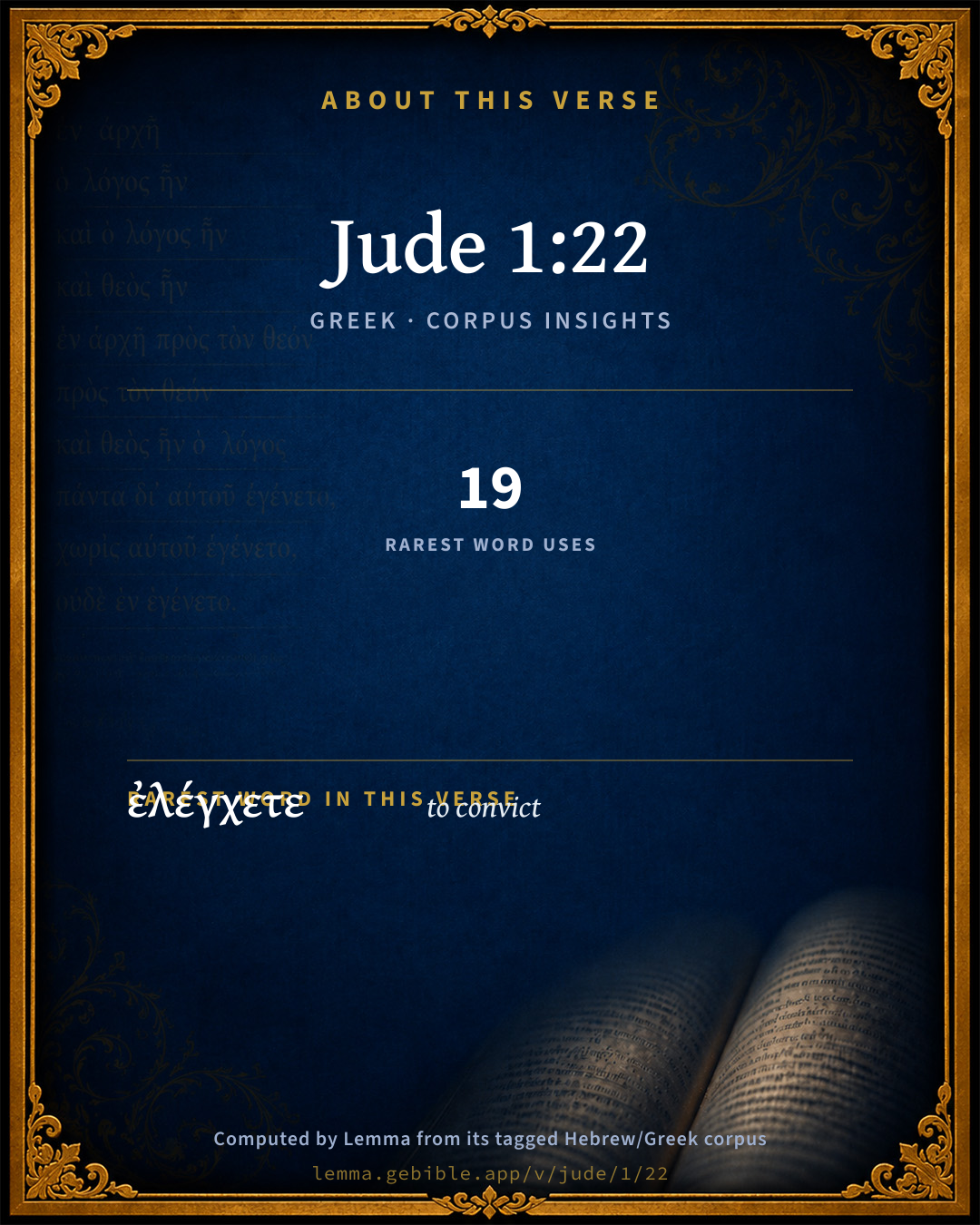
Jude 1:22

Greek (Tischendorf 8th ed.) Jude 1:22 appears in the Greek New Testament. The text above is from the Tischendorf 8th edition. Each word links to its Strong’s number and a concise gloss. Click any word for its full Thayer’s Greek Lexicon entry.

Download image
Cite this verse

Jude 1:22 (World English Bible). Public Domain. Lemma interlinear Bible study tool, https://lemma.gebible.app/v/jude/1/22.

Show BibTeX & RIS
BibTeX
RIS
English Translation
On some have compassion, making a distinction,
World English Bible · Public Domain
Download a study sheet

One document with this verse’s original text, its word-by-word gloss line, the meaning frame, cross-references with their text, attributed commentary, and full source and license credits — printable, and it pastes into notes with its structure intact.

This verse Autodidact and up

Study sheet (.html) Plain text (.txt)

A passage Seminary Student

Up to 50 verses in one chapter. A passage sheet keeps up to 6 commentary sources and 12 cross-references per verse, in the order this page ranks them, and says so on the sheet whenever that leaves anything out. Ask for a single verse and you get the Autodidact verse sheet above.

Everything on this page stays free to read, with no account — the sheet is a download of what is already on screen, not access to it.

Want to remove ads? Support Godless Engineer
Compare translations 3

The same verse in 3 English versions, stacked beneath the original-language interlinear above. Click any original word for its lexicon entry.

Each is an independent rendering of the whole verse — the interlinear is not word-aligned to these translations.

Highlighted words mark where these versions differ — a whole-verse word diff, not a word-by-word alignment.

  • World English Bible Public Domain
    On some have compassion, making a distinction,
  • King James Version Public Domain
    And of some have compassion, making a difference:
  • unfoldingWord Literal Text CC BY-SA 4.0
    And indeed, have mercy on who are doubting,

unfoldingWord Literal Text — © unfoldingWord, licensed CC BY-SA 4.0. Word-aligned USFM3 via Door43 (git.door43.org/unfoldingWord/en_ult).

Versions to compare (up to 4)

3 of 4 selected

Show all 19 translations

Every available English version of this verse, each an independent rendering of the whole verse.

  • World English Bible Public Domain
    On some have compassion, making a distinction,
  • Berean Standard Bible Public Domain
    And indeed, have mercy on those who doubt;
  • Majority Standard Bible Public Domain
    And indeed, have mercy on some, making a distinction;
  • King James Version Public Domain
    And of some have compassion, making a difference:
  • American Standard Version (1901) Public Domain
    And on some have mercy, who are in doubt;
  • Revised Version (1885) Public Domain
    And on some have mercy, who are in doubt;
  • Geneva Bible (1599) Public Domain
    And haue compassion of some, in putting difference:
  • Douay-Rheims (1899) Public Domain
    And some indeed reprove, being judged:
  • Young's Literal Translation Public Domain
    and to some be kind, judging thoroughly,
  • Literal Standard Version CC BY-SA 4.0
    and, indeed, show mercy to those who are doubting,
  • Unlocked Literal Bible CC BY-SA 4.0
    Be merciful to those who doubt.
  • unfoldingWord Literal Text CC BY-SA 4.0
    And indeed, have mercy on who are doubting,
  • Darby Bible Public Domain
    And of some have compassion, making a difference,
  • World Messianic Bible Public Domain
    On some have compassion, making a distinction,
  • Webster's Bible Public Domain
    And of some have compassion, making a difference:
  • Free Bible Version CC BY-SA 4.0
    Show kindness to those who doubt.
  • Bible in Basic English Public Domain
    And have pity on those who are in doubt;
  • Text-Critical English NT CC BY 4.0
    Have mercy on some, using discernment;
  • Tyndale New Testament (1534) Public Domain
    And have compassion on some separatynge them:

Literal Standard Version (2020), Covenant Press — licensed CC BY-SA 4.0. Text via the HelloAO Bible API (eBible.org). Unlocked Literal Bible (unfoldingWord) — licensed CC BY-SA 4.0. Text via the HelloAO Bible API (eBible.org). unfoldingWord Literal Text — © unfoldingWord, licensed CC BY-SA 4.0. Word-aligned USFM3 via Door43 (git.door43.org/unfoldingWord/en_ult). Free Bible Version, Dr. Jonathan Gallagher — licensed CC BY-SA 4.0. Text via the HelloAO Bible API (eBible.org).

Word by word

More ways to search: Search by grammar → Find every occurrence → Compare this word →

Practice this passage: Drill this verse → Learn its vocabulary →

ἐλέγχετε
elénchō
G1651
“to convict”
Verb, Present, Active, Imperative, 2nd person, Plural
Part of Speech
Verb
Tense
Present
Voice
Active
Mood
Imperative
Person
2nd person
Number
Plural
Full Thayer's Definition

Origin: of uncertain affinity

TDNT: 09:53,2

1. to convict, refute, confute a. generally with a suggestion of shame of the person convicted b. by conviction to bring to the light, to expose 2. to find fault with, correct a. by word 1. to reprehend severely, chide, admonish, reprove 2. to call to account, show one his fault, demand an explanation b. by deed 1. to chasten, to punish
  1. καὶ kaí G2532 “and” Conjunction
  2. οὓς hós G3739 “who” Relative pronoun, Accusative, Plural, Masculine
  3. μὲν mén G3303 “truly” Particle
  4. διακρινομένους diakrínō G1252 “to distinguish” Verb, Present, Middle, Participle, Accusative, Plural, Masculine

About this verse

These counts appear in no published source. They are computed here, from the morphology-tagged text and Lemma’s own curated glosses. What Lemma adds →

5
words
5
distinct lemmas
General Epistles
section

Notable vocabulary

The rarest word here is ἐλέγχετε to convict G1651 — appearing just 19 times in the whole Greek New Testament.

Shared distinctive vocabulary

ἐλέγχετε to convict G1651 occurs in 19 verses of the Greek New Testament. Also found in:

Cross-references

7

Topical passages linked to Jude 1:22 in the Treasury of Scripture Knowledge — connected by theme and wording, ordered by reader-vote popularity; previews shown in the World English Bible.

  • James 5:19–20 Brothers, if any among you wanders from the truth, and someone turns him back,
  • Galatians 6:1 Brothers, even if a man is caught in some fault, you who are spiritual must restore such a one in a spirit of gentleness; looking to yourself so that you also aren't tempted.
  • 1 John 5:16–18 If anyone sees his brother sinning a sin not leading to death, he shall ask, and God will give him life for those who sin not leading to death. There is a sin leading to death. I don't say that he should make a request concerning this.
  • Hebrews 6:4–8 For concerning those who were once enlightened and tasted of the heavenly gift, and were made partakers of the Holy Spirit,
  • Jude 1:4–13 For there are certain men who crept in secretly, even those who were long ago written about for this condemnation: ungodly men, turning the grace of our God into lasciviousness, and denying our only Master, God, and Lord, Jesus Christ.
  • Ezekiel 34:17 As for you, O my flock, thus says the Lord Yahweh: Behold, I judge between sheep and sheep, the rams and the male goats.
  • Galatians 4:20 but I could wish to be present with you now, and to change my tone, for I am perplexed about you.

Cross-references courtesy of OpenBible.info (CC BY 4.0).

Where the printed editions differ

1 variant

Places in this verse where the major printed Greek editions disagree on the wording in a way that affects the translation — a comparison of editions, not a manuscript-by-manuscript collation. The editions are the modern critical texts (Nestlé-Aland 28/27, SBL, Westcott-Hort, Tregelles, Tyndale House) and the traditional texts behind the KJV (the Textus Receptus and the Byzantine/Majority text). It is not a claim about which reading is original.

  1. Different wording
    ἐλεᾶτε

    “do have mercy on”

    In NA28NA27SBLWHTRByz Not in TynTreg

    ἐλέγχετε (elegchete) 'do rebuke' occurs in a few manuscripts (Tyn+Treg) instead of ἐλεᾶτε (eleate) 'do have mercy on' in older manuscripts (NA28+NA27+SBL+WH+TR+Byz)

Textual data: Translators Amalgamated Greek New Testament (STEPBible TAGNT) · CC BY 4.0.

Commentary

Notes on Jude 1:22 from classic Christian and Jewish commentators (each source and its license shown beneath its notes). The classic Christian expositions comment on the surrounding passage and are grouped to its opening verse, so a note may address several verses; the Jewish commentaries on the Tanakh (Rashi and others) are per-verse, so they appear only where the commentator wrote on this verse.

Lemma curates 59 commentaries, every one of them public domain or Creative Commons licensed, each selected and text-cleaned for this edition rather than reprinted as found. About our sources →

The Biblical Illustrator

Joseph S. Exell

Jud_1:22-23

And of some have compassion, making a difference.

Different degrees of sinners differently to be treated

There is one kind of argument necessary to be used to men of evil principle and debauched lives; to lovers of pleasure and haters of discipline and wise instruction; to men puffed up with accidental advantages of this present world, and that have never tasted the powers of the world to come; and another sort proper to be applied to those who know the will of God and approve the things that are more excellent, being convinced that the law is holy, but through the strength of their passions and the weakness of their resolutions they are frequently seduced by the deceitfulness of sin. There are some that ought to be rebuked sharply (Tit_1:13); and others, whom when they, are overtaken in a fault, they which are spiritual are directed to restore them in the spirit of meekness (Gal_6:1). There can be no better direction given us in this matter than in the words of the text: Of some have compassion, etc. For so God Almighty Himself in the dispensations of His all-wise Providence draws some men with the tender mercies of a compassionate Father, and others He drives with the terrors of an incensed Judge. In the words we cannot but observe--

1. That there is great difference in the degrees of sin and in the danger of sinners; and that, accordingly, there ought to be a proportionable difference in the manner of treating them.

2. That the difference which ought to be made in this case is this, that those who sin through infirmity are to be admonished with greater tenderness than those who sin presumptuously.

3. That presumptuous sinners who transgress habitually and with a high hand, are to be looked upon as being in a condition near to desperate, as being already in the fire.

4. That even these persons we ought still to endeavour to save, by bringing them even yet to repentance. Firstly, some men there are who, for want of early instruction and good education, are utterly ignorant of all religious matters. Such persons want the very first principles of the doctrine of Christ. Secondly, others there are who deny all moral difference of actions, and take upon them by an extraordinary degree of reason and judgment to have gotten above the fears and obligations of religion. These are men of openly corrupt principles and debauched lives; despisers of true knowledge, and that cannot bear reproof. To such persons we must demonstrate, from the necessary notion of a first or self-existent Cause and from the structure and order of the world, that there is a supreme God, who made and governs all things; and from the necessary attributes of such a supreme and self-existent Cause we must prove that God, as He is all-powerful and all-wise, so He is also perfectly holy, just, and good. Thirdly, others we shall find who will profess to believe the Being of God and the natural obligations of religion; yet will deny the truth of all Divine revelation and have no regard to the authority of the gospel, which is the religion appointed for the reconciliation of sinners. To such persons as these we must endeavour to show the necessary difference between the natural duty of innocent creatures and a religion instituted for the salvation of sinners. Fourthly, among those who have gone still further than the former, and acknowledge not only the religion of nature, but also the gospel of Christ; yet how many are there who have corrupted this doctrine of truth with numberless vanities and superstitions? Against every one of these are proper remedies to be applied. Fifthly, even among those who maintain the truth in speculation, and contend for no errors in doctrine; many there are notoriously wicked in practice, and the truth which they hold is in the most shameful unrighteousness. The only way of applying to this sort of persons is to endeavour to awaken their stupefied consciences by representing to them the wrath of God, revealed from heaven, against all incorrigible sinners. Sixthly, others there are, on the contrary, who not only believe rightly, but also live well; and yet through indisposition of body and melancholy imaginations of mind they are always disconsolate and fearful of their own estate. These must be treated in a quite contrary method to the former, with all possible tenderness and compassion. (S. Clarke, D. D.)

Treating sinners with compassion and discretion

1. Reproofs must be managed with compassion and holy grief. This is like God (Lam_3:33). There are tears in His eyes when He hath a rod in His hand. It is like Christ (Luk_19:41). There are three grounds of this holy grief:--

(1) The dishonour done to God (Psa_119:136). Love will be affected with the wrong of the party loved.

(2) The harm and destruction men bring upon themselves, that they have no care of their own souls (Jer_13:17).

(3) The proneness that is in our nature to the same sin (Gal_6:1). Bernards good man would weep--he to-day and I to-morrow: there is no sin in their lives but was in your nature. Well, then, it checketh them that speak of others sins by way of censure, but with delight or petulancy of spirit; many reproofs are lost because there is more of passion than compassion in them. It is spiritual cruelty when you can turn a finger in your brothers wound without grief.

2. In reproving some must be handled gently: but who are those that must be handled gently?

(1) With the most notorious it is good to begin mildly, that they may see our goodwill and desire of their salvation (2Ti_2:25). Hasty spirits cannot brook the least opposition, and therefore are all a-fire presently. How did God deal with us in our natural condition? with what mildness? and spake comfortably to us, to allure us out of the devils snare (Hos_2:14).

(2) The persons whom we should treat with much compassion are these:--

(a) The ignorant and seduced. Many well-meaning men may err; be not too severe with them, lest prejudice make them obstinate.

(b) Those that slip of infirmity. Members must be set in joint tenderly (Gal_6:1).

(c) The afflicted in conscience. We must not speak to the grief of those whom God hath wounded (2Co_2:7).

(d) If they err in smaller matters. We must not deal with motes as with beams, and put the wicked and the scrupulous in the same rank, nor the gross heretic, and those that mistake in point of church order. While the judgment is sound in fundamentals, and the practice is reformed, we should use meekness till God reveal the same thing (Php_3:15-16).

(e) The tractable and those of whom we have any hopes. Dashing storms wash away the seed, whereas gentle showers refresh the earth: men left without hope grow desperate.

3. In all censures and punishments there must be choice used and discretion. Prudence is the queen of graces. Different tempers require different remedies (Isa_28:27). God Himself putteth a difference: some are brought in with violence, others gently. This showeth--

(1) That ministers had need be wise, to know how to suit their doctrines, to distinguish between persons, actions, circumstances.

(2) That ministers should give every one their portion. Terror to whom terror belongeth, and comfort to whom comfort belongeth.

(3) It showeth what care we should take to know the state of our flock (Pro_27:23), that we may know how to apply ourselves to them (Col_4:8). It also obligeth private Christians to consider each others temper, gifts, frame of heart, that we may the better suit ourselves to do and receive good (Heb_10:24-25). (T. Manton.)

Discrimination in the exercise of religious reformation

The exact nature of that discrimination in the exercise of religious wisdom which the apostle prescribes, will readily be seen if we only glance back at the circumstances of the persons to whom he referred. There were some among them who, through ignorance, through inattention, or through the power of a commanding example, might be betrayed into errors of opinion, and into impurities of practice; and who, in fact, might be victims to the artful leaders of the great heresy which St. Jude has condemned. There were the others however--those very artful leaders themselves--who were proud and insolent, overbearing and authoritative, in their wickedness; and for the sake of personal advantage, who were firmly fixed in their corruptions of faith and manners. Surely to have made no difference between these would have been the most flagrant injustice. Undoubtedly it will be granted that in all cases the attempt that is projected for the conversion of men ought to have compassion as its source and unwearied mainspring. What other sentiments, indeed, can be tolerated for leading us to diffuse the knowledge and influence of religion? But, while observing this, you will at the same time readily see that the two things contrasted in the text, compassion and fear, relate to the instruments by which we try to accomplish the ends of Christian benevolence. Though the affection be one, the means which are employed are varied. On one side then, in making this difference, some are to be treated with compassion. Here is the bruised reed, and we must be careful lest we break it. Here is the smoking flax, and we must be careful lest we quench it. Ignorance by its darkness has produced confusion; we must endeavour to restore order by admitting the light of truth. The principles are distorted, but through the bias of false education. Offences are committed, but chiefly through surprise and inadvertence. Wrong habits are indulged, but they were contracted not wilfully, and they are persevered in through carelessness. Hence correction must be administered in the spirit of meekness; reproof be regulated by time and circumstances; and everything be so conducted as to allure, rather than to terrify; and to lead, rather than by forcible methods to compel. On the contrary, however, the duty of making the difference, ascertains that others are to be saved with fear--that is by using fear as the means--by employing it without scruple, or shrinking, or cautious tenderness; but employing it promptly, determinately, and even vehemently; urging on to the person who is in jeopardy, and extracting him, as out of the very midst of the destroying element. Instead of the bruised reed of a feeble resolution, there is now the hardened heart, which must be assailed with many a blow in order to dissolve its stubbornness. Instead of the smoking flax of a timid and fickle piety, there is now the very hatred of religion flaming out against truth and godliness, which must be suppressed and extinguished. Instead of unavoidable ignorance there is wilful blindness. Instead of the unfortunate notions of a false education, there are evil principles adopted by design and cherished with obstinacy. Instead of teachableness, there is contempt of instruction. Instead of offendings by inadvertence, there are transgressions of purpose. Instead of practices, wrong by oversight, there are habits pernicious by intention. Instead of lapses by surprise, there are sins by deliberation and fixed execution. Instead of occasional failings, there is perpetual and almost incorrigible guilt. For these reasons our subject of address can no longer continue its tone of mild persuasion. The awakening language is now requisite. The warning and the rebuke are now needed; and the tearing off the coverings--the breaking down of the pretended excuses--the driving through every fence and vain protection--and the sweeping forcibly away of all those refuges of lies which the unbelieving heart is wont to raise up against conviction. Thus encouragement and alarm, on the subject of religion, have a reference to opposite classes of persons. In preaching, one material part of duty consists of setting forth and expounding the blessed promises of revelation. Without our making a difference, most assuredly we are not dividing the word aright; and this want of wisdom may prove itself in sad effects. The indiscriminate hopes may cause presumption. The undiscerning freeness may produce licentiousness. The premature healing of the wound may hinder for ever the perfected cure. The hasty consolation may stifle conviction. Again, in preaching, another material part of duty consists of setting forth and expounding the threatenings of revelation. There are the serious representations of the Divine government, which impress us with the thought--of a Judge, clothed in awful authority--of a tribunal, whence the sentence of life and death shall issue. But indiscriminate terrors might cause depression when there should be hope might cloud the evidences of safety where these were beginning to brighten, and oppress with new darkness the diffident and the doubting. While you thus see the reasons for our making a difference in preaching, you will not fail to grant that equally strong reasons press on you the same duty in hearing. Now inquire whether you have made the difference that must be made ere the receiving of the promise can be salutary or even safe; or, on the contrary, if you may not be deceived with superficial views of your character. (W. Muir, D. D. )

Ministerial discriminations

I need hardly tell you that, although it is only of one class that the minister is bidden to have compassion, the meaning cannot be that he is not to compassionate any other class. He would be wanting in the sensibilities of a man, to say nothing of those which his very office is adapted to cherish, if he could be indifferent to the condition of a single transgressor. And hence it cannot be the design of St. Jude to divide sinners into classes, for one of which the minister is to feel compassion, but not for the other: he must be referring to the difference in treatment, rather than to a difference in sentiment. And yet whilst there is a great sense in which every sinner is to be an object of compassion, undoubtedly the characters and circumstances of some are more adapted to the exciting pity than those of others. Behold that young person whose family is irreligious, who, with perhaps a secret sense of the necessity of providing for the soul, is laughed out of all seriousness by those who ought to be urging him to piety. I could not treat that young person sternly; I could not fail in any intercourse with him to bear in mind his peculiar disadvantages. I could indeed weep over one who had so much against him in the saving of the soul. Or behold, again, that man in distressed circumstances, on whom are pressing the cares of a large family, and who is tempted to gain the means of subsistence through practices which his conscience condemns--Sunday trading, for example. Could I go to that man in harshness and severity? I must not, indeed, spare his fault; I must not allow that difficulties are any excuse for his offence; but surely when I think on his peculiar temptations, and hear the cry of his young ones who are asking for bread, you will expect me to feel concern for the man, and to show it in the manner in which I reprove his misdoing. Oh! I know very well how easy it is for a man to deceive himself in the beginnings of sin, how many things commonly conspire to facilitate the entrance on an evil course, and to hide alike its peril and its wrongness. And whenever, therefore, we see a man just venturing his foot on a forbidden path, we would address him in the language of the text: language which would show that we make every allowance for what may be called the naturalness of his error, even as we would if we saw him entering a field the flowers round whose margin gave him no warning of the fatal marsh into which he would soon sink. Or once more--and here you have the exact case that appears to be contemplated by St. Jude--a man of no very strong intellect, and of no very great reading, is thrown into the society of sceptics, men perhaps of brilliant powers and of no inconsiderable acquirements. He will be no match for these apostles of infidelity. Towards a man thus seduced our prevailing feeling will be compassion--a feeling which you cannot expect to extend towards those who seduced him. So that if there be amongst you the man or the woman who can only please God by displeasing relations, or with whom close attention to religion seems likely to shut up the channels of subsistence, or who is unavoidably associated with those who half force him to be sceptical, or who is living upon what we may call the border-line where vice tries to pass for virtue, why, we would not class that individual with the reckless and the obdurate, who are sinning with a high hand, and doing despite to the Spirit of grace. Without disguising the nature of sin, of whatever degree or complexion, we may still show that we put a difference between sinners, just as the physician between patients, who may be all sick of diseases which tend directly to death, but who require, nevertheless, very different remedies. And there are gentle remedies which we would try with those cases we have endeavoured to describe. We feel for you--ah, that is little, very little. The Redeemer Himself feels for you. He knows your dangers and your difficulties--in how attractive a form temptation has come--how much you will have to give up, how much to encounter, if you come boldly out and embrace His discipleship. He bids me speak to you in tenderness. Go not away and say that Christianity is harsh and repulsive. You shall have our entreaties, if they will move you to run no further risks; you shall have our expostulations, our affectionate expostulations, if they will induce you to take the Saviour at His word. But it is time that we advanced to the consideration of the other part of the apostles directions. There is to be stern treatment as well as gentle. Others save with fear, pulling them out of the fire. There can be no very great difficulty in deciding what the cases are which St. Jude may be supposed to have here had in view. They are the cases of hardened and reckless men, of the openly dissolute and profane--men living in habitual sin, and showing an unblushing contempt for the authority of God. The apostle refers to men who cannot possibly be in any doubt as to the wrongness of their conduct, who cannot plead ignorance in excuse, or the suddenness of temptation, or the pressure of circumstances, but who, out of a decided preference for iniquity, a settled determination to gratify their passions, or aggrandise their families, pursue a course against which conscience remonstrates, and of which they would not themselves venture to advance any justification. How am I to act towards such men? Must I show them that I pity them? Oh! yes, that I pity them; for if ever men were within a hairs-breadth of destruction, these are the men. But the pity must be mixed with indignation. What mean you by thus persisting in iniquity? Is the Bible a forgery? is death annihilation? is hell a phantom? is heaven a day-dream? What mean you, young persons, with your delay; elder persons, with your avarice; men of pleasure, with your licentiousness; men of business, with your underhand transactions; men of argument, with your sceptical theories? We may pity you, but at the same time we hardly know how to keep down a righteous scorn. There is no excuse to be offered for you, no extenuation. And what treatment does the apostle bid us try with such? Others save with fear, pulling them out of the fire. Oh! beautiful words, notwithstanding all their harshness! The apostle speaks, you see, of saving these men. Then they may yet be saved. We are not to despair of any one amongst you. We have yet again to bring to you the message of pardon. We are sent to you once more with the touching words--Turn ye, turn ye; for why will ye die? But, then, whilst directed to make every effort to save you, and therefore assured that you are not past recovery, the terms are very peculiar in which the direction is conveyed. Save with fear, pulling them out of the fire. The apostle considers you as already in the fire. So perilous is your condition, that he speaks of you as though you had taken the last step and plugged into perdition. And the expression goes even beyond this. It is of danger to the man who seeks to save, as well as of danger to the perishing man, that the apostle would admonish us. And here is a fact which well deserves the being seriously pondered. We may say generally, that if our wish to convert the sinful bring us into intercourse with the sinful, there is a risk of our learning their vices whilst labouring to communicate our principles. Association, under whatever circumstances, with dissolute men is full of peril. There is one more clause of the text which, though it may not perhaps actually convey any new sentiment, is so strong in its expression as well to deserve separate notice--Hating even the garment spotted by the flesh. You would be very cautious in giving assistance to a man in the fire, fearing that you yourselves might be burned. You would be equally cautious in giving assistance to a man seized with the plague, fearing that yourselves might be infected. You should deal with them as with parties who cannot be approached without risk of contamination; who are hot only radically diseased, but to whom there can belong nothing which may not be a vehicle for conveying disease; their very dress--language which is the dress of thought--manners, which are often a fascinating garb, being not unlikely ultimately to act as a conductor, so that secretly and stealthily you may get the poison into your own veins. (H. Melvill, B. D.)

Wise treatment of sinners

First, generally we must use discretion, and make difference of men; we must be like surgeons and expert physicians, who do not lay one plaster to all sores, nor minister one potion to all patients: this is that wisdom that Christ requireth of His apostles (Mat_10:16). Some are wild heifers, and must have a yoke; some are rude horses, and must have a snaffle; some are dull asses, and must have a whip and a spur; some are unruly, and must be admonished; some feeble, and must be comforted; and towards all we must use patience. The nurse, when the child hath a fall, will first help it up, after chide it, and if it fall again correct it; so must the nurse of souls first help a brother out of the mire of sin, then chide him for falling into the ditch, and if this will not serve, apply a sharper corrosive to his sore; yet let all this be done with discretion. Well, we must have compassion of some, for some sins are to be pitied. We must be so far from hating and rejoicing at their falls, that we ought rather to sorrow and to be grieved. What father is not grieved with the hurt of his children? What friend is not grieved at the loss of his friend? What shepherd delighteth in the wronging and scattering of his flock, and not in gathering it together? The compassionate Samaritan to the poor passenger may teach us to show mercy unto sinners. It is strange to see how we pity an ox or an ass fallen into a ditch, but not a brother drowned in sin; it is vile to set a house on fire, but it is vile also to pass by it and not to quench it when it is in our power. Again, as some men are to be pitied, so other some are to be reproved, and must have the judgments of God denounced against them, and must be terrified with menaces. A Christian must not be afraid to reprove sin. Noah reproved the old world; Lot, Sodom and Gomorrah; Samuel, Saul; Nathan, David the king. This also teacheth the people to suffer the word of exhortation; but flatterers are most esteemed of them, such as can sow pillows under their elbows and can preach pleasing things unto them. If a shepherd, after his whistle, sets his dog on his sheep, it is not to worry them, but to return them home; therefore let men suffer the word of exhortation. (S. Otes.)

Brands

The method of treating the three classes on Christian grounds is here laid down, and is as applicable to-day as it then was.

1. The doubters. They are to be treated with consideration and kindliness. Many who once were disputers are now firm believers of the truth.

2. Scoffers. There was a class, not the leaders of the schism, that had been led away, to whom warning must be administered. The suggestion is that the authority of the truth be used; not persuasion, but admonition, exhibiting the power of the truth. Let the arrow of conviction have its own barb, and let it fly.

3. The sensualists. They must be approached with fear or with caution. They were within the bounds of conviction, although very near the circumference. The lesson for the Church to learn is to approach men according to their condition. Somebody in a hurry gave a tract on the sin of dancing to a man with two wooden legs. We fear that worse mistakes, if possible, are committed frequently. (T. Davies, M. A.)

Making a difference

Legh Richmond was once conversing with another clergyman in the case of a poor man who had acted inconsistently with his religious profession. After some angry and severe remarks on the conduct of such persons, the gentleman with whom he was discussing the case concluded by saying, I have no notion of such pretences; I will have nothing to do with him. Nay, brother, let us be humble and moderate. Remember who has said, making a difference; with opportunity on the one hand, and Satan at the other, and the grace of God at neither, where should you and I be?

The Biblical Illustrator, edited by Joseph S. Exell (c. 1880s–1900s) — public domain. Text from a community e-Sword module.

Joseph Benson's Commentary

Jdg 1:22-23. And of some — Who are perverted by these seducers, erring only through infirmity, and in lesser points; have compassion — Treat with lenity, and endeavour to reclaim, in a mild and gentle way, by the winning method of persuasion; making a difference — Between them and others that are more guilty and stubborn. And others — Who sin presumptuously and openly; save with fear — Endeavour to rouse their fears, setting before them a future judgment and its awful consequences in all their terrors. And if they continue unmoved, use the censures of the church as the last remedy. Or, as some think, he may mean with a jealous fear for yourselves, lest you should be infected with the disease you endeavour to cure; pulling them out of the fire — Of temptation, sin, and divine wrath, into which they are fallen, or are just ready to fall. As if he had said, And if you desire that your efforts in either of these cases should be successful, you must take great care to preserve your own purity; and while you love the sinners, to retain the utmost abhorrence of their sins, and of every the least degree of approach to them; hating even the garment spotted by the flesh — Lest by the touch of it you yourselves should be polluted. This clause, which is a caution addressed to “those who snatch others out of the fire, implies that in doing them that compassionate office, they are to avoid all familiarity with them, even as they would avoid touching a garment spotted by the flesh of one who had died of the plague, lest they should be infected by their vicious conversation.”

Joseph Benson's Commentary on the Old and New Testaments (1811–1818) — public domain. Text from a community e-Sword module.

Tyndale Open Study Notes

Tyndale Open Resources

1:22-36 Two references to the descendants of Joseph (1:22, 35) frame this litany of the northern tribes’ failures to drive out the enemy.

1:22 The Lord was with the descendants of Joseph (the tribes of Ephraim and Manasseh), but only in their united attack on Bethel, a place sacred to Israelite memories from the days of Jacob (Gen 28:19). They failed in attacks made separately (Judg 1:27-29). • Bethel is associated with the battle against Ai (Josh 7:2) and is listed in the summary statement of kings that Israel had defeated (Josh 12:16).

1:22-23 The NLT accepts the manuscript tradition that includes three commands in these verses, corresponding to three categories of people: (1) those whose faith is wavering, (2) those who need to be snatched from the flames of judgment, and (3) others who need to be shown mercy. Some manuscripts have only two categories of people: (1) those whose faith is wavering and thus need to be snatched from judgment, and (2) those who need to be shown mercy. The text adopted in the NLT follows the pattern of threes that Jude uses elsewhere (1:5-7, 11).

1:22 those whose faith is wavering: Some believers were in the early stages of doubt because of what the false teachers were saying.

Tyndale Open Study Notes — © Tyndale Open Resources, licensed CC BY-SA 4.0. Text via the HelloAO Bible API.

Bengel's Gnomon

Johann Albrecht Bengel

Jud 1:22. Καὶ, and) He who has already taken measures to secure his own interests, may take measures for the interests of others.

Jud 1:22-23. Οὓς μὲν ἐλέγχετε διακρινομένους· οὓς δὲ σώζετε ἐκ πυρὸς ἁρπάζοντες· οὓς δὲ ἐλεεῖτε ἐν φόβῳ,[10] Some indeed, who are hesitating, convince; but save others, snatching them from the fire; but on others have pity with fear) The apostle enumerates three descriptions of those, whose safety the righteous ought to consult: and the first class is deficient in understanding; the second in disposition, and that vehemently; the third in disposition, but in a less degree. Therefore, 1st, conviction, or a demonstration of good and evil, ought to be applied to those who are harassed with doubts, and hesitate in uncertainty and perplexity. 2d, Those whom the fire has already nearly seized upon, ought to be grasped by any part, with rapid effort, and thus preserved. 3d, They are to be treated with mercy and gentleness, who can be led back into the way by fear alone, and a kind pointing out of the danger. See App. Crit., Ed. ii., on this passage.—μισοῦντες, holding in hatred) This strictly coheres with ἐλεεῖτε, pity. He says, Wretched men must be rescued in one way from the fire, and in another way from the mud. It is sufficient for these last to be treated with mildness, fear only being applied: these, being almost untouched by you, may perceive from this very circumstance your hatred and loathing even of the mere surface of impurity.—καὶ, even) not only the flesh itself, which they pollute, Jud 1:8, but even the garment.—ἐσπιλωμένον χιτῶνα, the spotted tunic) The tunic is the whole outward habit of life, in which we are affected by others. The phrase resembles a proverbial one.

[10] Ἐλέγχετε is read by AB corrected, C (according to Lachm., but not so Tisch.), Vulg. Memph. B has ἐλεᾶτε: Rec. Text, ἐλεεῖτε, with inferior Uncial MSS. and later Syr.

Διακρινομένους is read by ABC Vulg. Syr. later Syr. Memph: but Rec. Text, διακρινόμενοι, with inferior Uncial MSS.

Οὓς δὲ ἐλεᾶτε ἐν φόβῳ is the reading of AB Vulg. But Rec. Text omits these words, except that it inserts ἐν φόβῳ after οὓς δὲ and before ἐκ πυρὸς, in opposition to ABC Vulg., which omit these words in that place. C and both Syr. Versions, however, omit οὓς δὲ ἐλεᾶτε, and merely put ἐν φόβῳ after ἁρπάζοντες.—E.

Bengel's Gnomon of the New Testament — English translation (T&T Clark, Edinburgh, 1860) — public domain. Text from a community e-Sword module.

Meyer's Critical & Exegetical Commentary

Heinrich August Wilhelm Meyer

Jud_1:22-23. The exhortations contained in these verses refer to the conduct of believers toward those who are exposed to seduction by the ἀσεβεῖς (Jud_1:4) (de Wette); not toward the false teachers themselves (Reiche), for these are of such a kind (Jud_1:12) that the church should have nothing to do with them. The best attested text is that which codex A affords: καὶ οὓς μὲν ἐλέγχετε διακρινομένους· οὓς δὲ σώζετε ἐκ πυρὸς ἁρπάζοντες, οὓς δὲ ἐλεεῖτε (Lachmann and Tischendorf, ἐλεᾶτε) ἐν φόβῳ; see critical remarks.

οὓς μὲν … οὓς δέ instead of τοὺς μὲν … τοὺς δέ, see Winer, p. 100. According to this reading, three classes of the seduced are distinguished, and toward each a special conduct is prescribed. It is, however, asked whether, as Brückner, Wiesinger, Schott, Reiche, and others assume, there is a gradation from the curable to the incurable (a dubitantibus minusque depravatis ad … insanabiles, quibus opem ferre pro tempore ab ipsorum contumacia prohibemur: Reiche); or conversely from the incurable to the curable. In reference to the first class it is said: οὓς μὲν ἐλέγχετε διακρινομένους] The verb ἐλέγχειν denotes to rebuke some ones sins by punishing him. The object for which this is done is not indicated in the word itself; it may be to lead the sinner to the acknowledgment of his sins, and thus to repentance, comp. 1Co_14:24; 2Ti_4:2; Tit_1:13; or it may also be condemnation, comp. particularly Jude Jud_1:15 (Joh_16:8; Tit_1:9). The explanation of Oecumenius is incorrect: φανεροῦτε τοῖς πᾶσιν τὴν ἀσέβειαν αὐτῶν. Those who are to be punished are denoted διακρινομένους. Both the translation of the Vulgate: judicatos, and the interpretation of Oecumenius: κακείνους εἰ μὲν ἀποδιΐστανται ὑμῶν ἐλέγχετε, are incorrect. διακρίνεσθαι signifies in the N. T. either to contend, which is here unsuitable, or to doubt, and is opposed to πιστεύειν; comp. Mat_21:21; Mar_11:23; Rom_4:20; especially Jam_1:6. This last passage shows that, although not equivalent to ἀπιστεῖν, it denotes the condition in which ἀπιστία has the preponderance over πίστις, the latter being a vanishing point.[47] It is evident that Jude does not consider the ΔΙΑΚΡΙΝΌΜΕΝΟΙ as weak believers (Schott), because, with reference to them, he will employ no other method than ἐλέγχειν (not ΠΑΡΑΚΑΛΕῖΝ, or something similar); those seduced are in his view such as (punishment apart) are to be left to themselves.[48] In reference to the second class it is said: οὓς δὲ σώζετε ἐκ πυρὸς ἁρπάζοντες] Their condition is not stated, but it is to be inferred from the conduct to be observed towards them. Toward those belonging to this class a σώζειν is to be employed, but of such a nature as is more precisely stated by ἐκ πυρὸς ἁρπάζοντες. ἐκ πυρός is not from the fire of future judgment (Oecumenius, Fronmüller), but πῦρ is the present destruction, in which they already are (Brückner, Wiesinger, Schott); ἁρπάζειν denotes hasty, almost violent, snatching out, and indicates that those are already in extreme danger of perdition; comp. Amo_4:11; Zec_3:2. Distinguished from the διακρινομένοις, the second class are to be considered as those who have not yet lost the faith, but have, through fellowship with the Antinomians, been enticed to their licentious life; these are to be rescued. σώζετε is evidently in contrast to ἐλέγχετε, and denotes them to be such as one may certainly hope to rescue, provided one snatches them with violence, and tears them out of this fellowship. In reference to the third class, Jude prescribes ἐλεεῖν (on the form ἐλεᾶτε, see Winer, p. 32 [E. T. 104]). This verb in the N. T. never means only to have compassion (Schott), but always to compassionate one with helpful love, as also ἔλεος is always used only of active compassion; so that with ἐλεεῖτε the exact contrary is said to what Luther finds expressed, when he explains it: let them go, avoid them, and have nothing to do with them. By this is denoted rather the helpful and saving benevolence by which the erring are again to be brought back to the right way. As this ἐλεεῖν makes a fellowship necessary with those upon whom it is exercised, Jude defines the same more precisely by ἐν φόβῳ; accordingly, they must not be wanting in foresight, lest they suffer injury themselves,[49] and he adds the participial sentence as an explanation of this ἘΝ ΦΌΒῼ: ΜΙΣΟῦΝΤΕς ΚΑῚ Κ.Τ.Λ.[50] This exhortation shows that Jude considers the third class as those who are indeed already involved, but who, by active compassion, may again be re-established; it is not so bad with them as with those toward whom only ἐλέγχειν is to be employed; but also it is not yet so bad as with those who can only be rescued by hastily snatching them.

[47] When Hofmann says, that διακρίνεσθαι cannot have this meaning requires no proof, he makes an entirely groundless assumption.

[48] In the reading of the Rec.: οὓς μὲν ἐλεεῖτε διακρινόμενοι, we are obliged to explain διακρίνεσθαι as = distinguished. Luther: and make this distinction, that ye compassionate some; or, more exactly, compassionate the one, making a distinction, namely, from others. But διακρινόμενοι must be passive, since not διακρίνεσθαι, but only διακρίνειν, has the meaning to distinguish.

[49] Schott is entirely mistaken when he says that ἐλεεῖν denotes here a compassion which has, and may have, its definite peculiarity no longer in an impulse to help, hut only in a fear of acting wrongly, and in consequence of receiving injury; in other words, a compassion which is no compassion.

[50] According to the reading of the Rec. ἐν φόβῳ belongs to σώζετε. Some expositors (Grotius, Stier, and others) incorrectly explain it of the fear of the persons to he rescued; correctly Arnaud: cest à dire, prenant garde que, tout en cherchant à les convertir, ils ne vous séduisent pas vous-memes. Reiche incorrectly, with the reading A, separates ἐν φόβῳ from ἐλεᾶτε, and joins it with μιτοῦντες, whilst it would attract to it a very superfluous addition.

Hofmann considers the reading of א: καὶ οὕς μὲν ἐλεᾶτε διακρινομένους οὕς δὲ σώζετε ἐκ πυρὸς ἁρπάζοντες, οὓς δὲ ἐλεᾶτε ἐν φόβῳ, as the correct one. In his explanation of this reading he distinguishes not three, but only two classes, assuming that only the first, but not the second οὓς δέ stands opposed to οὓς μέν; and that this latter οὓς δέ is to be considered rather as a resumption of the object mentioned in οὓς μέν. This opinion is, however, erroneous, since, according to it, the third οὕς is understood differently from the first and second οὕς, namely, as a pure relative pronoun; and since, in a highly arbitrary manner, ἐν φόβῳ is explained as a consequence, united with an imperative ἐλεᾶτε to be taken from οὓς ἐλεᾶτε: whom ye compassionate, them compassionate with fear. Also the explanation of the first member of the sentence: the readers are to compassionate the one with distinction, is to be rejected, since it has against it N. T. usage, according to which διακρίνεσθαι is never used as the passive of διακρίνειν in the sense of to distinguish.

The addition μισοῦντες καὶ τὸν ἀπὸ τῆς σαρκὸς ἐσπιλωμένον χιτῶνα[51] is correctly explained by Oecumenhis: ΠΡΟΣΛΑΜΒΆΝΕΣΘΕ … ΑὐΤΟῪς … ΜΕΤᾺ ΦΌΒΟΥ, ΠΕΡΙΣΚΕΠΤΌΜΕΝΟΙ ΜΉΠΩς Ἡ ΠΡΌΣΛΗΨΙς ΤΟΎΤΩΝ … ΛΎΜΗς ὙΜῖΝ ΓΈΝΗΤΑΙ ΑἸΤΊΑ.

ΚΑΊ, even, gives greater emphasis to the thought. The expression τὸν χιτῶνα is to be understood in a literal, and not in a figurative sense (Bullinger: exuvias veteris Adami, concupiscentias et opera carnis). ΧΙΤῶΝ is the under garment worn next the skin, and which, by means of its direct contact with the flesh unclean by unchastity, etc., is itself soiled (ΣΠΙΛΌΩ only here and in Jam_3:6); comp. Rev_3:4.

This garment is to the author the symbol of whatever, by means of external contact, shares in the moral destruction of those men. Calvin: vult fideles non tantum cavere a vitiorum contactu, sed ne qua ad eos contagio pertingat, quicquid affine est ac vicinum, fugiendum esse admonet.

[51] Both in the reading of the Rec. and in the reading of C this addition is surprising; one may regard it, with Jachmann, as the adversative reason of σώζετε (though ye hate); or, with de Wette, as the real reason (since ye hate, for which de Wette appeals to 1Co_5:6!).

Meyer — Critical and Exegetical Commentary on the New Testament — English translation by Peter Christie, edited by Frederick Crombie (T&T Clark, 1880) — public domain. Text from a community e-Sword module.

Expositor's Greek Testament

ed. W. Robertson Nicoll

Jud 1:22 . οὓς μὲν ἐλέγχετε διακρινομένους . On the reading see the Introduction. For the form ὃς μέν instead of ὁ μέν , cf. Mat 13:8 ; Mat 22:5 , Luk 23:33 , Act 27:44 , Rom 14:5 , 1Co 7:7 ; 1Co 11:21 , 2Co 2:16 , 2Ti 2:20 , not used in Hebrews , 1 and 2 Pet., James or John. The doubled ὃς δέ is found in Mat 21:35 , ὃν μὲν ἔδειραν , ὃν δὲ ἀπέκτειναν , ὃ δὲ ἐλιθοβόλησαν . Mat 25:15 , ᾧ μὲν ἔδωκεν πέντε τάλαντα , ᾧ δὲ δύο , ᾧ δὲ ἕν . The use is condemned as a solecism by Thomas Magister and by Lucian, Soloec. 1, but is common in late Greek from the time of Aristotle, cf. Sturz. Dial. Maced. pp. 105 f. On the word ἐλέγχω (here wrongly translated “strafen,” in the sense of excommunication, by Rampf), see Const. Apost. vii. 5, 3, ἐλεγμῷ ἐλέγξεις τὸν ἀδελφόν σου , and Hare’s excellent note [800] in his Mission of the Comforter , where he argues that the conviction wrought by the Spirit is a conviction unto salvation, rather than unto condemnation; and quotes Luecke as saying that “ ἐλέγχειν always implies the refutation, the overcoming of an error, a wrong, by the truth and right. When this is brought before our conscience through the ἔλεγχος there arises a feeling of sin, which is always painful: thus every ἔλεγχος is a chastening, a punishment.” Compare Grote’s life-like account of the Socratic Elenchus in his Hist. of Greece .

[800] Codex Angelicus (sæc. ix.), at Rome, collated by Tischendorf and others.

This verse seems to be referred to in Can. Apost. vi. 4, οὐ μισήσεις πάντα ἄνθρωπον , ἀλλʼ οὓς μὲν ἐλέγξεις , οὓς δὲ ἐλεήσεις , περὶ ὧν δὲ προσεύξῃ , οὓς δὲ ἀγαπήσεις ὑπὲρ τὴν ψυχήν σου , which is also found in the Didache ii. 7, with the omission of οὓς δὲ ἐλεήσεις . Cf. Joh 16:8 , ἐκεῖνος ἐλέγξει τὸν κόσμον περὶ ἁμαρτίας καὶ περὶ δικαιοσύνης καὶ περὶ κρίσεως , 1Co 14:24 , ἐλεγχεται ὑπὸ πάντων (the effect of the prophets’ teaching on an unbeliever), Tit 1:13 , ἔλεγχε αὐτοὺς ἀποτόμως ἵνα ὑγιαίνωσιν ἐν τῇ πίστει . Tit 1:9 , τοὺς ἀντιλέγοντας ἐλέγχειν 2Ti 4:2 (the charge to Timothy) ἔλεγξον , παρακάλεσον ἐι πάσῃ μακροθυμίᾳ , Rev 3:19 , ὅσους ἐὰν φιλῶ ἐλέγχω καὶ παιδεύω , Eph 5:13 , τὰ δὲ πάντα ἐλεγχόμενα ὑπὸ τοῦ φωτὸς φανεροῦται . There is a tone of greater severity in the ποιῆσαι κρίσιν καὶ ἐλέγξαι of the 15th verse, but even there we need not suppose that the preacher is hopeless of good being effected. The point is of importance in deciding the mutual relations of the three cases here considered.

διακρινομένους . We should have expected a nominative here to correspond with ἁρπάζοντες and μισοῦντες in the following clauses, and so the text. rec. has διακρινόμενοι , wrongly translated in A.V., as if it were the active διακρίνοντες , “making a difference”. This gives such a good sense that some commentators ( e.g. Stier) have been willing to condone the bad Greek. It would have been better to alter the reading at once. Keeping the reading of the best MSS. we may either take the accusative as complementary to ἐλέγχετε (as we find in Plato, Theaet. 171 D, ἐμὲ ἐλέγξας ληροῦντα , Xen. Mem. 1, 7, 2, ἐλεγχθήσεται γελοῖος ὤν , Jelf. § 681), or simply as descriptive of the condition of the persons referred to. There is also a question as to the meaning we should assign to διακρ . Is it to be understood in the same sense as in Jas 1:6 ; Jas 2:4 ? In that case we might translate “convict them of their want of faith,” taking the participle as complementary to the verb; or “reprove them because of their doubts”. It seems more probable, however, that the meaning here is “convince them when they dispute with you,” which we may compare with 1Pe 3:15 , ἕτοιμοι ἀεὶ πρὸς ἀπολογίαν παντὶ τῷ αἰτοῦντι ὑμᾶς λόγον … ἀλλὰ μετὰ πραΰτητος καὶ φόβου ( cf. ἐν φόβῳ below). So taken, this first clause would refer to intellectual difficulties to be met by quiet reasoning; the force of διακρινόμενος being the same as that in Jud 1:9 , τῷ διαβόλῳ διακρ ., and in Socr. E.H. Jud 1:5 , ὅ λαὸς εἶχεν ὁμόνοιαν καὶ οὐκέτι πρὸς ἀλλήλους διεκρίνοντο .

The Expositor's Greek Testament, edited by W. Robertson Nicoll (1897–1910) — public domain. Text from a community e-Sword module.

Geneva Bible (1599)

Geneva Bible translators

Among them which wander and go astray, the godly have to use this choice, that they handle some of them gently, and that others some being even in the very flame, they endeavor to save with severe and sharp instruction of the present danger: yet so, that they do in such sort abhor the wicked and dishonest, that they eschew even the least contagion that may be.

Geneva Bible (1599) marginal notes — public domain. Text via Bolls.life.

Jamieson, Fausset & Brown

Robert Jamieson, A. R. Fausset & David Brown

None but those who "keep themselves" are likely to "save" others.

have compassion--So one oldest manuscript reads. But two oldest manuscripts, Vulgate, &c., read, "convict"; "reprove to their conviction"; "confute, so as to convince."

making a difference--The oldest manuscripts and versions read the accusative for the nominative, "when separating themselves" [WAHL], referring to Jde 1:19; or "when contending with you," as the Greek is translated, Jde 1:9.

Jamieson, Fausset & Brown — Commentary Critical and Explanatory on the Whole Bible (1871) — public domain (CC PDM 1.0). Text via the HelloAO Bible API.

Adam Clarke's Commentary

Verse 22. And of some have compassion, making a difference] The general meaning of this exhortation is supposed to be, "Ye are not to deal alike with all those who have been seduced by false teachers; ye are to make a difference between those who have been led away by weakness and imprudence, and those who, in the pride and arrogance of their hearts, and their unwillingness to submit to wholesome discipline, have separated themselves from the Church, and become its inveterate enemies."

Instead of Και οὑς μεν ελεειτε διακρινομενοι, and of some have compassion, making a difference, many MSS., versions, and fathers have και οὑς μεν ελεγχετε διακρινομενους, and some rebuke, after having judged them; or, rebuke those that differ; or, some that are wavering convince; or whatever else the reader pleases: for this and the following verse are all confusion, both in the MSS. and versions; and it is extremely difficult to know what was the original text. Our own is as likely as any.

Adam Clarke's Commentary on the Bible (1810–1826) — public domain. Text from a community e-Sword/MySword module.

John Calvin's Commentaries

22. And of some have compassion. He adds another exhortation, shewing how the faithful ought to act in reproving their brethren, in order to restore them to the Lord. He reminds them that such ought to be treated in different ways, every one according to his disposition: for to the meek and teachable we ought to use kindness; but others, who are hard and perverse, must be subdued by terror. This is the difference which he mentions.

The participle διακρινόμενοι, I know not why this is rendered in a passive sense by Erasmus. It may, indeed, be rendered in either way, but its active meaning is more suitable to the context. The meaning then is, that if we wish to consult the well-being of such as go astray, we must consider the character and disposition of every one; so that they who are meek and tractable may in a kind manner be restored to the right way, as being objects of pity; but if any be perverse, he is to be corrected with more severity. And as asperity is almost hateful, he excuses it on the ground of necessity; for otherwise, they who do not willingly follow good counsels, cannot be saved.

Moreover, he employs a striking metaphor. When there is a danger of fire, we hesitate not to snatch away violently whom we desire to save; for it would not be enough to beckon with the finger, or kindly to stretch forth the hand. So also the salvation of some ought to be cared for, because they will not come to God, except when rudely drawn. Very different is the old translation, which reading is however found in many of the Greek copies; the Vulgate is, “Rebuke the judged,” (Arguite dijudicatos.) But the first meaning is more suitable, and is, I think, according to the old and genuine reading. The word to save, is transferred to men, not that they are the authors, but the ministers of salvation.

John Calvin's Commentaries (1540-1563) — public domain. Text from the Calvin Translation Society English edition (1840s-50s) via the Christian Classics Ethereal Library (ccel.org). Calvin's coverage is partial (roughly two-thirds of the Bible); uncommented books and verses are honest gaps, never fabricated. The 19th-century editor's footnotes and remarks are omitted so the notes are faithfully Calvin's own voice.

Ellicott's Commentary for English Readers

(22, 23) Exhortation to treat these libertines with discrimination, making three classes.

(22) And of some have compassion, making a difference.—The evidence is very strong in favour of a widely different reading: And some indeed convict (Jud_1:15) when they are in doubt (Mat_21:21; Act_10:20; Act_11:12; Rom_4:20; Rom_14:23; Jas_1:6); or, when they contend with you (Jud_1:9; Act_11:2); or, when they separate from you. The first seems best, though the second also makes excellent sense, and has Jud_1:9 in its favour. This, then, is the first and least hopeless class—those who are still in doubt, though inclined the wrong way. They may still be remonstrated with, convicted of error, and reclaimed (Mat_18:15; Tit_1:13; Jas_5:20). Some would make this first class the worst and most hopeless—those who are to be argued down in disputation, but without much chance of success. Such interpreters make the third class the best: those who can probably be saved by gentle means. The Greek here is so ambiguous that we cannot be certain of the meaning. But the addition of “in fear” and “hating even the garment spotted by the flesh” to the directions respecting the third class, seems to indicate that that class is the worst.

(23) And others save with fear.—“With fear” must certainly be omitted, as no part of the true text. “Save” should perhaps be try to save. It is the present imperative, not the aorist.

Pulling them out of the fire.—Better, snatching them out of the fire. We have here another reminiscence of Zec_3:1-3 : we had one in Jud_1:9. (Comp. Amo_4:11.) The fire of the judgment to come is probably not meant; rather the imminent danger (as of one who is asleep in a burning house) in which the fire of their sins keeps them. This is the second class: those who can still be rescued, but by strong measures.

After the words “out of the fire” we must insert another clause omitted from the inferior Greek texts used by our translators: “and on others have compassion in fear.” Wiclif and the Rhemish version, following the Vulgate, have this clause. This is the third and worst class: those on whom profound pity is all that we dare bestow, and that in fear and trembling, lest by contact with them we may be brought within the influence of the deadly contamination that clings to all their surroundings. Abhorrence must be shown to the very externals of pollution. (Comp. 1Co_5:11; 1Ti_5:22; Tit_3:10-11; 1Jn_5:16; 2Jn_1:10-11.)

A Bible Commentary for English Readers, edited by Charles John Ellicott (1878–1897) — public domain. Text from a community e-Sword module.

The Cambridge Bible for Schools and Colleges

gen. ed. J. J. S. Perowne

22. And of some have compassion, making a difference …] The MSS. present a strange variety of readings. Those of most authority give, Some rebuke (or convict, the same word as that used in Joh_16:8; Eph_5:11) when they debate with you (participle in the accusative case). The Received Text rests on the evidence of later MSS., but it may be questioned whether the participle (in this case in the nominative), which is in the middle voice, can have the meaning of “making a difference,” and even if we adopt that reading it would be better to render the word rebuke, as you debate with them, as with an implied reference to the same word as used in Jud_1:9. Internal evidence, as far as it goes, agrees with the better MSS. There is more point in the contrast between the teachers who need a severe rebuke and those who may be saved with fear than in the two degrees of pity presented by the Received Text.

The Cambridge Bible for Schools and Colleges (gen. ed. J. J. S. Perowne; Cambridge University Press, 1878–1918) — public domain. Text from a community e-Sword module.

John Gill's Exposition

And of some have compassion,.... That is, of such who have gone astray, being drawn aside; who are simple and ignorant, and out of the way; who sin through infirmity, and the force of temptation; and who are tractable and open to conviction, and whose mistakes are in lesser matters of religion; as also such who are convicted and wounded in their consciences for their sins and mistakes: and to these compassion is to be shown, by praying with them, and for them, with ardency and affection; instructing them in meekness; giving friendly and brotherly reproofs to them; expressing on all occasions a tender concern for their good; doing them all the good that can be done, both for their souls and bodies: and good reason there is why compassion should be shown them, because God is a God of compassion; Christ is a merciful high priest; a contrary spirit is grieving to the Holy Ghost; saints should consider what they themselves were, and what they now are, and that compassion has been shown to them, and they may want it again. The Alexandrian copy, and some others, and the Vulgate Latin and Ethiopic versions, read, "reprove",

Making a difference; between one and another; using some more tenderly, others more severely, as the nature and circumstances of their case appear to be. The Syriac version renders the whole, "when they repent, have compassion on them".

John Gill's Exposition of the Whole Bible (1746–1763) — public domain (CC PDM 1.0). Text via the HelloAO Bible API.

Albert Barnes' Notes on the Bible

And of some have compassion - This cannot be intended to teach that they were not to have compassion for all people, or to regard the salvation of all with solicitude, but that they were to have special and unusual compassion for a certain class of persons, or were to approach them with feelings appropriate to their condition. The idea is, that the special feeling to be manifest toward a certain class of persons in seeking their salvation was tender affection and kindness. They were to approach them in the gentlest manner, appealing to them by such words as “love” would prompt. Others were to be approached in a different manner, indicated by the phrase, “save with fear.” The class here referred to, to whom “pity” (ἐλεάτε eleate) was to be shown, and in whose conversion and salvation tender compassion was to be employed, appear to have been the timid, the gentle, the unwary; those who had not yet fallen into dangerous errors, but who might be exposed to them; those, for there are such, who would be more likely to be influenced by kind words and a gentle manner than by denunciation. The direction then amounts to this, that while we are to seek to save all, we are to adapt ourselves wisely to the character and circumstances of those whom we seek to save. See the notes at 1Co 9:19-22.

Making a difference - Making a distinction between them, not in regard to your “desires” for their salvation, or your “efforts” to save them, but to the “manner” in which it is done. To be able to do this is one of the highest qualifications to be sought by one who endeavors to save souls, and is indispensable for a good minister of the gospel. The young, the tender, the delicate, the refined, need a different kind of treatment from the rough, the uncultivated, the hardened. This wisdom was shown by the Saviour in all his preaching; it was eminent in the preaching of Paul.

Albert Barnes' Notes on the Bible (1834–1885) — public domain. Text from a community e-Sword/MySword module.

Haydock's Catholic Bible Commentary

And some indeed reprove, being judged. He gives them another instruction to practice charity in endeavouring to convert their neighbour, where they will meet with three sorts of persons. 1. With persons obstinate in their errors and sins, these may be said to be already judged and condemned, they are to be sharply reprehended, reproved, and, if possible, convinced of their errors. 2. As to others, you must endeavour to save them, by snatching them as it were out of the fire, from the ruin they stand in great danger of. 3. You must have compassion on others in great fear, when you see them, through ignorance or frailty, in danger of being drawn into the snares of these heretics; with these you must deal more gently and mildly, with a charitable compassion, hating always, and teaching others to hate the carnal coat, which is defiled, their sensual and corrupt manners, that defile both the soul and body. (Witham)

George Leo Haydock (1774–1849), Haydock's Catholic Family Bible and Commentary, 1859 edition — public domain. Excludes Psalms (Douay-Rheims chapter numbering differs from Protestant) and Deuterocanonical books (Catholic canon only).

Matthew Poole's English Annotations

And of some have compassion; use them gently, mildly reproving and admonishing them, that thereby ye may gain them.

Making a difference: he makes two sorts of offenders, or misled brethren, who might be restored; and that they might, they should be dealt with in different ways, and suitably to their respective conditions and circumstances; the former, who might be discouraged with roughness, should be handled with more tenderness and compassion.

Matthew Poole's English Annotations on the Holy Bible (1683–1685) — public domain. Text from a community e-Sword/MySword module.

Whedon's Commentary on the Bible

Daniel D. Whedon

22. The sinners to be rescued, if possible, are two classes: a some and an others; but Tischendorf makes three classes, including a third, who are others still.

Of some have compassion—The reading followed by our translators may be rendered, some treat with pity, making a discrimination, that is, according to the peculiarity of each case, using severity or tenderness as the transgressor needs. But the reading preferred by scholars at the present day would be: some who are making a dissension you must refute; including the idea of detection and exposure.

Daniel D. Whedon (gen. ed.), Commentary on the Old and New Testaments (1874–1909) — public domain. Text from a community e-Sword module.

The Pulpit Commentary

Vers. 22, 23. The law of Christian duty to others in times of peril and evil.

"And of some have compassion," etc. There is a duty to all, but the duty is not the same to each. Christian wisdom must decide how to distinguish between cases, and to act in each so as at once to seek the good of others and to keep ourselves pure. "Different courses are to be pursued according to their different circumstances, characters, and dispositions. Some must be dealt with sternly, even as that Hymeneus and Alexander, whom St. Paul "delivered unto Satan, that they may learn not to blaspheme." Some may be saved by promptness and decision even from the extremity of danger. Some, while they awaken compassion, must yet be dealt with tremblingly, lest he who seeks to save them himself suffer from the contact. Such is obviously the part of wisdom. An insight into character, and a ready tact in adapting one"s efforts to its various phases, is an important qualification in those who would win souls from the error of their ways. All souls are to be cared for; but not all by the same methods" (Gardiner).

Vers. 22, 23. Exhortation to faithful, but discriminating, dealing with three classes of transgressors.

I THE LEAST HOPELESS CLASS THE UNSTABLE AND DISPUTATIOUS. "And on some have mercy, who contend with you." We are to be compassionate towards errorists of this class.

1. Compassion becomes a Christian; for he ought to have the very bowels of Christ himself.

2. It is not to be denied to errorists of a certain class. They are entangled with doubts. Their very disputations imply that they are restless in mind. We are to restore the fallen in a spirit of meekness. "We live not among the perfect, but such as are subject to many slips." We have frequent need ourselves of God"s pity and help.

3. Wisdom is needed in dealing with the fallen. Some will be won by love who will be repelled by severity. The persons in this first class may have fallen through infirmity, ignorance, or blinded zeal.

II ANOTHER CLASS TO BE TREATED WITH A HOLY SEVERITY, "And some save, snatching them out of the fire.

1. This class is obdurate, presumptuous, and without shame. They have not known the bitterness of sin, and they are in great hazard.

2. The saints can, in a sense, save transgressors. "How knowest thou, O man, whether thou shalt save thy wife?"; (1Co_7:16) "Thou shalt both save thyself, and them that hear thee". (1Ti_4:16; see Jam_5:20) Believers can rebuke sinners, plead with them, pray for them, and win them back to the gospel.

1. A holy severity is often needed in dealing with transgressors. "Knowing the terrors of the Lord, we persuade men". (2Co_5:10) Sinners must be plucked violently from the fire. Our severity ought to have a saving motive: "Severity to sin being mercy to the soul;" "and a godly heart," as Jenkyn says, "would not have one threat the less in the Bible.

2. The wicked are fearless in sin, and regardless of its dread consequences. Yet

(1) those who are in the fire may be plucked out.

(2) The merriment of a sinner is madness. The fire of judgment is burning under his feet, and he knows it not.

III THE MOST HOPELESS AND CORRUPT CLASS. Those to be saved by appeals to their fear. "And on some have mercy with fear; hating even the garment spotted by the flesh.

1. Such sinners need to be confronted with the terrors of the Law. A holy rigour is needful for corrupt and proud transgressors. None but fools hate reproof.

2. The saints ought, in dealing with them, to watch lest they should receive contamination.

(1) Sinners are very defiling in all the accessories of their life.

(2) Even the saints run risks of defilement.

(3) They must seek to avoid even the appearance of evil. They should pray to be "kept from the evil." They must seek to purge themselves from the vessels of dishonour. T.C. (2Ti_2:21)

Vers. 22, 23. Believers who enjoy the blessing of mercy from Christ, are required to show mercy to others.

It is probable that there were many in the circle of the Church whose spiritual condition required judicious and compassionate treatment; and all who were strong in faith were here, as in many other parts of the New Testament, counseled to help and restore others to peace and spiritual strength. There must be merciful consideration of such as are perplexed with doubts and anxieties; for, according to the original, the phrase, "making a difference," seems to refer to such as were troubled by a scrupulous conscience. To such Paul refers when be writes, "But him that is weak in the faith receive ye, yet not to doubtful disputations." Others are to be snatched like a half-burnt brand from the fire, lest they be entirely lost by being "swallowed up with overmuch grief;" or some earnest cautions were to be given to those who stood in great moral peril; or by agonizing prayer a soul might be saved from spiritual death. Spiritual caution was necessary in some special cases, since mercy was to be exercised with "fear" lest the taint of fleshly evil should defile those who treated them for the purposes of penitence and restoration. The garment which must be touched must be hated, while the sinner was pitied and forgiven. These thoughts remind us of the responsibility of the Christian"s state, and the obligation which lies upon him to diffuse blessings around him. He will not be inattentive to the claims of others, and will not walk in the way of Cain, who said, "Am I my brother"s keeper?" If the scrupulous, the erring, and those who are in moral danger, are neglected by the followers of Christ, how can they be warned, restored, and strengthened? J.S.B.

The Pulpit Commentary (1880–1919), ed. H.D.M. Spence-Jones & Joseph S. Exell — public domain. Text from a community e-Sword module.

John Wesley's Explanatory Notes

Meantime watch over others, as well as yourselves, and give them such help as their various needs require. For instance,

1. Some, that are wavering in judgment, staggered by others or by their own evil reasoning, endeavour more deeply to convince of the whole truth as it is in Jesus.

2. Some snatch, with a swift and strong hand, out of the fire of sin and temptation.

3. On others show compassion in a milder and gentler way; though still with a jealous fear, lest yourselves be infected with the disease you endeavour to cure. See, therefore, that while you love the sinners, ye retain the utmost abhorrence of their sins, and of any the least degree of, or approach to, them.

John Wesley, Explanatory Notes Upon the Whole Bible (1754–1765) — public domain. Text via the GEBible commentary corpus.

Burkitt's Expository Notes on the New Testament

William Burkitt

In these words our apostle directs them how to carry and behave themselves toward those who were seduced, in order to their recovery, namely, after a different manner.

1. He advises to Christian lenity and gentleness, to compassion and tenderness towards some: Of some have compassion.

Learn thence, that though reproofs are to be given to backsliders, yet must they be given in compassion, and with holy grief. Our words must have bowels in them, and proceed not from passion, but from pity.

2. For those that are more entangled, corrupted, and hardened in their errors, he advises that they endeavour to save them with fear; that is, terrify them with the fear of God’s judgments and wrath, and by sharp admonitions recover them out of their errors, as Lot was snatched out of the fire of Sodom. There is a time when severity is not only useful, but absolutely necessary, yet necessity must be the mother of severity. Lenity must be first used; if that fails, severity must succeed.

William Burkitt's Expository Notes on the New Testament (1700–1703) — public domain. Text from a community e-Sword module.

The People's New Testament

B. W. Johnson

22. On some have mercy, who are in doubt. See the Revision. The thought is to be very gentle and pitiful to those disturbed by doubt.

B. W. Johnson's The People's New Testament with Notes (1889–1891) — public domain. Electronic text from the Christian Classics Ethereal Library (CCEL) ThML edition.

unfoldingWord translationNotes

Door43 World Missions Community

those who doubt

"those who do not yet believe that Jesus is God"

snatching them out of the fire

The picture is that of pulling people from a fire before they start to burn. AT: "doing for them whatever needs to be done to keep them from dying without Christ. This is like pulling them from the fire" (See: Metaphor)

To others be merciful with fear

"Be kind to others, but be afraid of sinning the way they did"

Hate even the garment stained by the flesh

Jude exaggerates to warn his readers that they can become like those sinners. AT: "Treat them as though you could become guilty of sin just by touching their clothes" (See: Hyperbole and Generalization)

translationWords

mercy

save

fire

fear

flesh

unfoldingWord translationNotes — © Distant Shores Media and the Door43 World Missions Community, licensed CC BY-SA 4.0. Source: git.door43.org/Door43/en_tn.

Cambridge Greek Testament for Schools and Colleges

22, 23. He abruptly returns to the thought of the false teachers suggested perhaps by the words ἑαυτοὺς τηρήσατε, “keep yourselves.” “And what about your relation to others? what is your duty to them?”

I have discussed the reading in Introd. pp. lvi, lvii, and prefer that which gives three clauses.

22. οὓς μὲν ἐλέγχετε διακρινομένους. A. V. reads διακρινόμενοι and translates “making a difference” which is only correct as a rendering of διακρίνοντες. διακρινόμενος in Jas 1:6 means “wavering, doubting,” and this gives a good sense here. “Some you must convince when they are wavering.” The alternative rendering is “when they dispute with you,” and this has support from Jud 1:9 of this Epistle.

οὓς δὲ σώζετε ἐκ πυρὸς ἁρπάζοντες. The idea is that of a brand plucked out of the burning, which occurs in Amo 4:11 (coupled with a reference to Sodom and Gomorrah: cf. Jud 1:7) and also in Zec 3:2 of the High Priest Joshua (cf. Jud 1:9, where the words ἐπιτιμήσαι σοι Κύριος are taken by Westcott and Hort as referring to the same verse in Zech.).

Cambridge Greek Testament for Schools and Colleges (Cambridge University Press, 1896; 21 vols, various authors incl. Carr, Maclear, Plummer, Farrar, Lumby, Moule, M. R. James, Simcox) — public domain. Text from a community e-Sword module.

International Critical Commentary

22, 23. The text of this passage is extremely uncertain. Some of the authorities give only two clauses, some have three, and there are variations in details. (1) Those which give two clauses are—(a) Clement of Alexandria, who twice quotes the verses, giving a different text each time, Strom. vi. 8. 65, καὶ οῦς μὲν ἐκ πυρὸς ἁρπάζετε, διακρινομένους δὲ ἐλεεῖτε Adumb. in Ep. Judae, “Quosdam autem saluate de igne rapientes, quibusdam uero miseremini in timore” (καὶ οὕς μὲν σώζετε ἐκ πυρὸς ἀρπάζοντες, οὕς δὲ̀ ἐλεεῖτε ἐν φύβῳ). (b) C, οὕς μὲν ἐλέγχετε διακρίομένους, οὕς δὲ ενλεεῖτε ἐν φύβῳ). (b) C, οὕς μὲν ἐλέγχετε διακρίομέους, οὕς δὲ σώζετε ἐκ πυρὸς ἀρπάζοντες ἐν φόβῳ. (c) K L O, οὕς μὲν ἐλεεῖτε διακρινόμενοι, οὕς δὲ ἐν φόβῳ σώζετε ἐκ πυρὸς ἀρπάζοντες: Peshito, “et hos quidem miseremini resipiscentes (διακρινομένους), hos autem seruate de igne rapientes in timore.” (d) Jerome, Eze_18, “et alios quidem de igne rapite, aliorum uero qui iudicantur miseremini” (οὓς μὲν ἐκ πυρὸς ἀρπάζετε, οὕς δὲ διακρινομένους ἐλεεῖτε). (e) The Bodleian Syriac, “et quosdam de illis quidem ex igne rapite, cum autem resipuerint miseremini super eis in timore” (οὕς μὲν ἐκ πυρὸς ἁρπάζετε, διακρινομένους δὲ ἐλεεῖτε ἐν φόβῳ). Those which make three clauses are—(a) A, οὓς μὲν ἐλέγχετε διακρινομένους, οὓς δὲ σώζετε ἐκ πυρὸς ἁρπάζοντες, οὓς δὲ ἐλεεῖτε ἐν φόβῳ: so the Vulgate, Cassiodorus, and Theophylact. (b) א, οὓς μὲν ἐλεᾶτε διακρινομένους, οὓς δὲ σώζετε ἐκ πυρὸς ἁρπάζοντες, οὓς δὲ ἐλεότε ἐν φόβῳ. Between the two classes stands B, οὓς μὲν ἐλεᾶτε διακρινομένους σώζετε ἐκ πυρὸς ἁρπάζοντες οὓς δὲ ἐλεᾶτε ἐν φόβῳ. This text of B cannot be correct. If we translate “those, whom you pity when they dispute, save and snatch from the fire, but some pity in fear,” we must give οὓς μέν one sense and οὓς δέ another, which must be wrong. It is clear that the scribe of B has either omitted οὓς δέ before σώζετε, in which case he agrees with א, or wrongly inserted ἐλεᾶτε διακρινομένους. The confusion is clearly very ancient.

Most of the textual critics and commentators, Lachmann, Tischendorf, Tregelles, Brückner, Wiesinger, Schott, Keil, Alford, Spitta, adopt the text of A. Translate, “Some confute when they dispute, some save snatching them from fire, on some have mercy in fear.”

In this case we have διακρινομένους used in that sense which is borne by the verb in ver. 9. This is the proper sense of the verb, and it is hardly likely that Jude used it in any other. But is it possible that there were originally three clauses? in other words, can Jude be recommending three distinct courses of action towards three distinct classes of people? It is extremely difficult to distinguish them. Who are the “some who dispute,” who are neither to be saved nor pitied? Surely but two classes of opponents are in view. All would dispute, some would recant their error, some would not. The authority for three clauses is limited to A א, the Vulgate, Armenian, and Aethiopic.

Some follow the text of א, reading ἐλεεῖτε (ἐλεᾶτε) for ἐλέγχετε. Thus the R. V. renders, “On some have mercy who are in doubt; and some save, snatching them out of the fire; and on some have mercy with fear.” This reading is supported by one MS. only, and compels us to give διακρίνεσθαι a meaning which it bears in Matthew, Mark, Acts, Romans, James, but not in Jude. Again, the repetition of ἐλεεῖτε is not in Jude’s manner, and is objectionable in point of sense. Lastly, the difficulty about the three clauses still remains unbroken.

The Textus Receptus and A.V. follow K L P, translating, with Luther, “Of some have compassion making a difference; and others save with fear.” But διακρινόμενοι cannot possibly have this meaning. We must certainly correct the nominative, and read διακρινομένους.

Weiss adopts the text of B, upon which Westcott and Hort remark with justice that it “involves the incongruity that the first οὕς must be taken as a relative, and the first ἐλεᾶτε as indicative. Some primitive error evidently affects the passage. Perhaps the first ἐλεᾶτε, which is not represented in Syr-Bod Clem Hier is intrusive, and was inserted mechanically from the second clause.”

The knot of the whole difficulty is to be found in B, the text of which is either conflate or erroneous. The most probable solution is that the scribe of B, or of B’s archetype, meant to give a two-clause text, that by accident he wrote down the second clause first and then corrected himself, but did not delete ἐλεᾶτε διακρινομένους, and fell into another slip by omitting the participle in the second clause. Out of the confused text thus produced arose the readings of A א.

We may thus believe that there were originally but two clauses, but the order of these two is doubtful. We are left to choose between οὓς μὲν ἐλέγχετε (ἐλεεῖτε) διακρινομένους, οὓς δὲ σώζετε ἐκ πυρὸς ἀρπάζοντες ἐν φόβῳ, with K L P (corrected) C and the Peshito, and οὓς μὲν σώζετε ἐκ πυρὸς ἁρπάζοντες, οὕς δὲ διακρινομένους ἐλεεῖτε ἐν φόβῳ, which would fairly represent Clement, the Bodleian Syriae, and Jerome. If the ἐλέγχετε of C is the right reading, the former seems preferable, for “confutation” would naturally come first; otherwise, the latter, for “pity” would naturally come last. As ἐλεεῖτε is upon the whole the better attested, we may take our stand upon the latter.

Translate then finally, “Some save, plucking them from fire; some, who dispute, pity in fear.” Ἐκ πυρὸς ἁρπάζοντες is probably suggested by Amo 4:11, κατέστρεψα ὑμᾶς καθὼς κατέστρεψεν ὁ Θεὸς Σόδομα καὶ Γόμορρα, καὶ ἐγένεσθε ὡς δαλὸς ἐξεσπασμένος ἐκ πυρός : or by Zec 3:2, καὶ εἷπε Κύριος πρὸς τὸν διάβολον Ἐπιτιμήσαι Κύριος ἐν σοὶ διάβολε, καὶ ἐπιτιμήσαι Κύριος ἐν σοὶ ὁ ἐκλεξάμενος τὴν Ἱερουσαλήμ οὐκ ἰδοὺ τοῦτο ὡς δαλὸς ἐξεσπασμένος ἐκ πυρός; The former passage might well be recalled to St. Jude’s mind by ver. 7, the latter by ver. 9. Ἑν φόβῳ, “in fear of contamination.” “Pity them, yet fear, lest the same doom overtake yourselves.” The faith once for all delivered to the saints, ver. 3, most holy, ver. 20, is the one way of salvation; those who reject it are rooted out, ver. 12, and doomed to the fire. Cf. Mar 16:16, ὁ δὲ ἀπιστήσας (τῷ κηούγματι) κατακριθήσεται. We might possibly find here an argument in favour of the concluding verses of St. Mark’s Gospel, which were rejected by ancient critics merely because the words ἀναστὰ δὲ πρωὶ πρώτῃ σαββάτου were thought to contradict those of St. Matthew, ὀψὲ δὲ σαββάτων, τῇ ἐπιφωσκούσῃ εἰς μίαν σαββάτων. See Eusebius, Quaest. ad Marinum, and Victor, quoted by Tischendorf, eighth edition, p. 405.

μισοῦντες … χιτῶνα. “Hating even the tunic spotted by the flesh.” St. Jude may be thinking of the garment that is infected with leprosy, Lev 13:47, though the word there used is ἱμάτιον. The χιτών was worn next to the skin, and therefore peculiarly liable to contamination. All contact with these moral lepers was to be avoided. Dr. Chase, however, finds here an allusion to the “filthy garments,” ἱμάτια ῥνπαρά, of Joshua the high priest in Zec 3:3; and this explanation would be possible, if we could be sure that the figure of the brand plucked from the burning is borrowed from this chapter. It may be questioned whether St. Jude contemplates only sorrowful avoidance of the company of these men, or actual excommunication (1Co 5:5; 1Ti 1:20), but his language is very strong.

International Critical Commentary — older volumes (1896–1929), various authors — public domain. Text from a community e-Sword module.

Vincent's Word Studies in the New Testament

Marvin R. Vincent

And of some have compassion, making a difference. This follows the reading, kai ouv men ejleeite [ελεατε] diakrinomenoi. The best texts, however, read diakrinomenouv, which would require, "On some have mercy who are in doubt. So Rev. Others, again, for ejleeite, have mercy, read ejlegcete, reprove, and render diakrinomenouv, who are contentious :" Some who are contentious rebuke. " The Rev. rendering better suits what follows.

Marvin R. Vincent, Word Studies in the New Testament (1887–1900) — public domain. Text from a community e-Sword/MySword module.

Lesson kit

Teaching starters — assembled from the data on this page, not authored interpretation. Every prompt links to the verse data it draws on. Edit before teaching.

Jude, in the General Epistles, opens this verse with 5 words (5 distinct Greek lemmas). Its most distinctive word is elénchō (“to convict”). A historical commentator’s framing appears above. Read the whole chapter for the surrounding context.

Discussion questions

  1. The word elénchō carries the sense “to convict.” How does it shape the verse?
  2. How does Matthew 18:15, which shares the word «to convict», read alongside this verse?
  3. The translations on this page render this verse differently — a whole-verse word diff, not a word-by-word alignment. What might account for the different wordings?
  4. Compare how The Biblical Illustrator and Joseph Benson's Commentary read this verse. Where do they agree or differ?

Things to notice

Reading settings

Reading text

Shown beneath each verse's original-language words.

Old Testament
Old Testament edition

Read the OT as the Masoretic Hebrew (MT) or the Greek Septuagint (LXX).

English shown for the Greek Septuagint (in the Hebrew ↔ Greek comparison).

Comparing translations? Open the Compare panel on any verse page to stack up to four side by side.