Daniel 2:42

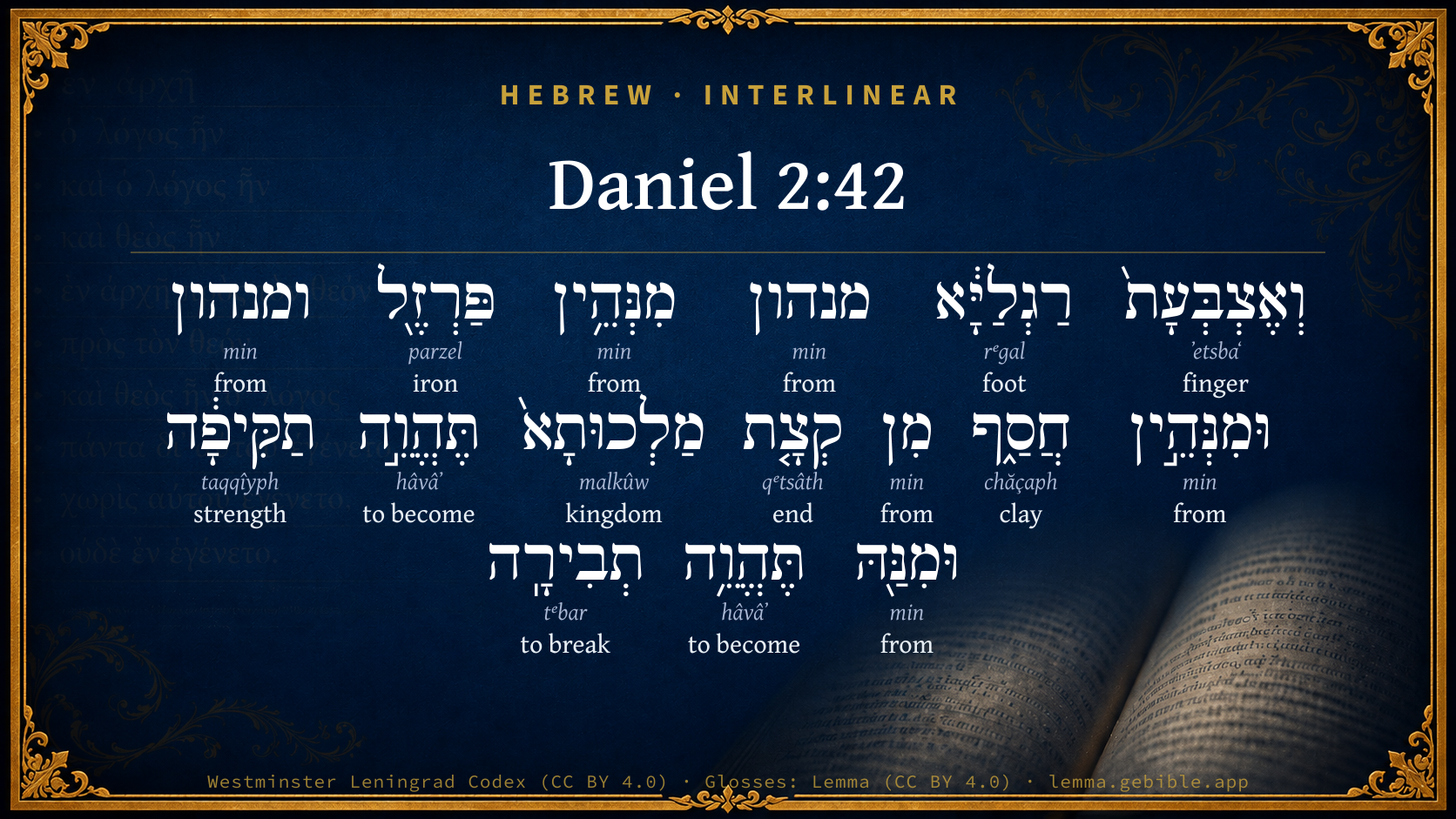
Hebrew (Westminster Leningrad Codex) Daniel 2:42 appears in the Hebrew Old Testament. The text above is from the Westminster Leningrad Codex. Each word links to its Strong’s number, a concise gloss, and parsing drawn from the Open Scriptures Hebrew Bible morphology. Click any word for its full Brown-Driver-Briggs (BDB) entry.
Download image
Cite this verse

Daniel 2:42 (World English Bible). Public Domain. Lemma interlinear Bible study tool, https://lemma.gebible.app/v/daniel/2/42.

Show BibTeX & RIS
BibTeX
RIS
English Translation
As the toes of the feet were part of iron, and part of clay, so the kingdom shall be partly strong, and partly broken.
World English Bible · Public Domain
Highlights
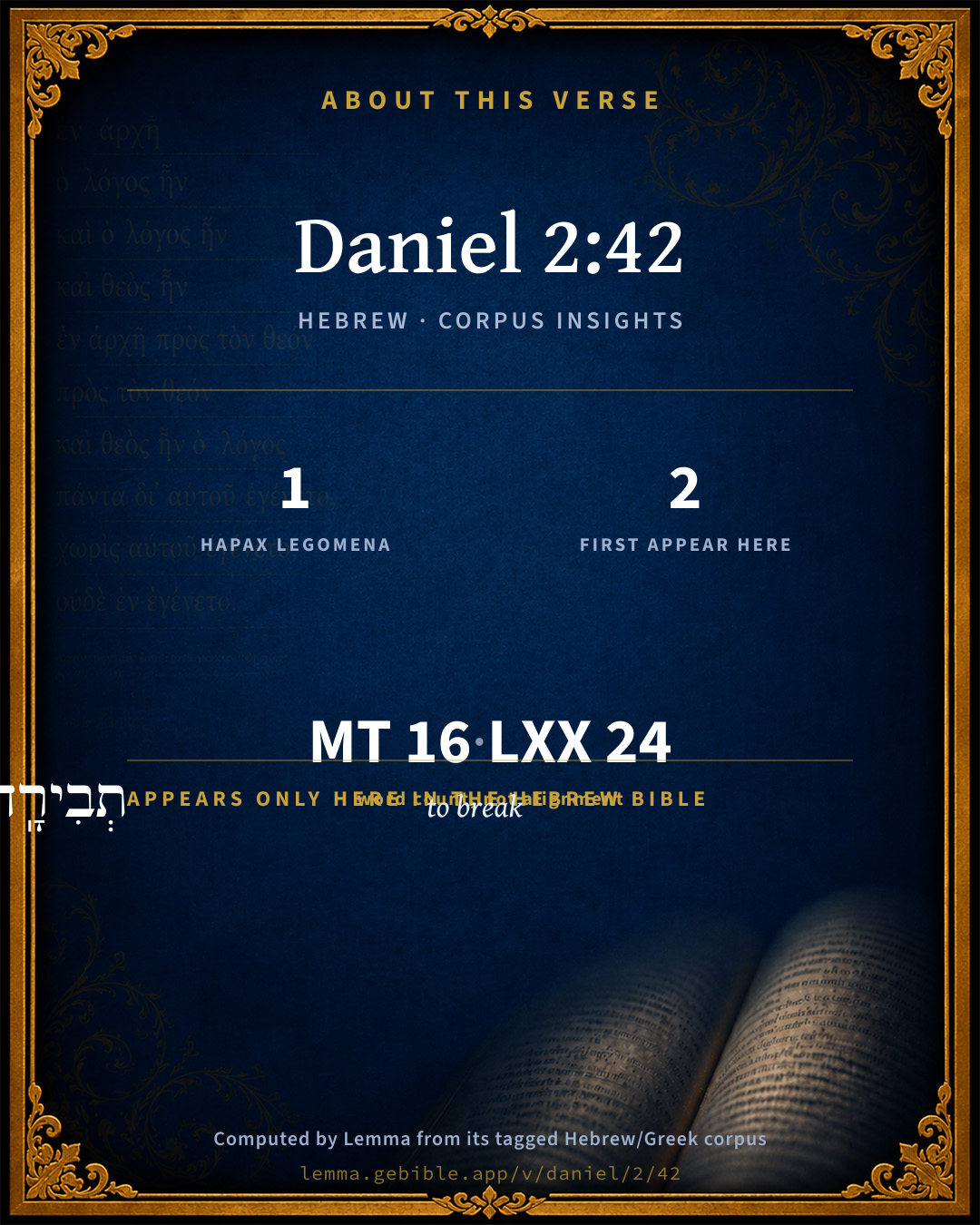
  • 1 hapax legomenon — only here in the Hebrew Bible
  • 2 first appearances in the Hebrew Bible
Full analysis ↓
Download a study sheet

One document with this verse’s original text, its word-by-word gloss line, the meaning frame, cross-references with their text, attributed commentary, and full source and license credits — printable, and it pastes into notes with its structure intact.

This verse Autodidact and up

Study sheet (.html) Plain text (.txt)

A passage Seminary Student

Up to 50 verses in one chapter. A passage sheet keeps up to 6 commentary sources and 12 cross-references per verse, in the order this page ranks them, and says so on the sheet whenever that leaves anything out. Ask for a single verse and you get the Autodidact verse sheet above.

Everything on this page stays free to read, with no account — the sheet is a download of what is already on screen, not access to it.

Want to remove ads? Support Godless Engineer
Compare translations 3

The same verse in 3 English versions, stacked beneath the original-language interlinear above. Click any original word for its lexicon entry.

Each is an independent rendering of the whole verse — the interlinear is not word-aligned to these translations.

Highlighted words mark where these versions differ — a whole-verse word diff, not a word-by-word alignment.

  • World English Bible Public Domain
    As the toes of the feet were part of iron, and part of clay, so the kingdom shall be partly strong, and partly broken.
  • King James Version Public Domain
    And as the toes of the feet were part of iron, and part of clay, so the kingdom shall be partly strong, and partly broken.
  • unfoldingWord Literal Text CC BY-SA 4.0
    As the toes of the feet were partly iron and partly clay, so the kingdom will be partly strong and partly brittle.

unfoldingWord Literal Text — © unfoldingWord, licensed CC BY-SA 4.0. Word-aligned USFM3 via Door43 (git.door43.org/unfoldingWord/en_ult).

Versions to compare (up to 4)

3 of 4 selected

Show all 18 translations

Every available English version of this verse, each an independent rendering of the whole verse.

  • World English Bible Public Domain
    As the toes of the feet were part of iron, and part of clay, so the kingdom shall be partly strong, and partly broken.
  • Berean Standard Bible Public Domain
    And as the toes of the feet were partly iron and partly clay, so this kingdom will be partly strong and partly brittle.
  • Majority Standard Bible Public Domain
    And as the toes of the feet were partly iron and partly clay, so this kingdom will be partly strong and partly brittle.
  • King James Version Public Domain
    And as the toes of the feet were part of iron, and part of clay, so the kingdom shall be partly strong, and partly broken.
  • American Standard Version (1901) Public Domain
    And as the toes of the feet were part of iron, and part of clay, so the kingdom shall be partly strong, and partly broken.
  • Revised Version (1885) Public Domain
    And as the toes of the feet were part of iron, and part of clay, so the kingdom shall be partly strong, and partly broken.
  • Geneva Bible (1599) Public Domain
    And as the toes of the feete were parte of yron, and parte of clay, so shall the kingdome be partly strong, and partly broken.
  • Douay-Rheims (1899) Public Domain
    And as the toes of the feet were part of iron, and part of clay, the kingdom shall be partly strong, and partly broken.
  • Young's Literal Translation Public Domain
    As to the toes of the feet, part of them iron, and part of them clay: some part of the kingdom is strong, and some part of it is brittle.
  • Literal Standard Version CC BY-SA 4.0
    As for the toes of the feet, part of them iron, and part of them clay: some part of the kingdom is strong, and some part of it is brittle.
  • Unlocked Literal Bible CC BY-SA 4.0
    As the toes of the feet were partly made of iron and partly made of clay, so the kingdom will be partly strong and partly brittle.
  • unfoldingWord Literal Text CC BY-SA 4.0
    As the toes of the feet were partly iron and partly clay, so the kingdom will be partly strong and partly brittle.
  • Darby Bible Public Domain
    And [as] the toes of the feet were part of iron and part of clay, the kingdom shall be partly strong and partly fragile.
  • World Messianic Bible Public Domain
    As the toes of the feet were part of iron, and part of clay, so the kingdom will be partly strong and partly brittle.
  • Webster's Bible Public Domain
    And as the toes of the feet were part of iron, and part of clay, so the kingdom shall be partly strong, and partly broken.
  • Free Bible Version CC BY-SA 4.0
    As the toes were partly iron and partly clay, the kingdom will be partly strong and partly brittle.
  • Bible in Basic English Public Domain
    And as the toes of the feet were in part of iron and in part of earth, so part of the kingdom will be strong and part of it will readily be broken.
  • JPS Tanakh (1917) Public Domain
    And as the toes of the feet were part of iron, and part of clay, so part of the kingdom shall be strong, and part thereof broken.

Literal Standard Version (2020), Covenant Press — licensed CC BY-SA 4.0. Text via the HelloAO Bible API (eBible.org). Unlocked Literal Bible (unfoldingWord) — licensed CC BY-SA 4.0. Text via the HelloAO Bible API (eBible.org). unfoldingWord Literal Text — © unfoldingWord, licensed CC BY-SA 4.0. Word-aligned USFM3 via Door43 (git.door43.org/unfoldingWord/en_ult). Free Bible Version, Dr. Jonathan Gallagher — licensed CC BY-SA 4.0. Text via the HelloAO Bible API (eBible.org).

Word by word

More ways to search: Search by grammar → Find every occurrence → Compare this word →

Practice this passage: Drill this verse → Learn its vocabulary →

תְבִירָֽה
tᵉbar
H8406
“broken”
Adjective, V, Singular
Part of Speech
Adjective
Number
Singular
Full BDB Definition

Origin: corresponding to H7665

TWOT: 3052

to break
  1. וְאֶצְבְּעָת֙ ʼetsbaʻ H677 “and · fingers of” Adjective, C + Noun, Common, Feminine, Plural, Construct
  2. רַגְלַיָּ֔א rᵉgal H7271 “feet · the” Adjective, N, Common + Particle, Definite Article
  3. מנהון min H4481 “from · them” Adjective, R + Suffix, Personal, 3rd Person, Masculine, Plural
  4. מִנְּהֵ֥ין min H4481 “from · them” Adjective, R + Suffix, Personal, 3rd Person, Feminine, Plural
  5. פַּרְזֶ֖ל parzel H6523 “iron” Adjective, N, Common
  6. ומנהון min H4481 “and · from · them” Adjective, C + Preposition + Suffix, Personal, 3rd Person, Masculine, Plural
  7. וּמִנְּהֵ֣ין min H4481 “and · from · them” Adjective, C + Preposition + Suffix, Personal, 3rd Person, Feminine, Plural
  8. חֲסַ֑ף chăçaph H2635 “clay” Adjective, N, Common
  9. מִן min H4481 “from” Adjective, R
  10. קְצָ֤ת qᵉtsâth H7118 “end of” Adjective, N, Common
  11. מַלְכוּתָא֙ malkûw H4437 “kingdom · the” Adjective, N, Common + Particle, Definite Article
  12. תֶּהֱוֵ֣ה hâvâʼ H1934 “to become” Adjective, V
  13. תַקִּיפָ֔ה taqqîyph H8624 “strength” Adjective, A
  14. וּמִנַּ֖הּ min H4481 “and · from · her” Adjective, C + Preposition + Suffix, Personal, 3rd Person, Feminine, Singular
  15. תֶּהֱוֵ֥ה hâvâʼ H1934 “to become” Adjective, V

About this verse

These counts appear in no published source. They are computed here, from the morphology-tagged text and Lemma’s own curated glosses. What Lemma adds →

16
words
10
distinct lemmas
Prophets
section

Notable vocabulary

1 hapax legomenon — a word that appears only here in the entire Hebrew Bible:

  • תְבִירָֽה to break H8406

First appearance in Scripture

These words make their first canonical appearance in the Hebrew Bible here:

  • קְצָ֤ת end H7118
  • תְבִירָֽה to break H8406

Shared distinctive vocabulary

וְאֶצְבְּעָת֙ finger H677 occurs in 3 verses of the Hebrew Bible. Also found in:

Grammatical profile

  • 1 noun
  • 10 adjectives
  • 3 prepositions
  • 2 particles

Repetition

Words recur within this verse — often emphatic in Hebrew:

  • תֶּהֱוֵ֣ה to become H1934 ×2
  • מנהון from H4481 ×6

Hebrew & Septuagint length

In English translation the verse runs 24 words from the Hebrew and 29 from the Septuagint (LXX English) — closely comparable.

A rough comparison of the two English renderings, which tokenize alike — not a word-level alignment.

Word counts can differ between the Hebrew and the Greek without any difference in meaning — e.g. the Hebrew direct-object marker אֵת has no separate Greek word, and Greek often adds the article ὁ.

In the original languages it is 16 Hebrew tokens and 24 Greek tokens — but the two are counted differently (Hebrew bundles its prefixes and suffixes into one token; the Greek is in lemma form), so that isn’t a like-for-like length.

Cross-references

2

Topical passages linked to Daniel 2:42 in the Treasury of Scripture Knowledge — connected by theme and wording, ordered by reader-vote popularity; previews shown in the World English Bible.

  • Daniel 7:24 As for the ten horns, out of this kingdom shall ten kings arise: and another shall arise after them; and he shall be diverse from the former, and he shall put down three kings.
  • Revelation 13:1 Then I stood on the sand of the sea. I saw a beast coming up out of the sea, having ten horns and seven heads. On his horns were ten crowns, and on his heads, blasphemous names.

Cross-references courtesy of OpenBible.info (CC BY 4.0).

Hebrew and Greek witnesses Masoretic Hebrew ↔ Greek Septuagint

The same verse in the two great witnesses to the Old Testament, shown verse-for-verse.

These are two independent witnesses, not word-aligned to each other, and the Septuagint is shown in lemma (dictionary) form.

Hebrew Daniel 2:42 Masoretic · Westminster Leningrad Codex

וְאֶצְבְּעָת֙ רַגְלַיָּ֔א מנהון מִנְּהֵ֥ין פַּרְזֶ֖ל ומנהון וּמִנְּהֵ֣ין חֲסַ֑ף מִן קְצָ֤ת מַלְכוּתָא֙ תֶּהֱוֵ֣ה תַקִּיפָ֔ה וּמִנַּ֖הּ תֶּהֱוֵ֥ה תְבִירָֽה

As the toes of the feet were part of iron, and part of clay, so the kingdom shall be partly strong, and partly broken.

World English Bible · Public Domain

Greek LXX Daniel 2:42 Septuagint · lemma form

καί ὁ δάκτυλος ὁ πούς μέρος μέν τις σιδηροῦς μέρος δέ τις ὀστράκινος μέρος τις ὁ βασιλεία εἰμί ἰσχυρός καί μέρος τις εἰμί συντρίβω

And whereas the toes of the feet were part of iron and part of earthenware, part of the kingdom shall be strong, and part of it shall be broken.

LXX2012 (modern English Septuagint) · Public Domain

Hebrew: Westminster Leningrad Codex (CC BY 4.0). Greek: Septuagint (public domain); English from LXX2012 (modern English Septuagint) (Public Domain). How the Septuagint differs from the Hebrew →

Commentary

Notes on Daniel 2:42 from classic Christian and Jewish commentators (each source and its license shown beneath its notes). The classic Christian expositions comment on the surrounding passage and are grouped to its opening verse, so a note may address several verses; the Jewish commentaries on the Tanakh (Rashi and others) are per-verse, so they appear only where the commentator wrote on this verse.

Lemma curates 59 commentaries, every one of them public domain or Creative Commons licensed, each selected and text-cleaned for this edition rather than reprinted as found. About our sources →

Trapp's Complete Commentary

John Trapp

Dan 2:42 And [as] the toes of the feet [were] part of iron, and part of clay, [so] the kingdom shall be partly strong, and partly broken.

Ver. 42. So the kingdom shall be partly strong, and partly broken.] Or, Brittle. This we see daily fulfilled in the tottering kingdoms both of that of the Turk (which laboureth with nothing more than the weightiness of itself, and yet hath been soundly battered of late by the Venetians) and the other of the Pope, which declineth also apace, and shall do every day more and more, according to that old distitch:

“ Roma diu titubans, variis erroribus acta,

Corruet, et mundi desinet esse caput. ”

John Trapp, A Commentary or Exposition upon All the Books of the Old and New Testament (1647–1656) — public domain. Text from a community e-Sword module.

Ibn Ezra

Rabbi Abraham ibn Ezra

[Daniel 2:42] V'etzbeʿat (וְאֶצְבְּעָת - And the toes): These are the princes (sarei - שָׂרֵי) of Ishmael and the kings in the East and in the West.

Ibn Ezra on the Tanakh — English translations: “Sefaria Community Translation” (CC0 1.0 (public-domain dedication)); “Yalkut, Sifsei Chachomim Chumash, Metsudah Publications, 2009” (CC BY 4.0); and “Commentary of Ibn Ezra on Isaiah - trans. by M. Friedlander, 1873” (public domain). Text via Sefaria.

Ellicott's Commentary for English Readers

(42) So the kingdom.—This strength, however, is only apparent. There are certain discordant elements in the fourth empire. These are here represented by the iron and clay, which cannot be made to cohere.

A Bible Commentary for English Readers, edited by Charles John Ellicott (1878–1897) — public domain. Text from a community e-Sword module.

The Cambridge Bible for Schools and Colleges

gen. ed. J. J. S. Perowne

42. so the kingdom, &c.] so part of the kingdom shall be strong, and part of it shall be broken.

The Cambridge Bible for Schools and Colleges (gen. ed. J. J. S. Perowne; Cambridge University Press, 1878–1918) — public domain. Text from a community e-Sword module.

John Gill's Exposition

And as the toes of the feet were part of iron and part of clay,.... Or some of them of iron, and so were strong and powerful, as some of these kingdoms were; and some of clay, and so were weak and easily crushed, and did not stand long:

so the kingdom shall be partly strong, and partly broken; this is not unfitly interpreted by some of the two fold power which has prevailed in these ten kingdoms, through the policy of the pope of Rome, the secular and ecclesiastic power; the latter often encroaching upon and prevailing over the other, which has tended to the weakening of these states.

John Gill's Exposition of the Whole Bible (1746–1763) — public domain (CC PDM 1.0). Text via the HelloAO Bible API.

Albert Barnes' Notes on the Bible

And as the toes of the feet were part of iron and part of clay, so the kingdom shall be partly strong, and partly broken - Margin, “brittle.” The margin is the more correct rendering of the Chaldee word (תבירה tebı̂yrâh). It means “frail, fragile” - easily broken, but not necessarily that it was actually broken. That did not occur until the stone cut out of the mountain impinged on it. It has been commonly supposed (comp. Newton “on the Prophecies”), that the ten toes on the feet refer to the ten kingdoms into which the Roman empire was ultimately broken up, corresponding with the ten horns seen in the vision of Daniel, in Dan 7:7. In regard to the fact that the Roman empire was ultimately broken up into ten such kingdoms, see the extended notes at Dan 7:24. The thing which struck the monarch in the vision, and Daniel in the interpretation, as remarkable, was that the feet and toes “were composed partly of iron and partly of clay.”

In the upper portion of the image there had been uniformity in the different parts, and had been no intermingling of metals. Here a new feature was seen - not only that a new metal was employed, but that there was intermingled with that, in the same portion of the image, a different substance, and one that had no affinity with the iron, and that could never be made to blend with it. In the latter part of this verse, the original word for “partly” is not the same in each clause. In the former it is מן־קצת min-qetsâth - properly “from the end,” sc., of the kingdom. Compare Dan 12:13, “At the end of the days;” Dan 1:15, “At the end of ten days;” and Dan 2:5, Dan 2:18. The word “might” be employed to denote the “end” or “extremity” of anything, e. g., in respect to “time,” and some have supposed that there is a reference here to the later periods of the Roman empire. See Poole’s “Synopsis.”

But the word is also used to denote “the sum,” or “the whole number;” and then the phrase is equivalent to “a part - as” e. g., in the phrase האלהים בית כלי מקצת miqetsât kelēy bēyth hâ'elohı̂ym - from the sum of the vessels of the house of God” Dan 1:2; that is, a portion of the whole number, or a part. Compare Neh 7:70, “from the sum of the heads of the fathers;” that is, a part of them. In the latter part of the clause it is מנת mı̂nnâh - “from it;” that is, a part of it; partly. The entire phrase means that one part of the whole would be strong, and one part would be fragile. The reference is not to the “time” when this would occur, but to the “fact” that it would be so. The idea in this verse does not vary materially from that in the former, except that in that, the prominent thought is, that there would be “strength” in the kingdom: in this, the idea is, that while there would be strength in the kingdom, there would be also the elements of weakness.

Albert Barnes' Notes on the Bible (1834–1885) — public domain. Text from a community e-Sword/MySword module.

Matthew Poole's English Annotations

This was plain in the civil wars of the Romans, the falling off of some countries, especially in and towards the end of it.

Matthew Poole's English Annotations on the Holy Bible (1683–1685) — public domain. Text from a community e-Sword/MySword module.

Whedon's Commentary on the Bible

Daniel D. Whedon

42. Even the toes, the extremities of the kingdom, shall have in them something of the strength of iron, but shall be “brittle” and easily cracked.

Daniel D. Whedon (gen. ed.), Commentary on the Old and New Testaments (1874–1909) — public domain. Text from a community e-Sword module.

John Wesley's Explanatory Notes

Broken - This was plain in the civil wars of the Romans, and the falling off of some countries, especially towards the end of it.

John Wesley, Explanatory Notes Upon the Whole Bible (1754–1765) — public domain. Text via the GEBible commentary corpus.

Lesson kit

Teaching starters — assembled from the data on this page, not authored interpretation. Every prompt links to the verse data it draws on. Edit before teaching.

Daniel, in the Prophets, opens this verse with 16 words (10 distinct Hebrew lemmas). Its most distinctive word is tᵉbar (“to break”). A historical commentator’s framing appears above. Read the whole chapter for the surrounding context.

Discussion questions

  1. What does “to break” (tᵉbar) contribute to the verse as a whole?
  2. 1 word here appears nowhere else in the Hebrew Bible. Why might the author reach for such rare wording?
  3. 2 words make their first appearance in Scripture here. What does this debut establish?
  4. How does Daniel 2:41, which shares the word «finger», read alongside this verse?
  5. What does the repetition of “to become” (2× in this one verse) do in this verse?
  6. These translations render this verse differently; the difference is in the English rendering, not the original. What questions does that raise?
  7. Compare how Trapp's Complete Commentary and Ibn Ezra read this verse. Where do they agree or differ?

Things to notice

  • 1 word in this verse appears nowhere else in the Hebrew Bible.
  • 2 words make their first canonical appearance in Scripture here.
  • This verse counts 16 Hebrew ↔ 24 Greek words.
  • These translations choose different wording for 5 words in this verse.
  • “to become” occurs 2× in this single verse.

Reading settings

Reading text

Shown beneath each verse's original-language words.

Old Testament
Old Testament edition

Read the OT as the Masoretic Hebrew (MT) or the Greek Septuagint (LXX).

English shown for the Greek Septuagint (in the Hebrew ↔ Greek comparison).

Comparing translations? Open the Compare panel on any verse page to stack up to four side by side.