Jude 1:8

Greek (Tischendorf 8th ed.) Jude 1:8 appears in the Greek New Testament. The text above is from the Tischendorf 8th edition. Each word links to its Strong’s number and a concise gloss. Click any word for its full Thayer’s Greek Lexicon entry.
Download image
Cite this verse

Jude 1:8 (World English Bible). Public Domain. Lemma interlinear Bible study tool, https://lemma.gebible.app/v/jude/1/8.

Show BibTeX & RIS
BibTeX
RIS
English Translation
Yet in like manner these also in their dreaming defile the flesh, despise authority, and slander celestial beings.
World English Bible · Public Domain
Download a study sheet

One document with this verse’s original text, its word-by-word gloss line, the meaning frame, cross-references with their text, attributed commentary, and full source and license credits — printable, and it pastes into notes with its structure intact.

This verse Autodidact and up

Study sheet (.html) Plain text (.txt)

A passage Seminary Student

Up to 50 verses in one chapter. A passage sheet keeps up to 6 commentary sources and 12 cross-references per verse, in the order this page ranks them, and says so on the sheet whenever that leaves anything out. Ask for a single verse and you get the Autodidact verse sheet above.

Everything on this page stays free to read, with no account — the sheet is a download of what is already on screen, not access to it.

Want to remove ads? Support Godless Engineer
Compare translations 3

The same verse in 3 English versions, stacked beneath the original-language interlinear above. Click any original word for its lexicon entry.

Each is an independent rendering of the whole verse — the interlinear is not word-aligned to these translations.

Highlighted words mark where these versions differ — a whole-verse word diff, not a word-by-word alignment.

  • World English Bible Public Domain
    Yet in like manner these also in their dreaming defile the flesh, despise authority, and slander celestial beings.
  • King James Version Public Domain
    Likewise also these filthy dreamers defile the flesh, despise dominion, and speak evil of dignities.
  • unfoldingWord Literal Text CC BY-SA 4.0
    Yet in the same way also, these, dreaming, indeed defile the flesh, but reject lordship and slander the glorious.

unfoldingWord Literal Text — © unfoldingWord, licensed CC BY-SA 4.0. Word-aligned USFM3 via Door43 (git.door43.org/unfoldingWord/en_ult).

Versions to compare (up to 4)

3 of 4 selected

Show all 19 translations

Every available English version of this verse, each an independent rendering of the whole verse.

  • World English Bible Public Domain
    Yet in like manner these also in their dreaming defile the flesh, despise authority, and slander celestial beings.
  • Berean Standard Bible Public Domain
    Yet in the same way these dreamers defile their bodies, reject authority, and slander glorious beings.
  • Majority Standard Bible Public Domain
    Yet in the same way these dreamers defile their bodies, reject authority, and slander glorious beings.
  • King James Version Public Domain
    Likewise also these filthy dreamers defile the flesh, despise dominion, and speak evil of dignities.
  • American Standard Version (1901) Public Domain
    Yet in like manner these also in their dreamings defile the flesh, and set at nought dominion, and rail at dignities.
  • Revised Version (1885) Public Domain
    Yet in like manner these also in their dreamings defile the flesh, and set at nought dominion, and rail at dignities.
  • Geneva Bible (1599) Public Domain
    Likewise notwithstanding these sleepers also defile the flesh, and despise gouernment, and speake euill of them that are in authoritie.
  • Douay-Rheims (1899) Public Domain
    In like manner these men also defile the flesh, and despise dominion, and blaspheme majesty.
  • Young's Literal Translation Public Domain
    In like manner, nevertheless, those dreaming also the flesh indeed do defile, and lordship they put away, and dignities they speak evil of,
  • Literal Standard Version CC BY-SA 4.0
    In like manner, nevertheless, those dreaming indeed defile the flesh, and they disregard lordship, and they speak evil of glorious [ones],
  • Unlocked Literal Bible CC BY-SA 4.0
    Yet in the same way, these dreamers also pollute their bodies. They reject authority, and they say slanderous things against the glorious ones.
  • unfoldingWord Literal Text CC BY-SA 4.0
    Yet in the same way also, these, dreaming, indeed defile the flesh, but reject lordship and slander the glorious.
  • Darby Bible Public Domain
    Yet in like manner these dreamers also defile [the] flesh, and despise lordship, and speak railingly against dignities.
  • World Messianic Bible Public Domain
    Yet in the same way, these also in their dreaming defile the flesh, despise authority, and slander celestial beings.
  • Webster's Bible Public Domain
    Likewise also these filthy dreamers defile the flesh, despise dominion, and speak evil of dignities.
  • Free Bible Version CC BY-SA 4.0
    Likewise these dreamers pollute their bodies, disregard authority, and insult heavenly beings.
  • Bible in Basic English Public Domain
    In the same way these dreamers make the flesh unclean, having no respect for authorities, and say evil of rulers.
  • Text-Critical English NT CC BY 4.0
    In the same way these ungodly men, relying on their dreams, defile the flesh, reject authority, and revile glorious beings.
  • Tyndale New Testament (1534) Public Domain
    Lykwyse these dremers defyle the flesshe despyse rulars and speake evyll of them that are in auctoritie.

Literal Standard Version (2020), Covenant Press — licensed CC BY-SA 4.0. Text via the HelloAO Bible API (eBible.org). Unlocked Literal Bible (unfoldingWord) — licensed CC BY-SA 4.0. Text via the HelloAO Bible API (eBible.org). unfoldingWord Literal Text — © unfoldingWord, licensed CC BY-SA 4.0. Word-aligned USFM3 via Door43 (git.door43.org/unfoldingWord/en_ult). Free Bible Version, Dr. Jonathan Gallagher — licensed CC BY-SA 4.0. Text via the HelloAO Bible API (eBible.org).

Word by word

More ways to search: Search by grammar → Find every occurrence → Compare this word →

Practice this passage: Drill this verse → Learn its vocabulary →

ἐνυπνιαζόμενοι
enypniázomai
G1797
“to dream”
Verb, Present, Middle or Passive deponent, Participle, Nominative, Plural, Masculine
Part of Speech
Verb
Tense
Present
Voice
Middle or Passive deponent
Mood
Participle
Case
Nominative
Number
Plural
Gender
Masculine
Full Thayer's Definition

Origin: middle voice from G1798

TDNT: 17:05,1

1. to dream (divinely suggested) dreams 2. metaph., to be beguiled with sensual images and carried away to an impious course of conduct
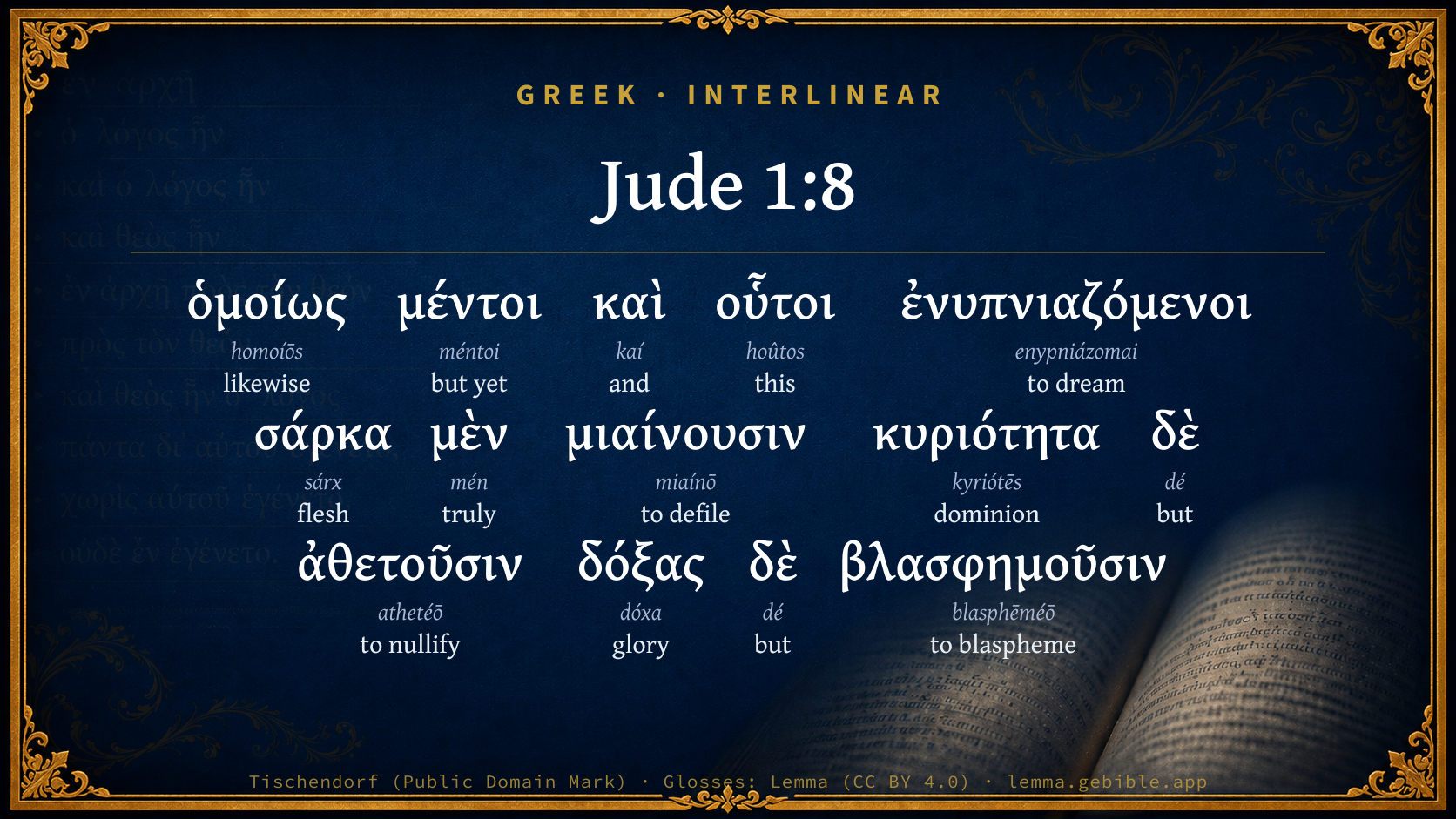
  1. ὁμοίως homoíōs G3668 “likewise” Adverb
  2. μέντοι méntoi G3305 “but yet” Conjunction
  3. καὶ kaí G2532 “and” Conjunction
  4. οὗτοι hoûtos G3778 “this” Demonstrative pronoun, Nominative, Plural, Masculine
  5. σάρκα sárx G4561 “flesh” Noun, Accusative, Singular, Feminine
  6. μὲν mén G3303 “truly” Particle
  7. μιαίνουσιν miaínō G3392 “to defile” Verb, Present, Active, Indicative, 3rd person, Plural
  8. κυριότητα kyriótēs G2963 “dominion” Noun, Accusative, Singular, Feminine
  9. δὲ dé G1161 “but” Conjunction
  10. ἀθετοῦσιν athetéō G114 “to nullify” Verb, Present, Active, Indicative, 3rd person, Plural
  11. δόξας dóxa G1391 “glory” Noun, Accusative, Plural, Feminine
  12. δὲ dé G1161 “but” Conjunction
  13. βλασφημοῦσιν blasphēméō G987 “to blaspheme” Verb, Present, Active, Indicative, 3rd person, Plural

About this verse

These counts appear in no published source. They are computed here, from the morphology-tagged text and Lemma’s own curated glosses. What Lemma adds →

14
words
13
distinct lemmas
General Epistles
section

Notable vocabulary

The rarest word here is ἐνυπνιαζόμενοι to dream G1797 — appearing just 2 times in the whole Greek New Testament.

Shared distinctive vocabulary

ἐνυπνιαζόμενοι to dream G1797 occurs in 2 verses of the Greek New Testament. Also found in:

Repetition

A word recurs within this verse:

Cross-references

21

Topical passages linked to Jude 1:8 in the Treasury of Scripture Knowledge — connected by theme and wording, ordered by reader-vote popularity; previews shown in the World English Bible.

  • Hebrews 13:17 Obey your leaders and submit to them, for they watch on behalf of your souls, as those who will give account, that they may do this with joy, and not with groaning, for that would be unprofitable for you.
  • 2 Peter 2:10–12 but chiefly those who walk after the flesh in the lust of defilement, and despise authority. Daring, self-willed, they are not afraid to speak evil of dignitaries;
  • Exodus 22:28 "You shall not blaspheme God, nor curse a ruler of your people.
  • 1 Timothy 1:10 for the sexually immoral, for homosexuals, for slave-traders, for liars, for perjurers, and for any other thing contrary to the sound doctrine;
  • 1 Peter 2:17 Honor all men. Love the brotherhood. Fear God. Honor the king.
  • Numbers 16:3 and they assembled themselves together against Moses and against Aaron, and said to them, You take too much on you, seeing all the congregation are holy, everyone of them, and Yahweh is among them: why then lift yourselves up above the assembly of Yahweh?
  • Ecclesiastes 10:20 Don't curse the king, no, not in your thoughts; And don't curse the rich in your bedchamber: For a bird of the sky may carry your voice, And that which has wings may tell the matter.
  • 1 Corinthians 3:17 If anyone destroys the temple of God, God will destroy him; for God's temple is holy, which you are.
  • Jude 1:9–10 But Michael, the archangel, when contending with the devil and arguing about the body of Moses, dared not bring against him an abusive condemnation, but said, "May the Lord rebuke you!"
  • Psalms 2:1–6 Why do the nations rage, And the peoples plot a vain thing?
  • Proverbs 30:11 There is a generation that curses their father, And doesn't bless their mother.
  • Luke 19:14 But his citizens hated him, and sent an envoy after him, saying, 'We don't want this man to reign over us.'
  • Acts 7:39 to whom our fathers wouldn't be obedient, but rejected him, and turned back in their hearts to Egypt,
  • Acts 23:5 Paul said, "I didn't know, brothers, that he was high priest. For it is written, 'You shall not speak evil of a ruler of your people.'"
  • Psalms 12:3–4 May Yahweh cut off all flattering lips, And the tongue that boasts,
  • Proverbs 30:17 The eye that mocks at his father, And scorns obedience to his mother: The ravens of the valley shall pick it out, The young eagles shall eat it.
  • Jeremiah 38:25–28 But if the princes hear that I have talked with you, and they come to you, and tell you, Declare to us now what you have said to the king; don't hide it from us, and we will not put you to death; also what the king said to you:
  • Acts 7:27 But he who did his neighbor wrong pushed him away, saying, 'Who made you a ruler and a judge over us?
  • 1 Thessalonians 4:8 Therefore he who rejects doesn't reject man, but God, who has also given his Holy Spirit to you.
  • Numbers 16:12–13 Moses sent to call Dathan and Abiram, the sons of Eliab; and they said, We won't come up:
  • Genesis 3:5 for God knows that in the day you eat it, your eyes will be opened, and you will be like God, knowing good and evil."

Cross-references courtesy of OpenBible.info (CC BY 4.0).

Commentary

Notes on Jude 1:8 from classic Christian and Jewish commentators (each source and its license shown beneath its notes). The classic Christian expositions comment on the surrounding passage and are grouped to its opening verse, so a note may address several verses; the Jewish commentaries on the Tanakh (Rashi and others) are per-verse, so they appear only where the commentator wrote on this verse.

Lemma curates 59 commentaries, every one of them public domain or Creative Commons licensed, each selected and text-cleaned for this edition rather than reprinted as found. About our sources →

Ellicott's Commentary for English Readers

(8-10) Application of these three instances to the libertines who are now provoking God.

(8) Likewise also.—Rather, Yet in like manner: i.e., in spite of these warnings. These ungodly men were like the unbelievers in the wilderness in denying Christ and scoffing at His promises; they were like the impure angels in leaving that “constitution which is in heaven” (Php_3:20) for the base pleasures of earth; they were like the people of Sodom in seeking even these base pleasures by unnatural courses.

These filthy dreamers.—We must add also. “Filthy” is not in the original Greek, nor in any previous English version, but is supplied from the next clause; not rightly, for “dreamers” goes with all three clauses, not with “defile the flesh” only. This being admitted, a number of painful interpretations are at once excluded. “These dreamers also” means these ungodly men, who are deep in the slumber of sin (see Note on Rom_13:11), as well as the three classes of sinners just mentioned. Excepting in Act_2:17, which is a quotation from Joe_2:28, the word for “dreamer” occurs nowhere else in the New Testament, but is found in the LXX. version of Isa_56:10, of dogs that dream and make a noise in their sleep. St. Jude perhaps has this passage in his mind. (See below, second Note on Jud_1:12.) “Dreamers” may perhaps refer to the empty speculations of these men.

Defile the flesh.—Like the inhabitants of the cities of the plain. Some of the earliest forms of Gnosticism, on its antinomian as distinct from its ascetic side, exhibit the licentiousness inveighed against here; e.g., the Simonians, Nicolaitanes, Cainites, Carpocratians.

Despise dominion.—Like the impure angels. Insert “and” before “despise.” The “dominion,” or lordship, is that of Almighty God. Set aside, or reject (Mar_7:9; Luk_7:30; Joh_12:48), would be better than “despise,” to mark the difference between this and 2Pe_2:10.

Speak evil of dignities.—Like the murmurers in the wilderness. By “dignities,” or glories, are meant unseen powers worthy of reverence. The Greek word is rare in the New Testament; only here, 2Pe_2:10, and 1Pe_1:11. Earthly dignities, whether ecclesiastical or civil, are not included. (Comp. the doctrine of Menander, Irenæus, I. xxiii. 5.)

(9) Yet Michael the archangel.—These libertines allow themselves to use language against celestial beings which even an archangel did not venture to use against Satan. In the Old Testament Michael appears as the guardian angel of the people of Israel, Dan_10:21; Dan_12:1; in the New Testament he is mentioned only here and in Rev_12:7. In the Book of Enoch his meekness is spoken of; he is “the merciful, the patient, the holy Michael,” Enoch 40:8.

He disputed about the body of Moses.—To be understood quite literally: to make “the body of Moses” into a metaphor for the people of Israel, or the Mosaic law, is most unnatural. This passage is the only evidence extant of any such incident or tradition. The nearest approach to it is the Targum of Jonathan on Deu_34:6, which says that Michael was the appointed guardian of Moses’ grave. According to Origen (De Princip. III. ii. 1) the source of it is a book called the Ascension, or Assumption of Moses. Evidently it is something supposed to be well known to those whom St. Jude is addressing, and it appears to be given as a fact which he believes, though we cannot be sure of this. In any case it does not follow that we are to believe in it as an historical fact. Reverent, and therefore cautious, theories of inspiration need not exclude the possibility of an unhistorical incident being cited as an illustration or a warning. St. Paul makes use of the Jewish legend of the rock following the Israelites in the wilderness as an illustration (1Co_10:4). The strange question, “What did the devil want with the body of Moses?” has been asked, and answered in more ways than one:—(1) to make it an object of idolatry, as the Israelites would be very likely to worship it; (2) to keep it as his own, as that of a murderer, because Moses killed the Egyptian (Exo_2:12).

Durst not . . .—Out of respect to Satan’s original angelic nature. (Comp. 1Co_6:1.)

A railing accusation.—More literally, a sentence savouring of evil-speaking. Wiclif, “doom”; Tyndale and Cranmer, “sentence”; Rheims, “judgment.” Michael brought no sentence against the devil, but left all judgment to God.

The Lord rebuke thee.—The same rebuke is administered to Satan by the angel of Jehovah, when Satan appears as the adversary of Joshua the high priest, the restorer of the temple and of the daily sacrifice, and one of the Old Testament types of Christ (Zec_3:2). It is probable that the tradition here given by St. Jude is derived from this passage in Zechariah, or from a source common to both. We have another reminiscence of Zec_3:2 in Jud_1:23.

(10) But these . . .—In strong contrast to the scrupulous reverence of the archangel. “Fools rush in where angels fear to tread.”

Those things which they know not.—The “dignities” of Jud_1:8. This shows that unseen spiritual powers are there meant: these men would know earthly rulers. It is on the unseen that they show their irreverence.

What they know naturally.—The means of gratifying their desires. The two halves of the verse are in emphatic contrast. What they do not know, and cannot know, they abuse by gross irreverence: what they know, and cannot help knowing, they abuse by gross licentiousness. If this Epistle is prior to 2 Peter it is strange that the author of the latter should have neglected so telling an antithesis, and should (from a literary point of view) have so spoiled the passage by his mode of adaptation (2Pe_2:12). If 2 Peter is prior there is nothing strange in St. Jude improving upon the mode of expression. The word for “know” is not the same in both clauses. The word used in “which they know not” is the most general and common word of the kind in Greek, expressing mere perception, and occurring about three hundred times in the New Testament; that used in “what they know naturally” is more definite, and expresses practical experience productive of skill and science; it occurs fourteen times in the New Testament, mostly in the Acts. (Comp. “Paul I know,” Act_19:15.)

They corrupt themselves.—Or, perhaps, they work their own ruin. Note the tense; not future, but present. The corruption, or ruin, is not a judgment hanging over them; it is already going on.

A Bible Commentary for English Readers, edited by Charles John Ellicott (1878–1897) — public domain. Text from a community e-Sword module.

The Biblical Illustrator

Joseph S. Exell

Jud_1:8

These filthy dreamers defile the flesh.

Filthy dreamers

I. Some interpret this literally of dreaming in sleep. A strong inducement hence for every one to keep their hearts with all diligence from those impure thoughts in the day-time, which may otherwise make them filthy dreamers in the night, and when they go to sleep to beseech God to keep the key of their imagination, that it may not run out to dreaming impurely.

II. Others interpret it metaphorically, conceiving that the apostle, in calling these seducers dreamers in sleep, compares them to such.

1. These seducers were spiritually overwhelmed in a deep, sound sleep of sin (Isa_29:10; 1Th_5:6).

2. These seducers are compared to dreamers in sleep in regard of their vain, false, empty imaginations.

(1) Sinners delude themselves in dreaming of their persons. Dreaming that they are not so bad as others because they abstain from gross abominations (Luk_18:11). Dreaming that they are in good and happy estate before God, being indeed miserable and bad (Rev_3:17; Gal_6:3).

(2) Sinners delude themselves in dreaming concerning their actions that they are good, because done with a good intention, not considering that a work may be good in a mans own eyes and the issues thereof the ways of death (2Sa_6:7; Pro_16:25).

Lessons:

1. Spiritual judgments are the sorest. Insensibleness in sin and self-delusion were judgments which made these seducers miserable; they are judgments which seize upon the soul.

2. All the sinful sleepiness of saints differs much from that of the wicked (Son_5:2).

3. Self-soothing, delusion, flattering, are very dangerous and destructive, as being the foundation of the wickedness and woe of these seducers, these dreamers.

4. It is our wisdom to take heed of spiritual sleeping in sin. For which purpose--

(1) Make much of a stirring ministry;

(2) Labour for a fruitful improvement of sufferings;

(3) Endeavour for a tender, trembling heart at the very beginning of the solicitations of sin;

(4) Labour for faith in threatenings;

(5) Vigorously and constantly exercise thyself in godliness;

(6) Keep company with waking Christians. (W. Jenkyn, M. A.)

Filthy dreamers and defilers of the flesh and evil speake

rs:--

I. From that filthy dreamers, note that the erroneous thoughts of wicked men are but a dream.

1. Wicked men are dreamers--

(1) In regard of their state and condition, every carnal man is in a state of a deep sleep (Isa_29:10), without troy sense of danger.

(2) In regard of the suitableness between their vain thoughts and a dream. A dream tickleth with a false delight, and deceiveth with a vain hope.

(3) Tickleth with a false delight, they embrace the contentments and pleasures of the world instead of the true riches.

(4) Deceiveth with a vain hope (Isa_29:7-8). Many flatter themselves with fair hopes till they awake in flames, but then all is gone.

(5) Take heed, then, of being deceived by your own dreams and the fictions of your own brain; there are no dreams so foolish as those we dream waking. There are dreams in point of hope; and so--

(a) Some wholly mistake in the object, and dream of an eternal happiness in temporal enjoyments (Psa_49:11; Luk_12:19; Rev_18:9).

(b) Others dream of attaining the end without using the means; they live in sin, and yet hope to die comfortably and go to heaven. Others mistake about the means, because they have a cold form; they are apt to be conceited of their spiritual condition and estate (Rev_3:17). If you would not dream in this kind, examine your hearts often; examination is like a rubbing of the eyes after sleep.

II. From that defile the flesh, observe that dreams of error dispose to practices of sin and uncleanness, and impurity of religion is usually joined with uncleanness of body (Hos_4:12-13).

III. Again, observe that sin is a defilement: it staineth and darkeneth the glory of a man (Mat_15:20). Desire to be washed, and that thoroughly (Psa_51:2).

IV. Again observe, that of all sins the sin of uncleanness is most defiling. It defileth the whole man, but chiefly the body, and therefore it is said they defile the flesh. It staineth the soul with filthy thoughts (Mat_15:20), it staineth the name (Pro_6:33), but in a singular manner it polluteth the body (1Co_6:18). It wasteth the strength and beauty of the body (Pro_5:9-11), hindereth our serviceableness. Are not your beauty, health, strength, concernments too good to be spent upon so vile an interest?

V. From that despise dominion. Observe that errors, especially such as tend to sensuality, make men unruly. Error taketh off the dread of God, and sedition the dread of the magistrate, that so they may more freely defile the flesh.

VI. Again, I observe from the same clause, that it is a sin to despise dominions. For it is here charged upon these seducers. It is a sin, because it is against the injunctions of the word (Rom_13:1; Tit_3:1). Again, it is a sin, because dominion preserveth human societies.

VII. The last expression is that speak evil of dignities, or of glories, by which probably Church officers are intended, such being spoken against in that age (3Jn_1:10). Note, there is a respect due to persons invested with Church power. This is established by Gods ordinance, and therefore should not be set at nought. (T. Manton.)

Waking dreamers

Hence we may note the cause why so few entertain the doctrine of the gospel, so few forsake their sins and turn unto God, and that is because men are dreamers. As first, some plead that they were never book-learned, they could never write nor read, therefore they must be excused in their ignorance as not being bound to know the Word of God. Secondly, others dream that because they have lived thus long and yet had never any such cross as they see befall others, therefore they are most happy men, and God loveth them. Thirdly, others have learning and knowledge, and begin to dream that therefore they want nothing; they bless themselves in their naked knowledge, and never have care in their hearts to receive Christ. Fourthly, others are profane and dream that the Master will not come yet; God will not yet call them; they shall have time enough to repent in, for they crave but one hour on their death-beds. Lastly, it is a common dream amongst men that the promise of eternal life is but a dream, and so many make but a dream of the whole Word of God and all religion. Even so men hold the doctrine of the gospel, but as a dream, seeing they can hold it in opinion, but never endeavour to reform their lives by it; but such dreams disappoint men commonly of salvation. The most powerful ministry shall little prevail so long as men come with their hearts full fraught with their carnal imaginations and with such heaviness of spirit. (W. Perkins.)

Unchastity

I. Sins of carnal uncleanness are peculiarly against the body or flesh of men (1Co_6:18). The body not only concurs, but suffers by this sin more than any other, both by dishonour and diseases.

(1) Dishonour, in the staining and defiling that noble piece of workmanship, curiously wrought by the finger of God Himself.

(2) By diseases, this lust being not only a conscience-wasting but a carcase-wasting enemy. Sensual men kill that which they pretend most to gratify.

2. Sins of unchastity are peculiarly defiling. All sin in general is called uncleanness, but fornication is particularly to be branded with that name. There is a peculiar opposition between fornication and sanctification (1Th_4:3). The saints of God should have a peculiar abhorrence of this sin (Eph_5:3; 2Co_7:1). The body is the garment of the soul, and a clean heart will preserve a pure body.

3. The love of lust makes men erroneous and seducers. They who make no conscience of ordering their conversation will soon be heretical. These seducers who opposed the faith were unclean and flesh-defilers. If the light be too much in mens eyes, they will either shut their eyes or draw the curtains. Lusts will pervert the light which is brought in, making men instead of bringing their crooked lives to the straight rule, to bring the straight rule to their crooked lives; and instead of bringing their hearts to the Scripture, to bring the Scripture to their hearts. God in judgment gives up such who will not see to an inability to discern what they ought, and to a reprobate mind; they who will not be scholars of truth are by God justly delivered up to be masters of error. (W. Jenkyn, M. A.)

Despise dominion.

Rulers not to be despised

Rebellion of all sins showeth the corruptions of our nature, yea, rebellion and contempt of government is unnatural, for God hath made a chiefty in all things, and everything keepeth his place. Among the angels there be Cherubim and Seraphim; among the planets the sun is the chief, and the rest borrow their light from him; among the fowls, the eagle; among the beasts, the lion; among the serpents, the basilisk; among the fishes, the whale; among the wethers there is a leader, a bell-wether; among the cranes there is one as a captain that goeth before the rest; in a flock there is dux gregis, a leader; in an hive of bees there is a master-bee; the very pismyres have there governor; and the grasshoppers go forth by bands. And hath not God made a chief, a ruler among men? God forbid, therefore, that we should despise government. Promotion and honour cometh neither from the east, nor from the west, nor from the south, but it is God that lifteth up one and pulleth down another. And God hath famously revenged this sin, as ever any. Absalom rebelled against his father, but Gods vengeance overtook him, for he was hanged. (S. Otes.)

Despising dominion

1. What we are to understand by dominion. The word in the original is the same with that in 2Pe_2:10, translated government, and means the civil magistrate.

2. What is meant by despising dominion. These seducers did not cast off governing so as to make it cease; that was not in their power; but in their judgment, desires, insinuations, they laboured to make it accounted void.

3. Upon what ground the apostle condemns them for despising dominions.

(1) This was a sin against an ordinance of God (Pro_8:15; Rom_13:1).

(2) It was a sin against the welfare and happiness of the public.

(3) By this despising of government they were in an especial manner their own enemies, and sinned against their own happiness (Pro_24:22; Ecc_10:8).

Lessons:

1. How provident is God for mans peace and welfare.

2. God is highly provoked by sin, when He suffers magistrates to be burdensome to a people, and dominion to be abused; when their deliverers and saviours become their destroyers (Pro_28:2).

3. God is much seen in causing mens subjection to magistrates.

4. The power given by God to magistrates should be improved for the Giver.

5. The enemies of godliness soon become opposers of civil dominion. They who fear not God, will not be afraid to speak evil of dignities.

6. Christianity does not destroy but strengthen magistracy.

7. Lust opposes restraint, is an enemy to dominion, loves not to be bridled. (W. Jenkyn, M. A.)

The Biblical Illustrator, edited by Joseph S. Exell (c. 1880s–1900s) — public domain. Text from a community e-Sword module.

The Expositor's Bible

Chapter 34

RAILING AT DIGNITIES-"THE ASSUMPTION OF MOSES"-ST. JUDES USE OF APOCRYPHAL LITERATURE.

Jud_1:8-12

ST. JUDE having given three terrible examples of the punishment of gross sin in Jews, Gentiles, and angels, proceeds to apply these instances to the libertines who in his own day, by their scandalous conduct as Christians, were provoking God to punish them in like manner; and the threefold description of their conduct here given seems to refer to the three instances just given, which are now taken in reverse order. Like the people of Sodom and Gomorrah, these ungodly libertines "defile the flesh"; like the "angels which kept not their own principality," they "set at naught dominion"; and like the unbelieving and rebellions Israelites in the wilderness, they "rail at dignities." In all three particulars they show themselves as "dreamers" (ενυπνιαζομενοι). They are like men who say and do monstrous things in their sleep. They are deadened to all sense of decency and duty, "dreaming, lying down, loving to slumber" (Isa_56:10, where thesame word that we have here is used in the LXX). They are sunk in the torpor of sin. {Rom_13:11} The Revisers have done rightly in omitting the epithet "filthy" in adding the word "also," and in substituting "in their dreamings" for "dreamers." The participle represented by "in their dreamings" does not belong to "defile the flesh" exclusively, but to the other two clauses as well; so that "filthy" is not even correct as an interpretation: it is quite unjustifiable as a rendering. There is no reason for suspecting that certain Levitical pollutions are indicated. Seeing that "in their dreamings" they "set at naught dominion, and rail at dignities," dreaming must not be understood of actual sleep. Moreover, St. Jude does not say "defile their flesh," but "defile the flesh" (σαρκα μιαινουσι), which includes more than their own bodies. He perhaps means that they pollute human nature, or even the whole animal world.

Like the men of Sodom, these profligates "defile the flesh." Like the angels who sold their birthright for base indulgences, they "set at naught dominion." But it is by no means easy to determine what this "dominion" or "lordship" (κυριοτητα) signifies. Calvin and others interpret this and "dignities" or "glories" (δοξας) of the civil power: "There is a contrast to be noticed, when he says that they defiled or polluted the flesh, that is, that they degraded what was less excellent, and that yet they despised as disgraceful what is deemed especially excellent among mankind. It appears from the second clause that they were seditious men, who sought anarchy, that, being loosed from the fear of the laws, they might sin more freely. But these two things are nearly always connected, that they who abandon themselves to iniquity do also wish to abolish all order. Though, indeed, their chief object is to be free from every yoke, it yet appears from the words of Jude that they were wont to speak insolently and reproachfully of magistrates, like the fanatics of the present day, who not only grumble because they are restrained by the authority of magistrates, but furiously declaim against all government, and say that the power of the sword is profane and opposed to godliness; in short, they superciliously reject from the Church of God all kings and all magistrates. Dignities, or glories, are orders or ranks eminent in power or honor" (Calvins "Commentaries on the Catholic Epistles," Eng. Tr., Edinburgh, 1855, p. 438). But if earthly rulers of any kind are meant by "dominion" and "dignities," it is more probable that St. Jude is thinking of ecclesiastical officers; in which case the meaning would be that these libertines set Church discipline at defiance, and reviled the presbyters or bishops who rebuked them for their evil conduct.

It is, however, more probable that at least "dominion," if not "dignities," refers to unseen and supernatural powers. We must look backwards to Jud_1:4, and forwards to Jud_1:10, for a key to the interpretation. These profligates "turn the grace of God into lasciviousness," and thus "defile the flesh"; and they "deny our only Master and Lord, Jesus Christ," and thus "set at naught lordship." Again, "what they understand naturally, like the creatures without reason, in these things are they destroyed," i.e., they ruin themselves, body and soul, by their carnal indulgences; while "they rail at whatsoever things they know not," i.e., they speak with flippant irreverence respecting the invisible world, reviling angels, and perhaps mocking at Satan. We may, therefore, with some hesitation, but with a fair amount of reason, interpret "dominion," or "lordship," of Christ or of God, and "dignities," or "glories," of angels, remembering that either or both of these may include Christs ministers and messengers on earth. One of the ways in which these ungodly men denied Christ in their lives was by their contemptuous disregard of the teaching of His Apostles.

It is quite possible that in this particular also St. Jude is under the influence of the "Book of Enoch." In it we read, "Ye fulfill not the commandments of the Lord; but ye transgress and calumniate greatness" (6:4); and again, "All who utter with their mouths unbecoming language against God, and speak harsh things of His glory, here they shall be collected" (26:2); and again, "My eyes beheld all the sinners, who denied the Lord of glory" (41:1). And with this last expression should be compared, "The splendor of the Godhead shall illuminate them" (1:8). But of course it does not follow that because St. Jude partly reproduces the language of this writer, therefore he uses it with precisely the same meaning.

"But Michael the archangel, when contending with the devil he disputed about the body of Moses, durst not bring against him a railing judgment, but said, The Lord rebuke thee." The meaning of this illustration is obvious. The profane libertines allow themselves to speak of "dignities" in a way which even an archangel did not venture to adopt in rebuking Satan. It is a very strong argument afortiori. Consequently, the fact that it was an evil angel against whom Michael did not dare to rail by no means proves that it was evil angels against which the libertines did dare to rail. Rather the contrary may be inferred. They use language of good angels which Michael would not use of a bad one. That "dignities," or "glories," may include the fallen angels or evil spirits is perhaps possible; that it refers to them exclusively is very improbable. The word itself is against this; for "glories" is certainly a strange name to give to devils.

But a more interesting question lies before us as to the source from which St. Jude derived the story about Michael the archangel contending with the devil about the body of Moses. It is as unreasonable to suppose that he received a special revelation on the subject as to suppose that St. Paul received a special revelation respecting the names of the Egyptian magicians (see on 2Ti_3:8 in this volume). St. Jude refers to the incident as something quite familiar to his readers; and this could hardly have been the case if it had been specially revealed to himself. Lardner supposes that the reference is to Zec_2:1-2. But, excepting that the words, "The Lord rebuke thee, O Satan," occur there, the difference between the two incidents is immense. Neither Michael nor the body of Moses is mentioned in Zechariah. The cause of Satans hostility is the consecration of Joshua the high priest. And it is the Lord, and not the angel, who rebukes the Evil One. These differences are conclusive; they leave just the features which need explanation still unexplained. We may safely decide that St. Jude is not alluding to anything contained in the Bible. More probably he is referring to some well-known Jewish story respecting the death and burial of Moses-in other words, to apocryphal literature.

"So Moses the servant of the Lord died there in the land of Moab, according to the word of the Lord. And He buried him in the valley in the land of "Moab over against Beth-peor: but no man knoweth of his sepulcher unto this day". {Deu_34:5-6} Those words excited the curiosity of the Jews; and as history told them nothing beyond the statement in Deuteronomy, they fell back upon imagination as a substitute, and the mysterious words of Scripture became a center round which a series of legends in process of time clustered. The "Targum of Jonathan" on the passage says that the grave of Moses was entrusted to the care of Michael the archangel. The "Midrash" on the same states that Sammael, chief of the evil spirits, was impatient for the death of Moses. "And he said, When will the longed-for moment come when Michael shall weep and I shall laugh? And at last the time came when Michael came to Sammael and said: Ah! cursed one! shall I weep while thou laughest? and he made answer in the words of Micah, {Mic_7:8} Rejoice not against me, O mine enemy: when I fall, I shall arise; when I sit in darkness, the Lord shall be a light unto me." The "Midrash" also contains another legend, in which the sin of the impure angels is mentioned in connection with the death of Moses. The soul of Moses prays that it may not be taken from the body: "Lord of the world, the angels Asa and Asael lusted after daughters of men; but Moses, from the day that Thou appearedst unto him. in the bush, led a life of perpetual continence"; the plea being that from so pure a body the soul need not depart. Both Gabriel and Michael shrink from bringing the soul, and Sammael failed to obtain it. "And Moses prayed, Lord of the world, give not my soul over to the angel of death. And there came a voice from heaven, Fear not, Moses; I will provide for thy burial. And Moses stood up and sanctified himself as do the Seraphim, and "the Most High came down from heaven, and the three chief angels with Him. Michael prepared the bier, and Gabriel spread out the winding-sheet. And the Most High kissed him, and through that kiss took his soul to Himself" (Plumptre in loco). These legends bring us a little nearer to the illustration used by St. Jude, for they bring Michael and the evil spirit into connection with what is related respecting the death and burial of Moses. But the contest between Michael and Satan respecting the body is not there. Origen tells us that this comes from an apocryphal book called "The Assumption" or "The Ascension (αναληψις or αναβασις) of Moses"; "In Genesis the serpent is described as having seduced Eve, regarding whom, in The Assumption of Moses (a little treatise of which the Apostle Jude makes mention in his Epistle), the archangel Michael, when disputing with the devil regarding the body of Moses, says that the serpent, being inspired by the devil, was the cause of the transgression of Adam and Eve" ("De Princip.," III 2. sub init.). The book was fairly well known in the early Church. Clement of Alexandria quotes it ("Strom.," 6. 15. sub fin.); and in the Latin translation of the "Hypotyposeis" his note on Jud_1:9 is "Hic confirmat Assumptionem Moysis." Didymus of Alexandria says the same as Origen about St. Judes use of it, and censures those who made this an objection to the Epistle of Jude ("In Epist. Judge enarratio in Gallandi Biblioth. Patr.," VI 307). Evodius, Bishop of Uzala, one of Augustines early friends ("Confess.," IX 7:17; 12:31), in writing to him, speaks of it as the "Mysteries (Secreta) of Moses," and calls it a writing devoid of authority (Aug. "Ep.," 168. 6). It was known in the second half of the fifth century to Gelasius of Cyzicus, and in the second half of the eighth to Nicephorus of Constantinople, who, in his "Stichometria Sacrorum Librorum," tells us that it was about as long as the Apocalypse of St. John. But from that time we hear no more of it until 1861, when Ceriani published about a third of it from a palimpsest in the Ambrosian Library at Milan ("Monu-menta Sacra et Prof.," I 1. p. 55). This fragment contains the passage quoted by Gelasius, but most tantalizingly comes to an end before the death of Moses, so that we are still without the passage about the contest between Michael and the devil respecting his body. Nevertheless, we have no reason for doubting the statements of Origen and of Didymus that the book contained this incident, and that this is the source of the illustration used by St. Jude. Such evidence as we have confirms the statements, and there is no evidence on the other side. We know that there were legends connecting Michael and the Evil One with the death of Moses. We know that "The Assumption of Moses" contained similar material. Above all, we know that the incident mentioned by St. Jude is not in the canonical Scriptures, and therefore must have come from some apocryphal source, and that elsewhere in his Epistle St. Jude makes use of apocryphal literature. We are not, therefore, creating a difficulty by adopting the all but certain conclusion that this apocryphal work is the source from which St. Jude draws. Even if we reject this highly probable conclusion, the difficulty, such as it is, will still remain.

That "The Assumption of Moses" was written before our Epistle is almost universally admitted. Philippi is almost alone in thinking that its author was a Christian, and that he borrowed from St. Jude. Ewald, Dillmann, Drummond, Schurer, and Wiesler place it between B.C. 4 (the year of the war of Quintilius Varus, to which it almost certainly refers) and A.D. 6. Hilgenfeld, Merx, Fritzsche, and Lucius place it at different points between A.D. 44 and 70. But the earlier date is the more probable. The large fragment in Latin which we now possess was evidently made from a Greek document, and Hilgenfeld has attempted to restore the Greek from the Latin. But this Greek document may itself have been a translation from the Aramaic. In either case St. Jude would be able to read it.

That any true tradition on the subject should have been handed down orally through fifteen centuries, "without leaving the slightest trace in a single passage in the Old Testament," is utterly improbable. This hypothesis, and the still more violent supposition of a special revelation made to St. Jude, are devices prompted by a reverent spirit, but thoroughly uncritical and untenable, to avoid the unwelcome conclusion that an inspired writer has quoted legendary material. Have we any right to assume that inspiration raises a writer to the intellectual position of a critical historian, with power to discriminate between legend and fact? St. Jude probably believed the story about the dispute between Michael and Satan to be true; but even if he knew it to be a myth, he might nevertheless readily use it as an illustrative argument, seeing that it was so familiar to his readers. If an inspired writer were living now, would it be quite incredible that he should make use of Dantes "Purgatory," or Shakespeares "King Lear"? Inspiration certainly does not preserve those who possess it from imperfect grammar, and we cannot be certain that it preserves them from other imperfections which have nothing to do with the truth that saves souls. Besides which, it may be merely our prejudices which lead us to regard the use of legendary material as an imperfection. Let us reverently examine the features which inspired writings actually present to us, not hastily determine beforehand what properties they ought to possess. We not unnaturally fancy that when the Holy Spirit inspires a person to write for the spiritual instruction of men throughout all ages, He also preserves him from making mistakes as to the authenticity of writings of which he makes use, or at least would preserve him from misleading others on such points; but it does not follow that this natural expectation of ours corresponds with the actual manner of the Spirits working. "We follow a very unsafe method if we begin by deciding in what way it seems to us most fitting that God should guide His Church, and then try to wrest facts into conformity with our preconceptions."

William Robertson Nicoll, ed., The Expositor's Bible (London: Hodder & Stoughton, 1887–1910) — public domain. 65 of 66 books (1 Corinthians is not separately keyed, as that volume carries no machine-parseable verse references); section-level commentary keyed to the opening verse. Introductory and overview sections not keyed to a specific passage are excluded.

Tyndale Open Study Notes

Tyndale Open Resources

1:8 supernatural beings: Literally glorious ones, which are probably evil angels. In the Old Testament and in Judaism, angels were given a prominent role in the judgment. The false teachers might have been downplaying the reality of a judgment to come (see 1:18; 2 Pet 3:3-4) or denying the glorious origin of these fallen angels (cp. 2 Pet 2:10).

Tyndale Open Study Notes — © Tyndale Open Resources, licensed CC BY-SA 4.0. Text via the HelloAO Bible API.

Bengel's Gnomon

Johann Albrecht Bengel

Jud 1:8. Μέντοι, indeed) A particle setting forth and comparing the impurity of such ungodly men with Sodom, whence the resemblance of punishment mentioned in Jud 1:7 is plainly seen.—ἐνυπνιαζόμενοι) disturbed with impure and confused dreams, and from their dreams conjecturing the future. The words, they know not, Jud 1:10, are equivalent: Isa 56:10-11, Septuagint, οὐκ ἔγνωσαν—ἐνυπνιαζόμενοι κοίτην.—οὐκ εἰδότες σύνεσιν, πάντες ταῖς ὁδοῖς αὐτῶν ἐξηκολούθησαν· They are ignorant—sleeping, lying down—they cannot understand—they all look to their own way.[2]—ΚΥΡΙΌΤΗΤΑ, dignities) See 2Pe 2:10, note.

[2] By the one word ἐνυπνιαζόμενοι the character of mere natural men is very graphically described. A man in dreaming seems to himself to be seeing and hearing many things, etc. His lusts are agitated by joy, distress, fear, and the other passions. But he is a stranger to self-control in such a state: but as is an image (phantom) arising out of an image, such is the condition of such men. Hence, though they bring into play all the sinews of reason, they cannot conceive that the sons of light. who are awake and in the daylight, enjoy true liberty.—V. g.

Bengel's Gnomon of the New Testament — English translation (T&T Clark, Edinburgh, 1860) — public domain. Text from a community e-Sword module.

Meyer's Critical & Exegetical Commentary

Heinrich August Wilhelm Meyer

Jud_1:8. Description of the sins of the false teachers; comp. 2Pe_2:10.

ὁμοίως] i.e. similarly as Sodom and Gomorrha, etc.

μέντοι] expresses here no contrast (so earlier in this commentary: notwithstanding the judgment which has come on those cities on account of such sins), but it serves, as Hofmann correctly observes, appealing to Kühners Gramm. II. p. 694, simply for the strengthening of the expression, putting the emphasis on ὁμοίως; those men, says Jude, actually do the same thing as the Sodomites.

καὶ οὗτοι] refers back to τινες ἄνθρωποι, Jud_1:4.

ἐνυπνιαζόμενοι] only here and in Act_2:17, where it is used of prophetical dreams, according to Joe_3:1. This meaning does not here suit, for Bretschneiders explanation: falsis oraculis decepti vel falsa oracula edentes, is wholly arbitrary. Most expositors unite it closely with the following σάρκα μιαίνουσι, and understand it either: de somniis, in quibus corpus polluitur (Vorstius), or of voluptuous dreams, appealing to Isa_56:10 (LXX. ἐνυπνιαζόμενοι κοίτην, an inaccurate translation of the Hebrew חֹזִים שֹׁכְבִים), or of unnatural cohabiting (Oecumenius). Jachmann (with whom Brückner agrees) understands it generally = sunk in sleep, i.e. hurried along in the tumult of the senses, appealing to the parallel passage, 2Pe_2:10 (ἐν ἐπιθυμίᾳ). Similarly Calvin: est metaphorica loquutio, qua significat, ipsos tam esse habetes, ut sine ulla verecundia ad omnem turpitudinem se prostituant. But in all these explanations the expression is only referred to the first clause of the following sentence; but this is opposed to the construction: it refers to both clauses,else it would have been put directly with μιαίνουσι,and denotes the condition in which and out of which they do those things which are expressed in the following clauses. It is unsatisfactory to keep in view only the negative point of ἐνυπνιάζεσθαι, the want of a clear consciousness (Hornejus: tam insipientes sunt, ut quasi lethargo sopiti non tantum impure vivant, etc.; Arnaud: qui agissent sans savoir ce quils font); the positive point is chiefly to be observed, which consists in living in the arbitrary fancies of their own perverted sense, which renders them deaf to the truths and warnings of the divine word (so in essentials, Stier, Fronmüller, Wiesinger, Schott, Brückner, Hofmann[25]). The reference to Isa_29:10, LXX.: πεπότικεν ὑμᾶς κύριος κατανύξεως, is unsuitable (against Beza, Carpzov, and others), as here the discourse is not about a punitive decree of God.

σάρκα μὲν μιαίνουσι] not their flesh, but generally the flesh, both their own and that of others: the thought refers back to Jud_1:7 : ἐκπορνεύσασαι, etc.

κυριότητα δὲ ἀθετοῦσι, δόξας δὲ βλασφημοῦσιν] announces a new side of their sinful nature. As this verse is in evident connection of thought with Jud_1:10, where the words ὅσα δὲ φυσικῶς … φθείρονται refer back to σάρκα μὲν μιαίν., so κυριότης and δόξαι can only be here such things as suit the words ὅσα οὐκ οἴδασιν. It is thus incorrect to understand them of political powers (Erasmus, Calvin, Grotius, Wolf, Semler, Stier, and others), or of ecclesiastical rulers (Oecumenius[26]), or of human authorities generally, the two words being either taken as designations of concrete persons, or one of them as a pure abstraction: Arnaud: par ΚΥΡΙΌΤΗΤΑ il faut entendre lautorité en général et par ΔΌΞΑς les dignités quelconques, les hommes méritant, par leur position, le respect et la considération.

Both expressions are to be understood as a designation of supermundane powers. Almost all recent expositors agree in this, although they differ widely in the more definite statement. These different explanations are as follows:(1) ΚΥΡΙΌΤΗς is taken as a designation of God or Christ, and ΔΌΞΑΙ as a designation of the good angels (Ritschl); (2) the good angels are understood in both expressions (Brückner); (3) ΚΥΡΙΌΤΗς is understood in the first explanation, but ΔΌΞΑΙ is explained of the evil angels (Wiesinger); (4) both expressions are understood as a designation of the evil angels (Schott). In order first correctly to determine the idea ΚΥΡΙΌΤΗς, the relation of Jud_1:8 to what goes before is to be observed. The judgments which have befallen the people (Jud_1:5), the angels (Jud_1:6), and the cities (Jud_1:7), are by Jude adduced as a testimony against the Antinomians (ΟὟΤΟΙ, Jud_1:8) mentioned in Jud_1:4, evidently because these persons are guilty of the same sins on account of which those judgments occurred. Since ΣΆΡΚΑ ΜΙΑΊΝΟΥΣΙ evidently points back to ἘΚΠΟΡΝΕΎΣΑΣΑΙ, Jud_1:7, and further to ἈΣΈΛΓΕΙΑΝ, Jud_1:4, it is most natural to refer ΚΥΡΙΌΤΗΤΑ ἈΘΕΤΟῦΣΙΝ to ΜῊ ΠΙΣΤΕΎΟΝΤΑς, Jud_1:5, and, further, to ΤῸΝ ΜΌΝΟΝ ΔΕΣΠΌΤΗΝ … ἈΡΝΟΎΜΕΝΟΙ, Jud_1:4. Consequently, by ΚΥΡΙΌΤΗςif one takes ΤῸΝ ΜΌΝΟΝ ΔΕΣΠΌΤΗΝ as a designation of Godis to be understood the Godhead; or, if one understands τ. μ. δ. as a predicate to ἸΗΣ. ΧΡ., Christ. If, now, it is assumed that δόξαι is an idea corresponding to ΚΥΡΙΌΤΗς, and to be taken along with it, then by it the good angels are to be understood. But it must not be overlooked that the clause ΔΌΞΑς ΔῈ ΒΛΑΣΦΗΜΟῦΣΙΝ is separated from the preceding clause by ΔΈ; and that Jud_1:9 leads to a different understanding of ΔΌΞΑΙ. When in Jud_1:9 it is said of the archangel Michael that he dared not ΚΡΊΣΙΝ ἘΠΕΝΕΓΚΕῖΝ ΒΛΑΣΦΗΜΊΑς against the devil, this βλασφημίας evidently refers back to ΒΛΑΣΦΗΜΟῦΣΙΝ, Jud_1:8, consequently the two ideas ΔΌΞΑς and ΔΙΆΒΟΛΟς are brought together, so that from this the preference must be given to the explanation which understands by ΔΌΞΑς the diabolical powers, or the evil angels. That not only δόξαι, but also ΚΥΡΙΌΤΗς, is a designation of evil powers, Schott incorrectly appeals to the fact that in 2Pe_2:10, and also here, the unchaste, carnal life of the false teachers is connected with their despising or rejection of ΚΥΡΙΌΤΗς; for although it is presupposed that the recognition of the reverence for ΚΥΡΙΌΤΗς might restrain these men from the abuse of their fleshly nature, yet it does not follow from this that only evil spirits can be meant, since also the recognition of the reverence for the divine power restrains from the abuse of the corporeal senses which were created by God. To the identification of ΚΥΡΙΌΤΗς and ΔΌΞΑΙwhether good or evil angels are to be understoodnot only is the form of the expression opposed, Jude not uniting the two clauses by ΚΑΊ, but, as already remarked, separating them by ΔΈ,[27] but also the difference of the conduct of the Antinomians, whilst they despise (ἀθετοῦσιν; 2 Pet.: καταφρονοῦσιν) the κυριότης, but blaspheme the δόξαι. The clearer this separation and distinction are kept in view, the less reason is there against deriving the exact meaning of δόξαι from Jud_1:9 (2Pe_2:10 from Jud_1:11), and consequently against understanding by it evil angels (comp. Hofmann); only it must not be affirmed that Jude has used the expression δόξαι as a name for the evil angels as such, but only that, whilst so naming angels generally, he here means the evil angels, as is evident from Jud_1:9. That these may be understood by this designation cannot be denied, especially, as Wiesinger points out, as Paul in Eph_6:12 names them αἱ ἀρχαί, αἱ ἐξουσίαι, οἱ κοσμοκράτορες, and says of them that they are ἐν τοῖς ἐπουρανίοις.

ἀθετοῦσιν … βλασφημοῦσιν] The first expression is negative, the second positive; the Antinomians manifested the despising of κυριότης by the carnal licentiousness of their lives, whilst they fancied themselves exempt by χάρις (Jud_1:4) from the duty of obedience to the will of God (or Christ) as the κύριος requiring a holy life; but their blasphemy of the δόξαι consisted in this, that on the reproach of having in their immorality fallen under diabolical powers, they mocked at them as entirely impotent beings.

[25] Those here spoken of are wakeful dreamers, so that they, when they should perceive with their wakeful senses, have only dreams, and what they dream they esteem as the perception of the wakeful spirit.

[26] Oecumenius, however, wavers, thinking that by κυριότης may also be understood ἡ τοῦ κατὰ Χριστὸν μυστηρίου τελετή, and by δόξαι also ἡ παλαία διαθήκη καὶ ἡ νέα; on 2Pe_2:10 he observes: δόξας, ἤτοι τὰς θείας φησὶ δυνάμεις, ἢ καὶ τὰς ἐκκλησιαστικὰς ἀρχάς.

[27] Also in 2Pe_2:10, δόξας οὐ τρέμουσιν βλασφημοῦντες is separated from κυριότητος καταφρονοῦντας by the intervening τολμηταὶ αὐθάδεις.

REMARK.

According to Ritschls opinion, the actions which Jude here asserts of the Antinomians represent directly only the guilt of their forerunners (namely, the Israelites, Jud_1:5; the angels, Jud_1:6; and the Sodomites, Jud_1:7), and his expressions can therefore only be understood in an indirect and metaphorical sense. To this conclusion Ritschl arrives (1) by explaining the second clause of Jud_1:10, that the Antinomians understood relations to be understood spiritually φυσικῶς ὡς τὰ ἄλογα ζῶα, i.e. that they considered the blessings promised in the kingdom of heaven as the blessings of sensual enjoyment; (2) by so understanding the relation of Jud_1:8 to the preceding, that δόξας βλασφ. is to be referred back to Jud_1:7, κυριότ. ἀθετ. to Jud_1:6, and σαρκὰ μιαίν. to Jud_1:5. According to his view, Jude finds the guilt of the Sodomites (Jud_1:7) to consist in this, that by the design of practising their lust on the angels, they blasphemed them; the guilt of the angels (Jud_1:6) in this, that they undervalued their own dominion; and the guilt of the Israelites (Jud_1:5) in this, that they had criminal intercourse with the impure daughters of Moab. Over against this, the guilt of the Antinomians consisted in this(1) that they regarded immorality as a privilege of the kingdom of God, which they have in common with the angels; (2) that by referring their immoral practice to the kingdom of God, they showed a depreciation of the dominion which belongs to Christ, or to which they themselves are called; and (3) that by their ἀσέλγεια they were guilty of the defilement of those connected with them in the Christian church. But both the explanation of the second clause of Jud_1:10, where there is no mention of the blessings of the kingdom of heaven, and the statement of the relation of Jud_1:8 to what goes before, is incorrect, since in Jud_1:7 the Sodomites and the other cities are reproached, not with an evil intention, but with an actual doing; in Jud_1:6 the not preserving their ἀρχή and the forsaking of their οἰκητήριον are indeed reckoned as a crime to the angels, but specially on this account, because they did itas τὸν ὅμοιον τρόπον τούτοις, Jud_1:7, showsfor the sake of ἐκπορνεύειν; and lastly, in Jud_1:5 the criminal intercourse with the daughters of Moab is not indicated as the reason of their ἀπώλεια, but their unbelief (μὴ πιστεύοντας). For these reasons Wiesinger has correctly rejected the explanation of Ritschl as mistaken.

The view of Steinfass, expressed on 2Pe_2:10, that the blasphemy of the δόξαι by the Antinomians consisted in their wishing to constrain the angels by charms to love-intrigues, is, apart from all other considerations, contradicted by the fact that neither in 2 Peter nor in Jude is there any reference to charms and love-intrigues with the angels.

Meyer — Critical and Exegetical Commentary on the New Testament — English translation by Peter Christie, edited by Frederick Crombie (T&T Clark, 1880) — public domain. Text from a community e-Sword module.

Expositor's Greek Testament

ed. W. Robertson Nicoll

Jud 1:8 . ὁμοίως μέντοι καὶ οὗτοι . Notwithstanding these warnings the libertines go on in similar courses.

ἐνυπνιαζόμενοι σάρκα μιαίνουσιν Compare Act 2:17 (a quotation from Joe 2:28 ), οἱ πρεσβύτεροι ὑμῶν ἐνυπνίοις ἐνυπνιασθήσονται , of those that see visions: and so Spitta (holding that Jude copied from 2 Peter), would render it here, prefixing the article to make it correspond with the ψευδοπροφῆται and ψευδοδιδάσκαλοι of 2Pe 2:1 . Those who take the opposite view ( viz. that 2 Peter was copied from Jude) will see nothing to justify the article. The word is used by Isa 56:10 in connexion with the words οὐκ ἔγνωσαν , οὐκ εἰδότες (see Jud 1:10 below), ἐνυπνιαζόμενοι κοίτην φιλοῦντες νυστάξαι , which Delitsch explains “instead of watching and praying to see divine revelations for the benefit of the people, they are lovers of ease talkers in their sleep.

Bengel explains “Hominum mere naturalium indoles graphice admodum descripta est. Somnians multa videre, audire, etc. sibi videtur.” And so Chase “they live in an unreal world of their own inflated imaginations,” comparing the conjectural reading of Col 2:18 , ἀέρα κενεμβατεύων . This accords with Jud 1:10 : in their delusion and their blindness they take the real for the unreal, and the unreal for the real. The verb is used both in the active and middle by Aristotle, Somm. i. 1, πότερον συμβαίνει ἀεὶ τοῖς καθεύδουσιν ἐνυπνιάζειν , ἀλλ οὐ μνημονεύουσιν ; Probl. 30, 14, 2, οἱ ἐν τῷ καθεύδειν ἐνυπνιαζόμενοι ἱσταμένης τῆς διανοίας , καὶ καθʼ ὅσον ἠρεμεῖ , ὀνειρώττουσιν , cf. Artem. Oneir , i. 1. Some interpret of polluting dreams ( cf. Lev 15 ); but the word ἐνυπνιαζόμενοι is evidently intended to have a larger scope, covering not merely μιαίνουσιν but ἀθετοῦσιν and βλασφημοῦσιν . We must also interpret μιαίνω here by the ἀσέλγειαν of Jud 1:4 , the ἐκπορνεύσασαι and σαρκὸς ἑτέρας of Jud 1:7 . This wide sense appears in Tit 1:15 , τοῖς μεμιασμένοις οὐδὲν καθαρόν , ἀλλὰ μεμίανται αὐτῶν καὶ ὁ νοῦς καὶ ἡ συνείδησις .

κυριότητα δὲ ἀθετοῦσιν , δόξας δὲ βλασφημοῦσιν . On first reading one is inclined to take the words κυριότης and δόξαι simply as abstractions. The result of indulgence in degrading lusts is the loss of reverence, the inability to recognise true greatness and due degrees of honour. This would agree with the description of the libertines as sharing in the ἀντιλογία of Korah, as κύματα ἄγρια θαλάσσης , as γογγυσταί uttering hard speeches against God. When we examine however the use of the word κυριότης and the patristic comments, and when we consider the reference to the archangel’s behaviour towards Satan, and the further explanation in Jud 1:10 , where the σάρκα of Jud 1:8 is represented by ὅσα φυσικῶς ἐπίστανται , and the phrase κυριότητα ἀθετοῦσιν , δόξας δὲ βλασφημοῦσιν by ὅσα οὐκ οἴδασιν βλασφημοῦσιν , we seem to require a more pointed and definite meaning, not simply “majesty,” but “the divine majesty,” not simply “dignities,” but “the angelic orders”. Cf. 2Pe 2:10 , Eph 1:21 (having raised him from the dead and set him on his right hand) ὑπεράνω πάσης ἀρχῆς καὶ ἐξουσίας καὶ δυνάμεως καὶ κυριότητος , Col 1:16 , ἐν αὐτῷ ἐκτίσθη τὰ πάντα ἐν τοῖς οὐρανοῖς καὶ ἐπὶ τῆς γῆς , τὰ ὁρατὰ καὶ τὰ ἀόρατα , εἴτε θρόνοι εἴτε κυριότητες εἴτε ἀρχαὶ εἴτε ἐξουσίαι , where Lightfoot considers that the words are intended to be taken in their widest sense, including bad and good angels, as well as earthly dignities. In our text, however, it would seem that the word should be understood as expressing the attribute of the true κύριος , cf. Didache , iv. 1 (honour him who speaks the word of God), ὡς κύριον , ὅθεν γὰρ ἡ κυριότης λαλεῖται , ἐκεῖ κύριός ἐστιν , Herm. Sim , Jud 1:6 ; Jud 1:1 , εἰς δούλου τρόπον οὐ κεῖται ὁ υἱὸς τοῦ Θεοῦ , ἀλλʼ εἰς ἐξουσίαν μεγάλην κεῖται καὶ κυριότητα . The verb ἀθετέω has God or Christ for its object in Luk 10:16 , Joh 12:48 , 1Th 4:8 , etc. We have then to consider how it can be said that the libertines ( οὗτοι ) “despise authority” in like manner to the above-mentioned offenders. For the former we may refer to Jud 1:4 , τὸν κύριον ἡμῶν ἀρνούμενοι , for the latter to the contempt shown by the Israelites towards the commandments of God. So the desertion of their appointed station and abode by the angels showed their disregard for the divine ordinance, and the behaviour of the men of Sodom combined with the vilest lusts an impious irreverence towards God’s representatives, the angels (Gen 19:5 ). Cf. Joseph. Ant. i. 11. 2, εἰς ἀνθρώπους ἦσαν ὑβρισταὶ καὶ πρὸς τὸ θεῖον ἀσεβεῖς , and Test. Aser. 7, where the sin of Sodom is expressly stated to have been their behaviour towards the angels, μὴ γίνεσθε ὡς Σόδομα ἥτις ἠγνόησε τοὺς ἀγγέλους Κυρίου καὶ ἀπώλετο ἕως αἰῶνος .

δόξας δὲ βλασφημοῦσιν . Cf. 2Pe 2:10 , τολμηταὶ αὐθάδεις δόξας οὐ τρέμουσιν βλασφημοῦντες . The only other passage in the N.T. in which the plural occurs is 1Pe 1:11 , where the sense is different. Dr. Bigg compares Exo 15:11 , τίς ὅμοιός σοι ἐν θεοῖς , Κύριε ; τίς ὁμοιός σοι ; δεδοξασμένος ἐν ἁγίοις , θαυμαστὸς ἐν δόξαις . Clement’s interpretation of this and the preceding clause is as follows: ( Adumbr. 1008) “dominationem spernunt, hoc est solum dominum qui vere dominus noster est, Jesus Christus … majestatem blasphemant, hoc est angelos”. The word δόξα in the singular is used for the Shekinah, see my note on Jas 2:1 . This suggests that Clement may be right in supposing the plural to be used for the angels, who are, as it were, separate rays of that glory. Compare Philo’s use of the name λόγοι for the angels as contrasted with the divine Λόγος . In Philo, Monarch , ii. p. 18 the divine δόξα , is said to consist of the host of angels, δόξαν δὲ σὴν εἶναι νομίζω τάς σε δορυφορούσας δυνάμεις . See Test. Jud 1:25 , Κύριος εὐλόγησε τὸν Λευί , ὁ ἄγγελος τοῦ προσώπου ἐμέ , αἱ δυνάμεις τῆς δοξης τὸν Συμεών , also Luk 9:26 , where it is said that “the Son of Man will come in His own glory and in the glory of the Father and of the holy angels”. [790] Ewald, Hist. Isr. tr. vol. viii. p. 142, explains ἡ κυριότης of the true Deity, whom they practically deny by their dual God; αἱ δόξαι as the angels, whom they blaspheme by supposing that they had created the world in opposition to the will of the true God, whereas Michael himself submitted everything to Him. This last clause would then be an appendage to the preceding, with special reference to the case of the Sodomites ( cf. Joh 13:20 ). There may also be some allusion to the teaching or practice of the libertines. If we compare the mysterious reference in 1Co 11:10 , διὰ τοῦτο ὀφείλει ἡ γυνὴ ἐξουσίαν ἔχειν ἐπὶ τῆς κεφαλῆς διὰ τοὺς ἀγγέλους , which is explained by Tertullian ( De Virg. Vel. 7) as spoken of the fallen angels mentioned by Jude, “propter angelos, scilicet quos legimus a Deo et caelo excidisse ob concupiscentiam feminarum,” we might suppose the βλασφημία , of which the libertines were guilty, to consist in a denial or non-recognition of the presence of good angels in their worship, or of the possibility of their own becoming κοινωνοὶ δαιμονίων ; or they may have scoffed at the warnings against the assaults of the devil, or even at the very idea of “spiritual wickedness in high places”. So understood, it prepares us for the strange story of the next verse.

[790] There is much said of the glory of the angels in Asc. Isaiae , pp. 47, 49 f ad. Charles.

The Expositor's Greek Testament, edited by W. Robertson Nicoll (1897–1910) — public domain. Text from a community e-Sword module.

Geneva Bible (1599)

Geneva Bible translators

It is a greater matter to despise government, than the governors, that is to say, the matter itself, than the persons.

Which are so blockish and void of reason as if all their senses and wits were in a most dead sleep.

Another most pernicious doctrine of theirs, in that they take away the authority of Magistrates, and speak evil of them, as at this day the Anabaptists do.

Geneva Bible (1599) marginal notes — public domain. Text via Bolls.life.

Matthew Henry's Commentary

The apostle here exhibits a charge against deceivers who were now seducing the disciples of Christ from the profession and practice of his holy religion. He calls them filthy dreamers, forasmuch as delusion is a dream, and the beginning of, and inlet to, all manner of filthiness. Note, Sin is filthiness; it renders men odious and vile in the sight of the most holy God, and makes them (sooner or later, as penitent or as punished to extremity and without resource) vile in their own eyes, and in a while they become vile in the eyes of all about them. These filthy dreamers dream themselves into a fool's paradise on earth, and into a real hell at last: let their character, course, and end, be our seasonable and sufficient warning; like sins will produce like punishments and miseries. Here,

I. The character of these deceivers is described.

1. They defile the flesh. The flesh or body is the immediate seat, and often the irritating occasion, of many horrid pollutions; yet these, though done in and against the body, do greatly defile and grievously maim and wound the soul. Fleshly lusts do war against the soul, Pe1 2:11. and in Co2 7:1 we read of filthiness of flesh and spirit, each of which, though of different kinds, defiles the whole man.

2. They despise dominion, and speak evil of dignities, are of a disturbed mind and a seditious spirit, forgetting that the powers that be are ordained of God, Rom 13:1. God requires us to speak evil of no man (Tit 3:2.); but it is a great aggravation of the sin of evil-speaking when what we say is pointed at magistrates, men whom God has set in authority over us, by blaspheming or speaking evil of whom we blaspheme God himself. Or if we understand it, as some do, with respect to religion, which ought to have the dominion in this lower world, such evil-speakers despise the dominion of conscience, make a jest of it, and would banish it out of the world; and as for the word of God, the rule of conscience, they despise it. The revelations of the divine will go for little with them; they are a rule of faith and manners, but not till they have explained them, and imposed their sense of them upon all about them. Or, as others account for the sense of this passage, the people of God, truly and specially so, are the dignities here spoken of or referred to, according to that of the psalmist, Touch not mine anointed, and do my prophets no harm, Psa 105:15. They speak evil, etc. Religion and its serious professors have been always and every where evil spoken of. Though there is nothing in religion but what is very good, and deserves our highest regards, both as it is perfective of our natures and as it is subservient to our truest and highest interests; yet this sect, as its enemies are pleased to call it, is every where spoken against, Act 28:22.

On this occasion the apostle brings in Michael the archangel, etc., Jde 1:9. Interpreters are at a loss what is here meant by the body of Moses. Some think that the devil contended that Moses might have a public and honourable funeral, that the place where he was interred might be generally known, hoping thereby to draw the Jews, so naturally prone thereto, to a new and fresh instance of idolatry. Dr. Scott thinks that by the body of Moses we are to understand the Jewish church, whose destruction the devil strove and contended for, as the Christian church is called the body of Christ in the New Testament style. Others bring other interpretations, which I will not here trouble the reader with. Though this contest was mightily eager and earnest, and Michael was victorious in the issue, yet he would not bring a railing accusation against the devil himself; he knew a good cause needed no such weapons to be employed in its defence. It is said, he durst not bring, etc. Why durst he not? Not that he was afraid of the devil, but he believed God would be offended if, in such a dispute, he went that way to work; he thought it below him to engage in a trial of skill with the great enemy of God and man which of them should out-scold or out-rail the other: a memorandum to all disputants, never to bring railing accusations into their disputes. Truth needs no supports from falsehood or scurrility. Some say, Michael would not bring a railing accusation against the devil as knowing beforehand that he would be too hard for him at that weapon. Some think the apostle refers here to the remarkable passage we have, Num 20:7-14. Satan would have represented Moses under disadvantageous colours, which he, good man, had at that time, and upon that occasion, given but too much handle for. Now Michael, according to this account, stands up in defence of Moses, and, in the zeal of an upright and bold spirit, says to Satan, The Lord rebuke thee. He would not stand disputing with the devil, nor enter into a particular debate about the merits of that special cause. He knew Moses was his fellow-servant, a favourite of God, and he would not patiently suffer him to be insulted, no, not by the prince of devils; but in a just indignation cries out, The Lord rebuke thee: like that of our Lord himself (Mat 4:10), Get thee hence, Satan. Moses was a dignity, a magistrate, one beloved and preferred by the great God; and the archangel thought it insufferable that such a one should be so treated by a vile apostate spirit, of how high an order soever. So the lesson hence is that we ought to stand up in defence of those whom God owns, how severe soever Satan and his instruments may be in their censures of them and their conduct. Those who censure (in particular) upright magistrates, upon every slip in their behaviour, may expect to hear, The Lord rebuke thee; and divine rebukes are harder to be borne than careless sinners now think for.

3. They speak evil of the things which they know not, etc., Jde 1:10. Observe, Those who speak evil of religion and godliness speak evil of the things which they know not; for, if they had known them, they would have spoken well of them, for nothing but good and excellent can be truly said of religion, and it is sad that any thing different or opposite should ever be justly said of any of its professors. A religious life is the most safe, happy, comfortable, and honourable life that is. Observe, further, Men are most apt to speak evil of those persons and things that they know least of. How many had never suffered by slanderous tongues if they had been better known! On the other hand, retirement screens some even from just censure. But what they know naturally, etc. It is hard, if not impossible, to find any obstinate enemies to the Christian religion, who do not in their stated course live in open or secret contradiction to the very principles of natural religion: this many think hard and uncharitable; but I am afraid it will appear too true in the day of the revelation of the righteous judgment of God. The apostle likens such to brute beasts, though they often think and boast themselves, if not as the wisest, yet at least as the wittiest part of mankind. In those things they corrupt themselves; that is, in the plainest and most natural and necessary things, things that lie most open and obvious to natural reason and conscience; even in those things they corrupt, debase, and defile themselves: the fault, whatever it is, lies not in their understanding or apprehensions, but in their depraved wills and disordered appetites and affections; they could and might have acted better, but then they must have offered violence to those vile affections which they obstinately chose rather to gratify than to mortify.

4. In Jde 1:11 the apostle represents them as followers of Cain, and in Jde 1:12, Jde 1:13, as atheistical and profane people, who thought little, and perhaps believed not much, of God or a future world - as greedy and covetous, who, so they could but gain present worldly advantages, cared not what came next - rebels against God and man, who, like Core, ran into attempts in which they must assuredly perish, as he did. Of such the apostle further says, (1.) These are spots in your feasts of charity - the agapai or love-feasts, so much spoken of by the ancients. They happened, by whatever means or mischance, to be admitted among them, but were spots in them, defiled and defiling. Observe, It is a great reproach, though unjust and accidental, to religion, when those who profess it, and join in the most solemn institution of it, are in heart and life unsuitable and even contrary to it: These are spots. Yet how common in all Christian societies here on earth, the very best not excepted, are such blemishes! The more is the pity. The Lord remedy it in his due time and way, not in men's blind and rigorous way of plucking up the wheat with the tares. But in the heaven we are waiting, hoping, and preparing for, there is none of this mad work, there are none of these disorderly doings. (2.) When they feast with you, they feed themselves without fear. Arrant gluttons, no doubt, there were; such as minded only the gratifying of their appetites with the daintiness and abundance of their fare; they had no regard to Solomon's caution, Pro 23:2. Note, In common eating and drinking a holy fear is necessary, much more in feasting, though we may sometimes be more easily and insensibly overcome at a common meal than at a feast; for, in the case supposed, we are less upon our guard, and sometimes, at least to some persons, the plenty of a feast is its own antidote, as to others it may prove a dangerous snare. (3.) Clouds they are without water, which promise rain in time of drought, but perform nothing of what they promise. Such is the case of formal professors, who at first setting out promise much, like early-blossoming trees in a forward spring, but in conclusion bring forth little or no fruit. - Carried about of winds, light and empty, easily driven about this way or that, as the wind happens to set; such are empty, ungrounded professors, and easy prey to every seducer. It is amazing to hear many talk so confidently of so many things of which they know little or nothing, and yet have not the wisdom and humility to discern and be sensible how little they know. How happy would our world be if men either knew more or practically knew how little they know. (4.) Trees whose fruit withereth, etc. Trees they are, for they are planted in the Lord's vineyard, yet fruitless ones. Observe, Those whose fruit withereth may be justly said to be without fruit. As good never a whit as never the better. It is a sad thing when men seem to begin in the Spirit and end in the flesh, which is almost as common a case as it is an awful one. The text speaks of such as were twice dead. One would think to be once dead were enough; we none of us, till grace renew us to a higher degree than ordinary, love to think of dying once, though this is appointed for us all. What then is the meaning of this being twice dead? They had been once dead in their natural, fallen, lapsed state; but they seemed to recover, and, as a man in a swoon, to be brought to life again, when they took upon them the profession of the Christian religion. But now they are dead again by the evident proofs they have given of their hypocrisy: whatever they seemed, they had nothing truly vital in them. - Plucked up by the roots, as we commonly serve dead trees, from which we expect no more fruit. They are dead, dead, dead; why cumber they the ground? Away with them to the fire. (5.) Raging waves of the sea, boisterous, noisy, and clamorous; full of talk and turbulency, but with little (if any) sense or meaning: Foaming out their own shame, creating much uneasiness to men of better sense and calmer tempers, which yet will in the end turn to their own greater shame and just reproach. The psalmist's prayer ought always to be that of every honest and good man, "Let integrity and uprightness preserve me (Psa 25:21), and, if it will not, let me be unpreserved." If honesty signify little now, knavery will signify much less, and that in a very little while. Raging waves are a terror to sailing passengers; but, when they have got to port, the waves are forgotten as if no longer in being: their noise and terror are for ever ended. (6.) Wandering stars, planets that are erratic in their motions, keep not that steady regular course which the fixed ones do, but shift their stations, that one has sometimes much ado to know where to find them. This allusion carries in it a very lively emblem of false teachers, who are sometimes here and sometimes there, so that one knows not where nor how to fix them. In the main things, at least, one would think something should be fixed and steady; and this might be without infallibility, or any pretensions to it in us poor mortals. In religion and politics, the great subjects of present debate, surely there are certain stamina in which wise and good, honest and disinterested, men might agree, without throwing the populace into the utmost anguish and distress of mind, or blowing up their passions into rage and fury, without letting them know what they say or whereof they affirm.

II. The doom of this wicked people is declared: To whom is reserved the blackness of darkness for ever. False teachers are to expect the worst of punishments in this and a future world: not every one who teaches by mistake any thing that is not exactly true (for who then, in any public assembly, durst open a Bible to teach others, unless he thought himself equal or superior to the angels of God in heaven?) but every one who prevaricates, dissembles, would lead others into by-paths and side-ways, that he may have opportunity to make a gain or prey of them, or (in the apostle's phrase) to make merchandize of them, Pe2 2:3. But enough of this. As for the blackness of darkness for ever, I shall only say that this terrible expression, with all the horror it imports, belongs to false teachers, truly, not slanderously so called, who corrupt the word of God, and betray the souls of men. If this will not make both ministers and people cautious, I know not what will.

Of the prophecy of Enoch, (Jde 1:14, Jde 1:15) we have no mention made in any other part or place of scripture; yet now it is scripture that there was such prophecy. One plain text of scripture is proof enough of any one point that we are required to believe, especially when relating to a matter of fact; but in matters of faith, necessary saving faith, God has not seen fit (blessed be his holy name he has not) to try us so far. There is no fundamental article of the Christian religion, truly so called, which is not inculcated over and over in the New Testament, by which we may know on what the Holy Ghost does, and consequently on what we ought, to lay the greatest stress. Some say that this prophecy of Enoch was preserved by tradition in the Jewish church; others that the apostle Jude was immediately inspired with the notice of it: be this as it may, it is certain that there was such a prophecy of ancient date, of long standing, and universally received in the Old Testament church; and it is a main point of our New Testament creed. Observe, 1. Christ's coming to judgment was prophesied of as early as the middle of the patriarchal age, and was therefore even then a received and acknowledged truth. - The Lord cometh with his holy myriads, including both angels and the spirits of just men made perfect. What a glorious time will that be, when Christ shall come with ten thousand of these! And we are told for what great and awful ends and purposes he will come so accompanied and attended, namely, to execute judgment upon all. 2. It was spoken of then, so long ago, as a thing just at hand: "Behold, the Lord cometh; he is just a coming, he will be upon you before you are aware, and, unless you be very cautious and diligent, before you are provided to meet him comfortably." He cometh, (1.) To execute judgment upon the wicked. (2.) To convince them. Observe, Christ will condemn none without precedent, trial, and conviction, such conviction as shall at least silence themselves. They shall have no excuse or apology to make that they either can or dare then stand by. Then every mouth shall be stopped, the Judge and his sentence shall be (by all the impartial) approved and applauded, and even the guilty condemned criminals shall be speechless, though at present they want not bold and specious pleas, which they vent with all assurance and confidence; and yet it is certain that the mock-trials of prisoners in the jail among themselves and the real trial at the bar before the proper judge soon appear to be very different things.

I cannot pass Jde 1:15 without taking notice how often, and how emphatically, the word ungodly is repeated in it, no fewer than four times: ungodly men, ungodly sinners, ungodly deeds, and, as to the manner, ungodly committed. Godly or ungodly signifies little with men now-a-days, unless it be to scoff at and deride even the very expressions; but it is not so in the language of the Holy Ghost. Note, Omissions, as well as commissions, must be accounted for in the day of judgment. Note, further, Hard speeches of one another, especially if ill-grounded, will most certainly come into account at the judgment of the great day. Let us all take care in time. "If thou," says one of our good old puritans, "smite (a miscalled heretic, or) a schismatic, and God find a real saint bleeding, look thou to it, how thou wilt answer it." It may be too late to say before the angel that it was an error, Ecc 5:6. I only here allude to that expression of the divinely inspired writer.

Matthew Henry's Commentary on the Whole Bible (1708–1710) — public domain (CC PDM 1.0). Text via the HelloAO Bible API.

Jamieson, Fausset & Brown

Robert Jamieson, A. R. Fausset & David Brown

also--rather, "In like manner nevertheless" (notwithstanding these warning examples) [ALFORD].

these . . . dreamers--The Greek has not "filthy" of English Version. The clause, "these men dreaming" (that is, in their dreams), belongs to all the verbs, "defile," "despise," and "speak evil." All sinners are spiritually asleep, and their carnal activity is as it were a dream (Th1 5:6-7). Their speaking evil of dignities is because they are dreaming, and know not what they are speaking evil of (Jde 1:10). "As a man dreaming seems to himself to be seeing and nearing many things, so the natural man's lusts are agitated by joy, distress, fear, and the other passions. But he is a stranger to self-command. Hence, though he bring into play all the powers of reason, he cannot conceive the true liberty which the sons of light, who are awake and in the daylight; enjoy" [BENGEL].

defile the flesh-- (Jde 1:7).

dominion--"lordship."

dignities--literally, "glories." Earthly and heavenly dignities.

Jamieson, Fausset & Brown — Commentary Critical and Explanatory on the Whole Bible (1871) — public domain (CC PDM 1.0). Text via the HelloAO Bible API.

Adam Clarke's Commentary

Verse 8. Likewise also these filthy dreamers] He means to say that these false teachers and their followers were as unbelieving and disobedient as the Israelites in the wilderness, as rebellious against the authority of God as the fallen angels, and as impure and unholy as the Sodomites; and that consequently they must expect similar punishment.

Our translators, by rendering ενυπνιαζομενοι filthy dreamers, seem to have understood St. Jude to mean les pollutions nocturnes et voluntaires de ces hommes impurs, qui se livrent sans scrupule a toutes sortes des pensees; et salissant leur imagination pas la vue de toutes sortes d' objets, tombent ensuite dans les corsuptions honteuses et criminelles. See Calmet. In plain English, self-pollution, with all its train of curses and cursed effects on body, soul, and spirit. The idea of our translators seems to be confirmed by the words σαρκαμενμιαινουσι, they indeed pollute the flesh. See what is said at the conclusion of the thirty-eighth chapter of Genesis.

Despise dominion] κυριοτητα δε αθετουσι. They set all government at nought-they will come under no restraints; they despise all law, and wish to live as they list.

Speak evil of dignities.] δοξας δε βλασφημουσιν. They blaspheme or speak injuriously of supreme authority. (See 2Pe 2:10-11.) They treat governors and government with contempt, and calumniate and misrepresent all Divine and civil institutions.

Adam Clarke's Commentary on the Bible (1810–1826) — public domain. Text from a community e-Sword/MySword module.

John Calvin's Commentaries

8. Likewise also these. This comparison is not to be pressed too strictly, as though he compared these whom he mentions in all things to be Sodomites, or to the fallen angels, or to the unbelieving people. He only shews that they were vessels of wrath appointed to destruction, and that they could not escape the hand of God, but that he would some time or another make them examples of his vengeance. For his design was to terrify the godly to whom he was writing, lest they should entangle themselves in their society.

But he begins here more clearly to describe these impostors. And he says first, that they polluted their flesh as it were by dreaming, by which words he denotes their stupid effrontery, as though he had said that they abandoned themselves to all kinds of filth, which the most wicked abhor, except sleep took away shame and also consciousness. It is then a metaphorical mode of speaking, by which he intimates that they were so dull and stupid as to give up themselves without any shame to every kind of baseness.

There is a contrast to be noticed, when he says that they defiled or polluted the flesh, that is, that they degraded what was less excellent, and that yet they despised as disgraceful what is deemed especially excellent among mankind.

It appears from the second clause that they were seditious men, who sought anarchy, that, being loosed from the fear of the laws, they might sin more freely. But these two things are nearly always connected, that they who abandon themselves to iniquity, do also wish to abolish all order. Though, indeed, their chief object is to be free from every yoke, it yet appears from the words of Jude that they were wont to speak insolently and reproachfully of magistrates, like the fanatics of the present day, who not only grumble because they are restrained by the authority of magistrates, but furiously declaim against all government, and say that the power of the sword is profane and opposed to godliness; in short, they superciliously reject from the Church of God all kings and all magistrates. Dignities or glories are orders or ranks eminent in power or honor.

John Calvin's Commentaries (1540-1563) — public domain. Text from the Calvin Translation Society English edition (1840s-50s) via the Christian Classics Ethereal Library (ccel.org). Calvin's coverage is partial (roughly two-thirds of the Bible); uncommented books and verses are honest gaps, never fabricated. The 19th-century editor's footnotes and remarks are omitted so the notes are faithfully Calvin's own voice.

The Cambridge Bible for Schools and Colleges

gen. ed. J. J. S. Perowne

8. Likewise also these filthy dreamers …] More accurately, these men dreaming defile the flesh. The English version follows many commentators in suggesting the thought that the words describe the kind of sensual dreams which lead to the pollution described in Lev_15:16-17. This meaning, however, does not lie in the word itself, and as the participle is, by the construction of the sentence, equally connected with all of the three verbs that follow, it is better to see in it a simple description of the dreaming, visionary character of the false teachers. They lived, as it were, in a dream (perhaps exulted in their clairvoyant visions), and the result was seen in impurity like that of the cities of the plain, in “despising dominion” and “speaking evil of dignities.” On the questions presented by the two last clauses, see notes on 2Pe_2:10.

The Cambridge Bible for Schools and Colleges (gen. ed. J. J. S. Perowne; Cambridge University Press, 1878–1918) — public domain. Text from a community e-Sword module.

John Gill's Exposition

Likewise also these filthy dreamers defile the flesh,.... Which may be literally understood, either of the Jewish doctors, who pretended to be interpreters of dreams, as R. Akiba, R. Lazar, and others (n); or of the false teachers in the apostle's time, and of their filthy dreams, and nocturnal pollutions in them; which sense the Arabic and Ethiopic versions confirm; the former rendering the words thus, "so these retiring in the time of sleep, defile their own flesh"; and the latter thus, "and likewise these, who in their own sleep, pollute their own flesh"; as also of their pretensions to divine assistance and intelligence by dreams; and likewise may be figuratively understood of them; for false doctrines are dreams, and the teachers of them dreamers, Jer 23:25, as are all those doctrines of men that oppose the trinity of persons in the Godhead; that contradict the deity and sonship of Christ; that depreciate any of his offices; that lessen the glory of the person and grace of the Spirit; that cry up the purity, power, and righteousness of human nature, and are contrary to the free grace of God. These arise from the darkness of the understanding, and a spirit of slumber upon them; are the fictions of their own brain, and of their roving imagination; are illusory and deceitful, and are in themselves vanities, and like dreams pass away. And the dreamers of these dreams may be said to "defile the flesh"; since they appear to follow and walk after the dictates of corrupt nature; and because by their unclean practices, mentioned in the preceding verse, they defile the flesh, that is, the body: all sin is of a defiling nature, and all men are defiled with it; but these were notoriously so; and often so it is, that unclean practices follow upon erroneous principles,

Despise dominion; either the government of the world by God, denying or speaking evil of his providence; the Ethiopic version renders it, "they deny their own God", either his being, or rather his providence; or the dominion and kingly power of Christ, to which they cared not to be subject; or rather civil magistracy, which they despised, as supposing it to be inconsistent with their Christian liberty, and rejected it as being a restraint on their lusts; choosing rather anarchy and confusion, that they might do as they pleased, though magistracy is God's ordinance, and magistrates are God's representatives:

and speak evil of dignities; or "glories"; the Arabic version reads, "the God of glory": this is to be understood either of angels, those glorious creatures, called thrones, dominions, &c. or ecclesiastical governors, who are set in the first and highest place in the church, and are the glory of the churches; or else civil magistrates, as before, who are the higher powers, and sit in high places of honour and grandeur. False teachers are injurious to themselves, disturbers of churches, and pernicious to civil government,

(n) T. Hieros. Maaser Sheni, fol. 55. 2, 3.

John Gill's Exposition of the Whole Bible (1746–1763) — public domain (CC PDM 1.0). Text via the HelloAO Bible API.

Albert Barnes' Notes on the Bible

Likewise also - In the same way do these persons defile the flesh, or resemble the inhabitants of Sodom; that is, they practice the same kind of vices. What the apostle says is, that their character resembled that of the inhabitants of Sodom; the example which he adduces of the punishment which was brought on those sinners, leaves it to be clearly inferred that the persons of whom he was speaking would be punished in a similar manner.

These filthy dreamers - The word “filthy” has been supplied by our translators, but there is no good reason why it should have been introduced. The Greek word (ἐνυπνιάζω enupniazō) means to dream; and is applied to these persons as holding doctrines and opinions which sustained the same relation to truth which dreams do to good sense. Their doctrines were the fruits of mere imagination, foolish vagaries and fancies. The word occurs nowhere else in the New Testament, except in Act 2:17, where it is applied to visions in dreams.

Defile the flesh - Pollute themselves; give indulgence to corrupt passions and appetites. See the notes at 2Pe 2:10.

Despise dominion - The same Greek word is used here which occurs in 2Pe 2:10. See the notes at that verse.

And speak evil of dignities - See the notes at 2Pe 2:10.

Albert Barnes' Notes on the Bible (1834–1885) — public domain. Text from a community e-Sword/MySword module.

Haydock's Catholic Bible Commentary

In like manner these men (heretics) also defile the flesh with their horrid abominations, despise just dominion, all lawful authority, as well as ecclesiastical as civil; blaspheme majesty, speak ill, and rail both against the majesty of God, and those whom he hath invested with power derived from him. (Witham) --- Blaspheme, &c. Speak evil of them that are in dignity; and even utter blasphemies against the divine majesty. (Challoner) --- The justice of God generally punishes the pride of heart, by abandoning the body to shameful and humiliating abominations, and this we observe in the chief heresiarchs. Their pride makes them rebel against authority; and when once they have got free of this yoke, every other restraint is laughed at.

George Leo Haydock (1774–1849), Haydock's Catholic Family Bible and Commentary, 1859 edition — public domain. Excludes Psalms (Douay-Rheims chapter numbering differs from Protestant) and Deuterocanonical books (Catholic canon only).

Matthew Poole's English Annotations

Likewise also; notwithstanding so many judgments of God upon others, which should have kept them from the like sins.

These filthy dreamers: either this may be taken properly, and joined to the next clause, defile the flesh; and then it may note the impurity of these wretches, who dreamed of what they loved, and acted over that filthiness in their sleep, to which they were so much addicted when awake: or metaphorically, and so they are called dreamers, as having the sense of their minds overcome and laid asleep by their sensual pleasures; or being like men in a dream, deluded by their absurd, though pleasing imaginations.

Defile the flesh: this notes all those lascivious practices, to which, like the Sodomites, they had given themselves over; and whereby they defiled themselves and others: the lust of uncleanness, as it is in Peter.

Despise dominion; in their minds, judgments, desires, they reject, make void, and abrogate civil government, as a thing not fit to be.

Dominion; not only governors, but government itself.

And speak evil of dignities; either spiritual governors, or rather, civil, called dignities, because of the honourable titles given them, and gifts bestowed on them: see 2Pe 2:10.

Matthew Poole's English Annotations on the Holy Bible (1683–1685) — public domain. Text from a community e-Sword/MySword module.

Whedon's Commentary on the Bible

Daniel D. Whedon

8. Dreamers—So called for the visionary speculations out of which their profligate and fantastic systems were formed. These visions produced vices of the three following classes.

Defile the flesh—Yielding themselves, under a pseudo-religious sanction, to gluttony, debauchery, and unnatural lust.

Despise—Literally, abolish, make nothing of, dominion, lordship, authority, human or divine, civil or ecclesiastical.

Speak evil of—Literally, blaspheme.

Dignities—Literally, glories. The sensualist’s brutal eyes degrade every noble thing they look upon. Every thing glorious they would bring down to their own level. And especially when they would sanctify a flagitious practice with a demoralized theory, all high and low are reversed and subverted. Legitimate lordship they repudiate, and all glories and sanctities of earth and heaven they flaunt and blaspheme with terms and phrases borrowed from their own obscene vocabulary.

Daniel D. Whedon (gen. ed.), Commentary on the Old and New Testaments (1874–1909) — public domain. Text from a community e-Sword module.

The Pulpit Commentary

Having set in the forefront of his warnings these terrible instances of gross sin and overwhelming penalty, the writer proceeds to deal with the real character of the insidious troublers and corrupters of the Churches of his time. He describes them as filthy dreamers; or better, as the Revised Version puts it, men in their dreamings an expression pointing to the foul and perverted fancies in the service of which they lived. He charges them with the particular sins of defiling the flesh, despising dominion, and railing at dignities. He further declares of them that, in practicing such sins, they run a course like that of the cities of the plain, and run it in defiance, too, of the warning held forth to them by the case of Sodom and Gomorrah. For such seems the point of the terms connecting this paragraph with the preceding, which are best rendered "nevertheless in like manner," or "yet in like manner" (Revised Version). The difficulty lies, however, in the description of their offences. What is intended by the charge that they defile the flesh is obvious. But what is referred to in the other clauses, and set at naught dominion (or, lordship), and rail at dignities (or, glories), is far from clear. It has been supposed that a lawlessness is meant which expressed itself in contempt for all earthly authority, whether political or ecclesiastical. The whole scope of the passage, however, and the analogy of 2Pe_2:10, etc., seem to point so decidedly to higher dignities than the earthly institutions of Church and State, that most interpreters now think that celestial lordship of some kind is in view. But of what kind? That of God and that of good angels, say some. That of Christ and that of angels, say others. Both clauses, say a third class of interpreters, refer to angels, both to good angels and to evil, or to good angels alone, or to evil angels alone, as the allusions are variously understood. Pointing to the particular word which is used here for "dominion" or "lordship," some contend that there is a definite reference to the dominion of Christ, the Lord distinctively so called. But the same word is used elsewhere (cf. Eph_1:21Co Eph_1:16) of angels, while the term translated "dignities," or "glories," occurs again only in 2Pe_2:10. If, therefore, any single kind of lordship is in view, we should conclude in favour of angelic dignities, and the authority of good angels in particular. But it may be that Jude uses the terms here in a general sense to cover all kinds of authority, especially celestial authority. This is favoured by the undefined expressions which meet us in the Petrine parallel. (2Pe_2:10, etc.) It is supported, too, by the consideration that in leveling three separate charges against the men, Jude has probably in view the three separate cases which he has just cited in verses 5-7. In which case the parallel between these latter and the men now described can naturally be only of a general kind. It is remarked by Professor Plumptre that the passage in 2Pe_2:10, etc. (see his Commentary), taken in connection with this one in Jude, suggests that "the undue worshipping of angels in the Judaizing Gnosticism which had developed out of the teaching of the Essenes, (Col_2:18) had been met by its most extreme opponents with coarse and railing mockery as to all angels, whether good or evil, and that the apostle felt it necessary to rebuke this license of speech as well as that which paid no respect to human authority.

Vers. 8-11. The mutual dependence of belief and life.

"Likewise also these filthy dreamers defile the flesh," etc. Religion is the strength and security of morality. Morality is the outcome and flower of religion. There must be some relation, therefore, between the truth of the religious belief and the purity and elevation of the moral life. A doctrine of God and things Divine which becomes mistaken, imperfect, or corrupt, cannot but affect the conduct which a man allows himself. A life of license is the natural result of a denial of God and Christ. Morals are imperiled and impaired as spiritual truth is scorned or depraved. The abuse of grace is the most fatal canker in the Church. The corruption of the best is the worst. The angel that falls becomes a devil. The grace of God, corrupted, is turned to lasciviousness. The liberty of the gospel, when perverted, becomes an occasion to the flesh. Humility is the true note of dignity. The highest natures are the most modest and self-restrained; the lowest and most ignorant, the rashest and the most self-willed. Reverence is the safeguard both of faith and of virtue. The latest developments of error and unbelief are no novelty. The corruptions of Jude"s time were but the corruptions of ancient days. The evils which crept into the primitive Church of Christ were but the renewals of the "way of Cain," the "error of Balsam," the "gainsaying of Korah." Sin only repeats itself as it perpetuates itself. Under many new forms we recognize only the old sins of envy, avarice, and pride.

The character of the libertines in Jude"s day.

Three triplets again, to correspond to the triplets of verses 5-7. Mark the sins of these libertines.

I GROSS LICENTIOUSNESS. "They defile the flesh." Thus they resemble the Sodomites. The early Gnosticism had an antinomian as well as an ascetic side.

1. Sins of unchastity inflict deep dishonour on the body. They defile that body which ought to be a temple of the Holy Ghost.

2. They lead men, into destructive error. "The lusts make the affections to be judges; and where affection sways, judgment decays." The errorists of primitive times were men "of corrupt minds," teaching "things they ought not for filthy lucre"s sake, serving their own belly." Solomon says, "Evil men understand not judgment.

II THEY ARE HOSTILE TO THE DIVINE LORDSHIP. "They set at naught dominion." Like the fallen angels. The dominion here spoken of is not human magistracy, but the Lordship of God Almighty. They deny the Lord Jesus; They will not have this Man to reign over them. This evil temper springs:

1. From pride.

2. From self-sufficiency.

3. From hatred of God.

4. From anger at all Divine restraint in their evil actions.

III THEY REVILE THE ANGELIC HIERARCHY. "They rail at dignities." Like the murmurers in the wilderness. They rail at celestial lordships.

1. Great is the excess of an unsanctified tongue.

2. Fools rail at powers of whom they know nothing.

3. It is a great sin to put dishonour on celestial beings whom God has so highly honoured.

IV THE FOUNTAIN FROM WHICH THESE SINS ISSUE. "In their dreamings." This threefold manifestation of an evil mind has its origin in the self-delusion of sinners. Their dreaming implies:

1. That they live in an unreal world, and have no true conception of the serious nature of sin.

2. That they are unconscious of the damager that threatens their immortal souls.

3. That they are insensible to all the warnings of coming judgment.

4. Dreaming is dangerous, for, like the hypocrite, the sinner shall fly away as a dream. T.C. (Job_20:8)

The Pulpit Commentary (1880–1919), ed. H.D.M. Spence-Jones & Joseph S. Exell — public domain. Text from a community e-Sword module.

John Wesley's Explanatory Notes

In like manner these dreamers - Sleeping and dreaming all their lives. Despise authority - Those that are invested with it by Christ, and made by him the overseers of his flock. Rail at dignities - The apostle does not seem to speak of worldly dignities. These they had "in admiration for the sake of gain," ver. 16; but those holy men, who for the purity of their lives, the soundness of their doctrine, and the greatness of their labours in the work of the ministry, were truly honourable before God and all good men; and who were grossly vilified by those who turned the grace of God into lasciviousness. Probably they were the impure followers of Simon Magus, the same with the Gnostics and Nicolaitans, Rev. ii, 15. 2 Pet. ii, 10.

John Wesley, Explanatory Notes Upon the Whole Bible (1754–1765) — public domain. Text via the GEBible commentary corpus.

Kretzmann's Popular Commentary

Paul E. Kretzmann

The character of the seducing teachers:

v. 8. Likewise also these filthy dreamers defile the flesh, despise dominion, and speak evil of dignities.

v. 9. Yet Michael, the archangel, when, contending with the devil, he disputed about the body of Moses, durst not bring against him a railing accusation, but said, The Lord rebuke thee!

v. 10. But these speak evil of those things which they know not; but what they know naturally, as brute beasts, in those things they corrupt themselves.

v. 11. Woe unto them! For they have gone in the way of Cain, and ran greedily after the error of Balaam for reward, and perished in the gainsaying of Core.

v. 12. These are spots in your feasts of charity, when they feast with you, feeding themselves without fear; clouds they are without water, carried about of winds; trees whose fruit withereth, without fruit, twice dead, plucked up by the roots;

v. 13. raging waves of the sea, foaming out their own shame; wandering stars, to whom is reserved the blackness of darkness forever.

The apostle now applies the lesson of the examples quoted by him to the false teachers: Now, in spite of all, these visionaries also defile the flesh, repudiate lordship, blaspheme the dignities. The false teachers might and should have known these warning examples; but they calmly disregard them, and follow similar courses. They are dreamers, visionaries, whose own imagination deceives them; in their delusion and blindness they take the unreal for the real. They become guilty of the most outrageous crimes of sensuality, not only in thoughts and desires, but also in deeds. At the same time they repudiate, reject, the heavenly lordship; they refuse to accept and bow down under the rule of God; and they blaspheme the dignities, the angelic orders, and everything that has majesty and glory before God.

This insolence is all the greater since, as the apostle writes: But Michael, the archangel, when, disputing with the devil, he debated concerning the body of Moses, did not dare to bring upon him a condemnation for his blasphemy, but said. The Lord rebuke thee! An angel of the very highest order, Michael, had been commissioned by God to bury Moses, Deu 34:5-6, and was challenged by the prince of the evil angels who wanted the body for himself. It was during this debate that Michael, although fully in the right, yet abstained from pronouncing the sentence of condemnation upon the powerful fallen angel. Instead of that he placed vengeance and punishment into the hands of God by calling out over Satan that the Lord should rebuke him.

The insolence of the false teachers, by contrast, has no bounds: But these men, on the one hand, scoff at what they do not know, and, on the other hand, what they do understand by instinct, like the irrational beasts, in these things they are ruined. That is a characteristic attitude of the false teachers. The truth they do not understand, their carnal mind is blind to all true wisdom; and therefore they scoff and jeer at it, Col 2:18. On the other hand, they do understand some things by nature, by instinct, just like irrational beasts, like animals, namely, the things pertaining to their fleshly lusts. But their understanding, instead of teaching them the proper care of themselves, is forgotten in their senseless lust, and they ruin themselves, body and soul, 2Pe 2:12.

The apostle now pictures the fate of the false teachers: Woe to them! For the road of Cain they walked, and in the error of Balaam they rushed headlong for reward, and in the rebellion of Korah they perished. The apostle describes the punishment as having already taken place, so certain it is, so surely the woes will come upon these deceivers. Just as the entire conduct of Cain, even to the murder of his brother Abel, grew out of a cursed selfishness; just as Balaam permitted himself to be blinded against better knowledge by the bribe of Balak, king of the Moabites, Num 25:1-3; Num 31:16, for the sake of filthy lucre; just as Korah rebelled against the Lord in refusing obedience to the Lord’s representative: so these false teachers of whom Jude here speaks are guilty of the same transgressions, selfishness, avarice, disobedience. Note the climax in the arrangement of the examples.

The apostle’s righteous indignation now breaks forth in his description of the false teachers: These are hidden rocks in your love-feasts, carousing together without fear, feeding themselves, clouds without water driven along by winds, autumnal trees, unfruitful, twice dead, uprooted; wild billows of the sea spewing up their own disgraces, wandering stars for whom the gloom of darkness is reserved eternally. Just as the hidden or sunken rocks endanger every boat that comes into their neighborhood, so these deceivers are a constant menace to the believers because they skillfully hide their true nature. They attend the love-feasts of the Christians, such as they celebrated in connection with the Holy Communion, not, however, in the spirit of Christian fellowship, but for the purpose of carousing, without the slightest regard for the reverence which propriety demands, of gorging as true servants of their own bodies. They are like fog-clouds that are driven in from the ocean, but never yield one drop of fructifying moisture. They are like trees in the late autumn, devoid of foliage and fruit and thus doubly dead, uprooted at that. They are like the waves and billows of the great sea, whose very foam brings out the impurities that are carried along by the ocean currents. They are like shooting stars, which rush from their sphere into darkness, never to be seen again. All these comparisons, jumbled as they purposely are, apply to the false teachers. They came into the assemblies of the Christians and were unduly prominent in everything they did. They presumed to be pastors, but they lived off the people whom they swindled, and waxed fat off the spoils, Eze 34:8. In great, swelling words of vanity they promised new wisdom; however, they produced nothing but the old foolishness, Col 2:8; 1Ti 4:7; 2Ti 2:16-18. They professed to lead the real Christian life, but they showed nothing but hypocrisy. They were altogether carnal, without one spark of true, spiritual life. Their end would therefore be everlasting disgrace in the darkness of hell. The same description applies to false teachers in our days and to the end of time.

Paul E. Kretzmann, Popular Commentary of the Bible (1921–1924) — public domain. Text from a community e-Sword module.

Burkitt's Expository Notes on the New Testament

William Burkitt

As if our apostle had said, "Notwithstanding these fore-mentioned examples of God’s vengeance upon the unclean Sodomites, and others, yet these heretical seducers, whom he calls dreamers, because they vented their own dreams and phantasies, instead of God’s truth, did defile themselves with their filthy practices, teaching that by their Christian liberty they were freed from all civil subjection, speaking evil of those who were set in authority over them.

Here observe, 1. That the doctrines which seducers bring, are not the truths of Christ, but their own dreams. Dreams they are in point of opinion, and dreams they will be found in point of expectation; they promise much, but perform nothing.

2. That dreams of error, or heretical principles, do dispose towards filthy and unclean practices. Filthy dreamers defile the flesh. Avoid error in judgment, if you would escape filthiness in conversation.

3. That lust loves not restraint, libertines despise dominion, sensuality makes men unruly; such are sons of Belail, they cast off the yoke.

4. That such as despise government speak evil of governors: dignities lie open to the lash of the tongue; neither power nor innocency can protect from calumny and imputations, from slander and false accusation: These filthy dreamers despise dominion, and speak evil of dignities.

William Burkitt's Expository Notes on the New Testament (1700–1703) — public domain. Text from a community e-Sword module.

Godbey's Commentary on the New Testament

William B. Godbey

8. “Likewise, indeed, these also dreaming pollute the flesh, reject lordship and speak evil of glories.” Remember, Jude is shooting this red-hot lightning at the carnal preachers and people in the fourth verse. “Lordship” is kuriotees, the abstract noun from kurios , lord, uniformly used in Scripture derivative of the Father, Son, and Holy Ghost. Hence “reject lordship” means that these people reject the divine government, revealed in God’s Word and Spirit. The Holy Ghost has the sole right to rule the churches and individual Christians. All we mean by “holiness people” is the people of all races, sex and countries who obey God, revealed in His Word and Spirit, i.e., they are loyal to the Holy Ghost. The “holiness people” know no authority but the Bible and the Holy Ghost. They are certainly the only people in the world who can claim loyalty to God. “Ye can not serve God and mammon.” “They blaspheme, i.e. speak evil of glories,” i.e., the glory of holiness. Hence you see the great army of carnal preachers and worldly professors are involved in this awful anathema.

William B. Godbey, Commentary on the New Testament (1896–1900) — public domain. Text from a community e-Sword module.

The People's New Testament

B. W. Johnson

8–10. Likewise also these filthy dreamers. These men who are agitated by impure dreams. Despise dominion. See notes on 2 Pet. 2:10.

B. W. Johnson's The People's New Testament with Notes (1889–1891) — public domain. Electronic text from the Christian Classics Ethereal Library (CCEL) ThML edition.

Cambridge Greek Testament for Schools and Colleges

8. μέντοι, however, “in spite of these warnings” (Mayor).

ἐνυπνιαζόμενοι. This probably refers to the pretended revelations of the false teachers, who laid claim to a special inspiration. Cf. Deu 13:1. In what follows, Jude sums up their conduct: they are of loose life, and rebellious against constituted authority. See on 2Pe 2:10.

Cambridge Greek Testament for Schools and Colleges (Cambridge University Press, 1896; 21 vols, various authors incl. Carr, Maclear, Plummer, Farrar, Lumby, Moule, M. R. James, Simcox) — public domain. Text from a community e-Sword module.

International Critical Commentary

8. οὗτοι, the false teachers of ver. 4. Ἐνυπνιάζεσθαι, “to dream.” Their dreams may be those of prophecy; these false teachers being also false prophets (2Pe 2:1), who support their evil doctrines by pretended revelations; cf. Deu 13:1, Deu 13:3, Deu 13:5. This explanation is favoured by von Soden and Spitta, and is much the best. Or possibly, as some hold, “dream” may be used in the sense of “vain imagination.” The difficulty is that, though the Latin somnium is used in this sense, the Greek ἐνύπνιον is not. Nevertheless this is the interpretation of Clement of Alexandria, Strom. iii. 2. II, ἐνυπνιαζόμενοι (ὃ γὰρ ὓπαρ τῇ ἀληθείᾳ ἐπιβαλλουσιν). Ἐπιβἀλλουσιν most probably means “attack,” and ὀ should be corrected to οὐ. So also Adumb. in Ep. Judae, “hi somniantes, hoc est, qui somniant imaginatione sua libidines et reprobas cupiditates.” The meaning involved in the “filthy dreamers” of the A.V. may be confidently rejected, because, as Alford points out, the participle belongs not only to σάρκα μιαίνουσι, but equally to κυριότητα ἀθετοῦοι and δὀξας βλασφημοῦσι.

σἀρκα μιαίουσι. Here Jude is adapting 2Pe 2:10, and the passages should be carefully compared. Peter says, “the Lord knows how to deliver the godly out of trial, and keep the unjust under punishment till the day of judgment, but especially those who walk after the flesh … and despise lordship. Self-willed daring ones, they fear not to blaspheme dignities.” He has passed away from Sodom, and is speaking of the False Teachers; it is they who despise lordship and rail at dignities. Jude says that the false teachers are like the people of the cities of the plain in that they despise lordship and blaspheme dignities. But it is only by a great effort of exegesis that we can fasten these two charges on the people of Sodom. Jude has abbreviated and confused his text. For κυριότης and δοξα see notes on 2 Peter.

International Critical Commentary — older volumes (1896–1929), various authors — public domain. Text from a community e-Sword module.

Vincent's Word Studies in the New Testament

Marvin R. Vincent

Yet [μεντοι] . Not rendered by A. V., but expressing that though they have these fearful examples before them, yet they persist in their sin. Dominion - dignities [κυριοτητα - δοξας] . It is not easy to determine the exact meaning of these two terms. Kuriothv, dominion, occurs in three other passages, Eph 1:21; Col 1:16; 2Pe 2:10. In the first two, and probably in the third, the reference is to angelic dignities. Some explain this passage and the one in Peter, of evil angels. In Colossians the term is used with thrones, principalities, and powers, with reference to the orders of the celestial hierarchy as conceived by Gnostic teachers, and with a view to exalt Christ above all these. Glories or dignities is used in this concrete sense only here and at 2Pe 2:10.

Marvin R. Vincent, Word Studies in the New Testament (1887–1900) — public domain. Text from a community e-Sword/MySword module.

Lesson kit

Teaching starters — assembled from the data on this page, not authored interpretation. Every prompt links to the verse data it draws on. Edit before teaching.

Jude, in the General Epistles, opens this verse with 14 words (13 distinct Greek lemmas). Its most distinctive word is enypniázomai (“to dream”). A historical commentator’s framing appears above. Read the whole chapter for the surrounding context.

Discussion questions

  1. What does “to dream” (enypniázomai) contribute to the verse as a whole?
  2. How does Acts 2:17, which shares the word «to dream», read alongside this verse?
  3. What does the repetition of “but” (2× in this one verse) do in this verse?
  4. These translations render this verse differently; the difference is in the English rendering, not the original. What questions does that raise?
  5. Compare how Ellicott's Commentary for English Readers and The Biblical Illustrator read this verse. Where do they agree or differ?

Things to notice

Reading settings

Reading text

Shown beneath each verse's original-language words.

Old Testament
Old Testament edition

Read the OT as the Masoretic Hebrew (MT) or the Greek Septuagint (LXX).

English shown for the Greek Septuagint (in the Hebrew ↔ Greek comparison).

Comparing translations? Open the Compare panel on any verse page to stack up to four side by side.