
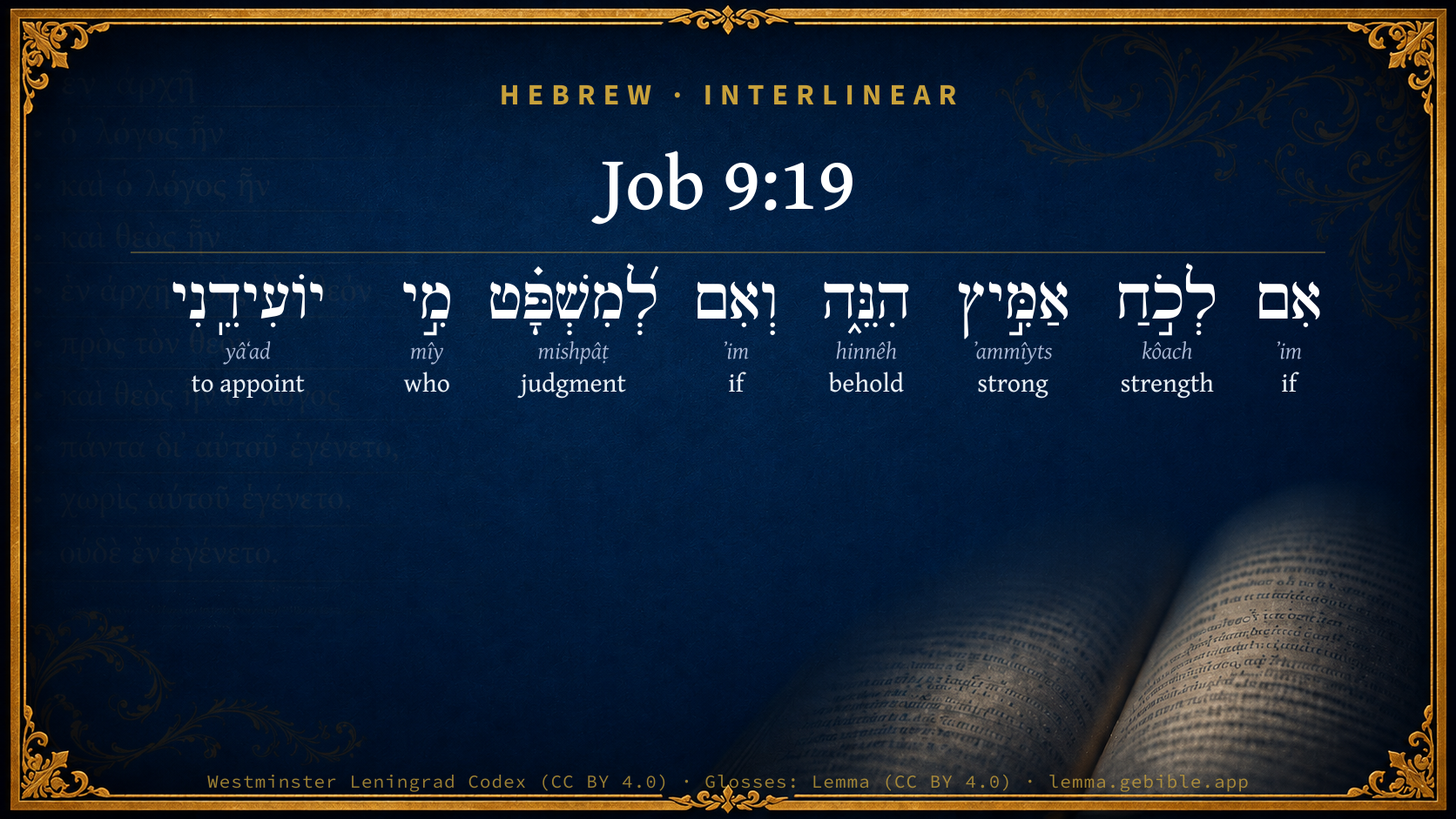
Job 9:19

Hebrew (Westminster Leningrad Codex) Job 9:19 appears in the Hebrew Old Testament. The text above is from the Westminster Leningrad Codex. Each word links to its Strong’s number, a concise gloss, and parsing drawn from the Open Scriptures Hebrew Bible morphology. Click any word for its full Brown-Driver-Briggs (BDB) entry.
Download image
Cite this verse

Job 9:19 (World English Bible). Public Domain. Lemma interlinear Bible study tool, https://lemma.gebible.app/v/job/9/19.

Show BibTeX & RIS
BibTeX
RIS
English Translation
If it is a matter of strength, behold, he is mighty! If of justice, 'Who,' says he, 'will summon me?'
World English Bible · Public Domain
Download a study sheet

One document with this verse’s original text, its word-by-word gloss line, the meaning frame, cross-references with their text, attributed commentary, and full source and license credits — printable, and it pastes into notes with its structure intact.

This verse Autodidact and up

Study sheet (.html) Plain text (.txt)

A passage Seminary Student

Up to 50 verses in one chapter. A passage sheet keeps up to 6 commentary sources and 12 cross-references per verse, in the order this page ranks them, and says so on the sheet whenever that leaves anything out. Ask for a single verse and you get the Autodidact verse sheet above.

Everything on this page stays free to read, with no account — the sheet is a download of what is already on screen, not access to it.

Want to remove ads? Support Godless Engineer
Compare translations 3

The same verse in 3 English versions, stacked beneath the original-language interlinear above. Click any original word for its lexicon entry.

Each is an independent rendering of the whole verse — the interlinear is not word-aligned to these translations.

Highlighted words mark where these versions differ — a whole-verse word diff, not a word-by-word alignment.

  • World English Bible Public Domain
    If it is a matter of strength, behold, he is mighty! If of justice, 'Who,' says he, 'will summon me?'
  • King James Version Public Domain
    If I speak of strength, lo, he is strong: and if of judgment, who shall set me a time to plead?
  • unfoldingWord Literal Text CC BY-SA 4.0
    If to strength, behold, mighty! And if to justice, who will summon him?

unfoldingWord Literal Text — © unfoldingWord, licensed CC BY-SA 4.0. Word-aligned USFM3 via Door43 (git.door43.org/unfoldingWord/en_ult).

Versions to compare (up to 4)

3 of 4 selected

Show all 18 translations

Every available English version of this verse, each an independent rendering of the whole verse.

  • World English Bible Public Domain
    If it is a matter of strength, behold, he is mighty! If of justice, 'Who,' says he, 'will summon me?'
  • Berean Standard Bible Public Domain
    If it is a matter of strength, He is indeed mighty! If it is a matter of justice, who can summon Him?
  • Majority Standard Bible Public Domain
    If it is a matter of strength, He is indeed mighty! If it is a matter of justice, who can summon Him?
  • King James Version Public Domain
    If I speak of strength, lo, he is strong: and if of judgment, who shall set me a time to plead?
  • American Standard Version (1901) Public Domain
    If `we speak' of strength, lo, `he is' mighty! And if of justice, Who, `saith he', will summon me?
  • Revised Version (1885) Public Domain
    If we speak of the strength of the mighty, lo, he is there! and if of judgment, who will appoint me a time?
  • Geneva Bible (1599) Public Domain
    If we speake of strength, behold, he is strog: if we speake of iudgement, who shall bring me in to pleade?
  • Douay-Rheims (1899) Public Domain
    If strength be demanded, he is most strong: if equity of judgment, no man dare bear witness for me.
  • Young's Literal Translation Public Domain
    If of power, lo, the Strong One; And if of judgment -- who doth convene me?
  • Literal Standard Version CC BY-SA 4.0
    If of power, behold, the Strong One; And if of judgment—who convenes me?
  • Unlocked Literal Bible CC BY-SA 4.0
    If it is a matter of strength, behold, he is mighty! If it is a matter of justice, who can summon him?
  • unfoldingWord Literal Text CC BY-SA 4.0
    If to strength, behold, mighty! And if to justice, who will summon him?
  • Darby Bible Public Domain
    Be it a question of strength, lo, [he is] strong; and be it of judgment, who will set me a time?
  • World Messianic Bible Public Domain
    If it is a matter of strength, behold, he is mighty! If of justice, ‘Who,’ says he, ‘will summon me?’
  • Webster's Bible Public Domain
    If I speak of strength, lo, he is strong: and if of judgment, who shall set me a time to plead?
  • Free Bible Version CC BY-SA 4.0
    If it's a question of strength, then God is the strongest. If it's a question of justice, then who will set a time for my case?
  • Bible in Basic English Public Domain
    If it is a question of strength, he says, Here I am! and if it is a question of a cause at law, he says, Who will give me a fixed day?
  • JPS Tanakh (1917) Public Domain
    If it be a matter of strength, lo, He is mighty! and if of justice, who will appoint me a time?

Literal Standard Version (2020), Covenant Press — licensed CC BY-SA 4.0. Text via the HelloAO Bible API (eBible.org). Unlocked Literal Bible (unfoldingWord) — licensed CC BY-SA 4.0. Text via the HelloAO Bible API (eBible.org). unfoldingWord Literal Text — © unfoldingWord, licensed CC BY-SA 4.0. Word-aligned USFM3 via Door43 (git.door43.org/unfoldingWord/en_ult). Free Bible Version, Dr. Jonathan Gallagher — licensed CC BY-SA 4.0. Text via the HelloAO Bible API (eBible.org).

Word by word

More ways to search: Search by grammar → Find every occurrence → Compare this word →

Practice this passage: Drill this verse → Learn its vocabulary →

About this verse

These counts appear in no published source. They are computed here, from the morphology-tagged text and Lemma’s own curated glosses. What Lemma adds →

8
words
7
distinct lemmas
Wisdom
section

Notable vocabulary

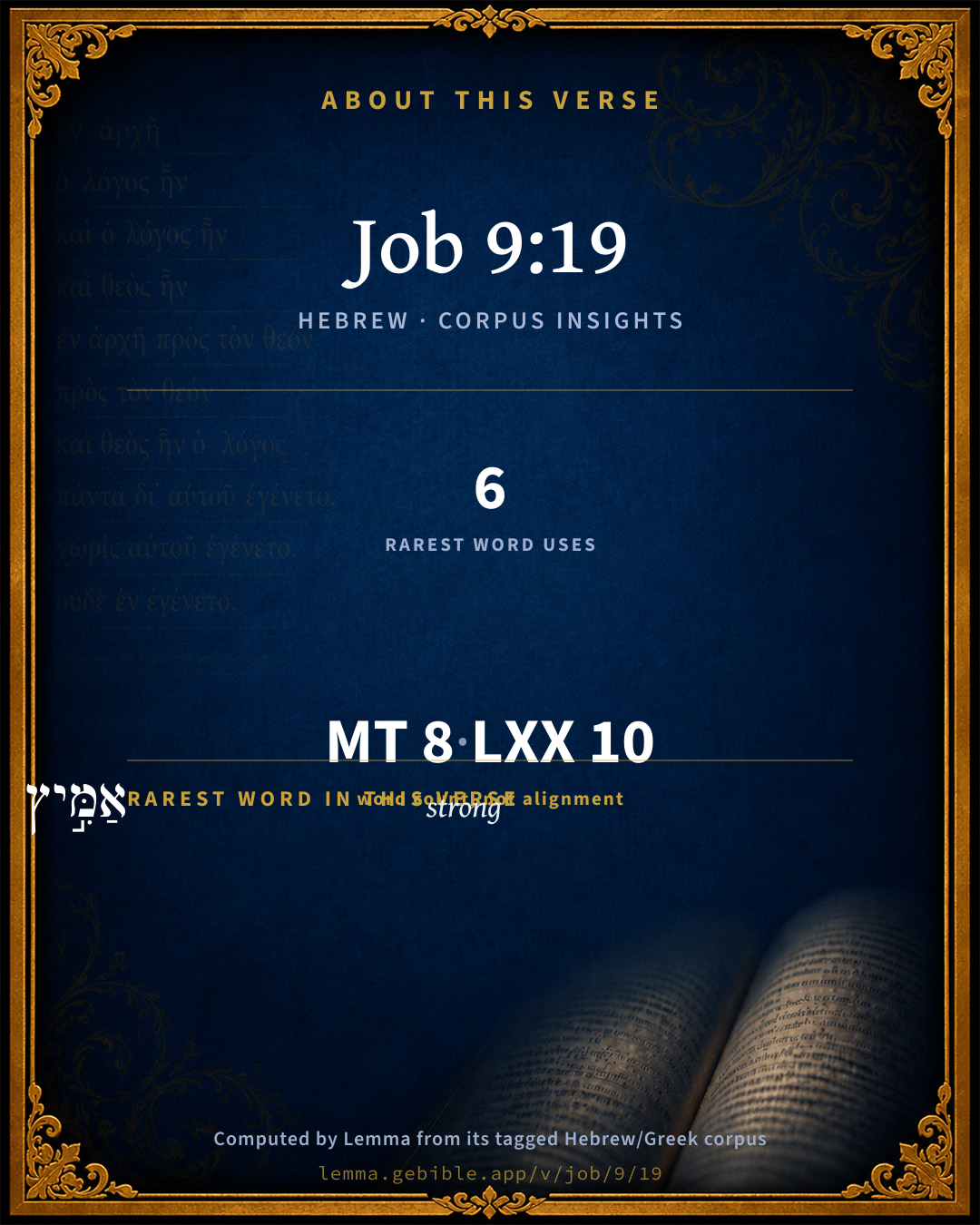
The rarest word here is אַמִּ֣יץ strong H533 — appearing just 6 times in the whole Hebrew Bible.

Shared distinctive vocabulary

אַמִּ֣יץ strong H533 occurs in 6 verses of the Hebrew Bible. Also found in:

Grammatical profile

  • 1 verb
  • 2 nouns
  • 1 adjective
  • 2 conjunctions
  • 2 particles

Verb forms

  • יוֹעִידֵֽנִי Hiphil · Imperfect

Repetition

A word recurs within this verse — often emphatic in Hebrew:

  • אִם if H518 ×2

Hebrew & Septuagint length

In English translation the verse runs 20 words from the Hebrew and 13 from the Septuagint (LXX English) — the Septuagint runs noticeably shorter here. See the side-by-side →

A rough comparison of the two English renderings, which tokenize alike — not a word-level alignment.

Word counts can differ between the Hebrew and the Greek without any difference in meaning — e.g. the Hebrew direct-object marker אֵת has no separate Greek word, and Greek often adds the article ὁ.

In the original languages it is 8 Hebrew tokens and 10 Greek tokens — but the two are counted differently (Hebrew bundles its prefixes and suffixes into one token; the Greek is in lemma form), so that isn’t a like-for-like length.

Cross-references

10

Topical passages linked to Job 9:19 in the Treasury of Scripture Knowledge — connected by theme and wording, ordered by reader-vote popularity; previews shown in the World English Bible.

  • Job 9:4 God who is wise in heart, and mighty in strength: Who has hardened himself against him, and prospered?
  • Job 9:32–33 For he is not a man, as I am, that I should answer him, That we should come together in judgment.
  • 1 Corinthians 1:25 Because the foolishness of God is wiser than men, and the weakness of God is stronger than men.
  • Job 40:9–10 Or have you an arm like God? Can you thunder with a voice like him?
  • Psalms 62:11 God has spoken once, Twice I have heard this, That power belongs to God.
  • Matthew 6:13 Bring us not into temptation, but deliver us from the evil one. For yours is the Kingdom, the power, and the glory forever. Amen.'
  • Job 31:35 Oh that I had one to hear me! (Behold, here is my signature, let the Almighty answer me); Let the accuser write my indictment!
  • Job 33:5–7 If you can, answer me; Set your words in order before me, and stand forth.
  • Job 36:17–19 "But you are full of the judgment of the wicked. Judgment and justice take hold of you.
  • 1 Corinthians 10:22 Or do we provoke the Lord to jealousy? Are we stronger than he?

Cross-references courtesy of OpenBible.info (CC BY 4.0).

Hebrew and Greek witnesses Masoretic Hebrew ↔ Greek Septuagint

The same verse in the two great witnesses to the Old Testament, shown verse-for-verse.

Here the Septuagint runs noticeably shorter than the Hebrew — LXX2012 (modern English Septuagint) 13 words vs World English Bible 20. A rough length comparison of the two English translations, not a word-level alignment — read both below.

These are two independent witnesses, not word-aligned to each other, and the Septuagint is shown in lemma (dictionary) form.

Hebrew Job 9:19 Masoretic · Westminster Leningrad Codex

אִם לְכֹ֣חַ אַמִּ֣יץ הִנֵּ֑ה וְאִם לְ֝מִשְׁפָּ֗ט מִ֣י יוֹעִידֵֽנִי

If it is a matter of strength, behold, he is mighty! If of justice, 'Who,' says he, 'will summon me?'

World English Bible · Public Domain

Greek LXX Job 9:19 Septuagint · lemma form

ὅτι μέν γάρ ἰσχύς κρατέω τίς οὖν κρίμα αὐτός ἀντιἵστημι

For indeed he is strong in power: who then shall resist his judgment?

LXX2012 (modern English Septuagint) · Public Domain

Hebrew: Westminster Leningrad Codex (CC BY 4.0). Greek: Septuagint (public domain); English from LXX2012 (modern English Septuagint) (Public Domain). How the Septuagint differs from the Hebrew →

Commentary

Notes on Job 9:19 from classic Christian and Jewish commentators (each source and its license shown beneath its notes). The classic Christian expositions comment on the surrounding passage and are grouped to its opening verse, so a note may address several verses; the Jewish commentaries on the Tanakh (Rashi and others) are per-verse, so they appear only where the commentator wrote on this verse.

Lemma curates 59 commentaries, every one of them public domain or Creative Commons licensed, each selected and text-cleaned for this edition rather than reprinted as found. About our sources →

Trapp's Complete Commentary

John Trapp

Job 9:19 If [I speak] of strength, lo, [he is] strong: and if of judgment, who shall set me a time [to plead]?

Ver. 19. If I speak of strength, lo, he is strong] Neither by might nor right can I deal with him. Broughton renders it, As for force, he is valiant. The Lord is a man of war, saith Moses, Exo 15:3. Yea, he is the Lord of arms, saith David, Psa 84:1-12 Yea, he alone is a whole army of men, van and rear both, saith Isaiah, Isa 52:12, there is no doubt, then, but he will carry the day, since no creature is able to grapple with him. The weakness of God (if any such thing there were) is stronger than men, 1Co 1:25, and by the weakest means he can effect the greatest matters, as once he did in Egypt.

And if of judgment, who shall set me a time to plead?] Who shall appoint the time and place for our meeting? If I shall go about to sue him at law, I shall have but a cold suit, an ill pull of it; for who shall make him appear, or bring him to his answer? and where shall I find an advocate, a patron, to plead my cause? yea, where shall I get a witness? for so the Vulgar reads it, Nemo audet pro me testimonium dicere; no man shall be so bold as to give an evidence for me, or be a witness on my side.

John Trapp, A Commentary or Exposition upon All the Books of the Old and New Testament (1647–1656) — public domain. Text from a community e-Sword module.

Joseph Benson's Commentary

Job 9:19. If I speak of strength — If my cause were to be decided by power; he is strong — Infinitely stronger than I; and if of judgment — If I would contend with him in a way of right; who shall set, &c. — There is no superior judge that can summon him and me together. Heath thus explains the words: “If I think to right myself by force, it is vain; for he is stronger than I: if I choose to decide our dispute by law, who hath authority to call us before him?”

Joseph Benson's Commentary on the Old and New Testaments (1811–1818) — public domain. Text from a community e-Sword module.

Geneva Bible (1599)

Geneva Bible translators

After he hath accused his own weakness, he continueth to justify God and his power.

Geneva Bible (1599) marginal notes — public domain. Text via Bolls.life.

Jamieson, Fausset & Brown

Robert Jamieson, A. R. Fausset & David Brown

UMBREIT takes these as the words of God, translating, "What availeth the might of the strong?" "Here (saith he) behold! what availeth justice? Who will appoint me a time to plead?" (So Jer 49:19). The last words certainly apply better to God than to Job. The sense is substantially the same if we make "me" apply to Job. The "lo!" expresses God's swift readiness for battle when challenged.

Jamieson, Fausset & Brown — Commentary Critical and Explanatory on the Whole Bible (1871) — public domain (CC PDM 1.0). Text via the HelloAO Bible API.

Adam Clarke's Commentary

Verse 19. If I speak of strength, lo, he is strong] Human wisdom, power, and influence avail nothing before him.

Who shall set me a time] מי יועידני mi yoideni, "Who would be a witness for me?" or, Who would dare to appear in my behalf? Almost all the terms in this part of the speech of Job, Job 9:11-24, are forensic or juridical, and are taken from legal processes and pleadings in their gates or courts of justice.

Adam Clarke's Commentary on the Bible (1810–1826) — public domain. Text from a community e-Sword/MySword module.

Ellicott's Commentary for English Readers

(19) If I speak of strength.—All this is the most uncompromising acknowledgment of the absolute inability of man to stand in judgment before God. The whole of this is so very abrupt and enigmatical that it is extremely difficult to be sure of the argument, though naturally the general drift of it is obvious enough. “If it were a trial of strength—Who is Almighty?—and if it was a matter of judgment, is He not judge and court together? and what authority that He would acknowledge could give me the opportunity of pleading my cause before Him? Were I righteous, my own mouth would show me wicked; were I perfect, then would it or He prove me perverse. Were I perfect, I should not know myself, or know it myself. I despise my life under such conditions; therefore, said I, it is all one: He destroyeth the perfect and the wicked alike.”

A Bible Commentary for English Readers, edited by Charles John Ellicott (1878–1897) — public domain. Text from a community e-Sword module.

The Cambridge Bible for Schools and Colleges

gen. ed. J. J. S. Perowne

19–21. These three verses read as follows,

If you speak of the strength of the mighty, Here I am! (saith He)

If of judgment, Who will set me a time?

The Cambridge Bible for Schools and Colleges (gen. ed. J. J. S. Perowne; Cambridge University Press, 1878–1918) — public domain. Text from a community e-Sword module.

John Gill's Exposition

If I justify myself,.... Seek for justification by his own righteousness, trust in himself that he was righteous, say that he was so, and pronounce himself a righteous man, what would it signify?

mine own mouth shall condemn me; the words of it being sinful, vain, idle, and frothy; and if a man is to be justified, and condemned by his words, he may be sure of the latter: indeed, "if any man offend not in word, the same is a perfect man", Jam 3:2; but let a man be as careful as he can, and keep ever such a guard upon his lips, such is the imperfection of human nature, that, though a Moses, he will speak unadvisedly with his lips, at one time or another, and in many things will offend; which would be his condemnation, if there was no other way to secure from it; nay, for a sinful man to justify himself, or to say that he is a righteous man by his own righteousness, and insist upon this before God, if he is tried upon it he must be condemned; yea, saying he is so is a falsehood, abominable to God, and enough to condemn him; and besides, a man that knows himself, as Job did, must be conscious of much sin within him, however externally righteous he may be before men; so that, should he say he was righteous, his conscience would speak, or cause his mouth to speak and contradict and condemn him:

if I say, I am perfect; not in an evangelical sense, as he was; but in a legal sense, so as to be free from sin, which no man that is perfect in a Gospel sense is; as Noah, Jacob, David, and others, who were so, yet not without sin; if therefore a man should assert this, he would not say that which was right, but what was perverse, as might be proved:

it shall also prove me perverse; to be a wicked man; either he, God, shall prove, or it, his mouth, as in the preceding clause; for to say this is to tell a lie, which to do is perverseness, see Jo1 1:8.

John Gill's Exposition of the Whole Bible (1746–1763) — public domain (CC PDM 1.0). Text via the HelloAO Bible API.

Albert Barnes' Notes on the Bible

If I speak of strength, lo, he is strong - There has been a considerable variety in the interpretation of this passage. The meaning seems to be this. It refers to a judicial contest, and Job is speaking of the effect if he and God were to come to a trial, and the cause were to be settled before judges. He is urging reasons why he would have no hope of success in such a case. He says, therefore, “If the matter pertained only to strength, or if it were to be determined by strength, lo, he is more mighty than I am, and I could have no hope of success in such a controversy: and if the controversy was one of judgment, that is, of justice or right, I have no one to manage my cause - no one that could cope with him in the pleadings - no one who could equal him in setting forth my arguments, or presenting my side of the case. It would, therefore, be wholly an unequal contest, where I could have no hope of success; and I am unwilling to engage in such a controversy or trial with God. My interest, my duty, and the necessity of the case, require me to submit the case without argument, and I will not attempt to plead with my Maker.” That there was a lack of right feeling in this, must be apparent to all.

There was evidently the secret belief that God had dealt with him severely; that he had gone beyond his deserts in indicting pain on him, and that he was under a necessity of submitting not so much to justice and right as to mere power and sovereignty. But who has not had something of this feeling when deeply afflicted? And yet who, when he has had it, has not felt that it was far from being what it should be? Our feeling should be, “we deserve all that we suffer, and more than we have yet endured. God is a sovereign; but He is right. Though he afflicts us much, and others little, yet it is not because he is unjust, but because he sees that there is some good reason why we should suffer. That reason may be seen yet by us, but if not, we should never doubt that it exists.”

Who shall set me a time to plead? - Noyes renders this, “Who shall summon me to trial?” Dr. Good, “Who should become a witness for me?” The sense is, “Who would summon witnesses for me? If it was a mere trial of strength, God is too mighty for me; if it were a question of justice, who would compel witnesses to come on my side? Who could make them willing to appear against God, and to bear testimony for me in a controversy with the Almighty?”

Albert Barnes' Notes on the Bible (1834–1885) — public domain. Text from a community e-Sword/MySword module.

Haydock's Catholic Bible Commentary

Equity. Hebrew, "if judgment, who will appoint me a time," (Haydock) or "set me before him," and undertake my defence? Who will dare to sit as judge between us?

George Leo Haydock (1774–1849), Haydock's Catholic Family Bible and Commentary, 1859 edition — public domain. Excludes Psalms (Douay-Rheims chapter numbering differs from Protestant) and Deuterocanonical books (Catholic canon only).

Matthew Poole's English Annotations

If my cause were to be decided by power,

lo, he is strong, i.e. stronger than I. If I would contend with him in a way of right, there is no superior judge that can summon him and me together, and appoint us a time of pleading before him, and oblige us both to stand to his sentence; and therefore I must be contented to sit down with the loss.

Matthew Poole's English Annotations on the Holy Bible (1683–1685) — public domain. Text from a community e-Sword/MySword module.

Whedon's Commentary on the Bible

Daniel D. Whedon

19. If… of strength — Many moderns see in the abrupt and startling הנה, behold! and מי יועידני, who will cite me! the responses of Deity, and read, If it be a question of the strength of the strong. God replies, Behold, (me,) here I am. And if of right, God again replies, Who will cite me? Compare Jer_49:19. Davidson regards the whole verse as words of God, and remarks: The sufferer imagines for a moment that he had cited his great adversary; his citation is attended with unexpected success. God appears — appears in a whirlwind, dashing his challenger about, (17 a,) multiplying his plagues, (17 b,) filling him with the bitterest pains, (18.) coming in magnificence, and rioting in the jubilant consciousness of omnipotence, as if to say, I have been cited, challenged. Was it to a trial of strength? here I am! To a trial at law? who will venture to implead me?

Daniel D. Whedon (gen. ed.), Commentary on the Old and New Testaments (1874–1909) — public domain. Text from a community e-Sword module.

The Pulpit Commentary

If I speak of strength, lo, he is strong. Still the idea is, "How can I contend with God? If it is to be a trial of strength, it is he who is strong, not I; if it is to be a suit, or pleading for justice, who will appoint me a day?" And if of judgment, who shall set me a time to plead? (comp. below, ver 33).

The Pulpit Commentary (1880–1919), ed. H.D.M. Spence-Jones & Joseph S. Exell — public domain. Text from a community e-Sword module.

John Wesley's Explanatory Notes

If - If my cause were to be decided by power. Is Strong - Stronger than I. Judgment - If I would contend with him in a way of right. Who - There is no superior judge that can summon him and me together.

John Wesley, Explanatory Notes Upon the Whole Bible (1754–1765) — public domain. Text via the GEBible commentary corpus.

unfoldingWord translationNotes

Door43 World Missions Community

If it is a matter of strength

"If there is a contest of strength"

behold, he is mighty

"look and you will see that he is mighty" or "pay attention to what I am about to tell you: he is mighty"

he is mighty

"he is the strong one"

who can summon him?

This question expects an answer of "No one" to make the point that no one is able to bring God to court. This can be reworded as a statement. AT: "no one can summon him." (See: Rhetorical Question)

Though I am in the right, my own mouth would condemn me; and though I am blameless, my words would prove me to be guilty

This verse expresses the same idea twice for emphasis. (See: Parallelism)

Though I am in the right

Here "I am in the right" means I am the one who has done right things. AT: "Although I have done right things" or "Even though I am innocent" (See: Idiom and Nominal Adjectives)

my own mouth would condemn me

Here "mouth" represents Job's words. AT: "my own words would accuse me" or "what I say would condemn me" (See: Metonymy)

blameless

"faultless"

my words would prove me to be guilty

Here "my words" are spoken of as if they could take action. AT: "God would use what I say to prove me guilty" (See: Metaphor)

guilty

The word here has the meaning of "twisted" or "crooked."

translationWords

might

just

righteous

condemn

blameless

guilt

unfoldingWord translationNotes — © Distant Shores Media and the Door43 World Missions Community, licensed CC BY-SA 4.0. Source: git.door43.org/Door43/en_tn.

Rashi

Rabbi Shlomo Yitzchaki (Rashi)

If it is a trial of strength How can I contend with Him? If He comes with strength, behold He is mighty.

and if of judgment who will be able to summon me before Him and confirm my verdict? Is it not so that...

Rashi on the Tanakh — English translations: “The Judaica Press complete Tanach with Rashi, translated by A. J. Rosenberg” (CC BY 4.0); “Pentateuch with Rashi's commentary by M. Rosenbaum and A.M. Silbermann, 1929-1934” (public domain); “The Metsudah Tanach series, Lakewood, N.J” (CC BY 4.0); and “The Book of Joshua, Metsudah Publications, 1997” (CC BY 4.0). Text via Sefaria.

Lesson kit

Teaching starters — assembled from the data on this page, not authored interpretation. Every prompt links to the verse data it draws on. Edit before teaching.

Job, in the Wisdom, opens this verse with 8 words (7 distinct Hebrew lemmas). Its most distinctive word is ʼammîyts (“strong”). The Greek Septuagint runs shorter here. A historical commentator’s framing appears above. Read the whole chapter for the surrounding context.

Discussion questions

  1. What does “strong” (ʼammîyts) contribute to the verse as a whole?
  2. 2 Samuel 15:12 shares the word «strong» with this verse. How do the two illuminate each other?
  3. “if” occurs 2× in this one verse. What is the effect of the repetition?
  4. Compared with the Hebrew, the Septuagint runs shorter here. What questions does that raise?
  5. These translations render this verse differently. What is at stake in choosing one wording over another?
  6. The verb «יוֹעִידֵֽנִי» is Hiphil Imperfect. How does its form color the action?
  7. Reading how Trapp's Complete Commentary and Joseph Benson's Commentary read this verse, where do the two commentators agree and where do they part?

Things to notice

Reading settings

Reading text

Shown beneath each verse's original-language words.

Old Testament
Old Testament edition

Read the OT as the Masoretic Hebrew (MT) or the Greek Septuagint (LXX).

English shown for the Greek Septuagint (in the Hebrew ↔ Greek comparison).

Comparing translations? Open the Compare panel on any verse page to stack up to four side by side.