
Jude 1:10

Greek (Tischendorf 8th ed.) Jude 1:10 appears in the Greek New Testament. The text above is from the Tischendorf 8th edition. Each word links to its Strong’s number and a concise gloss. Click any word for its full Thayer’s Greek Lexicon entry.
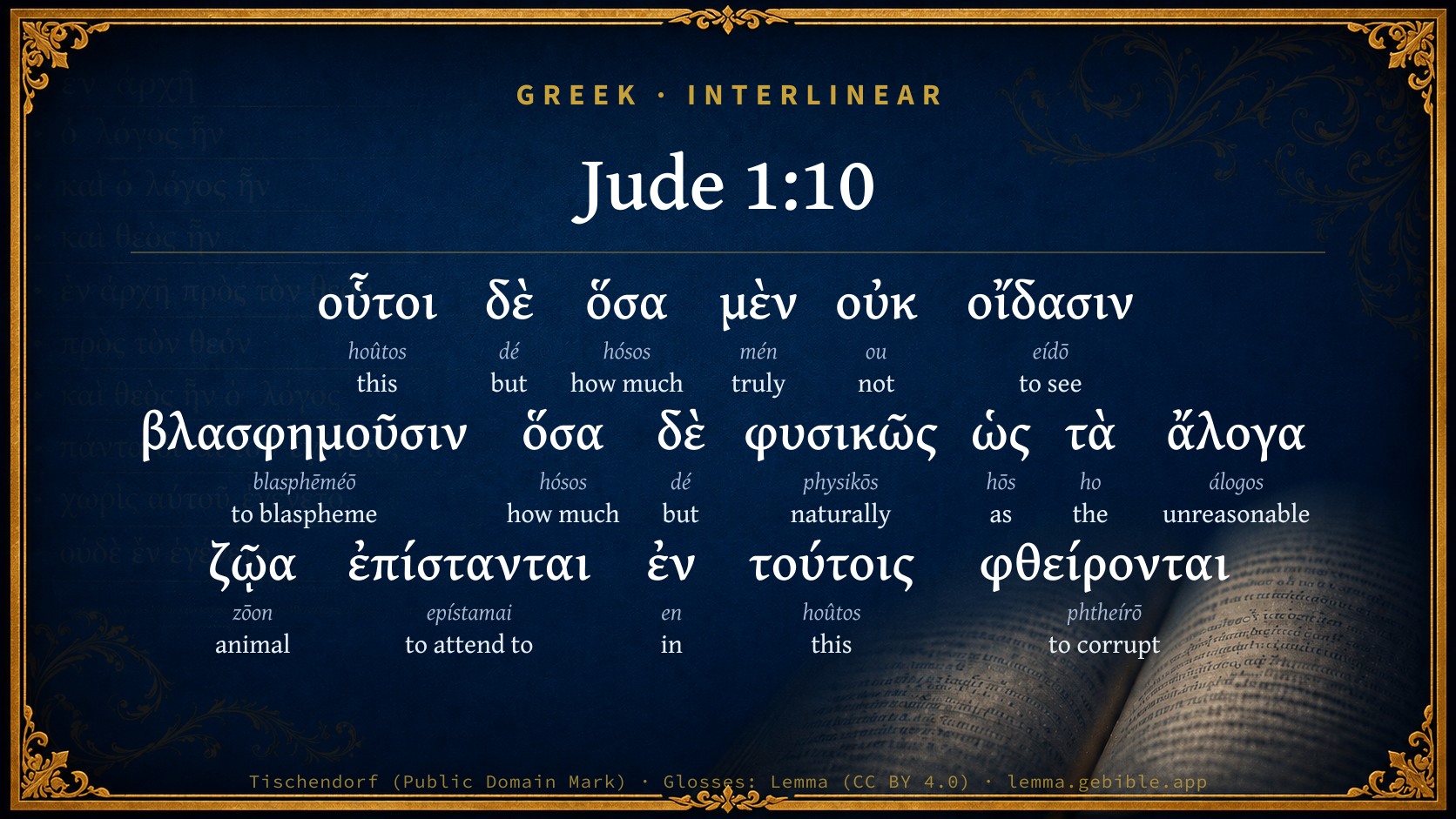
Download image
Cite this verse

Jude 1:10 (World English Bible). Public Domain. Lemma interlinear Bible study tool, https://lemma.gebible.app/v/jude/1/10.

Show BibTeX & RIS
BibTeX
RIS
English Translation
But these speak evil of whatever things they don't know. What they understand naturally, like the creatures without reason, in these things are they destroyed.
World English Bible · Public Domain
Highlights
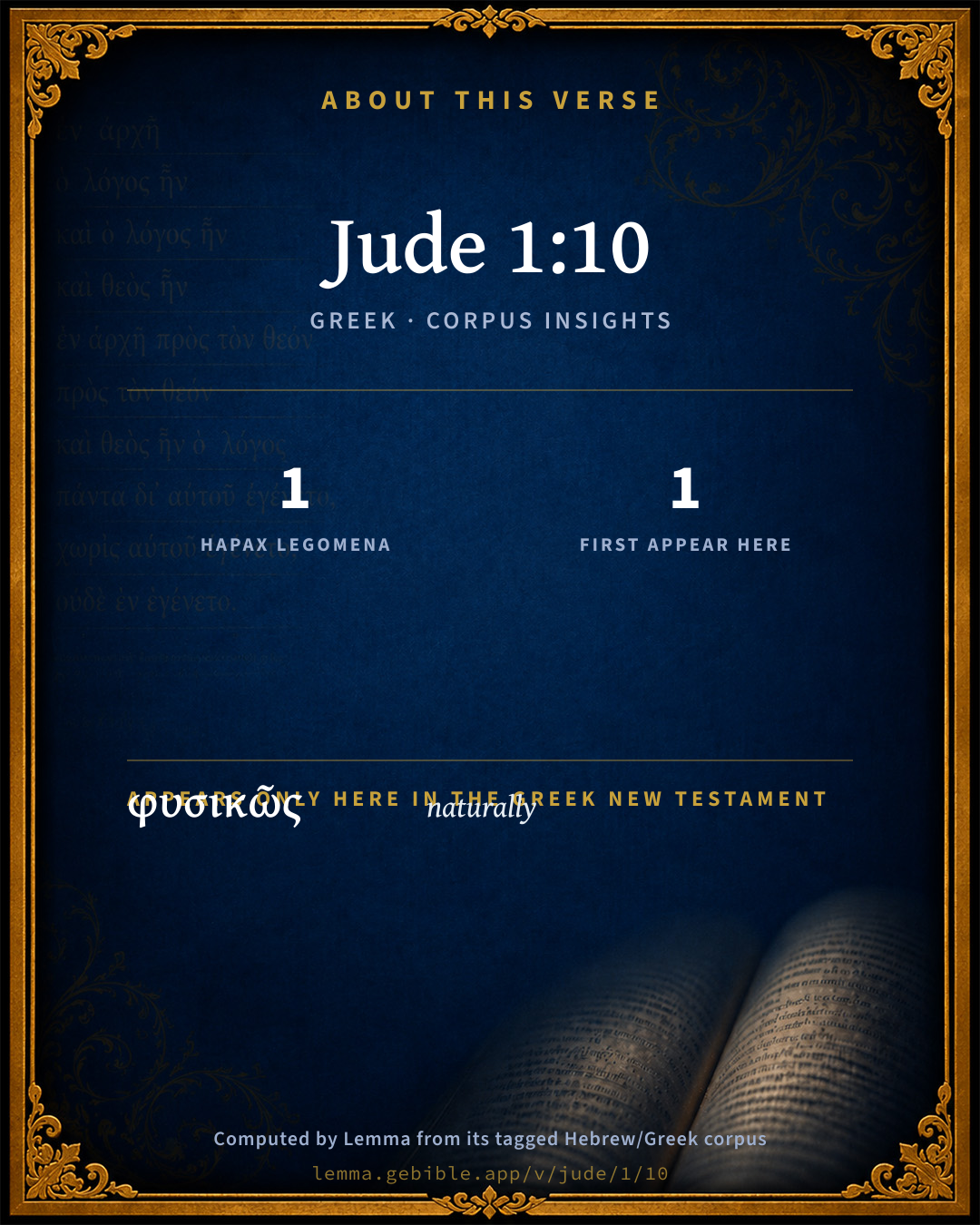
  • 1 hapax legomenon — only here in the Greek New Testament
  • 1 first appearance in the Greek New Testament
Full analysis ↓
Download a study sheet

One document with this verse’s original text, its word-by-word gloss line, the meaning frame, cross-references with their text, attributed commentary, and full source and license credits — printable, and it pastes into notes with its structure intact.

This verse Autodidact and up

Study sheet (.html) Plain text (.txt)

A passage Seminary Student

Up to 50 verses in one chapter. A passage sheet keeps up to 6 commentary sources and 12 cross-references per verse, in the order this page ranks them, and says so on the sheet whenever that leaves anything out. Ask for a single verse and you get the Autodidact verse sheet above.

Everything on this page stays free to read, with no account — the sheet is a download of what is already on screen, not access to it.

Want to remove ads? Support Godless Engineer
Compare translations 3

The same verse in 3 English versions, stacked beneath the original-language interlinear above. Click any original word for its lexicon entry.

Each is an independent rendering of the whole verse — the interlinear is not word-aligned to these translations.

Highlighted words mark where these versions differ — a whole-verse word diff, not a word-by-word alignment.

  • World English Bible Public Domain
    But these speak evil of whatever things they don't know. What they understand naturally, like the creatures without reason, in these things are they destroyed.
  • King James Version Public Domain
    But these speak evil of those things which they know not: but what they know naturally, as brute beasts, in those things they corrupt themselves.
  • unfoldingWord Literal Text CC BY-SA 4.0
    But these ones indeed slander what they do not understand; but what they understand by instinct as the unreasoning animals, by these things they are being destroyed.

unfoldingWord Literal Text — © unfoldingWord, licensed CC BY-SA 4.0. Word-aligned USFM3 via Door43 (git.door43.org/unfoldingWord/en_ult).

Versions to compare (up to 4)

3 of 4 selected

Show all 19 translations

Every available English version of this verse, each an independent rendering of the whole verse.

  • World English Bible Public Domain
    But these speak evil of whatever things they don't know. What they understand naturally, like the creatures without reason, in these things are they destroyed.
  • Berean Standard Bible Public Domain
    These men, however, slander what they do not understand, and like irrational animals, they will be destroyed by the things they do instinctively.
  • Majority Standard Bible Public Domain
    These men, however, slander what they do not understand, and like irrational animals, they will be destroyed by the things they do instinctively.
  • King James Version Public Domain
    But these speak evil of those things which they know not: but what they know naturally, as brute beasts, in those things they corrupt themselves.
  • American Standard Version (1901) Public Domain
    But these rail at whatsoever things they know not: and what they understand naturally, like the creatures without reason, in these things are they destroyed.
  • Revised Version (1885) Public Domain
    But these rail at whatsoever things they know not: and what they understand naturally, like the creatures without reason, in these things are they destroyed.
  • Geneva Bible (1599) Public Domain
    But these speake euill of those thinges, which they know not: and whatsoeuer things they know naturally, as beasts, which are without reason, in those things they corrupt them selues.
  • Douay-Rheims (1899) Public Domain
    But these men blaspheme whatever things they know not: and what things soever they naturally know, like dumb beasts, in these they are corrupted.
  • Young's Literal Translation Public Domain
    and these, as many things indeed as they have not known, they speak evil of; and as many things as naturally (as the irrational beasts) they understand, in these they are corrupted;
  • Literal Standard Version CC BY-SA 4.0
    But these, indeed, whatever [things] they have not known, they speak evil of; and whatever [they know], like the irrational beasts, they understand naturally—in these they are corrupted;
  • Unlocked Literal Bible CC BY-SA 4.0
    But these people slander whatever they do not understand, and what they do understand—what unreasoning animals know by instinct—these are what destroy them.
  • unfoldingWord Literal Text CC BY-SA 4.0
    But these ones indeed slander what they do not understand; but what they understand by instinct as the unreasoning animals, by these things they are being destroyed.
  • Darby Bible Public Domain
    But these, whatever things they know not, they speak railingly against; but what even, as the irrational animals, they understand by mere nature, in these things they corrupt themselves.
  • World Messianic Bible Public Domain
    But these speak evil of whatever things they don’t know. They are destroyed in these things that they understand naturally, like the creatures without reason.
  • Webster's Bible Public Domain
    But these speak evil of those things which they know not: but what they know naturally, as brute beasts, in those things they corrupt themselves.
  • Free Bible Version CC BY-SA 4.0
    But these people ridicule whatever they don't understand; and what they do understand they instinctively follow like unthinking animals—this is what destroys them.
  • Bible in Basic English Public Domain
    But these men say evil about such things as they have no knowledge of; and the things of which they have natural knowledge, like beasts without reason, are the cause of their destruction.
  • Text-Critical English NT CC BY 4.0
    Yet these men slander whatever they do not understand, and they are corrupted by what they, like irrational beasts, instinctively comprehend.
  • Tyndale New Testament (1534) Public Domain
    But these speake evyll of those thinges which they knowe not: and what thinges they knowe naturally as beastes which are without reason in tho thinges they corrupte them selves.

Literal Standard Version (2020), Covenant Press — licensed CC BY-SA 4.0. Text via the HelloAO Bible API (eBible.org). Unlocked Literal Bible (unfoldingWord) — licensed CC BY-SA 4.0. Text via the HelloAO Bible API (eBible.org). unfoldingWord Literal Text — © unfoldingWord, licensed CC BY-SA 4.0. Word-aligned USFM3 via Door43 (git.door43.org/unfoldingWord/en_ult). Free Bible Version, Dr. Jonathan Gallagher — licensed CC BY-SA 4.0. Text via the HelloAO Bible API (eBible.org).

Word by word

More ways to search: Search by grammar → Find every occurrence → Compare this word →

Practice this passage: Drill this verse → Learn its vocabulary →

φυσικῶς
physikōs
G5447
“naturally”
Adverb
Part of Speech
Adverb
Full Thayer's Definition

Origin: from G5446

TDNT: 13:11,1

1. in a natural manner, by nature, under the guidance of nature: by the aid of the bodily senses
  1. οὗτοι hoûtos G3778 “this” Demonstrative pronoun, Nominative, Plural, Masculine
  2. δὲ dé G1161 “but” Conjunction
  3. ὅσα hósos G3745 “how much” Correlative pronoun, Accusative, Plural, Neuter
  4. μὲν mén G3303 “truly” Particle
  5. οὐκ ou G3756 “not” Particle, Negative
  6. οἴδασιν eídō G1492 “to see” Verb, Perfect, Active, Indicative, 3rd person, Plural
  7. βλασφημοῦσιν blasphēméō G987 “to blaspheme” Verb, Present, Active, Indicative, 3rd person, Plural
  8. ὅσα hósos G3745 “how much” Correlative pronoun, Accusative, Plural, Neuter
  9. δὲ dé G1161 “but” Conjunction
  10. ὡς hōs G5613 “as” Adverb
  11. τὰ ho G3588 “the” Article, Nominative, Plural, Neuter
  12. ἄλογα álogos G249 “unreasonable” Adjective, Nominative, Plural, Neuter
  13. ζῷα zōon G2226 “animal” Noun, Nominative, Plural, Neuter
  14. ἐπίστανται epístamai G1987 “to attend to” Verb, Present, Middle or Passive deponent, Indicative, 3rd person, Plural
  15. ἐν en G1722 “in” Preposition
  16. τούτοις hoûtos G3778 “this” Demonstrative pronoun, Dative, Plural, Neuter
  17. φθείρονται phtheírō G5351 “to corrupt” Verb, Present, Passive, Indicative, 3rd person, Plural

About this verse

These counts appear in no published source. They are computed here, from the morphology-tagged text and Lemma’s own curated glosses. What Lemma adds →

18
words
15
distinct lemmas
General Epistles
section

Notable vocabulary

1 hapax legomenon — a word that appears only here in the entire Greek New Testament:

  • φυσικῶς naturally G5447

First appearance in Scripture

This word makes its first canonical appearance in the Greek New Testament here:

  • φυσικῶς naturally G5447

Shared distinctive vocabulary

ἄλογα unreasonable G249 occurs in 3 verses of the Greek New Testament. Also found in:
Repetition

Words recur within this verse:

  • ὅσα how much G3745 ×2
  • οὗτοι this G3778 ×2
  • δὲ but G1161 ×2

Cross-references

2

Topical passages linked to Jude 1:10 in the Treasury of Scripture Knowledge — connected by theme and wording, ordered by reader-vote popularity; previews shown in the World English Bible.

  • 2 Peter 2:12 But these, as unreasoning creatures, born natural animals to be taken and destroyed, speaking evil in matters about which they are ignorant, will in their destroying surely be destroyed,
  • Romans 1:21–22 Because, knowing God, they didn't glorify him as God, neither gave thanks, but became vain in their reasoning, and their senseless heart was darkened.

Cross-references courtesy of OpenBible.info (CC BY 4.0).

Commentary

Notes on Jude 1:10 from classic Christian and Jewish commentators (each source and its license shown beneath its notes). The classic Christian expositions comment on the surrounding passage and are grouped to its opening verse, so a note may address several verses; the Jewish commentaries on the Tanakh (Rashi and others) are per-verse, so they appear only where the commentator wrote on this verse.

Lemma curates 59 commentaries, every one of them public domain or Creative Commons licensed, each selected and text-cleaned for this edition rather than reprinted as found. About our sources →

Joseph Benson's Commentary

Jdg 1:10-11. But these — Without any shame; speak evil of those things which they know not — Namely, the things of God; of whose nature and excellence, truth and importance, they are entirely ignorant. See on 1Co 2:14. But what they know naturally as brute beasts — By instinct, as animals void of reason; in those things they corrupt themselves — They make them occasions of sin: or, they are corrupted by the gross and scandalous abuse of them, to the dishonour of God, and their own infamy and destruction. Thus the apostle signifies that, notwithstanding their high pretensions to knowledge, they had no knowledge even concerning the use of their own bodies, but what they derived from natural instinct as brute animals; and that, instead of using that knowledge rightly, they thereby destroyed both their souls and bodies. Thus, in this passage, he condemned the lascivious practices of the Nicolaitans, and of all the ungodly teachers, who defended the promiscuous use of women, and confuted the argument taken from natural appetite, by which they vindicated their common whoredoms. Wo unto them — Of all the apostles, Jude alone, and that in this single passage, denounces a wo. St. Peter, to the same effect, pronounces them cursed children. Macknight, who renders the clause, wo is to them, considers it as only a declaration of the misery which was to come on them: in which sense only the phrase is used by our Lord, Mat 24:19; Wo unto them that are with child, &c., for certainly this was no wish of punishment, since to be with child, and to give suck in those days, was no crime. But it was a declaration of the misery which was coming on persons in that helpless condition. For they have gone in the way of Cain — The murderer; and ran greedily — Greek, εξεχυθησαν, have been poured out, like a torrent without banks; after the error of Balaam — The covetous false prophet, being strongly actuated, like him, by a passion for riches, and therefore drawing money from their disciples by allowing them to indulge their lusts without restraint. See on 2Pe 2:15. And perished in the gainsaying of Core — Having opposed God’s messengers, as Korah did, like him and his company, vengeance will overtake them, as it did him. Here, as in many passages of Scripture, a thing is said to have happened which was only to happen. This manner of speaking was used to show the absolute certainty of the thing spoken of. The gainsaying, here mentioned, implies rebellion; for when princes and magistrates are contradicted, it is rebellion. By declaring that the ungodly teachers would perish in the rebellion of Korah, Jude insinuated that these men, by opposing the apostles of Christ, were guilty of a rebellion similar to that of Korah and his companions, who opposed Moses and Aaron, on pretence that they were no more commissioned by God, the one to be a prince, the other a priest, than the rest of the congregation, who, they said, were all holy, Num 16:3; Num 16:13. By comparing these false and wicked teachers to Cain, Balaam, and Korah, Jude has represented them as guilty of murder, covetousness, and ambition.

Joseph Benson's Commentary on the Old and New Testaments (1811–1818) — public domain. Text from a community e-Sword module.

Tyndale Open Study Notes

Tyndale Open Resources

1:10 Hebron was the city nearest to Abraham’s dwelling by the oaks of Mamre (Gen 13:18); the patriarchs later lived and were buried there (Gen 23:19; 35:27; 49:29-32). It was originally called Kiriath-arba (“City of Arba”), after the legendary Arba, who was “a great hero of the descendants of Anak” and “Anak’s ancestor” (Josh 14:15; 15:13). The Anakites, in turn, are identified with the dreaded Nephilites (Num 13:33; see Gen 6:4).

Tyndale Open Study Notes — © Tyndale Open Resources, licensed CC BY-SA 4.0. Text via the HelloAO Bible API.

Bengel's Gnomon

Johann Albrecht Bengel

Jud 1:10. Ὅσα) all things, which.—οὐκ οἴδασι, they are not acquainted with) This is said of spiritual things, belonging to God and the saints.—φυσικῶς, naturally) by their natural faculties, respecting natural things, by a natural mode of knowledge, and a natural appetite. That which is physical is here opposed to that which is spiritual, Jud 1:19.—ἐπίστανται, they know) A more subtle knowledge is conveyed by the former expression, οἴδασι, they are (not) acquainted with.—φθείρονται, they perish [“corrupt themselves”]) Comp. the following verse.

Bengel's Gnomon of the New Testament — English translation (T&T Clark, Edinburgh, 1860) — public domain. Text from a community e-Sword module.

Meyer's Critical & Exegetical Commentary

Heinrich August Wilhelm Meyer

Jud_1:10. Description of the false teachers with reference to Jud_1:8 in contrast to Jud_1:9; comp. 2Pe_2:12.

They blaspheme, ὅσα μὲν οὐκ οἴδασι, what they know not: the supermundane, to which the δόξαι, Jud_1:8, belong, is meant. Hofmann: they know about it, otherwise they could not blaspheme it; but they have no acquaintance with it, and yet in their ignorance judge of it, and that in a blasphemous manner (comp. Col_2:18 according to the usual reading). Those expositors who understand κυριότητα and δόξας of human authorities, are at a loss for an explanation of the thoughts here expressed; thus Arnaud: il est assez difficile de préciser, quelles étaient ces choses quignoraient ces impies.

ὅσα δὲ φυσικῶς ἐπίστανται] a contrast to what goes before; corresponding to σάρκα μιαίνουσι, Jud_1:8, only here the idea is carried farther. Jachmann explains it: the passions inherent in every one; but this does not suit ἐπίστανται. De Wette correctly: the objects of sensual enjoyment; to which the σάρξ (Jud_1:8) especially belongs. By φυσικῶς (ἅπ. λεγ. = of nature) ὡς τὰ ἄλογα ζῶα is prominently brought forward the fact that their understanding is not raised above that of the irrational animals, that to them only the sensual is something known. There is no distinction between εἰδέναι and ἐπίστασθαι, as Schott thinks, that the former denotes a comprehensive knowledge, and the latter a mere external knowing (they understand, namely, in respect of the external and sensual side of things, practically applied); but these two verbs obtain this distinctive meaning here only through the context in which they are employed by Jude (comp. Hofmann).

ἐν τούτοις φθείρονται] ἐν, more significant than διά, designates their entire surrender to these things.

φθείρονται; Luther, they corrupt themselves; better: they destroy themselves; namely, by their immoderate indulgences. In Luthers translation the words ὡς τὰ ἄλογα ζῶα are incorrectly attached to this verb.

Meyer — Critical and Exegetical Commentary on the New Testament — English translation by Peter Christie, edited by Frederick Crombie (T&T Clark, 1880) — public domain. Text from a community e-Sword module.

Expositor's Greek Testament

ed. W. Robertson Nicoll

Jud 1:10 . οὗτοι δὲ ὅσα μὲν οὐκ οἴδασιν βλασφημοῦσιν . The libertines do the contrary of what we are told of the respect shown by the angel even towards Satan: they speak evil of that spiritual world, those spiritual beings, of which they know nothing, cf. 2Pe 2:12 . The common verb βλασφ . shows that the δόξαι of Jud 1:8 are identical with ὅσα οὐκ οἴδασιν here. For the blindness of the carnal mind to all higher wisdom cf. 1Co 2:7-16 , a passage linked with our epistle by the distinction between the ψυχικοί and πνευματικοί and by the words λαλοῦμεν Θεοῦ σοφίαν , ἣν οὐδεὶς τῶν ἀρχόντων τοῦ αἰῶνος τούτου ἔγνωκεν · εἰ γὰρ ἔγνωσαν οὐκ ἂν τὸν κύριον τῆς δόξης ἐσταύρωσαν . See too Joh 8:19 , 1Ti 6:4 , τετύφωται μηδὲν ἐπιστάμενος . For the form οἴδασιν see my ed. of St. James, p. 183.

ὅσα δὲ φυσικῶς ὡς τὰ ἄλογα ζῷα ἐπίστανται . This stands for σάρκα in Jud 1:8 and is explained by ἀσέλγειαν in Jud 1:4 , ἐκπορνεύσασαι in Jud 1:7 , μιαίνουσιν in Jud 1:8 , κατὰ τὰς ἐπιθυμίας αὐτῶν πορευόμενοι in Jud 1:16 .

φυσικῶς , “by instinct,” so Dion. L. x. 137, φυσικῶς καὶ χωρὶς λόγου . Alford cites Xen. Cyrop. ii. 3, 9, μάχην ὁρῶ πάντας ἀνθρώπους φύσει ἐπισταμένους , ὥσπερ γε καὶ τἄλλα ζῷα ἐπίσταταί τινα μάχην ἕκαστα οὐδὲ παρʼ ἑνὸς ἄλλου μαθόντα ἢ παρὰ τῆς φύσεως .

ἐν τούτοις φθείρονται . The natural antithesis here would have been “these things they admire and delight in”. For this Jude substitutes by a stern irony “these things are their ruin”. Cf. Phi 3:19 , where speaking of the enemies of the Cross the apostle says: ὧν τὸ τέλος ἀπώλεια , ὧν ὁ θεὸς ἡ κοιλία , καὶ ἡ δόξα ἐν τῇ αἰσχύνῃ αὐτῶν , Eph 4:22 , ἀποθέσθαι … τὸν παλαιὸν ἄθρωπον τὸν φθειρόμενον κατὰ τὰς ἐπιθυμίας .

The Expositor's Greek Testament, edited by W. Robertson Nicoll (1897–1910) — public domain. Text from a community e-Sword module.

Geneva Bible (1599)

Geneva Bible translators

The conclusion.These men are in a double fault, to wit, both for their rash folly in condemning some, and for their impudent and shameless contempt of that knowledge, which when they had gotten, yet notwithstanding they lived as brute beasts, serving their bellies.

Geneva Bible (1599) marginal notes — public domain. Text via Bolls.life.

Jamieson, Fausset & Brown

Robert Jamieson, A. R. Fausset & David Brown

(Pe2 2:12.)

those things which--Greek, "all things whatsoever they understand not," namely, the things of the spiritual world.

but what . . . naturally--Connect thus, "Whatever (so the Greek) things naturally (by natural, blind instinct), as the unreasoning (so the Greek) animals, they know," &c. The Greek for the former "know" implies deeper knowledge; the latter "know," the mere perception of the "animal senses and faculties."

Jamieson, Fausset & Brown — Commentary Critical and Explanatory on the Whole Bible (1871) — public domain (CC PDM 1.0). Text via the HelloAO Bible API.

Adam Clarke's Commentary

Verse 10. Speak evil of those things which they know not] They do not understand the origin and utility of civil government; they revile that which ever protects their own persons and their property. This is true in most insurrections and seditions.

But what they know naturally] They are destitute of reflection; their minds are uncultivated; they follow mere natural instinct, and are slaves to their animal propensities.

As brute beasts] Ὡς τα αλογα ζωα· Like the irrational animals; but, in the indulgence of their animal propensities, they corrupt themselves, beyond the example of the brute beasts. A fearful description; and true of many in the present day.

Adam Clarke's Commentary on the Bible (1810–1826) — public domain. Text from a community e-Sword/MySword module.

John Calvin's Commentaries

10. But these speak evil of those things which they know not. He means that they had no taste for anything but what was gross, and as it were beastly, and therefore did not perceive what was worthy of honor; and that yet they added audacity to madness, so that they feared not to condemn things above their comprehension; and that they also labored under another evil — for when like beasts they were carried away to those things which gratified the senses of the body, they observed no moderation, but gorged themselves excessively like the swine which roll themselves in stinking mud. The adverb naturally is set in opposition to reason and judgment for the instinct of nature alone rules in brute animals; but reason ought to govern men and to bridle their appetites.

John Calvin's Commentaries (1540-1563) — public domain. Text from the Calvin Translation Society English edition (1840s-50s) via the Christian Classics Ethereal Library (ccel.org). Calvin's coverage is partial (roughly two-thirds of the Bible); uncommented books and verses are honest gaps, never fabricated. The 19th-century editor's footnotes and remarks are omitted so the notes are faithfully Calvin's own voice.

The Cambridge Bible for Schools and Colleges

gen. ed. J. J. S. Perowne

10. But these speak evil of those things which they know not …] The context leaves no doubt that the region of the “things which they know not” is that of good and evil spirits. The false teachers were, though in another spirit, “intruding into those things which they had not seen,” like those whom St Paul condemns in Col_2:18.

but what they know naturally, as brute beasts …] There is an obvious reference to the natural impulses of sensual desire which the false teachersdid understand only too well, but which they perverted either to the mere gratification of lust, or, as the words and the context seem to indicate, to that gratification in a manner which was contrary to the laws of nature. If we would understand the burning vehemence of the writer’s language, we must picture to ourselves the horror which he would feel at finding sins like those of Rom_1:26-27 reproduced among those who claimed to be followers of Christ, transcending others in their knowledge of the mysteries of the faith.

The Cambridge Bible for Schools and Colleges (gen. ed. J. J. S. Perowne; Cambridge University Press, 1878–1918) — public domain. Text from a community e-Sword module.

John Gill's Exposition

But these speak evil of those things which they know not,.... Which may more particularly refer to dignities, Jde 1:8; either angels, who are little known, and not at all, but by revelation, and yet were blasphemed, or evil spoken of by these men; either by ascribing too much to them, as the creation of the world; or by saying such things of them, as were below, and unworthy of them, as their congress with women, &c. or civil magistrates; these men were ignorant of the nature, use, and end, of magistracy and civil government, and so treated it with contempt; or the ministers of the Gospel, whose usefulness was not known, at least not acknowledged by them, and so became the object of their scorn and reproach: or it may refer more generally to the Scriptures, which false teachers are ignorant of, and yet speak evil of; either by denying them to be the Word of God, or by putting false glosses on them; and so to the several parts of the Scriptures, as to the law, the nature, use, and end of which they are not acquainted with; and therefore blaspheme it, by not walking according to it, or by denying it to be of God, and to be good, or by making the observance of it necessary to justification and salvation; and also to the Gospel, the doctrines and ordinances of it, which they speak evil of, despise and reject, not knowing the nature, value, and design of them:

but what they know naturally as brute beasts: man originally had a large share of natural knowledge, and there is in man still, notwithstanding the fall, by which his knowledge is impaired, a natural knowledge of God, and of things natural, civil, and moral; and there is a sensitive knowledge in man, which he has in common with the brutes, and which is here meant: and such was the brutish sensuality of these men, that

in those things they corrupt themselves; and act as brute beasts without shame and fear; yea, worse than brute beasts, as in the acts of unnatural lust, mentioned in Jde 1:7; whereby they corrupt both their souls and bodies, and so shall be destroyed, and perish in their corruption.

John Gill's Exposition of the Whole Bible (1746–1763) — public domain (CC PDM 1.0). Text via the HelloAO Bible API.

Albert Barnes' Notes on the Bible

But these speak evil of those things which they know not - These false and corrupt teachers employ reproachful language of those things which lie wholly beyond the reach of their vision. Notes, 2Pe 2:12.

But what they know naturally - As mere men; as animals; that is, in things pertaining to their physical nature, or in which they are on a level with the brute creation. The reference is to the natural instincts, the impulses of appetite, and passion, and sensual pleasure. The idea of the apostle seems to be, that their knowledge was confined to those things. They did not rise above them to the intelligent contemplation of those higher things, against which they used only the language of reproach. There are multitudes of such men in the world. Towards high and holy objects they use only the language of reproach. They do not understand them, but they can rail at them. Their knowledge is confined to the subjects of sensual indulgence, and all their intelligence in that respect is employed only to corrupt and destroy themselves.

As brute beasts - Animals without intelligence. Notes, 2Pe 2:12.

In those things they corrupt themselves - They live only for sensual indulgence, and sink deeper and deeper in sensual gratifications.

Albert Barnes' Notes on the Bible (1834–1885) — public domain. Text from a community e-Sword/MySword module.

Haydock's Catholic Bible Commentary

These men blaspheme whatsoever things they know not, as it is the custom of false and ignorant teachers: and as to things which they know by their senses, in these they are corrupted, following, like brute beasts, their natural lusts and appetites. (Witham)

George Leo Haydock (1774–1849), Haydock's Catholic Family Bible and Commentary, 1859 edition — public domain. Excludes Psalms (Douay-Rheims chapter numbering differs from Protestant) and Deuterocanonical books (Catholic canon only).

Matthew Poole's English Annotations

But these speak evil of those things which they know not; the same as 2Pe 2:12; unless this be more generally to be understood of all those spiritual things whereof they were ignorant.

But what they know naturally; without reason or judgment.

In those things they corrupt themselves; debauch and degrade their natures by extreme sensualities, whereby they bring destruction upon themselves: see 2Pe 2:12.

Matthew Poole's English Annotations on the Holy Bible (1683–1685) — public domain. Text from a community e-Sword/MySword module.

Whedon's Commentary on the Bible

Daniel D. Whedon

10. And now comes a most cutting antithesis. Of the dignities and glories above them they know not, and such they hold in contempt; but the sensual animalities below them they do, like brutes, naturally understand, and with those they are in deep sympathy.

These—The finger of apostolic rebuke pointing at them. They know not—In their animality they ignore the pure God above them, the glories of the heavenly world, the moral governmental order on earth, which faintly copies the government of God. These they appreciate not, and deny their existence, or mention them only with ridicule.

What they know—From the fleshly impulses within.

As brute beasts—Just as animals understand the dictates of their sexual and sensual nature.

Corrupt themselves—Sinking both their intellectual and bodily systems into debasement, disease, and death, temporal and eternal.

Daniel D. Whedon (gen. ed.), Commentary on the Old and New Testaments (1874–1909) — public domain. Text from a community e-Sword module.

The Pulpit Commentary

The description of the men dealt with in verse 8 is resumed, their impious irreverence and self-indulgence being set over against Michael"s bearing. The corresponding passage in 2Pe_2:12 is less definite. Here we have two pointed statements, one referring to the railers at dignities, the other to the defilers of the flesh in verse 8. But these rail at whatsoever things they know not: and what they understand naturally, like the creatures without reason, in those things are they destroyed. So the Revised Version renders it, with much more precision than the Authorized Version, and preserving the distinction which appears in the original between two verbs," knowing" and "understanding," applied to two different classes of objects. The idea is that high and holy objects are beyond their knowledge, and their understanding is limited to the senses, the physical wants and appetites which they have in common with the brutes. In the case of the former they are rash and profane of speech where they should be silent and restrained; in the case of the latter they use them only to their own undoing. The turn of the phrase, "in these they are destroyed" (or, "destroy themselves"), indicates, perhaps, how absolutely they are lost in the service of the physical appetites. The words which Milton makes the tempter use of himself have been cited as a parallel to this verse"I was at first as other beasts that graze The trodden herb, of abject thoughts and low, As was my food; nor aught but food discerned Or sex, and apprehended nothing high. ("Paradise Lost," 9:571-574.)

The deplorable perversion of knowledge.

This verse is a practical application of the historic reference to the archangel Michael.

I THE LESSON OF IGNORANT DEPRECIATION. "But these rail at whatsoever things they know not." These were unseen spiritual powers whom they treat with mocking irreverence.

1. The ignorance in question is that conceited and contented ignorance of which the psalmist speaks. "They know not nor will understand, but walk on in darkness." They are "willingly ignorant". (Rom_1:28) None are so ready to speak as the ignorant. Or, it is ignorance of things not possible for man to know in his present life, and is therefore excusable.

2. The sinfulness of railing at such things.

(1) It is great folly, for it is railing at what is the result of man"s infirmity or his limited powers. "He that answereth a matter before he heareth it, it is a folly and a shame to him". (Pro_18:13)

(2) It is great presumption.

1. It is great wickedness; for it is to impute evil where none may exist. It is to rejoice in the evil which may only exist in our own thoughts. How great is the sin of railing at things which are worthy! We see how corrupt affections blind the judgment.

2. We ought to reprove known evil, and to praise what we know to be good.

II THE LESSON OF THE RUIN WROUGHT BY SENSUAL KNOWLEDGE. "And what they understand naturally, like the creatures without reason, in these things they corrupt themselves.

1. The range and scope of natural knowledge. Jude refers here to the familiar objects of sense as equally obvious to both man and beast.

(1) These evil persons, like the irrational animals, readily discover the means of gratifying their desires.

(2) They receive all their blessings, like the beasts, without thought or thanks to the Giver.

(3) They cannot improve them spiritually any more than the beasts which only live to eat.

(4) They use them to excess, wallowing like swine in the mire of mere sensual enjoyments.

(5) They are impatient of restraint in proportion to the full enjoyment of natural bounties.

2. The corruption that springs out of mere things of sense.

(1) These evil men, by their abuse of natural blessings, bring disease upon themselves.

(2) They corrupt their moral nature. "Wine and women take away the heart". (Hos_4:11) Outward enjoyments make no man excel in beauty of character.

(3) They are corrupted eternally. "Satan lies in ambush behind our lawful enjoyments." "They who sow to the flesh shall of the flesh reap corruption". T.C. (Gal_6:8)

The Pulpit Commentary (1880–1919), ed. H.D.M. Spence-Jones & Joseph S. Exell — public domain. Text from a community e-Sword module.

John Wesley's Explanatory Notes

But these - Without all shame. Rail at the things of God which they know not - Neither can know, having no spiritual senses. And the natural things, which they know - By their natural senses, they abuse into occasions of sin.

John Wesley, Explanatory Notes Upon the Whole Bible (1754–1765) — public domain. Text via the GEBible commentary corpus.

Burkitt's Expository Notes on the New Testament

William Burkitt

A double crime is here charged upon these seducers by our apostle, namely, pride, in speaking evil of things they know not; and wickedness, in abusing the knowledge they had.

1. Their sin was great in speaking evil of what they did not know, (they reviled dignities and magistrates, the usefulness of whom they knew not) and possibly condemned the mysteries of the Christian faith, which they understand not, notwithstanding they called themselves Gnostics, and pretended to higher degrees and larger measures of knowledge than other men.

Learn, That truth is usually slandered by ignorant and conceited men; because men do not understand the things of God, therefore they do condemn them.

2. Their wickedness was great in abusing the knowledge that they had, and in acting contrary to it. What they knew naturally, or by the light of nature, to be sinful in those things, as brute beasts, did they corrupt and defile themselves.

Here note, 1. That where sin reigneth, it turneth men into brute beasts, Psa 49:12. Hence they are compared to dogs for filthiness, to swine for uncleanness, to wolves for cruelty; of the two it is worse to be like a beast, than to be a beast: the beast is what God has made it; but he that is like a beast, is what sin and the devil has made him.

2. That it is a sign of a man turned to a beast, to follow the lusts and passions of corrupt nature. Like brute beasts they corrupt themselves. It is just with God to leave them to be led by sense, who will not be guided by grace, and to suffer them to fall into the ditch of beastly sensuality, who forget that they are men.

William Burkitt's Expository Notes on the New Testament (1700–1703) — public domain. Text from a community e-Sword module.

Godbey's Commentary on the New Testament

William B. Godbey

10. “But these speak evil of such things as they know not; and such things as they know naturally, like irrational animals, in these they are corrupted.” These men are spiritually dead, knowing nothing about spiritual things. They may be great in human learning, all of which is polluted by depravity, only augmenting their spiritual corruption and damnation.

William B. Godbey, Commentary on the New Testament (1896–1900) — public domain. Text from a community e-Sword module.

The People's New Testament

B. W. Johnson

10. But these speak evil of those things which they know not. Of spiritual and unseen things. But what they know naturally. By the natural senses. In these things they corrupt themselves.

B. W. Johnson's The People's New Testament with Notes (1889–1891) — public domain. Electronic text from the Christian Classics Ethereal Library (CCEL) ThML edition.

Cambridge Greek Testament for Schools and Colleges

10. Corresponds to 2Pe 2:12 but in that place is differently turned. Here φυσικῶς means by instinct: and it is said of the false teachers that they come to ruin (φθείρονται) by means of the knowledge—and that a contemptible sort of knowledge—which they possess, while they speak evil of what they do not understand—perhaps primarily of the spiritual world—δόξας βλασφημοῦσιν Jud 1:8.

Cambridge Greek Testament for Schools and Colleges (Cambridge University Press, 1896; 21 vols, various authors incl. Carr, Maclear, Plummer, Farrar, Lumby, Moule, M. R. James, Simcox) — public domain. Text from a community e-Sword module.

Alford’s Greek Testament

Henry Alford

10.] Contrast of the behaviour of these persons to that just related. 2Pe 2:12. These on the other hand, whatever things they know not, speak evil of (the reference in ὅσα μὲν οὐκ οἴδασιν is to the spiritual world. Those who understand κυριότητα and δόξας above of human authorities, are at a loss for an explanation here: so Arnaud, “il est assez difficile de préciser, quelles étaient ces choses qu’ignoraient ces impies”): but whatever things naturally, as the irrational animals, they understand (viz. the objects of sense: of which σάρξ ver. 8 has already been mentioned as one. φυσικῶς, as Œc., φυσικῇ ὁρμῇ ἀδιακρίτως: Wetst. cites Xen. Cyr. 7, μάχη, ἣν ὁρῶ πάντας ἀνθρώπους φυσικῶς ἐπισταμένους: but it appears from Sturz, Lex, Xen. φύσις, 1. f. that the place is Cyr. ii. 3. 5, and the word φύσει, not φυσικῶς. In Xen. Apol. Socr. iii. 9. 1, we have ἡ ἀνδρεία πότερον εἴη διδακτὸν ἢ φυσικόν. In 2Pe 2:12, the comparison to irrational creatures is not confined to the sort of knowledge which they have, but is extended to the persons themselves and their conduct), in these (in the element and region of these) they corrupt themselves (or, are depraved).

Henry Alford, The Greek Testament (1849–1861) — public domain. Text from a community e-Sword module.

International Critical Commentary

10. οὗτοι δἐ … φθείρονται. “But these rail at whatsoever things they know not; and what they understand naturally, like the creatures without reason, in these things are they destroyed (or corrupted),” R.V. The things that they know not are κυριότης, δόξα, and generally the world of spirit to which these conceptions belong; the things which they understand are fleshly delight. Jude has made the rough-hewn sentence of 2Pe 2:12 much smoother and clearer; see also vers. 13 and 17. In particular he has corrected the awkward iteration of φθορῖ φθοράν, φθειρονται, which is so characteristic of 2 Peter.

International Critical Commentary — older volumes (1896–1929), various authors — public domain. Text from a community e-Sword module.

Vincent's Word Studies in the New Testament

Marvin R. Vincent

Compare 2Pe 2:12.

They know not [ουκ οιδασιν] . Mental comprehension and knowledge, and referring to the whole range of invisible things; while the other verb in this verse, also translated by A. V. know (ejpistantai, originally of skill in handicraft), refers to palpable things; objects of sense; the circumstances of sensual enjoyment. Rev. marks the distinction by rendering the latter verb understand.

Naturally [φυσικως] . Only here in New Testament. Compare fusika, natural, 2Pe 2:12.

Marvin R. Vincent, Word Studies in the New Testament (1887–1900) — public domain. Text from a community e-Sword/MySword module.

Lesson kit

Teaching starters — assembled from the data on this page, not authored interpretation. Every prompt links to the verse data it draws on. Edit before teaching.

Jude, in the General Epistles, opens this verse with 18 words (15 distinct Greek lemmas). Its most distinctive word is physikōs (“naturally”). A historical commentator’s framing appears above. Read the whole chapter for the surrounding context.

Discussion questions

  1. What does “naturally” (physikōs) contribute to the verse as a whole?
  2. This verse holds 1 word here found nowhere else in the Greek New Testament. What might the rare word draw attention to?
  3. The word “naturally” first appears here in Scripture. What is being introduced at this debut?
  4. Acts 25:27 shares the word «unreasonable» with this verse. How do the two illuminate each other?
  5. “how much” occurs 2× in this one verse. What is the effect of the repetition?
  6. These translations render this verse differently; the difference is in the English rendering, not the original. What questions does that raise?
  7. Reading how Joseph Benson's Commentary and Tyndale Open Study Notes read this verse, where do the two commentators agree and where do they part?

Things to notice

  • 1 word in this verse appears nowhere else in the Greek New Testament.
  • 1 word makes its first canonical appearance in Scripture here.
  • These translations choose different wording for 25 words in this verse.
  • “how much” occurs 2× in this single verse.
  • 15 distinct Greek lemmas span 18 words in this verse.

Reading settings

Reading text

Shown beneath each verse's original-language words.

Old Testament
Old Testament edition

Read the OT as the Masoretic Hebrew (MT) or the Greek Septuagint (LXX).

English shown for the Greek Septuagint (in the Hebrew ↔ Greek comparison).

Comparing translations? Open the Compare panel on any verse page to stack up to four side by side.