Daniel 3:23

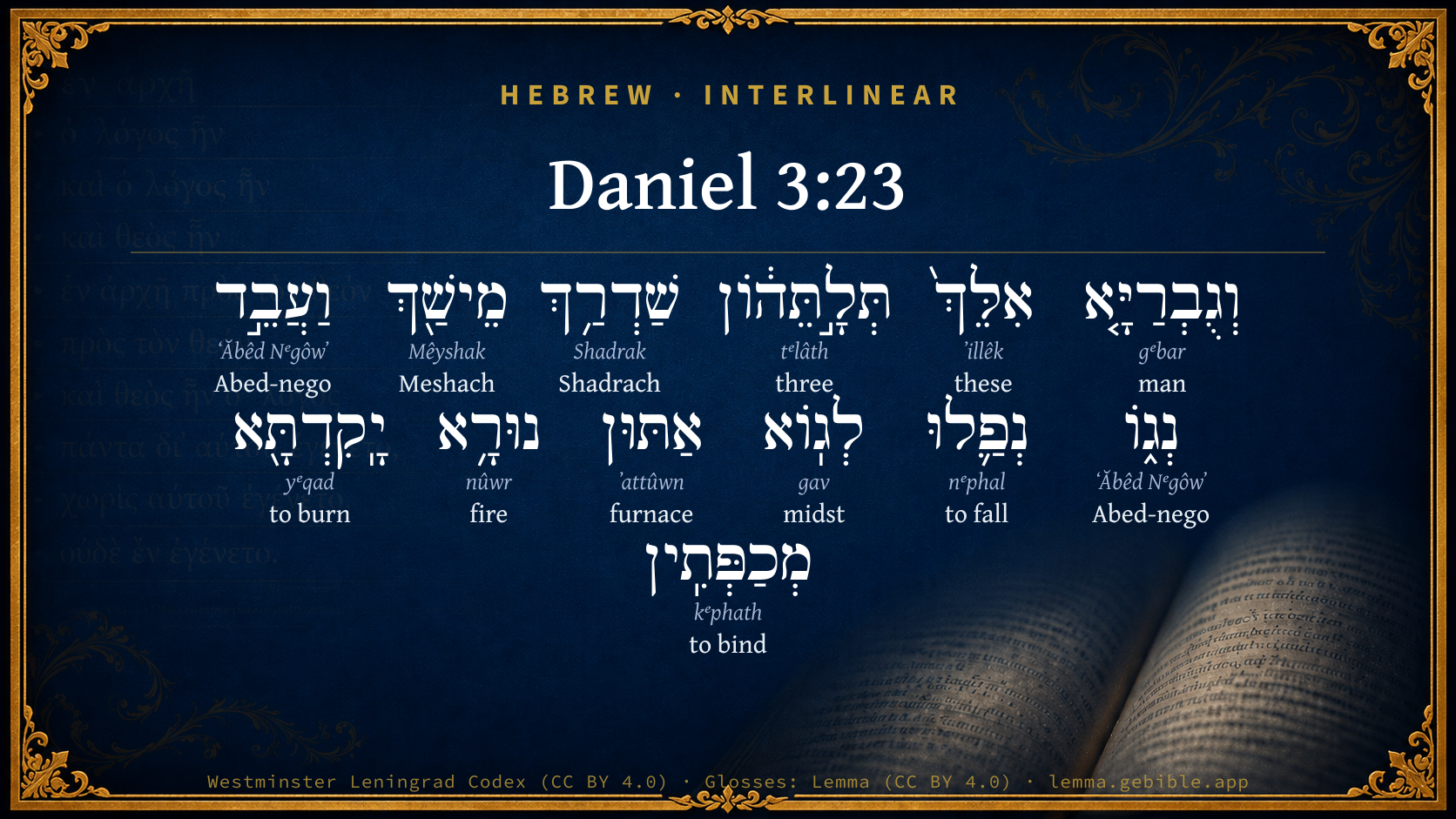
Hebrew (Westminster Leningrad Codex) Daniel 3:23 appears in the Hebrew Old Testament. The text above is from the Westminster Leningrad Codex. Each word links to its Strong’s number, a concise gloss, and parsing drawn from the Open Scriptures Hebrew Bible morphology. Click any word for its full Brown-Driver-Briggs (BDB) entry.
Download image
Cite this verse

Daniel 3:23 (World English Bible). Public Domain. Lemma interlinear Bible study tool, https://lemma.gebible.app/v/daniel/3/23.

Show BibTeX & RIS
BibTeX
RIS
English Translation
These three men, Shadrach, Meshach, and Abednego, fell down bound into the midst of the burning fiery furnace.
World English Bible · Public Domain
Download a study sheet

One document with this verse’s original text, its word-by-word gloss line, the meaning frame, cross-references with their text, attributed commentary, and full source and license credits — printable, and it pastes into notes with its structure intact.

This verse Autodidact and up

Study sheet (.html) Plain text (.txt)

A passage Seminary Student

Up to 50 verses in one chapter. A passage sheet keeps up to 6 commentary sources and 12 cross-references per verse, in the order this page ranks them, and says so on the sheet whenever that leaves anything out. Ask for a single verse and you get the Autodidact verse sheet above.

Everything on this page stays free to read, with no account — the sheet is a download of what is already on screen, not access to it.

Want to remove ads? Support Godless Engineer
Compare translations 3

The same verse in 3 English versions, stacked beneath the original-language interlinear above. Click any original word for its lexicon entry.

Each is an independent rendering of the whole verse — the interlinear is not word-aligned to these translations.

Highlighted words mark where these versions differ — a whole-verse word diff, not a word-by-word alignment.

  • World English Bible Public Domain
    These three men, Shadrach, Meshach, and Abednego, fell down bound into the midst of the burning fiery furnace.
  • King James Version Public Domain
    And these three men, Shadrach, Meshach, and Abednego, fell down bound into the midst of the burning fiery furnace.
  • unfoldingWord Literal Text CC BY-SA 4.0
    But these three men, Shadrach, Meshach, and Abednego, fell bound into the midst of the furnace of blazing fire.

unfoldingWord Literal Text — © unfoldingWord, licensed CC BY-SA 4.0. Word-aligned USFM3 via Door43 (git.door43.org/unfoldingWord/en_ult).

Versions to compare (up to 4)

3 of 4 selected

Show all 18 translations

Every available English version of this verse, each an independent rendering of the whole verse.

  • World English Bible Public Domain
    These three men, Shadrach, Meshach, and Abednego, fell down bound into the midst of the burning fiery furnace.
  • Berean Standard Bible Public Domain
    And these three men, Shadrach, Meshach, and Abednego, firmly bound, fell into the blazing fiery furnace.
  • Majority Standard Bible Public Domain
    And these three men, Shadrach, Meshach, and Abednego, firmly bound, fell into the blazing fiery furnace.
  • King James Version Public Domain
    And these three men, Shadrach, Meshach, and Abednego, fell down bound into the midst of the burning fiery furnace.
  • American Standard Version (1901) Public Domain
    And these three men, Shadrach, Meshach, and Abed-nego, fell down bound into the midst of the burning fiery furnace.
  • Revised Version (1885) Public Domain
    And these three men, Shadrach, Meshach, and Abed-nego, fell down bound into the midst of the burning fiery furnace.
  • Geneva Bible (1599) Public Domain
    And these three men Shadrach, Meshach and Abednego fell downe bound into the middes of the hote fierie fornace.
  • Douay-Rheims (1899) Public Domain
    But these three men, that is, Sidrach, Misach, and Abdenago, fell down bound in the midst of the furnace of burning fire.
  • Young's Literal Translation Public Domain
    And these three men, Shadrach, Meshach, and Abed-Nego, have fallen down in the midst of the burning fiery furnace -- bound.
  • Literal Standard Version CC BY-SA 4.0
    And these three men, Shadrach, Meshach, and Abed-Nego, have fallen down in the midst of the burning fiery furnace—bound.
  • Unlocked Literal Bible CC BY-SA 4.0
    These three men, Shadrach, Meshach, and Abednego, fell into the blazing furnace while they were tied up.
  • unfoldingWord Literal Text CC BY-SA 4.0
    But these three men, Shadrach, Meshach, and Abednego, fell bound into the midst of the furnace of blazing fire.
  • Darby Bible Public Domain
    And these three men, Shadrach, Meshach, and Abed-nego, fell down bound into the midst of the burning fiery furnace.
  • World Messianic Bible Public Domain
    These three men, Shadrach, Meshach, and Abednego, fell down bound into the middle of the burning fiery furnace.
  • Webster's Bible Public Domain
    And these three men, Shadrach, Meshach, and Abed-nego, fell down bound into the midst of the burning fiery furnace.
  • Free Bible Version CC BY-SA 4.0
    Shadrach, Meshach, and Abednego, still tied up, fell into the furnace of blazing fire.
  • Bible in Basic English Public Domain
    And these three men, Shadrach, Meshach, and Abed-nego, with the cords about them, went down into the burning and flaming fire.
  • JPS Tanakh (1917) Public Domain
    And these three men, Shadrach, Meshach, and Abed-nego, fell down bound into the midst of the burning fiery furnace.

Literal Standard Version (2020), Covenant Press — licensed CC BY-SA 4.0. Text via the HelloAO Bible API (eBible.org). Unlocked Literal Bible (unfoldingWord) — licensed CC BY-SA 4.0. Text via the HelloAO Bible API (eBible.org). unfoldingWord Literal Text — © unfoldingWord, licensed CC BY-SA 4.0. Word-aligned USFM3 via Door43 (git.door43.org/unfoldingWord/en_ult). Free Bible Version, Dr. Jonathan Gallagher — licensed CC BY-SA 4.0. Text via the HelloAO Bible API (eBible.org).

Word by word

More ways to search: Search by grammar → Find every occurrence → Compare this word →

Practice this passage: Drill this verse → Learn its vocabulary →

מְכַפְּתִֽין
kᵉphath
H3729
“bound”
Adjective, V, Singular
Part of Speech
Adjective
Number
Singular
Full BDB Definition

Origin: a root of uncertain correspondence

TWOT: 2798

to bind - (Peil) to be bound - (Pael) to bind
  1. וְגֻבְרַיָּ֤א gᵉbar H1400 “and · men · the” Adjective, C + Noun, Common, Masculine, Plural, Determined + Particle, Definite Article
  2. אִלֵּךְ֙ ʼillêk H479 “these” Adjective, P, Construct
  3. תְּלָ֣תֵּה֔וֹן tᵉlâth H8532 “three · their” Adjective, A, Common + Suffix, Personal, 3rd Person, Masculine, Plural
  4. שַׁדְרַ֥ךְ Shadrak H7715 “Shadrach” Adjective, N
  5. מֵישַׁ֖ךְ Mêyshak H4336 “Meshach” Adjective, N
  6. וַעֲבֵ֣ד ʻĂbêd Nᵉgôwʼ H5665 “and · Abed-nego” Adjective, C + Noun, Proper
  7. נְג֑וֹ ʻĂbêd Nᵉgôwʼ H5665 “Abed-nego” Adjective, N
  8. נְפַ֛לוּ nᵉphal H5308 “to fall” Adjective, V, Plural
  9. לְגֽוֹא gav H1459 “to/for · midst of” Adjective, R + Noun, Common, Masculine, Singular, Construct
  10. אַתּוּן ʼattûwn H861 “furnace of” Adjective, N, Common
  11. נוּרָ֥א nûwr H5135 “fire · the” Adjective, N, Common + Particle, Definite Article
  12. יָֽקִדְתָּ֖א yᵉqad H3345 “burning · the” Adjective, V + Particle, Definite Article

About this verse

These counts appear in no published source. They are computed here, from the morphology-tagged text and Lemma’s own curated glosses. What Lemma adds →

13
words
12
distinct lemmas
Prophets
section

Notable vocabulary

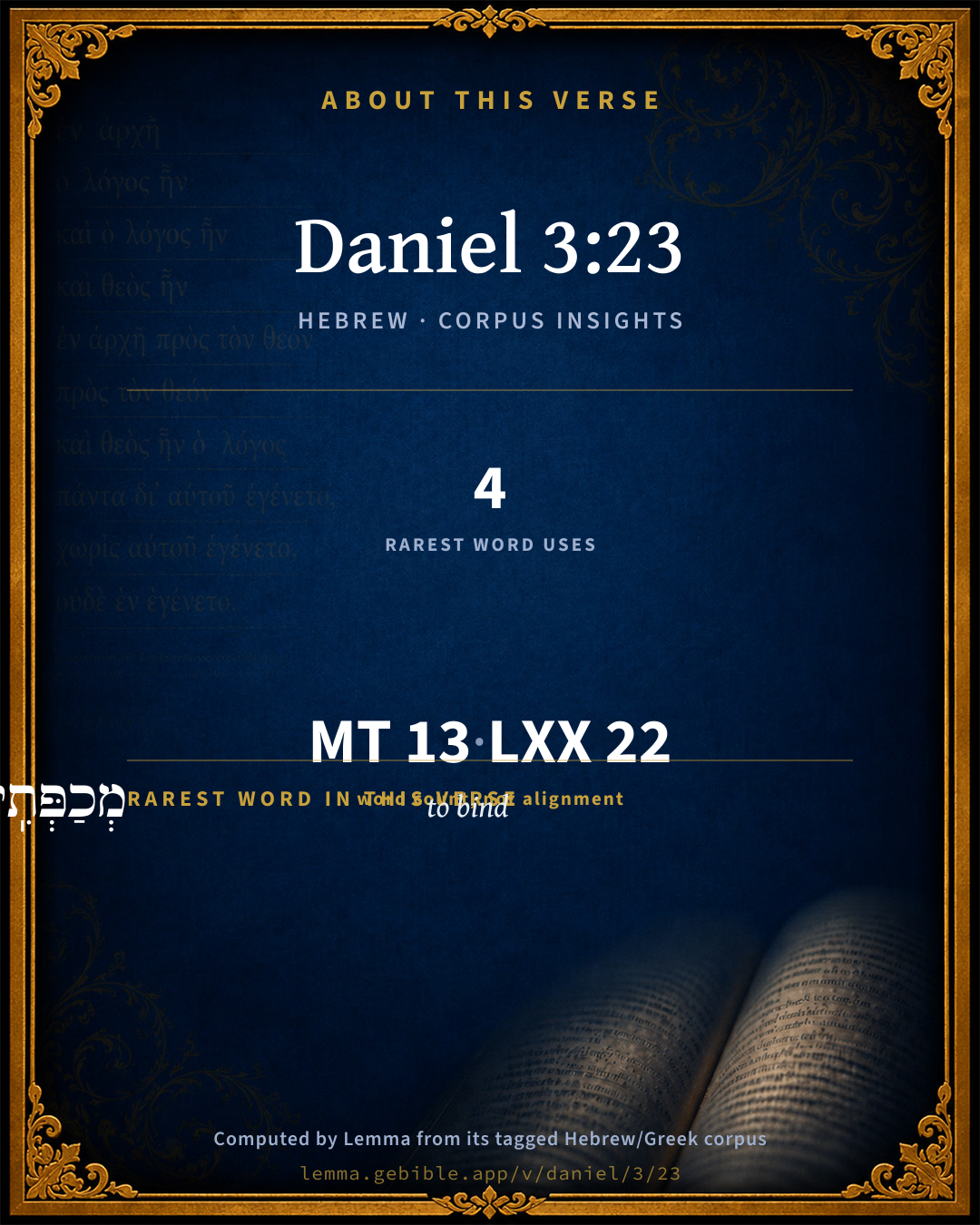
The rarest word here is מְכַפְּתִֽין to bind H3729 — appearing just 4 times in the whole Hebrew Bible.

Shared distinctive vocabulary

מְכַפְּתִֽין to bind H3729 occurs in 4 verses of the Hebrew Bible. Also found in:

Grammatical profile

  • 2 nouns
  • 8 adjectives
  • 3 particles

Repetition

A word recurs within this verse — often emphatic in Hebrew:

  • וַעֲבֵ֣ד Abed-nego H5665 ×2

Hebrew & Septuagint length

In English translation the verse runs 18 words from the Hebrew and 33 from the Septuagint (LXX English) — the Septuagint runs noticeably longer here. See the side-by-side →

A rough comparison of the two English renderings, which tokenize alike — not a word-level alignment.

Word counts can differ between the Hebrew and the Greek without any difference in meaning — e.g. the Hebrew direct-object marker אֵת has no separate Greek word, and Greek often adds the article ὁ.

In the original languages it is 13 Hebrew tokens and 22 Greek tokens — but the two are counted differently (Hebrew bundles its prefixes and suffixes into one token; the Greek is in lemma form), so that isn’t a like-for-like length.

Cross-references

9

Topical passages linked to Daniel 3:23 in the Treasury of Scripture Knowledge — connected by theme and wording, ordered by reader-vote popularity; previews shown in the World English Bible.

  • Jeremiah 38:6 Then took they Jeremiah, and cast him into the dungeon of Malchijah the king's son, that was in the court of the guard: and they let down Jeremiah with cords. In the dungeon there was no water, but mire; and Jeremiah sank in the mire.
  • Daniel 6:16–17 Then the king commanded, and they brought Daniel, and cast him into the den of lions. [Now] the king spoke and said to Daniel, Your God whom you serve continually, he will deliver you.
  • Psalms 34:19 Many are the afflictions of the righteous, But Yahweh delivers him out of them all.
  • Psalms 66:11–12 You brought us into prison. You laid a burden on our backs.
  • Psalms 124:1–5 If it had not been Yahweh who was on our side, Let Israel now say,
  • Lamentations 3:52–54 They have chased me sore like a bird, those who are my enemies without cause.
  • 2 Corinthians 1:8–10 For we don't desire to have you uninformed, brothers, concerning our affliction which happened to us in Asia, that we were weighed down exceedingly, beyond our power, so much that we despaired even of life.
  • 2 Corinthians 4:17 For our light affliction, which is for the moment, works for us more and more exceedingly an eternal weight of glory;
  • 1 Peter 4:12–13 Beloved, don't be astonished at the fiery trial which has come upon you, to test you, as though a strange thing happened to you.

Cross-references courtesy of OpenBible.info (CC BY 4.0).

Hebrew and Greek witnesses Masoretic Hebrew ↔ Greek Septuagint

The same verse in the two great witnesses to the Old Testament, shown verse-for-verse.

Here the Septuagint runs noticeably longer than the Hebrew — LXX2012 (modern English Septuagint) 33 words vs World English Bible 18. A rough length comparison of the two English translations, not a word-level alignment — read both below.

These are two independent witnesses, not word-aligned to each other, and the Septuagint is shown in lemma (dictionary) form.

Hebrew Daniel 3:23 Masoretic · Westminster Leningrad Codex

וְגֻבְרַיָּ֤א אִלֵּךְ֙ תְּלָ֣תֵּה֔וֹן שַׁדְרַ֥ךְ מֵישַׁ֖ךְ וַעֲבֵ֣ד נְג֑וֹ נְפַ֛לוּ לְגֽוֹא אַתּוּן נוּרָ֥א יָֽקִדְתָּ֖א מְכַפְּתִֽין

These three men, Shadrach, Meshach, and Abednego, fell down bound into the midst of the burning fiery furnace.

World English Bible · Public Domain

Greek LXX Daniel 3:23 Septuagint · lemma form

ὁ μέν οὖν ἀνήρ ὁ συνποδίζω ὁ περί ὁ αζαριας ἐκἔρχομαι ὁ φλόξ ἐκ ὁ κάμινος ἐνπυρίζω καί ἀποκτείνω αὐτός δέ συντηρέω

Then these three men, Sedrach, Misach, and Abdenago, fell bound into the midst of the burning furnace, and walked in the midst of the flame, singing praise to God, and blessing the Lord.

LXX2012 (modern English Septuagint) · Public Domain

On this verse, Jamieson, Fausset & Brown discusses the Septuagint’s reading. Read the note in Commentary ↓

Hebrew: Westminster Leningrad Codex (CC BY 4.0). Greek: Septuagint (public domain); English from LXX2012 (modern English Septuagint) (Public Domain). How the Septuagint differs from the Hebrew →

Commentary

Notes on Daniel 3:23 from classic Christian and Jewish commentators (each source and its license shown beneath its notes). The classic Christian expositions comment on the surrounding passage and are grouped to its opening verse, so a note may address several verses; the Jewish commentaries on the Tanakh (Rashi and others) are per-verse, so they appear only where the commentator wrote on this verse.

Lemma curates 59 commentaries, every one of them public domain or Creative Commons licensed, each selected and text-cleaned for this edition rather than reprinted as found. About our sources →

Trapp's Complete Commentary

John Trapp

Dan 3:23 And these three men, Shadrach, Meshach, and Abednego, fell down bound into the midst of the burning fiery furnace.

Ver. 23. And these three men … fell down bound.] Their binders were burnt, but not their bonds so soon, lest the glory of the miracle should have been thereby defaced.

Into the midst of the burning fiery furnace.] Where yet these holy salamanders took no hurt. In the creatures there is an essence and a faculty whereby the work, as in fire is the substance and the quality of heat: between these God can separate, and so hinder their working, as here he did. Quisque sollicitus sit non tam de vita quam de vocatione, &c.

John Trapp, A Commentary or Exposition upon All the Books of the Old and New Testament (1647–1656) — public domain. Text from a community e-Sword module.

Tyndale Open Study Notes

Tyndale Open Resources

3:23 In the Greek version and the Latin Vulgate, The Prayer of Azariah and The Song of the Three Jews are inserted after 3:23 (see Daniel Book Introduction, “Author and Date”).

Tyndale Open Study Notes — © Tyndale Open Resources, licensed CC BY-SA 4.0. Text via the HelloAO Bible API.

Jamieson, Fausset & Brown

Robert Jamieson, A. R. Fausset & David Brown

fell down--not cast down; for those who brought the three youths to the furnace, perished by the flames themselves, and so could not cast them in. Here follows an addition in the Septuagint, Syrian, Arabic, and Vulgate versions. "The Prayer of Azarias," and "The Song of the Three Holy Children." It is not in the Chaldee. The hymn was sung throughout the whole Church in their liturgies, from the earliest times [RUFINUS in Commentary on the Apostles Creed, and ATHANASIUS]. The "astonishment" of Nebuchadnezzar in Dan 3:24 is made an argument for its genuineness, as if it explained the cause of his astonishment, namely, "they walked in the midst of the fire praising God, but the angel of the Lord came down into the oven" (vs. 1 and vs. 27 of the Apocryphal addition). But Dan 3:25 of English Version explains his astonishment, without need of any addition.

Jamieson, Fausset & Brown — Commentary Critical and Explanatory on the Whole Bible (1871) — public domain (CC PDM 1.0). Text via the HelloAO Bible API.

Adam Clarke's Commentary

Verse 23. And these three men - fell down bound] There is a most evident want of connexion between this and the following verse; and it is between these verses that the apocryphal Song of the Three Children, as it is called, has been inserted by St. Jerome and others; but with this note: Quae sequuntur in Hebraeis voluminibus non reperi; "What follows I have not found in the Hebrew books." And then begins, "They walked in the midst of the flame, praising God, and blessing the Lord." The Septuagint and Arabic read the twenty-fourth verse thus: "Then Nebuchadnezzar heard them singing praise, and was astonished." To connect the two verses Houbigant adds two verses found in the Vulgate, which are the forty-ninth and the twenty-third: "But an angel of the Lord went down with Azariah and his companions into the furnace, and drove out the flame of fire from the furnace; and they walked in the midst of the furnace." This verse (the forty-ninth) has been added to show the reason of Nebuchadnezzar's astonishment, and also to account for the appearance of a fourth person in the furnace, as in Da 3:25.

Adam Clarke's Commentary on the Bible (1810–1826) — public domain. Text from a community e-Sword/MySword module.

John Gill's Exposition

And these three men fell down bound into the midst of the burning fiery furnace. The fire not so much as destroying what they were bound with, and much less them; but being bound they fell, and there they lay for the present, unbound and alive; when those that cast them in were destroyed. In the Septuagint, Vulgate Latin, Syriac, and Arabic versions, follow sixty seven verses, containing the song of Azariah and his companions in the furnace, which are not in the Hebrew text.

And these three men fell down bound into the midst of the burning fiery furnace. The fire not so much as destroying what they were bound with, and much less them; but being bound they fell, and there they lay for the present, unbound and alive; when those that cast them in were destroyed. In the Septuagint, Vulgate Latin, Syriac, and Arabic versions, follow sixty seven verses, containing the song of Azariah and his companions in the furnace, which are not in the Hebrew text.

Daniel 3:24

dan 3:24

dan 3:24

dan 3:24Then Nebuchadnezzar was astonished, At the burning of those that cast the three men into the furnace, as Jacchiades; or he might be seized with a panic, and his spirits filled with fear and dread, the word (u) is by some said to signify, and this from the immediate hand of God:

and rose up in haste; from the place where he was, and went to the mouth of the furnace, to see what was become of those that were cast into it:

and spake and said unto his counsellors; who had advised him to do what he had done, out of envy and ill will to these Jews:

did not we cast three men bound into the midst of the fire? that is, was there not an order of council for it? and was it not done according to it?

they answered and said, true, O King; it was certainly so: thus they are brought to bear a testimony to the truth of this; it was not only the king that gave the orders, and saw them obeyed, but his counsellors also; and which they own, and serves to corroborate the truth of the miracle.

(u) "expavit", Munster, Piscator, Michaelis; "trepidavit", Gejerus; so Ben Melech from the Targum on Gen. xxvii. 33; "trepidus", Junius & Tremellius.

John Gill's Exposition of the Whole Bible (1746–1763) — public domain (CC PDM 1.0). Text via the HelloAO Bible API.

Albert Barnes' Notes on the Bible

And these three men - fell down bound ... - That is, the flame did not loosen the cords by which they had been fastened. The fact that they were seen to fall into the furnace “bound,” made the miracle the more remarkable that they should be seen walking loose in the midst of the fire.

In the Septuagint, Syriac, Arabic, and Latin Vulgate, there follow in this place sixty-eight verses, containing “The Song of the Three Holy Children.” This is not in the Chaldee, and its origin is unknown. It is with entire propriety placed in the Apocrypha, as being no part of the inspired canon. With some things that are improbable and absurd, the “song” contains many things that are beautiful, and that would be highly appropriate if a song had been uttered at all in the furnace.

Albert Barnes' Notes on the Bible (1834–1885) — public domain. Text from a community e-Sword/MySword module.

Matthew Poole's English Annotations

All this is expressed with emphasis, to make the power of God more glorious in their preservation; for that flame that slew the executioners might much more easily have suffocated the three children before they fell down.

Matthew Poole's English Annotations on the Holy Bible (1683–1685) — public domain. Text from a community e-Sword/MySword module.

John Wesley's Explanatory Notes

Fell down - All this is exprest with emphasis, to make the power of God more glorious in their preservation; for that shame that slew the executioners, might much more easily have killed them, even before they fell down.

John Wesley, Explanatory Notes Upon the Whole Bible (1754–1765) — public domain. Text via the GEBible commentary corpus.

Rashi

Rabbi Shlomo Yitzchaki (Rashi)

bound [as translated,] bound.

Rashi on the Tanakh — English translations: “The Judaica Press complete Tanach with Rashi, translated by A. J. Rosenberg” (CC BY 4.0); “Pentateuch with Rashi's commentary by M. Rosenbaum and A.M. Silbermann, 1929-1934” (public domain); “The Metsudah Tanach series, Lakewood, N.J” (CC BY 4.0); and “The Book of Joshua, Metsudah Publications, 1997” (CC BY 4.0). Text via Sefaria.

Lesson kit

Teaching starters — assembled from the data on this page, not authored interpretation. Every prompt links to the verse data it draws on. Edit before teaching.

Daniel, in the Prophets, opens this verse with 13 words (12 distinct Hebrew lemmas). Its most distinctive word is kᵉphath (“to bind”). The Greek Septuagint runs longer here. A historical commentator’s framing appears above. Read the whole chapter for the surrounding context.

Discussion questions

  1. How does “to bind” (kᵉphath) shape what this verse is saying?
  2. How does Daniel 3:20, which shares the word «to bind», read alongside this verse?
  3. What does the repetition of “Abed-nego” (2× in this one verse) do in this verse?
  4. The Septuagint runs longer here than the Hebrew. What might account for the difference?
  5. The translations on this page render this verse differently — a whole-verse word diff, not a word-by-word alignment. What might account for the different wordings?
  6. Compare how Trapp's Complete Commentary and Tyndale Open Study Notes read this verse. Where do they agree or differ?

Things to notice

Reading settings

Reading text

Shown beneath each verse's original-language words.

Old Testament
Old Testament edition

Read the OT as the Masoretic Hebrew (MT) or the Greek Septuagint (LXX).

English shown for the Greek Septuagint (in the Hebrew ↔ Greek comparison).

Comparing translations? Open the Compare panel on any verse page to stack up to four side by side.