
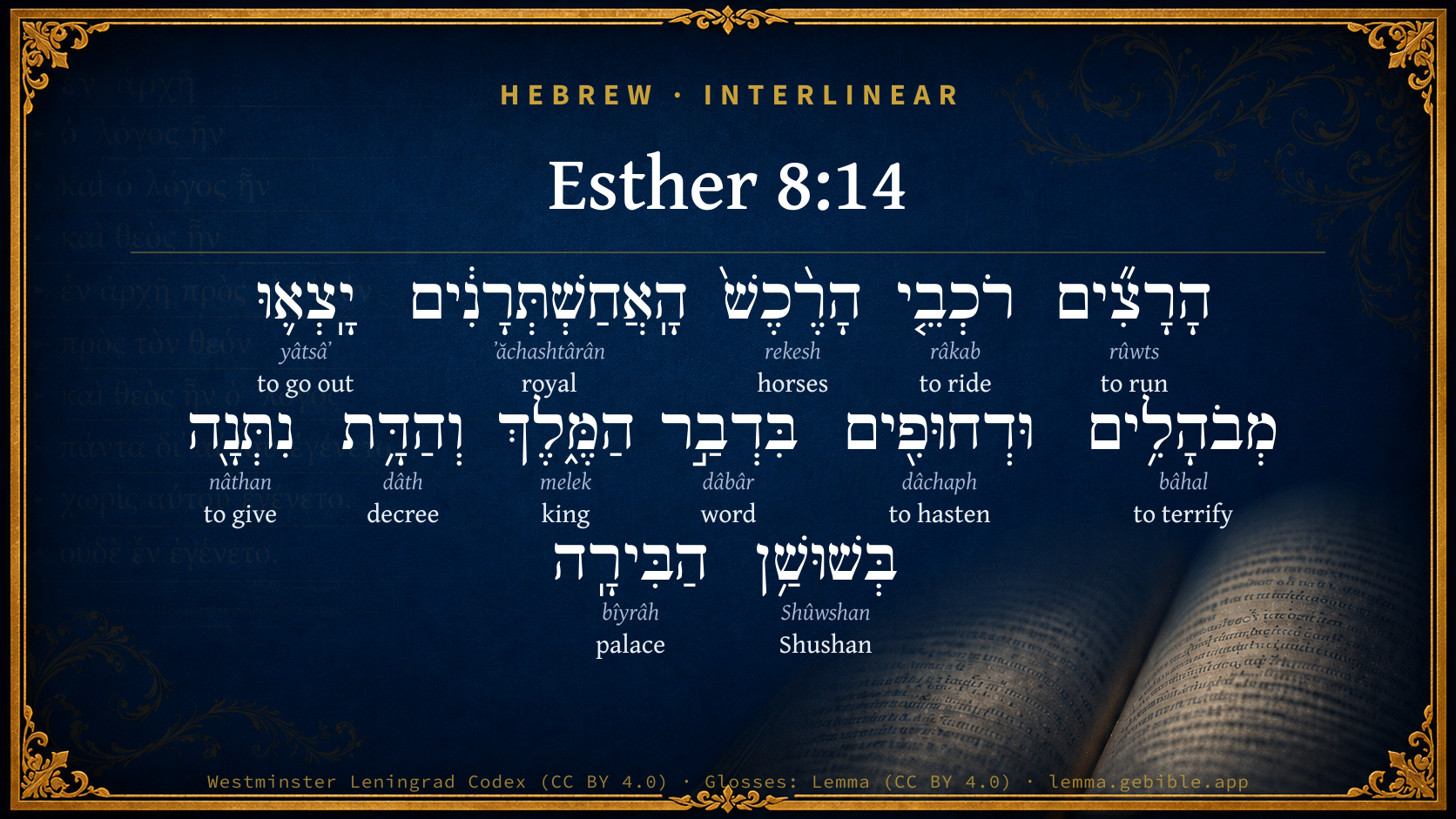
Esther 8:14

Hebrew (Westminster Leningrad Codex) Esther 8:14 appears in the Hebrew Old Testament. The text above is from the Westminster Leningrad Codex. Each word links to its Strong’s number, a concise gloss, and parsing drawn from the Open Scriptures Hebrew Bible morphology. Click any word for its full Brown-Driver-Briggs (BDB) entry.
Download image
Cite this verse

Esther 8:14 (World English Bible). Public Domain. Lemma interlinear Bible study tool, https://lemma.gebible.app/v/esther/8/14.

Show BibTeX & RIS
BibTeX
RIS
English Translation
So the posts who rode on swift steeds that were used in the king's service went out, being hurried and pressed on by the king's commandment; and the decree was given out in Shushan the palace.
World English Bible · Public Domain
Download a study sheet

One document with this verse’s original text, its word-by-word gloss line, the meaning frame, cross-references with their text, attributed commentary, and full source and license credits — printable, and it pastes into notes with its structure intact.

This verse Autodidact and up

Study sheet (.html) Plain text (.txt)

A passage Seminary Student

Up to 50 verses in one chapter. A passage sheet keeps up to 6 commentary sources and 12 cross-references per verse, in the order this page ranks them, and says so on the sheet whenever that leaves anything out. Ask for a single verse and you get the Autodidact verse sheet above.

Everything on this page stays free to read, with no account — the sheet is a download of what is already on screen, not access to it.

Want to remove ads? Support Godless Engineer
Compare translations 3

The same verse in 3 English versions, stacked beneath the original-language interlinear above. Click any original word for its lexicon entry.

Each is an independent rendering of the whole verse — the interlinear is not word-aligned to these translations.

Highlighted words mark where these versions differ — a whole-verse word diff, not a word-by-word alignment.

  • World English Bible Public Domain
    So the posts who rode on swift steeds that were used in the king's service went out, being hurried and pressed on by the king's commandment; and the decree was given out in Shushan the palace.
  • King James Version Public Domain
    So the posts that rode upon mules and camels went out, being hastened and pressed on by the king's commandment. And the decree was given at Shushan the palace.
  • unfoldingWord Literal Text CC BY-SA 4.0
    The runners, the riders of the royal pack horses, went out hastened and hurried by the word of the king. And the law was given in Susa the citadel.

unfoldingWord Literal Text — © unfoldingWord, licensed CC BY-SA 4.0. Word-aligned USFM3 via Door43 (git.door43.org/unfoldingWord/en_ult).

Versions to compare (up to 4)

3 of 4 selected

Show all 18 translations

Every available English version of this verse, each an independent rendering of the whole verse.

  • World English Bible Public Domain
    So the posts who rode on swift steeds that were used in the king's service went out, being hurried and pressed on by the king's commandment; and the decree was given out in Shushan the palace.
  • Berean Standard Bible Public Domain
    The couriers rode out in haste on their royal horses, pressed on by the command of the king. And the edict was also issued in the citadel of Susa.
  • Majority Standard Bible Public Domain
    The couriers rode out in haste on their royal horses, pressed on by the command of the king. And the edict was also issued in the citadel of Susa.
  • King James Version Public Domain
    So the posts that rode upon mules and camels went out, being hastened and pressed on by the king's commandment. And the decree was given at Shushan the palace.
  • American Standard Version (1901) Public Domain
    So the posts that rode upon swift steeds that were used in the king's service went out, being hastened and pressed on by the king's commandment; and the decree was given out in Shushan the palace.
  • Revised Version (1885) Public Domain
    So the posts that rode upon swift steeds that were used in the king’s service went out, being hastened and pressed on by the king’s commandment; and the decree was given out in Shushan the palace.
  • Geneva Bible (1599) Public Domain
    So the postes rode vpon beasts of price, and dromedaries, and went forth with speede, to execute the Kings commandement, and the decree was giuen at Shushan the palace.
  • Douay-Rheims (1899) Public Domain
    So the swift posts went out carrying the messages, and the king's edict was hung up in Susan.
  • Young's Literal Translation Public Domain
    The runners, riding on the dromedary, `and' the mules, have gone out, hastened and pressed by the word of the king, and the law hath been given in Shushan the palace.
  • Literal Standard Version CC BY-SA 4.0
    The runners, riding on the dromedary, [and] the mules, have gone out, hurried and pressed by the word of the king, and the law has been given in Shushan the palace.
  • Unlocked Literal Bible CC BY-SA 4.0
    So the couriers rode on the royal horses that were used in the king's service. They went without delay. The king's decree was also issued from the palace in Susa.
  • unfoldingWord Literal Text CC BY-SA 4.0
    The runners, the riders of the royal pack horses, went out hastened and hurried by the word of the king. And the law was given in Susa the citadel.
  • Darby Bible Public Domain
    The couriers mounted on coursers [and] horses of blood went out, being hastened and pressed on by the king's commandment. And the decree was given at Shushan the fortress.
  • World Messianic Bible Public Domain
    So the couriers who rode on royal horses went out, hastened and pressed on by the king’s commandment. The decree was given out in the citadel of Susa.
  • Webster's Bible Public Domain
    So the posts that rode upon mules and camels went out, being hastened and pressed on by the king's commandment. And the decree was given at Shushan the palace.
  • Free Bible Version CC BY-SA 4.0
    By order of the king, the messengers riding the king's relay horses rushed out, hurrying on their way. The decree was also issued in the fortress of Susa.
  • Bible in Basic English Public Domain
    So the men went out on the quick-running horses used on the king's business, wasting no time and forced on by the king's order; and the order was given out in Shushan, the king's town.
  • JPS Tanakh (1917) Public Domain
    So the posts that rode upon swift steeds that were used in the king's service went out, being hastened and pressed on by the king's commandment; and the decree was given out in Shushan the castle.

Literal Standard Version (2020), Covenant Press — licensed CC BY-SA 4.0. Text via the HelloAO Bible API (eBible.org). Unlocked Literal Bible (unfoldingWord) — licensed CC BY-SA 4.0. Text via the HelloAO Bible API (eBible.org). unfoldingWord Literal Text — © unfoldingWord, licensed CC BY-SA 4.0. Word-aligned USFM3 via Door43 (git.door43.org/unfoldingWord/en_ult). Free Bible Version, Dr. Jonathan Gallagher — licensed CC BY-SA 4.0. Text via the HelloAO Bible API (eBible.org).

Word by word

More ways to search: Search by grammar → Find every occurrence → Compare this word →

Practice this passage: Drill this verse → Learn its vocabulary →

הָֽאֲחַשְׁתְּרָנִ֔ים
ʼăchashtârân
H327
“the · royal”
Particle, Definite Article + Adjective, Adjective, Masculine, Plural, Absolute
Part of Speech
Particle + Adjective
Type
Adjective
Gender
Masculine
Number
Plural
State
Absolute
Full BDB Definition

Origin: of Persian origin

TWOT: 70

royal (steeds)
  1. הָרָצִ֞ים rûwts H7323 “the · running” Particle, Definite Article + Verb, Qal, Participle Active, Masculine, Plural, Absolute
  2. רֹכְבֵ֤י râkab H7392 “riding” Verb, Qal, Participle Active, Masculine, Plural, Construct
  3. הָרֶ֨כֶשׁ֙ rekesh H7409 “the · horses” Particle, Definite Article + Noun, Common, Masculine, Singular, Absolute
  4. יָֽצְא֛וּ yâtsâʼ H3318 “to go out” Verb, Qal, Perfect, 3rd Person, Common, Plural
  5. מְבֹהָלִ֥ים bâhal H926 “terrified” Verb, Pual, Participle Passive, Masculine, Plural, Absolute
  6. וּדְחוּפִ֖ים dâchaph H1765 “and · hastened” Conjunction + Verb, Qal, Participle Passive, Masculine, Plural, Absolute
  7. בִּדְבַ֣ר dâbâr H1697 “in/at · word of” Preposition + Noun, Common, Masculine, Singular, Construct
  8. הַמֶּ֑לֶךְ melek H4428 “the · king” Particle, Definite Article + Noun, Common, Masculine, Singular, Absolute
  9. וְהַדָּ֥ת dâth H1881 “and · the · decree” Conjunction + Particle, Definite Article + Noun, Common, Feminine, Singular, Absolute
  10. נִתְּנָ֖ה nâthan H5414 “to give” Verb, Niphal, Perfect, 3rd Person, Feminine, Singular
  11. בְּשׁוּשַׁ֥ן Shûwshan H7800 “in/at · Shushan” Preposition + Noun, Proper
  12. הַבִּירָֽה bîyrâh H1002 “the · palace” Particle, Definite Article + Noun, Common, Feminine, Singular, Absolute

About this verse

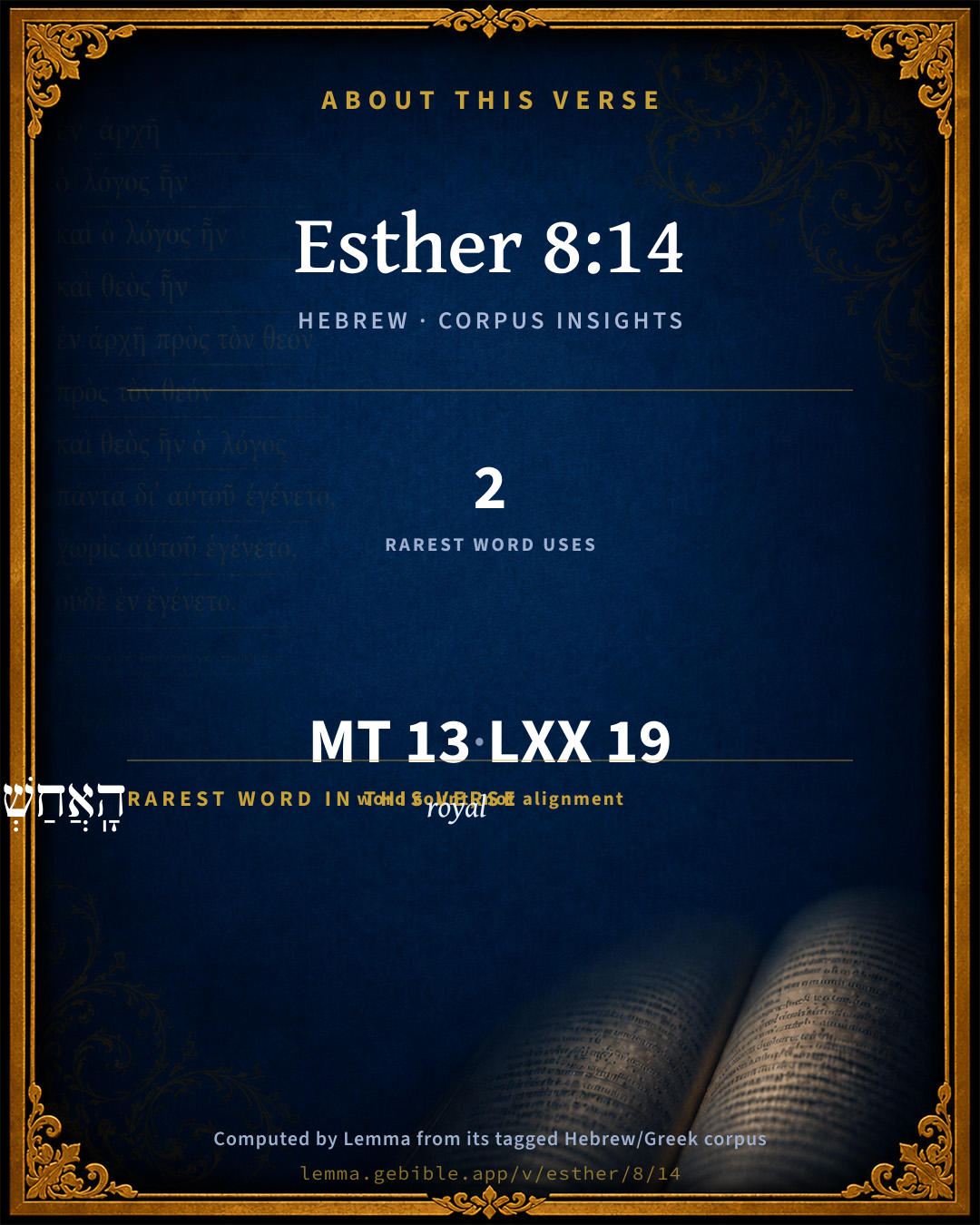
These counts appear in no published source. They are computed here, from the morphology-tagged text and Lemma’s own curated glosses. What Lemma adds →

13
words
13
distinct lemmas
Historical
section

Notable vocabulary

The rarest word here is הָֽאֲחַשְׁתְּרָנִ֔ים royal H327 — appearing just 2 times in the whole Hebrew Bible.

Shared distinctive vocabulary

הָֽאֲחַשְׁתְּרָנִ֔ים royal H327 occurs in 2 verses of the Hebrew Bible. Also found in:

Grammatical profile

  • 6 verbs
  • 6 nouns
  • 1 adjective

Verb forms

  • הָרָצִ֞ים Qal · Participle Active
  • רֹכְבֵ֤י Qal · Participle Active
  • יָֽצְא֛וּ Qal · Perfect
  • מְבֹהָלִ֥ים Pual · Participle Passive
  • וּדְחוּפִ֖ים Qal · Participle Passive
  • נִתְּנָ֖ה Niphal · Perfect

Hebrew & Septuagint length

In English translation the verse runs 36 words from the Hebrew and 20 from the Septuagint (LXX English) — the Septuagint runs noticeably shorter here. See the side-by-side →

A rough comparison of the two English renderings, which tokenize alike — not a word-level alignment.

Word counts can differ between the Hebrew and the Greek without any difference in meaning — e.g. the Hebrew direct-object marker אֵת has no separate Greek word, and Greek often adds the article ὁ.

In the original languages it is 13 Hebrew tokens and 19 Greek tokens — but the two are counted differently (Hebrew bundles its prefixes and suffixes into one token; the Greek is in lemma form), so that isn’t a like-for-like length.

Cross-references

7

Topical passages linked to Esther 8:14 in the Treasury of Scripture Knowledge — connected by theme and wording, ordered by reader-vote popularity; previews shown in the World English Bible.

  • Esther 3:15 The posts went forth in haste by the king's commandment, and the decree was given out in Shushan the palace. The king and Haman sat down to drink; but the city of Shushan was perplexed.
  • Daniel 8:2 I saw in the vision; now it was so, that when I saw, I was in Shushan the palace, which is in the province of Elam; and I saw in the vision, and I was by the river Ulai.
  • Esther 2:3 and let the king appoint officers in all the provinces of his kingdom, that they may gather together all the beautiful young virgins to Shushan the palace, to the house of the women, to the custody of Hegai the king's chamberlain, keeper of the women; and let their things for purification be given them;
  • Ecclesiastes 9:10 Whatever your hand finds to do, do it with your might; for there is no work, nor device, nor knowledge, nor wisdom, in Sheol, where you are going.
  • 1 Samuel 21:8 David said to Ahimelech, Isn't there here under your hand spear or sword? for I have neither brought my sword nor my weapons with me, because the king's business required haste.
  • Nehemiah 1:1 The words of Nehemiah the son of Hacaliah. Now it happened in the month Chislev, in the twentieth year, as I was in Shushan the palace,
  • Esther 1:2 that in those days, when the king Ahasuerus sat on the throne of his kingdom, which was in Shushan the palace,

Cross-references courtesy of OpenBible.info (CC BY 4.0).

Hebrew and Greek witnesses Masoretic Hebrew ↔ Greek Septuagint

The same verse in the two great witnesses to the Old Testament, shown verse-for-verse.

Here the Septuagint runs noticeably shorter than the Hebrew — LXX2012 (modern English Septuagint) 20 words vs World English Bible 36. A rough length comparison of the two English translations, not a word-level alignment — read both below.

These are two independent witnesses, not word-aligned to each other, and the Septuagint is shown in lemma (dictionary) form.

Hebrew Esther 8:14 Masoretic · Westminster Leningrad Codex

הָרָצִ֞ים רֹכְבֵ֤י הָרֶ֨כֶשׁ֙ הָֽאֲחַשְׁתְּרָנִ֔ים יָֽצְא֛וּ מְבֹהָלִ֥ים וּדְחוּפִ֖ים בִּדְבַ֣ר הַמֶּ֑לֶךְ וְהַדָּ֥ת נִתְּנָ֖ה בְּשׁוּשַׁ֥ן הַבִּירָֽה

So the posts who rode on swift steeds that were used in the king's service went out, being hurried and pressed on by the king's commandment; and the decree was given out in Shushan the palace.

World English Bible · Public Domain

Greek LXX Esther 8:14 Septuagint · lemma form

ὁ μέν οὖν ἱππεύς ἐκἔρχομαι σπεύδω ὁ ὑπό ὁ βασιλεύς λέγω ἐπιτελέω ἐκτίθημι δέ ὁ πρόσταγμα καί ἐν σουσά

So the horsemen went forth with haste to perform the king's commands; and the ordinance was also published in Susa.

LXX2012 (modern English Septuagint) · Public Domain

Hebrew: Westminster Leningrad Codex (CC BY 4.0). Greek: Septuagint (public domain); English from LXX2012 (modern English Septuagint) (Public Domain). How the Septuagint differs from the Hebrew →

Commentary

Notes on Esther 8:14 from classic Christian and Jewish commentators (each source and its license shown beneath its notes). The classic Christian expositions comment on the surrounding passage and are grouped to its opening verse, so a note may address several verses; the Jewish commentaries on the Tanakh (Rashi and others) are per-verse, so they appear only where the commentator wrote on this verse.

Lemma curates 59 commentaries, every one of them public domain or Creative Commons licensed, each selected and text-cleaned for this edition rather than reprinted as found. About our sources →

Trapp's Complete Commentary

John Trapp

Est 8:14 [So] the posts that rode upon mules [and] camels went out, being hastened and pressed on by the king’s commandment. And the decree was given at Shushan the palace.

Ver. 14. So the posts that rode upon mules and camels went out] Thus God provided that his poor afflicted should be speedily comforted, and assured that their prayers were accepted; when this good news came flying toward them, as on the wings of the wind, over the mountains of Bether, all lets and impediments. Thy words were heard, and I am come for thy words, saith the angel to Daniel, Dan 10:12; yea, as these posts were hastened and pressed on by the king’s commandment, so was the angel Gabriel caused to fly swiftly, Dan 9:21, or as the Hebrew hath it, with weariness of flight, to bring the prophet an answer to his prayers. Who would not then pray to such a God as maketh his angels spirits, his ministers a flame of fire, to convey seasonable relief to his poor suppliants?

being hastened] Heb. Frighted and head-longed, by a solicitous celerity, hasting and hurrying for life, as we say; being driven on to a despatch with utmost expedition, they threw themselves onward their way, as the second word here used importeth.

And the decree was given at Shushan the palace] So had the former decree against the Jews been, Est 3:15; the post also hastened, as now. There is no doubt but many disaffected persons would jeer at this last decree, as extorted from the king by the queen’s importunity; and would persuade themselves and others that the king was of the same mind as before, to have the Jews rooted out; only to give his wife content he had set forth this counter edict, which they would not take notice of. Thus those that are ripe for ruin harden their own hearts, and hasten their own destruction.

John Trapp, A Commentary or Exposition upon All the Books of the Old and New Testament (1647–1656) — public domain. Text from a community e-Sword module.

Adam Clarke's Commentary

Verse 14. The decree was given at Shushan] The contrary effect which it was to produce considered, this decree was in every respect like the former. See Es 3:8-15.

Adam Clarke's Commentary on the Bible (1810–1826) — public domain. Text from a community e-Sword/MySword module.

Ellicott's Commentary for English Readers

(14) Mules and camels.—See above on Est_8:10.

Being hastened.—Why this haste, seeing there yet remained nearly nine months (wanting ten days) before the first edict would come into play? There may probably have been fears lest the first edict, which indicated a distinct animus of the Court against the Jews, might have been interpreted freely, according to the spirit of it, and the date anticipated by eager partisans.

A Bible Commentary for English Readers, edited by Charles John Ellicott (1878–1897) — public domain. Text from a community e-Sword module.

The Cambridge Bible for Schools and Colleges

gen. ed. J. J. S. Perowne

14. swift steeds that were used in the king’s service] See on Est_8:10.

being hastened and pressed on] The increased need for promptitude is indicated by the two synonymous participles, of which only the latter is used at the sending out of the first edict.

The Cambridge Bible for Schools and Colleges (gen. ed. J. J. S. Perowne; Cambridge University Press, 1878–1918) — public domain. Text from a community e-Sword module.

John Gill's Exposition

And the Jews had light,.... Prosperity, as opposed to the darkness of adversity in which they had been, see Isa 8:22, or lightsomeness and cheerfulness of spirit, as explained by the two next words:

and gladness and joy; at the good news of their deliverance, so unexpected by them; thus light is explained by gladness, Psa 97:11

and honour: among men; from their neighbours, who before were held in contempt, as a people doomed to destruction.

John Gill's Exposition of the Whole Bible (1746–1763) — public domain (CC PDM 1.0). Text via the HelloAO Bible API.

Albert Barnes' Notes on the Bible

Being hastened - Between Sivan, the third month (June), when the posts went out, and Adar, the twelfth month (March), when the struggle was to take place, the interval would be one of more than 8 months; but all haste was made, with the object of their being no misunderstanding.

Albert Barnes' Notes on the Bible (1834–1885) — public domain. Text from a community e-Sword/MySword module.

Matthew Poole's English Annotations

By the king’s commandment; by his particular. and express command to that purpose.

Matthew Poole's English Annotations on the Holy Bible (1683–1685) — public domain. Text from a community e-Sword/MySword module.

Whedon's Commentary on the Bible

Daniel D. Whedon

14. That rode upon mules and camels — Rather, riders of the swift coursers, the royal steeds. See note on Est_8:10.

Being hastened — Though there were eight months yet before the month of Adar, it was important that this counter decree should be published throughout the empire as speedily as possible. Thus the enemies would be duly admonished not to attempt any assault, and the Jews would have time to prepare themselves for self-defence.

Daniel D. Whedon (gen. ed.), Commentary on the Old and New Testaments (1874–1909) — public domain. Text from a community e-Sword module.

The Pulpit Commentary

The posts that rode upon mules and camels. Rather, "that rode on coursers of the stud royal" (see the comment on ver. 10). The verse repeats Est_3:15, with small additions. It appears that the later posts were urged to haste still more strongly than the earlier ones not that time really pressed, but from superabundant caution that there might be an opportunity for further communications between the provinces and the court, if doubt was anywhere entertained as to the king"s intentions.

The Pulpit Commentary (1880–1919), ed. H.D.M. Spence-Jones & Joseph S. Exell — public domain. Text from a community e-Sword module.

Rashi

Rabbi Shlomo Yitzchaki (Rashi)

hastened They hastened them to act swiftly, because they had no time, since they had to get ahead of the first couriers to overtake them.

Rashi on the Tanakh — English translations: “The Judaica Press complete Tanach with Rashi, translated by A. J. Rosenberg” (CC BY 4.0); “Pentateuch with Rashi's commentary by M. Rosenbaum and A.M. Silbermann, 1929-1934” (public domain); “The Metsudah Tanach series, Lakewood, N.J” (CC BY 4.0); and “The Book of Joshua, Metsudah Publications, 1997” (CC BY 4.0). Text via Sefaria.

Lesson kit

Teaching starters — assembled from the data on this page, not authored interpretation. Every prompt links to the verse data it draws on. Edit before teaching.

Esther, in the Historical, opens this verse with 13 words (13 distinct Hebrew lemmas). Its most distinctive word is ʼăchashtârân (“royal”). The Greek Septuagint runs shorter here. A historical commentator’s framing appears above. Read the whole chapter for the surrounding context.

Discussion questions

  1. How does “royal” (ʼăchashtârân) shape what this verse is saying?
  2. Esther 8:10 shares the word «royal» with this verse. How do the two illuminate each other?
  3. Compared with the Hebrew, the Septuagint runs shorter here. What questions does that raise?
  4. These translations render this verse differently. What is at stake in choosing one wording over another?
  5. The verb «הָרָצִ֞ים» is Qal Participle Active. How does its form color the action?
  6. Reading how Trapp's Complete Commentary and Adam Clarke's Commentary read this verse, where do the two commentators agree and where do they part?

Things to notice

Reading settings

Reading text

Shown beneath each verse's original-language words.

Old Testament
Old Testament edition

Read the OT as the Masoretic Hebrew (MT) or the Greek Septuagint (LXX).

English shown for the Greek Septuagint (in the Hebrew ↔ Greek comparison).

Comparing translations? Open the Compare panel on any verse page to stack up to four side by side.