Philippians 1:16

Greek (Tischendorf 8th ed.) Philippians 1:16 appears in the Greek New Testament. The text above is from the Tischendorf 8th edition. Each word links to its Strong’s number and a concise gloss. Click any word for its full Thayer’s Greek Lexicon entry.
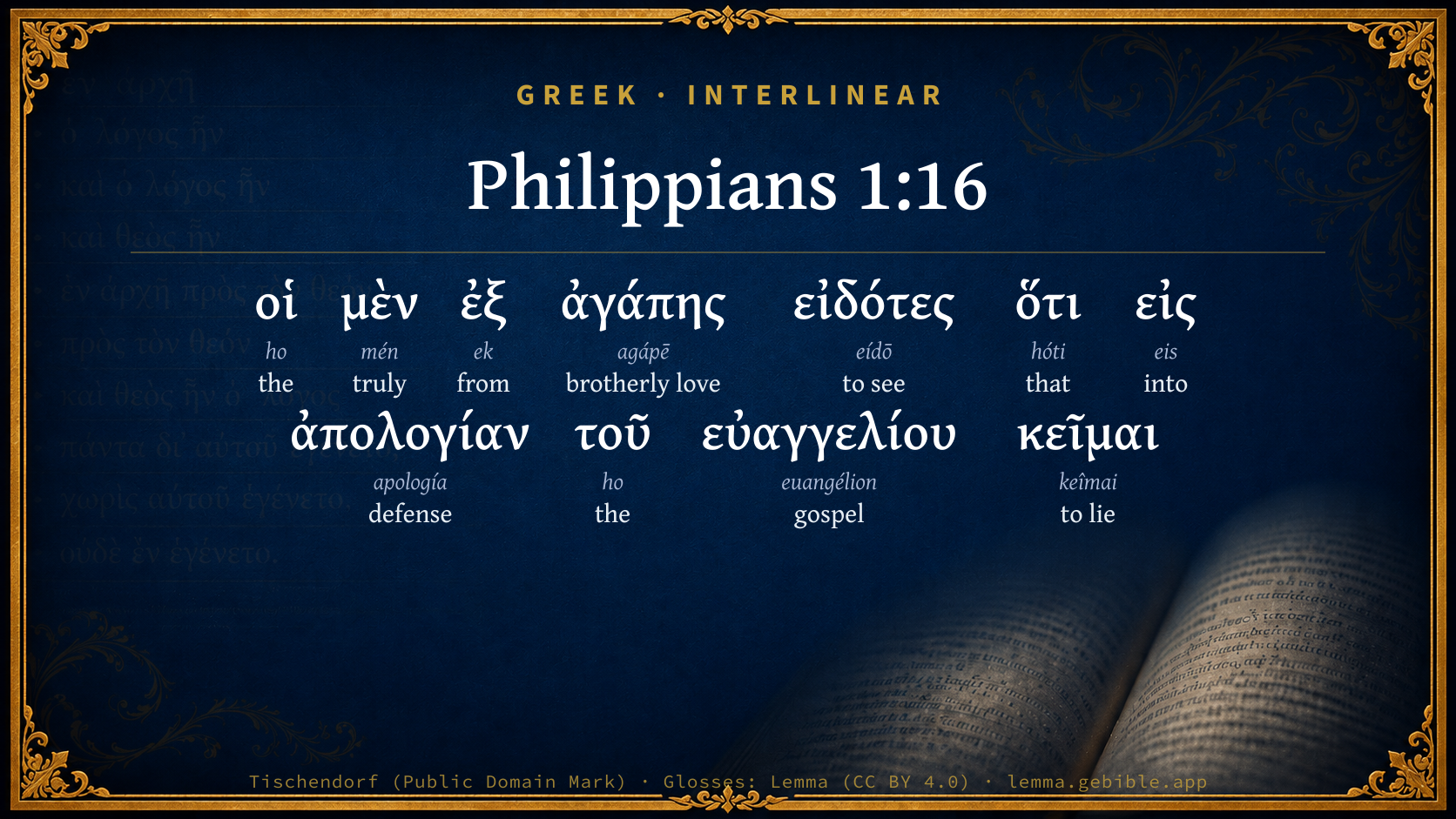
Download image
Cite this verse

Philippians 1:16 (World English Bible). Public Domain. Lemma interlinear Bible study tool, https://lemma.gebible.app/v/philippians/1/16.

Show BibTeX & RIS
BibTeX
RIS
English Translation
The former insincerly preach Christ from selfish ambition, thinking that they add affliction to my chains;
World English Bible · Public Domain
Download a study sheet

One document with this verse’s original text, its word-by-word gloss line, the meaning frame, cross-references with their text, attributed commentary, and full source and license credits — printable, and it pastes into notes with its structure intact.

This verse Autodidact and up

Study sheet (.html) Plain text (.txt)

A passage Seminary Student

Up to 50 verses in one chapter. A passage sheet keeps up to 6 commentary sources and 12 cross-references per verse, in the order this page ranks them, and says so on the sheet whenever that leaves anything out. Ask for a single verse and you get the Autodidact verse sheet above.

Everything on this page stays free to read, with no account — the sheet is a download of what is already on screen, not access to it.

Want to remove ads? Support Godless Engineer
Compare translations 3

The same verse in 3 English versions, stacked beneath the original-language interlinear above. Click any original word for its lexicon entry.

Each is an independent rendering of the whole verse — the interlinear is not word-aligned to these translations.

Highlighted words mark where these versions differ — a whole-verse word diff, not a word-by-word alignment.

  • World English Bible Public Domain
    The former insincerly preach Christ from selfish ambition, thinking that they add affliction to my chains;
  • King James Version Public Domain
    The one preach Christ of contention, not sincerely, supposing to add affliction to my bonds:
  • unfoldingWord Literal Text CC BY-SA 4.0
    the ones indeed from love having understood that I am appointed for the defense of the gospel,

unfoldingWord Literal Text — © unfoldingWord, licensed CC BY-SA 4.0. Word-aligned USFM3 via Door43 (git.door43.org/unfoldingWord/en_ult).

Versions to compare (up to 4)

3 of 4 selected

Show all 19 translations

Every available English version of this verse, each an independent rendering of the whole verse.

  • World English Bible Public Domain
    The former insincerly preach Christ from selfish ambition, thinking that they add affliction to my chains;
  • Berean Standard Bible Public Domain
    The latter do so in love, knowing that I am appointed for the defense of the gospel.
  • Majority Standard Bible Public Domain
    The former preach Christ out of selfish ambition, not sincerely, supposing that they can add to the distress of my chains.
  • King James Version Public Domain
    The one preach Christ of contention, not sincerely, supposing to add affliction to my bonds:
  • American Standard Version (1901) Public Domain
    the one `do it' of love, knowing that I am set for the defence of the gospel;
  • Revised Version (1885) Public Domain
    the one do it of love, knowing that I am set for the defence of the gospel:
  • Geneva Bible (1599) Public Domain
    The one part preacheth Christ of contention and not purely, supposing to adde more affliction to my bandes.
  • Douay-Rheims (1899) Public Domain
    Some out of charity, knowing that I am set for the defence of the gospel.
  • Young's Literal Translation Public Domain
    the one, indeed, of rivalry the Christ do proclaim, not purely, supposing to add affliction to my bonds,
  • Literal Standard Version CC BY-SA 4.0
    one, indeed, of rivalry proclaims the Christ, not purely, supposing to add affliction to my bonds,
  • Unlocked Literal Bible CC BY-SA 4.0
    The latter do it out of love, knowing that I am put here for the defense of the gospel.
  • unfoldingWord Literal Text CC BY-SA 4.0
    the ones indeed from love having understood that I am appointed for the defense of the gospel,
  • Darby Bible Public Domain
    These indeed out of love, knowing that I am set for the defence of the glad tidings;
  • World Messianic Bible Public Domain
    The former insincerely proclaim Messiah from selfish ambition, thinking that they add affliction to my chains;
  • Webster's Bible Public Domain
    The one preach Christ from contention, not sincerely, supposing to add affliction to my bonds:
  • Free Bible Version CC BY-SA 4.0
    They act out of love, because they know that I'm meant to be here to defend the good news.
  • Bible in Basic English Public Domain
    These do it from love, conscious that I am responsible for the cause of the good news:
  • Text-Critical English NT CC BY 4.0
    The former preach Christ out of selfish ambition, not sincerely but intending to add affliction to me in my imprisonment.
  • Tyndale New Testament (1534) Public Domain
    The one parte preacheth Christ of stryfe and not purely supposinge to adde more adversitie to my bondes.

Literal Standard Version (2020), Covenant Press — licensed CC BY-SA 4.0. Text via the HelloAO Bible API (eBible.org). Unlocked Literal Bible (unfoldingWord) — licensed CC BY-SA 4.0. Text via the HelloAO Bible API (eBible.org). unfoldingWord Literal Text — © unfoldingWord, licensed CC BY-SA 4.0. Word-aligned USFM3 via Door43 (git.door43.org/unfoldingWord/en_ult). Free Bible Version, Dr. Jonathan Gallagher — licensed CC BY-SA 4.0. Text via the HelloAO Bible API (eBible.org).

Word by word

More ways to search: Search by grammar → Find every occurrence → Compare this word →

Practice this passage: Drill this verse → Learn its vocabulary →

About this verse

These counts appear in no published source. They are computed here, from the morphology-tagged text and Lemma’s own curated glosses. What Lemma adds →

11
words
10
distinct lemmas
Pauline Epistles
section

Notable vocabulary

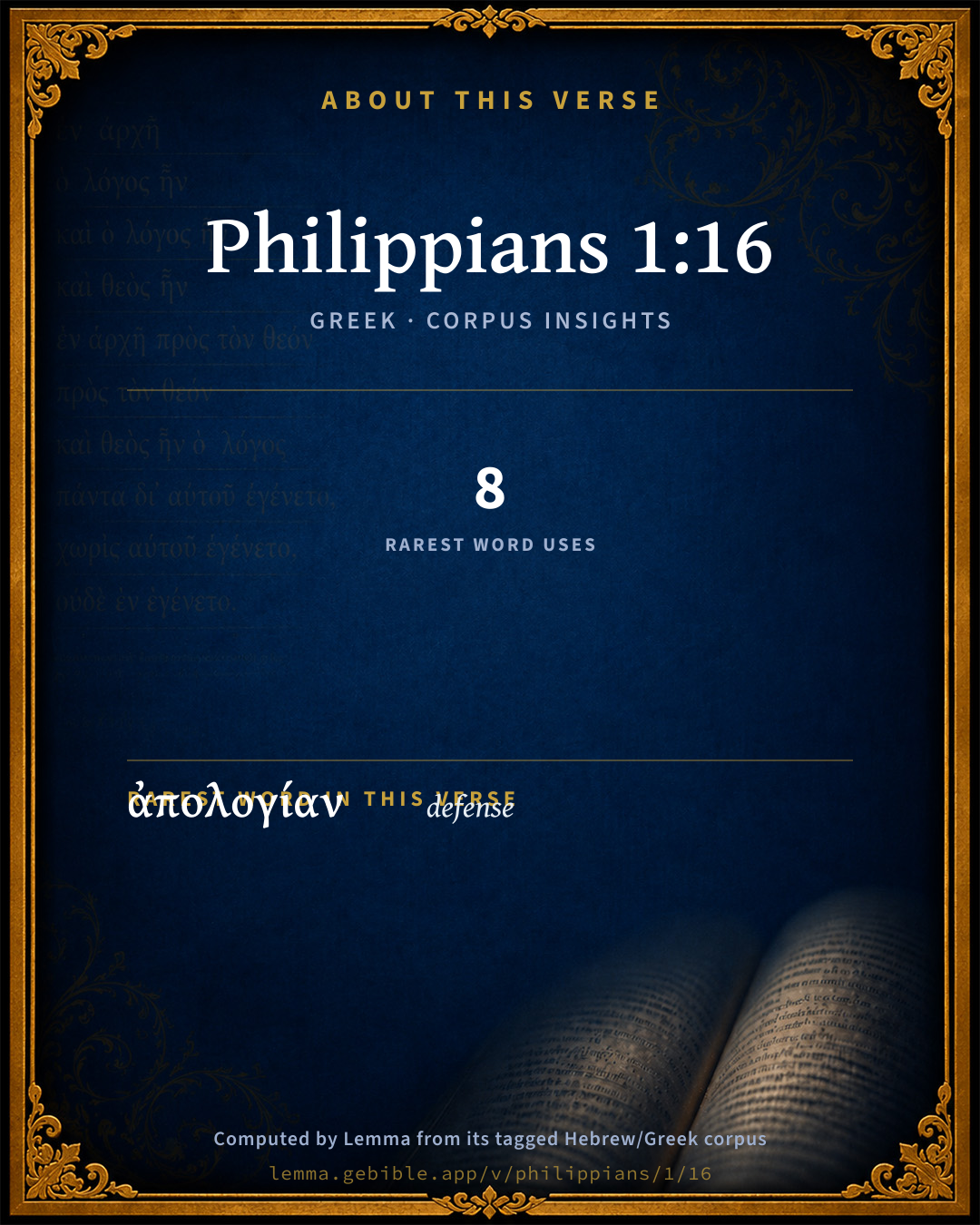
The rarest word here is ἀπολογίαν defense G627 — appearing just 8 times in the whole Greek New Testament.

Shared distinctive vocabulary

ἀπολογίαν defense G627 occurs in 8 verses of the Greek New Testament. Also found in:

Repetition

A word recurs within this verse:

Cross-references

8

Topical passages linked to Philippians 1:16 in the Treasury of Scripture Knowledge — connected by theme and wording, ordered by reader-vote popularity; previews shown in the World English Bible.

  • 2 Corinthians 2:17 For we are not as so many, peddling the word of God. But as of sincerity, but as of God, in the sight of God, we speak in Christ.
  • 2 Corinthians 4:1–2 Therefore seeing we have this ministry, even as we obtained mercy, we don't faint.
  • Job 6:14 "To him who is ready to faint, kindness should be shown from his friend; Even to him who forsakes the fear of the Almighty.
  • Psalms 69:26 For they persecute him whom you have wounded. They tell of the sorrow of those whom you have hurt.
  • Philippians 1:7 It is even right for me to think this way on behalf of all of you, because I have you in my heart, because, both in my bonds and in the defense and confirmation of the Gospel, you all are partakers with me of grace.
  • Philippians 1:10 so that you may approve the things that are excellent; that you may be sincere and without offense to the day of Christ;
  • Philippians 1:12 Now I desire to have you know, brothers, that the things which happened to me have turned out rather to the progress of the Gospel;
  • Job 16:4 I also could speak as you do. If your soul were in my soul's place, I could join words together against you, And shake my head at you.

Cross-references courtesy of OpenBible.info (CC BY 4.0).

Commentary

Notes on Philippians 1:16 from classic Christian and Jewish commentators (each source and its license shown beneath its notes). The classic Christian expositions comment on the surrounding passage and are grouped to its opening verse, so a note may address several verses; the Jewish commentaries on the Tanakh (Rashi and others) are per-verse, so they appear only where the commentator wrote on this verse.

Lemma curates 59 commentaries, every one of them public domain or Creative Commons licensed, each selected and text-cleaned for this edition rather than reprinted as found. About our sources →

The Cambridge Bible for Schools and Colleges

gen. ed. J. J. S. Perowne

16. The one preach Christ, &c.] There is good critical evidence for reading Php_1:16-17 in the opposite order to that of the A.V. Render, with R.V., The one do it of love, knowing that I am set for the defence of the Gospel; but the other proclaim Christ of faction, &c. It is possible to render, with Bp Ellicott, “Those who are (men) of love, do it, &c.… but those who are (men) of faction, &c.” But this puts a certain strain on the Greek, and is not required by the context.

preach] Better, with R.V., proclaim; not the same verb as that rendered “preach” just above. It is a word of slightly greater force.

contention] Better, faction, or rather factiousness, partizanship. The Greek word means first, “work for hire”; passes thence by usage into special political references, denoting hired canvassing, or other interested party-work; and lastly emerges into the present meaning. It is used similarly Rom_2:8; 2Co_12:20; Gal_5:20; below, Php_2:3 (where see note); Jas_3:14; Jas_3:16.

sincerely] Lit. purely.

to add affliction to my bonds] So the Received Text. But a better reading gives to raise up. The R.V. gives a good paraphrase; thinking to raise up affliction for me in my bonds. So Alford.—Lightfoot suggests the paraphrase, “thinking to make my chains gall me,” the word rendered “affliction” meaning literally “rubbing,” or “pressure.” (The Vulgate here has pressura, a word which easily bears, however, a non-physical meaning.) But the suggestion seems to us not altogether probable.

How did the persons in question expect to “raise up trouble” for the imprisoned Apostle? By preventing the access of enquirers or converts to him, unable as he was to go after them. Loyal fellow-workers would have made it a point to bring their hearers under the personal influence of the great Messenger of Christ, and also into a connexion of order with him. Every instance in which the opposite was done was fitted to try severely the spirit of St Paul; to afflict him in and through his position of restraint.

The Cambridge Bible for Schools and Colleges (gen. ed. J. J. S. Perowne; Cambridge University Press, 1878–1918) — public domain. Text from a community e-Sword module.

Bengel's Gnomon

Johann Albrecht Bengel

Php 1:16.[9] Ἐξ ἐριθείας, of contention) Construed with preach.—οὐχ ἁγνῶς, not sincerely) not with a pure intention, or, not without a Jewish leaven; comp. Gal 6:12-13. They spoke of and related what Paul taught: they either did not believe it themselves, or did not confess that they did so. Rumour, report, general preaching, is useful for rousing the attention of many, and requires no great ability [ἱκανότητα] in them that preach, which is necessary, and demands purity of mind and doctrine in closer application; as, for example, among the Galatians; comp. Gal 1:7, etc.—οἰόμενοι, thinking) They thought that the Gentiles, when they observed the increase of the Gospel, would be indignant with Paul in particular; but the efforts of his opponents did not succeed with them, nor did Paul consider it as an affliction, therefore he says, thinking.—θλίψιν, affliction) even accompanied with the danger of death.—ἐπιφέρειν, to add) His bonds were already an affliction: they were adding affliction to the afflicted.

[9] The Germ. Vers. places the 17th verse before this clause of the 16th, following the marg. of the 2d Ed. rather than the larger Ed.—E. B.

ABD(Δ)G Vulg. place οἱ μὲν ἐξ ἀγάπης—κεῖμαι before οἱ δἐ ἐξ ἐριθ.—μου. The Rec. Text order is supported by none of the very old authorities except the later Syr.—ED.

Bengel's Gnomon of the New Testament — English translation (T&T Clark, Edinburgh, 1860) — public domain. Text from a community e-Sword module.

Meyer's Critical & Exegetical Commentary

Heinrich August Wilhelm Meyer

Php_1:16-17. We have here a more detailed description of both parties in respect to the motives which actuated them in relation to the δεσμοί of the apostle.

οἱ μέν … οἱ δέ] corresponds to the two parties of Php_1:15, butand that indeed without any particular purposein an inverted order (see the critical remarks), as in 2Co_2:16, and frequently in classical authors (Thuc. i. 68. 4.; Xen. Anab. i. 10. 4). In Php_1:18 the order adopted in Php_1:15 is again reverted to.

οἱ ἐξ ἀγάπης] sc. ὄντες, a genetic description of the ethical condition of these people: those who are of love, i.e. of loving nature and action; comp. Rom_2:8; Gal_3:7; Joh_18:37, et al. We must supply what immediately precedes: τὸν Χριστὸν κηρύσσουσιν, of which εἰδότες κ.τ.λ. then contains the particular moving cause (Rom_5:3; Rom_5:6; Rom_5:9; Gal_2:16; Eph_6:8 f., et al.). We might also take οἱ μέν (and then οἱ δέ) absolutely: the one, and then bring up immediately, for ἐξ ἀγάπης, the subsequent τ. Χριστὸν καταγγέλλουσιν (so Hofmann and others). But this would be less appropriate, because the progress of the discourse does not turn on the saying that the one preach out of love, and the other out of contention (for this has been said in substance previously), but on the internal determining motives which are expressed by εἰδότες κ.τ.λ. and οἰόμενοι κ.τ.λ.; besides, οὐχ ἁγνῶς would then follow as merely a weak and disturbing auxiliary clause to ἐξ ἐριθείας.

ὅτι εἰς ἀπολ. τοῦ εὐαγγ. κεῖμαι] that I am destined, am ordained of God for (nothing else than) the defence of the gospela destination which they on their parts, in consequence of their love to me, feel themselves impelled to subserve. They labour sympathetically hand in hand with me.

κεῖμαι] as in Luk_2:34; 1Th_3:3; comp. Plat. Legg. x. p. 909; Thuc. iii. 45, 2, 47, 2; Sir_38:29, and other passages in which κεῖσθαι tanquam passivum verbi ποιεῖσθαι vel τιθέναι videtur, Ellendt, Lex. Soph. I. p. 943. Others render: I lie in prison (Luther, Piscator, Estius, Wolf, am Ende, Huther, and others); but the idea of lying under fetters, which κεῖμαι would thus convey (comp. Eur. Phoen. 1633; Aesch. Ag. 1492), does not harmonize with the position of the apostle any more than the reference of its meaning thereby introduced: they know that I am hindered in my preaching, and therefore they supplent hoc meum impedimentum sua praedicatione, Estius. See, on the contrary, Act_28:30-31; Php_1:7. Van Hengel also imports (comp. Weiss): me ad causam rei Christianae, ubi urgeat necessitas, coram judice defendendam hic in miseria jacere. Comp. Hom. Od. i. 46; Soph. Aj. 316 (323); Pflugk, ad Eur. Hec. 496.

οἱ δὲ ἐξ ἐριθ.] sc. ὄντες, the factious, the cabal-makers. See on Rom_2:8; 2Co_12:20; Gal_5:20. So also Ignatius, ad Philadelph. 8. It corresponds with the φθόνον κ. ἔριν, Php_1:15.

τὸν Χ. καταγγ. οὐχ ἁγνῶς] belong together. καταγγ. is, in substance, the same as κηρύσσειν, but more precisely defining it as the announcement of the Messiah (Act_17:3; Act_17:23; Col_1:28, et al.). The words τ. Χριστὸν καταγγέλλουσιν might have been left out, following the analogy of Php_1:16, but are inserted to bring out the tragic contrast which is implied in preaching Christ, and yet doing so οὐχ ἁγνῶς, non caste, not in purity of feeling and purpose. καθαρῶς is synonymous (Hom. H. in Apoll. 121), also with a mental reference (Hesiod. ἔργα, 339). Comp. Plat. Legg. viii. p. 840 D; 2Co_7:11; 2Co_11:2; Php_4:8, et al.; 2Co_6:6.

οἰόμενοι κ.τ.λ.] thinking to stir up affliction for my bonds, to make my captivity full of sorrow. This they intend to do, and that is the immoral moving spring of their unworthy conduct; but (observe the distinction between οἰόμενοι and εἰδότες in Php_1:16) Paul hints by this purposely-chosen word (which is nowhere else used by him), that what they imagine fails to happen. On οἶμαι with the present infinitive, see Pflugk, ad Eur. Hec. 283. The future infinitive would not convey that what is meant is even now occurring. See generally Stallbaum, ad Plat. Crit. p. 52 C; comp. Phaed. p. 116 E. How far they thought that they could effect that injurious result by their preaching, follows from Php_1:15 and from ἐξ ἐριθείας; in so far, namely, that they doubtless, rendered the more unscrupulous through the captivity of the apostle, sought by their preaching to prejudice his authority, and to stir up controversial and partisan interests of a Judaistic character against him, and thus thought thoroughly to embitter the prisoners lot by exciting opponents to vex and wrong him. This was the cabal in the background of their dishonest preaching. That by the spread of the gospel they desired to provoke the hostility of the heathen, especially of Nero, against Paul, and thus to render his captivity more severe, is a groundless conjecture imported (Erasmus, Cornelius a Lapide, Grotius, and others; comp. already Chrysostom, Oecumenius, Theophylact, Pelagius).

On ἐγείρειν (see the critical remarks) comp. ἐγ. ὠδῖνας, Plat. Theaet. p. 149 C, and similar passages.

Meyer — Critical and Exegetical Commentary on the New Testament — English translation by Peter Christie, edited by Frederick Crombie (T&T Clark, 1880) — public domain. Text from a community e-Sword module.

Expositor's Greek Testament

ed. W. Robertson Nicoll

Phi 1:16-17 . An overwhelming mass of authority is in favour of transposing these verses as above (see crit. note). TR. is simply an emendation based on the order in Phi 1:15 .

Phi 1:16 . οἱ μὲν ἐξ ἀγάπης . Is this a complete phrase or does ἐξ ἀγ . qualify the predicate τ . Χρ . κηρύσς . supplied from Phi 1:15 ? The latter seems most natural, as it preserves the complete parallelism of the clauses, which would otherwise be disturbed by οὐχ ἁγνῶς . κεῖμαι has practically become perf. passive of τίθημι . τέθειμαι is seldom used. (See Gildersleeve on Justin M., Apol. , i., 11, 6.) Exactly parallel are Luk 2:34 , οὗτος κεῖται εἰς πτῶσιν καὶ ἀνάστασιν πολλῶν ; 1Th 3:3 , αὐτοὶ γὰρ οἴδατε ὅτι εἰς τοῦτο κείμεθα . “Am appointed.”

The Expositor's Greek Testament, edited by W. Robertson Nicoll (1897–1910) — public domain. Text from a community e-Sword module.

Geneva Bible (1599)

Geneva Bible translators

Not with a pure mind: for otherwise their doctrine was pure.

Geneva Bible (1599) marginal notes — public domain. Text via Bolls.life.

Jamieson, Fausset & Brown

Robert Jamieson, A. R. Fausset & David Brown

The oldest manuscripts transpose these verses, and read, "These (last) indeed out of love (to Christ and me), knowing (the opposite of 'thinking' below) that I am set (that is, appointed by God, Th1 3:3) for the defense of the Gospel (Phi 1:7, not on my own account). But the others out of contention (or rather, 'a factious spirit'; 'cabal'; a spirit of intrigue, using unscrupulous means to compass their end; 'self-seeking' [ALFORD]) proclaim (the Greek is not the same as that for 'preach,' but, 'announce') Christ, not sincerely (answering to 'but of a spirit of intrigue,' or 'self-seeking'). Literally, 'not purely'; not with a pure intention; the Jewish leaven they tried to introduce was in order to glorify themselves (Gal 6:12-13; however, see on Phi 1:18), thinking (but in vain) to raise up (so the oldest manuscripts read) tribulation to my bonds." Their thought was, that taking the opportunity of my being laid aside, they would exalt themselves by their Judaizing preaching, and depreciate me and my preaching, and so cause me trouble of spirit in my bonds; they thought that I, like themselves, sought my own glory, and so would be mortified at their success over mine. But they are utterly mistaken; "I rejoice" at it (Phi 1:18), so far am I from being troubled at it.

Jamieson, Fausset & Brown — Commentary Critical and Explanatory on the Whole Bible (1871) — public domain (CC PDM 1.0). Text via the HelloAO Bible API.

Adam Clarke's Commentary

Verse 16. Preach Christ of contention] The Judaizing teachers, they also preach Christ; they acknowledge that Jesus is the Christ or promised Messiah, and preach him as such.

Not sincerely] ουχ αγνως. Not chastely, garbling the Gospel; not speaking the whole truth, but just what served their purpose; and at the same time they denounced the apostle as an enemy to the Divine institutions, because he spoke against circumcision.

Adam Clarke's Commentary on the Bible (1810–1826) — public domain. Text from a community e-Sword/MySword module.

John Calvin's Commentaries

16 Some, I say, from contention. Here we have a lengthened detail, in which he explains more fully the foregoing statement; for he repeats that there are two classes of men that are stirred up by his bonds to preach Christ — the one influenced by contention, that is, by depraved affection — the other by pious zeal, as being desirous to maintain along with him the defense of the gospel. The former, he says, do not preach Christ purely, because it was not a right zeal. For the term does not apply to doctrine, because it is possible that the man who teaches most purely, may, nevertheless, not be of a sincere mind. Now, that this impurity was in the mind, and did not shew itself in doctrine, may be inferred from the context. Paul assuredly would have felt no pleasure in seeing the gospel corrupted; yet he declares that he rejoices in the preaching of those persons, while it was not simple or sincere.

It is asked, however, how such preaching could be injurious to him? I answer, that many occasions are unknown to us, inasmuch as we are not acquainted with the circumstances of the times. It is asked farther, “Since the gospel cannot be preached but by those that understand it, what motive induced those persons to persecute the doctrine of which they approved?” I answer, that ambition is blind, nay, it is a furious beast. Hence it is not to be wondered if false brethren snatch a weapon from the gospel for harassing good and pious pastors. Paul, assuredly, says nothing here of which I have not myself had experience. For there are living at this very day those who have preached the gospel with no other design, than that they might gratify the rage of the wicked by persecuting pious pastors. As to Paul’s enemies, it is of importance to observe, if they were Jews, how mad their hatred was, so as even to forget on what account they hated him. For while they made it their aim to destroy him, they exerted themselves to promote the gospel, on account of which they were hostile to him; but they imagined, no doubt, that the cause of Christ would stand or fall in the person of one individual. If, however, there were envious persons, who were thus hurried away by ambition, we ought to acknowledge the wonderful goodness of God, who, notwithstanding, gave such a prosperous issue to their depraved affections.

John Calvin's Commentaries (1540-1563) — public domain. Text from the Calvin Translation Society English edition (1840s-50s) via the Christian Classics Ethereal Library (ccel.org). Calvin's coverage is partial (roughly two-thirds of the Bible); uncommented books and verses are honest gaps, never fabricated. The 19th-century editor's footnotes and remarks are omitted so the notes are faithfully Calvin's own voice.

Ellicott's Commentary for English Readers

(16) Not sincerely.—This version conveys an incorrect impression. The original is “not purely,” i.e., not with unmixed and single-minded enthusiasm for Christ. St. Paul does not impute to them hypocrisy, but an admixture of partisanship, and therefore of a narrow-minded hostility to him.

To add affliction.—The true reading, to stir up affliction, or oppressive severity (properly, pressure, or galling), perhaps suggests as most probable the meaning (adopted by Chrysostom here) of “stirring” the minds of St. Paul’s jailors to an increased severity, which might prevent his preaching to all “without hindrance.” The uneasiness of the Government in relation to the Jewish population at Rome is well known. The growth of a secret society (for such Christianity was held to be) among them might easily induce greater severity towards a leader of the sect. (Compare Php_1:19-20, in which St. Paul states his confidence that this malignant policy would be disappointed.)

A Bible Commentary for English Readers, edited by Charles John Ellicott (1878–1897) — public domain. Text from a community e-Sword module.

John Gill's Exposition

The one preach Christ of contention,.... That is, those that preached of envy and strife, an not of good will to Christ, to the Gospel, to the souls of men, or to the apostle; and though they preached Christ, yet

not sincerely or "purely"; not but that they delivered the sincere milk of the word, and preached the pure Gospel of Christ, without any mixture and adulteration; but then they did not preach it with a sincere heart, and a pure intention; for this respects not the doctrine they preached, but their views in it, which were not honest and upright; they did not preach Christ from a principle of love to his person, and from an inward experience of the power of his Gospel, and a zealous affection for it, and firm attachment to it, and with a view to the glory of God, the honour of Christ, and the good of immortal souls; but were influenced by avarice, ambition, and envy: they had very evil designs upon the apostle,

supposing to add affliction to my bonds; imagining that by their free and bold way of preaching Christ openly in the city without control, and with impunity, it might be thought that the apostle did not lie in bonds for preaching Christ, but for some other crime; or otherwise why were not they laid hold on and put under confinement also? or thinking that by such numbers of them frequently preaching Christ about the city, it would either incense and stir up the Jews, Paul's accusers, to prosecute him more vigorously; or excite Nero to take more cognizance of his case, and either more closely confine him, or hasten the bringing his cause to a hearing, and him to punishment, as the ringleader of this sect, to the terror of others; but this they could not do without exposing themselves to great danger, unless they were determined to recant, as soon as they should be taken up; wherefore it should rather seem that their view was in preaching Christ to carry away the glory of it from the apostle, and take it to themselves; and fancying that he was a man of the same cast with them, desirous of vain glory, they thought it would afflict and distress him, he being in bonds, and not at liberty to exert himself, and make use of his superior gifts and abilities; but in this they were mistaken, he was so far from being made uneasy hereby, that he rejoiced at the preaching of Christ, let their intentions be what they would; and therefore he does not say that they did add affliction to his bonds; but they "supposed", or thought, that the method they took would do it.

John Gill's Exposition of the Whole Bible (1746–1763) — public domain (CC PDM 1.0). Text via the HelloAO Bible API.

Trapp's Complete Commentary

John Trapp

16 The one preach Christ of contention, not sincerely, supposing to add affliction to my bonds:

Ver. 16. Preach Christ of contention] Striving to bear away the bell from me, as the better preachers. And with such ambitionists the Church of Christ hath ever been pestered. This made Luther pray, A doctore glorioso, et a pastore contentioso, liberet ecclesiam suam Dominus, From vain glorious and contentious preachers, the good Lord deliver his Church. This made Strigelius when he was on his death bed bless God that now he should be freed ab immanibus et implacabilibus odiis theologorum, from the cruel and implacable hatreds of dissenting divines. (Melch. Ad. in Vit. Strig.) This drew that counsel from Luther to preachers, that they should see that those three dogs did not follow them into the pulpit, -Pride, covetousness, and envy.

Supposing to add affliction to my bonds] As immane cruelty, such as Job and David often complain of, Job 6:14; Psa 69:26. Queen Elizabeth hated no less than did Mithridates, such as maliciously persecuted virtue forsaken of fortune, saith Camden.

John Trapp, A Commentary or Exposition upon All the Books of the Old and New Testament (1647–1656) — public domain. Text from a community e-Sword module.

Albert Barnes' Notes on the Bible

The one preach Christ of contention - So as to form parties, and to produce strifes among his professed followers.

Not sincerely - Not “purely” - ἁγνῶς hagnōs - not with pure motives or intentions. Their real aim is not to preach Christ, but to produce difficulty, and to stir up strife. They are ambitious people, and they have no real regard for the welfare of the church and the honor of religion.

Supposing to add affliction to my bonds - To make my trial the greater. How they did this is unknown. Perhaps they were those who were strongly imbued with Jewish notions, and who felt that his course tended to diminish respect for the law of Moses, and who now took this opportunity to promote their views, knowing that this would be particularly painful to him when he was not at liberty to meet them openly, and to defend his own opinions. It is possible also that they may have urged that Paul himself had met with a signal reproof for the course which he had taken, and, as a consequence, was now thrown into chains. Bloomfield suggests that it was the opinion of many of the ancient expositors that they endeavored to do this by so preaching as to excite the fury of the multitude or the rulers against Paul, and to produce increased severity in his punishment. But the way in which they did this is unknown, and conjecture is altogether useless.

Albert Barnes' Notes on the Bible (1834–1885) — public domain. Text from a community e-Sword/MySword module.

Matthew Poole's English Annotations

This distinction he did amplify and explain here, by particularly showing the ill motive, manners, and end of the worst sort of preachers, from an ill affection of hatred, emulation, and wrath, 2Co 12:20; Gal 5:20; with an intemperate zeal to render Paul suspected and despicable in the eyes of the church; and to occasion in the emperor a more severe persecution, and heighten the accusers’ rage against Paul, and to gain applause to themselves, and vex his soul under outward troubles.

Matthew Poole's English Annotations on the Holy Bible (1683–1685) — public domain. Text from a community e-Sword/MySword module.

The Pulpit Commentary

Vers. 16, 17. These two verses must change places according to the reading of the best manuscripts. The clauses are inverted by the figure chiasmus. But the other of love; read, as R.V., the one do it of love. This is better than the other possible rendering, "those who are of love do it. " Knowing that I am set for the defense of the gospel. Keimai . I am set or appointed, as in 1Th_2:3; not, as some understand, I lie in prison. They preach Christ out of love love for Christ, and love for Paul for Christ"s sake. The one preach Christ of contention; read and translate, as R.V., but the other proclaim Christ of faction; perhaps rather, announce ( kataggellousin); bring news of Christ; and that they do out of factious-ness. Eriyeia , derived from eriyov , a hired servant, means labor for hire, and is commonly used of hired canvassers, in the sense of factiousness, party spirit. It is reckoned by St. Paul in Gal_5:20 among the works of the flesh, and is condemned also in Rom_2:8. Not sincerely, supposing to add affliction to my bonds; rather, as R.V. (reading with the best manuscripts egeirein ), thinking to raise up affliction for me in my bonds. Their motives were not pure; they wished to make St. Paul feel the helplessness of imprisonment, and to increase his affliction by opposing his doctrines, and by forming a party insisting on the observance of the ceremonial law. Bishop Lightfoot translates yliqin egeirein "to make my chains gall me."

The Pulpit Commentary (1880–1919), ed. H.D.M. Spence-Jones & Joseph S. Exell — public domain. Text from a community e-Sword module.

The People's New Testament

B. W. Johnson

16. The one preach Christ from contention. Not from sincere love of the gospel, but from a factious spirit. While preaching, they sought to undermine Paul's influence, supposing to add affliction to his bonds. For an illustration of this class, read the first and second chapters of Galatians,

B. W. Johnson's The People's New Testament with Notes (1889–1891) — public domain. Electronic text from the Christian Classics Ethereal Library (CCEL) ThML edition.

Cambridge Greek Testament for Schools and Colleges

16. οἱ μὲν ἐξ ἀγάπης κτλ. On the order of the clauses here, see critical note.

εἰς ἀπολογίαν … κεῖμαι. In defensionem … positus sum (Vulgate).—For ἀπολογία, see note on Php 1:7 above.—Κεῖμαι: “I am set.” For a similar use of the verb see Luk 2:34, οὗτος κεῖται εἰς πτῶσιν κτλ.; 1Th 3:3. The thought is as of a soldier posted; (perhaps not without a reference to his “lying” in the prison which was his present “post”; but κεῖσθαι is at least very rare in this reference). These loyal and loving Christians were animated to co-operation by the fact of St Paul’s plainly providential presence at Rome, to be a witness and expounder of the Gospel. He was to be their centre and point d’appui; they, in their freedom of movement, his helpers everywhere.

Cambridge Greek Testament for Schools and Colleges (Cambridge University Press, 1896; 21 vols, various authors incl. Carr, Maclear, Plummer, Farrar, Lumby, Moule, M. R. James, Simcox) — public domain. Text from a community e-Sword module.

International Critical Commentary

16. The TR reverses the order of vs. 16, 17 (so Dbc KL., Syr.P, and several Fathers). The change seems to have been made in order to conform to the order of the parties in vs. 15. The words in the correct order of our text exhibit a cross-reference (chiasmus), the first specification of vs. 16 referring to the second of vs. 15. Render: ‘They that are of love (preach Christ) because they know that I am set for the defence of the gospel; and they that are of faction (preach Christ) not purely, because they think to add affliction to my bonds.’

Οἱ μὲν ἐξ ἀγάπης and οἱ δε ἐξ ἐριθίας (vs. 17) are generic descriptions, and the subjects of καταγγέλλουσιν.

Others, as Lightf., Kl., Alf., Ead., R.V., take οἱ μὲν, οἱ δε as the subjects, and ἐξ ἀγ., ἐξ ἐριθ. as qualifying καταγγ. Thus the rendering would be: ‘The one preach Christ of love, because they know, etc., and the other class preach Christ of faction because they think,’ etc. According to this construction, however, ἐξ ἀγ. and ἐξ ἐριθ. are substantially repetitions of διὰ εὐδοκ. and διἀ φθόν. καὶ ἔρ. Lightf.’s objection to the other construction, that thus τὸν Χτὸν καταγγ. is made too emphatic, is without force. The emphasis is intended in connection with οὐχ ἁγνῶς.

For the expressions οἱ ἐξ ἀγάπης and οἱ ἐξ ἐριθίας, comp. Joh 18:37; Rom 2:8; Gal 3:7.

Εἰδότες and οἰόμενοι (vs. 17) have a causal force; ‘since they know,’ ‘since they think.’

ἀπολογίαν: See on vs. 7. The meaning as there. Not as Chrys., Theoph., Œc., the ‘account’ of his ministry which Paul was to render to God.

κεῖμαι: As Luk 2:34; 1Th 3:3; 1Ti 1:9. Orig. ‘to be laid’; ‘to lie.’ Hence ‘to be appointed or destined.’

International Critical Commentary — older volumes (1896–1929), various authors — public domain. Text from a community e-Sword module.

Vincent's Word Studies in the New Testament

Marvin R. Vincent

The one preach Christ of contention. The order of vers. 16, 17, is reversed in the best texts. Of contentions [εξ εριθειας] . See on strife, Jas 3:14. Rev., better, faction. Compare Chaucer :

"For mine entente is not but for to winne And nothing for correction of sinne" " Pardouere's Tale, " 12337 - 8.

Sincerely [αγνως] . Purely, with unmixed motives. The adjective aJgnov means pure, in the sense of chaste, free from admixture of evil, and is once applied to God, 1Jo 3:3. See on Act 26:10, foot - note. Not sincerely is explained by in pretense, ver. 18.

To add affliction [θλιψιν επιφερειν] . Lit., to bring affliction to bear. But the correct reading is ejgeirein to raise up, as Rev. : to waken or stir up affliction. The phrase is striking in the light of the original meaning of qliyiv, namely, pressure. They would make his bonds press more heavily and gall him. See on Mt 13:21.

Marvin R. Vincent, Word Studies in the New Testament (1887–1900) — public domain. Text from a community e-Sword/MySword module.

Lesson kit

Teaching starters — assembled from the data on this page, not authored interpretation. Every prompt links to the verse data it draws on. Edit before teaching.

Philippians, in the Pauline Epistles, opens this verse with 11 words (10 distinct Greek lemmas). Its most distinctive word is apología (“defense”). A historical commentator’s framing appears above. Read the whole chapter for the surrounding context.

Discussion questions

  1. What does “defense” (apología) contribute to the verse as a whole?
  2. How does Acts 22:1, which shares the word «defense», read alongside this verse?
  3. What does the repetition of “the” (2× in this one verse) do in this verse?
  4. The translations on this page render this verse differently — a whole-verse word diff, not a word-by-word alignment. What might account for the different wordings?
  5. Compare how The Cambridge Bible for Schools and Colleges and Bengel's Gnomon read this verse. Where do they agree or differ?

Things to notice

Reading settings

Reading text

Shown beneath each verse's original-language words.

Old Testament
Old Testament edition

Read the OT as the Masoretic Hebrew (MT) or the Greek Septuagint (LXX).

English shown for the Greek Septuagint (in the Hebrew ↔ Greek comparison).

Comparing translations? Open the Compare panel on any verse page to stack up to four side by side.