Hebrews 12:10

Greek (Tischendorf 8th ed.) Hebrews 12:10 appears in the Greek New Testament. The text above is from the Tischendorf 8th edition. Each word links to its Strong’s number and a concise gloss. Click any word for its full Thayer’s Greek Lexicon entry.
Download image
Cite this verse

Hebrews 12:10 (World English Bible). Public Domain. Lemma interlinear Bible study tool, https://lemma.gebible.app/v/hebrews/12/10.

Show BibTeX & RIS
BibTeX
RIS
English Translation
For they indeed, for a few days, punished us as seemed good to them; but he for our profit, that we may be partakers of his holiness.
World English Bible · Public Domain
Download a study sheet

One document with this verse’s original text, its word-by-word gloss line, the meaning frame, cross-references with their text, attributed commentary, and full source and license credits — printable, and it pastes into notes with its structure intact.

This verse Autodidact and up

Study sheet (.html) Plain text (.txt)

A passage Seminary Student

Up to 50 verses in one chapter. A passage sheet keeps up to 6 commentary sources and 12 cross-references per verse, in the order this page ranks them, and says so on the sheet whenever that leaves anything out. Ask for a single verse and you get the Autodidact verse sheet above.

Everything on this page stays free to read, with no account — the sheet is a download of what is already on screen, not access to it.

Want to remove ads? Support Godless Engineer
Compare translations 3

The same verse in 3 English versions, stacked beneath the original-language interlinear above. Click any original word for its lexicon entry.

Each is an independent rendering of the whole verse — the interlinear is not word-aligned to these translations.

Highlighted words mark where these versions differ — a whole-verse word diff, not a word-by-word alignment.

  • World English Bible Public Domain
    For they indeed, for a few days, punished us as seemed good to them; but he for our profit, that we may be partakers of his holiness.
  • King James Version Public Domain
    For they verily for a few days chastened us after their own pleasure; but he for our profit, that we might be partakers of his holiness.
  • unfoldingWord Literal Text CC BY-SA 4.0
    For indeed, they were disciplining for a few days according to seems to them, but he, to benefit, so that we might share his holiness.

unfoldingWord Literal Text — © unfoldingWord, licensed CC BY-SA 4.0. Word-aligned USFM3 via Door43 (git.door43.org/unfoldingWord/en_ult).

Versions to compare (up to 4)

3 of 4 selected

Show all 19 translations

Every available English version of this verse, each an independent rendering of the whole verse.

  • World English Bible Public Domain
    For they indeed, for a few days, punished us as seemed good to them; but he for our profit, that we may be partakers of his holiness.
  • Berean Standard Bible Public Domain
    Our fathers disciplined us for a short time as they thought best, but God disciplines us for our good, so that we may share in His holiness.
  • Majority Standard Bible Public Domain
    Our fathers disciplined us for a short time as they thought best, but God disciplines us for our good, so that we may share in His holiness.
  • King James Version Public Domain
    For they verily for a few days chastened us after their own pleasure; but he for our profit, that we might be partakers of his holiness.
  • American Standard Version (1901) Public Domain
    For they indeed for a few days chastened `us' as seemed good to them; but he for `our' profit, that `we' may be partakers of his holiness.
  • Revised Version (1885) Public Domain
    For they verily for a few days chastened us as seemed good to them; but he for our profit, that we may be partakers of his holiness.
  • Geneva Bible (1599) Public Domain
    For they verely for a few dayes chastened vs after their owne pleasure: but he chasteneth vs for our profite, that we might be partakers of his holinesse.
  • Douay-Rheims (1899) Public Domain
    And they indeed for a few days, according to their own pleasure, instructed us: but he, for our profit, that we might receive his sanctification.
  • Young's Literal Translation Public Domain
    for they, indeed, for a few days, according to what seemed good to them, were chastening, but He for profit, to be partakers of His separation;
  • Literal Standard Version CC BY-SA 4.0
    For they, indeed, for a few days, according to what seemed good to them, were disciplining, but He for profit, to be partakers of His separation;
  • Unlocked Literal Bible CC BY-SA 4.0
    Our fathers disciplined us for a short time as they thought best. But God disciplines us for our good, so that we can share in his holiness.
  • unfoldingWord Literal Text CC BY-SA 4.0
    For indeed, they were disciplining for a few days according to seems to them, but he, to benefit, so that we might share his holiness.
  • Darby Bible Public Domain
    For they indeed chastened for a few days, as seemed good to them; but he for profit, in order to the partaking of his holiness.
  • World Messianic Bible Public Domain
    For they indeed for a few days disciplined us as seemed good to them, but he for our profit, that we may be partakers of his holiness.
  • Webster's Bible Public Domain
    For they verily for a few days chastened us after their own pleasure; but he for our profit, that we might be partakers of his holiness.
  • Free Bible Version CC BY-SA 4.0
    They disciplined us for a short while as they thought appropriate, but God does so for our benefit in order that we can share his holy character.
  • Bible in Basic English Public Domain
    For they truly gave us punishment for a short time, as it seemed good to them; but he does it for our profit, so that we may become holy as he is.
  • Text-Critical English NT CC BY 4.0
    For our fathers disciplined us for a short time as seemed best to them, but God disciplines us for our good, so that we may share in his holiness.
  • Tyndale New Testament (1534) Public Domain
    And they verely for a feaue dayes nurtred vs after their awne pleasure: but he learneth vs vnto that which is proffitable that we myght receave of his holines.

Literal Standard Version (2020), Covenant Press — licensed CC BY-SA 4.0. Text via the HelloAO Bible API (eBible.org). Unlocked Literal Bible (unfoldingWord) — licensed CC BY-SA 4.0. Text via the HelloAO Bible API (eBible.org). unfoldingWord Literal Text — © unfoldingWord, licensed CC BY-SA 4.0. Word-aligned USFM3 via Door43 (git.door43.org/unfoldingWord/en_ult). Free Bible Version, Dr. Jonathan Gallagher — licensed CC BY-SA 4.0. Text via the HelloAO Bible API (eBible.org).

Word by word

More ways to search: Search by grammar → Find every occurrence → Compare this word →

Practice this passage: Drill this verse → Learn its vocabulary →

ἁγιότητος
hagiótēs
G41
“holiness”
Noun, Genitive, Singular, Feminine
Part of Speech
Noun
Case
Genitive
Number
Singular
Gender
Feminine
Full Thayer's Definition

Origin: from G40

TDNT: 02:54,1

1. sanctity 2. in a moral sense: holiness
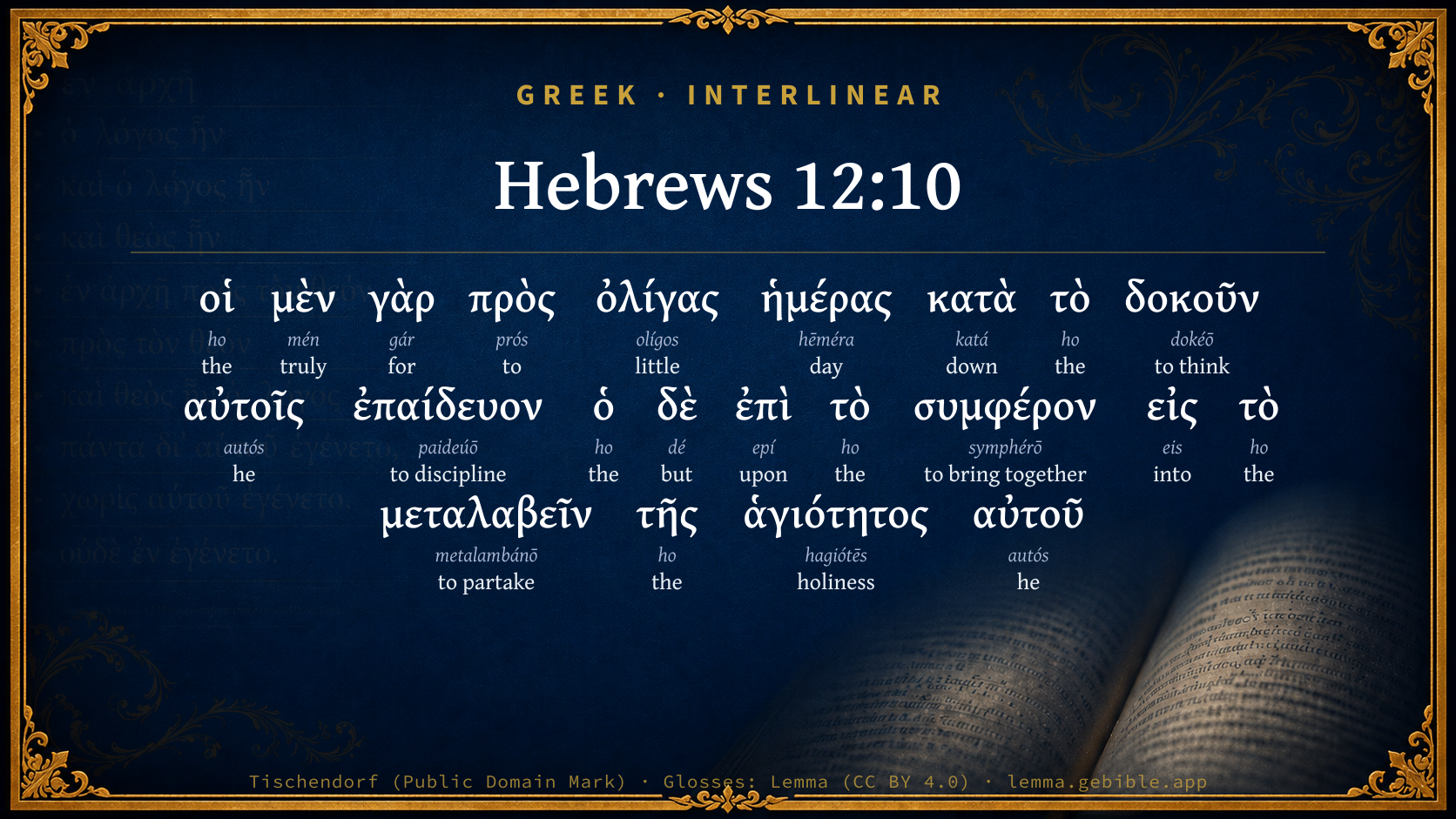
  1. οἱ ho G3588 “the” Article, Nominative, Plural, Masculine
  2. μὲν mén G3303 “truly” Particle
  3. γὰρ gár G1063 “for” Conjunction
  4. πρὸς prós G4314 “to” Preposition
  5. ὀλίγας olígos G3641 “little” Adjective, Accusative, Plural, Feminine
  6. ἡμέρας hēméra G2250 “day” Noun, Accusative, Plural, Feminine
  7. κατὰ katá G2596 “down” Preposition
  8. τὸ ho G3588 “the” Article, Accusative, Singular, Neuter
  9. δοκοῦν dokéō G1380 “to think” Verb, Present, Active, Participle, Accusative, Singular, Neuter
  10. αὐτοῖς autós G846 “he” Personal pronoun, Dative, Plural, Masculine
  11. ἐπαίδευον paideúō G3811 “to discipline” Verb, Imperfect, Active, Indicative, 3rd person, Plural
  12. ὁ ho G3588 “the” Article, Nominative, Singular, Masculine
  13. δὲ dé G1161 “but” Conjunction
  14. ἐπὶ epí G1909 “upon” Preposition
  15. τὸ ho G3588 “the” Article, Accusative, Singular, Neuter
  16. συμφέρον symphérō G4851 “to bring together” Verb, Present, Active, Participle, Accusative, Singular, Neuter
  17. εἰς eis G1519 “into” Preposition
  18. τὸ ho G3588 “the” Article, Accusative, Singular, Neuter
  19. μεταλαβεῖν metalambánō G3335 “to partake” Verb, Aorist, Active, Infinitive
  20. τῆς ho G3588 “the” Article, Genitive, Singular, Feminine
  21. αὐτοῦ autós G846 “he” Personal pronoun, Genitive, Singular, Masculine

About this verse

These counts appear in no published source. They are computed here, from the morphology-tagged text and Lemma’s own curated glosses. What Lemma adds →

22
words
16
distinct lemmas
General Epistles
section

Notable vocabulary

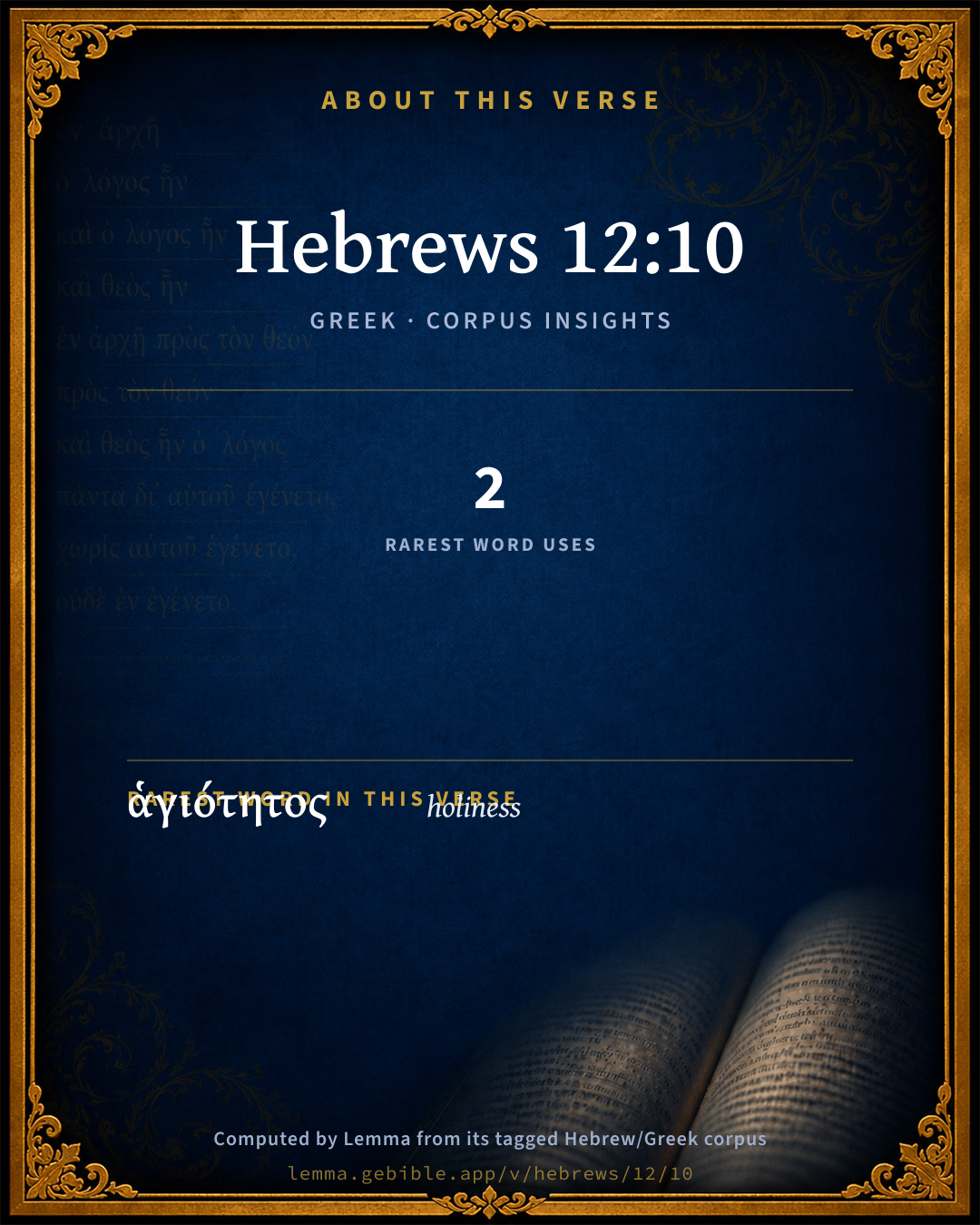
The rarest word here is ἁγιότητος holiness G41 — appearing just 2 times in the whole Greek New Testament.

Shared distinctive vocabulary

ἁγιότητος holiness G41 occurs in 2 verses of the Greek New Testament. Also found in:

Repetition

Words recur within this verse:

  • οἱ the G3588 ×6
  • αὐτοῖς he G846 ×2

Cross-references

13

Topical passages linked to Hebrews 12:10 in the Treasury of Scripture Knowledge — connected by theme and wording, ordered by reader-vote popularity; previews shown in the World English Bible.

  • 2 Peter 1:4 by which he has granted to us his precious and exceedingly great promises; that through these you may become partakers of the divine nature, having escaped from the corruption that is in the world by lust.
  • Leviticus 11:44–45 For I am Yahweh your God. Sanctify yourselves therefore, and be holy; for I am holy: neither shall you defile yourselves with any kind of creeping thing that moves on the earth.
  • Titus 2:14 who gave himself for us, that he might redeem us from all iniquity, and purify for himself a people for his own possession, zealous for good works.
  • Ezekiel 36:25–27 I will sprinkle clean water on you, and you shall be clean: from all your filthiness, and from all your idols, will I cleanse you.
  • Ephesians 5:26–27 that he might sanctify it, having cleansed it by the washing of water with the word,
  • Leviticus 19:2 "Speak to all the congregation of the children of Israel, and tell them, 'You shall be holy; for I Yahweh your God am holy.
  • Psalms 17:15 As for me, I shall see your face in righteousness; I shall be satisfied, when I awake, with seeing your form.
  • Ephesians 4:24 and put on the new man, who in the likeness of God has been created in righteousness and holiness of truth.
  • Colossians 1:22 yet now he has reconciled in the body of his flesh through death, to present you holy and without blemish and blameless before him,
  • 1 Peter 1:15–16 but just as he who called you is holy, you yourselves also be holy in all of your behavior;
  • 1 Peter 2:5 You also, as living stones, are built up as a spiritual house, to be a holy priesthood, to offer up spiritual sacrifices, acceptable to God through Jesus Christ.
  • 1 Peter 2:9 But you are a chosen race, a royal priesthood, a holy nation, a people for God's own possession, that you may show forth the excellencies of him who called you out of darkness into his marvelous light:
  • Hebrews 12:5–6 and you have forgotten the exhortation which reasons with you as with children, "My son, don't take lightly the chastening of the Lord, Nor faint when you are reproved by him;

Cross-references courtesy of OpenBible.info (CC BY 4.0).

Commentary

Notes on Hebrews 12:10 from classic Christian and Jewish commentators (each source and its license shown beneath its notes). The classic Christian expositions comment on the surrounding passage and are grouped to its opening verse, so a note may address several verses; the Jewish commentaries on the Tanakh (Rashi and others) are per-verse, so they appear only where the commentator wrote on this verse.

Lemma curates 59 commentaries, every one of them public domain or Creative Commons licensed, each selected and text-cleaned for this edition rather than reprinted as found. About our sources →

MacLaren's Expositions of Holy Scripture

Alexander MacLaren

Ecclesiastes

TWO VIEWS OF LIFE

Ecc 1:13. - Heb 12:10.

These two texts set before us human life as it looks to two observers. The former admits that God shapes it; but to him it seems sore travail, the expenditure of much trouble and efforts; the results of which seem to be nothing beyond profitless exercise. There is an immense activity and nothing to show for it at the end but wearied limbs. The other observer sees, at least, as much of sorrow and trouble as the former, but he believes in the ‘Father of spirits,’ and in a hereafter; and these, of course, bring a meaning and a wider purpose into the ‘sore travail,’ and make it, not futile but, profitable to our highest good.

I. Note first the Preacher’s gloomy half-truth.

The word rendered in our text ‘travail’ is a favourite one with the writer. It means occupation which costs effort and causes trouble. The phrase ‘to be exercised therewith,’ rather means to fatigue themselves, so that life as looked upon by the Preacher consists of effort without result but weariness.

If he knew it at all, it was very imperfectly and dimly; and whatever may be thought of teaching on that subject which appears in the formal conclusion of the book, the belief in a future state certainly exercises no influence on its earlier portions. These represent phases through which the writer passes on his way to his conclusion. He does believe in ‘God,’ but, very significantly, he never uses the sacred name ‘Lord.’ He has shaken himself free, or he wishes to represent a character who has shaken himself free from Revelation, and is fighting the problem of life, its meaning and worth, without any help from Law, or Prophet, or Psalm. He does retain belief in what he calls ‘God,’ but his pure Theism, with little, if any, faith in a future life, is a creed which has no power of unravelling the perplexed mysteries of life, and of answering the question, ‘What does it all mean?’ With keen and cynical vision he looks out not only over men, as in this first chapter, but over nature; and what mainly strikes him is the enormous amount of work that is being done, and the tragical poverty of its results. The question with which he begins his book is, ‘What profit hath a man of all his labour wherein he laboureth under the sun?’ And for answer he looks at the sun rising and going down, and being in the same place after its journey through the heavens; and he hears the wind continually howling and yet returning again to its circuits; and the waters now running as rivers into the sea and again drawn up in vapours, and once more falling in rain and running as waters. This wearisome monotony of intense activity in nature is paralleled by all that is done by man under heaven, and the net result of all is ‘Vanity and a strife after wind.’

The writer proceeds to confirm his dreary conclusion by a piece of autobiography put into the mouth of Solomon. He is represented as flinging himself into mirth and pleasure, into luxury and debauchery, and as satisfying every hunger for any joy, and as being pulled up short in the midst of his rioting by the conviction, like a funeral bell, tolling in his mind that all was vanity. ‘He gave himself to wisdom, and madness, and folly’; and in all he found but one result-enormous effort and no profit. There seemed to be a time for everything, and a kind of demonic power in men compelling them to toil as with equal energy, now at building up, and now at destroying. But to every purpose he saw that there was ‘time and judgment,’ and therefore, ‘the misery of man was great upon him.’ To his jaundiced eye the effort of life appeared like the play of the wind in the desert, always busy, but sometime busy in heaping the sands in hillocks, and sometimes as busy in levelling them to a plain.

We may regard such a view of humanity as grotesquely pessimistic; but there is no doubt that many of us do make of life little more than what the Preacher thought it. It is not only the victims of civilisation who are forced to wearisome monotony of toil which barely yields daily bread; but we see all around us men and women wearing out their lives in the race after a false happiness, gaining nothing by the race but weariness. What shall we say of the man who, in the desire to win wealth, or reputation, lives laborious days of cramping effort in one direction, and allows all the better part of his nature to be atrophied, and die, and passes, untasted, brooks by the way, the modest joys and delights that run through the dustiest lives. What is the difference between a squirrel in the cage who only makes his prison go round the faster by his swift race, and the man who lives toilsome days for transitory objects which he may never attain? In the old days every prison was furnished with a tread-mill, on which the prisoner being set was bound to step up on each tread of the revolving wheel, not in order to rise, but in order to prevent him from breaking his legs. How many men around us are on such a mill, and how many of them have fastened themselves on it, and by their own misreading and misuse of life have turned it into a dreary monotony of resultless toil. The Preacher may be more ingenious than sound in his pessimism, but let us not forget that every godless man does make of life ‘Vanity and strife after wind.’

II. The higher truth which completes the Preacher’ s.

Of course the fragmentary sentence in our second text needs to be completed from the context, and so completed will stand, ‘God chastens us for our profit, that we should be partakers of His holiness.’ Now let us consider for a moment the thought that the true meaning of life is discipline. I say discipline rather than ‘chastening,’ for chastening simply implies the fact of pain, whereas discipline includes the wholesome purpose of pain. The true meaning of life is not to be found by estimating its sorrows or its joys, but by trying to estimate the effects of either upon us. The true value of life, and the meaning of all its tears and of all its joys, is what it makes us. If the enormous effort which struck the Preacher issues in strengthened muscles and braced limbs, it is not ‘vanity.’ He who carries away with him out of life a character moulded as God would have it, does not go in all points ‘naked as he came.’ He bears a developed self, and that is the greatest treasure that a man can carry out of multitudinous toils of the busiest life. If we would think less of our hard work and of our heavy sorrows, and more of the loving purpose which appoints them all, we should find life less difficult, less toilsome, less mysterious. That one thought taken to our hearts, and honestly applied to everything that befalls us, would untie many a riddle, would wipe away many a tear, would bring peace and patience into many a heart, and would make still brighter many a gladness. Without it our lives are a chaos; with it they would become an ordered world.

But the recognition of the hand that ministers the discipline is needed to complete the peacefulness of faith. It would be a dreary world if we could only think of some inscrutable or impersonal power that inflicted the discipline; but if in its sharpest pangs we give ‘reverence to the Father of spirits,’ we shall ‘live.’ Of course, a loving father sees to his children’s education, and a loving child cannot but believe that the father’s single purpose in all his discipline is his good. The good that is sought to be attained by the sharpest chastisement is better than the good that is given by weak indulgence. When the father’s hand wields the rod, and a loving child receives the strokes, they may sting, but they do not wound. The ‘fathers of our flesh chasten us after their own pleasure,’ and there may be error and arbitrariness in their action; and the child may sometimes nourish a right sense of injustice, but ‘the Father of spirits’ makes no mistakes, and never strikes too hard. ‘He for our profit’ carries with it the declaration that the deep heart of God doth not willingly afflict, and seeks in afflicting for nothing but His children’s good.

Nor are these all the truths by which the New Testament completes and supersedes the Preacher’s pessimism, for our text closes by unveiling the highest profit which discipline is meant to secure to us as being that we should be ‘partakers of His holiness.’ The Biblical conception of holiness in God is that of separation from and elevation above the creature. Man’s holiness is separation from the world and dedication to God. He is separated from the world by moral perfection yet more than by His other attributes, and men who have yielded themselves to Him will share in that characteristic. This assimilation to His nature is the highest ‘profit’ to which we can attain, and all the purpose of His chastening is to make us more completely like Himself. ‘The fathers of our flesh’ chasten with a view to the brief earthly life, but His chastening looks onwards beyond the days of ‘strife and vanity’ to a calm eternity.

Thus, then, the immortality which glimmered doubtfully in the end of his book before the eyes of the Preacher is the natural inference for the Christian thought of moral discipline as the great purpose of life. No doubt it might be possible for a man to believe in the supreme importance of character, and in all the discipline of life as subsidiary to its development, and yet not believe in another world, where all that was tendency, often thwarted, should be accomplished result, and the schooling ended the rod should be broken. But such a position will be very rare and very absurd. To recognise moral discipline as the greatest purpose of life, gives quite overwhelming probability to a future. Surely God does not take such pains with us in order to make no more of us than He makes of us in this world. Surely human life becomes ‘confusion worse confounded’ if it is carefully, sedulously, continuously tended, checked, inspired, developed by all the various experiences of sorrow and joy, and then, at death, broken short off, as a man might break a stick across his knee, and the fragments tossed aside and forgotten. If we can say, ‘He for our profit that we might be partakers of His holiness,’ we have the right to say ‘We shall be like Him, for we shall see Him as He is.’

Hebrews

A FATHER’S DISCIPLINE

Heb 12:10

FEW words of Scripture have been oftener than these laid as a healing balm on wounded hearts. They may be long unnoticed on the page, like a lighthouse in calm sunshine, but sooner or later the stormy night falls, and then the bright beam flashes out and is welcome. They go very deep into the meaning of life as discipline; they tell us how much better God’s discipline is than that of the most loving and wise of parents, and they give that superiority as a reason for our yielding more entire and cheerful obedience to Him than we do to such.

Now, to grasp the full meaning of these words, we have to notice that the earthly and the heavenly disciplines are described in four contrasted clauses. which are arranged in what students call inverted parallelism - that is to say, the first clause corresponds to the fourth and the second to the third. ‘For a few days’ pairs off with ‘that we might be partakers of His holiness.’ Now, at first sight that does not seem a contrast; but notice that the ‘for’ in the former clause is not the ‘for’ of duration, but of direction. It does not tell us the space during which the chastisement or discipline lasts, but the end towards which it is pointed. The earthly parent’s discipline trains a boy or girl for circumstances, pursuits, occupations, professions, all of which terminate with the brief span of life. God’s training is for an eternal day. It would be quite irrelevant to bring in here any reference to the length of time during which an earthly father’s discipline lasts, but it is in full consonance with the writer’s intention to dwell upon the limited scope of the one and the wide and eternal purpose of the other.

Then, as for the other contrast - ‘for their own pleasure,’ or, as the Revised Version reads it, ‘as Seemed good to them’ - ‘but He for our profit.’ Elements of personal peculiarity, whim, passion, limited and possibly erroneous conceptions of what is the right thing to do for the child, enter into the training of the wisest and most loving amongst us; and we often make a mistake and do harm when we think we are doing good. But God’s training is all from a simple and unerring regard to the benefit of His child. Thus the guiding principles of the two disciplines are contrasted in the two central clauses.

Now, these are very threadbare, commonplace, and old-fashioned thoughts; but, perhaps, they are so familiar that they have not their proper power over us; and I wish to try in this sermon, if I can, to get more into them, or to get them more into us, by one or two very plain remarks.

I. I would ask you to note, first, the grand, deep, general conception, here firmly laid hold of, of life as only intelligible when it is regarded as education or discipline.

God corrects, chastens, trains, educates. That is the deepest word about everything that befalls us. Now, there are involved in that two or three very obvious thoughts, which would make us all calmer and nobler and stronger, if they were vividly and vitally present to us day by day.

The first is that all which befalls us has a will behind it and is co-operant to an end. Life is not a heap of unconnected incidents, like a number of links flung down on the ground, but the links are a chain, and the chain has a staple. It is not a law without a law-giver that shapes men’s lives. It is not a blind, impersonal chance that presides over it. Why, these very meteors that astronomers expect in autumn to be flying and flashing through the sky in apparent wild disorder, all obey law. Our lives, in like manner, are embodied thoughts of God’s, in as far as the incidents which befall in them are concerned. We may mar, we may fight against, may contradict the presiding divine purpose; but yet, behind the wild dance of flashing and transitory lights that go careering all over the sky, there guides, not an impersonal Power, but a living, loving Will He, not it; He, not they, men, circumstances, what people call second causes - He corrects, and He does it for a great purpose.

Ah! if we believed that, and not merely said it from the teeth outwards, but if it were a living conviction with us, do you not think our lives would tower up into a nobleness, and settle themselves down into a tranquillity all strange to them to-day?

But, then, further, there is the other thought to be grasped, that all our days we are here in a state of pupilage. The world is God’s nursery. There are many mansions in the Father’s house; and this earth is where He keeps the little ones. That is the true meaning of everything that befalls us. It is education. Work would not be worth doing if it were not. Life is given to us to teach us how to live, to exercise our powers, to give us habits and facilities of working. We are like boys in a training ship that lies for most of the time in harbour, and now and then goes out upon some short and easy cruise; not for the sake of getting anywhere in particular, but for the sake of exercising the lads in seamanship. There is no meaning worthy of us - to say nothing of God - in anything that we do, unless it is looked upon as schooling. We all say we believe that. Alas! I am afraid very many of us forget it,

But that conception of the meaning of each event that befalls us carries with it the conception of the whole of this life, as being an education towards another. I do not understand how any man can bear to live here, and to do all his painful work, unless he thinks that by it he is getting ready for the life beyond; and that ‘nothing can bereave him of the force he made his own, being here.’ The rough ore is turned into steel by being

‘Plunged in baths of hissing tears, And heated hot with hopes and fears, And battered with the shocks of doom.’

And then - what then? Is an instrument, thus fashioned, and tempered and polished, destined to be broken and ‘thrown as rubbish to the void’? Certainly not. If this life is education, as is obvious’ upon its very face, then there is a place where we shall exercise the faculties that we have acquired here, and manifest in loftier forms the characters which here we have made our own.

Now, brethren, if we carry these thoughts with us habitually, what a difference it will make upon everything that befalls us! You hear men often maundering and murmuring about the mysteries of the pain and sorrow and suffering of this world, wondering if there is any loving Will behind it all. That perplexed questioning goes on the hypothesis that life is meant mainly for enjoyment or for material good. If we once apprehended in its all- applicable range this simple truth, that life is a discipline, we should have less difficulty in understanding what people call the mysteries of Providence. I do not say it would interpret everything, but it would interpret an immense deal. It would make us eager, as each event came, to find out its special mission and what it was meant to do for us. It would dignify trifles, and bring down the overwhelming magnitude of the so- called great events, and would make us lords of ourselves, and lords of circumstances, and ready to wring the last drop of possible advantage out of each thing that befell us. Life is a Father’s discipline.

II. Note the guiding principle of that discipline.

‘They... as seemed good to them.’ I have already said that, even in the most wise and unselfish training by an earthly parent, there will -mingle subjective elements, peculiarities of view and thought, and sometimes of passion and whim and other ingredients, which detract from the value of all such training. The guiding principle for each earthly parent, even at the best, can only be his conception of what is for the good of his child; and oftentimes that is not purely the guide by which the parent’s discipline is directed. So the text turns us away from all these incompletenesses, and tells us, ‘He for our profit’ - with no sidelong look to anything else, and with an entirely wise knowledge of what is best for us, so that the result will be always and only for our good. This is the point of view from which every Christian man ought to look upon all that befalls him.

What follows? This, plainly: there is no such thing as evil except the evil of sin. All that comes is good - of various sorts and various complexions, but all generically the same. The inundation comes up over the fields, and men are in despair. It goes down; and then, like the slime left from the Nile in flood, there is better soil for the fertilising of our land. Storms keep sea and air from stagnating. All that men earl evil in the material world has in it a soul of good.

That is an old, old commonplace; but, like the other one, of which I have been speaking, it is more often professed than realised, and we need to be brought back to the recognition of it more entirely than we ordinarily are. If it be that all my life is paternal discipline, and that God makes no mistakes, then I can embrace whatever comes to me, and be sure that in it I shall find that which will be for my good.

Ah, brethren, it is easy to say so when things go well; but, surely, when the night falls is the time for the stars to shine. That gracious word should shine upon some of us in to-day’s perplexities, and pains, and disappointments, and sorrows - ‘He for our profit.’

Now, that great thought does not in the least deny the fact that pain and sorrow, and so-called evil, are very real There is no false stoicism in Christianity. The mission of our troubles would not be effected unless they did trouble us. The good that we get from a sorrow would not be realised unless we did sorrow. ‘Weep for yourselves’ said the Master, ‘and for your children.’ It is right that we should writhe in palm It is right that we should yield to the impressions that are made upon us by calamities. But it is not right that we should be so affected as that we should fail to discern in them this gracious thought - ‘for our profit.’ God sends us many love-tokens, and amongst them are the great and the little annoyances and pains that beset our lives, and on each of them, if we would look, we should see written, in His own hand, this inscription: ‘For your good.’ Do not let us have our eyes so full of tears that we cannot see, or our hearts so full of regrets that we cannot accept, that sweet, strong message.

The guiding principle of all that befalls us is God’s unerring knowledge of what will do us good. That will not prevent, and is not meant to prevent, the arrow from wounding, but it does wipe the poison off the arrow, and diminish the pain, and should diminish the tears.

III. Lastly, here we see the great aim of all the discipline.

The earthly parent trains his son, or her daughter, for earthly occupations. These last a little while. God trains us for an eternal end: ‘that we should be partakers of His holiness.’ The one object which is congruous with a man’s nature, and is stamped on his whole being, as its only adequate end, is that he should be like God. Holiness is the Scriptural shorthand expression for all that in the divine nature which separates God from, and lifts Him above, the creature; and in that aspect of the word the gulf can never be lessened nor bridged between us and Him. But it also is the expression for the moral purity and perfection of that divine nature which separates Him from the creatures far more really than do the metaphysical attributes that belong to His infinitude and eternity; and in that aspect the great hope that is given to us is that we may rise nearer and nearer to that perfect whiteness of purity, and though we cannot share in His essential, changeless being, may ‘walk’ - as befits our limited and changeful natures - ‘in the light, as He’ - as befits His boundless and eternal being - ‘is in the light.’ That is the only end which it is worthy of a man, being what he is, to propose to himself as the issue of his earthly experience. If I fail in that, whatever else I have accomplished, I fail in everything. I may have made myself rich, cultured, learned; famous, refined, prosperous; but if I have not at least begun to be like God in purity, in will, in heart, then my whole career has missed the purpose for which I was made, and for which all the discipline of life has been lavished upon me. Fail there, and, wherever you succeed, you are a failure. Succeed there, and, wherever you fail, you are a success.

That great and only worthy end may be reached by the ministration of circumstances and the discipline through which God passes us. These are not the only ways by which He makes us partakers of His holiness, as we well know. There is the work of that Divine Spirit who is granted to every Believer to breathe into him the holy breath of an immortal and incorruptible life. To work along with these there is the influence that is brought to bear upon us by the circumstances in which we are placed and the duties which we have to perform. These may all help us to be nearer and liker to God.

That is the intention of our sorrows. They will wean us; they will refine us; and they will blow us to His breast, as a strong wind might sweep a man into some refuge from itself. I am sure that among my hearers there are some who can thankfully attest that they were brought nearer to God by some short, sharp sorrow than by many long days of prosperity. What Absalom, in his wayward, impulsive way, did with Joab is like what God sometimes does with His sons. Joab would not come to Absalom’s palace, so Absalom set his corn on fire; and then Joab came. So God sometimes burns our harvests that we may go to Him.

But the sorrow that is meant to bring us nearer to Him may be in vain. The same circumstances may produce opposite effects. I dare say there are people listening to me now who have been made hard, and sullen, and bitter, and paralysed for good work, because they have some heavy burden or some wound that life can never heal, to be carded or to ache. Ah, brethren! we are often like shipwrecked crews, of whom some are driven by the danger to their knees, and some are driven to the spirit-casks. Take care that you do not waste your sorrows; that you do not let the precious gifts of disappointment, pain, loss, loneliness, ill-health, or similar afflictions that come into your. daily life, mar you instead of mending you. See that they send you. nearer to God, and not that they drive you farther from Him. See that they make you more anxious to have the durable riches and righteousness which no man can take from you, than to grasp at what may yet remain, of fleeting: earthly joys.

So, brethren, let us try to school ourselves into the habitual and operative conviction that life is discipline. Let us yield ourselves to the loving will of the unerring Father, the perfect love. Let us beware of getting no good from what is charged to the brim with good. And let us see to it that out of the many fleeting circumstances of life we gather and keep the eternal fruit of being partakers of His holiness. May it never have to be said of any of us that we wasted the mercies which were judgments too, and found no good in the things, that our tortured hearts felt to be also evils, lest God, should have to wail over any of us, ‘In vain have I smitten your children; they have received no correction!’

Alexander MacLaren, Expositions of Holy Scripture (1904–1910) — public domain. Text from a community e-Sword module.

Tyndale Open Study Notes

Tyndale Open Resources

12:10-11 There are at least two limitations on an earthly father’s discipline. First, his discipline, or education, is only for a few years (literally for a few days)—children eventually leave home. Second, earthly fathers were doing the best they knew how from their limited perspectives. By contrast, God’s discipline lasts throughout life and is always good for us, based on his limitless knowledge and love. His goal is that we might share in his holiness. Although it is painful, discipline brings about a peaceful harvest of right living. It brings God’s children into a state conducive to harmonious relationships and doing what is right (see also Rom 5:3-4; 8:17, 28; 2 Cor 4:17; Phil 1:12-14; Jas 1:2-4; 1 Pet 1:7; 4:14).

Tyndale Open Study Notes — © Tyndale Open Resources, licensed CC BY-SA 4.0. Text via the HelloAO Bible API.

Bengel's Gnomon

Johann Albrecht Bengel

Heb 12:10. Πρὸς ὀλίγας ἡμέρας) for a few days, of which our life consists in the flesh. Those days are not only denoted, during which the discipline lasts, but those [viz. all the days of the present life] to which the fruit of discipline appertains. The εἰς corresponds to this πρὸς at the end of the verse: comp. ch. Heb 9:13-14. In like manner Paul joins these prepositions, Eph 4:12, where see note.—κατὰ τὸ δοκοῦν αὐτοῖς, as they themselves thought fit) Such is indeed the case. Our fathers of the flesh commit great faults in respect of discipline, both in indulgence and in severity; nor do they so much chastise, as think that they chastise us. But the Father of our spirits altogether chastens us for our advantage: αὐτοῖς, to themselves, includes an antithesis to those who are chastened by the fathers of the flesh. So δοκοῦν and δοκεῖν, in the following verse, correspond.—εἰς τὸ μεταλαβεῖν τῆς ἁγιότητος αὐτοῦ, that we may become partakers of His holiness) ἁγιωσύνη, sanctimony: ἁγιασμὸς, sanctification: Heb 12:14; but ἁγιότης, sanctity or holiness.[74] The holiness of GOD: i.e. GOD, who is holy, whom men do not attain to unless they be sanctified; and they who attain to Him, shall obtain the enjoyment of the spiritual life for ever. [It is a religious obligation to pursue this Holiness with filial reverence; and yet we are not allowed to come near to it.—V. g.] An abstract appellation, as ἡ μεγαλωσὺνη, Majesty, Heb 1:3; ἡ δόξα αὐτοῦ, His glory, Jude, Heb 12:24; ἡ μεγαλοπρεπὴς δόξα, the excellent glory, 2Pe 1:17. And this expression, ἵνα γένησθε θείας κοινωνοὶ φὺσεως, that you become partakers of the Divine nature, i.e. of GOD, 2Pe 1:4, accords in a singular manner with the passage before us.

[74] See note, Rom 1:4, on this distinction.

Heb 12:10. In the midst of all these things, it is clear and certain that by the eating of Christ’s flesh and the drinking of His blood, or by faith, 1. Christians are intimately united with Christ; 2. that they are indebted for that union to His flesh and blood, because they eat the one and drink the other; 3. that the flesh and blood of Christ have in them a close and efficacious operation, and impart to them eternal life.

Bengel's Gnomon of the New Testament — English translation (T&T Clark, Edinburgh, 1860) — public domain. Text from a community e-Sword module.

Meyer's Critical & Exegetical Commentary

Heinrich August Wilhelm Meyer

Heb_12:10. Justification of the πολὺ μᾶλλον, Heb_12:9, by presenting in relief the diversity of character borne by the disciplinary correction of the earthly fathers from that of the heavenly Father. The emphasis falls upon κατὰ τὸ δοκοῦν αὐτοῖς and upon ἐπὶ τὸ συμφέρον, while πρὸς ὀλίγας ἡμέρας is an unaccentuated addition, which belongs equally to both members of the sentence.[117] For if πρὸς ὀλίγας ἡμέρας belonged only to the first member, and served for the indication of a further particular of diversity, an antithetic addition corresponding to the same could not have been wanting in the second member. But to find such antithesis, with Bengel, Ebrard, Bisping, Delitzsch, Hofmann, and others, in εἰς τὸ μεταλαβεῖν κ.τ.λ., is inadmissible, since these words are only an epexegetical amplification of ἐπὶ τὸ συμφέρον. Πρὸς ὀλίγας ἡμέρας denotes, therefore, not the period of the earthly life, brief in comparison with eternity (Calvin, Estius, Justinian, Cornelius a Lapide, Schlichting, Limborch, Er. Schmid, Bengel, Tholuck, Ebrard, Bisping, Maier, Kluge, al.), in such wise that the thought would be expressed, that the earthly fathers aimed in connection with the παιδεύειν at a benefit or gain merely in regard to the earthly lifetime; God, on the other hand, at a gain for eternity,by which at any rate a false opposition would arise, since the first half of the statement could not be at all conceded as a universally valid truth. Rather do the words affirm that the chastisement on the part of the natural fathers (and not less that on the part of the heavenly Father) continued only a few days, lasted only during a brief period. In a sense quite corresponding is πρός employed immediately after, Heb_12:11, as well as 1Co_7:5; 2Co_7:8; 1Th_2:17, and very frequently elsewhere.

κατὰ τὸ δοκοῦν αὐτοῖς] according to their judgment, which was not always an erroneous one.

The imperfect ἐπαίδευον stands there for the same reason as the imperfects, Heb_12:9.

ὁ δέ] sc. πρὸς ὀλίγας ἡμέρας παιδεύει.

ἐπὶ τὸ συμφέρον] with a view to that which is salutary (our infallible welfare).

εἰς τὸ μεταλαβεῖν τῆς ἁγιότητος αὐτοῦ] in order that we may be made partakers of His holiness, may become ever more free from sin, and in moral purity ever more like God Himself.

[117] Riehms objection to this (Lehrbegr. des Hebräerbr. p. 762, Obs.), that in such case κατὰ τὸ δοκοῦν αὐτοῖς must have been placed before πρὸς ὀλίγας ἡμέρας, is entirely without weight. Just the proposing of πρὸς ὀλίγας ἡμέρας was, if these words were to be referred to both members of the sentence, the most appropriate order; because κατὰ τὸ δοκοῦν αὐτοῖς and ἐπὶ τὸ συμφέρον then as contrasts stood in so much the more immediate opposition to each other in the two halves of the sentence.

Meyer — Critical and Exegetical Commentary on the New Testament — English translation by Peter Christie, edited by Frederick Crombie (T&T Clark, 1880) — public domain. Text from a community e-Sword module.

Expositor's Greek Testament

ed. W. Robertson Nicoll

Heb 12:10 . οἱ μὲν γὰρ .… The reasonableness of the appeal of Heb 12:9 is further illustrated by a comparison of the character and end in the earthly and heavenly fathers’ discipline respectively. The earthly fathers exercised discipline for a few days in accordance with what commended itself to their judgment as proper; a judgment which could not be infallible and must sometimes have hindered rather than helped true growth; but the heavenly Father uses discipline with a view to our profit that we may partake of his holiness. Two notes of imperfection characterise the discipline of the fathers of our flesh. (1) It is πρὸς ὀλίγας ἡμέρας , “for a few days,” i.e. , during the brief period of youth. It must cease when manhood is attained, whether or not it has attained its end. (2) It is κατὰ τὸ δοκοῦν αὐτοῖς , subject to misconception both of the end to be reached and the means by which it can be attained. In contrast to this second feature the discipline of the Father of our spirit is without fail ἐπὶ τὸ συμφέρον , “for our advantage,” which is defined in εἰς τὸ μεταλαβεῖν τῆς ἁγιότητος αὐτοῦ , “that we may partake of His holiness,” in which the contrast to the incomplete.

The Expositor's Greek Testament, edited by W. Robertson Nicoll (1897–1910) — public domain. Text from a community e-Sword module.

Geneva Bible (1599)

Geneva Bible translators

An amplification of the same argument: Those fathers have corrected us after their fancy, for some frail and transitory profit: but God chasteneth and instructeth us for our singular profit, to make us partakers of his holiness: which thing although these our senses do not presently perceive, yet the end of the matter proveth it.

Geneva Bible (1599) marginal notes — public domain. Text via Bolls.life.

Jamieson, Fausset & Brown

Robert Jamieson, A. R. Fausset & David Brown

Showing wherein the chastisement of our heavenly Father is preferable to that of earthly fathers.

for a few days--that is, with a view to our well-being in the few days of our earthly life: so the Greek.

after their own pleasure--Greek, "according to what seemed fit to themselves." Their rule of chastening is what may seem fit to their own often erring judgment, temper, or caprice. The two defects of human education are: (1) the prevalence in it of a view to the interests of our short earthly term of days; (2) the absence in parents of the unerring wisdom of our heavenly Father. "They err much at one time in severity, at another in indulgence [Sa1 3:13; Eph 6:4], and do not so much chasten as THINK they chasten" [BENGEL].

that we might be partakers of his holiness--becoming holy as He is holy (Joh 15:2). To become holy like God is tantamount to being educated for passing eternity with God (Heb 12:14; Pe2 1:4). So this "partaking of God's holiness" stands in contrast to the "few days" of this life, with a view to which earthly fathers generally educate their sons.

Jamieson, Fausset & Brown — Commentary Critical and Explanatory on the Whole Bible (1871) — public domain (CC PDM 1.0). Text via the HelloAO Bible API.

Adam Clarke's Commentary

Verse 10. For - a few days] The chastisement of our earthly parents lasted only a short time; that of our heavenly Father will also be but a short time, if we submit: and as our parents ceased to correct when we learned obedience; so will our heavenly Father when the end for which he sent the chastisement is accomplished. God delights not in the rod; judgment is his strange work.

Adam Clarke's Commentary on the Bible (1810–1826) — public domain. Text from a community e-Sword/MySword module.

John Calvin's Commentaries

10. For they verily for a few days, etc. The second amplification of the subject, as I have said, is that God’s chastisements are appointed to subdue and mortify our flesh, so that we may be renewed for a celestial life. It hence appears that the fruit or benefit is to be perpetual; but such a benefit cannot be expected from men, since their discipline refers to civil life, and therefore properly belongs to the present world. It hence follows that these chastisements bring far greater benefit, as the spiritual holiness conferred by God far exceeds the advantages which belong to the body.

Were any one to object and say, that it is the duty of parents to instruct their children in the fear and worship of God, and that therefore their discipline seems not to be confined to so short a time; to this the answer is, that this is indeed true, but the Apostle speaks here of domestic life, as we are wont commonly to speak of civil government; for though it belongs to magistrates to defend religion, yet we say that their office is confined to the limits of this life, for otherwise the civil and earthly government cannot be distinguished from the spiritual kingdom of Christ.

Moreover when God’s chastisements are said to be profitable to make men partners of his holiness, this is not to be so taken as though they made us really holy, but that they are helps to sanctify us, for by them the Lord exercises us in the work of mortifying the flesh.

John Calvin's Commentaries (1540-1563) — public domain. Text from the Calvin Translation Society English edition (1840s-50s) via the Christian Classics Ethereal Library (ccel.org). Calvin's coverage is partial (roughly two-thirds of the Bible); uncommented books and verses are honest gaps, never fabricated. The 19th-century editor's footnotes and remarks are omitted so the notes are faithfully Calvin's own voice.

Ellicott's Commentary for English Readers

(10) After their own pleasure.—Rather, as seemed good unto them. The contrast is continued here between human liability to mistake and the perfect knowledge of our heavenly Father, who seeks our profit, and cannot err in the means which He employs. There is a general resemblance between this verse and the last, the “few days” corresponding to the “fathers of our flesh;” and the last clause here, “that we may be partakers of His holiness,” to the words which close Heb_12:9, “and live.” To the “few days” no contrast is directly expressed in the second member of the verse; none was needed, because the last words so clearly imply the permanence of the result.

A Bible Commentary for English Readers, edited by Charles John Ellicott (1878–1897) — public domain. Text from a community e-Sword module.

The Cambridge Bible for Schools and Colleges

gen. ed. J. J. S. Perowne

10. after their own pleasure] Rather, “as seemed good to them.” He is contrasting the brief authority of parents, and their liability to error, and even to caprice, with the pure love and eternal justice of God.

The Cambridge Bible for Schools and Colleges (gen. ed. J. J. S. Perowne; Cambridge University Press, 1878–1918) — public domain. Text from a community e-Sword module.

John Gill's Exposition

For they verily for a few days chastened us,.... Which respects not the minority of children, during which time they are under the correction of parents, and which is but a few days; nor the short life of parents; but rather the end which parents have in chastening their children, which is their temporal good, and which lasts but for a few days; which sense the opposition in the latter part of the text requires: and this they do

after their own pleasure: not to please and delight themselves in the pains and cries of their children, which would be brutish and inhuman; though corrections are too often given to gratify the passions; nor merely in an arbitrary way, and when they please; but the sense is, they correct as seems good unto them; in the best way and manner; to the best of their judgments, which are fallible:

but he for our profit; saints are no losers by afflictions; they lose nothing but their dross and tin; they do not lose the love of God; nor their interest in the covenant of grace; nor the presence of God; nor grace in their own hearts; nor spiritual peace and comfort: on the contrary, they are real gainers by them; their graces gain by them fresh lustre and glory; they obtain a greater degree of spiritual knowledge; and a larger stock of experience; and are hereby restored to their former state, duty, and zeal; and become more conformable to Christ; yea, their afflictions conduce to their future glory; many are the profits arising from them. The Alexandrian copy reads in the plural number, "profits": particularly God's end in chastening of his children is,

that we might be partakers of his holiness; not the essential holiness of God, which is incommunicable; but a communicative holiness of his, which it is his determining will his people should have: it comes from him, from whom every good and perfect gift does; it is in Christ for them, and is received out of his fulness; and is wrought in them by the Spirit; and it bears a resemblance to the divine nature: now men are naturally destitute of this holiness; they have it not by nature, but by participation; as God's gift; and they first partake of it in regeneration; and here an increase of it is designed, a gradual participation of it; and it may include perfect holiness in heaven: afflictions are designed as means to bring persons to this end; to bring them to a sense of sin, an acknowledgment of it, an aversion to it, and to a view of pardon of it; to purge it away; to wean the saints from this world; to increase their grace, and lead them on to a perfect state of glory, where there will be no more sin, and no more sorrow.

John Gill's Exposition of the Whole Bible (1746–1763) — public domain (CC PDM 1.0). Text via the HelloAO Bible API.

Trapp's Complete Commentary

John Trapp

10 For they verily for a few days chastened us after their own pleasure; but he for our profit, that we might be partakers of his holiness.

Ver. 10. After their own pleasure] To ease their stomachs, vent their choler, discharge themselves of that displeasure they have (and perhaps without cause) conceived against us. Not so the Lord; "Fury is not in me," saith he, Isa 27:4. Though God may do with his own as he pleaseth, yet he doth never over do. For it goes as much against the heart with him, as against the hair with us; it is even a pain to him to be punishing, Lam 3:33.

That we might be partakers] Thus bitter pills bring sweet health, and sharp winter kills worms and weeds, and mellows the earth for better bearing of fruits and flowers. The lily is sowed in its own tears, and God’s vines bear the better for bleeding. The walnut tree is most fruitful when most beaten, and camomile the more you tread it, the more you spread it. Aloes kill worms, and stained clothes are whitened by bleeching.

John Trapp, A Commentary or Exposition upon All the Books of the Old and New Testament (1647–1656) — public domain. Text from a community e-Sword module.

Albert Barnes' Notes on the Bible

For they verily for a few days - That is, with reference to a few days (πρὸς pros}; or it was a chastisement that had reference mainly to this short life. The apostle seems to bring in this circumstance to contrast the dealings of earthly parents with those of God. One of the circumstances is, that the corrections of earthly parents had a much less important object than those of God. They related to this life - a life so brief that it may be said to continue but a “few days.” Yet, in order to secure the benefit to be derived for so short a period from fatherly correction, we submitted without complaining. Much more cheerfully ought we to submit to that discipline from the hand of our heavenly Father which is designed to extend its benefits through eternity. This seems to me to afford a better sense than that adopted by Prof. Stuart and others, that it means “during our childhood or minority;” or than that proposed by Doddridge, that it refers both to our earthly parents and to our heavenly Father.

After their own pleasure - Margin, “as seemed good, or meet to them.” Meaning that it was sometimes done arbitrarily, or from caprice, or under the influence of passion. This is an additional reason why we should submit to God. We submitted to our earthly parents, though their correction was sometimes passionate, and was designed to gratify their own pleasure rather than to promote our good. There is much of this kind of punishment in families; but there is none of it under the administration of God.

But he for our profit - Never from passion, from caprice, from the love of power or superiority, but always for our good. The exact benefit which he designs to produce we may not be able always to understand, but we may be assured that no other cause influences him than a desire to promote our real welfare, and as he can never be mistaken in regard to the proper means to secure that, we may be assured that our trials are always adapted to that end.

That we might be partakers of his holiness - Become so holy that it may be said that we are partakers of the very holiness of God; compare 2Pe 1:4. This is the elevated object at which God aims by our trials. It is not that he delights to produce pain; not that he envies us and would rob us of our little comforts; not that he needs what we prize to increase his own enjoyment, and therefore rudely takes it away; and not that he acts from caprice - now conferring a blessing and then withdrawing it without any reason: it is, that he may make us more pure and holy, and thus promote our own best interest. To be holy as God is holy; to be so holy that it may be said that we “are partakers of his holiness,” is a richer blessing than health, and property, and friends, without it; and when by the exchange of the one we acquire the other, we have secured infinitely more than we have lost. To obtain the greater good we should be willing to part with the less; to secure the everlasting friendship and favour of God we should be willing, if necessary, to surrender the last farthing of our property; the last friend that is left us; the last feeble and fluttering pulsation of life in our veins.

Albert Barnes' Notes on the Bible (1834–1885) — public domain. Text from a community e-Sword/MySword module.

Matthew Poole's English Annotations

For they verily for a few days chastened us after their own pleasure: as God hath his prerogative in paternity, so he hath the transcendency in the end of chastening his children; for our natural parents, fathers of our bodies, nurtured us by the word and rod for a little time, the days of childhood and youth, as they would and thought good, as they apprehended their power over them, arbitrarily, passionately, without reaching what is best for them by it; their own thoughts, whether good or bad, were the rule of their chastening, and such as their thoughts are, such is their end; how imperfect and defective must that be!

But he for our profit, that we might be partakers of his holiness; but God, the Father of our spirits, corrects us επι το συμφερον, which strictly notes comportation, intimating, that in his chastening his children he brings in his help, puts as it were his shoulder to it, brings in his stock of grace, and so bears together with them unto their advantage and profit in spiritual life, and this during our whole lives. That which he bears home to them, and puts in them by his chastening, is his holiness; of which being made partakers, they thrive mightily as to their spiritual life, and increase in the Divine nature with all the increases of God, Eph 3:13,19; Col 2:19.

Matthew Poole's English Annotations on the Holy Bible (1683–1685) — public domain. Text from a community e-Sword/MySword module.

Whedon's Commentary on the Bible

Daniel D. Whedon

10. A few days—During the period of our minority.

Own pleasure— Literally, according to the seeming good to them. Note, Eph_1:9. It might be according to right and conscience, or it might be according to caprice, passion, or pleasure. This human fallibility of correction stands in contrast with the absolute, for our profit, of divine discipline.

Daniel D. Whedon (gen. ed.), Commentary on the Old and New Testaments (1874–1909) — public domain. Text from a community e-Sword module.

The Pulpit Commentary

For they verily for a few days chastened us after their own pleasure; but he for our profit, that we might be partakers of his holiness. The afortiori argument is thus continued. The discipline of our earthly fathers was "for a few days," i.e. during our childhood only, since which we have been left to ourselves; and even then not necessarily for our greatest advantage; it was only as seemed good to them (kata to dokoun autoiv); it might be injudicious, or even capricious. But our heavenly Father"s discipline we may trust to be always good for us, and with a definite final purpose. Though there is here no distinctly expressed antithesis to the "few days" of ordinary parental chastisement, yet one is implied in the last clause; for if God"s purpose in chastening us is to make us partakers of his own holiness, we may conclude that the discipline will be continued till the end be attained; and thus also a further reason is implied why Christians should not "faint" under even lifelong trials.

The Pulpit Commentary (1880–1919), ed. H.D.M. Spence-Jones & Joseph S. Exell — public domain. Text from a community e-Sword module.

John Wesley's Explanatory Notes

For they verily for a few days - How few are even all our day on earth! Chastened us as they thought good - Though frequently they erred therein, by too much either of indulgence or severity. But he always, unquestionably, for our profit, that we may be partakers of his holiness - That is, of himself and his glorious image.

John Wesley, Explanatory Notes Upon the Whole Bible (1754–1765) — public domain. Text via the GEBible commentary corpus.

The People's New Testament

B. W. Johnson

10. They chastened us. For a little while earthly parents corrected as it pleased them, but God ever watches us that we may be made holy.

B. W. Johnson's The People's New Testament with Notes (1889–1891) — public domain. Electronic text from the Christian Classics Ethereal Library (CCEL) ThML edition.

Cambridge Greek Testament for Schools and Colleges

10. πρὸς ὀλίγας ἡμέρας. Comp. πρὸς καιρόν Luk 8:13.

κατὰ τὸ δοκοῦν αὐτοῖς. “As seemed good to them.” He is contrasting the brief authority of parents, and their liability to error, and even to caprice, with the pure love and eternal justice of God.

Cambridge Greek Testament for Schools and Colleges (Cambridge University Press, 1896; 21 vols, various authors incl. Carr, Maclear, Plummer, Farrar, Lumby, Moule, M. R. James, Simcox) — public domain. Text from a community e-Sword module.

Alford’s Greek Testament

Henry Alford

10.] The a fortiori is strengthened, by bringing out the difference between the two chastisements as to their character. For they indeed (our earthly parents) for a few days (see the meaning below. πρός as in reff. mainly temporal, but also indicating reference: ‘during, and with a view to.’ See below) chastised us (imperf. as above, ver. 9) after their own pleasure (according to that which seemed good to them: their standard and rule of action in the matter was at best their own view of what was right, and too often their own caprice or temper, ἡδονὴν πληροῦντες πολλάκις, Chrys.), but He in order to (ἐπί, of the contemplated direction of the result) that which is profitable, in order to our partaking of His holiness (ἁγιότης, except in the two places in reff., no where found in Greek literature. It is a more complete abstract than ἁγιωσύνη, which is rather inherent and attributive. The becoming partakers of God’s holiness is manifestly to be taken subjectively: becoming holy like Him. So Thl. partly after Chrys.: τῆς ἁγ., τουτέστι, τῆς καθαρότητος αὐτοῦ· ὥστε, φησί, γενέσθαι ἡμᾶς δεκτικοὺς τῶν αὐτοῦ ἀγαθῶν· ἄρα οὖν ἡ παιδεία μετάληψις ἁγιότητός ἐστι, καὶ εἰκότως· συστρέφει γὰρ τὴν ψυχὴν πρὸς τὸν ἅγιον θεόν, μὴ ἐῶσα αὐτὴν πρὸς ἀνθρώπινόν τι ῥέμβεσθαι). Two questions arise regarding this verse: 1. what is the intended reference of πρὸς ὀλίγας ἡμέρας? 2. what are the clauses opposed to one another? The former of these questions in fact involves the latter. πρὸς ὀλίγας ἡμέρας has been understood by many of the duration of our natural life, as the term to which the chastisement of our natural parents had reference, whereas that of our Heavenly Father regarded eternity. So Calv., Estius, Justiniani, Corn. a-Lap., Calmet, Schlichting, Limborch, Bengel, Tholuck, Ebrard, al. But this cannot be the meaning of the Writer. For in the first place it is not true that all earthly correction had regard only to the present life. And in the next, there is not one word in the latter clause expressing the eternal nature of God’s purpose, which surely there would have been. The other interpretation, ‘during and in reference to the time of our being subject to their chastisement,’ is certainly the right one. So Œc. (ἢ γὰρ θάνατος τοῦ πατρός, ἢ αὔξησις τοῦ παιδός, ἵστησι τὴν παιδείαν), Thl., Schol.-Matthæi, vulg. (“in tempore paucorum dierum”). D-lat., Erasm.(par.), Luth, Jac. Cappell., Grot., Wetst., Böhme, Kuinoel, Bleek, Lünem., Delitzsch, al. Then we come to the second question, how the antitheses are to be arranged. Some, as Wetst., Storr, Böhme, Kuinoel, and Bleek, have thought that πρὸς ὀλίγας ἡμέρας is to be supplied in the second member of the sentence also: seeing that the divine chastisement, like the human, lasts for a few days only, i. e. for the term of this time of trial. Others again would supply in the second member some contrast to πρὸς ὀλ. ἡμ. So Œc. (ὁ δὲ θεὸς ἀεὶ παιδεύων τελείους ποιεῖ), Thl., Jac. Cappell., al. Delitzsch takes the antithesis thus: The second pair of contrasts, with which he begins, is κατὰ τὸ δοκοῦν αὐτοῖς and ἐπὶ τὸ συμφέρον. The other is, πρὸς ὀλίγας ἡμέρας, and εἰς τὸ μεταλ. τ. ἁγιότητος αὐτοῦ. As in πρός the meanings of duration and intention are mingled, so in εἰς the meanings of intention and result. But I cannot think that Delitzsch is right. Both order of words, and correspondence of meaning, are against him. Surely the true antithesis is that pointed out by the order of the clauses themselves, and by their correspondence: 1. πρὸς ὀλίγας ἡμέρας and ἐπὶ τὸ συμφέρον: 2. κατὰ τὸ δοκοῦν αὐτοῖς and εἰς τὸ μεταλ. τ. ἁγ. αὐτοῦ. In (1), we have set over against one another,—the short time during which, the temporary reference with which, their chastisement was inflicted,—and the great purpose, implied as eternal from its very expression as τὸ συμφέρον for an immortal being, for which He chastises us: and in (2), are opposed,—their purpose and standard of action, to satisfy their own seeming, be it good or bad,—and His purpose, to make us partakers of His holiness, which holiness, absolute and pure, is His rule of acting, and no mere δοκοῦν αὐτῷ. Thus all is straightforward, and no clause need be supplied.

Henry Alford, The Greek Testament (1849–1861) — public domain. Text from a community e-Sword module.

Vincent's Word Studies in the New Testament

Marvin R. Vincent

Much difficulty and confusion have attached to the interpretation of this verse, growing out of :

(a) the relations of the several clauses;

(b) the meaning of for a few days, and how much is covered by it. The difficulties have been aggravated by the determination of commentators to treat the verse by itself, confining the relation of its clauses within its own limits, attempting to throw them into pairs, in which attempt none of them have succeeded, and entirely overlooking relations to the preceding verse.

For a few days [προς ολιγας ημερας] . This clause is directly related to be in subjection to the father of spirits and live, and points a contrast. On the one hand, subjection to the Father of spirits, the source of all life, has an eternal significance. Subjection to his fatherly discipline means, not only the everlasting life of the future, but present life, eternal in quality, developed even while the discipline is in progress. Subjection to the Father of spirits and life go together. On the other hand, the discipline of the human father is brief in duration, and its significance is confined to the present life. In other words, the offset to for a few days is in ver. 9. To read for a few days into the two latter clauses of the verse which describes the heavenly discipline, and to say that both the chastening of the earthly and of the heavenly father are of brief duration, is to introduce abruptly into a sharp contrast between the two disciplines a point of resemblance. The dominant idea in prov is not mere duration, but duration as related to significance : that is to say, "for a few days" means, during just that space of time in which the chastisement had force and meaning. See, for instances, Luk 8:13; Joh 5:35; 1Th 2:17; 2Co 7:8. The few days can scarcely refer to the whole lifetime, since, even from the ancient point of view of the continuance of parental authority, parental discipline is not applied throughout the lifetime. It signifies rather the brief period of childhood and youth.

After their own pleasure [κατα το δοκουν αυτοις] . Better, as seemed good to them. The aujtoiv has a slightly emphatic force, as contrasted with a higher intelligence. The thought links itself with paideutav in ver. 9, and is explained by as seemed good to them, and is placed in contrast with subjection to the Father of spirits. The human parents were shortsighted, fallible, sometimes moved by passion rather than by sound judgment, and, therefore, often mistaken in their disciplinary methods. What seemed good to them was not always best for us. No such possibility of error attaches to the Father of spirits.

But he for our profit [ο δε επι το συμφερον] . The contrast is with what is implied in as seemed good to them. The human parent may not have dealt with us to our profit. Sumferein means to bring together : to collect or contribute in order to help : hence, to help or be profitable. Often impersonally, sumferei it is expedient, as Mt 5:29; Mt 18:6; Joh 11:50. The neuter participle, as here, advantage, profit, 1Co 12:7; 2 Cor. xii. There is a backward reference to live, ver. 9, the result of subjection to the Father of spirits; and this is expanded and defined in the final clause, namely :

That we might be partakers of his holiness [εις το μεταλαβειν της αγιοτητος αυτου] . Lit. unto the partaking of his holiness. Eiv marks the final purpose of chastening. Holiness is life. Shall we not be subject to the Father of spirits and live ? For, in contrast with the temporary, faultful chastening of the human parent, which, at best, prepares for work and success in time and in worldly things, his chastening results in holiness and eternal life.

Marvin R. Vincent, Word Studies in the New Testament (1887–1900) — public domain. Text from a community e-Sword/MySword module.

Lesson kit

Teaching starters — assembled from the data on this page, not authored interpretation. Every prompt links to the verse data it draws on. Edit before teaching.

Hebrews, in the General Epistles, opens this verse with 22 words (16 distinct Greek lemmas). Its most distinctive word is hagiótēs (“holiness”). A historical commentator’s framing appears above. Read the whole chapter for the surrounding context.

Discussion questions

  1. The word hagiótēs carries the sense “holiness.” How does it shape the verse?
  2. 2 Corinthians 1:12 shares the word «holiness» with this verse. How do the two illuminate each other?
  3. “the” occurs 6× in this one verse. What is the effect of the repetition?
  4. The translations on this page render this verse differently — a whole-verse word diff, not a word-by-word alignment. What might account for the different wordings?
  5. Reading how MacLaren's Expositions of Holy Scripture and Tyndale Open Study Notes read this verse, where do the two commentators agree and where do they part?

Things to notice

Reading settings

Reading text

Shown beneath each verse's original-language words.

Old Testament
Old Testament edition

Read the OT as the Masoretic Hebrew (MT) or the Greek Septuagint (LXX).

English shown for the Greek Septuagint (in the Hebrew ↔ Greek comparison).

Comparing translations? Open the Compare panel on any verse page to stack up to four side by side.