
Psalms 34:20

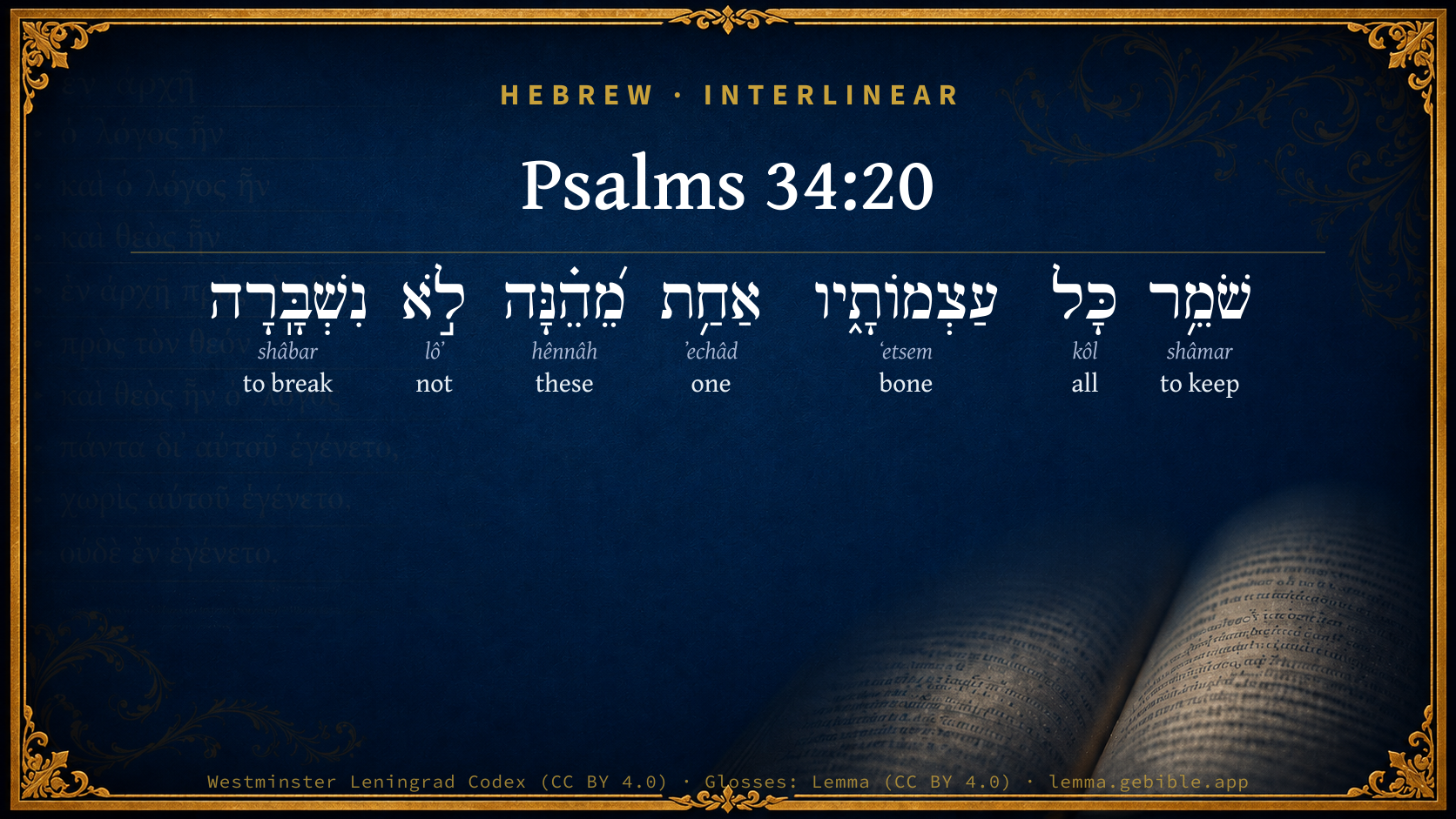
Hebrew (Westminster Leningrad Codex) Psalms 34:20 appears in the Hebrew Old Testament. The text above is from the Westminster Leningrad Codex. Each word links to its Strong’s number, a concise gloss, and parsing drawn from the Open Scriptures Hebrew Bible morphology. Click any word for its full Brown-Driver-Briggs (BDB) entry.
Download image
Cite this verse

Psalms 34:20 (World English Bible). Public Domain. Lemma interlinear Bible study tool, https://lemma.gebible.app/v/psalms/34/20.

Show BibTeX & RIS
BibTeX
RIS
English Translation
He protects all of his bones. Not one of them is broken.
World English Bible · Public Domain
Download a study sheet

One document with this verse’s original text, its word-by-word gloss line, the meaning frame, cross-references with their text, attributed commentary, and full source and license credits — printable, and it pastes into notes with its structure intact.

This verse Autodidact and up

Study sheet (.html) Plain text (.txt)

A passage Seminary Student

Up to 50 verses in one chapter. A passage sheet keeps up to 6 commentary sources and 12 cross-references per verse, in the order this page ranks them, and says so on the sheet whenever that leaves anything out. Ask for a single verse and you get the Autodidact verse sheet above.

Everything on this page stays free to read, with no account — the sheet is a download of what is already on screen, not access to it.

Want to remove ads? Support Godless Engineer
Compare translations 3

The same verse in 3 English versions, stacked beneath the original-language interlinear above. Click any original word for its lexicon entry.

Each is an independent rendering of the whole verse — the interlinear is not word-aligned to these translations.

Highlighted words mark where these versions differ — a whole-verse word diff, not a word-by-word alignment.

  • World English Bible Public Domain
    He protects all of his bones. Not one of them is broken.
  • King James Version Public Domain
    He keepeth all his bones: not one of them is broken.
  • unfoldingWord Literal Text CC BY-SA 4.0
    He is guarding all of his bones; not one of them is broken.

unfoldingWord Literal Text — © unfoldingWord, licensed CC BY-SA 4.0. Word-aligned USFM3 via Door43 (git.door43.org/unfoldingWord/en_ult).

Versions to compare (up to 4)

3 of 4 selected

Show all 18 translations

Every available English version of this verse, each an independent rendering of the whole verse.

  • World English Bible Public Domain
    He protects all of his bones. Not one of them is broken.
  • Berean Standard Bible Public Domain
    He protects all his bones; not one of them will be broken.
  • Majority Standard Bible Public Domain
    He protects all his bones; not one of them will be broken.
  • King James Version Public Domain
    He keepeth all his bones: not one of them is broken.
  • American Standard Version (1901) Public Domain
    He keepeth all his bones: Not one of them is broken.
  • Revised Version (1885) Public Domain
    He keepeth all his bones: not one of them is broken.
  • Geneva Bible (1599) Public Domain
    He keepeth all his bones: not one of them is broken.
  • Douay-Rheims (1899) Public Domain
    Many are the afflictions of the just; but out of them all will the Lord deliver them.
  • Young's Literal Translation Public Domain
    He is keeping all his bones, One of them hath not been broken.
  • Literal Standard Version CC BY-SA 4.0
    He is keeping all his bones, || Not one of them has been broken.
  • Unlocked Literal Bible CC BY-SA 4.0
    He keeps all his bones, not one of them will be broken.
  • unfoldingWord Literal Text CC BY-SA 4.0
    He is guarding all of his bones; not one of them is broken.
  • Darby Bible Public Domain
    He keepeth all his bones; not one of them is broken.
  • World Messianic Bible Public Domain
    He protects all of his bones. Not one of them is broken.
  • Webster's Bible Public Domain
    \\34:19\\Many are the afflictions of the righteous: but the LORD delivereth him out of them all.
  • Free Bible Version CC BY-SA 4.0
    He keeps them safe—not a single one of their bones will be broken.
  • Bible in Basic English Public Domain
    He keeps all his bones: not one of them is broken.
  • JPS Tanakh (1917) Public Domain
    (34-21) He keepeth all his bones; not one of them is broken.

Literal Standard Version (2020), Covenant Press — licensed CC BY-SA 4.0. Text via the HelloAO Bible API (eBible.org). Unlocked Literal Bible (unfoldingWord) — licensed CC BY-SA 4.0. Text via the HelloAO Bible API (eBible.org). unfoldingWord Literal Text — © unfoldingWord, licensed CC BY-SA 4.0. Word-aligned USFM3 via Door43 (git.door43.org/unfoldingWord/en_ult). Free Bible Version, Dr. Jonathan Gallagher — licensed CC BY-SA 4.0. Text via the HelloAO Bible API (eBible.org).

Word by word

More ways to search: Search by grammar → Find every occurrence → Compare this word →

Practice this passage: Drill this verse → Learn its vocabulary →

About this verse

These counts appear in no published source. They are computed here, from the morphology-tagged text and Lemma’s own curated glosses. What Lemma adds →

7
words
7
distinct lemmas
Wisdom
section

Shared distinctive vocabulary

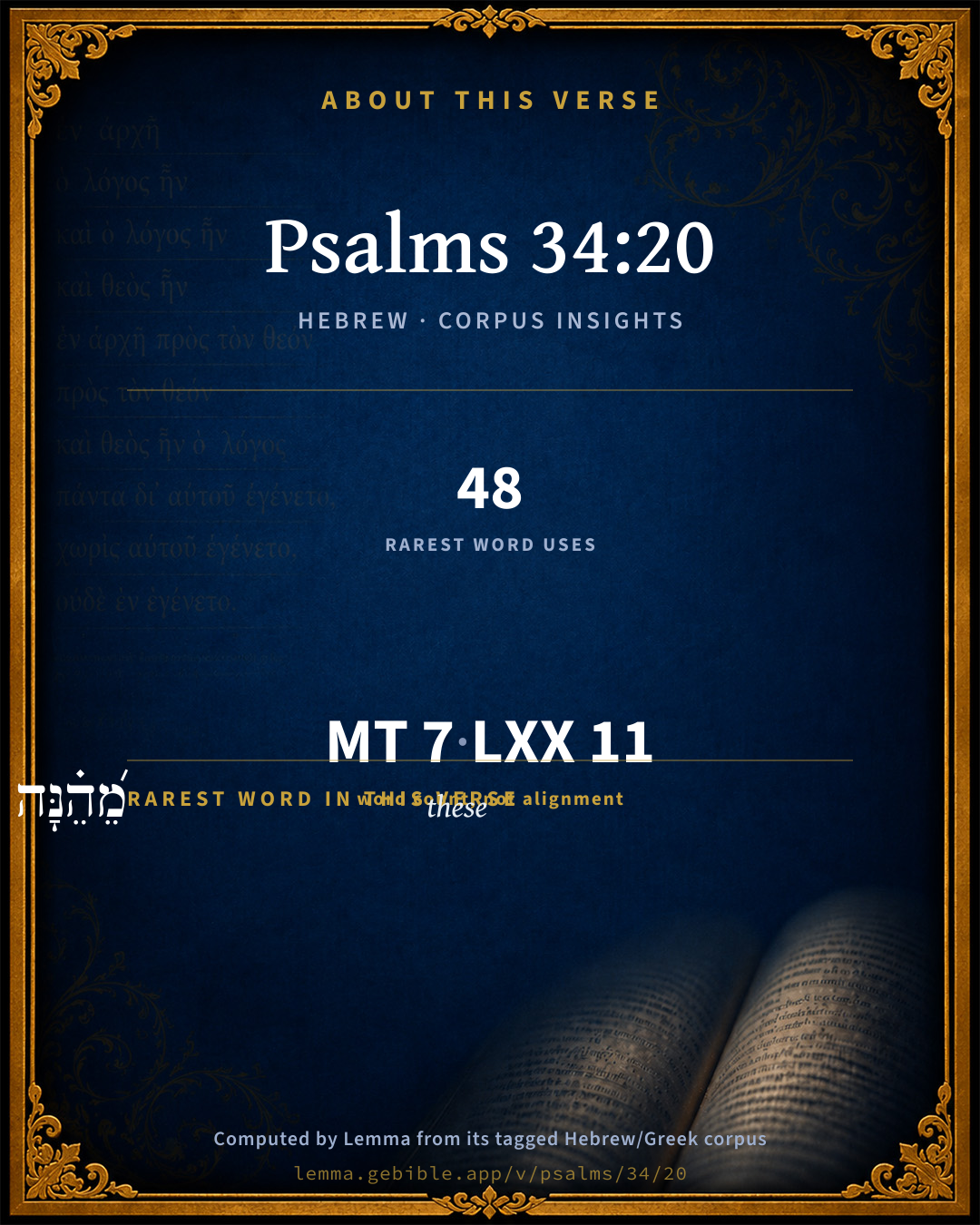
מֵ֝הֵ֗נָּה these H2007 occurs in 44 verses of the Hebrew Bible. Also found in:

Grammatical profile

  • 2 verbs
  • 2 nouns
  • 1 adjective
  • 1 pronoun
  • 1 particle

Verb forms

  • שֹׁמֵ֥ר Qal · Participle Active
  • נִשְׁבָּֽרָה Niphal · Perfect

Hebrew & Septuagint length

In English translation the verse runs 12 words from the Hebrew and 12 from the Septuagint (LXX English) — the same length.

A rough comparison of the two English renderings, which tokenize alike — not a word-level alignment.

Word counts can differ between the Hebrew and the Greek without any difference in meaning — e.g. the Hebrew direct-object marker אֵת has no separate Greek word, and Greek often adds the article ὁ.

In the original languages it is 7 Hebrew tokens and 11 Greek tokens — but the two are counted differently (Hebrew bundles its prefixes and suffixes into one token; the Greek is in lemma form), so that isn’t a like-for-like length.

Cross-references

4

Topical passages linked to Psalms 34:20 in the Treasury of Scripture Knowledge — connected by theme and wording, ordered by reader-vote popularity; previews shown in the World English Bible.

  • John 19:36 For these things happened, that the Scripture might be fulfilled, "A bone of him will not be broken."
  • Psalms 35:10 All my bones shall say, "Yahweh, who is like you, Who delivers the poor from him who is too strong for him, Yes, the poor and the needy from him who robs him?"
  • Psalms 91:12 They will bear you up in their hands, So that you won't dash your foot against a stone.
  • Daniel 6:22–24 My God has sent his angel, and has shut the lions' mouths, and they have not hurt me; because as before him innocence was found in me; and also before you, O king, have I done no hurt.

Cross-references courtesy of OpenBible.info (CC BY 4.0).

Hebrew and Greek witnesses Masoretic Hebrew ↔ Greek Septuagint

The same verse in the two great witnesses to the Old Testament, shown verse-for-verse.

You’re reading Greek Psalm 33 (Hebrew Psalm 34). The Septuagint counts the superscription, so verse numbers can differ from the Hebrew — chapter-level alignment, not verse-by-verse. Numbering follows Rahlfs.

These are two independent witnesses, not word-aligned to each other, and the Septuagint is shown in lemma (dictionary) form.

Hebrew Psalms 34:20 Masoretic · Westminster Leningrad Codex

שֹׁמֵ֥ר כָּל עַצְמוֹתָ֑יו אַחַ֥ת מֵ֝הֵ֗נָּה לֹ֣א נִשְׁבָּֽרָה

He protects all of his bones. Not one of them is broken.

World English Bible · Public Domain

Greek LXX Greek Psalm 33:20 Septuagint · lemma form

πολύς ὁ θλῖψις ὁ δίκαιος καί ἐκ πᾶς αὐτός ῥύομαι αὐτός

He keeps all their bones: not one of them shall be broken.

LXX2012 (modern English Septuagint) · Public Domain

Hebrew: Westminster Leningrad Codex (CC BY 4.0). Greek: Septuagint (public domain); English from LXX2012 (modern English Septuagint) (Public Domain). How the Septuagint differs from the Hebrew →

Commentary

Notes on Psalms 34:20 from classic Christian and Jewish commentators (each source and its license shown beneath its notes). The classic Christian expositions comment on the surrounding passage and are grouped to its opening verse, so a note may address several verses; the Jewish commentaries on the Tanakh (Rashi and others) are per-verse, so they appear only where the commentator wrote on this verse.

Lemma curates 59 commentaries, every one of them public domain or Creative Commons licensed, each selected and text-cleaned for this edition rather than reprinted as found. About our sources →

Trapp's Complete Commentary

John Trapp

Psa 34:20 He keepeth all his bones: not one of them is broken.

Ver. 20. He keepeth all his bones] Which are very many. Perhaps, saith Aben Ezra here, David had been scourged by the Philistines, but his bones were not broken, nor were our Saviour’s, Joh 19:36.

John Trapp, A Commentary or Exposition upon All the Books of the Old and New Testament (1647–1656) — public domain. Text from a community e-Sword module.

J. A. Alexander on Psalms

Joseph Addison Alexander

21. (Psa 34:20). Keeping all his bones—not one of them is broken. The sentence may be completed by supplying the substantive verb: (he is) keeping, i.e. habitually keeps; but it is simpler and better to regard this and the verse before it as one sentence, and the participle as agreeing regularly with Jehovah.—Keeping, in the pregnant sense of watching and preserving.—His bones, his frame, his body. See above, Psa 32:3, and below, Psa 35:10.—The literal translation of the last clause, one of them is not broken, would be equivocal in English. The original expression occurs also in Isa 34:16. The doctrine or promise of this verse is analogous to that in Mat 10:30.

Joseph Addison Alexander, The Psalms Translated and Explained (1850) — public domain. Text from a community e-Sword module.

Tyndale Open Study Notes

Tyndale Open Resources

34:20 Bones represent a person’s entire being (see 6:2). • not one of them is broken: John applied this statement to Jesus at the crucifixion (John 19:36).

Tyndale Open Study Notes — © Tyndale Open Resources, licensed CC BY-SA 4.0. Text via the HelloAO Bible API.

Geneva Bible (1599)

Geneva Bible translators

And as Christ saith, all the hairs of his head.

Geneva Bible (1599) marginal notes — public domain. Text via Bolls.life.

Jamieson, Fausset & Brown

Robert Jamieson, A. R. Fausset & David Brown

bones--framework of the body.

Jamieson, Fausset & Brown — Commentary Critical and Explanatory on the Whole Bible (1871) — public domain (CC PDM 1.0). Text via the HelloAO Bible API.

Adam Clarke's Commentary

Verse 20. He keepeth all his bones] He takes care of his life; and if he have scars, they are honourable ones.

Adam Clarke's Commentary on the Bible (1810–1826) — public domain. Text from a community e-Sword/MySword module.

Ellicott's Commentary for English Readers

(20) Broken.—See Joh_19:36, N. Test. Commentary.

A Bible Commentary for English Readers, edited by Charles John Ellicott (1878–1897) — public domain. Text from a community e-Sword module.

The Cambridge Bible for Schools and Colleges

gen. ed. J. J. S. Perowne

20. As breaking the bones is a forcible metaphor for the torture of pain that racks the bodily framework (Psa_51:8; Isa_38:13), or for cruel oppression (Mic_3:3), so keeping them denotes the safe preservation of the man’s whole being. See note on Psa_6:2. This passage as well as Exo_12:46 may have been present to the Evangelist’s mind as fulfilled in Christ (Joh_19:36). The promise to the righteous man found an unexpectedly literal realisation in the passion of the perfectly Righteous One.

The Cambridge Bible for Schools and Colleges (gen. ed. J. J. S. Perowne; Cambridge University Press, 1878–1918) — public domain. Text from a community e-Sword module.

John Gill's Exposition

He keepeth all his bones; not one of them is broken. This is literally true of Christ, in whom the type of the passover lamb had its accomplishment, and this passage also; see Exo 12:46; and seems better to agree with him than with any of his members, since the bones of many of them have been broken by one accident or another; and especially many of the martyrs of Jesus have had all their bones broken upon the rack or wheel; wherefore, to understand these words of them might tend to create uneasiness and despondency in the minds of such who by any means have their bones broken; as if they were not righteous persons, this promise not being fulfilled in them: and to interpret this of the Lord's keeping the bones of his people in the grave, and in the resurrection putting them together again; this is no other than what will be done to the wicked; it seems therefore best to understand the whole of Christ; and it looks as if this passage was had in view as fulfilled in Joh 19:36; since a Scripture is referred to; but if it is interpreted of the righteous in general, it must be with a limitation; as that their bones are all kept by the Lord, and not one is broken without his knowledge and will; and that they are not broken finally, but restored again perfect and whole in the resurrection, and so will continue to all eternity: the phrase, without entering into particulars, may in general design the care of Providence over the righteous; with this compare Mat 10:29.

.

Psalms 34:21

psa 34:21

psa 34:21

psa 34:21Evil shall slay the wicked,.... Meaning either the evil they designed against the righteous shall return and fall upon their heads, to their own ruin; or the evil of affliction, which to them is the evil of punishment, both here and hereafter, from which they will have no deliverance in the end; though the righteous have from their afflictions, being not properly punishments, but chastisements for sin, and are but for a time; or else the evil of sin, which is the cause of death corporeal and eternal;

and they that hate the righteous shall be desolate; or "shall be guilty" (n); be found so; or "shall be condemned", or "damned", as the Targum renders it. All wicked men hate the righteous, both Jesus Christ the righteous, and his people; and that because they are righteous, and do not run into the same excess of wickedness with them, these will be arraigned at the day of judgment, and will be convicted of all their hard speeches which they have spoken against Christ and his members; and will be pronounced guilty, and will be punished with everlasting destruction.

(n) "rei fiunt", Cocceius; "reatum habebunt", Schmidt; "damnabuntur", Gejerus; "shall be condemned as guilty", Ainsworth.

John Gill's Exposition of the Whole Bible (1746–1763) — public domain (CC PDM 1.0). Text via the HelloAO Bible API.

Albert Barnes' Notes on the Bible

He keepeth all his bones - That is, he preserves or guards the righteous.

Not one of them is broken - Perhaps there is a direct and immediate allusion here to what the psalmist had himself experienced. In His dangers God had preserved him, so that he had escaped without a broken bone. But the statement is more general, and is designed to convey a truth in respect to the usual and proper effect of religion, or to denote the advantage, in reference to personal safety in the dangers of this life, derived from religion. The language is of a general character, such as often occurs in the Scriptures, and it should, in all fairness, be so construed. It cannot mean that the bones of a righteous man are never broken, or that the fact that a man has a broken bone proves that he is not righteous; but it means that, as a general principle, religion conduces to safety, or that the righteous are under the protection of God. Compare Mat 10:30-31. Nothing more can be demanded in the fair interpretation of the language than this.

Albert Barnes' Notes on the Bible (1834–1885) — public domain. Text from a community e-Sword/MySword module.

Matthew Poole's English Annotations

All his bones, i.e. all the parts and members of their bodies, which are synecdochically expressed by the bones, which are the stay and strength of the rest. God will not suffer any mischief to befall him; though he may be oft afflicted, yet he shall not be destroyed. But these words, though they are here spoken of the righteous men in general, of whom they are true in a metaphorical sense; yet they had a further meaning in them, being designed by the Spirit of God (which dictated to David, not only the matter, but the very words and expressions) to signify a great mystery, that none of Christ’s bones should be broken; to which purpose they are alleged, Joh 19:36.

Matthew Poole's English Annotations on the Holy Bible (1683–1685) — public domain. Text from a community e-Sword/MySword module.

The Treasury of David

Charles H. Spurgeon

Ver. 20. He keepeth all his bones: not one of them is broken. David had come off with kicks and cuffs, but no broken bones. No substantial injury occurs to the saints. Eternity will heal all their wounds. Their real self is safe; they may have flesh wounds, but no part of the essential fabric of their being shall be broken. This verse may refer to frequent providential protections vouchsafed to the saints; but as good men have had broken limbs as well as others, it cannot absolutely be applied to bodily preservations; but must, it seems to me, be spiritually applied to great injuries of soul, which are for ever prevented by divine love. Not a bone of the mystical body of Christ shall be broken, even as his corporeal frame was preserved intact. Divine love watches over every believer as it did over Jesus; no fatal injury shall happen to us, we shall neither be halt or maimed in the kingdom, but shall be presented after life's trials are over without spot or wrinkle or any such thing, being preserved in Christ Jesus, and kept by the power of God through faith unto salvation.

Ver. 20. He keepeth all his bones, which were very many. Perhaps (saith Abenezra here), David had been scourged by the Philistines, but his bones were not broken, nor were our Saviour's. Joh 19:36. John Trapp.

Ver. 20. All his bones. Muis observes, "It says not his body, for this he permits to be afflicted; but it signifies that the evils of the godly are light, and scarcely penetrate to the bone; "but Geier observes, "This is too subtle, rather the bone reminds us of the essential parts of the body, by whose injury the whole frame is endangered. It is a proverbial form of speech like that in Mt 10:30, `The very hairs of your head are all numbered, ' expressing the remarkable defence afforded to the righteous." Genebrard says, "The bones are put by synecdoche for all the members." From Poli Synopsis.

Ver. 20. The passover lamb, of which not a bone was broken, prefigured Jesus as one, "not a bone of whose body should be broken; " and yet, at the same time, it prefigured the complete keeping and safety of Christ's body, the church; as it is written, He keepeth all his bones; not one of them is broken. Andrew A. Bonar's Commentary on Leviticus.

Ver. 20. Christ's bones were in themselves breakable, but could not actually be broken by all the violence in the world, because God had fore decreed, a bone of him shall not be broken. So we confess God's children mortal; but all the power of devil or man may not, must not, cannot, kill them before their conversion, according to God's election of them to life, which must be fully accomplished. Thomas Fuller.

Ver. 20. Observe as a point of resemblance between this and the following Psalm, the mention of the bones here and in Ps 35:10. C. Wordsworth.

Ver. 20. The real safety of a believer when in great perils. His soul, his spiritual life, his faith, hope, love, etc.; his interest in Jesus, his adoption, justification, these all kept.

Psalms 34:21*

Charles H. Spurgeon's The Treasury of David (1869–1885) — public domain. Psalms only. Text from a community e-Sword/MySword module.

The Pulpit Commentary

He keepeth all his bones: not one of them is broken. The "bones" are put for the entire frame, or body, of a man. (comp. Psa_6:2 Psa_31:10 Psa_32:3 Psa_38:3 Psa_42:10 Psa_102:3) God "keepeth," i.e. watches over, keeps from harm, the entire persons of the righteous, letting no hurt touch them, but such as he permits and sees to be needful. In using the phrase, "not one of them is broken," the psalmist probably alludes to Exo_12:46 and Num_9:12, taking the Paschal lamb as a type of innocence, and so of godliness.

The Pulpit Commentary (1880–1919), ed. H.D.M. Spence-Jones & Joseph S. Exell — public domain. Text from a community e-Sword module.

John Wesley's Explanatory Notes

Bones - All the parts and members of their bodies.

John Wesley, Explanatory Notes Upon the Whole Bible (1754–1765) — public domain. Text via the GEBible commentary corpus.

Scofield Reference Notes

C. I. Scofield

He keepeth

See Exo 12:46; Joh 19:36

The Scofield Reference Bible (1917 edition), notes by C. I. Scofield — public domain. Text from a community e-Sword module.

Rashi

Rabbi Shlomo Yitzchaki (Rashi)

Many evils befall the righteous Many evils and terrors befall him, and he is saved from all of them.

Rashi on the Tanakh — English translations: “The Judaica Press complete Tanach with Rashi, translated by A. J. Rosenberg” (CC BY 4.0); “Pentateuch with Rashi's commentary by M. Rosenbaum and A.M. Silbermann, 1929-1934” (public domain); “The Metsudah Tanach series, Lakewood, N.J” (CC BY 4.0); and “The Book of Joshua, Metsudah Publications, 1997” (CC BY 4.0). Text via Sefaria.

Lesson kit

Teaching starters — assembled from the data on this page, not authored interpretation. Every prompt links to the verse data it draws on. Edit before teaching.

Psalms, in the Wisdom, opens this verse with 7 words (7 distinct Hebrew lemmas). Its most distinctive word is hênnâh (“these”). A historical commentator’s framing appears above. Read the whole chapter for the surrounding context.

Discussion questions

  1. How does “these” (hênnâh) shape what this verse is saying?
  2. How does Genesis 6:2, which shares the word «these», read alongside this verse?
  3. These translations render this verse differently. What is at stake in choosing one wording over another?
  4. «שֹׁמֵ֥ר» is a Qal Participle Active verb. How does that grammatical form shape the action described?
  5. Compare how Trapp's Complete Commentary and J. A. Alexander on Psalms read this verse. Where do they agree or differ?

Things to notice

Reading settings

Reading text

Shown beneath each verse's original-language words.

Old Testament
Old Testament edition

Read the OT as the Masoretic Hebrew (MT) or the Greek Septuagint (LXX).

English shown for the Greek Septuagint (in the Hebrew ↔ Greek comparison).

Comparing translations? Open the Compare panel on any verse page to stack up to four side by side.