2 Corinthians 2:16

Greek (Tischendorf 8th ed.) 2 Corinthians 2:16 appears in the Greek New Testament. The text above is from the Tischendorf 8th edition. Each word links to its Strong’s number and a concise gloss. Click any word for its full Thayer’s Greek Lexicon entry.
Download image
Cite this verse

2 Corinthians 2:16 (World English Bible). Public Domain. Lemma interlinear Bible study tool, https://lemma.gebible.app/v/2-corinthians/2/16.

Show BibTeX & RIS
BibTeX
RIS
English Translation
to the one a stench from death to death; to the other a sweet aroma from life to life. Who is sufficient for these things?
World English Bible · Public Domain
Download a study sheet

One document with this verse’s original text, its word-by-word gloss line, the meaning frame, cross-references with their text, attributed commentary, and full source and license credits — printable, and it pastes into notes with its structure intact.

This verse Autodidact and up

Study sheet (.html) Plain text (.txt)

A passage Seminary Student

Up to 50 verses in one chapter. A passage sheet keeps up to 6 commentary sources and 12 cross-references per verse, in the order this page ranks them, and says so on the sheet whenever that leaves anything out. Ask for a single verse and you get the Autodidact verse sheet above.

Everything on this page stays free to read, with no account — the sheet is a download of what is already on screen, not access to it.

Want to remove ads? Support Godless Engineer
Compare translations 3

The same verse in 3 English versions, stacked beneath the original-language interlinear above. Click any original word for its lexicon entry.

Each is an independent rendering of the whole verse — the interlinear is not word-aligned to these translations.

Highlighted words mark where these versions differ — a whole-verse word diff, not a word-by-word alignment.

  • World English Bible Public Domain
    to the one a stench from death to death; to the other a sweet aroma from life to life. Who is sufficient for these things?
  • King James Version Public Domain
    To the one we are the savour of death unto death; and to the other the savour of life unto life. And who is sufficient for these things?
  • unfoldingWord Literal Text CC BY-SA 4.0
    to the ones, indeed, an aroma from death to death, but to the, an aroma from life to life. And for these things, who sufficient?

unfoldingWord Literal Text — © unfoldingWord, licensed CC BY-SA 4.0. Word-aligned USFM3 via Door43 (git.door43.org/unfoldingWord/en_ult).

Versions to compare (up to 4)

3 of 4 selected

Show all 19 translations

Every available English version of this verse, each an independent rendering of the whole verse.

  • World English Bible Public Domain
    to the one a stench from death to death; to the other a sweet aroma from life to life. Who is sufficient for these things?
  • Berean Standard Bible Public Domain
    To the one, we are an odor of death and demise; to the other, a fragrance that brings life. And who is qualified for such a task?
  • Majority Standard Bible Public Domain
    To the one we are an odor that brings death, to the other a fragrance that brings life. And who is qualified for such a task?
  • King James Version Public Domain
    To the one we are the savour of death unto death; and to the other the savour of life unto life. And who is sufficient for these things?
  • American Standard Version (1901) Public Domain
    to the one a savor from death unto death; to the other a savor from life unto life. And who is sufficient for these things?
  • Revised Version (1885) Public Domain
    to the one a savour from death unto death; to the other a savour from life unto life. And who is sufficient for these things?
  • Geneva Bible (1599) Public Domain
    To the one we are the sauour of death, vnto death, and to the other the sauour of life, vnto life: and who is sufficient for these things?
  • Douay-Rheims (1899) Public Domain
    To the one indeed the odour of death unto death: but to the others the odour of life unto life. And for these things who is so sufficient?
  • Young's Literal Translation Public Domain
    to the one, indeed, a fragrance of death to death, and to the other, a fragrance of life to life; and for these things who is sufficient?
  • Literal Standard Version CC BY-SA 4.0
    to one, indeed, a fragrance of death to death, and to the other, a fragrance of life to life; and who is sufficient for these things?
  • Unlocked Literal Bible CC BY-SA 4.0
    To the people who are perishing, it is an aroma from death to death. To the ones being saved, it is an aroma from life to life. Who is worthy of these things?
  • unfoldingWord Literal Text CC BY-SA 4.0
    to the ones, indeed, an aroma from death to death, but to the, an aroma from life to life. And for these things, who sufficient?
  • Darby Bible Public Domain
    to the one an odour from death unto death, but to the others an odour from life unto life; and who [is] sufficient for these things?
  • World Messianic Bible Public Domain
    to the one a stench from death to death, to the other a sweet aroma from life to life. Who is sufficient for these things?
  • Webster's Bible Public Domain
    To the one we are the savor of death to death; and to the other the savor of life to life. And who is sufficient for these things?
  • Free Bible Version CC BY-SA 4.0
    To those who are dying it is the smell of decay, while to those who are being saved it is the scent of life! But who is up to such an assignment?
  • Bible in Basic English Public Domain
    To the one it is a perfume of death to death; to the other a perfume of life to life. And who is enough for such things?
  • Text-Critical English NT CC BY 4.0
    to the latter we are a smell of death leading to death, but to the former we are a fragrance of life leading to life. And who is equal to such a task?
  • Tyndale New Testament (1534) Public Domain
    To the one parte are we the savoure of deeth vnto deeth. And vnto the other parte are we the savoure of lyfe vnto lyfe. And who is mete vnto these thinges?

Literal Standard Version (2020), Covenant Press — licensed CC BY-SA 4.0. Text via the HelloAO Bible API (eBible.org). Unlocked Literal Bible (unfoldingWord) — licensed CC BY-SA 4.0. Text via the HelloAO Bible API (eBible.org). unfoldingWord Literal Text — © unfoldingWord, licensed CC BY-SA 4.0. Word-aligned USFM3 via Door43 (git.door43.org/unfoldingWord/en_ult). Free Bible Version, Dr. Jonathan Gallagher — licensed CC BY-SA 4.0. Text via the HelloAO Bible API (eBible.org).

Word by word

More ways to search: Search by grammar → Find every occurrence → Compare this word →

Practice this passage: Drill this verse → Learn its vocabulary →

ὀσμὴ
osmḗ
G3744
“smell”
Noun, Nominative, Singular, Feminine
Part of Speech
Noun
Case
Nominative
Number
Singular
Gender
Feminine
Full Thayer's Definition

Origin: from G3605

TDNT: 13:13,7

1. a smell, odour
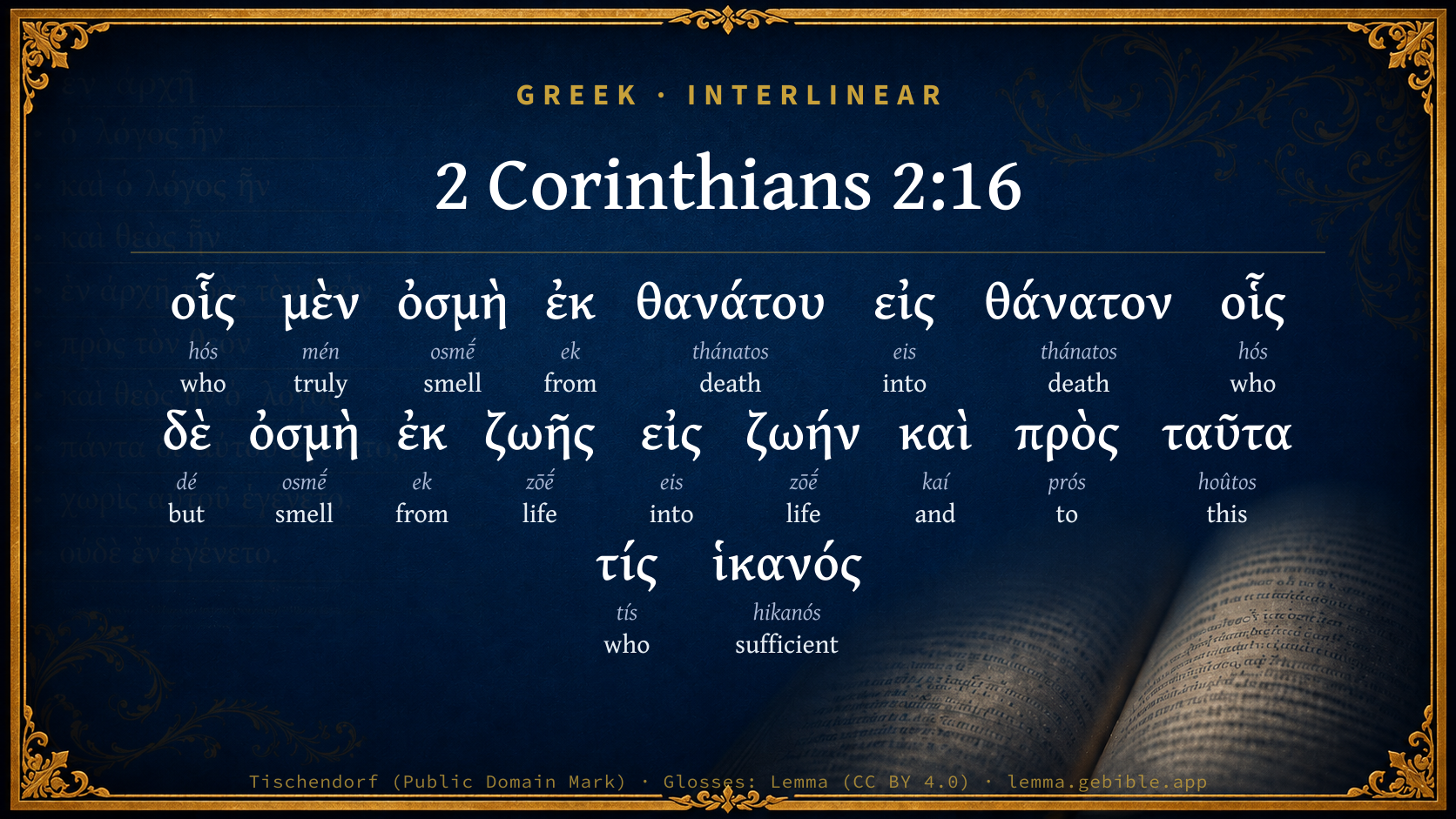
  1. οἷς hós G3739 “who” Relative pronoun, Dative, Plural, Masculine
  2. μὲν mén G3303 “truly” Particle
  3. ἐκ ek G1537 “from” Preposition
  4. θανάτου thánatos G2288 “death” Noun, Genitive, Singular, Masculine
  5. εἰς eis G1519 “into” Preposition
  6. θάνατον thánatos G2288 “death” Noun, Accusative, Singular, Masculine
  7. οἷς hós G3739 “who” Relative pronoun, Dative, Plural, Masculine
  8. δὲ dé G1161 “but” Conjunction
  9. ὀσμὴ osmḗ G3744 “smell” Noun, Nominative, Singular, Feminine
  10. ἐκ ek G1537 “from” Preposition
  11. ζωῆς zōḗ G2222 “life” Noun, Genitive, Singular, Feminine
  12. εἰς eis G1519 “into” Preposition
  13. ζωήν zōḗ G2222 “life” Noun, Accusative, Singular, Feminine
  14. καὶ kaí G2532 “and” Conjunction
  15. πρὸς prós G4314 “to” Preposition
  16. ταῦτα hoûtos G3778 “this” Demonstrative pronoun, Accusative, Plural, Neuter
  17. τίς tís G5101 “who” Interrogative pronoun, Nominative, Singular, Masculine
  18. ἱκανός hikanós G2425 “sufficient” Adjective, Nominative, Singular, Masculine

About this verse

These counts appear in no published source. They are computed here, from the morphology-tagged text and Lemma’s own curated glosses. What Lemma adds →

19
words
13
distinct lemmas
Pauline Epistles
section

Notable vocabulary

The rarest word here is ὀσμὴ smell G3744 — appearing just 6 times in the whole Greek New Testament.

Shared distinctive vocabulary

ὀσμὴ smell G3744 occurs in 5 verses of the Greek New Testament. Also found in:

Repetition

Words recur within this verse:

  • ὀσμὴ smell G3744 ×2
  • θανάτου death G2288 ×2
  • εἰς into G1519 ×2
  • ζωῆς life G2222 ×2
  • οἷς who G3739 ×2
  • ἐκ from G1537 ×2

Cross-references

8

Topical passages linked to 2 Corinthians 2:16 in the Treasury of Scripture Knowledge — connected by theme and wording, ordered by reader-vote popularity; previews shown in the World English Bible.

  • 2 Corinthians 3:5–6 not that we are sufficient of ourselves, to account anything as from ourselves; but our sufficiency is from God;
  • John 9:39 Jesus said, "I came into this world for judgment, that those who don't see may see; and that those who see may become blind."
  • 1 Peter 2:7–8 For you therefore who believe is the honor, but for such as are disobedient, "The stone which the builders rejected, Has become the chief cornerstone,"
  • Luke 2:34 and Simeon blessed them, and said to Mary, his mother, "Behold, this child is set for the falling and the rising of many in Israel, and for a sign which is spoken against.
  • 1 Corinthians 15:10 But by the grace of God I am what I am. His grace which was bestowed on me was not futile, but I worked more than all of them; yet not I, but the grace of God which was with me.
  • Acts 13:45–47 But when the Jews saw the multitudes, they were filled with jealousy, and contradicted the things which were spoken by Paul, and blasphemed.
  • Acts 20:26–27 Therefore I testify to you this day that I am clean from the blood of all men,
  • 2 Corinthians 12:11 I have become foolish in boasting. You compelled me, for I ought to have been commended by you, for in nothing was I inferior to the very best apostles, though I am nothing.

Cross-references courtesy of OpenBible.info (CC BY 4.0).

Commentary

Notes on 2 Corinthians 2:16 from classic Christian and Jewish commentators (each source and its license shown beneath its notes). The classic Christian expositions comment on the surrounding passage and are grouped to its opening verse, so a note may address several verses; the Jewish commentaries on the Tanakh (Rashi and others) are per-verse, so they appear only where the commentator wrote on this verse.

Lemma curates 59 commentaries, every one of them public domain or Creative Commons licensed, each selected and text-cleaned for this edition rather than reprinted as found. About our sources →

Bengel's Gnomon

Johann Albrecht Bengel

2Co 2:16. Ὀσμὴ θανάτου, the savour of death) They reckon us [and our Gospel message] as a thing dead; hence they meet with death as the natural and just consequence.—οἷς δὲ, whilst to the former) who are being saved. This verse, if we compare the antecedents and consequents, has a chiasmus.[13]—καὶ πρὸς ταῦτα τίς ἱκανός; and who is sufficient for these things?) Who? i.e. but few, viz., we. This sentiment [idea] is modestly hinted at, and is left to be perceived and acknowledged by the Corinthians; comp. the next verse. Paul asserts at considerable length both his own sufficiency (ἱκανότητα) and that of the few in the following chapter, and repeats this very word, 2Co 2:5-6, of that ch., so that his adversaries seem either expressly or in sense [virtually] to have denied, that Paul was sufficient.

[13] See App.

Bengel's Gnomon of the New Testament — English translation (T&T Clark, Edinburgh, 1860) — public domain. Text from a community e-Sword module.

Expositor's Greek Testament

ed. W. Robertson Nicoll

2Co 2:16 . οἷς μὲν ὀσμὴ κ . τ . λ .: to the one a savour from death unto death; to the other a savour from life unto life ; and yet it is the same ὀσμή in both cases; cf. Luk 2:34 . ἐκ θανάτου εἰς θάνατον may be illustrated by Rom 1:17 , ἐκ πίστεως εἰς πίστιν (see also chap. 2Co 3:18 ); emphasis is gained, according to the Hebrew idiom, by repeating the important word. The Rabbinical parallels given by Wetstein and others show that the metaphor of this verse was common among Jewish writers they called the Law an aroma vitae to the good, but an aroma mortis to the evil. καὶ πρὸς ταῦτα τίς ἱκανός : who then is sufficient for these things? sc. , to fill such a part as has been just described (for καὶ … τίς see on 2Co 2:2 above). St. Paul’s answer is not fully expressed, but the sequence of thought is this: “it might be thought that no one is sufficient for such a task; and yet we are, for we are not as the many,” etc.; an answer which he is careful to explain and qualify in 2Co 2:5 of the next chapter, lest he should be accused of undue confidence.

The Expositor's Greek Testament, edited by W. Robertson Nicoll (1897–1910) — public domain. Text from a community e-Sword module.

Geneva Bible (1599)

Geneva Bible translators

Again, he putteth away all suspicion of arrogance, attributing all things that he did, to the virtue of God, whom he serveth sincerely, and without all dishonest affection: whereof he maketh them witnesses even to verse 6 of the next chapter.

Geneva Bible (1599) marginal notes — public domain. Text via Bolls.life.

Jamieson, Fausset & Brown

Robert Jamieson, A. R. Fausset & David Brown

savour of death unto death . . . of life unto life--an odor arising out of death (a mere announcement of a dead Christ, and a virtually lifeless Gospel, in which light unbelievers regard the Gospel message), ending (as the just and natural consequence) in death (to the unbeliever); (but to the believer) an odor arising out of life (that is, the announcement of a risen and living Saviour), ending in life (to the believer) (Mat 21:44; Luk 2:34; Joh 9:39).

who is sufficient for these things?--namely, for diffusing aright everywhere the savor of Christ, so diverse in its effects on believers and unbelievers. He here prepares the way for one purpose of his Epistle, namely, to vindicate his apostolic mission from its detractors at Corinth, who denied his sufficiency. The Greek order puts prominently foremost the momentous and difficult task assigned to him, "For these things, who is sufficient?" He answers his own question (Co2 3:5-6), "Not that we are sufficient of ourselves, but our sufficiency is of God, who hath made us able (Greek, 'sufficient') ministers," &c.

Jamieson, Fausset & Brown — Commentary Critical and Explanatory on the Whole Bible (1871) — public domain (CC PDM 1.0). Text via the HelloAO Bible API.

Adam Clarke's Commentary

Verse 16. To the one we are the savour of death unto death] There are several sayings among the ancient Jewish writers similar to this. In Debarim Rabba, sec. i. fol. 248, it is said: "As the bee brings home honey to its owner, but stings others; so it is with the words of the law;" : סם חיים לישראל sam chaiyim leyisrael, "They are a savour of lives to the Israelites:" וסם המות לאומות העולם vesam hammaveth leomoth haolam, "And a savour of death to the people of this world." The learned reader may see much more to this effect in Schoettgen. The apostle's meaning is plain: those who believe and receive the Gospel are saved; those who reject it, perish. The meaning of the rabbins is not less plain: the Israelites received the law and the prophets as from God, and thus possessed the means of salvation; the Gentiles ridiculed and despised them, and thus continued in the path of death. The same happens to the present day to those who receive and to those who reject the Gospel: it is the means of salvation to the former, it is the means of destruction to the latter; for they are not only not saved because they do not believe the Gospel, but they are condemned because they reject it. For how can they escape who neglect so great a salvation? The sun which nourishes the tree that is planted in a good soil, decomposes and destroys it if plucked up and laid on the surface.

That the saved, σωζομενοι, and they that perish, απολλυμενοι mean those who receive and obey the Gospel, and those who reject it and live and die in sin, needs no proof. No other kinds of reprobate and elect, in reference to the eternal world, are known in the BOOK of GOD, though they abound in the books of men. The Jews were possessed with such an exalted opinion of their own excellence that they imagined that all the love and mercy of God were concentrated among themselves, and that God never would extend his grace to the Gentiles.

Such sentiments may become JEWS but when we find some Gentiles arrogating to themselves all the salvation of God, and endeavouring to prove that he has excluded the major part even of their own world-the Gentiles, from the possibility of obtaining mercy; and that God has made an eternal purpose, that the death of Christ shall never avail them, and that no saving grace shall ever be granted to them, and that they shall infallibly and eternally perish; what shall we say to such things? It is Judaism in its worst shape: Judaism with innumerable deteriorations. The propagators of such systems must answer for them to God.

Who is sufficient for these things?] Is it the false apostle that has been labouring to pervert you? Or, is it the men to whom God has given an extraordinary commission, and sealed it by the miraculous gifts of the Holy Ghost? That this is the apostle's meaning is evident from the following verse.

Adam Clarke's Commentary on the Bible (1810–1826) — public domain. Text from a community e-Sword/MySword module.

John Calvin's Commentaries

16. And who is sufficient for these things? This exclamation is thought by some to be introduced by way of guarding against arrogance, for he confesses, that to discharge the office of a good Apostle to Christ is a thing that exceeds all human power, and thus he ascribes the praise to God. Others think, that he takes notice of the small number of good ministers. I am of opinion, that there is an implied contrast that is shortly afterwards expressed. “Profession, it is true, is common, and many confidently boast; but to have the reality, is indicative of a rare and distinguished excellence. I claim nothing for myself, but what will be discovered to be in me, if trial is made.” Accordingly, as those, who hold in common the office of instructor, claim to themselves indiscriminately the title, Paul, by claiming to himself a peculiar excellence, separates himself from the herd of those, who had little or no experience of the influence of the Spirit.

John Calvin's Commentaries (1540-1563) — public domain. Text from the Calvin Translation Society English edition (1840s-50s) via the Christian Classics Ethereal Library (ccel.org). Calvin's coverage is partial (roughly two-thirds of the Bible); uncommented books and verses are honest gaps, never fabricated. The 19th-century editor's footnotes and remarks are omitted so the notes are faithfully Calvin's own voice.

Ellicott's Commentary for English Readers

(16) To the one we are the savour of death unto death.—As with other instances of St. Paul’s figurative language, we note the workings of a deeply, though unconsciously, poetic imagination. Keeping the image of the triumph in his mind, he thinks of the widely different impression and effect which the odour of the incense would work in the two classes of the prisoners. To some it would seem to be as a breath from Paradise, giving life and health; to others its sweetness would seem sickly and pestilential, coming as from a charnel house, having in it the “savour of death,” and leading to death as its issue.

And who is sufficient for these things?—The question forced itself on St. Paul’s mind as it forces itself on the mind of every true teacher, Who can feel qualified for a work which involves such tremendous issues? If we ask how it was that he did not draw back from it altogether, the answer is found in other words of his: “God has made us able (sufficient) ministers of the New Testament” (2Co_3:6); “our sufficiency is of God” (2Co_3:5). It is obvious that even here he assumes his sufficiency, and gives in the next verse the ground of the assumption.

A Bible Commentary for English Readers, edited by Charles John Ellicott (1878–1897) — public domain. Text from a community e-Sword module.

The Cambridge Bible for Schools and Colleges

gen. ed. J. J. S. Perowne

16. To the one we are the savour of death unto death; and to the other the savour of life unto life] The reading accepted by most recent editors is ‘a savour arising from death and resulting in death,’ and ‘a savour arising from life and resulting in life,’ according to a construction common to St Paul, of which the most remarkable instance, perhaps, is Rom_1:17. The Gospel is a savour arising from death, because it proclaims the Death of Christ as the foundation of all reconciliation. Cf. Joh_9:39; 1Co_1:23-24; 1Co_15:14-18; 1Pe_2:7-8. To those only who believe in a risen, ascended, living Christ, is the Gospel a savour arising from, and tending to life. Dr Plumptre remarks on the way in which the figure of the triumphal procession is kept before the reader. To some of those who were being led in procession the odour of the incense “would seem as a breath from Paradise, giving life and health; to others its sweetness would seem sickly and pestilential, coming as from a charnel house.”

And who is sufficient for these things?] The thought occurs to the Apostle that the wondrous effects consequent on the first proclamation of Christ’s Gospel are far above unassisted human powers. Cf. 1Co_2:12-16. But he defers the consideration of this topic to ch. 2Co_3:5, confining himself at present (see next verse) to assigning the reason for his exclamation, namely, that he can fearlessly appeal to what was above man’s natural ability, the transparent honesty, and thorough faithfulness to God, of his preaching. Perhaps also the Apostle intends to convey the idea that what may be an easy task for those who proclaim a spurious Gospel, is one that demands the utmost watchfulness on the part of the genuine minister of Christ.

The Cambridge Bible for Schools and Colleges (gen. ed. J. J. S. Perowne; Cambridge University Press, 1878–1918) — public domain. Text from a community e-Sword module.

John Gill's Exposition

To the one we are the savour of death unto death,.... Who are for death, or appointed to it; see Jer 43:11. What the apostle says of the Gospel, and Gospel ministers, the Jews his countrymen used frequently to say of the law, and to which he seems to refer;

"saith Rabba (f), to them that go on the right hand of it, (the law,) it is , "the savour of life"; but to them that go on the left hand of it, it is , "the savour of death".''

Again (g),

"everyone that studies in the law for the sake of it, to him it becomes , "the savour of life", according to Pro 3:18, but everyone that studies in the law, not for the sake of it, to him it becomes , "the savour of death";''

once more (h),

"if a man is worthy or righteous, to him the law becomes , "the savour of life"; but if he is not righteous, it becomes to him , "the savour of death":''

and this they not only say of the written law, but also of their oral law (i), and are not contented with those general descriptions of persons to whom the law is so, but particularly mention the Gentiles;

"the words of the law (say they (k)) are , "the savour of life", to the Israelites; and , "the savour of death", to the nations of the world:''

that the law should be the savour of death, since it is the ministration of it, and cannot give life, see Gal 3:21, is no wonder; but that the Gospel and the ministers of that, should be the savour of death unto death, may seem strange, but so it is. These preach up salvation by the death of Christ, and so are the sweet savour of the death of Christ; but this being despised and rejected by the sons of men, is "unto the death", and issues in the eternal death of the despisers and rejecters of it; likewise this doctrine preached by them, strikes with death all a man's wisdom, righteousness, and holiness, and declares that life and salvation are only by Christ and his righteousness; and besides, is attended with persecution and death, and therefore is foolishness to them that perish; and so becomes "the savour of death unto death"; a savour, but not a sweet savour, nor the sweet savour of Christ; a sweet savour indeed to God, whose justice, holiness, power, and wisdom, are displayed in the death and righteous destruction of sinners, but not to them:

to the other, the savour of life unto life; those who are ordained to eternal life. The Gospel preached by Christ's faithful ministers is the means of quickening souls, and giving them "spiritual life"; and of supporting and maintaining that life, and of nourishing them up unto "eternal life"; and so becomes "the savour of life" spiritual, "unto life" eternal. The Alexandrian copy, and some others, and so the Ethiopic version, read both clauses, "from death to death, and from life to life"; with which compare Rom 1:17, and then the meaning may be, either as Grotius observes, that the ill report of the Gospel from men dead in sin, brings death to those who give credit to it; and the good report of it from God, the author of life, to which may be added from ministers, who are alive in a spiritual sense, is the means of life to others: or they are the means of adding death to death, death eternal, to death spiritual, or moral; death for sin, to death in sin, the Gospel being despised; and of increasing spiritual life, the comforts of it; and of adding eternal life to spiritual life: upon the whole of which, the apostle makes this exclamation,

and who is sufficient for these things; the meaning of which is either, who is able to search and find out the reason of this different influence of the Gospel ministry upon the souls of men? no man can do it; it must be ascribed to the sovereign will and pleasure of God, who hides the Gospel from some, and reveals it to others; or who is sufficient for the preaching of the Gospel? no man is sufficient of himself, very insufficient in the best sense, and none so but by the grace of God, and gifts of his Spirit; or who is sufficient to give success to the Gospel when preached? none can do this; Paul may plant, and Apollos water, but it is God alone that gives the increase.

(f) T. Bab. Sabbat, fol. 88. 2. (g) Taanith, fol. 7. 1. (h) Yoma, fol 72. 2. (i) Zohar in Gen. fol. 19. 3. (k) Vajikra Rabba, fol. 147. 1. Debarim Rabba, fol. 233. 3. Shirhashirim Rabba, fol. 9. 4.

John Gill's Exposition of the Whole Bible (1746–1763) — public domain (CC PDM 1.0). Text via the HelloAO Bible API.

Trapp's Complete Commentary

John Trapp

16 To the one we are the savour of death unto death; and to the other the savour of life unto life. And who is sufficient for these things?

Ver. 16. The savour of death] Aristotle writeth, that vultures are killed with oil of roses. Swine (saith Pliny) cannot live in some parts of Arabia, by reason of the sweet scent of aromatical trees there growing in every wood. Tigers are enraged with perfumes. Vipera interficitur palmis, Snakes are killed with palm dates, saith Pausanias. Moses killed the Egyptian, saved the Israelite. Obededom was blessed for the ark, the Philistines were cursed. The sun of the gospel shining upon one that is ordained to eternal life reviveth and quickeneth him; but lighting upon a child of death it causeth him to stink more abominably. Gregory in his Morals saith that "this word is like the planet Venus, which unto some is Lucifer, a bright morning star arising in their hearts, whereby they are roused up, and stirred from iniquity; but to the other is Hesperus, an evening star, whereby they are brought to bed, and laid asleep in impiety." Oecumenius tells us, that the fragrance of precious ointment is wholesome for doves, but kills the beetle, columbam vegetal, scarabaeum necat, &c.

And who is sufficient] And yet now who is it almost that thinks not himself sufficient for that sacred and tremendous function of the ministry "Who am I?" saith Moses; "Who am I not?" saith our upstart. Bradford was hardly persuaded to become a preacher. Latimer leaped when he laid down his bishopric, being discharged, as he said, of such a heavy burthen. Luther was wont to say, that if he were again to choose his calling, he would dig, or do anything rather than take upon him the office of a minister; so said reverend Mr Whately of Banbury once in my hearing.

John Trapp, A Commentary or Exposition upon All the Books of the Old and New Testament (1647–1656) — public domain. Text from a community e-Sword module.

Albert Barnes' Notes on the Bible

To the one - To those who perish.

We are the savour of death unto death - We are the occasion of deepening their condemnation, and of sinking them lower into ruin. The expression used here means literally, “to the one class we bear a death-conveying odor leading to their death” - a savor, a smell which, under the circumstances, is destructive to life, and which leads to death. Mr. Locke renders this: “To the one my preaching is of ill savor, unacceptable and offensive, by their rejecting whereof they draw death on themselves.” Grateful as their labors were to God, and acceptable as would be their efforts, whatever might be the results, yet Paul could not be ignorant that the gospel would in fact be the means of greater condemnation to many; see the notes on 2Co 2:15. It was indeed by their own fault; yet wherever the gospel was preached, it would to many have this result. It is probable that the language here used is borrowed from similar expressions which were common among the Jews. Thus, in Debarim Rabba, sec. 1, fol. 248, it is said, “As the bee brings home honey to the owner, but stings others, so it is with the words of the Law.” “They (the words of the Law) are a savor of life to Israel, but a savor of death to the people of this world.”

Thus, in Taarieth, fol. 7, 1, “Whoever gives attention to the Law on account of the Law itself, to him it becomes an aromatic of life (סם חיים cam chayiym), but to him who does not attend to the Law on account of the Law itself, to him it becomes an aromatic of death (סם מות cam mowt) “ - the idea of which is, that as medicines skillfully applied will heal, but if unskillfully applied will aggravate a disease, so it is with the words of the Law. Again, “The word of the Law which proceeds out of the mouth of God is an odor of life to the Israelites, but an odor of death to the Gentiles;” see Rosenmuller, and Bloomfield. The sense of the passage is plain, that the gospel, by the willful rejection of it, becomes the means of the increased guilt and condemnation of many of those who hear it.

And to the other - To those who embrace it, and are saved.

The savor of life - An odor, or fragrance producing life, or tending to life. It is a living, or life-giving savor. it is in itself grateful and pleasant.

Unto life - Tending to life; or adapted to produce life. The word “life” here, as often elsewhere, is used to denote salvation. It is:

Life in opposition to the death in sin in which all are by nature; In opposition to death in the grave - as it leads to a glorious resurrection; In opposition to eternal death; to the second dying, as it leads to life and peace and joy in heaven; see the words “life” and “death” explained in the notes on Rom 6:23. The gospel is “the savor of life unto life,” because: It is its nature and tendency to produce life and salvation. It is adapted to that; and is designed to that end. Because it actually results in the life and salvation of those who embrace it. It is the immediate and direct cause of their salvation; of their recovery from sin; of their glorious resurrection; of their eternal life in heaven.

And who is sufficient for these things? - For the arduous and responsible work of the ministry; for a work whose influence must be felt either in the eternal salvation, or the eternal ruin of the soul. Who is worthy of so important a charge? Who can undertake it without trembling? Who can engage in it without feeling that he is in himself unfit for it, and that he needs constant divine grace? This is an exclamation which anyone may well make in view of the responsibilites of the work of the ministry. And we may remark:

(1) If Paul felt this, assuredly others should feel it also. If, With all the divine assistance which he had; all the proofs of the unique presence of God, and all the mighty miraculous powers conferred on him, Paul had such a sense of unfitness for this great work, then a consciousness of unfitness, and a deep sense of responsibility, may well rest on all others.

(2) It was this sense of the responsibility of the ministry which contributed much to Paul’s success. It was a conviction that the results of his work must be seen in the joys of heaven, or the woes of hell, that led him to look to God for aid, and to devote himself so entirely to his great work. People will not feel much concern unless they have a deep sense of the magnitude and responsibility of their work. People who feel as they should about the ministry will look to God for aid, and will feel that he alone can sustain them in their arduous duties.

Albert Barnes' Notes on the Bible (1834–1885) — public domain. Text from a community e-Sword/MySword module.

Haydock's Catholic Bible Commentary

The odour of death, &c. The preaching of the apostle, which by its fragrant odour brought many to life, was to others, through their own fault, the occasion of death; by their wilfully opposing and resisting that divine call. (Challoner) --- And for these things who is so sufficient,[3] as we whom Christ hath chosen to be the ministers of his gospel? The reading of the Latin Vulgate seems to agree better with the following verse of the next chapter, when he answers their objection, Do we then begin again to commend ourselves? (Witham) --- Who are so fit as we who are chosen by God to fulfil his ministry? If God had not chosen us, how should we have been able to acquit ourselves of so arduous an undertaking? for we did not intrude or thrust ourselves into this ministry. (Calmet) ---Though it is not so difficult for those to preach the gospel who corrupt its doctrines, who weaken its truths, who disguise its obligations, and who mix the word of God with human inventions in order to be more esteemed, of for the sake of filthy lucre, like those who mix and adulterate their wines, in order to be the greater gainers. (St. John Chrysostom) --- But we preach the word in all sincerity, as on the part of God, in the presence of God, and in the Spirit and person of Jesus Christ. (Bible de Vence) --- In this grand work all may justly tremble, for who is fit? as we read in the Greek.

===============================

[BIBLIOGRAPHY]

Et ad hæc quis tam idoneus? but in the Greek without tam; Greek: kai pros tauta tis ikanos.

George Leo Haydock (1774–1849), Haydock's Catholic Family Bible and Commentary, 1859 edition — public domain. Excludes Psalms (Douay-Rheims chapter numbering differs from Protestant) and Deuterocanonical books (Catholic canon only).

Matthew Poole's English Annotations

As sweet smells, which are to some pleasant and comfortable, are to others pernicious and deadly; so it is with the sweet savour of the gospel. The report which we in all places make of Christ, to some, through their unbelief and hardness of heart, and fondness of their lusts, proveth but

the savour of death unto death, hardening their hearts to their eternal ruin and destruction; but to such who, being ordained to eternal life, believe our reports, and embrace the gospel, and live up to the precepts and rule of it, our preaching proves a cause of spiritual and of eternal life, to which that leadeth.

And who is sufficient for these things? And oh how great a work is this! What man, what angel, is sufficient for it? It is a mighty work to preach the gospel as we ought to preach it.

Matthew Poole's English Annotations on the Holy Bible (1683–1685) — public domain. Text from a community e-Sword/MySword module.

Whedon's Commentary on the Bible

Daniel D. Whedon

16. Savour of death unto death—An odour savouring of, and tending unto, and resulting in, death. Unpardoned prisoners, who were to be executed on the arrival of the victor at the Capitol, were often in the procession. To them the odour was redolent of death and pointed unto death. Others were to be spared; and to them the incense was fragrant of life and prophetic unto life. The impenitent hearers of the gospel represent the condemned captives.

Sufficient… things—Literally, and for these things who is adequate? These things refer to the preaching of the gospel, with its fearful alternatives of life and death eternal. The apostle began the paragraph at 2Co_2:14; as a pean, but it ends in a wail. He would that all might be rescued unto life, but what sufficiency has man for such a result?

Daniel D. Whedon (gen. ed.), Commentary on the Old and New Testaments (1874–1909) — public domain. Text from a community e-Sword module.

The Pulpit Commentary

The savour of death unto death; rather, a savour from death to death. To those who are perishing, the incense of the Name of Christ which our work enables them to breathe, seems to rise from death, and to lead to death. They (for here again the outlines of the metaphor shift) are like the doomed captives, who, as they breathed the incense on the day of triumph, knew where that triumph would lead them before the victors can climb the Capitol. To them it would seem to bring with it not "airs from heaven," but wafts from the abyss. So Christ was alike for the fall and for the rising again of many. (Luk_2:34) To some he was a Stone of stumbling (Act_4:11; Rom_9:33 1Pe_2:8) which grinds to powder those on whom it falls. (Mat_21:44) This contrast between the intended effect of the gospel as the power and wisdom of God, and its accidental effect, through man"s sin and blindness which converts it into a source of judgment, is often alluded to in the New Testament (1Co_1:18, 1Co_1:23, 1Co_1:24; Joh_3:19 Joh_9:39 Joh_15:22, etc.) St. Paul is fond of intensified expressions, like "from death unto death," as in Rom_1:17; "from faith to faith," etc.. (2Co_4:17) Savour of life unto life; rather, a savour from life, as before. It came from the Source of life; it is issued in the sole reality of life.

Similarly the rabbis spoke of the Law as "an aroma" alike of death and of life. "Why are the words of the Law likened to princes? (Pro_8:6) Because, like princes, they have the power to kill and to give life. Rays said to those that walk on its right, the Law is a medicine of life; to those that walk on the left side, a medicine of death" ("Shabbath," f. 88, 2; "Yoma," f. 72, 2) Everything is as a two-edged sword. All Christian privileges are, as they are used, either blessings or banes (Wordsworth). And who is sufficient for these things? St. Paul always implies that nothing but the grace of God could enable him to discharge the great duty laid upon him (2Co_3:5, 2Co_3:6; 1Co_15:10)

Who is sufficient?

Those to whom the ministry of the gospel of Christ is merely a profession, who regard the offices of religion as a routine, who consider chiefly such emoluments and advantages as may be connected with it, read these words with astonishment and without sympathy, But those who think as Paul thought of the ministry, with a wondering amazement at the grace of God and at the provision made in Christ for the passage of that grace to man, those who realize the preciousness of the soul and the solemnity alike of life and of eternity, cannot but cherish a conviction that, for a service so high and holy as the ministry of God"s Word, no human qualification can suffice.

I THE INSUFFICIENCY OF HUMAN POWER. To understand this we must regard:

1. The deficiencies of the human agent. No minister has an adequate viewof the Saviour he preaches; none has a sufficiently keen sympathy with the souls of his fellowmen; none has a power of persuasion commensurate with the necessities of the case; none has the burning zeal for God which was perfectly displayed by Christ alone.

2. The peculiar difficulties of the work to be accomplished. The ignorance,the levity, the prejudices, the wilfulness, the gross sinfulness of men, all must be taken into account if we would have a just conception of the magnitude of the great task which is entrusted to the Christian minister.

II THE SUFFICIENCY OF DIVINE GRACE.

1. This is revealed to those, and to those alone, who are sincerelyconscious of their own powerlessness and the inadequacy of all human aid.

2. God"s own commission is an assurance that he will not withhold theassistance needed. The work is his; his is the call and his the authority.

3. God, by his Spirit, assists all lowly and faithful agents in his service,strengthening the feeble, so that by their means, however seemingly inadequate, great results are accomplished.

4. By the same invisible but marvellous agency God overcomes theobstacles encountered in the sinner"s heart, and makes the word of man effectual because the vehicle of the power and grace of Heaven. T.

The Pulpit Commentary (1880–1919), ed. H.D.M. Spence-Jones & Joseph S. Exell — public domain. Text from a community e-Sword module.

John Wesley's Explanatory Notes

And who is sufficient for these things - No man living, but by the power of God's Spirit.

John Wesley, Explanatory Notes Upon the Whole Bible (1754–1765) — public domain. Text via the GEBible commentary corpus.

McGarvey & Pendleton's Commentaries

J. W. McGarvey

to the one a savor from death unto death; to the other a savor from life unto life. And who is sufficient for these things?

J. W. McGarvey (with Philip Y. Pendleton), Commentaries on the New Testament (The Fourfold Gospel, 1914; Acts; and the epistles) — public domain. Text from a community e-Sword/MySword module.

The People's New Testament

B. W. Johnson

16. To the one we are the savor of death unto death. In the triumphal procession, alluded to in verse 14, the captives were led, and when it closed were put to death. The fragrant odors of the incense, flowers and sacrifices, were a savor to them of their approaching death. So the savor of the gospel is a savor, a sign, an intimation of death to those who reject it. And to the other the savor of life. This savor to the saved is a sign of life, and leads to eternal life. Who is sufficient for these things? He seems to exclaim in astonishment that such results should follow human preaching.

B. W. Johnson's The People's New Testament with Notes (1889–1891) — public domain. Electronic text from the Christian Classics Ethereal Library (CCEL) ThML edition.

unfoldingWord translationNotes

Door43 World Missions Community

it is an aroma

"the knowledge of Christ is an aroma." This refers back to 2 Corinthians 2:14, where Paul speaks of the knowledge of Christ as if it were incense that has a pleasing smell. (See: Metaphor)

an aroma from death to death

Possible meanings are 1) that the word "death" is repeated for emphasis and the phrase means "an aroma that causes death" or 2) "an aroma of death that causes people to die" (See: Doublet)

the ones being saved

This can be stated in active form. AT: "the ones whom God is saving" (See: Active or Passive)

aroma from life to life

Possible meanings are 1) that the word "life" is repeated for emphasis and the phrase means "an aroma that gives life" or 2) "an aroma of life that gives people live" (See: Doublet)

Who is worthy of these things?

Paul uses this question to emphasize that no one is worthy to do the ministry that God has called them to do. AT: "No one is worthy of these things" (See: Rhetorical Question)

who sell the word of God

"Word" here is a metonym for "message." AT: "who sell God's message" (See: Metonymy)

purity of motives

"pure motives"

we speak in Christ

"we speak as people who are joined to Christ" or "we speak with the authority of Christ"

as we are sent from God

This can be stated in active form. AT: "as people whom God has sent" (See: Active or Passive)

in the sight of God

Paul and his coworkers preach the gospel with the awareness that God is watching them. AT: "we speak in the presence of God" (See: Ellipsis)

translationWords

perish

die

save

life

worthy

word of God

profit

pure

in Christ

send

God

unfoldingWord translationNotes — © Distant Shores Media and the Door43 World Missions Community, licensed CC BY-SA 4.0. Source: git.door43.org/Door43/en_tn.

Cambridge Greek Testament for Schools and Colleges

16. ἐκ θανάτου … ἐκ ζωῆς (אABC, Copt. Aeth., Clem. Orig.). In both places ἐκ is omitted (?as difficult) DFGKL, Vulg. Arm., Chrys. Iren-Lat.

16. οἶς μὲν ὀσμὴ ἐκ θανάτου εἰς θάνατον, οἶς δὲ ὀσμὴ ἐκ ζωῆς εἰς ζωήν. Note the chiasmus: the clauses balance what precedes in the reverse order. Comp. 2Co 4:3, 2Co 6:8, 2Co 9:6, 2Co 13:3. A savour from death unto death … a savour from life unto life. Inaccuracy about the definite article is a common defect in the A.V. Sometimes, as here (‘the savour’), it is inserted where there is no article in the Greek (2Co 3:3; 2Co 3:15, 2Co 6:2, 2Co 11:13; 2Co 11:15; Luk 6:16; Joh 4:27; Act 8:5); very often it is ignored where it is in the Greek (2Co 2:6, 2Co 12:13; 1Co 9:5; Php 1:14; Rom 5:15-19; Col 1:19; Heb 11:10; Rev 7:13-14, &c.); sometimes it is mistranslated ‘that’ or ‘this’ (2Co 3:17, 2Co 7:11; Joh 1:21; Joh 1:25; Joh 6:14; Joh 6:48; Joh 6:69; Act 9:2; Act 19:9; Act 19:23; Act 24:22). The ἐκ in both places is to be retained: see critical note. It has probably been omitted because of the difficulty of seeing how Χριστοῦ εὐωδία can proceed ἐκ θανάτου. The meaning seems to be this. The two kinds of recipients are in an incomplete condition, the one tending to salvation, the other to perdition. The sweet savour of Christ comes to both, and it confirms each class in its original tendency. In the one case there is a progress from death potential to death realized, in the other a progress from life potential to life realized. The coming of Christ, whether in person or in the preaching of the Gospel, involves a κρίσις, a sundering of those who are ready for Him from those who are not (Joh 1:5; Joh 3:19; Joh 9:39; Joh 18:37; Luk 2:34; 1Pe 2:7). For ἐκ … εἰς comp. Rom 1:17; Psalms 83 (84):8.

καὶ πρὸς ταῦτα τίς ἱκανός; And for these things (first with emphasis) who is sufficient? Comp. οὗτος δὲ τί; (Joh 21:21). For the καί see on 2Co 2:2. With dramatic suddenness S. Paul presses on his readers the tremendous responsibility of having to carry a message with this double power, which to some of those who hear it may result in death. The question is preparatory to an inquiry into the office and character of an Apostle as a vindication of his own conduct. See 2Co 3:4-6 for the answer. Is quis tam (Vulg.) a corruption of quisnam?

Cambridge Greek Testament for Schools and Colleges (Cambridge University Press, 1896; 21 vols, various authors incl. Carr, Maclear, Plummer, Farrar, Lumby, Moule, M. R. James, Simcox) — public domain. Text from a community e-Sword module.

International Critical Commentary

16. ὲκ θανάτου εἰς θάνατον … ἐκ ζωῆς εἰς ζωἠν. The classes just mentioned are taken in reverse order: chiasmus is freq. in these Epistles (4:3, 6:8, 9:6, 10:11, 13:3; 1Co 3:17, 1Co 4:10, 1Co 8:13, 1Co 13:2). ‘A savour from death to death … a savour from life to life.’ It may be doubted whether the double ἐκ … εἰς ought to be pressed and rigidly interpreted. Perhaps nothing more is meant than continuous succession, as when we say ‘from day to day,’ ‘from strength to strength.’ In such cases it would be misleading to insist upon ‘out of’ and ‘into’ as the meaning of ‘from’ and ‘to,’ and ‘then ask, ‘out of what?’ and ‘into what?’ It is easy to see that to some persons the Gospel message may be εἰς θάνατον. ‘What should have been to their wealth’ becomes, through their own fault, ‘an occasion of falling’ lower and lower. But it is not easy to see how the Gospel can be ἐκ θανάτου, in the sense that it proceeds ‘out of death.’ Progress from one evil condition to another is what is meant, movement from bad to worse. They were in a condition that was virtually fatal when the Gospel came to them, and its effect was to confirm that fatal tendency. The idea of pestilential air coming from a corpse is not required. Nor need we, with Bousset, bring in the oriental idea that the perfumes of heaven, or other strong smells (Tobit 8:2, 3), will drive demons back to hell. Chrys. does not help us with the remark that ointment is said to suffocate swine, nor Thdrt, with the popular belief that sweet odours drive away vultures. Evidence of this curious belief is given by Wetstein. It is better to abide by the comment of Gregor. Nyss.; κατὰ τὴν προσοῦσαν ἑκάστῳ διάθεσιν ἢ ζωοποιὸς ἐγένετο ἢ θανατηφόρος ἡ εὔπνοια. So also Jerome (Ep. cxx. 11); Nominis Christi in omni loco bonus odor sumus Deo et praedicationis nostrae longe lateque spirat fragrantia. Sed odor noster qui per se bonus est, virtute eorum qui suscipiunt sive non suscipiunt in vitam transit aut mortem, ut qui crediderint salvi fiant, qui vero non crediderint pereant. Schoettgen and Wetstein quote Jewish sayings to the effect that the words of the Law are medicine to the wise and poison to fools. As regards the Χριστοῦ εὑωδία Saul of Tarsus and Paulus the Proconsul illustrate the one side, Simon Magus and Elymas Magus the other side.

καὶ πρὸς ταῦτα τίς ἱκανός; ‘Well, if that is true (see on v. 2), who is sufficient for these responsibilities?’ What kind of a minister ought he to be who preaches a Gospel which may prove fatal to those who come in contact with it? Vulg. has et ad haec quis tam idoneus? The tam has no authority in any Greek text, and it makes the question still more surprising in form; ‘Who is so competent as we are?’ Quis tam may be a mistake for quisnam.

We do not know enough about the situation to see why St Paul prepares the way for his elaborate vindication of the Apostolic office and of the Gospel (3:1-6:10) by flashing out this question in a way which, even without the tam, is almost offensive, and is certainly very abrupt. Augustine and Herveius interpret the question as meaning, ‘Who is competent to understand these things?’ which does not fit the context. ‘Who is equal to such responsibilities?’ is the meaning. The answer is not stated, but is clearly implied in the next verse; ‘We are, for, etc.’

ἐκ is omitted in both places by D E F G K L, Latt. Arm.; probably because of the difficulty of seeing how Χριστοῦ εὐωδία could be ἐκ θανάτου, Goth. has the second ἐκ, which is easy, and omits the first, which is difficult. We must read ἐκ in both places with א A B C Copt. Aeth., Clem-Alex. Orig.

International Critical Commentary — older volumes (1896–1929), various authors — public domain. Text from a community e-Sword module.

Vincent's Word Studies in the New Testament

Marvin R. Vincent

To the one a savor, etc. [οσμη] . Returning to the word used in ver. 14, which is more general than eujwdia sweet savor, denoting an odor of any kind, salutary or deadly, and therefore more appropriate here, where it is used in both senses. The two words are combined, Eph 5:2; Phi 4:18.

Of death [εκ θανατου] . Rev., better, giving the force of the preposition, proceeding from, wafted from death. The figure is carried out with reference to the different effects of the Gospel, as preached by the apostles, upon different persons. The divine fragrance itself may have, to Christ 's enemies, the effect of a deadly odor. The figure was common in rabbinical writings. Thus : "Whoever bestows labor on the law for the sake of the law itself, it becomes to him a savor of life; and whoever does not bestow labor on the law for the law 's sake, it becomes a savor of death." " Even as the bee brings sweetness to its own master, but stings others, so also are the words of the law; a saving odor to the Israelites, but a deadly odor to the Gentiles. " These are specimens of a great many.

Some find here an allusion to a revolting feature of the Roman triumph. Just as the procession was ascending the Capitoline Hill, some of the captive chiefs were taken into the adjoining prison and put to death. "Thus the sweet odors which to the victor - a Marius or a Julius Caesar - and to the spectators were a symbol of glory and success and happiness, were to the wretched victims - a Jugurtha or a Vercingetorix - an odor of death" (Farrar). 141 Sufficient [ικανος] . See on Rom 14:23.

Marvin R. Vincent, Word Studies in the New Testament (1887–1900) — public domain. Text from a community e-Sword/MySword module.

Lesson kit

Teaching starters — assembled from the data on this page, not authored interpretation. Every prompt links to the verse data it draws on. Edit before teaching.

2 Corinthians, in the Pauline Epistles, opens this verse with 19 words (13 distinct Greek lemmas). Its most distinctive word is osmḗ (“smell”). A historical commentator’s framing appears above. Read the whole chapter for the surrounding context.

Discussion questions

  1. The word osmḗ carries the sense “smell.” How does it shape the verse?
  2. How does John 12:3, which shares the word «smell», read alongside this verse?
  3. What does the repetition of “smell” (2× in this one verse) do in this verse?
  4. The translations on this page render this verse differently — a whole-verse word diff, not a word-by-word alignment. What might account for the different wordings?
  5. Compare how Bengel's Gnomon and Expositor's Greek Testament read this verse. Where do they agree or differ?

Things to notice

  • These translations choose different wording for 9 words in this verse.
  • “smell” occurs 2× in this single verse.
  • 13 distinct Greek lemmas span 19 words in this verse.

Reading settings

Reading text

Shown beneath each verse's original-language words.

Old Testament
Old Testament edition

Read the OT as the Masoretic Hebrew (MT) or the Greek Septuagint (LXX).

English shown for the Greek Septuagint (in the Hebrew ↔ Greek comparison).

Comparing translations? Open the Compare panel on any verse page to stack up to four side by side.