Luke 23:56

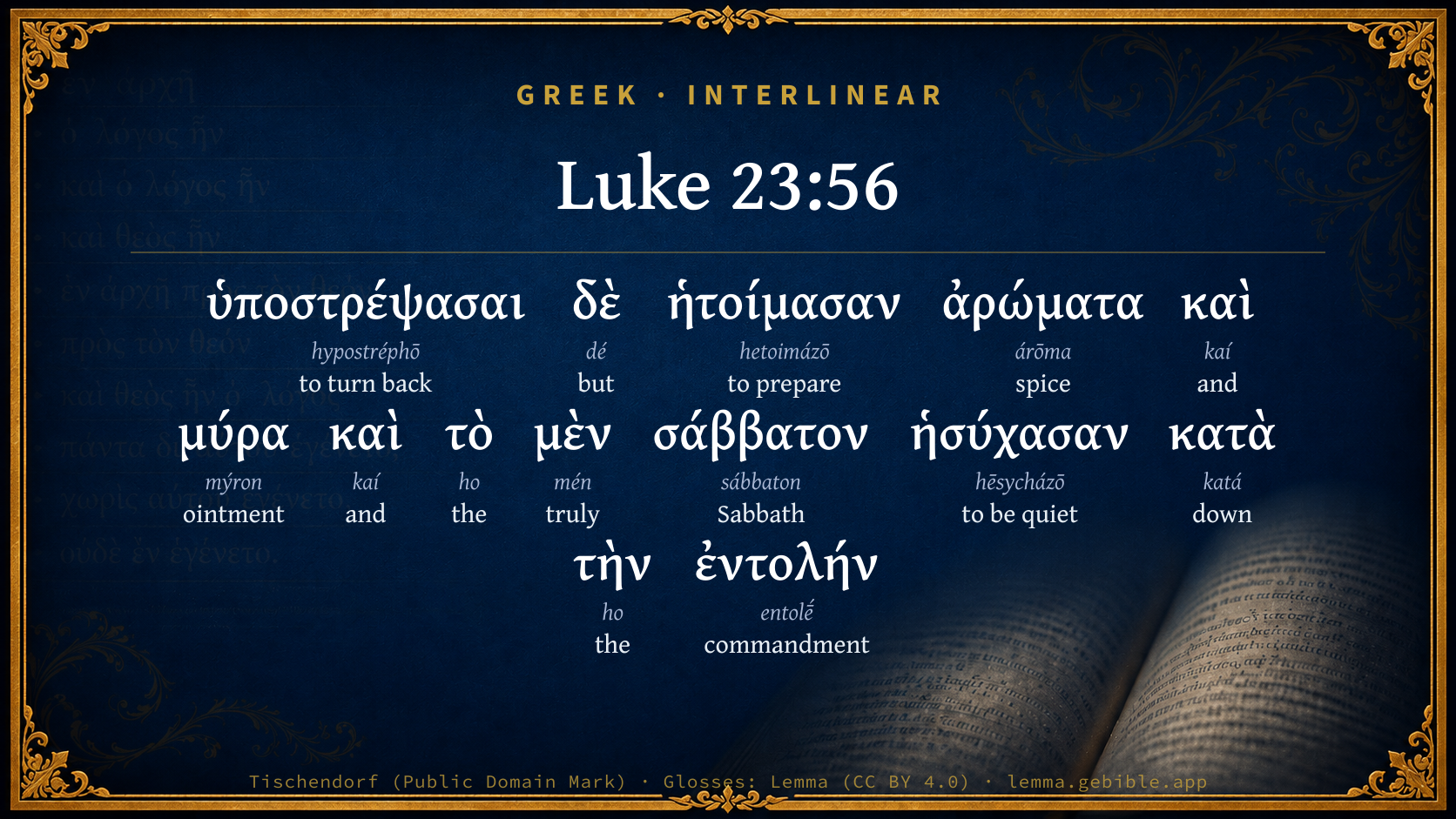
Greek (Tischendorf 8th ed.) Luke 23:56 appears in the Greek New Testament. The text above is from the Tischendorf 8th edition. Each word links to its Strong’s number and a concise gloss. Click any word for its full Thayer’s Greek Lexicon entry.
Download image
Cite this verse

Luke 23:56 (World English Bible). Public Domain. Lemma interlinear Bible study tool, https://lemma.gebible.app/v/luke/23/56.

Show BibTeX & RIS
BibTeX
RIS
English Translation
They returned, and prepared spices and ointments. On the Sabbath they rested according to the commandment.
World English Bible · Public Domain
Download a study sheet

One document with this verse’s original text, its word-by-word gloss line, the meaning frame, cross-references with their text, attributed commentary, and full source and license credits — printable, and it pastes into notes with its structure intact.

This verse Autodidact and up

Study sheet (.html) Plain text (.txt)

A passage Seminary Student

Up to 50 verses in one chapter. A passage sheet keeps up to 6 commentary sources and 12 cross-references per verse, in the order this page ranks them, and says so on the sheet whenever that leaves anything out. Ask for a single verse and you get the Autodidact verse sheet above.

Everything on this page stays free to read, with no account — the sheet is a download of what is already on screen, not access to it.

Want to remove ads? Support Godless Engineer
Compare translations 3

The same verse in 3 English versions, stacked beneath the original-language interlinear above. Click any original word for its lexicon entry.

Each is an independent rendering of the whole verse — the interlinear is not word-aligned to these translations.

Highlighted words mark where these versions differ — a whole-verse word diff, not a word-by-word alignment.

  • World English Bible Public Domain
    They returned, and prepared spices and ointments. On the Sabbath they rested according to the commandment.
  • King James Version Public Domain
    And they returned, and prepared spices and ointments; and rested the sabbath day according to the commandment.
  • unfoldingWord Literal Text CC BY-SA 4.0
    Then, having returned, they prepared spices and ointments. And on the Sabbath they rested, according to the commandment.

unfoldingWord Literal Text — © unfoldingWord, licensed CC BY-SA 4.0. Word-aligned USFM3 via Door43 (git.door43.org/unfoldingWord/en_ult).

Versions to compare (up to 4)

3 of 4 selected

Show all 19 translations

Every available English version of this verse, each an independent rendering of the whole verse.

  • World English Bible Public Domain
    They returned, and prepared spices and ointments. On the Sabbath they rested according to the commandment.
  • Berean Standard Bible Public Domain
    Then they returned to prepare spices and perfumes. And they rested on the Sabbath, according to the commandment.
  • Majority Standard Bible Public Domain
    Then they returned to prepare spices and perfumes. And they rested on the Sabbath, according to the commandment.
  • King James Version Public Domain
    And they returned, and prepared spices and ointments; and rested the sabbath day according to the commandment.
  • American Standard Version (1901) Public Domain
    And they returned, and prepared spices and ointments. And on the sabbath they rested according to the commandment.
  • Revised Version (1885) Public Domain
    And they returned, and prepared spices and ointments. And on the sabbath they rested according to the commandment.
  • Geneva Bible (1599) Public Domain
    And they returned and prepared odours, and ointments, and rested the Sabbath day according to the commandement.
  • Douay-Rheims (1899) Public Domain
    And returning, they prepared spices and ointments; and on the sabbath day they rested, according to the commandment.
  • Young's Literal Translation Public Domain
    and having turned back, they made ready spices and ointments, and on the sabbath, indeed, they rested, according to the command.
  • Literal Standard Version CC BY-SA 4.0
    and having turned back, they made ready spices and ointments, and on the Sabbath, indeed, they rested, according to the command.
  • Unlocked Literal Bible CC BY-SA 4.0
    They returned, and prepared spices and ointments. Then on the Sabbath they rested according to the commandment.
  • unfoldingWord Literal Text CC BY-SA 4.0
    Then, having returned, they prepared spices and ointments. And on the Sabbath they rested, according to the commandment.
  • Darby Bible Public Domain
    And having returned they prepared aromatic spices and ointments, and remained quiet on the sabbath, according to the commandment.
  • World Messianic Bible Public Domain
    They returned and prepared spices and ointments. On the Sabbath they rested according to the commandment.
  • Webster's Bible Public Domain
    And they returned, and prepared spices and ointments; and rested on the sabbath, according to the commandment.
  • Free Bible Version CC BY-SA 4.0
    They returned home and prepared spices and ointments. But on the Sabbath they rested, observing the commandment.
  • Bible in Basic English Public Domain
    And they went back and got ready spices and perfumes; and on the Sabbath they took their rest, in agreement with the law.
  • Text-Critical English NT CC BY 4.0
    Then they returned and prepared spices and ointments. But they rested on the Sabbath according to the commandment.
  • Tyndale New Testament (1534) Public Domain
    And they returned and prepared odoures and oyntmetes: but rested the Saboth daye accordynge to the commaundement.

Literal Standard Version (2020), Covenant Press — licensed CC BY-SA 4.0. Text via the HelloAO Bible API (eBible.org). Unlocked Literal Bible (unfoldingWord) — licensed CC BY-SA 4.0. Text via the HelloAO Bible API (eBible.org). unfoldingWord Literal Text — © unfoldingWord, licensed CC BY-SA 4.0. Word-aligned USFM3 via Door43 (git.door43.org/unfoldingWord/en_ult). Free Bible Version, Dr. Jonathan Gallagher — licensed CC BY-SA 4.0. Text via the HelloAO Bible API (eBible.org).

Word by word

More ways to search: Search by grammar → Find every occurrence → Compare this word →

Practice this passage: Drill this verse → Learn its vocabulary →

About this verse

These counts appear in no published source. They are computed here, from the morphology-tagged text and Lemma’s own curated glosses. What Lemma adds →

14
words
12
distinct lemmas
Gospels
section

Notable vocabulary

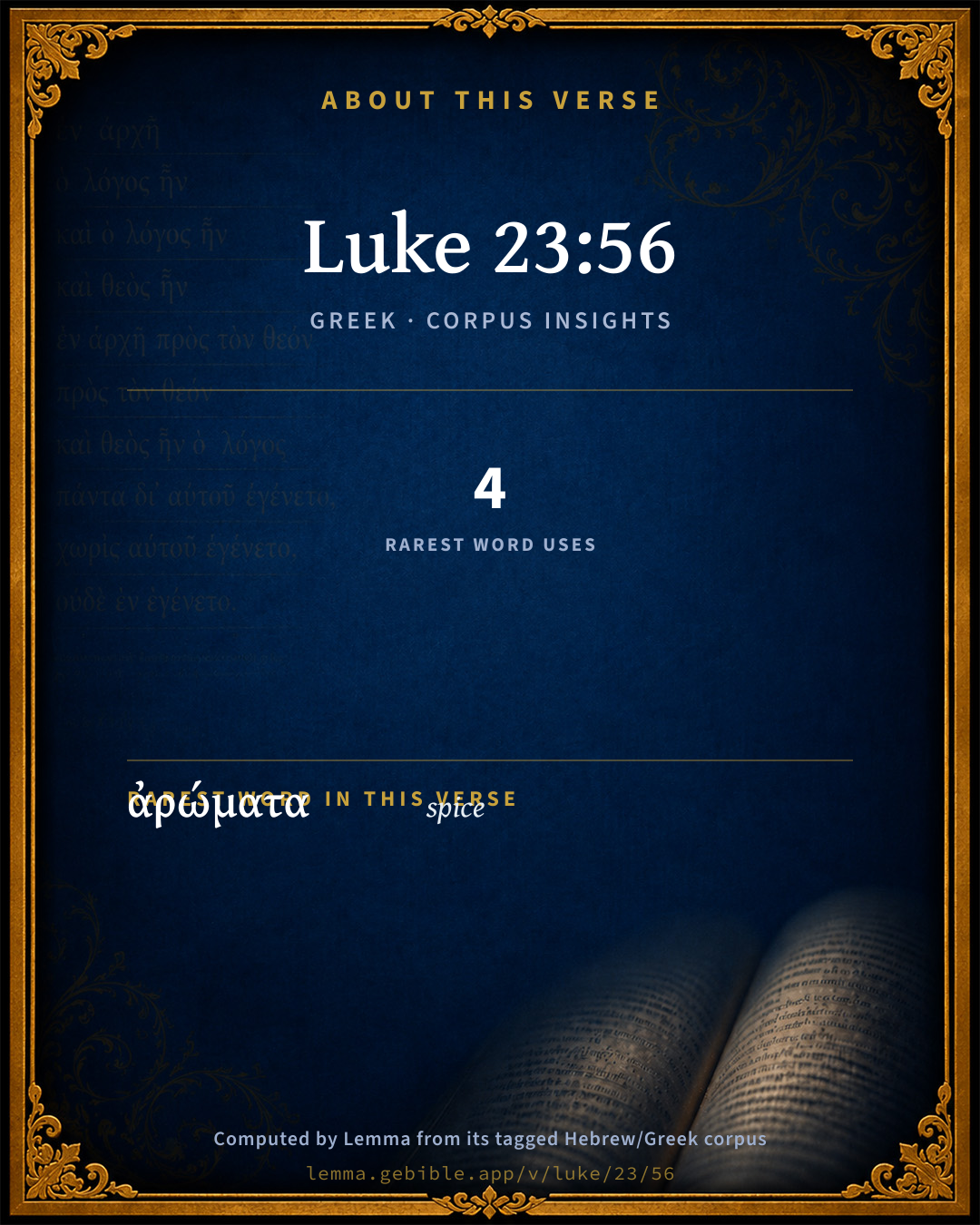
The rarest word here is ἀρώματα spice G759 — appearing just 4 times in the whole Greek New Testament.

Shared distinctive vocabulary

ἀρώματα spice G759 occurs in 4 verses of the Greek New Testament. Also found in:

Repetition

Words recur within this verse:

Cross-references

8

Topical passages linked to Luke 23:56 in the Treasury of Scripture Knowledge — connected by theme and wording, ordered by reader-vote popularity; previews shown in the World English Bible.

  • Luke 24:1 But on the first day of the week, at early dawn, they and some others came to the tomb, bringing the spices which they had prepared.
  • Mark 16:1 When the Sabbath was past, Mary Magdalene, and Mary the mother of James, and Salome, bought spices, that they might come and anoint him.
  • Deuteronomy 5:14 but the seventh day is a Sabbath to Yahweh your God: [in it] you shall not do any work, you, nor your son, nor your daughter, nor your man-servant, nor your maid-servant, nor your ox, nor your donkey, nor any of your cattle, nor your stranger who is within your gates; that your man-servant and your maid-servant may rest as well as you.
  • Exodus 20:8–10 "Remember the Sabbath day, to keep it holy.
  • Exodus 31:14 You shall keep the Sabbath therefore; for it is holy to you. Everyone who profanes it shall surely be put to death; for whoever does any work therein, that soul shall be cut off from among his people.
  • Exodus 35:2–3 'Six days shall work be done, but on the seventh day there shall be a holy day for you, a Sabbath of solemn rest to Yahweh: whoever does any work in it shall be put to death.
  • Isaiah 58:13–14 If you turn away your foot from the Sabbath, from doing your pleasure on my holy day; and call the Sabbath a delight, [and] the holy of Yahweh honorable; and shall honor it, not doing your own ways, nor finding your own pleasure, nor speaking [your own] words:
  • Jeremiah 17:24–25 It shall happen, if you diligently listen to me, says Yahweh, to bring in no burden through the gates of this city on the Sabbath day, but to make the Sabbath day holy, to do no work therein;

Cross-references courtesy of OpenBible.info (CC BY 4.0).

Commentary

Notes on Luke 23:56 from classic Christian and Jewish commentators (each source and its license shown beneath its notes). The classic Christian expositions comment on the surrounding passage and are grouped to its opening verse, so a note may address several verses; the Jewish commentaries on the Tanakh (Rashi and others) are per-verse, so they appear only where the commentator wrote on this verse.

Lemma curates 59 commentaries, every one of them public domain or Creative Commons licensed, each selected and text-cleaned for this edition rather than reprinted as found. About our sources →

F. W. Grant's Numerical Bible

Subdivision 3. (Luk 23:56; Luk 24:1-53.)

Resurrection and Ascension to Heaven.

The sorrow is past; the suffering is over; upon it all rises the glory of a serene and perfect day. The Lord risen; there is peace with God accomplished, acceptance in the Beloved; and with ascension; not only heaven opened, but (as another has said) "heaven furnished for us."

What strikes one especially in these resurrection scenes in Luke, as compared with the other Gospels, is the large place the word of God has in them. This is still, no doubt, the continuation of that Human Face which, as we have seen abundantly, the third Gospel presents to us. The word of God, as that by which in his true life man lives, (as He Himself affirms from Deuteronomy,) was that by which He walked and to which He ever appealed, which He honored and held up, whether before His own, or His enemies. In these last scenes it assumes peculiar prominence. In the journey to Emmaus it is that by which He leads the perplexed disciples to a firmer faith before He manifests Himself to them in the breaking of bread. Afterwards with the eleven He refers to what is written in the Law of Moses and in the Prophets and the Psalms concerning Himself, and opens their understanding to understand the Scriptures. His ascension is to be a new light over all, the basis of mysteries hidden in the Old. Testament itself and which necessitate a new testimony afterwards to be committed to a fresh apostle sent forth from Christ in glory, and which is distinctively what he calls it in one place, "the gospel of the glory of Christ" (2Co 4:4, R.V.).

1. The light of the resurrection morning dawns with comparative slowness in Luke’s Gospel. Even because it is the Gospel of peace, we are made to see all the exercise and perplexity about it, and have that upon which all peace rests established upon the surest foundations. Here at first we have but the announcement, "He is alive," carried to the apostles by those who had themselves been only taking their spices to the grave to complete His burial, and hide away for ever their best hopes!

The angels, announcement has in the very fact that it is by angels an air of distance in it, intensified by the reserve and reproof pervading the message. They do not even promise a meeting with Him: He is alive; had He not told them He would rise? why seek the living One among the dead? The women are perplexed and terrified; the apostles sceptical: these are tales, idle tales, bred in the minds of enthusiastic and visionary women: just the thought of a noted sceptic of these latter days. Peter runs, however, to the sepulchre: nothing is said of his companion; John, who will relate the visit in his own Gospel. He sees the linen clothes lying, their tenant gone, and departs, wondering.

2. We are now made to accompany two disciples, of whom we have heard nothing before and shall hear nothing again; and of whom we only know the name of one, Cleopas, upon a sorrowful walk to Emmaus, a village sixty furlongs outside Jerusalem. Their backs upon the city at such a time, and under the peculiar circumstances which they themselves relate, is surely significant. Perplexity and discouragement have taken hold of them; and in such a condition a backward course is inevitable.*

{*There is something in the names that impresses us, though one may fail in giving them their proper application. Yet if we believe that every jot and tittle of the inspired Word have meaning, we cannot refuse to see significance in such points as these. Cleopas seems then to mean "All," or "every one," "a glory." The village to which he is going, if we accept the form that used to be given to the word, means "a despised people." Here is contrast, certainly, and one in agreement with a backward (and downward) course. It would remind us naturally of Israel according to the glory with which God in His promises has clothed her -(see Rev 12:1-17, the "woman clothed with the sun") and her condition, with Christ her glory renounced. The unbelief of the disciples tended to identify them with this lapsed condition, though divine love was about to recall them -could not possibly leave them to a path like this. But this is only a suggestion as to the meaning.}

While, then, they were on the road discussing the events that had happened, "Jesus Himself drew near and went with them." It is a sign of their condition that "their eyes were holden, that they did not know Him." In answer to His inquiries, the whole thing comes out, and "we trusted that it had been He who is going to redeem Israel" tells the tale of doubt and trouble. Yet they have heard the women’s story of His being alive, and of Peter’s visit to the sepulchre. What to think they know not.

Then, with a reproof for their unbelief, He begins to unfold the long prophetic burden of the ages past, through Moses and all the prophets following: their hearts burning within them as faith is rekindled at the sacred fire. They reach the village while He is reciting; and there they stay the wondrous Stranger from passing on; as He appears ready to do. Constrained by their solicitude, He enters the house to abide with them. There, in the breaking of bread He is revealed to them at last.

It is striking the character of all this: the first announcement made to women; here, before the apostles, two simple disciples are taken up to be ministered to, and with painstaking earnestness to bring them back to simplicity of faith. When they come back to Jerusalem, they find that He has appeared unto Simon; and we realize that here there is more pastoral work of the same tender sort. This appearing, however, is not given us any where at large, as we might have expected. They meet, as it were in secret, the Lord and His failed disciple, before He meets them together, Peter and the rest of the eleven. The tender style of all this, how like the Lord it is! How unofficial, too. It is plain that this is One who is going to be Himself the Shepherd of every individual soul of His, and not put them into the hands of some ecclesiastical go-between. It is, "One is your Teacher, even Christ; and all ye are brethren." Scripture is used, and they are built up with it: no miracles take the place of it: we hear again the Voice that said, "If they hear not Moses and the prophets, neither will they be persuaded though one rose from the dead."

3. (1) But the time is now come for fuller manifestation; and we see Him presently in the midst of the gathering of His people, inviting them to assure themselves fully of the reality of what they behold. With the doors shut, as John expressly tells us, His appearance in the midst impresses itself upon them as that of His bodiless spirit rather than the reappearance of the One they knew so well as He had lived and moved among them. In the tenderest way He invites them to make proof of His being in the body, to look at and handle Him, with the very wounds He had received still upon Him. When even yet, because of the greatness of the joy, they cannot realize it, he takes of the food they give Him and eats before them. It is the blessed fact and its full certification to those who are to be His witness that are put before us in Luke, and not yet the doctrines in connection with it, which are to be given us elsewhere.

(2) The Word is again appealed to, and His solemn testimony given to the written Word as it existed in His day, His sufferings and resurrection being a special part of this prophetic witness. Repentance and remission of sins are to be preached to all nations in the name of the Risen One; Jerusalem, guilty above all, to be first addressed. Thus Luke maintains its character to the end. Nothing is said of miraculous attestation, nor of baptism: the gospel is left in its own sufficiency. But they, its witnesses, are to be clothed with the power of the Spirit, the promise of the Father, sent by Himself: a step in advance of both Matthew and Mark, and in the line of the Acts and Paul.

(3) The gospel is to be first addressed to Jerusalem, but He does not ascend from thence, but from Bethany. "From thence He had set out to present Himself as King to Jerusalem. It was there that the resurrection of Lazarus had taken place; there that the family which present the character of the remnant -attached to His Person, now rejected, with better hopes -in the most striking manner received Jesus. It was thither He retired when His testimony to the Jews was ended; that His heart might rest for a few moments among those He loved; who, through grace, loved Him. It was there that He established the link (as to circumstances) between the remnant attached to His Person and heaven. From thence He ascends." (Synopsis.)

He ascends with His hands stretched out in blessing, to take that place before God in which He abides, the Representative of His people, the Head of blessing for them. While Israel and the earth wait for His return to find what the Old Testament has pledged in their behalf, His place in heaven is the sign of a new order of blessing which the "mysteries" of Christianity are to take up and unfold to us. Luke is here again the precursor of Paul while John has first his own glories to display, which, while seen on earth, are essentially of heaven; and at last will unite heaven and earth together, as surely as He in whom we recognize them unites already in His Person; in one indissoluble perfection; God with Man.

F. W. Grant, The Numerical Bible (4th ed., 1903) — public domain. Text from a community e-Sword module.

Bengel's Gnomon

Johann Albrecht Bengel

Luk 23:56. Ἡτοίμασαν, they prepared) They had their home in Galilee; Luk 23:49. The office they rendered to Him is the greater on that account, as being rendered away from home, and attended with greater cost and trouble. [Thou hereby dost perceive truly unwearied piety (affection) and assiduity springing from faith; which faith, however, itself already underwent a strange eclipse in those excellent souls.—Harm., p. 583.]—ἀρώματα, spices) which are dry.—μῦρα, ointments) which are liquid.—Σάββατον, the Sabbath) The rest appointed to be observed on the Sabbath was more obligatory than the rest connected with the feast. [Christ’s rest in the sepulchre claimed to itself this whole Sabbath, which is on that very account most worthy of attentive consideration. The things which at that time took place in the kingdom of the invisible world, will benefit believers in no ordinary degree, so long as there shall remain aught of them, nay, indeed to all eternity.—V. g. Most excellent effects truly took place, during the calm repose of this Sabbath, in those souls which, though timid, were yet choice and precious, nay, indeed in the Saviour Himself. 1Pe 3:18-19; Act 2:24, et seqq.—Harm., p. 583.]

Bengel's Gnomon of the New Testament — English translation (T&T Clark, Edinburgh, 1860) — public domain. Text from a community e-Sword module.

Expositor's Greek Testament

ed. W. Robertson Nicoll

Luk 23:56 . κατὰ τὴν ἐντολήν : they respected the Sabbath law as commonly understood. The purchase of spices and ointments is viewed by some as a proof that the day of Christ’s crucifixion was an ordinary working day.

The Expositor's Greek Testament, edited by W. Robertson Nicoll (1897–1910) — public domain. Text from a community e-Sword module.

Adam Clarke's Commentary

Verse 56. Prepared spices and ointments] This was in order to embalm him; which sufficiently proves that they had no hope of his resurrection the third day.

And rested the Sabbath day] For though the Jewish canons allowed all works, necessary for the dead, to be done, even on the Sabbath, such as washing and anointing, provided they moved not a limb of the dead person, yet, as the Jews had put Christ to death under the pretence of his being a malefactor, it would not have been either prudent or safe to appear too forward in the present business; and therefore they rested on the Sabbath.

CERTAIN copies of the Itala have some remarkable additions in these concluding verses. The conclusion of the 48th verse, Lu 23:48 in one of them, is read thus: Beating their breasts and their foreheads, and saying, Wo to us because of what is done this day, on account of our sins; for the desolation of Jerusalem is at hand. To Lu 23:52, another adds: And when Pilate heard that he was dead, he glorified God and gave the body to Joseph. On the circumstances of the crucifixion, see the observations at the end of Matt. 27, and consider how heinous sin must be in the sight of God, when it required such a sacrifice! See Clarke on Mt 27:66

Adam Clarke's Commentary on the Bible (1810–1826) — public domain. Text from a community e-Sword/MySword module.

Ellicott's Commentary for English Readers

(56) They returned, and prepared spices and ointments.—This seems at first inconsistent with their “buying” spices after the Sabbath was over (Luk_24:1). Possibly, we have two groups of women—the two Maries and “Joanna and the others” (Luk_24:10)—taking part in the same work; possibly, what they did on the Friday afternoon or evening was not enough, and it was necessary to buy more spices as soon as shops were open on Saturday evening.

Rested the sabbath day.—It is noticeable that this is the only record in the Gospels of that memorable Sabbath. Can we picture to ourselves how it was spent by those who had taken part in the great drama of the previous day;—Caiaphas and the priests officiating in the Temple services of that day, after their hurried Passover, just in time to fulfil the bare letter of the law, on the previous afternoon; the crowds that had mocked and scoffed on Golgotha crowding the courts of the Temple, or attending in the synagogues of Hebrew or Hellenistic Jews; scribes and Pharisees preaching sermons on the history and meaning of the Passover, and connecting it with the hope of a fresh deliverance for Israel? And the disciples, where were they? scattered each to his own lodging, or meeting in the guest-chamber where they had eaten their Paschal supper, or, as that was apparently a new room to them (Luk_22:8-9), in some other inn or lodging in the city, or its suburbs? On that Sabbath, John and Peter must have met, and the penitent must have found in his friend’s love the pledge and earnest of his Lord’s forgiveness; and the Twelve and the Seventy must, in groups of twos or threes, have mourned over the failure of their hopes; and the women have comforted themselves with the thought that they could at least show their reverence for the Lord they loved as they had never shown it before; and Nicodemus and Joseph of Arimathæa have rested with satisfaction in the thought that they could honour a dead prophet without the danger that had attached to honouring a living one, or have reproached themselves for the cowardice which had kept them from any open confession till it was too late, and mourned over the irrevocable past. The records are silent, but the imagination which turns the dead chronicles of history into a living drama has here, within due limits, legitimate scope for action. May we go a step yet further, and think of what was then being accomplished behind the veil, of the descent into Hades and the triumph over Death, the soul of the robber in the rest of Paradise, and the good news proclaimed to “the spirits in prison” (1Pe_3:19)? If we dare not fill up the gap with the legends of the Apocryphal Gospel that bears the name of Nicodemus, we may, at least, venture to dwell reverently on the hints that Scripture actually gives.

A Bible Commentary for English Readers, edited by Charles John Ellicott (1878–1897) — public domain. Text from a community e-Sword module.

The Cambridge Bible for Schools and Colleges

gen. ed. J. J. S. Perowne

56. they returned] As the sunset was now rapidly approaching, they must have hurried home to complete their preparations before the Sabbath began.

prepared spices and ointments] The spices are dry, the ‘perfumes’ liquid. They wished to complete the imperfect embalming of the body which Joseph and Nicodemus had hastily begun. Comp. 2Ch_16:14. They had to purchase the spices (Mar_16:1). St Matthew alone relates the circumstances under which the Jews obtained leave to place a watch over the sepulchre, and to seal the stone, Mat_27:62-66.

and rested] This clause is closely connected with the next chapter,

“And during the Sabbath day they rested...but on the first day of the week, &c.”

The Cambridge Bible for Schools and Colleges (gen. ed. J. J. S. Perowne; Cambridge University Press, 1878–1918) — public domain. Text from a community e-Sword module.

Trapp's Complete Commentary

John Trapp

56 And they returned, and prepared spices and ointments; and rested the sabbath day according to the commandment.

Ver. 56. And rested the seventh day] From all servile work, yea, that (otherwise most honourable) work of embalming Christ’s dead body.

John Trapp, A Commentary or Exposition upon All the Books of the Old and New Testament (1647–1656) — public domain. Text from a community e-Sword module.

Cambridge Greek Testament for Schools and Colleges

56. ὑποστρέψασαι. As the sunset was now rapidly approaching, they must have hurried home to complete their preparations before the Sabbath began.

ἀρώματα καὶ μύρα. The spices are dry, the ‘perfumes’ liquid. They wished to complete the imperfect embalming of the body which Joseph and Nicodemus had hastily begun. Comp. 2Ch 16:14. They had to purchase the spices (Mar 16:1). St Matthew alone relates the circumstances under which the Jews obtained leave to place a watch over the sepulchre, and to seal the stone, Mat 27:62-66.

ἡσύχασαν. This clause is closely connected with the next chapter. “And during the Sabbath day they rested … but on the first day of the week, &c.”

Cambridge Greek Testament for Schools and Colleges (Cambridge University Press, 1896; 21 vols, various authors incl. Carr, Maclear, Plummer, Farrar, Lumby, Moule, M. R. James, Simcox) — public domain. Text from a community e-Sword module.

Alford’s Greek Testament

Henry Alford

56.] They bought their spices, &c. in the short time before sunset. The μέν before σάβ. answers to δέ, ch. 24:1, which ought therefore to continue the sense, as I have punctuated it in the text.

Henry Alford, The Greek Testament (1849–1861) — public domain. Text from a community e-Sword module.

International Critical Commentary

56. ἀρώματα. In N.T. only of these spices; freq. in LXX. For μύρα comp. 7:37. Mk. says that when the sabbath was over, i.e. on Saturday evening, the women bought ἀρωματα that they might anoint Him, which shows that ἀρώματα are not to be confined to “sweet-smelling herbs” or to “dry” spices. The chapter ought to end at μύρα, for τὸ μὲν σάββατον plainly balances τῇ δὲ μιᾷ τῶν σαββάτων, and no more than a comma is needed after ἐντολήν. D omits κατὰ τὴν ἐντολήν.

ἡσύχασαν. The notice of this resting on the sabbath would be strange if they had been working on so sabbatical a day as Nisan 15; for it could not be urged that the preparation of spices and ointments was in any sense necessary. When a Sabbath immediately preceded Nisan 15, it was lawful to work on the sabbath at preparations for the feast. But can we suppose that, if in this year Nisan 15 immediately preceded the sabbath, pious women would have worked merely to gratify affectionate feeling? Or, having thought themselves justified in working for this purpose on Nisan 15, that they would scrupulously have avoided continuing such work on the sabbath? If Nisan 15 coincided with the sabbath, all is explained: up to sunset on Friday it was lawful to work. and after sunset on Saturday it was lawful to work again. Of the interval Godet remarks, On peut dire que ce sabbat était le dernier de I’ancienne alliance qui prenait fin avec la mort du Christ Il fut scrupuleusement respecté par tous ceux qui, sans le savoit allaient inaugurer la nouuelle.

Additional Note on Readings in Chapters 22 and 23

(1) 22:43, 44, Ὤφθη δὲ … ἐπὶ τὴν γῆν.

Evidence for the passage:—

א*cD F G H K L M Q U X L etc. and nearly all cursives. A has the Ammonian section the passage marked in the margin. although it omits the passage in the text.

All MSS. of Lat Vet. Excepting f Vulg. some MSS. of Bob. of Sah. and of Arm. Syr-Cur. (omitting ἀπʼ οὐρανοῦ) Syr-Pesh. Syr-Hier.

Just- M. Iren. Hippol. Dion-Alex. Eus. Greg-Naz. Epiph. Hil Hieron Aug.

Evidence against the passage:—

אa A B R T 124 : 13 has ὤφθη δέ prima manu, the rest secunda manu Co 69 and all known Evangelistaria have the passage inserted after Mat 26:39, A S V G D P and others, including nine cursives. have the passage marked with asterisks or obeli. Et in Græcis et in Latinis codd. complur. known to Hilary it was wanting. and it was found only in quibusdam exemplaribus tam Græcis quam Latinis known to Jerome

f, most MSS. of Boh. including the best, some MSS. of Sah. and of Arm. (see Sanday, App. ad N.T. pp. 188. 191). Syr-Sin., Syr-Harcl. marg.

Cry-Alex. omits in his Homilies on Lk. Ambr. likewise. The silence of clem-Alex. Orig. Cyr-Hier. Ath. and Greg-Nys. can hardly be accidental in all even in most.

Excision for doctrinal reasons will not explain the omission. “There is no tangible evidence for the excision of a substantial portion of narrative for doctrinal reasons at any period of textual history” (WH ii. App. p. 66).

Nor does “Lectionary practice” seem to be an adequate cause for such widespread omission. It is suggested that. because the passage was read after Mat 26:39 in the Lection for Holy Thursday, and omitted after Luk 22:42 in the Lection for Tuesday after Sexagesima, therefore some MSS. came to omit in Lk. or both Gospels.

It will be observed that the early non-patristic evidence in favour of the words is א*D Latt. Syrr. “a frequent Western combination.”

But, if we regard the passage as probably a Western insertion in the text of Lk. we need have no hesitation whatever in retaining it as a genuine portion historical tradition. It is true, whoever wrote it.

(2) 22:68. After οὐ μὴ ἀποκριθῆτε the words μοι ἥ ἀπολύσητε.

Evidence for the words:—

A D X Γ Δ Λ Π etc., Latt. Syr-Cur. Syr-Sin.

Evidence against the words:—

א B L T, Boh. one MS. of Vulg. (J). Cyr-Alex. Ambr.

A few authorities have μοι without ἢ ἀπολύσητε.

With Tisch. WH. RV., we may safely omit. Treg, brackets, Alf. the same, suggesting homœoteleuton as the cause of omission.

(3) 23:34a. ὁδὲ Ἰησοῦς … ποιοῦσιν

Evidence for the passage:—

א*c A C D2L Q X Γ Δ Λ Π etc.

c e f ff2 I r Vulg. most MSS. of Bob. Syrr. (Cur. Pesh, Harel. Hier.) Aeth. Arm.

Iren-lat. Orig-lat. Hippol. Clem- Hom Eus. Ath. Greg-Nys. Bas. Gest-Pilat. Chrys, Hil,. Ambr. Hieron. Aug.

Evidence against the passage:—

א* B D* 38 43 435. A has it marked with an asterisk.

a b d two best MSS. of Bob. Sah. Syr-Sin.

Cyr-Alex is said by Arethas to have regarded it as spurious; and this is confirmed by the text prefixed to the Syriac Homily on Luk 23:32-43 (p. 718 ed. Payne Smith). This, however, exists in only one which ends before ver. 34 is properly reached.

The omission in such witnesses would be very difficult to explain, if the passage had been part of the original text of Lk. But, even more strongly than in the case 22:43, 44, internal evidence warrants its in retaining the passage in its traditional place as a genuine portion of the evangelic narrative. That point being quite certain, it matters comparatively little whether we owe this precious fragment to Lk. or not.

Additional Note on 23:45

Dr. E. A. Abbott conjectures that both here and 22:51 we have instances of substitution through misunderstanding. In the Classical Review of Dec. 1893, p. 443, he writes: “Though these words (τοῦ ἡλίου ἐκλείποντος) might mean the sun failing (to give its light),’ yet the natural meaning is ‘the sun being eclipsed.’ Now every one knew that an eclipse could not happen except at new moon, and every Jew knew that Passover was at full moon.” Why, then, he goes on to ask, does Lk. give an explanation of the darkness, which neither Mt. nor Mk. give, and which involves a portentous miracle? To the imaginary reply, “Because Lk. wished to make it clear that it was a miracle and not a natural obscuration of the sun; for he is not afraid of being the only Evangelist to insert a miracle, as is shown by his account of the healing of Malchus’ ear,” Dr. Abbott rejoins that “the latter miracle is substituted rather than inserted. It is substituted for a rebuke to Peter, ‘restore thy sword to its place.’ Comp. Mat 26:52; Joh 18:11, with ἀποκαταστάθητι in Jer_29. (Heb. 47) 6, and it will appear that the miraculous narrative probably arose from a misunderstanding of some ambiguous word, such as ἀποκαταστάθητι (‘be thou restored’) or ἀποκαταστασταθήτω (‘let it be restored”), in the original tradition. ‘It’ (or ‘thou’) was interpreted by Mt. and Jn. (rightly) to be the ‘sword’ and by Lk.(wrongly) to be ‘the ear’; and the verb was interpreted by Mt. and Jn. (rightly) to mean ‘restored to its place’ but by Lk. (wrongly, though more in conformity with the Synoptic vocabulary, Mat 12:13; Mar 3:5, Mar 3:8:25; Luk 6:10, where it is used of a withered hand, or of a blind man) to mean ‘restored to its original condition.”

Is it possible that the present, also, may be a case of substitution through misunderstanding? Let us turn to the parallel passage in Mt (27:46-49) and Mk. (15:34-36). Here we find no mention of an eclipse, but of a saying of Jesus which was interpreted by the bystanders to mean that “Elise” had “abandoned” (ἐγκαταλείπειν) Jesus. This Lk. omits altogether. But the genitive case of “Elise” is the same so that of the “sun,” viz. ἡλείου or in MSS. ἡλίου and ἐκλείπειν although not often used of persons failing others in an emergency, is so used occasionally. Thus ηκλίου ἐκλείποντος might mean either “the sun being, eclipsed,” or “Elias failing, or forsaking.”

But how could ἐκαταλείποντος be changed into ἐκλείποντος? Curtailments of long compounds are not infrequent in MSS. of the N.T., and specially with κατά: comp. Mar 14:40; Luk 6:36; Mat 13:40; Jas 2:13, Jas 3:14.… If Lk., or others before him, concluded that ἡλίου must mean the sun, they would naturally infer that ἐγκαταλείποντος must be an error for ἐκλείποντος.

… It seems probable that Lk., finding obscure and divergent traditions about some utterance of Jesus, … considered that he was restoring the original meaning, and a meaning worthy of the subject, in retaining two or three words of the current tradition, but placing them in such a context as to show that it was the sun, and not Elias, that “failed.”

Jos. Josephus.

1 The expressions jus gladii and potestas gladii are of later date. Professor Chwolson argues that the Sadducees were dominant when Jesus was condemned to death. It was against the law as maintained by the Pharisees to sentence a criminal and execute him within a few hours. The law required an interval of forty days for the collection of evidence on his behalf. It was the Sadducees, the servile upholders of Roman authority, who took the lead against Christ. They were the wealthy class, who lived on the temple sacrifices and dues, and therefore were bitter antagonists of a Teacher whose doctrine tended to the reform of lucrative abuses (Das letzte Passamahl Christi, etc., Appendix).

Tyn. Tyndale.

Cov. Coverdale.

Gen. Geneva.

AV. Authorized Version.

B B. Cod. Vaticanus, sæc. 4. In the Vatican Library certainly since 15331 (Batiffol, La Vaticane de Paul 3, etc., p. 86).

L L. Cod. Regius Parisiensis, sæc. viii. National Library at Paris. Contains the whole Gospel.

X X. Cod. Monacensis, sæc. ix. In the University Library at Munich. Contains 1:1-37, 2:19-3:38, 4:21-10:37, 11:1-18:43, 20:46-24:53.

Vulg. Vulgate.

Lat. Vet. Vetus Latina.

A A. Cod. Alexandrinus, sæc. v. Once in the Patriarchal Library at Alexandria; sent by Cyril Lucar as a present to Charles 1. in 1628, and now in the British Museum. Complete.

R R. Cod. Nitriensis Rescriptus, sæc. 8. Brought from a convent in the Nitrian desert about 1847, and now in the British Museum. Contains 1:1-13, 1:69-2:4, 16-27, 4:38-5:5, 5:25-6:8, 18-36, 39, 6:49-7:22, 44, 46, 47, 8:5-15, 8:25-9:1, 12-43, 10:3-16, 11:5-27, 12:4-15, 40-52, 13:26-14:1, 14:12-15:1, 15:13-16:16, 17:21-18:10, 18:22-20:20, 20:33-47, 21:12-22:15, 42-56, 22:71-23:11, 38-51. By a second hand 15:19-21.

§ Found in Luke alone.

TR. Textus Receptus.

D D. Cod. Bezae, sæc. vi. Given by Beza to the University Library at Cambridge 1581. Greek and Latin. Contains the whole Gospel.

M M. Cod. Campianus, sæc. ix. In the National Library at Paris. Contains the whole Gospel.

C

C. Cod. Ephraemi Rescriptus, sæc. 5. In the National Library at Paris. Contains the following portions of the Gospel: 1:2-2:5, 2:42-3:21, 4:25-6:4, 6:37-7:16, or 17, 8:28-12:3, 19:42-20:27, 21:21-22:19, 23:25-24:7, 24:46-53.

These four MSS. are parts of what were once complete Bibles, and are designated by the same letter throughout the LXX and N.T.

אԠא Cod. Sinaiticus, sæc. iv. Brought by Tischendorf from the Convent of St. Catherine on Mt. Sinai; now at St. Petersburg. Contains the whole Gospel complete.

Sah. Sahidic.

Arm. Armenian.

Syr Syriac.

Cur. Curetonian.

Sin. Sinaitic.

WH. Westcott and Hort.

Aug. Augustine.

K K. Cod. Cyprius, sæc. ix. In the National Library at Paris. Contains the whole Gospel.

Δ̠Δ. Cod. Sangallensis, sæc. ix. In the monastery of St. Gall in Switzerland. Greek and Latin. Contains the whole Gospel.

Latt. Latin.

Wic. Wiclif.

RV. Revised Version.

Win. Winer, Grammar of N.T. Greek (the page refers to Moulton’s edition).

Burton. Burton, N.T. Moods and Tenses.

Alf. Alford.

Boh. Bohairic.

F F. Cod. Boreeli, sæc. ix. In the Public Library at Utrecht. Contains considerable portions of the Gospel.

Aeth. Ethiopic.

Rhem. Rheims (or Douay).

1 Jos. B. J. ii. 14, 9, v. 11, 1; Livy, xxii. 13, 6, xxxiii. 36, 3; Cir. In Verr. v. 62, 162. Capital punishment of any kind was generally, according to Roman custom, preceded by beating.

D. B. Smith’s Dictionary of the Bible, 2nd edition.

Iren. Irenæus.

Tert. Tertullian.

Hippol. Hippolytus.

Aegyptt. Egyptian.

Eus. Eusebius of Cæsarea

Chrys. Chrysostom.

Euthym. Euthymius Zigabenus.

Tisch. Tischendorf.

אԠאc attributed to the beginning of sæc. 7. Two hands of about this date are sometimes distinguished as אca and אcb

a אa contemporary, or nearly so, and representing a second MS. of high value;

De W. De Wette.

Nösg. Nösgen.

Pesh. Peshitto.

Ambr. Ambrose.

Wetst. Wetstein.

Orig. Origen.

Beng. Bengel.

Mey. Meyer.

Orig-lat. Latin Version of Origen.

Epiph. Epipnamus.

Treg. Tregelles.

1

Jerome says. In evangelio autem quod Hebraicis litteris scriptum est, legimus non velum templi scissum, sed superlimenare Templi miræ magnitudinis coruisee (Ad Hedyb. viii.). Elsewhere he says. superlimenare templi infinitæ magnitudinis fractum esse atque divisum legimus (Com. in. Matt. xxvii. 51). See Nicholson, Gospel acc. to the Hebrews, p. 62.

In the Gemara it is stated that some forty years before the destruction of Jerusalem, the heavy gates of the temple, which could with difficulty be moved by many men, and which were locked at the time, flew open about midnight at the Passover. Josephus (B.J. vi. 5, 3) reports an occurrence of this kind shortly before the capture of the city. As Neander remarks (L. J. C. § 293 n.), these accounts hint at some strange occurrence as being remembered in connexion with the time of the Crucifixion.

The rending of the veil perhaps symbolized the end of the temple and its services. In Clem. Recogn. i. 41 It is otherwise interpreted as a lamentation (comp. the rending of clothes) over the destruction which threatened the place. Better Theophylact: δεικνύντος τοῦ Κυρίου, ὅτι οὐκ ἕτι ἅβατα ἕσται τὰ Ἅγια τῶν ἑγίων, ἀλλὰ τοῖς Ῥωμαίοις παραδοθέντα, βάσιμα καὶ βέβηλα γενήσονται.

G G. Cod. Harleianus, sæc. ix. In the British Museum. Contains considerable portions.

U U. Cod. Nanianus, sæc. x. In the Library of St. Mark’s, Venice. Contains the whole Gospel.

Hier. Palestinian (Jerusalem).

T T. Cod. Borgianus, sæc. v. In the Library of the Propaganda at Rome. Greek and Egyptian. Contains 22:20–23:20.

S S. Cod. Vaticanus, sæc. x. In the Vatican. The earliest dated MS. of the Greek Testament. Contains the whole Gospel.

Harcl. Harclean.

Iren-lat. Latin Version of Irenæus

Bas. Basil.

International Critical Commentary — older volumes (1896–1929), various authors — public domain. Text from a community e-Sword module.

Vincent's Word Studies in the New Testament

Marvin R. Vincent

Returned [υποστρεψασαι] . This word occurs thirty - two times in Luke, and only three times in the rest of the New Testament. It is a significant fact that, reckoning the aggregate space occupied by the four Gospels, nearly one - sixth of the whole amount is occupied with the account of the twenty - four hours beginning with the last supper and ending with the burial of Jesus. There is no day in all Bible history narrated with the fulness of that day. If we possessed the whole life of Christ, written with the same detail, the record would occupy one hundred and eighty volumes as large as the whole Bible. ===Luk24

CHAPTER XXIV

1 - 3. Compare Mt 28:1; Mr 16:2 - 4.

Marvin R. Vincent, Word Studies in the New Testament (1887–1900) — public domain. Text from a community e-Sword/MySword module.

Lesson kit

Teaching starters — assembled from the data on this page, not authored interpretation. Every prompt links to the verse data it draws on. Edit before teaching.

Luke, in the Gospels, opens this verse with 14 words (12 distinct Greek lemmas). Its most distinctive word is árōma (“spice”). A historical commentator’s framing appears above. Read the whole chapter for the surrounding context.

Discussion questions

  1. How does “spice” (árōma) shape what this verse is saying?
  2. How does Mark 16:1, which shares the word «spice», read alongside this verse?
  3. What does the repetition of “and” (2× in this one verse) do in this verse?
  4. The translations on this page render this verse differently — a whole-verse word diff, not a word-by-word alignment. What might account for the different wordings?
  5. Compare how F. W. Grant's Numerical Bible and Bengel's Gnomon read this verse. Where do they agree or differ?

Things to notice

Reading settings

Reading text

Shown beneath each verse's original-language words.

Old Testament
Old Testament edition

Read the OT as the Masoretic Hebrew (MT) or the Greek Septuagint (LXX).

English shown for the Greek Septuagint (in the Hebrew ↔ Greek comparison).

Comparing translations? Open the Compare panel on any verse page to stack up to four side by side.