
Acts 1:18

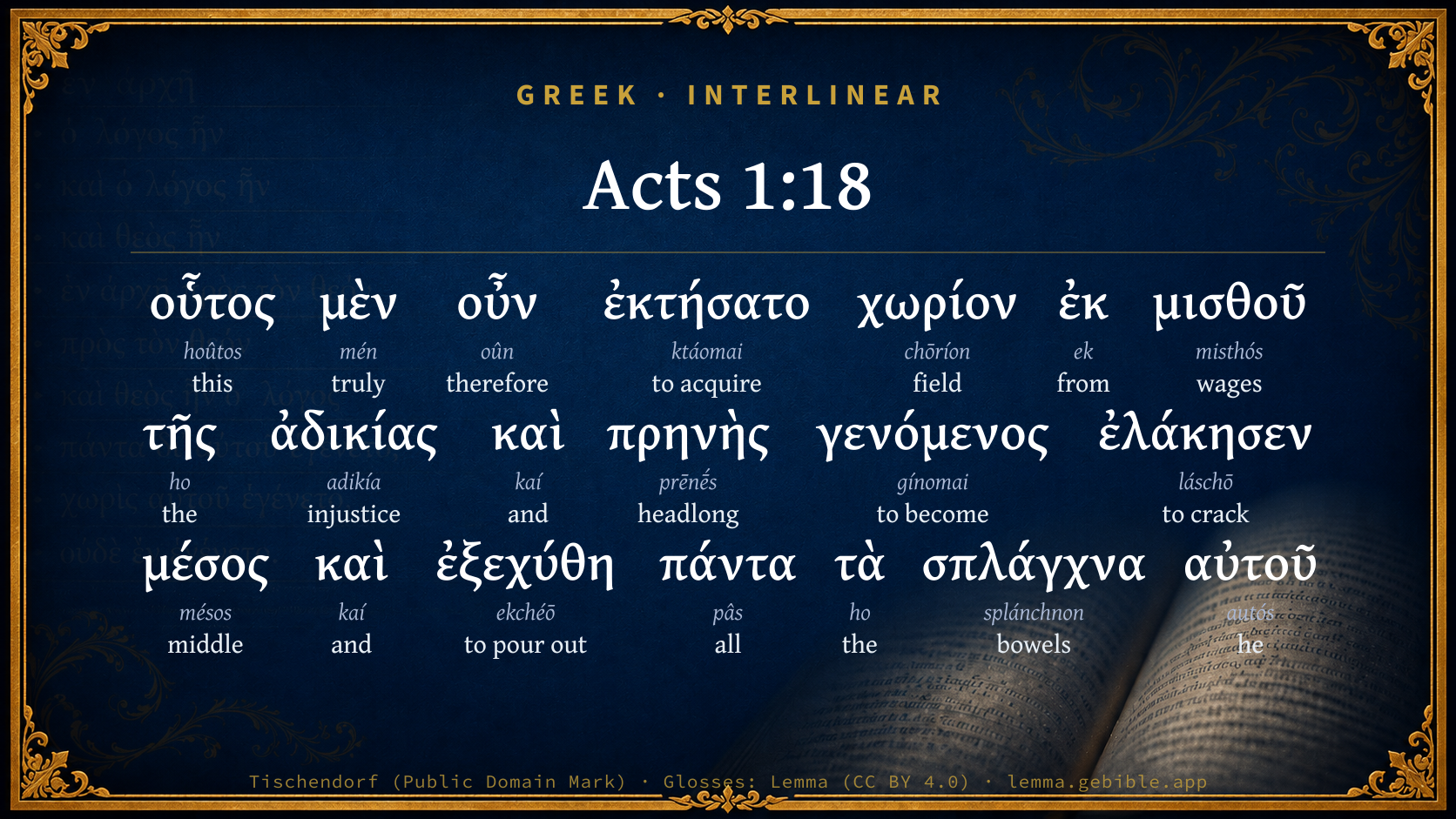
Greek (Tischendorf 8th ed.) Acts 1:18 appears in the Greek New Testament. The text above is from the Tischendorf 8th edition. Each word links to its Strong’s number and a concise gloss. Click any word for its full Thayer’s Greek Lexicon entry.
Download image
Cite this verse

Acts 1:18 (World English Bible). Public Domain. Lemma interlinear Bible study tool, https://lemma.gebible.app/v/acts/1/18.

Show BibTeX & RIS
BibTeX
RIS
English Translation
Now this man obtained a field with the reward for his wickedness, and falling headlong, his body burst open, and all his intestines gushed out.
World English Bible · Public Domain
Highlights
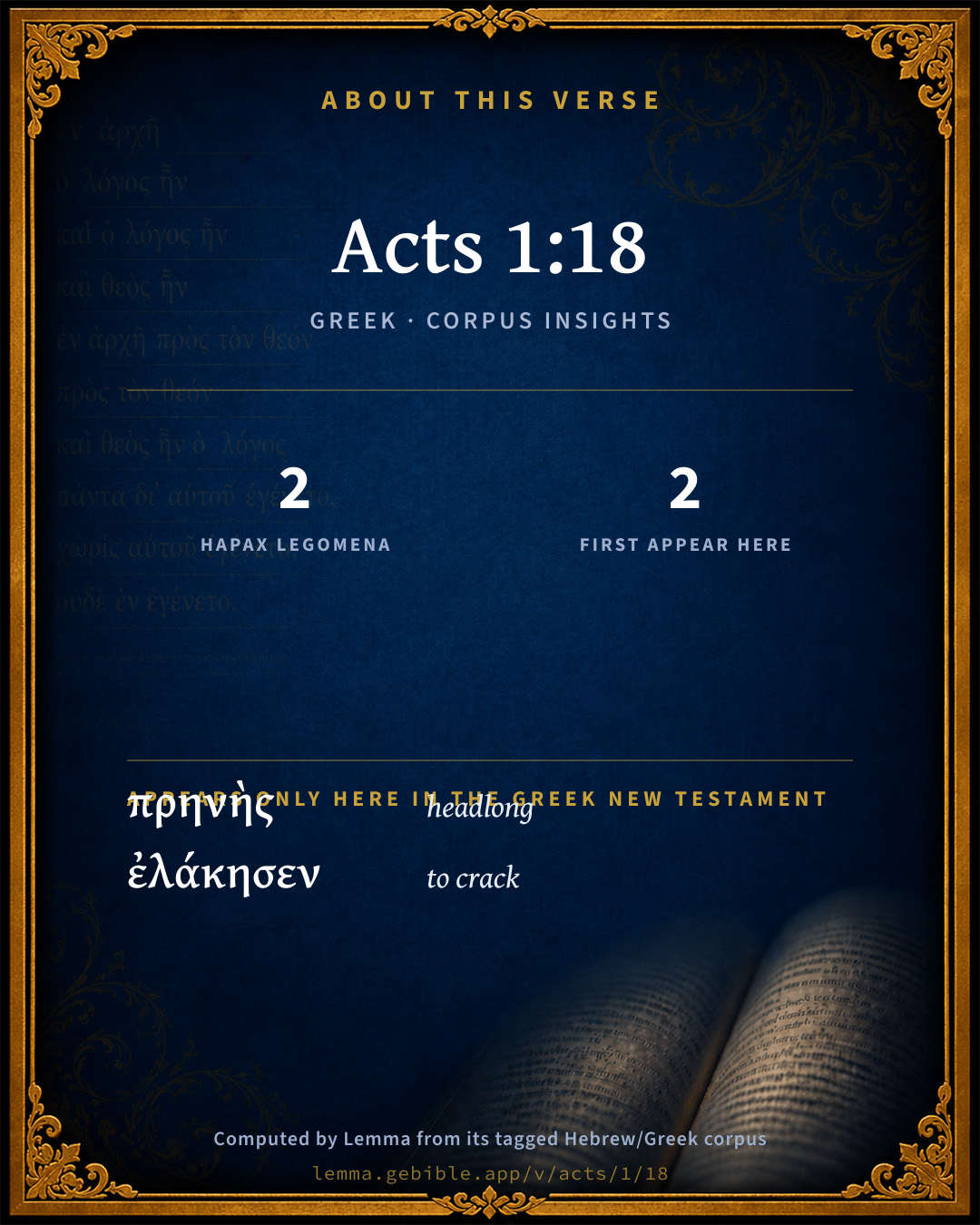
  • 2 hapax legomena — only here in the Greek New Testament
  • 2 first appearances in the Greek New Testament
Full analysis ↓
Download a study sheet

One document with this verse’s original text, its word-by-word gloss line, the meaning frame, cross-references with their text, attributed commentary, and full source and license credits — printable, and it pastes into notes with its structure intact.

This verse Autodidact and up

Study sheet (.html) Plain text (.txt)

A passage Seminary Student

Up to 50 verses in one chapter. A passage sheet keeps up to 6 commentary sources and 12 cross-references per verse, in the order this page ranks them, and says so on the sheet whenever that leaves anything out. Ask for a single verse and you get the Autodidact verse sheet above.

Everything on this page stays free to read, with no account — the sheet is a download of what is already on screen, not access to it.

Want to remove ads? Support Godless Engineer
Compare translations 3

The same verse in 3 English versions, stacked beneath the original-language interlinear above. Click any original word for its lexicon entry.

Each is an independent rendering of the whole verse — the interlinear is not word-aligned to these translations.

Highlighted words mark where these versions differ — a whole-verse word diff, not a word-by-word alignment.

  • World English Bible Public Domain
    Now this man obtained a field with the reward for his wickedness, and falling headlong, his body burst open, and all his intestines gushed out.
  • King James Version Public Domain
    Now this man purchased a field with the reward of iniquity; and falling headlong, he burst asunder in the midst, and all his bowels gushed out.
  • unfoldingWord Literal Text CC BY-SA 4.0
    (Now indeed this one bought a field from the wage of unrighteousness, and having become prostrate, he burst open in the middle, and all his entrails were poured out.

unfoldingWord Literal Text — © unfoldingWord, licensed CC BY-SA 4.0. Word-aligned USFM3 via Door43 (git.door43.org/unfoldingWord/en_ult).

Versions to compare (up to 4)

3 of 4 selected

Show all 19 translations

Every available English version of this verse, each an independent rendering of the whole verse.

  • World English Bible Public Domain
    Now this man obtained a field with the reward for his wickedness, and falling headlong, his body burst open, and all his intestines gushed out.
  • Berean Standard Bible Public Domain
    (Now with the reward for his wickedness Judas bought a field; there he fell headlong and burst open in the middle, and all his intestines spilled out.
  • Majority Standard Bible Public Domain
    (Now with the reward for his wickedness Judas bought a field; there he fell headlong and burst open in the middle, and all his intestines spilled out.
  • King James Version Public Domain
    Now this man purchased a field with the reward of iniquity; and falling headlong, he burst asunder in the midst, and all his bowels gushed out.
  • American Standard Version (1901) Public Domain
    (Now this man obtained a field with the reward of his iniquity; and falling headlong, he burst asunder in the midst, and all his bowels gushed out.
  • Revised Version (1885) Public Domain
    (Now this man obtained a field with the reward of his iniquity; and falling headlong, he burst asunder in the midst, and all his bowels gushed out.
  • Geneva Bible (1599) Public Domain
    He therefore hath purchased a field with the reward of iniquitie: and when he had throwen downe himselfe headlong, hee brast asunder in the middes, and all his bowels gushed out.
  • Douay-Rheims (1899) Public Domain
    And he indeed hath possessed a field of the reward of iniquity, and being hanged, burst asunder in the midst: and all his bowels gushed out.
  • Young's Literal Translation Public Domain
    this one, indeed, then, purchased a field out of the reward of unrighteousness, and falling headlong, burst asunder in the midst, and all his bowels gushed forth,
  • Literal Standard Version CC BY-SA 4.0
    (This one, indeed, then, purchased a field out of the reward of unrighteousness, and falling headlong, burst apart in the midst, and all his bowels gushed forth,
  • Unlocked Literal Bible CC BY-SA 4.0
    (Now this man bought a field with the earnings he received for his wickedness, and there he fell headfirst, and his body burst open, and all his intestines poured out.
  • unfoldingWord Literal Text CC BY-SA 4.0
    (Now indeed this one bought a field from the wage of unrighteousness, and having become prostrate, he burst open in the middle, and all his entrails were poured out.
  • Darby Bible Public Domain
    (This [man] then indeed got a field with [the] reward of iniquity, and, having fallen down headlong, burst in the midst, and all his bowels gushed out.
  • World Messianic Bible Public Domain
    Now this man obtained a field with the reward for his wickedness; and falling headlong, his body burst open and all his intestines gushed out.
  • Webster's Bible Public Domain
    Now this man purchased a field with the reward of iniquity; and falling headlong, he burst asunder in the midst, and all his bowels gushed out.
  • Free Bible Version CC BY-SA 4.0
    (Judas had bought a field with his ill-gotten gains. There he fell down headfirst, and his body burst apart, spilling out all his intestines.
  • Bible in Basic English Public Domain
    (Now this man, with the reward of his evil-doing, got for himself a field, and falling head first, came to a sudden and violent end there.
  • Text-Critical English NT CC BY 4.0
    (Now this man Judas had acquired a field with the wages of unrighteousness, and falling headfirst, his body burst open, and all his intestines gushed out.
  • Tyndale New Testament (1534) Public Domain
    And the same hath now possessed a plot of grounde with the rewarde of iniquite and when he was hanged brast a sondre in the myddes and all his bowels gusshed oute.

Literal Standard Version (2020), Covenant Press — licensed CC BY-SA 4.0. Text via the HelloAO Bible API (eBible.org). Unlocked Literal Bible (unfoldingWord) — licensed CC BY-SA 4.0. Text via the HelloAO Bible API (eBible.org). unfoldingWord Literal Text — © unfoldingWord, licensed CC BY-SA 4.0. Word-aligned USFM3 via Door43 (git.door43.org/unfoldingWord/en_ult). Free Bible Version, Dr. Jonathan Gallagher — licensed CC BY-SA 4.0. Text via the HelloAO Bible API (eBible.org).

Word by word

More ways to search: Search by grammar → Find every occurrence → Compare this word →

Practice this passage: Drill this verse → Learn its vocabulary →

πρηνὴς
prēnḗs
G4248
“headlong”
Adjective, Nominative, Singular, Masculine
Part of Speech
Adjective
Case
Nominative
Number
Singular
Gender
Masculine
Full Thayer's Definition

Origin: from G4253

TDNT: None

1. headlong
  1. οὗτος hoûtos G3778 “this” Demonstrative pronoun, Nominative, Singular, Masculine
  2. μὲν mén G3303 “truly” Particle
  3. οὖν oûn G3767 “therefore” Conjunction
  4. ἐκτήσατο ktáomai G2932 “to acquire” Verb, Aorist, Middle deponent, Indicative, 3rd person, Singular
  5. χωρίον chōríon G5564 “field” Noun, Accusative, Singular, Neuter
  6. ἐκ ek G1537 “from” Preposition
  7. μισθοῦ misthós G3408 “wages” Noun, Genitive, Singular, Masculine
  8. τῆς ho G3588 “the” Article, Genitive, Singular, Feminine
  9. ἀδικίας adikía G93 “injustice” Noun, Genitive, Singular, Feminine
  10. καὶ kaí G2532 “and” Conjunction
  11. γενόμενος gínomai G1096 “to become” Verb, Aorist, Middle deponent, Participle, Nominative, Singular, Masculine
  12. ἐλάκησεν láschō G2997 “to crack” Verb, Aorist, Active, Indicative, 3rd person, Singular
  13. μέσος mésos G3319 “middle” Adjective, Nominative, Singular, Masculine
  14. καὶ kaí G2532 “and” Conjunction
  15. ἐξεχύθη ekchéō G1632 “to pour out” Verb, Aorist, Passive, Indicative, 3rd person, Singular
  16. πάντα pâs G3956 “all” Adjective, Nominative, Plural, Neuter
  17. τὰ ho G3588 “the” Article, Nominative, Plural, Neuter
  18. σπλάγχνα splánchnon G4698 “bowels” Noun, Nominative, Plural, Neuter
  19. αὐτοῦ autós G846 “he” Personal pronoun, Genitive, Singular, Masculine

About this verse

These counts appear in no published source. They are computed here, from the morphology-tagged text and Lemma’s own curated glosses. What Lemma adds →

20
words
18
distinct lemmas
Acts
section

Notable vocabulary

2 hapax legomena — words that appear only here in the entire Greek New Testament:

  • πρηνὴς headlong G4248
  • ἐλάκησεν to crack G2997

First appearance in Scripture

These words make their first canonical appearance in the Greek New Testament here:

  • πρηνὴς headlong G4248
  • ἐλάκησεν to crack G2997

Shared distinctive vocabulary

ἐκτήσατο to acquire G2932 occurs in 7 verses of the Greek New Testament. Also found in:
Repetition

Words recur within this verse:

Cross-references

10

Topical passages linked to Acts 1:18 in the Treasury of Scripture Knowledge — connected by theme and wording, ordered by reader-vote popularity; previews shown in the World English Bible.

  • Matthew 27:3–10 Then Judas, who betrayed him, when he saw that Jesus was condemned, felt remorse, and brought back the thirty pieces of silver to the chief priests and elders,
  • Psalms 55:23 But you, God, will bring them down into the pit of destruction. Bloodthirsty and deceitful men shall not live out half their days, But I will trust in you.
  • Matthew 26:14–15 Then one of the twelve, who was called Judas Iscariot, went to the chief priests,
  • Numbers 22:7 The elders of Moab and the elders of Midian departed with the rewards of divination in their hand; and they came to Balaam, and spoke to him the words of Balak.
  • Joshua 7:21–26 when I saw among the spoil a goodly Babylonian mantle, and two hundred shekels of silver, and a wedge of gold of fifty shekels weight, then I coveted them, and took them; and, behold, they are hid in the earth in the midst of my tent, and the silver under it.
  • 2 Kings 5:20–27 But Gehazi the servant of Elisha the man of God, said, Behold, my master has spared this Naaman the Syrian, in not receiving at his hands that which he brought: as Yahweh lives, I will run after him, and take somewhat of him.
  • Job 20:12–15 "Though wickedness is sweet in his mouth, Though he hide it under his tongue,
  • Psalms 55:15 Let death come suddenly on them. Let them go down alive into Sheol. For wickedness is in their dwelling, in the midst of them.
  • 2 Peter 2:15–16 forsaking the right way, they went astray, having followed the way of Balaam the son of Beor, who loved the wages of wrong-doing;
  • Matthew 25:15 To one he gave five talents, to another two, to another one; to each according to his own ability. Then he went on his journey.

Cross-references courtesy of OpenBible.info (CC BY 4.0).

Commentary

Notes on Acts 1:18 from classic Christian and Jewish commentators (each source and its license shown beneath its notes). The classic Christian expositions comment on the surrounding passage and are grouped to its opening verse, so a note may address several verses; the Jewish commentaries on the Tanakh (Rashi and others) are per-verse, so they appear only where the commentator wrote on this verse.

Lemma curates 59 commentaries, every one of them public domain or Creative Commons licensed, each selected and text-cleaned for this edition rather than reprinted as found. About our sources →

Adam Clarke's Commentary

Verse 18. Purchased a field with the reward of iniquity] Probably Judas did not purchase the field himself, but the money for which he sold his Lord was thus applied, see Mt 27:6-8. It is possible, however, that he might have designed to purchase a field or piece of ground with this reward of his iniquity, and might have been in treaty far it, though he did not close the bargain, as his bringing the money to the treasury proves: the priests, knowing his intentions, might have completed the purchase, and, as Judas was now dead, applied the field thus bought for the burial of strangers, i.e. Jews from foreign parts, or others who, visiting Jerusalem, had died there. Though this case is possible, yet the passage will bear a very consistent interpretation without the assistant of this conjecture; for, in ordinary conversation, we often attribute to a man what is the consequence of his own actions, though such consequence was never designed nor wished for by himself: thus we say of a man embarking in a hazardous enterprise, he is gone to seek his death; of one whose conduct has been ruinous to his reputation, he has disgraced himself; of another who has suffered much in consequence of his crimes, he has purchased repentance at a high price, c., &c. All these, though undesigned, were consequences of certain acts, as the buying of the yield was the consequence of Judas's treason.

And falling headlong, he burst asunder] It is very likely that the 18th and 19th verses Acts 1:18 Acts 1:19 are not the words of Peter, but of the historian, St. Luke, and should be read in a parenthesis, and then the 17th and 20th verses Acts 1:17; Acts 1:20 will make a connected sense. (ln the case of Judas, and the manner of his death, see the observations at the end of this chapter. See Clarke on Ac 1:26.

Adam Clarke's Commentary on the Bible (1810–1826) — public domain. Text from a community e-Sword/MySword module.

The Cambridge Bible for Schools and Colleges

gen. ed. J. J. S. Perowne

18. It seems best to treat this verse and the following, which break the connexion of St Peter’s remarks on David’s prophecies, as no part of the Apostle’s speech on the election of Matthias. St Luke most likely derived the words from St Peter, from whom he no doubt gathered the facts for this part of his history, and the Apostle would thus at a later time emphasize to St Luke, by a minute description, the ruin which came upon Judas, though in his public address he had only spoken in the words of the Psalmist.

These two verses (18 and 19) are connected in themselves by the copulative conjunction, but the particles which introduce Act_1:18 (μὲν οὗν) express no more than a confirmation of the statement in which they occur, and a transition to some explanatory matter. They are frequently employed in a similar manner by the writer of the Acts (as Act_5:41, Act_13:4, Act_17:30, Act_23:22, Act_26:9). But that which stamps the passage as a parenthesis is the demonstrative pronoun which stands at the head of it. The position of the Greek words would be represented by This man you are to know acquired, &c. If it had been a continuous narrative we should have had some connection of the following kind: “He had obtained part of this ministry, and yet he with the reward of his iniquity, &c.” without the insertion of any demonstrative, or indeed of any pronoun at all, in the Greek.

Now this man purchased a field] Rather, acquired, which probably was the sense intended by the A. V., as it was an old sense of the English word purchase. This may be said not only of him who buys, but of him who becomes the occasion of another’s buying. The field was bought by the chief priests (Mat_27:5-8) with the money which Judas returned, but as they could not take that money for the treasury, they were likely to look upon what was purchased with it as still the property of the traitor. St Luke’s employment of the unusual word “acquire” in a narrative where he calls the price of the land “the reward of iniquity,” and speaks of the immediate death of Judas, makes it clear that he views (and that the people of Jerusalem did the same) the field Akeldama as the field which Judas acquired, though it became, from the circumstances, a public possession for a burial ground.

the reward of iniquity] This expression is only found in N. T. here and 2Pe_2:13; 2Pe_2:15. So that it seems to be a Petrine phrase. The A. V. conceals the identity of the Greek words in these three passages by giving them in each place a different English rendering.

and falling headlong, &c.] This can only have occurred after the hanging mentioned by St Matthew (Mat_27:5). It appears from St Luke’s narrative here that the death of Judas, attended by all these dreadful circumstances, took place in the spot which the chief priests eventually purchased. This, if a fit place for an Eastern burying ground, would be of a rocky character where caves abounded or could easily be made, and it would be the more rugged, if, as St Matthew’s narrative intimates, it had been used for the digging of clay for the potters. If in such a place the suicide first hanged himself and the cord which he used gave way, it is easy to understand how in the fall all the consequences described in this verse would be the result. For a similar result to bodies falling on rocks, cp. 2Ch_25:12. Buxtorf (Rabb. Lex. s. v. סכר) suggests that the expression of St Matthew, “hanged himself,” might be rendered “he was choked,” as if by asphyxia, from over-excitement and anguish. He says the Jews have so explained the end of Ahithophel, and that a like explanation might suit in the Gospel. And St Chrysostom, Hom. xxii. ad Antiochenos, uses the expression to be strangled by conscience. But this view seems to be surrounded by far more difficulties than the belief that St Matthew merely mentioned one single incident in the suicide’s fate, while St Luke, because his purpose seemed to ask it, has described the death of Judas in such wise as to shew that his destruction was as terrible as anything of which David had spoken in the Psalms to which St Peter had referred.

The Cambridge Bible for Schools and Colleges (gen. ed. J. J. S. Perowne; Cambridge University Press, 1878–1918) — public domain. Text from a community e-Sword module.

Joseph Benson's Commentary

Act 1:18-20. This man purchased a field with the reward of iniquity — That is, a field was purchased therewith: for that reward, being restored by him to the chief priests, had been paid by them for the purchase of a field, which, in some sense, he might be said to have purchased, having supplied the money that paid for it. See note on Mat 27:3-10, where the next clause also, namely, his falling headlong, and bursting asunder, (in consequence, probably, of the rope breaking wherewith he hanged himself,) so that his bowels gushed out, is explained at large. It is justly observed by Dr. Doddridge, that an action is sometimes said in Scripture to be done by a person who was the occasion of doing it. See Gen 42:38; Exo 23:8; Rom 14:15; 1Co 7:16; 1Ti 4:16. And it was known to all the dwellers at Jerusalem — The fact was public and notorious, and, the circumstance being extraordinary, it was so much noticed as to become the subject of general conversation; insomuch as that field — Which was so purchased; is called in their proper tongue, (Chaldaio-Syriac,) Aceldama, the field of blood — As being bought with money which was, in more senses than one, the price of blood; having been the cursed hire for which Judas sold the blood of his Master, and, in effect, his own. We must either suppose that Luke added the expression, that is, the field of blood, to the words of Peter, for the use of Theophilus and other readers who did not understand the language of Palestine, or that the whole verse is to be considered as Luke’s words, and to be read in a parenthesis. It may not be improper to observe here, that Aringhius (in his Romans Subterran., p. 436) mentions a funeral inscription dug up in the Via Nomentana, in Italy, by which it appears that the fate of Judas became a proverbial form of cursing. For it is written in the book of Psalms — See note on Act 1:16.

Joseph Benson's Commentary on the Old and New Testaments (1811–1818) — public domain. Text from a community e-Sword module.

Godbey's Commentary on the New Testament

William B. Godbey

REMORSE AND SUICIDE OF JUDAS

Mat 27:3-10; Act 1:18-19. Matthew: “Then Judas, the one having betrayed Him, seeing that He was condemned; giving way to remorse, brought the thirty pieces of silver to the high priests and elders, saying, I sinned, betraying the innocent blood, And they said, What is that to us? You see to it.” “Repented,” in E. V. is incorrect, as it is not metanoeo, the word properly translated “repent” in the New Testament, but metamelomai, which means to be flooded with remorse. When man repents, God always saves. Hell is full of remorse, but no repentance. If the lost souls in perdition could repent, salvation would take them out quickly. Repentance is one of the graces of the Holy Spirit; who never visits people in hell: Judas had passed the dead-line possessed by Satan, so that he could not repent. The remorse that seized him was really a prelude of hell’s torment. That is the reason why he committed suicide. Even this prelude of damnation is so awful as to drive people precipitately into suicide.

“And throwing down the money in the temple, he went away, and having gone, hanged himself.” The Temple Campus is very near Pilate’s judgment- hall. I am perfectly satisfied that Judas had no thought of the matter turning out as it did. He did not believe they could arrest Him or hurt Him, as he had seen them try it over and over, and always fail. We are not apologizing for him. He had yielded to the love of money and become a poor backslider, thus opening the door for Satan to tempt him along that line.

Jesus had pronounced him a thief, doubtless because of his intention to sell Him for money when he was satisfied that they could not take Him. Judas, as well as the other eleven, was on the constant outlook for Him to put forth His miraculous power, which he had so often witnessed, extricate Himself from His enemies, and, as they hoped, ascend the throne of Judea. Now that he sees the last hope of His release is gone, Pilate having ceased to labor for His deliverance, signed His death-warrant, and acquiesced in His crucifixion, he gives way to despair, and is inundated with a flood of intolerable remorse, so that, rushing to the temple, where the money was kept, and throwing it all down, he ran away off out of the city, beyond the deep Valley of Hinnom, and hanged himself.

“Then indeed he purchased the ground from the reward of iniquity; and falling headlong, he bursts open in the middle, and all his bowels ran out. This was known to all those living at Jerusalem, so that that place is called, in their language, Aceldama, that is, Place of blood.” (Act 1:18-19.)

Judas was a robust Jew, corpulent and heavy. In his precipitation, crazy with remorse, he hanged himself to a tree whose limb extended out over the deep chasm of Hinnom. The rope broke, and he fell a great way, and was dashed to pieces on the rocks beneath. N. B. — The Israelites, and especially in that day, either buried in caves or in stone sepulchers hewn out of the cliff. During my recent tour, I visited the tombs of Aceldama, and went into a number of them as large as an ordinary room in a dwelling, where, on the shelves prepared for the dead bodies, I saw great piles of bones, illustrating the custom of bringing a corpse into a tomb, and laying it on the dry bones of others which have long been there wasting. I saw vast piles of human bones in those tombs, confirming this Scripture in reference to the purchasing of this portion of those rugged cliffs with the money which Judas threw: down. So many Jews, from all parts of the world, thronged the metropolis during the festivals, that it was not improbable that many strangers would die and be buried there. A reason why they sold it so readily was because the death of Judas had defiled it, and in Jewish estimation rendered it unclean. You see all this predicted in Zec 11:12, and Jer 32:6. The sad fate of Judas should put a tremor on us all when we contemplate the love of money, as his financial office as apostolical treasurer surely prepared the way for his apostasy and ruin. I never would have a money office.

William B. Godbey, Commentary on the New Testament (1896–1900) — public domain. Text from a community e-Sword module.

Tyndale Open Study Notes

Tyndale Open Resources

1:18-19 Matthew’s account (Matt 27:3-10) is somewhat different; the two can be harmonized by considering the priests’ purchase of the “Field of Blood” as acting in Judas’s name. In addition, Judas may have committed suicide by hanging, but he subsequently fell headfirst and his body split open, perhaps when the rope broke.

Tyndale Open Study Notes — © Tyndale Open Resources, licensed CC BY-SA 4.0. Text via the HelloAO Bible API.

Bengel's Gnomon

Johann Albrecht Bengel

Act 1:18. Ἐκτήσατο, acquired possession of) purchased. Judas, indeed, did not pay the money, Mat 27:5, “He cast down the pieces of silver in the temple—And the chief priests took the silver pieces—and bought with them the potters’ field:” but yet he either had determined to purchase it: comp. 2Ki 5:26 [Elisha to Gehazi, “Went not mine heart with thee when,” etc.]; or by making the commencement of the purchase, gave occasion to the priests to consummate it. The wretched man did not believe that the cause of Jesus would be a lasting one: and in the event of its coming to nought, he had marked out, against the time to come, a dwelling-place for himself and those belonging to him (Psa 109:9 implies he had a wife and children, “Let his children be fatherless, and his wife a widow: let his children be continually vagabonds and beg”), whither they might betake themselves; and he wished to provide for his and their livelihood. Others explain it, ἐκτήσατο, he acquired, or obtained, viz. not for himself, but in reality for others.—πρηνὴς γενόμενος, having fallen forward on his face [headlong]) The kind of death which Judas inflicted on himself (Mat 27:5, note; he strangled himself, a death which is usually effected by hanging. So Ahitophel, 2Sa 17:23), was at the time well known. Therefore it is taken for granted in this place; and what followed that act is added, namely, the position of the dead body after it had been cast out with ignominy, viz. lying prostrate on the face; whereas those decently buried are laid out lying on the back. The passage may be illustrated from a book written in elegant Greek, 3Ma 5:41 (43), where a king, most hostile to the Jews, threatens that he will level the temple to the ground by fire, τὸν ναὸν πυρὶ πρηνέα καταστήσειν. Πρηνῆ γένεσθαι does not mean to throw himself headlong.—ἐλάκησε μέσος, burst asunder with a crash [loud noise] in the midst) Hesychius explains ἔλακεν by ἐψόφησεν. And the μέσος makes the language more express and explicit. The verb coheres with πρηνὴς, as in Wis 4:19, ῥήξει αὐτοὺς ἀφώνους πρηνεῖς.—σπλάγχνα, bowels) He had himself previously laid aside the bowels of compassion: Psa 109:17-18, “As he clothed himself with cursing like as with his garment, so let it come into his bowels like water.”

Bengel's Gnomon of the New Testament — English translation (T&T Clark, Edinburgh, 1860) — public domain. Text from a community e-Sword module.

Meyer's Critical & Exegetical Commentary

Heinrich August Wilhelm Meyer

Act_1:18. This person now acquired for himself a field for the wages of his iniquitya rhetorical indication of the fact exactly known to the hearers: for the money which Judas had received for his treason, a place, a piece of land, was purchased (Mat_27:6-8). This rhetorical designation, purposely chosen on account of the covetousness of Judas,[102] clearly proves that Act_1:18 is part of the speech of Peter, and not, as Calvin, Heinrichs, Kuinoel, Olshausen, and others think, a remark inserted by Luke. With regard to the expression of the fact itself, Chrys. correctly remarks: ἠθικὸν ποιεῖ τὸν λόγον καὶ λανθανόντως τὴν αἰτίαν παιδευτικὴν οὖσαν ἀποκαλύπτει. To go further, and to assumewhat also the fragment of Papias in Cramers Cat. narratesthat the death of Judas took place in the field itself (Hofm. Weissag. u. Erf. II. p. 134; Baumg. p. 31; Lange), is not warranted by any indication in the purposely chosen form of representation. Others, such as Strauss, Zeller, de Wette, Ewald, have been induced by the direct literal tenor of the passage to assume a tradition deviating from Matthew (that Judas himself had actually purchased the field); although it is improbable in itself that Judas, on the days immediately following his treason, and under the pressure of its tragical event, should have made the purchase of a property, and should have chosen for this purchase the locality of Jerusalem, the arena of his shameful deed.

καὶ πρηνὴς γενόμ., etc.] ΚΑΊ is the simple and, annexing to the infamous deed its bloody reward. By πρηνὴς γενόμ.[103] κ.τ.λ., the death of Judas is represented as a violent fall (πρηνής, headlong: the opposite ὕπτιος, Hom. Il. xi. 179, xxiv. 11) and bursting. The particular circumstances are presupposed as well known, but are unknown to us. The usual mode of reconciliation with Matthewthat the rope, with which Judas hanged himself, broke, and that thus what is here related occurredis an arbitrary attempt at harmonizing. Luke follows another tradition, of which it is not even certain whether it pointed to suicide. The twofold form of the tradition (and in Papias there occurs even a third[104]) does not render a tragical violent end of Judas unhistorical in itself (Strauss, Zeller, and others), but only makes the manner of it uncertain. See, generally, on Mat_27:5.

ἐλάκησε] he cracked, burst in the midst of his body,a rhetorically strong expression of bursting with a noise. Hom. Il. xiii. 616; Act. Thom. 37.

ἐξεχύθη] Comp. Ael. Anim. iv. 52: τὰ σπλάγχνα ἐξέχεαν.

[102] Beza aptly remarks that the mode of expression affirms non quid conatus sit Judas, sed consiliorum ipsius eventum.

[103] Which cannot be rendered suspensus (Vulgate, Erasmus, Luther, Castalio).

[104] See on Mat_27:5, and comp. Introd sec. 1.

Meyer — Critical and Exegetical Commentary on the New Testament — English translation by Peter Christie, edited by Frederick Crombie (T&T Clark, 1880) — public domain. Text from a community e-Sword module.

Expositor's Greek Testament

ed. W. Robertson Nicoll

Act 1:18 . οὗτος μὲν οὖν κ . τ . λ . This verse and the next are regarded in R.V. as a parenthesis (compare also W.H [107] ), μὲν οὖν making the transition from St. Peter’s own words to the explanatory statement of St. Luke; see Rendall’s Appendix on μὲν οὖν , although he would place Act 1:20 also in a parenthesis, Acts , p. 160 ff. For this frequent use of μὲν οὖν in Acts, see also Blass, who regards μέν as used here, as in other places, without any following antithesis expressed by δέ , Grammatik des N. G. , pp. 261, 267, see also Hackett’s note in loco . Spitta, Feine, Weiss, see in these two verses an editorial interpolation. ἐκτήσατο χωρίον . To harmonise this with Mat 27:5 , an explanation has been often used to this effect, that although Judas did not purchase the field, it was purchased by his money, and that thus he might be called its possessor. This was the explanation adopted by the older commentators, and by many modern. Theophylact, e.g. , describes Judas as rightly called the κύριος of the field for the price of it was his. It is no doubt quite possible that St. Peter (if the words are his and not St. Luke’s) should thus express himself rhetorically (and some of his other expressions are certainly rhetorical, e.g. , ἐλάκησε μέσος ), or that Judas should be spoken of as the possessor of the field, just as Joseph of Arimathæa is said to have hewn his own tomb, or Pilate to have scourged Jesus, but possibly Dr. Edersheim’s view that the blood-money by a fiction of law was still considered to belong to Judas may help to explain the difficulty, Jesus the Messiah , ii., 575. Lightfoot comments, “Not that he himself bought the field, for Matthew resolves the contrary nor was there any such thing in his intention when he bargained for the money,” and then he adds, “But Peter by a bitter irrision showeth the fruit and profit of his wretched covetise:” Hor. Heb. (see also Hackett’s note). Without fully endorsing this, it is quite possible that St. Peter, or St. Luke, would contrast the portion in the ministry which Judas had received with the little which was the result of the price of his iniquity. ἐκ τοῦ μισθοῦ τῆς ἀδικίας pro τοῦ ἀδίκου μισθοῦ , a Hebraism, Blass, in loco , see also Winer-Schmiedel, p. 268. The phrase only occurs again in 2Pe 2:13 ; 2Pe 2:15 ; on this use of ἐκ see Simcox, Language of the N. T. , p. 146. Combinations of words with ἀδικία are characteristic of St. Luke (Friedrich). In the other Evangelists the word is only found once, Joh 7:18 . καὶ πρηνὴς γενόμ . Wendt (following Zeller and Overbeck) and others maintain that St. Luke here follows a different tradition from St. Matthew, Mat 27:6 ff., and that it is only arbitrary to attempt to reconcile them. But Felten and Zöckler (so too Lumby and Jacobson) see in St. Luke’s description a later stage in the terrible end of the traitor. St. Matthew says καὶ ἀπελθὼν ἀπήγξατο : if the rope broke, or a branch gave way under the weight of Judas, St. Luke’s narrative might easily be supplementary to that of St. Matthew. Blass, in loco , adopts the former alternative, and holds that thus the narrative may be harmonised with that of St. Matthew, rupto fune Iudam in terram procidisse . It is difficult to see (as against Overbeck) why πρηνὴς γεν . is inconsistent with this. The words no doubt mean strictly “falling flat on his face” opposed to ὕπτιος , not “falling headlong,” and so they do not necessarily imply that Judas fell over a precipice, but Hackett’s view that Judas may have hung himself from a tree on the edge of a precipice near the valley of Hinnom, and that he fell on to the rocky pavement below is suggested from his own observation of the locality, p. 36, Acts of the Apostles (first English edition), see also Edersheim, ubi supra , pp. 575, 576. At all events there is nothing disconcerting in the supposition that we may have here “some unknown series of facts, of which we have but two fragmentary narratives”: “Judas,” B.D. 2 , and see further Plummer sub v. in Hastings’ B.D. ἐλάκησε : here only in the N.T. λάσκω : a strong expression, signifying bursting asunder with a loud noise, Hom., Iliad , xiii., 616; cf. also Acta Thomæ , 33 (p. 219, ed. Tdf.): ὁ δράκων φυσηθεὶς ἐλάκησε καὶ ἀπέθανε καὶ ἐξεχύθη ὁ ἰὸς αὐτοῦ καὶ ἡ χολή , for the construction cf. Luk 23:45 .

[107] Westcott and Hort’s The New Testament in Greek: Critical Text and Notes.

The Expositor's Greek Testament, edited by W. Robertson Nicoll (1897–1910) — public domain. Text from a community e-Sword module.

Cambridge Greek Testament for Schools and Colleges

18. μὲν οὖν. These particles at the opening of the verse shew that there is a break in the continuity of the narrative and that what follows, in Act 1:18-19, must be taken for a parenthesis. For examples of such use of μὲν οὖν cf. Act 5:41; Act 13:4; Act 17:30; Act 23:22; Act 26:9.

ἐκτήσατο, acquired. The word may be used not only of him who gets something for himself, but of one who is the cause of its being gotten by another. The field was bought by the chief priests (Mat 27:5-8), but it was the return of the money by Judas, and the difficulty of disposing of it in any other way, which brought about the purchase of the field.

ἐκ μισθοῦ τῆς ἀδικίας. This expression is found only here and in 2Pe 2:13; 2Pe 2:15. It seems therefore to be a Petrine phrase. The varied English of the A.V. in these places effectually obscures the evidence of this. Though these verses are in the form of a parenthesis, St Luke most probably gathered the facts which they contain from St Peter himself, or he would not thus have inserted them within the compass of that Apostle’s address.

πρηνὴς γενόμενος. Of course this occurred after he had hanged himself, as is recorded by St Matthew (Mat 27:5). If the cord used by Judas broke with his weight, it is easy to understand how all that is related took place. The ground, to be suitable for an Eastern burial-place must needs be rocky and cavernous. St Matthew intimates that it was a clay-pit which had probably been long before dug out for making pottery. When the body suspended over such a place fell down on the hard bottom, a result would ensue like that described 2Ch 25:12, and which might well be described by the language in the text.

ἐλάκησεν (from λάσκω). The word indicates that the occurrence was attended by a loud sound. There is a passage in the apocryphal Acta Thomæ § 33 which illustrates the language of this verse, and where this rare verb occurs. ὁ δράκων φυσηθεὶς ἐλάκησε καὶ ἀπέθανε καὶ ἐξεχύθη ὁ ἰὸς αὐτοῦ καὶ ἡ χολή. The dragon burst asunder by reason of the poison which he had been compelled by the Apostle to suck back out of the body of a young man whom he had slain and whom the Apostle raised to life. The apocryphal story then goes on to tell how a chasm opened, so that the dragon was swallowed into the earth, while the Apostle, after commanding the hollow to be filled up, and houses to be built over it, adds, ἵνα οἴκησις γένηται τοῖς ξένοις, that it may be a dwelling-place for the strangers. Cf. Mat 27:7.

Cambridge Greek Testament for Schools and Colleges (Cambridge University Press, 1896; 21 vols, various authors incl. Carr, Maclear, Plummer, Farrar, Lumby, Moule, M. R. James, Simcox) — public domain. Text from a community e-Sword module.

Geneva Bible (1599)

Geneva Bible translators

The Greek words signify thus much, that Judas fell down flat and was rent in sunder in the middle, with a marvelous huge noise.

Luke considered not Judas’s purpose, but that that followed of it, and so we used to say, that a man hath procured himself harm, not that his will and purpose was so, but in respect of that which followed.

Geneva Bible (1599) marginal notes — public domain. Text via Bolls.life.

Jamieson, Fausset & Brown

Robert Jamieson, A. R. Fausset & David Brown

falling headlong, &c.--This information supplements, but by no means contradicts, what is said in Mat 27:5.

Jamieson, Fausset & Brown — Commentary Critical and Explanatory on the Whole Bible (1871) — public domain (CC PDM 1.0). Text via the HelloAO Bible API.

John Calvin's Commentaries

18. And he truly It seemeth unto me a thing like to be true, that this narration of the death of Judas was put in by Luke; therefore, it seemeth good to me to include it within a parenthesis, that it may be separated from Peter’s sermon. For to what end should Peter here reckon up unto the disciples those things which they already knew well enough?

Secondly, it should have been an absurd thing to have spoken after this among them, that the field which was bought with the money that was given to betray Christ was called of the Hebrews, in their own mother tongue, Aceldama. But whereas some do answer, that Peter spoke this unto the Galileans, whose speech did disagree with the Jewish tongue, it is but vain and frivolous. In very deed they did somewhat disagree in pronunciation; yet not so much but that they did well understand one another; like as do these of Paris and the men of Rouen.

Furthermore, how could this be a fit word for Jerusalem, where Peter made his sermon? To what end should he interpret in Greek among the Hebrews their own mother tongue? Therefore doth Luke of himself put in this sentence concerning the death of Judas, lest Peter’s words might seem strange through ignorance of that history.

He possessed a field This word hath a double signification, which, in my opinion, doth rather signify in this place to possess than to get; yet because it skilleth little whether way we read it, I leave it indifferent. And he speaketh after this sort, not because Judas had the use of the field, or that he himself did buy it, seeing it was bought after his death. But Luke’s meaning was, that his burial was the perpetual note of ignominy; was the reward which he had for his falsehood and wicked act. Neither did he so much sell Christ for thirty pieces as his apostleship. He enjoyed not the money; he only possessed the field. Furthermore, it came to pass through the marvelous providence of God, that the very common name of the field should be a note of infamy for the priests, which had bought (the) innocent blood of [from] the traitor. He saith that the Hebrews did call it by that name in their tongue, because he himself was a Grecian born; and he calleth that the Hebrew tongue which the Jews did use after the captivity of Babylon, namely, such as was mixed of the Assyrian tongue and of the Chaldean tongue.

It is written in the book of Psalms He taketh away, by authority of Scriptures, all offense which might have happened by reason of the falling away of Judas. Yet might this place seem to be greatly wrested: First, in that David did not wish that these things might befall any particular person, but (in the plural number) he wisheth them unto his enemies. Secondly, it seemeth that Peter doth apply these things amiss unto Judas, which were spoken of the enemies of David. I answer, that David doth there speak after this [afterwards] of himself, that he may describe the condition and state of Christ’s kingdom.

In that Psalm (I say) is contained the common image of the whole Church, which is the body of the Son of God. Therefore, the things which are there set down must needs have been fulfilled in the head, which are indeed fulfilled, as the evangelists do testify, know, if any man object that those things which there were spoken against the enemies of David do not fitly agree unto Judas, we may easily gather that they do so much the rather agree with him, because David doth not respect himself as being separated from the body of the Church; but rather as he was one of the members of Christ, and so taking upon him his image, he steppeth forth in his name.

Whosoever shall mark that this singular person was attributed to David, that he should be a figure of Christ, will not marvel if all these things be applied unto him which were prefigured in David. Although, therefore, he doth comprehend the whole Church, yet he beginneth at the head thereof, and doth especially describe what things Christ should suffer by the hands of the wicked. For we learn out of Paul’s doctrine, that whatsoever afflictions the godly suffer, they are part of the afflictions of Christ, and serve to the fulfilling of the same, (Colossians 1:14.) This order and connection did David observe, or rather the Spirit of God, who meant by the mouth of David to instruct the whole Church. But as touching the persecutors of Christ, all that which is commonly spoken of them is by good right referred unto their standard-bearer; whose impiety and wickedness, as it is most famous, so his punishment ought to be made known unto all men. If any man do object again, that that which is recited in the Psalm is only certain cursings, and not prophecies; and that, therefore, Peter doth gather improperly that it was of necessity that it should be fulfilled, it is soon answered. For David was not moved with any perverse or corrupt affection of the flesh to crave vengeance; but he had the Holy Spirit to be his guide and director. Therefore, what things soever he prayed for there, being inspired with the Holy Ghost, they have the same strength which prophecies have, because the Spirit doth require no other thing than that which God hath determined with himself to perform, and will also promise unto us. But whereas Peter doth cite out of the Scriptures two diverse testimonies; by the first is meant, that Judas, together with his name and family, should quite be extinguished, that his place might be empty; the other, which he fetcheth out of the 109th Psalm, tendeth to this end, that there should be another chosen to supply his place. These seem at first to be contrary; namely, a waste habitation and succession. Yet, because the Spirit saith only, in the former place, that the adversaries of the Church should be taken away, that their place might be empty, and without one to dwell therein, in respect of themselves, this is no let why another may not afterward supply their empty place. Yea, this doth also augment their punishment, in that the honor, after it was taken from him that was unworthy thereof, is given to another.

And his bishopric The Hebrew word could not be translated more fitly. For פכודה (pecudah) doth signify a jurisdiction or government, so called of the overseeing and beholding of things. For as for those which interpret it wife, the text refuteth them; for it followeth in the next verse, of his wife, that she may be made a widow. Therefore, after that he had wished that the wicked may be deprived of his life, he addeth, moreover, that he may be spoiled of his honor; neither doth he stay here, but also he desireth that another may succeed him, whereby, as I have said before, his punishment is doubled. In the meanwhile, he noteth by the way, that this false, treacherous, and wicked person, whereof he speaketh, should not be some one of the common sort, but such an one as should be indued with honor and dignity; from which, nevertheless, he shall fall. And out of this place must we learn, that the wicked shall not escape scott free, which have persecuted the Church of God; for this miserable and wretched end is prepared for them all.

John Calvin's Commentaries (1540-1563) — public domain. Text from the Calvin Translation Society English edition (1840s-50s) via the Christian Classics Ethereal Library (ccel.org). Calvin's coverage is partial (roughly two-thirds of the Bible); uncommented books and verses are honest gaps, never fabricated. The 19th-century editor's footnotes and remarks are omitted so the notes are faithfully Calvin's own voice.

Ellicott's Commentary for English Readers

(18, 19) Now this man purchased a field.—Better, acquired, got possession of, a field, the Greek not necessarily including the idea of buying. On the difficulties presented by a comparison of this account with that in Mat_27:5-8, see Note on that passage. Here the field bought with Judas’s money is spoken of as that which he gained as the reward of his treachery. The details that follow are additions to the briefer statement of St. Matthew, but are obviously not incompatible with it. Nor is there any necessity for assuming, as some have done, that there were two fields known as Aceldama, one that which the priests had bought, and the other that which was the scene of Judas’s death. The whole passage must be regarded as a note of the historian, not as part of the speech of St. Peter. It was not likely that he, speaking to disciples, all of whom knew the Aramaic, or popular Hebrew of Palestine, should stop to explain that Aceldama meant “in their proper tongue, The field of blood.”

A Bible Commentary for English Readers, edited by Charles John Ellicott (1878–1897) — public domain. Text from a community e-Sword module.

John Gill's Exposition

Now this man purchased a field,.... This verse, with the following, seem to be the words of Luke the historian, which should be read in a parenthesis; for there was no need to have acquainted the disciples with the manner of Judas's death, which was so well known to all the inhabitants of Jerusalem; nor would Jerusalem, and the inhabitants of it, be mentioned with that propriety by Peter, when he, and those he spoke of, were upon the spot; nor could there be any necessity of his explaining a word in their own tongue, which they understood, and that in a language unknown unto them; nor does it seem likely, that in so short a time as five or six weeks, the field should have obtained the name of "Aceldama", and be commonly known by it. The Ethiopic version calls this field, "a vineyard"; and so it might be, and yet the potter's field too. It is somewhat difficult, that Judas should be said to purchase it, when Matthew says the chief priests bought it, Mat 27:7. Both are true; Judas having received his money of the chief priests two days ago, might not only intend to purchase, but might really strike a bargain with the potter for his field; but repenting of his sin, instead of carrying the money to make good the agreement, went and threw it to the chief priests, and then hanged himself; when they, by a secret providence, might be directed to make a purchase of the same field with his money; or he may be said to purchase it, because it was purchased with his money. The Vulgate Latin, and Arabic versions render it, "he possessed" it; not in person, unless he was buried there, as he might be; and so all that he got by his wretched bargain, was only so much ground as to be buried in; or the sense may be, "he caused it to be possessed"; by returning the money which the chief priests used this way,

with the reward of his iniquity; that is, with the thirty pieces of silver, given him as a reward for that vile action of his betraying of his Lord and master: so the reward of divination, or what Balsam got by soothsaying, which was an iniquitous and wicked practice, is called, "the wages of unrighteousness", Pe2 2:15.

and falling headlong he burst in the midst; either falling from the gallows, or tree on which he hanged himself, the rope breaking, upon a stone, or stump, his belly was broke, and burst; or falling from the air, whither he was violently snatched up by Satan, who was in him, and by whom he was thrown down to the earth, and who went out of him by a rupture made in his belly; or being in deep melancholy, he was strangled with the squinancy, and fell down on his face to the ground, as the Syriac, Arabic, and Ethiopic versions render it,

and burst asunder: and all his bowels gushed out; through the rupture that was made. So we read of a man that fell from the roof of a house, , "and his belly burst, and his bowels came out" (l). And this was the miserable end of Judas. The death of Arius, as related by Athanasius (m), from Macarius the presbyter, who was present, was much after the same manner; who reports, that having swore to the orthodox faith, and being about to be introduced into the church at Constantinople, after the prayer of Alexander, the bishop of it, he went out to the seat, to ease nature; when he, on a sudden, fell down headlong, and burst in the middle, and immediately expired: and Epiphanius (n) compares his exit with this of Judas, who observes, that he went out in the night to the vault, as before related, and burst asunder, as Judas of old did; and came to his end in a filthy and unclean place. Ruffinus says (o), that as he sat, his entrails, and all his bowels, came from him into the vault; and so he died in such a place, a death worthy of his blasphemous and corrupt mind. As to the seeming difference between the Evangelist Matthew and the Apostle Peter, it may be reconciled by either of the ways before mentioned; see Gill on Mat 27:5 though it seems most likely, that Judas not being able to bear the torments of his mind, he hanged himself, as Achitophel did, and was not strangled by the devil, or by any disease; and that he fell down from the tree on which he hung, either the rope breaking, or the tree falling; and so the things happened to him which are recorded: or he might fall from hence, either through a violent strong wind which blew him down; or through the rushing of wild beasts against the gallows, on which he hung; or by the devil himself, who might throw him down from hence after he had dispatched himself, as some have conjectured: or, which seems best of all, he might be cast down from hence by men, either of themselves, or by the order of the civil magistrates, not enduring such a sight, that one that had destroyed himself should hang long there; and which, according to the law, was not to be admitted; and these not taking him down, in a gentle manner, but using some violence, or cutting the rope, the body fell, and burst asunder, as is here said: and it should be observed, that the Evangelist Matthew speaks of the death of Judas, in which he himself was concerned; and the Apostle Peter reports what befell his carcass after his death, and in which others were concerned. The Vulgate Latin renders it, and being hanged, he burst in the middle; as if this happened to him upon the gallows, without falling,

(l) T. Bab. Cholin, fol. 56. 2. (m) Epist. ad. Scrapion, Vol. I. p. 523. (n) Contra Haeres. l. 2. Haeres. 68. (o) L. 1. c. 13.

John Gill's Exposition of the Whole Bible (1746–1763) — public domain (CC PDM 1.0). Text via the HelloAO Bible API.

Trapp's Complete Commentary

John Trapp

17 For he was numbered with us, and had obtained part of this ministry.

18 Now this man purchased a field with the reward of iniquity; and falling headlong, he burst asunder in the midst, and all his bowels gushed out.

Ver. 18. And all his bowels gushed out] Because he had no bowels of compassion toward his Master, he burst in the midst with a huge crack (as the word ελακησε signifieth), by a singular judgment of God. So Foxford, chancellor to the bishop of London, a cruel persecutor in Henry VIII’s time, died suddenly in his chair; his belly being burst and his guts falling out before him. So Arius voiding out his bowels, sent his soul as a harbinger to the devil to provide room for his body. Papias (that ancient millenary, scholar to St John) tells us ( In Traditionibus quas vocant Apostolicis), that Judas having hanged himself, the rope broke, and he lived some time after, and was crushed to death by the fall of a cart that was to pass by him; but this is a mere fiction of his, and it gives us cause to credit Eusebius, who saith that this Papias, though much reverenced for opinion of his holiness and learning, yet was homo ingenii pertenuis, a slender-witted man.

John Trapp, A Commentary or Exposition upon All the Books of the Old and New Testament (1647–1656) — public domain. Text from a community e-Sword module.

Albert Barnes' Notes on the Bible

Now this man ... - The money which was given for betraying the Lord Jesus was thrown down in the temple, and the field was purchased with it by the Jewish priests. See Mat 27:5, Mat 27:10, and the notes on that place. A man is said often to do a thing when he furnishes means for doing it. Compare Mat 27:60, “And laid it (the body of Jesus) in his own new tomb, which he had hewn out in the rock.” That is, had caused to be hewn out. Joh 4:1, “when, therefore, the Lord knew how the Pharisees had heard that Jesus “made and baptized” more disciples than John.” Through his disciples, for Jesus himself baptized not, Joh 4:2. The same principle is recognized in law in the well-known maxim, “Qui facit per alium, facit per se.”

The reward of iniquity - The price which he had for that deed of stupendous wickedness - the betraying of the Lord Jesus.

And falling headlong - The word here rendered “headlong” - πρηνής prēnēs (Latin “pronus,” whence our English word “prone”) - means properly “bent forward, head-foremost”; and the idea is, that his position in hanging himself was such that when the cord broke he fell headlong, or fell forward on his face. This can easily be supposed if he threw himself from a rock or elevated place. He first hanged himself, and then fell and was burst asunder. See the notes on Mat 27:5.

Albert Barnes' Notes on the Bible (1834–1885) — public domain. Text from a community e-Sword/MySword module.

Haydock's Catholic Bible Commentary

Possessed a field. Judas is here said to have done, what was done by others, with the thirty pieces of money, the reward of his iniquity. And being hanged, that is, as St. Matthew says, (chap. xxvii. 5.) having hanged himself, he burst asunder. The Greek has it, falling headlong,[3] as perhaps he did, by his judgment of God, from the place or tree where he hanged himself. (Witham) --- Judas did not possess the potter’s field, but he furnished the price to buy it, giving back the thirty pieces of silver. (Menochius) --- We often say in common, that we have done what happens in consequence of any action of ours, though it was not in our first intention. (Calmet)

===============================

[BIBLIOGRAPHY]

Suspensus crepuit medius, Greek: prenes genomenos.

====================

George Leo Haydock (1774–1849), Haydock's Catholic Family Bible and Commentary, 1859 edition — public domain. Excludes Psalms (Douay-Rheims chapter numbering differs from Protestant) and Deuterocanonical books (Catholic canon only).

Matthew Poole's English Annotations

Purchased a field; which Judas might have agreed for at that price, and yet the chief priests bought, (as Mat 27:7) by a strange providence, leading of them to that purchase; howsoever, eventually he bought it, as throwing back to them their money which paid for it, Mat 27:5.

Falling headlong, he burst asunder; it is said he hanged himself, which implying only his death by suffocation, whether he died out of horror of his fact, or laying violent hands on himself in such circumstances as may agree with this relation, it is not material to determine.

Matthew Poole's English Annotations on the Holy Bible (1683–1685) — public domain. Text from a community e-Sword/MySword module.

Whedon's Commentary on the Bible

Daniel D. Whedon

18, 19. These two verses we hold, in accordance with the opinion of Olshausen and others, to be not the words of Peter, but an explanatory parenthesis inserted in the speech by Luke. Peter’s hearers might know all the circumstances, but Luke’s readers might not. (See note on Act_1:19-20.)

18. Purchased a field—He did not purchase the field in his own person, nor intentionally. He did it through the priests, by setting agoing the causes by which it became purchased. He hoped to enrich himself; he only bought a burial-ground for refugees like himself. So often our human thought attributes an effect back to an earlier cause or agent. So Joseph “laid the body of Christ” in the tomb through others’ hands. Mat_27:60.

(See note on Joh_4:2.)

Burst asunder—Matthew says that Judas went and hanged himself. Luke here adds that he also fell, burst asunder, and his bowels gushed out. It is impossible for objectors to make out any contradiction here, for all the circumstances may be true of the same person as successive items in the same event. Judas may have hung himself on some dizzy precipice, and the rope breaking may have let him fall, breaking himself asunder on some projecting point of rock and crushing him at bottom by the force of his fall. No one can say this was the method; but this hypothesis, at least, shows that there is no impossibility for both accounts to be true. (See notes on Mat_27:5-8.) But, it is asked, Why does each omit what the other states, precisely as if he knew nothing of it? Matthew, we answer, like a rapid historian, intends only to mark his death by suicide; Luke, whose account evidently intends to be incomplete, presupposing an abundance of circumstances he does not narrate, is painting those opprobrious points in the traitor’s death which indicate the Divine abhorrence of his wickedness.

Daniel D. Whedon (gen. ed.), Commentary on the Old and New Testaments (1874–1909) — public domain. Text from a community e-Sword module.

The Pulpit Commentary

Obtained for purchased, A.V., an unnecessary change; his iniquity for iniquity, A.V. It is obvious that this verso and ver. 19, which are placed in a parenthesis in the R.V, are not part of St. Peter"s discourse, but are explanatory words inserted by St. Luke for the instruction of Theophilus and his other readers. Falling headlong; i.e. from the tree or gallows on which he hung himself. (see Mat_27:3-8) The only apparent discrepancies in the accounts of St. Matthew and St. Luke in regard to the purchase of the field, and the name given to it, are that, according to St. Matthew"s more detailed account, it was the chief priests who actually purchased the field with Judas"s money, whereas St. Luke says, less accurately, that Judas purchased it. Again, St. Matthew explains the name Akel-dama as being given to the field because it was the price of the "innocent blood" of Jesus betrayed by Judas, whereas St. Luke"s account rather suggests that it was Judas"s own blood shed in his fall which gave the name. But both accounts of the name might be true, some understanding the name in one sense and some in the other. (Compare the different accounts of the name of Beer-sheba in Gen_21:31 and Gen_26:32, Gen_26:33; of the origin of the proverb, "Is Saul among the prophets?" 1Sa_10:11, 12 and 20:24; and other similar cases) Though, however, there is no serious discrepancy between St. Luke and St. Matthew, it is probable, from the variations above named, that St. Luke had not seen St. Matthew"s account.

The Pulpit Commentary (1880–1919), ed. H.D.M. Spence-Jones & Joseph S. Exell — public domain. Text from a community e-Sword module.

John Wesley's Explanatory Notes

This man purchased a field with the reward of iniquity - That is, a field was purchased with the reward of his iniquity; though very possibly Judas might design the purchase. And falling down on his face - It seems the rope broke before, or as he died.

John Wesley, Explanatory Notes Upon the Whole Bible (1754–1765) — public domain. Text via the GEBible commentary corpus.

McGarvey & Pendleton's Commentaries

J. W. McGarvey

See notes on verse 15

J. W. McGarvey (with Philip Y. Pendleton), Commentaries on the New Testament (The Fourfold Gospel, 1914; Acts; and the epistles) — public domain. Text from a community e-Sword/MySword module.

The People's New Testament

B. W. Johnson

18. This man purchased a field. He returned the bribe money to the priests, who used it to purchase the potter's field. Peter here intends to say that his money bought the field. The Greek verb rendered “purchased,” has the form that means “caused to be purchased.” Falling headlong. Matt. 27:5 says he hanged himself. Peter tells some additional particulars, which Matthew omitted. He probably hanged himself on a tree projecting over the precipices of the Valley of Hinnom, and afterwards, on account of the rope or limb breaking, fell headlong with such force as to burst his body open on the jagged rocks. This is the traditional account of his death.

B. W. Johnson's The People's New Testament with Notes (1889–1891) — public domain. Electronic text from the Christian Classics Ethereal Library (CCEL) ThML edition.

Alford’s Greek Testament

Henry Alford

18.] This verse cannot be regarded as inserted by Luke; for, 1. the place of its insertion would be most unnatural for an historical notice; 2. the μὲν οὖν forbids the supposition; 3. the whole style of the verse is rhetorical, and not narrative, e.g. οὗτος, μισθοῦ τῆς ἀδικίας.

The ἐκτήσατο χωρίον does not appear to agree with the account in Mat 27:6-8; nor, consistently with common honesty, can they be reconciled, unless we knew more of the facts than we do. If we compare the two, that of Matthew is the more particular, and more likely to give rise to this one, as a general inference from the buying of the field, than vice versâ. Whether Judas, as Bengel supposes, ‘initio emtionis facto, occasionem dederat ut Sacerdotes eam consummarent,’ we cannot say: such a thing is of course possible[, but is certainly not contemplated by St. Matthew’s account, where the priests settle to buy the field, on deliberation, what they should do with the money]. At all events we hence clearly see that Luke could not have been acquainted with the Gospel of Matthew at this time, or surely (not, he would have repeated St. Matt.’s account, as Wordsw. unfairly represents me to say, but) this apparent discrepancy would not have been found. The various attempts to reconcile the two narratives, which may be seen in most of our English commentaries, are among the saddest examples of the shifts to which otherwise high-minded men are driven by an unworthy system. See as a notable example, Wordsw.’s note, written since the above. I need hardly say to any intelligent and ingenuous reader, that his way of harmonizing,—viz. that as the Jews are said to have crucified our Lord when they were only the occasion of his being crucified, so Judas may be said to have bought the field when he only gave occasion to its being bought by the Chief Priests,—is entirely precluded here by the words ἐκ μισθοῦ τῆς ἀδικίας, ‘out of the wages of his iniquity,’ which plainly bind on the purchase to Judas as his personal act.

καὶ πρ. γεν.] The connexion of this with the former clause would seem to point to the death of Judas having taken place in the field which he bought. See also ver. 19.

πρηνὴς γενόμενος will hardly bear the meaning assigned to it by those who wish to harmonize the two accounts,—viz. that, having hanged himself, he fell by the breaking of the rope. πρηνής· ἐπὶ πρόσωπον πεπτωκώς, Hesych. ὅλον μὲν τὸ σῶμα κεῖσθαι πρηνὲς λέγομεν, ὅταν ἡ μὲν γαστὴρ κάτωθεν, ἄνωθεν δὲ ᾖ τὸ νῶτον, Galen, cited by Wetstein. πρηνής, εἰς τοὔμπροσθεν, ἐπὶ στόματος, Etymol. Nor again is it at all probable that the Apostle would recount what was a mere accident accompanying his death, when that death itself was the accursed one of hanging. What then are we to decide respecting the two accounts? That there should have been a double account actually current of the death of Judas at this early period is in the highest degree improbable, and will only be assumed by those (De Wette, &c.) who take a very low view of the accuracy of the Evangelists. Dismissing then this solution, let us compare the accounts themselves. In this case, that in Mat_27 is general,—ours particular. That depends entirely on the exact sense to be assigned to ἀπήγξατο (וַיֵּחָנַק, καὶ ἀπήγξατο, 2Sa 17:23): whereas this distinctly assigns the manner of his death, without stating any cause for the falling on his face. It is obvious that, while the general term used by Matthew points mainly at self-murder, the account given here does not preclude the catastrophe related having happened, in some way, as a divine judgment, during the suicidal attempt. Further than this, with our present knowledge, we cannot go. An accurate acquaintance with the actual circumstances would account for the discrepancy, but nothing else.

Another kind of death is assigned to Judas by Œcumenius, quoting from Papias: ἱστορεῖ Παπίας ὁ τοῦ Ἰωάννου τοῦ ἀποστ. μαθητὴς λέγων· μέγα τῆς ἀσεβείας ὑπόδειγμα ἐν τούτῳ τῷ κόσμῳ περιεπάτησεν Ἰούδας· πρησθεὶς γὰρ ἐπὶ τὴν σάρκα, ὥστε μὴ δύνασθαι διελθεῖν, ἁμάξης ῥαδίως διερχομένης, ὑπὸ τῆς ἁμάξης ἐπιέσθη, ὥστε τὰ ἔγκατα αὐτοῦ ἐκκενωθῆναι. Theophylact quotes the same on Mat_27, but without the last words, ὑπὸ τῆς ἁμ. κ.τ.λ., which De Wette supposes to have been inserted from Œcumenius having misunderstood Papias. If so, the tradition is in accordance with, and has arisen from an exaggerated amplification of, our text. See the whole passage from Theophylact cited, and a discussion whether it is rightly ascribed to Papias, in Routh, Reliquiæ Sacræ, vol. i. p. 9, and notes.

ἐλάκησεν] cracked asunder: it implies bursting with a noise. It is quite possible that this catastrophe happening in the field, as our narrative implies, may have suggested its employment as a burial-place for strangers, as being defiled. So Stier, Reden der Apostel, i. 10.

Henry Alford, The Greek Testament (1849–1861) — public domain. Text from a community e-Sword module.

Vincent's Word Studies in the New Testament

Marvin R. Vincent

Purchased [εκτησατο] . See on possess, Luk 18:12. Better, as Rev., obtained. Judas did not purchase the field, but the priests did with the money which he returned to them (Mt 27:7). The expression means merely that the field was purchased with the money of Judas.

Falling headlong [πρηνης γενομενος] . Lit., having become headlong.

He burst asunder [ελακησε] . Only here in New Testament. Lit., to crack, to burst with a noise. So Homer, of the bones cracking beneath a blow (" Iliad, "13, 616). Compare Aristophanes," Clouds, " 410.

Marvin R. Vincent, Word Studies in the New Testament (1887–1900) — public domain. Text from a community e-Sword/MySword module.

Lesson kit

Teaching starters — assembled from the data on this page, not authored interpretation. Every prompt links to the verse data it draws on. Edit before teaching.

Acts, in the Acts, opens this verse with 20 words (18 distinct Greek lemmas). Its most distinctive word is prēnḗs (“headlong”). A historical commentator’s framing appears above. Read the whole chapter for the surrounding context.

Discussion questions

  1. What does “headlong” (prēnḗs) contribute to the verse as a whole?
  2. 2 words here appear nowhere else in the Greek New Testament. Why might the author reach for such rare wording?
  3. 2 words make their first appearance in Scripture here. What does this debut establish?
  4. How does Matthew 10:9, which shares the word «to acquire», read alongside this verse?
  5. What does the repetition of “the” (2× in this one verse) do in this verse?
  6. These translations render this verse differently; the difference is in the English rendering, not the original. What questions does that raise?
  7. Compare how Adam Clarke's Commentary and The Cambridge Bible for Schools and Colleges read this verse. Where do they agree or differ?

Things to notice

  • 2 words in this verse appear nowhere else in the Greek New Testament.
  • 2 words make their first canonical appearance in Scripture here.
  • These translations choose different wording for 26 words in this verse.
  • “the” occurs 2× in this single verse.
  • 18 distinct Greek lemmas span 20 words in this verse.

Reading settings

Reading text

Shown beneath each verse's original-language words.

Old Testament
Old Testament edition

Read the OT as the Masoretic Hebrew (MT) or the Greek Septuagint (LXX).

English shown for the Greek Septuagint (in the Hebrew ↔ Greek comparison).

Comparing translations? Open the Compare panel on any verse page to stack up to four side by side.