
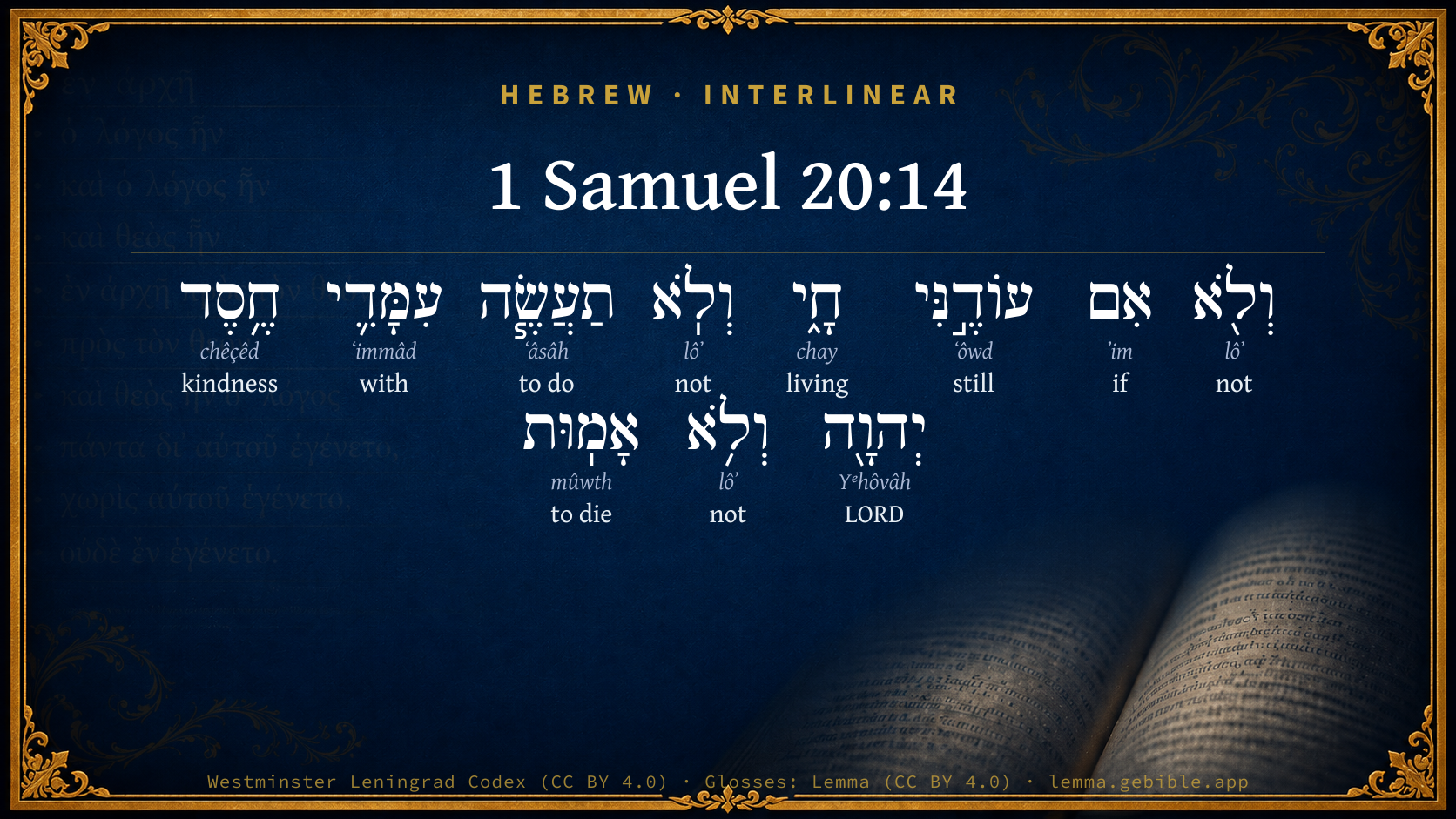
1 Samuel 20:14

Hebrew (Westminster Leningrad Codex) 1 Samuel 20:14 appears in the Hebrew Old Testament. The text above is from the Westminster Leningrad Codex. Each word links to its Strong’s number, a concise gloss, and parsing drawn from the Open Scriptures Hebrew Bible morphology. Click any word for its full Brown-Driver-Briggs (BDB) entry.
Download image
Cite this verse

1 Samuel 20:14 (World English Bible). Public Domain. Lemma interlinear Bible study tool, https://lemma.gebible.app/v/1-samuel/20/14.

Show BibTeX & RIS
BibTeX
RIS
English Translation
You shall not only while yet I live show me the loving kindness of Yahweh, that I not die;
World English Bible · Public Domain
Download a study sheet

One document with this verse’s original text, its word-by-word gloss line, the meaning frame, cross-references with their text, attributed commentary, and full source and license credits — printable, and it pastes into notes with its structure intact.

This verse Autodidact and up

Study sheet (.html) Plain text (.txt)

A passage Seminary Student

Up to 50 verses in one chapter. A passage sheet keeps up to 6 commentary sources and 12 cross-references per verse, in the order this page ranks them, and says so on the sheet whenever that leaves anything out. Ask for a single verse and you get the Autodidact verse sheet above.

Everything on this page stays free to read, with no account — the sheet is a download of what is already on screen, not access to it.

Want to remove ads? Support Godless Engineer
Compare translations 3

The same verse in 3 English versions, stacked beneath the original-language interlinear above. Click any original word for its lexicon entry.

Each is an independent rendering of the whole verse — the interlinear is not word-aligned to these translations.

Highlighted words mark where these versions differ — a whole-verse word diff, not a word-by-word alignment.

  • World English Bible Public Domain
    You shall not only while yet I live show me the loving kindness of Yahweh, that I not die;
  • King James Version Public Domain
    And thou shalt not only while yet I live show me the kindness of the LORD, that I die not:
  • unfoldingWord Literal Text CC BY-SA 4.0
    And if I am not still alive, then you shall not do the covenant faithfulness of Yahweh with me, so I do not die,

unfoldingWord Literal Text — © unfoldingWord, licensed CC BY-SA 4.0. Word-aligned USFM3 via Door43 (git.door43.org/unfoldingWord/en_ult).

Versions to compare (up to 4)

3 of 4 selected

Show all 18 translations

Every available English version of this verse, each an independent rendering of the whole verse.

  • World English Bible Public Domain
    You shall not only while yet I live show me the loving kindness of Yahweh, that I not die;
  • Berean Standard Bible Public Domain
    And as long as I live, treat me with the LORD’s loving devotion, that I may not die,
  • Majority Standard Bible Public Domain
    And as long as I live, treat me with the LORD’s loving devotion, that I may not die,
  • King James Version Public Domain
    And thou shalt not only while yet I live show me the kindness of the LORD, that I die not:
  • American Standard Version (1901) Public Domain
    And thou shalt not only while yet I live show me the lovingkindness of Jehovah, that I die not;
  • Revised Version (1885) Public Domain
    And thou shalt not only while yet I live shew me the kindness of the LORD, that I die not:
  • Geneva Bible (1599) Public Domain
    Likewise I require not whiles I liue: for I dout not but thou wilt shew me the mercy of the Lord, that I die not.
  • Douay-Rheims (1899) Public Domain
    And if I live, thou shalt shew me the kindness of the Lord: but if I die,
  • Young's Literal Translation Public Domain
    and not only while I am alive dost thou do with me the kindness of Jehovah, and I die not,
  • Literal Standard Version CC BY-SA 4.0
    and not only while I am alive do you do the kindness of YHWH with me, and I do not die,
  • Unlocked Literal Bible CC BY-SA 4.0
    If I am still alive, will you not show me the covenant faithfulness of Yahweh, that I may not die?
  • unfoldingWord Literal Text CC BY-SA 4.0
    And if I am not still alive, then you shall not do the covenant faithfulness of Yahweh with me, so I do not die,
  • Darby Bible Public Domain
    And thou shalt not only while yet I live shew me the kindness of Jehovah, that I die not,
  • World Messianic Bible Public Domain
    You shall not only show me the loving kindness of the LORD while I still live, that I not die;
  • Webster's Bible Public Domain
    And thou shalt, not only while yet I live, show me the kindness of the LORD, that I may not die:
  • Free Bible Version CC BY-SA 4.0
    While I live, please show me trustworthy love like that of the Lord so I don't die,
  • Bible in Basic English Public Domain
    And may you, while I am still living, O may you be kind to me, as the Lord is kind, and keep me from death!
  • JPS Tanakh (1917) Public Domain
    And thou shalt not only while yet I live show me the kindness of the LORD, that I die not;

Literal Standard Version (2020), Covenant Press — licensed CC BY-SA 4.0. Text via the HelloAO Bible API (eBible.org). Unlocked Literal Bible (unfoldingWord) — licensed CC BY-SA 4.0. Text via the HelloAO Bible API (eBible.org). unfoldingWord Literal Text — © unfoldingWord, licensed CC BY-SA 4.0. Word-aligned USFM3 via Door43 (git.door43.org/unfoldingWord/en_ult). Free Bible Version, Dr. Jonathan Gallagher — licensed CC BY-SA 4.0. Text via the HelloAO Bible API (eBible.org).

Word by word

More ways to search: Search by grammar → Find every occurrence → Compare this word →

Practice this passage: Drill this verse → Learn its vocabulary →

About this verse

These counts appear in no published source. They are computed here, from the morphology-tagged text and Lemma’s own curated glosses. What Lemma adds →

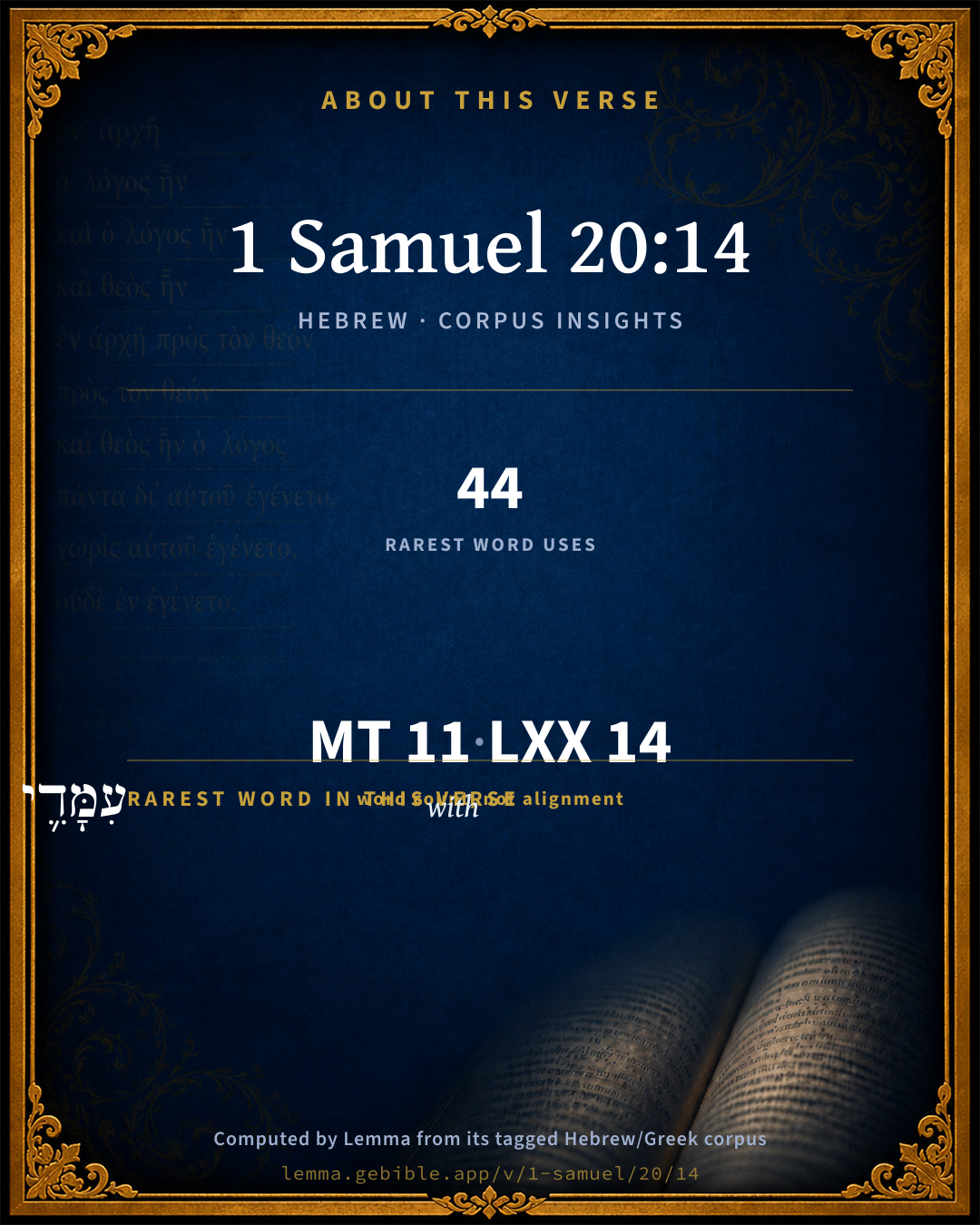
11
words
9
distinct lemmas
Historical
section

Shared distinctive vocabulary

עִמָּדִ֛י with H5978 occurs in 44 verses of the Hebrew Bible. Also found in:

Grammatical profile

  • 2 verbs
  • 2 nouns
  • 1 adjective
  • 1 preposition
  • 1 conjunction
  • 1 adverb
  • 3 particles

Verb forms

  • תַעֲשֶׂ֧ה Qal · Imperfect
  • אָמֽוּת Qal · Imperfect

Repetition

A word recurs within this verse — often emphatic in Hebrew:

  • וְלֹ֖א not H3808 ×3

Hebrew & Septuagint length

In English translation the verse runs 19 words from the Hebrew and 19 from the Septuagint (LXX English) — the same length.

A rough comparison of the two English renderings, which tokenize alike — not a word-level alignment.

Word counts can differ between the Hebrew and the Greek without any difference in meaning — e.g. the Hebrew direct-object marker אֵת has no separate Greek word, and Greek often adds the article ὁ.

In the original languages it is 11 Hebrew tokens and 14 Greek tokens — but the two are counted differently (Hebrew bundles its prefixes and suffixes into one token; the Greek is in lemma form), so that isn’t a like-for-like length.

Cross-references

2

Topical passages linked to 1 Samuel 20:14 in the Treasury of Scripture Knowledge — connected by theme and wording, ordered by reader-vote popularity; previews shown in the World English Bible.

  • 2 Samuel 9:3 The king said, Is there not yet any of the house of Saul, that I may show the kindness of God to him? Ziba said to the king, Jonathan has yet a son, who is lame of his feet.
  • Ephesians 5:1–2 Be therefore imitators of God, as beloved children.

Cross-references courtesy of OpenBible.info (CC BY 4.0).

Hebrew and Greek witnesses Masoretic Hebrew ↔ Greek Septuagint

The same verse in the two great witnesses to the Old Testament, shown verse-for-verse.

These are two independent witnesses, not word-aligned to each other, and the Septuagint is shown in lemma (dictionary) form.

Hebrew 1 Samuel 20:14 Masoretic · Westminster Leningrad Codex

וְלֹ֖א אִם עוֹדֶ֣נִּי חָ֑י וְלֹֽא תַעֲשֶׂ֧ה עִמָּדִ֛י חֶ֥סֶד יְהוָ֖ה וְלֹ֥א אָמֽוּת

You shall not only while yet I live show me the loving kindness of Yahweh, that I not die;

World English Bible · Public Domain

Greek LXX 1 Samuel 20:14 Septuagint · lemma form

καί μέν ἔτι ἐγώ ζάω καί ποιέω ἔλεος μετά ἐγώ καί ἐάν θάνατος ἀποθνήσκω

And if indeed I continue to live, then shall you deal mercifully with me; and if I indeed die,

LXX2012 (modern English Septuagint) · Public Domain

Hebrew: Westminster Leningrad Codex (CC BY 4.0). Greek: Septuagint (public domain); English from LXX2012 (modern English Septuagint) (Public Domain). How the Septuagint differs from the Hebrew →

Targum (Aramaic paraphrase)

1

The Targum is the ancient Jewish Aramaic paraphrase of the Hebrew Scriptures — an interpretive translation, not the Hebrew text itself. Onkelos (literal) and Pseudo-Jonathan (expansive) render the Torah, and Jonathan the Prophets. Coverage is partial: where no permissively-licensed English translation exists for a verse, only the Aramaic is shown. This is verse-level text, not a word-by-word alignment to the Hebrew.

  1. Targum Jonathan Prophets (Joshua–Malachi)
    וְלָא עַד דַאֲנָא קַיָם וְלָא תַעְבֵּיד עִמִי טִיבוּ מִן קֳדָם יְיָ וְלָא אֵמוּת:

    (no public-domain English translation for this verse)

    Targum Jonathan — Aramaic: “Mikraot Gedolot” (public domain). English: “Sefaria Community Translation” (CC0 1.0 (public-domain dedication)); “London "Chaldee Paraphrase," 1871” (public domain). Text via Sefaria.

Commentary

Notes on 1 Samuel 20:14 from classic Christian and Jewish commentators (each source and its license shown beneath its notes). The classic Christian expositions comment on the surrounding passage and are grouped to its opening verse, so a note may address several verses; the Jewish commentaries on the Tanakh (Rashi and others) are per-verse, so they appear only where the commentator wrote on this verse.

Lemma curates 59 commentaries, every one of them public domain or Creative Commons licensed, each selected and text-cleaned for this edition rather than reprinted as found. About our sources →

Ellicott's Commentary for English Readers

(14) And thou shalt not only while yet I live shew me the kindness of the Lord, that I die not.—The Hebrew of this and the next verse is again very confused, abrupt, and ungrammatical, but this is evidently to be attributed to the violent emotion of the speaker. We have, doubtless (as above suggested). David’s own report of what took place, and the words of his dead friend had, no doubt, impressed themselves with a sad accuracy on his heart.

The Syriac and Arabic renderings have been followed by Maurer, Ewald, Keil, Lange, and others, who change v’lo (“and not”) in the first two clauses of 1Sa_20:14, into the interjection v’lu (and “O that,” or “would that”). They render them, “And mayest thou, if I still live, show to me the favour of the Lord, and if I die, not withdraw thy favour from my house for ever, not even when Jehovah shall cut off the enemies of David, every one from the face of the earth.”

The last words, “when Jehovah shall cut off,” tells us with striking clearness how thoroughly convinced was Jonathan that in the end David’s cause, as the cause of their God, would surely triumph. Mournfully he looked on to his father’s downfall and his own (Jonathan’s) premature death; and in full view of this he bespoke the interest of his friend—though his friend would probably in a few hours become an exile and outlaw—on behalf of his own (Jonathan’s) children, who would, he foresaw, before many years had expired, be landless, homeless orphans.

A Bible Commentary for English Readers, edited by Charles John Ellicott (1878–1897) — public domain. Text from a community e-Sword module.

Trapp's Complete Commentary

John Trapp

1Sa 20:14 And thou shalt not only while yet I live shew me the kindness of the LORD, that I die not:

Ver. 14. Show me the kindness of the Lord.] Such as he showeth to his people; and such as they that have their thoughts steeped in the kindness of the Lord to themselves, do show one to another, loving mutually, "out of a pure heart fervently." {1Pe 1:22}

That I die not.] As justly perhaps I might do, for my father’s hatred to thee, and persecution of thee. That was a cruel custom of Ulades, prince of Walachia, together with the offender, to execute the whole family; yea, sometimes the whole kindred. {a}

{a} Turk. Hist.

John Trapp, A Commentary or Exposition upon All the Books of the Old and New Testament (1647–1656) — public domain. Text from a community e-Sword module.

Joseph Benson's Commentary

1Sa 20:14. And thou shalt show me the kindness of the Lord — That kindness to which thou hast engaged thyself, in the covenant sworn between thee and me in God’s presence. The words in the Hebrew run plainly thus: And wilt thou not, if I be then alive, (namely, when God had advanced David to the throne as he had done Saul,) wilt thou not show me the loving-kindness of the Lord? He made no doubt, but rather strongly affirmed his belief of it. That I die not — That thou do not kill me or mine, as princes of another line used to kill the nearest relations of the former line, from whom the kingdom was translated to them.

Joseph Benson's Commentary on the Old and New Testaments (1811–1818) — public domain. Text from a community e-Sword module.

Tyndale Open Study Notes

Tyndale Open Resources

20:14-16 faithful love: Hebrew khesed (see study note on 20:8). Jonathan was reminding David to keep his commitment to him when he became king. It was reasonable for Jonathan to be concerned that David might kill any descendant of Saul who could make a rival claim to his throne. Saul later made a similar request of David (24:21).

Tyndale Open Study Notes — © Tyndale Open Resources, licensed CC BY-SA 4.0. Text via the HelloAO Bible API.

Geneva Bible (1599)

Geneva Bible translators

I know that if thou werest now preferred to the Kingdom, thou wouldest not destroy me, but show thyself friendly to my posterity.

Geneva Bible (1599) marginal notes — public domain. Text via Bolls.life.

Adam Clarke's Commentary

Verse 14. Show me the kindness of the Lord] When thou comest to the kingdom, if I am alive, thou shalt show kindness to me, and thou shalt continue that kindness to my family after me.

Adam Clarke's Commentary on the Bible (1810–1826) — public domain. Text from a community e-Sword/MySword module.

The Cambridge Bible for Schools and Colleges

gen. ed. J. J. S. Perowne

14, 15. Convinced that David will succeed to the kingdom, Jonathan exacts from him a promise to shew kindness to his posterity after his death as well as to himself during his life time. His words, like Saul’s in ch. 1Sa_14:21, are prompted by a fear lest even David should conform to the barbarous Oriental custom by which the first king of a new dynasty often tried to secure himself on the throne by murdering his predecessor’s family. Cp. 1Ki_15:29; 1Ki_16:11; 2Ki_10:6; 2Ki_11:1. David fulfilled his promise by shewing kindness to Mephibosheth (2Sa_9:1 ff; 2Sa_21:7). This is clearly the general sense of the passage, though the exact rendering is doubtful. (1) Retaining the Heb. text we may translate: “And wilt thou not, if I am still alive (when thou comest to the throne), yea wilt thou not shew me the kindness of Jehovah, that I die not? And thou shalt not cut off, &c.” But this involves a very harsh construction, and it is perhaps best (2) to alter the text slightly, and translate: “And mayest thou, if I am still alive, yea mayest thou shew me the kindness of Jehovah: and if I die, thou shalt not cut off thy kindness from my house for ever, &c.”

The Cambridge Bible for Schools and Colleges (gen. ed. J. J. S. Perowne; Cambridge University Press, 1878–1918) — public domain. Text from a community e-Sword module.

John Gill's Exposition

And thou shalt not only, while yet I live, show me the kindness of the Lord,.... Such kindness as is well pleasing in the sight of God, and imitate what he shows to men, and which was covenanted, promised, and agreed to in the presence of the Lord, when David and Jonathan entered into covenant with each other; this Jonathan did not doubt of, and therefore did not make this a request:

that I die not; he had no fear nor dread on his mind, should David come to the throne while he was alive, that he would take away his life; which was usually done by tyrants and usurpers, when there were any that had a fairer title, and better claim to the throne than they.

John Gill's Exposition of the Whole Bible (1746–1763) — public domain (CC PDM 1.0). Text via the HelloAO Bible API.

Albert Barnes' Notes on the Bible

The general meaning is: Jonathan had a presentiment, doubtless from God, that David would be established upon the throne. By God’s mercy he had the comfort, which he well deserved, of knowing that his own posterity would receive kindness at David’s hand (see the marginal references).

Albert Barnes' Notes on the Bible (1834–1885) — public domain. Text from a community e-Sword/MySword module.

Haydock's Catholic Bible Commentary

Die. Hebrew literally, "If I live, thou shalt not shew me, &c....and if I die, (15) thou shalt not," &c. It seems there is a negation too much. Jonathan requests that David would shew mercy to him and to his family; or he is willing that neither should partake of his kindness, if he prove a traitor to his friend. (Calmet) --- Protestants, "And thou shalt not only, while yet I live, shew me the kindness of the Lord, that I die not: (15) But also thou shalt not cut off they kindness from my house for ever, no not when the Lord hath cut off," &c. (Haydock)

George Leo Haydock (1774–1849), Haydock's Catholic Family Bible and Commentary, 1859 edition — public domain. Excludes Psalms (Douay-Rheims chapter numbering differs from Protestant) and Deuterocanonical books (Catholic canon only).

Matthew Poole's English Annotations

Or,

And wilt thou not, if I shall then be alive, ( to wit, when the Lord shall be with thee, as he hath been with my father, as he now said, i.e. when God shall have advanced thee to the kingdom, as he did him,) yea, wilt thou not (the same particle twice repeated for asseveration, i.e. I am well assured that thou wilt)

show me the kindness of the Lord; i.e. either such kindness as the Lord hath showed to thee in preserving thy life in the midst of so many and such great dangers; or that kindness to which thou hast engaged thyself; in the covenant sworn between thee and me in God’s presence.

That I die not; that thou do not kill me or mine, as princes of another line use to kill the nearest relations of the former line, from whom the kingdom was translated to them; which they do either by way of revenge, or in policy, and reason of state, to secure the kingdom to themselves.

Matthew Poole's English Annotations on the Holy Bible (1683–1685) — public domain. Text from a community e-Sword/MySword module.

The Pulpit Commentary

Vers. 14, 15. The construction of this passage is very difficult if we retain the three negatives of the Masoretic text; but most commentators, following the reading of the Syriac as regards at least one of them, consider that the Masorites have been mistaken in the vowels which they have attached to the consonants. (see on 1Sa_1:7) Read with other vowels, two of these negatives become interjections of desireO that; and the whole may be translated, "And O that, while I still live, yea, O that thou wouldst show me the kindness of Jehovah,i.e. great unfailing kindness, such as was that of Jehovah to Israel, that I die not, nor shalt thou cut off thy kindness from my house forever." It was the sanguinary custom in the East on a change of dynasty to put all the seed royal to death. (1Ki_15:29 1Ki_16:11, etc., and comp. 2Sa_19:28) As then Jonathan foresaw that it was Jehovah"s will to transfer the kingdom to David, he binds him by the memory of his own true love to him to show mercy to his race.

The Pulpit Commentary (1880–1919), ed. H.D.M. Spence-Jones & Joseph S. Exell — public domain. Text from a community e-Sword module.

John Wesley's Explanatory Notes

Kindness as the Lord - That kindness to which thou hast engaged thyself, in the covenant sworn between thee and me in God's presence. I die not - That thou do not kill me or mine, as princes of another line use to kill the nearest relations of the former line, from whom the kingdom was translated to them.

John Wesley, Explanatory Notes Upon the Whole Bible (1754–1765) — public domain. Text via the GEBible commentary corpus.

unfoldingWord translationNotes

Door43 World Missions Community

General Information:

Jonathan asks David not to completely kill all his offspring so that a remnant will remain.

will you not show me the covenant faithfulness of Yahweh, that I may not die?

Jonathan asks this question to confirm that David will do this. This rhetorical question can be translated as a statement. AT: "please show me the covenant faithfulness of Yahweh, that I may not die" (See: Rhetorical Question)

show me the covenant faithfulness of Yahweh

The abstract noun "faithfulness" can be stated as "faithful." Possible meanings for "of Yahweh" are 1) "be faithful to me as Yahweh is faithful" or 2) "be faithful to me as Yahweh requires" (See: Abstract Nouns)

house of David

The word "house" is a metonym for the people who live in the house. AT: "David's family" (See: Metonymy)

May Yahweh require an accounting from the hand of the enemies of David

The hand is a synecdoche for the person. Possible meanings are 1) "May Yahweh use David's enemies to punish David if David breaks this promise" or 2) "May Yahweh destroy the enemies of David." (See: Synecdoche)

translationWords

life

covenant faithfulness

Yahweh

die

cut off

house

adversary

face

earth

covenant

hand

unfoldingWord translationNotes — © Distant Shores Media and the Door43 World Missions Community, licensed CC BY-SA 4.0. Source: git.door43.org/Door43/en_tn.

Rashi

Rabbi Shlomo Yitzchaki (Rashi)

I will not [ask of you] if I still be alive. An expression of request, as in and if only [וָלאׁ] it will be given to your bondsman.' It is not removed from its usual meaning, 'and will you not do with me good while I am still alive, and do with me the kindness of Adonoy before I die?' And what is the kindness? That you will not discontinue your kindness with my household. Regarding this, you will make a covenant with me in my lifetime.

Rashi on the Tanakh — English translations: “The Judaica Press complete Tanach with Rashi, translated by A. J. Rosenberg” (CC BY 4.0); “Pentateuch with Rashi's commentary by M. Rosenbaum and A.M. Silbermann, 1929-1934” (public domain); “The Metsudah Tanach series, Lakewood, N.J” (CC BY 4.0); and “The Book of Joshua, Metsudah Publications, 1997” (CC BY 4.0). Text via Sefaria.

Lesson kit

Teaching starters — assembled from the data on this page, not authored interpretation. Every prompt links to the verse data it draws on. Edit before teaching.

1 Samuel, in the Historical, opens this verse with 11 words (9 distinct Hebrew lemmas). Its most distinctive word is ʻimmâd (“with”). A historical commentator’s framing appears above. Read the whole chapter for the surrounding context.

Discussion questions

  1. How does “with” (ʻimmâd) shape what this verse is saying?
  2. How does Genesis 3:12, which shares the word «with», read alongside this verse?
  3. What does the repetition of “not” (3× in this one verse) do in this verse?
  4. These translations render this verse differently. What is at stake in choosing one wording over another?
  5. «תַעֲשֶׂ֧ה» is a Qal Imperfect verb. How does that grammatical form shape the action described?
  6. Compare how Ellicott's Commentary for English Readers and Trapp's Complete Commentary read this verse. Where do they agree or differ?

Things to notice

Reading settings

Reading text

Shown beneath each verse's original-language words.

Old Testament
Old Testament edition

Read the OT as the Masoretic Hebrew (MT) or the Greek Septuagint (LXX).

English shown for the Greek Septuagint (in the Hebrew ↔ Greek comparison).

Comparing translations? Open the Compare panel on any verse page to stack up to four side by side.