Galatians 4:23

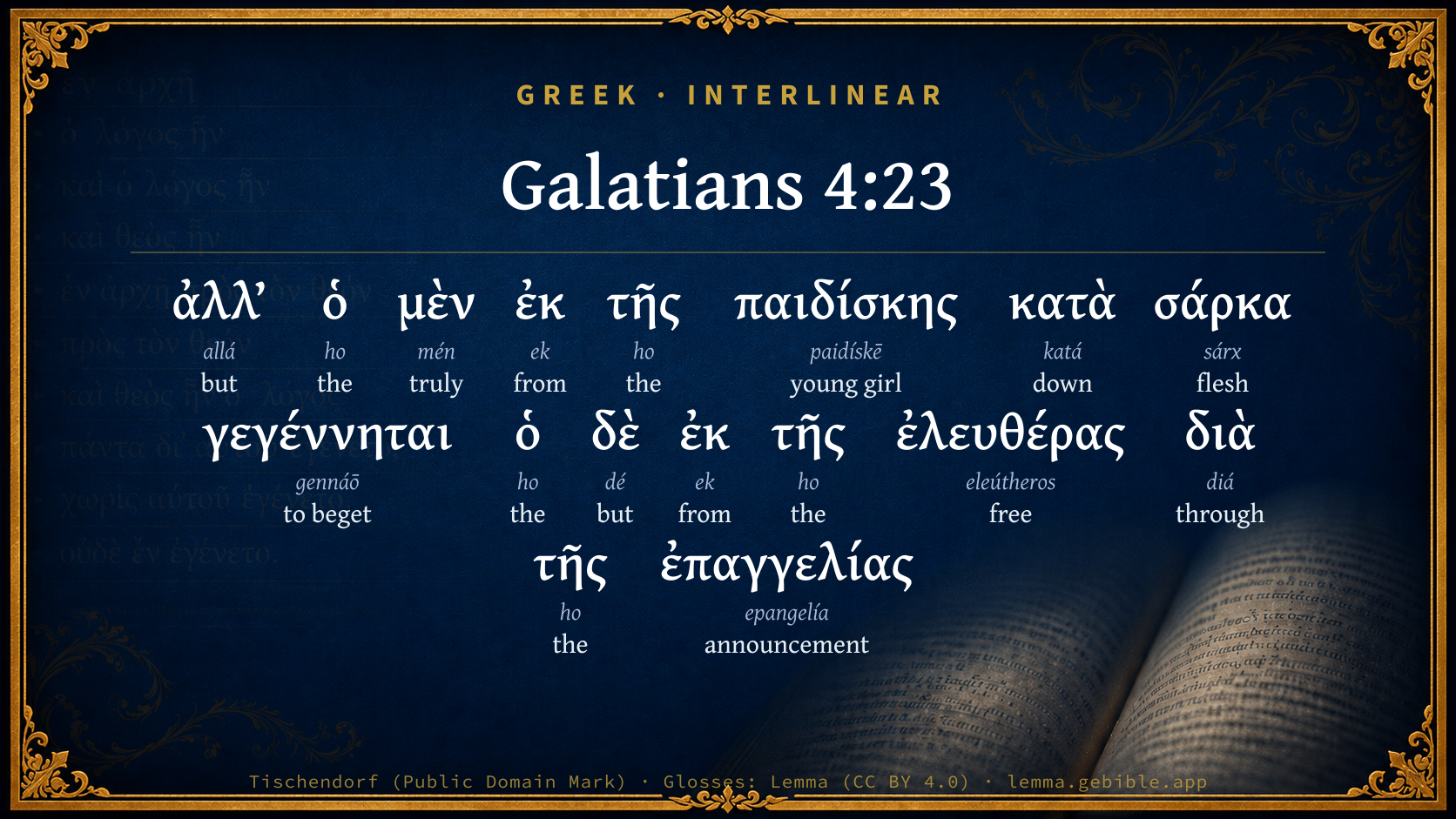
Greek (Tischendorf 8th ed.) Galatians 4:23 appears in the Greek New Testament. The text above is from the Tischendorf 8th edition. Each word links to its Strong’s number and a concise gloss. Click any word for its full Thayer’s Greek Lexicon entry.
Download image
Cite this verse

Galatians 4:23 (World English Bible). Public Domain. Lemma interlinear Bible study tool, https://lemma.gebible.app/v/galatians/4/23.

Show BibTeX & RIS
BibTeX
RIS
English Translation
However, the son by the handmaid was born according to the flesh, but the son by the free woman was born through promise.
World English Bible · Public Domain
Download a study sheet

One document with this verse’s original text, its word-by-word gloss line, the meaning frame, cross-references with their text, attributed commentary, and full source and license credits — printable, and it pastes into notes with its structure intact.

This verse Autodidact and up

Study sheet (.html) Plain text (.txt)

A passage Seminary Student

Up to 50 verses in one chapter. A passage sheet keeps up to 6 commentary sources and 12 cross-references per verse, in the order this page ranks them, and says so on the sheet whenever that leaves anything out. Ask for a single verse and you get the Autodidact verse sheet above.

Everything on this page stays free to read, with no account — the sheet is a download of what is already on screen, not access to it.

Want to remove ads? Support Godless Engineer
Compare translations 3

The same verse in 3 English versions, stacked beneath the original-language interlinear above. Click any original word for its lexicon entry.

Each is an independent rendering of the whole verse — the interlinear is not word-aligned to these translations.

Highlighted words mark where these versions differ — a whole-verse word diff, not a word-by-word alignment.

  • World English Bible Public Domain
    However, the son by the handmaid was born according to the flesh, but the son by the free woman was born through promise.
  • King James Version Public Domain
    But he who was of the bondwoman was born after the flesh; but he of the freewoman was by promise.
  • unfoldingWord Literal Text CC BY-SA 4.0
    And the one was born from the slave girl according to flesh, but the, from the free woman, through promise.

unfoldingWord Literal Text — © unfoldingWord, licensed CC BY-SA 4.0. Word-aligned USFM3 via Door43 (git.door43.org/unfoldingWord/en_ult).

Versions to compare (up to 4)

3 of 4 selected

Show all 19 translations

Every available English version of this verse, each an independent rendering of the whole verse.

  • World English Bible Public Domain
    However, the son by the handmaid was born according to the flesh, but the son by the free woman was born through promise.
  • Berean Standard Bible Public Domain
    His son by the slave woman was born according to the flesh, but his son by the free woman was born through the promise.
  • Majority Standard Bible Public Domain
    His son by the slave woman was born according to the flesh, but his son by the free woman was born through the promise.
  • King James Version Public Domain
    But he who was of the bondwoman was born after the flesh; but he of the freewoman was by promise.
  • American Standard Version (1901) Public Domain
    Howbeit the `son' by the handmaid is born after the flesh; but the `son' by the freewoman `is born' through promise.
  • Revised Version (1885) Public Domain
    Howbeit the son by the handmaid is born after the flesh; but the son by the freewoman is born through promise.
  • Geneva Bible (1599) Public Domain
    But he which was of the seruant, was borne after the flesh: and he which was of the free woman, was borne by promise.
  • Douay-Rheims (1899) Public Domain
    But he who was of the bondwoman, was born according to the flesh: but he of the free woman, was by promise.
  • Young's Literal Translation Public Domain
    but he who `is' of the maid-servant, according to flesh hath been, and he who `is' of the free-woman, through the promise;
  • Literal Standard Version CC BY-SA 4.0
    but he who [is] of the maidservant has been according to flesh, but he who [is] of the free [woman], through the promise,
  • Unlocked Literal Bible CC BY-SA 4.0
    One was born by the slave girl according to the flesh, but the other was born by the free woman through promise.
  • unfoldingWord Literal Text CC BY-SA 4.0
    And the one was born from the slave girl according to flesh, but the, from the free woman, through promise.
  • Darby Bible Public Domain
    But he [that was] of the maid servant was born according to flesh, and he [that was] of the free woman through the promise.
  • World Messianic Bible Public Domain
    However, the son by the servant was born according to the flesh, but the son by the free woman was born through promise.
  • Webster's Bible Public Domain
    But he who was of the bond-woman, was born according to the flesh; but he of the free-woman was by promise.
  • Free Bible Version CC BY-SA 4.0
    However, the son from the servant girl was born following a human plan, while the son from the free woman was born as the result of the promise.
  • Bible in Basic English Public Domain
    Now the son by the servant-woman has his birth after the flesh; but the son by the free woman has his birth through the undertaking of God.
  • Text-Critical English NT CC BY 4.0
    But the son of the slave woman was born according to the flesh, while the son of the free woman was born through the promise.
  • Tyndale New Testament (1534) Public Domain
    Yee and he which was of the bonde woman was borne after the flesshe: but he which was of the fre woman was borne by promes.

Literal Standard Version (2020), Covenant Press — licensed CC BY-SA 4.0. Text via the HelloAO Bible API (eBible.org). Unlocked Literal Bible (unfoldingWord) — licensed CC BY-SA 4.0. Text via the HelloAO Bible API (eBible.org). unfoldingWord Literal Text — © unfoldingWord, licensed CC BY-SA 4.0. Word-aligned USFM3 via Door43 (git.door43.org/unfoldingWord/en_ult). Free Bible Version, Dr. Jonathan Gallagher — licensed CC BY-SA 4.0. Text via the HelloAO Bible API (eBible.org).

Word by word

More ways to search: Search by grammar → Find every occurrence → Compare this word →

Practice this passage: Drill this verse → Learn its vocabulary →

παιδίσκης
paidískē
G3814
“young girl”
Noun, Genitive, Singular, Feminine
Part of Speech
Noun
Case
Genitive
Number
Singular
Gender
Feminine
Full Thayer's Definition

Origin: from diminutive of G3816

TDNT: None

1. a young girl, damsel 2. a maid-servant, a young female slave a. a maid servant who has charge of the door
  1. ἀλλ’ allá G235 “but” Conjunction
  2. ὁ ho G3588 “the” Article, Nominative, Singular, Masculine
  3. μὲν mén G3303 “truly” Particle
  4. ἐκ ek G1537 “from” Preposition
  5. τῆς ho G3588 “the” Article, Genitive, Singular, Feminine
  6. κατὰ katá G2596 “down” Preposition
  7. σάρκα sárx G4561 “flesh” Noun, Accusative, Singular, Feminine
  8. γεγέννηται gennáō G1080 “to beget” Verb, Perfect, Passive, Indicative, 3rd person, Singular
  9. ὁ ho G3588 “the” Article, Nominative, Singular, Masculine
  10. δὲ dé G1161 “but” Conjunction
  11. ἐκ ek G1537 “from” Preposition
  12. τῆς ho G3588 “the” Article, Genitive, Singular, Feminine
  13. ἐλευθέρας eleútheros G1658 “free” Adjective, Genitive, Singular, Feminine
  14. διὰ diá G1223 “through” Preposition
  15. τῆς ho G3588 “the” Article, Genitive, Singular, Feminine
  16. ἐπαγγελίας epangelía G1860 “announcement” Noun, Genitive, Singular, Feminine

About this verse

These counts appear in no published source. They are computed here, from the morphology-tagged text and Lemma’s own curated glosses. What Lemma adds →

17
words
12
distinct lemmas
Pauline Epistles
section

Notable vocabulary

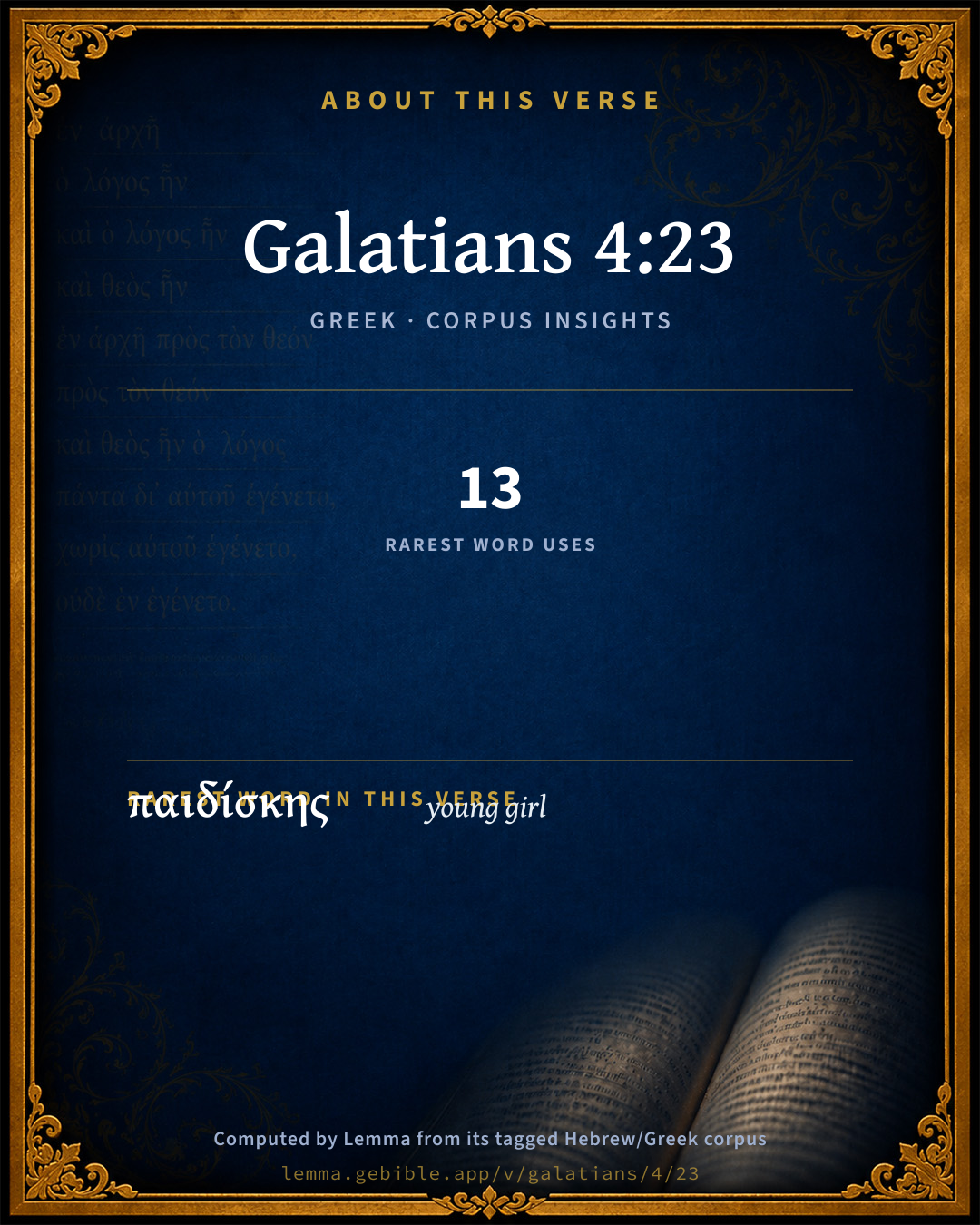
The rarest word here is παιδίσκης young girl G3814 — appearing just 13 times in the whole Greek New Testament.

Shared distinctive vocabulary

παιδίσκης young girl G3814 occurs in 12 verses of the Greek New Testament. Also found in:

Repetition

Words recur within this verse:

Cross-references

8

Topical passages linked to Galatians 4:23 in the Treasury of Scripture Knowledge — connected by theme and wording, ordered by reader-vote popularity; previews shown in the World English Bible.

  • Hebrews 11:11 By faith, even Sarah herself received power to conceive, and she bore a child when she was past age, since she counted him faithful who had promised.
  • Genesis 21:1–2 Yahweh visited Sarah as he had said, and Yahweh did to Sarah as he had spoken.
  • Romans 9:7–8 Neither, because they are Abraham's seed, are they all children. But, "In Isaac will your seed be called."
  • Genesis 18:10–14 He said, "I will certainly return to you when the season comes round. Behold, Sarah your wife will have a son." Sarah heard in the tent door, which was behind him.
  • Galatians 4:28–29 Now we, brothers, as Isaac was, are children of promise.
  • Genesis 17:15–19 God said to Abraham, "As for Sarai your wife, you shall not call her name Sarai, but her name will be Sarah.
  • Romans 4:18–21 Who in hope believed against hope, to the end that he might become a father of many nations, according to that which had been spoken, "So will your seed be."
  • Romans 10:8 But what does it say? "The word is near you, in your mouth, and in your heart;" that is, the word of faith, which we preach:

Cross-references courtesy of OpenBible.info (CC BY 4.0).

Commentary

Notes on Galatians 4:23 from classic Christian and Jewish commentators (each source and its license shown beneath its notes). The classic Christian expositions comment on the surrounding passage and are grouped to its opening verse, so a note may address several verses; the Jewish commentaries on the Tanakh (Rashi and others) are per-verse, so they appear only where the commentator wrote on this verse.

Lemma curates 59 commentaries, every one of them public domain or Creative Commons licensed, each selected and text-cleaned for this edition rather than reprinted as found. About our sources →

Meyer's Critical & Exegetical Commentary

Heinrich August Wilhelm Meyer

Gal_4:23 presents the relation of diversity between the two, in contrast to the previously mentioned relation of similarity, according to which they both were sons of Abraham.

κατὰ σάρκα] according to the flesh, so that the birth was the result of a natural carnal intercourse. Differently in Rom_1:3; Rom_9:5

γεγέννηται] is born; the perfect realizes the historically existing relation as present.

διὰ τὴς ἐπαγγελίας] through the (well-known) promise, Gen_17:16; Gen_17:19; Gen_18:10; Rom_9:9. This must not, however, be rationalized (with Grotius, Rosenmüller, and others) into per eam vim extraordinariam, quam Deus promiserat, which does violence to the history in Genesis, as above; nor, with Hofmann, to the effect that the promise, with which Abraham had been called, was realized in the procreation itself; but it is to be definitely explained in accordance with the tenor of the words and with Gen_21:1 : by virtue of the promise he is born, so that in his procreation (Mat_1:2; Luk_3:34) the divine promise made to his parents, which had assured them of the birth of a son, was the procuring cause of the result, which would not have occurred without such an operation of the power of the divine promise (Gen_18:14), seeing that the two parents were in themselves incapable of the procreation of Isaac; for Sarah was barren, and both were already too old (Gen_18:11; Rom_4:19). Comp. Chrysostom.

Meyer — Critical and Exegetical Commentary on the New Testament — English translation by Peter Christie, edited by Frederick Crombie (T&T Clark, 1880) — public domain. Text from a community e-Sword module.

Expositor's Greek Testament

ed. W. Robertson Nicoll

Gal 4:23 . The two who were coupled together in the last verse as sons of one father are here contrasted in respect of their different mothers. γεγέννηται . The perfect is used in order to present the birth as a Scripture record now in existence ( cf. Heb 11:17 ; Heb 11:28 …): otherwise the aorist ἐγεννήθη would have been appropriate. διʼ ἐπαγγελίας . There is an alternative reading διὰ τῆς ἐπ . supported by equal MS. authority: but it is difficult to attach any meaning to the article, whereas διʼ ἐπαγγ . forms an appropriate antithesis to κατὰ σάρκα . Like διὰ νόμου in Gal 2:19 ; Gal 2:21 it describes the attendant circumstances under which the birth took place, διά not having an instrumental force.

The Expositor's Greek Testament, edited by W. Robertson Nicoll (1897–1910) — public domain. Text from a community e-Sword module.

Geneva Bible (1599)

Geneva Bible translators

As all men are, and by the common course of nature.

By virtue of the promise, which Abraham laid hold on for himself and his true seed, for otherwise Abraham and Sarah were past begetting and bearing children.

Geneva Bible (1599) marginal notes — public domain. Text via Bolls.life.

Jamieson, Fausset & Brown

Robert Jamieson, A. R. Fausset & David Brown

after the flesh--born according to the usual course of nature: in contrast to Isaac, who was born "by virtue of the promise" (so the Greek), as the efficient cause of Sarah's becoming pregnant out of the course of nature (Rom 4:19). Abraham was to lay aside all confidence in the flesh (after which Ishmael was born), and to live by faith alone in the promise (according to which Isaac was miraculously born, contrary to all calculations of flesh and blood).

Jamieson, Fausset & Brown — Commentary Critical and Explanatory on the Whole Bible (1871) — public domain (CC PDM 1.0). Text via the HelloAO Bible API.

Adam Clarke's Commentary

Verse 23. Was born after the flesh] Ishmael was born according to the course of nature, his parents being both of a proper age, so that there was nothing uncommon or supernatural in his birth: this is the proper meaning of the apostle's κατα σαρκα, after or according to the flesh, and answers to the Hebrew phrase, על דרך בשר al derec basar, according to the manner of the flesh, i.e. naturally, according to the common process of nature.

By promise.] Both Abraham and Sarah had passed that age in which the procreation of children was possible on natural principles. The birth, therefore, of Isaac was supernatural; it was the effect of an especial promise of God; and it was only on the ground of that promise that it was either credible or possible.

Adam Clarke's Commentary on the Bible (1810–1826) — public domain. Text from a community e-Sword/MySword module.

John Calvin's Commentaries

23. But he who was of the bond woman. Both were sons of Abraham according to the flesh; but in Isaac there was this peculiarity, that he had the promise of grace. In Ishmael there was nothing besides nature; in Isaac there was the election of God, signified in part by the manner of his birth, which was not in the ordinary course, but miraculous. Yet there is an indirect reference to the calling of the Gentiles, and the rejection of the Jews: for the latter boast of their ancestry, while the former, without any human interference, are become the spiritual offspring of Abraham.

John Calvin's Commentaries (1540-1563) — public domain. Text from the Calvin Translation Society English edition (1840s-50s) via the Christian Classics Ethereal Library (ccel.org). Calvin's coverage is partial (roughly two-thirds of the Bible); uncommented books and verses are honest gaps, never fabricated. The 19th-century editor's footnotes and remarks are omitted so the notes are faithfully Calvin's own voice.

Ellicott's Commentary for English Readers

(23) But.—Both were alike in being children of Abraham; they were unlike in that one was born naturally, the other by divine instrumentality.

Was born.—Strictly, is born—i.e., is stated to have been born, was born as we still read.

After the flesh—i.e., in the regular course of nature.

By promise.—The birth of Isaac is regarded as due to the direct agency of the promise, The promise itself is conceived of as possessing a creative power. The birth of Isaac was the result of a miraculous intervention. (See Gen_18:10.)

A Bible Commentary for English Readers, edited by Charles John Ellicott (1878–1897) — public domain. Text from a community e-Sword module.

John Gill's Exposition

Which things are an allegory,.... Or "are allegorized": so Sarah and Hagar were allegorized by Philo the Jew (p), before they were by the apostle. Sarah he makes to signify virtue, and Hagar the whole circle of arts and sciences, which are, or should be, an handmaid to virtue; but these things respecting Hagar and Sarah, the bondwoman and the free, and their several offspring, are much better allegorized by the apostle here. An allegory is a way of speaking in which one thing is expressed by another, and is a continued metaphor; and the apostle's meaning is, that these things point at some other things; have another meaning in them, a mystical and spiritual one, besides the literal; and which the Jews call

"Midrash", a name they give to the mystical and allegorical sense of Scripture, in which they greatly indulge themselves. An allegory is properly a fictitious way of speaking; but here it designs an accommodation of a real history, and matter of fact, to other cases and things, and seems to intend a type or figure; and the sense to be, that these things which were literally true of Hagar and Sarah, of Ishmael and Isaac, were types and figures of things to come; just as what befell the Israelites were types and figures of things that would be under the Gospel dispensation, Co1 10:11.

for these are the two covenants, or "testaments"; that is, these women, Hagar and Sarah, signify, and are figures of the two covenants; not the covenant of works, and the covenant of grace. Hagar was no figure of the covenant of works, that was made and broke before she was born; besides, the covenant she was a figure of was made at Mount Sinai, whereas the covenant of works was made in paradise: moreover, the covenant of works was made with Adam, and all his posterity, but the covenant which Hagar signified was only made with the children of Israel; she represented Jerusalem, that then was with her children. Nor was Sarah a figure of the covenant of grace, for this was made long before she had a being, even from everlasting; but they were figures of the two administrations of one and the same covenant, which were to take place in the world successively; and which following one the other, are by the author of the Epistle to the Hebrews called the first and the second, the old and the new covenants. Now these are the covenants or testaments, the old and the new, and the respective people under them, which were prefigured by these two women, and their offspring.

The one from the Mount Sinai; that is, one of these covenants, or one of the administrations of the covenant, one dispensation of it, which is the first, and now called old, because abolished, took its rise from Mount Sinai, was delivered there by God to Moses, in order to be communicated to the people of Israel, who were to be under that form of administration until the coming of the Messiah. And because the whole Mosaic economy was given to Moses on Mount Sinai, it is said to be from thence: hence, in Jewish writings, we read, times without number, of , a rite, custom, constitution, or appointment given to Moses "from Mount Sinai", the same phrase as here. Sinai signifies "bushes", and has its name from the bushes which grew upon if, (q); in one of which the Lord appeared to Moses; for Horeb and Sinai are one and the same mount; one signifies waste and desolate, the other bushy; as one part of the mountain was barren and desert, and the other covered with bushes and brambles; and may fitly represent the condition of such that are under the law.

Which gendereth to bondage; begets and brings persons into a state of bondage, induces on them a spirit of bondage to fear, and causes them to be all their lifetime subject to it; as even such were that were under the first covenant, or under the Old Testament dispensation:

which is Agar; or this is the covenant, the administration of it, which Hagar, the bondwoman, Sarah's servant, represented.

(p) De Cherubim, p. 108, 109. (q) Pirke Eliezer, c. 41.

John Gill's Exposition of the Whole Bible (1746–1763) — public domain (CC PDM 1.0). Text via the HelloAO Bible API.

Trapp's Complete Commentary

John Trapp

23 But he who was of the bondwoman was born after the flesh; but he of the freewoman was by promise.

Ver. 23. Was born after the flesh] In an ordinary way, as all others are; for Hagar was young, and Abraham not old.

Was by promise] i.e. By a supernatural power, by a divine miracle.

John Trapp, A Commentary or Exposition upon All the Books of the Old and New Testament (1647–1656) — public domain. Text from a community e-Sword module.

Albert Barnes' Notes on the Bible

But he who was of the bondwoman was born after the flesh - In the ordinary course of nature, without any special promise, or any unusual divine interposition, as in the case of Isaac.

But he of the free woman ... - The birth of Isaac was in accordance with a special promise, and by a remarkable divine interposition; see Gen 18:10; Gen 21:1-2; Heb 11:11-12; compare the notes at Rom 4:19-21. The idea here of Paul is, that the son of the slave was in a humble and inferior condition from his very birth. There was no special promise attending him. He was born into a state of inferiority and servitude which attended him through his whole life. Isaac, however, was met with promises as soon as he was born, and was under the benefit of those promises as long as he lived. The object of Paul is, to state the truth in regard to a condition of servitude and slavery. It is attended with evils from beginning to end; from the birth to the grave. By this illustration he means to show them the folly of becoming the voluntary slaves of the Law after they had once been made free.

Albert Barnes' Notes on the Bible (1834–1885) — public domain. Text from a community e-Sword/MySword module.

Matthew Poole's English Annotations

They were both (in a sense) born after the flesh, viz. in a natural way and course of generation: but

after the flesh is plainly, in this verse, opposed to

by promise; and the meaning is, that Ishmael, the son of Hagar, was not that son of Abraham to whom the promise was made, that in him all the nations of the earth should be blessed: see Gen 15:4; 17:19. Isaac is said to have been born after the promise, either because God gave Isaac to Abraham, in completion or fulfilling of the promise made to him, that he should have an heir out of his own loins; or because the mighty and miraculous power of God was seen in his production, enabling Abraham at those years to beget, and Sarah to bear, a child, when both their bodies were as dead.

Matthew Poole's English Annotations on the Holy Bible (1683–1685) — public domain. Text from a community e-Sword/MySword module.

Whedon's Commentary on the Bible

Daniel D. Whedon

23. After the flesh—Not by miracle and promise, as Isaac was, but in the ordinary mode. And so he is suitable type of the unregenerate; and, as under bondage, he is type of the falsely regenerate under law and works; just like their Judaizing apostles and all their converts in Galatia or elsewhere. See note, Rom_9:8.

Daniel D. Whedon (gen. ed.), Commentary on the Old and New Testaments (1874–1909) — public domain. Text from a community e-Sword module.

The Pulpit Commentary

But he who was of the bondwoman was born after the flesh (ajll oJ meskhv katarka gegennhtai); howbeit the son by the handmaid is shown as born (or, begotten) after the flesh. The ajlla is strongly adversative; both, indeed, were sons of Abraham, but there was a marked distinction in the way in which they severally came into being. The apostle has evidently in his eye the analogy presented by the natural birth of the Jewish descendants from Abraham, as contrasted with the birth of Abraham"s spiritual seed through faith in the promises of the gospel. This point, however, he is content with merely, in vers. 28, 29, glancing at. His main point is the condition of both mother and child in each case, as being either both free or both in bondage. It is not clear whether the apostle by gegennhtai meant "born" or "begotten," the verb being used in both senses: but neither is it material. The perfect tense of the verb either supposes us to be as it were present at the time of Ishmael"s expulsion, in which case it would mean, "hath been born," or is used with reference to the record in the history, meaning in this case "appears in the story as having been born." So the perfect tense is used also in twke, Heb_7:6, dedeka eujloghke, and nistai. (Heb_10:18, ejgkekai) "According to the flesh" does not precisely mean "in the common course of torture;" the word "flesh" rather contrasts the present visible sphere of human life with the invisible spiritual world, in much the same way as "flesh" is so often contrasted with "spirit." Ishmael was born "after the flesh," because he was born in the common course of nature; Isaac was born (ver. 28) "after the Spirit," because his birth was connected with the invisible spiritual world "through the promise," which on the one A hand was given by God the great Sovereign of the spiritual world, and on the other was laid hold of and made effectual in that same world of spiritual action by Abraham"s and Sarah"s faith. But he of the freewoman was by promise (oJ derav di Receptus, dia thv ejpaggeliav); but the son by the freewoman through a promise (or, through the promise). If the article before ejpaggeliav be retained, it is to be taken as pointing to the well-known promise made by the Lord to Abraham, both in the night in which God made a covenant with him. (Ge 15) and afresh, in a more definite form, on the eve of the destruction of Sodom. (Ge 18) This promise was the means of Isaac"s being born, calling forth as it did an acting of faith in God, both in Abraham, (Rom_4:17-21) and likewise in Sarah, (Heb_11:11) in consideration of which the Almighty beyond the course of nature gave them this child.

The Pulpit Commentary (1880–1919), ed. H.D.M. Spence-Jones & Joseph S. Exell — public domain. Text from a community e-Sword module.

John Wesley's Explanatory Notes

Was born after the flesh - In a natural way. By promise - Through that supernatural strength which was given Abraham in consequence of the promise.

John Wesley, Explanatory Notes Upon the Whole Bible (1754–1765) — public domain. Text via the GEBible commentary corpus.

Luther on Galatians

Martin Luther

see notes on vs 22

Martin Luther — Commentary on the Epistle to the Galatians (1535), English translation by Theodore Graebner (Zondervan, 1939) — public domain (U.S. copyright not renewed). Text from a community e-Sword module.

McGarvey & Pendleton's Commentaries

J. W. McGarvey

Howbeit the son by the handmaid is born after the flesh; but the son by the freewoman is born through promise. [ Gen_18:10 ; Gen_18:14 ; Gen_21:1-2 ; Heb_11:11 ; Rom_4:13 ; Rom_9:7-9 ]

J. W. McGarvey (with Philip Y. Pendleton), Commentaries on the New Testament (The Fourfold Gospel, 1914; Acts; and the epistles) — public domain. Text from a community e-Sword/MySword module.

The People's New Testament

B. W. Johnson

23. Was born after the flesh. The son of the bondwoman was born in the ordinary course of nature. Was by promise. The son of Sarah was a child of promise, born when she was long past the age of bearing children. See Gen. 18:10, 14; 21:1, 2; Heb. 11:11.

B. W. Johnson's The People's New Testament with Notes (1889–1891) — public domain. Electronic text from the Christian Classics Ethereal Library (CCEL) ThML edition.

Cambridge Greek Testament for Schools and Colleges

23. διʼ ἐπαγγελίας אAC. διὰ τῆς ἐπ. Text. Rec. and W.H. marg. with BDG etc.

23. ἀλλʼ. There was a further difference between the two sons of the one father.

κατὰ σάρκα. In accordance with the natural impulses of the flesh.

γεγἐννηται. The perfect means either “stands in Scripture as so horn,” or, better, “still exists” (in the persons of unbelieving Jews). Contrast the aorist, Gal 4:29.

διʼ ἐπαγγελίας, Gal 3:18, “by promise,” possibly “by a promise.” Flesh as such was powerless. Promise, nothing less, was the means by which Sarah was enabled to bear Isaac. The article of W.H. marg. recalls the actual promise. Chrysostom gives the sense of the phrase in saying: ὁ μὴ κατὰ σάρκα τοῦ κατὰ σάρκα γεννηθέντος τιμιώτερος ἦν.

St Paul has now stated two differences between the two sons of Abraham. Ishmael was (a) of the servant, (b) after the flesh; Isaac was (a) of the freewoman, (b) by means of promise. He first deals with (a) in Gal 4:24 b—27; and then mentions (b) in Gal 4:28, not dwelling on this at length, for he has already done so in c. 3.

Cambridge Greek Testament for Schools and Colleges (Cambridge University Press, 1896; 21 vols, various authors incl. Carr, Maclear, Plummer, Farrar, Lumby, Moule, M. R. James, Simcox) — public domain. Text from a community e-Sword module.

Alford’s Greek Testament

Henry Alford

23.] κατὰσάρκα, according to nature, in her usual course: διʼ ἐπαγγελίας, by virtue of (the) promise, as the efficient cause of Sara’s becoming pregnant contrary to nature: see Rom 4:19.

Henry Alford, The Greek Testament (1849–1861) — public domain. Text from a community e-Sword module.

International Critical Commentary

23. ἀλλʼ ὁ μὲν ἐκ τῆς παιδίσκης κατὰ σάρκα γεγέννηται, ὁ δὲ ἐκ τῆς ἐλευθέρας διʼ ἐαγγελίας. “But the son of the maid servant was born according to the flesh; the son of the freewoman through promise.” κατὰ σάρκα, “by natural generation,” in the ordinary course of nature (cf. Rom 1:3, Rom 9:5 and detached note on Πνεῦμα and Σάρξ, p. 492, 3 (a) under σάρξ), and διʼ ἐπαγγελίας, “through promise,” are antithetical, not by mutual exclusion, but in the fact that, though Isaac was begotten and born κατὰ σάρκα, his birth was also διʼ ἐπαγγελίας, and was significant because of this, while the birth of Ishmael was simply κατὰ σάρκα. On the ἐπαγγελία here referred to, see Gen 15:4, Gen 17:19, and cf. chap. 3:18. The perfect γεγέννηται is used in preference to the aorist ἐγενήθη, because the writer is thinking not simply of the historical fact but of the existing result of that fact, in the race of Ishmael’s descendants and especially (for γεγέννηται belongs in thought to both members of the sentence) in Isaac’s descendants.

WH. bracket μέν, omitted by B f Vg. Tert. Hil. Hier. Yet the concurrent omission of such a word by one Grk. ms. and a small group of Latin authorities seems to raise no serious question of its belonging to the text. Between διʼ ἐπαγγελίας (אAC 33, 442 al.) and διὰ τῆς ἐπαγγελίας (BDFGKLP al. pler. Or.) it is impossible to choose with confidence. Both readings are supported by good pre-Syrian groups. But the probability that Paul would have opposed to κατὰ σάρκα a qualitative διʼ ἐπαγγελίας rather than used the article in referring to a promise not previously mentioned seems to turn the scale in favour of διʼ ἐπ.

International Critical Commentary — older volumes (1896–1929), various authors — public domain. Text from a community e-Sword module.

Vincent's Word Studies in the New Testament

Marvin R. Vincent

Was born [γεγεννηται] . Has been born, or is born : perfect tense, treating the historical fact as if present.

After the flesh [κατα σαρκα] . According to the regular course of nature. Very common in Paul.

By promise [δι επαγγελιας] . Most editors retain the article, the promise of Gen 17:16, 19; Gen 18:10. Comp. Rom 9:9. In virtue of the promise; for according to natural conditions he would not have been born.

Marvin R. Vincent, Word Studies in the New Testament (1887–1900) — public domain. Text from a community e-Sword/MySword module.

Lesson kit

Teaching starters — assembled from the data on this page, not authored interpretation. Every prompt links to the verse data it draws on. Edit before teaching.

Galatians, in the Pauline Epistles, opens this verse with 17 words (12 distinct Greek lemmas). Its most distinctive word is paidískē (“young girl”). A historical commentator’s framing appears above. Read the whole chapter for the surrounding context.

Discussion questions

  1. What does “young girl” (paidískē) contribute to the verse as a whole?
  2. How does Matthew 26:69, which shares the word «young girl», read alongside this verse?
  3. What does the repetition of “the” (5× in this one verse) do in this verse?
  4. These translations render this verse differently. What is at stake in choosing one wording over another?
  5. Compare how Meyer's Critical & Exegetical Commentary and Expositor's Greek Testament read this verse. Where do they agree or differ?

Things to notice

Reading settings

Reading text

Shown beneath each verse's original-language words.

Old Testament
Old Testament edition

Read the OT as the Masoretic Hebrew (MT) or the Greek Septuagint (LXX).

English shown for the Greek Septuagint (in the Hebrew ↔ Greek comparison).

Comparing translations? Open the Compare panel on any verse page to stack up to four side by side.