Leviticus 27:7

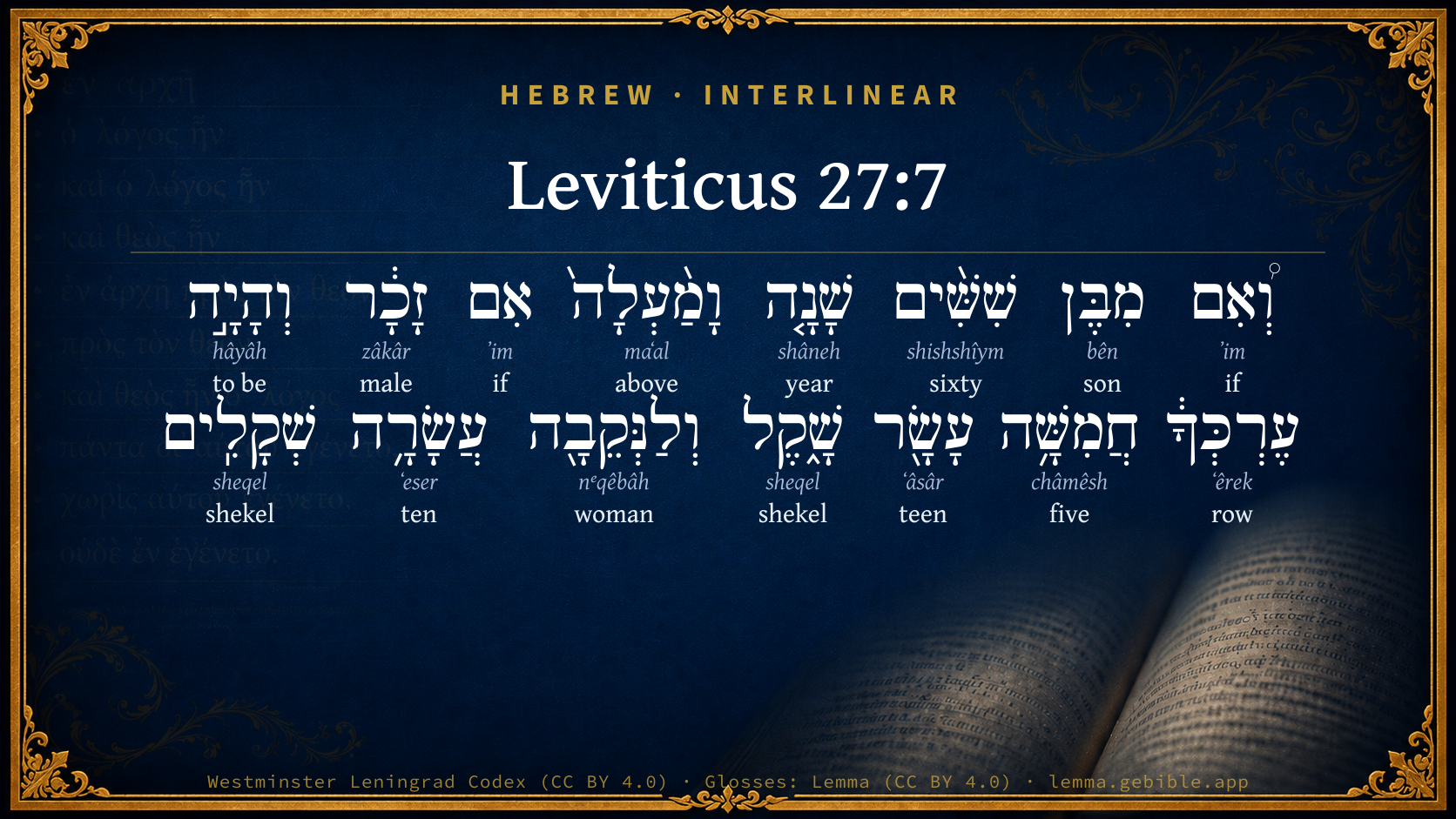
Hebrew (Westminster Leningrad Codex) Leviticus 27:7 appears in the Hebrew Old Testament. The text above is from the Westminster Leningrad Codex. Each word links to its Strong’s number, a concise gloss, and parsing drawn from the Open Scriptures Hebrew Bible morphology. Click any word for its full Brown-Driver-Briggs (BDB) entry.
Download image
Cite this verse

Leviticus 27:7 (World English Bible). Public Domain. Lemma interlinear Bible study tool, https://lemma.gebible.app/v/leviticus/27/7.

Show BibTeX & RIS
BibTeX
RIS
English Translation
If the person is from sixty years old and upward; if it is a male, then your valuation shall be fifteen shekels, and for a female ten shekels.
World English Bible · Public Domain
Download a study sheet

One document with this verse’s original text, its word-by-word gloss line, the meaning frame, cross-references with their text, attributed commentary, and full source and license credits — printable, and it pastes into notes with its structure intact.

This verse Autodidact and up

Study sheet (.html) Plain text (.txt)

A passage Seminary Student

Up to 50 verses in one chapter. A passage sheet keeps up to 6 commentary sources and 12 cross-references per verse, in the order this page ranks them, and says so on the sheet whenever that leaves anything out. Ask for a single verse and you get the Autodidact verse sheet above.

Everything on this page stays free to read, with no account — the sheet is a download of what is already on screen, not access to it.

Want to remove ads? Support Godless Engineer
Compare translations 3

The same verse in 3 English versions, stacked beneath the original-language interlinear above. Click any original word for its lexicon entry.

Each is an independent rendering of the whole verse — the interlinear is not word-aligned to these translations.

Highlighted words mark where these versions differ — a whole-verse word diff, not a word-by-word alignment.

  • World English Bible Public Domain
    If the person is from sixty years old and upward; if it is a male, then your valuation shall be fifteen shekels, and for a female ten shekels.
  • King James Version Public Domain
    And if it be from sixty years old and above; if it be a male, then thy estimation shall be fifteen shekels, and for the female ten shekels.
  • unfoldingWord Literal Text CC BY-SA 4.0
    And if from a son of 60 years and upward, if a male, then your valuation will be 15 shekels, and for the female ten shekels.

unfoldingWord Literal Text — © unfoldingWord, licensed CC BY-SA 4.0. Word-aligned USFM3 via Door43 (git.door43.org/unfoldingWord/en_ult).

Versions to compare (up to 4)

3 of 4 selected

Show all 18 translations

Every available English version of this verse, each an independent rendering of the whole verse.

  • World English Bible Public Domain
    If the person is from sixty years old and upward; if it is a male, then your valuation shall be fifteen shekels, and for a female ten shekels.
  • Berean Standard Bible Public Domain
    And if the person is sixty years of age or older, then your valuation shall be fifteen shekels for the male and ten shekels for the female.
  • Majority Standard Bible Public Domain
    And if the person is sixty years of age or older, then your valuation shall be fifteen shekels for the male and ten shekels for the female.
  • King James Version Public Domain
    And if it be from sixty years old and above; if it be a male, then thy estimation shall be fifteen shekels, and for the female ten shekels.
  • American Standard Version (1901) Public Domain
    And if it be from sixty years old and upward; if it be a male, then thy estimation shall be fifteen shekels, and for the female ten shekels.
  • Revised Version (1885) Public Domain
    And if it be from sixty years old and upward; if it be a male, then thy estimation shall be fifteen shekels, and for the female ten shekels.
  • Geneva Bible (1599) Public Domain
    And from sixty yeere olde and aboue, if he be a male, then thy price shalbe fifteene shekels, and for the female ten shekels.
  • Douay-Rheims (1899) Public Domain
    A man that is sixty years old or upward, shall give fifteen aisles: a woman ten.
  • Young's Literal Translation Public Domain
    and if from a son of sixty years and above -- if a male, then hath thy valuation been fifteen shekels, and for a female, ten shekels.
  • Literal Standard Version CC BY-SA 4.0
    and if from a son of sixty years and above, if a male, then your valuation has been fifteen shekels, and for a female, ten shekels.
  • Unlocked Literal Bible CC BY-SA 4.0
    From sixty years old and up for a male your standard value must be fifteen shekels, and for a female ten shekels.
  • unfoldingWord Literal Text CC BY-SA 4.0
    And if from a son of 60 years and upward, if a male, then your valuation will be 15 shekels, and for the female ten shekels.
  • Darby Bible Public Domain
    And if it be from sixty years old and above, if it be a male, thy valuation shall be fifteen shekels; and for the female ten shekels.
  • World Messianic Bible Public Domain
    If the person is from sixty years old and upward; if he is a male, then your valuation shall be fifteen shekels, and for a female ten shekels.
  • Webster's Bible Public Domain
    And if it shall be from sixty years old and above; if a male, then thy estimation shall be fifteen shekels, and for the female ten shekels.
  • Free Bible Version CC BY-SA 4.0
    The value of someone aged sixty or older is fifteen shekels for a male and ten shekels of silver for a female.
  • Bible in Basic English Public Domain
    And for sixty years old and over, for a male the value will be fifteen shekels, and for a female, ten.
  • JPS Tanakh (1917) Public Domain
    And if it be from sixty years old and upward: if it be a male, then thy valuation shall be fifteen shekels, and for the female ten shekels.

Literal Standard Version (2020), Covenant Press — licensed CC BY-SA 4.0. Text via the HelloAO Bible API (eBible.org). Unlocked Literal Bible (unfoldingWord) — licensed CC BY-SA 4.0. Text via the HelloAO Bible API (eBible.org). unfoldingWord Literal Text — © unfoldingWord, licensed CC BY-SA 4.0. Word-aligned USFM3 via Door43 (git.door43.org/unfoldingWord/en_ult). Free Bible Version, Dr. Jonathan Gallagher — licensed CC BY-SA 4.0. Text via the HelloAO Bible API (eBible.org).

Word by word

More ways to search: Search by grammar → Find every occurrence → Compare this word →

Practice this passage: Drill this verse → Learn its vocabulary →

וְלַנְּקֵבָ֖ה
nᵉqêbâh
H5347
“and · to/for · woman”
Conjunction + Preposition + Noun, Common, Feminine, Singular, Absolute
Part of Speech
Conjunction + Preposition + Noun
Type
Common
Gender
Feminine
Number
Singular
State
Absolute
Full BDB Definition

Origin: from H5344

TWOT: 1409b

female - woman, female child - female animal
  1. וְ֠אִם ʼim H518 “and · if” Conjunction + Conjunction
  2. מִבֶּן bên H1121 “from · son of” Preposition + Noun, Common, Masculine, Singular, Construct
  3. שִׁשִּׁ֨ים shishshîym H8346 “sixty” Adjective, Cardinal number, Both, Plural, Absolute
  4. שָׁנָ֤ה shâneh H8141 “year” Noun, Common, Feminine, Singular, Absolute
  5. וָמַ֨עְלָה֙ maʻal H4605 “and · above · toward” Conjunction + Adverb + Suffix, Demonstrative
  6. אִם ʼim H518 “if” Conjunction
  7. זָכָ֔ר zâkâr H2145 “male” Adjective, Adjective, Masculine, Singular, Absolute
  8. וְהָיָ֣ה hâyâh H1961 “and · to be” Conjunction + Verb, Qal, Sequential Perfect, 3rd Person, Masculine, Singular
  9. עֶרְכְּךָ֔ ʻêrek H6187 “row · your” Noun, Common, Masculine, Singular, Construct + Suffix, Personal, 2nd Person, Masculine, Singular
  10. חֲמִשָּׁ֥ה châmêsh H2568 “five” Adjective, Cardinal number, Masculine, Singular, Absolute
  11. עָשָׂ֖ר ʻâsâr H6240 “teen” Adjective, Cardinal number, Masculine, Singular, Absolute
  12. שָׁ֑קֶל sheqel H8255 “shekel” Noun, Common, Masculine, Singular, Absolute
  13. עֲשָׂרָ֥ה ʻeser H6235 “ten” Adjective, Cardinal number, Masculine, Singular, Absolute
  14. שְׁקָלִֽים sheqel H8255 “shekels” Noun, Common, Masculine, Plural, Absolute

About this verse

These counts appear in no published source. They are computed here, from the morphology-tagged text and Lemma’s own curated glosses. What Lemma adds →

15
words
13
distinct lemmas
Pentateuch
section

Notable vocabulary

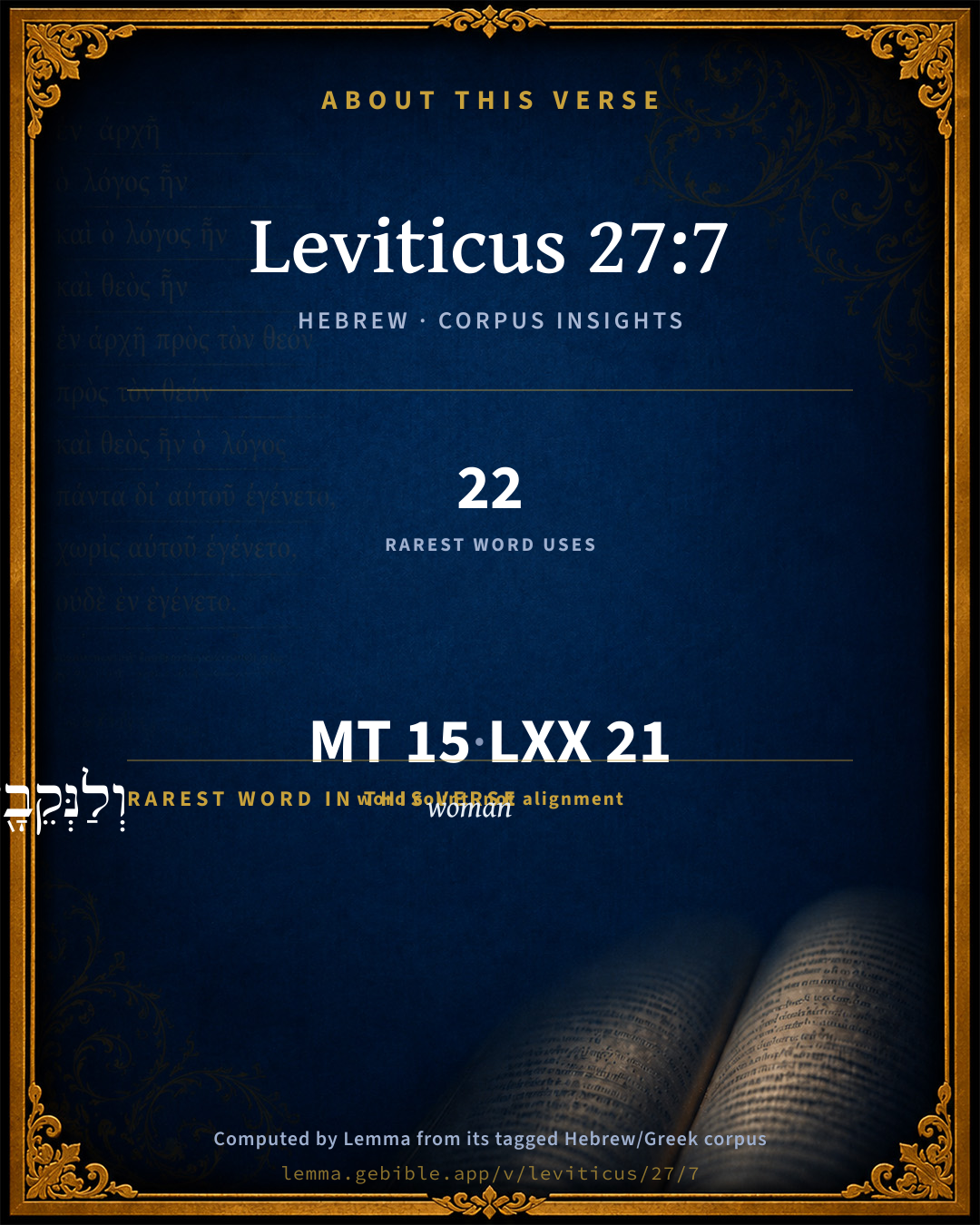
The rarest word here is וְלַנְּקֵבָ֖ה woman H5347 — appearing just 22 times in the whole Hebrew Bible.

Shared distinctive vocabulary

וְלַנְּקֵבָ֖ה woman H5347 occurs in 22 verses of the Hebrew Bible. Also found in:

Grammatical profile

  • 1 verb
  • 6 nouns
  • 5 adjectives
  • 2 conjunctions
  • 1 adverb

Verb forms

  • וְהָיָ֣ה Qal · Sequential Perfect

Repetition

Words recur within this verse — often emphatic in Hebrew:

  • שָׁ֑קֶל shekel H8255 ×2
  • וְ֠אִם if H518 ×2

Hebrew & Septuagint length

In English translation the verse runs 28 words from the Hebrew and 27 from the Septuagint (LXX English) — closely comparable.

A rough comparison of the two English renderings, which tokenize alike — not a word-level alignment.

Word counts can differ between the Hebrew and the Greek without any difference in meaning — e.g. the Hebrew direct-object marker אֵת has no separate Greek word, and Greek often adds the article ὁ.

In the original languages it is 15 Hebrew tokens and 21 Greek tokens — but the two are counted differently (Hebrew bundles its prefixes and suffixes into one token; the Greek is in lemma form), so that isn’t a like-for-like length.

Cross-references

1

Topical passages linked to Leviticus 27:7 in the Treasury of Scripture Knowledge — connected by theme and wording, ordered by reader-vote popularity; previews shown in the World English Bible.

  • Psalms 90:10 The days of our years are seventy, Or even by reason of strength eighty years; Yet their pride is but labor and sorrow, For it passes quickly, and we fly away.

Cross-references courtesy of OpenBible.info (CC BY 4.0).

Hebrew and Greek witnesses Masoretic Hebrew ↔ Greek Septuagint

The same verse in the two great witnesses to the Old Testament, shown verse-for-verse.

These are two independent witnesses, not word-aligned to each other, and the Septuagint is shown in lemma (dictionary) form.

Hebrew Leviticus 27:7 Masoretic · Westminster Leningrad Codex

וְ֠אִם מִבֶּן שִׁשִּׁ֨ים שָׁנָ֤ה וָמַ֨עְלָה֙ אִם זָכָ֔ר וְהָיָ֣ה עֶרְכְּךָ֔ חֲמִשָּׁ֥ה עָשָׂ֖ר שָׁ֑קֶל וְלַנְּקֵבָ֖ה עֲשָׂרָ֥ה שְׁקָלִֽים

If the person is from sixty years old and upward; if it is a male, then your valuation shall be fifteen shekels, and for a female ten shekels.

World English Bible · Public Domain

Greek LXX Leviticus 27:7 Septuagint · lemma form

ἐάν δέ ἀπό ἑξηκονταετής καί ἐπάνω ἐάν μέν ἄρσην εἰμί εἰμί ὁ τιμή πεντεκαίδεκα δίδραγμον ἀργύριον ἐάν δέ θῆλυς δέκα δίδραγμον

And if from sixty year old and upward, if it be a male, his valuation shall be fifteen didrachmas of silver, and if a female, ten didrachmas.

LXX2012 (modern English Septuagint) · Public Domain

Hebrew: Westminster Leningrad Codex (CC BY 4.0). Greek: Septuagint (public domain); English from LXX2012 (modern English Septuagint) (Public Domain). How the Septuagint differs from the Hebrew →

Targum (Aramaic paraphrase)

2

The Targum is the ancient Jewish Aramaic paraphrase of the Hebrew Scriptures — an interpretive translation, not the Hebrew text itself. Onkelos (literal) and Pseudo-Jonathan (expansive) render the Torah, and Jonathan the Prophets. Coverage is partial: where no permissively-licensed English translation exists for a verse, only the Aramaic is shown. This is verse-level text, not a word-by-word alignment to the Hebrew.

  1. Targum Onkelos Torah (Genesis–Deuteronomy)
    וְאִם מִבַּר שִׁתִּין שְׁנִין וּלְעֵלָא אִם דְכוּרָא וִיהֵי פֻרְסָנֵהּ חֲמֵשׁ עֶסְרֵי סִלְעִין וְלִנְקוּבְתָא עֲסַר סִלְעִין

    (no public-domain English translation for this verse)

    Targum Onkelos — Aramaic: “Onkelos Genesis” (public domain); “Onkelos Exodus” (public domain); “Onkelos Leviticus” (public domain); “Onkelos Numbers” (public domain); “Onkelos Deuteronomy” (public domain). English: “Sefaria Community Translation” (CC0 1.0 (public-domain dedication)); “J.W. Etheridge. The Targums of Onkelos and Jonathan Ben Uzziel on the Pentateuch. London: Longmans, Green, 1862” (public domain). Text via Sefaria.

  2. Targum Pseudo-Jonathan Torah (Genesis–Deuteronomy)
    וְאִין מִבַּר שִׁתִּין שְׁנִין וּלְעֵילָא אִין בִּיר דְכַר וִיהֵי עֲלוֹיֵיהּ חֲמֵיסַר סִלְעִין וְלִבְרַתָּא נוּקְבָא עֲשַר סִלְעִין

    Moreover, for a man of sixty years and upwards, his estimation shall be fifteen shekels; and for a female, ten shekels.

    Targum Pseudo-Jonathan — Aramaic: “Targum Jonathan on Genesis” (public domain); “Targum Jonathan on Exodus” (public domain); “Targum Jonathan on Leviticus” (public domain); “Targum Jonathan on Numbers” (public domain); “Targum Jonathan on Deuteronomy” (public domain). English: “The Targum of Jonathan ben Uzziel, trans. J. W. Etheridge, London, 1862” (public domain). Text via Sefaria.

Commentary

Notes on Leviticus 27:7 from classic Christian and Jewish commentators (each source and its license shown beneath its notes). The classic Christian expositions comment on the surrounding passage and are grouped to its opening verse, so a note may address several verses; the Jewish commentaries on the Tanakh (Rashi and others) are per-verse, so they appear only where the commentator wrote on this verse.

Lemma curates 59 commentaries, every one of them public domain or Creative Commons licensed, each selected and text-cleaned for this edition rather than reprinted as found. About our sources →

Trapp's Complete Commentary

John Trapp

Lev 27:7 And if [it be] from sixty years old and above; if [it be] a male, then thy estimation shall be fifteen shekels, and for the female ten shekels.

Ver. 7. And if it be from sixty years.] The rate of old age is less than of youth, and more than of childhood.

John Trapp, A Commentary or Exposition upon All the Books of the Old and New Testament (1647–1656) — public domain. Text from a community e-Sword module.

Adam Clarke's Commentary

Verse 7. Sixty years old] The old man and the old woman, being nearly past labour, were nearly of an equal value; hence the one was estimated at fifteen shekels, 2£. 5s., the other at ten shekels, 1£. 10s. This was about the same ratio as that of the children, Le 27:5, and for the same reason.

Adam Clarke's Commentary on the Bible (1810–1826) — public domain. Text from a community e-Sword/MySword module.

Ellicott's Commentary for English Readers

(7) From sixty years old and above.—Being almost past labour, the old man is next in value to the child.

A male . . . fifteen shekels.—The old man is therefore to be redeemed at £1 18s. 9d.

The female ten shekels.—The old woman, from sixty and upwards, is estimated at exactly the same value as the girl from five to twenty years old (see Lev_27:5), and hence is to be redeemed at £1 5s. 10d. It will be seen that the disproportion between a man and a woman is not the same in old age as in youth. The authorities during the second Temple account for it by adducing the adage, “An old man in the house is always in the way; an old woman in the house is a treasure, she manages all household affairs.”

A Bible Commentary for English Readers, edited by Charles John Ellicott (1878–1897) — public domain. Text from a community e-Sword module.

John Gill's Exposition

But if he be poorer than thy estimation,.... If he is so poor that he is not able to pay the value that, is set upon him, according to the rules before given:

then he shall present himself before the priest; that has made the estimation, according to the above directions, observing the difference of years, and of male and female; but if a person could not pay the said sums that were appointed, he might apply to the priest, and tell his case:

and the priest shall value him; put a price upon him he is able to pay, as follows:

according to his ability that vowed shall the priest value him; he was to examine into his circumstances, and as they appeared to him he was to put a value on him, which was to be paid, but not less than, a shekel; for if he could not pay that, it was to remain as a debt until he could (q); and it was the ability of him that made the vow that was to be inquired into, and according to which the estimation was to be made, and not of him that was vowed: so it is said in the Misnah,"ability is regarded in the vower, and years in the vowed, and estimations in the estimated, and according to the tithe of the estimation: ability in the vower, how? a poor man that estimates a rich man, pays the value of a poor man; and a rich man that estimates a poor man, pays the value of a rich man: if he is poor and afterwards becomes rich, or rich and afterwards poor, he pays the price of a rich man (r);''but the sense which Jarchi gives is, that a priest in such a case was to judge according to what a man has, and so order him to pay, but was to leave him so as he might live, a bed and bolster, and working tools, and if he had an ass he might leave him that.

(q) Maimon. Hilchot Eracin, c. 3. sect. 4. (r) Misn. Eracin, c. 4. sect. 1, 2.

John Gill's Exposition of the Whole Bible (1746–1763) — public domain (CC PDM 1.0). Text via the HelloAO Bible API.

unfoldingWord translationNotes

Door43 World Missions Community

sixty years old and up

"sixty years old and older"

sixty ... fifteen ... ten

"60 ... 15 ... 10" (See: Numbers)

fifteen shekels

If it is necessary to use modern weight units, here are two ways of doing it. AT: "fifteen pieces of silver" or "150 grams of silver" (See: Biblical Weight)

for a female ten shekels

The phrases "of that age" and "your standard value must be" are left out, but are meant to be understood. AT: "for a female of that age your standard value must be ten shekels" (See: Ellipsis)

the person being given must be presented to the priest

This can be stated in active form. AT "he must present to the priest the person he is giving" (See: Active or Passive)

translationWords

priest

unfoldingWord translationNotes — © Distant Shores Media and the Door43 World Missions Community, licensed CC BY-SA 4.0. Source: git.door43.org/Door43/en_tn.

Rashi

Rabbi Shlomo Yitzchaki (Rashi)

ואם מבן ששים שנה AND IF IT BE FROM SIXTY YEARS OLD [AND ABOVE; IF IT BE A MALE THEN THE VALUATION SHALL BE FIFTEEN SHEKELS, AND FOR THE FEMALE TEN SHEKELS] — When one approaches old age a woman is more likely to be of the same importance as a man therefore a man decreases to beyond a third of his valuation when he becomes old (his ערך being fifty shekels and after sixty only fifteen, which is less then 17, the approximate third of 50), whilst a woman decreases only to exactly a third of her valuation (which was previously thirty shekels, and after sixty becomes ten), because people say (i. e. there is a familiar saying): “An old man in the house is a snare (a nuisance) in the house, an old woman in the house is a treasure in the house and a good omen in the house” (Arakhin 19a).

Rashi on the Tanakh — English translations: “The Judaica Press complete Tanach with Rashi, translated by A. J. Rosenberg” (CC BY 4.0); “Pentateuch with Rashi's commentary by M. Rosenbaum and A.M. Silbermann, 1929-1934” (public domain); “The Metsudah Tanach series, Lakewood, N.J” (CC BY 4.0); and “The Book of Joshua, Metsudah Publications, 1997” (CC BY 4.0). Text via Sefaria.

Lesson kit

Teaching starters — assembled from the data on this page, not authored interpretation. Every prompt links to the verse data it draws on. Edit before teaching.

Leviticus, in the Pentateuch, opens this verse with 15 words (13 distinct Hebrew lemmas). Its most distinctive word is nᵉqêbâh (“woman”). A historical commentator’s framing appears above. Read the whole chapter for the surrounding context.

Discussion questions

  1. The word nᵉqêbâh carries the sense “woman.” How does it shape the verse?
  2. Genesis 1:27 shares the word «woman» with this verse. How do the two illuminate each other?
  3. “shekel” occurs 2× in this one verse. What is the effect of the repetition?
  4. The translations on this page render this verse differently — a whole-verse word diff, not a word-by-word alignment. What might account for the different wordings?
  5. The verb «וְהָיָ֣ה» is Qal Sequential Perfect. How does its form color the action?
  6. Reading how Trapp's Complete Commentary and Adam Clarke's Commentary read this verse, where do the two commentators agree and where do they part?

Things to notice

Reading settings

Reading text

Shown beneath each verse's original-language words.

Old Testament
Old Testament edition

Read the OT as the Masoretic Hebrew (MT) or the Greek Septuagint (LXX).

English shown for the Greek Septuagint (in the Hebrew ↔ Greek comparison).

Comparing translations? Open the Compare panel on any verse page to stack up to four side by side.