1 Peter 1:20

Greek (Tischendorf 8th ed.) 1 Peter 1:20 appears in the Greek New Testament. The text above is from the Tischendorf 8th edition. Each word links to its Strong’s number and a concise gloss. Click any word for its full Thayer’s Greek Lexicon entry.
Download image
Cite this verse

1 Peter 1:20 (World English Bible). Public Domain. Lemma interlinear Bible study tool, https://lemma.gebible.app/v/1-peter/1/20.

Show BibTeX & RIS
BibTeX
RIS
English Translation
who was foreknown indeed before the foundation of the world, but was revealed at the end of times for your sake,
World English Bible · Public Domain
Download a study sheet

One document with this verse’s original text, its word-by-word gloss line, the meaning frame, cross-references with their text, attributed commentary, and full source and license credits — printable, and it pastes into notes with its structure intact.

This verse Autodidact and up

Study sheet (.html) Plain text (.txt)

A passage Seminary Student

Up to 50 verses in one chapter. A passage sheet keeps up to 6 commentary sources and 12 cross-references per verse, in the order this page ranks them, and says so on the sheet whenever that leaves anything out. Ask for a single verse and you get the Autodidact verse sheet above.

Everything on this page stays free to read, with no account — the sheet is a download of what is already on screen, not access to it.

Want to remove ads? Support Godless Engineer
Compare translations 3

The same verse in 3 English versions, stacked beneath the original-language interlinear above. Click any original word for its lexicon entry.

Each is an independent rendering of the whole verse — the interlinear is not word-aligned to these translations.

Highlighted words mark where these versions differ — a whole-verse word diff, not a word-by-word alignment.

  • World English Bible Public Domain
    who was foreknown indeed before the foundation of the world, but was revealed at the end of times for your sake,
  • King James Version Public Domain
    Who verily was foreordained before the foundation of the world, but was manifest in these last times for you,
  • unfoldingWord Literal Text CC BY-SA 4.0
    having been foreknown before the foundation of the world, but having been revealed in the last of the times for you,

unfoldingWord Literal Text — © unfoldingWord, licensed CC BY-SA 4.0. Word-aligned USFM3 via Door43 (git.door43.org/unfoldingWord/en_ult).

Versions to compare (up to 4)

3 of 4 selected

Show all 19 translations

Every available English version of this verse, each an independent rendering of the whole verse.

  • World English Bible Public Domain
    who was foreknown indeed before the foundation of the world, but was revealed at the end of times for your sake,
  • Berean Standard Bible Public Domain
    He was known before the foundation of the world, but was revealed in the last times for your sake.
  • Majority Standard Bible Public Domain
    He was known before the foundation of the world, but was revealed in the last times for your sake.
  • King James Version Public Domain
    Who verily was foreordained before the foundation of the world, but was manifest in these last times for you,
  • American Standard Version (1901) Public Domain
    who was foreknown indeed before the foundation of the world, but was manifested at the end of times for your sake,
  • Revised Version (1885) Public Domain
    who was foreknown indeed before the foundation of the world, but was manifested at the end of the times for your sake,
  • Geneva Bible (1599) Public Domain
    Which was ordeined before the foundation of the world, but was declared in the last times for your sakes,
  • Douay-Rheims (1899) Public Domain
    Foreknown indeed before the foundation of the world, but manifested in the last times for you,
  • Young's Literal Translation Public Domain
    foreknown, indeed, before the foundation of the world, and manifested in the last times because of you,
  • Literal Standard Version CC BY-SA 4.0
    foreknown, indeed, before the foundation of the world, and revealed in the last times because of you,
  • Unlocked Literal Bible CC BY-SA 4.0
    Christ was chosen before the foundation of the world, but now he has been revealed to you in these last times.
  • unfoldingWord Literal Text CC BY-SA 4.0
    having been foreknown before the foundation of the world, but having been revealed in the last of the times for you,
  • Darby Bible Public Domain
    foreknown indeed before [the] foundation of [the] world, but who has been manifested at the end of times for your sakes,
  • World Messianic Bible Public Domain
    who was foreknown indeed before the foundation of the world, but was revealed in this last age for your sake,
  • Webster's Bible Public Domain
    Who verily was fore-ordained before the foundation of the world, but was manifested in these last times for you,
  • Free Bible Version CC BY-SA 4.0
    He was chosen before the world was created, but he was revealed in these last days for your benefit.
  • Bible in Basic English Public Domain
    Who was marked out by God before the making of the world, but was caused to be seen in these last times for you,
  • Text-Critical English NT CC BY 4.0
    He was foreknown before the foundation of the world, but was revealed in the last times for your sake.
  • Tyndale New Testament (1534) Public Domain
    which was ordeyened before the worlde was made: but was declared in the last tymes for youre sakes

Literal Standard Version (2020), Covenant Press — licensed CC BY-SA 4.0. Text via the HelloAO Bible API (eBible.org). Unlocked Literal Bible (unfoldingWord) — licensed CC BY-SA 4.0. Text via the HelloAO Bible API (eBible.org). unfoldingWord Literal Text — © unfoldingWord, licensed CC BY-SA 4.0. Word-aligned USFM3 via Door43 (git.door43.org/unfoldingWord/en_ult). Free Bible Version, Dr. Jonathan Gallagher — licensed CC BY-SA 4.0. Text via the HelloAO Bible API (eBible.org).

Word by word

More ways to search: Search by grammar → Find every occurrence → Compare this word →

Practice this passage: Drill this verse → Learn its vocabulary →

προεγνωσμένου
proginṓskō
G4267
“to foreknow”
Verb, Perfect, Passive, Participle, Genitive, Singular, Masculine
Part of Speech
Verb
Tense
Perfect
Voice
Passive
Mood
Participle
Case
Genitive
Number
Singular
Gender
Masculine
Full Thayer's Definition

Origin: from G4253 and G1097

TDNT: 12:55,1

1. to have knowledge before hand 2. to foreknow a. of those whom God elected to salvation 3. to predestinate
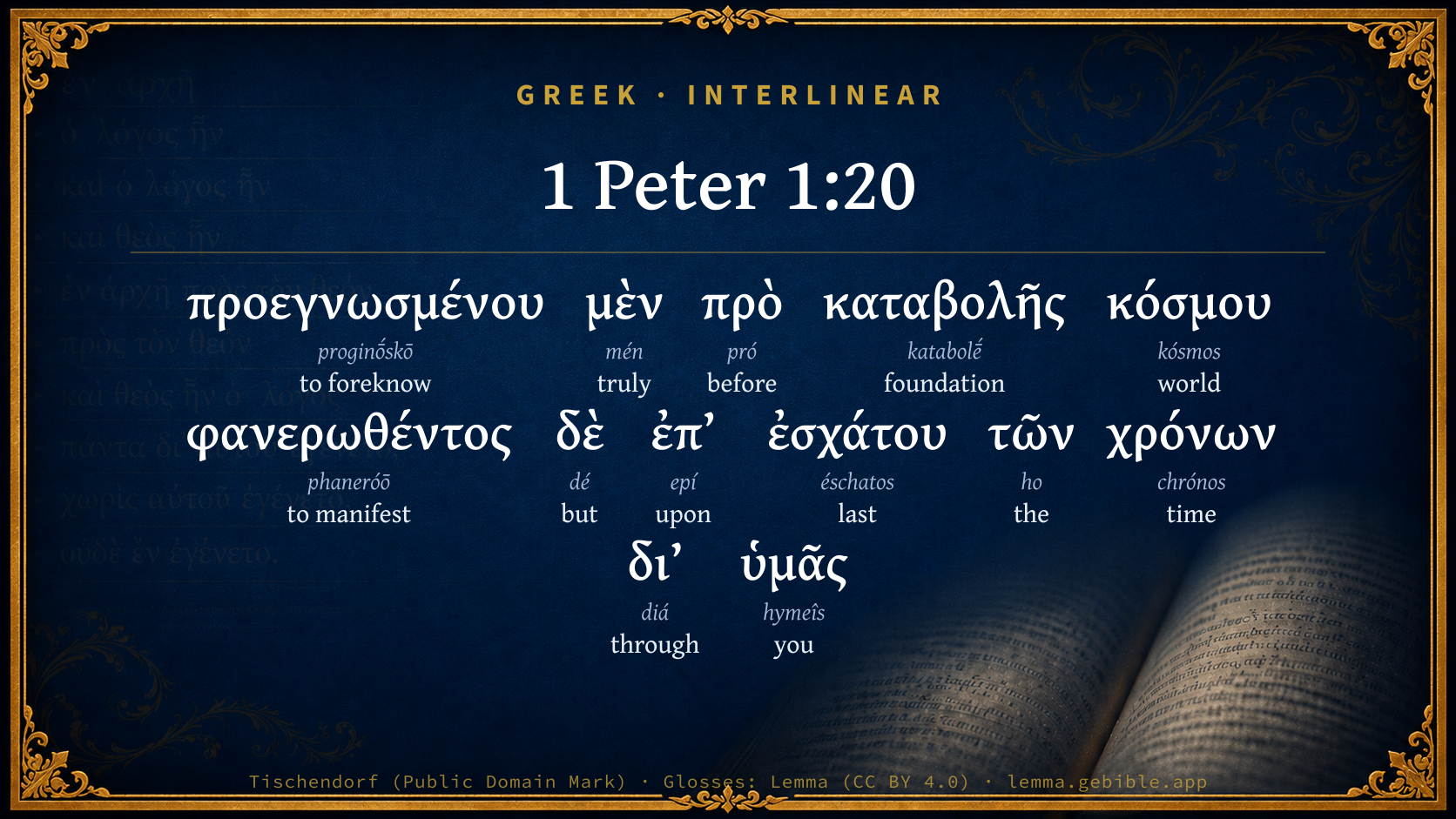
  1. μὲν mén G3303 “truly” Particle
  2. πρὸ pró G4253 “before” Preposition
  3. καταβολῆς katabolḗ G2602 “foundation” Noun, Genitive, Singular, Feminine
  4. κόσμου kósmos G2889 “world” Noun, Genitive, Singular, Masculine
  5. φανερωθέντος phaneróō G5319 “to manifest” Verb, Aorist, Passive, Participle, Genitive, Singular, Masculine
  6. δὲ dé G1161 “but” Conjunction
  7. ἐπ’ epí G1909 “upon” Preposition
  8. ἐσχάτου éschatos G2078 “last” Adjective, Genitive, Singular, Masculine, Superlative
  9. τῶν ho G3588 “the” Article, Genitive, Plural, Masculine
  10. χρόνων chrónos G5550 “time” Noun, Genitive, Plural, Masculine
  11. δι’ diá G1223 “through” Preposition
  12. ὑμᾶς hymeîs G5210 “you” Personal pronoun, 2nd person, Accusative, Plural

About this verse

These counts appear in no published source. They are computed here, from the morphology-tagged text and Lemma’s own curated glosses. What Lemma adds →

13
words
13
distinct lemmas
General Epistles
section

Notable vocabulary

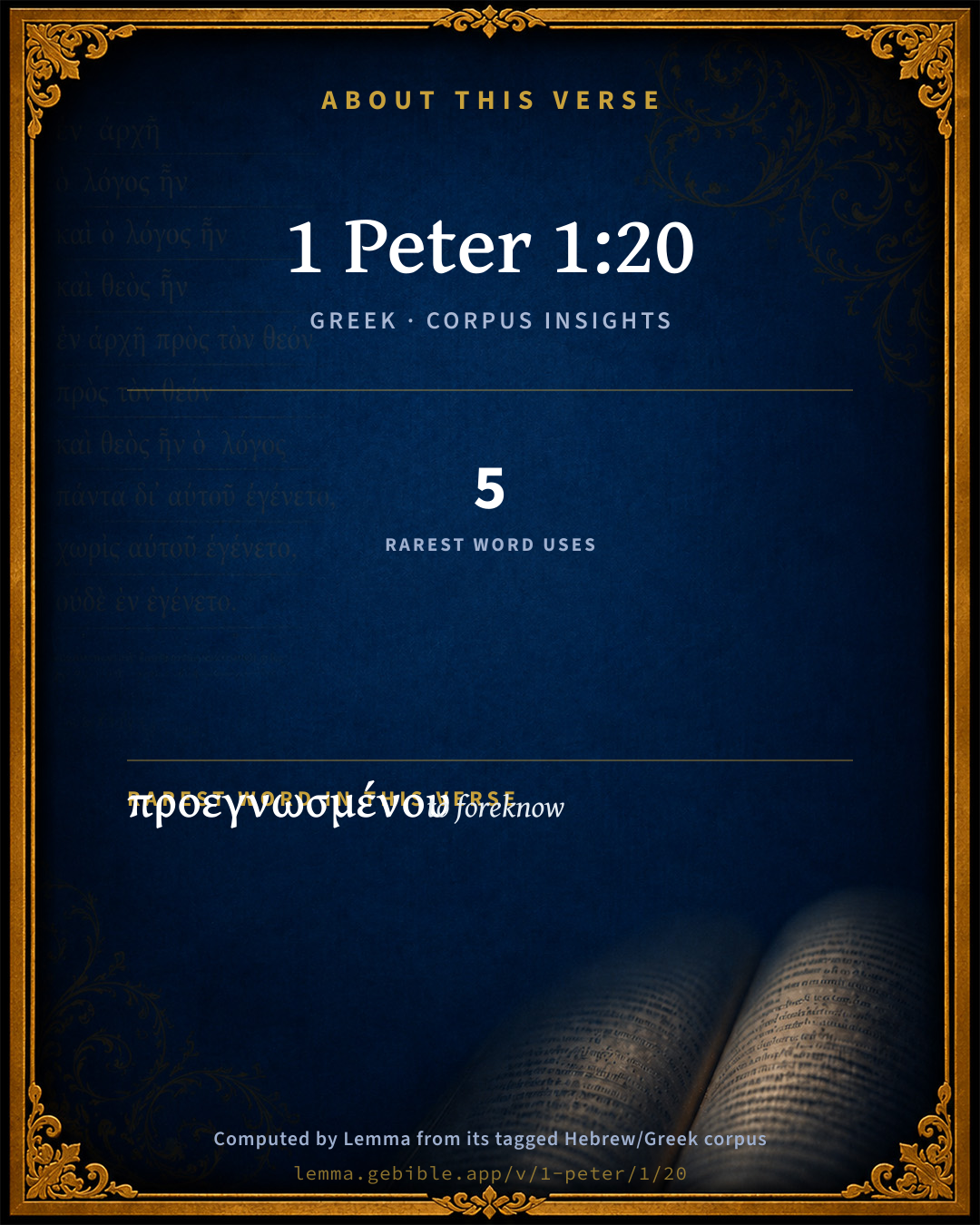
The rarest word here is προεγνωσμένου to foreknow G4267 — appearing just 5 times in the whole Greek New Testament.

Shared distinctive vocabulary

προεγνωσμένου to foreknow G4267 occurs in 5 verses of the Greek New Testament. Also found in:

Cross-references

21

Topical passages linked to 1 Peter 1:20 in the Treasury of Scripture Knowledge — connected by theme and wording, ordered by reader-vote popularity; previews shown in the World English Bible.

  • Ephesians 1:4 even as he chose us in him before the foundation of the world, that we would be holy and without blemish before him in love;
  • 2 Timothy 1:9–10 who saved us and called us with a holy calling, not according to our works, but according to his own purpose and grace, which was given to us in Christ Jesus before times eternal,
  • Hebrews 9:26 or else he must have suffered often since the foundation of the world. But now once at the end of the ages, he has been revealed to put away sin by the sacrifice of himself.
  • Revelation 13:8 All who dwell on the earth will worship him, everyone whose name has not been written from the foundation of the world in the book of life of the Lamb who has been killed.
  • Titus 1:2–3 in hope of eternal life, which God, who can't lie, promised before eternal times;
  • Hebrews 1:2 has at the end of these days spoken to us by his Son, whom he appointed heir of all things, through whom also he made the worlds.
  • Micah 5:2 But you, Bethlehem Ephrathah, Being small among the clans of Judah, Out of you one will come forth to me that is to be ruler in Israel; Whose goings forth are from of old, from everlasting.
  • Ephesians 3:9 and to make all men see what is the administration of the mystery which for ages has been hidden in God, who created all things through Jesus Christ;
  • Colossians 1:26 the mystery which has been hidden for ages and generations. But now it has been revealed to his saints,
  • Romans 16:25–26
  • Galatians 4:4 But when the fullness of the time came, God sent out his Son, born to a woman, born under the law,
  • Ephesians 1:10 to an administration of the fullness of the times, to sum up all things in Christ, the things in the heavens, and the things on the earth, in him;
  • Ephesians 3:11 according to the eternal purpose which he purposed in Christ Jesus our Lord;
  • Genesis 3:15 I will put enmity between you and the woman, and between your offspring and her offspring. He will bruise your head, and you will bruise his heel."
  • Proverbs 8:23 I was set up from everlasting, from the beginning, Before the earth existed.
  • 1 John 1:2 (and the life was revealed, and we have seen, and testify, and declare to you the life, the eternal life, which was with the Father, and was revealed to us);
  • 1 John 4:9–10 By this was God's love revealed in us, that God has sent his one and only Son into the world that we might live through him.
  • Acts 3:25–26 You are the children of the prophets, and of the covenant which God made with our fathers, saying to Abraham, 'In your seed will all the families of the earth be blessed.'
  • Romans 3:25 whom God set forth to be an atoning sacrifice, through faith in his blood, for a demonstration of his righteousness through the passing over of prior sins, in God's forbearance;
  • 1 John 3:8 He who sins is of the devil, for the devil has been sinning from the beginning. To this end the Son of God was revealed, that he might destroy the works of the devil.
  • 1 John 3:5 You know that he was revealed to take away our sins, and in him is no sin.

Cross-references courtesy of OpenBible.info (CC BY 4.0).

Commentary

Notes on 1 Peter 1:20 from classic Christian and Jewish commentators (each source and its license shown beneath its notes). The classic Christian expositions comment on the surrounding passage and are grouped to its opening verse, so a note may address several verses; the Jewish commentaries on the Tanakh (Rashi and others) are per-verse, so they appear only where the commentator wrote on this verse.

Lemma curates 59 commentaries, every one of them public domain or Creative Commons licensed, each selected and text-cleaned for this edition rather than reprinted as found. About our sources →

Albert Barnes' Notes on the Bible

Who verily was foreordained before the foundation of the world - That is, it was foreordained, or predetermined, that he should be the great stoning Sacrifice for sin. On the meaning of the word “foreordained,” (προγινώσκω proginōskō,) see Rom 8:29. The word is rendered which knew, Act 26:5; foreknew and foreknow, Rom 8:29; Rom 11:2; foreordained, 1Pe 1:20; and know before, 2Pe 2:17. It does not elsewhere occur in the New Testament. The sense is, that the plan was formed, and the arrangements made for the atonement, before the world was created.

Before the foundation of the world - That is, from eternity. It was before man was formed; before the earth was made; before any of the material universe was brought into being; before the angels were created. Compare the Mat 25:34 note; Joh 17:24 note; Eph 1:4 note.

But was manifest - Was revealed. See the notes at 1Ti 3:16.

In these last times - In this, the last dispensation of things on the earth. See the notes at Heb 1:2.

For you - For your benefit or advantage. See the notes at 1Pe 1:12. It follows from what is said in this verse:

(1)That the atonement was not an afterthought on the part of God. It entered into his plan when he made the world, and was revolved in his purposes from eternity.

(2)It was not a device to supply a defect in the system; that is, it was not adopted because the system did not work well, or because God had been disappointed. It was arranged before man was created, and when none but God could know whether he would stand or fall.

(3)The creation of the earth must have had some reference to this plan of redemption, and that plan must have been regarded as in itself so glorious, and so desirable, that it was deemed best to bring the world into existence that the plan might be developed, though it would involve the certainty that the race would fall, and that many would perish. It was, on the whole, more wise and benevolent that the race should be created with a certainty that they would apostatize, than it would be that the race should not he created, and the plan of salvation be unknown to distant worlds. See the notes at 1Pe 1:12.

Albert Barnes' Notes on the Bible (1834–1885) — public domain. Text from a community e-Sword/MySword module.

Tyndale Open Study Notes

Tyndale Open Resources

1:20 With Christ’s coming, Old Testament promises of redemption are being fulfilled and the last days have begun.

Tyndale Open Study Notes — © Tyndale Open Resources, licensed CC BY-SA 4.0. Text via the HelloAO Bible API.

Bengel's Gnomon

Johann Albrecht Bengel

1Pe 1:20. Προεγνωσμένου, who was fore-ordained) Act 2:23.—πρὸ, before) Therefore all the good pleasure of God is fulfilled in Christ.—φανερωθέντος δὲ, but manifested) The foreknowledge was in God alone.—χρόνων) times, viz. of the world.

Bengel's Gnomon of the New Testament — English translation (T&T Clark, Edinburgh, 1860) — public domain. Text from a community e-Sword module.

Meyer's Critical & Exegetical Commentary

Heinrich August Wilhelm Meyer

1Pe_1:20. προεγνωσμένου μέν] is indeed not simply and at once: praeordinatus (Beza), but the foreknowledge of God is, with respect to the salvation He was to bring about, essentially a providing, cf. 1Pe_1:2 : πρόγνωσις. In regard to Christ it was provided (προεγνωσμένου refers not directly to ἀμνοῦ, but to Χριστοῦ) that He should appear (φανερωθέντος δέ) as a sacrificial lamb to redeem the world by His blood. The passage does not say that Christ would have appeared even though sin had never entered.

πρὸ καταβολῆς κόσμου] a frequent designation of antemundane eternity, Joh_17:24; Eph_1:4. This nearer definition specifies the sending of Christ as having originated in the eternal counsels of God, in order thus to give point to the exhortation contained in 1Pe_1:17.

φανερωθέντος δέ] here of the first appearing of Christ, which in this passage is represented as an emerging from the obscurity in which He was (chap. 1Pe_5:4, of His second coming); it is incorrect to refer φανερωθέντος to the obscurity of the divine counsels (as formerly in this commentary), since φανερωθέντος applies as much as προεγνωσμένου to the person of Christ. Between the πρόγνωσις and the φανέρωσις lies the προφητεία, 1Pe_1:10. Rightly interpreted, φανερωθέντος testifies to the pre-existence of Christ.[94] The sequence of the aorist participle on the participle προεγνωσμένου is to be explained from this, that by φανερωθέντος an historical fact is mentioned.

ἐπʼ ἐσχάτου τῶν χρόνων] ἔσχατον: a substantival use of it, at the end of the times. This ἔσχατον of the times is here conceived as the whole period extending from the first appearance of Christ to His second coming; in like manner Heb_1:1; otherwise 2Pe_3:3, where by ἔσχατον is meant the time as yet future, immediately preceding the second coming of Christ; in like manner 1Pe_1:5.[95]

Note the antithesis: ΠΡῸ ΚΑΤΑΒ. Κ. and ἘΠʼ ἘΣΧΆΤΟΥ Τ. ΧΡ.: beginning and end united in Christ.

ΔΙʼ ὙΜᾶς] refers in the first instance to the readers, but embraces at the same time all ἘΚΛΕΚΤΟΊ. Believers are the aim of all Gods schemes of salvation; what an appeal to them to walk ἘΝ ΦΌΒῼ ΤῸΝ ΠΑΡΟΙΚΊΑς ΧΡΌΝΟΝ! There is as little here to indicate any reference to the heathen (Hofmann) as there was in εἰς ὑμᾶς, 1Pe_1:10.

[94] Schmid rightly says (bibl. Theol. II. p. 165): προεγνωσμένου does not deny the actual pre-existence, because Χριστοῦ includes a designation which is not yet realized in the actual pre-existence, but will be so only in virtue of the φανερωθῆναι.

[95] It is indeed correct that, as Schott says, the end of the times is so, through the manifestation of Christ; but it is an arbitrary assertion to say that ἐτί serves to give more prominence and precision to this thought.

Meyer — Critical and Exegetical Commentary on the New Testament — English translation by Peter Christie, edited by Frederick Crombie (T&T Clark, 1880) — public domain. Text from a community e-Sword module.

Expositor's Greek Testament

ed. W. Robertson Nicoll

1Pe 1:20 . As the paschal lamb was taken on the tenth day of the month (Exo 13:3 ) so Christ was foreknown before the creation and existed before His manifestation. The preexistence of Moses is stated in similar terms in Assumption of Moses , i. 12 14, “God created the world on behalf of His people. But He was not pleased to manifest this purpose of creation from the foundation of the world in order that the Gentiles might thereby be convicted.… Accordingly He designed and devised me and He prepared me before the foundation of the world that I should be the mediator of His Covenant.” So of the Messiah, Enoch (xlviii. 3, 6) says: “His name was called before the Lord of spirits before the sun and the signs of the zodiac were created.… He was chosen and hidden with God before the world was created. At the end of time God will reveal him to the world.” Alexandrian Judaism took over from Greek philosophy (Pythagoras, Plato, Aristotle) the doctrine of the preexistence of all souls. So in the Secrets of Enoch (xxiii. 5) it is said “Every soul was created eternally before the foundation of the world”. The author of Wisdom was a goodly child and obtained a good soul or rather being good came into a body undefiled (Sap. 8:19 f.); and Philo found Scriptural warrant in the first of the two accounts of Creation (Gen 1:26 f.). Outside Alexandria, apart from the Essenes (Joseph, B. J., ii. 154 157) the general doctrine does not appear to have been accepted. But the belief in the preexistence of the Name of the Messiah if not the Messiah Himself was not unknown in Palestine and was latent in many of the current ideals. The doctrine of Trypho was probably part of the general reaction from the position reached by the Jewish thinkers (A.D.) and appropriated by the Christians. There are many hints in the O.T. which Christians exploited without violence and the development of angelology offered great assistance. Current conceptions of Angels and Wisdom as well as of the Messiah all led up to this belief. Apart from the express declarations of Jesus recorded by St. John, it is clear that St. Peter held to the real and not merely ideal pre-existence of Christ, not deriving it from St. Paul or St. John and Heb. It is no mere corollary of God’s omniscience that the spirit of Christ was in the prophets. προεγνωσμένου , cf. κατὰ πρόγνωσιν , 1Pe 1:2 ; only here of Messiah, perhaps as a greater Jeremiah ( cf. Jer 1:5 ) but see the description of Moses cited above. πρὸ καταβολῆς κόσμου . The phrase does not occur in LXX but Mat 13:35 = Psa 78:2 renders מני קדם by ἀπὸ καταβολῆς (LXX ἀπʼ ἀρχῆς ) Philo has καταβολὴ γενέσεως ) and αἱ καταβολαὶ σπερμάτων and uses ἐκ κ . = afresh. In 2Ma 2:29 , καταβολή is used of the foundation of a house; cf. κατασκευάζειν in Heb. φανερωθέντος , of the past manifestation of Christ. In 1Pe 5:1 of the future implies previous hidden existence, cf. 1Ti 3:16 (quotation of current quasi-creed) ἐφανερώθη ἐν τῷ κόσμῳ . The manifestation consists in the resurrection and glorification evidenced by descent of spirit (21): cf. Peter’s sermon in Act 2 , risen, exalted, Jesus has sent the spirit: therefore let all the house of Israel know surely that God hath made Him both Lord and Christ . St. Paul speaks in the same way of the revelation of the secret, which is Christ in you ; see especially Col 1:25-27 . Compare Joh 1:14 . ἐπʼ ἐσχάτου τῶν χρόνων , at the end of the times, cf. ἐπʼ ἐσχάτου τῶν ἡμερῶν (Heb 1:1 and LXX). The deliverance effected certo tempore by Christ’s blood is eternally efficacious, cf. αἰώνιον λύτρωσιν εὑράμενος Heb 9:12 and the more popular statement of the same idea in Rev 13:8 , the lamb slain from the foundation of the world .

The Expositor's Greek Testament, edited by W. Robertson Nicoll (1897–1910) — public domain. Text from a community e-Sword module.

Geneva Bible (1599)

Geneva Bible translators

The taking away of an objection: what was done to the world before that Christ was sent into the world? was there no holiness before, and was there no Church? The Apostle answereth, that Christ was ordained and appointed to redeem and deliver mankind, before that mankind was: much less was there any Church without him before his coming into the flesh: yet we are happiest above the rest, to whom Christ was exhibited indeed, in this that he having suffered and overcome death for us, doth now most effectually work in us by the virtue of his Spirit, to create in us faith, hope, and charity.

From everlasting.

Geneva Bible (1599) marginal notes — public domain. Text via Bolls.life.

Jamieson, Fausset & Brown

Robert Jamieson, A. R. Fausset & David Brown

God's eternal foreordination of Christ's redeeming sacrifice, and completion of it in these last times for us, are an additional obligation on us to our maintaining a holy walk, considering how great things have been thus done for us. Peter's language in the history corresponds with this here: an undesigned coincidence and mark of genuineness. Redemption was no afterthought, or remedy of an unforeseen evil, devised at the time of its arising. God's foreordaining of the Redeemer refutes the slander that, on the Christian theory, there is a period of four thousand years of nothing but an incensed God. God chose us in Christ before the foundation of the world (Eph 1:4).

manifest--in His incarnation in the fulness of the time. He existed from eternity before He was manifested.

in these last times-- Co1 10:11, "the ends of the world." This last dispensation, made up of "times" marked by great changes, but still retaining a general unity, stretches from Christ's ascension to His coming to judgment.

Jamieson, Fausset & Brown — Commentary Critical and Explanatory on the Whole Bible (1871) — public domain (CC PDM 1.0). Text via the HelloAO Bible API.

Adam Clarke's Commentary

Verse 20. Who verily was foreordained] προεγνωσμενου. Foreknown; appointed in the Divine purpose to be sent into the world, because infinitely approved by the Divine justice.

Before the foundation of the world] Before the law was given, or any sacrifice prescribed by it. Its whole sacrificial system was appointed in reference to this foreappointed Lamb, and consequently from him derived all its significance and virtue. The phrase καταβοληκοσμου, foundation of the world, occurs often in the New Testament, and is supposed by some learned men and good critics to signify the commencement of the Jewish state. Perhaps it may have this meaning in Mt 13:35; Lu 11:50; Eph 1:4; Heb 4:3; Heb 9:26. But if we take it here in its common signification, the creation of universal nature, then it shows that God, foreseeing the fall and ruin of man, appointed the remedy that was to cure the disease. It may here have a reference to the opinion of the Jewish doctors, who maintain that seven things existed before the creation of the world, one of which was the Messiah.

Last times] The Gospel dispensation, called the last times, as we have often seen, because never to be succeeded by any other.

Adam Clarke's Commentary on the Bible (1810–1826) — public domain. Text from a community e-Sword/MySword module.

John Calvin's Commentaries

20 Who verily was foreordained He again by a comparison amplifies the grace of God, with which he had peculiarly favored the men of that age. For it was not a common or a small favor that God deferred the manifestation of Christ to that time, when yet he had ordained him in his eternal council for the salvation of the world. At the same time, however, he reminds us, that it was not a new or a sudden thing as to God that Christ appeared as a Savior; and this is what ought especially to be known. For, in addition to this, that novelty is always suspicious, what would be the stability of our faith, if we believed that a remedy for mankind had suddenly occurred at length to God after some thousands of years? In short, we cannot confidently recumb on Christ, except we are convinced that eternal salvation is in him, and always has been in him. Besides, Peter addressed the Jews, who had heard that he had already been long ago promised; and though they understood nothing true or clear or certain respecting his power and office, yet there remained among them a persuasion, that a Redeemer had been promised by God to the fathers.

It may yet be asked, As Adam did not fall before the creation of the world, how was it that Christ had been appointed the Redeemer? for a remedy is posterior to the disease. My reply is, that this is to be referred to God’s foreknowledge; for doubtless God, before he created man, foresaw that he would not stand long in his integrity. Hence he ordained, according to his wonderful wisdom and goodness, that Christ should be the Redeemer, to deliver the lost race of man from ruin. For herein shines forth more fully the unspeakable goodness of God, that he anticipated our disease by the remedy of his grace, and provided a restoration to life before the first man had fallen into death. If the reader wishes for more on this subject, he may find it in my Institutes.

But was manifest, or manifested. Included in these words, as I think, is not only the personal appearance of Christ, but also the proclamation of the Gospel. For, by the coming of Christ, God executed what he had decreed; and what he had obscurely indicated to the fathers is now clearly and plainly made known to us by the Gospel. He says that this was done in these last times, meaning the same as when Paul says,

“In the fullness of time,” (Galatians 4:4;)

for it was the mature season and the full time which God in his counsel had appointed.

For you He does not exclude the fathers, to whom the promise had not been useless; but as God has favored us more than them, he intimates that the greater the amplitude of grace towards us, the more reverence and ardor and care are required of us.

John Calvin's Commentaries (1540-1563) — public domain. Text from the Calvin Translation Society English edition (1840s-50s) via the Christian Classics Ethereal Library (ccel.org). Calvin's coverage is partial (roughly two-thirds of the Bible); uncommented books and verses are honest gaps, never fabricated. The 19th-century editor's footnotes and remarks are omitted so the notes are faithfully Calvin's own voice.

Ellicott's Commentary for English Readers

(20) Who verily was foreordained.—There is a sharp contrast intended between the two clauses of this verse, and in the Greek the tenses are different. “Who had been foreknown, indeed, before the foundation of the world, but for your benefit was (only) pointed out at the end of the times.” St, Peter is returning once more to the great argument of 1Pe_1:10-12, “Do not treat your share in the gospel liberation as if it were, at best, a piece of good luck, and so learn to despise it. Neither think of it as if Paul and Silvanus were preaching to you a novel invention at discord with the spirit of the old covenant, under which you were bred. God knew from all eternity who was to be His Messiah and His Lamb, but for your sakes the particular and personal declaration of Him was reserved till now. For you has been kept the revelation of a secret which underlay the whole Old Testament system.” The grammatical antecedent of the relative “who verily” is not “lamb,” but “Christ;” and the word for “foreordained” is, literally, foreknown, only as in 1Pe_1:2 (see Note), with the additional notion of coming to a decision. We see that St. Peter’s doctrine has not changed since the great day of Pentecost (Act_2:23). The foreknowledge (as that passage would show) includes not only the knowledge and decision that Jesus should be the Christ, but that the Christ’s history should be what it was; and this seems to involve not only the doctrine that the Incarnation was no mere episode, consequent upon the Fall of man, but also the doctrine that, “before the foundation of the world,” God had foreknown, and predecided to allow, the Fall itself. The same doctrine seems to be involved in Rev_13:8, but only indirectly, because there the words “from the foundation of the world,” are to be attached, not to the word “slain,” but to the word “written.”

Was manifest.—Better, was manifested, i.e., unambiguously shown, pointed out. The context shows that it does not simply mean the visible life of the Incarnate Word among men, as in 1Ti_3:16; 1Jn_3:5; but that the Messiah and Lamb of God was pointed out as being identical with the Man Jesus. And this was the work of John the Baptist, to say of the particular Person whom he saw walking by Jordan, “Behold the Lamb.” So St. John Baptist himself described his mission: “The whole purpose of my coming was that He might be manifested, singled out and shown to Israel,” as the Person round whom all their Messianic hopes were gathered (Joh_1:31).

In these last times—i.e., not merely “in modern times,” “lately,” but “at the end of the times,” showing St. Peter’s belief that the end of the world was not far distant. (Comp. once more Dan_12:4; Dan_12:9; Dan_12:13.) Almost exactly the same phrase is used in Heb_1:2; 2Pe_3:3.

A Bible Commentary for English Readers, edited by Charles John Ellicott (1878–1897) — public domain. Text from a community e-Sword module.

The Cambridge Bible for Schools and Colleges

gen. ed. J. J. S. Perowne

20. who verily was foreordained] Literally, foreknown, but the foreknowledge of God implies the foreordaining. Here also we note the coincidence with St Peter’s language in Act_2:23; Act_3:18. The Greek for “these last times” is literally the end of the times. The Apostle’s language was determined probably in part by the prophecy of Joel which he cites in Act_2:17, in part by his belief that with the manifestation of Christ in the flesh, the last period of God’s dealings with mankind, the duration of which it was not given to him to measure, had actually begun. In the thought that the foreknowledge of God was “before the foundation of the world,” we have the very phrase which St Peter had heard from our Lord’s lips in Mat_25:34, Luk_11:50, Joh_17:24, and which he may have read with the same force as in this passage in Eph_1:4.

The Cambridge Bible for Schools and Colleges (gen. ed. J. J. S. Perowne; Cambridge University Press, 1878–1918) — public domain. Text from a community e-Sword module.

John Gill's Exposition

Who verily was foreordained,.... Or "foreknown"; that is, by God; and which intends, not barely his prescience of Christ, of what he should be, do, and suffer; but such a previous knowledge of him, which is joined with love and affection to him; not merely as his own Son, and the express image of his person, but as Mediator; and whom he loved before the world was, and with a love of complacency and delight, and which will last for ever. It includes the choice of him as the head of the election, and the pre-ordination of his human nature, to the grace of union to his divine Person, and the pre-appointment of him to various things. The Syriac version adds, "to this"; that is, to be the lamb for a sacrifice, to be a propitiation for the sins of his people, to be the Saviour and Redeemer of them by his precious blood. The allusion is to the taking of the passover lamb from the sheep, or from the goats, and keeping it separate, from the tenth to the fourteenth day of the month, before it was slain; so Christ, as man, was chosen out from among the people; and as Joseph's antitype was separated from his brethren, and that

before the foundation of the world; for all God's decrees and appointments, relating either to Christ, or his people, are eternal; no new thoughts, counsels, and resolutions, are taken up by him in time. The affair of redemption by Christ is no new thing; the scheme of it was drawn in eternity; the persons to be redeemed were fixed on; the Redeemer was appointed in the council and covenant of peace; and even the very Gospel which proclaims it was ordained before the world, for our glory. A Saviour was provided before sin was committed, and the method of man's recovery was settled before his ruin took place; and which was done without any regard to the works and merits of men, but is wholly owing to the free and sovereign grace of God, and to his everlasting love, both to the Redeemer and the redeemed. The Jews (h) reckon the name of the Messiah among the seven things that were created before the world was; in proof of which they mention, Psa 72:17 but was manifest in these last times for you; he was before, he existed from everlasting; he lay in the bosom of his Father from all eternity: and was veiled and hid under the shadows of the ceremonial law, during the legal dispensation; but in the fulness of time was manifest in the flesh, and more clearly revealed in the Gospel, and to the souls of men; his manifestation in human nature is principally intended, and which was in the last times of the legal dispensation, at the end of the Jewish world or state, when a new world, or the world to come, took place. It is a rule with the Jews (i), that whenever the last days or times are mentioned, the times of the Messiah are designed: and this manifestation of Christ was for the sake of some particular persons, even for all God's elect, whether among Jews or Gentiles, and who are described in the following verse. The Alexandrian copy reads, "for us"; and the Ethiopic version, "for him",

(h) T. Bab. Pesachim, fol. 59. 1. & Nedarim, fol. 89. 2. (i) Kimchi in Isa. ii. 2.

John Gill's Exposition of the Whole Bible (1746–1763) — public domain (CC PDM 1.0). Text via the HelloAO Bible API.

Trapp's Complete Commentary

John Trapp

20 Who verily was foreordained before the foundation of the world, but was manifest in these last times for you,

Ver. 20. Who verily, &e.] So careful was God to make all sure concerning our redemption in Christ, saith one here.

John Trapp, A Commentary or Exposition upon All the Books of the Old and New Testament (1647–1656) — public domain. Text from a community e-Sword module.

Matthew Poole's English Annotations

Who verily was fore-ordained; by God’s decree appointed to the work of redemption, and to be that Lamb that should take away the sins of the world, Eph 1:9.

Before the foundation of the world; from eternity; there being nothing before the world began but what was eternal, Joh 17:24.

But was manifested; not only by his incarnation, 1Ti 3:16, but by the preaching of the gospel. See these Scriptures: Gal 4:4; Eph 1:10; Heb 1:2; 9:26.

In these last times; last, in comparison of the times of the Old Testament; the same as the fulness of time, Gal 4:4.

For you; that you, with other believers, might partake of salvation by him. The fruit of Christ’s redemption reacheth all ages, but much more abundantly the times after his coming in the flesh. The sum of the argument is, Christ was ordained from eternity, promised to the fathers, but manifested to you: your privilege therefore being greater than theirs, Mat 13:17; Heb 11:39,40, you should be the more holy.

Matthew Poole's English Annotations on the Holy Bible (1683–1685) — public domain. Text from a community e-Sword/MySword module.

Whedon's Commentary on the Bible

Daniel D. Whedon

20. Foreordained—Rather, foreknown. In itself the word means nothing else. St. Peter, in his speech on the Pentecost, speaks of Christ as “delivered by the determinate counsel (or decree) and foreknowledge of God,” (Act_2:23;) but here he speaks only of the foreknowledge. Most assuredly it was the purpose of God, framed before the creation of the world, to save men through Christ’s voluntary sacrifice; but it is not so stated here, nor was there occasion for it. Evidently the apostle is replying to a supposed objection, that this redemption by Christ is a new thing—a remedy that, after ages of sin and woe, suddenly came into the mind of God; and, to the confirmation of believers and confusion of sceptics, he meets it by saying that God had known it all along, even from eternity, as he also foreknew man’s fall and wretchedness. Christ was, in the mind of God, foreknown and certain as the lamb of sacrifice, although but lately made manifest to the sight and knowledge of men in his incarnation. This fills out the contrast, and furnishes perfect stability for faith.

Daniel D. Whedon (gen. ed.), Commentary on the Old and New Testaments (1874–1909) — public domain. Text from a community e-Sword module.

The Pulpit Commentary

Who verily was foreordained before the foundation of the world; rather, as in the Revised Version, who was foreknown indeed; literally, who hath been fore known. But the foreknowledge of God implies the exercise of his will, therefore the "foreordained" of the Authorized Version, though not here an exact translation, is true in doctrine. St. Peter had asserted the same great truth in his sermon on the Day of Pentecost Act_2:23; comp. also 3:18 and 4:28). He had heard the words, "before the foundation of the world," again and again from the lips of Christ; he may possibly have read them in the Epistle to the Ephesians. (Eph_1:4) The incarnation, death, and resurrection of Christ were not the result of a change of purpose to meet unforeseen circumstances; they were foreseen and foreordained in the eternal counsels of God. Those counsels are wholly above the range of our understanding; we cannot see through the veil of mystery which surrounds them; we cannot fathom the awful necessities which they imply. But was manifest in these last times for you; rather, as in the Revised Version, with the best manuscripts, was manifested at the end of the times for your sake. The aorist (fanerwqentov) marks the Incarnation as an event which took place in time; the purpose of God was eternal, before all time. For the phrase, "at the end of the times" (ejp ejscatou twn cronwn), compare the reading of the most ancient manuscripts intou Heb_1:1 (ejp ejsca) twn hJmerwn toutwn, "at the end of these days"); also intou Jud_1:8 (ejp ejsca cronou). "This is the last time," St. John says; or, rather, "the last hour (ejscath wra)"; (1Jn_2:18) the last period in the development of God"s dealings with mankind is the time which intervenes between the first and the second advents of Christ.

The Pulpit Commentary (1880–1919), ed. H.D.M. Spence-Jones & Joseph S. Exell — public domain. Text from a community e-Sword module.

Scofield Reference Notes

C. I. Scofield

foreordained

The divine order is foreknowledge, election, predestination. That foreknowledge determines the election or choice is clear from 1Pe 1:2 and predestination is the bringing to pass of the election. "election looks back to foreknowledge; predestination forward to the destiny." But Scripture nowhere declares what it is in the divine foreknowledge which determines the divine election and predestination. The foreknown are elected, and the elect are predestinated, and this election is certain to every believer by the mere fact that he believes 1Th 1:4; 1Th 1:5

See Predestination (See Scofield "Eph 1:5").

The Scofield Reference Bible (1917 edition), notes by C. I. Scofield — public domain. Text from a community e-Sword module.

The People's New Testament

B. W. Johnson

20. Who verily was foreordained. See John 1:29. Christ was the center of God's plans of salvation from the beginning. But was manifest. Though Christ was God's plan from the beginning he was only manifested in these last times. In that period, the end of the Jewish age and near the end of the temple and of the Jewish nation. For you. Christ was manifested for the sake of his people, who have become his people by faith.

B. W. Johnson's The People's New Testament with Notes (1889–1891) — public domain. Electronic text from the Christian Classics Ethereal Library (CCEL) ThML edition.

unfoldingWord translationNotes

Door43 World Missions Community

Christ was chosen

This can be stated in active form. AT: "God chose Christ" (See: Active or Passive)

before the foundation of the world

You can translate this with a verbal phrase. AT: "before God created the world" (See: Abstract Nouns)

he has been revealed to you

This can be stated in active form. AT: "God has revealed him to you" (See: Active or Passive)

he has been revealed to you

Peter does not mean that his readers actually saw Christ, but that they learned the truth about him. (See: Metaphor)

who raised him from the dead

Here to raise up is an idiom for causing someone who has died to become alive again. AT: "who caused him to live again so that he was no longer among the dead"

and gave him glory

"and glorified him" or "and showed that he is glorious" (See: Abstract Nouns)

translationWords

Christ

found

world

reveal

last day

believe

God

raise

die

glory

faith

confidence

unfoldingWord translationNotes — © Distant Shores Media and the Door43 World Missions Community, licensed CC BY-SA 4.0. Source: git.door43.org/Door43/en_tn.

Cambridge Greek Testament for Schools and Colleges

20. προεγνωσμένου = designated beforehand as God’s appointed agent. This was true not only of the Messiah as the long-expected King, but also of the suffering Messiah, the Lamb. This is the usual interpretation of Rev 13:8, “whose name hath not been written in the book of life of the Lamb that hath been slain from the foundation of the world” (ἀπὸ καταβολῆς κόσμου), but see R.V. margin.

In Eph 1:4 God is described as having chosen us in Christ πρὸ καταβολῆς κόσμου, and one factor in the execution of God’s purpose is “redemption by Christ’s blood.” Again, in Mat 25:34, the Kingdom is said to have been prepared for God’s children ἀπὸ καταβολῆς κόσμου, and in Rev 5:9 the Lamb slain is said to have purchased men for God of every nation to be a kingdom and priests by His blood. In St Peter’s speech on the day of Pentecost Jesus is described as being delivered up (ἔκδοτον) by the determinate counsel and foreknowledge (προγνώσει) of God, Act 2:23.

φανερωθέντος. The eternal purpose of God was not manifested to the world until the “fulness of the times” was come; cf. 1Ti 2:6 and Rom 16:25-26.

ἐπʼ ἐσχάτου τῶν χρόνων, at the end of the times, cf. καιρῷ ἐσχάτῳ, 1Pe 1:5. The Christian dispensation is regarded as the climax for which all the earlier periods of God’s dealings with the world were preparatory. Cf. 1Co 10:11, the story of Israel in the wilderness was written “for our admonition upon whom the ends of the ages are come”; Heb 1:2, God has spoken to us by the Son, ἐπʼ ἐσχάτου τῶν ἡμερῶν τούτων; Heb 9:26, Christ sacrificed Himself “at the end of the ages,” ἐπὶ συντελείᾳ τῶν αἰώνων.

Cambridge Greek Testament for Schools and Colleges (Cambridge University Press, 1896; 21 vols, various authors incl. Carr, Maclear, Plummer, Farrar, Lumby, Moule, M. R. James, Simcox) — public domain. Text from a community e-Sword module.

Alford’s Greek Testament

Henry Alford

20.] The preciousness and completeness of this redemption is further enhanced by God’s foreordination of it, and His bringing it to glorious completion in His due time. Who (viz. χριστός, as shewn by the αὐτόν and αὐτῷ below) hath been foreordained indeed (see on ver. 2) before the foundation of the world (see reff. The same thought is foremost in the Apostle’s speech in Act 2:23, Act 3:18), but manifested (brought out of the κρυπτόν of God’s purposes into the φανερόν of Incarnation and historical world-fact. The same word occurs in ch. 5:4 of the yet future manifestation of Christ at His second coming) at the end of the times (cf. ἐπʼ ἐσχάτου τῶν ἡμερῶν τούτων, Heb 1:1, and note there: and for this substantive sense of ἐσχάτου, Act 1:8; Act 13:47. This φανέρωσις of Christ, as Wiesinger remarks, marks this as the end of the times, and this last time shall only endure so long, as this φανέρωσις requires) for your sakes (an additional and weighty intensification of their obligation)

Henry Alford, The Greek Testament (1849–1861) — public domain. Text from a community e-Sword module.

Vincent's Word Studies in the New Testament

Marvin R. Vincent

Foreordained [προεγνωσμενου] . Lit., and better, foreknown, as Rev. Manifested [φανερωθεντος] . Observe the difference in tense.

Foreknown is the perfect participle, has been known from all eternity down to the present : "in reference to the place held and continuing to be held by Christ in the divine mind" (Salmond). Manifested is the aorist participle, pointing to a definite act at a given time.

In these last times [επ εσχατου των χρονων] . Lit., as Rev., at the end of the times.

Marvin R. Vincent, Word Studies in the New Testament (1887–1900) — public domain. Text from a community e-Sword/MySword module.

Lesson kit

Teaching starters — assembled from the data on this page, not authored interpretation. Every prompt links to the verse data it draws on. Edit before teaching.

1 Peter, in the General Epistles, opens this verse with 13 words (13 distinct Greek lemmas). Its most distinctive word is proginṓskō (“to foreknow”). A historical commentator’s framing appears above. Read the whole chapter for the surrounding context.

Discussion questions

  1. What does “to foreknow” (proginṓskō) contribute to the verse as a whole?
  2. Acts 26:5 shares the word «to foreknow» with this verse. How do the two illuminate each other?
  3. The translations on this page render this verse differently — a whole-verse word diff, not a word-by-word alignment. What might account for the different wordings?
  4. Reading how Albert Barnes' Notes on the Bible and Tyndale Open Study Notes read this verse, where do the two commentators agree and where do they part?

Things to notice

Reading settings

Reading text

Shown beneath each verse's original-language words.

Old Testament
Old Testament edition

Read the OT as the Masoretic Hebrew (MT) or the Greek Septuagint (LXX).

English shown for the Greek Septuagint (in the Hebrew ↔ Greek comparison).

Comparing translations? Open the Compare panel on any verse page to stack up to four side by side.