

James 3:17
Greek (Tischendorf 8th ed.) James 3:17 appears in the Greek New Testament. The text above is from the Tischendorf 8th edition. Each word links to its Strong’s number and a concise gloss. Click any word for its full Thayer’s Greek Lexicon entry.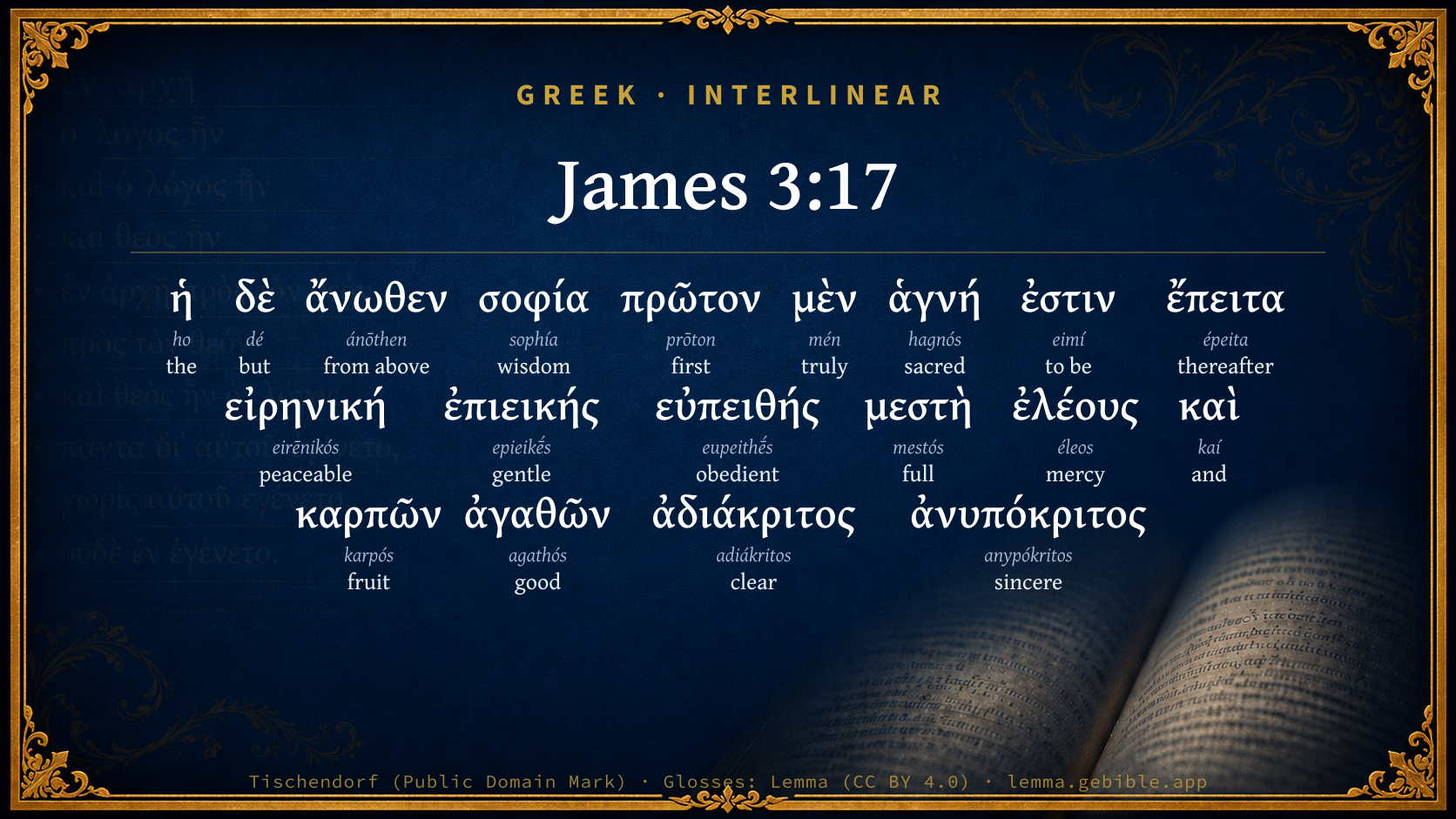
But the wisdom that is from above is first pure, then peaceful, gentle, reasonable, full of mercy and good fruits, without partiality, and without hypocrisy.
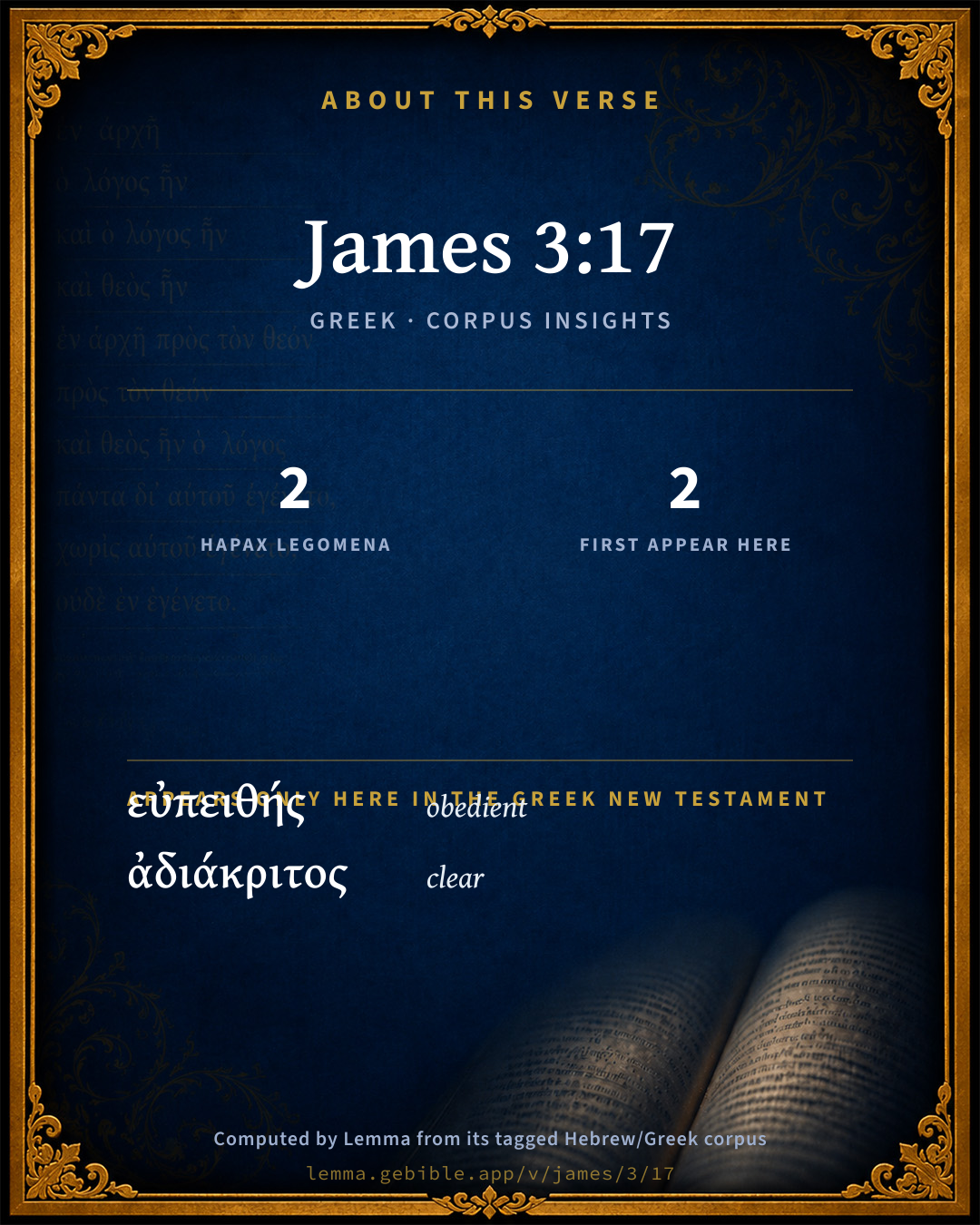
- 2 hapax legomena — only here in the Greek New Testament
- 2 first appearances in the Greek New Testament
Download a study sheet
One document with this verse’s original text, its word-by-word gloss line, the meaning frame, cross-references with their text, attributed commentary, and full source and license credits — printable, and it pastes into notes with its structure intact.
This verse Autodidact and up
A passage Seminary Student
Up to 50 verses in one chapter. A passage sheet keeps up to 6 commentary sources and 12 cross-references per verse, in the order this page ranks them, and says so on the sheet whenever that leaves anything out. Ask for a single verse and you get the Autodidact verse sheet above.
Everything on this page stays free to read, with no account — the sheet is a download of what is already on screen, not access to it.
Compare translations 3
The same verse in 3 English versions, stacked beneath the original-language interlinear above. Click any original word for its lexicon entry.
Each is an independent rendering of the whole verse — the interlinear is not word-aligned to these translations.
Highlighted words mark where these versions differ — a whole-verse word diff, not a word-by-word alignment.
-
World English Bible Public Domain
But the wisdom that is from above is first pure, then peaceful, gentle, reasonable, full of mercy and good fruits, without partiality, and without hypocrisy.
-
King James Version Public Domain
But the wisdom that is from above is first pure, then peaceable, gentle, and easy to be intreated, full of mercy and good fruits, without partiality, and without hypocrisy.
-
unfoldingWord Literal Text CC BY-SA 4.0
But the wisdom from above first indeed is pure, then peaceable, gentle, cooperative, full of mercy and good fruits, impartial, sincere.
unfoldingWord Literal Text — © unfoldingWord, licensed CC BY-SA 4.0. Word-aligned USFM3 via Door43 (git.door43.org/unfoldingWord/en_ult).
Show all 19 translations
Every available English version of this verse, each an independent rendering of the whole verse.
-
World English Bible Public Domain
But the wisdom that is from above is first pure, then peaceful, gentle, reasonable, full of mercy and good fruits, without partiality, and without hypocrisy.
-
Berean Standard Bible Public Domain
But the wisdom from above is first of all pure, then peace-loving, gentle, accommodating, full of mercy and good fruit, impartial, and sincere.
-
Majority Standard Bible Public Domain
But the wisdom from above is first of all pure, then peace-loving, gentle, accommodating, full of mercy and good fruit, impartial, and sincere.
-
King James Version Public Domain
But the wisdom that is from above is first pure, then peaceable, gentle, and easy to be intreated, full of mercy and good fruits, without partiality, and without hypocrisy.
-
American Standard Version (1901) Public Domain
But the wisdom that is from above is first pure, then peaceable, gentle, easy to be entreated, full of mercy and good fruits, without variance, without hypocrisy.
-
Revised Version (1885) Public Domain
But the wisdom that is from above is first pure, then peaceable, gentle, easy to be entreated, full of mercy and good fruits, without variance, without hypocrisy.
-
Geneva Bible (1599) Public Domain
But the wisedome that is from aboue, is first pure, then peaceable, gentle, easie to be intreated, full of mercie and good fruites, without iudging, and without hipocrisie.
-
Douay-Rheims (1899) Public Domain
But the wisdom, that is from above, first indeed is chaste, then peaceable, modest, easy to be persuaded, consenting to the good, full of mercy and good fruits, without judging, without dissimulation.
-
Young's Literal Translation Public Domain
and the wisdom from above, first, indeed, is pure, then peaceable, gentle, easily entreated, full of kindness and good fruits, uncontentious, and unhypocritical: --
-
Literal Standard Version CC BY-SA 4.0
but the wisdom from above, first, indeed, is pure, then peaceable, gentle, well-convinced, full of kindness and good fruits, uncontentious, and unhypocritical—
-
Unlocked Literal Bible CC BY-SA 4.0
But the wisdom from above is first pure, then peace-loving, gentle, reasonable, full of mercy and good fruits, impartial and sincere.
-
unfoldingWord Literal Text CC BY-SA 4.0
But the wisdom from above first indeed is pure, then peaceable, gentle, cooperative, full of mercy and good fruits, impartial, sincere.
-
Darby Bible Public Domain
But the wisdom from above first is pure, then peaceful, gentle, yielding, full of mercy and good fruits, unquestioning, unfeigned.
-
World Messianic Bible Public Domain
But the wisdom that is from above is first pure, then peaceful, gentle, reasonable, full of mercy and good fruits, without partiality, and without hypocrisy.
-
Webster's Bible Public Domain
But the wisdom that is from above is first pure, then peaceable, gentle, and easy to be entreated, full of mercy and good fruits, without partiality, and without hypocrisy.
-
Free Bible Version CC BY-SA 4.0
However, wisdom that comes from above is first of all pure, and it also brings peace. It is kind and open to reason. It is full of mercy and produces good things. It is genuine and not hypocritical.
-
Bible in Basic English Public Domain
But the wisdom which is from heaven is first holy, then gentle, readily giving way in argument, full of peace and mercy and good works, not doubting, not seeming other than it is.
-
Text-Critical English NT CC BY 4.0
But the wisdom from above is first pure, then peaceable, gentle, easily entreated, full of mercy and good fruits, impartial, and unhypocritical.
-
Tyndale New Testament (1534) Public Domain
But the wisdom that is from above is fyrst pure then peasable gentle and easy to be entreated full of mercy and good frutes without iudgynge and without simulacion:
Literal Standard Version (2020), Covenant Press — licensed CC BY-SA 4.0. Text via the HelloAO Bible API (eBible.org). Unlocked Literal Bible (unfoldingWord) — licensed CC BY-SA 4.0. Text via the HelloAO Bible API (eBible.org). unfoldingWord Literal Text — © unfoldingWord, licensed CC BY-SA 4.0. Word-aligned USFM3 via Door43 (git.door43.org/unfoldingWord/en_ult). Free Bible Version, Dr. Jonathan Gallagher — licensed CC BY-SA 4.0. Text via the HelloAO Bible API (eBible.org).
Word by word
More ways to search: Search by grammar → Find every occurrence → Compare this word →
Practice this passage: Drill this verse → Learn its vocabulary →
- Appears 1× in the Greek New Testament
- First appears here
- Part of Speech
- Adjective
- Case
- Nominative
- Number
- Singular
- Gender
- Feminine
Full Thayer's Definition
- ἡ ho G3588 “the” Article, Nominative, Singular, Feminine
- δὲ dé G1161 “but” Conjunction
- ἄνωθεν ánōthen G509 “from above” Adverb
- σοφία sophía G4678 “wisdom” Noun, Nominative, Singular, Feminine
- πρῶτον prōton G4412 “first” Adverb, Superlative
- μὲν mén G3303 “truly” Particle
- ἁγνή hagnós G53 “sacred” Adjective, Nominative, Singular, Feminine
- ἐστιν eimí G1510 “to be” Verb, Present, Active, Indicative, 3rd person, Singular
- ἔπειτα épeita G1899 “thereafter” Adverb
- εἰρηνική eirēnikós G1516 “peaceable” Adjective, Nominative, Singular, Feminine
- ἐπιεικής epieikḗs G1933 “gentle” Adjective, Nominative, Singular, Feminine
- εὐπειθής eupeithḗs G2138 “obedient” Adjective, Nominative, Singular, Feminine
- μεστὴ mestós G3324 “full” Adjective, Nominative, Singular, Feminine
- ἐλέους éleos G1656 “mercy” Noun, Genitive, Singular, Neuter
- καὶ kaí G2532 “and” Conjunction
- καρπῶν karpós G2590 “fruit” Noun, Genitive, Plural, Masculine
- ἀγαθῶν agathós G18 “good” Adjective, Genitive, Plural, Masculine
- ἀδιάκριτος adiákritos G87 “clear” Adjective, Nominative, Singular, Feminine
- ἀνυπόκριτος anypókritos G505 “sincere” Adjective, Nominative, Singular, Feminine
About this verse
These counts appear in no published source. They are computed here, from the morphology-tagged text and Lemma’s own curated glosses. What Lemma adds →
- 19
- words
- 19
- distinct lemmas
- General Epistles
- section
Notable vocabulary
2 hapax legomena — words that appear only here in the entire Greek New Testament:
First appearance in Scripture
These words make their first canonical appearance in the Greek New Testament here:
Shared distinctive vocabulary
εἰρηνική peaceable G1516 occurs in 2 verses of the Greek New Testament. Also found in:
Cross-references
58Topical passages linked to James 3:17 in the Treasury of Scripture Knowledge — connected by theme and wording, ordered by reader-vote popularity; previews shown in the World English Bible.
- Galatians 5:22–23 But the fruit of the Spirit is love, joy, peace, patience, kindness, goodness, faithfulness,
- Proverbs 2:6 For Yahweh gives wisdom. Out of his mouth comes knowledge and understanding.
- 1 Corinthians 13:4–7 Love is patient and is kind; love doesn't envy. Love doesn't brag, is not proud,
- James 3:15 This wisdom is not that which comes down from above, but is earthly, sensual, and demonic.
- Romans 12:9 Let love be without hypocrisy. Abhor that which is evil. Cling to that which is good.
- James 1:5 But if any of you lacks wisdom, let him ask of God, who gives to all liberally and without reproach; and it will be given to him.
- Matthew 5:8 Blessed are the pure in heart, For they shall see God.
- James 1:17 Every good gift and every perfect gift is from above, coming down from the Father of lights, with whom can be no variation, nor turning shadow.
- 1 Corinthians 2:6–7 We speak wisdom, however, among those who are full grown; yet a wisdom not of this world, nor of the rulers of this world, who are coming to nothing.
- 1 Peter 1:22 Seeing you have purified your souls in your obedience to the truth through the Spirit in sincere brotherly affection, love one another from the heart fervently:
- 1 John 3:18 My little children, let's not love in word only, neither with the tongue only, but in deed and truth.
- Luke 21:15 for I will give you a mouth and wisdom which all your adversaries will not be able to withstand or to contradict.
- 1 John 3:3 Everyone who has this hope set on him purifies himself, even as he is pure.
- 2 Timothy 2:24 The Lord's servant must not quarrel, but be gentle towards all, able to teach, patient,
- Hebrews 12:14 Follow after peace with all men, and the sanctification without which no man will see the Lord,
- Isaiah 32:15–17 until the Spirit be poured on us from on high, and the wilderness become a fruitful field, and the fruitful field be esteemed as a forest.
- Luke 6:36 Therefore be merciful, Even as your Father is also merciful.
- Job 28:28 To man he said, 'Behold, the fear of the Lord, that is wisdom. To depart from evil is understanding.'"
- 1 Chronicles 22:12 May Yahweh give you discretion and understanding, and put you in charge of Israel; that so you may keep the law of Yahweh your God.
- Isaiah 11:2–9 The Spirit of Yahweh shall rest on him, the spirit of wisdom and understanding, the spirit of counsel and might, the spirit of knowledge and of the fear of Yahweh.
- Romans 15:14 I myself am also persuaded about you, my brothers, that you yourselves are full of goodness, filled with all knowledge, able also to admonish others.
- Colossians 1:10 that you may walk worthily of the Lord, to please him in all respects, bearing fruit in every good work, and increasing in the knowledge of God;
- Hebrews 12:11 All chastening seems for the present to be not joyous but grievous; yet afterward it yields the peaceful fruit of righteousness to those who have been exercised thereby.
- James 2:4 haven't you shown partiality among yourselves, and become judges with evil thoughts?
- Philippians 4:8 Finally, brothers, whatever things are true, whatever things are honorable, whatever things are just, whatever things are pure, whatever things are lovely, whatever things are of good report; if there is any virtue, and if there is any praise, think about these things.
- 1 Corinthians 12:8 For to one is given through the Spirit the word of wisdom, and to another the word of knowledge, according to the same Spirit;
- Job 28:23 "God understands its way, And he knows its place.
- 1 Timothy 5:21 I charge you in the sight of God, and Christ Jesus, and the chosen angels, that you observe these things without prejudice, doing nothing by partiality.
- 1 Peter 2:1 Putting away therefore all wickedness, all deceit, hypocrisies, envies, and all evil speaking,
- 1 Kings 3:9 Give your servant therefore an understanding heart to judge your people, that I may discern between good and evil; for who is able to judge this your great people?
- Daniel 1:17 Now as for these four youths, God gave them knowledge and skill in all learning and wisdom: and Daniel had understanding in all visions and dreams.
- Malachi 2:9 "Therefore I have also made you contemptible and base before all the people, according to the way you have not kept my ways, but have had respect for persons in the law.
- John 1:14 The Word became flesh, and lived among us. We saw his glory, such glory as of the one and only Son of the Father, full of grace and truth.
- Romans 12:18 If it is possible, as much as it is up to you, be at peace with all men.
- 1 Kings 3:12 behold, I have done according to your word: behold, I have given you a wise and an understanding heart; so that there has been none like you before you, neither after you shall any arise like you.
- 1 Kings 3:28 All Israel heard of the judgment which the king had judged; and they feared the king: for they saw that the wisdom of God was in him, to do justice.
- Isaiah 32:6 For the fool will speak folly, and his heart will work iniquity, to practice profanity, and to utter error against Yahweh, to make empty the soul of the hungry, and to cause the drink of the thirsty to fail.
- Malachi 3:3 and he will sit as a refiner and purifier of silver, and he will purify the sons of Levi, and refine them as gold and silver; and they shall offer to Yahweh offerings in righteousness.
- Matthew 23:28 Even so you also outwardly appear righteous to men, but inwardly you are full of hypocrisy and iniquity.
- Luke 12:1–2 Meanwhile, when a multitude of many thousands had gathered together, so much so that they trampled on each other, he began to tell his disciples first of all, "Beware of the yeast of the Pharisees, which is hypocrisy.
- Acts 11:24 For he was a good man, and full of the Holy Spirit and of faith, and many people were added to the Lord.
- Titus 1:15 To the pure, all things are pure; but to those who are defiled and unbelieving, nothing is pure; but both their mind and their conscience are defiled.
- Titus 3:2 to speak evil of no one, not to be contentious, to be gentle, showing all humility toward all men.
- James 4:8 Draw near to God, and he will draw near to you. Cleanse your hands, you sinners; and purify your hearts, you double-minded.
- Genesis 41:38–39 Pharaoh said to his servants, "Can we find such a one as this, a man in whom is the Spirit of God?"
- Exodus 36:2 Moses called Bezalel and Oholiab, and every wise-hearted man, in whose heart Yahweh had put wisdom, even everyone whose heart stirred him up to come to the work to do it:
- Job 28:12 "But where shall wisdom be found? Where is the place of understanding?
- Isaiah 2:4 He will judge between the nations, And will decide concerning many peoples; And they shall beat their swords into plowshares, And their spears into pruning-hooks. Nation shall not lift up sword against nation, Neither shall they learn war any more.
- Isaiah 9:6–7 For to us a child is born, to us a son is given; and the government shall be on his shoulder: and his name shall be called Wonderful, Counselor, Mighty God, Everlasting Father, Prince of Peace.
- John 1:47 Jesus saw Nathanael coming to him, and said about him, "Behold, an Israelite indeed, in whom is no deceit!"
- Acts 9:36 Now there was at Joppa a certain disciple named Tabitha, which when translated, means Dorcas. This woman was full of good works and acts of mercy which she did.
- Ephesians 5:9 for the fruit of the Spirit is in all goodness and righteousness and truth,
- Philippians 1:11 being filled with the fruits of righteousness, which are through Jesus Christ, to the glory and praise of God.
- 1 Thessalonians 2:7 But we were gentle among of you, as when a nurse cherishes her own children.
- 1 Chronicles 22:9 Behold, a son shall be born to you, who shall be a man of rest; and I will give him rest from all his enemies round about; for his name shall be Solomon, and I will give peace and quietness to Israel in his days:
- Isaiah 40:11 He will feed his flock like a shepherd, he will gather the lambs in his arm, and carry them in his bosom, [and] will gently lead those who have their young.
- 2 Corinthians 9:10 Now may he who supplies seed to the sower and bread for food, supply and multiply your seed for sowing, and increase the fruits of your righteousness;
- 2 Corinthians 10:1 Now I Paul, myself, entreat you by the humility and gentleness of Christ; I who in your presence am lowly among you, but being absent am of good courage toward you.
Cross-references courtesy of OpenBible.info (CC BY 4.0).
Lesson kit
Teaching starters — assembled from the data on this page, not authored interpretation. Every prompt links to the verse data it draws on. Edit before teaching.
James, in the General Epistles, opens this verse with 19 words (19 distinct Greek lemmas). Its most distinctive word is eupeithḗs (“obedient”). A historical commentator’s framing appears above. Read the whole chapter for the surrounding context.
Discussion questions
- The word eupeithḗs carries the sense “obedient.” How does it shape the verse?
- 2 words here appear nowhere else in the Greek New Testament. Why might the author reach for such rare wording?
- 2 words make their first appearance in Scripture here. What does this debut establish?
- How does Hebrews 12:11, which shares the word «peaceable», read alongside this verse?
- These translations render this verse differently; the difference is in the English rendering, not the original. What questions does that raise?
- Compare how Albert Barnes' Notes on the Bible and The Biblical Illustrator read this verse. Where do they agree or differ?
Things to notice
- 2 words in this verse appear nowhere else in the Greek New Testament.
- 2 words make their first canonical appearance in Scripture here.
- These translations choose different wording for 12 words in this verse.
- 19 distinct Greek lemmas span 19 words in this verse.
Commentary
Notes on James 3:17 from classic Christian and Jewish commentators (each source and its license shown beneath its notes). The classic Christian expositions comment on the surrounding passage and are grouped to its opening verse, so a note may address several verses; the Jewish commentaries on the Tanakh (Rashi and others) are per-verse, so they appear only where the commentator wrote on this verse.
Lemma curates 59 commentaries, every one of them public domain or Creative Commons licensed, each selected and text-cleaned for this edition rather than reprinted as found. About our sources →
Albert Barnes' Notes on the Bible
Albert Barnes' Notes on the Bible (1834–1885) — public domain. Text from a community e-Sword/MySword module.
The Biblical Illustrator
Joseph S. Exell
The Biblical Illustrator, edited by Joseph S. Exell (c. 1880s–1900s) — public domain. Text from a community e-Sword module.
Joseph Benson's Commentary
Joseph Benson's Commentary on the Old and New Testaments (1811–1818) — public domain. Text from a community e-Sword module.
The Expositor's Bible
William Robertson Nicoll, ed., The Expositor's Bible (London: Hodder & Stoughton, 1887–1910) — public domain. 65 of 66 books (1 Corinthians is not separately keyed, as that volume carries no machine-parseable verse references); section-level commentary keyed to the opening verse. Introductory and overview sections not keyed to a specific passage are excluded.
Bengel's Gnomon
Johann Albrecht Bengel
Bengel's Gnomon of the New Testament — English translation (T&T Clark, Edinburgh, 1860) — public domain. Text from a community e-Sword module.
Meyer's Critical & Exegetical Commentary
Heinrich August Wilhelm Meyer
Meyer — Critical and Exegetical Commentary on the New Testament — English translation by Peter Christie, edited by Frederick Crombie (T&T Clark, 1880) — public domain. Text from a community e-Sword module.
Expositor's Greek Testament
ed. W. Robertson Nicoll
The Expositor's Greek Testament, edited by W. Robertson Nicoll (1897–1910) — public domain. Text from a community e-Sword module.
Geneva Bible (1599)
Geneva Bible translators
Geneva Bible (1599) marginal notes — public domain. Text via Bolls.life.
Jamieson, Fausset & Brown
Robert Jamieson, A. R. Fausset & David Brown
Jamieson, Fausset & Brown — Commentary Critical and Explanatory on the Whole Bible (1871) — public domain (CC PDM 1.0). Text via the HelloAO Bible API.
Adam Clarke's Commentary
Adam Clarke's Commentary on the Bible (1810–1826) — public domain. Text from a community e-Sword/MySword module.
John Calvin's Commentaries
John Calvin's Commentaries (1540-1563) — public domain. Text from the Calvin Translation Society English edition (1840s-50s) via the Christian Classics Ethereal Library (ccel.org). Calvin's coverage is partial (roughly two-thirds of the Bible); uncommented books and verses are honest gaps, never fabricated. The 19th-century editor's footnotes and remarks are omitted so the notes are faithfully Calvin's own voice.
Ellicott's Commentary for English Readers
A Bible Commentary for English Readers, edited by Charles John Ellicott (1878–1897) — public domain. Text from a community e-Sword module.
The Cambridge Bible for Schools and Colleges
gen. ed. J. J. S. Perowne
The Cambridge Bible for Schools and Colleges (gen. ed. J. J. S. Perowne; Cambridge University Press, 1878–1918) — public domain. Text from a community e-Sword module.
John Gill's Exposition
John Gill's Exposition of the Whole Bible (1746–1763) — public domain (CC PDM 1.0). Text via the HelloAO Bible API.
Trapp's Complete Commentary
John Trapp
John Trapp, A Commentary or Exposition upon All the Books of the Old and New Testament (1647–1656) — public domain. Text from a community e-Sword module.
Haydock's Catholic Bible Commentary
George Leo Haydock (1774–1849), Haydock's Catholic Family Bible and Commentary, 1859 edition — public domain. Excludes Psalms (Douay-Rheims chapter numbering differs from Protestant) and Deuterocanonical books (Catholic canon only).
Matthew Poole's English Annotations
Matthew Poole's English Annotations on the Holy Bible (1683–1685) — public domain. Text from a community e-Sword/MySword module.
Whedon's Commentary on the Bible
Daniel D. Whedon
Daniel D. Whedon (gen. ed.), Commentary on the Old and New Testaments (1874–1909) — public domain. Text from a community e-Sword module.
The Pulpit Commentary
The Pulpit Commentary (1880–1919), ed. H.D.M. Spence-Jones & Joseph S. Exell — public domain. Text from a community e-Sword module.
John Wesley's Explanatory Notes
John Wesley, Explanatory Notes Upon the Whole Bible (1754–1765) — public domain. Text via the GEBible commentary corpus.
Burkitt's Expository Notes on the New Testament
William Burkitt
William Burkitt's Expository Notes on the New Testament (1700–1703) — public domain. Text from a community e-Sword module.
The People's New Testament
B. W. Johnson
B. W. Johnson's The People's New Testament with Notes (1889–1891) — public domain. Electronic text from the Christian Classics Ethereal Library (CCEL) ThML edition.
Cambridge Greek Testament for Schools and Colleges
Cambridge Greek Testament for Schools and Colleges (Cambridge University Press, 1896; 21 vols, various authors incl. Carr, Maclear, Plummer, Farrar, Lumby, Moule, M. R. James, Simcox) — public domain. Text from a community e-Sword module.
Alford’s Greek Testament
Henry Alford
Henry Alford, The Greek Testament (1849–1861) — public domain. Text from a community e-Sword module.
International Critical Commentary
International Critical Commentary — older volumes (1896–1929), various authors — public domain. Text from a community e-Sword module.
Vincent's Word Studies in the New Testament
Marvin R. Vincent
Marvin R. Vincent, Word Studies in the New Testament (1887–1900) — public domain. Text from a community e-Sword/MySword module.