
Daniel 3:15

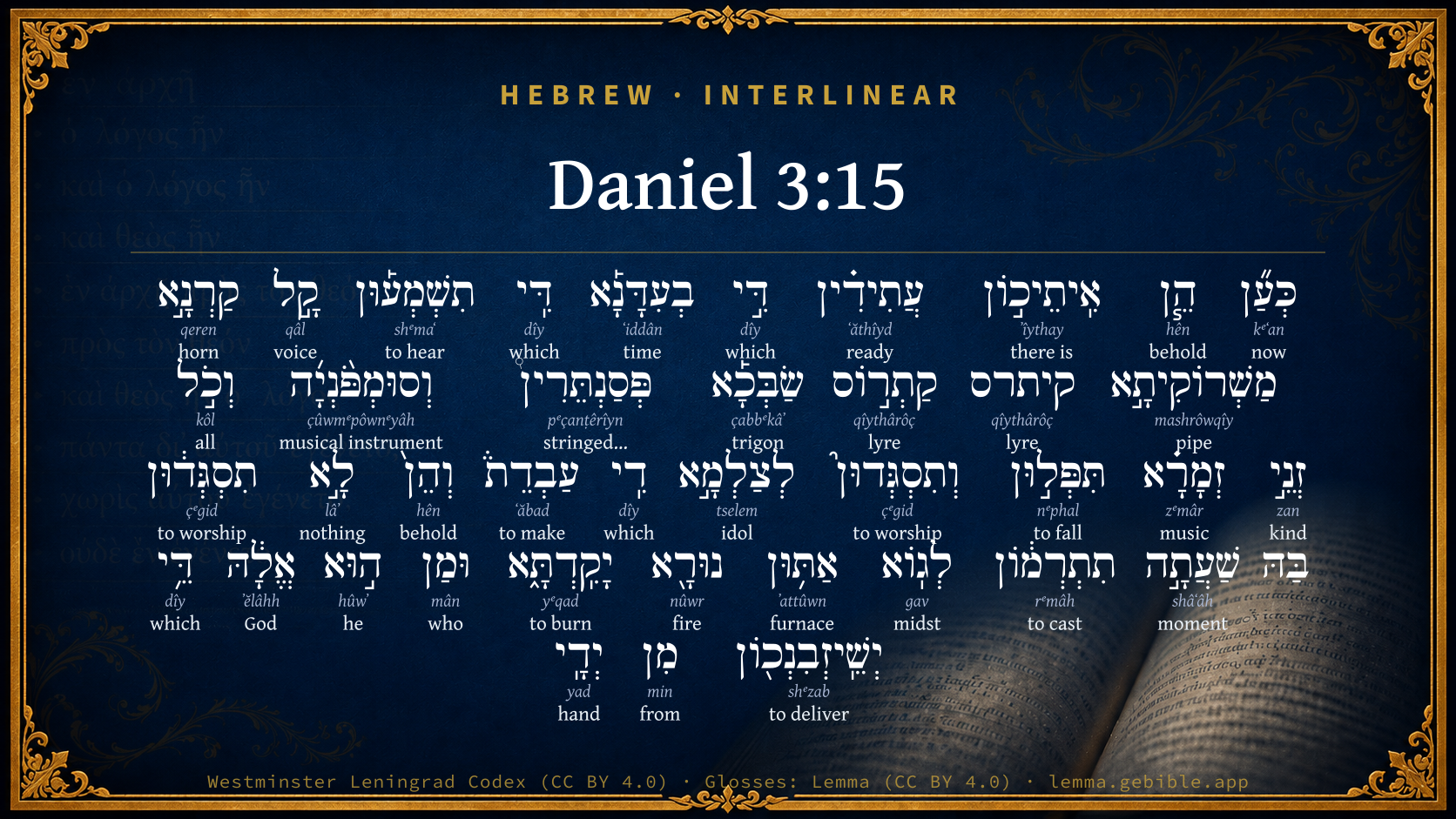
Hebrew (Westminster Leningrad Codex) Daniel 3:15 appears in the Hebrew Old Testament. The text above is from the Westminster Leningrad Codex. Each word links to its Strong’s number, a concise gloss, and parsing drawn from the Open Scriptures Hebrew Bible morphology. Click any word for its full Brown-Driver-Briggs (BDB) entry.
Download image
Cite this verse

Daniel 3:15 (World English Bible). Public Domain. Lemma interlinear Bible study tool, https://lemma.gebible.app/v/daniel/3/15.

Show BibTeX & RIS
BibTeX
RIS
English Translation
Now if you are ready whenever you hear the sound of the horn, flute, zither, lyre, harp, pipe, and all kinds of music to you fall down and worship the image which I have made, [well]: but if you don't worship, you shall be cast the same hour into the midst of a burning fiery furnace; and who is that god that shall deliver you out of my hands?
World English Bible · Public Domain
Highlights
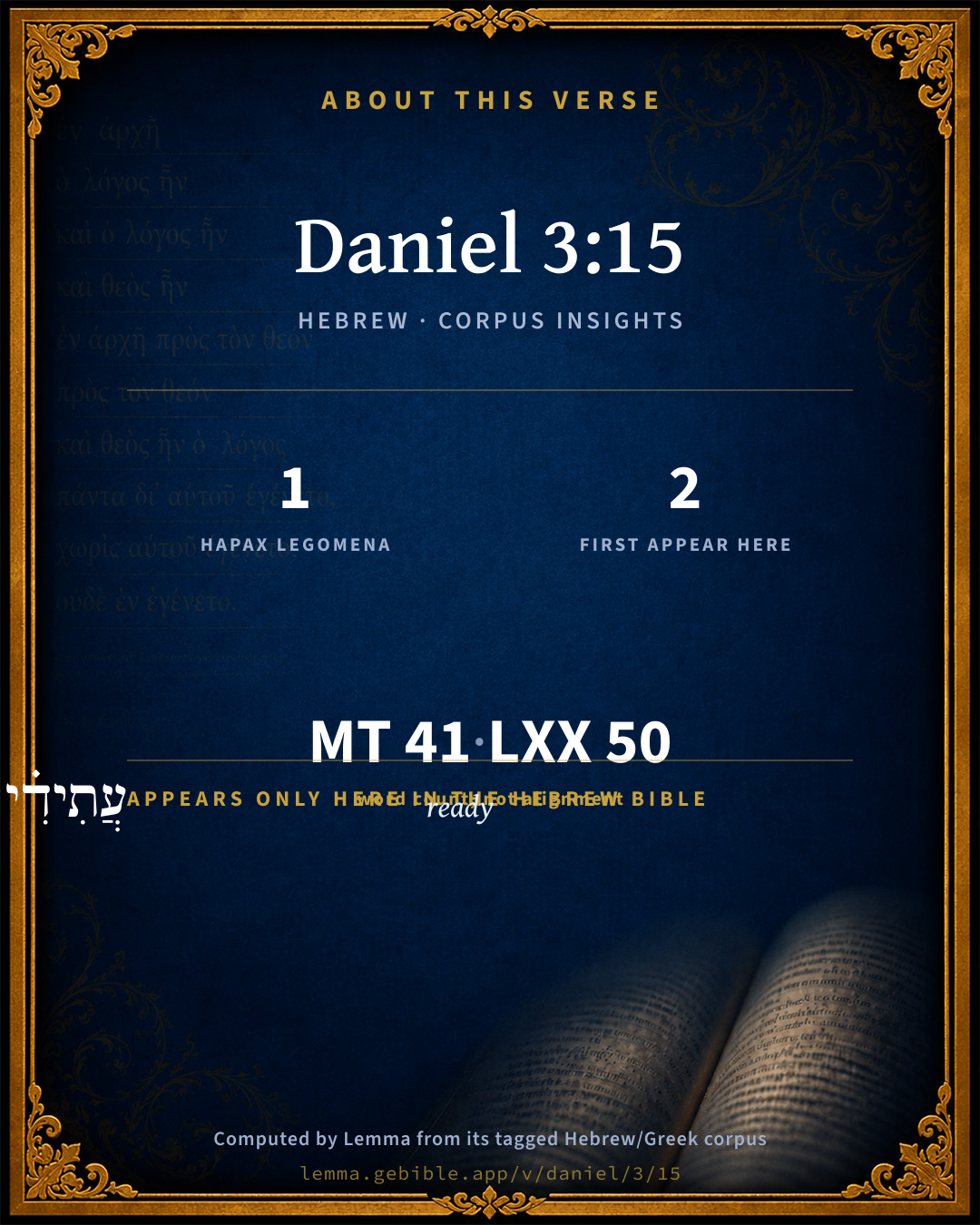
  • 1 hapax legomenon — only here in the Hebrew Bible
  • 2 first appearances in the Hebrew Bible
Full analysis ↓
Download a study sheet

One document with this verse’s original text, its word-by-word gloss line, the meaning frame, cross-references with their text, attributed commentary, and full source and license credits — printable, and it pastes into notes with its structure intact.

This verse Autodidact and up

Study sheet (.html) Plain text (.txt)

A passage Seminary Student

Up to 50 verses in one chapter. A passage sheet keeps up to 6 commentary sources and 12 cross-references per verse, in the order this page ranks them, and says so on the sheet whenever that leaves anything out. Ask for a single verse and you get the Autodidact verse sheet above.

Everything on this page stays free to read, with no account — the sheet is a download of what is already on screen, not access to it.

Want to remove ads? Support Godless Engineer
Compare translations 3

The same verse in 3 English versions, stacked beneath the original-language interlinear above. Click any original word for its lexicon entry.

Each is an independent rendering of the whole verse — the interlinear is not word-aligned to these translations.

Highlighted words mark where these versions differ — a whole-verse word diff, not a word-by-word alignment.

  • World English Bible Public Domain
    Now if you are ready whenever you hear the sound of the horn, flute, zither, lyre, harp, pipe, and all kinds of music to you fall down and worship the image which I have made, [well]: but if you don't worship, you shall be cast the same hour into the midst of a burning fiery furnace; and who is that god that shall deliver you out of my hands?
  • King James Version Public Domain
    Now if ye be ready that at what time ye hear the sound of the cornet, flute, harp, sackbut, psaltery, and dulcimer, and all kinds of musick, ye fall down and worship the image which I have made; well: but if ye worship not, ye shall be cast the same hour into the midst of a burning fiery furnace; and who is that God that shall deliver you out of my hands?
  • unfoldingWord Literal Text CC BY-SA 4.0
    Now if you are ready—at the moment you hear the sound of the horn, flute, lyre, trigon, harp, and bagpipe, and all kinds of music—to fall down and worship the image that I have made, all will be well. But if you do not worship, you will immediately be thrown into the midst of a furnace of blazing fire. Who is the god who will rescue you out of my hands?”

unfoldingWord Literal Text — © unfoldingWord, licensed CC BY-SA 4.0. Word-aligned USFM3 via Door43 (git.door43.org/unfoldingWord/en_ult).

Versions to compare (up to 4)

3 of 4 selected

Show all 18 translations

Every available English version of this verse, each an independent rendering of the whole verse.

  • World English Bible Public Domain
    Now if you are ready whenever you hear the sound of the horn, flute, zither, lyre, harp, pipe, and all kinds of music to you fall down and worship the image which I have made, [well]: but if you don't worship, you shall be cast the same hour into the midst of a burning fiery furnace; and who is that god that shall deliver you out of my hands?
  • Berean Standard Bible Public Domain
    Now, if you are ready, as soon as you hear the sound of the horn, flute, zither, lyre, harp, pipes, and all kinds of music, you must fall down and worship the statue I have made. But if you refuse to worship, you will be thrown at once into the blazing fiery furnace. Then what god will be able to deliver you from my hands?”
  • Majority Standard Bible Public Domain
    Now when you hear the sound of the horn, flute, zither, lyre, harp, pipes, and all kinds of music, if you are ready to fall down and worship the statue I have made, very good. But if you refuse to worship, you will be thrown at once into the blazing fiery furnace. Then what god will be able to deliver you from my hands?”
  • King James Version Public Domain
    Now if ye be ready that at what time ye hear the sound of the cornet, flute, harp, sackbut, psaltery, and dulcimer, and all kinds of musick, ye fall down and worship the image which I have made; well: but if ye worship not, ye shall be cast the same hour into the midst of a burning fiery furnace; and who is that God that shall deliver you out of my hands?
  • American Standard Version (1901) Public Domain
    Now if ye be ready that at what time ye hear the sound of the cornet, flute, harp, sackbut, psaltery, and dulcimer, and all kinds of music, ye fall down and worship the image which I have made, `well': but if ye worship not, ye shall be cast the same hour into the midst of a burning fiery furnace; and who is that god that shall deliver you out of my hands?
  • Revised Version (1885) Public Domain
    Now if ye be ready that at what time ye hear the sound of the cornet, flute, harp, sackbut, psaltery, and dulcimer, and all kinds of music, ye fall down and worship the image which I have made, well: but if ye worship not, ye shall be cast the same hour into the midst of a burning fiery furnace; and who is that God that shall deliver you out of my hands?
  • Geneva Bible (1599) Public Domain
    Now therefore are ye ready when ye heare the sound of the cornet, trumpet, harpe, sackebut, psalterie, and dulcimer, and all instruments of musike, to fall downe, and worship the image, which I haue made? for if ye worship it not, ye shall be cast immediatly into the middes of an hote fierie fornace: for who is that God, that can deliuer you out of mine handes?
  • Douay-Rheims (1899) Public Domain
    Now therefore if you be ready at what hour soever you shall hear the sound of the trumpet, flute, harp, sackbut, and psaltery, and symphony, and of all kind of music, prostrate yourselves, and adore the statue which I have made: but if you do not adore, you shall be cast the same hour into the furnace of burning fire: and who is the God that shall deliver you out of my hand?
  • Young's Literal Translation Public Domain
    Now, lo, ye are ready, so that at the time that ye hear the voice of the cornet, the flute, the harp, the sackbut, the psaltery, and the symphony, and all kinds of music, ye fall down and do obeisance to the image that I have made! -- and lo, ye do no obeisance -- in that hour ye are cast into the midst of a burning fiery furnace; who is that God who doth deliver you out of my hands?'
  • Literal Standard Version CC BY-SA 4.0
    Now behold, you are ready, so that at the time that you hear the voice of the horn, the flute, the harp, the lyre, the stringed instrument, and the symphony, and all kinds of music, you fall down and pay respect to the image that I have made! But if you do not worship—in that hour you are cast into the midst of a burning fiery furnace; who is that God who delivers you out of my hands?”
  • Unlocked Literal Bible CC BY-SA 4.0
    Now if you are ready—when you hear the sounds of the horns, flutes, zithers, lyres, harps, and pipes, and all kinds of music—to fall down and prostrate yourselves to the statue that I have made, all will be well. But if you do not worship, you will immediately be thrown into a blazing furnace. Who is the god who is able to rescue you out of my hands?”
  • unfoldingWord Literal Text CC BY-SA 4.0
    Now if you are ready—at the moment you hear the sound of the horn, flute, lyre, trigon, harp, and bagpipe, and all kinds of music—to fall down and worship the image that I have made, all will be well. But if you do not worship, you will immediately be thrown into the midst of a furnace of blazing fire. Who is the god who will rescue you out of my hands?”
  • Darby Bible Public Domain
    Now if ye be ready at the time that ye hear the sound of the cornet, pipe, lute, sambuca, psaltery, and bagpipe, and all kinds of music, to fall down and worship the image that I have made, [well]: but if ye worship not, ye shall be cast that same hour into the midst of a burning fiery furnace: and who is the God that shall deliver you out of my hands?
  • World Messianic Bible Public Domain
    Now if you are ready whenever you hear the sound of the horn, flute, zither, lyre, harp, pipe, and all kinds of music to fall down and worship the image which I have made, good; but if you don’t worship, you shall be cast the same hour into the middle of a burning fiery furnace. Who is that god who will deliver you out of my hands?”
  • Webster's Bible Public Domain
    Now if ye be ready that at what time ye hear the sound of the cornet, flute, harp, sackbut, psaltery, and dulcimer, and all kinds of music, ye fall down and worship the image which I have made; well: but if ye worship not, ye shall be cast the same hour into the midst of a burning fiery furnace; and who is that God that shall deliver you out of my hands?
  • Free Bible Version CC BY-SA 4.0
    “Are you ready now to fall down and worship the statue I had made when you hear the sound of the musical instruments? If you don't, you will be immediately thrown into the furnace of blazing fire, and there's no god who can save you from my power!”
  • Bible in Basic English Public Domain
    Now if you are ready, on hearing the sound of the horn, pipe, harp, trigon, psaltery, bagpipe, and all sorts of instruments, to go down on your faces in worship before the image which I have made, it is well: but if you will not give worship, that same hour you will be put into a burning and flaming fire; and what god is there who will be able to take you out of my hands?
  • JPS Tanakh (1917) Public Domain
    Now if ye be ready that at what time ye hear the sound of the horn, pipe, harp, trigon, psaltery, and bagpipe, and all kinds of music, ye fall down and worship the image which I have made, well; but if ye worship not, ye shall be cast the same hour into the midst of a burning fiery furnace; and who is the god that shall deliver you out of my hands?'

Literal Standard Version (2020), Covenant Press — licensed CC BY-SA 4.0. Text via the HelloAO Bible API (eBible.org). Unlocked Literal Bible (unfoldingWord) — licensed CC BY-SA 4.0. Text via the HelloAO Bible API (eBible.org). unfoldingWord Literal Text — © unfoldingWord, licensed CC BY-SA 4.0. Word-aligned USFM3 via Door43 (git.door43.org/unfoldingWord/en_ult). Free Bible Version, Dr. Jonathan Gallagher — licensed CC BY-SA 4.0. Text via the HelloAO Bible API (eBible.org).

Word by word

More ways to search: Search by grammar → Find every occurrence → Compare this word →

Practice this passage: Drill this verse → Learn its vocabulary →

עֲתִידִ֗ין
ʻăthîyd
H6263
“ready”
Adjective, A
Part of Speech
Adjective
Full BDB Definition

Origin: corresponding to H6264

TWOT: 2934

ready, prepared
  1. כְּעַ֞ן kᵉʻan H3705 “now” Adjective, D
  2. הֵ֧ן hên H2006 “behold” Adjective, C
  3. אִֽיתֵיכ֣וֹן ʼîythay H383 “there is · you” Adjective, T + Suffix, Personal, 2nd Person, Masculine, Plural
  4. דִּ֣י dîy H1768 “which” Adjective, T
  5. בְעִדָּנָ֡א ʻiddân H5732 “in/at · time · the” Adjective, R + Noun, Common, Masculine, Singular, Determined + Particle, Definite Article
  6. דִּֽי dîy H1768 “which” Adjective, T
  7. תִשְׁמְע֡וּן shᵉmaʻ H8086 “to hear” Adjective, V
  8. קָ֣ל qâl H7032 “voice of” Adjective, N, Common
  9. קַרְנָ֣א qeren H7162 “horn · the” Adjective, N, Common + Particle, Definite Article
  10. מַשְׁרוֹקִיתָ֣א mashrôwqîy H4953 “pipe · the” Adjective, N, Common + Particle, Definite Article
  11. קיתרס qîythârôç H7030 “lyre” Adjective, N, Common
  12. קַתְר֣וֹס qîythârôç H7030 “lyre” Adjective, N, Common
  13. שַׂבְּכָ֡א çabbᵉkâʼ H5443 “trigon” Adjective, N, Common
  14. פְּסַנְתֵּרִין֩ pᵉçanṭêrîyn H6460 “stringed instrument” Adjective, N, Common
  15. וְסוּמְפֹּ֨נְיָ֜ה çûwmᵉpôwnᵉyâh H5481 “and · musical instrument” Adjective, C + Noun, Common, Feminine, Singular, Absolute
  16. וְכֹ֣ל kôl H3606 “and · all of” Adjective, C + Noun, Common, Masculine, Singular, Construct
  17. זְנֵ֣י zan H2178 “kinds of” Adjective, N, Common
  18. זְמָרָ֗א zᵉmâr H2170 “music · the” Adjective, N, Common + Particle, Definite Article
  19. תִּפְּל֣וּן nᵉphal H5308 “to fall” Adjective, V
  20. וְתִסְגְּדוּן֮ çᵉgid H5457 “and · to worship” Adjective, C + Verb, Qal, Imperfect, 2nd Person, Masculine, Plural
  21. לְצַלְמָ֣א tselem H6755 “to/for · idol · the” Adjective, R + Noun, Common, Masculine, Singular, Determined + Particle, Definite Article
  22. דִֽי dîy H1768 “which” Adjective, T
  23. עַבְדֵת֒ ʻăbad H5648 “to make” Adjective, V, Plural
  24. וְהֵן֙ hên H2006 “and · behold” Adjective, C + Conjunction
  25. לָ֣א lâʼ H3809 “nothing” Adjective, T
  26. תִסְגְּד֔וּן çᵉgid H5457 “to worship” Adjective, V
  27. שַׁעֲתָ֣ה shâʻâh H8160 “moment · the” Adjective, N, Common + Particle, Definite Article
  28. תִתְרְמ֔וֹן rᵉmâh H7412 “to cast” Adjective, V
  29. לְגֽוֹא gav H1459 “to/for · midst of” Adjective, R + Noun, Common, Masculine, Singular, Construct
  30. אַתּ֥וּן ʼattûwn H861 “furnace of” Adjective, N, Common
  31. נוּרָ֖א nûwr H5135 “fire · the” Adjective, N, Common + Particle, Definite Article
  32. יָקִֽדְתָּ֑א yᵉqad H3345 “burning · the” Adjective, V + Particle, Definite Article
  33. וּמַן mân H4479 “and · who” Adjective, C + Pronoun, Interrogative, 3rd Person, Common, Singular
  34. ה֣וּא hûwʼ H1932 “he” Adjective, T
  35. אֱלָ֔הּ ʼĕlâhh H426 “God” Adjective, N, Common
  36. דֵּ֥י dîy H1768 “which” Adjective, T
  37. יְשֵֽׁיזְבִנְכ֖וֹן shᵉzab H7804 “to deliver · you” Adjective, V + Suffix, Personal, 2nd Person, Masculine, Plural
  38. מִן min H4481 “from” Adjective, R
  39. יְדָֽי yad H3028 “hands · my” Adjective, N, Common + Suffix, Personal, 1st Person, Common, Singular

About this verse

These counts appear in no published source. They are computed here, from the morphology-tagged text and Lemma’s own curated glosses. What Lemma adds →

41
words
34
distinct lemmas
Prophets
section

Notable vocabulary

1 hapax legomenon — a word that appears only here in the entire Hebrew Bible:

  • עֲתִידִ֗ין ready H6263

First appearance in Scripture

These words make their first canonical appearance in the Hebrew Bible here:

  • עֲתִידִ֗ין ready H6263
  • יְשֵֽׁיזְבִנְכ֖וֹן to deliver H7804

Shared distinctive vocabulary

מַשְׁרוֹקִיתָ֣א pipe H4953 occurs in 4 verses of the Hebrew Bible. Also found in:

Grammatical profile

  • 1 verb
  • 3 nouns
  • 27 adjectives
  • 1 pronoun
  • 1 conjunction
  • 8 particles

Verb forms

  • וְתִסְגְּדוּן֮ Qal · Imperfect

Repetition

Words recur within this verse — often emphatic in Hebrew:

  • הֵ֧ן behold H2006 ×2
  • קיתרס lyre H7030 ×2
  • וְתִסְגְּדוּן֮ to worship H5457 ×2
  • דִּ֣י which H1768 ×4

Hebrew & Septuagint length

In English translation the verse runs 69 words from the Hebrew and 74 from the Septuagint (LXX English) — closely comparable.

A rough comparison of the two English renderings, which tokenize alike — not a word-level alignment.

Word counts can differ between the Hebrew and the Greek without any difference in meaning — e.g. the Hebrew direct-object marker אֵת has no separate Greek word, and Greek often adds the article ὁ.

In the original languages it is 41 Hebrew tokens and 50 Greek tokens — but the two are counted differently (Hebrew bundles its prefixes and suffixes into one token; the Greek is in lemma form), so that isn’t a like-for-like length.

Cross-references

23

Topical passages linked to Daniel 3:15 in the Treasury of Scripture Knowledge — connected by theme and wording, ordered by reader-vote popularity; previews shown in the World English Bible.

  • Acts 5:29 But Peter and the apostles answered, "We must obey God rather than men.
  • Exodus 5:2 Pharaoh said, "Who is Yahweh, that I should listen to his voice to let Israel go? I don't know Yahweh, and moreover I will not let Israel go."
  • 2 Kings 18:35 Who are they among all the gods of the countries, that have delivered their country out of my hand, that Yahweh should deliver Jerusalem out of my hand?
  • 2 Chronicles 32:15–17 Now therefore don't let Hezekiah deceive you, nor persuade you after this manner, neither believe you him; for no god of any nation or kingdom was able to deliver his people out of my hand, and out of the hand of my fathers: how much less shall your God deliver you out of my hand?
  • Daniel 3:17 If it be [so], our God whom we serve is able to deliver us from the burning fiery furnace; and he will deliver us out of your hand, O king.
  • Isaiah 36:18–20 Beware lest Hezekiah persuade you, saying, Yahweh will deliver us. Has any of the gods of the nations delivered his land out of the hand of the king of Assyria?
  • Acts 4:8–12 Then Peter, filled with the Holy Spirit, said to them, "You rulers of the people, and elders of Israel,
  • Daniel 3:5–6 that whenever you hear the sound of the horn, flute, zither, lyre, harp, pipe, and all kinds of music, you fall down and worship the golden image that Nebuchadnezzar the king has set up;
  • Daniel 6:16 Then the king commanded, and they brought Daniel, and cast him into the den of lions. [Now] the king spoke and said to Daniel, Your God whom you serve continually, he will deliver you.
  • Mark 13:11 When they lead you away and deliver you up, don't be anxious beforehand, or premeditate what you will say, but say whatever will be given you in that hour. For it is not you who speak, but the Holy Spirit.
  • Acts 4:19 But Peter and John answered them, "Whether it is right in the sight of God to listen to you rather than to God, judge for yourselves,
  • Exodus 32:32 Yet now, if you will, forgive their sin-- and if not, please blot me out of your book which you have written."
  • Isaiah 37:23 Whom have you defied and blasphemed? and against whom have you exalted your voice and lifted up your eyes on high? [even] against the Holy One of Israel.
  • Daniel 3:28–29 Nebuchadnezzar spoke and said, Blessed be the God of Shadrach, Meshach, and Abednego, who has sent his angel, and delivered his servants who trusted in him, and have changed the king's word, and have yielded their bodies, that they might not serve nor worship any god, except their own God.
  • Daniel 6:20 When he came near to the den to Daniel, he cried with a lamentable voice; the king spoke and said to Daniel, Daniel, servant of the living God, is your God, whom you serve continually, able to deliver you from the lions?
  • Luke 4:7–8 If you therefore will worship before me, it will all be yours."
  • Luke 12:11 When they bring you before the synagogues, the rulers, and the authorities, don't be anxious how or what you will answer, or what you will say;
  • Luke 13:9 If it bears fruit, fine; but if not, after that, you can cut it down.'"
  • Luke 21:14–15 Settle it therefore in your hearts not to meditate beforehand how to answer,
  • Acts 6:15 All who sat in the council, fastening their eyes on him, saw his face like it was the face of an angel.
  • Matthew 10:19 But when they deliver you up, don't be anxious how or what you will say, for it will be given you in that hour what you will say.
  • Matthew 27:43 He trusts in God. Let God deliver him now, if he wants him; for he said, 'I am the Son of God.'"
  • Acts 24:10–13 When the governor had beckoned to him to speak, Paul answered, "Because I know that you have been a judge of this nation for many years, I cheerfully make my defense,

Cross-references courtesy of OpenBible.info (CC BY 4.0).

Hebrew and Greek witnesses Masoretic Hebrew ↔ Greek Septuagint

The same verse in the two great witnesses to the Old Testament, shown verse-for-verse.

These are two independent witnesses, not word-aligned to each other, and the Septuagint is shown in lemma (dictionary) form.

Hebrew Daniel 3:15 Masoretic · Westminster Leningrad Codex

כְּעַ֞ן הֵ֧ן אִֽיתֵיכ֣וֹן עֲתִידִ֗ין דִּ֣י בְעִדָּנָ֡א דִּֽי תִשְׁמְע֡וּן קָ֣ל קַרְנָ֣א מַשְׁרוֹקִיתָ֣א קיתרס קַתְר֣וֹס שַׂבְּכָ֡א פְּסַנְתֵּרִין֩ וְסוּמְפֹּ֨נְיָ֜ה וְכֹ֣ל זְנֵ֣י זְמָרָ֗א תִּפְּל֣וּן וְתִסְגְּדוּן֮ לְצַלְמָ֣א דִֽי עַבְדֵת֒ וְהֵן֙ לָ֣א תִסְגְּד֔וּן בַּהּ שַׁעֲתָ֣ה תִתְרְמ֔וֹן לְגֽוֹא אַתּ֥וּן נוּרָ֖א יָקִֽדְתָּ֑א וּמַן ה֣וּא אֱלָ֔הּ דֵּ֥י יְשֵֽׁיזְבִנְכ֖וֹן מִן יְדָֽי

Now if you are ready whenever you hear the sound of the horn, flute, zither, lyre, harp, pipe, and all kinds of music to you fall down and worship the image which I have made, [well]: but if you don't worship, you shall be cast the same hour into the midst of a burning fiery furnace; and who is that god that shall deliver you out of my hands?

World English Bible · Public Domain

Greek LXX Daniel 3:15 Septuagint · lemma form

καί νῦν εἰ μέν ἔχω ἑτοίμως ἅμα ὁ ἀκούω ὁ σάλπιγξ καί πᾶς ἤχος μουσικός πίπτω προςκυνέω ὁ εἰκών ὁ χρυσοῦς ὅς ἵστημι εἰ δέ μή γέ γιγνώσκω ὅτι μή προςκυνέω σύ αὐθωρί ἐνβάλλω εἰς ὁ κάμινος ὁ πῦρ ὁ καίω καί ποῖος θεός ἐκαἱρέω σύ ἐκ ὁ χείρ ἐγώ

Now then if you⌃ be ready, whenever you⌃ shall hear the sound of the trumpet, and pipe, and harp, and sackbut, and lute, and harmony, and every kind of music, to fall down and worship the golden image which I have made; well: but if you⌃ worship not, in the same hour you⌃ shall be cast into the burning fiery furnace; and who is the God that shall deliver you out of my hand?

LXX2012 (modern English Septuagint) · Public Domain

On this verse, The Pulpit Commentary discusses the Septuagint’s reading. Read the note in Commentary ↓

Hebrew: Westminster Leningrad Codex (CC BY 4.0). Greek: Septuagint (public domain); English from LXX2012 (modern English Septuagint) (Public Domain). How the Septuagint differs from the Hebrew →

Commentary

Notes on Daniel 3:15 from classic Christian and Jewish commentators (each source and its license shown beneath its notes). The classic Christian expositions comment on the surrounding passage and are grouped to its opening verse, so a note may address several verses; the Jewish commentaries on the Tanakh (Rashi and others) are per-verse, so they appear only where the commentator wrote on this verse.

Lemma curates 59 commentaries, every one of them public domain or Creative Commons licensed, each selected and text-cleaned for this edition rather than reprinted as found. About our sources →

Trapp's Complete Commentary

John Trapp

Dan 3:15 Now if ye be ready that at what time ye hear the sound of the cornet, flute, harp, sackbut, psaltery, and dulcimer, and all kinds of musick, ye fall down and worship the image which I have made; [well]: but if ye worship not, ye shall be cast the same hour into the midst of a burning fiery furnace; and who [is] that God that shall deliver you out of my hands?

Ver. 15. Now if ye be ready that at what time ye hear.] Many can no sooner hear flattering promises of preferment, as it were Nebuchadnezzar’s instruments, but they presently fall down and worship the Babylonish idol; but these three worthies were none such.

And who is that God that shall deliver you out of my hand?] What God is he? Sure a mean God he were, thou poor thimbleful of dust, could he not stay thy hand, and stop thy blasphemous mouth with a spadeful of mould, and that in a trice.

John Trapp, A Commentary or Exposition upon All the Books of the Old and New Testament (1647–1656) — public domain. Text from a community e-Sword module.

Tyndale Open Study Notes

Tyndale Open Resources

3:15 I will give you one more chance: The three men’s earlier relationship to the king may have helped them get a second chance.

Tyndale Open Study Notes — © Tyndale Open Resources, licensed CC BY-SA 4.0. Text via the HelloAO Bible API.

Ibn Ezra

Rabbi Abraham ibn Ezra

[Daniel 3:15] Now (כְּעַן - Ke'an): [Means] Now (ʿAtah). If you are ready (הֵן אִיתֵיכוֹן עֲתִידִין - hen iteikhon ʿatidin): [Ibn Ezra interprets the king giving them this second chance as follows:] Behold, you are ready (hineh yeshkhem ʿatidim). He accorded them honor (chalak lahem kavod), perhaps [thinking] he would not kill them on account of Daniel's honor (ulai lo yahargem baʿavur k'vod Daniel).

Ibn Ezra on the Tanakh — English translations: “Sefaria Community Translation” (CC0 1.0 (public-domain dedication)); “Yalkut, Sifsei Chachomim Chumash, Metsudah Publications, 2009” (CC BY 4.0); and “Commentary of Ibn Ezra on Isaiah - trans. by M. Friedlander, 1873” (public domain). Text via Sefaria.

Geneva Bible (1599)

Geneva Bible translators

Signifying that he would receive them to grace if they would now at the length obey his decree.

Geneva Bible (1599) marginal notes — public domain. Text via Bolls.life.

Jamieson, Fausset & Brown

Robert Jamieson, A. R. Fausset & David Brown

who is that God--so Sennacherib's taunt (Kg2 18:35), and Pharaoh's (Exo 5:2).

Jamieson, Fausset & Brown — Commentary Critical and Explanatory on the Whole Bible (1871) — public domain (CC PDM 1.0). Text via the HelloAO Bible API.

Ellicott's Commentary for English Readers

(15) Well.—The word is not in the Chaldee, where an aposiopesis is to be observed, as in Exo_32:32. Comp. Luk_13:9.

Who is that God?—Nebuchadnezzar has so little belief in his own gods that he ranks himself as far above them as above Jehovah. He defies all supernatural powers. Very different is the boast of Sennacherib (Isa_36:18-20), who pits his own god Assur against Jehovah.

A Bible Commentary for English Readers, edited by Charles John Ellicott (1878–1897) — public domain. Text from a community e-Sword module.

The Cambridge Bible for Schools and Colleges

gen. ed. J. J. S. Perowne

15. sackbut, psaltery, and dulcimer] trigon, psaltery, and bagpipe.

well] an aposiopesis, as e.g. Gen_30:27, Exo_32:32, Luk_13:9; Il. i. 135 f. (von Lengerke).

who is the God] The sense is not appreciably affected; but ‘that’ is not philologically correct (comp. on Dan_2:38). The question is a defiant challenge, like those of Sennacherib, and the Rab-shakeh, Isa_36:19 f., Isa_37:11 f.

The Cambridge Bible for Schools and Colleges (gen. ed. J. J. S. Perowne; Cambridge University Press, 1878–1918) — public domain. Text from a community e-Sword module.

John Gill's Exposition

Now if ye be ready that at what time ye shall hear,.... The meaning is, that if they were disposed in mind, which the king was very desirous they should, both for his own honour, and for their safety, for whom he had a regard; and were willing to comply with his orders, and readily yield obedience to his will, and worship his idol; the following would be a signal to them, and all would be well with them: or it may be rendered, "when now ye shall be, that at what time ye shall hear" (q); for the word signifies future, as well as "ready", and is by some so translated; and the sense is, when it shall be, or for the future, that they should hear

the sound of the cornet, flute, harp, sackbut, psaltery, and dulcimer, and all kinds of music; which was played not once only, but perhaps at certain times every day, and designed to be continued:

ye fall down and worship the image which I have made; it is well; so doing the king's wrath would be appeased, their lives would be preserved, and they continued in his favour, and in their honourable posts:

but if ye worship not, ye shall be cast the same hour into the midst of a burning fiery furnace; immediately, without any delay; no reprieve will be granted, and much less a pardon:

and who is that God that shall deliver you out of my hands? he knew their confidence in the God of Israel, which he attempts to break and remove; he foresaw the objection they would make, which he endeavours to anticipate by this proud and vain boast, forgetting what he himself had said, Dan 2:47.

(q) "si futuri estis", Gejerus.

John Gill's Exposition of the Whole Bible (1746–1763) — public domain (CC PDM 1.0). Text via the HelloAO Bible API.

Albert Barnes' Notes on the Bible

Now, if ye be ready, that at what time ... - At the very time; on the very instant. It would seem probable from this that the ceremonies of the consecration of the image were prolonged for a considerable period, so that there was still an opportunity for them to unite in the service if they would. The supposition that such services would be continued through several days is altogether probable, and accords with what was usual on festival occasions. It is remarkable that the king was willing to give them another trial, to see whether they were disposed or not to worship the golden image. To this he might have been led by the apprehension that they had not understood the order, or that they had not duly considered the subject; and possibly by respect for them as faithful officers, and for their countryman Daniel. There seems, moreover, to have been in the bosom of this monarch, with all his pride and passion, a readiness to do justice, and to furnish an opportunity of a fair trial before he proceeded to extremities. See Dan 2:16, Dan 2:26, Dan 2:46-47,

And who is that God that shall deliver you out of my hands? - That is, he either supposed that the God whom they worshipped would not be “able” to deliver them, or that he would not be “disposed” to do it. It was a boast of Sennacherib, when he warred against the Jews, that none of the gods of the nations which he had conquered had been able to rescue the lands over which they presided, and he argued from these premises that the God whom the Hebrews worshipped would not be able to defend their country: “Hath any of the gods of the nations delivered his land out of the hand of the king of Assyria? Where are the gods of Hamath, and of Arphad? where are the gods of Sepharvaim? and have they delivered Samaria out of my hand? Who are they among all the gods of these lands, that have delivered their land out of my hand, that the Lord should deliver Jerusalem out of my hand?” Isa 36:18-20. Nebuchadnezzar seems to have reasoned in a similar manner, and with a degree of vain boasting that strongly resembled this, calling their attention to the certain destruction which awaited them if they did not comply with his demand.

Albert Barnes' Notes on the Bible (1834–1885) — public domain. Text from a community e-Sword/MySword module.

Haydock's Catholic Bible Commentary

Hand? Proof of this king’s inconstancy, as he had witnessed the power of God!

George Leo Haydock (1774–1849), Haydock's Catholic Family Bible and Commentary, 1859 edition — public domain. Excludes Psalms (Douay-Rheims chapter numbering differs from Protestant) and Deuterocanonical books (Catholic canon only).

Matthew Poole's English Annotations

Prodigious pride and blasphemy! for he doth not only insult over all gods in general, but particularly against the only true God, whom he lately confessed, Dan 2:47, to be

a God of gods, and a Lord of kings. So the king of Assyria, 2Ki 18:30,33. Thus all the tyrants of the East, Turk, Mogul, Kham, whose very titles are blasphemy. It is a wonder why these men worship any god, seeing they set up themselves above all. Reason of state makes them set up somewhat to keep the people in awe; they themselves are exempt, and care for none. The root of Nebuchadnezzar’s arrogance lay chiefly here, he had burnt the temple of the Jews’ God, and made slaves of his people, and he did not deliver either, and therefore thought he could not; and so presumes the same now; but God will make him quickly of another mind.

Matthew Poole's English Annotations on the Holy Bible (1683–1685) — public domain. Text from a community e-Sword/MySword module.

The Pulpit Commentary

Now if ye be ready that at what time ye hear the sound of the cornet, flute, harp, sackbut, psaltery, and dulcimer, and all kinds of music, ye fall down and worship the image which I have made; well: but if ye worship not, ye shall be east the same hour into the midst of a burning fiery furnace; and who is that God that shall deliver you out of my hands? The differences between the Septuagint and the Massoretic text are not great. The last clause is rendered," but if not, know." It inserts the epithet "golden" after "image." The insertion of "know ye" makes the sentence run more easily, but it is not to be accepted. Here, as before, "midst" is omitted. Theodotion is very close to the Massoretic, but agrees with the Septuagint in its omission of "midst" and its insertion of "golden." The Peshitta is in yet closer agreement with the Massoretic text, save in regard to the musical instrumentsp"santerin, as in the other cases, being omitted. It seems clear from this that the festival of the dedication of this new idol of the Babylonian king occupied several days. Nebuchadnezzar, willing to save those Jews, is ready to condone their first failure to obey his command if, probably at the sunrise of the following day, they were willing when they heard the sound of the musical instruments to fall down and worship this golden image which he had set up to the honour of his god. The latter clause does not seem in perfect harmony with the tone of the earlier part of the verse. There has been no reference in the conversation as reported to any other god to explain Nebuchadnezzar"s demand, "Who is that God that shall deliver you out of my hands?" Moreover, there is in the beginning a desire apparent to give these Jewish officials a way of escape, but in the last clause there is contempt as well as anger expressed. The fact is that while the simple structure of Shemitic lends itself to direct narration, the reader is not to suppose that, though speeches are reported in the oratio recta, they any more record or claim to record the ipsissima verba than if the speeches had been recorded in the oratio obliqua of more Western tongues. The presumption is that merely the main heads of the conversation are recorded. These very jolts and leaps are in themselves indirect evidences of the truth of the document with which we have to do. It would have been easy to insert a question and answer to bridge over the hiatus. Only one recording facts would be regardless of this. The attitude of mind expressed by these last words of Nebuchadnezzar are natural to a heathen, and especially to monarchs of the Assyrian type. Sennacherib"s words of defiance (2Ki_18:33) are quite in the same line, "Hath any of the gods of the nations delivered his land out of the hand of the King of Assyria?" The capture of Jerusalem by his arms was regarded by Nebuchadnezzar as a demonstration that the God of Israel was inferior to the gods of Babylonia. To Nebuchadnezzar this belief would not in the slightest degree contradict his previous declaration, (Dan_2:47) that this same God was "a God of gods, and a Lord of kings." He might be great as a Revealer of secrets, but not in might to deliver in that he was clearly inferior to the gods of Babylon, as the events of recent campaigns had abundantly proved. It is this declaration, with the idea behind it of the imitation of Jehovah, that gives the event narrated in this chapter its importance.

Excursus on the Musical Instruments in this Chapter.

The names of the musical instruments which occur in the fifth, seventh, tenth, and fifteenth verses of this chapter are supposed to afford a demonstrative proof of the late date of Daniel. Thus Canon Driver, by no means an extreme critic, declares that, while "the Hebrew and Aramaic permit" a late date, these Greek words "demand" that the date of Daniel be placed as late as the period of the Syrian power. The words in question areqathros, pesanterin, sum-phonya. The first of these, swOrtq (qathros), appears to be transferred from the Greek kiqariv (kiqara), from its resemblance to the older form, kiqariv, which occurs in Homer: we may deduce that the word, if borrowed from the Greek, was borrowed at an early period. Canon Driver would not, in view of the intercourse between Greece and Babylon, press this word as proof of the recent date of Daniel. The intercourse between Babylon and Greece was sufficiently great to have rendered the conveyance of this name at least not impossible. It has been shown, moreover, by Professor Whitehouse, that the word is probably derived from the East; indeed, he fixes on Phoenicia as its source. It must be observed that he maintains that, while originally Phoenician, the form it assumes in Daniel proves it to have come to the author of Daniel from Greek

The word may have been modified from its more ancient to its more recent form, for the sake of readers. One of the suggestions of those who oppose the antiquity of the Book of Daniel is that rNOKi (kinnor) is the word that would have been used by a genuine Aramaic writer of Daniel"s period, as kinder and qitharos (or qathros) represent one and the same instrument; but, unfortunately for this, in the Peshitta we have both terms, the one after the other.

The other words, ay; nwOpmWs, sumfwnia, and (pesanterin), supposed to be equivalent to yalthrion, are on a different footing.

In the first place, any one who has studied the apocalyptic writings, must see how peculiarly liable they are to interpolation. There is hardly one that is not largely and obviously interpolated. No one can deny that this has taken place with. Daniel. The apocryphal additions are too well known for any one to maintain the opposite opinion. When, moreover, one begins to compare the Massoretic text with the more ancient versions, the Septuagint, the Peshitta, and that of Theodotion, we at once see that the changes which the text has undergone have not been confined to large interpolations, but all through there are words and phrases where the versions differ from the Massoretic text and from each other. The text especially from which the Septuagint translation has been made, must have presented many and important verbal differences from that adopted by the Massoretes. Even Theodotion, though his version agrees more closely with the Massoretic text than does the Septuagint, differs from it in ways and in a degree than can at times be explained only on the supposition that the text before him was not identical with that adopted by the Massoretes. The supposition that Theodotion has been altered from the Septuagint has been hazarded, and in a few cases it may have some semblance of probability, but in other cases it is destitute of every shadow of likelihood. The Peshitta is another source of various readings. Its variations are independent of either of the other two versions. In some chapters these variations are more marked than in others, but in every case they are numerous enough to make any stress on individual words highly hazardous. While these variations are known and chronicled, there is no security that no variations occurred even before the types of the text separated from each other. In such a case as this, although it would be unscientific, on the ground of this uncertainty, to proceed to change the text to what seems to make better sense, it is equally unscientific to lay any evidential weight on single words.

But, further, no words are, in one respect, less evidential than musical terms. They are changed and modified with a freedom applied to few other things. Thus we have "cornet-a-piston" figuring also as "cornopean," two words like each other in sound, of the same meaning, but of widely different derivation. They pass from country to country with greater freedom than most other terms. To infer, then, that the writer of Daniel wrote under Greek domination, because certain Greek musical terms occur in the present Massoretic text, is rash in the extreme, and would, it seems to us, be universally regarded so, were there not an object to be gained by assuming that evidence drawn from them was liable to no doubt. New Testament critics have taught us to suspect what are called tendenz documents, i.e. documents that have an overweening bias towards one side of a controversy: there is such a thing as a tendenz judgment. The judgment of the critics in regard to the evidential value of these musical terms is a tendenz judgment, which we should say is even more to be suspected than the contents of a tendenz document.

The history of the argument from the alleged presence of Greek terms in Daniel is also instructive. The number of Greek terms that Hitzig and some earlier critics saw was large. Gradually they had to abandon all but those coming in the list of musical instruments here. Of these only four could be claimed as really Greek. However, one of these had soon to go, ak; bc; it was maintained to be derived from the sambukh. It was found that this Greek word was really derived from an Eastern, probably an Assyrian, source. Next, it has been acknowledged by Canon Driver, as above stated, that much stress cannot be laid on sdotq (kiqara), seeing it is an instrument of such ancient date in Greece, that it might easily have drifted eastward, name and thing, to Babylon. The matter is further complicated by the fact that the word, in all probability, is not Greek, to begin with, but Eastern, probably Phoenician. In regard to the remaining words sumphonya and pesanterin it is argued that they are of Greek origin, and that, while Babylonian intercourse with Greece is not denied, the origin of these words is maintained to be late, at all events, in the sense in which they appear in this passage. Thus, pesanterin is declared to be the Greek yalthrion, and it is further said that yalthrion is not a term applied to musical instruments till late, Aristotle and Theophrastus being the earliest authors that use the word. That this word pesanterin is derived from yalthrion is supposed to be proved by an argument which shows that the Greek letter y is resolved, in passing into Aramaic, into p and s; second, that l may be changed into n, and that -ion becomes not infrequently yA Even though all these points be admitted, it does not follow that pesanterin is derived from psalterion; as fair a case might be made out for deriving "mystery" from "mist" While yA sometimes represents -ion, it much more frequently is simply the sign of the plural; and while p may be at times the first half of y resolved, it also does represent at times the Coptic article pe. While it is not impossible that santer may represent the remaining letters of the name of the Greek instrument, saptwre has a meaning in Coptic also; it may mean a chorus"those singing to an instrument." This, then, would show that pesanter,"n might mean those singing in accompaniment to the previously named instruments. Confirmatory of this is the fact that in Lower Egypt, at the present day, there is a musical instrument called the santeer. When one remembers the great intercourse that existed between Assyria and Egypt when Esarhaddon and Asshur-bani-pal held possession of Egypt the former of whom frequently held his court in Babylon that Egyptian words should come into Babylon would not be extraordinary. We admit readily that possibility is not proof of actuality, yet it weakens the force of the other argument, which also is merely from possibility.

A prior question has to be settled before we deduce anything from the origin of this word pesanteria. Is it really part of the original text? There are in this third chapter of Daniel four distinct lists of what purport to be musical instruments. And these are arranged in such a way that the reader expects them to be identical. Each of these may thus be regarded as separate manuscripts. We have further three old versions, as already mentioned, as well as the Massoretic text: the Septuagint dated about B.C. 200; Theodotion and the Peshitta, dated about A.D. 150; the Massoretic text, being fixed somewhere about A.D. 600, and represented by manuscripts, the earliest of which is of the tenth century the Qri and K"thib represent two forms of reading. Of these authorities the latest is the Massoretic text.

To begin with the Massoretic text, the first thing that meets us is that, while in the fifth, tenth, and fifteenth verses, the word is yrtnsp, in the seventh verse it is yrmnsp. This is not so insignificant as at first sight seems, for t and f do not appear to have been pronounced in the same way originally, any more than the Greek q and t. But further, it is an acknowledged canon of criticism that when a passage has many variations of reading in different manuscripts, that itself raises a suspicion that it has come from the margin into the text. This variation of f and t in a word is an instance similar to that of varying words in the case of a passage; a varying letter is, in the case of a word, a note conveying suspicion.

When we turn to the versions, we find that while the Greek the Septuagint and Theodotion have it, the word is quite omitted from the Syriac Peshitta. If it had dropped into the text from the margin, it would be most likely to do so in the Greek versions first, and then find its way into the Massoretic text afterwards. Hence the positive value of the evidence of the Greek versions is comparatively small, although their negative value is considerable. On the other hand, the word is not present at all in the Peshitta, which originated beyond the sphere of Greek domination. That being the state of the matter, we venture to maintain that the word pesanterin does not belong to the genuine text of Daniel.

The case against aynpmws is yet stronger. In regard to this word there is a divergence between the Q"ri and the K"thib. Hence we may regard this as a case in which we have twenty manuscripts. If we now examine the evidence supplied by these, we shall find that the evidence for the presence of aybpmws in the original text is very weak. In the K"thib, which represents in general the better text, we have sumphonya only in two cases, in one case we have siphonya , in the fourth case nothing at all. In the Q"ri we have three cases of sumpboaya. When we turn to the Greek texts, we find that symphonia occurs in the Septuagint in two cases, in Theodotion only in one case. When we turn to the Peshitta, we have no case of sumphonia, but we have in all cases tsiphoaia, a form akin to what we find in the tenth verse in the Massoretic text. If, then, we take these various cases together, and sum them up, we lind eight cases of symphonia, five cases of siphonia, and seven cases of nothing at all. As the word as we have it now is distinctly Greek, the evidence of the Greek versions, while strong negatively, is weak positively. We mean by this that a Greek word put on the margin might easily slip into the text of the Septuagint, and thence into the Palestinian recension the Massoretic. Moreover, the case against sumphonya is strengthened when we compare the instances in which it occurs with those in which it does not occur. If we looked at the matter apriori, the cases where a word would most likely be dropped is in a conversational repetition of such a list of instruments. But the best supported case of the occurrence of this word is in the offer made by Nebuchadnezzar, that if even yet they would yield, they would be forgiven. The word in question occurs here in the two texts represented by the Massoretic in the Septuagint and Theodotion. It does not appear in the Peshitta its place being represented by tzipbonia, as we said above. On the other hand, the place where we might most readily find a marginal note like sumphonia is precisely the last occurrence of a frequently recurring list. But, again, the place where we should most certainly expect to find every word of such a list given with scrupulous exaetness, is what purports to be the record of a proclamation. But in Theodotion the word in question is not present in his record of the proclamation. In the seventh verse, where the proclamation is repeated to show the obedience it received, the word sumphonya is absent in the Massoretic text and the versions. Further, next to the record of a proclamation in likelihood for an accurate repetition of all the words of such a list, is, where a case is being founded on this proclamation. This, again, is a case in which sumphonya does not occur save in the Q"ri. When those who are about to accuse to Nebuchadnezzar the three Hebrews, repeat to him his proclamation, according to the Greek versions they leave out the word before us altogether, according to the K"thib and Peshitta they insert another word altogether. To us the argument seems conclusive that the word in question was not part of the original text of Daniel.

We cannot leave this question without adverting to some other aspects of it. The intercourse between the Hellenic peoples and Assyria seems to have been considerable We know from Strabo, 13:2. 3, under the title of Lesbos, that Antimenidas, the brother of the poet Alcaeus, was in the Babylonian army at the time when Nebuchadnezzar was king. Strabo quotes Alcaeus, jAntimenidan on fhsin jAlkaiov Babulwnioiv summacointa along with the Babylonians as their ally." The Assyrians possessed Cyprus another source of Hellenic influence. The later Sargonids, Esarhaddon and Asshur-bani-pal, those who had the closest relationship with Babylon, had also the supremacy in Egypt, and now we know from Flinders Petrie and others, in the accounts they have given us of their explorations at Dapine, that there was, before the time of the Babylonian power, a Greek colony of old standing. To meet this contention it is urged that the words in question are much later than the time of Nebuchadnezzar. Certainly we shall admit that the earliest instance of yalthrion is in Aristotle, but the date of the word is not to be limited by its occurrence in Aristotle (Arist., "Problem.," 19:23. 2). It occurs in a definition of a trigon as a triangular psaltery a mode of speech which implies that "psaltery" was already relatively a common designation. We could not define a "trichord" as a piano in which each note was produced by three wires of the same length stretched to the same degree of tension unless pianos were comparatvely common. That it does not occur earlier is.probably due to the word beginning possibly as a localism, and then becoming common in literature. Thus many of the phrases denounced as recent Americanisms are proved by more careful investigation to be old provincialisms that have attained literary rank, or at all events semi-literary rank, in a new country. Hence, even though it were proved that psanterin is of Greek origin, and that it belongs to the original text of Daniel, which is more than doubtful, it would yet be no great strain to imagine the name and the instrument had passed over to Babylon before the traditional date of Daniel.

The case for sumphonya is even weaker. Even should it be granted to be in the text of Daniel, and further that it is a Greek word, it is not an instrument until at all events a much later date than any one pretends Daniel to have been written. Yet Canon Driver lays the main stress of his argument on the fact that in the passage before us it means an instrument, and in this view he is supported by Mr. Bevan. The whole stress of this statement really depends on a passage in Polybius (Polyb., 26:10), in which it is alleged the word in question means a musical instrument of some sort. The view that the word before us in the passage means a musical instrument can only be maintained on reading the word preceding sumfwnia as keration, not keramion, and on the further assumption that keranion means a musical instrument, of which there is no proof. It is true that kerav means not only the horn of an animal, but also a musical horn; it is also true that keration is the diminutive from kerav; but it is not to be assumed that all the senses of the original word are retained by the diminutive. A "lance" is the name given both to a medical instrument and to a weapon used by cavalry: it does not follow from this that since "a lancet" is a medical instrument, it is also a military weapon. There is certainly no instance to support the assertion t,at there ever was such a usage. As naturally it might be used of a drinking-horn. If the reading keramion is adopted, the meaning assigned to sumfwnia loses even the limited plausibility it had. This view was presented years ago by Dr. Pusey, yet Canon Driver and Professor Bevan have repeated their exploded statements without the faintest attempt at answering the counter-arguments. Were any defender of Daniel to be guilty of anything similar, his ignorance would be sneered at, and his arguments hustled out of court.

But there is a further question Is siphonia the same word as sumfwnia? That the m (m) might disappear and the upsilon of the Greek might be represented by yod in Aramaic, is not impossible, but the fact that, on the one side, there is the Greek word sifwn, on the other there is the Eastern Aramaic word tzgphonia, throws grave doubt on this. With regard to x, Strack ("Lehrbuch," p. 15) declares that it is interchanged x with s before t sounds, and at the end of words; from this we deduce that tziphonia cannot be derived etymologie-ally from sumphonya. On the other hand, siphonya may readily be the product of tzi-phonia, through the intervention of the Greek sifwn, and perhaps the Hebrew pWs (suph), "a reed." Changes otherwise impossible are rendered possible when they lead to a word with an intelligible sound. There is a verb pWs, both Chaldee and Hebrew, which, however, does not seem to have any close connection with pWs, "a reed," or to have any musical meaning. It is used in Biblical Chaldee for the fulfilment of a prophecy, (Dan_4:30) in Targumic Chaldee "to have an end," "to cease". (Onkelos, Lev_26:20) The same verb with the same meaning occurs in Syriac. (Luk_9:54) This is an additional evidence that tziphonia is the original form of the word. In transferring the word to Chaldee, they gave it a form intelligible to those who used that tongue. If Syriac were the language in which Daniel was written, then the meaning of the word in that language is important. Castelli on what authority we know not gives the meaning of tzephonya, a word all but identical with that before us, as tibia, tuba.

Altogether, not only is the genuineness of the word extremely doubtful, but even were it granted that there was a word there, it is not at all certain that it was a word connected with the Greek sumfwnia. As the assailants of the authenticity of Daniel have laid the great stress of their argument on these words, and, as we have seen, these words afford but dubious evidence, we may consider ourselves to have a right to demand from them to abandon their opposition, or show reason why they do not.

The Pulpit Commentary (1880–1919), ed. H.D.M. Spence-Jones & Joseph S. Exell — public domain. Text from a community e-Sword module.

unfoldingWord translationNotes

Door43 World Missions Community

the horns, flutes ... and pipes

These are musical instruments. See how you translated this list in Daniel 3:5.

fall down

Here "fall down" means "quickly lie down"

prostrate yourselves to

stretch yourselves out on the ground face down in worship of" (See: Symbolic Action)

all will be well

"there will no longer be a problem" or "you will be free to go"

the statue that I have made

Nebuchadnezzar commanded his men to do this work, he did not do the work himself. AT: "the statue that my men have made" (See: Metonymy)

you will immediately be thrown into a blazing furnace

This can be stated in active form. AT: "my soldiers will immediately throw you into a blazing furnace" (See: Active or Passive)

blazing furnace

This is a large room filled with a hot fire. See how you translated this in Daniel 3:6.

Who is the god ... my hands?

The king does not expect an answer. He is threatening the three men. AT: "No god is able to rescue you from my power!" (See: Rhetorical Question)

out of my hands

Here "hands" refers to power to punish. AT: "from my punishment" (See: Metonymy)

translationWords

flute

lute

harp

worship

false god

hand

unfoldingWord translationNotes — © Distant Shores Media and the Door43 World Missions Community, licensed CC BY-SA 4.0. Source: git.door43.org/Door43/en_tn.

Rashi

Rabbi Shlomo Yitzchaki (Rashi)

Now, behold you are destined Now, behold you are destined against your will to accept this upon yourselves.

and if you do not prostrate yourselves and if you do not prostrate yourselves, you shall be cast.

into into the midst of.

and who is a god and who is a god who will save you from my hands?

Rashi on the Tanakh — English translations: “The Judaica Press complete Tanach with Rashi, translated by A. J. Rosenberg” (CC BY 4.0); “Pentateuch with Rashi's commentary by M. Rosenbaum and A.M. Silbermann, 1929-1934” (public domain); “The Metsudah Tanach series, Lakewood, N.J” (CC BY 4.0); and “The Book of Joshua, Metsudah Publications, 1997” (CC BY 4.0). Text via Sefaria.

Lesson kit

Teaching starters — assembled from the data on this page, not authored interpretation. Every prompt links to the verse data it draws on. Edit before teaching.

Daniel, in the Prophets, opens this verse with 41 words (34 distinct Hebrew lemmas). Its most distinctive word is ʻăthîyd (“ready”). A historical commentator’s framing appears above. Read the whole chapter for the surrounding context.

Discussion questions

  1. The word ʻăthîyd carries the sense “ready.” How does it shape the verse?
  2. This verse holds 1 word here found nowhere else in the Hebrew Bible. What might the rare word draw attention to?
  3. 2 words here appear for the first time in Scripture. What is being introduced at this debut?
  4. Daniel 3:5 shares the word «pipe» with this verse. How do the two illuminate each other?
  5. “behold” occurs 2× in this one verse. What is the effect of the repetition?
  6. These translations render this verse differently; the difference is in the English rendering, not the original. What questions does that raise?
  7. The verb «וְתִסְגְּדוּן֮» is Qal Imperfect. How does its form color the action?
  8. Reading how Trapp's Complete Commentary and Tyndale Open Study Notes read this verse, where do the two commentators agree and where do they part?

Things to notice

  • 1 word in this verse appears nowhere else in the Hebrew Bible.
  • 2 words make their first canonical appearance in Scripture here.
  • This verse counts 41 Hebrew ↔ 50 Greek words.
  • These translations choose different wording for 35 words in this verse.
  • “behold” occurs 2× in this single verse.

Reading settings

Reading text

Shown beneath each verse's original-language words.

Old Testament
Old Testament edition

Read the OT as the Masoretic Hebrew (MT) or the Greek Septuagint (LXX).

English shown for the Greek Septuagint (in the Hebrew ↔ Greek comparison).

Comparing translations? Open the Compare panel on any verse page to stack up to four side by side.