John 19:32

Greek (Tischendorf 8th ed.) John 19:32 appears in the Greek New Testament. The text above is from the Tischendorf 8th edition. Each word links to its Strong’s number and a concise gloss. Click any word for its full Thayer’s Greek Lexicon entry.
Download image
Cite this verse

John 19:32 (World English Bible). Public Domain. Lemma interlinear Bible study tool, https://lemma.gebible.app/v/john/19/32.

Show BibTeX & RIS
BibTeX
RIS
English Translation
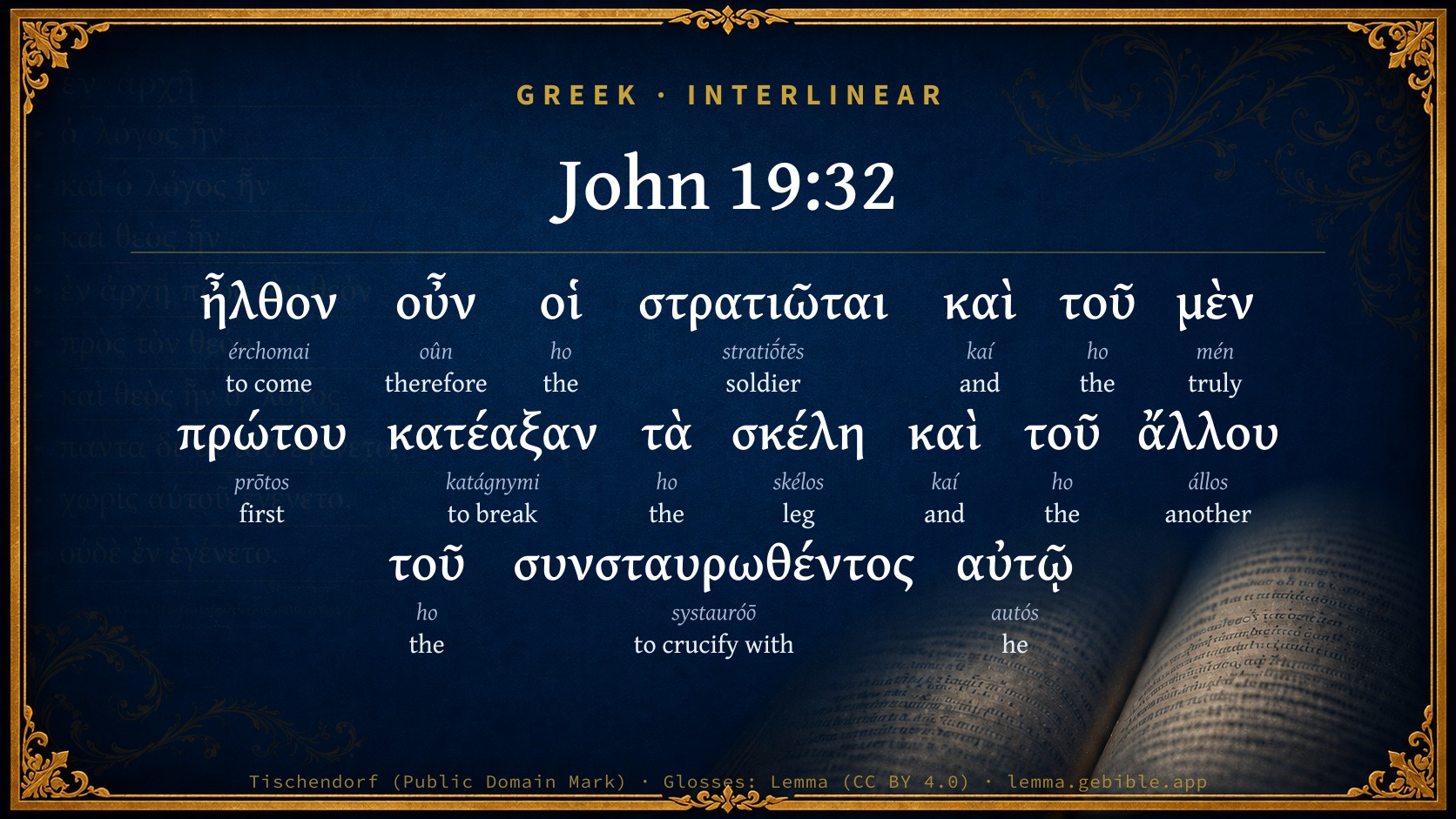
Therefore the soldiers came, and broke the legs of the first, and of the other who was crucified with him;
World English Bible · Public Domain
Download a study sheet

One document with this verse’s original text, its word-by-word gloss line, the meaning frame, cross-references with their text, attributed commentary, and full source and license credits — printable, and it pastes into notes with its structure intact.

This verse Autodidact and up

Study sheet (.html) Plain text (.txt)

A passage Seminary Student

Up to 50 verses in one chapter. A passage sheet keeps up to 6 commentary sources and 12 cross-references per verse, in the order this page ranks them, and says so on the sheet whenever that leaves anything out. Ask for a single verse and you get the Autodidact verse sheet above.

Everything on this page stays free to read, with no account — the sheet is a download of what is already on screen, not access to it.

Want to remove ads? Support Godless Engineer
Compare translations 3

The same verse in 3 English versions, stacked beneath the original-language interlinear above. Click any original word for its lexicon entry.

Each is an independent rendering of the whole verse — the interlinear is not word-aligned to these translations.

Highlighted words mark where these versions differ — a whole-verse word diff, not a word-by-word alignment.

  • World English Bible Public Domain
    Therefore the soldiers came, and broke the legs of the first, and of the other who was crucified with him;
  • King James Version Public Domain
    Then came the soldiers, and brake the legs of the first, and of the other which was crucified with him.
  • unfoldingWord Literal Text CC BY-SA 4.0
    Therefore, the soldiers came and broke the legs of the first man and of the other one having been crucified with him.

unfoldingWord Literal Text — © unfoldingWord, licensed CC BY-SA 4.0. Word-aligned USFM3 via Door43 (git.door43.org/unfoldingWord/en_ult).

Versions to compare (up to 4)

3 of 4 selected

Show all 19 translations

Every available English version of this verse, each an independent rendering of the whole verse.

  • World English Bible Public Domain
    Therefore the soldiers came, and broke the legs of the first, and of the other who was crucified with him;
  • Berean Standard Bible Public Domain
    So the soldiers came and broke the legs of the first man who had been crucified with Jesus, and those of the other.
  • Majority Standard Bible Public Domain
    So the soldiers came and broke the legs of the first man who had been crucified with Jesus, and those of the other.
  • King James Version Public Domain
    Then came the soldiers, and brake the legs of the first, and of the other which was crucified with him.
  • American Standard Version (1901) Public Domain
    The soldiers therefore came, and brake the legs of the first, and of the other that was crucified with him:
  • Revised Version (1885) Public Domain
    The soldiers therefore came, and brake the legs of the first, and of the other which was crucified with him:
  • Geneva Bible (1599) Public Domain
    Then came the souldiers and brake the legges of the first, and of the other, which was crucified with Iesus.
  • Douay-Rheims (1899) Public Domain
    The soldiers therefore came; and they broke the legs of the first, and of the other that was crucified with him.
  • Young's Literal Translation Public Domain
    The soldiers, therefore, came, and of the first indeed they did break the legs, and of the other who was crucified with him,
  • Literal Standard Version CC BY-SA 4.0
    The soldiers, therefore, came, and they indeed broke the legs of the first and of the other who was crucified with Him,
  • Unlocked Literal Bible CC BY-SA 4.0
    Then the soldiers came and broke the legs of the first man and of the second man who had been crucified with Jesus.
  • unfoldingWord Literal Text CC BY-SA 4.0
    Therefore, the soldiers came and broke the legs of the first man and of the other one having been crucified with him.
  • Darby Bible Public Domain
    The soldiers therefore came and broke the legs of the first and of the other that had been crucified with him;
  • World Messianic Bible Public Domain
    Therefore the soldiers came and broke the legs of the first and of the other who was crucified with him;
  • Webster's Bible Public Domain
    Then came the soldiers, and broke the legs of the first, and of the other who was crucified with him.
  • Free Bible Version CC BY-SA 4.0
    So the soldiers came and broke the legs of the first one and then the other of those crucified with Jesus,
  • Bible in Basic English Public Domain
    So the men of the army came, and the legs of the first were broken and then of the other who was put to death on the cross with Jesus:
  • Text-Critical English NT CC BY 4.0
    So the soldiers came and broke the legs of the first man and of the other who had been crucified with him.
  • Tyndale New Testament (1534) Public Domain
    Then came the soudiers and brake the legges of the fyrst and of the other which was crucified with Iesus.

Literal Standard Version (2020), Covenant Press — licensed CC BY-SA 4.0. Text via the HelloAO Bible API (eBible.org). Unlocked Literal Bible (unfoldingWord) — licensed CC BY-SA 4.0. Text via the HelloAO Bible API (eBible.org). unfoldingWord Literal Text — © unfoldingWord, licensed CC BY-SA 4.0. Word-aligned USFM3 via Door43 (git.door43.org/unfoldingWord/en_ult). Free Bible Version, Dr. Jonathan Gallagher — licensed CC BY-SA 4.0. Text via the HelloAO Bible API (eBible.org).

Word by word

More ways to search: Search by grammar → Find every occurrence → Compare this word →

Practice this passage: Drill this verse → Learn its vocabulary →

σκέλη
skélos
G4628
“leg”
Noun, Accusative, Plural, Neuter
Part of Speech
Noun
Case
Accusative
Number
Plural
Gender
Neuter
Full Thayer's Definition

Origin: apparently from skello (to parch, through the idea of leanness)

TDNT: None

1. the leg, from the hip to the toes inclusive
  1. ἦλθον érchomai G2064 “to come” Verb, Aorist, Active, Indicative, 3rd person, Plural
  2. οὖν oûn G3767 “therefore” Conjunction
  3. οἱ ho G3588 “the” Article, Nominative, Plural, Masculine
  4. στρατιῶται stratiṓtēs G4757 “soldier” Noun, Nominative, Plural, Masculine
  5. καὶ kaí G2532 “and” Conjunction
  6. τοῦ ho G3588 “the” Article, Genitive, Singular, Masculine
  7. μὲν mén G3303 “truly” Particle
  8. πρώτου prōtos G4413 “first” Adjective, Genitive, Singular, Masculine, Superlative
  9. κατέαξαν katágnymi G2608 “to break” Verb, Aorist, Active, Indicative, 3rd person, Plural
  10. τὰ ho G3588 “the” Article, Accusative, Plural, Neuter
  11. καὶ kaí G2532 “and” Conjunction
  12. τοῦ ho G3588 “the” Article, Genitive, Singular, Masculine
  13. ἄλλου állos G243 “another” Adjective, Genitive, Singular, Masculine
  14. τοῦ ho G3588 “the” Article, Genitive, Singular, Masculine
  15. συνσταυρωθέντος systauróō G4957 “to crucify with” Verb, Aorist, Passive, Participle, Genitive, Singular, Masculine
  16. αὐτῷ autós G846 “he” Personal pronoun, Dative, Singular, Masculine

About this verse

These counts appear in no published source. They are computed here, from the morphology-tagged text and Lemma’s own curated glosses. What Lemma adds →

17
words
12
distinct lemmas
Gospels
section

Notable vocabulary

The rarest word here is σκέλη leg G4628 — appearing just 3 times in the whole Greek New Testament.

Shared distinctive vocabulary

σκέλη leg G4628 occurs in 3 verses of the Greek New Testament. Also found in:

Repetition

Words recur within this verse:

Cross-references

2

Topical passages linked to John 19:32 in the Treasury of Scripture Knowledge — connected by theme and wording, ordered by reader-vote popularity; previews shown in the World English Bible.

  • John 19:18 where they crucified him, and with him two others, on either side one, and Jesus in the middle.
  • Luke 23:39–43 One of the criminals who was hanged insulted him, saying, "If you are the Christ, save yourself and us!"

Cross-references courtesy of OpenBible.info (CC BY 4.0).

Commentary

Notes on John 19:32 from classic Christian and Jewish commentators (each source and its license shown beneath its notes). The classic Christian expositions comment on the surrounding passage and are grouped to its opening verse, so a note may address several verses; the Jewish commentaries on the Tanakh (Rashi and others) are per-verse, so they appear only where the commentator wrote on this verse.

Lemma curates 59 commentaries, every one of them public domain or Creative Commons licensed, each selected and text-cleaned for this edition rather than reprinted as found. About our sources →

The Biblical Illustrator

Joseph S. Exell

Joh_19:32-33

Then came the soldiers and broke the legs--By no mode of judicial death has mans inhumanity to man been more shown than by crucifixion.

It was a slow death by exhaustion and starvation. These processes were so slow, that when the crucified person was in ordinary health and vigour, invariably he survived the first twenty-four hours, lived generally over the second, occasionally even into the fifth or sixth day. I was told, says Captain Clapperton, speaking of the punishments in the Soudan, that wretches on the cross generally linger three days before death puts an end to their sufferings. In old times, at nightfall, when the crowd had gone home, and each head had found its soft pillow, the soldiers lighted their lanterns and waited. Through the frost of the night, through the fire of the day, then through another night and day, the man on the cross would be dying slowly, until the savage watchers, out of patience, would sometimes, not indeed for his sake, but for their own, by blow of mace or mallet, break his limbs; and the shock of this would shake out the last quivering spark of life. In this instance, besides the impatience of the soldiers, there was that of the people. Next day would be the Sabbath of the Passover, regarded as the great Sabbath of the year. According to their standard, it would have been desecration of this day if they had allowed a man to die on it by hanging on a tree. A deputation, therefore, waited on the governor, with an entreaty that the men who were on the crosses might be despatched at once, and their bodies taken away. He acceded to this; the order was forwarded to the soldiers; in carrying out this order they broke the legs, first of the malefactor on the one side, next of him on the other side of the central cross; but when they came to that they found that Jesus was dead already. (C. Stanford, D. D.)

The Biblical Illustrator, edited by Joseph S. Exell (c. 1880s–1900s) — public domain. Text from a community e-Sword module.

Bengel's Gnomon

Johann Albrecht Bengel

Joh 19:32. Τοῦ πρώτου, καὶ τοῦ ἄλλου, the first, and the other) Pains often remain even to the converted [as here in the case of the penitent robber]; and an equal amount of outward bodily suffering with the ungodly. Ἄλλος, the other (a different one), is the expression used, not, the second; from which it may be inferred, as it seems, that by the first is meant the converted robber, who was more speedily released from his pains than the other.

Bengel's Gnomon of the New Testament — English translation (T&T Clark, Edinburgh, 1860) — public domain. Text from a community e-Sword module.

Meyer's Critical & Exegetical Commentary

Heinrich August Wilhelm Meyer

Joh_19:32-33. To assume, on account of Mar_15:39 (Comp. Mat_27:54), that these soldiers were others (sent out by Pilate) than those who had crucified Jesus (Storr, Kuinoel, Olshausen, Maier, Lange), is indicated by nothing in the text, where rather οἱ στρατιῶται are those already known. The ἦλθον is only pictorial, and the centurion does not come into consideration with John.

Since they came to Jesus last, we must suppose that two each began on the two sides of the three crosses.

Meyer — Critical and Exegetical Commentary on the New Testament — English translation by Peter Christie, edited by Frederick Crombie (T&T Clark, 1880) — public domain. Text from a community e-Sword module.

Expositor's Greek Testament

ed. W. Robertson Nicoll

Joh 19:32 . The two robbers were thus dispatched. ἐπὶ δὲ τὸν Ἰησοῦν ἐλθόντες , but when the soldiers who were carrying out Pilate’s orders came to Jesus and saw that He was already dead, they refrained from breaking His legs.

The Expositor's Greek Testament, edited by W. Robertson Nicoll (1897–1910) — public domain. Text from a community e-Sword module.

Ellicott's Commentary for English Readers

(32) Then came the soldiers,. . . .—The words do not mean, as they have sometimes been understood, that other soldiers came, but refer to the quaternion before named (Joh_19:23), who had naturally fallen back from the crosses, and are here represented as coming forward to complete their work. The mention of the “first” and the “other” suggests that they formed two pairs, and began on either side breaking the legs of the thieves crucified with Jesus.

A Bible Commentary for English Readers, edited by Charles John Ellicott (1878–1897) — public domain. Text from a community e-Sword module.

The Cambridge Bible for Schools and Colleges

gen. ed. J. J. S. Perowne

32. Then came the soldiers] The soldiers therefore came, in consequence of the fresh order from Pilate which the Jews would bring. Two probably went to each of the robbers.

The Cambridge Bible for Schools and Colleges (gen. ed. J. J. S. Perowne; Cambridge University Press, 1878–1918) — public domain. Text from a community e-Sword module.

John Gill's Exposition

Then came the soldiers,.... Pilate having granted the Jews what they desired; either the soldiers that crucified Christ, and the others with him, and watched their bodies, being ordered by Pilate, went from the place where they sat; or a fresh company, which were sent for this purpose, came from the city:

and brake the legs of the first; they came unto, which whether it was he that was crucified on his right hand, and was the penitent believer in him, as some have thought, is not certain:

and of the other which was crucified with him; who, if the former is true, must be he that reviled him; and was this their position, it was a lively emblem of the last day, when the sheep shall stand at the right, and the goats on the left hand of Christ.

John Gill's Exposition of the Whole Bible (1746–1763) — public domain (CC PDM 1.0). Text via the HelloAO Bible API.

Trapp's Complete Commentary

John Trapp

32 Then came the soldiers, and brake the legs of the first, and of the other which was crucified with him.

Ver. 32. Brake the legs of the first] The good thief also had his legs broken and his life taken away; though by his repentance he made his cross a Jacob’s ladder, whereby angels descended to fetch up his soul.

John Trapp, A Commentary or Exposition upon All the Books of the Old and New Testament (1647–1656) — public domain. Text from a community e-Sword module.

Matthew Poole's English Annotations

They brake the two other malefactors’ legs, but not Christ’s, because they found him dead. It is very possible in a natural course, that of three men dying in the same manner, one may die sooner than another; but it is but rationally presumed, that the cause of our Saviour’s quicker death, was not the failure of his spirits sooner, but his own voluntary surrender of his soul.

Matthew Poole's English Annotations on the Holy Bible (1683–1685) — public domain. Text from a community e-Sword/MySword module.

Whedon's Commentary on the Bible

Daniel D. Whedon

32. Came the soldiers—At a little after three o’clock the soldiers, either the four who had watched the crucifixion, or a special number sent by Pilate, came to the two thieves first and to Jesus last, as being in the middle.

Daniel D. Whedon (gen. ed.), Commentary on the Old and New Testaments (1874–1909) — public domain. Text from a community e-Sword module.

The Pulpit Commentary

Vers. 32-34. Then came the soldiers, and brake the legs of the first two of the quaternion employed on the one deed, and two on the other and of the other which was crucified with him. But when they came to Jesus, and saw that he was already dead, they brake not his legs. Their barbarous mercy was unnecessary, and John caw in this another correspondence with the sacred symbolism and prophetic anticipations of the Old Testament. But one of the soldiers pierced gashed, probably, for the word enuxen is used in both senses his side with a spear (logch , a lance, a heavy formidable weapon) to give him the coup de grace, should their expectation not be actually realized, and forthwith came there-out blood and water. We do not enter into the numerous physiological reasons which have been advanced by Gruner, Bartholinus, and Dr. Stroud ("Physical Cause of the Death of Christ") for this event, but regard it as one of the great portents of the Crucifixion, which cannot be entirely explained as some physiologists have done. Dr. Schaff appears willing to accept the hypothesis that the extravagated blood, being first separated into its two constituents, was thus liberated from the pericardium a phenomenon that might seem to justify the supposition of the evangelist, that it was blood and water. Dr. Stroud endeavored, with much medical learning, to show that this might follow the side-piercing if the Lord"s physical death had followed, as he argued, from rupture of the heart due to his intense agonies. Sir R. Bennett has accepted this solution. Nor, further, do we see here any reference to the sacramental system of which John elsewhere says so little; but we do see a token miraculously given of the twofold power of his redemptive life and work

(1) renovation, refreshment, rivers of living water issuing from the koilia of Christ, the first great rush of spiritual power which was to regenerate humanity; and

(2) the expression of that redemptive process which was effected in the positive shedding of his precious blood. It was, moreover, a proof and sign given to Roman soldiers that their Victim was actually dead. We cannot think, with Westcott, that it was a kind of sign of the commencement of the resurrection-life, which goes perilously near to the assertion that he never really died. Moulton argues that the phenomena were physiologically possible if the-event occurred immediately after death. There is nothing in the narrative to prevent such juxtaposition. That John should have witnessed it, and been unable to understand it, and therefore put it down among the marvels of the Crucifixion, corroborates the veracity of the eyewitness (Webster and Wilkinson). The interesting catena of patristic interpretations given by Westcott ("Additional Note") shows that the earliest writer who refers to the marvel, Claudius Apollinaris, regarded it as expressive of logov and pneuma , "the Word and the Spirit." Origen showed that from a corpse such a phenomenon could not occur; and so even in his death there are still the signs of the living one. Cyril of Jerusalem saw the two baptisms of blood and water; Chrysostom, the two sacraments, or the mysteries of baptism and of the flesh and blood. Macarius Magnes and Apollinarius saw an allusion to the side of Adam, from which Eve, the source of evil, was taken; that now the side of the second Adam should give forth the means of salvation and deliverance. Tertullian dwells on the two baptisms of water and blood; so Jerome; while Augustine sees in it the laver and the cup. That there was some special, abnormal phenomenon seems specially noticeable from the emphasis which the eye-witness lays upon the observation and record of the fact.

The Pulpit Commentary (1880–1919), ed. H.D.M. Spence-Jones & Joseph S. Exell — public domain. Text from a community e-Sword module.

International Critical Commentary

32. ἦλθον οὖν οἱ στρ. “Therefore,” sc. in obedience to the orders they received, “the soldiers came,” and broke the legs of the two robbers, who were not yet dead. The Gospel of Peter (which betrays knowledge of the Johannine narrative of the Passion) gives a curious turn to this incident. It represents the Jews as indignant with the penitent thief, because of his defence of Jesus’ innocence (cf. Luk 23:41), and as commanding “that his bones should not be broken to the end that he might die in torment” (§ 4). This is inconsistent with what Pseudo-Peter says in § 3 about the illegality of allowing the bodies to remain on the crosses after sundown; but its interest is that it shows the freedom with which this apocryphal writer treats the Gospel narrative.

International Critical Commentary — older volumes (1896–1929), various authors — public domain. Text from a community e-Sword module.

Vincent's Word Studies in the New Testament

Marvin R. Vincent

Brake the legs. A detail recorded only by John. This crurifragium, leg - breaking, consisted in striking the legs with a heavy mallet in order to expedite death. It was sometimes inflicted as a punishment upon slaves. Some horrible illustrations are furnished by Suetonius, in his lives of Augustus and Tiberius.

Marvin R. Vincent, Word Studies in the New Testament (1887–1900) — public domain. Text from a community e-Sword/MySword module.

Godet's Commentaries

Frédéric Louis Godet

Vv. 32-34. “The soldiers therefore came and broke the legs of the first, then of the other who was crucified with him. 33. But, when they came to Jesus, seeing that he was already dead, they did not break his legs; 34, but one of the soldiers pierced his side with his spear, and immediately there came thereout blood and water.”

The word: they came, is more naturally explained if we hold with Storr, Olshausen and Weiss that they were different soldiers from those who had accomplished the work of crucifixion. They had been sent especially for this purpose with the necessary instruments.

If the purpose for which the limbs of the condemned were broken was that of which we have spoken, this treatment was made useless with respect to Jesus by the fact of His death. The spear-thrust of the soldier was, therefore, as it were, only a compensation for the operation which was omitted; it signified: If thou art not dead already, here is what will finish thee. It would be absurd to demand examples for such an act, which had in it nothing judicial.

The verb νύσσειν indicates a more or less deep thrust, in contrast to a cut. This term is sometimes used in Homer to designate mortal wounds.

Is the fact of the outflowing of the blood and water to be regarded as a natural phenomenon? In general, undoubtedly, when a dead body is pierced, no liquid comes forth from it; nevertheless, if one of the large vessels is reached, it may happen that there will flow from the wound a blackish blood covered with a coating of serum. Can this be what John calls blood and water? This is improbable.Ebrard accordingly supposes that the lance reached the deposits of extravasated blood. Gruner (Commentatio de morte Jesu Christi vera, Halle, 1805) also has this opinion. He thinks that the lance pierced the aqueous deposits which, during this long-continued torture, had been formed around the heart, and then the heart itself. William Stroud (London, 1847) alleges phenomena observed in cases of sudden death in consequence of cramp of the heart. These explanations are all of them quite improbable. The expression: blood and water, naturally denotes two substances flowing simultaneously, but to the eyes of the spectators distinct, a thing which has no place in any of these suppositions. Baur, Strauss, etc., conclude from this that there is a necessity for a symbolic interpretation, and find here again the purely ideal character of the narrative. The author meant to express by this fact of his own invention the abundance of spiritual life which will, from this moment, flow forth from the person of Christ (Baur); the water more especially represents the Holy Spirit, the blood the Holy Supper, with an allusion to the custom of mixing the wine of this sacrament with water (Strauss, in his new Life of Jesus). But what idea must we form of the morality of a man who should solemnly affirm that he had seen (Joh 19:35) that which he had the consciousness of having beheld only in idea. In favor of this allegorical explanation an appeal has been made to the words in 1Jn 5:6 : “He came not by water only, but by water and blood.” But these words do not have the least connection with the fact with which we are occupied.

The water of which John speaks in his epistle denotes, as Joh 3:5, baptism: Jesus did not come, like the forerunner, only with the baptism of water, the symbol of purification, but with the blood which brings the expiation itself. In our view there remains but one explanation: it is that which admits that this mysterious fact took place outside of the laws of common physiology, and that it is connected with the exceptional nature of a body which sin had never tainted and which moved forward to the resurrection without having to pass through dissolution. At the instant of death, the process of dissolution, in general, begins. The body of Jesus must have taken at that moment a different path from that of death: it entered upon that of glorification. He who was the Holy One of God, in the absolute sense of the word, was also absolutely exempt from corruption (Psa 16:10). This is the meaning which the evangelist seems to me to have ascribed to this unprecedented phenomenon, of which he was a witness.

Thus is explained the affirmation, having somewhat the character of an oath, by which, in the following verse, he certifies its reality; not that the affirmation of Joh 19:35 refers only to this fact; for it certainly has reference to the totality of the facts mentioned Joh 19:33-34 (see below). Weiss holds that there is a natural phenomenon here which cannot be certainly explained; but he thinks that John saw in the blood the means of our redemption and in the water the symbol of its purifying force. In this case, a grossly superstitious idea must be imputed to the apostle: by what right? The text says not a word of such a symbolic sense. According to Reuss, also, the blood designates the redemptive death, and the water baptism, and we have here a mystical explanation of a fact which struck the author. All this has no better foundation than the opinion of those who think that the evangelist wished to combat the idea that Jesus was not really dead (Lucke, Neander), or the idea that He had only an apparent body (Olshausen). The first of these ideas is entirely modern; the second ascribes to the author an argument which has no force, since the Docetae did not in the least deny the sensible appearances in the earthly life of Jesus.

The absence of all corruption in the Holy One of God implied the beginning of the restoration of life from the very moment when, at death, in the case of every sinner the work of dissolution which is to destroy the body commences.

Frédéric Louis Godet — Commentaries on Luke, John, Romans, and 1 Corinthians — English translation (T&T Clark, Edinburgh, 1870s–1890s) — public domain. Text from a community e-Sword module.

Lesson kit

Teaching starters — assembled from the data on this page, not authored interpretation. Every prompt links to the verse data it draws on. Edit before teaching.

John, in the Gospels, opens this verse with 17 words (12 distinct Greek lemmas). Its most distinctive word is skélos (“leg”). A historical commentator’s framing appears above. Read the whole chapter for the surrounding context.

Discussion questions

  1. How does “leg” (skélos) shape what this verse is saying?
  2. John 19:31 shares the word «leg» with this verse. How do the two illuminate each other?
  3. “the” occurs 5× in this one verse. What is the effect of the repetition?
  4. These translations render this verse differently. What is at stake in choosing one wording over another?
  5. Reading how The Biblical Illustrator and Bengel's Gnomon read this verse, where do the two commentators agree and where do they part?

Things to notice

Reading settings

Reading text

Shown beneath each verse's original-language words.

Old Testament
Old Testament edition

Read the OT as the Masoretic Hebrew (MT) or the Greek Septuagint (LXX).

English shown for the Greek Septuagint (in the Hebrew ↔ Greek comparison).

Comparing translations? Open the Compare panel on any verse page to stack up to four side by side.