
Philippians 2:23

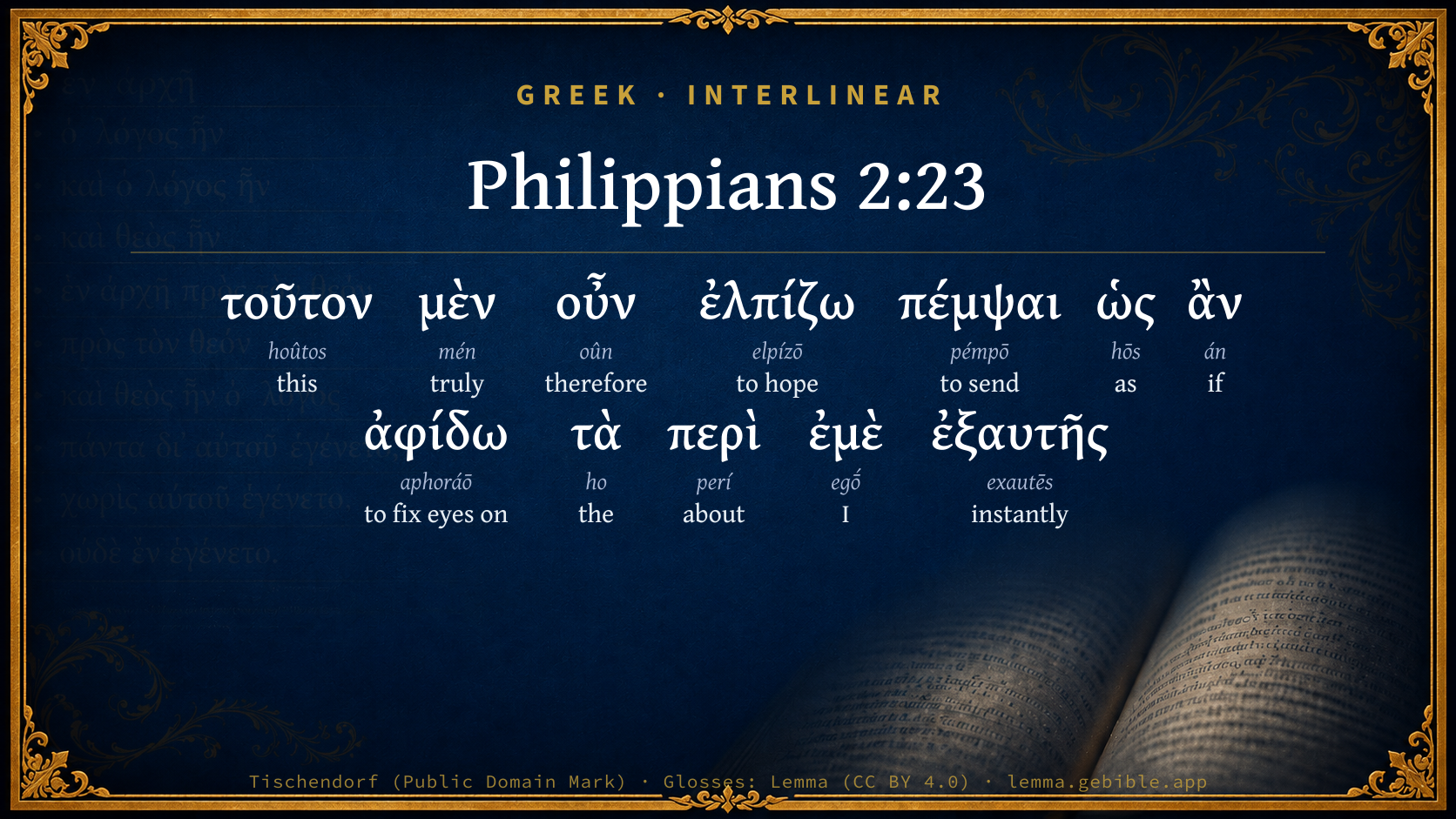
Greek (Tischendorf 8th ed.) Philippians 2:23 appears in the Greek New Testament. The text above is from the Tischendorf 8th edition. Each word links to its Strong’s number and a concise gloss. Click any word for its full Thayer’s Greek Lexicon entry.
Download image
Cite this verse

Philippians 2:23 (World English Bible). Public Domain. Lemma interlinear Bible study tool, https://lemma.gebible.app/v/philippians/2/23.

Show BibTeX & RIS
BibTeX
RIS
English Translation
Therefore I hope to send him at once, as soon as I see how it will go with me.
World English Bible · Public Domain
Highlights
  • 1 first appearance in the Greek New Testament
Full analysis ↓
Download a study sheet

One document with this verse’s original text, its word-by-word gloss line, the meaning frame, cross-references with their text, attributed commentary, and full source and license credits — printable, and it pastes into notes with its structure intact.

This verse Autodidact and up

Study sheet (.html) Plain text (.txt)

A passage Seminary Student

Up to 50 verses in one chapter. A passage sheet keeps up to 6 commentary sources and 12 cross-references per verse, in the order this page ranks them, and says so on the sheet whenever that leaves anything out. Ask for a single verse and you get the Autodidact verse sheet above.

Everything on this page stays free to read, with no account — the sheet is a download of what is already on screen, not access to it.

Want to remove ads? Support Godless Engineer
Compare translations 3

The same verse in 3 English versions, stacked beneath the original-language interlinear above. Click any original word for its lexicon entry.

Each is an independent rendering of the whole verse — the interlinear is not word-aligned to these translations.

Highlighted words mark where these versions differ — a whole-verse word diff, not a word-by-word alignment.

  • World English Bible Public Domain
    Therefore I hope to send him at once, as soon as I see how it will go with me.
  • King James Version Public Domain
    Him therefore I hope to send presently, so soon as I shall see how it will go with me.
  • unfoldingWord Literal Text CC BY-SA 4.0
    Therefore, I hope to send him at once, as soon as I would see the things concerning me.

unfoldingWord Literal Text — © unfoldingWord, licensed CC BY-SA 4.0. Word-aligned USFM3 via Door43 (git.door43.org/unfoldingWord/en_ult).

Versions to compare (up to 4)

3 of 4 selected

Show all 19 translations

Every available English version of this verse, each an independent rendering of the whole verse.

  • World English Bible Public Domain
    Therefore I hope to send him at once, as soon as I see how it will go with me.
  • Berean Standard Bible Public Domain
    So I hope to send him as soon as I see what happens with me.
  • Majority Standard Bible Public Domain
    So I hope to send him as soon as I see what happens with me.
  • King James Version Public Domain
    Him therefore I hope to send presently, so soon as I shall see how it will go with me.
  • American Standard Version (1901) Public Domain
    Him therefore I hope to send forthwith, so soon as I shall see how it will go with me:
  • Revised Version (1885) Public Domain
    Him therefore I hope to send forthwith, so soon as I shall see how it will go with me:
  • Geneva Bible (1599) Public Domain
    Him therefore I hope to send assoone as I knowe howe it will goe with me,
  • Douay-Rheims (1899) Public Domain
    Him therefore I hope to send unto you immediately, so soon as I shall see how it will go with me.
  • Young's Literal Translation Public Domain
    him, indeed, therefore, I hope to send, when I may see through the things concerning me -- immediately;
  • Literal Standard Version CC BY-SA 4.0
    I indeed hope to send him, when I may see through the things concerning me—immediately;
  • Unlocked Literal Bible CC BY-SA 4.0
    So I hope to send him as soon as I see how things will go with me.
  • unfoldingWord Literal Text CC BY-SA 4.0
    Therefore, I hope to send him at once, as soon as I would see the things concerning me.
  • Darby Bible Public Domain
    Him therefore I hope to send immediately, as soon as I shall see how it goes with me:
  • World Messianic Bible Public Domain
    Therefore I hope to send him at once, as soon as I see how it will go with me.
  • Webster's Bible Public Domain
    Him therefore I hope to send presently, so soon as I shall see how it will go with me.
  • Free Bible Version CC BY-SA 4.0
    So I hope to send him as soon as I see how I'm doing,
  • Bible in Basic English Public Domain
    Him then I am hoping to send as quickly as possible, when I am able to see how things will go for me:
  • Text-Critical English NT CC BY 4.0
    Therefore I hope to send him to you at once, as soon as I find out what is going to happen to me.
  • Tyndale New Testament (1534) Public Domain
    Him I hope to sende assone as I knowe how it will go with me.

Literal Standard Version (2020), Covenant Press — licensed CC BY-SA 4.0. Text via the HelloAO Bible API (eBible.org). Unlocked Literal Bible (unfoldingWord) — licensed CC BY-SA 4.0. Text via the HelloAO Bible API (eBible.org). unfoldingWord Literal Text — © unfoldingWord, licensed CC BY-SA 4.0. Word-aligned USFM3 via Door43 (git.door43.org/unfoldingWord/en_ult). Free Bible Version, Dr. Jonathan Gallagher — licensed CC BY-SA 4.0. Text via the HelloAO Bible API (eBible.org).

Word by word

More ways to search: Search by grammar → Find every occurrence → Compare this word →

Practice this passage: Drill this verse → Learn its vocabulary →

About this verse

These counts appear in no published source. They are computed here, from the morphology-tagged text and Lemma’s own curated glosses. What Lemma adds →

12
words
12
distinct lemmas
Pauline Epistles
section

Notable vocabulary

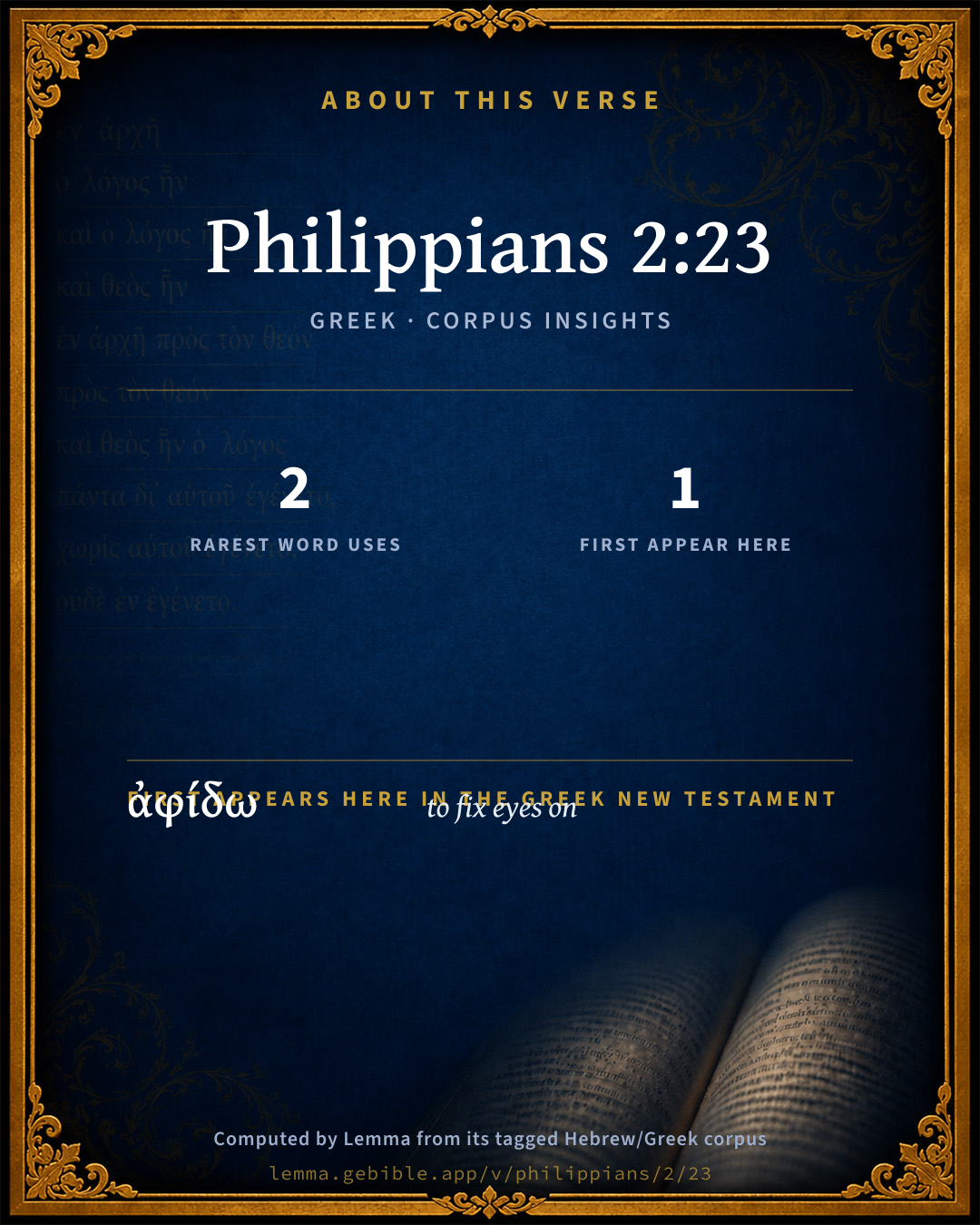
The rarest word here is ἀφίδω to fix eyes on G872 — appearing just 2 times in the whole Greek New Testament.

First appearance in Scripture

This word makes its first canonical appearance in the Greek New Testament here:

  • ἀφίδω to fix eyes on G872

Shared distinctive vocabulary

ἀφίδω to fix eyes on G872 occurs in 2 verses of the Greek New Testament. Also found in:
Cross-references

2

Topical passages linked to Philippians 2:23 in the Treasury of Scripture Knowledge — connected by theme and wording, ordered by reader-vote popularity; previews shown in the World English Bible.

  • 1 Samuel 22:3 David went there to Mizpeh of Moab: and he said to the king of Moab, Please let my father and my mother come forth, [and be] with you, until I know what God will do for me.
  • Philippians 2:19 But I hope in the Lord Jesus to send Timothy to you soon, that I also may be cheered up when I know how you are doing.

Cross-references courtesy of OpenBible.info (CC BY 4.0).

Commentary

Notes on Philippians 2:23 from classic Christian and Jewish commentators (each source and its license shown beneath its notes). The classic Christian expositions comment on the surrounding passage and are grouped to its opening verse, so a note may address several verses; the Jewish commentaries on the Tanakh (Rashi and others) are per-verse, so they appear only where the commentator wrote on this verse.

Lemma curates 59 commentaries, every one of them public domain or Creative Commons licensed, each selected and text-cleaned for this edition rather than reprinted as found. About our sources →

The Biblical Illustrator

Joseph S. Exell

Php_2:23-24

Him, therefore, I hope to send

The servant of God in affliction

I.

Cares for the Church.

II. Waits patiently the end.

III. Commits the future into the hands of the Lord.

IV. Anticipates deliverance in hope of further service. (J. Lyth, D. D.)

So soon as I shall see how it will go with me--

New years sermon

The first day of the new year is often a season of--

1. Peculiar transactions: balancing of accounts and commencing business.

2. Humanity and benevolence, family gatherings, gifts to the poor.

3. Thankfulness and joy for preservation of life, etc.

4. Seriousness and recollection.

5. Forecast. Let us confine ourselves to the latter view, and consider--

I. Our inability to determine our future circumstances. The endowments of the apostles were not absolute. In some cases Paul could foretell things to come, but in others he was left in ignorance, and could only reason from probabilities (Act_20:22). And when we look into futurity, all that meets the eye is a dark unknown.

1. Even prophecy is wrapped up in so much obscurity that the fulfilment and the explanation generally arrive together. How often has this been exemplified in the calculations of not very wise men, who, in addition to being drawn off from more useful duties, have frequently survived their laborious schemes.

2. Your own history testifies that God has led you by a way which you knew not, and you hardly know it now. Had all your changes been foretold, they would have appeared incredible?

3. Nor have you any information that can enable you to foresee things for a single year--how it will go with your health, circumstances, relations.

II. What use we should make of this ignorance. Let us--

1. Learn our littleness, and that God is all in all. Trust in the Lord with all thy heart.

2. Beware of presumption. The future is Gods, not thine. Never say I will without If the Lord will.

3. Never despair. Seeing we know not how it will go with us, why should we look only for evil?

4. Draw off our attention from future events to present duties. We are to cast, not our work, but our care, upon the Lord. Duty and means belong to us, but events are entirely His.

5. Seek after a preparation for all events. We shall find this in Divine grace. This drew prayer from Jacob when he went forth with a staff; this preserved Daniel in the court of Darius and in the lions den; this enabled Paul to say, I can do all things, etc. And seeing that we have neither the ordering of the weather, nor the choice of food, happy is the man whose constitution enables him to bear any weather, and whose appetite enables him to relish any food.

III. What there is to encourage us under all this darkness and uncertainty. You say, I see not how it will go with me, and--

1. It is well you do not. You know as much as is good for you. It is with the mind as with the senses. A greater degree of hearing would incommode us. If our eyes could see things microscopically we should be afraid to move. Were we informed of the blessings of providence beforehand, we should cease to enjoy those we have; or of adversities, what dismay would ensue.

2. God does; and He is your friend, and far more concerned for your happiness than you can be.

3. You know that it shall be well with them that fear God.

4. Your ignorance only regards time; all in eternity is sure. (W. Jay.)

The Providence of God

We should--

I. Express future purposes with a resignation to Gods will and guidance (Psa_21:1).

II. Observe that Gods providence extends to every particular thing--our incomings, outgoings, journeys, the very hairs of our head. This should teach us--

1. To set on our affairs with looking up to heaven for permission (Jam_4:13). Let us in all our affairs be holy, and not limit our holiness to coming to church.

2. That we ought Dot to set on anything wherein we cannot expect Gods guidance, and so consequently cannot trust in Him for a blessing.

3. To take nothing but that for which we can give God thanks. (R. Sibbes, D. D.)

Trust in the Lord

I. Implies--

1. Reliance on His providential care.

2. Because of His mercy and love.

II. Is necessary under all circumstances.

1. In joy and sorrow.

2. In all our plans and purposes.

3. In small matters as in great.

III. Is a source of unspeakable comfort.

1. It brings peace.

2. It assures that all will be well. (J. Lyth, D. D.)

Trust in God

The child at school is not to lean his elbow on the table, and vex himself by thinking how he shall find raiment, how he shall get home, how the expense of his education is to be defrayed. He is a learner; he is to mind his book--the father requires no more of him--he will provide. The farmer is not to muse from day to day about the weather: Perhaps it may not be a fine season--there may be a blight--and all my labour may be lost. No: but he is to act; he goes forth bearing precious seed, commits it to the ground, and then pursues his other business--and what can his anxiety do afterwards? The soldier is to learn his exercise, to obey the word of command, to keep his arms bright, to be always at the post assigned him; but he is not to neglect all this, by busying himself in drawing plans of the campaign, and describing the duties of the general. (W. Jay.)

The Biblical Illustrator, edited by Joseph S. Exell (c. 1880s–1900s) — public domain. Text from a community e-Sword module.

Tyndale Open Study Notes

Tyndale Open Resources

2:23 What is going to happen to me here possibly refers to the outcome of Paul’s trial.

Tyndale Open Study Notes — © Tyndale Open Resources, licensed CC BY-SA 4.0. Text via the HelloAO Bible API.

Bengel's Gnomon

Johann Albrecht Bengel

Php 2:23. Ὡς ἂν ἀπίδω) ἀπιδεῖν,[26] to carry off or acquire, to obtain information.—ἐξαυτῆς, presently) The relative force implied in the αὐτῆς of the compound has regard to the phrase, I shall have obtained the information (of your state).

[26] Wahl, Clavis, translates, “Simulac cognovero rerum mearum eventum.”—ED.

Bengel's Gnomon of the New Testament — English translation (T&T Clark, Edinburgh, 1860) — public domain. Text from a community e-Sword module.

Meyer's Critical & Exegetical Commentary

Heinrich August Wilhelm Meyer

Php_2:23. Μὲν οὖν] οὖν resumes Php_2:19, and to the μέν corresponds the δὲ in Php_2:24.

ὡς ἂν ἀπίδω κ.τ.λ.] when (of the time, see Klotz, ad Devar. p. 759, that is, as soon as, comp. on 1Co_11:34; Rom_15:24) I anyhow (by ἄν the matter is left to experience) shall have seen to the end (Jon_4:5). The latter, which expresses the perceiving from a distance (Herod. viii. 37; Dem. 1472. 15; Lucian, D. D. vi. 2), denotes the knowledge of the final course of matters to be expected,only after which could it be decided whether or not he could spare the faithful Timothy for a time. The form ἀφίδω (Lachmann and Tischendorf) in A B* D* F G א is, on account of this weighty evidence, to be considered not as a copyists error, but as the original, and to be derived from the pronunciation of ἰδεῖν (with the digamma). Comp. on Act_4:29, and see Winer, p. 44 [E. T. p. 48]; J. B. Lightfoot ad loc.; Buttmann, Neut. Gr. p. 7 [E. T. p. 7].

τὰ περὶ ἐμέ] the things about me, that is, the state of my affairs. Substantially not different from τὰ περὶ ἐμοῦ (Php_2:19 f.). See Kühner, ad Xen. Mem. i. 1. 20; Winer, p. 379 [E. T. p. 506].

Meyer — Critical and Exegetical Commentary on the New Testament — English translation by Peter Christie, edited by Frederick Crombie (T&T Clark, 1880) — public domain. Text from a community e-Sword module.

Expositor's Greek Testament

ed. W. Robertson Nicoll

Phi 2:23 . μέν . He emphasises the coming of Timothy as distinct from his own. ὡς ἄν . Cf. Rom 15:24 , 1Co 11:34 . “As soon as I shall have thoroughly ascertained my position.” This temporal use of ὡς ἄν seems foreign to classical prose. It almost means “according as I shall”. ἄν marks the uncertainty which surrounds the whole prospect. (See Moulton’s Ed. of Winer’s Grammar , p. 387; Viteau, Le Verbe , p. 126.) ἀπίδω . On the form see the crit. note supr. ἀπό emphasises his turning away his attention from other things and concentrating it upon his own situation, i.e. , gaining a definite knowledge of how his affairs stand. Mynster ( Kleine Theolog. Schriften , p. 173) points out that this verse proves that the Epistle could not have been written at Cæsarea. ἐξαυτῆς . Chiefly in Acts in N.T. = Latin ilico. A Hellenistic word. See Phrynichus (ed. Lobeck), 47.

The Expositor's Greek Testament, edited by W. Robertson Nicoll (1897–1910) — public domain. Text from a community e-Sword module.

Jamieson, Fausset & Brown

Robert Jamieson, A. R. Fausset & David Brown

so soon as I shall see--that is, so soon as I shall have known for certain.

Jamieson, Fausset & Brown — Commentary Critical and Explanatory on the Whole Bible (1871) — public domain (CC PDM 1.0). Text via the HelloAO Bible API.

Adam Clarke's Commentary

Verse 23. How it will go with me.] The apostle was now in captivity; his trial appears to have been approaching, and of its issue he was doubtful; though he seems to have had a general persuasion that he should be spared, see Phil 2:19; Phil 2:24.

Adam Clarke's Commentary on the Bible (1810–1826) — public domain. Text from a community e-Sword/MySword module.

John Calvin's Commentaries

24 I trust that I myself. He adds this, too, lest they should imagine that anything had happened to change his intention as to the journey of which he had previously made mention. At the same time, he always speaks conditionally — If it shall please the Lord. For although he expected deliverance from the Lord, yet there having been, as we have observed, no express promise, this expectation was by no means settled, but was, as it were, suspended upon the secret purpose of God.

John Calvin's Commentaries (1540-1563) — public domain. Text from the Calvin Translation Society English edition (1840s-50s) via the Christian Classics Ethereal Library (ccel.org). Calvin's coverage is partial (roughly two-thirds of the Bible); uncommented books and verses are honest gaps, never fabricated. The 19th-century editor's footnotes and remarks are omitted so the notes are faithfully Calvin's own voice.

Ellicott's Commentary for English Readers

(23) How it will go with me.—An explanatory paraphrase, though probably correct, of the original, the things concerning me. Probably some crisis in the imprisonment was at hand, with which the expectation of release implied in the next verse was connected.

A Bible Commentary for English Readers, edited by Charles John Ellicott (1878–1897) — public domain. Text from a community e-Sword module.

The Cambridge Bible for Schools and Colleges

gen. ed. J. J. S. Perowne

23. presently] Better, with R.V., forthwith, promptly, on ascertaining the issue of his trial.

so soon as I shall see] He is sure, au fond, of the prospect of continued life (Php_1:25 and note); but this leaves him as much as ever obliged to wait the development of the Roman legal process. And it needs no very subtle psychology to see the possibility of the presence, in the same person, of certainties and uncertainties about the same event.—Observe that Divine inspiration is far from conveying universal prescience.

how it will go with me] A good paraphrase for the lit., “the things around me,” my circumstances.

The Cambridge Bible for Schools and Colleges (gen. ed. J. J. S. Perowne; Cambridge University Press, 1878–1918) — public domain. Text from a community e-Sword module.

John Gill's Exposition

But I trust in the Lord,.... The Syriac version reads, "in my Lord":

that I also myself shall come shortly: this he adds, partly to let them see, that he still retained a secret hope and persuasion in his own mind of a deliverance, though he could not be certain of it, how things would go with him; and partly, that he might not be thought to put them off with sending Timothy to them; for notwithstanding that, his intention still was, should he be released, to pay them a visit himself. The Alexandrian copy adds, "to you": so the Vulgate Latin, Syriac, and Arabic versions.

John Gill's Exposition of the Whole Bible (1746–1763) — public domain (CC PDM 1.0). Text via the HelloAO Bible API.

Trapp's Complete Commentary

John Trapp

23 Him therefore I hope to send presently, so soon as I shall see how it will go with me.

Ver. 23. So soon as I shall see] For his life was now in suspense by reason of that roaring lion Nero, whom Tertullian wittily calleth Dedicatorem damnationis Christianorum, quippe qui orientem fidem primus Romae cruentavit.

John Trapp, A Commentary or Exposition upon All the Books of the Old and New Testament (1647–1656) — public domain. Text from a community e-Sword module.

Albert Barnes' Notes on the Bible

So soon as I shall see how it will go with me - Paul was a prisoner at Rome, and there was not a little uncertainty whether he would be condemned or acquitted. He was, it is commonly supposed, in fact released on the first trial; 2Ti 4:16. He now felt that he would soon be able to send Timothy to them at any rate. If he was condemned and put to death, he would, of course, have no further occasion for his services, and if he was released from his present troubles and dangers, he could spare him for a season to go and visit the churches.

Albert Barnes' Notes on the Bible (1834–1885) — public domain. Text from a community e-Sword/MySword module.

Matthew Poole's English Annotations

Him therefore I hope to send presently; seeing the matter was thus, he thought not of any other to employ in the service of their faith, but hoped, i.e.

in the Lord Jesus as Phi 2:19, in a short time after his present writing, to send this excellent, humble, and approved young man, who would naturally care for their concerns, Phi 2:20.

So soon as I shall see how it will go with me; even without any delay, (though as yet, to accompany Epaphroditus, he could not spare him, who was so useful to him in his bonds, to take care for things necessary to the propagation of the gospel, in the ample city of Rome), from the hour he should come to a certainty what would be the issue of his present imprisonment, which if it should end in his being offered up, he had satisfied them before, as it would be for his own advantage, Phi 1:21, so, by the providence of God, no disservice to their faith, Phi 2:17,18; from which, with ready submission to God’s will, whatever occurred, it seems he had a greater inclination to conceive a good hope of freedom.

Matthew Poole's English Annotations on the Holy Bible (1683–1685) — public domain. Text from a community e-Sword/MySword module.

Whedon's Commentary on the Bible

Daniel D. Whedon

23. Presently—Forthwith, after ascertaining Nero’s decision in his case.

Daniel D. Whedon (gen. ed.), Commentary on the Old and New Testaments (1874–1909) — public domain. Text from a community e-Sword module.

The Pulpit Commentary

Him therefore I hope to send presently, so soon as I shall see how it will go with me. Presently; rather, forthwith, as R.V Dr. Farrar translates, "As soon as I get a glimpse." The oldest manuscripts here read afidw (remarkable for the aspirate) instead of apidw .

The Pulpit Commentary (1880–1919), ed. H.D.M. Spence-Jones & Joseph S. Exell — public domain. Text from a community e-Sword module.

The People's New Testament

B. W. Johnson

23. So soon as I shall see, etc. As soon as there is some decision in his case, showing whether he will be released, or what may be his fate, he will send Timothy.

B. W. Johnson's The People's New Testament with Notes (1889–1891) — public domain. Electronic text from the Christian Classics Ethereal Library (CCEL) ThML edition.

Cambridge Greek Testament for Schools and Colleges

23. ἀφίδω. So אAB*D2*G2, 17. B3CD2cLP, most cursives, all Greek quotations ἀπίδω. Ltft says, “If any weight is to be attached to the agreement of the older MSS., the aspirated form (ἀφίδω for ἀπίδω) must be read here.” He collects from MSS. of the LXX. several instances of aspirates in compounds of εἷδον: εφιδων, αφειδη, καθιδε, &c. (εφειδε occurs in an inscription), and gives some such compounds with ἐλπίς: αφελπιζοντες, εφʼ ελπιδι. “The aspirates are doubtless to be explained as remnants of the digamma.” All recent editors (but Wordsw) ἀφίδω.

23. τοῦτον μὲν οὖν. “So him,” with a slight emphasis; he is about to speak of others too, himself and Epaphroditus.

ὡς ἂν … ἐξαυτῆς. “At once when” (Lightfoot). “For ὡς ἄν temporal, comp. Rom 15:24 [ὡς ἂν πορεύωμαι εἰς τὴν Σπανίαν], 1Co 11:34 [τὰ λοιπὰ, ὡς ἂν ἔλθω, διατάξομαι]” (Lightfoot).

ἀφίδω. “Get a view of,” as from a point of observation. Cp. Jon 4:5, ἕως οὗ ἀπίδῃ τί ἔσται τῇ πόλει.—On the form ἀφίδω here, see above, introductory notes to ch. 2

τὰ περὶ ἐμὲ. “My circumstances,” “my position.”

Cambridge Greek Testament for Schools and Colleges (Cambridge University Press, 1896; 21 vols, various authors incl. Carr, Maclear, Plummer, Farrar, Lumby, Moule, M. R. James, Simcox) — public domain. Text from a community e-Sword module.

Alford’s Greek Testament

Henry Alford

23.] But the approved worth (reff.) of him ye know (viz. by trial, when we were at Philippi together, Act 16:1, Act 16:3,—17:14),—viz.: that as a son (serves) a father, he served with me for (reff.) the Gospel. The construction is this: the Apostle would have written, ‘as a son a father, so he served me,’—but changes it to ‘so he served with me,’ from modesty and reverence, seeing that we are not servants one of another, but all of God, in the matter of the Gospel. We must not supply σύν before πατρί:—when, in case of several nouns governed by the same preposition, that preposition is omitted before any, it is not before the first, cf. Plato, Rep. iii. p. 414, δεῖ ὡς περὶ μητρὸς κ. τροφοῦ τῆς χώρας ἐν ᾗ εἰσι βουλεύεσθαι: and see Bernhardy, Syntax, p. 205. The examples cited by Ellicott to disprove this, do not seem to me to apply: viz. Æsch. Suppl. 313 (311), Eur. Hel. 872 (863): both are instances of local terms coupled by καί, and both occur in poetry, where the exigencies of metre come into play. Winer takes the construction as above, edn. 6, § 63, ii. 1 [see Moulton’s Translation, p. 722].

μέν answers to δέ, ver. 24: οὖν reassumes ver. 19.

ὡς ἂν ἀφίδω] as soon as I shall have ascertained. On the force of the preposition, see Heb 12:2, note.

ὡς ἄν, of time, implying uncertainty as to the event indicated: see reff. and Cebes, tab. p. 168, προστάττει δὲ τοῖς εἰσπορευομένοις, τί δεῖ αὐτοὺς ποιεῖν, ὡς ἂν εἰσέλθωσιν εἰς τὸν βίον. See also Klotz, Devar. pp. 759. 63. The form ἀφίδω is supposed by Meyer to be owing to the pronunciation of ἴδω with the digamma. The word signifies here, see clearly, as in Herod. viii. 37, ἐπεὶ δὲ ἀγχοῦ τε ἔσαν οἱ βάρβαροι ἐπιόντες καὶ ἀπώρεον τὸ ἱρὸν …: following the analogy of ἀπέχω and similar words: the preposition being not intensive (as Ellic. wrongly reports my view), but exhaustive.

τὰ περὶ ἐμέ, my matters.

Henry Alford, The Greek Testament (1849–1861) — public domain. Text from a community e-Sword module.

International Critical Commentary

23. οὖν: Resuming vs. 19; he being thus qualified.

ὡς ἂν ἀφίδω: Whenever he shall have definite reports to send them concerning his own fate. The ἀπὸ implies looking away from the present circumstances to what is going to happen, which will decide the question of his sending Timothy.

International Critical Commentary — older volumes (1896–1929), various authors — public domain. Text from a community e-Sword module.

Vincent's Word Studies in the New Testament

Marvin R. Vincent

I shall see [αφιδω] . The compounded preposition ajpo gives the sense of looking away from the present condition of affairs to what is going to turn out.

Marvin R. Vincent, Word Studies in the New Testament (1887–1900) — public domain. Text from a community e-Sword/MySword module.

Lesson kit

Teaching starters — assembled from the data on this page, not authored interpretation. Every prompt links to the verse data it draws on. Edit before teaching.

Philippians, in the Pauline Epistles, opens this verse with 12 words (12 distinct Greek lemmas). Its most distinctive word is aphoráō (“to fix eyes on”). A historical commentator’s framing appears above. Read the whole chapter for the surrounding context.

Discussion questions

  1. How does “to fix eyes on” (aphoráō) shape what this verse is saying?
  2. The word “to fix eyes on” first appears here in Scripture. What is being introduced at this debut?
  3. Hebrews 12:2 shares the word «to fix eyes on» with this verse. How do the two illuminate each other?
  4. These translations render this verse differently. What is at stake in choosing one wording over another?
  5. Reading how The Biblical Illustrator and Tyndale Open Study Notes read this verse, where do the two commentators agree and where do they part?

Things to notice

  • 1 word makes its first canonical appearance in Scripture here.
  • These translations choose different wording for 9 words in this verse.
  • 12 distinct Greek lemmas span 12 words in this verse.

Reading settings

Reading text

Shown beneath each verse's original-language words.

Old Testament
Old Testament edition

Read the OT as the Masoretic Hebrew (MT) or the Greek Septuagint (LXX).

English shown for the Greek Septuagint (in the Hebrew ↔ Greek comparison).

Comparing translations? Open the Compare panel on any verse page to stack up to four side by side.